The power of a crane, which lifts a mass of to a height of in is: ()
- 1
- 2
- 3
- 4
Show answer and solution
Correct: option 4,
Power .
The power of a crane, which lifts a mass of to a height of in is: ()
Correct: option 4,
Power .
A particle of mass M moves along a horizontal axis from to . The coefficient of kinetic friction varies as a function of as , where , are constants of appropriate dimensions, so that . The total work done by the frictional force during the motion is , where g is the acceleration due to gravity. The value of n is:
Correct: option 4,
Since , . The friction force is , so the magnitude of the work it does is . Comparing with gives , option (4). (The work is negative in sign; the options give its size.)
Bob of mass at rest is hanging vertically from the ceiling via a massless string of length 10 m, as shown in the figure. Point mass of mass travelling horizontally with speed hits bob elastically. The bob rises meter after the collision. Taking the acceleration due to gravity and neglecting the size of the bob, the value of is:
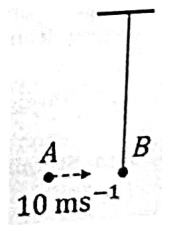
Correct: option 3, 5
In a head-on elastic collision between equal masses the velocities are exchanged, so stops and moves off at . Energy conservation for the bob gives m, which is less than the string length, so the bob simply swings up to that height. Option (3).
The kinetic energies of two similar cars A and B are 100 J and 225 J respectively. On applying brakes, car A stops after 1000 m and car B stops after 1500 m. If and are the forces applied by the brakes on cars A and B, respectively, then the ratio is
Correct: option 2,
By the work-energy theorem the braking force times the stopping distance equals the kinetic energy lost, so . N and N. The ratio is , option (2).
A bob of heavy mass is suspended by a light string of length . The bob is given a horizontal velocity as shown in figure. If the string gets slack at some point making an angle from the horizontal, the ratio of the speed of the bob at point to its initial speed is:
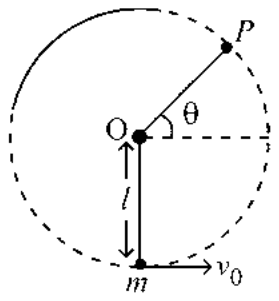
Correct: option 4,
At P the tension is zero, so the component of gravity along the string alone gives the centripetal force: , so . P is at a height above the lowest point, so energy conservation gives . Dividing, , option (4).
At any instant of time , the displacement of any particle is given by (SI unit) under the influence of force of 5N. The value of instantaneous power is (in SI unit):
Correct: option 2, 10
The velocity is . Instantaneous power is W, option (2).
Two bodies A and B of same mass undergo completely inelastic one dimensional collision. The body A moves with velocity while body B is at rest before collision. The velocity of the system after collision is . The ratio is:
Correct: option 3, 2:1
In a completely inelastic collision the bodies move together. Momentum is conserved: , so and , option (3).
An object moving along horizontal x-direction with kinetic energy 10 J is displaced through m by the force N. The kinetic energy of the object at the end of the displacement is
Correct: option 3, 4 J
Work done by the force is J. By the work-energy theorem the final kinetic energy is J.
An object falls from a height of 10 m above the ground. After striking the ground it loses 50% of its kinetic energy. The height upto which the object can rebounce from the ground is:
Correct: option 4, 5 m
Just before impact the kinetic energy is . Half of it is lost, so the object leaves the ground with , which carries it to a height where , that is m.
The potential energy of a long spring when stretched by 2 cm is U. If the spring is stretched by 8 cm, potential energy stored in it will be:
Correct: option 4, 16U
The energy stored in a spring is , proportional to . The stretch becomes 4 times, so the energy becomes times, that is 16U, option (4).
A particle moves with a velocity horizontally under the action of constant force . The instantaneous power supplied to the particle is:
Correct: option 2, 140 W
Instantaneous power is .
A bullet of mass hits a block of mass elastically. The transfer of energy is the maximum, when
Correct: option 3,
In a head-on elastic collision with a body at rest, the fraction of kinetic energy transferred is . This is largest, equal to 1, when : the bullet stops and the block moves off with all of its energy.
The energy that will be ideally radiated by a 100 kW transmitter in 1 hour is:
Correct: option 2, J
Energy = power time J, option (2).
An electric lift with a maximum load of 2000 kg (lift + passengers) is moving up with a constant speed of . The frictional force opposing the motion is 3000 N. The minimum power delivered by the motor to the lift in watts is: ()
Correct: option 4, 34500
At constant speed the motor must supply a force equal to weight plus friction: N. Power W, option (4).
Water falls from a height of 60 m at the rate of 15 kg/s to operate a turbine. The losses due to frictional force are 10% of the input energy. How much power is generated by the turbine? ()
Correct: option 2, 8.1 kW
Input power W. With 10% lost, the power generated is W kW.
A particle is released from height S from the surface of the Earth. At a certain height its kinetic energy is three times its potential energy. The height from the surface of earth and the speed of the particle at that instant are respectively:
Correct: option 4,
Total energy is . At height h, gives , so and . Then , so .
Body A of mass 4m moving with speed collides with another body B of mass 2m, at rest. The collision is head on and elastic in nature. After the collision the fraction of energy lost by the colliding body A is:
Correct: option 2,
In a head-on elastic collision with a body at rest, the fraction of kinetic energy transferred is . Check: A moves on with , keeping of its energy, so it loses .
A force acts on a particle in -direction where F is in newton and in meter. Work done by this force to move the particle from to m is:
Correct: option 3, 25 J
J.
A particle of mass at rest suddenly breaks on its own into three fragments. Two fragments of mass each move along mutually perpendicular direction with speed each. The energy released during the process is,
Correct: option 2,
The two small fragments have total momentum . The third fragment of mass must carry equal and opposite momentum, so its speed is . Energy released = total kinetic energy .
An object of mass 500 g, initially at rest, is acted upon by a variable force whose X-component varies with X in the manner shown. The velocities of the object at the points m and m, would have the respective values of (nearly)
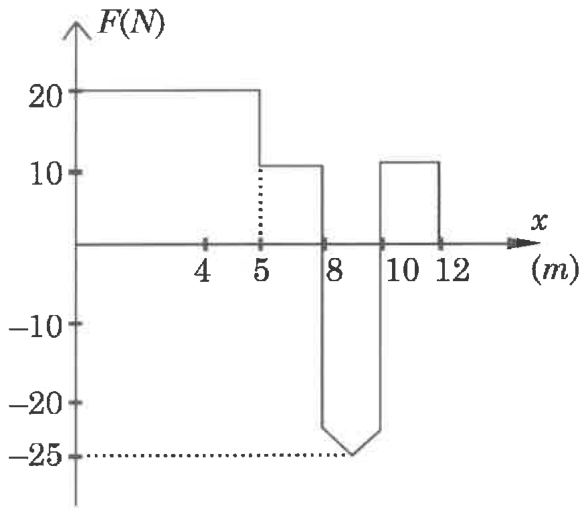
Correct: option 1, 23 m/s and 20.6 m/s
Work done is the area under the F-x graph and equals the gain in kinetic energy. Up to 8 m: J, so and m/s. From 8 m to 10 m the area is J and from 10 m to 12 m it is J, so the total is 105 J and m/s, nearest to 20.6 m/s.
A body initially at rest and sliding along a frictionless track from a height h (as shown in the figure) just completes a vertical circle of diameter AB = D. The height h is equal to
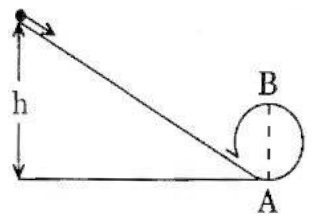
Correct: option 4,
To just complete the circle of radius the speed at the lowest point A must be . Energy conservation gives , so .
A moving block having mass m, collides with another stationary block having mass 4m. The lighter block comes to rest after collision. When the initial velocity of the lighter block is v, then the value of coefficient of restitution (e) will be
Correct: option 2, 0.25
Momentum conservation: , so the heavier block moves off at . Then .
Consider a drop of rain water having mass 1 g falling from a height of 1 km. It hits the ground with a speed of 50 m/s. Take 'g' constant with a value . The work done by the (i) gravitational force and the (ii) resistive force of air is:
Correct: option 4, (i) 10 J (ii) J
Work by gravity: J. The gain in kinetic energy is J. By the work-energy theorem J, so J.
A particle of mass 10 g moves along a circle of radius 6.4 cm with a constant tangential acceleration. What is the magnitude of this acceleration if the kinetic energy of the particle becomes equal to J by the end of the second revolution after the beginning of the motion?
Correct: option 1,
Only the tangential force does work, so with m. Then .
What is the minimum velocity with which a body of mass must enter a vertical loop of radius R so that it can complete the loop?
Correct: option 4,
At the top the least speed is given by , so . Energy conservation from the bottom to the top, a height , gives , so .
A body of mass 1 kg begins to move under the action of a time dependent force N, where and are unit vectors along x and y axis. What power will be developed by the force at the time t?
Correct: option 4, W
With mass 1 kg, , and starting from rest . Power W.
A bullet of mass 10 g moving horizontally with a velocity of strikes a wooden block of mass 2 kg which is suspended by a light inextensible string of length 5 m. As a result, the centre of gravity of the block is found to rise a vertical distance of 10 cm. The speed of the bullet after it emerges out horizontally from the block will be
Correct: option 3,
The block rises 0.1 m, so just after the bullet passes its speed is . Momentum is conserved during the impact: , so and , option (3).
Two identical balls and having velocities of 0.5 m/s and m/s respectively collide elastically in one dimension. The velocities of and after the collision respectively will be
Correct: option 2, 0.5 m/s and m/s
In a one-dimensional elastic collision between equal masses the two bodies simply exchange velocities. So after the collision moves with 0.5 m/s and with m/s. In the order asked ( first, then ) this is option (2).
A particle moves from a point to when a force of N is applied. How much work has been done by the force?
Correct: option 3, 5 J
The displacement is . Work J, option (3).
Two particles of masses , move with initial velocities and . On collision, one of the particles get excited to higher level, after absorbing energy . If final velocities of particles be and then we must have:
Correct: option 2,
Total energy is conserved. Part of the initial kinetic energy, an amount , is stored as excitation energy of one particle, so the kinetic energy left after the collision is the initial kinetic energy minus : . That is option (2); options (3) and (4) are not even dimensionally consistent.
A block of mass 10 kg, moving in x direction with a constant speed of , is subjected to a retarding force F = 0.1 x J/m during its travel from x = 20 m to 30 m. Its final KE will be:
Correct: option 4, 475 J
The initial kinetic energy is . The retarding force (in newton, with x in metre) removes energy . By the work-energy theorem the final kinetic energy is , option (4).
Two similar springs P and Q have spring constants and , such that . They are stretched, first by the same amount (case a), then by the same force (case b). The work done by the springs and are related as, in case (a) and case (b), respectively:
Correct: option 2, ;
Case (a), same extension x: is proportional to K, so the stiffer spring stores more and . Case (b), same force F: the extension is , so is inversely proportional to K, and . This is option (2).
A particle of mass m is driven by a machine that delivers a constant power k watts. If the particle starts from rest the force on the particle at time t is:
Correct: option 4,
At constant power all the work goes into kinetic energy: , so . Power is also , so . This is option (4).
A ball is thrown vertically downwards from a height of 20 m with an initial velocity . It collides with the ground, loses 50 percent of its energy in collision and rebounds to the same height. The initial velocity is: (Take )
Correct: option 3,
Energy just before hitting the ground is . Half of it is left after the collision and that must carry the ball back up to height h: . So and .
On a frictionless surface, a block of mass M moving at speed collides elastically with another block of same mass M which is initially at rest. After collision the first block moves at an angle to its initial direction and has a speed . The second block's speed after the collision is:
Correct: option 2,
In an elastic collision kinetic energy is conserved: . So and .
A body of mass (4m) is lying in x-y plane at rest. It suddenly explodes into three pieces. Two pieces, each of mass (m) move perpendicular to each other with equal speeds (). The total kinetic energy generated due to explosion is:
Correct: option 3,
The two pieces of mass have a combined momentum . Momentum is conserved, so the third piece of mass carries the same momentum the other way and moves at . Total kinetic energy , option (3).
A uniform force of newton acts on a particle of mass 2 kg. Hence the particle is displaced from position meter to position meter. The work done by the force on the particle is:
Correct: option 4, 9 J
The displacement is m. Work is the dot product of force and displacement: .
A particle with total energy E is moving in a potential energy regions U(x). Motion of the particle is restricted to the region when:
Correct: option 4,
Kinetic energy is and cannot be negative, so the particle can only be found where ; it cannot enter a region where . On that reasoning the allowed region is the one in option (3). The source's answer key gives option (4), , which is the region the particle is kept out of; the key's answer is recorded here.
One coolie takes 1 minute to raise a suitcase through a height of 2 m but the second coolie takes 30 s to raise the same suitcase to the same height. The powers of two coolies are in the ratio:
Correct: option 4,
Both do the same work , so power is inversely proportional to the time taken: .
The potential energy of particle in a force field is , where A and B are positive constants and r is the distance of particle from the centre of the field. For stable equilibrium, the distance of the particle is:
Correct: option 2, 2A / B
At equilibrium the force is zero: , which gives . There , so the energy is a minimum and the equilibrium is stable.
Two spheres A and B of masses and respectively collide. A is at rest initially and B is moving with velocity v along x-axis. After collision B has a velocity in a direction perpendicular to the original direction. The mass A moves after collision in the direction.
Correct: option 4, to the x-axis
Momentum is conserved along each axis. Along x: , since B has no x-velocity afterwards. Along y: , so . For A, , so it moves at to the x-axis, on the side opposite to B's new velocity.
A car of mass m starts from rest and accelerates so that the instantaneous power delivered to the car has a constant magnitude . The instantaneous velocity of this car is proportional to:
Correct: option 2,
With constant power, the work done in time t equals the kinetic energy gained from rest: . So , which is proportional to .
The potential energy of a system increases if work is done:
Correct: option 4, upon the system by a conservative force
Potential energy is defined only for conservative forces, with , so non-conservative forces (options 1 and 3) cannot be the cause. The answer key used for this paper gives option (4). Note that by the potential energy rises when the conservative force does negative work, that is, when work is done against it (as in lifting a body against gravity), which is the wording of option (2).
Force F on a particle moving in a straight line varies with distance d as shown in the figure. The work done on the particle during its displacement of 12 m is:
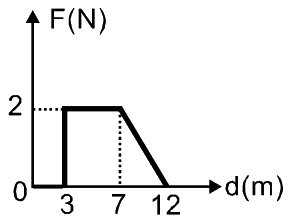
Correct: option 4, 13 J
Work is the area under the force-distance graph. The force is zero up to 3 m, 2 N from 3 m to 7 m (area J), and falls evenly to zero from 7 m to 12 m (area J). Total work J.
A mass m moving horizontally (along the x-axis) with velocity v collides and sticks to mass of 3m moving vertically upward (along the y-axis) with velocity 2v. The final velocity of the combination is:
Correct: option 1,
Momentum is conserved in the collision and the combined mass is 4m. Along x: , so . Along y: , so . The final velocity is .
A particle of mass M, starting from rest, undergoes uniform acceleration. If the speed acquired in time T is V, the power delivered to the particle is
Correct: option 4,
By the work-energy theorem the work done on the particle in time T equals its gain in kinetic energy, . The power delivered over this time is the work divided by the time, .
A ball moving with velocity 2 m/s collides head on with another stationary ball of double the mass. If the coefficient of restitution is 0.5, then their velocities (in m/s) after collision will be
Correct: option 1, 0, 1
Let the masses be m and 2m. Momentum conservation gives , so . The coefficient of restitution gives . Solving the two equations, and m/s.
An engine pumps water through a hose pipe. Water passes through the pipe and leaves it with a velocity of 2 m/s. The mass per unit length of water in the pipe is 100 kg/m. What is the power of the engine?
Correct: option 4, 800 W
The mass of water leaving per second is kg/s. The keyed answer takes the force as the rate of change of momentum, N, and the power as W. (Counting only the kinetic energy given to the water each second, , would give 400 W; the key uses .)
An engine pumps water continuously through a hose. Water leaves the hose with a velocity v and m is the mass per unit length of the water jet. What is the rate at which kinetic energy is imparted to water?
Correct: option 4,
In one second a length of the jet leaves the hose, so the mass leaving per second is . Each unit of mass carries kinetic energy , so the kinetic energy given per second is .
A body of mass 1 kg is thrown upwards with a velocity 20 m/s. It momentarily comes to rest after attaining a height of 18 m. How much energy is lost due to air friction? ()
Correct: option 4, 20 J
The initial kinetic energy is J. At the top the body has only potential energy J. The difference, J, is lost to air friction.
A block of mass M is attached to the lower end of a vertical spring. The spring is hung from a ceiling and has force constant value k. The mass is released from rest with the spring initially unstretched. The maximum extension produced in the length of the spring will be:
Correct: option 4,
At the lowest point the block is momentarily at rest, so the gravitational energy lost equals the energy stored in the spring: , giving , option (1). is the extension at the equilibrium position, about which the block oscillates. The answer key available for this paper marks option (4), , and that is the answer recorded here; the working above does not support it as the maximum extension.
Water falls from a height of 60 m at the rate of 15 kg/s to operate a turbine. The losses due to frictional forces are 10% of energy. How much power is generated by the turbine? ()
Correct: option 2, 8.1 kW
Potential energy lost by the water each second is W. Ten per cent is lost to friction, so the turbine delivers kW.
A shell of mass 200 gm is ejected from a gun of mass 4 kg by an explosion that generates 1.05 kJ of energy. The initial velocity of the shell is
Correct: option 2,
Momentum is conserved, so the gun recoils with speed . The explosion energy becomes kinetic energy of both: . Hence and .
A vertical spring with force constant K is fixed on a table. A ball of mass m at a height h above the free upper end of the spring falls vertically on the spring so that the spring is compressed by a distance d. The net work done in the process is
Correct: option 3,
The ball falls through a total height , so gravity does work . The spring force opposes the compression and does work . The net work is , option (3).
The potential energy of a long spring when stretched by 2 cm is U. If the spring is stretched by 8 cm the potential energy stored in it is:-
Correct: option 3, 16U
The energy stored in a spring is , proportional to the square of the extension. The extension becomes 4 times as large, so the energy becomes times, that is .
A body of mass 3 kg is under a constant force which causes a displacement s in metres in it, given by the relation , where t is in seconds. Work done by the force in 2 seconds is:-
Correct: option 3,
Differentiating twice, the acceleration is , so the force is . In 2 s the displacement is . Work done .
300 J of work is done in sliding a 2 kg block up an inclined plane of height 10 m. Taking , work done against friction is
Correct: option 2, 100 J
The work done against gravity is . The rest of the 300 J goes against friction: .
A force F acting on an object varies with distance x as shown here.
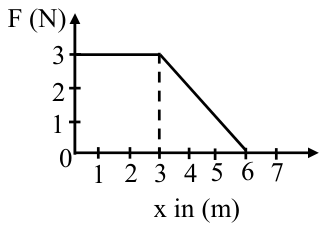
The force is in N and x in m. The work done by the force in moving the object from x = 0 to x = 6 m is
Correct: option 2, 13.5 J
Work is the area under the F–x graph. From x = 0 to 3 m the force is constant at 3 N, giving ; from 3 m to 6 m it falls linearly to zero, giving . Total work is 13.5 J.
A particle of mass is moving with a velocity and another particle of mass is moving with a velocity . Both of them have the same momentum but their different kinetic energies are and respectively. If then:
Correct: option 4,
Kinetic energy in terms of momentum is . For the same , , so the heavier particle has the smaller kinetic energy: .
A stone is tied to a string of length '' and is whirled in a vertical circle with the other end of the string as the centre. At a certain instant of time, the stone is at its lowest position and has a speed 'u'. The magnitude of the change in velocity as it reaches a position where the string is horizontal (g being acceleration due to gravity) is:-
Correct: option 4,
The stone rises a height , so by energy conservation its speed there is given by . At the lowest point the velocity is horizontal and at the horizontal-string position it is vertical, so the two velocities are perpendicular and .
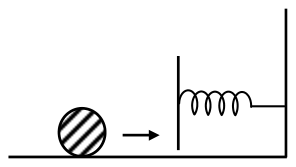
A mass of 0.5 kg moving with a speed of 1.5 m/s on a horizontal smooth surface, collides with a nearly weightless spring of force constant k = 50 N/m. The maximum compression of the spring would be:-
Correct: option 4, 0.15 m
At maximum compression all the kinetic energy is stored in the spring: . So m.
A ball of mass 2 kg and another of mass 4 kg are dropped together from a 60 feet tall building. After a fall of 30 feet each towards earth, their respective kinetic energies will be in the ratio of-
Correct: option 2,
Both balls fall the same height and reach the same speed, so each has kinetic energy , proportional to its mass. The ratio is .
A stationary particle explodes into two particles of masses and which move in opposite directions with velocities and . The ratio of their kinetic energies is:
Correct: option 1,
The total momentum stays zero, so the two fragments have momenta of equal magnitude . Since kinetic energy is , for equal it is inversely proportional to mass, giving .
When a long spring is stretched by 2 cm, its potential energy is U. If the spring is stretched by 10 cm, the potential energy stored in it will be:
Correct: option 4, 25 U
The energy stored in a spring is , proportional to the square of the stretch. The stretch becomes 5 times larger, so the energy becomes times, that is 25 U.
If kinetic energy of a body is increased by 300% then percentage change in momentum will be
Correct: option 1, 100%
An increase of 300% makes the kinetic energy 4 times its first value. Since , the momentum becomes times, which is an increase of 100%.
A child is sitting on a swing. Its minimum and maximum heights from the ground is 0.75 m and 2 m respectively, its maximum speed will be
Correct: option 2, 5 m/s
The speed is greatest at the lowest point. By conservation of energy, , so m/s.
Two springs A and B having spring constant and . () are stretched by applying force of equal magnitude. If energy stored in spring A is E then energy stored in B will be:
Correct: option 1, 2E
With the same force , the extension is and the energy stored is , which is inversely proportional to . Since , spring B stores twice the energy, .
250 N force is required to raise 75 kg mass from a pulley. If rope is pulled 12 m then the load is lifted to 3m, the efficiency of pulley system will be:
Correct: option 3, 75%
Work put in J. Useful work done on the load J (taking m/s). Efficiency .
A man is slipping on a frictionless inclined plane & a bag falls down from the same height. Then the speed of both is related as:
Correct: option 3,
With no friction, mechanical energy is conserved for both. Each loses the same height , so each reaches the bottom with speed , whatever the path. Hence .
The bob of simple pendulum having length , is displaced from mean position to an angular position with respect to vertical. If it is released, then velocity of bob at lowest position:
Correct: option 1,
At angle the bob is higher than the lowest point by . Energy conservation gives , so .
If N and m/s, then instantaneous power is:
Correct: option 2, 45 watt
Instantaneous power watt.
The K.E. of a person is just half of K.E. of a boy whose mass is just half of that person. If person increases its speed by 1 m/s, then its K.E. equals to that of boy then initial speed of person was -
Correct: option 1, m/s
Let the person have mass and speed , and the boy mass and speed . First condition: , so . Second condition: , so and m/s.
Two springs A and B () are stretched by same suspended weights then ratio of workdone in stretching is -
Correct: option 1, 1 : 2
For the same stretching force , the extension is and the work done is , so . Hence .
When a spring is subjected to 4N force its length is a metre and if 5N is applied length is b metre. If 9N is applied its length is:
Correct: option 3, 5b – 4a
Let the natural length be and the spring constant . Then and . Subtracting, , and then . For 9 N the length is .
If , then work done in first 4s. will be (Mass of the particle is 3 gram):
Correct: option 1, 384 mJ
The velocity is , which is 0 at and at . By the work-energy theorem the work done equals the gain in kinetic energy: .
Two identical balls A and B are moving with velocity and respectively. They collide head on elastically then their velocities after collision will be:
Correct: option 1, &
In a head-on elastic collision between equal masses, momentum and kinetic energy are both conserved only if the two bodies exchange velocities. So A leaves with and B with .
A ball is dropped from a height of 5 m, if it rebound upto height of 1.8 m, then the ratio of velocities of the ball after and before rebound is:
Correct: option 1,
The speed on reaching or leaving the ground is , so the ratio of the speed after rebound to the speed before is .