Questions with solutions
Question 1NEET 2026, Q9
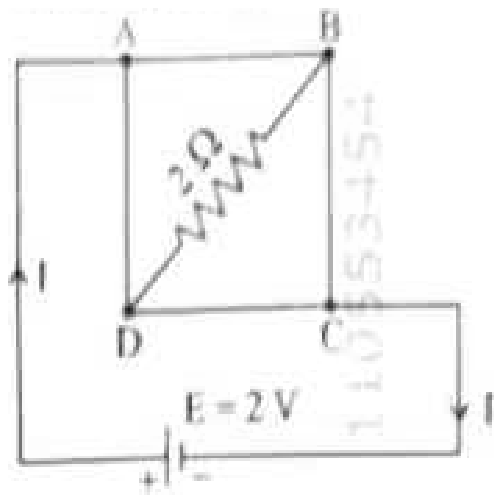
A uniform metallic wire having resistance is bent to form a square loop (ABCD) (see figure). A resistance of is connected between points B and D and a battery of is connected across points A and C as shown in the figure. Now the value of current (I) is:
- 1
- 2
- 3
- 4
Show answer and solution
Correct: option 1,
Each side of the square has resistance . Between A and C the network is a balanced Wheatstone bridge (AB/BC = AD/DC), so B and D are at the same potential and the resistor carries no current. That leaves two paths (ABC and ADC) in parallel, giving . Hence .
Question 2NEET 2026, Q16
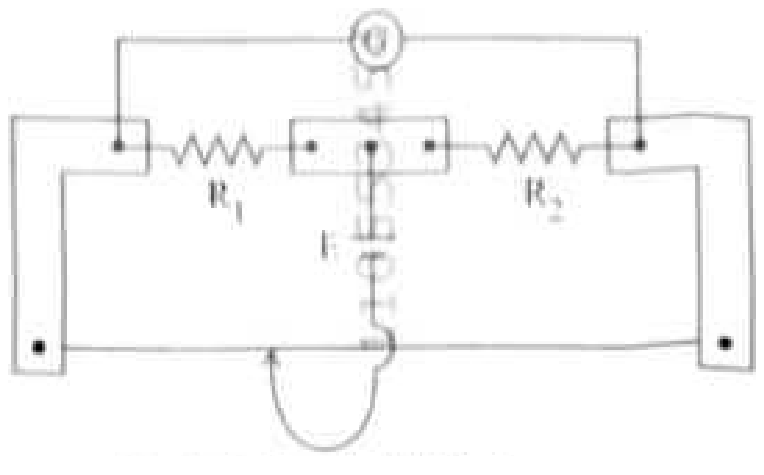
In a metre bridge experiment (see figure), the positions of the cell, E, and galvanometer, G, are interchanged. We shall observe in the galvanometer:
- 1Only the right-sided deflection
- 2Only the left-sided deflection
- 3There will be no deflection irrespective of the position of the jockey
- 4Both right-sided and left-sided deflection and at balance point, no deflection
Show answer and solution
Correct: option 4, Both right-sided and left-sided deflection and at balance point, no deflection
A metre bridge is a Wheatstone bridge, and the balance condition of a Wheatstone bridge is unchanged when the cell and the galvanometer are interchanged. So the bridge still works: the galvanometer deflects to one side when the jockey is on one side of the balance point, to the other side beyond it, and shows no deflection at the balance point.
Question 3NEET 2026, Q26
A resistor is connected to a battery of emf and internal resistance . If the current in the circuit is , the terminal voltage of the battery is:
- 1
- 2
- 3
- 4
Show answer and solution
Correct: option 2,
Terminal voltage .
Question 4NEET 2026, Q29
A room heater is rated , . If the supply voltage drops to , what will be the power consumed (approximately)?
- 1
- 2
- 3
- 4
Show answer and solution
Correct: option 2,
The resistance of the heater is fixed, so varies as . .
Question 5NEET 2026 Re-exam, Q36
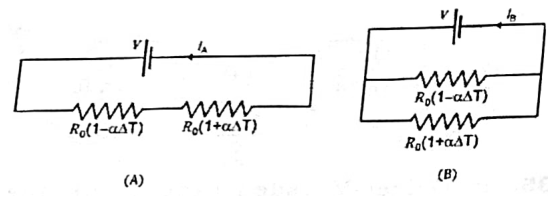
Consider two circuits, (A) and (B), each having two resistors. One of them has a positive temperature coefficient of resistance, , while the other one has a negative temperature of coefficient, , as shown in the figure. The current through these circuits are denoted by and . At initial temperature, the resistance of the two resistors is . As the temperature is increased, the correct option that describes the variation of current in these circuits is:
- 1 remains constant while increases
- 2 decreases while increases
- 3 increases while decreases
- 4both and remain constant
Show answer and solution
Correct: option 1, remains constant while increases
In circuit (A) the resistors are in series: , which does not change, so stays constant. In circuit (B) they are in parallel: , which falls as the temperature rises, so increases. This is option (1).
Question 6NEET 2025, Q6
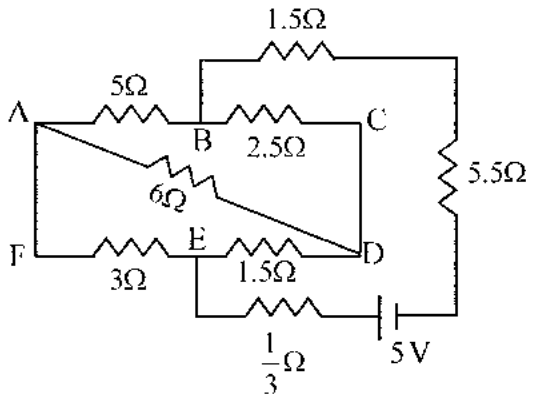
The current passing through the battery in the given circuit, is:
- 12.0 A
- 20.5 A
- 32.5 A
- 41.5 A
Show answer and solution
Correct: option 2, 0.5 A
Current enters the network at B and leaves at E. Between them the (BA), (AE, through F), (BD, through C) and (DE) resistors form a Wheatstone bridge with the resistor across A and D. Since the bridge is balanced and the carries no current, so the network is . The total resistance is , so the current is A, option (2).
Question 7NEET 2025, Q33
A wire of resistance R is cut into 8 equal pieces. From these pieces two equivalent resistances are made by adding four of these together in parallel. Then these two sets are added in series. The net effective resistance of the combination is:
- 1
- 2
- 3
- 4
Show answer and solution
Correct: option 3,
Each piece has resistance . Four of them in parallel give . Two such sets in series give , option (3).
Question 8NEET 2025, Q36
A constant voltage of 50 V is maintained between the points A and B of the circuit shown in the figure. The current through the branch CD of the circuit is:
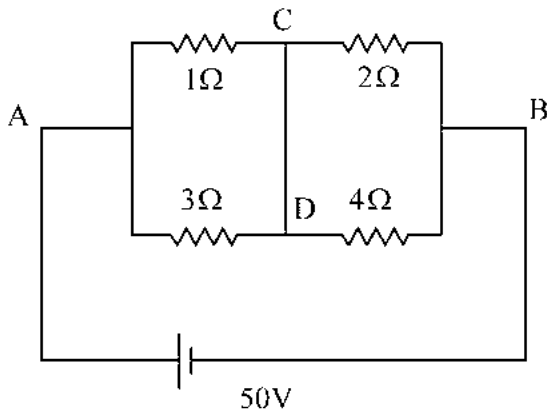
- 11.5 A
- 22.0 A
- 32.5 A
- 43.0 A
Show answer and solution
Correct: option 2, 2.0 A
The wire CD joins C and D, so the and are in parallel () and so are the and (). The total resistance is and the total current is A. It splits as 18 A in the and 6 A in the , and then as 16 A in the and 8 A in the . At C, 18 A arrives and 16 A leaves through the , so A flows along CD, option (2).
Question 9NEET 2024, Q9
A wire of length '' and resistance is divided into 10 equal parts. The first 5 parts are connected in series while the next 5 parts are connected in parallel. The two combinations are again connected in series. The resistance of this final combination is:
- 1
- 2
- 3
- 4
Show answer and solution
Correct: option 3,
Each part has resistance . Five in series give and five in parallel give . The two groups in series give , option (3).
Question 10NEET 2024, Q18
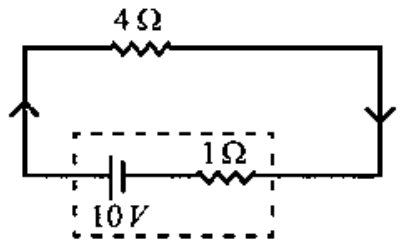
The terminal voltage of the battery, whose emf is and internal resistance , when connected through an external resistance of as shown in the figure is:
- 1
- 2
- 3
- 4
Show answer and solution
Correct: option 4,
The current is A. The terminal voltage is V (the same as ), option (4).
Question 11NEET 2024, Q39
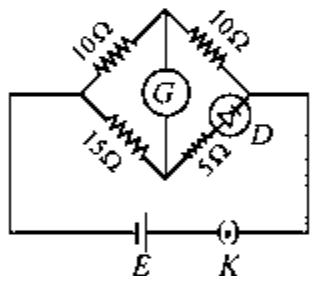
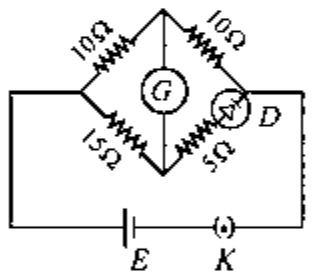
Choose the correct circuit which can achieve the bridge balance.
- 1
- 2
- 3
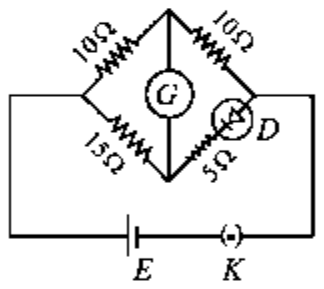
- 4
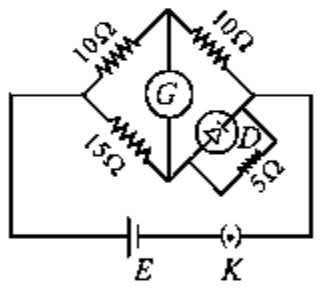
Show answer and solution
Correct: option 2
For balance the arms must satisfy , so the fourth arm must be . The resistor alone is too small, so the diode has to add the missing . That is possible only when the diode is in series with the resistor and forward biased, so that it conducts and its resistance adds to . A reverse biased diode blocks the arm, and a diode in parallel with the resistor makes the arm less than . The official key gives circuit (2).
Question 12NEET 2024, Q40
Two heaters A and B have power rating of 1 kW and 2 kW, respectively. Those two are first connected in series and then in parallel to a fixed power source. The ratio of power outputs for these two cases is:
- 12 : 3
- 21 : 1
- 32 : 9
- 41 : 2
Show answer and solution
Correct: option 3, 2 : 9
For the same supply voltage , so and (with power in kW). In series the power is kW. In parallel each heater gives its rated power, kW. The ratio is , option (3).
Question 13NEET 2024 Re-exam, Q12
A uniform wire of diameter carries a current of 100 mA when the mean drift velocity of electrons in the wire is . For a wire of diameter of the same material to carry a current of 200 mA, the mean drift velocity of electrons in the wire is
- 1
- 2
- 3
- 4
Show answer and solution
Correct: option 2,
, so for the same material. Halving the diameter makes the area one quarter, and the current is doubled, so the drift velocity becomes times, that is .
Question 14NEET 2024 Re-exam, Q21
A uniform metal wire of length has 10 Ω resistance. Now this wire is stretched to a length and then bent to form a perfect circle. The equivalent resistance across any arbitrary diameter of that circle is:
- 110 Ω
- 25 Ω
- 340 Ω
- 420 Ω
Show answer and solution
Correct: option 1, 10 Ω
Stretching keeps the volume fixed, so doubling the length halves the area and becomes four times: . Across a diameter the circle is two halves of each in parallel, giving .
Question 15NEET 2024 Re-exam, Q46
The given circuit shows a uniform straight wire AB of 40 cm length fixed at both ends. In order to get zero reading in the galvanometer G, the free end of J is to be placed from B at:
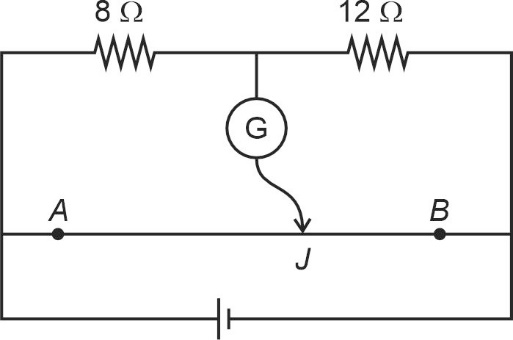
- 132 cm
- 28 cm
- 316 cm
- 424 cm
Show answer and solution
Correct: option 4, 24 cm
This is a balanced Wheatstone (metre bridge) arrangement: the galvanometer reads zero when , because the wire is uniform. With cm, cm and cm. So J is 24 cm from B.
Question 16NEET 2024 Re-exam, Q50
The steady state current in the circuit shown below is:
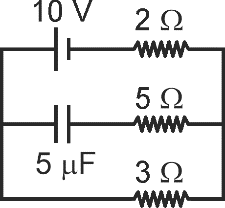
- 10.67 A
- 21.5 A
- 32 A
- 41 A
Show answer and solution
Correct: option 3, 2 A
In the steady state the capacitor is fully charged and carries no current, so the middle branch (5 μF with 5 Ω) can be ignored. The 10 V cell then drives current through the 2 Ω and 3 Ω resistors in series: A.
Question 17NEET 2023, Q7
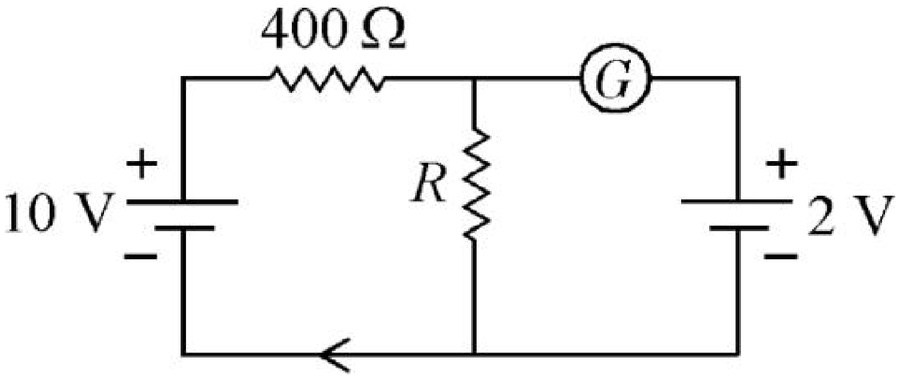
If the galvanometer does not show any deflection in the circuit shown, the value of is given by:
- 1
- 2
- 3
- 4
Show answer and solution
Correct: option 3,
No current flows through the galvanometer, so the potential difference across equals the 2 V of the right-hand cell. The remaining V drops across the resistor, giving a current of A through both resistors. Hence , option (3).
Question 18NEET 2023, Q11
Resistance of a carbon resistor determined from colour codes is . The colour of third band must be:
- 1Red
- 2Green
- 3Orange
- 4Yellow
Show answer and solution
Correct: option 3, Orange
. The first two bands give the digits 2 and 2 (red, red) and the third band gives the multiplier , whose colour is orange. So the answer is option (3).
Question 19NEET 2023, Q33
The magnitude and direction of the current in the following circuit is
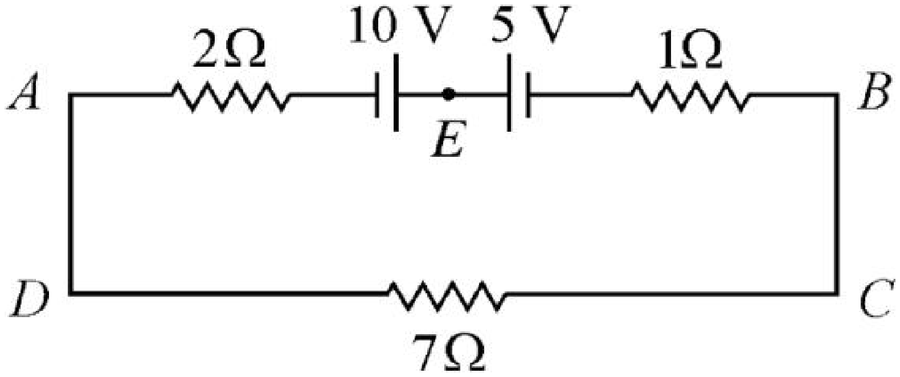
- 10.2 A from to through
- 20.5 A from to through
- 3 A from to through
- 41.5 A from to through
Show answer and solution
Correct: option 2, 0.5 A from to through
The two cells are connected in opposition, so the net emf is V, and the total resistance of the single loop is . The current is A, driven by the stronger 10 V cell from to through , option (2).
Question 20NEET 2023, Q44
10 resistors, each of resistance are connected in series to a battery of emf and negligible internal resistance. Then those are connected in parallel to the same battery, the current is increased times. The value of is:
- 110
- 2100
- 31
- 41000
Show answer and solution
Correct: option 2, 100
In series the resistance is and the current is . In parallel the resistance is and the current is . The ratio is , option (2).
Question 21NEET 2023, Q48
The resistance of platinum wire at C is and at C. The temperature coefficient of resistance of the wire is:
- 1
- 2
- 3
- 4
Show answer and solution
Correct: option 3,
, so , option (3).
Question 22NEET 2023 Manipur, Q6
A certain wire A has resistance . The resistance of another wire B of same material and equal length but of diameter thrice the diameter of A will be
- 1
- 2
- 3
- 4
Show answer and solution
Correct: option 4,
and , so for the same material and length . Tripling the diameter makes the area 9 times larger, so .
Question 23NEET 2023 Manipur, Q41
A copper wire of radius 1 mm contains free electrons per cubic metre. The drift velocity for free electrons when 10 A current flows through the wire will be (Given, charge on electron )
- 1
- 2
- 3
- 4
Show answer and solution
Correct: option 4,
with . .
Question 24NEET 2023 Manipur, Q44
The emf of a cell having internal resistance is balanced against a length of 330 cm on a potentiometer wire. When an external resistance of is connected across the cell, the balancing length will be
- 1115 cm
- 2332 cm
- 3220 cm
- 4330 cm
Show answer and solution
Correct: option 3, 220 cm
The balancing length is proportional to the potential difference across the cell. On open circuit this is the emf , balanced at 330 cm. With connected, the terminal voltage is , so the new length is cm.
Question 25NEET 2022, Q1
Two resistors of resistance, and are connected in parallel in an electrical circuit. The ratio of the thermal energy developed in to that in in a given time is:
- 1
- 2
- 3
- 4
Show answer and solution
Correct: option 3,
Resistors in parallel have the same voltage across them, so the heat produced in time is , which is inversely proportional to . Hence , option (3).
Question 26NEET 2022, Q4
As the temperature increases, the electrical resistance:
- 1decreases for conductors but increases for semiconductors
- 2increases for both conductors and semiconductors
- 3decreases for both conductors and semiconductors
- 4increases for conductors but decreases for semiconductors
Show answer and solution
Correct: option 4, increases for conductors but decreases for semiconductors
In a conductor, heating makes the ions vibrate more, the electrons collide more often and the resistance rises. In a semiconductor, heating frees many more charge carriers, and this outweighs the extra collisions, so the resistance falls. Option (4) states both correctly.
Question 27NEET 2022, Q17
A copper wire of length 10 m and radius m has electrical resistance of . The current density in the wire for an electric field strength of 10 (V/m) is:
- 1
- 2
- 3
- 4
Show answer and solution
Correct: option 1,
Area . Resistivity . Current density , option (1).
Question 28NEET 2022, Q46
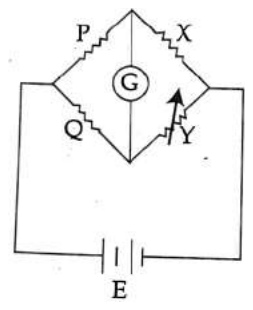
A wheatstone bridge is used to determine the value of unknown resistance X by adjusting the variable resistance Y as shown in the figure. For the most precise measurement of X, the resistances P and Q:
- 1do not play any significant role
- 2should be approximately equal to 2X
- 3should be approximately equal and are small
- 4should be very large and unequal
Show answer and solution
Correct: option 3, should be approximately equal and are small
A Wheatstone bridge is most sensitive when all four arms have resistances of the same order, so that a small imbalance sends a noticeable current through the galvanometer. P and Q should therefore be nearly equal, and small so that the currents (and the galvanometer deflection for a given imbalance) are large. This is option (3).
Question 29NEET 2022 Re-exam, Q4
The reciprocal of resistance is:
- 1conductance
- 2reactance
- 3mobility
- 4conductivity
Show answer and solution
Correct: option 1, conductance
Conductance is defined as , measured in siemens. Conductivity is the reciprocal of resistivity, not of resistance; reactance is the opposition offered by an inductor or capacitor to ac, and mobility is drift speed per unit electric field. So option (1).
Question 30NEET 2022 Re-exam, Q15
A cell of emf 4 V and internal resistance is connected to a external resistance. The terminal potential difference of the cell is
- 10.375 V
- 23.75 V
- 34.25 V
- 44 V
Show answer and solution
Correct: option 2, 3.75 V
Current A. Terminal potential difference V (equivalently ), option (2).
Question 31NEET 2022 Re-exam, Q24
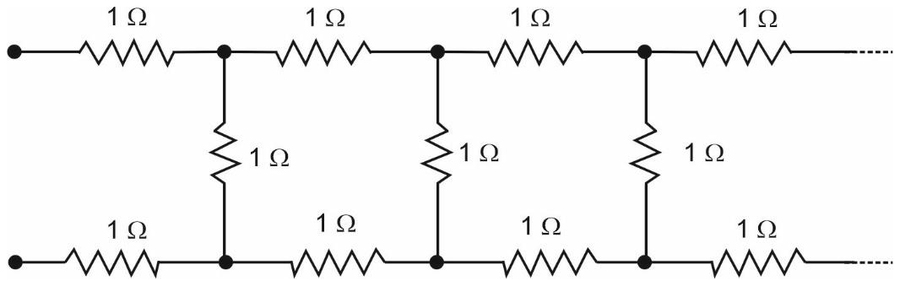
The equivalent resistance of the infinite network given below is:
- 1
- 2
- 3
- 4
Show answer and solution
Correct: option 4,
Let the equivalent resistance be . Removing the first section (two series resistors and one across) leaves the same infinite network, so . This gives , so (taking the positive root), option (4).
Question 32NEET 2022 Re-exam, Q50
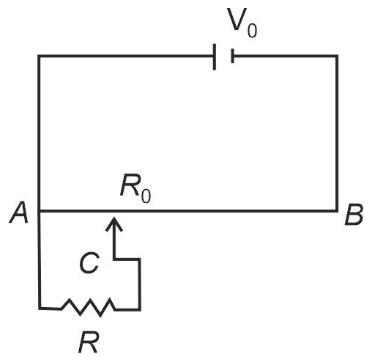
The sliding contact is at one fourth of the length of the potentiometer wire () from as shown in the circuit diagram. If the resistance of the wire is , then the potential drop (V) across the resistor is
- 1
- 2
- 3
- 4
Show answer and solution
Correct: option 2,
Part of the wire has resistance and is in parallel with : . This is in series with part , of resistance . The drop across is , option (2).
Question 33NEET 2021, Q12
Column - I gives certain physical terms associated with flow of current through a metallic conductor. Column - II gives some mathematical relations involving electrical quantities. Match Column - I and Column - II with appropriate relations.
| Column - I | Column - II |
|---|
| (A) Drift Velocity | (P) |
| (B) Electrical Resistivity | (Q) |
| (C) Relaxation Period | (R) |
| (D) Current Density | (S) |
- 1A-R, B-S, C-P, D-Q
- 2A-R, B-S, C-Q, D-P
- 3A-R, B-P, C-S, D-Q
- 4A-R, B-Q, C-S, D-P
Show answer and solution
Correct: option 1, A-R, B-S, C-P, D-Q
Drift velocity is (R). Resistivity is defined by , so (S). From the relaxation period is (P). Current density is (Q).
Question 34NEET 2021, Q18
The effective resistance of a parallel connection that consists of four wires of equal length, equal area of cross-section and same material is 0.25 . What will be the effective resistance if they are connected in series?
- 10.25
- 20.5
- 31
- 44
Show answer and solution
Correct: option 4, 4
The four wires are identical, each of resistance R. In parallel , so . In series the total is .
Question 35NEET 2021, Q19
In a potentiometer circuit a cell of EMF 1.5 V gives balance point at 36 cm length of wire. If another cell of EMF 2.5 V replaces the first cell, then at what length of the wire, the balance point occurs?
- 160 cm
- 221.6 cm
- 364 cm
- 462 cm
Show answer and solution
Correct: option 1, 60 cm
The balancing length is proportional to the EMF: . So cm.
Question 36NEET 2021, Q38
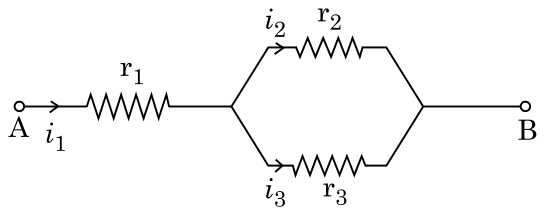
Three resistors having resistances , and are connected as shown in the given circuit. The ratio of currents in terms of resistances used in the circuit is:
- 1
- 2
- 3
- 4
Show answer and solution
Correct: option 2,
The current splits between the parallel resistors and , which have the same potential difference: with . So and the ratio is .
Question 37NEET 2020, Q143
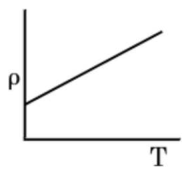
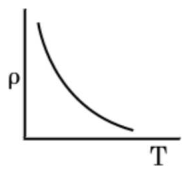
Which of the following graph represents the variation of resistivity () with temperature (T) for copper?
- 1
- 2
- 3
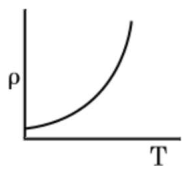
- 4
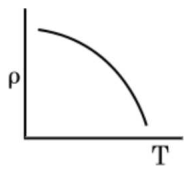
Show answer and solution
Correct: option 3
Copper is a metal, so its resistivity rises as the temperature rises, which rules out the two falling curves. The resistivity does not fall to zero at low temperature: it starts from a small finite value, rises slowly at first and then more steeply, being nearly linear only over a limited range near room temperature. The curve that starts at a small value and bends upwards, graph (3), shows this.
Question 38NEET 2020, Q152
A resistance wire connected in the left gap of a metre bridge balances a resistance in the right gap at a point which divides the bridge wire in the ratio 3 : 2. If the length of the resistance wire is 1.5 m, then the length of of the resistance wire is:
- 1
- 2
- 3
- 4
Show answer and solution
Correct: option 2,
At balance the resistances are in the ratio of the two parts of the bridge wire: , so . This is the resistance of 1.5 m of the wire, so corresponds to .
Question 39NEET 2020, Q166
The color code of a resistance is given below:
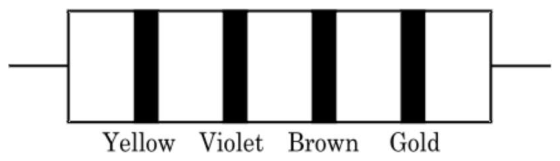
The values of resistance and tolerance, respectively, are:
- 1, 5%
- 2, 10%
- 3, 5%
- 4, 5%
Show answer and solution
Correct: option 4, , 5%
The first two bands give the digits: yellow is 4 and violet is 7, making 47. The third band is the multiplier: brown is . The fourth band, gold, is a tolerance of 5%. So the resistance is with 5% tolerance.
Question 40NEET 2020, Q169
A charged particle having drift velocity of in an electric field of , has a mobility in of:
- 1
- 2
- 3
- 4
Show answer and solution
Correct: option 2,
Mobility is the drift velocity per unit electric field: .
Question 41NEET 2020, Q171
The solids which have the negative temperature coefficient of resistance are:
- 1metals
- 2insulators only
- 3semiconductors only
- 4insulators and semiconductors
Show answer and solution
Correct: option 4, insulators and semiconductors
A negative temperature coefficient means the resistance falls as the temperature rises. In metals the resistance rises with temperature because the electrons collide more often. In both semiconductors and insulators, heating frees more charge carriers across the energy gap, and this outweighs the extra collisions, so their resistance falls. Hence insulators and semiconductors.
Question 42NEET 2020 Phase 2, Q100
The equivalent resistance between A and B for the mesh shown in the figure is
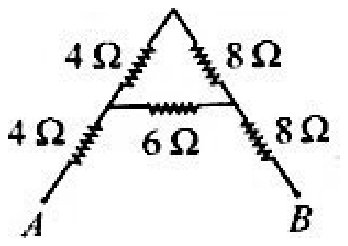
- 1
- 2
- 3
- 4
Show answer and solution
Correct: option 1,
The upper and meet at the top and are in series, giving ; this is in parallel with the across the middle: . That is in series with the lower and arms, so .
Question 43NEET 2020 Phase 2, Q104
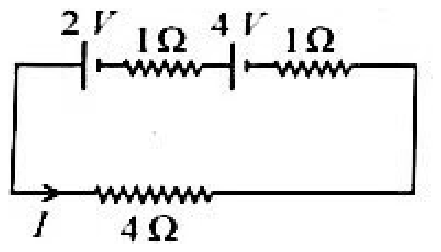
For the circuit shown in the figure, the current I will be
- 11 A
- 21.5 A
- 30.5 A
- 40.75 A
Show answer and solution
Correct: option 1, 1 A
The two cells are connected in series so that their emfs add: . The three resistors are in series in the single loop: . So .
Question 44NEET 2020 Phase 2, Q107
Two solid conductors are made up of same material, have same length and same resistance. One of them has a circular cross section of area and the other one has a square cross section of area . The ratio is
- 11
- 20.8
- 32
- 41.5
Show answer and solution
Correct: option 1, 1
depends on the area of the cross-section, not on its shape. Since , and are the same for both conductors, the areas must be equal, so .
Question 45NEET 2020 Phase 2, Q121
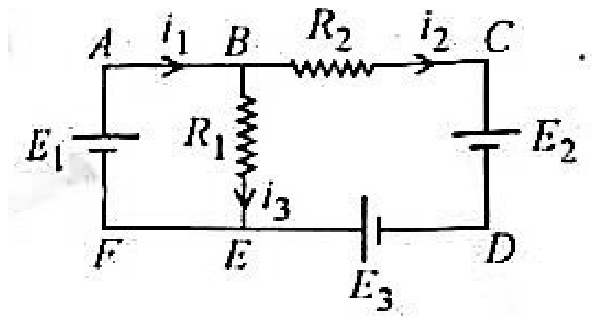
For the circuit given below, the Kirchhoff's loop rule for the loop BCDEB is given by the equation
- 1
- 2
- 3
- 4
Show answer and solution
Correct: option 1,
Go round the loop B to C to D to E to B and add the changes in potential. From B to C along through : . From C to D through , from its positive plate to its negative plate: . From D to E through , from negative to positive: . From E to B against through : . So , which is the same as .
Question 46NEET 2019, Q17
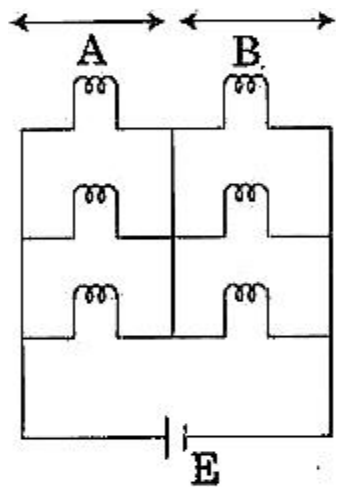
Six similar bulbs are connected as shown in the figure with a DC source of emf E, and zero internal resistance.
The ratio of power consumption by the bulbs when (i) all are glowing and (ii) in the situation when two from section A and one from section B are glowing, will be:
- 14 : 9
- 29 : 4
- 31 : 2
- 42 : 1
Show answer and solution
Correct: option 2, 9 : 4
Each section has three bulbs (resistance R each) in parallel, and the two sections are in series. (i) All glowing: . (ii) Two in A and one in B: . Since , .
Question 47NEET 2019, Q23
Which of the following acts as a circuit protection device?
- 1conductor
- 2inductor
- 3switch
- 4fuse
Show answer and solution
Correct: option 4, fuse
A fuse is a thin wire of low melting point placed in series with the circuit. When the current exceeds the safe value the wire melts and breaks the circuit, protecting the appliances. A conductor, an inductor and a switch do not do this.
Question 48NEET 2019, Q24
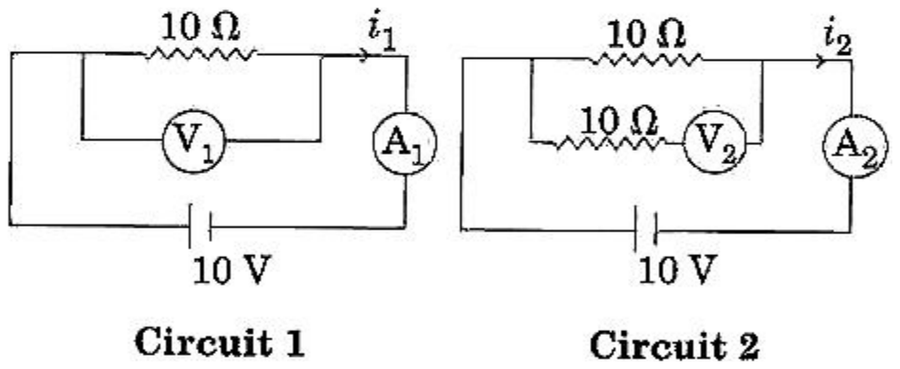
In the circuits shown below, the readings of the voltmeters and the ammeters will be:
- 1 and
- 2 and
- 3 and
- 4 and
Show answer and solution
Correct: option 3, and
An ideal voltmeter has infinite resistance, so no current flows through the voltmeter branch in either circuit; the extra in series with changes nothing. In both circuits the current is A through the resistor and the voltmeter reads the full 10 V across it. So and .
Question 49NEET 2019 Odisha, Q41
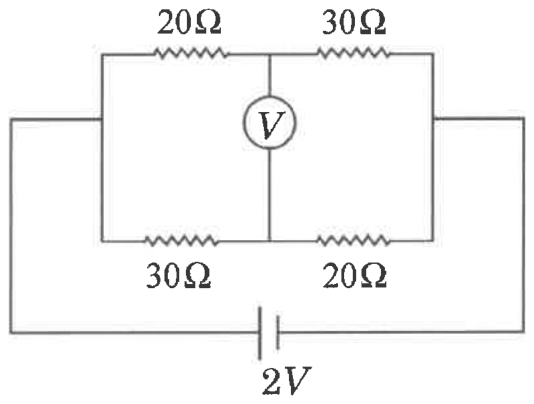
The reading of an ideal voltmeter in the circuit shown is,
- 10.5 V
- 20.4 V
- 30.6 V
- 40 V
Show answer and solution
Correct: option 2, 0.4 V
An ideal voltmeter draws no current, so each branch is simply 50 ohm across 2 V and carries A. In the upper branch the drop across the 20 ohm resistor is 0.8 V; in the lower branch the drop across the 30 ohm resistor is 1.2 V. The two midpoints therefore differ by V, which is the reading.
Question 50NEET 2019 Odisha, Q42
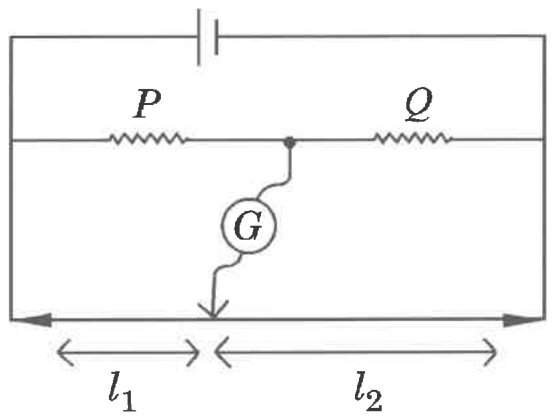
The metre bridge shown is in balance position with . If we now interchange the positions of galvanometer and cell, will the bridge work? If yes, what will be balance condition?
- 1yes,
- 2yes,
- 3yes,
- 4no, no null point
Show answer and solution
Correct: option 2, yes,
A metre bridge is a Wheatstone bridge, and in a Wheatstone bridge the cell and the galvanometer arms are conjugate: interchanging them does not disturb the balance. The bridge still works and the balance condition stays .
Question 51NEET 2018, Q5
A carbon resistor of is to be marked with rings of different colours for its identification. The colour code sequence will be
- 1Yellow – Green – Violet – Gold
- 2Yellow – Violet – Orange – Silver
- 3Violet – Yellow – Orange – Silver
- 4Green – Orange – Violet – Gold
Show answer and solution
Correct: option 2, Yellow – Violet – Orange – Silver
, so the digits are 4 (yellow) and 7 (violet) and the multiplier is orange. The tolerance is , which is silver. The sequence is Yellow – Violet – Orange – Silver.
Question 52NEET 2018, Q6
A set of 'n' equal resistors, of value 'R' each, are connected in series to a battery of emf 'E' and internal resistance 'R'. The current drawn is I. Now, the 'n' resistors are connected in parallel to the same battery. Then the current drawn from battery becomes 10 I. The value of 'n' is
- 120
- 211
- 310
- 49
Show answer and solution
Correct: option 3, 10
In series . In parallel . Dividing, , so .
Question 53NEET 2018, Q7
A battery consists of a variable number 'n' of identical cells (having internal resistance 'r' each) which are connected in series. The terminals of the battery are short-circuited and the current I is measured. Which of the graphs shows the correct relationship between I and n ?
- 1
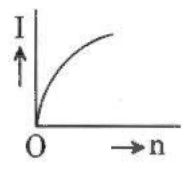
- 2
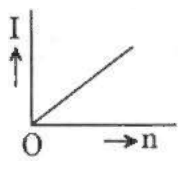
- 3
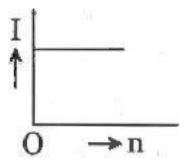
- 4
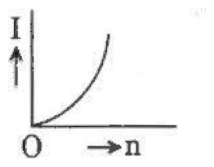
Show answer and solution
Correct: option 3
With n cells in series the total emf is and the total internal resistance is . On short circuit , which does not depend on n. The graph is a horizontal straight line, which is option (3).
Question 54NEET 2017, Q1
A potentiometer is an accurate and versatile device to make electrical measurements of E.M.F. because the method involves
- 1cells
- 2potential gradients
- 3a condition of no current flow through the galvanometer
- 4a combination of cells, galvanometer and resistances
Show answer and solution
Correct: option 3, a condition of no current flow through the galvanometer
A potentiometer is balanced at the null point, where no current flows through the galvanometer. So no current is drawn from the cell being measured, there is no drop across its internal resistance, and the reading is the true EMF. That null condition is what makes the method accurate.
Question 55NEET 2017, Q45
The resistance of a wire is 'R' ohm. If it is melted and stretched to 'n' times its original length, its new resistance will be:
- 1nR
- 2
- 3
- 4
Show answer and solution
Correct: option 3,
The volume of the wire stays the same, so when the length becomes n times, the cross-section becomes times. Since , the new resistance is .
Question 56NEET 2016 Phase 1, Q14
The charge flowing through a resistance R varies with time t as , where a and b are positive constants. The total heat produced in R is:
- 1
- 2
- 3
- 4
Show answer and solution
Correct: option 1,
The current is , which falls to zero at . The heat is .
Question 57NEET 2016 Phase 1, Q31
A potentiometer wire is 100 cm long and a constant potential difference is maintained across it. Two cells are connected in series first to support one another and then in opposite direction. The balance points are obtained at 50 cm and 10 cm from the positive end of the wire in the two cases. The ratio of emf's is:
- 15 : 1
- 25 : 4
- 33 : 4
- 43 : 2
Show answer and solution
Correct: option 4, 3 : 2
The balancing length is proportional to the emf, so . This gives , so .
Question 58NEET 2016 Phase 2, Q25
The potential difference between the points and in the given figure is

- 1 V
- 2 V
- 3 V
- 4 V
Show answer and solution
Correct: option 4, V
Go from to along the current of 2 A. The potential drops by V across the 2 resistor, by 3 V across the cell (it is entered at its positive terminal and left at its negative terminal), and by V across the 1 resistor. So V, option (4).
Question 59NEET 2016 Phase 2, Q26
A filament bulb (500 W, 100 V) is to be used in a 230 V main supply. When a resistance is connected in series, it works perfectly and the bulb consumes 500 W. The value of is
- 1230
- 246
- 326
- 413
Show answer and solution
Correct: option 3, 26
To work at its rating the bulb needs 100 V across it and a current A. The series resistance must drop the remaining V at the same current, so , option (3).
Question 60AIPMT 2015, Q143
Across a metallic conductor of non-uniform cross section a constant potential difference is applied. The quantity which remains constant along the conductor is:
- 1current
- 2drift velocity
- 3electric field
- 4current density
Show answer and solution
Correct: option 1, current
Charge cannot pile up anywhere in a steady state, so the same current passes through every cross section of the conductor. Current density , electric field and drift velocity all change wherever the area A changes. Only the current stays the same, option (1).
Question 61AIPMT 2015, Q145
A potentiometer wire has length 4 m and resistance . The resistance that must be connected in series with the wire and an accumulator of e.m.f. 2V, so as to get a potential gradient 1 mV per cm on the wire is:
- 1
- 2
- 3
- 4
Show answer and solution
Correct: option 4,
A gradient of 1 mV per cm over 400 cm means 0.4 V must drop across the wire. The current in the wire is then . The total resistance of the circuit must be , so the series resistance is , option (4).
Question 62AIPMT 2015, Q174
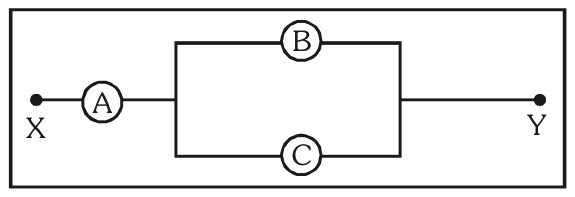
A, B and C are voltmeters of resistance R, 1.5 R and 3R respectively as shown in the figure. When some potential difference is applied between X and Y, the voltmeter readings are , and respectively. Then:
- 1
- 2
- 3
- 4
Show answer and solution
Correct: option 4,
B and C are in parallel, so they read the same voltage, . Their combined resistance is , the same as the resistance of A, which is in series with the pair. Equal resistances in series share the voltage equally, so equals the voltage across the pair. Hence , option (4).
Question 63AIPMT 2015 Re-test, Q141
A potentiometer wire of length L and a resistance r are connected in series with a battery of e.m.f. and a resistance . An unknown e.m.f. E is balanced at a length of the potentiometer wire. The e.m.f. E will be given by:
- 1
- 2
- 3
- 4
Show answer and solution
Correct: option 3,
Current in the wire is , so the potential drop across the whole wire is and the drop per unit length is . At balance the unknown e.m.f. equals the drop across length : .
Question 64AIPMT 2015 Re-test, Q159
Two metal wires of identical dimensions are connected in series. If and are the conductivities of the metal wires respectively, the effective conductivity of the combination is:
- 1
- 2
- 3
- 4
Show answer and solution
Correct: option 2,
Each wire has length l and area A, so its resistance is . In series the resistances add, and the combination is a wire of length 2l and area A: . Hence and .
Question 65AIPMT 2015 Re-test, Q175
A circuit contains an ammeter, a battery of 30 V and a resistance 40.8 ohm all connected in series. If the ammeter has a coil of resistance 480 ohm and a shunt of 20 ohm, the reading in the ammeter will be:
- 11 A
- 20.5 A
- 30.25 A
- 42 A
Show answer and solution
Correct: option 2, 0.5 A
The coil and its shunt are in parallel, so the ammeter's resistance is . Total resistance . The ammeter reads the total circuit current, .
Question 66AIPMT 2014, Q92
Two cities are 150 km apart. Electric power is sent from one city to another city through copper wires. The fall of potential per km is 8 volt and the average resistance per km is . The power loss in the wire is:
- 112.2 kW
- 219.2 W
- 319.2 kW
- 419.2 J
Show answer and solution
Correct: option 3, 19.2 kW
Total potential drop and total resistance . Power lost , which is option (3).
Question 67AIPMT 2014, Q98
A potentiometer circuit has been set up for finding the internal resistance of a given cell. The main battery, used across the potentiometer wire, has an emf of 2.0 V and a negligible internal resistance. The potentiometer wire itself is 4 m long. When the resistance, R, connected across the given cell, has values of.
(i) infinity
(ii) ,
the 'balancing lengths', on the potentiometer wire are found to be 3 m and 2.85 m, respectively.
The value of internal resistance of the cell is:
- 1
- 2
- 3
- 4
Show answer and solution
Correct: option 4,
With R infinite the balancing length measures the emf; with the length measures the terminal voltage. The internal resistance is , option (4).
Question 68AIPMT 2014, Q102
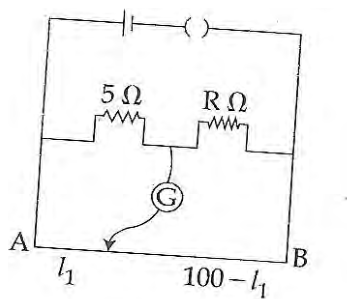
The resistances in the two arms of the meter bridge are and , respectively. When the resistance R is shunted with an equal resistance, the new balance point is at . The resistance 'R', is:
- 1
- 2
- 3
- 4
Show answer and solution
Correct: option 3,
At first balance . With R shunted by an equal resistance the arm becomes , so . Dividing, , which gives . Then , option (3).
Question 69NEET 2013, Q146
A wire of resistance 4 is stretched to twice its original length. The resistance of stretched wire would be:
- 14
- 28
- 316
- 42
Show answer and solution
Correct: option 3, 16
The volume of the wire stays fixed, so doubling the length halves the area of cross-section. Since , the resistance becomes times, that is .
Question 70NEET 2013, Q161
The internal resistance of a 2.1 V cell which gives a current of 0.2 A through a resistance of 10 is:
- 10.5
- 20.8
- 31.0
- 40.2
Show answer and solution
Correct: option 1, 0.5
From , the total resistance is . Subtracting the external leaves an internal resistance of .
Question 71NEET 2013, Q165
The resistances of the four arms P, Q, R and S in a Wheatstone's bridge are 10 ohm, 30 ohm, 30 ohm and 90 ohm, respectively. The e.m.f. and internal resistance of the cell are 7 Volt and 5 ohm respectively. If the galvanometer resistance is 50 ohm, the current drawn from the cell will be:
- 10.2 A
- 20.1 A
- 32.0 A
- 41.0 A
Show answer and solution
Correct: option 1, 0.2 A
Since , the bridge is balanced and no current flows in the galvanometer, so it can be ignored. The two branches are and in parallel, giving . The current is A.
Question 72NEET 2013 Karnataka, Q137
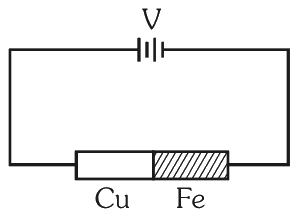
Two rods are joined end to end, as shown. Both have a cross-sectional area of . Each is 1 meter long. One rod is of copper with a resistivity of ohm-centimeter, the other is of iron with a resistivity of ohm-centimeter.
How much voltage is required to produce a current of 1 ampere in the rods?
- 1
- 2
- 3
- 4
Show answer and solution
Correct: option 4,
Use with and . Copper: . Iron: . The rods are in series, so and .
Question 73NEET 2013 Karnataka, Q171
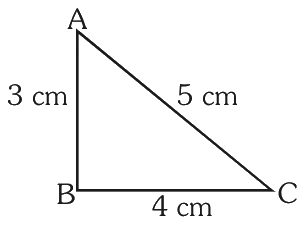
A 12 cm wire is given a shape of a right angled triangle ABC having sides 3 cm, 4 cm and 5 cm, as shown in the figure. The resistance between two ends (AB, BC, CA) of the respective sides are measured one by one by a multi-meter. The resistances will be in the ratio:
- 1
- 2
- 3
- 4
Show answer and solution
Correct: option 2,
Resistance is proportional to length, so the sides have resistances , and . Across any side, that side is in parallel with the other two in series. , , , giving the ratio .
Question 74NEET 2013 Karnataka, Q176
Ten identical cells connected in series are needed to heat a wire of length one meter and radius 'r' by 10° C in time 't'. How many cells will be required to heat the wire of length two meter of the same radius by the same temperature in time 't'?
- 120
- 230
- 340
- 410
Show answer and solution
Correct: option 1, 20
A wire twice as long has twice the mass, so it needs twice the heat, and it has twice the resistance. With cells of emf : and . Dividing, , so .
Question 75AIPMT 2012 Prelims, Q25
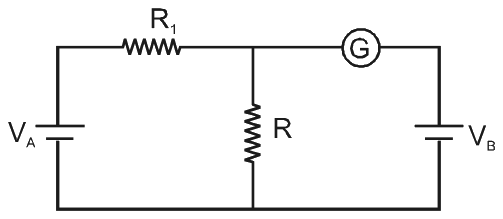
In the circuit shown the cells A and B have negligible resistances. For , and the galvanometer (G) shows no deflection. The value of is:
- 14 V
- 22 V
- 312 V
- 46 V
Show answer and solution
Correct: option 2, 2 V
No current passes through the galvanometer, so cell A alone drives a current through and R in series. The potential difference across R is , and for zero deflection must equal it, so .
Question 76AIPMT 2012 Prelims, Q39
If voltage across a bulb rated 220 Volt - 100 Watt drops by 2.5% of its rated value, the percentage of the rated value by which the power would decrease is:
- 120%
- 22.5%
- 35%
- 410%
Show answer and solution
Correct: option 3, 5%
Taking the resistance of the bulb as constant, , so for a small change .
Question 77AIPMT 2012 Prelims, Q50
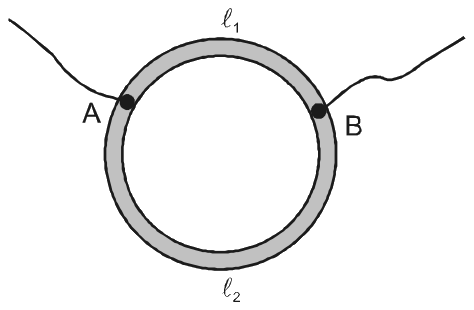
A ring is made of a wire having a resistance . Find the points A and B as shown in the figure, at which a current carrying conductor should be connected so that the resistance R of the sub circuit between these points is equal to .
- 1
- 2
- 3
- 4
Show answer and solution
Correct: option 4,
The two arcs are resistances and in parallel, with . Then gives , so the arcs are and . Resistance is proportional to length, so .
Question 78AIPMT 2012 Mains, Q16
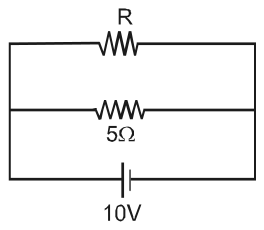
The power dissipated in the circuit shown in the figure is 30 Watts. The value of R is:
- 1
- 2
- 3
- 4
Show answer and solution
Correct: option 3,
R and the resistor are in parallel across the 10 V cell, so each has 10 V across it. The resistor dissipates W, leaving 10 W for R. Then gives .
Question 79AIPMT 2012 Mains, Q17
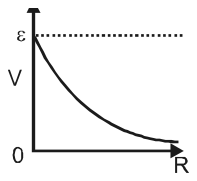
Cell having an emf and internal resistance r is connected across a variable external resistance R. As the resistance R is increased, the plot of potential difference V across R is given by:
- 1
- 2
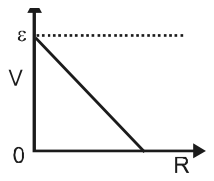
- 3
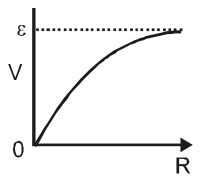
- 4
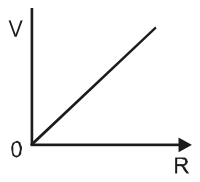
Show answer and solution
Correct: option 3
The current is , so . V is zero at , rises as R increases, and levels off towards for very large R. That is the rising, saturating curve of option (3).
Question 80AIPMT 2011 Prelims, Q182
A current of 2A flows through a resistor when connected across a battery. The same battery supplies a current of 0.5 A when connected across a resistor. The internal resistance of the battery is:
- 1
- 2
- 3
- 4
Show answer and solution
Correct: option 2,
With emf and internal resistance : and . Equating, , so and .
Question 81AIPMT 2011 Prelims, Q184
If power dissipated in the resistor in the circuit shown is 36 Watt, the potential difference across the resistor is
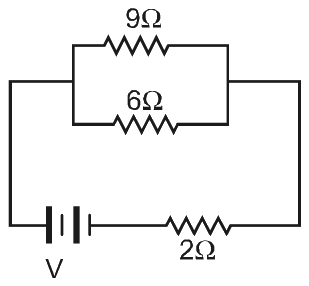
- 14 Volt
- 28 Volt
- 310 Volt
- 42 Volt
Show answer and solution
Correct: option 3, 10 Volt
For the resistor , so and V. The resistor is in parallel with it and has the same 18 V. Currents: A and A, a total of 5 A, all of which flows through the resistor. Its potential difference is V.
Question 82AIPMT 2011 Prelims, Q197
The rate of increase of thermo-e.m.f. with temperature at the neutral temperature of a thermocouple:
- 1is positive
- 2is zero
- 3depends upon the choice of the two materials of the thermocouple.
- 4is negative
Show answer and solution
Correct: option 2, is zero
The thermo-emf varies with temperature as , a parabola that reaches its maximum at the neutral temperature. At a maximum the slope is zero.
Question 83AIPMT 2011 Mains, Q94
A galvanometer of resistance, G is shunted by a resistance S ohm. To keep the main current in the circuit unchanged, the resistance to be put in series with the galvanometer is:
- 1
- 2
- 3
- 4
Show answer and solution
Correct: option 3,
The main current stays the same only if the total resistance stays equal to G. The shunted galvanometer has resistance , so the series resistance needed is .
Question 84AIPMT 2011 Mains, Q96
A thermocouple of negligible resistance produces an e.m.f. of 40 μV/°C in the linear range of temperature. A galvanometer of resistance 10 ohm whose sensitivity is 1 μA/div, is employed with the thermocouple. The smallest value of temperature difference that can be detected by the system will be:
- 10.5°C
- 21°C
- 30.1°C
- 40.25°C
Show answer and solution
Correct: option 4, 0.25°C
The smallest current the galvanometer can show is one division, 1 μA. Through 10 ohm this needs an e.m.f. of . At 40 μV per °C this corresponds to °C.
Question 85AIPMT 2011 Mains, Q118
In the circuit shown in the figure, if potential at point A is taken to be zero the potential at point B is:
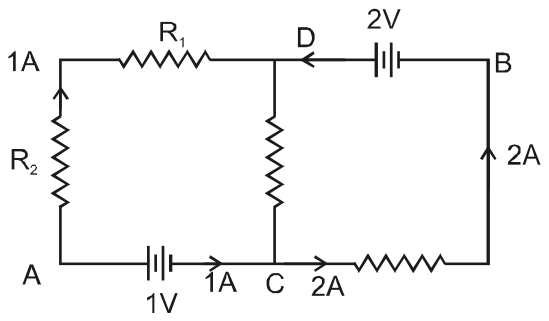
- 1-1V
- 2+ 2V
- 3- 2V
- 4+ 1V
Show answer and solution
Correct: option 4, + 1V
By the junction rule at C, 1 A arrives from A and 2 A leaves towards B, so 1 A flows from D to C through the middle resistor. The source copy does not print the value of that resistor; in the original paper it is 2 Ω. Going from A, the 1 V cell raises the potential to V. The 2 Ω resistor then gives V, and across the 2 V cell V.
Question 86AIPMT 2010 Mains, Q24
The thermo e.m.f. E in volts of a certain thermocouple is found to vary with temperature difference in °C between the two junctions according to the relation
The neutral temperature for the thermo-couple will be
- 1450°C
- 2400°C
- 3225°C
- 430°C
Show answer and solution
Correct: option 3, 225°C
The neutral temperature is where the thermo e.m.f. is a maximum, so . Differentiating, , which gives °C.
Question 87AIPMT 2010 Prelims, Q24
A potentiometer circuit is set up as shown. The potential gradient, across the potentiometer wire, is k volt/cm and the ammeter, present in the circuit reads 1.0 A when two way key is switched off. The balance points, when the key between the terminals (i) 1 and 2 (ii) 1 and 3, is plugged in, are found to be at length cm and cm respectively. The magnitudes, of the resistors R and X, in ohms, are then, equal, respectively, to
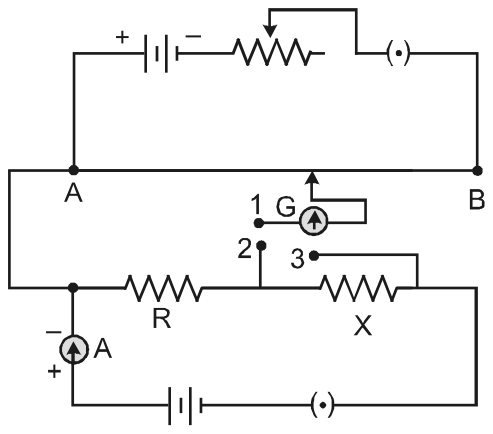
- 1 and
- 2 and
- 3 and
- 4 and
Show answer and solution
Correct: option 2, and
A current of 1 A flows through R and X in series. With the key between 1 and 2 the potentiometer balances the potential difference across R alone: , so . With the key between 1 and 3 it balances the potential difference across R and X together: , so .
Question 88AIPMT 2010 Prelims, Q32
In producing chlorine by electrolysis 100 kW power at 125 V is being consumed. How much chlorine per minute is liberated (E.C.E. of chlorine is kg/C)
- 1 kg
- 2 kg
- 3 kg
- 4 kg
Show answer and solution
Correct: option 3, kg
The current is A. By Faraday's first law the mass liberated is kg in one minute.
Question 89AIPMT 2010 Prelims, Q49
Consider the following two statements.
(A) Kirchhoff's junction law follows from the conservation of charge
(B) Kirchhoff's loop law follows from the conservation of energy
Which of the following is correct?
- 1Both (A) and (B) are wrong
- 2(A) is correct and (B) is wrong
- 3(A) is wrong and (B) is correct
- 4Both (A) and (B) are correct
Show answer and solution
Correct: option 4, Both (A) and (B) are correct
The junction law says the currents entering a junction equal the currents leaving it; charge cannot pile up or vanish there, so it is conservation of charge. The loop law says the potential changes round a closed loop add to zero; a charge taken round the loop gains no net energy, so it is conservation of energy. Both statements are correct.
Question 90AIPMT 2009 Prelims, Q6
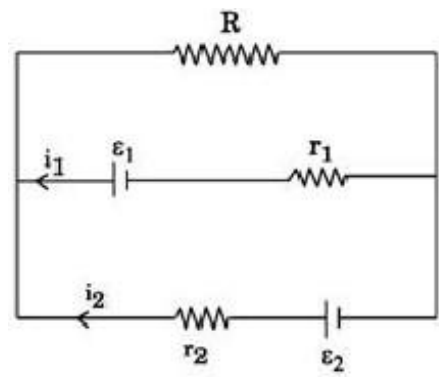
See the electric circuit shown in this Figure. Which of the following equations is a correct equation for it?
- 1
- 2
- 3
- 4
Show answer and solution
Correct: option 4,
The currents and meet at the left junction, so flows through . Going round the loop made of the branch and in the direction of the current, the cell raises the potential by and there are drops of across and across . Kirchhoff's loop rule gives .
Question 91AIPMT 2009 Prelims, Q22
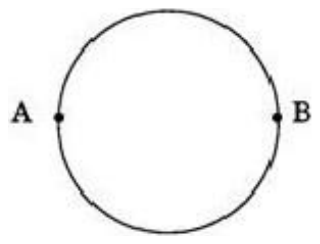
A wire of resistance 12 ohms per meter is bent to form a complete circle of radius 10 cm. The resistance between its two diametrically opposite points, A and B as shown in the Figure, is:
- 1
- 2
- 3
- 4
Show answer and solution
Correct: option 1,
The wire has length m, so its resistance is . Between A and B the two halves, each , are in parallel, which works out to , option (4). The answer key available for this paper marks option (1), , and that is the answer recorded here; the working above does not support it.
Question 92AIPMT 2009 Prelims, Q33
A student measures the terminal potential difference (V) of a cell (of emf and internal resistance r) as a function of the current (I) flowing through it. The slope, and intercept, of the graph between V and I, then, respectively, equal:
- 1 and
- 2 and
- 3 and
- 4 and
Show answer and solution
Correct: option 1, and
For a cell delivering current, . Compared with the straight line with on the y axis and on the x axis, the slope is and the intercept on the V axis is .
Question 93AIPMT 2009 Prelims, Q46
The mean free path of electrons in a metal is m. The electric field which can give on an average 2 eV energy to an electron in the metal will be in units of V/m:
- 1
- 2
- 3
- 4
Show answer and solution
Correct: option 3,
Between collisions an electron travels one mean free path and gains energy . For this to be 2 eV the potential drop over that distance must be 2 V: V/m.
Question 94AIPMT 2008 Prelims, Q28
A cell can be balanced against 110 cm and 100 cm of potentiometer wire, respectively with and without being short circuited through a resistance of . Its internal resistance is
- 1Zero
- 21.0 ohm
- 30.5 ohm
- 42.0 ohm
Show answer and solution
Correct: option 2, 1.0 ohm
The balance length is proportional to the potential difference across the cell. On open circuit this is the emf (the longer length, cm); with the resistance across the cell it is the smaller terminal voltage ( cm). Then ohm.
Question 95AIPMT 2008 Prelims, Q29
A wire of a certain material is stretched slowly by ten per cent. Its new resistance and specific resistance become respectively
- 11.1 times, 1.1 times
- 21.2 times, 1.1 times
- 31.21 times, same
- 4Both remain the same
Show answer and solution
Correct: option 3, 1.21 times, same
Specific resistance (resistivity) depends only on the material, so it stays the same. The volume of the wire is fixed, so when the length becomes the area becomes , and becomes times.
Question 96AIPMT 2008 Prelims, Q30
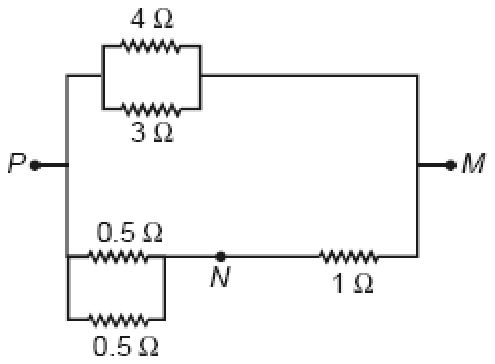
In the circuit shown, the current through the resistor is 1 amp when the points P and M are connected to a d.c. voltage source. The potential difference between the points M and N is
- 13.2 volt
- 21.5 volt
- 31.0 volt
- 40.5 volt
Show answer and solution
Correct: option 1, 3.2 volt
The resistor is connected directly between P and M, so V. The lower branch is the two resistors in parallel () in series with , and it has the same 4 V across it. Its current is A, so the drop across the resistor between N and M is 3.2 volt.
Question 97AIPMT 2008 Prelims, Q31
An electric kettle takes 4A current at 220 V. How much time will it take to boil 1 kg of water from temperature ? The temperature of boiling water is .
- 14.2 min
- 26.3 min
- 38.4 min
- 412.6 min
Show answer and solution
Correct: option 2, 6.3 min
Heat needed is J, taking the specific heat of water as . The kettle supplies W, so s, about 6.3 min.
Question 98AIPMT 2008 Prelims, Q32
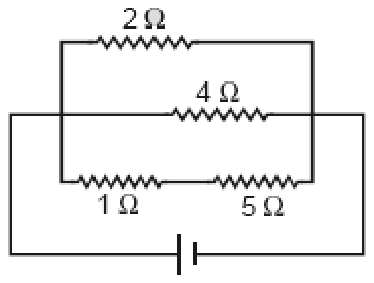
A current of 3 amp. flows through the resistor shown in the circuit. The power dissipated in the resistor is
- 15 watt
- 24 watt
- 32 watt
- 41 watt
Show answer and solution
Correct: option 1, 5 watt
The three branches are in parallel, so each has the voltage of the resistor: V. The branch holding the and resistors in series carries A, so the resistor dissipates watt.
Question 99AIPMT 2007 Prelims, Q177
The total power dissipated in Watts in the circuit shown here is
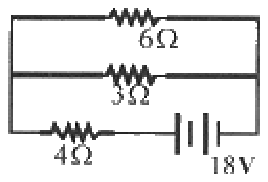
- 14
- 216
- 340
- 454
Show answer and solution
Correct: option 4, 54
The 6 Ω and 3 Ω resistors are in parallel: Ω. This is in series with 4 Ω, so the total resistance is 6 Ω. Power W, option (4).
Question 100AIPMT 2007 Prelims, Q178
A steady current of 1.5 amp flows through a copper voltameter for 10 minute. If the electrochemical equivalent of copper is , the mass of copper deposited on the electrode will be
- 10.27 gm
- 20.40 gm
- 30.50 gm
- 40.67 gm
Show answer and solution
Correct: option 1, 0.27 gm
By Faraday's first law of electrolysis, . The charge passed is C, so gm, option (1).
Question 101AIPMT 2007 Prelims, Q179
If the cold junction of a thermo-couple is kept at and the hot junction is kept at , then the relation between neutral temperature () and temperature of inversion () is
- 1
- 2
- 3
- 4
Show answer and solution
Correct: option 2,
The thermo-emf is a parabolic function of the hot junction temperature, so the neutral temperature lies midway between the cold junction temperature and the temperature of inversion: . With the cold junction at this gives . The key gives option (2), the only option with the form of a half-sum, although as printed it does not reduce to .
Question 102AIPMT 2007 Prelims, Q180
Three resistances P, Q, R each of 2 Ω and an unknown resistance S form the four arms of a Wheatstone bridge circuit. When a resistance of 6 Ω is connected in parallel to S the bridge gets balanced. What is the value of S?
- 11 Ω
- 22 Ω
- 33 Ω
- 46 Ω
Show answer and solution
Correct: option 3, 3 Ω
With P = Q = R = 2 Ω the bridge balances only when the fourth arm is also 2 Ω. So S in parallel with 6 Ω must equal 2 Ω: , which gives Ω, option (3).
Question 103AIPMT 2006 Prelims, Q1
In producing chlorine through electrolysis 100 watt power at 125 V is being consumed. How much chlorine per minute is liberated? E.C.E. of chlorine is kg/coulomb:-
- 117.6 mg
- 221.3 mg
- 324.3 mg
- 413.6 mg
Show answer and solution
Correct: option 1, 17.6 mg
The current is , so the charge passed in one minute is . By Faraday's first law .
Question 104AIPMT 2006 Prelims, Q2
In the circuit shown, if a conducting wire is connected between points A and B, the current in this wire will-
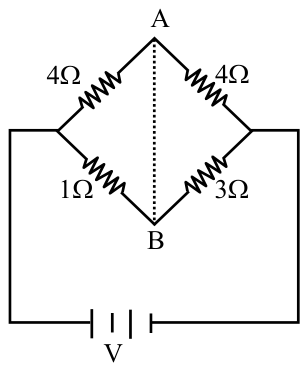
- 1Flow from A to B
- 2Flow in the direction which will be decided by the value of V
- 3Be zero
- 4Flow from B to A
Show answer and solution
Correct: option 4, Flow from B to A
Before the wire is joined, each branch divides the battery voltage in the ratio of its resistances. In the upper branch ( and ) point A is below the left junction. In the lower branch ( and ) point B is only below the left junction. With the left junction joined to the positive terminal of the battery, B is at the higher potential ( against ), so current flows in the wire from B to A, whatever the value of V.
Question 105AIPMT 2006 Prelims, Q6
Two cells, having the same e.m.f., are connected in series through an external resistance R. Cell have internal resistances and () respectively. When the circuit is closed, the potential difference across the first cell is zero. The value of R is:-
- 1
- 2
- 3
- 4
Show answer and solution
Correct: option 1,
The current is . The terminal voltage of the first cell is , so . Equating, , which gives .
Question 106AIPMT 2006 Prelims, Q36
Power dissipated across the resistor in the circuit shown here is 2 watt. The power dissipated in watt units across the resistor is:-
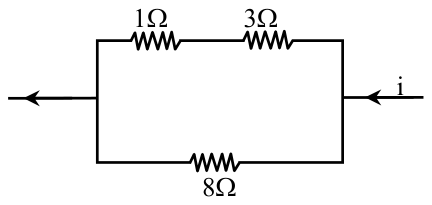
- 12.0
- 21.0
- 30.5
- 43.0
Show answer and solution
Correct: option 4, 3.0
The resistor is in parallel with the series pair . From , the voltage across the resistor is . The same 4 V drives a current of through the upper branch, so the resistor dissipates .
Question 107AIPMT 2006 Prelims, Q37
Kirchhoff's first and second laws for electrical circuits are consequences of:-
- 1Conservation of energy
- 2Conservation of electric charge and energy respectively
- 3Conservation of electric charge
- 4Conservation of energy and electric charge respectively
Show answer and solution
Correct: option 2, Conservation of electric charge and energy respectively
The first (junction) law says the currents entering a junction equal those leaving it; charge cannot pile up or vanish there, which is conservation of charge. The second (loop) law says the potential changes round a closed loop add to zero; a charge taken round the loop returns with the same energy, which is conservation of energy.
Question 108AIPMT 2005 Prelims, Q6
Two batteries, one of emf 18 volts and internal resistance 2Ω and the other of emf 12 volt and internal resistance 1Ω, are connected as shown. The voltmeter V will record a reading of.
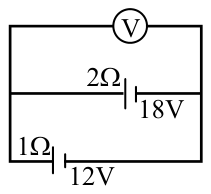
- 118 volt
- 230 volt
- 314 volt
- 415 volt
Show answer and solution
Correct: option 3, 14 volt
The two batteries are in parallel, so the common terminal voltage is . The voltmeter across them reads 14 volt.
Question 109AIPMT 2005 Prelims, Q9
A 5-ampere fuse wire can withstand a maximum power of 1 watt in the circuit. The resistance of the fuse wire is:
- 15 ohm
- 20.04 ohm
- 30.2 ohm
- 40.4 ohm
Show answer and solution
Correct: option 2, 0.04 ohm
Using , .
Question 110AIPMT 2005 Prelims, Q14
When a wire of uniform cross-section a, length and resistance R is bent into a complete circle, resistance between any two of diametrically opposite points will be
- 1R/2
- 2R/4
- 3R/8
- 44R
Show answer and solution
Correct: option 2, R/4
Diametrically opposite points split the circle into two halves, each of resistance R/2. These two halves are in parallel, giving .
Question 111AIPMT 2005 Prelims, Q16
The temperature of inversion of a thermocouple is 620°C and the neutral temperature is 300°C. What is the temperature of cold junction:
- 140°C
- 220°C
- 3320°C
- 4–20°C
Show answer and solution
Correct: option 4, –20°C
The neutral temperature lies midway between the cold junction and inversion temperatures: . So .
Question 112AIPMT 2005 Prelims, Q26
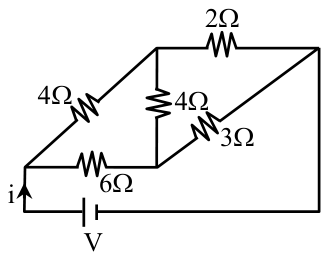
For the network shown in the figure the value of the current i is
- 1
- 2
- 3
- 4
Show answer and solution
Correct: option 4,
The network is a Wheatstone bridge with arms 4Ω and 2Ω on one side, 6Ω and 3Ω on the other, and the second 4Ω as the bridge. Since the bridge is balanced and no current flows in the bridge resistor. The resistance is then , so .
Question 113AIPMT 2004 Prelims, Q1
When three identical bulbs of 60 watt, 200 volt rating are connected in series to a 200 volt supply, the power drawn by them will be:-
- 1180 watt
- 210 watt
- 320 watt
- 460 watt
Show answer and solution
Correct: option 3, 20 watt
Each bulb has resistance . In series the total resistance is , so the power drawn from the same 200 V supply is watt.
Question 114AIPMT 2004 Prelims, Q2
The electric resistance of a certain wire of iron is R. If its length and radius are both doubled, then:-
- 1The resistance will be halved and the specific resistance will remain unchanged
- 2The resistance will be halved and the specific resistance will be doubled
- 3The resistance and the specific resistance, will both remain unchanged
- 4The resistance will be doubled and the specific resistance will be halved
Show answer and solution
Correct: option 1, The resistance will be halved and the specific resistance will remain unchanged
. Doubling doubles the resistance and doubling divides it by 4, so the resistance becomes . Specific resistance depends only on the material (iron), so it does not change.
Question 115AIPMT 2004 Prelims, Q3
Resistances n, each of r ohm, when connected in parallel give an equivalent resistance of R ohm. If these resistances were connected in series, the combination would have a resistance in ohms, equal to
- 1
- 2
- 3
- 4
Show answer and solution
Correct: option 4,
In parallel , so . In series the resistance is .
Question 116AIPMT 2004 Prelims, Q22
In India electricity is supplied for domestic use at 220 V. It is supplied at 110 V in USA. If the resistance of a 60W bulb for use in India is R, The resistance of a 60W bulb for use in USA will be:-
- 1
- 2
- 3
- 4
Show answer and solution
Correct: option 2,
For a bulb of rated power at voltage , the resistance is . With the same power and half the voltage the resistance is one quarter: .
Question 117AIPMT 2004 Prelims, Q47
A battery is charged at a potential of 15V for 8 hours when the current flowing is 10A. The battery on discharge supplies a current of 5A for 15 hours. The mean terminal voltage during discharges is 14 V. The "Watt hour" efficiency of the battery is:-
- 180%
- 290%
- 387.5%
- 482.5%
Show answer and solution
Correct: option 3, 87.5%
Energy put in while charging Wh. Energy given out on discharge Wh. Efficiency .
Question 118AIPMT 2004 Prelims, Q48
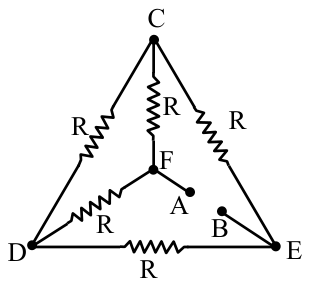
Five equal resistances each of resistance R are connected as shown in the Figure. A battery of V volts is connected between A and B. The current flowing in AFCEB will be
- 1
- 2
- 3
- 4
Show answer and solution
Correct: option 2,
A is joined to F and B is joined to E, so the battery voltage V acts between F and E. The branches F–C–E and F–D–E each hold two resistances R in series, so C and D are at the same potential and the resistance between C and D carries no current. The current in the branch AFCEB is therefore .
Question 119AIPMT 2004 Prelims, Q50
A 6 volt battery is connected to the terminals of a three metre long wire of uniform thickness and resistance of 100 ohm. The difference of potential between two points on the wire separated by a distance of 50 cm will be:-
- 13 V
- 21 V
- 31.5 V
- 42 V
Show answer and solution
Correct: option 2, 1 V
The potential falls uniformly along a uniform wire, by V per metre. Across 50 cm (0.5 m) the potential difference is V.
Question 120AIPMT 2003 Prelims, Q29
Two 220 volt, 100 watt bulbs are connected first in series and then in parallel. Each time the combination is connected to a 220 volt a.c. supply line. The power drawn by the combination in each case respectively will be:
- 150 watt, 100 watt
- 2100 watt, 50 watt
- 3200 watt, 150 watt
- 450 watt, 200 watt
Show answer and solution
Correct: option 4, 50 watt, 200 watt
Each bulb has resistance . In series the total resistance is , so the power is W. In parallel each bulb gets the full 220 V and gives its rated 100 W, a total of 200 W.
Question 121AIPMT 2003 Prelims, Q30
An electric kettle has two heating coils. When one of the coils is connected to an a.c. source, the water in the kettle boils in 10 minutes. When the other coil is used the water boils in 40 minutes. If both the coils are connected in parallel, the time taken by the same quantity of water to boil will be:
- 18 min
- 24 min
- 325 min
- 415 min
Show answer and solution
Correct: option 1, 8 min
The same heat is needed each time, so the coils have powers and per minute. In parallel on the same supply the powers add: , so min.
Question 122AIPMT 2003 Prelims, Q31
In a Wheatstone's bridge all the four arms have equal resistance R. If the resistance of the galvanometer arm is also R, the equivalent resistance of the combination as seen by the battery is:
- 1R/4
- 2R/2
- 3R
- 42R
Show answer and solution
Correct: option 3, R
With four equal arms the bridge is balanced, so no current flows in the galvanometer arm and it can be ignored. What is left is two branches of in parallel, which gives .
Question 123AIPMT 2003 Prelims, Q34
- 1high resistance and high melting point
- 2high resistance and low melting point
- 3low resistance and low melting point
- 4low resistance and high melting point
Show answer and solution
Correct: option 2, high resistance and low melting point
A fuse must heat up quickly and melt as soon as the current goes above the safe value. That needs a high resistance (more heating) and a low melting point.
Question 124AIPMT 2002 Prelims, Q37
Specific resistance of a conductor increases with:
- 1Increase in temperature
- 2Increase in cross section area
- 3Increase in cross section and decrease in length
- 4Decrease in cross section area
Show answer and solution
Correct: option 1, Increase in temperature
Specific resistance (resistivity) is a property of the material and does not depend on the length or the cross section of the piece. For a conductor it rises with temperature, because the electrons collide more often with the vibrating ions.
Question 125AIPMT 2002 Prelims, Q40
For a cell terminal P.D. is 2.2V when circuit is open and reduces to 1.8V when cell is connected to a resistance of R = 5. Determine internal resistance of cell (r) is then:-
- 1
- 2
- 3
- 4
Show answer and solution
Correct: option 1,
The open circuit P.D. is the emf, V. The current is A. Then .
Question 126AIPMT 2001 Prelims, Q34
If specific resistance of a potentiometer wire is m and current flow through it is 0.1 A, cross-sectional area of wire is m then potential gradient will be:
- 1 V/m
- 2 V/m
- 3 V/m
- 4 V/m
Show answer and solution
Correct: option 1, V/m
Potential gradient is the potential drop per unit length: V/m.
Question 127AIPMT 2001 Prelims, Q43
The resistance of each arm of the wheat stone bridge is 10 ohm. A resistance of 10 ohm is connected in series with galvanometer then the equivalent resistance across the battery will be:
- 110 ohm
- 215 ohm
- 320 ohm
- 440 ohm
Show answer and solution
Correct: option 1, 10 ohm
With all four arms equal the bridge is balanced, so no current flows through the galvanometer branch and the extra 10 ohm in it has no effect. The network is two series pairs of 20 ohm in parallel: ohm.
Question 128AIPMT 2001 Prelims, Q44
Copper and silicon is cooled from 300 K to 60 K, the specific resistance:
- 1Decrease in copper but increase in silicon
- 2Increase in copper but decrease in silicon
- 3Increase in both
- 4Decrease in both
Show answer and solution
Correct: option 1, Decrease in copper but increase in silicon
Copper is a metal: on cooling, the lattice vibrations weaken, electrons are scattered less and the resistivity falls. Silicon is a semiconductor: on cooling, fewer charge carriers are thermally excited, so its resistivity rises.
Question 129AIPMT 2000 Prelims, Q4
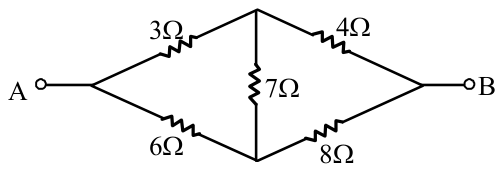
Calculate the net resistance of the circuit between A and B:
- 18/3
- 214/3
- 316/3
- 422/3
Show answer and solution
Correct: option 2, 14/3
The network is a Wheatstone bridge with , so it is balanced and no current flows in the resistor. The upper branch is and the lower branch is . In parallel, .
Question 130AIPMT 2000 Prelims, Q39
A car battery of emf 12 V and internal resistance , receives a current of 60 Å from external source, then terminal voltage of battery is:
- 112 V
- 29 V
- 315 V
- 420 V
Show answer and solution
Correct: option 3, 15 V
Reading the current as 60 A: the battery is being charged, so current is driven into it against its emf and the terminal voltage is above the emf. V.
Question 131AIPMT 2000 Prelims, Q40
Two bulbs of (40 W, 200 V), and (100 W, 200 V). Then correct relation for their resistance:
- 1
- 2
- 3
- 4No relation can be predicted
Show answer and solution
Correct: option 2,
. At the same rated voltage the lower-power bulb has the higher resistance: and . So .
Question 132AIPMT 2000 Prelims, Q43
The potentiometer is best for measuring voltage, as:
- 1It has a sensitive galvanometer
- 2It has wire of high resistance
- 3It measures p.d. like in closed circuit
- 4It measures p.d. like in open circuit
Show answer and solution
Correct: option 4, It measures p.d. like in open circuit
At the balance point the galvanometer shows no deflection, so no current is drawn from the source being measured. The potentiometer therefore reads the potential difference as it is on open circuit, with no drop across the internal resistance, which a voltmeter cannot do.
Question 133AIPMT 1999 Prelims, Q7
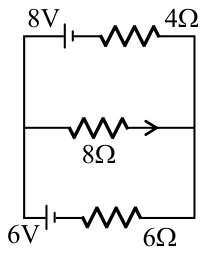
The current in 8Ω resistance is (See fig.)
- 10.69 A
- 20.92 A
- 31.30 A
- 41.6 A
Show answer and solution
Correct: option 1, 0.69 A
The three branches are in parallel between the same two junctions. Let the potential difference across the 8 Ω resistance be . The currents from the two cell branches add up to the current in the 8 Ω branch: . This gives , so V and the current is A.
Question 134AIPMT 1999 Prelims, Q9
If the power dissipated in 5Ω is 20 W then power dissipated in 4Ω is -
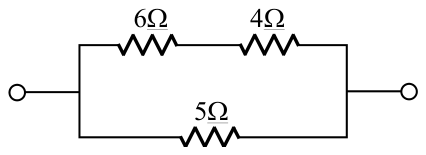
- 14 W
- 26 W
- 310 W
- 420 W
Show answer and solution
Correct: option 1, 4 W
For the 5 Ω resistance , so and V. The same 10 V is across the series pair 6 Ω + 4 Ω = 10 Ω, so the current in it is 1 A. Power in the 4 Ω resistance is W.
Question 135AIPMT 1999 Prelims, Q10
The value of R for which power in it is maximum-
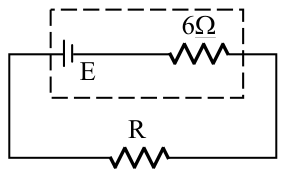
- 13Ω
- 26Ω
- 312Ω
- 49Ω
Show answer and solution
Correct: option 2, 6Ω
By the maximum power transfer theorem the power delivered to the external resistance is greatest when it equals the internal resistance of the source. The source (dashed box) has an internal resistance of 6 Ω, so Ω.
Question 136AIPMT 1999 Prelims, Q15
The terminal potential difference of a cell is greater than its emf when -
- 1A battery of less emf is connected in its series
- 2A battery of higher emf is connected in its series
- 3A battery of higher emf is connected in its parallel
- 4A battery of less emf is connected in its parallel
Show answer and solution
Correct: option 3, A battery of higher emf is connected in its parallel
The terminal potential difference is , larger than the emf, only when current is driven through the cell against its emf, that is when the cell is being charged. This happens when a battery of higher emf is joined in parallel with it (like terminals together): the stronger battery forces current backwards through the cell.
Question 137AIPMT 1998 Prelims, Q20
coulomb charge liberated 1 gm silver (Ag). If now charge is doubled then the amount of liberated Ag will be:
- 11 gm
- 22 gm
- 33 gm
- 44 gm
Show answer and solution
Correct: option 2, 2 gm
By Faraday's first law of electrolysis the mass liberated is proportional to the charge passed, . Doubling the charge doubles the mass, from 1 gm to 2 gm.
Question 138AIPMT 1998 Prelims, Q30
When three identical bulbs are connected in series, the consumed power is 10W. If they are now connected in parallel then the consumed power will be:
- 130W
- 290W
- 3 W
- 4270W
Show answer and solution
Correct: option 2, 90W
On the same supply . In series the resistance is 3R, so W and W. In parallel the resistance is R/3, so the power is W.
Question 139AIPMT 1998 Prelims, Q36
In hot wire Ammeter due to flowing of current temperature of wire is increased by . If value of current is doubled, then increases in temperature will be:
- 1
- 2
- 3
- 4
Show answer and solution
Correct: option 2,
The heat produced, and so the rise in temperature of the wire, is proportional to (Joule's law). Doubling the current makes the rise 4 times as large: .