Questions with solutions
Question 1NEET 2026, Q22
For a travelling harmonic wave
, where x and y are in cm and t in s. The phase difference between oscillatory motion of two points separated by a distance of is:
- 1 rad
- 2 rad
- 3 rad
- 4 rad
Show answer and solution
Correct: option 4, rad
The phase changes with position at the rate . For a separation , the phase difference is rad.
Question 2NEET 2026 Re-exam, Q4
For sound waves, if the number of nodes for the 5th harmonic of an open-ended pipe is and that for the 9th harmonic of the same pipe with one of its ends closed is , the ratio is:
- 1
- 2
- 31
- 4
Show answer and solution
Correct: option 3, 1
In the 5th harmonic of an open pipe the length holds five half-wavelengths with an antinode at each end, which gives 5 nodes, so . In the 9th harmonic of a closed pipe the length is with a node at the closed end and an antinode at the open end, which also gives 5 nodes, so . The ratio is 1, option (3).
Question 3NEET 2025, Q45
A pipe open at both ends has a fundamental frequency in air. The pipe is now dipped vertically in a water drum to half of its length. The fundamental frequency of the air column is now equal to:
- 1
- 2
- 3
- 4
Show answer and solution
Correct: option 2,
An open pipe of length has fundamental frequency . Half dipped in water it becomes a pipe closed at one end with an air column of length , whose fundamental is . The frequency is unchanged, option (2).
Question 4NEET 2024 Re-exam, Q38
The displacement of a travelling wave where is time, is distance and is the wavelength, all in S.I. units. Then the frequency of the wave is:
- 1
- 2
- 3
- 4
Show answer and solution
Correct: option 4,
Comparing with , the angular frequency is . The frequency is (here is the wave speed).
Question 5NEET 2023, Q31
The ratio of frequencies of fundamental harmonic produced by an open pipe to that of closed pipe having the same length is:
- 11 : 2
- 22 : 1
- 31 : 3
- 43 : 1
Show answer and solution
Correct: option 2, 2 : 1
The fundamental of an open pipe is and that of a closed pipe is . Their ratio is , option (2).
Question 6NEET 2023 Manipur, Q26
The 4th overtone of a closed organ pipe is same as that of 3rd overtone of an open pipe. The ratio of the length of the closed pipe to the length of the open pipe is:
- 19 : 8
- 27 : 9
- 38 : 9
- 49 : 7
Show answer and solution
Correct: option 1, 9 : 8
A closed pipe has only odd harmonics, so its 4th overtone is the 9th harmonic: . An open pipe has all harmonics, so its 3rd overtone is the 4th harmonic: . Equating, , so .
Question 7NEET 2022, Q5
If the initial tension on a stretched string is doubled, then the ratio of the initial and final speeds of a transverse wave along the string is:
- 1
- 2
- 3
- 4
Show answer and solution
Correct: option 4,
The speed of a transverse wave on a string is , so . When becomes , , that is , option (4).
Question 8NEET 2022 Re-exam, Q48
An organ pipe filled with a gas at 27°C resonates at 400 Hz in its fundamental mode. If it is filled with the same gas at 90°C, the resonance frequency at the same mode will be
- 1512 Hz
- 2420 Hz
- 3440 Hz
- 4484 Hz
Show answer and solution
Correct: option 3, 440 Hz
For a fixed pipe the frequency is proportional to the speed of sound, and with in kelvin. So Hz, option (3).
Question 9NEET 2020, Q164
In a guitar, two strings A and B made of same material are slightly out of tune and produce beats of frequency 6 Hz. When tension in B is slightly decreased, the beat frequency increases to 7 Hz. If the frequency of A is 530 Hz, the original frequency of B will be:
- 1523 Hz
- 2524 Hz
- 3536 Hz
- 4537 Hz
Show answer and solution
Correct: option 2, 524 Hz
A beat frequency of 6 Hz means B is at , that is 524 Hz or 536 Hz. The frequency of a string is proportional to , so lowering the tension lowers the frequency of B. If B were at 536 Hz, lowering it would bring it closer to 530 Hz and reduce the beats; the beats increase instead, so B was below A, at 524 Hz.
Question 10NEET 2020 Phase 2, Q132
The length of the string of a musical instrument is 90 cm and has a fundamental frequency of 120 Hz. Where should it be pressed to produce fundamental frequency of 180 Hz?
- 160 cm
- 245 cm
- 380 cm
- 475 cm
Show answer and solution
Correct: option 1, 60 cm
The fundamental frequency of a stretched string is , and the tension, so the wave speed , is unchanged. Hence and .
Question 11NEET 2019 Odisha, Q8
A tuning fork with frequency 800 Hz produces resonance in a resonance column tube with upper end open and lower end closed by water surface. Successive resonances are observed at lengths 9.75 cm, 31.25 cm and 52.75 cm. The speed of sound in air is,
- 1344 m/s
- 2172 m/s
- 3500 m/s
- 4156 m/s
Show answer and solution
Correct: option 1, 344 m/s
Successive resonance lengths of a closed column differ by . Here the difference is cm, so cm m. Then m/s.
Question 12NEET 2018, Q2
The fundamental frequency in an open organ pipe is equal to the third harmonic of a closed organ pipe. If the length of the closed organ pipe is 20 cm, the length of the open organ pipe is
- 112.5 cm
- 28 cm
- 313.2 cm
- 416 cm
Show answer and solution
Correct: option 3, 13.2 cm
Open pipe fundamental: . Closed pipe third harmonic: . Setting them equal gives , and the nearest option is 13.2 cm.
Question 13NEET 2018, Q24
A tuning fork is used to produce resonance in a glass tube. The length of the air column in this tube can be adjusted by a variable piston. At room temperature of two successive resonances are produced at 20 cm and 73 cm of column length. If the frequency of the tuning fork is 320 Hz, the velocity of sound in air at is
- 1350 m/s
- 2339 m/s
- 3330 m/s
- 4300 m/s
Show answer and solution
Correct: option 2, 339 m/s
Successive resonance lengths differ by half a wavelength: cm, so m. Then .
Question 14NEET 2017, Q20
Two cars moving in opposite directions approach each other with speed of 22 m/s and 16.5 m/s respectively. The driver of the first car blows a horn having a frequency 400 Hz. The frequency heard by the driver of the second car is [velocity of sound 340 m/s]:
- 1350 Hz
- 2361 Hz
- 3411 Hz
- 4448 Hz
Show answer and solution
Correct: option 4, 448 Hz
Source and observer move towards each other, so Hz.
Question 15NEET 2017, Q43
The two nearest harmonics of a tube closed at one end and open at other end are 220 Hz and 260 Hz. What is the fundamental frequency of the system?
- 110 Hz
- 220 Hz
- 330 Hz
- 440 Hz
Show answer and solution
Correct: option 2, 20 Hz
A tube closed at one end has only odd harmonics: Neighbouring harmonics differ by . So Hz and Hz. Check: 220 and 260 are the 11th and 13th harmonics of 20 Hz, both odd.
Question 16NEET 2016 Phase 1, Q4
A siren emitting a sound of frequency 800 Hz moves away from an observer towards a cliff at a speed of . Then, the frequency of sound that the observer hears in the echo reflected from the cliff is:
(Take velocity of sound in air )
- 1765 Hz
- 2800 Hz
- 3838 Hz
- 4885 Hz
Show answer and solution
Correct: option 3, 838 Hz
The siren approaches the cliff, so the cliff receives and reflects Hz. The cliff and the observer are both at rest, so the observer hears the echo at this same frequency.
Question 17NEET 2016 Phase 1, Q10
A uniform rope of length L and mass hangs vertically from a rigid support. A block of mass is attached to the free end of the rope. A transverse pulse of wavelength is produced at the lower end of the rope. The wavelength of the pulse when it reaches the top of the rope is . The ratio is:
- 1
- 2
- 3
- 4
Show answer and solution
Correct: option 2,
The frequency stays the same, so . The tension is at the lower end and at the top, so .
Question 18NEET 2016 Phase 1, Q12
An air column, closed at one end and open at the other, resonates with a tuning fork when the smallest length of the column is 50 cm. The next larger length of the column resonating with the same tuning fork is:
- 166.7 cm
- 2100 cm
- 3150 cm
- 4200 cm
Show answer and solution
Correct: option 3, 150 cm
A closed pipe resonates at lengths The smallest length is cm, so the next is cm.
Question 19NEET 2016 Phase 2, Q21
The second overtone of an open organ pipe has the same frequency as the first overtone of a closed pipe metre long. The length of the open pipe will be
- 1
- 2
- 3
- 4
Show answer and solution
Correct: option 2,
An open pipe of length has frequencies ; its second overtone is the third harmonic, . A closed pipe has only odd harmonics of ; its first overtone is . Equating, , so , option (2).
Question 20NEET 2016 Phase 2, Q22
Three sound waves of equal amplitudes have frequencies , , . They superimpose to give beats. The number of beats produced per second will be
- 11
- 24
- 33
- 42
Show answer and solution
Correct: option 4, 2
Adding the three waves gives a wave of frequency whose amplitude varies as . The intensity depends on the square of this, which in each second has two maxima (at , where the factor is 3, and at , where it is ) separated by zeros at and . So 2 beats are heard per second, option (4).
Question 21AIPMT 2015, Q150
The fundamental frequency of a closed organ pipe of length 20 cm is equal to the second overtone of an organ pipe open at both the ends. The length of organ pipe open at both the ends is:-
- 1100 cm
- 2120 cm
- 3140 cm
- 480 cm
Show answer and solution
Correct: option 2, 120 cm
A closed pipe of length has fundamental frequency . An open pipe of length has harmonics , and its second overtone is the third harmonic, . Setting gives , option (2).
Question 22AIPMT 2015 Re-test, Q144
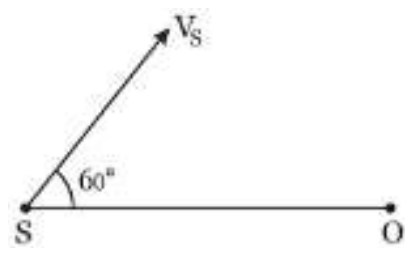
A source of sound S emitting waves of frequency 100 Hz and an observer O are located at some distance from each other. The source is moving with a speed of at an angle of with the source observer line as shown in the figure. The observer is at rest. The apparent frequency observed by the observer (velocity of sound in air ), is:
- 197 Hz
- 2100 Hz
- 3103 Hz
- 4106 Hz
Show answer and solution
Correct: option 3, 103 Hz
Only the component of the source velocity along the line SO matters: , directed towards the observer. Then .
Question 23AIPMT 2015 Re-test, Q153
A string is stretched between fixed points separated by 75.0 cm. It is observed to have resonant frequencies of 420 Hz and 315 Hz. There are no other resonant frequencies between these two. The lowest resonant frequency for this string is:
- 1105 Hz
- 2155 Hz
- 3205 Hz
- 410.5 Hz
Show answer and solution
Correct: option 1, 105 Hz
A string fixed at both ends resonates at whole-number multiples of its fundamental, . Two neighbouring resonances therefore differ by exactly : (the two given frequencies are the 3rd and 4th harmonics).
Question 24AIPMT 2015 Re-test, Q161
4.0 g of a gas occupies 22.4 litres at NTP. The specific heat capacity of the gas at constant volume is . If the speed of sound in this gas at NTP is , then the heat capacity at constant pressure is
(Take gas constant )
- 1
- 2
- 3
- 4
Show answer and solution
Correct: option 2,
22.4 litres at NTP is one mole, so the molar mass is . Speed of sound gives . Then .
Question 25AIPMT 2014, Q101
If , and are the fundamental frequencies of three segments into which a string is divided, then the original fundamental frequency n of the string is given by:
- 1
- 2
- 3
- 4
Show answer and solution
Correct: option 2,
For a string under the same tension the fundamental frequency is , so each length is . The segments add up to the whole string, , which gives , option (2).
Question 26AIPMT 2014, Q108
A speeding motorcyclist sees traffic jam ahead of him. He slows down to 36 km/hour. He finds that traffic has eased and a car moving ahead of him at 18 km/hour is honking at a frequency of 1392 Hz. If the speed of sound is 343 m/s, the frequency of the honk as heard by him will be:
- 11454 Hz
- 21332 Hz
- 31372 Hz
- 41412 Hz
Show answer and solution
Correct: option 4, 1412 Hz
The observer moves towards the source at and the source moves away from him at . So , option (4).
Question 27AIPMT 2014, Q113
The number of possible natural oscillations of air column in a pipe closed at one end of length 85 cm whose frequencies lie below 1250 Hz are: (velocity of sound = )
- 16
- 24
- 35
- 47
Show answer and solution
Correct: option 1, 6
The fundamental of a closed pipe is and only odd harmonics are present: 100, 300, 500, 700, 900 and 1100 Hz lie below 1250 Hz (the next, 1300 Hz, does not). That is 6 modes, option (1).
Question 28NEET 2013, Q157
If we study the vibration of a pipe open at both ends, then the following statement is not true:
- 1Odd harmonics of the fundamental frequency will be generated
- 2All harmonics of the fundamental frequency will be generated
- 3Pressure change will be maximum at both ends
- 4Open end will be antinode
Show answer and solution
Correct: option 3, Pressure change will be maximum at both ends
An open end is a displacement antinode and a pressure node: the pressure there stays at atmospheric value, so the pressure change is least at the ends, not greatest. An open pipe produces every harmonic, odd ones included, and its open ends are antinodes, so the other three statements hold.
Question 29NEET 2013, Q160
A source of unknown frequency gives 4 beats/s, when sounded with a source of known frequency 250 Hz. The second harmonic of the source of unknown frequency gives five beats per second, when sounded with a source of frequency 513 Hz. The unknown frequency is:
- 1246 Hz
- 2240 Hz
- 3260 Hz
- 4254 Hz
Show answer and solution
Correct: option 4, 254 Hz
Four beats with 250 Hz means the frequency is 246 Hz or 254 Hz. The second harmonic would be 492 Hz or 508 Hz. Only 508 Hz gives beats per second with 513 Hz, so the unknown frequency is 254 Hz.
Question 30NEET 2013, Q171
A wave travelling in the +ve -direction having displacement along -direction as 1 m, wavelength m and frequency of Hz is represented by:
- 1
- 2
- 3
- 4
Show answer and solution
Correct: option 4,
A wave moving along has the form . Here m, and . So .
Question 31NEET 2013 Karnataka, Q145
The length of the wire between two ends of a sonometer is 100 cm. What should be the positions of two bridges below the wire so that the three segments of the wire have their fundamental frequencies in the ratio
- 1
- 2
- 3
- 4
Show answer and solution
Correct: option 4,
With the same tension and wire, , so the lengths are in the ratio . Out of 100 cm the segments are , and cm. The bridges are therefore at cm and at cm from one end.
Question 32NEET 2013 Karnataka, Q172
Two sources P and Q produce notes of frequency 660 Hz each. A listener moves from P to Q with a speed of . If the speed of sound is 330 m/s, then number of beats heard by the listener per second will be:
- 14
- 28
- 32
- 4zero
Show answer and solution
Correct: option 1, 4
Moving away from P the listener hears and moving towards Q hears . The beat frequency is the difference, per second.
Question 33AIPMT 2012 Prelims, Q2
When a string is divided into three segments of length , and the fundamental frequencies of these three segments are , and respectively. The original fundamental frequency () of the string is
- 1
- 2
- 3
- 4
Show answer and solution
Correct: option 3,
For the same tension and mass per unit length, the fundamental frequency is , so . Since , it follows that .
Question 34AIPMT 2012 Prelims, Q49
Two sources of sound placed close to each other are emitting progressive waves given by and . An observer located near these two sources of sound will hear:
- 14 beats per second with intensity ratio 25 : 16 between waxing and waning.
- 28 beats per second with intensity ratio 25 : 16 between waxing and waning
- 38 beats per second with intensity ratio 81 : 1 between waxing and waning
- 44 beats per second with intensity ratio 81 : 1 between waxing and waning
Show answer and solution
Correct: option 4, 4 beats per second with intensity ratio 81 : 1 between waxing and waning
From the frequencies are 300 Hz and 304 Hz, so there are beats per second. The amplitudes are 4 and 5, so the loudest and faintest intensities are in the ratio .
Question 35AIPMT 2012 Mains, Q12
The equation of a simple harmonic wave is given by
Where x and y are in meters and t is in seconds. The ratio of maximum particle velocity to the wave velocity is
- 1
- 2
- 3
- 4
Show answer and solution
Correct: option 2,
Writing gives m, and . Wave velocity and maximum particle velocity . The ratio is (equivalently ).
Question 36AIPMT 2012 Mains, Q13
A train moving at a speed of towards a stationary object, emits a sound of frequency 1000 Hz. Some of the sound reaching the object gets reflected back to the train as echo. The frequency of the echo as detected by the driver of the train is:
(speed of sound in air is )
- 13500 Hz
- 24000 Hz
- 35000 Hz
- 43000 Hz
Show answer and solution
Correct: option 3, 5000 Hz
The stationary object receives because the source approaches it. It reflects this frequency, and the driver, an observer moving towards the reflector, hears Hz.
Question 37AIPMT 2011 Prelims, Q164
Two waves are represented by the equations m and m, where x is in meter and t in sec. The phase difference between them is:
- 11.0 radian
- 21.25 radian
- 31.57 radian
- 40.57 radian
Show answer and solution
Correct: option 1, 1.0 radian
Write the second wave as a sine: . The phase difference is radian.
Question 38AIPMT 2011 Prelims, Q191
Sound waves travel at 350 m/s through a warm air and at 3500 m/s through brass. The wavelength of a 700 Hz acoustic wave as it enters brass from warm air:
- 1decreases by a factor 10
- 2increases by a factor 20
- 3increases by a factor 10
- 4decreases by a factor 20
Show answer and solution
Correct: option 3, increases by a factor 10
The frequency does not change when a wave passes from one medium to another, so is proportional to the speed. The speed rises from 350 m/s to 3500 m/s, ten times, so the wavelength increases by a factor 10 (from 0.5 m to 5 m).
Question 39AIPMT 2011 Mains, Q91
Two identical piano wires kept under the same tension T have a fundamental frequency of 600 Hz. The fractional increase in the tension of one of the wires which will lead to occurrence of 6 beats/s when both the wires oscillate together would be:
- 10.02
- 20.03
- 30.04
- 40.01
Show answer and solution
Correct: option 1, 0.02
The fundamental frequency of a wire is , so and for a small change . For 6 beats per second Hz, so .
Question 40AIPMT 2010 Prelims, Q13
A transverse wave is represented by . For what value of the wavelength is the wave velocity equal to the maximum particle velocity?
- 1
- 2
- 3
- 4A
Show answer and solution
Correct: option 3,
The wave velocity is and the maximum particle velocity is . Equating them gives . Since , this means .
Question 41AIPMT 2010 Prelims, Q25
A tuning fork of frequency 512 Hz makes 4 beats per second with the vibrating string of a piano. The beat frequency decreases to 2 beats per sec when the tension in the piano string is slightly increased. The frequency of the piano string before increasing the tension was
- 1510 Hz
- 2514 Hz
- 3516 Hz
- 4508 Hz
Show answer and solution
Correct: option 4, 508 Hz
Four beats per second means the string was at 516 Hz or 508 Hz. Increasing the tension raises the string's frequency. From 516 Hz that would move it further from 512 Hz and increase the beats; from 508 Hz it moves closer to 512 Hz and the beats decrease, as observed. So the string was at 508 Hz.
Question 42AIPMT 2009 Prelims, Q16
Each of the two strings of length 51.6 cm and 49.1 cm are tensioned separately by 20 N force. Mass per unit length of both the strings is same and equal to 1 g/m. When both the strings vibrate simultaneously the number of beats is:
- 17
- 28
- 33
- 45
Show answer and solution
Correct: option 1, 7
The wave speed on each string is . The fundamental frequencies are Hz and Hz. The beat frequency is their difference, 7 per second.
Question 43AIPMT 2009 Prelims, Q21
The driver of a car travelling with speed 30 m/sec towards a hill sounds a horn of frequency 600 Hz. If the velocity of sound in air is 330 m/s, the frequency of reflected sound as heard by driver is:
- 1555.5 Hz
- 2720 Hz
- 3500 Hz
- 4550 Hz
Show answer and solution
Correct: option 2, 720 Hz
The hill receives sound from an approaching source and reflects it to an approaching observer, so Hz.
Question 44AIPMT 2009 Prelims, Q31
A wave in a string has an amplitude of 2 cm. The wave travels in the + ve direction of x axis with a speed of 128 m/sec. and it is noted that 5 complete waves fit in 4 m length of the string. The equation describing the wave is:
- 1
- 2
- 3
- 4
Show answer and solution
Correct: option 3,
Five waves in 4 m means m, so and . A wave moving in the +x direction has the form , so .
Question 45AIPMT 2008 Prelims, Q18
The wave described by , where x and y are in meters and t in seconds, is a wave travelling along the
- 1-ve x direction with amplitude 0.25 m and wavelength = 0.2 m
- 2-ve x direction with frequency 1 Hz
- 3+ve x direction with frequency Hz and wavelength = 0.2 m
- 4+ve x direction with frequency 1 Hz and wavelength = 0.2 m
Show answer and solution
Correct: option 4, +ve x direction with frequency 1 Hz and wavelength = 0.2 m
Compare with . The terms in and have opposite signs, so the wave moves along . gives m, and gives a frequency Hz.
Question 46AIPMT 2008 Prelims, Q20
Two points are located at a distance of 10 m and 15 m from the source of oscillation. The period of oscillation is 0.05 sec and the velocity of the wave is 300 m/sec. What is the phase difference between the oscillations of two points?
- 1
- 2
- 3
- 4
Show answer and solution
Correct: option 3,
The wavelength is m. The path difference between the points is m, so the phase difference is .
Question 47AIPMT 2006 Prelims, Q35
Two sound waves with wavelength 5.0 m and 5.5 m respectively, each propagate in a gas with velocity 330 m/s. We expect the following number of beats per second:-
- 112
- 20
- 31
- 46
Show answer and solution
Correct: option 4, 6
The frequencies are and . The beat frequency is their difference, beats per second.
Question 48AIPMT 2006 Prelims, Q38
A transverse wave propagating along x-axis is represented by
where x is in metres and t is in seconds. The speed of the wave is:-
- 1 m/s
- 2 m/s
- 3 m/s
- 48 m/s
Show answer and solution
Correct: option 4, 8 m/s
Comparing with gives and . The wave speed is .
Question 49AIPMT 2006 Prelims, Q39
The time of reverberation of a room A is one second. What will be the time (in seconds) of reverberation of a room, having all the dimensions double of those of room A-
- 12
- 24
- 3
- 41
Show answer and solution
Correct: option 1, 2
Sabine's formula gives the reverberation time as proportional to , the volume of the room divided by its absorbing surface area. Doubling every dimension makes the volume 8 times and the surface area 4 times, so the time doubles to 2 s.
Question 50AIPMT 2006 Prelims, Q40
Which one of the following statements is true:
- 1Both light and sound waves in air are transverse
- 2The sound waves in air are longitudinal while the light waves are transverse
- 3Both light and sound waves in air are longitudinal
- 4Both light and sound waves can travel in vacuum
Show answer and solution
Correct: option 2, The sound waves in air are longitudinal while the light waves are transverse
Sound in air travels as compressions and rarefactions, with the air moving back and forth along the direction of travel, so it is longitudinal. Light is an electromagnetic wave whose electric and magnetic fields oscillate at right angles to the direction of travel, so it is transverse. Sound needs a medium and cannot cross a vacuum.
Question 51AIPMT 2005 Prelims, Q13
Two vibrating tuning forks produce progressive waves given by and . Number of beats produced per minute is
- 13
- 2360
- 3180
- 460
Show answer and solution
Correct: option 3, 180
Frequencies are and . Beat frequency is per second, which is per minute.
Question 52AIPMT 2005 Prelims, Q43
A point source emits sound equally in all directions in a non-absorbing medium. Two points P and Q are at distance of 2m and 3m respectively from the source. The ratio of the intensities of the waves at P and Q is
- 13 : 2
- 22 : 3
- 39 : 4
- 44 : 9
Show answer and solution
Correct: option 3, 9 : 4
With no absorption the power spreads over a sphere, so . Then .
Question 53AIPMT 2004 Prelims, Q9
A car is moving towards a high cliff. The car driver sounds a horn of frequency 'f'. The reflected sound heard by the driver has a frequency 2f. If 'v' be the velocity of sound then the velocity of the car, in the same velocity units, will be -
- 1
- 2
- 3
- 4
Show answer and solution
Correct: option 1,
The cliff receives frequency and acts as a source at rest; the driver moving towards it hears . Setting this equal to gives , so .
Question 54AIPMT 2004 Prelims, Q33
The phase difference between two waves, represented by
m
m
Where x is expressed in metres and t is expressed in seconds, is approximately:-
- 12.07 radians
- 20.5 radians
- 31.5 radians
- 41.07 radians
Show answer and solution
Correct: option 4, 1.07 radians
Write the cosine as a sine: , so has phase . The phase of is . The difference is radians.
Question 55AIPMT 2003 Prelims, Q15
An observer moves towards a stationary source of sound with a speed 1/5th of the speed of sound. The wavelength and frequency of the source emitted are and f respectively. The apparent frequency and wavelength recorded by the observer are respectively:
- 1
- 2
- 3
- 4
Show answer and solution
Correct: option 2,
For an observer moving towards a source at rest, . The source is not moving, so the waves in the medium are not squeezed and the wavelength stays .
Question 56AIPMT 2002 Prelims, Q32
A wave travelling in positive X-direction with A = 0.2 m velocity = 360 m/s and = 60 m, then correct expression for the wave is:-
- 1
- 2
- 3
- 4
Show answer and solution
Correct: option 3,
Frequency Hz. A wave moving along +X is . The plus sign would mean travel along negative X.
Question 57AIPMT 2002 Prelims, Q33
A whistle revolves in a circle with angular speed = 20 rad/sec using a string of length 50 cm. If the frequency of sound from the whistle is 385 Hz, then what is the minimum frequency heard by an observer which is far away from the centre:- ( = 340 m/s)
- 1385 Hz
- 2374 Hz
- 3394 Hz
- 4333 Hz
Show answer and solution
Correct: option 2, 374 Hz
The whistle's speed is m/s. The lowest frequency is heard when the whistle moves directly away from the observer: Hz.
Question 58AIPMT 2001 Prelims, Q18
If the tension and diameter of a sonometer wire of fundamental frequency n is doubled and density is halved then its fundamental frequency will become
- 1
- 2
- 3n
- 4
Show answer and solution
Correct: option 3, n
For a wire of diameter and density , the mass per unit length is , so . Doubling and halving multiplies the square root by , and doubling divides by 2. The frequency stays .
Question 59AIPMT 2001 Prelims, Q27
Two waves having equation
If in the resultant wave the frequency and amplitude remains equals to amplitude of superimposing waves. Then phase diff. between them:
- 1
- 2
- 3
- 4
Show answer and solution
Correct: option 2,
The resultant amplitude of two waves of amplitude with phase difference is . Setting this equal to gives , so and .
Question 60AIPMT 2001 Prelims, Q39
The equation of a wave is represented by:
m, then the velocity of wave will be:
- 1100 m/s
- 24 m/s
- 31000 m/s
- 40.00 m/s
Show answer and solution
Correct: option 3, 1000 m/s
Comparing with gives rad/s and m. Wave velocity m/s.
Question 61AIPMT 2000 Prelims, Q26
Two stationary sources each emitting waves of wave length . An observer moves from one source to other with velocity u. Then number of beats heard by him:
- 1
- 2
- 3
- 4
Show answer and solution
Correct: option 1,
Let the wave speed be and the frequency . The source he approaches is heard at and the one he leaves at . Beat frequency .
Question 62AIPMT 2000 Prelims, Q27
A string is cut into three parts, having fundamental frequencies , and respectively. Then original fundamental frequency 'n' related by the expression as:
- 1
- 2
- 3
- 4
Show answer and solution
Correct: option 1,
At the same tension, the fundamental frequency of a string is inversely proportional to its length: . Since , we get .
Question 63AIPMT 1999 Prelims, Q21
A cylindrical tube (L = 125 cm) is resonant with a tuning fork of frequency 330 Hz. If it is filling by water then to get resonance again, minimum length of water column is ( = 330 m/s) -
- 150 cm
- 260 cm
- 325 cm
- 420 cm
Show answer and solution
Correct: option 1, 50 cm
m cm. A tube closed at one end resonates for air column lengths = 25 cm, 75 cm, 125 cm. The 125 cm tube is the third of these. Pouring in water shortens the air column, and the next resonance is at 75 cm, so the least water column is cm.
Question 64AIPMT 1998 Prelims, Q5
For a wave , for what value of is the maximum particle velocity equal to two times the wave velocity:
- 1
- 2
- 3
- 4
Show answer and solution
Correct: option 1,
The maximum particle velocity is and the wave velocity is . Setting gives . Since , this means .
Question 65AIPMT 1998 Prelims, Q35
A standing wave having 3 nodes and 2 antinodes is formed between 1.21 Å distance then the wavelength is:
- 11.21 Å
- 22.42 Å
- 30.605 Å
- 44.84 Å
Show answer and solution
Correct: option 1, 1.21 Å
Neighbouring nodes are half a wavelength apart. Three nodes with two antinodes between them make two loops, so the distance is . Hence Å.
Question 66AIPMT 1998 Prelims, Q42
If a source moves perpendicularly from listener then the change in frequency will be:
- 12 n
- 2n
- 3n/2
- 4Zero
Show answer and solution
Correct: option 4, Zero
The Doppler shift depends only on the component of the source's velocity along the line joining source and listener. When the source moves at right angles to that line this component is zero, so the frequency heard does not change.