Questions with solutions
Question 1NEET 2026, Q43
In the first excited state of hydrogen atom, the energy of its electron is . The radial distance of the electron from the hydrogen nucleus in this case is approximately:
(Take , and )
- 1
- 2
- 3
- 4
Show answer and solution
Correct: option 4,
In the Bohr model the total energy is , so .
Question 2NEET 2026 Re-exam, Q35
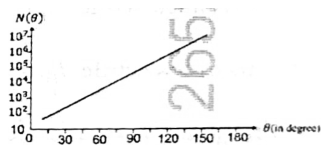
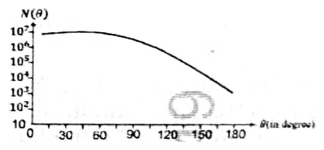
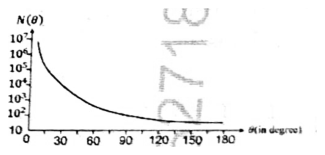
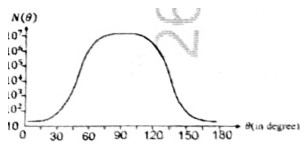
In Geiger-Marsden experiment, the number of scattered -particles is plotted as a function of scattering angle . Which of the following options represents the correct plot?
- 1
- 2
- 3
- 4
Show answer and solution
Correct: option 3
Rutherford's scattering formula gives . Most -particles pass almost undeflected, so the count is very large at small angles, drops steeply as the angle grows and is very small but not zero near . Only the steadily falling curve of option (3) shows this.
Question 3NEET 2026 Re-exam, Q40
Consider that an electron is revolving in an excited state of Hydrogen atom with velocity . The radius of the orbit is m. The value of is:
[Take the mass of electron to be kg, charge of electron C and ]
- 14
- 23
- 32
- 41
Show answer and solution
Correct: option 4, 1
The Coulomb attraction supplies the centripetal force: , so m. So , option (4).
Question 4NEET 2025, Q30
A particle of mass is moving around the origin with a constant force pulling it towards the origin. If Bohr model is used to describe its motion, the radius of the th orbit and the particle's speed in the orbit depend on as
- 1
- 2
- 3
- 4
Show answer and solution
Correct: option 3,
The constant force supplies the centripetal force, , and Bohr's condition is , so . Substituting, is constant, so , and then . That is option (3).
Question 5NEET 2025, Q34
De-Broglie wavelength of an electron orbiting in the state of hydrogen atom is close to (Given Bohr radius = 0.052 nm)
- 10.067 nm
- 20.67 nm
- 31.67 nm
- 42.67 nm
Show answer and solution
Correct: option 2, 0.67 nm
In the th Bohr orbit the circumference holds de Broglie wavelengths: , with . So nm, which is closest to 0.67 nm, option (2).
Question 6NEET 2024, Q1
Match List I with List II.
| List I (Spectral Lines of Hydrogen for transitions from) | List II (Wavelengths (nm)) |
|---|
| A. to | I. 410.2 |
| B. to | II. 434.1 |
| C. to | III. 656.3 |
| D. to | IV. 486.1 |
Choose the correct answer from the options given below:
- 1A-I, B-II, C-III, D-IV
- 2A-II, B-I, C-IV, D-III
- 3A-III, B-IV, C-II, D-I
- 4A-IV, B-III, C-I, D-II
Show answer and solution
Correct: option 3, A-III, B-IV, C-II, D-I
These are Balmer lines, with . A larger means a larger energy gap and a shorter wavelength. So is the longest, 656.3 nm (III); is 486.1 nm (IV); is 434.1 nm (II); is 410.2 nm (I). This is option (3).
Question 7NEET 2024, Q22
Given below are two statements:
Statement I: Atoms are electrically neutral as they contain equal number of positive and negative charges.
Statement II: Atoms of each element are stable and emit their characteristic spectrum.
In the light of the above statements, choose the most appropriate answer from the options given below:
- 1Statement I is incorrect but Statement II is correct.
- 2Both Statement I and Statement II are correct.
- 3Both Statement I and Statement II are incorrect.
- 4Statement I is correct but Statement II is incorrect.
Show answer and solution
Correct: option 4, Statement I is correct but Statement II is incorrect.
The official key is option (4). Statement I is correct: an atom has as many protons as electrons, so its net charge is zero. Statement II is taken as incorrect: not every atom is stable (radioactive ones decay), and a stable atom in its ground state does not radiate; it gives its characteristic spectrum only when it is excited.
Question 8NEET 2024 Re-exam, Q22
The spectral series which corresponds to the electronic transition from the levels to the level is
- 1Pfund series
- 2Brackett series
- 3Lyman series
- 4Balmer series
Show answer and solution
Correct: option 2, Brackett series
Hydrogen series are named by the lower level: Lyman ends on , Balmer on 2, Paschen on 3, Brackett on 4 and Pfund on 5. Transitions ending on form the Brackett series.
Question 9NEET 2024 Re-exam, Q34
Some energy levels of a molecule are shown in the figure with their wavelengths of transitions. Then:
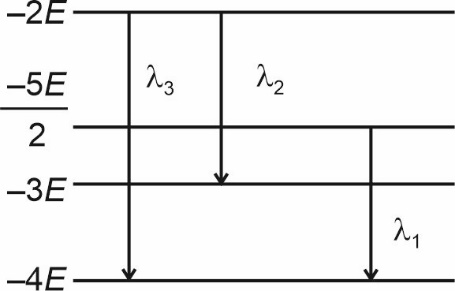
- 1,
- 2,
- 3,
- 4,
Show answer and solution
Correct: option 4, ,
The wavelength is . From the figure: is for , a gap of ; is for , a gap of ; is for , a gap of . So , , , which gives and .
Question 10NEET 2023, Q26
In hydrogen spectrum, the shortest wavelength in the Balmer series is . The shortest wavelength in the Bracket series is:
- 1
- 2
- 3
- 4
Show answer and solution
Correct: option 2,
The shortest wavelength (series limit) comes from : . For Balmer , so . For Brackett , so the wavelength is , option (2).
Question 11NEET 2023, Q49
The radius of inner most orbit of hydrogen atom is m. What is the radius of third allowed orbit of hydrogen atom?
- 10.53 Å
- 21.06 Å
- 31.59 Å
- 44.77 Å
Show answer and solution
Correct: option 4, 4.77 Å
In the Bohr model . For : m m Å, option (4).
Question 12NEET 2023 Manipur, Q9
The ground state energy of hydrogen atom is . The energy needed to ionize hydrogen atom from its second excited state will be
- 11.51 eV
- 23.4 eV
- 313.6 eV
- 46.8 eV
Show answer and solution
Correct: option 1, 1.51 eV
. The second excited state is , so . To ionize the atom the electron must be raised to zero energy, which needs 1.51 eV.
Question 13NEET 2023 Manipur, Q35
The wavelength of Lyman series of hydrogen atom appears in
- 1Ultraviolet region
- 2Infrared region
- 3Visible region
- 4Far infrared region
Show answer and solution
Correct: option 1, Ultraviolet region
Lyman lines come from transitions ending on . Their wavelengths lie between about 91 nm and 122 nm, which is in the ultraviolet region. The Balmer series is visible, and the Paschen, Brackett and Pfund series are infrared.
Question 14NEET 2023 Manipur, Q50
The angular momentum of an electron moving in an orbit of hydrogen atom is . The energy in the same orbit is nearly
- 1 eV
- 2 eV
- 3 eV
- 4 eV
Show answer and solution
Correct: option 3, eV
Bohr's condition is . Here , so . eV, nearly eV.
Question 15NEET 2022, Q34
Let and be the energy of an electron in the first and second excited states of hydrogen atom, respectively. According to the Bohr's model of an atom, the ratio is:
- 1
- 2
- 3
- 4
Show answer and solution
Correct: option 1,
The first excited state is and the second excited state is . Since eV, , option (1).
Question 16NEET 2022 Re-exam, Q2
Let be the radius of the second stationary orbit and be the radius of the fourth stationary orbit of an electron in Bohr's model. The ratio is:
- 14
- 20.25
- 30.5
- 42
Show answer and solution
Correct: option 2, 0.25
In Bohr's model the orbit radius is proportional to . So , option (2).
Question 17NEET 2020, Q177
For which one of the following, Bohr model is not valid?
- 1Hydrogen atom
- 2Singly ionised helium atom ()
- 3Deuteron atom
- 4Singly ionised neon atom ()
Show answer and solution
Correct: option 4, Singly ionised neon atom ()
Bohr's model works only for hydrogen-like systems, which have a single electron moving round the nucleus. The hydrogen atom, the deuterium atom and each have one electron. still has 9 electrons, and the model cannot deal with the forces between electrons, so it is not valid for .
Question 18NEET 2020 Phase 2, Q112
The total energy of an electron in the th stationary orbit of the hydrogen atom can be obtained by,
- 1
- 2
- 3
- 4
Show answer and solution
Correct: option 1,
In the Bohr model the energy of the electron in the th orbit of hydrogen is . The value is negative because the electron is bound to the nucleus, and the ground state () has energy .
Question 19NEET 2019, Q27
The total energy of an electron in an atom in an orbit is eV. Its kinetic and potential energies are, respectively:
- 1 eV, eV
- 2 eV, eV
- 33.4 eV, eV
- 43.4 eV, 3.4 eV
Show answer and solution
Correct: option 3, 3.4 eV, eV
For an electron in a Bohr orbit, and . With eV, eV and eV; their sum is eV as required.
Question 20NEET 2019 Odisha, Q15
The radius of the first permitted Bohr orbit, for the electron, in a hydrogen atom equals and its ground state energy equals eV. If the electron in the hydrogen atom is replaced by muon [charge same as electron and mass ], the first Bohr radius and ground state energy will be,
- 1 m, keV
- 2 m, eV
- 3 m, eV
- 4 m, eV
Show answer and solution
Correct: option 1, m, keV
In the Bohr model and . With a mass 207 times larger, the radius becomes about m and the energy becomes eV keV. (The options use the usual Bohr radius of 0.53 angstrom.)
Question 21NEET 2018, Q11
The ratio of kinetic energy to the total energy of an electron in a Bohr orbit of the hydrogen atom, is
- 1
- 2
- 3
- 4
Show answer and solution
Correct: option 2,
In a Bohr orbit and the potential energy is , so the total energy is . Therefore .
Question 22NEET 2017, Q13
The ratio of wavelengths of the last line of Balmer series and the last line of Lyman series is:
- 12
- 21
- 34
- 40.5
Show answer and solution
Correct: option 3, 4
The last line of a series is its series limit, a jump from . For Balmer, . For Lyman, . So .
Question 23NEET 2016 Phase 1, Q23
When an -particle of mass 'm' moving with velocity '' bombards on a heavy nucleus of charge 'Ze', its distance of closest approach from the nucleus depends on m as:
- 1
- 2
- 3
- 4
Show answer and solution
Correct: option 1,
At closest approach all the kinetic energy is electrostatic potential energy: . So .
Question 24NEET 2016 Phase 1, Q38
Given the value of Rydberg constant is , the wave number of the last line of the Balmer series in hydrogen spectrum will be:
- 1
- 2
- 3
- 4
Show answer and solution
Correct: option 3,
The last line (series limit) of the Balmer series is the transition from to . Its wave number is .
Question 25NEET 2016 Phase 2, Q41
If an electron in a hydrogen atom jumps from the 3rd orbit to the 2nd orbit, it emits a photon of wavelength . When it jumps from the 4th orbit to the 3rd orbit, the corresponding wavelength of the photon will be
- 1
- 2
- 3
- 4
Show answer and solution
Correct: option 3,
From the Rydberg formula, and . Dividing, , so , option (3).
Question 26AIPMT 2015, Q146
Consider 3rd orbit of (Helium), using non-relativistic approach, the speed of electron in this orbit will be [given constant, and h (Planck's Constant) ]
- 1
- 2
- 3
- 4
Show answer and solution
Correct: option 1,
In the Bohr model the speed in the nth orbit of a hydrogen-like ion is . With and : . Equivalently it is of the hydrogen ground state speed . Option (1).
Question 27AIPMT 2015 Re-test, Q136
In the spectrum of hydrogen, the ratio of the longest wavelength in the Lyman series to the longest wavelength in the Balmer series is:
- 1
- 2
- 3
- 4
Show answer and solution
Correct: option 1,
The longest wavelength of a series comes from the smallest jump. Lyman (): . Balmer (): . So .
Question 28AIPMT 2014, Q103
Hydrogen atom in ground state is excited by a monochromatic radiation of . Number of spectral lines in the resulting spectrum emitted will be:
- 110
- 23
- 32
- 46
Show answer and solution
Correct: option 4, 6
Photon energy . From the ground state () this lifts the atom to , which is the level . The number of lines emitted as it returns is , option (4).
Question 29NEET 2013, Q174
Ratio of longest wave lengths corresponding to Lyman and Balmer series in hydrogen spectrum is:
- 1
- 2
- 3
- 4
Show answer and solution
Correct: option 4,
The longest wavelength of a series comes from the smallest jump. Lyman (): . Balmer (): . So .
Question 30NEET 2013 Karnataka, Q156
An electron in hydrogen atom makes a transition where and are principal quantum numbers of the two states. Assuming Bohr's model to be valid, the time period of the electron in the initial state is eight times that in the final state. The possible values of and are:
- 1 and
- 2 and
- 3 and
- 4 and
Show answer and solution
Correct: option 4, and
In the Bohr model and , so the period . Then gives , which only , satisfies.
Question 31AIPMT 2012 Prelims, Q1
Electron in hydrogen atom first jumps from third excited state to second excited state and then from second excited to the first excited state. The ratio of the wavelength emitted in the two cases is
- 17/5
- 227/20
- 327/5
- 420/7
Show answer and solution
Correct: option 4, 20/7
The third, second and first excited states are , and . For each jump , so and . Hence .
Question 32AIPMT 2012 Prelims, Q23
An electron of a stationary hydrogen atom passes from the fifth energy level to the ground level. The velocity that the atom acquired as a result of photon emission will be:
(m is the mass of the electron, R, Rydberg constant and h Planck's constant)
- 1
- 2
- 3
- 4
Show answer and solution
Correct: option 1,
The emitted photon has and momentum . The atom was at rest, so it recoils with equal and opposite momentum: , giving .
Question 33AIPMT 2012 Mains, Q27
The transition from the state n = 3 to n = 1 in a hydrogen like atom results in ultraviolet radiation. Infrared radiation will be obtained in the transition from:
- 1
- 2
- 3
- 4
Show answer and solution
Correct: option 4,
Infrared photons have less energy than ultraviolet ones, so the transition must release much less energy than . The energy released is proportional to , which is smallest for () among the options. Transitions ending on n = 3 form the Paschen series, which lies in the infrared for hydrogen.
Question 34AIPMT 2011 Prelims, Q156
The wavelength of the first line of Lyman series for hydrogen atom is equal to that of the second line of Balmer series for a hydrogen like ion. The atomic number Z of hydrogen like ion is:
- 13
- 24
- 31
- 42
Show answer and solution
Correct: option 4, 2
First Lyman line of hydrogen (): . Second Balmer line of the ion (): . Equating the two gives , so .
Question 35AIPMT 2011 Mains, Q113
An electron in the hydrogen atom jumps from excited state n to the ground state. The wavelength so emitted illuminates a photosensitive material having work function 2.75 eV. If the stopping potential of the photoelectron is 10 V, the value of n is:
- 13
- 24
- 35
- 42
Show answer and solution
Correct: option 2, 4
The photon energy is the work function plus the maximum kinetic energy: eV. For a jump from level n to the ground state, , so and .
Question 36AIPMT 2011 Mains, Q117
Out of the following which one is not a possible energy for a photon to be emitted by hydrogen atom according to Bohr's atomic model?
- 11.9 eV
- 211.1 eV
- 313.6 eV
- 40.65 eV
Show answer and solution
Correct: option 2, 11.1 eV
The hydrogen levels are , , , eV and so on, and a photon carries the difference between two levels. 1.9 eV is the 3 to 2 jump, 0.65 eV is close to the 4 to 3 jump (0.66 eV) and 13.6 eV is the series limit to the ground state. Jumps to the ground state give 10.2 eV, 12.09 eV, 12.75 eV, ..., and no pair of levels differs by 11.1 eV.
Question 37AIPMT 2010 Mains, Q19
The electron in the hydrogen atom jumps from excited state (n = 3) to its ground state (n = 1) and the photons thus emitted irradiate a photosensitive material. If the work function of the material is 5.1 eV, the stopping potential is estimated to be (the energy of the electron in nth state eV)
- 15.1 V
- 212.1 V
- 317.2 V
- 47V
Show answer and solution
Correct: option 4, 7V
The photon energy is eV. The maximum kinetic energy of the photoelectrons is eV, and the stopping potential is this energy divided by the electron charge, that is 7 V.
Question 38AIPMT 2010 Prelims, Q30
The energy of a hydrogen atom in the ground state is eV. The energy of a ion in the first excited state will be
- 1 eV
- 2 eV
- 3 eV
- 4 eV
Show answer and solution
Correct: option 1, eV
For a hydrogen-like ion eV. For , Z = 2, and the first excited state is n = 2, so eV.
Question 39AIPMT 2010 Prelims, Q34
An alpha nucleus of energy bombards a heavy nuclear target of charge Ze. Then the distance of closest approach for the alpha nucleus will be proportional to
- 1
- 2
- 3
- 4
Show answer and solution
Correct: option 3,
At the distance of closest approach d all the kinetic energy has become electrostatic potential energy: . So , which is proportional to Ze, to and to . Only is among the options.
Question 40AIPMT 2009 Prelims, Q29
In a Rutherford scattering experiment when a projectile of charge and mass approaches a target nucleus of charge and mass , the distance of closest approach is . The energy of the projectile is:
- 1directly proportional to
- 2inversely proportional to
- 3directly proportional to mass
- 4directly proportional to
Show answer and solution
Correct: option 1, directly proportional to
At the distance of closest approach all the kinetic energy of the projectile has become electrostatic potential energy: . For a given the energy is therefore directly proportional to and does not depend on the masses.
Question 41AIPMT 2009 Prelims, Q47
The ionization energy of the electron in the hydrogen atom in its ground state is 13.6 eV. The atoms are excited to higher energy levels to emit radiations of 6 wavelengths. Maximum wavelength of emitted radiation corresponds to the transition between:
- 1n = 3 to n = 1 states
- 2n = 2 to n = 1 states
- 3n = 4 to n = 3 states
- 4n = 3 to n = 2 states
Show answer and solution
Correct: option 3, n = 4 to n = 3 states
Atoms excited to level can emit different lines; 6 lines means . The longest wavelength belongs to the transition with the smallest energy gap, which among levels 1 to 4 is n = 4 to n = 3.
Question 42AIPMT 2008 Prelims, Q40
In the phenomenon of electric discharge through gases at low pressure, the coloured glow in the tube appears as a result of
- 1Collision between different electrons of the atoms of the gas
- 2Excitation of electrons in the atoms
- 3Collision between the atoms of the gas
- 4Collisions between the charged particles emitted from the cathode and the atoms of the gas
Show answer and solution
Correct: option 2, Excitation of electrons in the atoms
The light of a discharge tube is emitted by the gas atoms themselves: their electrons are raised to higher energy levels and give out light of colours characteristic of the gas when they fall back. The key therefore takes excitation of electrons in the atoms as the cause of the glow. (The excitation is itself produced by collisions with the fast charged particles in the tube, which is why option 4 is a tempting choice.)
Question 43AIPMT 2008 Prelims, Q43
The ground state energy of hydrogen atom is -13.6 eV. When its electron is in the first excited state, its excitation energy is
- 10
- 23.4 eV
- 36.8 eV
- 410.2 eV
Show answer and solution
Correct: option 4, 10.2 eV
The first excited state is , with energy eV. Excitation energy is the energy needed to lift the electron there from the ground state: eV.
Question 44AIPMT 2007 Prelims, Q196
The total energy of electron in the ground state of hydrogen atom is -13.6 eV. The kinetic energy of an electron in the first excited state is
- 11.7 eV
- 23.4 eV
- 36.8 eV
- 413.6 eV
Show answer and solution
Correct: option 2, 3.4 eV
The first excited state is n = 2, where the total energy is eV. In a Bohr orbit the kinetic energy equals minus the total energy, so the kinetic energy is 3.4 eV, option (2).
Question 45AIPMT 2006 Prelims, Q12
Ionization potential of hydrogen atom is 13.6 eV. Hydrogen atoms in the ground state are excited by monochromatic radiation of photon energy 12.1 eV. According to Bohr's theory, the spectral lines emitted by hydrogen will be:-
- 1Two
- 2Three
- 3Four
- 4One
Show answer and solution
Correct: option 2, Three
The atom's energy after absorbing the photon is , which is the level (). From the possible transitions are , and , so spectral lines are emitted.
Question 46AIPMT 2005 Prelims, Q37
The total energy of an electron in the first excited state of hydrogen atom is about –3.4eV. Its kinetic energy in this state is
- 1–6.8 eV
- 23.4 eV
- 36.8 eV
- 4–3.4 eV
Show answer and solution
Correct: option 2, 3.4 eV
In a Bohr orbit the kinetic energy equals the negative of the total energy (and the potential energy is twice the total energy). So the kinetic energy is –(–3.4 eV) = 3.4 eV.
Question 47AIPMT 2005 Prelims, Q46
Energy levels A, B and C of a certain atom correspond to increasing values of energy i.e. . If , and are wave lengths of radiations corresponding to transitions C to B, B to A and C to A respectively, which of the following relations is correct
- 1
- 2
- 3
- 4
Show answer and solution
Correct: option 4,
Energies add: , so . This gives , that is .
Question 48AIPMT 2004 Prelims, Q36
Energy E of a hydrogen atom with principal quantum number n is given by eV. The energy of a photon ejected when the electron jumps from n = 3 state to n = 2 state of hydrogen is approximately:-
- 10.85 eV
- 23.4 eV
- 31.9 eV
- 41.5 eV
Show answer and solution
Correct: option 3, 1.9 eV
eV and eV. The photon carries away the difference, eV.
Question 49AIPMT 2004 Prelims, Q42
The Bohr model of atoms:-
- 1Uses Einstein's photo electric equation
- 2Predicts continuous emission spectra for atoms
- 3Predicts the same emission spectra for all types of atoms
- 4Assumes that the angular momentum of electrons is quantized
Show answer and solution
Correct: option 4, Assumes that the angular momentum of electrons is quantized
Bohr's postulate is that an electron can revolve only in orbits for which its angular momentum is a whole multiple of . The model gives line (not continuous) spectra that differ from atom to atom, and it does not use the photoelectric equation.
Question 50AIPMT 2003 Prelims, Q38
In which of the following systems will be radius of the first orbit (n = 1) be minimum -
- 1Doubly ionized lithium
- 2Singly ionized helium
- 3Deuterium atom
- 4Hydrogen atom
Show answer and solution
Correct: option 1, Doubly ionized lithium
For a one-electron system the Bohr radius is angstrom, so for it is smallest for the largest . Doubly ionized lithium has , against 2 for and 1 for hydrogen and deuterium.
Question 51AIPMT 2002 Prelims, Q52
In Hydrogen atom, energy of first excited state is eV. Then find out KE of same orbit of Hydrogen atom:
- 1 eV
- 2 eV
- 3 eV
- 4 eV
Show answer and solution
Correct: option 1, eV
In a Bohr orbit the kinetic energy equals minus the total energy: and . With eV, the kinetic energy is eV.
Question 52AIPMT 2001 Prelims, Q41
The energy of hydrogen atom in nth orbit is then the energy in nth orbit of singly ionised helium atom will be:
- 1
- 2
- 3
- 4
Show answer and solution
Correct: option 1,
For a one-electron atom the energy of the nth orbit is proportional to . Singly ionised helium has one electron and , so its energy is times that of hydrogen: .
Question 53AIPMT 2000 Prelims, Q15
Maximum frequency of emission is obtained for the transition:
- 1n = 2 to n = 1
- 2n = 6 to n = 2
- 3n = 1 to n = 2
- 4n = 2 to n = 6
Show answer and solution
Correct: option 1, n = 2 to n = 1
Emission needs a jump from a higher to a lower level, so only options (1) and (2) are emissions. Energy released for is eV, and for is eV. The larger energy means the larger frequency, so to .
Question 54AIPMT 2000 Prelims, Q48
When an electron do transition from n = 4 to n = 2, then emitted line in spectrum will be:
- 1First line of Lyman series
- 2Second line of Balmer series
- 3First line of Paschen series
- 4Second line of Paschen series
Show answer and solution
Correct: option 2, Second line of Balmer series
Lines ending on belong to the Balmer series. The first Balmer line is and the second is .
Question 55AIPMT 1998 Prelims, Q39
In the Bohr model of H-atom, an electron (e) is revolving around a proton (p) with velocity v, if r is the radius of orbit and m is mass and is vacuum permittivity, the value of v is:
- 1
- 2
- 3
- 4
Show answer and solution
Correct: option 1,
The Coulomb attraction provides the centripetal force: . So and .