Questions with solutions
Question 1NEET 2026, Q14
The magnitude and direction of the acceleration produced in a body of mass when two mutually perpendicular forces and act on it, are respectively:
- 1; with 6 N force
- 2; with 8 N force
- 3; with 8 N force
- 4; with 8 N force
Show answer and solution
Correct: option 3, ; with 8 N force
The resultant force is , so . The angle it makes with the 8 N force satisfies , so the direction is with the 8 N force.
Question 2NEET 2026, Q35
A box of mass is kept on the floor of a stationary trolley. The coefficient of static friction between the box and the trolley is 0.12. Keeping the box in stationary state over the trolley, the maximum acceleration with which the trolley can be moved horizontally in is:
()
- 11.5
- 21.8
- 32.1
- 41.2
Show answer and solution
Correct: option 4, 1.2
Static friction is the only horizontal force on the box, so it must supply the box's acceleration: . The maximum acceleration is , whatever the mass.
Question 3NEET 2026 Re-exam, Q41
A car travels on a circular racetrack of radius 50 m, which is banked at an angle . If the car travels at a speed , then the wear and tear on its tyres is minimum. Taking the acceleration due to gravity to be , the value of is:
- 1
- 2
- 3
- 4
Show answer and solution
Correct: option 1,
Wear and tear is least when no friction is needed, that is when the horizontal part of the normal force alone supplies the centripetal force. Then , option (1).
Question 4NEET 2025, Q4
There are two inclined surfaces of equal length () and same angle of inclination with the horizontal. One of them is rough and the other is perfectly smooth. A given body takes 2 times as much time to slide down on rough surface than on the smooth surface. The coefficient of kinetic friction () between the object and the rough surface is close to
- 10.25
- 20.40
- 30.5
- 40.75
Show answer and solution
Correct: option 4, 0.75
Starting from rest, , so for the same length and the rough incline has one quarter of the smooth incline's acceleration. On the smooth incline ; on the rough one . So and , option (4).
Question 5NEET 2025, Q10
A ball of mass 0.5 kg is dropped from a height of 40 m. The ball hits the ground and rises to a height of 10 m. The impulse imparted to the ball during its collision with the ground is (Take g = 9.8 )
- 121 NS
- 27 NS
- 30
- 484 NS
Show answer and solution
Correct: option 1, 21 NS
The speed just before hitting is downward, and just after it is upward. The impulse is the change in momentum, N s, option (1).
Question 6NEET 2024, Q25
A bob is whirled in a horizontal plane by means of a string with an initial speed of rpm. The tension in the string is . If speed becomes while keeping the same radius, the tension in the string becomes:
- 1
- 2
- 3
- 4
Show answer and solution
Correct: option 3,
The tension supplies the centripetal force, . With the radius fixed, , so doubling the angular speed makes the tension times, that is , option (3).
Question 7NEET 2024, Q31
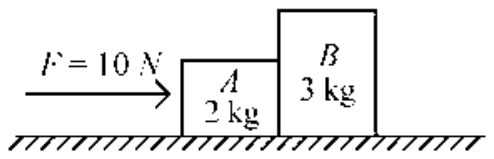
A horizontal force is applied to a block as shown in figure. The mass of blocks and are 2 kg and 3 kg, respectively. The blocks slide over a frictionless surface. The force exerted by block on block is:
- 1
- 2zero
- 3
- 4
Show answer and solution
Correct: option 4,
Both blocks move together with acceleration . The only horizontal force on is the push from , so that force is N, option (4).
Question 8NEET 2024 Re-exam, Q2
A bob is whirled in a horizontal circle by means of a string at an initial speed of 10 rpm. If the tension in the string is quadrupled while keeping the radius constant, the new speed is:
- 120 rpm
- 240 rpm
- 35 rpm
- 410 rpm
Show answer and solution
Correct: option 1, 20 rpm
The tension supplies the centripetal force, , so at a fixed radius . Making the tension four times larger doubles the angular speed: rpm.
Question 9NEET 2024 Re-exam, Q35
A box of mass 5 kg is pulled by a cord, up along a frictionless plane inclined at 30° with the horizontal. The tension in the cord is 30 N. The acceleration of the box is (Take )
- 1
- 2Zero
- 3
- 4
Show answer and solution
Correct: option 4,
Along the incline, . So , giving up the plane.
Question 10NEET 2023, Q4
A football player is moving southward and suddenly turns eastward with the same speed to avoid an opponent. The force that acts on the player while turning is:
- 1along eastward
- 2along northward
- 3along north-east
- 4along south-west
Show answer and solution
Correct: option 3, along north-east
Force is along the change in velocity. The change is (final velocity, east) minus (initial velocity, south), which is a vector of equal parts east and north. So the force is along north-east, option (3).
Question 11NEET 2023, Q47
Calculate the maximum acceleration of a moving car so that a body lying on the floor of the car remains stationary. The coefficient of static friction between the body and the floor is 0.15 ().
- 1
- 2
- 3
- 4
Show answer and solution
Correct: option 3,
Static friction is the only horizontal force on the body, so it must supply . Its largest value is , hence , option (3).
Question 12NEET 2023 Manipur, Q37
A 1 kg object strikes a wall with velocity at an angle of with the wall and reflects at the same angle. If it remains in contact with wall for 0.1 s, then the force exerted on the wall is
- 1 N
- 2 N
- 3 N
- 4Zero
Show answer and solution
Correct: option 1, N
Only the velocity component perpendicular to the wall is reversed. That component is , so the change in momentum is . N.
Question 13NEET 2023 Manipur, Q48
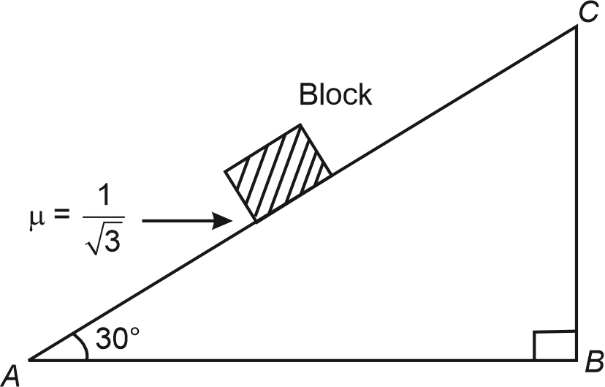
A block of mass 2 kg is placed on an inclined rough surface AC (as shown in figure) of coefficient of friction . If , the net force (in N) on the block will be
- 110
- 220
- 3
- 4Zero
Show answer and solution
Correct: option 4, Zero
The pull down the slope is N. The largest friction available is N. Friction can just balance the pull down the slope, so the block stays at rest and the net force on it is zero.
Question 14NEET 2022, Q20
A shell of mass m is at rest initially. It explodes into three fragments having mass in the ratio . If the fragments having equal mass fly off along mutually perpendicular directions with speed , the speed of the third (lighter) fragment is:
- 1
- 2
- 3
- 4
Show answer and solution
Correct: option 4,
The masses are , and . The two equal fragments have momenta at right angles, with resultant . Total momentum is zero, so the third fragment carries an equal and opposite momentum: , giving , option (4).
Question 15NEET 2022 Re-exam, Q7
The distance covered by a body of mass 5 g having linear momentum 0.3 kg m/s in 5 s is
- 10.3 m
- 2300 m
- 330 m
- 43 m
Show answer and solution
Correct: option 2, 300 m
Speed . With constant momentum the speed is constant, so the distance in 5 s is m, option (2).
Question 16NEET 2022 Re-exam, Q31
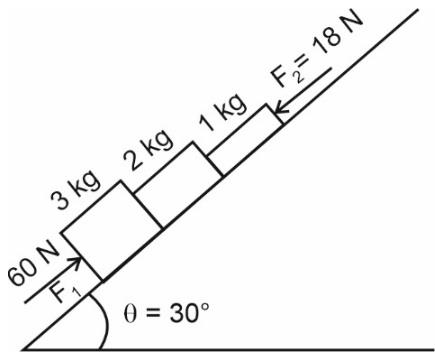
In the diagram shown, the normal reaction force between 2 kg and 1 kg is (Consider the surface, to be smooth):
Given
- 110 N
- 225 N
- 339 N
- 46 N
Show answer and solution
Correct: option 2, 25 N
Take up the incline as positive. For the three blocks together (6 kg): , so . For the 1 kg block, the 2 kg block pushes it up with , while N and its weight component N act down: , so N, option (2).
Question 17NEET 2021, Q45
A ball of mass 0.15 kg is dropped from a height 10 m, strikes the ground and rebounds to the same height. The magnitude of impulse imparted to the ball is () nearly:
- 10 kg m/s
- 24.2 kg m/s
- 32.1 kg m/s
- 41.4 kg m/s
Show answer and solution
Correct: option 2, 4.2 kg m/s
Speed just before impact: m/s. It rebounds to the same height, so it leaves with the same speed in the opposite direction. Impulse = change in momentum kg m/s.
Question 18NEET 2020, Q148
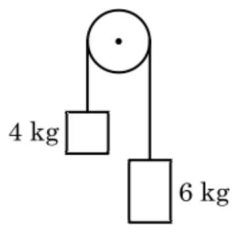
Two bodies of mass 4 kg and 6 kg are tied to the ends of a massless string. The string passes over a pulley which is frictionless (see figure). The acceleration of the system in terms of acceleration due to gravity (g) is:
- 1g
- 2g/2
- 3g/5
- 4g/10
Show answer and solution
Correct: option 3, g/5
The heavier body goes down and the lighter one goes up with the same acceleration. The net driving force is and the total mass moved is , so .
Question 19NEET 2020 Phase 2, Q124
A point mass 'm' is moved in a vertical circle of radius 'r' with the help of a string. The velocity of the mass is at the lowest point. The tension in the string at the lowest point is
- 17 mg
- 28 mg
- 31 mg
- 46 mg
Show answer and solution
Correct: option 2, 8 mg
At the lowest point the tension acts up and the weight acts down, and their resultant supplies the centripetal force: . With , .
Question 20NEET 2020 Phase 2, Q134
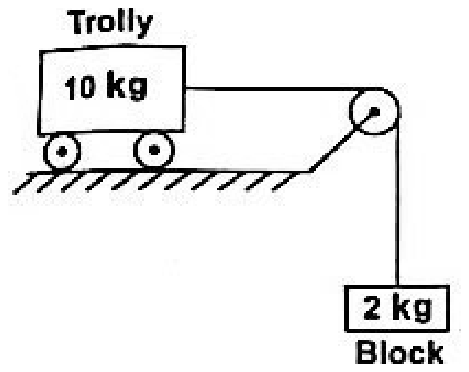
Calculate the acceleration of the block and trolly system shown in the figure. The coefficient of kinetic friction between the trolly and the surface is 0.05. (, mass of the string is negligible and no other friction exists).
- 1
- 2
- 3
- 4
Show answer and solution
Correct: option 4,
The weight of the 2 kg block, , pulls the system, and friction on the 10 kg trolly, , opposes it. The whole 12 kg moves together, so .
Question 21NEET 2019, Q2
A mass m is attached to a thin wire and whirled in a vertical circle. The wire is most likely to break when:
- 1the mass is at the highest point
- 2the wire is horizontal
- 3the mass is at the lowest point
- 4inclined at an angle of from vertical
Show answer and solution
Correct: option 3, the mass is at the lowest point
At an angle from the lowest point the tension is . At the lowest point the speed is greatest and the weight acts fully against the tension, so is maximum there and the wire is most likely to break.
Question 22NEET 2019, Q30
When an object is shot from the bottom of a long smooth inclined plane kept at an angle with horizontal, it can travel a distance along the plane. But when the inclination is decreased to and the same object is shot with the same velocity, it can travel distance. Then will be:
- 1
- 2
- 3
- 4
Show answer and solution
Correct: option 3,
On a smooth incline the retardation is , so the distance travelled is . Hence .
Question 23NEET 2019, Q33
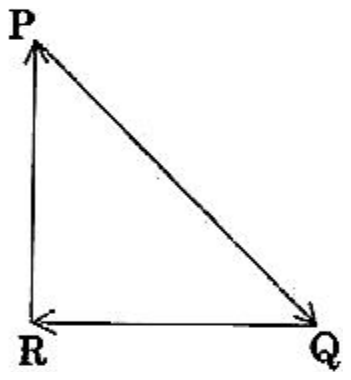
A particle moving with velocity is acted by three forces shown by the vector triangle PQR. The velocity of the particle will:
- 1increase
- 2decrease
- 3remain constant
- 4change according to the smallest force
Show answer and solution
Correct: option 3, remain constant
The three forces are represented by the sides of a triangle taken in order (P to Q, Q to R, R to P), so by the triangle law their vector sum is zero. With zero net force there is no acceleration and the velocity remains constant.
Question 24NEET 2019, Q35
A block of mass 10 kg is in contact against the inner wall of a hollow cylindrical drum of radius 1 m. The coefficient of friction between the block and the inner wall of the cylinder is 0.1. The minimum angular velocity needed for the cylinder to keep the block stationary when the cylinder is vertical and rotating about its axis, will be: ()
- 1 rad/s
- 2 rad/s
- 310 rad/s
- 4 rad/s
Show answer and solution
Correct: option 3, 10 rad/s
The normal force from the wall supplies the centripetal force, , and friction must hold up the weight: . So rad/s.
Question 25NEET 2019 Odisha, Q4
A truck is stationary and has a bob suspended by a light string, in a frame attached to the truck. The truck, suddenly moves to the right with an acceleration of . The pendulum will tilt
- 1to the left and angle of inclination of the pendulum with the vertical is
- 2to the left and angle of inclination of the pendulum with the vertical is
- 3to the left and angle of inclination of the pendulum with the vertical is
- 4to the left and angle of inclination of the pendulum with the vertical is
Show answer and solution
Correct: option 4, to the left and angle of inclination of the pendulum with the vertical is
In the truck's frame a pseudo force acts on the bob towards the left, so it swings to the left. In equilibrium and , so and .
Question 26NEET 2019 Odisha, Q9
An object flying in air with velocity suddenly breaks into two pieces whose masses are in the ratio 1:5. The smaller mass flies off with a velocity . The velocity of the larger piece will be,
- 1
- 2
- 3
- 4
Show answer and solution
Correct: option 3,
Take the masses as and . Momentum is conserved: . So and .
Question 27NEET 2019 Odisha, Q33
A body of mass is kept on a rough horizontal surface (coefficient of friction = ). A horizontal force is applied on the body, but it does not move. The resultant of normal reaction and the frictional force acting on the object is given by , where is,
- 1
- 2
- 3
- 4
Show answer and solution
Correct: option 1,
The normal reaction is and, since the body does not move, the friction is static with . The two are perpendicular, so .
Question 28NEET 2018, Q33
Which one of the following statements is incorrect ?
- 1Frictional force opposes the relative motion.
- 2Limiting value of static friction is directly proportional to normal reaction.
- 3Rolling friction is smaller than sliding friction.
- 4Coefficient of sliding friction has dimensions of length.
Show answer and solution
Correct: option 4, Coefficient of sliding friction has dimensions of length.
The coefficient of friction is the ratio of two forces, , so it has no dimensions. Statement (4) is therefore incorrect; the other three statements are true.
Question 29NEET 2018, Q35
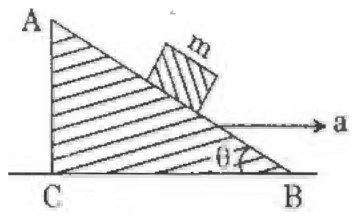
A block of mass m is placed on a smooth inclined wedge ABC of inclination as shown in the figure. The wedge is given an acceleration 'a' towards the right. The relation between a and for the block to remain stationary on the wedge is
- 1
- 2
- 3
- 4
Show answer and solution
Correct: option 4,
In the frame of the wedge the block feels a pseudo force ma opposite to the acceleration. Along the incline, the component of the pseudo force must balance the component of weight: . So .
Question 30NEET 2017, Q7
One end of string of length is connected to a particle of mass 'm' and the other end is connected to a small peg on a smooth horizontal table. If the particle moves in circle with speed '', the net force on the particle (directed towards center) will be (T represents the tension in the string)
- 1T
- 2
- 3
- 4Zero
Show answer and solution
Correct: option 1, T
On a smooth horizontal table the weight is balanced by the normal force, and the only horizontal force is the tension. So the net force towards the centre is T. The quantity is not an extra force; it is the value this net force must have, so .
Question 31NEET 2017, Q36
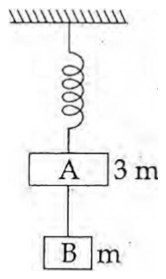
Two blocks A and B of masses 3m and m respectively are connected by a massless and inextensible string. The whole system is suspended by a massless spring as shown in figure. The magnitudes of acceleration of A and B immediately after the string is cut, are respectively:
- 1
- 2
- 3
- 4
Show answer and solution
Correct: option 2,
Before the cut the spring holds both blocks, so its force is 4mg upward. Just after the cut the spring has not yet changed length, so it still pulls A up with 4mg while A's weight is 3mg: (upward). B has only its weight acting, so it falls freely with .
Question 32NEET 2016 Phase 1, Q45
A car is negotiating a curved road of radius R. The road is banked at an angle . The coefficient of friction between the tyres of the car and the road is . The maximum safe velocity on this road is:
- 1
- 2
- 3
- 4
Show answer and solution
Correct: option 2,
At the maximum speed friction acts down the slope. Vertically and horizontally . Dividing gives .
Question 33NEET 2016 Phase 2, Q4
A rigid ball of mass strikes a rigid wall at and gets reflected without loss of speed as shown in the figure below. The value of impulse imparted by the wall on the ball will be
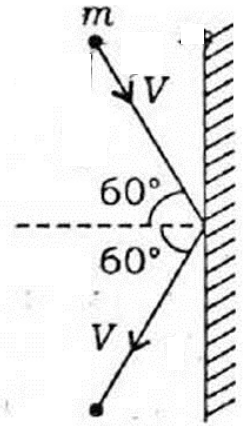
- 1
- 2
- 3
- 4
Show answer and solution
Correct: option 1,
In the figure the velocity makes with the normal to the wall before and after the hit. The component along the wall is unchanged, while the component along the normal, , is reversed. Impulse = change in momentum , option (1).
Question 34AIPMT 2015, Q158
A block A of mass rests on a horizontal table. A light string connected to it passes over a frictionless pulley at the edge of table and from its other end another block B of mass is suspended. The coefficient of kinetic friction between the block and the table is . When the block A is sliding on the table, the tension in the string is:-
- 1
- 2
- 3
- 4
Show answer and solution
Correct: option 2,
For B: . For A, with friction opposing the motion: . Adding gives . Then , option (2).
Question 35AIPMT 2015, Q173
Three blocks A, B and C of masses 4 kg, 2 kg and 1 kg respectively, are in contact on a frictionless surface, as shown. If a force of 14 N is applied on the 4 kg block, then the contact force between A and B is:
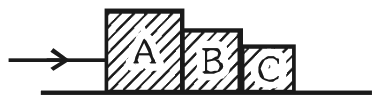
- 16 N
- 28 N
- 318 N
- 42 N
Show answer and solution
Correct: option 1, 6 N
All three blocks move together with acceleration . The contact force from A on B is the only horizontal force pushing B and C forward, so it must accelerate their combined mass of 3 kg: , option (1). Check on A: .
Question 36AIPMT 2015 Re-test, Q163
A plank with a box on it at one end is gradually raised about the other end. As the angle of inclination with the horizontal reaches , the box starts to slip and slides 4.0 m down the plank in 4.0 s. The coefficients of static and kinetic friction between the box and the plank will be, respectively:
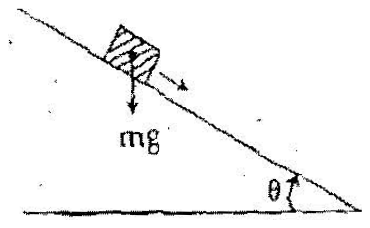
- 10.4 and 0.3
- 20.6 and 0.6
- 30.6 and 0.5
- 40.5 and 0.6
Show answer and solution
Correct: option 3, 0.6 and 0.5
The box just starts to slip at the angle of repose, so . Sliding from rest, gives . From : , so .
Question 37AIPMT 2015 Re-test, Q164
Two stones of masses m and 2 m are whirled in horizontal circles, the heavier one in a radius and the lighter one in radius r. The tangential speed of lighter stone is n times that of the value of heavier stone when they experience same centripetal forces. The value of n is:
- 11
- 22
- 33
- 44
Show answer and solution
Correct: option 2, 2
Centripetal force is . Lighter stone: . Heavier stone: . Equating, , so and .
Question 38AIPMT 2014, Q95
A system consists of three masses , and connected by a string passing over a pulley P. The mass hangs freely and and are on a rough horizontal table (the coefficient of friction = ).
The pulley is frictionless and of negligible mass. The downward acceleration of mass is:
(Assume )
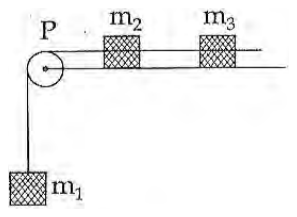
- 1
- 2
- 3
- 4
Show answer and solution
Correct: option 4,
Treat the three masses as one system of mass . The driving force is the weight of the hanging mass and the opposing force is the friction on the two blocks on the table, . So , option (4).
Question 39AIPMT 2014, Q110
A balloon with mass 'm' is descending down with an acceleration 'a' (where a < g). How much mass should be removed from it so that it starts moving up with an acceleration 'a'?
- 1
- 2
- 3
- 4
Show answer and solution
Correct: option 2,
Let the upthrust be (it stays the same). Going down: , so . After removing mass and going up: , so . Hence , option (2).
Question 40AIPMT 2014, Q129
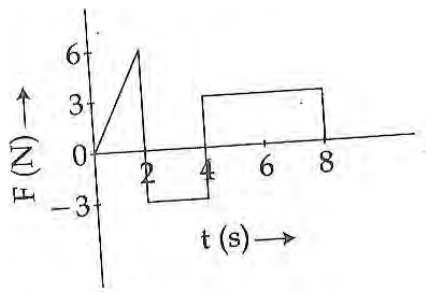
The force 'F' acting on a particle of mass 'm' is indicated by the force-time graph shown below. The change in momentum of the particle over the time interval from zero to 8 s is:
- 16 Ns
- 224 Ns
- 320 Ns
- 412 Ns
Show answer and solution
Correct: option 4, 12 Ns
Change in momentum equals the area under the force-time graph. From 0 to 2 s: a triangle of height 6 N, area . From 2 to 4 s: . From 4 to 8 s: . Total , option (4).
Question 41NEET 2013, Q139
The upper half of an inclined plane of inclination is perfectly smooth while lower half is rough. A block starting from rest at the top of the plane will again come to rest at the bottom, if the coefficient of friction between the block and lower half of the plane is given by:
- 1
- 2
- 3
- 4
Show answer and solution
Correct: option 2,
Let the plane have length . The block starts and ends at rest, so the work done by gravity over the whole length equals the work done against friction over the lower half: . This gives .
Question 42NEET 2013, Q155
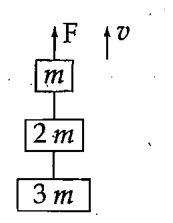
Three blocks with masses , and are connected by strings, as shown in the figure. After an upward force F is applied on block , the masses move upward at constant speed . What is the net force on the block of mass ?
(g is the acceleration due to gravity)
- 1
- 2
- 3
- 4zero
Show answer and solution
Correct: option 4, zero
Every block moves at constant speed, so its acceleration is zero. By Newton's second law the net force on each block, including the one of mass , is zero.
Question 43NEET 2013, Q158
An explosion breaks a rock into three parts in a horizontal plane. Two of them go off at right angles to each other. The first part of mass 1 kg moves with a speed of and the second part of mass 2 kg moves with speed. If the third part flies off with speed, then its mass is:
- 15 kg
- 27 kg
- 317 kg
- 43 kg
Show answer and solution
Correct: option 1, 5 kg
The rock was at rest, so the momentum of the third part must balance the resultant of the other two. Their momenta are and at right angles, giving a resultant of . So and kg.
Question 44NEET 2013 Karnataka, Q148
A car is moving in a circular horizontal track of radius 10 m with a constant speed of 10 m/s. A bob is suspended from the roof of the car by a light wire of length 1.0 m. The angle made by the wire with the vertical is:
- 1
- 2
- 3
- 4
Show answer and solution
Correct: option 3,
For the bob, and , so (taking ). Hence .
Question 45NEET 2013 Karnataka, Q157
A person holding a rifle (mass of person and rifle together is 100 kg) stands on a smooth surface and fires 10 shots horizontally, in 5 s. Each bullet has a mass of 10 g with a muzzle velocity of . The final velocity acquired by the person and the average force exerted on the person are:
- 1;
- 2;
- 3;
- 4;
Show answer and solution
Correct: option 2, ;
The examiners dropped this question and gave every candidate the 4 marks.
The answer key marks this question as a bonus, so every candidate gets the marks. The ten bullets carry a momentum of , so the 100 kg person recoils at about , and the average force is . No option gives both values; option (2) is shown only because it has the right velocity.
Question 46AIPMT 2012 Prelims, Q27
A car of mass 1000 kg negotiates a banked curve of radius 90 m on a frictionless road. If the banking angle is 45°, the speed of the car is:
- 1
- 2
- 3
- 4
Show answer and solution
Correct: option 2,
On a frictionless banked road the horizontal part of the normal force supplies the centripetal force, which gives . So . The mass of the car does not matter.
Question 47AIPMT 2012 Mains, Q3
A car of mass m is moving on a level circular track of radius R. If represents the static friction between the road and tyres of the car, the maximum speed of the car in circular motion is given by:
- 1
- 2
- 3
- 4
Show answer and solution
Correct: option 4,
On a level road the centripetal force comes only from static friction, whose largest value is . Setting gives ; the mass cancels.
Question 48AIPMT 2011 Prelims, Q179
A person of mass 60 kg is inside a lift of mass 940 kg and presses the button on control panel. The lift starts moving upwards with an acceleration . If , the tension in the supporting cable is:
- 18600 N
- 29680 N
- 311000 N
- 41200 N
Show answer and solution
Correct: option 3, 11000 N
Treat the lift and the person as one body of mass kg. , so N.
Question 49AIPMT 2011 Prelims, Q193
A body of mass M hits normally a rigid wall with velocity V and bounces back with the same velocity. The impulse experienced by the body is:
- 1MV
- 21.5 MV
- 32 MV
- 4Zero
Show answer and solution
Correct: option 3, 2 MV
Impulse equals the change in momentum. The momentum goes from towards the wall to away from it, a change of in magnitude.
Question 50AIPMT 2011 Mains, Q107
A conveyor belt is moving at a constant speed of 2m/s. A box is gently dropped on it. The coefficient of friction between them is . The distance that the box will move relative to belt before coming to rest on it taking , is:
- 11.2 m
- 20.6 m
- 3zero
- 40.4 m
Show answer and solution
Correct: option 4, 0.4 m
Seen from the belt, the box starts with a speed of 2 m/s backwards and kinetic friction slows it at . It stops relative to the belt after sliding m.
Question 51AIPMT 2010 Prelims, Q1
A block of mass m is in contact with the cart C as shown in the figure.
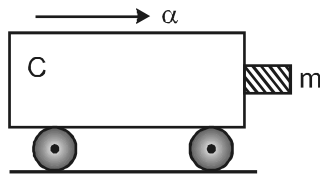
The coefficient of static friction between the block and the cart is . The acceleration of the cart that will prevent the block from falling satisfies
- 1
- 2
- 3
- 4
Show answer and solution
Correct: option 3,
The cart pushes the block forward with a normal force . The only upward force on the block is friction, at most , and it must balance the weight . So , which gives .
Question 52AIPMT 2010 Prelims, Q28
A gramophone record is revolving with an angular velocity . A coin is placed at a distance r from the centre of the record. The static coefficient of friction is . The coin will revolve with the record if
- 1
- 2
- 3
- 4
Show answer and solution
Correct: option 3,
Static friction must supply the centripetal force , and it can be at most . The coin stays in place when , that is .
Question 53AIPMT 2009 Prelims, Q7
A body, under the action of a force , acquires an acceleration of . The mass of this body must be:
- 110 kg
- 220 kg
- 3 kg
- 4 kg
Show answer and solution
Correct: option 3, kg
The magnitude of the force is . From with , the mass is kg.
Question 54AIPMT 2009 Prelims, Q14
The mass of a lift is 2000 kg. When the tension in the supporting cable is 28000 N, then its acceleration is:
- 1 upwards.
- 2 downwards.
- 3 upwards.
- 4 downwards.
Show answer and solution
Correct: option 1, upwards.
Taking , the weight is 20000 N, which is less than the tension, so the net force is upward. gives upwards.
Question 55AIPMT 2009 Prelims, Q39
An explosion blows a rock into three parts. Two parts go off at right angles to each other. These two are, 1 kg first part moving with a velocity of and 2 kg second part moving with a velocity of . If the third part flies off with a velocity of , its mass would be:
- 17 kg
- 217 kg
- 33 kg
- 45 kg
Show answer and solution
Correct: option 4, 5 kg
The rock starts at rest, so the momentum of the third part must balance the resultant of the other two. Their momenta are and at right angles, with resultant . Hence and kg.
Question 56AIPMT 2008 Prelims, Q7
Sand is being dropped on a conveyor belt at the rate of M kg/s. The force necessary to keep the belt moving with a constant velocity of v m/s will be
- 1Zero
- 2 newton
- 3 newton
- 4 newton
Show answer and solution
Correct: option 2, newton
Each second a mass of sand, which had no horizontal velocity, is brought up to the belt speed . The momentum given to the sand per second is , and by Newton's second law this is the force needed: newton.
Question 57AIPMT 2008 Prelims, Q8
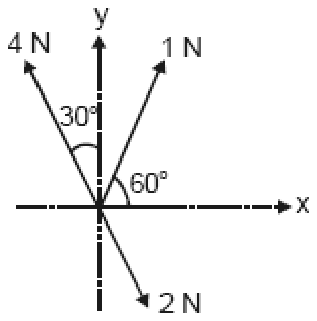
Three forces acting on a body are shown in the figure. To have the resultant force only along the y-direction, the magnitude of the minimum additional force needed is
- 1
- 20.5 N
- 31.5 N
- 4
Show answer and solution
Correct: option 2, 0.5 N
The resultant lies along y only if the x-components add to zero. The 1 N force gives N, the 2 N force (at to the y-axis) gives N, and the 4 N force gives N. The total is N, so the smallest extra force is 0.5 N along .
Question 58AIPMT 2008 Prelims, Q13
A roller coaster is designed such that riders experience "weightlessness" as they go round the top of a hill whose radius of curvature is 20 m. The speed of the car at the top of the hill is between
- 113 m/s and 14 m/s
- 214 m/s and 15 m/s
- 315 m/s and 16 m/s
- 416 m/s and 17 m/s
Show answer and solution
Correct: option 2, 14 m/s and 15 m/s
At the top of the hill . Weightlessness means the normal force is zero, so m/s, which lies between 14 m/s and 15 m/s.
Question 59AIPMT 2007 Prelims, Q155
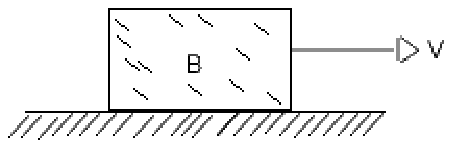
A block B is pushed momentarily along a horizontal surface with an initial velocity V. If is the coefficient of sliding friction between B and the surface, block B will come to rest after a time
- 1
- 2
- 3
- 4
Show answer and solution
Correct: option 2,
After the push the only horizontal force is friction , giving a retardation . From the block stops after , option (2).
Question 60AIPMT 2006 Prelims, Q29
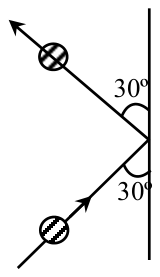
A 0.5 kg ball moving with a speed of 12 m/s strikes a hard wall at an angle of with the wall. It is reflected with the same speed and at the same angle. If the ball is in contact with the wall for 0.25 seconds, the average force acting on the wall is:-
- 148 N
- 224 N
- 312 N
- 496 N
Show answer and solution
Correct: option 2, 24 N
Only the velocity component perpendicular to the wall is reversed. Since the angle is measured from the wall, that component is . The change of momentum is , so the average force is .
Question 61AIPMT 2006 Prelims, Q47
A tube of length L is filled completely with an incompressible liquid of mass M and closed at both the ends. The tube is then rotated in a horizontal plane about one of its ends with a uniform angular velocity . The force exerted by the liquid at the other ends is:-
- 1
- 2
- 3
- 4
Show answer and solution
Correct: option 1,
The far end of the tube must supply the centripetal force for the whole liquid column. The centre of mass of the liquid is at from the axis, so the force is . (Integrating from 0 to gives the same result.)
Question 62AIPMT 2005 Prelims, Q18
A bomb of mass 30kg at rest explodes into two pieces of masses 18 kg and 12 kg. The velocity of 18kg mass is . The kinetic energy of the other mass is:
- 1524 J
- 2256 J
- 3486 J
- 4324 J
Show answer and solution
Correct: option 3, 486 J
Momentum is conserved and was zero at the start, so , giving for the 12 kg piece. Its kinetic energy is .
Question 63AIPMT 2004 Prelims, Q34
A block of mass m is placed on a smooth wedge of inclination . The whole system is accelerated horizontally so that the block does not slip on the wedge. The force exerted by the wedge on the block (g is acceleration due to gravity) will be:-
- 1
- 2
- 3
- 4
Show answer and solution
Correct: option 3,
The wedge is smooth, so it exerts only a normal force on the block. The block has no vertical acceleration, so the vertical component of balances the weight: , giving . (The horizontal component provides the acceleration.)
Question 64AIPMT 2004 Prelims, Q40
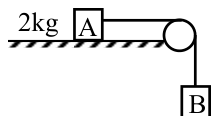
The coefficient of static friction, , between block A of mass 2 kg and the table as shown in the figure is 0.2. What would be the maximum mass value of block B so that the two blocks do not move? The string and the pulley are assumed to be smooth and massless.
()
- 14.0 kg
- 20.2 kg
- 30.4 kg
- 42.0 kg
Show answer and solution
Correct: option 3, 0.4 kg
The blocks stay at rest as long as the weight of B does not exceed the limiting friction on A: . So the maximum kg.
Question 65AIPMT 2003 Prelims, Q8
A monkey of mass 20 kg is holding a vertical rope. The rope will not break when a mass of 25 kg is suspended from it but will break if the mass exceeds 25 kg. What is the maximum acceleration with which the monkey can climb up along the rope? ()
- 1
- 2
- 3
- 4
Show answer and solution
Correct: option 4,
The largest tension the rope can bear is N. For the monkey climbing with acceleration , , so and .
Question 66AIPMT 2003 Prelims, Q9
A man weighs 80 kg. He stands on a weighing scale in a lift which is moving upwards with a uniform acceleration of . What would be the reading on the scale? ()
- 1Zero
- 2400 N
- 3800 N
- 41200 N
Show answer and solution
Correct: option 4, 1200 N
The scale reads the normal force on the man. With the lift accelerating upwards, , so N.
Question 67AIPMT 2002 Prelims, Q23
An object of mass 3kg is at rest. Now a force of is applied on the object then velocity of object at t = 3 second is:-
- 1
- 2
- 3
- 4
Show answer and solution
Correct: option 2,
. Integrating from rest, . At s this is .
Question 68AIPMT 2002 Prelims, Q26
A block of mass 10 kg placed on rough horizontal surface having coefficient of friction = 0.5, if a horizontal force of 100 N acting on it then acceleration of the block will be:-
- 110 m/s
- 25 m/s
- 315 m/s
- 40.5 m/s
Show answer and solution
Correct: option 2, 5 m/s
Friction is N (taking ). The net force is N, so .
Question 69AIPMT 2002 Prelims, Q27
A lift of mass 1000 Kg which is moving with acceleration of 1 m/s in upward direction, then the tension developed in string which is connected to lift is:-
- 19800 N
- 210,800 N
- 311000 N
- 410,000 N
Show answer and solution
Correct: option 2, 10,800 N
For upward acceleration, , so N.
Question 70AIPMT 2001 Prelims, Q17
A cricketer catches a ball of mass 150 gm. in 0.1 second moving with speed 20 ms. Then he experiences force of:
- 1300 N
- 230 N
- 33 N
- 40.3 N
Show answer and solution
Correct: option 2, 30 N
Force equals the rate of change of momentum: N.
Question 71AIPMT 2001 Prelims, Q30
On the horizontal surface of a truck a block of mass 1 kg is placed ( = 0.6) and truck is moving with acceleration 5 m/s then the frictional force on block will be:
- 15N
- 26N
- 35.88N
- 48N
Show answer and solution
Correct: option 1, 5N
To move with the truck the block needs a force N. The limiting friction is N, which is more than 5 N, so the block does not slip and static friction supplies exactly 5 N.
Question 72AIPMT 2001 Prelims, Q49
A 1 kg stationary bomb is exploded in three parts having mass 1 : 1 : 3 respectively. Parts having same mass move in perpendicular direction with velocity 30 ms, then the velocity of bigger part will be:
- 1 ms
- 2 ms
- 3 ms
- 4 ms
Show answer and solution
Correct: option 1, ms
The parts have masses 0.2 kg, 0.2 kg and 0.6 kg. Each small part has momentum kg m/s, and as they are perpendicular their resultant is kg m/s. The total momentum must stay zero, so and ms.
Question 73AIPMT 2000 Prelims, Q1
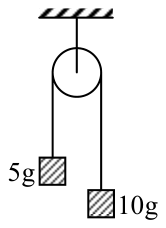
Two masses as shown are suspended from a massless pulley. Calculate the acceleration of the system when masses are left free:
- 12g/3
- 2g/3
- 3g/9
- 4g/7
Show answer and solution
Correct: option 2, g/3
For two masses over a light pulley, . With the two masses in the ratio 5 to 10, .
Question 74AIPMT 2000 Prelims, Q2
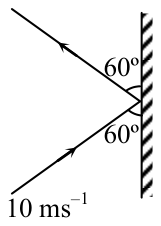
A body of mass 3 kg hits a wall at an angle of & returns at the same angle. The impact time was 0.2 s. Calculate the force exerted on the wall:
- 1 N
- 2 N
- 3100 N
- 4 N
Show answer and solution
Correct: option 1, N
The figure shows the path making with the wall, so the velocity component perpendicular to the wall is and it reverses, while the component along the wall is unchanged. Change in momentum . Force N.
Question 75AIPMT 2000 Prelims, Q3
A mass of 1kg is thrown up with a velocity of 100 m/s. After 5 seconds, it explodes into two parts. One part of mass 400 g comes down with a velocity 25 m/s Calculate the velocity of other part:
- 140 m/s upward
- 240 m/s downward
- 3100 m/s upward
- 460 m/s downward
Show answer and solution
Correct: option 3, 100 m/s upward
Taking , the velocity after 5 s is m/s upward. Momentum is conserved in the explosion: , so and m/s upward.
Question 76AIPMT 2000 Prelims, Q7
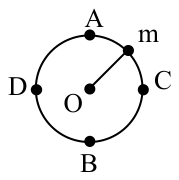
A mass is performing vertical circular motion (see figure). If the average velocity of the particle is increased, then at which point the string will break:
- 1A
- 2B
- 3C
- 4D
Show answer and solution
Correct: option 2, B
The tension is greatest at the lowest point, where the string must both support the weight and supply the centripetal force: , and the speed is also greatest there. So the string breaks at the bottom point B.
Question 77AIPMT 1999 Prelims, Q6
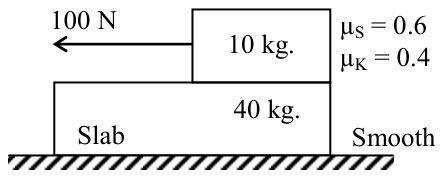
If 100N force is applied to 10 kg. block as shown in diagram then acceleration produced for slab -
- 1
- 2
- 3
- 4
Show answer and solution
Correct: option 2,
If the two moved together the acceleration would be and the slab would need a friction force of N. The largest static friction is N, so the block slides on the slab. The slab is then pulled only by kinetic friction N (the floor is smooth), giving .
Question 78AIPMT 1998 Prelims, Q10
If force , then function of impulse with time will be:
- 1
- 2
- 3
- 4
Show answer and solution
Correct: option 1,
Impulse is the time integral of force: .
Question 79AIPMT 1998 Prelims, Q12
A particle of mass m is tied to a string of length L and whirled into a horizontal plane. If tension in the string is T then the speed of the particle will be:
- 1
- 2
- 3
- 4
Show answer and solution
Correct: option 1,
In a horizontal circle the tension supplies the centripetal force, so , where is the length of the string (called L in the question). Hence .
Question 80AIPMT 1998 Prelims, Q17
A small ball is suspended from a thread. It is lifted up with an acceleration and lowered with an acceleration then the ratio of tensions in the thread in both cases will be:
- 11 : 3
- 23 : 1
- 31 : 1
- 4
Show answer and solution
Correct: option 2, 3 : 1
Here . Accelerating upward, ; accelerating downward, . The ratio is 3 : 1.
Question 81AIPMT 1998 Prelims, Q26
For a Rocket propulsion velocity of exhaust gases relative to rocket is 2 km/s. If mass of rocket system is 1000 kg, then the rate of fuel consumption for a rocket to rise up with acceleration will be:
- 112.25 kg/s
- 217.5 kg/s
- 37.35 kg/s
- 45.2 kg/s
Show answer and solution
Correct: option 3, 7.35 kg/s
The thrust must support the weight and give the acceleration: . So kg/s.