Questions with solutions
Question 1NEET 2026, Q20
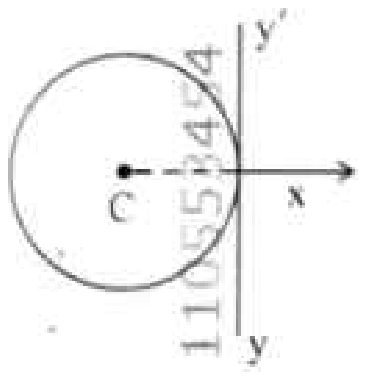
A thin wire of length 'L' and linear mass density 'm' is bent into a circular ring (in x-y plane) with centre 'C' as shown in figure. The moment of inertia of the ring about an axis yy′ will be:
- 1
- 2
- 3
- 4
Show answer and solution
Correct: option 1,
The ring has mass and radius . Its moment of inertia about a diameter is . The axis yy′ is a tangent lying in the plane of the ring, parallel to a diameter at distance , so by the parallel axis theorem .
Question 2NEET 2026, Q38
The angular speed of a flywheel is increased from 600 rpm to 1200 rpm in . The number of revolutions completed by the flywheel during this time is:
- 1600
- 2900
- 3300
- 4150
Show answer and solution
Correct: option 4, 150
Taking the angular acceleration as uniform, the average speed is rpm revolutions per second. In 10 s the flywheel completes revolutions.
Question 3NEET 2026 Re-exam, Q23
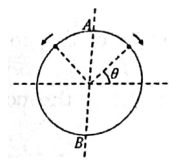
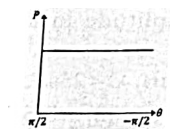
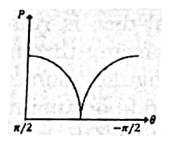
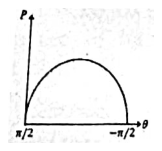
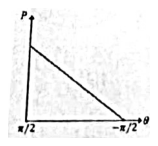
A frictionless circular wire of unit radius is fixed on the horizontal plane. Two point particles of unit mass start moving simultaneously from point with identical uniform angular speeds in opposite directions, and meet again at point . During this time, which of the following figures schematically represent the magnitude of the total linear momentum of the system, as a function of ?
- 1
- 2
- 3
- 4
Show answer and solution
Correct: option 3
At every instant the two particles are mirror images of each other in the line . Each has speed along the tangent (unit mass, unit radius). The components of their momenta perpendicular to cancel and the components along add, giving . This is zero at , largest at and zero again at , the arch-shaped graph of option (3).
Question 4NEET 2026 Re-exam, Q27
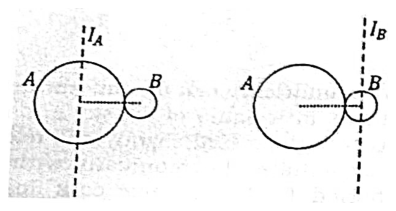
A solid sphere of radius R and mass M is attached at a point to a smaller solid sphere of radius and mass . Assume that the line joining their centres lies along the horizontal. The moment of inertia of the system calculated about a vertical axis passing through the centre of is and that calculated about a vertical axis passing through the centre of is . The difference is:
- 1
- 2
- 3
- 40
Show answer and solution
Correct: option 2,
The centres are apart. By the parallel axis theorem, and . Subtracting, , option (2).
Question 5NEET 2026 Re-exam, Q31
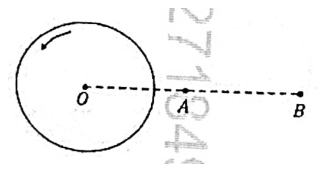
A thin horizontal disc is rotating about a vertical axis passing through its fixed centre . Its angular momentum is and computed about points and , respectively, with . The value of is:
- 1
- 2
- 31
- 42
Show answer and solution
Correct: option 3, 1
The angular momentum about any point is the spin angular momentum about the centre of mass plus . The centre of the disc is fixed, so and the second term vanishes for every point. The angular momentum is therefore about and about alike, and the ratio is 1, option (3).
Question 6NEET 2025, Q17
The Sun rotates around its centre once in 27 days. What will be the period of revolution if the Sun were to expand to twice its present radius without any external influence? Assume the Sun to be a sphere of uniform density.
- 1100 days
- 2105 days
- 3115 days
- 4108 days
Show answer and solution
Correct: option 4, 108 days
With no external torque the angular momentum is conserved. For a uniform sphere , and , so stays constant and . Doubling the radius makes the period days, option (4).
Question 7NEET 2025, Q22
A uniform rod of mass 20 kg and length 5 m leans against a smooth vertical wall making an angle of with it. The other end rests on a rough horizontal floor. The friction force that the floor exerts on the rod is (take g = 10 )
- 1100 N
- 2 N
- 3200 N
- 4 N
Show answer and solution
Correct: option 2, N
The smooth wall pushes the rod horizontally with a force , and the only other horizontal force is friction at the floor, so . Taking torques about the lower end, with the rod at to the wall: , so N. That is option (2).
Question 8NEET 2025, Q39
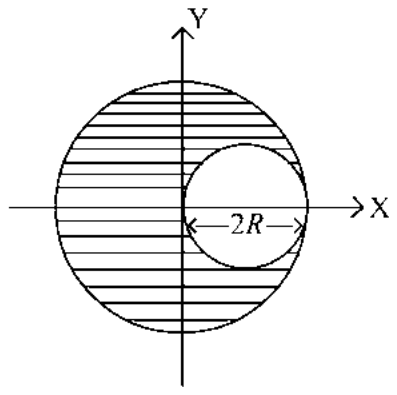
A sphere of radius is cut from a larger solid sphere of radius as shown in the figure. The ratio of the moment of inertia of the smaller sphere to that of the rest part of the sphere about the Y-axis is:
- 1
- 2
- 3
- 4
Show answer and solution
Correct: option 3,
Let the full sphere have mass ; the small sphere has one eighth of the volume, so its mass is , and its centre is at a distance from the Y-axis. By the parallel axis theorem its moment of inertia is . The full sphere has , so the rest has . The ratio is , option (3).
Question 9NEET 2024, Q10
The moment of inertia of a thin rod about an axis passing through its mid point and perpendicular to the rod is . The length of the 400 g rod is nearly:
- 172.0 cm
- 28.5 cm
- 317.5 cm
- 420.7 cm
Show answer and solution
Correct: option 2, 8.5 cm
For a thin rod about its centre, . So and cm, option (2).
Question 10NEET 2024, Q32
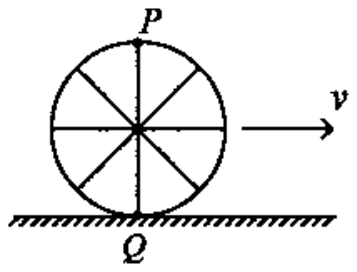
A wheel of a bullock cart is rolling on a level road as shown in the figure below. If its linear speed is in the direction shown, which one of the following options is correct ( and are any highest and lowest points on the wheel, respectively)?
- 1Point has zero speed.
- 2Point moves slower than point .
- 3Point moves faster than point .
- 4Both the points and move with equal speed.
Show answer and solution
Correct: option 3, Point moves faster than point .
In rolling without slipping, each point has the velocity of the centre plus the velocity due to rotation, . At the top point the two add to ; at the lowest point they cancel and the speed is zero. So moves faster than , option (3).
Question 11NEET 2024 Re-exam, Q16
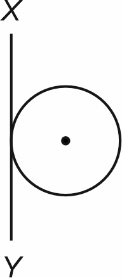
The radius of gyration of a solid sphere of mass 5 kg about XY is 5 m as shown in figure. The radius of the sphere m, then the value of is:
- 15
- 2
- 3
- 4
Show answer and solution
Correct: option 4,
XY is a tangent to the sphere, so by the parallel axis theorem and . With m, m. Comparing with gives .
Question 12NEET 2023, Q2
The ratio of radius of gyration of a solid sphere of mass and radius about its own axis to the radius of gyration of the thin hollow sphere of same mass and radius about its axis is:
- 13 : 5
- 25 : 3
- 32 : 5
- 45 : 2
Show answer and solution
Correct: option 1, 3 : 5
The examiners dropped this question and gave every candidate the 4 marks.
The official answer key marks this question as dropped, so every candidate gets the marks. For the solid sphere , so ; for the thin hollow sphere , so . The ratio is , which is not among the options.
Question 13NEET 2023, Q14
The angular acceleration of a body, moving along the circumference of a circle, is:
- 1along the radius, away from centre
- 2along the radius towards the centre
- 3along the tangent to its position
- 4along the axis of rotation
Show answer and solution
Correct: option 4, along the axis of rotation
Angular velocity is an axial vector directed along the axis of rotation (right-hand rule). For motion in a fixed circle its direction does not change, so its rate of change, the angular acceleration, is also along the axis of rotation, option (4).
Question 14NEET 2023 Manipur, Q1
Two particles A and B initially at rest, move towards each other under mutual force of attraction. At an instance when the speed of A is and speed of B is , the speed of centre of mass is
- 1
- 2
- 3
- 4Zero
Show answer and solution
Correct: option 4, Zero
The attraction between A and B is an internal force, so no external force acts on the system and the velocity of its centre of mass cannot change. Both particles start from rest, so the centre of mass starts at rest and stays at rest whatever the individual speeds are. Its speed is zero.
Question 15NEET 2023 Manipur, Q43
A constant torque of 100 N m turns a wheel of moment of inertia about an axis passing through its centre. Starting from rest, its angular velocity after 3 s is
- 110 rad/s
- 215 rad/s
- 31 rad/s
- 45 rad/s
Show answer and solution
Correct: option 3, 1 rad/s
. Starting from rest, rad/s.
Question 16NEET 2022, Q7
The ratio of the radius of gyration of a thin uniform disc about an axis passing through its centre and normal to its plane to the radius of gyration of the disc about its diameter is:
- 1
- 2
- 3
- 4
Show answer and solution
Correct: option 3,
About the central axis normal to the plane, , so . About a diameter, , so . The ratio , option (3).
Question 17NEET 2022, Q14
Two objects of mass 10 kg and 20 kg respectively are connected to the two ends of a rigid rod of length 10 m with negligible mass. The distance of the center of mass of the system from the 10 kg mass is:
- 15 m
- 2 m
- 3 m
- 410 m
Show answer and solution
Correct: option 3, m
Take the 10 kg mass as the origin. Then m, option (3). The centre of mass lies nearer the heavier mass.
Question 18NEET 2022, Q22
The angular speed of a fly wheel moving with uniform angular acceleration changes from 1200 rpm to 3120 rpm in 16 seconds. The angular acceleration in is:
- 1
- 2
- 3
- 4
Show answer and solution
Correct: option 3,
The change in speed is rpm rev/s rad/s. Angular acceleration , option (3).
Question 19NEET 2022 Re-exam, Q1
An energy of 484 J is spent in increasing the speed of a flywheel from 60 rpm to 360 rpm. The moment of inertia of the flywheel is:
- 10.07 kg-m
- 20.7 kg-m
- 33.22 kg-m
- 430.8 kg-m
Show answer and solution
Correct: option 2, 0.7 kg-m
The energy spent equals the gain in rotational kinetic energy, . Here (60 rpm) and (360 rpm), so . Then , option (2).
Question 20NEET 2022 Re-exam, Q12
Given below are two statements: One is labelled as Assertion (A) and the other is labelled as Reason (R).
Assertion (A): When a fire cracker (rocket) explodes in mid air, its fragments fly in such a way that they continue moving in the same path, which the fire cracker would have followed, had it not exploded.
Reason (R): Explosion of cracker (rocket) occurs due to internal force only and no external force acts for this explosion.
In the light of the above statements, choose the most appropriate answer from the option given below
- 1(A) is not correct but (R) is correct
- 2Both (A) and (R) are correct and (R) is the correct explanation of (A)
- 3Both (A) and (R) are correct but (R) is not the correct explanation of (A)
- 4(A) is correct but (R) is not correct
Show answer and solution
Correct: option 1, (A) is not correct but (R) is correct
The explosion is caused by internal forces only, so (R) is correct. Internal forces cannot change the motion of the centre of mass, so it is the centre of mass of the fragments that continues along the original parabolic path; the individual fragments fly off in different directions. So (A) is not correct, and the answer is option (1).
Question 21NEET 2021, Q48
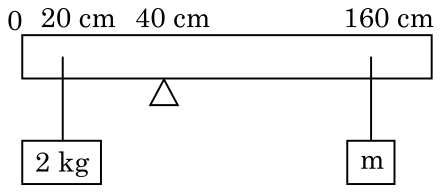
A uniform rod of length 200 cm and mass 500 g is balanced on a wedge placed at 40 cm mark. A mass of 2 kg is suspended from the rod at 20 cm and another unknown mass 'm' is suspended from the rod at 160 cm mark as shown in the figure. Find the value of 'm' such that the rod is in equilibrium. ()
- 1 kg
- 2 kg
- 3 kg
- 4 kg
Show answer and solution
Correct: option 4, kg
Take torques about the wedge at 40 cm. The 2 kg mass is 20 cm to the left; the rod's weight (0.5 kg) acts at the 100 cm mark, 60 cm to the right; m is 120 cm to the right. Balance: , so and kg.
Question 22NEET 2021, Q49
From a circular ring of mass 'M' and radius 'R' an arc corresponding to a sector is removed. The moment of inertia of the remaining part of the ring about an axis passing through the centre of the ring and perpendicular to the plane of the ring is 'K' times ''. Then the value of 'K' is:
- 1
- 2
- 3
- 4
Show answer and solution
Correct: option 1,
A arc is a quarter of the ring, so the remaining part has mass . All of it is still at distance R from the axis, so and .
Question 23NEET 2020, Q156
Find the torque about the origin when a force of acts on a particle whose position vector is .
- 1
- 2
- 3
- 4
Show answer and solution
Correct: option 3,
Torque is . Since , reversing the order gives . So .
Question 24NEET 2020, Q168
Two particles of mass 5 kg and 10 kg respectively are attached to the two ends of a rigid rod of length 1 m with negligible mass.
The centre of mass of the system from the 5 kg particle is nearly at a distance of:
- 133 cm
- 250 cm
- 367 cm
- 480 cm
Show answer and solution
Correct: option 3, 67 cm
Take the 5 kg particle as the origin, with the 10 kg particle 1 m away. Then . The centre of mass lies nearer the heavier particle.
Question 25NEET 2020 Phase 2, Q95
The angular speed of the wheel of a vehicle is increased from 360 rpm to 1200 rpm in 14 second. Its angular acceleration is,
- 1
- 2
- 3
- 4
Show answer and solution
Correct: option 4,
The change in speed is rpm revolutions per second, which is . The angular acceleration is .
Question 26NEET 2020 Phase 2, Q127
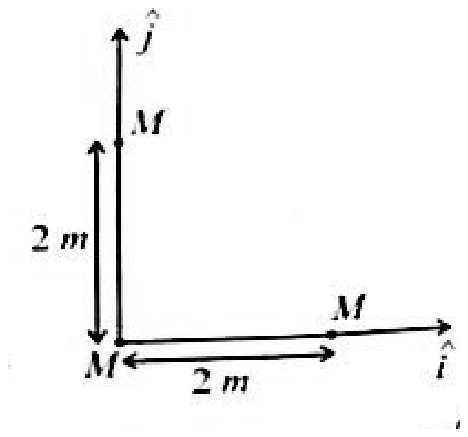
Three identical spheres, each of mass M, are placed at the corners of a right angle triangle with mutually perpendicular sides equal to 2 m (see figure). Taking the point of intersection of the two mutually perpendicular sides as the origin, find the position vector of centre of mass.
- 1
- 2
- 3
- 4
Show answer and solution
Correct: option 2,
The spheres are at , and . As the masses are equal, and . So the position vector of the centre of mass is .
Question 27NEET 2019, Q9
A disc of radius 2 m and mass 100 kg rolls on a horizontal floor. Its centre of mass has speed of 20 cm/s. How much work is needed to stop it?
- 13 J
- 230 kJ
- 32 J
- 41 J
Show answer and solution
Correct: option 1, 3 J
A rolling disc has kinetic energy . With m/s this is J, which is the work needed to stop it.
Question 28NEET 2019, Q21
A solid cylinder of mass 2 kg and radius 4 cm is rotating about its axis at the rate of 3 rpm. The torque required to stop after revolutions is:
- 1 N m
- 2 N m
- 3 N m
- 4 N m
Show answer and solution
Correct: option 1, N m
. rad/s and rad. From , . Torque N m.
Question 29NEET 2019 Odisha, Q2
A particle starting from rest, moves in a circle of radius 'r'. It attains a velocity of m/s in the nth round. Its angular acceleration will be,
- 1
- 2
- 3
- 4
Show answer and solution
Correct: option 1,
Use with , and after n rounds. This gives .
Question 30NEET 2019 Odisha, Q36
A solid cylinder of mass 2 kg and radius 50 cm rolls up an inclined plane of angle of inclination . The centre of mass of the cylinder has speed of 4 m/s. The distance travelled by the cylinder on the inclined surface will be, [take ]
- 11.2 m
- 22.4 m
- 32.2 m
- 41.6 m
Show answer and solution
Correct: option 2, 2.4 m
For a rolling solid cylinder the kinetic energy is . Setting this equal to gives m. The distance along the incline is m.
Question 31NEET 2018, Q31
Three objects, A : (a solid sphere), B : (a thin circular disk) and C : (a circular ring), each have the same mass M and radius R. They all spin with the same angular speed about their own symmetry axes. The amounts of work (W) required to bring them to rest, would satisfy the relation
- 1
- 2
- 3
- 4
Show answer and solution
Correct: option 3,
The work needed equals the rotational kinetic energy , so it is proportional to I. (sphere), (disk), (ring). Since , .
Question 32NEET 2018, Q36
The moment of the force, at (2, 0, – 3), about the point (2, – 2, – 2), is given by
- 1
- 2
- 3
- 4
Show answer and solution
Correct: option 4,
. Then .
Question 33NEET 2018, Q38
A solid sphere is rotating freely about its symmetry axis in free space. The radius of the sphere is increased keeping its mass same. Which of the following physical quantities would remain constant for the sphere ?
- 1Rotational kinetic energy
- 2Moment of inertia
- 3Angular velocity
- 4Angular momentum
Show answer and solution
Correct: option 4, Angular momentum
No external torque acts in free space, so angular momentum is conserved. The moment of inertia increases with R, so falls and the kinetic energy also falls. Only angular momentum stays constant.
Question 34NEET 2018, Q41
A solid sphere is in rolling motion. In rolling motion a body possesses translational kinetic energy as well as rotational kinetic energy simultaneously. The ratio for the sphere is
- 1
- 2
- 3
- 4
Show answer and solution
Correct: option 2,
. With and , . So and the ratio is .
Question 35NEET 2017, Q26
Which of the following statements are correct?
(a) Centre of mass of a body always coincides with the centre of gravity of the body.
(b) Centre of mass of a body is the point at which the total gravitational torque on the body is zero.
(c) A couple on a body produce both translational and rotational motion in a body.
(d) Mechanical advantage greater than one means that small effort can be used to lift a large load.
- 1(b) and (d)
- 2(a) and (b)
- 3(b) and (c)
- 4(c) and (d)
Show answer and solution
Correct: option 1, (b) and (d)
(a) is wrong: the two points coincide only when gravity is uniform over the body, not always. (b) is taken as correct: in a uniform field the gravitational torque about the centre of mass is zero. (c) is wrong: a couple is two equal and opposite forces, so the net force is zero and it produces rotation only. (d) is correct: mechanical advantage is load divided by effort, so a value above one means the load is larger than the effort. So (b) and (d).
Question 36NEET 2017, Q39
Two discs of same moment of inertia rotating about their regular axis passing through centre and perpendicular to the plane of disc with angular velocities and . They are brought into contact face to face coinciding the axis of rotation. The expression for loss of energy during this process is
- 1
- 2
- 3
- 4
Show answer and solution
Correct: option 2,
Angular momentum is conserved: , so the common angular velocity is . Loss of energy .
Question 37NEET 2017, Q41
A rope is wound around a hollow cylinder of mass 3 kg and radius 40 cm. What is the angular acceleration of the cylinder if the rope is pulled with a force of 30 N?
- 1
- 2
- 3
- 4
Show answer and solution
Correct: option 3,
The torque is N m. A hollow cylinder has . So .
Question 38NEET 2016 Phase 1, Q1
From a disc of radius R and mass M, a circular hole of diameter R, whose rim passes through the centre is cut. What is the moment of inertia of the remaining part of the disc about a perpendicular axis, passing through the centre?
- 1
- 2
- 3
- 4
Show answer and solution
Correct: option 2,
The removed piece has radius , so its mass is and its centre is from the axis. By the parallel axis theorem its moment of inertia about the axis is . Subtracting from the full disc, .
Question 39NEET 2016 Phase 1, Q19
A uniform circular disc of radius 50 cm at rest is free to turn about an axis which is perpendicular to its plane and passes through its centre. It is subjected to a torque which produces a constant angular acceleration of . Its net acceleration in at the end of 2.0 s is approximately:
- 18.0
- 27.0
- 36.0
- 43.0
Show answer and solution
Correct: option 1, 8.0
After 2.0 s, . For a point on the rim the centripetal acceleration is and the tangential acceleration is . The net acceleration is .
Question 40NEET 2016 Phase 1, Q21
A disk and a sphere of same radius but different masses roll off on two inclined planes of the same altitude and length. Which one of the two objects gets to the bottom of the plane first?
- 1Disk
- 2Sphere
- 3Both reach at the same time
- 4Depends on their masses
Show answer and solution
Correct: option 2, Sphere
For rolling without slipping , which does not depend on mass. is for a solid sphere and for a disk, so the sphere has the larger acceleration and reaches the bottom first.
Question 41NEET 2016 Phase 2, Q8
Two rotating bodies and of masses and with moments of inertia and () have equal kinetic energy of rotation. If and be their angular momenta respectively, then
- 1
- 2
- 3
- 4
Show answer and solution
Correct: option 3,
Rotational kinetic energy is , so . With the same , the body with the larger moment of inertia has the larger angular momentum. Since , , option (3). The masses do not matter here.
Question 42NEET 2016 Phase 2, Q9
A solid sphere of mass and radius is rotating about its diameter. A solid cylinder of the same mass and same radius is also rotating about its geometrical axis with an angular speed twice that of the sphere. The ratio of their kinetic energies of rotation () will be
- 12 : 3
- 21 : 5
- 31 : 4
- 43 : 1
Show answer and solution
Correct: option 2, 1 : 5
. For the sphere and angular speed ; for the cylinder and angular speed . So , option (2).
Question 43NEET 2016 Phase 2, Q10
A light rod of length has two masses and attached to its two ends. The moment of inertia of the system about an axis perpendicular to the rod and passing through the centre of mass is
- 1
- 2
- 3
- 4
Show answer and solution
Correct: option 1,
The centre of mass is at from and from . Then , option (1). This is the reduced mass times .
Question 44AIPMT 2015, Q156
A mass m moves in a circle on a smooth horizontal plane with velocity at a radius . The mass is attached to a string which passes through a smooth hole in the plane as shown.
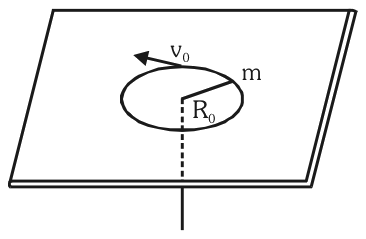
The tension in the string is increased gradually and finally m moves in a circle of radius . The final value of the kinetic energy is:-
- 1
- 2
- 3
- 4
Show answer and solution
Correct: option 2,
The tension always points to the hole, so it has no torque about the hole and the angular momentum of the mass is conserved: , giving . The final kinetic energy is , option (2). The extra energy comes from the work done in pulling the string.
Question 45AIPMT 2015, Q161
A rod of weight W is supported by two parallel knife edges A and B and is in equilibrium in a horizontal position. The knives are at a distance d from each other. The centre of mass of the rod is at distance x from A. The normal reaction on A is:-
- 1
- 2
- 3
- 4
Show answer and solution
Correct: option 3,
Take torques about knife edge B so that the reaction at B drops out. The weight acts at distance from B and the reaction at distance d. Equilibrium needs , so , option (3). The closer the centre of mass is to A, the larger the share of the weight A carries.
Question 46AIPMT 2015, Q167
Two spherical bodies of mass M and 5 M and radii R and 2 R are released in free space with initial separation between their centres equal to 12 R. If they attract each other due to gravitational force only, then the distance covered by the smaller body before collision is:
- 14.5 R
- 27.5 R
- 31.5 R
- 42.5 R
Show answer and solution
Correct: option 2, 7.5 R
They touch when their centres are apart, so together they move . Only internal forces act, so the centre of mass stays at rest and the distances moved are in the inverse ratio of the masses: . With , the smaller body covers , option (2).
Question 47AIPMT 2015, Q175
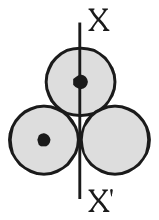
Three identical spherical shells, each of mass m and radius r are placed as shown in figure. Consider an axis XX' which is touching to two shells and passing through diameter of third shell.
Moment of inertia of the system consisting of these three spherical shells about XX' axis is:-
- 1
- 2
- 3
- 4
Show answer and solution
Correct: option 3,
A thin spherical shell has moment of inertia about a diameter. For the shell whose diameter lies on XX' this is its contribution. Each of the other two shells touches the axis, so the axis is a tangent, at distance r from the centre: by the parallel axis theorem each gives . Total , option (3).
Question 48AIPMT 2015 Re-test, Q145
An automobile moves on a road with a speed of . The radius of its wheels is 0.45 m and the moment of inertia of the wheel about its axis of rotation is . If the vehicle is brought to rest in 15 s, the magnitude of average torque transmitted by its brakes to the wheel is:
- 1
- 2
- 3
- 4
Show answer and solution
Correct: option 2,
, so the wheel's initial angular speed is . Angular retardation . Torque .
Question 49AIPMT 2015 Re-test, Q154
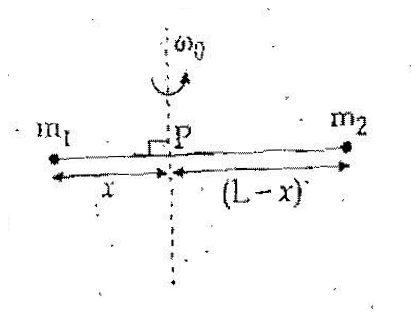
Point masses and are placed at the opposite ends of a rigid rod of length L, and negligible mass. The rod is to be set rotating about an axis perpendicular to it. The position of point P on this rod through which the axis should pass so that the work required to set the rod rotating with angular velocity is minimum, is given by:
- 1
- 2
- 3
- 4
Show answer and solution
Correct: option 1,
Work needed , so it is least when the moment of inertia is least. Setting gives , which is the centre of mass of the two masses.
Question 50AIPMT 2015 Re-test, Q156
A force is acting at a point . The value of for which angular momentum about origin is conserved is:
- 11
- 2
- 32
- 4zero
Show answer and solution
Correct: option 2,
Angular momentum about the origin is conserved when the torque is zero, that is when is parallel (or antiparallel) to . Comparing components, , so and .
Question 51AIPMT 2014, Q105
The ratio of the accelerations for a solid sphere (mass 'm' and radius 'R') rolling down an incline of angle '' without slipping and slipping down the incline without rolling is:
- 17 : 5
- 25 : 7
- 32 : 3
- 42 : 5
Show answer and solution
Correct: option 2, 5 : 7
Rolling without slipping: for a solid sphere. Sliding without rolling (no friction): . The ratio is , option (2).
Question 52AIPMT 2014, Q106
A solid cylinder of mass 50 kg and radius 0.5 m is free to rotate about the horizontal axis. A massless string is wound round the cylinder with one end attached to it and other hanging freely. Tension in the string required to produce an angular acceleration of is:
- 1157 N
- 225 N
- 350 N
- 478.5 N
Show answer and solution
Correct: option 1, 157 N
Angular acceleration . The torque of the tension gives , so , option (1).
Question 53NEET 2013, Q148
A small object of uniform density rolls up a curved surface with an initial velocity ''. It reaches upto a maximum height of with respect to the initial position. The object is:
- 1Solid sphere
- 2Hollow sphere
- 3Disc
- 4Ring
Show answer and solution
Correct: option 3, Disc
For rolling, the total kinetic energy is , and this becomes at the top. With we get , so . That is the value for a disc.
Question 54NEET 2013, Q150
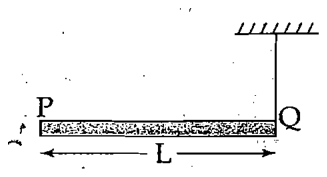
A rod PQ of mass M and length L is hinged at end P. The rod is kept horizontal by a massless string tied to point Q as shown in figure. When string is cut, the initial angular acceleration of the rod is:
- 1g/L
- 22g/L
- 3
- 4
Show answer and solution
Correct: option 4,
Just after the string is cut, the only torque about the hinge P is that of the weight acting at the centre of the rod: . The moment of inertia of the rod about its end is . So .
Question 55NEET 2013 Karnataka, Q140
The ratio of radii of gyration of a circular ring and a circular disc, of the same mass and radius, about an axis passing through their centres and perpendicular to their planes are:
- 1
- 2
- 3
- 4
Show answer and solution
Correct: option 4,
For the ring , so . For the disc , so . The ratio is .
Question 56NEET 2013 Karnataka, Q166
Two discs are rotating about their axes, normal to the discs and passing through the centres of the discs. Disc has 2 kg mass and 0.2 m radius and initial angular velocity of . Disc has 4 kg mass, 0.1 m radius and initial angular velocity of . The two discs are brought in contact face to face, with their axes of rotation coincident. The final angular velocity (in ) of the system is:
- 160
- 2100
- 3120
- 440
Show answer and solution
Correct: option 2, 100
and . Angular momentum is conserved: .
Question 57AIPMT 2012 Prelims, Q5
When a mass is rotating in a plane about a fixed point, its angular momentum is directed along:
- 1a line perpendicular to the plane of rotation
- 2the line making an angle of 45° to the plane of rotation.
- 3the radius
- 4the tangent to the orbit.
Show answer and solution
Correct: option 1, a line perpendicular to the plane of rotation
Angular momentum is . Both and lie in the plane of rotation, and a cross product is perpendicular to both of its vectors, so points along the axis, perpendicular to the plane of rotation.
Question 58AIPMT 2012 Prelims, Q19
Two persons of masses 55 kg and 65 kg respectively, are at the opposite ends of a boat. The length of the boat is 3.0 m and weighs 100 kg. The 55 kg man walks up to the 65 kg man and sits with him. If the boat is in still water the centre of mass of the system shifts by:
- 13.0 m
- 22.3 m
- 3zero
- 40.75 m
Show answer and solution
Correct: option 3, zero
The men and the boat form one system, and in still water no external horizontal force acts on it. The system starts at rest, so its centre of mass stays where it is: as the man walks one way the boat moves the other way. The shift is zero.
Question 59AIPMT 2012 Prelims, Q28
A solid cylinder of mass 3 kg is rolling on a horizontal surface with velocity . It collides with a horizontal spring of force constant . The maximum compression produced in the spring will be:
- 10.5 m
- 20.6 m
- 30.7 m
- 40.2 m
Show answer and solution
Correct: option 2, 0.6 m
A rolling solid cylinder has kinetic energy . At maximum compression all of it is stored in the spring: , so .
Question 60AIPMT 2012 Prelims, Q42
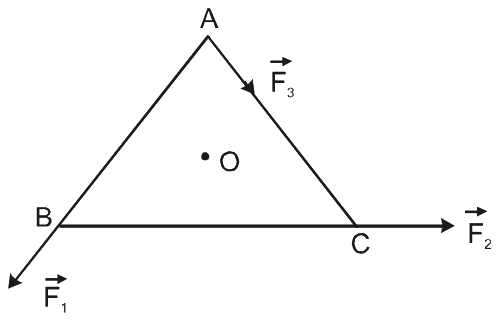
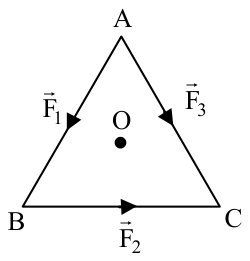
ABC is an equilateral triangle with O as its centre. , and represent three forces acting along the sides AB, BC and AC respectively. If the total torque about O is zero the magnitude of is:
- 1
- 2
- 3
- 4
Show answer and solution
Correct: option 1,
O is at the same perpendicular distance x from all three sides. (from A to B) and (from B to C) turn the triangle the same way about O, while (from A to C) turns it the opposite way. Zero net torque means , so .
Question 61AIPMT 2012 Mains, Q5
A circular platform is mounted on a frictionless vertical axle. Its radius R = 2 m and its moment of inertia about the axle is . It is initially at rest. A 50 kg man stands on the edge of the platform and begins to walk along the edge at the speed of relative to the ground. Time taken by the man to complete one revolution is:
- 1 s
- 2 s
- 3 s
- 4 s
Show answer and solution
Correct: option 3, s
Angular momentum about the axle stays zero, so the platform turns the opposite way with : , giving . The angular speed of the man relative to the ground is , so relative to the platform he moves at . One revolution around the platform takes s.
Question 62AIPMT 2012 Mains, Q6
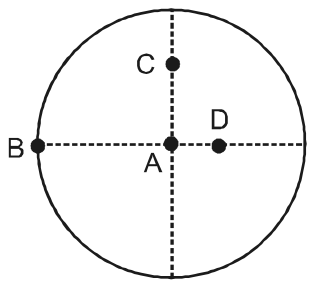
The moment of inertia of a uniform circular disc is maximum about an axis perpendicular to the disc and passing through:
- 1B
- 2C
- 3D
- 4A
Show answer and solution
Correct: option 1, B
By the parallel axis theorem , where d is the distance of the axis from the centre A. Of the four points, B lies on the rim and is farthest from the centre, so the moment of inertia is largest about the axis through B.
Question 63AIPMT 2012 Mains, Q7
Three masses are placed on the x-axis: 300 g at origin, 500 g at x = 40 cm and 400 g at x = 70 cm. The distance of the centre of mass from the origin is:
- 140 cm
- 245 cm
- 350 cm
- 430 cm
Show answer and solution
Correct: option 1, 40 cm
cm.
Question 64AIPMT 2011 Prelims, Q165
The instantaneous angular position of a point on a rotating wheel is given by the equation . The torque on the wheel becomes zero at:
- 1t = 1s
- 2t = 0.5 s
- 3t = 0.25 s
- 4t = 2s
Show answer and solution
Correct: option 1, t = 1s
Torque is zero when the angular acceleration is zero. and , which is zero at s.
Question 65AIPMT 2011 Prelims, Q167
The moment of inertia of a thin uniform rod of mass M and length L about an axis passing through its midpoint and perpendicular to its length is . Its moment of inertia about an axis passing through one of its ends and perpendicular to its length is:
- 1
- 2
- 3
- 4
Show answer and solution
Correct: option 2,
The midpoint is the centre of mass, and the end is a distance from it. By the parallel axis theorem .
Question 66AIPMT 2011 Mains, Q111
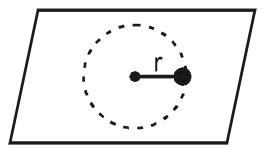
A small mass attached to a string rotates on frictionless table top as shown. If the tension is the string is increased by pulling the string causing the radius of the circular motion to decrease by a factor of 2, the kinetic energy of the mass will:
- 1remain constant
- 2increase by a factor of 2
- 3increase by a factor of 4
- 4decrease by a factor of 2
Show answer and solution
Correct: option 3, increase by a factor of 4
The tension acts along the string towards the centre, so it has no torque about the centre and the angular momentum is conserved. The kinetic energy is , which varies as . Halving r makes the kinetic energy 4 times larger; the extra energy comes from the work done in pulling the string.
Question 67AIPMT 2010 Mains, Q13
From a circular disc of radius R and mass 9M, a small disc of mass M and radius is removed concentrically. The moment of inertia of the remaining disc about an axis perpendicular to the plane of the disc and passing through its centre is
- 1
- 2
- 3
- 4
Show answer and solution
Correct: option 1,
The full disc has moment of inertia about the axis. The removed disc shares the same axis and has . Subtracting, .
Question 68AIPMT 2010 Mains, Q23
A solid cylinder and a hollow cylinder, both of the same mass and same external diameter are released from the same height at the same time on an inclined plane. Both roll down without slipping. Which one will reach the bottom first?
- 1Both together only when angle of inclination of plane is 45°
- 2Both together
- 3Hollow cylinder
- 4Solid cylinder
Show answer and solution
Correct: option 4, Solid cylinder
For rolling without slipping the acceleration down the plane is , where K is the radius of gyration. The solid cylinder has , while the hollow cylinder has more of its mass far from the axis and so a larger . The solid cylinder therefore has the larger acceleration and reaches the bottom first.
Question 69AIPMT 2010 Mains, Q25
(i) Centre of gravity (C.G.) of a body is the point at which the weight of the body acts
(ii) Centre of mass coincides with the centre of gravity if the earth is assumed to have infinitely large radius
(iii) To evaluate the gravitational field intensity due to any body at an external point, the entire mass of the body can be considered to be concentrated at its C.G.
(iv) The radius of gyration of any body rotating about an axis is the length of the perpendicular dropped from the C.G. of the body to the axis.
Which one of the following pairs of statements is correct?
- 1(iv) and (i)
- 2(i) and (ii)
- 3(ii) and (iii)
- 4(iii) and (iv)
Show answer and solution
Correct: option 1, (iv) and (i)
Statement (i) is the definition of the centre of gravity. Statement (ii) describes a uniform gravitational field, in which the centre of gravity is at the centre of mass. Statement (iii) holds only for spherically symmetric bodies, and the radius of gyration in (iv) is defined by and is not in general the distance of the C.G. from the axis. The answer key used for this paper gives option (1), (iv) and (i); by the reasoning above the pair (i) and (ii) fits better, so treat this key with caution.
Question 70AIPMT 2010 Mains, Q29
A thin circular ring of mass M and radius r is rotating about its axis with constant angular velocity . Two objects each of mass m are attached gently to the opposite ends of a diameter of the ring. The ring now rotates with angular velocity given by
- 1
- 2
- 3
- 4
Show answer and solution
Correct: option 4,
No external torque acts about the axis, so angular momentum is conserved. The moment of inertia rises from to , so and .
Question 71AIPMT 2010 Prelims, Q3
A circular disk of moment of inertia is rotating in a horizontal plane, about its symmetry axis, with a constant angular speed . Another disk of moment of inertia is dropped coaxially onto the rotating disk. Initially the second disk has zero angular speed. Eventually both the disks rotate with a constant angular speed . The energy lost by the initially rotating disc to friction is
- 1
- 2
- 3
- 4
Show answer and solution
Correct: option 4,
There is no external torque, so angular momentum is conserved: , giving . The final kinetic energy is . Subtracting this from the initial energy gives a loss of .
Question 72AIPMT 2010 Prelims, Q21
Two particles which are initially at rest, move towards each other under the action of their internal attraction. If their speeds are v and 2v at any instant, then the speed of centre of mass of the system will be
- 12v
- 2zero
- 31.5 v
- 4v
Show answer and solution
Correct: option 2, zero
Only internal forces act on the two particles, so the total momentum of the system stays what it was at the start, which is zero. The centre of mass was at rest initially and therefore remains at rest: its speed is zero whatever the individual speeds are.
Question 73AIPMT 2010 Prelims, Q33
A man of 50 kg mass is standing in a gravity free space at a height of 10 m above the floor. He throws a stone of 0.5 kg mass downwards with a speed 2 m/s. When the stone reaches the floor, the distance of the man above the floor will be
- 19.9 m
- 210.1 m
- 310 m
- 420 m
Show answer and solution
Correct: option 2, 10.1 m
No external force acts, so the centre of mass of the man and the stone stays where it was. When the stone has moved 10 m down, the man has moved up by x with , so m. The man is then m above the floor.
Question 74AIPMT 2009 Prelims, Q2
A thin circular ring of mass M and radius R is rotating in a horizontal plane about an axis vertical to its plane with a constant angular velocity . If two objects each of mass m be attached gently to the opposite ends of a diameter of the ring, the ring will then rotate with an angular velocity:
- 1
- 2
- 3
- 4
Show answer and solution
Correct: option 1,
No external torque acts about the axis, so angular momentum is conserved. The moment of inertia changes from to . Hence , giving .
Question 75AIPMT 2009 Prelims, Q9
If is the force acting on a particle having position vector and be the torque of this force about the origin, then:
- 1 and
- 2 and
- 3 and
- 4 and
Show answer and solution
Correct: option 2, and
Torque is , and a cross product is perpendicular to both of its factors. So is perpendicular to and to , and both dot products are zero.
Question 76AIPMT 2009 Prelims, Q15
Four identical thin rods each of mass M and length l, form a square frame. Moment of inertia of this frame about an axis through the centre of the square and perpendicular to its plane is:
- 1
- 2
- 3
- 4
Show answer and solution
Correct: option 4,
Each rod has about its own centre, and its centre is from the centre of the square. By the parallel axis theorem each rod contributes . Four rods give .
Question 77AIPMT 2009 Prelims, Q44
Two bodies of mass 1 kg and 3 kg have position vectors and , respectively. The centre of mass of this system has a position vector:
- 1
- 2
- 3
- 4
Show answer and solution
Correct: option 1,
.
Question 78AIPMT 2008 Prelims, Q11
The ratio of the radii of gyration of a circular disc to that of a circular ring, each of same mass and radius, around their respective axes is
- 1
- 2
- 3
- 4
Show answer and solution
Correct: option 3,
About its own axis a disc has , so ; a ring has , so . The ratio is .
Question 79AIPMT 2008 Prelims, Q12
A thin rod of length L and mass M is bent at its midpoint into two halves so that the angle between them is . The moment of inertia of the bent rod about an axis passing through the bending point and perpendicular to the plane defined by the two halves of the rod is
- 1
- 2
- 3
- 4
Show answer and solution
Correct: option 3,
Each half is a rod of mass and length turning about an axis through its end and perpendicular to it, with . The two halves together give . The angle between them does not matter, because every bit of mass stays at the same distance from the axis.
Question 80AIPMT 2007 Prelims, Q157
A wheel has angular acceleration of and an initial angular speed of 2.00 rad/sec. In a time of 2 sec it has rotated through an angle (in radian) of
- 14
- 26
- 310
- 412
Show answer and solution
Correct: option 3, 10
For constant angular acceleration, rad, option (3).
Question 81AIPMT 2007 Prelims, Q161
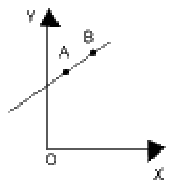
A particle of mass m moves in the XY plane with a velocity V along the straight line AB. If the angular momentum of the particle with respect to origin O is when it is at A and when it is at B, then
- 1
- 2
- 3
- 4The relationship between and depends upon the slope of the line AB
Show answer and solution
Correct: option 3,
Angular momentum about O is , where d is the perpendicular distance from O to the line of motion. The particle keeps moving along the same line AB with the same velocity, so d does not change and , option (3).
Question 82AIPMT 2007 Prelims, Q162
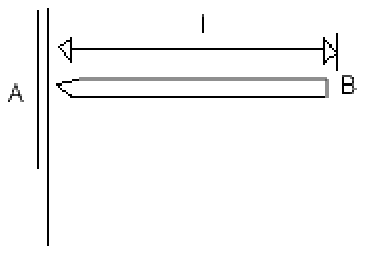
A uniform rod AB of length l and mass m is free to rotate about point A. The rod is released from rest in the horizontal position. Given that the moment of inertia of the rod about A is , the initial angular acceleration of the rod will be
- 1
- 2
- 3
- 4
Show answer and solution
Correct: option 1,
The weight mg acts at the centre of the rod, a distance from A, so the torque about A is . Using : , option (1).
Question 83AIPMT 2006 Prelims, Q30
The moment of inertia of a uniform circular disc of radius 'R' and mass 'M' about an axis touching the disc at its diameter and normal to the disc is:-
- 1
- 2
- 3
- 4
Show answer and solution
Correct: option 3,
The axis is perpendicular to the disc and passes through a point on its rim (the end of a diameter). About the parallel axis through the centre , and the two axes are a distance apart. By the parallel axis theorem .
Question 84AIPMT 2006 Prelims, Q48
A uniform rod of length and mass m is free to rotate in a vertical plane about A. The rod initially in horizontal position is released. The initial angular acceleration of the rod is (Moment of inertia of rod about A is ):

- 1
- 2
- 3
- 4
Show answer and solution
Correct: option 1,
The weight acts at the centre of the rod, a distance from A, so the torque about A when the rod is horizontal is . Then .
Question 85AIPMT 2005 Prelims, Q27
The moment of inertia of a uniform circular disc of radius 'R' and mass 'M' about an axis passing from the edge of the disc and normal to the disc is
- 1
- 2
- 3
- 4
Show answer and solution
Correct: option 3,
About the central axis normal to the disc, . The edge axis is parallel to it at distance R, so by the parallel axis theorem .
Question 86AIPMT 2005 Prelims, Q33
A drum of radius R and mass M, rolls down without slipping along an inclined plane of angle . The frictional force
- 1Decreases the rotational and translational motion
- 2Dissipates energy as heat
- 3Decreases the rotational motion
- 4Converts translational energy to rotational energy
Show answer and solution
Correct: option 4, Converts translational energy to rotational energy
In rolling without slipping the point of contact is at rest, so static friction does no net work and no heat is produced. Friction acts up the plane: it reduces the linear acceleration and its torque spins the drum up. It thus turns part of the translational energy into rotational energy.
Question 87AIPMT 2005 Prelims, Q49
Two bodies have their moments of inertia I and 2I respectively about their axis of rotation. If their kinetic energies of rotation are equal, their angular momentum will be in the ratio
- 11 : 2
- 2
- 3
- 42 : 1
Show answer and solution
Correct: option 3,
Rotational kinetic energy is , so . For equal K, and the ratio is .
Question 88AIPMT 2004 Prelims, Q27
The ratio of the radii of gyration of a circular disc about a tangential axis in the plane of the disc and of a circular ring of the same radius about a tangential axis in the plane of the ring is:-
- 1
- 2
- 3
- 4
Show answer and solution
Correct: option 2,
About a diameter the disc has and the ring . By the parallel axis theorem, about a tangent in the plane these become and . Since , the ratio is .
Question 89AIPMT 2004 Prelims, Q28
A round disc of moment of inertia about its axis perpendicular to its plane and passing through its centre is placed over another disc of moment of inertia rotating with an angular velocity about the same axis. The final angular velocity of the combination of discs is:-
- 1
- 2
- 3
- 4
Show answer and solution
Correct: option 2,
No external torque acts, so angular momentum is conserved: . Hence .
Question 90AIPMT 2004 Prelims, Q35
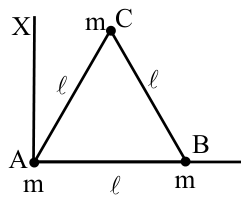
Three particles, each of mass m gram, are situated at the vertices of an equilateral triangle ABC of side cm. (as shown in the figure). The moment of inertia of the system about a line AX perpendicular to AB and in the plane of ABC, in gram cm units will be:-
- 1
- 2
- 3
- 4
Show answer and solution
Correct: option 2,
The distances of the particles from the line AX are: A, zero; B, ; C, (C lies above the midpoint of AB). So .
Question 91AIPMT 2004 Prelims, Q37
A wheel having moment of inertia 2 kg–m about its vertical axis, rotates at the rate of 60 rpm about the axis. The torque which can stop the wheel's rotation in one minute would be:-
- 1 N–m
- 2 N–m
- 3 N–m
- 4 N–m
Show answer and solution
Correct: option 2, N–m
60 rpm is 1 revolution per second, so rad/s. To stop in 60 s the angular retardation is rad/s. The torque is N–m.
Question 92AIPMT 2004 Prelims, Q38
Consider a system of two particles having masses and . If the particle of mass is pushed towards the mass centre of particles through a distance 'd', by what distance would the particle of mass move so as to keep the mass centre of particles at the original position:-
- 1
- 2
- 3
- 4
Show answer and solution
Correct: option 1,
For the centre of mass to stay where it is, the mass-weighted displacements must cancel: . So the second particle must move towards the centre of mass through .
Question 93AIPMT 2003 Prelims, Q3
A thin circular ring M and radius 'r' is rotating about its axis with a constant angular velocity . Four objects each of mass m, are kept gently to the opposite ends of two perpendicular diameters of the ring. The angular velocity of the ring will be -
- 1
- 2
- 3
- 4
Show answer and solution
Correct: option 2,
No external torque acts, so angular momentum about the axis is conserved. The moment of inertia rises from to when the four masses sit on the rim, so and .
Question 94AIPMT 2003 Prelims, Q5
A solid cylinder of mass M and radius R rolls without slipping down an inclined plane of length L and height h. What is the speed of its centre of mass when the cylinder reaches its bottom -
- 1
- 2
- 3
- 4
Show answer and solution
Correct: option 3,
Energy is conserved in rolling without slipping: with and . This gives , so .
Question 95AIPMT 2003 Prelims, Q10
A ball rolls without slipping. The radius of gyration of the ball about an axis passing through its centre of mass is K. If radius of the ball be R, then the fraction of total energy associated with its rotational energy will be:
- 1
- 2
- 3
- 4
Show answer and solution
Correct: option 3,
Rotational energy is and translational energy is . The rotational fraction is .
Question 96AIPMT 2002 Prelims, Q3
A circular disc is to be made by using iron and aluminium so that it acquired maximum moment of inertia about geometrical axis. It is possible with:-
- 1Aluminium at interior and iron surround to it
- 2Iron at interior and aluminium surround to it
- 3Using iron and aluminium layers in alternate order
- 4Sheet of iron is used at both external surface and aluminium sheet as internal layers
Show answer and solution
Correct: option 1, Aluminium at interior and iron surround to it
Moment of inertia is , so it is largest when most of the mass lies far from the axis. Iron is denser than aluminium, so the iron should form the outer ring and the lighter aluminium the inner part.
Question 97AIPMT 2002 Prelims, Q7
A disc is rotating with angular speed . If a child sits on it, what is conserved:-
- 1Linear momentum
- 2Angular momentum
- 3Kinetic energy
- 4Potential energy
Show answer and solution
Correct: option 2, Angular momentum
When the child sits on the disc no external torque acts on the disc and child system about the axis, so its angular momentum is conserved. The moment of inertia rises and the angular speed falls, so the kinetic energy is not conserved.
Question 98AIPMT 2002 Prelims, Q13
A solid sphere of radius R is placed on smooth horizontal surface. A horizontal force 'F' is applied at height 'h' from the lowest point. For the maximum, acceleration of centre of mass, which is correct:-
- 1
- 2
- 3
- 4No relation between h and R
Show answer and solution
Correct: option 4, No relation between h and R
The surface is smooth, so there is no friction and F is the only horizontal force. The acceleration of the centre of mass is wherever the force is applied; the height h only changes the torque and hence the spin. So there is no relation between h and R.
Question 99AIPMT 2002 Prelims, Q25
A point P consider at contact point of a wheel on ground which rolls on ground without slipping then value of displacement of point P when wheel completes half of rotation (If radius of wheel is 1m):-
- 12m
- 2 m
- 3 m
- 4 m
Show answer and solution
Correct: option 2, m
In half a rotation the wheel advances horizontally and point P goes from the bottom to the top of the wheel, a vertical rise of . The displacement is m for m.
Question 100AIPMT 2002 Prelims, Q29
A rod of length is 3m and its mass acting per unit length is directly proportional to distance x from one of its end then its centre of gravity from that end will be at:-
- 11.5 m
- 22 m
- 32.5 m
- 43.0 m
Show answer and solution
Correct: option 2, 2 m
With mass per unit length , . For m this is 2 m.
Question 101AIPMT 2001 Prelims, Q33
A disc is rolling the velocity of its centre of mass is then which one will be correct:
- 1The velocity of highest point is and point of contact is zero
- 2The velocity of highest point is and point of contact is
- 3The velocity of highest point is and point of contact is
- 4The velocity of highest point is and point of contact is
Show answer and solution
Correct: option 1, The velocity of highest point is and point of contact is zero
In rolling without slipping, . At the top the rotational velocity adds to , giving . At the point of contact it is opposite to , giving zero.
Question 102AIPMT 2000 Prelims, Q16
For a hollow cylinder & a solid cylinder rolling without slipping on an inclined plane, then which of these reaches earlier on the ground:
- 1Solid cylinder
- 2Hollow cylinder
- 3Both simultaneously
- 4Can't say anything
Show answer and solution
Correct: option 1, Solid cylinder
For rolling down an incline, . For a solid cylinder , for a hollow cylinder it is 1. The solid cylinder has the larger acceleration and reaches the ground first.
Question 103AIPMT 2000 Prelims, Q35
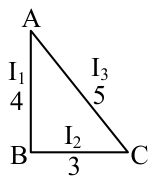
For the adjoining diagram, a triangular lamina is shown the correct relation between , & is
(I – moment of inertia)
- 1
- 2
- 3
- 4
Show answer and solution
Correct: option 2,
, and are about the sides AB (4), BC (3) and AC (5). The moment of inertia is larger when the mass lies farther from the axis. About BC the lamina extends up to 4 units away, about AB up to 3 units, and about AC only up to the altitude units. For a triangular lamina about a side, , so ; of the options only is true.
Question 104AIPMT 1999 Prelims, Q24
A particle is projected with velocity 'u' makes an angle w.r.t. horizontal. Now it breaks in two identical parts at highest point of trajectory. If one part is retrace its path, then velocity of other part is -
- 1
- 2
- 3
- 4
Show answer and solution
Correct: option 1,
At the highest point the velocity is , horizontal. The part that retraces its path must leave with velocity . Conserving momentum for a particle of mass splitting into two masses : , so .
Question 105AIPMT 1999 Prelims, Q45
For a body angular velocity and radius vector is then its velocity is:
- 1
- 2
- 3
- 4
Show answer and solution
Correct: option 1,
. With and : , , . So .
Question 106AIPMT 1999 Prelims, Q46
When a stick is released (as shown in fig.). Its free end velocity when it strikes the ground is:
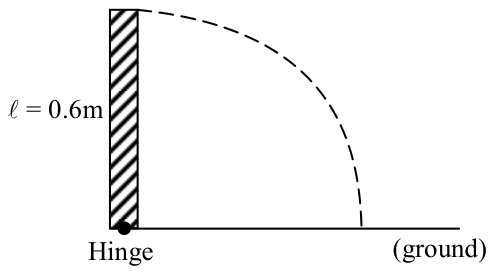
- 14.2 m/s
- 21.4 m/s
- 32.8 m/s
- 4 m/s
Show answer and solution
Correct: option 1, 4.2 m/s
The stick turns about the hinge, and its centre of mass falls by . Energy conservation: , so . The free end moves with m/s.
Question 107AIPMT 1998 Prelims, Q8
A circular ring of mass M and radius R is rotating about its axis with constant angular velocity . Two particle each of mass m are attached gently to the opposite ends of a diameter of the ring. The angular velocity of the ring will now become:
- 1
- 2
- 3
- 4
Show answer and solution
Correct: option 3,
No external torque acts, so angular momentum about the axis is conserved. The moment of inertia changes from to , so and .
Question 108AIPMT 1998 Prelims, Q25
If a ladder is not in balance against a smooth vertical wall, then it can be made in balance by:
- 1Decreasing the length of ladder
- 2Increasing the length of ladder
- 3Increasing the angle of inclination
- 4Decreasing the angle of inclination
Show answer and solution
Correct: option 3, Increasing the angle of inclination
With a smooth wall, taking torques about the foot gives the wall's push as , and friction at the floor must equal N. So the ladder stays put only if , a condition that does not involve the length. Making the ladder steeper (a larger angle with the floor) reduces the friction needed and brings it into balance.
Question 109AIPMT 1998 Prelims, Q27
O is the centre of an equilateral triangle ABC , , are three forces acting along the sides AB, BC and AC as shown in fig. What should be the magnitude of so that total torque about O is zero:
- 1
- 2
- 3
- 4Not possible
Show answer and solution
Correct: option 1,
O is the same perpendicular distance d from all three sides. (from A to B) and (from B to C) go round the triangle in the same sense and give torques and in the same direction, while along AC goes round in the opposite sense and gives the other way. For zero net torque, , so .