Questions with solutions
Question 1NEET 2026, Q2
Match List I with List II:
| List I | List II |
|---|
| A. | I. de Broglie wavelength |
| B. Diffraction and Interference | II. Particle nature of light |
| C. | III. Wave nature of light |
| D. Compton effect | IV. Energy of photon |
Choose the correct answer from the options given below:
- 1A-IV, B-III, C-I, D-II
- 2A-I, B-IV, C-III, D-II
- 3A-IV, B-I, C-II, D-III
- 4A-IV, B-III, C-II, D-I
Show answer and solution
Correct: option 1, A-IV, B-III, C-I, D-II
is the energy of a photon (A-IV). Diffraction and interference show the wave nature of light (B-III). is the de Broglie wavelength (C-I). The Compton effect, in which a photon scatters off an electron like a particle, shows the particle nature of light (D-II).
Question 2NEET 2026, Q42
For a metal of work function , which of the following wavelengths of incident radiation does not give rise to the photoelectric effect?
(Take Planck's constant as )
- 1
- 2
- 3
- 4
Show answer and solution
Correct: option 1,
The threshold wavelength is . Only wavelengths shorter than this eject electrons. 200 nm is longer than the threshold, so it gives no photoelectric effect.
Question 3NEET 2026 Re-exam, Q8
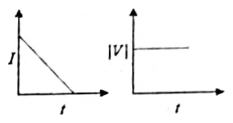
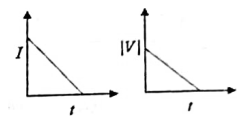
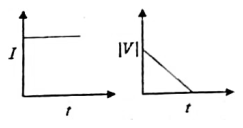
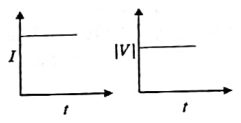
A beam of light falls on a metal surface such that photo-electrons are generated. If power of the light source starts to decrease linearly with time , then variation of the photocurrent and magnitude of the stopping potential with time is best represented by:
- 1
- 2
- 3
- 4
Show answer and solution
Correct: option 1
The photocurrent is proportional to the number of photons arriving each second, that is to the power of the source, so falls linearly with time. The stopping potential depends only on the frequency of the light and the work function, not on the intensity, so stays constant. That is the pair of graphs in option (1).
Question 4NEET 2026 Re-exam, Q18
A ray of light with wavelength is incident on three different photo-electric cells namely 1, 2 and 3. The threshold wavelength of these photo-electric cells are , , and , respectively and the magnitude of stopping potentials of these cells are , and , respectively. The relation between and threshold wavelengths are , and . The correct option is:
- 1,
- 2,
- 3,
- 4,
Show answer and solution
Correct: option 1, ,
Electrons are emitted only when the incident wavelength is shorter than the threshold wavelength. For cell 1, , so there is no emission and . For the others , which is larger when the threshold wavelength is longer, so . This is option (1).
Question 5NEET 2026 Re-exam, Q19
A photon and an electron, each of 20 eV energy, move in free space. The ratio of linear momentum of electron to that of photon , is:
(Take speed of light , charge of electron C and mass of electron kg)
- 1
- 2
- 3225
- 4275
Show answer and solution
Correct: option 3, 225
J. For the electron . For the photon . The ratio is 225, option (3).
Question 6NEET 2025, Q37
A photon and an electron (mass ) have the same energy . The ratio () of their de Broglie wavelengths is: ( is the speed of light)
- 1
- 2
- 3
- 4
Show answer and solution
Correct: option 3,
For the photon . For the electron, taking as its kinetic energy, the momentum is and . The ratio is , option (3).
Question 7NEET 2025, Q38
Which of the following options represent the variation of photoelectric current with property of light shown on the x-axis?
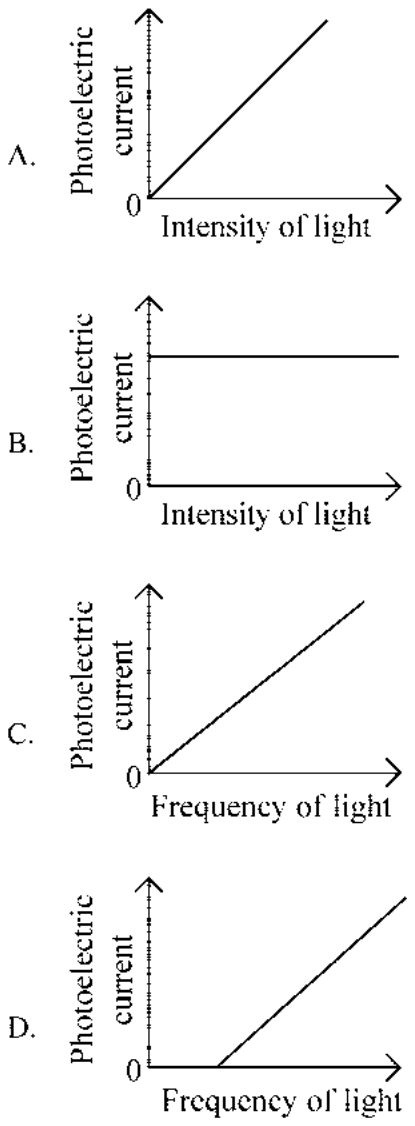
- 1A only
- 2A and C
- 3A and D
- 4B and D
Show answer and solution
Correct: option 1, A only
The photoelectric current is proportional to the number of photons arriving each second, that is to the intensity of the light, so graph A (a straight line through the origin) is right and B is wrong. Frequency decides only whether emission happens and the energy of the electrons; above the threshold the current does not grow in proportion to frequency, so C and D are wrong. The answer is A only, option (1).
Question 8NEET 2024, Q8
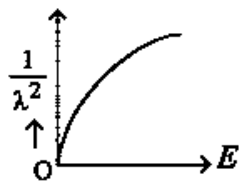
The graph which shows the variation of and its kinetic energy, is (where is de Broglie wavelength of a free particle):
- 1
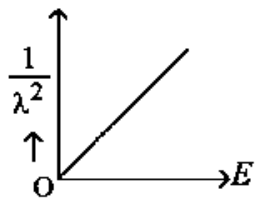
- 2
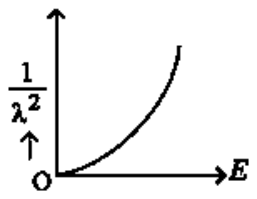
- 3
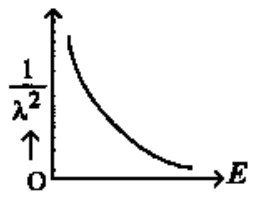
- 4
Show answer and solution
Correct: option 1
For a free particle , so . This is directly proportional to , so the graph is a straight line through the origin, which is graph (1).
Question 9NEET 2024, Q24
If is the velocity of light in free space, the correct statements about photon among the following are:
A. The energy of a photon is .
B. The velocity of a photon is .
C. The momentum of a photon, .
D. In a photon-electron collision, both total energy and total momentum are conserved.
E. Photon possesses positive charge.
Choose the correct answer from the options given below:
- 1A, B, D and E only
- 2A and B only
- 3A, B, C and D only
- 4A, C and D only
Show answer and solution
Correct: option 3, A, B, C and D only
A photon has energy (A), moves at speed in free space (B) and has momentum (C). In a collision between a photon and an electron total energy and total momentum are conserved (D). A photon is electrically neutral, so E is wrong. The correct set is A, B, C and D, option (3).
Question 10NEET 2024 Re-exam, Q7
An electron and an alpha particle are accelerated by the same potential difference. Let and denote the de-Broglie wavelengths of the electron and the alpha particle, respectively, then:
- 1
- 2
- 3
- 4
Show answer and solution
Correct: option 1,
A particle of charge and mass accelerated through a potential difference has . The alpha particle has twice the charge and about 7300 times the mass of the electron, so is far larger for it and its wavelength is far smaller. Hence (the ratio is about 120, not 4).
Question 11NEET 2024 Re-exam, Q31
If is the work function of photosensitive material in eV and light of wavelength of numerical value metre, is incident on it with energy above its threshold value at an instant then the maximum kinetic energy of the photo-electron ejected by it at that instant (Take -Planck's constant, -velocity of light in free space) is (in SI units):
- 1
- 2
- 3
- 4
Show answer and solution
Correct: option 3,
The photon energy is (numerically, in joule). Einstein's equation gives .
Question 12NEET 2023, Q19
The minimum wavelength of X-rays produced by an electron accelerated through a potential difference of volts is proportional to:
- 1
- 2
- 3
- 4
Show answer and solution
Correct: option 2,
The most energetic X-ray photon takes the whole kinetic energy of the electron: . So , proportional to , option (2).
Question 13NEET 2023, Q27
The work functions of Caesium (Cs), Potassium (K) and Sodium (Na) are 2.14 eV, 2.30 eV and 2.75 eV respectively. If incident electromagnetic radiation has an incident energy of 2.20 eV, which of these photosensitive surfaces may emit photoelectrons?
- 1Cs only
- 2Both Na and K
- 3K only
- 4Na only
Show answer and solution
Correct: option 1, Cs only
Photoelectrons are emitted only when the photon energy exceeds the work function. 2.20 eV is more than 2.14 eV (Cs) but less than 2.30 eV (K) and 2.75 eV (Na). So only caesium emits, option (1).
Question 14NEET 2023 Manipur, Q20
The maximum kinetic energy of the emitted photoelectrons in photoelectric effects is independent of:
- 1Frequency of incident radiation
- 2Wavelength of incident radiation
- 3Work function of material
- 4Intensity of incident radiation
Show answer and solution
Correct: option 4, Intensity of incident radiation
Einstein's equation is . It contains the frequency (or wavelength) of the light and the work function of the material, but not the intensity. Intensity only changes the number of photoelectrons emitted per second.
Question 15NEET 2023 Manipur, Q25
The de Broglie wavelength associated with an electron, accelerated by a potential difference of 81 V is given by:
- 11.36 nm
- 20.136 nm
- 313.6 nm
- 4136 nm
Show answer and solution
Correct: option 2, 0.136 nm
For an electron accelerated through volts, . With , .
Question 16NEET 2022, Q3
When two monochromatic lights of frequency, and are incident on a photoelectric metal, their stopping potential becomes and respectively. The threshold frequency for this metal is:
- 1
- 2
- 3
- 4
Show answer and solution
Correct: option 1,
Einstein's equation gives and . Doubling the first and equating it to the second: , so , option (1). (With the data as printed the threshold comes out above both frequencies, but this is the value the given relations lead to.)
Question 17NEET 2022, Q9
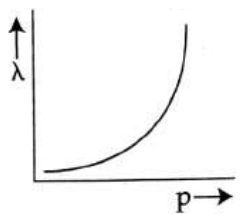
The graph which shows the variation of the de Broglie wavelength () of a particle and its associated momentum (p) is:
- 1
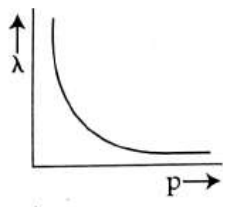
- 2
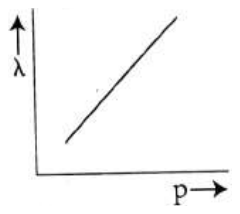
- 3
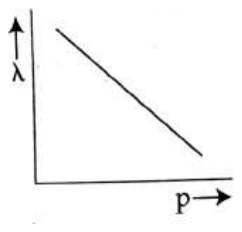
- 4
Show answer and solution
Correct: option 1
The de Broglie relation is , so is inversely proportional to and is constant. The graph of against is therefore a rectangular hyperbola that falls as grows, which is the curve in option (1).
Question 18NEET 2022 Re-exam, Q19
The light rays having photons of energy 4.2 eV are falling on a metal surface having a work function of 2.2 eV. The stopping potential of the surface is
- 16.4 V
- 22 eV
- 32 V
- 41.1 V
Show answer and solution
Correct: option 3, 2 V
Einstein's equation gives eV, so the stopping potential is V, option (3). Option (2) has the unit of energy, not of potential.
Question 19NEET 2022 Re-exam, Q23
The threshold frequency of a photoelectric metal is . If light of frequency is incident on this metal, then the maximum kinetic energy of emitted electrons will be:
- 1
- 2
- 3
- 4
Show answer and solution
Correct: option 4,
The work function is . Einstein's photoelectric equation gives , option (4).
Question 20NEET 2021, Q16
The number of photons per second on an average emitted by the source of monochromatic light of wavelength 600 nm, when it delivers the power of watt will be: ( Js)
- 1
- 2
- 3
- 4
Show answer and solution
Correct: option 3,
Energy of one photon: J. Photons per second .
Question 21NEET 2021, Q33
An electromagnetic wave of wavelength '' is incident on a photosensitive surface of negligible work function. If 'm' mass is of photoelectron emitted from the surface has de-Broglie wavelength , then:
- 1
- 2
- 3
- 4
Show answer and solution
Correct: option 3,
With negligible work function the whole photon energy becomes kinetic energy: . Putting gives , so .
Question 22NEET 2020, Q140
An electron is accelerated from rest through a potential difference of V volt. If the de Broglie wavelength of the electron is , the potential difference is:
- 1
- 2
- 3
- 4
Show answer and solution
Correct: option 4,
For an electron accelerated through V volt, . Setting this equal to gives , so .
Question 23NEET 2020, Q172
Light of frequency 1.5 times the threshold frequency is incident on a photosensitive material. What will be the photoelectric current if the frequency is halved and intensity is doubled?
- 1doubled
- 2four times
- 3one-fourth
- 4zero
Show answer and solution
Correct: option 4, zero
The original frequency is . When it is halved it becomes , which is below the threshold frequency . Below the threshold no photoelectrons are emitted, whatever the intensity, so the photoelectric current is zero.
Question 24NEET 2020 Phase 2, Q113
The de Broglie wavelength of an electron moving with kinetic energy of 144 eV is nearly,
- 1
- 2
- 3
- 4
Show answer and solution
Correct: option 4,
An electron of kinetic energy 144 eV has been accelerated through volt, and its de Broglie wavelength is .
Question 25NEET 2020 Phase 2, Q131
The wave nature of electrons was experimentally verified by,
- 1Hertz
- 2Einstein
- 3Davisson and Germer
- 4de Broglie
Show answer and solution
Correct: option 3, Davisson and Germer
de Broglie proposed that moving particles have a wavelength, but the proof came from the experiment of Davisson and Germer, who found that electrons scattered from a nickel crystal form a diffraction pattern, with a wavelength matching de Broglie's formula. Hertz discovered the photoelectric effect and Einstein explained it.
Question 26NEET 2019, Q13
An electron is accelerated through a potential difference of 10,000 V. Its de Broglie wavelength is, (nearly): ( kg)
- 1 m
- 2 m
- 3 m
- 412.2 nm
Show answer and solution
Correct: option 2, m
m, that is about m. (Equivalently angstrom angstrom.)
Question 27NEET 2019 Odisha, Q28
The work function of a photosensitive material is 4.0 eV. The longest wavelength of light that can cause photon emission from the substance is (approximately)
- 131 nm
- 2310 nm
- 33100 nm
- 4966 nm
Show answer and solution
Correct: option 2, 310 nm
The longest (threshold) wavelength has photon energy equal to the work function: nm.
Question 28NEET 2019 Odisha, Q29
A proton and an -particle are accelerated from rest to the same energy. The de Broglie wavelengths and are in the ratio,
- 1
- 24:1
- 32:1
- 41:1
Show answer and solution
Correct: option 3, 2:1
, so for the same kinetic energy . Since , , that is 2:1.
Question 29NEET 2018, Q12
An electron of mass m with an initial velocity enters an electric field at t = 0. If is its de-Broglie wavelength initially, then its de-Broglie wavelength at time t is
- 1
- 2
- 3
- 4
Show answer and solution
Correct: option 3,
The force on the electron is , along its velocity, so it speeds up: . Since and , we get .
Question 30NEET 2018, Q14
When the light of frequency (where is threshold frequency), is incident on a metal plate, the maximum velocity of electrons emitted is . When the frequency of the incident radiation is increased to , the maximum velocity of electrons emitted from the same plate is . The ratio of to is
- 1
- 2
- 3
- 4
Show answer and solution
Correct: option 3,
Einstein's equation: . For the kinetic energy is and for it is . So and .
Question 31NEET 2017, Q6
The de-Broglie wavelength of a neutron in thermal equilibrium with heavy water at a temperature T (Kelvin) and mass m, is:
- 1
- 2
- 3
- 4
Show answer and solution
Correct: option 2,
A neutron in thermal equilibrium has average kinetic energy . Its momentum is . So the de-Broglie wavelength is .
Question 32NEET 2017, Q18
The photoelectric threshold wavelength of silver is m. The velocity of the electron ejected from a silver surface by ultraviolet light of wavelength m is:
(Given eVs and )
- 1
- 2
- 3
- 4
Show answer and solution
Correct: option 1,
The examiners dropped this question and gave every candidate the 4 marks.
The answer key gives no single option for this question, so it is treated as dropped and every candidate gets the marks. The working: eV. Then . Options (1) and (2) are the same value written two ways, so both are correct.
Question 33NEET 2016 Phase 1, Q20
An electron of mass m and a photon have same energy E. The ratio of de-Broglie wavelengths associated with them is:
( being velocity of light)
- 1
- 2
- 3
- 4
Show answer and solution
Correct: option 1,
For the electron and for the photon . So .
Question 34NEET 2016 Phase 2, Q39
Electrons of mass with de-Broglie wavelength fall on the target in an X-ray tube. The cutoff wavelength () of the emitted X-ray is
- 1
- 2
- 3
- 4
Show answer and solution
Correct: option 1,
The electron's momentum is , so its kinetic energy is . The shortest X-ray wavelength is emitted when all of this energy goes into one photon: , which gives , option (1).
Question 35NEET 2016 Phase 2, Q40
Photons with energy 5 eV are incident on a cathode in a photoelectric cell. The maximum energy of emitted photoelectrons is 2 eV. When photons of energy 6 eV are incident on , no photoelectrons will reach the anode , if the stopping potential of relative to is
- 1 V
- 2 V
- 3 V
- 4 V
Show answer and solution
Correct: option 4, V
Work function eV. With 6 eV photons the maximum kinetic energy is eV. To stop these electrons the anode must be 3 V lower than the cathode, so the potential of relative to is V, option (4).
Question 36AIPMT 2015, Q148
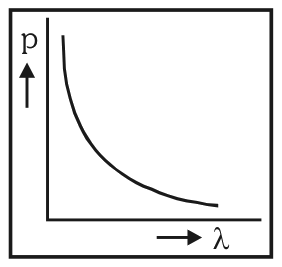
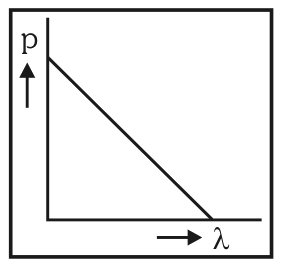
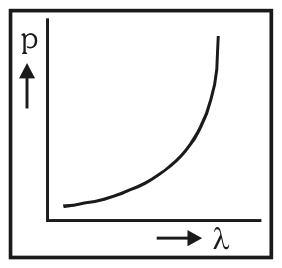
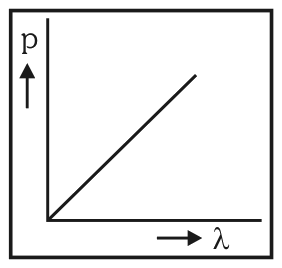
Which of the following figures represent the variation of particle momentum and the associated de-Broglie wavelength?
- 1
- 2
- 3
- 4
Show answer and solution
Correct: option 1
The de Broglie relation is , so is constant and momentum is inversely proportional to wavelength. The graph of p against is therefore a rectangular hyperbola, falling steeply at small and flattening at large . That is the curve in option (1); the straight lines and the rising curve do not fit.
Question 37AIPMT 2015, Q154
A certain metallic surface is illuminated with monochromatic light of wavelength, . The stopping potential for photo-electric current for this light is . If the same surface is illuminated with light of wavelength , the stopping potential is . The threshold wavelength for this surface for photoelectric effect is:-
- 1
- 2
- 3
- 4
Show answer and solution
Correct: option 1,
Einstein's equation gives and . Multiplying the second by 3 and equating: , so . Since , the threshold wavelength is , option (1).
Question 38AIPMT 2015 Re-test, Q160
Light of wavelength 500 nm is incident on a metal with work function 2.28 eV. The de Broglie wavelength of the emitted electron is:
- 1
- 2
- 3
- 4
Show answer and solution
Correct: option 4,
Photon energy , so the maximum kinetic energy of an electron is . The fastest electron has the shortest de Broglie wavelength, . Slower electrons have longer wavelengths, so .
Question 39AIPMT 2015 Re-test, Q179
A photoelectric surface is illuminated successively by monochromatic light of wavelength and . If the maximum kinetic energy of the emitted photoelectrons in the second case is 3 times that in the first case, the work function of the surface of the material is:
(h = Planck's constant, c = speed of light)
- 1
- 2
- 3
- 4
Show answer and solution
Correct: option 2,
Einstein's equation for the two cases: and . Substituting the first into the second: , so and .
Question 40AIPMT 2014, Q99
If the kinetic energy of the particle is increased to 16 times its previous value, the percentage change in the de-Broglie wavelength of the particle is:
- 150
- 225
- 375
- 460
Show answer and solution
Correct: option 3, 75
The de Broglie wavelength is , so . When becomes the wavelength becomes . The change is per cent (a decrease), option (3).
Question 41AIPMT 2014, Q109
When the energy of the incident radiation is increased by 20%, the kinetic energy of the photoelectrons emitted from a metal surface increased from 0.5 eV to 0.8 eV. The work function of the metal is:
- 11.5 eV
- 20.65 eV
- 31.0 eV
- 41.3 eV
Show answer and solution
Correct: option 3, 1.0 eV
Einstein's equation gives and (in eV). Subtracting, , so and , option (3).
Question 42NEET 2013, Q153
For photoelectric emission from certain metal the cutoff frequency is . If radiation of frequency impinges on the metal plate, the maximum possible velocity of the emitted electron will be (m is the electron mass):
- 1
- 2
- 3
- 4
Show answer and solution
Correct: option 2,
The work function is . Einstein's equation gives the maximum kinetic energy as . Setting gives .
Question 43NEET 2013, Q163
The wavelength of an electron and of a photon of same energy E are related by:
- 1
- 2
- 3
- 4
Show answer and solution
Correct: option 4,
For the photon , so . For the electron , so . Comparing the two, .
Question 44NEET 2013, Q178
A parallel beam of fast moving electrons is incident normally on a narrow slit. A fluorescent screen is placed at a large distance from the slit. If the speed of the electrons is increased, which of the following statements is correct?
- 1The angular width of the central maximum of the diffraction pattern will increase.
- 2The angular width of the central maximum will decrease.
- 3The angular width of the central maximum will be unaffected.
- 4Diffraction pattern is not observed on the screen in the case of electrons.
Show answer and solution
Correct: option 2, The angular width of the central maximum will decrease.
Electrons behave as waves of de Broglie wavelength , which gets shorter as the speed rises. The angular width of the central maximum of a single slit is , so it decreases.
Question 45NEET 2013 Karnataka, Q162
A source of light is placed at a distance of 50 cm from a photo cell and the stopping potential is found to be . If the distance between the light source and photo cell is made 25 cm, the new stopping potential will be:
- 1
- 2
- 3
- 4
Show answer and solution
Correct: option 2,
Stopping potential depends only on the frequency of the light and the work function: . Moving the source closer raises the intensity (and so the photocurrent) but not the frequency, so the stopping potential stays .
Question 46NEET 2013 Karnataka, Q173
The de-Broglie wavelength of neutrons in thermal equilibrium at temperature T is:
- 1
- 2
- 3
- 4
Show answer and solution
Correct: option 4,
. Taking the thermal energy of a neutron as : . (With the number would be about 25, so 30.8 is the option intended.)
Question 47AIPMT 2012 Prelims, Q3
A 200 W sodium street lamp emits yellow light of wavelength . Assuming it to be 25% efficient in converting electrical energy to light, the number of photons of yellow light it emits per second is.
- 1
- 2
- 3
- 4
Show answer and solution
Correct: option 1,
Light power is 25% of 200 W, that is 50 W. Each photon carries . The number emitted per second is .
Question 48AIPMT 2012 Prelims, Q41
Monochromatic radiation emitted when electron on hydrogen atom jumps from first excited to the ground state irradiates a photosensitive material. The stopping potential is measured to be 3.57 V. The threshold frequency of the material is:
- 1 Hz
- 2 Hz
- 3 Hz
- 4 Hz
Show answer and solution
Correct: option 3, Hz
The photon from n = 2 to n = 1 has energy . The maximum kinetic energy of the photoelectrons is 3.57 eV, so the work function is . The threshold frequency is .
Question 49AIPMT 2012 Prelims, Q45
An -particle moves in a circular path of radius 0.83 cm in the presence of a magnetic field of . The de Broglie wavelength associated with the particle will be:
- 11 Å
- 20.1 Å
- 310 Å
- 40.01 Å
Show answer and solution
Correct: option 4, 0.01 Å
For circular motion in a magnetic field , so the momentum is . Then Å.
Question 50AIPMT 2012 Mains, Q25
If the momentum of electron is changed by P, then the de Broglie wavelength associated with it changes by 0.5%. The initial momentum of electron will be:
- 1200 P
- 2400 P
- 3
- 4100 P
Show answer and solution
Correct: option 1, 200 P
Since , a small fractional change in wavelength equals the fractional change in momentum in size: . So , which gives the initial momentum .
Question 51AIPMT 2012 Mains, Q26
Two radiations of photons energies 1 eV and 2.5 eV, successively illuminate a photosensitive metallic surface of work function 0.5 eV. The ratio of the maximum speeds of the emitted electrons is:
- 11 : 4
- 21 : 2
- 31 : 1
- 41 : 5
Show answer and solution
Correct: option 2, 1 : 2
The photoelectric equation gives the maximum kinetic energies eV and eV. Since , the speeds are in the ratio , that is 1 : 2.
Question 52AIPMT 2011 Prelims, Q151
Photoelectric emission occurs only when the incident light has more than a certain minimum:
- 1power
- 2wavelength
- 3intensity
- 4frequency
Show answer and solution
Correct: option 4, frequency
A photon can free an electron only if its energy is at least the work function of the metal. So emission needs , the threshold frequency, whatever the intensity or power of the light.
Question 53AIPMT 2011 Prelims, Q186
In the Davisson and Germer experiment, the velocity of electrons emitted from the electron gun can be increased by:
- 1increasing the potential difference between the anode and filament
- 2increasing the filament current
- 3decreasing the filament current
- 4decreasing the potential difference between the anode and filament
Show answer and solution
Correct: option 1, increasing the potential difference between the anode and filament
The electrons from the filament are accelerated by the potential difference between the anode and the filament, gaining . A larger gives a larger speed. The filament current changes only the number of electrons emitted.
Question 54AIPMT 2011 Prelims, Q192
Light of two different frequencies whose photons have energies 1 eV and 2.5 eV respectively illuminate a metallic surface whose work function is 0.5 eV successively. Ratio of maximum speeds emitted electrons will be:
- 11 : 4
- 21 : 2
- 31 : 1
- 41 : 5
Show answer and solution
Correct: option 2, 1 : 2
Maximum kinetic energy : eV and eV, a ratio of 1 : 4. Since kinetic energy is proportional to , the maximum speeds are in the ratio , that is 1 : 2.
Question 55AIPMT 2011 Prelims, Q194
Electrons used in a electron microscope are accelerated by a voltage of 25 kV. If the voltage is increased to 100kV then the de-Broglie wavelength associated with the electrons would:
- 1increases by 2 times
- 2decrease by 2 times
- 3decrease by 4 times
- 4increases by 4 times
Show answer and solution
Correct: option 2, decrease by 2 times
For an electron accelerated through a voltage , , so . The voltage becomes 4 times, so the wavelength becomes of its value: it decreases by 2 times.
Question 56AIPMT 2011 Prelims, Q196
In photoelectric emission process from a metal of work function 1.8 eV, the kinetic energy of most energetic electrons is 0.5 eV. The corresponding stopping potential is:
- 11.8 V
- 21.2 V
- 30.5 V
- 42.3 V
Show answer and solution
Correct: option 3, 0.5 V
The stopping potential just stops the fastest electrons, so eV and V. The work function is not needed.
Question 57AIPMT 2011 Mains, Q93
The threshold frequency for a photosensitive metal is Hz. If light of frequency Hz is incident on this metal, the cut-off voltage for the photoelectric emission is nearly:
- 12V
- 23V
- 35V
- 41V
Show answer and solution
Correct: option 1, 2V
Einstein's equation gives . So V.
Question 58AIPMT 2010 Mains, Q6
When monochromatic radiation of intensity I falls on a metal surface, the number of photoelectrons and their maximum kinetic energy are N and T respectively. If the intensity of radiation is 2I, the number of emitted electrons and their maximum kinetic energy are respectively
- 1N and 2T
- 22N and T
- 32N and 2T
- 4N and T
Show answer and solution
Correct: option 2, 2N and T
Doubling the intensity at the same frequency doubles the number of photons arriving per second, so the number of photoelectrons doubles to 2N. The maximum kinetic energy depends only on the photon energy and the work function, not on the intensity, so it stays T.
Question 59AIPMT 2010 Prelims, Q40
A source is producing photons per second of wavelength 5000 Å. Another source is producing photons per second of wavelength 5100 Å. Then (power of )/(power of ) is equal to
- 11.00
- 21.02
- 31.04
- 40.98
Show answer and solution
Correct: option 1, 1.00
The power of a source is the number of photons per second times the energy of each, . So .
Question 60AIPMT 2010 Prelims, Q44
The potential difference that must be applied to stop the fastest photoelectrons emitted by a nickel surface, having work function 5.01 eV, when ultraviolet light of 200 nm falls on it, must be
- 12.4 V
- 2 V
- 3 V
- 41.2 V
Show answer and solution
Correct: option 4, 1.2 V
The photon energy is eV. The fastest photoelectrons have kinetic energy eV, so the stopping potential has magnitude 1.2 V, the keyed answer. (It is a retarding potential, so with a sign convention it is written V; the key gives the magnitude.)
Question 61AIPMT 2009 Prelims, Q4
The number of photo electrons emitted for light of a frequency (higher than the threshold frequency ) is proportional to:
- 1Threshold frequency ()
- 2Intensity of light
- 3Frequency of light ()
- 4
Show answer and solution
Correct: option 2, Intensity of light
Above the threshold frequency each absorbed photon can release one electron, so the number of photoelectrons emitted per second depends on the number of photons arriving per second, that is, on the intensity of the light. The frequency only fixes the maximum kinetic energy of the electrons.
Question 62AIPMT 2009 Prelims, Q18
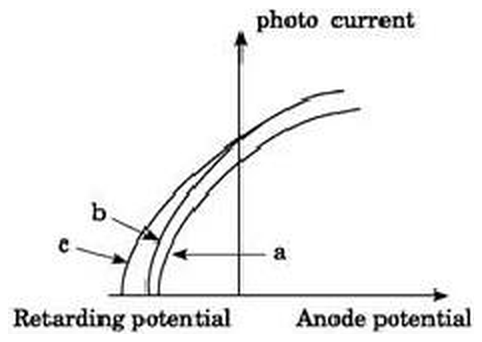
The Figure shows a plot of photo current versus anode potential for a photo sensitive surface for three different radiations. Which one of the following is a correct statement?
- 1curves (a) and (b) represent incident radiations of same frequency but of different intensities.
- 2curves (b) and (c) represent incident radiations of different frequencies and different intensities.
- 3curves (b) and (c) represent incident radiations of same frequency having same intensity.
- 4curves (a) and (b) represent incident radiations of different frequencies and different intensities.
Show answer and solution
Correct: option 1, curves (a) and (b) represent incident radiations of same frequency but of different intensities.
The stopping potential depends only on the frequency of the light, and the saturation current depends on its intensity. Curves (a) and (b) meet the potential axis at the same retarding potential, so they have the same frequency, but they rise to different currents, so their intensities differ. Curve (c) has a different stopping potential and therefore a different frequency.
Question 63AIPMT 2009 Prelims, Q30
Monochromatic light of wavelength 667 nm is produced by a helium neon laser. The power emitted is 9 mW. The number of photons arriving per sec. on the average at a target irradiated by this beam is:
- 1
- 2
- 3
- 4
Show answer and solution
Correct: option 1,
Each photon has energy J. The number arriving per second is .
Question 64AIPMT 2008 Prelims, Q41
The work function of a surface of a photosensitive material is 6.2 eV. The wavelength of the incident radiation for which the stopping potential is 5 V lies in the
- 1X-ray region
- 2Ultraviolet region
- 3Visible region
- 4Infrared region
Show answer and solution
Correct: option 2, Ultraviolet region
Einstein's equation gives the photon energy as eV. The wavelength is (about 110 nm), which is shorter than visible light (4000 to 7000 Å) and far longer than X-rays, so it is in the ultraviolet.
Question 65AIPMT 2008 Prelims, Q42
A particle of mass 1 mg has the same wavelength as an electron moving with a velocity of . The velocity of the particle is (mass of electron = kg)
- 1
- 2
- 3
- 4
Show answer and solution
Correct: option 2,
The de Broglie wavelength is , so equal wavelengths mean equal momenta. With 1 mg kg: , giving .
Question 66AIPMT 2007 Prelims, Q190
Monochromatic light of frequency Hz is produced by a laser. The power emitted is W. The number of photons emitted, on the average, by the source per second is
- 1
- 2
- 3
- 4
Show answer and solution
Correct: option 2,
Each photon has energy J. The number emitted per second is , option (2).
Question 67AIPMT 2006 Prelims, Q22
A photo-cell employs photoelectric effect to convert:-
- 1Change in the frequency of light into a change in electric voltage
- 2Change in the intensity of illumination into a change in photoelectric current
- 3Change in the intensity of illumination into a change in the work function of the photocathode
- 4Change in the frequency of light into a change in the electric current
Show answer and solution
Correct: option 2, Change in the intensity of illumination into a change in photoelectric current
In a photocell the number of electrons emitted per second, and so the photoelectric current, is proportional to the intensity of the light falling on the cathode. The cell therefore turns changes of illumination into changes of current. The work function is a fixed property of the cathode material, and the current does not follow the frequency.
Question 68AIPMT 2006 Prelims, Q25
In a discharge tube ionization of enclosed gas produced due to collisions between:
- 1Positive ions and neutral atoms/molecules
- 2Negative electrons and neutral atoms/molecules
- 3Photons and neutral atoms/molecules
- 4Neutral gas atoms/molecules
Show answer and solution
Correct: option 2, Negative electrons and neutral atoms/molecules
In a discharge tube the electric field accelerates the free electrons. Being light, they gain enough energy between collisions to knock electrons out of the neutral gas atoms or molecules they hit, and this is what ionises the gas. The heavy positive ions gain too little speed to do so.
Question 69AIPMT 2006 Prelims, Q26
When photons of energy fall on an aluminium plate (of work function ), photoelectrons of maximum kinetic energy K are ejected. If the frequency of the radiation is doubled, the maximum kinetic energy of the ejected photoelectrons will be
- 1
- 2
- 3
- 4
Show answer and solution
Correct: option 4,
Einstein's equation gives . With the frequency doubled, .
Question 70AIPMT 2006 Prelims, Q31
The momentum of a photon of energy 1 MeV in kg m/s, will be-
- 1
- 2
- 3
- 4
Show answer and solution
Correct: option 4,
For a photon . Here , so , which is closest to .
Question 71AIPMT 2005 Prelims, Q1
The work functions for metals A, B and C are respectively 1.92 eV, 2.0 eV and 5 eV. According to Einstein's equation, the metals which will emit photo electrons for a radiation of wavelength 4100 Å is/are
- 1None
- 2A only
- 3A and B only
- 4All the three metals
Show answer and solution
Correct: option 3, A and B only
Photon energy (with eV Å). Emission needs the photon energy to exceed the work function. That holds for A (1.92 eV) and B (2.0 eV) but not for C (5 eV), so only A and B emit.
Question 72AIPMT 2005 Prelims, Q20
A photosensitive metallic surface has work function, . If photons of energy fall on this surface, the electrons come out with a maximum velocity of m/s. When the photon energy is increased to , then maximum velocity of photo electrons will be
- 1 m/s
- 2 m/s
- 3 m/s
- 4 m/s
Show answer and solution
Correct: option 4, m/s
Maximum kinetic energy is photon energy minus work function: in the first case and in the second. Kinetic energy becomes 4 times, so the speed becomes times, that is m/s.
Question 73AIPMT 2004 Prelims, Q19
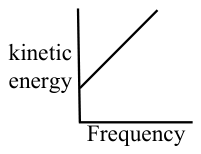
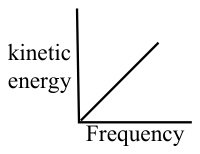
According to Einstein's photoelectric equation, the graph between the kinetic energy of photoelectrons ejected and the frequency of incident radiation is:-
- 1
- 2
- 3
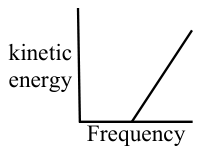
- 4
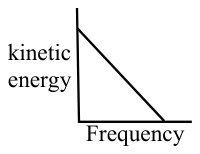
Show answer and solution
Correct: option 3
Einstein's equation is . Kinetic energy is zero up to the threshold frequency and then rises linearly with frequency, so the graph is a straight line of positive slope that starts from a point on the frequency axis away from the origin, as in graph (3).
Question 74AIPMT 2003 Prelims, Q36
A photoelectric cell is illuminated by a point source of light 1 m away. When the source is shifted to 2m then -
- 1each emitted electron carries one quarter of the initial energy
- 2number of electrons emitted is half the initial number
- 3each emitted electron carries half the initial energy
- 4number of electrons emitted is a quarter of the initial number
Show answer and solution
Correct: option 4, number of electrons emitted is a quarter of the initial number
The intensity from a point source falls as , so doubling the distance cuts it to one quarter. The number of photoelectrons is proportional to the intensity, so it becomes a quarter; the energy of each electron depends only on the frequency and does not change.
Question 75AIPMT 2003 Prelims, Q40
J.J. Thomson's cathode-ray tube experiment demonstrated that
- 1cathode rays are streams of negatively charged ions
- 2all the mass of an atom is essentially in the nucleus
- 3the e/m of electrons is much greater than the e/m of protons
- 4the e/m ratio of the cathode ray particles changes when a different gas is placed in the discharge tube
Show answer and solution
Correct: option 3, the e/m of electrons is much greater than the e/m of protons
Thomson measured e/m for cathode-ray particles and found it the same for every gas and electrode, and about 1800 times larger than the value for the hydrogen ion (proton). The particles are electrons, not ions, and the nucleus came later from Rutherford's experiment, so (3) is the statement that holds.
Question 76AIPMT 2002 Prelims, Q9
If particles are moving with same velocity, then De-Broglie wavelength is maximum for:-
- 1Proton
- 2-particle
- 3Neutron
- 4-particle
Show answer and solution
Correct: option 4, -particle
, so at the same velocity the wavelength is largest for the smallest mass. A -particle is an electron, far lighter than a proton, a neutron or an -particle, so it has the maximum wavelength.
Question 77AIPMT 2002 Prelims, Q10
When ultraviolet rays incident on metal plate then photoelectric effect does not occur, it occurs by incidence of:-
- 1Infrared rays
- 2X-rays
- 3Radio wave
- 4Light wave
Show answer and solution
Correct: option 2, X-rays
If ultraviolet light cannot eject electrons, its frequency is below the threshold frequency of the metal. Only radiation of higher frequency can work. Of the options only X-rays have a higher frequency than ultraviolet; infrared, radio and visible light are all lower.
Question 78AIPMT 2002 Prelims, Q12
Which of the following is not the property of cathode rays:-
- 1It produces heating effect
- 2It does not deflect in electric field
- 3It casts shadow
- 4It produces fluorescence
Show answer and solution
Correct: option 2, It does not deflect in electric field
Cathode rays are streams of electrons, which carry negative charge, so they are deflected by electric and magnetic fields. They do heat the target, cast shadows of obstacles and cause fluorescence. The statement that they are not deflected in an electric field is therefore not a property.
Question 79AIPMT 2001 Prelims, Q26
Which one among shows particle nature of light.
- 1P.E.E.
- 2Interference
- 3Refraction
- 4Polarization
Show answer and solution
Correct: option 1, P.E.E.
The photoelectric effect (P.E.E.) can only be explained by light arriving as photons of energy , each ejecting one electron. Interference, refraction and polarization are explained by the wave picture of light.
Question 80AIPMT 2001 Prelims, Q47
A photo-cell is illuminated by a source of light, which is placed at a distance d from the cell. If the distance become d/2, then number of electrons emitted per second will be:
- 1Remain same
- 2Four times
- 3Two times
- 4One-fourth
Show answer and solution
Correct: option 2, Four times
The intensity from a small source varies as , so halving the distance makes the intensity four times. The number of photoelectrons emitted per second is proportional to the intensity, so it also becomes four times.
Question 81AIPMT 2000 Prelims, Q14
By photo electric effect, Einstein proved:
- 1
- 2
- 3
- 4
Show answer and solution
Correct: option 1,
Einstein explained the photoelectric effect by treating light as photons, each of energy , one photon giving its energy to one electron. This established the quantum relation .
Question 82AIPMT 2000 Prelims, Q38
Who evaluated the mass of electron indirectly with help of charge:
- 1Thomson
- 2Millikan
- 3Rutherford
- 4Newton
Show answer and solution
Correct: option 2, Millikan
Thomson had measured only the ratio . Millikan's oil-drop experiment gave the charge itself, and combining it with gave the mass of the electron, .
Question 83AIPMT 1999 Prelims, Q30
The current conduction in a discharge tube is due to -
- 1Electrons only
- 2+ve ions and –ve ions
- 3–ve ions and electrons
- 4+ve ions, and electrons
Show answer and solution
Correct: option 4, +ve ions, and electrons
In a discharge tube the gas at low pressure is ionised: atoms lose electrons and become positive ions. The free electrons drift to the anode and the positive ions drift to the cathode, and both movements carry the current.
Question 84AIPMT 1999 Prelims, Q31
A light of amplitude A and wavelength is incident on a metallic surface, then saturation current flows is proportional to (assume cut off wave length = ) -
- 1, if
- 2, if
- 3, if
- 4, if
Show answer and solution
Correct: option 2, , if
Photoelectrons are emitted only when the wavelength is shorter than the cut-off wavelength, . The saturation current is proportional to the intensity of the light, and intensity is proportional to the square of the amplitude, .
Question 85AIPMT 1999 Prelims, Q32
Light of wavelength 3000 Å in Photoelectric effect gives electron of max. K.E. 0.5 eV. If wavelength change to 2000 Å then max. K.E. of emitted electrons will be:
- 1Less than 0.5 eV
- 20.5 eV
- 3Greater than 0.5 eV
- 4PEE does not occurs
Show answer and solution
Correct: option 3, Greater than 0.5 eV
. A shorter wavelength means a photon of higher energy (about 6.2 eV at 2000 Å against about 4.1 eV at 3000 Å), while the work function is unchanged. So the maximum kinetic energy becomes greater than 0.5 eV.
Question 86AIPMT 1999 Prelims, Q33
The K.E. of electron and photon is same then relation between their De-Broglie wavelength:
- 1
- 2
- 3
- 4
Show answer and solution
Correct: option 3,
For a photon of energy , . For an electron of kinetic energy , . The ratio is , which is greater than 1 for any ordinary energy because MeV is very large compared with . So .
Question 87AIPMT 1998 Prelims, Q13
If the light of wavelength is incident on metal surface, the ejected fastest electron has speed v. If the wavelength is changed to , the speed of the fastest emitted electron will be:
- 1Smaller than
- 2Greater than
- 32v
- 4Zero
Show answer and solution
Correct: option 2, Greater than
Einstein's equation gives . With wavelength the photon energy becomes , so . The new kinetic energy is more than of the old one, so is greater than .
Question 88AIPMT 1998 Prelims, Q21
Work function of a metal surface is eV. If a light of wavelength 5000Å falls on it then the maximum K.E. of ejected electron will be -
- 11.2 eV
- 20.98 eV
- 30.45 eV
- 40 eV
Show answer and solution
Correct: option 2, 0.98 eV
The photon energy is eV. The maximum kinetic energy is eV.