Questions with solutions
Question 1NEET 2026, Q39
A submarine is designed to withstand an absolute pressure of 100 atm. How deep can it go below the water surface?
(Consider the density of water = , and gravitational acceleration )
- 1
- 2
- 3
- 4
Show answer and solution
Correct: option 4,
Absolute pressure at depth h is . The water may add , so .
Question 2NEET 2026 Re-exam, Q10
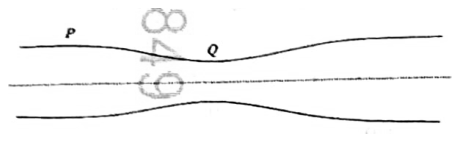
Water flows in a streamline motion through a horizontal pipe of circular cross-section as shown in the figure. The pressure difference of water between and is . The area of cross-section at and are and , respectively. The rate of flow of water through the pipe, in , is:
[Take density of water ]
- 1100
- 2200
- 3300
- 4400
Show answer and solution
Correct: option 4, 400
Continuity gives because the area halves. Bernoulli's equation for a horizontal pipe gives , so and . Rate of flow , option (4).
Question 3NEET 2026 Re-exam, Q12
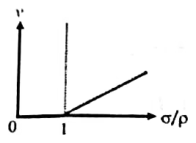
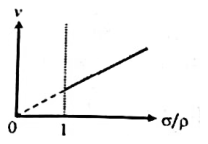
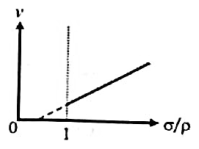
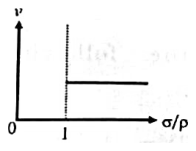
In the measurement of viscosity of liquids using terminal velocity experiment, spherical balls of same radius but having different densities are used. The variation of the terminal velocity () with the ratio of density of spherical ball () to density of the liquid (), is best represented by:
- 1
- 2
- 3
- 4
Show answer and solution
Correct: option 1
The terminal velocity is . It is zero when and rises linearly with beyond that; a ball less dense than the liquid does not sink. This is the graph in option (1).
Question 4NEET 2025, Q1
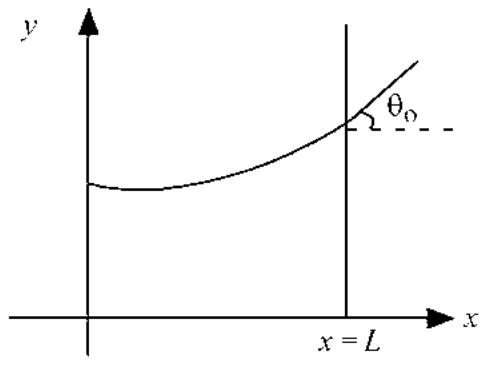
Consider a water tank shown in the figure. It has one wall at and can be taken to be very wide in the direction. When filled with a liquid of surface tension and density , the liquid surface makes angle () with the -axis at . If is the height of the surface then the equation for is:
(take , g is the acceleration due to gravity)
- 1
- 2
- 3
- 4
Show answer and solution
Correct: option 2,
Take a strip of the surface between and (unit width along ). Surface tension pulls on its two ends along the surface, so the net vertical pull is . This balances the pressure difference across the curved surface, which is the hydrostatic pressure acting on the width . So , which is option (2).
Question 5NEET 2025, Q24
A balloon is made of a material of surface tension and its inflation outlet (from where gas is filled in it) has small area . It is filled with a gas of density and takes a spherical shape of radius . When the gas is allowed to flow freely out of it, its radius changes from to 0 (zero) in time . If the speed of gas coming out of the balloon depends on as and then
- 1
- 2
- 3
- 4
Show answer and solution
Correct: option 3,
The excess pressure inside the balloon is proportional to , and Bernoulli's equation gives , so , that is . The volume falls at the rate at which gas leaves: , so . Integrating from to 0 gives . These exponents are option (3).
Question 6NEET 2024, Q15
A thin flat circular disc of radius 4.5 cm is placed gently over the surface of water. If surface tension of water is , then the excess force required to take it away from the surface is:
- 199 N
- 219.8 mN
- 3198 N
- 41.98 mN
Show answer and solution
Correct: option 2, 19.8 mN
The water pulls on the disc along its rim, of length . The extra force is N mN, option (2).
Question 7NEET 2024 Re-exam, Q5
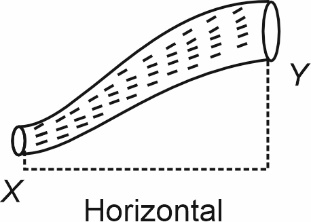
An ideal fluid is flowing in a non-uniform cross-sectional tube XY (as shown in the figure) from end X to end Y. If and are the kinetic energy per unit volume of the fluid at X and Y respectively, then the correct option is:
- 1
- 2
- 3
- 4
Show answer and solution
Correct: option 3,
By the equation of continuity is constant, so the fluid moves faster where the tube is narrower. The figure shows the tube narrow at X and wide at Y, so . Kinetic energy per unit volume is , hence .
Question 8NEET 2023, Q18
The amount of energy required to form a soap bubble of radius 2 cm from a soap solution is nearly: (surface tension of soap solution )
- 1 J
- 2 J
- 3 J
- 4 J
Show answer and solution
Correct: option 3, J
A soap bubble has two free surfaces, so the area created is . Energy J, option (3).
Question 9NEET 2023, Q30
The venturi-meter works on:
- 1Huygen's principle
- 2Bernoulli's principle
- 3The principle of parallel axes
- 4The principle of perpendicular axes
Show answer and solution
Correct: option 2, Bernoulli's principle
A venturi-meter measures the flow speed of a fluid from the pressure difference between a wide and a narrow section of a tube. That pressure difference follows from Bernoulli's principle together with the equation of continuity. The answer is option (2).
Question 10NEET 2023 Manipur, Q12
The viscous drag acting on a metal sphere of diameter 1 mm, falling through a fluid of viscosity 0.8 Pa s with a velocity of is equal to
- 1
- 2
- 3
- 4
Show answer and solution
Correct: option 3,
Stokes' law: with . , that is about .
Question 11NEET 2023 Manipur, Q22
Which of the following statement is not true?
- 1Pressure is a vector quality
- 2Relative density is a scalar quantity
- 3Coefficient of viscosity is a scalar quantity
- 4Surface tension is a scalar quantity
Show answer and solution
Correct: option 1, Pressure is a vector quality
Pressure is a scalar: at a point in a fluid it acts equally in all directions and has no direction of its own. Relative density, coefficient of viscosity and surface tension are scalars as well, so those three statements are true. The statement that is not true is that pressure is a vector.
Question 12NEET 2022, Q18
If a soap bubble expands, the pressure inside the bubble:
- 1is equal to the atmospheric pressure
- 2decreases
- 3increases
- 4remains the same
Show answer and solution
Correct: option 2, decreases
The pressure inside a soap bubble is , where is the surface tension. As the bubble expands increases, the excess pressure falls, and so the inside pressure decreases, option (2).
Question 13NEET 2022, Q21
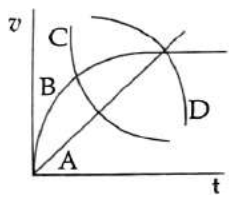
A spherical ball is dropped in a long column of a highly viscous liquid. The curve in the graph shown, which represents the speed of the ball () as a function of time (t) is:
- 1D
- 2A
- 3B
- 4C
Show answer and solution
Correct: option 3, B
The ball starts from rest and speeds up, but the viscous drag grows with speed, so the acceleration keeps falling until drag plus buoyancy balance the weight. The speed then stays at the terminal value. The curve that rises from zero and flattens out to a constant is B, option (3).
Question 14NEET 2022 Re-exam, Q5
Two copper vessels and have the same base area but of different shapes. takes twice the volume of water as that requires to fill upto a particular common height. Then the correct statement among the following is:
- 1Vessel weighs twice that of .
- 2Pressure on the base area of vessels and is same.
- 3Pressure on the base area of vessels and is not same.
- 4Both vessels and weigh the same.
Show answer and solution
Correct: option 2, Pressure on the base area of vessels and is same.
The pressure of a liquid at a depth is and does not depend on the shape of the vessel or the amount of liquid (the hydrostatic paradox). Both vessels are filled to the same height, so the pressure on their bases is the same, option (2). The vessel with twice the water weighs more, so (1) and (4) are wrong.
Question 15NEET 2022 Re-exam, Q35
The terminal velocity of a copper ball of radius 5 mm falling through a tank of oil at room temperature is 10 cm s. If the viscosity of oil at room temperature is 0.9 kg m s, the viscous drag force is:
- 1 N
- 2 N
- 3 N
- 4 N
Show answer and solution
Correct: option 2, N
By Stokes' law the viscous drag is N, option (2).
Question 16NEET 2021, Q2
The velocity of a small ball of mass M and density d, when dropped in a container filled with glycerine becomes constant after some time. If the density of glycerine is , then the viscous force acting on the ball will be:
- 1
- 2
- 3
- 4
Show answer and solution
Correct: option 1,
At constant (terminal) velocity the net force is zero: viscous force = weight buoyant force. The ball's volume is , so the buoyant force is . The viscous force is .
Question 17NEET 2020, Q139
A capillary tube of radius r is immersed in water and water rises in it to a height h. The mass of the water in the capillary is 5 g. Another capillary tube of radius 2r is immersed in water. The mass of water that will rise in this tube is:
- 12.5 g
- 25.0 g
- 310.0 g
- 420.0 g
Show answer and solution
Correct: option 3, 10.0 g
The weight of the liquid column is held up by surface tension acting round the circumference: , so . (Equivalently and the mass .) Doubling the radius doubles the mass, from 5 g to 10 g.
Question 18NEET 2020 Phase 2, Q102
A liquid does not wet the solid surface if angle of contact is:
- 1equal to
- 2greater than
- 3zero
- 4equal to
Show answer and solution
Correct: option 2, greater than
When the angle of contact is obtuse (greater than ), the molecules of the liquid attract each other more strongly than they are attracted by the solid, so the liquid gathers into drops and does not wet the surface, as mercury does on glass. An acute angle of contact means the liquid wets the solid.
Question 19NEET 2020 Phase 2, Q118
A barometer is constructed using a liquid (density = ). What would be the height of the liquid column, when a mercury barometer reads 76 cm?
(density of mercury = )
- 113.6 m
- 2136 m
- 30.76 m
- 41.36 m
Show answer and solution
Correct: option 1, 13.6 m
Both columns balance the same atmospheric pressure, so . The height of the liquid column is .
Question 20NEET 2019, Q7
A soap bubble, having radius of 1 mm, is blown from a detergent solution having a surface tension of N/m. The pressure inside the bubble equals at a point below the free surface of water in a container. Taking , density of water , the value of is:
- 1100 cm
- 210 cm
- 31 cm
- 40.5 cm
Show answer and solution
Correct: option 3, 1 cm
A soap bubble has two surfaces, so the excess pressure inside is Pa. Setting this equal to the gauge pressure gives m cm.
Question 21NEET 2019, Q38
A small hole of area of cross-section is present near the bottom of a fully filled open tank of height 2 m. Taking , the rate of flow of water through the open hole would be nearly:
- 1
- 2
- 3
- 4
Show answer and solution
Correct: option 1,
By the Torricelli law the speed of efflux is m/s. Rate of flow .
Question 22NEET 2019 Odisha, Q1
Two small spherical metal balls, having equal masses, are made from materials of densities and and have radii of 1 mm and 2 mm, respectively. They are made to fall vertically (from rest) in a viscous medium whose coefficient of viscosity equals and whose density is . The ratio of their terminal velocities would be,
- 1
- 2
- 3
- 4
Show answer and solution
Correct: option 2,
Terminal velocity is , so with . Then .
Question 23NEET 2019 Odisha, Q17
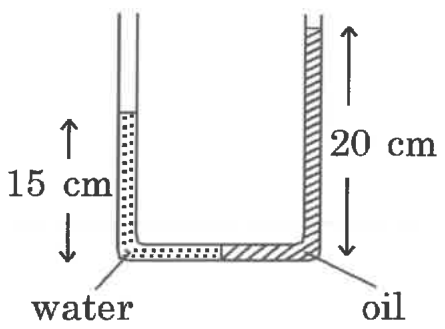
In a u-tube as shown in the fig. water and oil are in the left side and right side of the tube respectively. The heights from the bottom for water and oil columns are 15 cm and 20 cm respectively. The density of the oil is
[take ]
- 1
- 2
- 3
- 4
Show answer and solution
Correct: option 4,
The pressures at the bottom level of the two columns are equal: . So .
Question 24NEET 2018, Q42
A small sphere of radius 'r' falls from rest in a viscous liquid. As a result, heat is produced due to viscous force. The rate of production of heat when the sphere attains its terminal velocity, is proportional to
- 1
- 2
- 3
- 4
Show answer and solution
Correct: option 1,
Rate of heat production = viscous force velocity = . The terminal velocity is proportional to , so the rate is proportional to .
Question 25NEET 2017, Q4
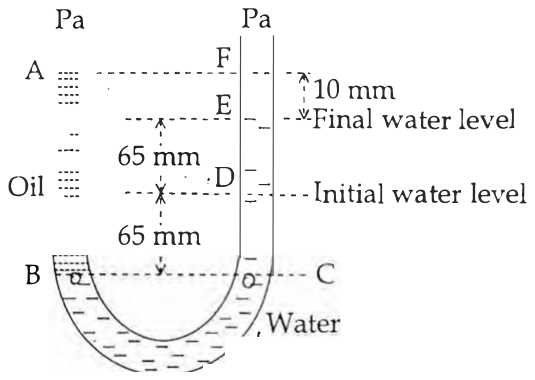
A U tube with both ends open to the atmosphere, is partially filled with water. Oil, which is immiscible with water, is poured into one side until it stands at a distance of 10 mm above the water level on the other side. Meanwhile the water rises by 65 mm from its original level (see diagram). The density of the oil is:
- 1
- 2
- 3
- 4
Show answer and solution
Correct: option 4,
Pressures at the same level B and C in the two arms are equal. Above B there is an oil column of mm, and above C a water column of mm. So , which gives .
Question 26NEET 2016 Phase 1, Q33
Two non-mixing liquids of densities and (n > 1) are put in a container. The height of each liquid is h. A solid cylinder of length L and density d is put in this container. The cylinder floats with its axis vertical and length pL (p < 1) in the denser liquid. The density d is equal to:
- 1
- 2
- 3
- 4
Show answer and solution
Correct: option 4,
Weight equals the total upthrust. With cross-section A: . So .
Question 27NEET 2016 Phase 2, Q13
A rectangular film of liquid is extended from (4 cm 2 cm) to (5 cm 4 cm). If the work done is J, the value of the surface tension of the liquid is
- 1
- 2
- 3
- 4
Show answer and solution
Correct: option 2,
The area grows from to , an increase of . A film has two free surfaces, so the surface area increases by . Work , so , option (2).
Question 28NEET 2016 Phase 2, Q14
Three liquids of densities , and (with ), having the same value of surface tension , rise to the same height in three identical capillaries. The angles of contact , and obey
- 1
- 2
- 3
- 4
Show answer and solution
Correct: option 2,
Capillary rise is . With , and the same, , so and therefore . Since the liquids rise, every angle is acute (below ). That is option (2).
Question 29AIPMT 2015, Q166
A wind with speed 40 m/s blows parallel to the roof of a house. The area of the roof is . Assuming that the pressure inside the house is atmospheric pressure, the force exerted by the wind on the roof and the direction of the force will be:
()
- 1, upwards
- 2, upwards
- 3, downwards
- 4, downwards
Show answer and solution
Correct: option 2, , upwards
By Bernoulli's principle the moving air above the roof is at a lower pressure than the still air inside: . The net force on the roof is . It acts from the higher pressure side to the lower, that is upwards, option (2).
Question 30AIPMT 2015 Re-test, Q139
The cylindrical tube of a spray pump has radius R, one end of which has n fine holes, each of radius r. If the speed of the liquid in the tube is V, the speed of the ejection of the liquid through the holes is:
- 1
- 2
- 3
- 4
Show answer and solution
Correct: option 3,
The liquid is incompressible, so the volume flowing per second through the tube equals the total through the n holes (equation of continuity): . Hence .
Question 31AIPMT 2015 Re-test, Q171
The heart of a man pumps 5 litres of blood through the arteries per minute at a pressure of 150 mm of mercury. If the density of mercury be and then the power of heart in watt is:
- 11.50
- 21.70
- 32.35
- 43.0
Show answer and solution
Correct: option 2, 1.70
Power = pressure volume pumped per second. Pressure . Flow rate . Power .
Question 32AIPMT 2015 Re-test, Q176
Water rises to a height 'h' in capillary tube. If the length of capillary tube above the surface of water is made less than 'h', then:
- 1water does not rise at all.
- 2water rises upto the tip of capillary tube and then starts overflowing like a fountain.
- 3water rises upto the top of capillary tube and stays there without overflowing.
- 4water rises upto a point a little below the top and stays there.
Show answer and solution
Correct: option 3, water rises upto the top of capillary tube and stays there without overflowing.
Water climbs to the top of the short tube, where the meniscus flattens: its radius of curvature grows until the smaller pressure difference across it just balances the shorter water column ( stays constant). The water therefore stays at the top without overflowing; a fountain would mean a continuous flow with no energy source.
Question 33AIPMT 2014, Q119
A certain number of spherical drops of a liquid of radius 'r' coalesce to form a single drop of radius 'R' and volume 'V'. If 'T' is the surface tension of the liquid, then:
- 1energy is neither released nor absorbed.
- 2energy = is released.
- 3energy = is absorbed.
- 4energy = is released.
Show answer and solution
Correct: option 4, energy = is released.
Volume is conserved: . The surface area of the small drops is and of the big drop . The area decreases, so surface energy is released, option (4).
Question 34NEET 2013, Q140
The wettability of a surface by a liquid depends primarily on:
- 1surface tension
- 2density
- 3angle of contact between the surface and the liquid.
- 4viscosity
Show answer and solution
Correct: option 3, angle of contact between the surface and the liquid.
Whether a liquid spreads over a solid or forms drops on it is decided by the angle of contact: an acute angle means the liquid wets the surface and an obtuse angle means it does not.
Question 35NEET 2013 Karnataka, Q167
A fluid is in stream line flow across of a horizontal pipe of variable area of cross section. For this which of the following statements is correct?
- 1The velocity is maximum at the narrowest part of the pipe and pressure is maximum at the widest part of the pipe
- 2Velocity and pressure both are maximum at the narrowest part of the pipe
- 3Velocity and pressure both are maximum at the widest part of the pipe
- 4The velocity is minimum at the narrowest part of the pipe and the pressure is minimum at the widest part of the pipe
Show answer and solution
Correct: option 1, The velocity is maximum at the narrowest part of the pipe and pressure is maximum at the widest part of the pipe
By the equation of continuity , the speed is greatest where the pipe is narrowest. By Bernoulli's theorem for a horizontal pipe , so the pressure is greatest where the speed is least, at the widest part.