Questions with solutions
Question 1NEET 2026, Q1
A 100-turn closely wound circular coil of radius has a magnetic field of at its centre. The current flowing through the coil, and the magnitude of the magnetic moment of this coil are, respectively:
(Take )
- 1
- 2
- 3
- 4
Show answer and solution
Correct: option 1,
At the centre of a coil , so . The magnetic moment is . So option (1) is correct.
Question 2NEET 2026, Q8
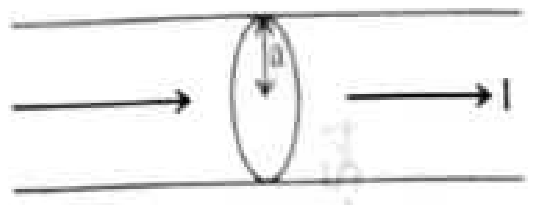
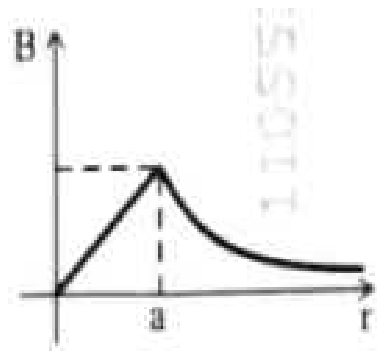
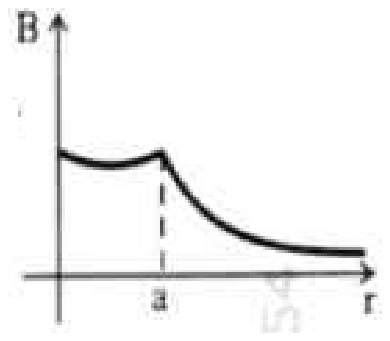
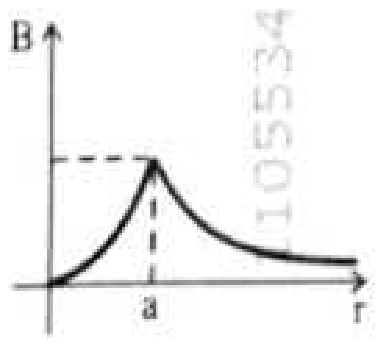
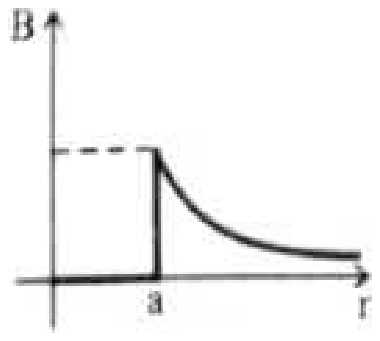
The figure given below shows a long straight solid wire of circular cross-section of radius 'a' carrying steady current I. The current I is uniformly distributed across its cross-section. The plot which correctly represents the variation of magnetic field (B) with distance (r) from the axis of the conductor in the region is:
- 1
- 2
- 3
- 4
Show answer and solution
Correct: option 1
By Ampere's law, inside the wire () the enclosed current is , so , which rises in a straight line from zero. Outside (), , which falls as . The field is greatest at . Plot (1) shows the straight-line rise followed by the fall.
Question 3NEET 2026, Q12
A galvanometer of resistance gives full scale deflection for a current of . It is converted into an ammeter of range . The shunt required is:
- 1
- 2
- 3
- 4
Show answer and solution
Correct: option 1,
The shunt carries the rest of the current while having the same voltage as the galvanometer: .
Question 4NEET 2026 Re-exam, Q11
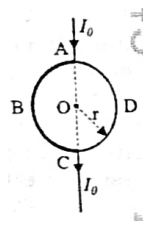
A current flows through a metallic circular loop of radius r as shown in the figure. Resistance of the segment ABC is half that of ADC. Magnitude of magnetic field at the center O of the loop is:
- 1
- 2
- 3
- 4
Show answer and solution
Correct: option 1,
The two semicircles are in parallel, so the current divides inversely as the resistance: ABC carries and ADC carries . A semicircle carrying current gives at the centre, and the two halves give fields in opposite directions. The net field is , option (1).
Question 5NEET 2026 Re-exam, Q15
Two infinitely long parallel conducting wires A and B carry currents I and 2I, respectively, in the same direction. The wire A has uniform mass per unit length and lies on an insulated floor. The wire B is kept fixed at a height h above the floor. The minimum magnitude of h so that the wire A does not rise from the floor is:
[g is the acceleration due to gravity and is the permeability of free space.]
- 1
- 2
- 3
- 4
Show answer and solution
Correct: option 2,
Parallel currents in the same direction attract, so B pulls A upward with force per unit length . A stays on the floor while this does not exceed its weight per unit length , so . The minimum height is option (2).
Question 6NEET 2025, Q3
An electron (mass kg and charge C) moving with speed c/100 (c = speed of light) is injected into a magnetic field of magnitude T perpendicular to its direction of motion. We wish to apply an uniform electric field together with the magnetic field so that the electron does not deflect from its path. Then (speed of light )
- 1 is perpendicular to and its magnitude is
- 2 is perpendicular to and its magnitude is
- 3 is parallel to and its magnitude is
- 4 is parallel to and its magnitude is
Show answer and solution
Correct: option 2, is perpendicular to and its magnitude is
The electron goes undeflected when the electric force cancels the magnetic force: , with perpendicular to both and . The speed is , so . That is option (2).
Question 7NEET 2025, Q12
A 2 amp current is flowing through two different small circular copper coils having radii ratio 1:2. The ratio of their respective magnetic moments will be
- 11:4
- 21:2
- 32:1
- 44:1
Show answer and solution
Correct: option 1, 1:4
The magnetic moment of a current loop is . With the same current in both coils , so the ratio is , option (1).
Question 8NEET 2025, Q18
A model for quantized motion of an electron in a uniform magnetic field states that the flux passing through the orbit of the electron is where is an integer, is Planck's constant and is the magnitude of electron's charge. According to the model, the magnetic moment of an electron in its lowest energy state will be ( is the mass of the electron)
- 1
- 2
- 3
- 4
Show answer and solution
Correct: option 2,
In the lowest state , so and . For circular motion in the field , so . The magnetic moment of the orbiting charge is , option (2).
Question 9NEET 2024, Q21
A tightly wound 100 turns coil of radius 10 cm carries a current of 7 A. The magnitude of the magnetic field at the centre of the coil is (Take permeability of free space as SI units):
- 144 T
- 244 mT
- 34.4 T
- 44.4 mT
Show answer and solution
Correct: option 4, 4.4 mT
At the centre of a circular coil T mT, option (4).
Question 10NEET 2023, Q45
A wire carrying a current along the positive -axis has length . It is kept in a magnetic field T. The magnitude of the magnetic force acting on the wire is:
- 1
- 2
- 3
- 4
Show answer and solution
Correct: option 3,
. Only the field components perpendicular to the wire matter, and the magnitude is , option (3).
Question 11NEET 2023, Q50
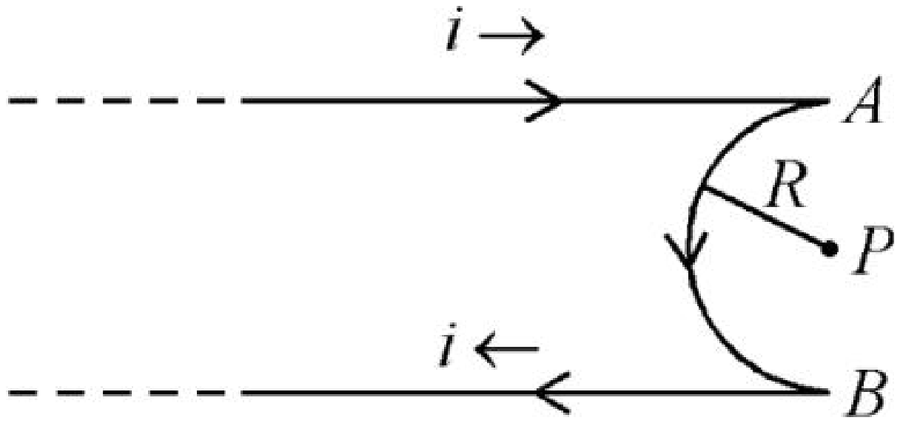
A very long conducting wire is bent in a semi-circular shape from to as shown in figure. The magnetic field at point for steady current configuration is given by:
- 1 pointed into the page
- 2 pointed away from the page
- 3 pointed away from page
- 4 pointed into the page
Show answer and solution
Correct: option 3, pointed away from page
The semicircle of radius gives at its centre , directed out of the page for the current direction shown. Each long straight wire ends level with at a perpendicular distance , so each acts as a semi-infinite wire giving , and both of these point into the page: together . The net field is , pointed away from the page, option (3).
Question 12NEET 2023 Manipur, Q5
A uniform electric field and a uniform magnetic field are acting along the same direction in a certain region. If an electron is projected in the region such that its velocity is pointed along the direction of fields, then the electron
- 1Speed will decrease
- 2Speed will increase
- 3Will turn towards right of direction of motion
- 4Will turn towards left of direction of motion
Show answer and solution
Correct: option 1, Speed will decrease
The velocity is parallel to the magnetic field, so the magnetic force is zero and the electron does not turn. The electric force on the negatively charged electron is , opposite to the field and so opposite to its velocity. The electron is slowed down: its speed decreases.
Question 13NEET 2023 Manipur, Q29
A long straight wire of length 2 m and mass 250 g is suspended horizontally in a uniform horizontal magnetic field of 0.7 T. The amount of current flowing through the wire will be ()
- 12.75 A
- 21.75 A
- 32.45 A
- 42.25 A
Show answer and solution
Correct: option 2, 1.75 A
For the wire to stay suspended the magnetic force must balance its weight: . .
Question 14NEET 2022, Q19
Given below are two statements:
Statement I: Biot-Savart's law gives us the expression for the magnetic field strength of an infinitesimal current element (Idl) of a current carrying conductor only.
Statement II: Biot-Savart's law is analogous to Coulomb's inverse square law of charge q, with the former being related to the field produced by a scalar source, Idl while the latter being produced by a vector source, q.
In light of above statements choose the most appropriate answer from the options given below:
- 1Statement I is incorrect and Statement II is correct
- 2Both Statement I and Statement II are correct
- 3Both Statement I and Statement II are incorrect
- 4Statement I is correct and Statement II is incorrect
Show answer and solution
Correct: option 4, Statement I is correct and Statement II is incorrect
Statement I is correct: the Biot-Savart law gives the field of a small current element of a conductor. Statement II has the sources the wrong way round: the current element Idl is a vector source, while the charge q of Coulomb's law is a scalar source. So Statement I is correct and Statement II is incorrect, option (4).
Question 15NEET 2022, Q35
A long solenoid of radius 1 mm has 100 turns per mm. If 1 A current flows in the solenoid, the magnetic field strength at the centre of the solenoid is:
- 1 T
- 2 T
- 3 T
- 4 T
Show answer and solution
Correct: option 3, T
100 turns per mm is turns per metre. Inside a long solenoid T, option (3). The radius does not matter.
Question 16NEET 2022, Q42
From Ampere's circuital law for a long straight wire of circular cross-section carrying a steady current, the variation of magnetic field in the inside and outside region of the wire is:
- 1a linearly decreasing function of distance upto the boundary of the wire and then a linearly increasing one for the outside region.
- 2uniform and remains constant for both the regions.
- 3a linearly increasing function of distance upto the boundary of the wire and then linearly decreasing for the outside region.
- 4a linearly increasing function of distance r upto the boundary of the wire and then decreasing one with 1/r dependence for the outside region.
Show answer and solution
Correct: option 4, a linearly increasing function of distance r upto the boundary of the wire and then decreasing one with 1/r dependence for the outside region.
Inside the wire of radius the enclosed current is , so , which rises linearly with . Outside, the whole current is enclosed and , which falls as . This is option (4).
Question 17NEET 2022 Re-exam, Q9
A closely packed coil having 1000 turns has an average radius of 62.8 cm. If current carried by the wire of the coil is 1 A, the value of magnetic field produced at the centre of the coil will be (permeability of free space = H/m) nearly
- 1 T
- 2 T
- 3 T
- 4 T
Show answer and solution
Correct: option 1, T
At the centre of a flat circular coil of turns, . Since , this gives T, option (1).
Question 18NEET 2022 Re-exam, Q17
The shape of the magnetic field lines due to an infinite long, straight current carrying conductor is
- 1a plane
- 2a straight line
- 3circular
- 4elliptical
Show answer and solution
Correct: option 3, circular
The field of a long straight current has the same magnitude at all points at distance from the wire and is tangential there. The field lines are therefore concentric circles around the wire, in planes perpendicular to it. Option (3).
Question 19NEET 2022 Re-exam, Q38
Two very long, straight, parallel conductors and carry current of 5 A and 10 A respectively and are at a distance of 10 cm from each other. The direction of current in two conductors is same. The force acting per unit length between two conductors is: ( SI unit)
- 1 and is repulsive
- 2 and is attractive
- 3 and is repulsive
- 4 and is attractive
Show answer and solution
Correct: option 4, and is attractive
Force per unit length . Parallel currents in the same direction attract each other. Option (4).
Question 20NEET 2022 Re-exam, Q39
The magnetic field on the axis of a circular loop of radius 100 cm carrying current A, at point 1 m away from the centre of the loop is given by:
- 1 T
- 2 T
- 3 T
- 4 T
Show answer and solution
Correct: option 2, T
On the axis with m, so . Then T, option (2).
Question 21NEET 2021, Q3
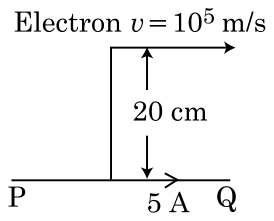
An infinitely long straight conductor carries a current of 5 A as shown. An electron is moving with a speed of m/s parallel to the conductor. The perpendicular distance between the electron and the conductor is 20 cm at an instant. Calculate the magnitude of the force experienced by the electron at that instant.
- 1 N
- 2 N
- 3 N
- 4 N
Show answer and solution
Correct: option 4, N
Field of the wire at 20 cm: T. The velocity is perpendicular to this field, so N.
Question 22NEET 2021, Q32
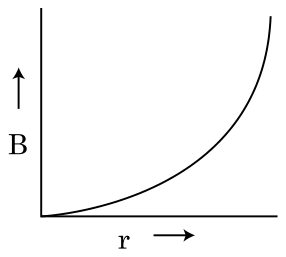
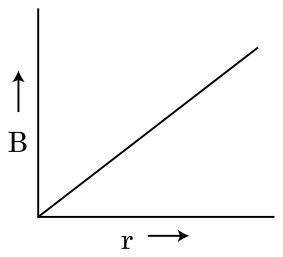
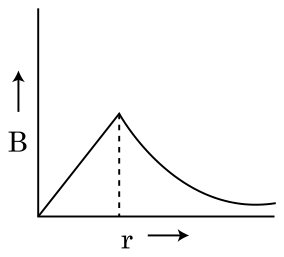
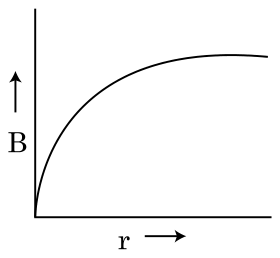
A thick current carrying cable of radius 'R' carries current 'I' uniformly distributed across its cross-section. The variation of magnetic field B(r) due to the cable with the distance 'r' from the axis of the cable is represented by:
- 1
- 2
- 3
- 4
Show answer and solution
Correct: option 3
Ampere's law gives inside the cable (), which rises in a straight line from zero, and outside (), which falls off as . The graph that rises linearly to a peak at and then curves downward is option (3).
Question 23NEET 2021, Q44
In the product
For and and
What will be the complete expression for ?
- 1
- 2
- 3
- 4
Show answer and solution
Correct: option 2,
. Matching the parts: , so . Matching the parts: , so (the part checks: ). So .
Question 24NEET 2021, Q46
A uniform conducting wire of length 12a and resistance 'R' is wound up as a current carrying coil in the shape of,
(i) an equilateral triangle of side 'a'.
(ii) a square of side 'a'.
The magnetic dipole moments of the coil in each case respectively are:
- 1 and
- 2 and
- 3 and
- 4 and
Show answer and solution
Correct: option 1, and
Magnetic moment = number of turns current area. Triangle: one turn uses 3a of wire, so there are 4 turns of area , giving . Square: one turn uses 4a, so there are 3 turns of area , giving .
Question 25NEET 2020, Q179
A long solenoid of 50 cm length having 100 turns carries a current of 2.5 A. The magnetic field at the centre of the solenoid is:
()
- 1
- 2
- 3
- 4
Show answer and solution
Correct: option 1,
Inside a long solenoid , where n is the number of turns per unit length: . So .
Question 26NEET 2020 Phase 2, Q125
A wire of length L metre carrying a current of I ampere is bent in the form of a circle. Its magnetic moment is,
- 1
- 2
- 3
- 4
Show answer and solution
Correct: option 3,
The wire forms one circle of circumference , so its radius is . The magnetic moment is current times area: .
Question 27NEET 2019, Q3
Ionized hydrogen atoms and -particles with same momenta enters perpendicular to a constant magnetic field, B. The ratio of their radii of their paths will be:
- 12 : 1
- 21 : 2
- 34 : 1
- 41 : 4
Show answer and solution
Correct: option 1, 2 : 1
The radius of the circular path is . With the same momentum and field, . The hydrogen ion has charge and the -particle , so .
Question 28NEET 2019, Q45
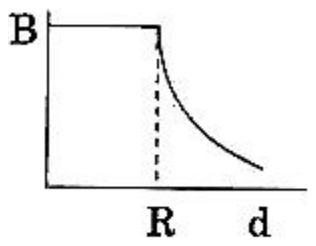
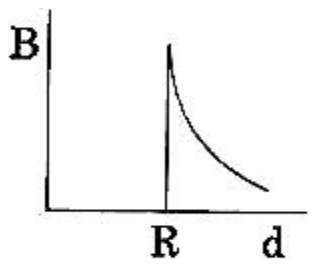
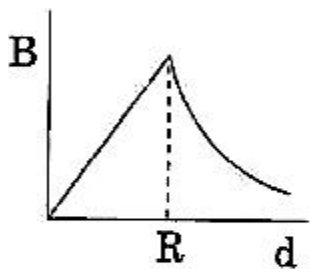
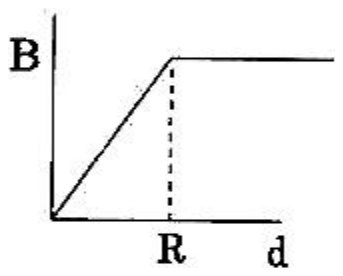
A cylindrical conductor of radius R is carrying a constant current. The plot of the magnitude of the magnetic field, B with the distance, d, from the centre of the conductor, is correctly represented by the figure:
- 1
- 2
- 3
- 4
Show answer and solution
Correct: option 3
By the Ampere circuital law, inside the conductor () the enclosed current grows as , giving , a straight line through the origin. Outside (), , which falls off as . The graph that rises linearly to a peak at and then decays is option (3).
Question 29NEET 2019 Odisha, Q44
Two toroids 1 and 2 have total no. of turns 200 and 100 respectively with average radii 40 cm and 20 cm respectively. If they carry same current , the ratio of the magnetic fields along the two loops is,
- 12:1
- 21:2
- 31:1
- 44:1
Show answer and solution
Correct: option 3, 1:1
Inside a toroid , so for the same current. , that is 1:1.
Question 30NEET 2019 Odisha, Q45
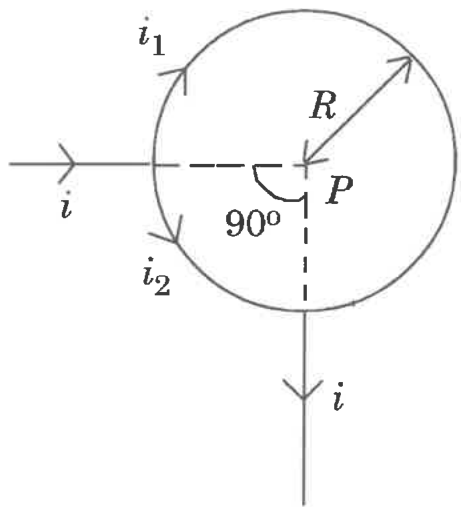
A straight conductor carrying current splits into two parts as shown in the figure. The radius of the circular loop is . The total magnetic field at the centre P of the loop is,
- 1, inward
- 2, inward
- 3zero
- 4, outward
Show answer and solution
Correct: option 3, zero
The two arcs are in parallel, so the current divides inversely as the arc lengths: . The field at the centre due to an arc is proportional to (current arc length), so the two arcs give equal fields, and they are in opposite directions because the currents go round opposite ways. The straight wires point along lines through P and give no field there. The total field is zero.
Question 31NEET 2018, Q26
A metallic rod of mass per unit length is lying horizontally on a smooth inclined plane which makes an angle of with the horizontal. The rod is not allowed to slide down by flowing a current through it when a magnetic field of induction 0.25 T is acting on it in the vertical direction. The current flowing in the rod to keep it stationary is
- 114.76 A
- 25.98 A
- 37.14 A
- 411.32 A
Show answer and solution
Correct: option 4, 11.32 A
The magnetic force BIL is horizontal. Along the incline its component balances the component of weight: . So .
Question 32NEET 2018, Q29
Current sensitivity of a moving coil galvanometer is 5 div/mA and its voltage sensitivity (angular deflection per unit voltage applied) is 20 div/V. The resistance of the galvanometer is
- 1
- 2
- 3
- 4
Show answer and solution
Correct: option 1,
Voltage sensitivity = current sensitivity divided by resistance. So .
Question 33NEET 2017, Q5
A 250 - Turn rectangular coil of length 2.1 cm and width 1.25 cm carries a current of 85 A and subjected to a magnetic field of strength 0.85 T. Work done for rotating the coil by 180° against the torque is:
- 19.1 J
- 24.55 J
- 32.3 J
- 41.15 J
Show answer and solution
Correct: option 1, 9.1 J
The magnetic moment is . Turning the coil from to needs work J. The nearest option is 9.1 J.
Question 34NEET 2017, Q29
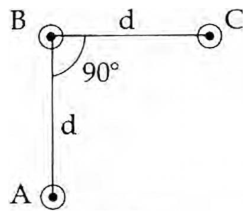
An arrangement of three parallel straight wires placed perpendicular to plane of paper carrying same current 'I' along the same direction is shown in Fig. Magnitude of force per unit length on the middle wire 'B' is given by:
- 1
- 2
- 3
- 4
Show answer and solution
Correct: option 4,
Parallel currents attract. Wire A pulls B with force per unit length towards A, and wire C pulls B with the same F towards C. These two forces are at right angles, so the resultant is .
Question 35NEET 2016 Phase 1, Q2
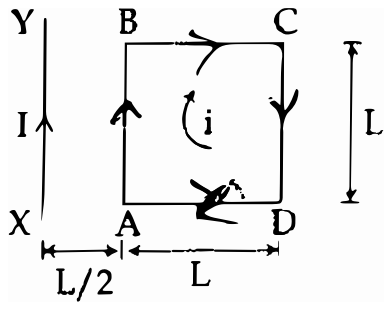
A square loop ABCD carrying a current i, is placed near and coplanar with a long straight conductor XY carrying a current I, the net force on the loop will be:
- 1
- 2
- 3
- 4
Show answer and solution
Correct: option 1,
The forces on BC and AD cancel. Side AB is at distance and side CD at from the wire, and they carry opposite currents, so the net force is .
Question 36NEET 2016 Phase 1, Q26
A long straight wire of radius a carries a steady current I. The current is uniformly distributed over its cross-section. The ratio of the magnetic fields B and B', at radial distances and 2a respectively, from the axis of the wire is:
- 1
- 2
- 3
- 4
Show answer and solution
Correct: option 3,
Inside the wire , so at , . Outside , so at , . The ratio is 1.
Question 37NEET 2016 Phase 2, Q27
A long wire carrying a steady current is bent into a circular loop of one turn. The magnetic field at the centre of the loop is . It is then bent into a circular coil of turns. The magnetic field at the centre of this coil of turns will be
- 1
- 2
- 3
- 4
Show answer and solution
Correct: option 2,
For one turn of radius , . The same length of wire wound into turns gives a radius , since . The field of turns of radius is , option (2).
Question 38NEET 2016 Phase 2, Q29
An electron is moving in a circular path under the influence of a transverse magnetic field of T. If the value of is C/kg, the frequency of revolution of the electron is
- 11 GHz
- 2100 MHz
- 362.8 MHz
- 46.28 MHz
Show answer and solution
Correct: option 1, 1 GHz
The frequency of revolution of a charge in a magnetic field is Hz GHz, option (1).
Question 39AIPMT 2015, Q136
An electron moving in a circular orbit of radius r makes n rotations per second. The magnetic field produced at the centre has magnitude:
- 1Zero
- 2
- 3
- 4
Show answer and solution
Correct: option 3,
The orbiting electron passes any point n times each second, so it is equivalent to a current in a circular loop of radius r. The field at the centre of a single circular loop is , which is option (3).
Question 40AIPMT 2015, Q147
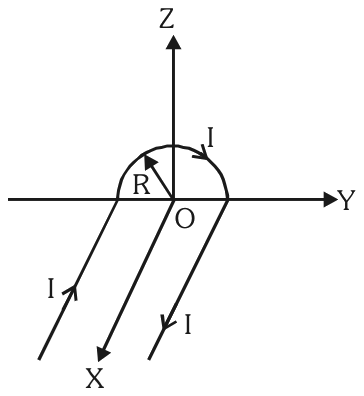
A wire carrying current I has the shape as shown in adjoining figure. Linear parts of the wire are very long and parallel to X-axis while semicircular portion of radius R is lying in Y-Z plane. Magnetic field at point O is:
- 1
- 2
- 3
- 4
Show answer and solution
Correct: option 2,
The semicircle lies in the Y-Z plane, so its field at O is along the X-axis with magnitude ; for the current direction shown the right-hand rule gives . Each straight part is a semi-infinite wire at perpendicular distance R from O, giving , and for both wires the direction is (the currents are opposite and the wires are on opposite sides of O). Adding, , option (2).
Question 41AIPMT 2015 Re-test, Q146
A rectangular coil of length 0.12 m and width 0.1 m having 50 turns of wire is suspended vertically in a uniform magnetic field of strength . The coil carries a current of 2 A. If the plane of the coil is inclined at an angle of with the direction of the field, the torque required to keep the coil in stable equilibrium will be:
- 10.12 Nm
- 20.15 Nm
- 30.20 Nm
- 40.24 Nm
Show answer and solution
Correct: option 3, 0.20 Nm
Torque on a current coil is , where is the angle between the field and the normal to the coil. The plane makes with the field, so . . An equal and opposite torque must be applied to hold the coil.
Question 42AIPMT 2015 Re-test, Q172
A proton and an alpha particle both enter a region of uniform magnetic field B, moving at right angles to the field B. If the radius of circular orbits for both the particles is equal and the kinetic energy acquired by proton is 1 MeV, the energy acquired by the alpha particle will be:
- 11 MeV
- 24 MeV
- 30.5 MeV
- 41.5 MeV
Show answer and solution
Correct: option 1, 1 MeV
Radius , so . For the same B and r, . The alpha particle has twice the charge and four times the mass of a proton, so is times the proton's value. Its energy is also 1 MeV.
Question 43AIPMT 2014, Q117
In an ammeter 0.2% of main current passes through the galvanometer. If resistance of galvanometer is G, the resistance of ammeter will be:
- 1
- 2
- 3
- 4
Show answer and solution
Correct: option 4,
The galvanometer carries . The potential difference across the ammeter equals that across the galvanometer, , and the whole current flows through the ammeter. So its resistance is , option (4).
Question 44AIPMT 2014, Q135
Two identical long conducting wires AOB and COD are placed at right angle to each other, with one above other such that 'O' is their common point for the two. The wires carry and currents, respectively. Point 'P' is lying at distance 'd' from 'O' along a direction perpendicular to the plane containing the wires. The magnetic field at the point 'P' will be:
- 1
- 2
- 3
- 4
Show answer and solution
Correct: option 1,
Each long wire produces a field at P, at right angles to both the wire and the line OP. Because the wires are perpendicular to each other, the two fields are perpendicular too, so the resultant is , option (1).
Question 45NEET 2013, Q162
A current loop in a magnetic field:
- 1can be in equilibrium in one orientation.
- 2can be in equilibrium in two orientations, both the equilibrium states are unstable.
- 3can be in equilibrium in two orientations, one stable while the other is unstable.
- 4experiences a torque whether the field is uniform or non uniform in all orientations.
Show answer and solution
Correct: option 3, can be in equilibrium in two orientations, one stable while the other is unstable.
The torque on a loop of magnetic moment is , which is zero when the moment is parallel to the field () and when it is antiparallel (). The parallel position has the lowest potential energy and is stable; the antiparallel one has the highest energy and is unstable.
Question 46NEET 2013, Q176
When a proton is released from rest in a room, it starts with an initial acceleration towards west. When it is projected towards north with a speed it moves with an initial acceleration toward west. The electric and magnetic fields in the room are:
- 1 west, down
- 2 east, up
- 3 east, down
- 4 west, up
Show answer and solution
Correct: option 1, west, down
At rest only the electric force acts, so towards west: west. When the proton moves north the total force is west, so the magnetic force is west: , giving . For a positive charge moving north, points west only if is vertically downward.
Question 47NEET 2013 Karnataka, Q138
A long straight wire carries a certain current and produces a magnetic field at a perpendicular distance of 5 cm from the wire. An electron situated at 5 cm from the wire moves with a velocity m/s towards the wire along perpendicular to it. The force experienced by the electron will be (charge on electron ):
- 1
- 2
- 3
- 4Zero
Show answer and solution
Correct: option 2,
The field of a straight wire circles the wire, so an electron moving straight towards the wire moves at right angles to the field. The force is .
Question 48NEET 2013 Karnataka, Q159
A circular coil ABCD carrying a current 'i' is placed in a uniform magnetic field. If the magnetic force on the segment AB is , the force on the remaining segment BCDA is:
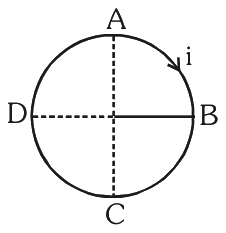
- 1
- 2
- 3
- 4
Show answer and solution
Correct: option 1,
The net force on any closed current loop in a uniform magnetic field is zero. So the forces on AB and on the rest of the loop must add to zero, and the force on BCDA is .
Question 49AIPMT 2012 Prelims, Q11
Two similar coils of radius R are lying concentrically with their planes at right angles to each other. The currents flowing in them are and , respectively. The resultant magnetic field induction at the centre will be:
- 1
- 2
- 3
- 4
Show answer and solution
Correct: option 1,
Each coil gives a field at the centre along its own axis: and . The axes are at right angles, so .
Question 50AIPMT 2012 Prelims, Q18
A milli voltmeter of 25 milli volt range is to be converted into an ammeter of 25 ampere range. The value (in ohm) of necessary shunt will be:
- 10.001
- 20.01
- 31
- 40.05
Show answer and solution
Correct: option 1, 0.001
At full scale the voltage across the meter, and so across the shunt in parallel with it, is 25 mV. Nearly all of the 25 A passes through the shunt because the meter itself draws very little, so .
Question 51AIPMT 2012 Prelims, Q32
An alternating electric field, of frequency , is applied across the dees (radius = R) of a cyclotron that is being used to accelerate protons (mass = m). The operating magnetic field (B) used in the cyclotron and the kinetic energy (K) of the proton beam, produced by it, are given by:
- 1 and
- 2 and
- 3 and
- 4 and
Show answer and solution
Correct: option 3, and
The field frequency must equal the proton's cyclotron frequency , so . At the edge of the dees the speed is , so .
Question 52AIPMT 2012 Mains, Q18
A proton carrying 1 MeV kinetic energy is moving in a circular path of radius R in uniform magnetic field. What should be the energy of an -particle to describe a circle of same radius in the same field?
- 12 MeV
- 21 MeV
- 30.5 MeV
- 44 MeV
Show answer and solution
Correct: option 2, 1 MeV
The radius is , so for the same R and B the quantity must be the same. An -particle has four times the mass and twice the charge of a proton, so and MeV.
Question 53AIPMT 2011 Prelims, Q152
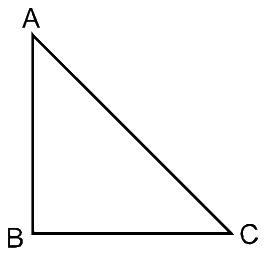
A current carrying loop in the form of a right angle isosceles triangle ABC is placed in a uniform magnetic field acting along AB. If the magnetic force on the arm BC is , the force on the arm AC is:
- 1
- 2
- 3
- 4
Show answer and solution
Correct: option 2,
The net force on a closed current loop in a uniform magnetic field is zero. The arm AB lies along the field, so the force on it is zero. Hence , which gives .
Question 54AIPMT 2011 Prelims, Q190
A uniform electric field and uniform magnetic field are acting along the same direction in a certain region. If an electron is projected in the region such that its velocity is pointed along the direction of fields, then the electron:
- 1will turn towards right of direction of motion
- 2speed will decrease
- 3speed will increase
- 4will turn towards left of direction of motion
Show answer and solution
Correct: option 2, speed will decrease
The velocity is parallel to the magnetic field, so the magnetic force is zero and the electron does not turn. The electric force on the negatively charged electron is opposite to the field, hence opposite to its velocity, so the electron slows down.
Question 55AIPMT 2011 Mains, Q95
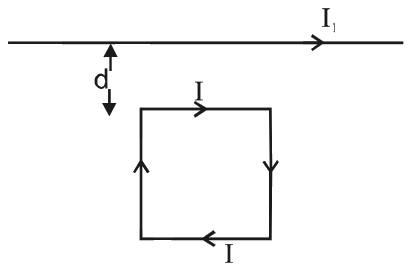
A square loop, carrying a steady current I, is placed in a horizontal plane near a long straight conductor carrying a steady current at a distance d from the conductor as shown in figure. The loop will experience:
- 1a net repulsive force away from the conductor
- 2a net torque acting upward perpendicular to the horizontal plane
- 3a net torque acting downward normal to the horizontal plane
- 4a net attractive force towards the conductor
Show answer and solution
Correct: option 4, a net attractive force towards the conductor
The forces on the two sides of the loop perpendicular to the wire are equal and opposite and cancel. The near side carries current in the same direction as and is attracted; the far side carries the opposite current and is repelled. The field of the wire falls off as , so the attraction on the near side is larger and the loop feels a net force towards the conductor. All the forces lie in the plane of the loop, so there is no torque.
Question 56AIPMT 2011 Mains, Q101
Charge q is uniformly spread on a thin ring of radius R. The ring rotates about its axis with a uniform frequency f Hz. The magnitude of magnetic induction at the centre of the ring is
- 1
- 2
- 3
- 4
Show answer and solution
Correct: option 1,
The charge q passes any point f times each second, so the rotating ring is a circular current . The field at the centre of a circular current loop is .
Question 57AIPMT 2010 Mains, Q1
A current loop consists of two identical semicircular parts each of radius R, one lying in the x-y plane and the other in x-z plane. If the current in the loop is i. The resultant magnetic field due to the two semicircular parts at their common centre is
- 1
- 2
- 3
- 4
Show answer and solution
Correct: option 1,
A semicircular arc of radius R gives a field at its centre, directed along the normal to its plane. The arc in the x-y plane gives a field along the z-axis and the arc in the x-z plane gives an equal field along the y-axis, so the two are at right angles. The resultant is .
Question 58AIPMT 2010 Mains, Q17
A particle having a mass of kg carries a charge of C. The particle is given an initial horizontal velocity of in the presence of electric field and magnetic field . To keep the particle moving in a horizontal direction, it is necessary that
(i) should be perpendicular to the direction of velocity and should be along the direction of velocity
(ii) Both and should be along the direction of velocity
(iii) Both and are mutually perpendicular and perpendicular to the direction of velocity.
(iv) should be along the direction of velocity and should be perpendicular to the direction of velocity
Which one of the following pairs of statements is possible
- 1(i) and (iii)
- 2(iii) and (iv)
- 3(ii) and (iii)
- 4(ii) and (iv)
Show answer and solution
Correct: option 3, (ii) and (iii)
The particle keeps its direction only if there is no net sideways force from the fields. In (ii) the magnetic force is zero because is parallel to , and the electric force acts along the velocity, so the direction is unchanged. In (iii) the electric force and the magnetic force lie along the same line and can cancel, as in a velocity selector. In (i) the magnetic force is unbalanced and in (iv) the electric force is unbalanced, so both deflect the particle. The possible pair is (ii) and (iii).
Question 59AIPMT 2010 Mains, Q27
Two identical bar magnets are fixed with their centres at a distance d apart. A stationary charge Q is placed at P in between the gap of the two magnets at a distance D from the centre O as shown in the figure
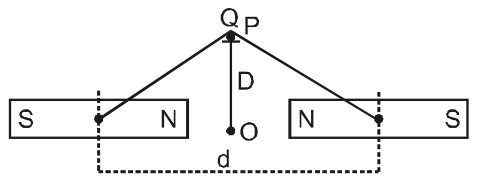
The force on the charge Q is
- 1Zero
- 2directed along OP
- 3directed along PO
- 4directed perpendicular to the plane of paper
Show answer and solution
Correct: option 1, Zero
A magnetic field exerts a force on a charge, which is zero when the charge is at rest. The charge Q is stationary, so whatever the field of the two magnets at P, the force on it is zero.
Question 60AIPMT 2010 Prelims, Q7
A beam of cathode rays is subjected to crossed electric (E) and magnetic fields (B). The fields are adjusted such that the beam is not deflected. The specific charge of the cathode rays is given by
(Where V is the potential difference between cathode and anode)
- 1
- 2
- 3
- 4
Show answer and solution
Correct: option 4,
For no deflection the electric and magnetic forces balance, , so the speed is . The electrons gained this speed by falling through the potential difference V: . Hence .
Question 61AIPMT 2010 Prelims, Q16
A thin ring of radius R meter has charge q coulomb uniformly spread on it. The ring rotates about its axis with a constant frequency of f revolutions/s. The value of magnetic induction in Wb/m at the centre of the ring is
- 1
- 2
- 3
- 4
Show answer and solution
Correct: option 4,
The charge q passes any point f times each second, so the rotating ring is equivalent to a current . The field at the centre of a circular current loop is .
Question 62AIPMT 2010 Prelims, Q27
A galvanometer has a coil of resistance 100 ohm and gives a full scale deflection for 30mA current. If it is to work as a voltmeter of 30 volt range, the resistance required to be added will be
- 1900
- 21800
- 3500
- 41000
Show answer and solution
Correct: option 1, 900
At full scale 30 mA must flow when 30 V is applied, so the total resistance has to be . The coil supplies 100 of this, so must be added in series.
Question 63AIPMT 2010 Prelims, Q48
A square current carrying loop is suspended in a uniform magnetic field acting in the plane of the loop. If the force on one arm of the loop is , the net force on the remaining three arms of the loop is
- 1
- 2
- 3
- 4
Show answer and solution
Correct: option 2,
The net force on any closed current loop in a uniform magnetic field is zero (the loop can only feel a torque). So the forces on all four arms add to zero, and the three remaining arms together must exert .
Question 64AIPMT 2009 Prelims, Q24
A galvanometer having a coil resistance of shows full scale deflection when a current of 1.0 amp passes through it. It can be converted into an ammeter to read currents upto 5.0 amp by:
- 1putting in series a resistance of
- 2putting in series a resistance of
- 3putting in parallel a resistance of
- 4putting in parallel a resistance of
Show answer and solution
Correct: option 3, putting in parallel a resistance of
An ammeter needs a shunt in parallel that carries the extra current. At full scale the coil carries 1 A and the shunt 4 A, with the same potential difference across both: , so in parallel.
Question 65AIPMT 2009 Prelims, Q43
The magnetic force acting on a charged particle of charge in a magnetic field of 2 T acting in y direction, when the particle velocity is , is:
- 14 N in z direction
- 28 N in y direction
- 38 N in z direction
- 48 N in - z direction
Show answer and solution
Correct: option 4, 8 N in - z direction
. Here , because and . Multiplying by C gives N, that is 8 N in the direction.
Question 66AIPMT 2009 Prelims, Q48
Under the influence of a uniform magnetic field, a charged particle moves with constant speed V in a circle of radius R. The time period of rotation of the particle:
- 1depends on R and not on V
- 2is independent of both V and R
- 3depends on both V and R
- 4depends on V and not on R
Show answer and solution
Correct: option 2, is independent of both V and R
The magnetic force supplies the centripetal force, , so . The period is , which contains neither V nor R.
Question 67AIPMT 2008 Prelims, Q33
A particle of mass m, charge Q and kinetic energy T enters a transverse uniform magnetic field of induction . After 3 seconds the kinetic energy of the particle will be
- 14 T
- 23 T
- 32 T
- 4T
Show answer and solution
Correct: option 4, T
The magnetic force on a moving charge is always at right angles to its velocity, so it does no work. The particle changes direction but not speed, and its kinetic energy stays T at all times.
Question 68AIPMT 2008 Prelims, Q34
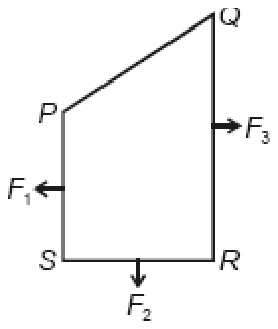
A closed loop PQRS carrying a current is placed in a uniform magnetic field. If the magnetic forces on segments PS, SR and RQ are , and respectively and are in the plane of the paper and along the directions shown, the force on the segment QP is
- 1
- 2
- 3
- 4
Show answer and solution
Correct: option 3,
The net force on a closed current loop in a uniform magnetic field is zero, so the force on QP balances the other three. (to the right) and (to the left) leave horizontally, and acts vertically, at right angles to it. The force on QP therefore has magnitude .
Question 69AIPMT 2008 Prelims, Q36
A galvanometer of resistance is connected to a battery of 3 V along with a resistance of in series. A full scale deflection of 30 divisions is obtained in the galvanometer. In order to reduce this deflection to 20 divisions, the resistance in series should be
- 1
- 2
- 3
- 4
Show answer and solution
Correct: option 1,
Deflection is proportional to current, and the current is the battery voltage over the total resistance. For 30 divisions the total is . For 20 divisions the current must be as large, so the total must be , and the series resistance is .
Question 70AIPMT 2007 Prelims, Q181
The resistance of an ammeter is 13 Ω and its scale is graduated for a current upto 100 Amps. After an additional shunt has been connected to this ammeter it becomes possible to measure currents upto 750 Amperes by this meter. The value of shunt-resistance is
- 12 KΩ
- 220 Ω
- 32 Ω
- 40.2 Ω
Show answer and solution
Correct: option 3, 2 Ω
At full scale the ammeter carries 100 A and the shunt must carry the remaining A. Both have the same potential difference, so , giving Ω, option (3).
Question 71AIPMT 2007 Prelims, Q182
Under the influence of a uniform magnetic field a charge-particle is moving in a circle of radius R with constant speed V. The time period of the motion
- 1depends on R and not on V
- 2depends on V and not on R
- 3depends on both R and V
- 4is independent of both R and V
Show answer and solution
Correct: option 4, is independent of both R and V
The magnetic force provides the centripetal force: , so . The period is , which contains neither R nor V. Option (4).
Question 72AIPMT 2007 Prelims, Q183
A charged particle (charge q) is moving in a circle of radius R with uniform speed v. The associated magnetic moment is given by
- 1
- 2
- 3
- 4
Show answer and solution
Correct: option 2,
The circulating charge is equivalent to a current . The magnetic moment is current times area: , option (2).
Question 73AIPMT 2007 Prelims, Q184
A beam of electrons passes undeflected through mutually perpendicular electric and magnetic fields. If the electric field is switched off, and the same magnetic field is maintained, the electrons move
- 1along a straight line
- 2in an elliptical orbit
- 3in a circular orbit
- 4along a parabolic path
Show answer and solution
Correct: option 3, in a circular orbit
For the beam to pass undeflected through crossed fields its velocity must be perpendicular to both fields. With the electric field removed, only the magnetic force acts; it is always perpendicular to the velocity and constant in size, so the electrons move in a circular orbit. Option (3).
Question 74AIPMT 2007 Prelims, Q191
In a mass spectrometer used for measuring the masses of ions, the ions are initially accelerated by an electric potential V and then made to describe semicircular paths of radius R using a magnetic field B. If V and B are kept constant, the ratio will be proportional to
- 1
- 2
- 3
- 4
Show answer and solution
Correct: option 3,
Acceleration through V gives , and in the field . Eliminating v: , so . With V and B fixed this is proportional to , option (3).
Question 75AIPMT 2006 Prelims, Q5
When a charged particle moving with velocity is subjected to a magnetic field of induction , the force on it is non-zero. This implies the:-
- 1Angle between and is necessary
- 2Angle between and can have any value other than
- 3Angle between and can have any value other than zero and
- 4Angle between and is either zero or
Show answer and solution
Correct: option 3, Angle between and can have any value other than zero and
The magnetic force has magnitude . It vanishes only when , that is for or . A non-zero force therefore only tells us that the angle is something other than zero and ; it need not be .
Question 76AIPMT 2006 Prelims, Q8
Two circular coil 1 and 2 are made from the same wire but the radius of the 1st coil is twice that of the 2nd coil. What potential difference in volts should be applied across them so that the magnetic field at their centres is the same-
- 13
- 24
- 36
- 42
Show answer and solution
Correct: option 2, 4
The question is asking for the ratio of the two potential differences, . The field at the centre of a coil is , so equal fields need . The coils are of the same wire, so resistance is proportional to the length , giving . Then .
Question 77AIPMT 2005 Prelims, Q8
An electron moves in a circular orbit with a uniform speed v. It produces a magnetic field B at the centre of the circle. The radius of the circle is proportional to:
- 1
- 2
- 3
- 4
Show answer and solution
Correct: option 1,
The orbiting electron is a current , and the field at the centre is . So and .
Question 78AIPMT 2005 Prelims, Q11
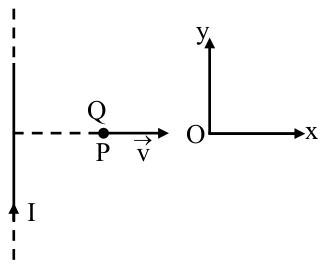
A very long straight wire carries a current I. At the instant when a charge +Q at point P has velocity , as shown, the force on the charge is
- 1Along ox
- 2Opposite to oy
- 3Along oy
- 4Opposite to ox
Show answer and solution
Correct: option 3, Along oy
The current flows along +y and P lies on the +x side of the wire, so by the right-hand rule the field at P points into the page (–z). The velocity is along +x, and has direction . The force is along oy.
Question 79AIPMT 2005 Prelims, Q23
A coil in the shape of an equilateral triangle of side is suspended between the pole pieces of a permanent magnet such that is in plane of the coil. If due to a current i in the triangle a torque acts on it, the side of the triangle is
- 1
- 2
- 3
- 4
Show answer and solution
Correct: option 3,
With the field in the plane of the coil the torque is maximum, , and the area of the triangle is . So and .
Question 80AIPMT 2004 Prelims, Q5
A galvanometer acting as a voltmeter will have:-
- 1a high resistance in series with its coil
- 2a low resistance in parallel with its coil
- 3a low resistance in series with its coil
- 4a high resistance in parallel with its coil
Show answer and solution
Correct: option 1, a high resistance in series with its coil
A voltmeter is connected across the component and must draw very little current. A galvanometer is therefore turned into a voltmeter by putting a high resistance in series with its coil.
Question 81AIPMT 2004 Prelims, Q49
A galvanometer of 50 ohm resistance has 25 divisions. A current of ampere gives a deflection of one division. To convert this galvanometer into a voltmeter having a range of 25 volts, it should be connected with a resistance of:-
- 1245 as a shunt
- 22550 in series
- 32450 in series
- 42500 as a shunt
Show answer and solution
Correct: option 3, 2450 in series
Full-scale current A. A voltmeter needs a series resistance R such that : , so in series.
Question 82AIPMT 2003 Prelims, Q26
A long solenoid carrying a current produces a magnetic field B along its axis. If the current is doubled and the number of turns per cm is halved, the new value of the magnetic field is -
- 1B/2
- 2B
- 32B
- 44B
Show answer and solution
Correct: option 2, B
Inside a long solenoid . Doubling and halving leaves the product unchanged, so the field is still B.
Question 83AIPMT 2003 Prelims, Q27
A charged particle moves through a magnetic field in a direction perpendicular to it. Then the
- 1Speed of the particle remains unchanged
- 2Direction of the particle remains unchanged
- 3Acceleration remains unchanged
- 4Velocity remains unchanged
Show answer and solution
Correct: option 1, Speed of the particle remains unchanged
The magnetic force is always perpendicular to the velocity, so it does no work and the speed stays constant. It does keep turning the particle in a circle, so the direction, the velocity and the (centripetal) acceleration all keep changing.
Question 84AIPMT 2002 Prelims, Q41
To convert a galvanometer into a voltmeter one should connect a:-
- 1High resistance in series with galvanometer
- 2Low resistance in series with galvanometer
- 3High resistance in parallel with galvanometer
- 4Low resistance in parallel with galvanometer
Show answer and solution
Correct: option 1, High resistance in series with galvanometer
A voltmeter is connected across the circuit element and must draw very little current, so it needs a high resistance. This is obtained by joining a high resistance in series with the galvanometer. A low resistance in parallel (a shunt) makes an ammeter instead.
Question 85AIPMT 2002 Prelims, Q45
The magnetic field of given length of wire for single turn coil at its centre is 'B' then its value for two turns coil for the same wire is:-
- 1
- 2
- 34B
- 42B
Show answer and solution
Correct: option 3, 4B
The field at the centre of a coil is . Making two turns from the same wire halves the radius () and doubles N, so the field becomes times, that is 4B.
Question 86AIPMT 2002 Prelims, Q46
A charge 'q' moves in a region where electric field and magnetic field both exist, then force on it is:-
- 1
- 2
- 3
- 4
Show answer and solution
Correct: option 2,
The total (Lorentz) force is the sum of the electric force and the magnetic force . The order of the cross product matters, so gives the wrong direction.
Question 87AIPMT 2001 Prelims, Q4
An electron having mass 'm' and kinetic energy E enter in uniform magnetic field B perpendicularly, then its frequency will be:
- 1
- 2
- 3
- 4
Show answer and solution
Correct: option 3,
The magnetic force supplies the centripetal force: , so . The frequency of revolution is , which does not depend on the kinetic energy.
Question 88AIPMT 2001 Prelims, Q28
In Thomson mass spectrograph then the velocity of undeflected electron beam will be:
- 1
- 2
- 3
- 4
Show answer and solution
Correct: option 1,
The beam passes undeflected when the electric force balances the magnetic force: . This gives , the ratio of the magnitudes of the two fields.
Question 89AIPMT 2001 Prelims, Q31
Tangent galvanometer is used to measure:
- 1Potential difference
- 2Current
- 3Resistance
- 4In measuring charge
Show answer and solution
Correct: option 2, Current
In a tangent galvanometer the field of the current-carrying coil is set at right angles to the Earth's horizontal field, and the needle deflects by where . It therefore measures current.
Question 90AIPMT 2001 Prelims, Q38
If number of turn, area and current through it is given by n, A and i respectively then its magnetic moment will be:
- 1niA
- 2
- 3
- 4
Show answer and solution
Correct: option 1, niA
One turn carrying current and enclosing area has magnetic moment . For turns the moments add, giving .
Question 91AIPMT 2000 Prelims, Q23
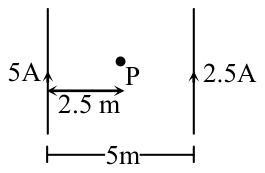
For adjoining fig., The magnetic field at point, 'P' will be:
- 1
- 2
- 3
- 4
Show answer and solution
Correct: option 3,
P is 2.5 m from each wire and both currents flow the same way (upward in the figure). The 5 A wire on the left gives into the page at P; the 2.5 A wire on the right gives out of the page. Net field , into the page ().
Question 92AIPMT 2000 Prelims, Q24
A charge having q/m equal to C/kg and with velocity m/s enters into a uniform magnetic field B = 0.3 tesla at an angle with direction of field. Then radius of curvature will be:
- 10.01 cm
- 20.5 cm
- 31 cm
- 42 cm
Show answer and solution
Correct: option 2, 0.5 cm
Only the velocity component perpendicular to the field makes the charge circle: m cm.
Question 93AIPMT 1999 Prelims, Q12
A current carrying coil (I = 5A, R = 10 cm.) having 50 number of turns find field at its centre-
- 11.57 mT
- 23.14 mT
- 31 mT
- 42 mT
Show answer and solution
Correct: option 1, 1.57 mT
At the centre of a circular coil T mT.
Question 94AIPMT 1999 Prelims, Q35
Two identically charged particles A and B initially at rest, are accelerated by a common potential difference V. They enters into a transverse uniform magnetic field B. They describe a circular path of radii and respectively then their mass ratio is:
- 1
- 2
- 3
- 4
Show answer and solution
Correct: option 1,
After acceleration through the kinetic energy is , so the momentum is . The radius in the field is . With , and the same, , so .
Question 95AIPMT 1998 Prelims, Q14
A coil of one loop is made from a wire of length L and thereafter a coil of two loops is made from same wire, then the ratio of magnetic field at the centre of coils will be:
- 11 : 4
- 21 : 1
- 31 : 8
- 44 : 1
Show answer and solution
Correct: option 1, 1 : 4
The field at the centre of a coil of N turns and radius r is . With the same wire, two loops have half the radius ( instead of ), so B is multiplied by 2 for the turns and by 2 again for the radius. The second field is 4 times the first, and the ratio is 1 : 4.
Question 96AIPMT 1998 Prelims, Q24
Resistance of a Galvanometer coil is and Shunt resistance is connected with it. If main current is 1 A then the current flow through resistance will be:
- 10.2 A
- 20.8 A
- 30.1 A
- 40.4 A
Show answer and solution
Correct: option 2, 0.8 A
The shunt is in parallel with the galvanometer, so the current divides in the inverse ratio of the resistances. The current in the shunt is A (the other 0.2 A goes through the coil).
Question 97AIPMT 1998 Prelims, Q32
Two long parallel wires are at a distance of 1m. If both of them carry one ampere of current in same direction, then the force of attraction on unit length of the wires will be:
- 1 N/m
- 2 N/m
- 3 N/m
- 4 N/m
Show answer and solution
Correct: option 1, N/m
The force per unit length between parallel currents is N/m. This is the definition of the ampere.