Questions with solutions
Question 1NEET 2026, Q45
A flask contains argon and chlorine in the ratio of 2 : 1 by mass. The temperature of the mixture is . The ratio of root mean square speed of the molecules of the two gases is:
(Atomic mass of argon = and molecular mass of chlorine = )
- 1
- 2
- 3
- 4
Show answer and solution
Correct: option 1,
, so at the same temperature the ratio depends only on the molar masses, not on how much of each gas is present: .
Question 2NEET 2026 Re-exam, Q2
The mean free path of molecules in an ideal gas A is half that of another ideal gas B. The diameter of the spherical molecules of gas A is twice the diameter of the molecules of B. If number densities of the gases A and B are and , respectively, then the correct option is:
- 1
- 2
- 3
- 4
Show answer and solution
Correct: option 4,
The mean free path is , so . Then , which is option (4).
Question 3NEET 2026 Re-exam, Q45
An ideal gas is made of polyatomic molecules. Each of the molecules has three translational, three rotational and number of vibrational modes. If the ratio of heat capacities of the gas is 8/7, then the value of is:
- 14
- 23
- 32
- 41
Show answer and solution
Correct: option 1, 4
Each translational and rotational degree of freedom contributes to and each vibrational mode contributes . So and . Setting gives , so , option (1).
Question 4NEET 2025, Q14
An oxygen cylinder of volume 30 litre has 18.20 moles of oxygen. After some oxygen is withdrawn from the cylinder, its gauge pressure drops to 11 atmospheric pressure at temperature . The mass of the oxygen withdrawn from the cylinder is nearly equal to:
[Given, , and
molecular mass of ,
1 atm pressure ]
- 10.125 kg
- 20.144 kg
- 30.116 kg
- 40.156 kg
Show answer and solution
Correct: option 3, 0.116 kg
Gauge pressure is measured above atmospheric pressure, so the absolute pressure is atm Pa. The moles left are . So mol were withdrawn, a mass of g, closest to 0.116 kg, option (3).
Question 5NEET 2025, Q29
A container has two chambers of volumes litres and litres separated by a partition made of a thermal insulator. The chambers contains and moles of ideal gas at pressures atm and atm, respectively. When the partition is removed, the mixture attains an equilibrium pressure of:
- 11.3 atm
- 21.6 atm
- 31.4 atm
- 41.8 atm
Show answer and solution
Correct: option 2, 1.6 atm
No heat or work is exchanged with the surroundings, so the total internal energy of the gas is conserved. For an ideal gas the internal energy is proportional to , that is to , so . Hence atm, option (2).
Question 6NEET 2024, Q49
The following graph represents the T-V curves of an ideal gas (where T is the temperature and the volume) at three pressures , and compared with those of Charles's law represented as dotted lines.
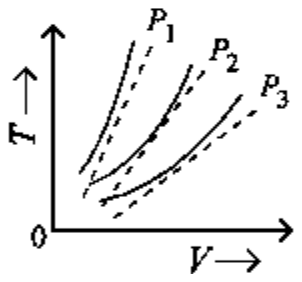
Then the correct relation is:
- 1
- 2
- 3
- 4
Show answer and solution
Correct: option 1,
For an ideal gas , so at constant pressure the T-V line has slope proportional to . The line for is the steepest and the line for the least steep, so , option (1).
Question 7NEET 2024 Re-exam, Q47
According to the law of equipartition of energy, the number of vibrational modes of a polyatomic gas of constant is ( where are the specific heat capacities of the gas at constant pressure and constant volume, respectively):
- 1
- 2
- 3
- 4
Show answer and solution
Correct: option 3,
A polyatomic molecule has 3 translational and 3 rotational degrees of freedom, and each vibrational mode counts twice (kinetic and potential), so and for vibrational modes. Then , which gives , so .
Question 8NEET 2023, Q23
The temperature of a gas is C. To what temperature the gas should be heated so that the rms speed is increased by 3 times?
- 1 C
- 2 C
- 33097 K
- 4223 K
Show answer and solution
Correct: option 2, C
and the initial temperature is K. The key reads the phrase increased by 3 times as an increase of , so the new speed is and the temperature must be K C, option (2). (If the speed only became 3 times, the answer would be K, which is not an option.)
Question 9NEET 2023 Manipur, Q42
A container of volume contains 0.2 mole of hydrogen gas and 0.3 mole of argon gas. The pressure of the system at temperature 200 K () will be
- 1 Pa
- 2 Pa
- 3 Pa
- 4 Pa
Show answer and solution
Correct: option 2, Pa
By Dalton's law the gases add their mole numbers: mol. Pa.
Question 10NEET 2022, Q37
The volume occupied by the molecules contained in 4.5 kg water at STP, if the intermolecular forces vanish away is:
- 1
- 2
- 3
- 4
Show answer and solution
Correct: option 1,
Without intermolecular forces the water behaves as an ideal gas. Moles . At STP one mole occupies 22.4 L, so the volume is , option (1).
Question 11NEET 2022 Re-exam, Q47
Three vessels of equal capacity have gases at the same temperature and pressure. The first vessel contains helium (monoatomic), the second contains fluorine (diatomic) and the third contains sulfur hexafluoride (polyatomic). The correct statement, among the following is:
- 1The root mean square speed of sulfur hexafluoride is the largest
- 2All vessels contain unequal number of respective molecules
- 3The root mean square speed of molecules is same in all three cases
- 4The root mean square speed of helium is the largest
Show answer and solution
Correct: option 4, The root mean square speed of helium is the largest
Equal volumes at the same temperature and pressure hold equal numbers of molecules (Avogadro's law), so (2) is wrong. The rms speed is ; at the same temperature it is largest for the gas with the smallest molar mass, which is helium. Option (4).
Question 12NEET 2021, Q26
Match Column - I and Column - II and choose the correct match from the given choices.
| Column - I | Column - II |
|---|
| (A) Root mean square speed of gas molecules | (P) |
| (B) Pressure exerted by ideal gas | (Q) |
| (C) Average kinetic energy of a molecule | (R) |
| (D) Total internal energy of 1 mole of a diatomic gas | (S) |
- 1A-R, B-P, C-S, D-Q
- 2A-Q, B-R, C-S, D-P
- 3A-Q, B-P, C-S, D-R
- 4A-R, B-Q, C-P, D-S
Show answer and solution
Correct: option 3, A-Q, B-P, C-S, D-R
The rms speed is (Q). The pressure of an ideal gas is (P). The average translational kinetic energy of a molecule is (S). A diatomic gas has 5 degrees of freedom, so one mole has internal energy (R).
Question 13NEET 2020, Q136
A cylinder contains hydrogen gas at pressure of 249 kPa and temperature 27°C.
Its density is: ()
- 1
- 2
- 3
- 4
Show answer and solution
Correct: option 2,
For an ideal gas , so . With , for hydrogen and , .
Question 14NEET 2020, Q142
The average thermal energy for a mono-atomic gas is: ( is Boltzmann constant and T, absolute temperature)
- 1
- 2
- 3
- 4
Show answer and solution
Correct: option 2,
By the law of equipartition of energy each degree of freedom carries an average energy . A mono-atomic gas molecule has only 3 translational degrees of freedom, so its average thermal energy is .
Question 15NEET 2020, Q154
The mean free path for a gas, with molecular diameter d and number density n can be expressed as:
- 1
- 2
- 3
- 4
Show answer and solution
Correct: option 2,
A molecule of diameter d sweeps out a collision cross-section , and allowing for the motion of the other molecules brings in a factor . The mean free path is therefore . A dimension check agrees: is in and in , giving a length.
Question 16NEET 2020 Phase 2, Q93
The mean free path for a gas molecule depends upon diameter, of the molecule as
- 1
- 2
- 3
- 4
Show answer and solution
Correct: option 4,
The mean free path is , where is the number of molecules per unit volume. A molecule sweeps out a collision cross-section , so the bigger the molecule the more often it collides, and .
Question 17NEET 2020 Phase 2, Q115
An ideal gas equation can be written as
where and are respectively,
- 1number density, molar mass
- 2mass density, molar mass
- 3number density, mass of the gas
- 4mass density, mass of the gas
Show answer and solution
Correct: option 2, mass density, molar mass
For mass of gas of molar mass , , so . Here is the mass density of the gas and is its molar mass.
Question 18NEET 2019, Q12
Increase in temperature of a gas filled in a container would lead to:
- 1increase in its mass
- 2increase in its kinetic energy
- 3decrease in its pressure
- 4decrease in intermolecular distance
Show answer and solution
Correct: option 2, increase in its kinetic energy
The average kinetic energy of gas molecules is proportional to the absolute temperature ( per molecule), so heating raises the kinetic energy. The mass does not change, the pressure rises in a closed container, and the molecular spacing does not decrease.
Question 19NEET 2019 Odisha, Q21
The value of , for hydrogen, helium and another ideal diatomic gas X (whose molecules are not rigid but have an additional vibrational mode), are respectively equal to,
- 1
- 2
- 3
- 4
Show answer and solution
Correct: option 3,
. Hydrogen is a rigid diatomic gas with , so . Helium is monatomic with , so . A diatomic gas with one vibrational mode has , so .
Question 20NEET 2018, Q3
At what temperature will the rms speed of oxygen molecules become just sufficient for escaping from the Earth's atmosphere ?
(Given :
Mass of oxygen molecule (m) = kg
Boltzmann's constant )
- 1 K
- 2 K
- 3 K
- 4 K
Show answer and solution
Correct: option 2, K
Set the rms speed equal to the escape speed, : , so .
Question 21NEET 2017, Q2
A gas mixture consists of 2 moles of and 4 moles of Ar at temperature T. Neglecting all vibrational modes, the total internal energy of the system is
- 14 RT
- 215 RT
- 39 RT
- 411 RT
Show answer and solution
Correct: option 4, 11 RT
Internal energy is . Oxygen is diatomic with , so . Argon is monatomic with , so . The total is .
Question 22NEET 2016 Phase 1, Q25
The molecules of a given mass of a gas have r.m.s. velocity of at 27°C and pressure. When the temperature and pressure of the gas are respectively, 127°C and , the r.m.s. velocity of its molecules in is:
- 1
- 2
- 3
- 4
Show answer and solution
Correct: option 2,
depends only on temperature, not on pressure. So .
Question 23NEET 2016 Phase 2, Q19
A given sample of an ideal gas occupies a volume at a pressure and absolute temperature . The mass of each molecule of the gas is . Which of the following gives the density of the gas?
- 1
- 2
- 3
- 4
Show answer and solution
Correct: option 2,
For molecules, , so the number of molecules per unit volume is . Density is mass per unit volume , option (2).
Question 24AIPMT 2015, Q169
The ratio of the specific heats in terms of degrees of freedom (n) is given by:
- 1
- 2
- 3
- 4
Show answer and solution
Correct: option 2,
By equipartition each degree of freedom contributes per mole to , so . For an ideal gas . Hence , option (2).
Question 25AIPMT 2015 Re-test, Q148
Two vessels separately contain two ideal gases A and B at the same temperature, the pressure of A being twice that of B. Under such conditions, the density of A is found to be 1.5 times the density of B. The ratio of molecular weight of A and B is:
- 1
- 2
- 3
- 42
Show answer and solution
Correct: option 3,
For an ideal gas , so . At the same temperature .
Question 26AIPMT 2014, Q93
The mean free path of molecules of a gas, (radius 'r') is inversely proportional to:
- 1
- 2
- 3
- 4
Show answer and solution
Correct: option 3,
The mean free path is , where is the molecular diameter and the number density. So , which is option (3).
Question 27NEET 2013, Q166
In the given (VT) diagram, what is the relation between pressures and ?
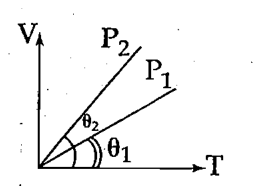
- 1
- 2
- 3Cannot be predicted
- 4
Show answer and solution
Correct: option 2,
For an ideal gas , so each straight line through the origin is at constant pressure and its slope is . The line marked is steeper (), so it has the smaller pressure: .
Question 28NEET 2013, Q167
The molar specific heats of an ideal gas at constant pressure and volume are denoted by and , respectively. If and R is the universal gas constant, then is equal to:
- 1
- 2
- 3
- 4
Show answer and solution
Correct: option 1,
Mayer's relation is . Putting gives , so .
Question 29NEET 2013, Q168
The amount of heat energy required to raise the temperature of 1 g of Helium at NTP, from K to K is:
- 1
- 2
- 3
- 4
Show answer and solution
Correct: option 4,
One gram of helium is mol. Helium is monatomic, so its molar heat capacity at constant volume is . The heat needed is . The keyed option takes the heating at constant volume.
Question 30NEET 2013 Karnataka, Q158
In a vessel, the gas is at a pressure P. If the mass of all the molecules is halved and their speed is doubled, then the resultant pressure will be:
- 1
- 2
- 3
- 4
Show answer and solution
Correct: option 1,
Pressure of a gas is , so . Halving and doubling gives times the pressure, that is .
Question 31AIPMT 2008 Prelims, Q16
At the value of the density of a fixed mass of an ideal gas divided by its pressure is x. At this ratio is
- 1
- 2
- 3
- 4
Show answer and solution
Correct: option 1,
For an ideal gas , so , which is inversely proportional to the absolute temperature. Going from 283 K to 383 K the ratio becomes .
Question 32AIPMT 2006 Prelims, Q33
The molar specific heat at constant pressure of an ideal gas is . The ratio of specific heat at constant pressure to that at constant volume is:-
- 1
- 2
- 3
- 4
Show answer and solution
Correct: option 1,
For an ideal gas , so . The ratio is .
Question 33AIPMT 2004 Prelims, Q25
The equation of state for 5g of oxygen at a pressure P and temperature T, when occupying a volume V, will be:-
Where is the gas constant.
- 1
- 2
- 3
- 4
Show answer and solution
Correct: option 4,
The ideal gas equation is , where R is the gas constant. Oxygen () has molar mass 32 g, so 5 g is mole and .
Question 34AIPMT 2000 Prelims, Q17
To find out degree of freedom, the correct expression is:
- 1
- 2
- 3
- 4
Show answer and solution
Correct: option 1,
For a gas with degrees of freedom, and , so . Rearranging gives .