Questions with solutions
Question 1NEET 2026, Q13
In Young's double slit experiment, using monochromatic light of wavelength , the intensity of light at a point on the screen where the path difference is is K units. The intensity of light at a point where the path difference is will be:
- 1
- 2K
- 3
- 42 K
Show answer and solution
Correct: option 1,
The intensity is with phase difference path difference. A path difference of gives , a maximum, so . A path difference of gives , so .
Question 2NEET 2026, Q34
In interference and diffraction, the light energy is redistributed. If it reduces in one region, producing a dark fringe, it increases in another region, producing a bright fringe.
A. As there is no gain or loss of energy, these phenomena are consistent with the principle of conservation of energy.
B. Diffraction and interference are characteristics exhibited only by light waves.
Choose the correct answer from the options given below:
- 1A is true, but B is false
- 2A is true and B is also true
- 3A is false, but B is true
- 4Both A and B are false
Show answer and solution
Correct: option 1, A is true, but B is false
A is true: the energy missing from the dark fringes appears in the bright fringes, so the total energy is conserved. B is false: interference and diffraction are shown by all kinds of waves, such as sound waves, water waves and matter waves, not only by light.
Question 3NEET 2025, Q27
An unpolarized light beam travelling in air is incident on a medium of refractive index 1.73 at Brewster's angle. Then-
- 1reflected light is completely polarized and the angle of reflection is close to
- 2reflected light is partially polarized and the angle of reflection is close to
- 3both reflected and transmitted light are perfectly polarized with angles of reflection and refraction close to and , respectively.
- 4transmitted light is completely polarized with angle of refraction close to
Show answer and solution
Correct: option 1, reflected light is completely polarized and the angle of reflection is close to
Brewster's law gives , so , and the angle of reflection equals it. At this angle the reflected light is completely plane polarized, while the refracted light (at ) is only partially polarized. So option (1) is correct.
Question 4NEET 2025, Q43
The intensity of transmitted light when a polaroid sheet, placed between two crossed polaroids at from the polarization axis of one of the polaroid, is ( is the intensity of polarised light after passing through the first polaroid):
- 1
- 2
- 3
- 4
Show answer and solution
Correct: option 3,
By Malus' law the middle sheet passes . Its axis makes with the last polaroid, which passes a further factor . So , option (3).
Question 5NEET 2024, Q4
An unpolarised light beam strikes a glass surface at Brewster's angle. Then
- 1the reflected light will be completely polarised but the refracted light will be partially polarised.
- 2the reflected light will be partially polarised.
- 3the refracted light will be completely polarised.
- 4both the reflected and refracted light will be completely polarised.
Show answer and solution
Correct: option 1, the reflected light will be completely polarised but the refracted light will be partially polarised.
At Brewster's angle the reflected beam contains only the vibrations perpendicular to the plane of incidence, so it is completely plane polarised. The refracted beam still carries both components, with one of them weakened, so it is only partially polarised. This is option (1).
Question 6NEET 2024, Q35
If the monochromatic source in Young's double slit experiment is replaced by white light, then
- 1all bright fringes will be of equal width.
- 2interference pattern will disappear.
- 3there will be a central dark fringe surrounded by a few coloured fringes.
- 4there will be a central bright white fringe surrounded by a few coloured fringes.
Show answer and solution
Correct: option 4, there will be a central bright white fringe surrounded by a few coloured fringes.
At the centre the path difference is zero for every wavelength, so all colours form a bright fringe there and the central fringe is white. Away from the centre the fringe positions depend on wavelength, so the colours separate and only a few coloured fringes are seen before they overlap into uniform light. This is option (4).
Question 7NEET 2024 Re-exam, Q25
Two slits in Young's double slit experiment are 1.5 mm apart and the screen is placed at a distance of 1 m from the slits. If the wavelength of light used is m then the fringe separation is
- 1 m
- 2 m
- 3 m
- 4 m
Show answer and solution
Correct: option 4, m
Fringe width is m.
Question 8NEET 2024 Re-exam, Q30
Interference pattern can be observed due to superposition of the following waves:
A.
B.
C.
D.
Choose the correct answer from the options given below.
- 1B and C
- 2B and D
- 3A and C
- 4A and B
Show answer and solution
Correct: option 3, A and C
A steady interference pattern needs coherent waves: the same frequency and a constant phase difference. A and C both have angular frequency and differ by the fixed phase , so they interfere. B and D have frequencies and , different from the others and from each other.
Question 9NEET 2024 Re-exam, Q42
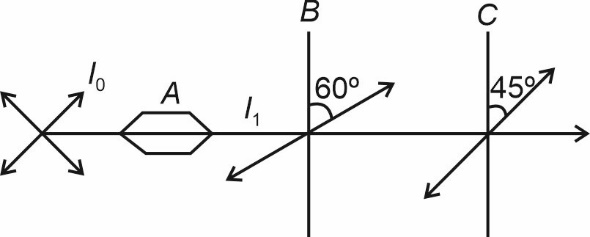
A beam of unpolarized light of intensity is passed through a polaroid A, then through another polaroid B, oriented at 60º and finally through another polaroid C, oriented at 45º relative to B as shown. The intensity of emergent light is:
- 1
- 2
- 3
- 4
Show answer and solution
Correct: option 1,
The first polaroid passes half the unpolarized light: . By Malus's law B passes , and C passes .
Question 10NEET 2023, Q25
For Young's double slit experiment, two statements are given below:
Statement I: If screen is moved away from the plane of slits, angular separation of the fringes remains constant.
Statement II: If the monochromatic source is replaced by another monochromatic source of larger wavelength, the angular separation of fringes decreases.
In the light of the above statements, choose the correct answer from the options given below:
- 1Both Statement I and Statement II are true.
- 2Both Statement I and Statement II are false.
- 3Statement I is true but Statement II is false.
- 4Statement I is false but Statement II is true.
Show answer and solution
Correct: option 3, Statement I is true but Statement II is false.
The angular separation of the fringes is . It does not depend on the screen distance , so Statement I is true. It increases with wavelength, so Statement II, which says it decreases, is false. The answer is option (3).
Question 11NEET 2022, Q29
In a Young's double slit experiment, a student observes 8 fringes in a certain segment of screen when a monochromatic light of 600 nm wavelength is used. If the wavelength of light is changed to 400 nm, then the number of fringes he would observe in the same region of the screen is:
- 112
- 26
- 38
- 49
Show answer and solution
Correct: option 1, 12
Fringe width is , so the number of fringes in a fixed length is inversely proportional to : . Then , option (1).
Question 12NEET 2022 Re-exam, Q25
If the screen is moved away from the plane of the slits in a Young's double slit experiment, then the:
- 1linear separation of the fringes decreases
- 2angular separation of the fringes increases
- 3angular separation of the fringes decreases
- 4linear separation of the fringes increase
Show answer and solution
Correct: option 4, linear separation of the fringes increase
The linear fringe width is , which grows as the screen distance increases. The angular fringe width does not depend on , so it stays the same. Hence only option (4) is right.
Question 13NEET 2022 Re-exam, Q30
After passing through a polariser a linearly polarised light of intensity is incident on an analyser making an angle of 30° with that of the polariser. The intensity of light emitted from the analyser will be
- 1
- 2
- 3
- 4
Show answer and solution
Correct: option 4,
By Malus's law the transmitted intensity is , option (4).
Question 14NEET 2020, Q146
The Brewsters angle for an interface should be:
- 1
- 2
- 3
- 4
Show answer and solution
Correct: option 3,
Brewster's law gives , where is the refractive index of the second medium relative to the first. For light going from a rarer to a denser medium , so and ; since is finite, . Hence .
Question 15NEET 2020, Q149
In Young's double slit experiment, if the separation between coherent sources is halved and the distance of the screen from the coherent sources is doubled, then the fringe width becomes:
- 1double
- 2half
- 3four times
- 4one-fourth
Show answer and solution
Correct: option 3, four times
The fringe width is . With and , the new fringe width is , four times the original.
Question 16NEET 2020, Q151
Assume that light of wavelength 600 nm is coming from a star. The limit of resolution of telescope whose objective has a diameter of 2 m is:
- 1
- 2
- 3
- 4
Show answer and solution
Correct: option 1,
The limit of resolution of a telescope is . Here .
Question 17NEET 2020 Phase 2, Q96
Two coherent sources of light interfere and produce fringe pattern on a screen. For central maximum, the phase difference between the two waves will be,
- 1
- 2
- 3
- 4zero
Show answer and solution
Correct: option 4, zero
The central maximum lies at the point equally distant from the two sources, so the path difference there is zero. The two waves therefore arrive in step, with phase difference , and add up to give the brightest fringe.
Question 18NEET 2019, Q5
In a double slit experiment, when light of wavelength 400 nm was used, the angular width of the first minima formed on a screen placed 1 m away, was found to be . What will be the angular width of the first minima, if the entire experimental apparatus is immersed in water? ()
- 1
- 2
- 3
- 4
Show answer and solution
Correct: option 2,
Angular width is proportional to the wavelength (). In water the wavelength becomes , so .
Question 19NEET 2019 Odisha, Q27
Angular width of the central maxima in the Fraunhofer diffraction for is . When the same slit is illuminated by another monochromatic light, the angular width decreases by 30%. The wavelength of this light is,
- 1
- 2
- 3
- 4
Show answer and solution
Correct: option 4,
The angular width of the central maximum is , proportional to for the same slit. A width that is 30% smaller means angstrom.
Question 20NEET 2019 Odisha, Q38
In a Young's double slit experiment, if there is no initial phase difference between the light from the two slits, a point on the screen corresponding to the fifth minimum has path difference
- 1
- 2
- 3
- 4
Show answer and solution
Correct: option 1,
Minima occur where the path difference is with For the fifth minimum , giving .
Question 21NEET 2018, Q8
Unpolarised light is incident from air on a plane surface of a material of refractive index ''. At a particular angle of incidence 'i', it is found that the reflected and refracted rays are perpendicular to each other. Which of the following options is correct for this situation ?
- 1
- 2Reflected light is polarised with its electric vector perpendicular to the plane of incidence
- 3Reflected light is polarised with its electric vector parallel to the plane of incidence
- 4
Show answer and solution
Correct: option 2, Reflected light is polarised with its electric vector perpendicular to the plane of incidence
When the reflected and refracted rays are perpendicular, the light is incident at the Brewster angle, , so options (1) and (4) are wrong. At this angle the reflected light is completely plane polarised with its electric vector perpendicular to the plane of incidence.
Question 22NEET 2018, Q9
In Young's double slit experiment the separation d between the slits is 2 mm, the wavelength of the light used is 5896 Å and distance D between the screen and slits is 100 cm. It is found that the angular width of the fringes is . To increase the fringe angular width to (with same and D) the separation between the slits needs to be changed to
- 12.1 mm
- 21.9 mm
- 31.8 mm
- 41.7 mm
Show answer and solution
Correct: option 2, 1.9 mm
Angular fringe width is , so with the same , is constant. .
Question 23NEET 2017, Q14
Young's double slit experiment is first performed in air and then in a medium other than air. It is found that 8th bright fringe in the medium lies where 5th dark fringe lies in air. The refractive index of the medium is nearly:
- 11.25
- 21.59
- 31.69
- 41.78
Show answer and solution
Correct: option 4, 1.78
In the medium the wavelength is , so the 8th bright fringe is at . In air the 5th dark fringe is at . Setting them equal gives .
Question 24NEET 2017, Q37
Two Polaroids and are placed with their axis perpendicular to each other. Unpolarised light is incident on . A third polaroid is kept in between and such that its axis makes an angle 45° with that of . The intensity of transmitted light through is
- 1
- 2
- 3
- 4
Show answer and solution
Correct: option 3,
passes half of the unpolarised light: . is at 45° to , so by Malus's law it passes . is at 45° to , so it passes .
Question 25NEET 2016 Phase 1, Q6
In a diffraction pattern due to a single slit of width 'a', the first minimum is observed at an angle 30° when light of wavelength 5000 Å is incident on the slit. The first secondary maximum is observed at an angle of:
- 1
- 2
- 3
- 4
Show answer and solution
Correct: option 4,
First minimum: , so . The first secondary maximum is at , so .
Question 26NEET 2016 Phase 1, Q18
The intensity at the maximum in a Young's double slit experiment is . Distance between two slits is , where is the wavelength of light used in the experiment. What will be the intensity in front of one of the slits on the screen placed at a distance ?
- 1
- 2
- 3
- 4
Show answer and solution
Correct: option 4,
The point in front of a slit is at , so the path difference is , a phase difference of . The intensity is .
Question 27NEET 2016 Phase 2, Q36
The interference pattern is obtained with two coherent light sources of intensity ratio . In the interference pattern, the ratio will be
- 1
- 2
- 3
- 4
Show answer and solution
Correct: option 2,
Let the intensities be and . Then and . So and , and the ratio is , option (2).
Question 28NEET 2016 Phase 2, Q38
A linear aperture whose width is 0.02 cm is placed immediately in front of a lens of focal length 60 cm. The aperture is illuminated normally by a parallel beam of wavelength cm. The distance of the first dark band of the diffraction pattern from the centre of the screen is
- 10.10 cm
- 20.25 cm
- 30.20 cm
- 40.15 cm
Show answer and solution
Correct: option 4, 0.15 cm
In single-slit diffraction the first minimum is at . The pattern forms in the focal plane of the lens, so its distance from the centre is cm, option (4).
Question 29AIPMT 2015, Q141
In a double slit experiment, the two slits are 1 mm apart and the screen is placed 1 m away. A monochromatic light of wavelength 500 nm is used. What will be the width of each slit for obtaining ten maxima of double slit within the central maxima of single slit pattern?
- 10.1 mm
- 20.5 mm
- 30.02 mm
- 40.2 mm
Show answer and solution
Correct: option 4, 0.2 mm
The double slit fringes are spaced apart in angle, where is the slit separation. The central maximum of a single slit of width has angular width . For ten fringes to fit inside it, , so , option (4).
Question 30AIPMT 2015, Q142
For a parallel beam of monochromatic light of wavelength '', diffraction is produced by a single slit whose width 'a' is of the order of the wavelength of the light. If 'D' is the distance of the screen from the slit, the width of the central maxima will be:
- 1
- 2
- 3
- 4
Show answer and solution
Correct: option 4,
The first minima of a single slit pattern lie at angles on either side of the centre. On a screen at distance D they are at , so the central maximum, which stretches from one first minimum to the other, has width . This is option (4).
Question 31AIPMT 2015 Re-test, Q155
At the first minimum adjacent to the central maximum of a single-slit diffraction pattern, the phase difference between the Huygen's wavelet from the edge of the slit and the wavelet from the midpoint of the slit is:
- 1 radian
- 2 radian
- 3 radian
- 4 radian
Show answer and solution
Correct: option 4, radian
The first minimum is where for slit width a. The wavelets from one edge and from the midpoint start a distance apart, so their path difference is . A path difference of half a wavelength is a phase difference of radian, which is why they cancel in pairs.
Question 32AIPMT 2015 Re-test, Q170
Two slits in Young's experiment have widths in the ratio 1 : 25. The ratio of intensity at the maxima and minima in the interference pattern, is:
- 1
- 2
- 3
- 4
Show answer and solution
Correct: option 2,
The intensity from a slit is proportional to its width, so and the amplitudes are in the ratio . .
Question 33AIPMT 2014, Q130
In the Young's double-slit experiment, the intensity of light at a point on the screen where the path difference is is K, ( being the wave length of light used). The intensity at a point where the path difference is , will be:
- 1Zero
- 2K
- 3K/4
- 4K/2
Show answer and solution
Correct: option 4, K/2
The intensity is . A path difference means and . A path difference means , so , option (4).
Question 34AIPMT 2014, Q134
A beam of light of from a distant source falls on a single slit 1 mm wide and the resulting diffraction pattern is observed on a screen 2 m away. The distance between first dark fringes on either side of the central bright fringe is:
- 12.4 mm
- 21.2 cm
- 31.2 mm
- 42.4 cm
Show answer and solution
Correct: option 1, 2.4 mm
The first dark fringes are at , so their separation is , option (1).
Question 35NEET 2013, Q154
In Young's double slit experiment, the slits are 2 mm apart and are illuminated by photons of two wavelengths and . At what minimum distance from the common central bright fringe on the screen 2 m from the slit will a bright fringe from one interference pattern coincide with a bright fringe from the other?
- 16 mm
- 24 mm
- 33 mm
- 48 mm
Show answer and solution
Correct: option 1, 6 mm
Bright fringes coincide when , that is . The smallest whole numbers are , . The distance is .
Question 36NEET 2013 Karnataka, Q136
In Young's double slit experiment the distance between the slits and the screen is doubled. The separation between the slits is reduced to half. As a result the fringe width:
- 1is halved
- 2become four times
- 3remains unchanged
- 4is doubled
Show answer and solution
Correct: option 2, become four times
Fringe width is . Doubling and halving gives , so the fringe width becomes four times.
Question 37NEET 2013 Karnataka, Q152
A parallel beam of light of wavelength is incident normally on a narrow slit. A diffraction pattern is formed on a screen placed perpendicular to the direction of the incident beam. At the second minimum of the diffraction pattern, the phase difference between the rays coming from the two edges of slit is:
- 1
- 2
- 3
- 4
Show answer and solution
Correct: option 3,
Single-slit minima occur where , and is the path difference between the rays from the two edges. At the second minimum the path difference is , so the phase difference is .
Question 38AIPMT 2008 Prelims, Q22
Two periodic waves of intensities and pass through a region at the same time in the same direction. The sum of the maximum and minimum intensities is
- 1
- 2
- 3
- 4
Show answer and solution
Correct: option 1,
Amplitudes add at a maximum and subtract at a minimum, so and . Adding them, the cross terms cancel and the sum is .
Question 39AIPMT 2005 Prelims, Q31
The angular resolution of a 10cm diameter telescope at a wavelength of 5000Å is of the order of
- 1 rad
- 2 rad
- 3 rad
- 4 rad
Show answer and solution
Correct: option 2, rad
The limit of resolution is rad, which is of the order of rad.
Question 40AIPMT 2004 Prelims, Q32
A telescope has an objective lens of 10 cm diameter and is situated at a distance of one kilometer from two objects. The minimum distance between these two objects, which can be resolved by the telescope, when the mean wavelength of light is 5000 Å, is of the order of-
- 15 m
- 25 mm
- 35 cm
- 40.5 m
Show answer and solution
Correct: option 2, 5 mm
The limit of resolution of a telescope is rad. At a distance of 1000 m this corresponds to a separation m, which is of the order of 5 mm.
Question 41AIPMT 2002 Prelims, Q14
Diameter of human eye lens is 2 mm. What will be the minimum distance between two points to resolve them, which are situated at a distance of 50 meter from eye. The wavelength of light is 5000 Å:-
- 12.32 m
- 24.28 mm
- 31.25 cm
- 412.48 cm
Show answer and solution
Correct: option 3, 1.25 cm
The angular limit of resolution is about rad. At 50 m this corresponds to a separation of m cm. (With the factor 1.22 for a circular aperture the value is about 1.5 cm, and 1.25 cm is still the nearest option.)
Question 42AIPMT 2001 Prelims, Q40
The interplanar distance in a crystal is m. The value of maximum wavelength which can be diffracted:
- 1 m
- 2 m
- 3 m
- 4 m
Show answer and solution
Correct: option 2, m
Bragg's law is . The wavelength is largest for and , so m.
Question 43AIPMT 1998 Prelims, Q33
For the diffraction from a crystal with Å and Bragg's angle , then for the second order diffraction 'd' will be:
- 11.15 Å
- 20.75 Å
- 30.55 Å
- 42.1 Å
Show answer and solution
Correct: option 1, 1.15 Å
Bragg's law is . With : Å.