Questions with solutions
Question 1NEET 2026, Q28
An electric heater supplies heat to a system at a rate of . If the system performs work at a rate of , then the rate at which internal energy increases will be:
- 1
- 2
- 3
- 4
Show answer and solution
Correct: option 3,
By the first law of thermodynamics, . Per second, the internal energy rises by , that is, at .
Question 2NEET 2026 Re-exam, Q17
In an adiabatic expansion, the temperature of one mole of an ideal monatomic gas () decreases from 60K to 50K. The work done by the gas in the process is:
(Take the universal gas constant as )
- 141.5 J
- 283 J
- 3124.5 J
- 4166 J
Show answer and solution
Correct: option 3, 124.5 J
In an adiabatic process no heat is exchanged, so the work done by the gas equals the fall in internal energy: J, option (3).
Question 3NEET 2026 Re-exam, Q39
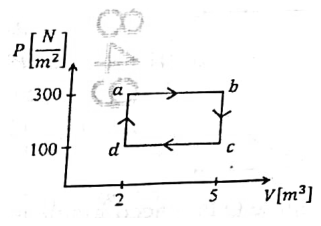
One mole of an ideal monatomic gas undergoes a cyclic process as shown in the figure. The total heat supplied to the gas is:
- 1400 J
- 2500 J
- 3600 J
- 4800 J
Show answer and solution
Correct: option 3, 600 J
Over a complete cycle the internal energy returns to its starting value, so the net heat supplied equals the net work done by the gas, which is the area enclosed by the cycle on the P-V diagram. The cycle runs clockwise, so the work is positive: J, option (3).
Question 4NEET 2025, Q41
Two gases and are filled at the same pressure in separate cylinders with movable pistons of radius and , respectively. On supplying an equal amount of heat to both the systems reversibly under constant pressure, the pistons of gas and are displaced by 16 cm and 9 cm, respectively. If the change in their internal energy is the same, then the ratio is equal to
- 1
- 2
- 3
- 4
Show answer and solution
Correct: option 2,
By the first law ; the heat and the change in internal energy are the same for both, so the work done is the same. At constant pressure , so . Hence , option (2).
Question 5NEET 2024, Q27
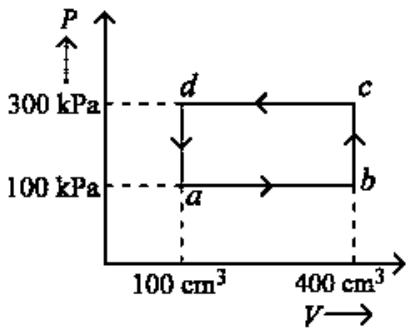
A thermodynamic system is taken through the cycle . The work done by the gas along the path is:
- 1
- 2zero
- 3
- 4
Show answer and solution
Correct: option 2, zero
Along the volume stays at while the pressure rises from 100 kPa to 300 kPa. Work done by a gas is , and with no change in volume it is zero, option (2).
Question 6NEET 2024 Re-exam, Q33
The equilibrium state of a thermodynamic system is described by
A. Pressure
B. Total heat
C. Temperature
D. Volume
E. Work done
Choose the most appropriate answer from the options given below.
- 1A, B and E only
- 2B, C and D only
- 3A, B and C only
- 4A, C and D only
Show answer and solution
Correct: option 4, A, C and D only
An equilibrium state is described by state variables, which depend only on the state and not on how it was reached: pressure, volume and temperature (A, C, D). Heat and work are energy in transit and depend on the path, so they do not describe a state.
Question 7NEET 2023, Q15
A Carnot engine has an efficiency of 50% when its source is at a temperature C. The temperature of the sink is:
- 1 C
- 2 C
- 3 C
- 4 C
Show answer and solution
Correct: option 1, C
with K. So , giving K C, option (1).
Question 8NEET 2023 Manipur, Q24
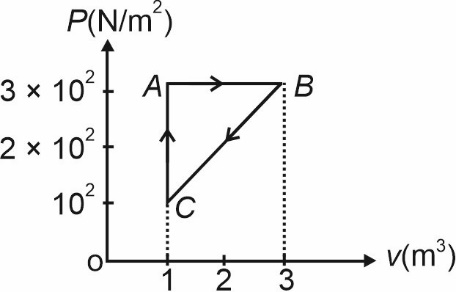
For the given cycle, the work done during isobaric process is:
- 1400 J
- 2600 J
- 3200 J
- 4Zero
Show answer and solution
Correct: option 2, 600 J
The isobaric (constant pressure) step is A to B, at , with the volume rising from to . .
Question 9NEET 2022, Q12
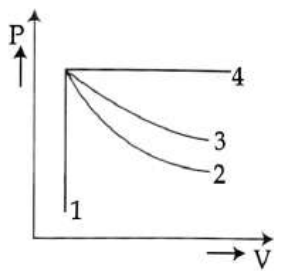
An ideal gas undergoes four different processes from the same initial state as shown in the figure below. Those processes are adiabatic, isothermal, isobaric and isochoric. The curve which represents the adiabatic process among 1, 2, 3 and 4 is:
- 14
- 21
- 32
- 43
Show answer and solution
Correct: option 3, 2
On a P-V diagram the horizontal line 4 is isobaric and the vertical line 1 is isochoric. Of the two falling curves, the adiabatic one is steeper, because its slope is against for the isothermal. The lower, steeper curve is 2, so the adiabatic process is curve 2, option (3).
Question 10NEET 2022 Re-exam, Q16
An ideal gas follows a process described by the equation from the initial to final thermodynamic states, where is a constant. Then
- 1If then
- 2If then
- 3If then
- 4If then
Show answer and solution
Correct: option 4, If then
Putting in gives constant, so temperature falls when volume rises: if then , option (4). Also falls as rises, so means and , which rules out (1) and (2).
Question 11NEET 2020, Q147
Two cylinders A and B of equal capacity are connected to each other via a stop cock. A contains an ideal gas at standard temperature and pressure. B is completely evacuated. The entire system is thermally insulated. The stop cock is suddenly opened. The process is:
- 1isothermal
- 2adiabatic
- 3isochoric
- 4isobaric
Show answer and solution
Correct: option 2, adiabatic
The system is thermally insulated, so no heat enters or leaves the gas while it expands into the evacuated cylinder. A process with no heat exchange is adiabatic. (This is a free expansion: no work is done either, so the internal energy and temperature of the ideal gas stay the same, but the process is sudden and is classed by the absence of heat exchange.)
Question 12NEET 2020 Phase 2, Q110
The efficiency of a Carnot engine depends upon
- 1the temperatures of the source and sink
- 2the volume of the cylinder of the engine
- 3the temperature of the source only
- 4the temperature of the sink only
Show answer and solution
Correct: option 1, the temperatures of the source and sink
The efficiency of a Carnot engine is , where is the temperature of the source and that of the sink. It depends on both temperatures and on nothing else, not the working substance or the size of the cylinder.
Question 13NEET 2020 Phase 2, Q116
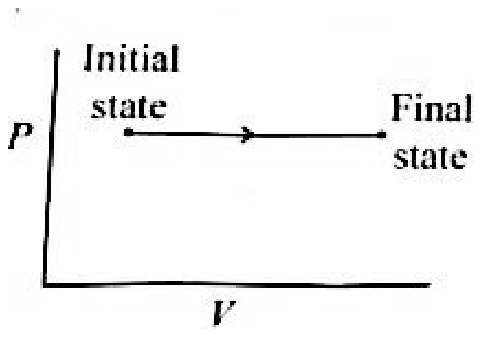
The P-V diagram for an ideal gas in a piston cylinder assembly undergoing a thermodynamic process is shown in the figure. The process is
- 1isochoric
- 2isobaric
- 3isothermal
- 4adiabatic
Show answer and solution
Correct: option 2, isobaric
The path from the initial state to the final state is a horizontal line on the P-V diagram: the volume changes while the pressure stays the same. A process at constant pressure is isobaric.
Question 14NEET 2019, Q40
In which of the following processes, heat is neither absorbed nor released by a system?
- 1isothermal
- 2adiabatic
- 3isobaric
- 4isochoric
Show answer and solution
Correct: option 2, adiabatic
An adiabatic process is defined by no heat exchange between the system and its surroundings (). In isothermal, isobaric and isochoric processes heat generally flows in or out.
Question 15NEET 2019 Odisha, Q26
1 g of water, of volume 1 at , is converted into steam at same temperature under normal atmospheric pressure Pa. The volume of steam formed equals 1671 . If the specific latent heat of vaporisation of water is 2256 J/g, the change in internal energy is,
- 1167 J
- 22256 J
- 32423 J
- 42089 J
Show answer and solution
Correct: option 4, 2089 J
Heat supplied is J. Work done by the steam is J. By the first law, J.
Question 16NEET 2018, Q1
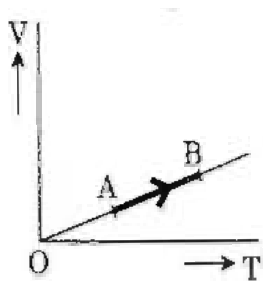
The volume (V) of a monatomic gas varies with its temperature (T), as shown in the graph. The ratio of work done by the gas, to the heat absorbed by it, when it undergoes a change from state A to state B, is
- 1
- 2
- 3
- 4
Show answer and solution
Correct: option 3,
The graph is a straight line through the origin, so and the process is at constant pressure. Then and for a monatomic gas. So .
Question 17NEET 2018, Q4
The efficiency of an ideal heat engine working between the freezing point and boiling point of water, is
- 16.25%
- 220%
- 326.8%
- 412.5%
Show answer and solution
Correct: option 3, 26.8%
For an ideal (Carnot) engine with and . So , that is 26.8%.
Question 18NEET 2018, Q45
A sample of 0.1 g of water at and normal pressure requires 54 cal of heat energy to convert to steam at . If the volume of the steam produced is 167.1 cc, the change in internal energy of the sample, is
- 142.2 J
- 2208.7 J
- 3104.3 J
- 484.5 J
Show answer and solution
Correct: option 2, 208.7 J
Heat supplied J. Work done by the sample J. First law: J.
Question 19NEET 2017, Q16
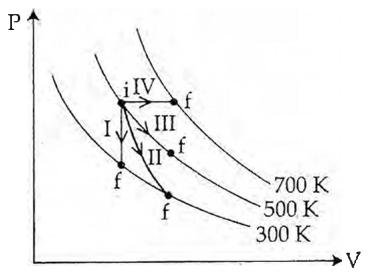
Thermodynamic processes are indicated in the following diagram.
Match the following
| Column-1 | Column-2 |
|---|
| P. Process I | a. Adiabatic |
| Q. Process II | b. Isobaric |
| R. Process III | c. Isochoric |
| S. Process IV | d. Isothermal |
- 1P-a, Q-c, R-d, S-b
- 2P-c, Q-a, R-d, S-b
- 3P-c, Q-d, R-b, S-a
- 4P-d, Q-b, R-a, S-c
Show answer and solution
Correct: option 2, P-c, Q-a, R-d, S-b
Process I is a vertical line, so the volume is constant: isochoric (c). Process IV is a horizontal line, so the pressure is constant: isobaric (b). Process III runs along the 700 K curve, so the temperature is constant: isothermal (d). Process II falls more steeply than the isotherm and crosses to lower temperature curves: adiabatic (a). So P-c, Q-a, R-d, S-b.
Question 20NEET 2017, Q27
A carnot engine having an efficiency of as heat engine, is used as a refrigerator. If the work done on the system is 10 J, the amount of energy absorbed from the reservoir at lower temperature is:
- 11 J
- 290 J
- 399 J
- 4100 J
Show answer and solution
Correct: option 2, 90 J
For the same Carnot cycle run backwards, the coefficient of performance is . Since , the heat taken from the cold reservoir is J.
Question 21NEET 2016 Phase 1, Q11
A refrigerator works between 4°C and 30°C. It is required to remove 600 calories of heat every second in order to keep the temperature of the refrigerated space constant. The power required is:
(Take 1 cal = 4.2 Joules)
- 12.365 W
- 223.65 W
- 3236.5 W
- 42365 W
Show answer and solution
Correct: option 3, 236.5 W
For an ideal refrigerator the coefficient of performance is . Heat removed per second is W, so the power needed is W.
Question 22NEET 2016 Phase 1, Q30
A gas is compressed isothermally to half its initial volume. The same gas is compressed separately through an adiabatic process until its volume is again reduced to half. Then:
- 1Compressing the gas isothermally will require more work to be done.
- 2Compressing the gas through adiabatic process will require more work to be done.
- 3Compressing the gas isothermally or adiabatically will require the same amount of work.
- 4Which of the case (whether compression through isothermal or through adiabatic process) requires more work will depend upon the atomicity of the gas.
Show answer and solution
Correct: option 2, Compressing the gas through adiabatic process will require more work to be done.
On a P-V diagram the adiabatic curve is steeper than the isothermal one, so during compression from the same starting point the adiabatic curve lies above the isothermal. The area under it, which is the work done on the gas, is therefore larger for the adiabatic compression.
Question 23NEET 2016 Phase 2, Q17
One mole of an ideal monoatomic gas undergoes a process described by the equation . The heat capacity of the gas during this process is
- 1
- 2
- 3
- 4
Show answer and solution
Correct: option 4,
For a polytropic process the molar heat capacity is . Here for a monoatomic gas and , so , option (4).
Question 24NEET 2016 Phase 2, Q18
The temperature inside a refrigerator is °C and the room temperature is °C. The amount of heat delivered to the room for each joule of electrical energy consumed ideally will be
- 1
- 2
- 3
- 4
Show answer and solution
Correct: option 2,
For an ideal (Carnot) refrigerator the heats are in the ratio of the absolute temperatures: , and the work is . So the heat delivered to the room per unit work is , option (2).
Question 25AIPMT 2015, Q137
One mole of an ideal diatomic gas undergoes a transition from A to B along a path AB as shown in the figure,
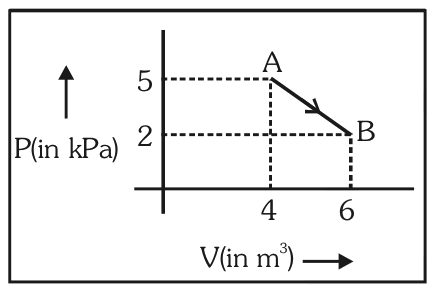
The change in internal energy of the gas during the transition is:
- 1
- 2
- 3
- 4
Show answer and solution
Correct: option 1,
Internal energy depends only on the end states: for a diatomic gas, since . From the graph, and . So , option (1).
Question 26AIPMT 2015, Q153
A Carnot engine, having an efficiency of as heat engine, is used as a refrigerator. If the work done on the system is 10 J, the amount of energy absorbed from the reservoir at lower temperature is:-
- 199 J
- 290 J
- 31 J
- 4100 J
Show answer and solution
Correct: option 2, 90 J
For a Carnot cycle run backwards between the same two temperatures, the coefficient of performance is . With the heat taken from the cold reservoir is , option (2). (The heat given to the hot reservoir is then 100 J, and matches the efficiency.)
Question 27AIPMT 2015, Q170
Figure below shows two paths that may be taken by a gas to go from a state A to a state C.
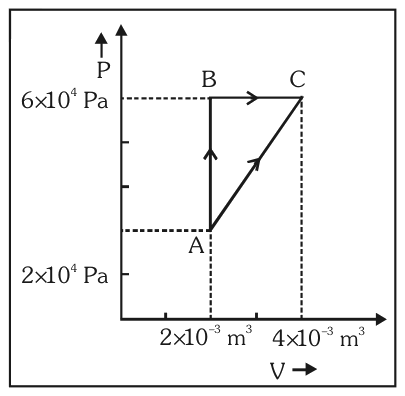
In process AB, 400 J of heat is added to the system and in process BC, 100 J of heat is added to the system. The heat absorbed by the system in the process AC will be:
- 1500 J
- 2460 J
- 3300 J
- 4380 J
Show answer and solution
Correct: option 2, 460 J
Along ABC: AB is at constant volume (no work) and BC is at constant pressure, so . With , . Along the straight path AC the work is the area under the line, . So , option (2).
Question 28AIPMT 2015 Re-test, Q165
The coefficient of performance of a refrigerator is 5. If the temperature inside freezer is , the temperature of the surroundings to which it rejects heat is:
- 1
- 2
- 3
- 4
Show answer and solution
Correct: option 2,
For an ideal refrigerator, coefficient of performance with temperatures in kelvin. , so , giving and .
Question 29AIPMT 2015 Re-test, Q166
An ideal gas is compressed to half its initial volume by means of several processes. Which of the process results in the maximum work done on the gas?
- 1Isothermal
- 2Adiabatic
- 3Isobaric
- 4Isochoric
Show answer and solution
Correct: option 2, Adiabatic
Work done on the gas is the area under its P-V curve between V and V/2. Starting from the same state, the pressure stays constant in the isobaric process, rises as in the isothermal one and rises fastest, as , in the adiabatic one, so the adiabatic curve lies highest and encloses the largest area. An isochoric process has no volume change and no work. So the adiabatic compression needs the most work.
Question 30AIPMT 2014, Q111
A monoatomic gas at a pressure P, having a volume V expands isothermally to a volume 2V and then adiabatically to a volume 16V. The final pressure of the gas is: (take )
- 116P
- 264P
- 332P
- 4P/64
Show answer and solution
Correct: option 4, P/64
Isothermal step: , so . Adiabatic step: , so , option (4).
Question 31AIPMT 2014, Q133
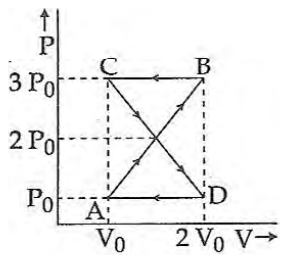
A thermodynamic system undergoes cyclic process ABCDA as shown in Fig. The work done by the system in the cycle is:
- 1Zero
- 2
- 3
- 4
Show answer and solution
Correct: option 1, Zero
The work done in a cycle is the area enclosed on the P-V diagram, positive for a clockwise loop and negative for an anticlockwise one. The path ABCDA crosses itself and forms two equal triangles, each of area , traced in opposite senses. Their works cancel, so the net work is zero, option (1).
Question 32NEET 2013, Q142
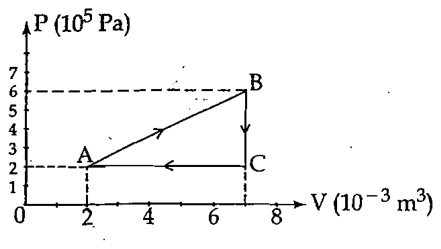
A gas is taken through the cycle ABCA, as shown. What is the net work done by the gas?
- 11000 J
- 2Zero
- 3 J
- 42000 J
Show answer and solution
Correct: option 1, 1000 J
The net work in a cycle is the area enclosed on the P-V diagram. The triangle has base and height , so the area is . The cycle runs clockwise (expansion at the higher pressures), so the work done by the gas is positive.
Question 33NEET 2013, Q170
During an adiabatic process, the pressure of a gas is found to be proportional to the cube of its temperature. The ratio of for the gas is:
- 12
- 2
- 3
- 4
Show answer and solution
Correct: option 3,
In an adiabatic process , so . Setting gives , so .
Question 34NEET 2013 Karnataka, Q142
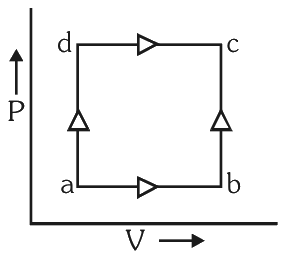
A system is taken from state a to state c by two paths adc and abc as shown in the figure. The internal energy at a is . Along the path adc the amount of heat absorbed and the work obtained whereas along the path abc the heat absorbed . The amount of work along the path abc is:
- 1
- 2
- 3
- 4
Show answer and solution
Correct: option 4,
The change in internal energy between a and c is the same for both paths. Along adc: . Along abc: .
Question 35NEET 2013 Karnataka, Q165
Which of the following relations, does not give the equation of an adiabatic process, where terms have their usual meaning?
- 1
- 2
- 3
- 4
Show answer and solution
Correct: option 4,
The adiabatic law is . Putting gives , and putting gives . The form has the exponents interchanged and is not an adiabatic relation.
Question 36NEET 2013 Karnataka, Q174
Two Carnot engines A and B are operated in series. The engine A receives heat from the source at temperature and rejects the heat to the sink at temperature T. The second engine B receives the heat at temperature T and rejects to its sink at temperature . For what value of T the efficiencies of the two engines are equal:
- 1
- 2
- 3
- 4
Show answer and solution
Correct: option 3,
Carnot efficiency is . Equal efficiencies mean , so and .
Question 37AIPMT 2012 Prelims, Q9
A thermodynamic system is taken through the cycle ABCD as shown in figure. Heat rejected by the gas during the cycle is:
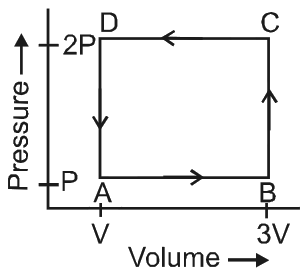
- 12 PV
- 24 PV
- 3 PV
- 4PV
Show answer and solution
Correct: option 1, 2 PV
Over a full cycle the internal energy does not change, so the net heat equals the net work, which is the area of the loop: . The loop is traversed anticlockwise (expansion at the lower pressure P, compression at 2P), so the work done by the gas is and the gas rejects heat .
Question 38AIPMT 2012 Prelims, Q29
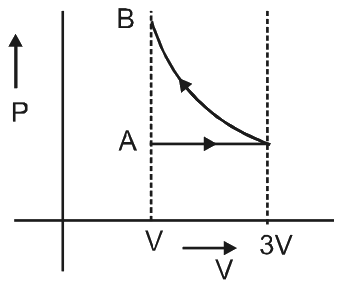
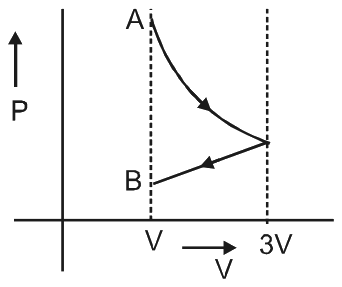
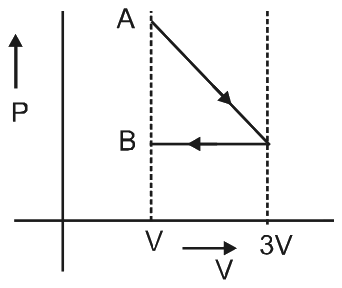
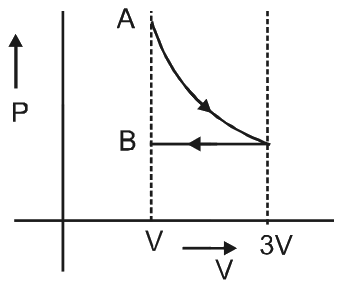
One mole of an ideal gas goes from an initial state A to final state B via two processes: It first undergoes isothermal expansion from volume V to 3V and then its volume is reduced from 3V to V at constant pressure. The correct P-V diagram representing the two processes is:
- 1
- 2
- 3
- 4
Show answer and solution
Correct: option 4
The isothermal expansion is a falling curve (a hyperbola, PV constant) from A at volume V down to volume 3V. The compression at constant pressure is a horizontal line from 3V back to V, ending at B directly below A. Only option (4) shows a curve from A followed by a horizontal line to B; option (3) has a straight line for the first step, option (2) a sloping second step, and option (1) starts with the horizontal line.
Question 39AIPMT 2012 Mains, Q11
An ideal gas goes from state A to state B via three different processes as indicated in the P-V diagram:
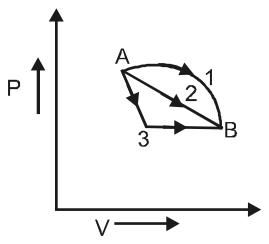
If , , indicate the heat absorbed by the gas along the three processes and , , indicate the change in internal energy along the three processes respectively, then
- 1 and
- 2 and
- 3 and
- 4 and
Show answer and solution
Correct: option 1, and
Internal energy is a state function, so with the same end states A and B, . The work done by the gas is the area under each path on the P-V diagram; path 1 lies highest and path 3 lowest, so . From the first law , hence .
Question 40AIPMT 2011 Prelims, Q163
During an isothermal expansion, a confined ideal gas does –150 J of work against its surroundings. This implies that:
- 1150 J heat has been removed from the gas
- 2300 J of heat has been added to the gas
- 3no heat is transferred because the process is isothermal
- 4150 J of heat has been added to the gas
Show answer and solution
Correct: option 1 or 4
The answer key accepts options 1 and 4.
For an ideal gas at constant temperature , so the first law gives . In an expansion the gas does positive work, so reading the work as 150 J means 150 J of heat has been added (option 4). Taking the printed value –150 J literally gives J, heat removed (option 1). The answer key accepts either option because of this sign.
Question 41AIPMT 2011 Prelims, Q189
When 1 kg of ice at C melts to water at C, the resulting change in its entropy, taking latent heat of ice to be 80 Cal/C, is:
- 1273 Cal/K
- 2 Cal/K
- 380 Cal/K
- 4293 Cal/K
Show answer and solution
Correct: option 4, 293 Cal/K
Melting takes place at the constant temperature K, so . Taking the latent heat as 80 cal per gram, cal and cal/K.
Question 42AIPMT 2011 Mains, Q108
A mass of diatomic gas () at a pressure of 2 atmospheres is compressed adiabatically so that its temperature rise from 27°C to 927°C. The pressure of the gas is final state is:
- 128 atm
- 268.7atm
- 3256 atm
- 48 atm
Show answer and solution
Correct: option 3, 256 atm
For an adiabatic change is constant, so . Here K, K and . So atm.
Question 43AIPMT 2010 Mains, Q20
If and denote the specific heats (per unit mass) of an ideal gas of molecular weight M where R is the molecular weight constant, then
- 1
- 2
- 3
- 4
Show answer and solution
Correct: option 3,
For one mole of an ideal gas the molar specific heats obey , with R the gas constant. A mole has mass M, so the molar values are M times the values per unit mass: and . Hence and .
Question 44AIPMT 2010 Mains, Q30
A monoatomic gas at pressure and volume is compressed adiabatically to th of its original volume. What is the final pressure of the gas
- 1
- 2
- 3
- 4
Show answer and solution
Correct: option 4,
In an adiabatic process is constant, and for a monoatomic gas . So .
Question 45AIPMT 2010 Prelims, Q36
If and represent the increase in internal energy and work done by the system respectively in a thermodynamical process, which of the following is true?
- 1, in a adiabatic process
- 2, in a isothermal process
- 3, in a adiabatic process
- 4, in a isothermal process
Show answer and solution
Correct: option 1, , in a adiabatic process
The first law is . In an adiabatic process no heat is exchanged, , so . In an isothermal process of an ideal gas instead, so the isothermal options are not correct in general.
Question 46AIPMT 2009 Prelims, Q3
In thermodynamic processes which of the following statements is not true?
- 1In an isochoric process pressure remains constant
- 2In an isothermal process the temperature remains constant
- 3In an adiabatic process = constant
- 4In an adiabatic process the system is insulated from the surroundings
Show answer and solution
Correct: option 1, In an isochoric process pressure remains constant
In an isochoric process it is the volume that stays constant, not the pressure; constant pressure describes an isobaric process. The other three statements are correct descriptions of isothermal and adiabatic processes.
Question 47AIPMT 2009 Prelims, Q37
The internal energy change in a system that has absorbed 2 Kcals of heat and done 500 J of work is:
- 16400 J
- 25400 J
- 37900 J
- 48900 J
Show answer and solution
Correct: option 3, 7900 J
The heat absorbed is J. By the first law, J.
Question 48AIPMT 2008 Prelims, Q14
If Q, E and W denote respectively the heat added, change in internal energy and the work done in a closed cycle process, then
- 1
- 2
- 3
- 4
Show answer and solution
Correct: option 4,
Internal energy is a state function. A closed cycle brings the system back to its starting state, so the change in internal energy is zero, . The first law, , then gives , and these need not be zero.
Question 49AIPMT 2007 Prelims, Q165
An engine has an efficiency of 1/6. When the temperature of sink is reduced by , its efficiency is doubled. Temperature of the source is
- 1
- 2
- 3
- 4
Show answer and solution
Correct: option 1,
For a Carnot engine . First ; after lowering the sink, . Subtracting, , so K , option (1).
Question 50AIPMT 2006 Prelims, Q4
A Carnot engine whose sink is at 300 K has an efficiency of 40%. By how much should the temperature of source be increased so as to increase its efficiency by 50% of original efficiency:-
- 1275 K
- 2325 K
- 3250 K
- 4380 K
Show answer and solution
Correct: option 3, 250 K
From , gives . The new efficiency is , so gives . The source temperature must rise by .
Question 51AIPMT 2005 Prelims, Q5
Which of the following processes is reversible
- 1Transfer of heat by radiation
- 2Transfer of heat by conduction
- 3Isothermal compression
- 4Electrical heating of a nichrome wire
Show answer and solution
Correct: option 3, Isothermal compression
Heat flow across a finite temperature difference (radiation, conduction) and Joule heating are dissipative and cannot be undone without a net change elsewhere. A slow isothermal compression passes through equilibrium states and can be retraced exactly, so it is reversible.
Question 52AIPMT 2005 Prelims, Q22
An ideal gas heat engine operates in Carnot cycle between 227°C and 127°C. It absorbs cals of heat at higher temperature. Amount of heat converted to work is:
- 1 cals
- 2 cals
- 3 cals
- 4 cals
Show answer and solution
Correct: option 3, cals
The temperatures are 500 K and 400 K, so the Carnot efficiency is . Work obtained is cals.
Question 53AIPMT 2004 Prelims, Q46
One mole of an ideal gas at an initial temperature of T K does 6R joules of work adiabatically. If the ratio of specific heats of this gas at constant pressure and at constant volume is , the final temperature of gas will be:-
- 1(T – 2.4) K
- 2(T + 4) K
- 3(T – 4) K
- 4(T + 2.4) K
Show answer and solution
Correct: option 3, (T – 4) K
In an adiabatic process the work done by the gas comes from its internal energy: . So , giving and K.
Question 54AIPMT 2003 Prelims, Q21
An ideal gas heat engine operates in a carnot cycle between 227ºC and 127ºC. It absorbs 6 kcal at the higher temperature. The amount of heat (in kcal) converted into work is equal to -
- 14.8
- 23.5
- 31.6
- 41.2
Show answer and solution
Correct: option 4, 1.2
The temperatures are 500 K and 400 K, so the Carnot efficiency is . Work done is kcal.
Question 55AIPMT 2002 Prelims, Q20
The efficiency of carnot engine is 50% and temperature of sink is 500K. If temperature of source is kept constant and its efficiency raised to 60%, then the required temperature of the sink will be:-
- 1100 K
- 2600 K
- 3400 K
- 4500 K
Show answer and solution
Correct: option 3, 400 K
. From the source is at K. For 60% efficiency, , so K.
Question 56AIPMT 2001 Prelims, Q16
A scientist says that the efficiency of his heat engine which work at source temperature 127ºC and sink temperature 27ºC to 26%, then
- 1It is impossible
- 2It is possible but less probable
- 3It is quite probable
- 4Data are incomplete
Show answer and solution
Correct: option 1, It is impossible
The greatest possible efficiency between these temperatures is the Carnot value . No engine can exceed it, so a claim of 26% is impossible.
Question 57AIPMT 2000 Prelims, Q30
The ratio (W/Q) for a carnot-engine is , Now the temp. of sink is reduced by C, then this ratio becomes twice, therefore the initial temp. of the sink and source are respectively:
- 1C, C
- 2C, C
- 3C, C
- 497 K, 37 K
Show answer and solution
Correct: option 2, C, C
gives . After lowering the sink by 62 K, , so and K C. Then K C. Sink C, source C.
Question 58AIPMT 1999 Prelims, Q22
Initial pressure and volume of a gas are P and V respectively. First its volume is expanded to 4V by isothermal process and then again its volume makes to be V by adiabatic process then its final pressure is ( = 1.5) -
- 18P
- 24P
- 3P
- 42P
Show answer and solution
Correct: option 4, 2P
Isothermal expansion to : . Adiabatic compression back to : , so .
Question 59AIPMT 1998 Prelims, Q28
When volume changes from V to 2V at constant pressure(P) then the change in internal energy will be:
- 1PV
- 23PV
- 3
- 4
Show answer and solution
Correct: option 3,
For an ideal gas . At constant pressure , so .
Question 60AIPMT 1998 Prelims, Q29
A gas of volume changes 2 litre to 10 litre at constant temperature 300K, then the change in internal energy will be:
- 112 J
- 224 J
- 336 J
- 40 J
Show answer and solution
Correct: option 4, 0 J
The internal energy of an ideal gas depends only on its temperature. The temperature stays at 300 K, so the internal energy does not change whatever the change in volume.
Question 61AIPMT 1998 Prelims, Q48
We consider a thermodynamic system. If represents the increase in its internal energy and W the work done by the system, which of the following statements is true?
- 1 in an isothermal process
- 2 in an isothermal process
- 3 in an adiabatic process
- 4 in an adiabatic process
Show answer and solution
Correct: option 3, in an adiabatic process
The first law is . In an adiabatic process , so : work done by the system comes out of its internal energy. In an isothermal process of an ideal gas instead, so the first two statements fail.