Questions with solutions
Question 1NEET 2024, Q7
A particle moving with uniform speed in a circular path maintains:
- 1varying velocity and varying acceleration.
- 2constant velocity.
- 3constant acceleration.
- 4constant velocity but varying acceleration.
Show answer and solution
Correct: option 1, varying velocity and varying acceleration.
In uniform circular motion the speed is constant but the direction of the velocity changes all the time, so the velocity varies. The centripetal acceleration has a constant size but always points to the centre, so its direction also keeps changing. Both velocity and acceleration vary, option (1).
Question 2NEET 2024 Re-exam, Q44
Let , and be the angular speed of the second hand, minute hand and hour hand of a smoothly running analog clock, respectively. If , and are their respective angular distances in 1 minute then the factor which remains constant () is
- 1
- 2
- 3
- 4
Show answer and solution
Correct: option 1,
Each hand turns at a steady rate, so the angle it covers in a time is . With the same (1 minute) for all three hands, is the same for each: .
Question 3NEET 2023, Q35
A bullet is fired from a gun at the speed of in the direction above the horizontal. The maximum height attained by the bullet is (, ):
- 12800 m
- 22000 m
- 31000 m
- 43000 m
Show answer and solution
Correct: option 3, 1000 m
m, option (3).
Question 4NEET 2023 Manipur, Q4
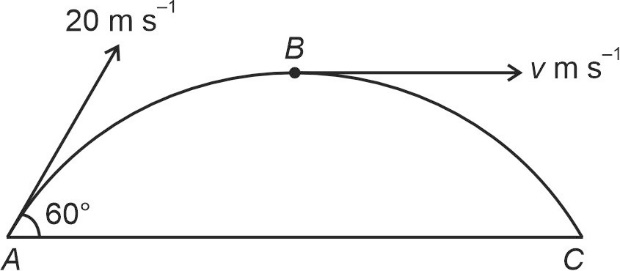
A ball is projected from point A with velocity at an angle to the horizontal direction. At the highest point B of the path (as shown in figure), the velocity of the ball will be
- 1Zero
- 210
- 320
- 4
Show answer and solution
Correct: option 2, 10
At the highest point the vertical component of velocity is zero and only the horizontal component remains, which never changes during the flight. .
Question 5NEET 2023 Manipur, Q23
The position of a particle is given by
where is in seconds and in metre. Find the magnitude and direction of velocity , at , with respect to x-axis.
- 1,
- 2,
- 3,
- 4,
Show answer and solution
Correct: option 3, ,
. At , , so . The angle with the x-axis has , so .
Question 6NEET 2023 Manipur, Q36
A particle is executing uniform circular motion with velocity and acceleration . Which of the following is true?
- 1 is a constant; is a constant
- 2 is not a constant; is a constant
- 3 is a constant; is not a constant
- 4 is not a constant; is not a constant
Show answer and solution
Correct: option 4, is not a constant; is not a constant
In uniform circular motion the speed is constant but the velocity vector is along the tangent, so its direction changes all the time. The acceleration has constant magnitude but always points towards the centre, so its direction also changes all the time. Neither vector is constant.
Question 7NEET 2022, Q41
A ball is projected with a velocity, , at an angle of with the vertical direction. Its speed at the highest point of its trajectory will be:
- 1
- 2Zero
- 3
- 4
Show answer and solution
Correct: option 3,
At the highest point only the horizontal component of velocity remains. The angle is measured from the vertical, so the horizontal component is , option (3).
Question 8NEET 2022 Re-exam, Q13
A cricket ball is thrown by a player at a speed of 20 m/s in a direction 30° above the horizontal. The maximum height attained by the ball during its motion is
()
- 125 m
- 25 m
- 310 m
- 420 m
Show answer and solution
Correct: option 2, 5 m
Maximum height m, option (2).
Question 9NEET 2022 Re-exam, Q26
If and , then the scalar and vector products of and have the magnitudes respectively as
- 1
- 2
- 3
- 4
Show answer and solution
Correct: option 4,
Scalar product: . Vector product: , of magnitude . So the answer is , option (4).
Question 10NEET 2021, Q41
A car starts from rest and accelerates at . At s, a ball is dropped out of a window by a person sitting in the car. What is the velocity and acceleration of the ball at s?
(Take )
- 120 m/s,
- 220 m/s, 0
- 3 m/s, 0
- 4 m/s,
Show answer and solution
Correct: option 4, m/s,
When released the ball has the car's velocity, m/s horizontally, and it keeps this. After that only gravity acts, so its acceleration is downward. Two seconds later its vertical velocity is m/s, so its speed is m/s.
Question 11NEET 2021, Q43
A particle moving in a circle of radius R with a uniform speed takes a time T to complete one revolution.
If this particle were projected with the same speed at an angle '' to the horizontal, the maximum height attained by it equals 4R. The angle of projection, , is then given by:
- 1
- 2
- 3
- 4
Show answer and solution
Correct: option 4,
The speed is . Maximum height: , so . Hence .
Question 12NEET 2019, Q32
The speed of a swimmer in still water is 20 m/s. The speed of river water is 10 m/s and is flowing due east. If he is standing on the south bank and wishes to cross the river along the shortest path, the angle at which he should make his strokes w.r.t. north is given by:
- 1 west
- 2
- 3 west
- 4 west
Show answer and solution
Correct: option 1, west
For the shortest path the resultant velocity must point straight north, so the westward component of the velocity of the swimmer must cancel the flow of the river: , giving and west of north.
Question 13NEET 2019, Q34
Two particles A and B are moving in uniform circular motion in concentric circles of radii and with speed and respectively. Their time period of rotation is the same. The ratio of angular speed of A to that of B will be:
- 1
- 2
- 3
- 41 : 1
Show answer and solution
Correct: option 4, 1 : 1
Angular speed is . Since both particles have the same time period, they have the same angular speed, so the ratio is 1 : 1 whatever the radii and speeds.
Question 14NEET 2019 Odisha, Q40
Two bullets are fired horizontally and simultaneously towards each other from roof tops of two buildings 100 m apart and of same height of 200 m, with the same velocity of 25 m/s. When and where will the two bullets collide? ()
- 1after 4s at a height of 120 m
- 2they will not collide
- 3after 2s at a height of 180 m
- 4after 2s at a height of 20 m
Show answer and solution
Correct: option 3, after 2s at a height of 180 m
Both bullets fall by the same amount at every instant, so they stay at the same height and meet when their horizontal separation closes: s. In 2 s each falls m, so they collide at a height of m.
Question 15NEET 2017, Q9
The and coordinates of the particle at any time are and respectively, where and are in meters and t in seconds. The acceleration of the particle at t = 2s is
- 10
- 2
- 3
- 4
Show answer and solution
Correct: option 3,
Differentiate twice. and . The acceleration is constant, so at s it is (along x).
Question 16NEET 2016 Phase 1, Q27
A particle moves so that its position vector is given by . Where is a constant.
Which of the following is true?
- 1Velocity and acceleration both are perpendicular to .
- 2Velocity and acceleration both are parallel to .
- 3Velocity is perpendicular to and acceleration is directed towards the origin.
- 4Velocity is perpendicular to and acceleration is directed away from the origin.
Show answer and solution
Correct: option 3, Velocity is perpendicular to and acceleration is directed towards the origin.
, and , so the velocity is perpendicular to . , which points opposite to , that is towards the origin. This is uniform circular motion.
Question 17NEET 2016 Phase 1, Q37
If the magnitude of sum of two vectors is equal to the magnitude of difference of the two vectors, the angle between these vectors is:
- 10°
- 290°
- 345°
- 4180°
Show answer and solution
Correct: option 2, 90°
gives , so and .
Question 18NEET 2016 Phase 2, Q3
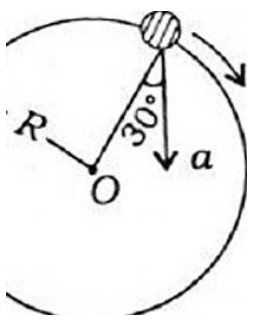
In the given figure, represents the total acceleration of a particle moving in the clockwise direction in a circle of radius at a given instant of time. The speed of the particle is
- 1
- 2
- 3
- 4
Show answer and solution
Correct: option 3,
The total acceleration makes with the radius, so its component towards the centre is the centripetal acceleration: . Since , and , option (3).
Question 19AIPMT 2015, Q160
A ship A is moving Westwards with a speed of and a ship B 100 km South of A, is moving Northwards with a speed of . The time after which the distance between them becomes shortest, is:-
- 15 h
- 2 h
- 3 h
- 40 h
Show answer and solution
Correct: option 1, 5 h
Work in the frame of A. The velocity of B relative to A is 10 km/h North plus 10 km/h East, that is towards the north-east, at to the line BA. B is closest to A at the foot of the perpendicular from A to this path, after travelling . Time , option (1).
Question 20AIPMT 2015 Re-test, Q143
If vectors and are functions of time, then the value of t at which they are orthogonal to each other is:
- 1
- 2
- 3
- 4
Show answer and solution
Correct: option 4,
Orthogonal vectors have zero dot product: . So , giving .
Question 21AIPMT 2015 Re-test, Q152
The position vector of a particle as a function of time is given by:
Where R is in meters, t is in seconds and and denote unit vectors along x- and y-directions, respectively. Which one of the following statements is wrong for the motion of particle?
- 1Path of the particle is a circle of radius 4 meter.
- 2Acceleration vector is along
- 3Magnitude of acceleration vector is , where is the velocity of particle.
- 4Magnitude of the velocity of particle is 8 meter/second
Show answer and solution
Correct: option 4, Magnitude of the velocity of particle is 8 meter/second
, so the path is a circle of radius 4 m, covered uniformly with . This is uniform circular motion: the acceleration is , directed along , with magnitude . The speed is , not 8 m/s, so the last statement is the wrong one.
Question 22AIPMT 2015 Re-test, Q157
Two particles A and B, move with constant velocities and . At the initial moment their position vectors are and respectively. The condition for particles A and B for their collision is:
- 1
- 2
- 3
- 4
Show answer and solution
Correct: option 2,
They collide if at some time t their positions coincide: , so with . The two vectors must therefore point in the same direction, i.e. have the same unit vector: .
Question 23AIPMT 2014, Q124
A particle is moving such that its position coordinates (x, y) are
(2m, 3m) at time t = 0,
(6m, 7m) at time t = 2 s and
(13m, 14m) at time t = 5 s.
Average velocity vector from t = 0 to t = 5 s is:
- 1
- 2
- 3
- 4
Show answer and solution
Correct: option 1,
Average velocity is the total displacement divided by the total time; the middle point does not matter. Displacement metres in 5 s, so , option (1).
Question 24AIPMT 2014, Q128
A projectile is fired from the surface of the earth with a velocity of and angle with the horizontal. Another projectile fired from another planet with a velocity of at the same angle follows a trajectory which is identical with the trajectory of the projectile fired from the earth. The value of the acceleration due to gravity on the planet is (in ) is: (given )
- 1110.8
- 23.5
- 35.9
- 416.3
Show answer and solution
Correct: option 2, 3.5
The trajectory is . For the same angle the paths are identical when is the same, so , option (2).
Question 25NEET 2013, Q144
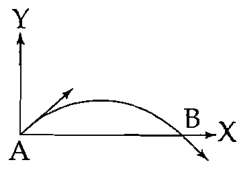
The velocity of a projectile at the initial point A is m/s. Its velocity (in m/s) at point B is:
- 1
- 2
- 3
- 4
Show answer and solution
Correct: option 2,
B is at the same level as A. The horizontal component of velocity never changes, and on returning to the launch level the vertical component has the same size but points downward. The velocity at B is therefore m/s.
Question 26NEET 2013 Karnataka, Q163
Vectors , and are such that
and
Then the vector parallel to is:
- 1
- 2
- 3
- 4 and
Show answer and solution
Correct: option 3,
The zero dot products mean is perpendicular to both and . The vector is also perpendicular to both, so it lies along the same line as .
Question 27AIPMT 2012 Prelims, Q14
The horizontal range and the maximum height of a projectile are equal. The angle of projection of the projectile is:
- 1
- 2
- 3
- 4
Show answer and solution
Correct: option 2,
Range and maximum height . Setting them equal gives , so and .
Question 28AIPMT 2012 Prelims, Q40
A particle has initial velocity and acceleration . The magnitude of velocity after 10 seconds will be:
- 1 units
- 2 units
- 35 units
- 49 units
Show answer and solution
Correct: option 2, units
. Its magnitude is units.
Question 29AIPMT 2011 Prelims, Q153
A particle moves in a circle of radius 5 cm with constant speed and time period s. The acceleration of the particle is:
- 1
- 2
- 3
- 4
Show answer and solution
Correct: option 4,
At constant speed the only acceleration is centripetal. , so .
Question 30AIPMT 2011 Prelims, Q155
A missile is fired for maximum range with an initial velocity of 20 m/s. If , the range of the missile is:
- 140 m
- 250 m
- 360 m
- 420 m
Show answer and solution
Correct: option 1, 40 m
The range is greatest for a launch angle of , when .
Question 31AIPMT 2011 Prelims, Q171
A body is moving with velocity 30 m/s towards east. After 10 seconds its velocity becomes 40 m/s towards north. The average acceleration of the body is:
- 1
- 2
- 3
- 4
Show answer and solution
Correct: option 4,
Change in velocity , of magnitude m/s. Average acceleration .
Question 32AIPMT 2011 Mains, Q116
A projectile is fired at an angle of 45° with the horizontal. Elevation angle of the projectile at its highest point as seen from the point of projection is:
- 160°
- 2
- 3
- 445°
Show answer and solution
Correct: option 2,
For projection at 45° the maximum height is and the range is . The highest point is at a horizontal distance , so the angle of elevation satisfies , giving .
Question 33AIPMT 2010 Mains, Q14
A particle moves in x-y plane according to rule and . The particle follows
- 1an elliptical path
- 2a circular path
- 3a parabolic path
- 4a straight line path inclined equally to x and y-axes
Show answer and solution
Correct: option 2, a circular path
Squaring and adding the two equations removes the time: . This is the equation of a circle of radius a centred at the origin, so the path is circular.
Question 34AIPMT 2010 Prelims, Q14
A particle has initial velocity and has acceleration . Its speed after 10 s is
- 17 units
- 2 units
- 38.5 units
- 410 units
Show answer and solution
Correct: option 2, units
Using with t = 10 s: . Its magnitude is units.
Question 35AIPMT 2010 Prelims, Q26
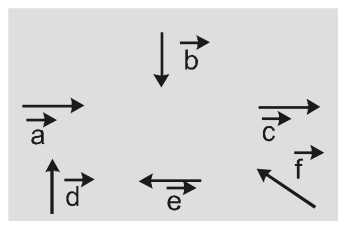
Six vectors, through have the magnitudes and directions indicated in the figure. Which of the following statements is true?
- 1
- 2
- 3
- 4
Show answer and solution
Correct: option 3,
In the figure points up and to the left. points straight up and points to the left, so by the triangle law their sum points up and to the left, along . The other pairs include (downward) or (to the right), which cannot give an up-left resultant. Hence .
Question 36AIPMT 2008 Prelims, Q6
A particle of mass m is projected with velocity v making an angle of with the horizontal. When the particle lands on the level ground the magnitude of the change in its momentum will be
- 1zero
- 2
- 3
- 4
Show answer and solution
Correct: option 4,
The horizontal component of velocity does not change. The vertical component goes from at launch to on landing, so the change in momentum has magnitude .
Question 37AIPMT 2007 Prelims, Q154
A particle starting from the origin (0, 0) moves in a straight line in the (x, y) plane. Its co-ordinates at a later time are . The path of the particle makes with the x-axis an angle of
- 1
- 2
- 3
- 4
Show answer and solution
Correct: option 4,
The slope of the straight path is , so , option (4).
Question 38AIPMT 2007 Prelims, Q158
and are two vectors and is the angle between them, if the value of is
- 1
- 2
- 3
- 4
Show answer and solution
Correct: option 2,
and . The condition gives , so and , option (2).
Question 39AIPMT 2006 Prelims, Q14
For angles of projection of a projectile at angles and , the horizontal ranges described by the projectile are in the ratio of:
- 11 : 1
- 22 : 3
- 31 : 2
- 42 : 1
Show answer and solution
Correct: option 1, 1 : 1
The range is . For the two angles and , which are equal. The two angles are complementary, so for the same speed the ranges are equal and the ratio is 1 : 1.
Question 40AIPMT 2006 Prelims, Q45
A car runs at a constant speed on a circular track of radius 100 m, taking 62.8 seconds for every circular lap. The average velocity and average speed for each circular lap respectively is:
- 10, 0
- 20, 10 m/s
- 310 m/s, 10 m/s
- 410 m/s, 0
Show answer and solution
Correct: option 2, 0, 10 m/s
After one full lap the car is back where it started, so its displacement and hence its average velocity are zero. The distance covered is , so the average speed is .
Question 41AIPMT 2006 Prelims, Q49
The vectors and are such that . The angle between the two vectors is:-
- 1
- 2
- 3
- 4
Show answer and solution
Correct: option 1,
Squaring both sides, , so and . The vectors are perpendicular, .
Question 42AIPMT 2005 Prelims, Q34
A stone tied to the end of a string of 1 m long is whirled in a horizontal circle with a constant speed. If the stone makes 22 revolution in 44 seconds, what is the magnitude and direction of acceleration of the stone
- 1 and direction along the tangent to the circle
- 2 and direction along the radius towards the centre.
- 3 and direction along the radius towards the centre.
- 4 and direction along the radius away from the centre.
Show answer and solution
Correct: option 2, and direction along the radius towards the centre.
The period is , so . In uniform circular motion the acceleration is centripetal: , directed along the radius towards the centre.
Question 43AIPMT 2005 Prelims, Q40
If a vector is perpendicular to the vector , then the value of
- 1–1
- 2
- 3
- 41
Show answer and solution
Correct: option 2,
Perpendicular vectors have zero dot product: , so and .
Question 44AIPMT 2005 Prelims, Q42
If the angle between the vector and is , the value of the product is equal to
- 1Zero
- 2
- 3
- 4
Show answer and solution
Correct: option 1, Zero
is perpendicular to both and . Its dot product with is therefore zero, whatever the angle .
Question 45AIPMT 2005 Prelims, Q48
Two boys are standing at the ends A and B of a ground where AB = a. The boy at B starts running in a direction perpendicular to AB with velocity . The boy at A starts running simultaneously with velocity v and catches the other boy in a time t, where t is
- 1
- 2
- 3
- 4
Show answer and solution
Correct: option 2,
In time t the boy from B covers perpendicular to AB and the boy from A covers along the hypotenuse of a right triangle with sides a and . So , giving and . This is the keyed option (2); the source copy prints an extra root sign over inside it.
Question 46AIPMT 2004 Prelims, Q39
If then the value of is:-
- 1
- 2
- 3
- 4
Show answer and solution
Correct: option 4,
gives , so . Then .
Question 47AIPMT 2003 Prelims, Q2
A particle moves along a circle of radius m with constant tangential acceleration. If the velocity of the particle is 80 m/s at the end of the second revolution after motion has begun, the tangential acceleration is: -
- 1
- 2
- 3
- 4
Show answer and solution
Correct: option 1,
The distance covered in two revolutions is . Starting from rest, , so , which is option (1).
Question 48AIPMT 2003 Prelims, Q11
The vector sum of two forces is perpendicular to their vector differences. In that case, the forces:
- 1Are equal to each other
- 2Are equal to each other in magnitude
- 3Are not equal to each other in magnitude
- 4Cannot be predicted
Show answer and solution
Correct: option 2, Are equal to each other in magnitude
Perpendicular vectors have zero dot product: . So : the forces have equal magnitudes, but their directions need not be the same, so they need not be equal vectors.
Question 49AIPMT 2002 Prelims, Q28
A particle (A) is dropped from a height and another particle (B) is projected in horizontal direction with speed of 5 m/s from the same height then correct statement is:-
- 1Particle (A) will reach at ground first with respect to particle (B)
- 2Particle (B) will reach at ground first with respect to particle (A)
- 3Both particles will reach at ground simultaneously
- 4Both particles will reach at ground with same speed
Show answer and solution
Correct: option 3, Both particles will reach at ground simultaneously
Both particles start with zero vertical velocity from the same height and have the same downward acceleration g, so both take to fall. They reach the ground together. B lands with a greater speed because it keeps its horizontal velocity, so option (4) is wrong.
Question 50AIPMT 2001 Prelims, Q6
A particle is projected making angle 45º with horizontal having kinetic energy K. The kinetic energy at highest point will be:
- 1
- 2
- 32K
- 4K
Show answer and solution
Correct: option 2,
At the highest point only the horizontal velocity remains. Kinetic energy there is .
Question 51AIPMT 2001 Prelims, Q8
Two particles having mass 'M' and 'm' are moving in a circular path having radius R & r respectively. If their time period are same then the ratio of angular velocity will be:
- 1
- 2
- 31
- 4
Show answer and solution
Correct: option 3, 1
Angular velocity is , which depends only on the time period. Since both particles have the same , their angular velocities are equal and the ratio is 1, whatever the masses and radii.
Question 52AIPMT 2001 Prelims, Q24
If then angle between A and B will be:
- 190º
- 2120º
- 30º
- 460º
Show answer and solution
Correct: option 2, 120º
Let each magnitude be . Then , which gives and .
Question 53AIPMT 2000 Prelims, Q6
Two projectiles of same mass and with same velocity are thrown at an angle & with the horizontal, then which quantity will remain same:
- 1Time of flight
- 2Horizontal range of projectile
- 3Max height acquired
- 4All of them
Show answer and solution
Correct: option 2, Horizontal range of projectile
Range , and , so complementary angles give the same range. Time of flight () and maximum height () are different for and .
Question 54AIPMT 2000 Prelims, Q20
The width of river is 1 km. The velocity of boat is 5 km/hr. The boat covered the width of river with shortest will possible path in 15 min. Then the velocity of river stream is:
- 13 km/hr
- 24 km/hr
- 3 km/hr
- 4 km/hr
Show answer and solution
Correct: option 1, 3 km/hr
For the shortest path the boat goes straight across, so its resultant velocity is perpendicular to the flow: km/hr. The boat's own speed (5 km/hr) is the hypotenuse, so the river speed is km/hr.
Question 55AIPMT 1999 Prelims, Q4
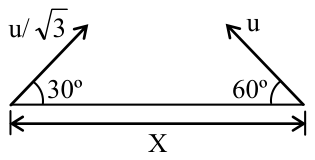
Two particles separated at a horizontal distance X as shown in fig. they projected at the same line as shown in fig. with different initial speeds. The time after which the horizontal distance between them become zero -
- 1
- 2
- 3
- 4None of these
Show answer and solution
Correct: option 1,
The horizontal velocities are for one particle and for the other, directed towards each other. They close the horizontal gap at a rate , so the time is .
Question 56AIPMT 1999 Prelims, Q48
Two particles are projected with same initial velocity one makes angle with horizontal while other makes an angle with vertical. If their common range is R then product of their time of flight is directly proportional to:
- 1
- 2
- 3
- 4
Show answer and solution
Correct: option 1,
The angles of projection are and , so and . Their product is , which is directly proportional to .
Question 57AIPMT 1998 Prelims, Q15
The speed of a boat is 5 km/hr in still water. It crosses a river of width 1 km along the shortest possible path in 15 minutes. The velocity of river water is:
- 13 km/hr
- 24 km/hr
- 35 km/hr
- 42 km/hr
Show answer and solution
Correct: option 1, 3 km/hr
On the shortest path the boat moves straight across, so its resultant velocity is km/hr, perpendicular to the current. The boat's 5 km/hr is the hypotenuse of the velocity triangle, so the river speed is km/hr.
Question 58AIPMT 1998 Prelims, Q44
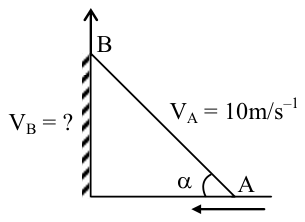
A rigid rod is placed against the wall as shown in figure. When its velocity of lower end is and its base makes an angle with horizontal, then the vertical velocity of its end B will be:
- 1
- 2
- 3
- 4
Show answer and solution
Correct: option 2,
The rod is rigid, so both ends must have the same velocity component along the rod. For A this is and for B, which moves along the wall, it is . So .