Questions with solutions
Question 1NEET 2026, Q25
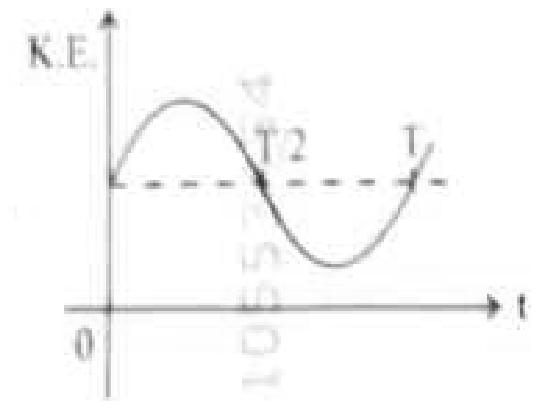
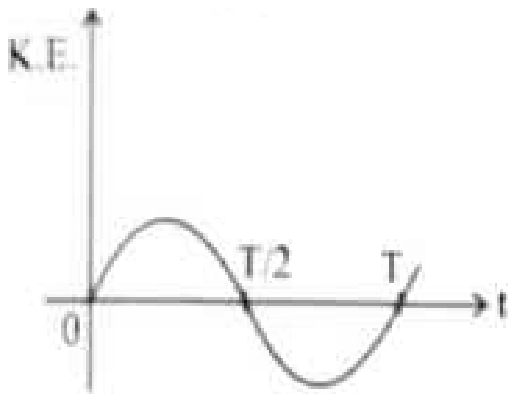
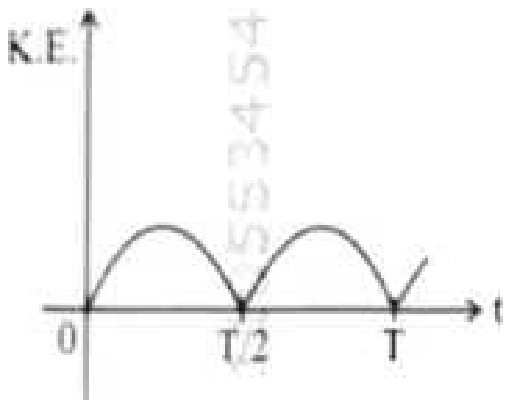
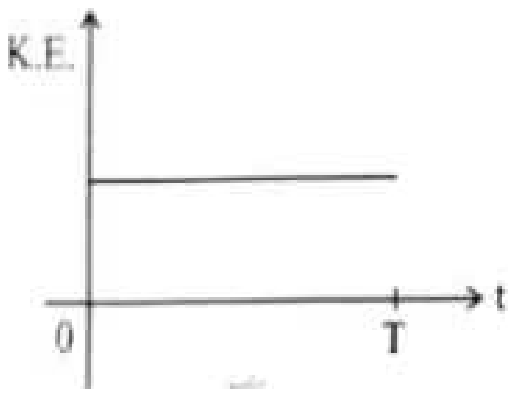
For a simple pendulum, having time period T, the variation of kinetic energy (K.E.) with time (t) is represented by:
- 1
- 2
- 3
- 4
Show answer and solution
Correct: option 3
If the displacement varies as , the velocity varies as and the kinetic energy as (or ). Kinetic energy is never negative, and it goes through a full cycle twice in one period, touching zero every . Plot (3) shows this: positive humps with zeros at and . Plot (2) goes negative, plot (1) has period T, and plot (4) is constant.
Question 2NEET 2026, Q32
Savitha, a XI standard student, while conducting an experiment to determine the effective length of a simple pendulum L, notes down the data of time taken to complete 30 oscillations as and hence calculates the length of the simple pendulum as:
(Take and )
- 1
- 2
- 3
- 4
Show answer and solution
Correct: option 4,
The time period is . From , .
Question 3NEET 2026, Q36
The sum of kinetic energy and potential energy of a simple pendulum bob is 0.02 joule. The speed of the simple pendulum bob at equilibrium position is approximately:
(Consider mass of the bob = )
- 1
- 2
- 3
- 4
Show answer and solution
Correct: option 1,
At the equilibrium position the potential energy is zero, so all of the total energy is kinetic: . With , , so .
Question 4NEET 2026 Re-exam, Q25
A cylindrical cork of uniform density floats in a liquid of density . If the cork is depressed slightly and released, it oscillates harmonically with time period T. If the same cork floats in another liquid of density , then the similar oscillation has time period 2T. The value of is:
- 14
- 22
- 31/2
- 41/4
Show answer and solution
Correct: option 4, 1/4
When the cork of cross-section is pushed down by , the extra buoyant force acts as the restoring force, so and . Doubling the period needs a quarter of the density: , option (4).
Question 5NEET 2026 Re-exam, Q28
Consider a spring-mass simple harmonic oscillator in one dimension. The mass of the particle is kg and the spring constant is . At a given instant, the extension of the spring is meter and the speed of the particle is . On the - plane, if the graph of as a function of is a circle, then the correct option is:
- 1
- 2
- 3
- 4
Show answer and solution
Correct: option 2,
Energy conservation gives , that is . This is an ellipse in general and becomes a circle only when the two denominators are equal, which needs (numerically). That is option (2).
Question 6NEET 2025, Q23
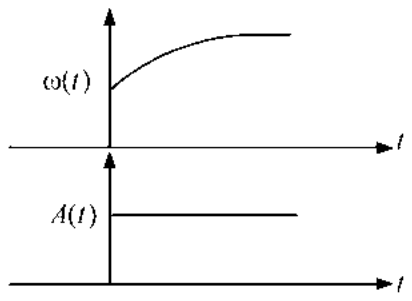
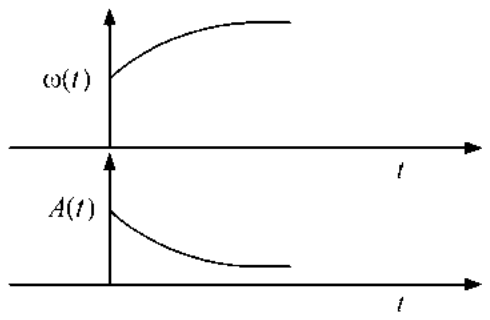
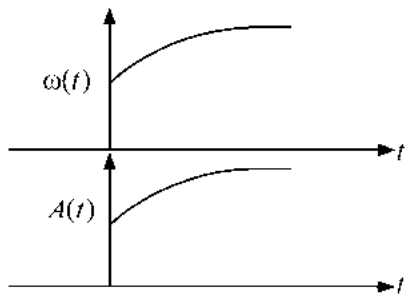
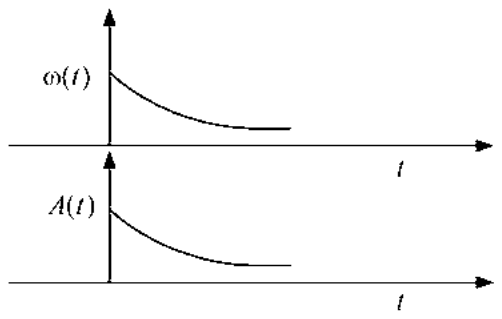
In an oscillating spring mass system, a spring is connected to a box filled with sand. As the box oscillates, sand leaks slowly out of the box vertically so that the average frequency and average amplitude of the system change with time . Which one of the following options schematically depicts these changes correctly?
- 1
- 2
- 3
- 4
Show answer and solution
Correct: option 2
The frequency is , so as sand leaks out and the mass falls, rises. The leaking sand leaves with the velocity the box has at that moment and so carries kinetic energy away; the energy of the oscillation therefore falls, and with it the amplitude. The graphs with rising and falling are option (2).
Question 7NEET 2025, Q44
Two identical point masses P and Q, suspended from two separate massless springs of spring constants and , respectively, oscillate vertically. If their maximum speeds are the same, the ratio () of the amplitude of mass to the amplitude of mass is:
- 1
- 2
- 3
- 4
Show answer and solution
Correct: option 4,
The maximum speed in simple harmonic motion is . With equal masses and equal maximum speeds, , so , option (4).
Question 8NEET 2024, Q26
If represents the motion of a particle executing simple harmonic motion, the amplitude and time period of motion, respectively, are:
- 15 m, 1 s
- 25 cm, 2 s
- 35 m, 2 s
- 45 cm, 1 s
Show answer and solution
Correct: option 3, 5 m, 2 s
Comparing with : the amplitude is m and . The time period is s. This is option (3).
Question 9NEET 2024, Q42
If the mass of the bob in a simple pendulum is increased to thrice its original mass and its length is made half its original length, then the new time period of oscillation is times its original time period. Then the value of is:
- 14
- 2
- 3
- 4
Show answer and solution
Correct: option 3,
does not depend on the mass of the bob. Halving the length gives . Setting gives , option (3).
Question 10NEET 2024 Re-exam, Q24
A particle executing simple harmonic motion with amplitude has the same potential and kinetic energies at the displacement
- 1
- 2
- 3
- 4
Show answer and solution
Correct: option 3,
Potential energy is and kinetic energy is . Setting them equal gives , so .
Question 11NEET 2024 Re-exam, Q41
The two-dimensional motion of a particle, described by is a/an:
A. parabolic path
B. elliptical path
C. periodic motion
D. simple harmonic motion
Choose the correct answer from the options given below:
- 1B, C and D only
- 2A, B and C only
- 3A, C and D only
- 4C and D only
Show answer and solution
Correct: option 4, C and D only
Here and , so : the path is a straight line, neither a parabola nor an ellipse. Along that line the displacement varies as , so , which is simple harmonic motion, and every SHM is periodic. Only C and D hold.
Question 12NEET 2023, Q38
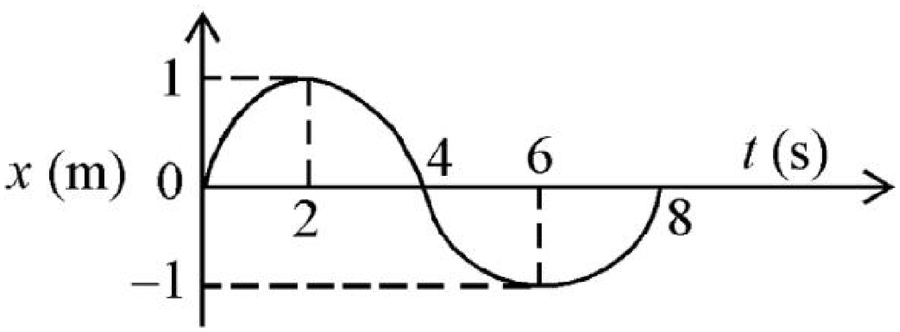
The - graph of a particle performing simple harmonic motion is shown in the figure. The acceleration of the particle at s is:
- 1
- 2
- 3
- 4
Show answer and solution
Correct: option 4,
From the graph the period is 8 s, so , and at s the particle is at m. Then , option (4).
Question 13NEET 2023 Manipur, Q38
A simple pendulum oscillating in air has a period of s. If it is completely immersed in non-viscous liquid, having density th of the material of the bob, the new period will be
- 12 s
- 2 s
- 3 s
- 4 s
Show answer and solution
Correct: option 1, 2 s
In the liquid the buoyant force is one quarter of the bob's weight, so the effective acceleration is . Since , s.
Question 14NEET 2022, Q36
Two pendulums of length 121 cm and 100 cm start vibrating in phase. At some instant, the two are at their mean position in the same phase. The minimum number of vibrations of the shorter pendulum after which the two are again in phase at the mean position is:
- 18
- 211
- 39
- 410
Show answer and solution
Correct: option 2, 11
, so . They are in phase again when the shorter pendulum has made exactly one more vibration than the longer one: , so and , option (2).
Question 15NEET 2022 Re-exam, Q6
Match List-I with List-II
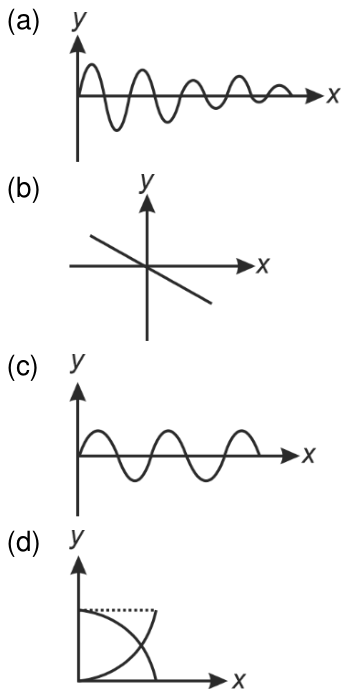
| List-I (- graphs) | List-II (Situations) |
|---|
| (a) | (i) Total mechanical energy is conserved |
| (b) | (ii) Bob of a pendulum is oscillating under negligible air friction |
| (c) | (iii) Restoring force of a spring |
| (d) | (iv) Bob of a pendulum is oscillating along with air friction |
Choose the correct answer from the options given below
- 1a-iii, b-ii, c-i, d-iv
- 2a-iv, b-ii, c-iii, d-i
- 3a-iv, b-iii, c-ii, d-i
- 4a-i, b-iv, c-iii, d-ii
Show answer and solution
Correct: option 3, a-iv, b-iii, c-ii, d-i
Graph (a) is an oscillation whose amplitude keeps falling, which is a pendulum damped by air friction (iv). Graph (b) is a straight line of negative slope through the origin, the restoring force of a spring (iii). Graph (c) is an oscillation of constant amplitude, a pendulum with negligible friction (ii). Graph (d) shows one curve falling while the other rises, with their sum (dotted line) constant: kinetic and potential energy with total mechanical energy conserved (i). So a-iv, b-iii, c-ii, d-i, option (3).
Question 16NEET 2022 Re-exam, Q11
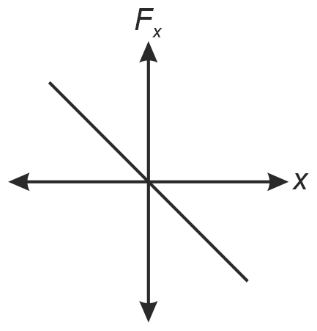
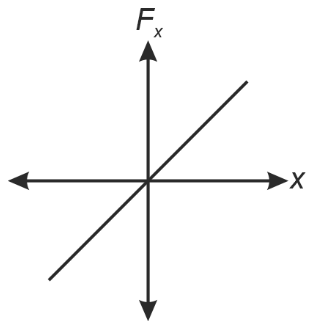
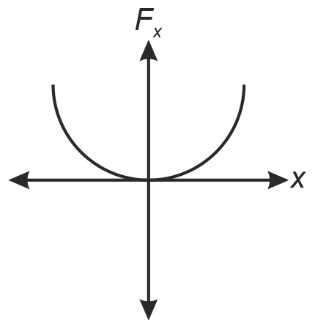
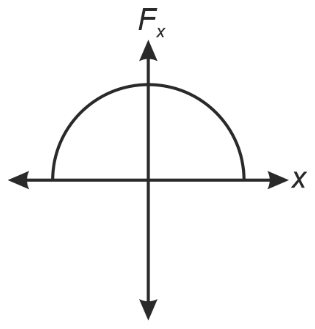
The restoring force of a spring with a block attached to the free end of the spring is represented by
- 1
- 2
- 3
- 4
Show answer and solution
Correct: option 1
The restoring force of a spring is : proportional to the displacement and opposite to it. Its graph is a straight line through the origin with negative slope, which is graph (1). Graph (2) has a positive slope, and (3) and (4) are not straight lines.
Question 17NEET 2022 Re-exam, Q20
Identify the function which represents a non-periodic motion.
- 1
- 2
- 3
- 4
Show answer and solution
Correct: option 2,
decreases steadily with time and never repeats its value, so it is non-periodic: option (2). The sine functions in (1) and (3) repeat after , and is periodic too.
Question 18NEET 2021, Q10
A spring is stretched by 5 cm by a force 10 N. The time period of the oscillations when a mass of 2 kg is suspended by it is:
- 10.0628 s
- 26.28 s
- 33.14 s
- 40.628 s
Show answer and solution
Correct: option 4, 0.628 s
Spring constant . s.
Question 19NEET 2021, Q27
A body is executing simple harmonic motion with frequency 'n', the frequency of its potential energy is:
- 1n
- 22n
- 33n
- 44n
Show answer and solution
Correct: option 2, 2n
With , the potential energy is . It varies at angular frequency , so it goes through two cycles in each oscillation: its frequency is 2n.
Question 20NEET 2020, Q161
The phase difference between displacement and acceleration of a particle in a simple harmonic motion is:
- 1 rad
- 2 rad
- 3 rad
- 4zero
Show answer and solution
Correct: option 1, rad
If the displacement is , the acceleration is . The acceleration is always opposite to the displacement, so the two differ in phase by rad.
Question 21NEET 2020 Phase 2, Q101
Identify the function which represents a periodic motion.
- 1
- 2
- 3
- 4
Show answer and solution
Correct: option 2,
A periodic function repeats its value after a fixed time. repeats every . The logarithm and the two exponentials only keep rising or falling with time and never repeat.
Question 22NEET 2019, Q10
The displacement of a particle executing simple harmonic motion is given by
.
Then the amplitude of its oscillation is given by:
- 1
- 2
- 3
- 4
Show answer and solution
Correct: option 2,
only shifts the mean position. The two oscillating terms have the same frequency and a phase difference of , so they combine to . The amplitude is .
Question 23NEET 2019, Q19
Average velocity of a particle executing SHM in one complete vibration is:
- 1
- 2
- 3
- 4zero
Show answer and solution
Correct: option 4, zero
After one complete vibration the particle is back where it started, so its displacement is zero. Average velocity is displacement divided by time, so it is zero.
Question 24NEET 2019, Q42
The radius of circle, the period of revolution, initial position and sense of revolution are indicated in the fig.
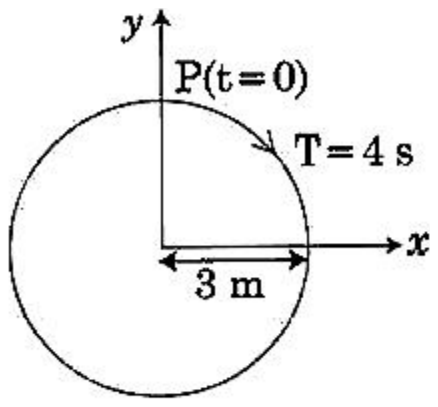
-projection of the radius vector of rotating particle P is:
- 1, where in m
- 2, where in m
- 3, where in m
- 4, where in m
Show answer and solution
Correct: option 4, , where in m
The amplitude is the radius, 3 m, and rad/s. At the particle is at the top of the circle, so starts at its maximum value m, which is a cosine: .
Question 25NEET 2019 Odisha, Q6
The distance covered by a particle undergoing SHM in one time period is (amplitude = ),
- 1
- 2
- 3zero
- 4
Show answer and solution
Correct: option 2,
In one period the particle goes from the mean position to one extreme, back through the mean position to the other extreme, and back again. That is four stretches of length , so the distance is (the displacement is zero).
Question 26NEET 2019 Odisha, Q7
A mass falls from a height 'h' and its time of fall 't' is recorded in terms of time period of a simple pendulum. On the surface of earth it is found that . The entire set up is taken on the surface of another planet whose mass is half of that of earth and radius the same. Same experiment is repeated and corresponding times noted as and . Then we can say
- 1
- 2
- 3
- 4
Show answer and solution
Correct: option 2,
The time of fall is and the pendulum period is , so both vary as . Changing g (here to g/2) multiplies both by the same factor, so their ratio stays the same and .
Question 27NEET 2018, Q25
A pendulum is hung from the roof of a sufficiently high building and is moving freely to and fro like a simple harmonic oscillator. The acceleration of the bob of the pendulum is at a distance of 5 m from the mean position. The time period of oscillation is
- 12 s
- 2 s
- 3 s
- 41 s
Show answer and solution
Correct: option 2, s
In SHM , so and . The time period is s.
Question 28NEET 2017, Q15
A particle executes linear simple harmonic motion with an amplitude of 3 cm. When the particle is at 2 cm from the mean position, the magnitude of its velocity is equal to that of its acceleration. Then its time period in seconds is
- 1
- 2
- 3
- 4
Show answer and solution
Correct: option 3,
In SHM, and . Setting them equal: , so . Then s.
Question 29NEET 2017, Q23
A spring of force constant k is cut into lengths of ratio 1 : 2 : 3. They are connected in series and the new force constant is k'. Then they are connected in parallel and force constant is k''. Then k' : k'' is:
- 11 : 6
- 21 : 9
- 31 : 11
- 41 : 14
Show answer and solution
Correct: option 3, 1 : 11
Force constant is inversely proportional to length. Pieces of length , and have constants 6k, 3k and 2k. In series they make up the original spring again: , so . In parallel . So .
Question 30NEET 2016 Phase 2, Q20
A body of mass is attached to the lower end of a spring whose upper end is fixed. The spring has negligible mass. When the mass is slightly pulled down and released, it oscillates with a time period of 3 s. When the mass is increased by 1 kg, the time period of oscillations becomes 5 s. The value of in kg is
- 1
- 2
- 3
- 4
Show answer and solution
Correct: option 4,
For a spring-mass system , so . Then , giving and kg, option (4).
Question 31AIPMT 2015, Q138
When two displacements represented by and are superimposed the motion is:
- 1simple harmonic with amplitude
- 2simple harmonic with amplitude
- 3simple harmonic with amplitude
- 4not a simple harmonic
Show answer and solution
Correct: option 2, simple harmonic with amplitude
Both displacements have the same angular frequency and differ in phase by , because . Their sum is with , which is again simple harmonic. The amplitude is , option (2).
Question 32AIPMT 2015, Q159
A particle is executing SHM along a straight line. Its velocities at distances and from the mean position are and , respectively. Its time period is:-
- 1
- 2
- 3
- 4
Show answer and solution
Correct: option 1,
In SHM . Writing this for both positions and subtracting removes the amplitude: . So and , option (1).
Question 33AIPMT 2015 Re-test, Q142
A particle is executing a simple harmonic motion. Its maximum acceleration is and maximum velocity is . Then, its time period of vibration will be:
- 1
- 2
- 3
- 4
Show answer and solution
Correct: option 1,
For amplitude A and angular frequency : and . Dividing, , so .
Question 34AIPMT 2014, Q131
The oscillation of a body on a smooth horizontal surface is represented by the equation,
where X = displacement at time t
= frequency of oscillation
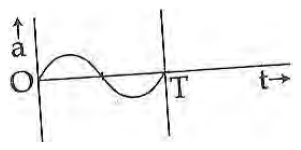
Which one of the following graphs shows correctly the variation 'a' with 't'?
Here a = acceleration at time t
T = time period
- 1
- 2
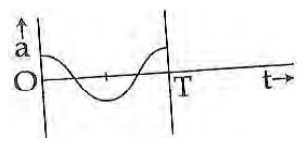
- 3
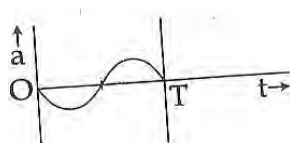
- 4
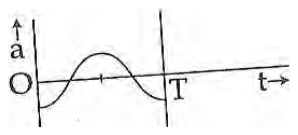
Show answer and solution
Correct: option 4
Differentiating twice, . So the acceleration starts at its largest negative value at , passes through zero at , reaches its largest positive value at and returns to the largest negative value at . Graph (4) is this inverted cosine curve.
Question 35NEET 2013 Karnataka, Q175
A particle of mass m oscillates along x-axis according to equation . The nature of the graph between momentum and displacement of the particle is:
- 1Circle
- 2Hyperbola
- 3Ellipse
- 4Straight line passing through origin
Show answer and solution
Correct: option 3, Ellipse
and . Eliminating : , which is the equation of an ellipse.
Question 36AIPMT 2012 Prelims, Q35
The damping force on an oscillator is directly proportional to the velocity. The units of the constant of proportionality are:
- 1
- 2
- 3
- 4
Show answer and solution
Correct: option 3,
With , the constant is , with units .
Question 37AIPMT 2011 Prelims, Q183
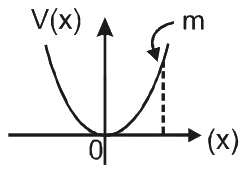
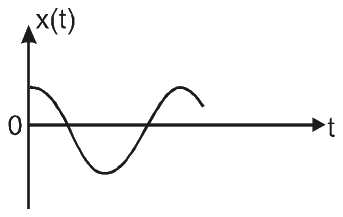
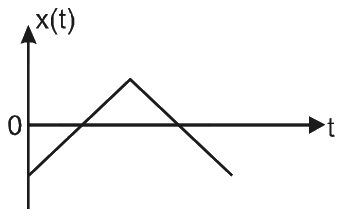
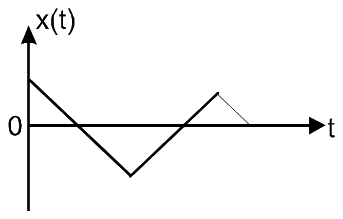
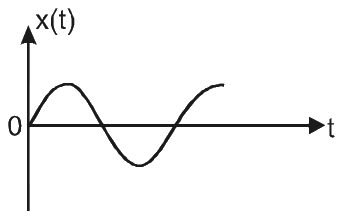
A particle of mass m is released from rest and follows a parabolic path as shown. Assuming that the displacement of the mass from the origin is small, which graph correctly depicts the position of the particle as a function of time
- 1
- 2
- 3
- 4
Show answer and solution
Correct: option 1
A parabolic potential gives a restoring force proportional to , so the motion is simple harmonic. The particle is released from rest at its greatest positive displacement, so : a smooth cosine curve that starts at its maximum. That is graph (1); graph (4) starts from zero, and graphs (2) and (3) are straight-line zigzags, not SHM.
Question 38AIPMT 2011 Prelims, Q195
Out of the following functions representing motion of a particle which represents SHM:
(A)
(B)
(C)
(D)
- 1Only (A)
- 2Only (D) does not represent SHM
- 3Only (A) and (C)
- 4Only (A) and (B)
Show answer and solution
Correct: option 3, Only (A) and (C)
(A) , a single sine function, so it is SHM. (B) mixes two frequencies: periodic but not SHM. (C) is a single cosine of angular frequency , so it is SHM. (D) keeps growing with time and is not even periodic. Hence only (A) and (C).
Question 39AIPMT 2011 Mains, Q110
Two particle are oscillating along two close parallel straight lines side by side, with the same frequency and amplitudes. They pass each other, moving in opposite directions when their displacement is half of the amplitude. The mean positions of the two particles lie on a straight line perpendicular to the paths of the two particles. The phase difference is:
- 10
- 2
- 3
- 4
Show answer and solution
Correct: option 2,
Write each displacement as . At , , so the phase is for the particle moving away from the mean position and for the one moving back towards it. The phase difference is .
Question 40AIPMT 2010 Prelims, Q5
The displacement of a particle along the x axis is given by . The motion of the particle corresponds to
- 1simple harmonic motion of frequency
- 2simple harmonic motion of frequency
- 3non simple harmonic motion
- 4simple harmonic motion of frequency
Show answer and solution
Correct: option 1, simple harmonic motion of frequency
Using , the displacement is . This is a simple harmonic oscillation about the point with angular frequency , so its frequency is .
Question 41AIPMT 2010 Prelims, Q10
The period of oscillation of a mass m suspended from a spring of negligible mass is T. If along with it another mass M is also suspended the period of oscillation will now be
- 1T
- 2
- 32T
- 4
Show answer and solution
Correct: option 4,
The period of a spring-mass system is , so it varies as the square root of the suspended mass. The keyed answer takes the added mass to be equal to the first one, so the mass doubles and the period becomes . (As printed, with masses m and M, the general result is , which equals only when M = m.)
Question 42AIPMT 2009 Prelims, Q5
A simple pendulum performs simple harmonic motion about x = 0 with an amplitude a and time period T. The speed of pendulum at x = a/2 will be:
- 1
- 2
- 3
- 4
Show answer and solution
Correct: option 3,
In SHM with . At , .
Question 43AIPMT 2009 Prelims, Q32
Which one of the following equations of motion represents simple harmonic motion?
Where , , and are all positive.
- 1acceleration =
- 2acceleration =
- 3acceleration =
- 4acceleration =
Show answer and solution
Correct: option 1, acceleration =
SHM needs an acceleration proportional to the displacement from a fixed point and directed towards it. Writing , the first equation is acceleration , which is SHM about . In the second and third the acceleration is directed away from the equilibrium point, and the fourth is not linear in .
Question 44AIPMT 2008 Prelims, Q17
Two Simple Harmonic Motions of angular frequency 100 and 1000 have the same displacement amplitude. The ratio of their maximum accelerations is
- 1
- 2
- 3
- 4
Show answer and solution
Correct: option 3,
The maximum acceleration in SHM is . With the same amplitude the ratio is , that is .
Question 45AIPMT 2008 Prelims, Q19
A point performs simple harmonic oscillation of period T and the equation of motion is given by . After the elapse of what fraction of the time period the velocity of the point will be equal to half of its maximum velocity?
- 1
- 2
- 3
- 4
Show answer and solution
Correct: option 1,
The velocity is , with maximum . It is half the maximum when , that is . So and .
Question 46AIPMT 2007 Prelims, Q160
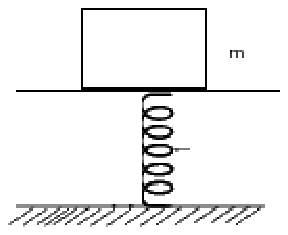
A mass of 2.0 kg is put on a flat pan attached to a vertical spring fixed on the ground as shown in the figure. The mass of the spring and the pan is negligible. When pressed slightly and released the mass executes a simple harmonic motion. The spring constant is 200 N/m. What should be the minimum amplitude of the motion so that the mass gets detached from the pan? [Take ]
- 14.0 cm
- 28.0 cm
- 310.0 cm
- 4any value less than 12.0 cm
Show answer and solution
Correct: option 3, 10.0 cm
The mass leaves the pan when the downward acceleration of the pan at the top of the motion reaches g, so . Here , so m cm, option (3).
Question 47AIPMT 2007 Prelims, Q168
The phase difference between the instantaneous velocity and acceleration of a particle executing simple harmonic motion is
- 1zero
- 2
- 3
- 4
Show answer and solution
Correct: option 2,
If , then and . The acceleration leads the velocity by , option (2).
Question 48AIPMT 2007 Prelims, Q169
The particle executing simple harmonic motion has a kinetic energy . The maximum values of the potential energy and the total energy are respectively
- 1 and
- 20 and
- 3 and
- 4 and
Show answer and solution
Correct: option 1, and
The maximum kinetic energy is , reached at the mean position where the potential energy is zero, so the total energy is . At the extreme positions the kinetic energy is zero and all of this energy is potential, so the maximum potential energy is also . Option (1).
Question 49AIPMT 2007 Prelims, Q170
A particle executes simple harmonic oscillation with an amplitude a. The period of oscillation is T. The minimum time taken by the particle to travel half of the amplitude from the equilibrium position is
- 1T/2
- 2T/4
- 3T/8
- 4T/12
Show answer and solution
Correct: option 4, T/12
Starting from the equilibrium position, . Setting gives , so , option (4).
Question 50AIPMT 2006 Prelims, Q3
A rectangular block of mass m and area of cross-section A floats in a liquid of density . If it is given a small vertical displacement from equilibrium it undergoes oscillation with a time period T. Then:-
- 1
- 2
- 3
- 4
Show answer and solution
Correct: option 2,
Pushing the block down by adds a buoyant restoring force , so the motion is simple harmonic with force constant . Hence , which gives , and . Only the last of these is among the options.
Question 51AIPMT 2005 Prelims, Q15
A particle executing simple harmonic motion of amplitude 5 cm has maximum speed of 31.4 cm/s. The frequency of its oscillation is:
- 11Hz
- 23Hz
- 32Hz
- 44Hz
Show answer and solution
Correct: option 1, 1Hz
Maximum speed is , so . Then .
Question 52AIPMT 2005 Prelims, Q36
The circular motion of a particle with constant speed is
- 1Periodic and simple harmonic
- 2Simple harmonic but not periodic
- 3Neither periodic nor simple harmonic
- 4Periodic but not simple harmonic
Show answer and solution
Correct: option 4, Periodic but not simple harmonic
The particle repeats its path after every revolution, so the motion is periodic. It is not simple harmonic because the particle does not move to and fro about a mean position under a restoring force proportional to displacement; only the projection of the motion on a diameter is simple harmonic.
Question 53AIPMT 2004 Prelims, Q6
Which one of the following statements is true for the speed 'v' and the acceleration 'a' of a particle executing simple harmonic motion
- 1Value of a is zero, whatever may be the value of 'v'
- 2When 'v' is zero, a is zero
- 3When 'v' is maximum, a is zero
- 4When 'v' is maximum, a is maximum
Show answer and solution
Correct: option 3, When 'v' is maximum, a is zero
In SHM and . The speed is greatest at the mean position , where the acceleration is zero; at the extremes the speed is zero and the acceleration is greatest.
Question 54AIPMT 2004 Prelims, Q7
Two springs of spring constants and are joined in series. The effective spring constant of the combination is given by -
- 1
- 2
- 3
- 4
Show answer and solution
Correct: option 3,
In series both springs carry the same force and the extensions add: . So , which gives .
Question 55AIPMT 2003 Prelims, Q16
The time period of a mass suspended from a spring is T. If the spring is cut into four equal parts and the same mass is suspended from one of the parts, then the new time period will be -
- 1T/4
- 2T
- 3T/2
- 42T
Show answer and solution
Correct: option 3, T/2
The spring constant is inversely proportional to the length, so each quarter has constant . Since , the period becomes .
Question 56AIPMT 2003 Prelims, Q17
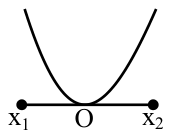
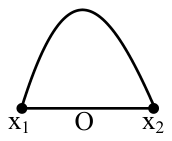
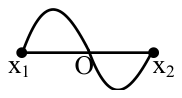
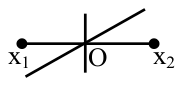
A particle of mass m oscillates with simple harmonic motion between points and , the equilibrium position being O. Its potential energy is plotted. It will be as given below in the graph:
- 1
- 2
- 3
- 4
Show answer and solution
Correct: option 1
The potential energy in SHM is , measured from the equilibrium position. It is zero (minimum) at O and rises as a parabola to its largest value at the extreme points and , which is the upward-opening curve of option (1).
Question 57AIPMT 2003 Prelims, Q18
In case of a forced vibration, the resonance wave becomes very sharp when the:
- 1Damping force is small
- 2Restoring force is small
- 3Applied periodic force is small
- 4Quality factor is small
Show answer and solution
Correct: option 1, Damping force is small
The sharpness of the resonance curve is set by damping: the smaller the damping, the taller and narrower the peak (a large quality factor). So resonance is very sharp when the damping force is small.
Question 58AIPMT 2003 Prelims, Q23
The potential energy of a simple harmonic oscillator when the particle is half way to its end point is -
- 12/3 E
- 21/8 E
- 31/4 E
- 41/2 E
Show answer and solution
Correct: option 3, 1/4 E
The total energy is and the potential energy at displacement is . At this is .
Question 59AIPMT 2002 Prelims, Q1
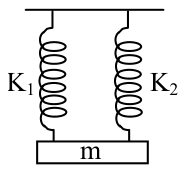
A mass is suspended separately by two different springs in successive order then time period is and respectively. If it is connected by both spring as shown in figure then time period is , the correct relation is:-
- 1
- 2
- 3
- 4
Show answer and solution
Correct: option 2,
For a spring, , so . In the figure the two springs are side by side (in parallel), so the effective constant is . Hence , that is .
Question 60AIPMT 2002 Prelims, Q2
When an oscillator completes 100 oscillation its amplitude reduced to of initial value. What will be its amplitude, when it completes 200 oscillation:-
- 1
- 2
- 3
- 4
Show answer and solution
Correct: option 4,
In damped oscillation the amplitude falls by the same factor in equal times, . If 100 oscillations reduce it to , the next 100 reduce it by another factor of , giving of the initial value.
Question 61AIPMT 2002 Prelims, Q6
Displacement between max. P.E. position and max. K.E. position for a particle executing simple harmonic motion is:-
- 1
- 2
- 3
- 4
Show answer and solution
Correct: option 3,
Potential energy is maximum at the extreme positions () and kinetic energy is maximum at the mean position (). The displacement between the two is therefore , where is the amplitude.
Question 62AIPMT 2001 Prelims, Q19
The total energy of particle performing SHM depend on:
- 1K, a, m
- 2K, a
- 3K, a, x
- 4K, x
Show answer and solution
Correct: option 2, K, a
The total energy in SHM is , where is the force constant and the amplitude. It is the same at every displacement and, written this way, does not involve the mass, so it depends on K and a only.
Question 63AIPMT 2000 Prelims, Q28
The equations of two waves given as and , Where , then resultant wave represent:
- 1a circle (c.w)
- 2a circle (a.c.w)
- 3an Ellipse (c.w)
- 4an ellipse (a.c.w)
Show answer and solution
Correct: option 2, a circle (a.c.w)
Substituting , and , so : a circle. When the phase goes from 0 to the point moves from to , that is from the top to the left, which is anticlockwise.
Question 64AIPMT 2000 Prelims, Q36
Two spherical bob of masses and are hung vertically from two strings of length and respectively. They are executing SHM with frequency relation , Then:
- 1
- 2
- 3 &
- 4 &
Show answer and solution
Correct: option 1,
For a simple pendulum , which does not depend on the mass. , so .
Question 65AIPMT 1999 Prelims, Q25
The amplitude of a S.H.O. reduces to 1/3 in first 20 secs. then in first 40 sec. its amplitude becomes -
- 1
- 2
- 3
- 4
Show answer and solution
Correct: option 2,
In damped oscillation the amplitude falls exponentially, , so it falls by the same factor in equal times. It becomes in the first 20 s and falls by another factor of in the next 20 s, so after 40 s it is of the initial amplitude.
Question 66AIPMT 1999 Prelims, Q27
A spring elongated by length 'L' when a mass 'M' is suspended to it. Now a tiny mass 'm' is attached and then released, its time period of oscillation is -
- 1
- 2
- 3
- 4
Show answer and solution
Correct: option 1,
The mass stretches the spring by , so the spring constant is . With the extra mass the oscillating mass is , and . This is option (1), where the elongation is written as .
Question 67AIPMT 1999 Prelims, Q28
Frequency of simple pendulum in a free falling lift is -
- 1Zero
- 2Infinite
- 3Can't be say
- 4Finite
Show answer and solution
Correct: option 1, Zero
In a freely falling lift the effective acceleration due to gravity is . The time period becomes infinite, so the bob does not oscillate and the frequency is zero.
Question 68AIPMT 1998 Prelims, Q6
Two pendulums suspended from same point having length 2m and 0.5m. If they displaced slightly and released then they will be in same phase, when small pendulum will have completed:
- 12 oscillation
- 24 oscillation
- 33 oscillation
- 45 oscillation
Show answer and solution
Correct: option 1, 2 oscillation
The period of a simple pendulum is proportional to , so . The long pendulum takes twice as long per swing, so the two are first in phase again when the long one has completed 1 oscillation and the short one 2 oscillations.
Question 69AIPMT 1998 Prelims, Q22
If time of mean position from amplitude (extreme) position is 6 s. then the frequency of SHM will be:
- 10.01 Hz
- 20.02 Hz
- 30.03 Hz
- 40.04 Hz
Show answer and solution
Correct: option 4, 0.04 Hz
Going from the extreme position to the mean position takes a quarter of a period, so s. The frequency is Hz, which is closest to 0.04 Hz.
Question 70AIPMT 1998 Prelims, Q34
If the frequency of a spring is n after suspending mass M, now 4M mass is suspended from spring then the frequency will be:
- 12n
- 2n/2
- 3n
- 4None of the above
Show answer and solution
Correct: option 2, n/2
The frequency of a mass on a spring is , proportional to . Making the mass 4 times larger halves the frequency, giving n/2.
Question 71AIPMT 1998 Prelims, Q50
A particle, with restoring force proportional to displacement and resisting force proportional to velocity is subjected to a force . If the amplitude of the particle is maximum for and the energy of the particle maximum for , then:
- 1 and
- 2 and
- 3 and
- 4 and
Show answer and solution
Correct: option 2, and
Here is the natural frequency of the undamped oscillator. The key treats this as simple resonance: when the driving frequency equals the oscillator responds most strongly, so both the amplitude and the energy are taken to be greatest there, and . Note that an exact treatment with damping puts the amplitude maximum slightly below , at , while the velocity and energy maximum is exactly at ; on that basis many books prefer the first option. The answer shown here is the one given in the key.