Questions with solutions
Question 1NEET 2024, Q2
Match List-I with List-II.
| List-I (Material) | List-II (Susceptibility ()) |
|---|
| A. Diamagnetic | I. |
| B. Ferromagnetic | II. |
| C. Paramagnetic | III. |
| D. Non-magnetic | IV. (a small positive number) |
Choose the correct answer from the options given below:
- 1A-IV, B-III, C-II, D-I
- 2A-II, B-III, C-IV, D-I
- 3A-II, B-I, C-III, D-IV
- 4A-III, B-II, C-I, D-IV
Show answer and solution
Correct: option 2, A-II, B-III, C-IV, D-I
A diamagnetic material has a small negative susceptibility, (II). A ferromagnetic material has a very large positive one, (III). A paramagnetic material has a small positive one (IV). A non-magnetic material has (I). This is option (2).
Question 2NEET 2024, Q3
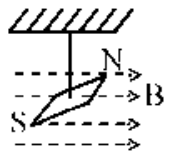
In a uniform magnetic field of 0.049 T, a magnetic needle performs 20 complete oscillations in 5 seconds as shown. The moment of inertia of the needle is . If the magnitude of magnetic moment of the needle is ; then the value of '' is:
- 1
- 2
- 3
- 4
Show answer and solution
Correct: option 1,
The period is s. For a needle oscillating in a field, , so . So , option (1).
Question 3NEET 2024, Q47
An iron bar of length L has magnetic moment M. It is bent at the middle of its length such that the two arms make an angle with each other. The magnetic moment of this new magnet is:
- 1
- 2M
- 3
- 42 M
Show answer and solution
Correct: option 3,
The pole strength is and does not change on bending. The two arms, each of length , make with each other, so the poles are now apart. The new magnetic moment is , option (3).
Question 4NEET 2024 Re-exam, Q1
The magnetic potential energy, when a magnetic bar of magnetic moment is placed perpendicular to the magnetic field is
- 1
- 2Zero
- 3
- 4
Show answer and solution
Correct: option 2, Zero
The potential energy of a magnetic dipole in a field is . When the bar is perpendicular to the field, and , so .
Question 5NEET 2024 Re-exam, Q4
The incorrect relation for a diamagnetic material (all the symbols carry their usual meaning and is a small positive number) is:
- 1
- 2
- 3
- 4
Show answer and solution
Correct: option 4,
A diamagnetic material has a small negative susceptibility, , so lies between 0 and 1 and . The relation describes a paramagnetic material, so it is the incorrect one here.
Question 6NEET 2024 Re-exam, Q18
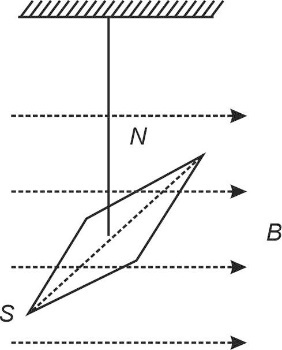
The magnetic moment and moment of inertia of a magnetic needle as shown are, respectively, and . If it completes 10 oscillations in 10 s, the magnitude of the magnetic field is:
- 10.4 T
- 24 T
- 30.4 mT
- 44 mT
Show answer and solution
Correct: option 3, 0.4 mT
The period is s. For a needle oscillating in a uniform field, , so T = 0.4 mT.
Question 7NEET 2024 Re-exam, Q45
The magnetic moment of an iron bar is . It is now bent in such a way that it forms an arc section of a circle subtending an angle of 60° at the centre. The magnetic moment of this arc section is
- 1
- 2
- 3
- 4
Show answer and solution
Correct: option 1,
Let the bar have pole strength and length , so . Bent into an arc of angle , its radius is , and the poles are now separated by the chord . The new moment is .
Question 8NEET 2023, Q34
The net magnetic flux through any closed surface is:
- 1Zero
- 2Positive
- 3Infinity
- 4Negative
Show answer and solution
Correct: option 1, Zero
Magnetic field lines form closed loops because isolated magnetic poles do not exist. Every line that enters a closed surface also leaves it, so the net magnetic flux is zero (Gauss's law for magnetism), option (1).
Question 9NEET 2023 Manipur, Q15
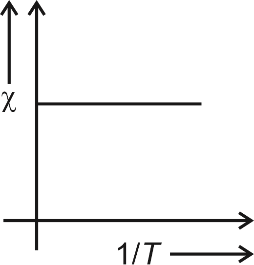
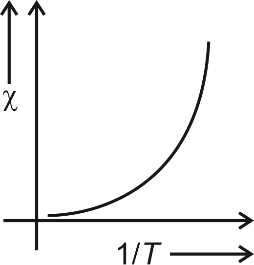
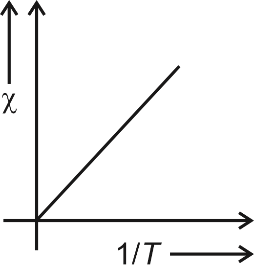
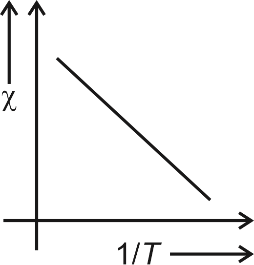
The variation of susceptibility () with absolute temperature () for a paramagnetic material is represented as:
- 1
- 2
- 3
- 4
Show answer and solution
Correct: option 3
A paramagnetic material obeys Curie's law, , so is directly proportional to . Plotted against this is a straight line through the origin with positive slope, which is graph (3).
Question 10NEET 2020, Q180
An iron rod of susceptibility 599 is subjected to a magnetising field of . The permeability of the material of the rod is:
()
- 1
- 2
- 3
- 4
Show answer and solution
Correct: option 1,
Permeability is . The magnetising field of is not needed.
Question 11NEET 2019, Q26
At a point A on the earth's surface the angle of dip, . At a point B on the earth's surface the angle of dip, . We can interpret that:
- 1A and B are both located in the northern hemisphere.
- 2A is located in the southern hemisphere and B is located in the northern hemisphere.
- 3A is located in the northern hemisphere and B is located in the southern hemisphere.
- 4A and B are both located in the southern hemisphere.
Show answer and solution
Correct: option 3, A is located in the northern hemisphere and B is located in the southern hemisphere.
The angle of dip is taken as positive where the north pole of a dip needle points below the horizontal, which happens in the northern hemisphere, and negative where it points above the horizontal, in the southern hemisphere. So A is in the northern hemisphere and B in the southern.
Question 12NEET 2019 Odisha, Q43
The relations amongst the three elements of earth's magnetic field, namely horizontal component , vertical component and dip are, ( = total magnetic field)
- 1
- 2
- 3
- 4
Show answer and solution
Correct: option 4,
The angle of dip is the angle the total field makes with the horizontal. Resolving , the horizontal component is and the vertical component is .
Question 13NEET 2018, Q27
A thin diamagnetic rod is placed vertically between the poles of an electromagnet. When the current in the electromagnet is switched on, then the diamagnetic rod is pushed up, out of the horizontal magnetic field. Hence the rod gains gravitational potential energy. The work required to do this comes from
- 1the lattice structure of the material of the rod
- 2the magnetic field
- 3the current source
- 4the induced electric field due to the changing magnetic field
Show answer and solution
Correct: option 4, the induced electric field due to the changing magnetic field
The answer key gives option (4). When the current is switched on the magnetic field grows, and a changing magnetic field produces an induced electric field. This induced electric field acts on the electrons of the rod and sets up the opposing magnetic moment that makes the rod diamagnetic, so the work on the rod is done through it; a steady magnetic field by itself does no work on moving charges. Note that the energy is ultimately supplied by the current source, which is why many textbooks give option (3) for this question.
Question 14NEET 2017, Q28
If and be the apparent angles of dip observed in two vertical planes at right angles to each other, then the true angle of dip is given by:
- 1
- 2
- 3
- 4
Show answer and solution
Correct: option 1,
Let the first plane make angle with the magnetic meridian. The vertical field V is unchanged, but the horizontal field in that plane is , so , giving . In the perpendicular plane . Squaring and adding: .
Question 15NEET 2016 Phase 1, Q3
The magnetic susceptibility is negative for:
- 1diamagnetic material only
- 2paramagnetic material only
- 3ferromagnetic material only
- 4paramagnetic and ferromagnetic materials
Show answer and solution
Correct: option 1, diamagnetic material only
A diamagnetic material is magnetised opposite to the applied field, so its susceptibility is small and negative. Paramagnetic and ferromagnetic materials have positive susceptibility.
Question 16NEET 2016 Phase 2, Q28
A bar magnet is hung by a thin cotton thread in a uniform horizontal magnetic field and is in equilibrium state. The energy required to rotate it by is . Now the torque required to keep the magnet in this new position is
- 1
- 2
- 3
- 4
Show answer and solution
Correct: option 2,
Work to turn a magnet of moment from the field direction through is , so . The torque needed to hold it at is , option (2).
Question 17AIPMT 2014, Q127
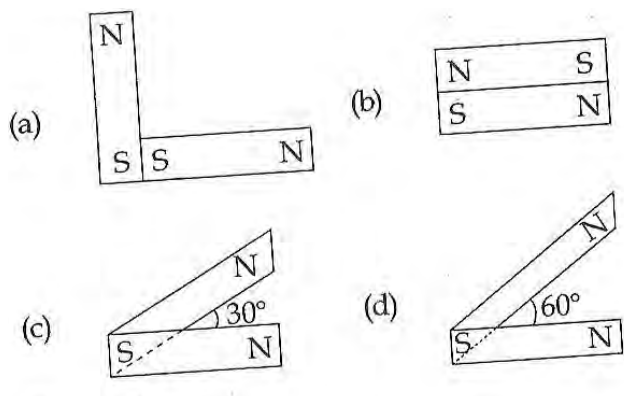
Following figures show the arrangement of bar magnets in different configurations. Each magnet has magnetic dipole moment . Which configuration has highest net magnetic dipole moment?
- 1(d)
- 2(a)
- 3(b)
- 4(c)
Show answer and solution
Correct: option 4, (c)
The resultant of two equal moments at angle is , which is largest when the angle between them is smallest. In (a) the moments are at 90° (net ), in (b) they are opposite (net zero), in (c) they are at 30° (net ) and in (d) at 60° (net ). Configuration (c) is the largest, which is option (4).
Question 18NEET 2013, Q149
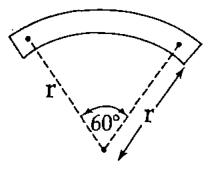
A bar magnet of length '' and magnetic dipole moment 'M' is bent in the form of an arc as shown in figure. The new magnetic dipole moment will be:
- 1 M
- 2 M
- 3
- 4M
Show answer and solution
Correct: option 1, M
The arc of length subtends rad, so and . The poles are now separated by the chord, and a chord equals the radius . With pole strength , the new moment is .
Question 19NEET 2013 Karnataka, Q149
A bar magnet of magnetic moment M is placed at right angles to a magnetic induction B. If a force F is experienced by each pole of the magnet, the length of the magnet will be:
- 1
- 2
- 3
- 4
Show answer and solution
Correct: option 1,
If the pole strength is and the length is , then and the force on each pole is . So and .
Question 20AIPMT 2012 Prelims, Q24
A compass needle which is allowed to move in a horizontal plane is taken to a geomagnetic pole. It:
- 1will become rigid showing no movement
- 2will stay in any position
- 3will stay in north-south direction only
- 4will stay in east-west direction only
Show answer and solution
Correct: option 2, will stay in any position
At a geomagnetic pole the earth's field is vertical, so its horizontal component is zero. A needle that can turn only in a horizontal plane feels no torque in that plane, so it has no preferred direction and stays in whatever position it is left.
Question 21AIPMT 2012 Mains, Q19
A magnetic needle suspended parallel to a magnetic field requires J of work to turn it through 60°. The torque needed to maintain the needle in this position will be:
- 1 J
- 23 J
- 3 J
- 4 J
Show answer and solution
Correct: option 2, 3 J
Work to turn the needle from 0° to 60° is J, so J. The torque needed to hold it at 60° is (in N m, which the options print as J).
Question 22AIPMT 2011 Prelims, Q178
There are four light-weight-rod samples A,B,C,D separately suspended by threads. A bar magnet is slowly brought near each sample and the following observations are noted:
(i) A is feebly repelled
(ii) B is feebly attracted
(iii) C is strongly attracted
(iv) D remains unaffected
Which one of the following is true?
- 1B is of a paramagnetic material
- 2C is of a diamagnetic material
- 3D is of a ferromagnetic material
- 4A is of a non-magnetic material
Show answer and solution
Correct: option 1, B is of a paramagnetic material
A diamagnetic material is feebly repelled by a magnet (A), a paramagnetic material is feebly attracted (B), a ferromagnetic material is strongly attracted (C), and a non-magnetic material is unaffected (D). Only the statement about B is correct.
Question 23AIPMT 2011 Mains, Q105
A short bar magnet of magnetic moment is placed in a uniform magnetic field of 0.16 T. The magnet is stable equilibrium when the potential energy is:
- 1-0.64 J
- 2zero
- 3-0.082 J
- 40.064
Show answer and solution
Correct: option 1, -0.64 J
The potential energy of a magnet in a field is . Equilibrium is stable when the moment points along the field (), where the energy is lowest: J. The source copy prints the first option as -0.64 J; it is the option meant for this value and is the keyed answer.
Question 24AIPMT 2010 Mains, Q15
A closely wound solenoid of 2000 turns and area of cross-section carries a current of 2.0 A. It is suspended through its centre and perpendicular to its length, allowing it to turn in a horizontal plane in a uniform magnetic field tesla making an angle of 30° with the axis of the solenoid. The torque on the solenoid will be
- 1 N m
- 2 N m
- 3 N m
- 4 N m
Show answer and solution
Correct: option 3, N m
The solenoid behaves as a magnetic dipole of moment . The torque is .
Question 25AIPMT 2010 Mains, Q26
The magnetic moment of a diamagnetic atom is
- 1much greater than one
- 2one
- 3between zero and one
- 4equal to zero
Show answer and solution
Correct: option 4, equal to zero
In a diamagnetic atom all the electrons are paired, so their orbital and spin magnetic moments cancel. The atom has no net magnetic moment of its own; it is zero.
Question 26AIPMT 2010 Prelims, Q42
A vibration magnetometer placed in magnetic meridian has a small bar magnet. The magnet executes oscillations with a time period of 2 sec in earth's horizontal magnetic field of 24 microtesla. When a horizontal field of 18 microtesla is produced opposite to the earth's field by placing a current carrying wire, the new time period of magnet will be
- 11 s
- 22 s
- 33 s
- 44 s
Show answer and solution
Correct: option 4, 4 s
The period of the magnet is , so it varies as . The net field falls from 24 T to T, a factor of 4, so the period doubles: s.
Question 27AIPMT 2010 Prelims, Q47
Electromagnets are made of soft iron because soft iron has
- 1low retentivity and high coercive force
- 2high retentivity and high coercive force
- 3low retentivity and low coercive force
- 4high retentivity and low coercive force
Show answer and solution
Correct: option 3, low retentivity and low coercive force
An electromagnet should lose its magnetism as soon as the current is switched off and should be easy to magnetise and demagnetise. Soft iron suits this because it keeps very little magnetism (low retentivity) and needs only a small reverse field to remove it (low coercive force).
Question 28AIPMT 2009 Prelims, Q28
A bar magnet having a magnetic moment of is free to rotate in a horizontal plane. A horizontal magnetic field T exists in the space. The work done in taking the magnet slowly from a direction parallel to the field to a direction 60° from the field is:
- 112 J
- 26 J
- 32 J
- 40.6 J
Show answer and solution
Correct: option 2, 6 J
The potential energy of a magnet in a field is , so the work done in turning it from 0° to 60° is J.
Question 29AIPMT 2009 Prelims, Q34
If a diamagnetic substance is brought near the north or the south pole of a bar magnet, it is:
- 1repelled by the north pole and attracted by the south pole
- 2attracted by the north pole and repelled by the south pole
- 3attracted by both the poles
- 4repelled by both the poles
Show answer and solution
Correct: option 4, repelled by both the poles
A diamagnetic substance is magnetised opposite to the applied field, whatever the direction of that field, so it is pushed from the stronger to the weaker part of the field. It is therefore repelled by either pole of the magnet.
Question 30AIPMT 2008 Prelims, Q37
Curie temperature is the temperature above which
- 1Ferromagnetic material becomes diamagnetic material
- 2Ferromagnetic material becomes paramagnetic material
- 3Paramagnetic material becomes diamagnetic material
- 4Paramagnetic material becomes ferromagnetic material
Show answer and solution
Correct: option 2, Ferromagnetic material becomes paramagnetic material
Above the Curie temperature thermal agitation breaks up the magnetic domains of a ferromagnet. The atoms still carry magnetic moments, but they no longer line up on their own, so the material behaves as a paramagnet.
Question 31AIPMT 2007 Prelims, Q188
Nickel shows ferromagnetic property at room temperature. If the temperature is increased beyond Curie temperature then it will show
- 1diamagnetism
- 2paramagnetism
- 3anti ferromagnetism
- 4no magnetic property
Show answer and solution
Correct: option 2, paramagnetism
Above the Curie temperature thermal agitation destroys the domain alignment of a ferromagnet. The atoms still have magnetic moments, so the material behaves as a paramagnet. Option (2).
Question 32AIPMT 2006 Prelims, Q41
Above Curie temperature:-
- 1A ferromagnetic substance becomes paramagnetic
- 2A paramagnetic substance becomes diamagnetic
- 3A diamagnetic substance becomes paramagnetic
- 4A paramagnetic substance becomes ferromagnetic
Show answer and solution
Correct: option 1, A ferromagnetic substance becomes paramagnetic
The Curie temperature is the temperature above which thermal agitation destroys the domain structure of a ferromagnetic material. The atomic magnets then point at random and respond only weakly to a field, so the material behaves as a paramagnet.
Question 33AIPMT 2005 Prelims, Q12
If the magnetic dipole moment of an atom of diamagnetic material, paramagnetic material and ferromagnetic material are denoted by , and respectively, then
- 1 and
- 2 and
- 3 and
- 4 and
Show answer and solution
Correct: option 4, and
In a diamagnetic atom all electron moments cancel, so its net dipole moment is zero. Atoms of paramagnetic and ferromagnetic materials have unpaired electrons and a permanent moment. Hence and .
Question 34AIPMT 2003 Prelims, Q28
A bar magnet is oscillating in the Earth's magnetic field with a period T. What happens to this period and motion if this mass is quadrupled -
- 1Motion remains S.H. with time period = T/2
- 2Motion remains S.H. with time period = 2T
- 3Motion remains S.H. with time period = 4T
- 4Motion remains S.H. with time and period remains nearly constant
Show answer and solution
Correct: option 2, Motion remains S.H. with time period = 2T
The period of a magnet oscillating in a field is , where the moment of inertia is proportional to the mass and the magnetic moment is unchanged. Four times the mass gives four times , so the period becomes , and the motion is still simple harmonic.
Question 35AIPMT 2003 Prelims, Q43
According to Curie's law, the magnetic susceptibility of a substance at an absolute temperature T is proportional to -
- 11/T
- 2T
- 3
- 4
Show answer and solution
Correct: option 1, 1/T
Curie's law for a paramagnetic substance is , where is the Curie constant. The susceptibility is inversely proportional to the absolute temperature.
Question 36AIPMT 2003 Prelims, Q44
Diamagnetic material in a magnetic field moves:
- 1from stronger to the weaker parts of the field
- 2from weaker to the stronger parts of the field
- 3perpendicular to the field
- 4in none of the above directions
Show answer and solution
Correct: option 1, from stronger to the weaker parts of the field
A diamagnetic substance is magnetised opposite to the applied field, so it is weakly repelled by a magnet. In a non-uniform field it therefore moves from the stronger part towards the weaker part.
Question 37AIPMT 2002 Prelims, Q47
Two bar magnets having same geometry with magnetic moments M and 2M, are firstly placed in such a way that their similar poles are same side then its time period of oscillation is . Now the polarity of one of the magnet is reversed then time period of oscillation is , then:-
- 1
- 2
- 3
- 4
Show answer and solution
Correct: option 1,
and the moment of inertia is the same in both cases. With like poles together ; with one reversed . A smaller net moment gives a longer period, so (in fact ).
Question 38AIPMT 2001 Prelims, Q42
Among which the magnetic susceptibility does not depend on the temperature:
- 1Dia-magnetism
- 2Paramagnetism
- 3Ferro-magnetism
- 4Ferrite
Show answer and solution
Correct: option 1, Dia-magnetism
Diamagnetism comes from induced orbital moments that oppose the applied field and is not affected by thermal agitation, so its susceptibility is independent of temperature. Paramagnetic susceptibility follows Curie's law (), and ferromagnets and ferrites also change with temperature.
Question 39AIPMT 1999 Prelims, Q17
For a vibration magnetometer, the time period of suspended bar magnet can be reduced by -
- 1Moving it towards south pole
- 2Moving it towards north pole
- 3Moving it towards equator
- 4Anyone of them
Show answer and solution
Correct: option 3, Moving it towards equator
The time period is , where is the horizontal component of the earth's magnetic field. becomes smaller when becomes larger, and is largest at the magnetic equator and falls to zero at the poles. So the magnet should be moved towards the equator.
Question 40AIPMT 1998 Prelims, Q7
For protecting a magnetic needle it should be placed:
- 1In iron box
- 2In wooden box
- 3In metallic box
- 4None of these
Show answer and solution
Correct: option 1, In iron box
Soft iron has a very high permeability, so external magnetic field lines crowd into the walls of an iron box and pass around the space inside. The inside is magnetically shielded, which protects the needle. Wood, and metals in general, do not shield a magnetic field in this way.