Questions with solutions
Question 1NEET 2026, Q27
The amount of work done to raise a mass 'm' from the surface of the Earth to a height equal to the radius of the Earth 'R', will be:
- 1
- 2
- 3
- 4
Show answer and solution
Correct: option 4,
Work done equals the gain in gravitational potential energy: . Using , .
Question 2NEET 2026 Re-exam, Q13
Two planets and with equal mass have radii and , respectively, where . The escape speeds of and are and , respectively. Then is:
- 1
- 21
- 3
- 42
Show answer and solution
Correct: option 3,
Escape speed is , so for equal masses . Then , option (3).
Question 3NEET 2026 Re-exam, Q14
In a solar system, the time-period of revolution of a planet tracing a circular orbit of radius R is proportional to:
- 1
- 2
- 3
- 4
Show answer and solution
Correct: option 2,
Kepler's third law says (for a circular orbit, gravity supplies the centripetal force, giving ). So , option (2).
Question 4NEET 2025, Q31
The radius of Martian orbit around the Sun is about 4 times the radius of the orbit of Mercury. The Martian year is 687 Earth days. Then which of the following is the length of 1 year on Mercury?
- 188 earth days
- 2225 earth days
- 3172 earth days
- 4124 earth days
Show answer and solution
Correct: option 1, 88 earth days
Kepler's third law says , so . Mercury's orbit is 4 times smaller than that of Mars, so its year is times shorter: Earth days. The closest option is 88 earth days, option (1).
Question 5NEET 2025, Q32
A body weighs 48 N on the surface of the earth. The gravitational force experienced by the body due to the earth at a height equal to one-third the radius of the earth from its surface is:
- 116 N
- 227 N
- 332 N
- 436 N
Show answer and solution
Correct: option 2, 27 N
The gravitational force varies as , with measured from the centre of the earth. At a height the distance is , so the force is N, option (2).
Question 6NEET 2024, Q33
The mass of a planet is th that of the earth and its diameter is half that of the earth. The acceleration due to gravity on that planet is:
- 1
- 2
- 3
- 4
Show answer and solution
Correct: option 1,
. With and , , option (1).
Question 7NEET 2024, Q48
The minimum energy required to launch a satellite of mass from the surface of earth of mass and radius in a circular orbit at an altitude of from the surface of the earth is:
- 1
- 2
- 3
- 4
Show answer and solution
Correct: option 2,
On the surface the energy is . In a circular orbit of radius the total energy is . The energy to be supplied is , option (2).
Question 8NEET 2024 Re-exam, Q6
The escape velocity for earth is . A planet having 9 times mass that of earth and radius, 16 times that of earth, has the escape velocity of:
- 1
- 2
- 3
- 4
Show answer and solution
Correct: option 3,
Escape velocity is , so it varies as . For the planet, .
Question 9NEET 2024 Re-exam, Q39
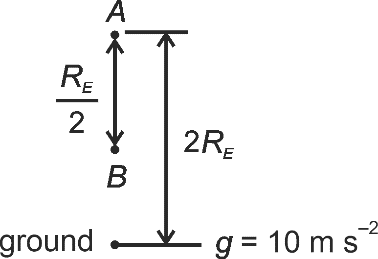
An object of mass 100 kg falls from point A to B as shown in figure. The change in its weight, corrected to the nearest integer is ( is the radius of the earth):
- 149 N
- 289 N
- 35 N
- 410 N
Show answer and solution
Correct: option 1, 49 N
Weight at a distance from the earth's centre is . A is above the ground, so and the weight is N. B is lower, so and the weight is N. The change is N.
Question 10NEET 2023, Q16
Two bodies of mass and are placed at a distance . The gravitational potential on the line joining the bodies where the gravitational field equals zero, will be ( = gravitational constant):
- 1
- 2
- 3
- 4
Show answer and solution
Correct: option 3,
Let the field be zero at distance from : , so and . The potential there is , option (3).
Question 11NEET 2023, Q46
A satellite is orbiting just above the surface of the earth with period . If is the density of the earth and is the universal constant of gravitation, the quantity represents:
- 1
- 2
- 3
- 4
Show answer and solution
Correct: option 2,
For an orbit of radius (the earth's radius), with . Substituting, . So the quantity is , option (2).
Question 12NEET 2023 Manipur, Q33
The escape velocity of a body on the earth surface is 11.2 km/s. If the same body is projected upward with velocity 22.4 km/s, the velocity of this body at infinite distance from the centre of the earth will be
- 111.2 km/s
- 2 km/s
- 3 km/s
- 4Zero
Show answer and solution
Correct: option 2, km/s
Energy conservation: , and . So km/s.
Question 13NEET 2023 Manipur, Q45
If is the radius of the earth and is the acceleration due to gravity on the earth surface. Then the mean density of the earth will be
- 1
- 2
- 3
- 4
Show answer and solution
Correct: option 1,
and , so . Hence .
Question 14NEET 2022, Q32
A body of mass 60 g experiences a gravitational force of 3.0 N, when placed at a particular point. The magnitude of the gravitational field intensity at that point is:
- 1180 N/kg
- 20.05 N/kg
- 350 N/kg
- 420 N/kg
Show answer and solution
Correct: option 3, 50 N/kg
Gravitational field intensity is force per unit mass: N/kg, option (3).
Question 15NEET 2022 Re-exam, Q33
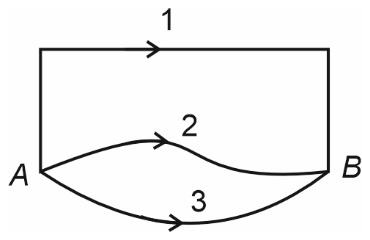
A gravitational field is present in a region and a mass is shifted from to through different paths as shown. If , and represent the work done by the gravitational force along the respective paths, then:
- 1
- 2
- 3
- 4
Show answer and solution
Correct: option 2,
Gravitational force is conservative, so the work it does depends only on the starting and ending points and not on the path taken. All three paths go from to , so , option (2).
Question 16NEET 2022 Re-exam, Q36
In a gravitational field, the gravitational potential is given by, (J/Kg). The gravitational field intensity at point (2, 0, 3) m is
- 1
- 2
- 3
- 4
Show answer and solution
Correct: option 4,
The field intensity is the negative gradient of the potential. depends only on , so . At m this is , option (4).
Question 17NEET 2021, Q34
The escape velocity from the Earth's surface is . The escape velocity from the surface of another planet having a radius, four times that of Earth and same mass density is:
- 1
- 2
- 3
- 4
Show answer and solution
Correct: option 4,
and , so , which is proportional to R when the density is the same. A radius four times as large gives an escape velocity of .
Question 18NEET 2021, Q42
A particle of mass 'm' is projected with a velocity from the surface of the earth.
( = escape velocity)
The maximum height above the surface reached by the particle is:
- 1
- 2
- 3
- 4
Show answer and solution
Correct: option 4,
Energy conservation: . Using this becomes , so and .
Question 19NEET 2020, Q174
A body weighs 72 N on the surface of the earth. What is the gravitational force on it, at a height equal to half the radius of the earth?
- 148 N
- 232 N
- 330 N
- 424 N
Show answer and solution
Correct: option 2, 32 N
The gravitational force varies as , with r measured from the centre of the earth. At a height the distance is , so the force is .
Question 20NEET 2020 Phase 2, Q97
What is the depth at which the value of acceleration due to gravity becomes times the value that at the surface of earth? (radius of earth = )
- 1
- 2
- 3
- 4
Show answer and solution
Correct: option 1,
At depth the acceleration due to gravity is . Setting gives , so .
Question 21NEET 2019, Q16
A body weighs 200 N on the surface of the earth. How much will it weigh half way down to the centre of the earth?
- 1150 N
- 2200 N
- 3250 N
- 4100 N
Show answer and solution
Correct: option 4, 100 N
Inside the earth falls linearly with depth: . At , , so the weight is N.
Question 22NEET 2019, Q29
The work done to raise a mass m from the surface of the earth to a height h, which is equal to the radius of the earth, is:
- 1
- 2
- 3
- 4
Show answer and solution
Correct: option 3,
Work done equals the gain in potential energy: . Using , .
Question 23NEET 2019 Odisha, Q25
Assuming that the gravitational potential energy of an object at infinity is zero, the change in potential energy (final initial) of an object of mass , when taken to a height from the surface of earth (of radius ), is given by,
- 1
- 2
- 3
- 4
Show answer and solution
Correct: option 4,
. The change is .
Question 24NEET 2019 Odisha, Q31
The time period of a geostationary satellite is 24 h, at a height ( is radius of earth) from surface of earth. The time period of another satellite whose height is from surface will be,
- 1 h
- 2 h
- 3 h
- 4 h
Show answer and solution
Correct: option 3, h
The orbital radii are and , a ratio of 2 : 1. By Kepler's third law , so h.
Question 25NEET 2018, Q39
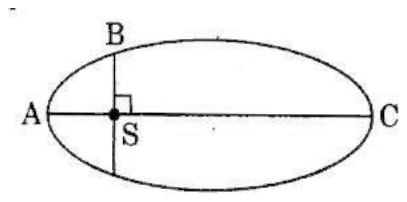
The kinetic energies of a planet in an elliptical orbit about the Sun, at positions A, B and C are , and , respectively. AC is the major axis and SB is perpendicular to AC at the position of the Sun S as shown in the figure. Then
- 1
- 2
- 3
- 4
Show answer and solution
Correct: option 2,
The planet moves faster the nearer it is to the Sun (angular momentum is conserved, and the potential energy is lowest closest to the Sun). From the figure the distances from S are in the order . So the speeds, and the kinetic energies, are in the order .
Question 26NEET 2018, Q40
If the mass of the Sun were ten times smaller and the universal gravitational constant were ten times larger in magnitude, which of the following is not correct ?
- 1Time period of a simple pendulum on the Earth would decrease.
- 2Walking on the ground would become more difficult.
- 3Raindrops will fall faster.
- 4'g' on the Earth will not change.
Show answer and solution
Correct: option 4, 'g' on the Earth will not change.
On the Earth depends on G and the Earth's mass, not the Sun's mass, so g becomes ten times larger. Then a pendulum's period decreases, weight rises so walking is harder, and raindrops fall faster. The statement that g will not change is the one that is not correct.
Question 27NEET 2017, Q25
The acceleration due to gravity at a height 1 km above the earth is the same as at a depth d below the surface of earth. Then:
- 1 km
- 2 km
- 3 km
- 4 km
Show answer and solution
Correct: option 4, km
For a small height h, . At depth d, . Setting them equal gives km.
Question 28NEET 2017, Q30
Two astronauts are floating in gravitational free space after having lost contact with their spaceship. The two will:
- 1keep floating at the same distance between them.
- 2move towards each other.
- 3move away from each other.
- 4will become stationary.
Show answer and solution
Correct: option 1, keep floating at the same distance between them.
The answer key gives option (1). It reads "gravitational free space" as meaning no gravitational force acts on the astronauts, so nothing changes their motion and the distance between them stays the same. Note that the two astronauts do attract each other with a very small gravitational force, and on that reading they would slowly move towards each other, option (2); the key does not accept it.
Question 29NEET 2016 Phase 1, Q7
At what height from the surface of earth the gravitation potential and the value of g are and respectively? Take the radius of earth as 6400 km:
- 12600 km
- 21600 km
- 31400 km
- 42000 km
Show answer and solution
Correct: option 1, 2600 km
At distance from the centre, and , so m km. The height is km.
Question 30NEET 2016 Phase 1, Q36
The ratio of escape velocity at earth () to the escape velocity at a planet () whose radius and mean density are twice as that of earth is:
- 1
- 2
- 3
- 4
Show answer and solution
Correct: option 2,
, so . For the planet this is times the earth's value, so .
Question 31NEET 2016 Phase 2, Q11
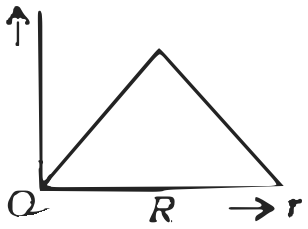
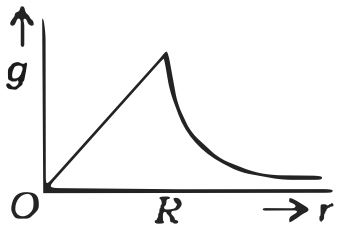
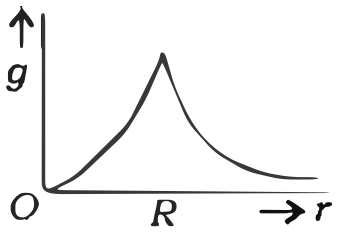
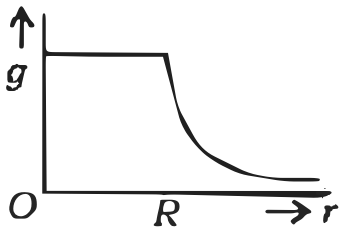
Starting from the centre of the earth having radius , the variation of (acceleration due to gravity) is shown by
- 1
- 2
- 3
- 4
Show answer and solution
Correct: option 2
Inside the earth (taken as a uniform sphere) , which grows in a straight line from zero at the centre to its largest value at the surface . Outside, , which falls off as a curve. The graph with a straight rise up to followed by a fall is option (2).
Question 32NEET 2016 Phase 2, Q12
A satellite of mass is orbiting the earth (of radius ) at a height from its surface. The total energy of the satellite in terms of , the value of acceleration due to gravity at the earth's surface, is
- 1
- 2
- 3
- 4
Show answer and solution
Correct: option 2,
For a circular orbit of radius the total energy is (kinetic energy plus potential energy ). Using , , option (2). The energy is negative because the satellite is bound.
Question 33AIPMT 2015, Q164
Kepler's third law states that square of period of revolution (T) of a planet around the sun, is proportional to third power of average distance r between sun and planet
i.e.
here K is constant.
If the masses of sun and planet are M and m respectively then as per Newton's law of gravitation force of attraction between them is
, here G is gravitational constant.
The relation between G and K is described as:
- 1
- 2
- 3
- 4
Show answer and solution
Correct: option 1,
For a circular orbit gravity supplies the centripetal force: . This gives . Comparing with , , so , option (1).
Question 34AIPMT 2015 Re-test, Q149
A satellite S is moving in an elliptical orbit around the earth. The mass of the satellite is very small compared to the mass of the earth. Then,
- 1the acceleration of S is always directed towards the centre of the earth.
- 2the angular momentum of S about the centre of the earth changes in direction, but its magnitude remains constant.
- 3the total mechanical energy of S varies periodically with time.
- 4the linear momentum of S remains constant in magnitude.
Show answer and solution
Correct: option 1, the acceleration of S is always directed towards the centre of the earth.
The only force on the satellite is the earth's gravity, a central force pointing to the earth's centre (the earth hardly moves because it is so much heavier). So the acceleration always points to the centre of the earth. A central force gives no torque, so the angular momentum is constant in both magnitude and direction; gravity is conservative, so the total energy is constant; and the speed changes round an ellipse, so the linear momentum does not stay constant in magnitude.
Question 35AIPMT 2015 Re-test, Q151
A remote-sensing satellite of earth revolves in a circular orbit at a height of above the surface of earth. If earth's radius is and , then the orbital speed of the satellite is:
- 1
- 2
- 3
- 4
Show answer and solution
Correct: option 2,
Orbital speed , using . Here , so .
Question 36AIPMT 2014, Q104
A black hole is an object whose gravitational field is so strong that even light cannot escape from it. To what approximate radius would earth (mass = ) have to be compressed to be a black hole?
- 1100 m
- 2
- 3
- 4
Show answer and solution
Correct: option 4,
Light just fails to escape when the escape speed equals : , so , which is about , option (4).
Question 37AIPMT 2014, Q115
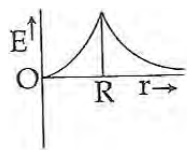
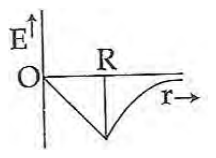
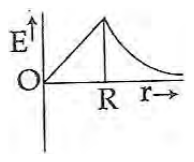
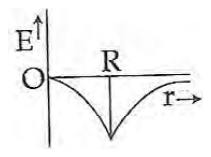
Dependence of intensity of gravitational field (E) of earth with distance (r) from centre of earth is correctly represented by:
- 1
- 2
- 3
- 4
Show answer and solution
Correct: option 2
Inside the earth the field grows in proportion to (a straight line) and outside it falls as ; its magnitude is largest at the surface . The field points towards the centre, so it is taken as negative. Graph (2) shows a straight line going down to a minimum at R followed by a curve rising back towards zero.
Question 38NEET 2013, Q173
A body of mass '' is taken from the earth's surface to the height equal to twice the radius (R) of the earth. The change in potential energy of body will be:
- 1
- 2
- 3
- 4
Show answer and solution
Correct: option 1,
At height the body is from the centre. . Using , this is .
Question 39NEET 2013, Q175
Infinite number of bodies, each of mass 2 kg are situated on -axis at distances 1 m, 2 m, 4 m, 8 m, ......., respectively, from the origin. The resulting gravitational potential due to this system at the origin will be:
- 1 G
- 2 G
- 3 G
- 4G
Show answer and solution
Correct: option 3, G
Potentials add as scalars: . The geometric series sums to , so .
Question 40NEET 2013 Karnataka, Q150
The radius of a planet is twice the radius of earth. Both have almost equal average mass-densities. If and are escape velocities of the planet and the earth, respectively, then:
- 1
- 2
- 3
- 4
Show answer and solution
Correct: option 2,
Escape velocity is , so for equal density . The planet has twice the radius, so .
Question 41NEET 2013 Karnataka, Q153
A particle of mass 'm' is kept at rest at a height 3R from the surface of earth, where 'R' is radius of earth and 'M' is mass of earth. The minimum speed with which it should be projected, so that it does not return back, is:
(g is acceleration due to gravity on the surface of earth)
- 1
- 2
- 3
- 4
Show answer and solution
Correct: option 1,
The particle is at from the centre. To just escape, its total energy must be zero: , so .
Question 42AIPMT 2012 Prelims, Q22
The height at which the weight of a body becomes 1/16th, its weight on the surface of earth (radius R), is:
- 15R
- 215R
- 33R
- 44R
Show answer and solution
Correct: option 3, 3R
Weight varies as . For we need , so .
Question 43AIPMT 2012 Prelims, Q33
A spherical planet has a mass and diameter . A particle of mass m falling freely near the surface of this planet will experience an acceleration due to gravity, equal to:
- 1
- 2
- 3
- 4
Show answer and solution
Correct: option 1,
The acceleration due to gravity at the surface is with radius , so . It does not depend on the mass m of the falling particle.
Question 44AIPMT 2012 Prelims, Q37
A geostationary satellite is orbiting the earth at a height of 5R above that surface of the earth, R being the radius of the earth. The time period of another satellite in hours at a height of 2R from the surface of the earth is:
- 15
- 210
- 3
- 4
Show answer and solution
Correct: option 3,
The orbital radii are and , and the geostationary period is 24 h. By Kepler's third law , so , giving hours.
Question 45AIPMT 2012 Mains, Q8
If is escape velocity and is orbital velocity of a satellite for orbit close to the earth’s surface, then these are related by:
- 1
- 2
- 3
- 4
Show answer and solution
Correct: option 4,
For an orbit close to the surface , while the escape velocity from the surface is . Dividing, .
Question 46AIPMT 2012 Mains, Q9
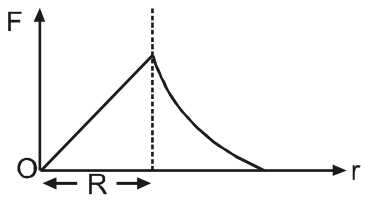
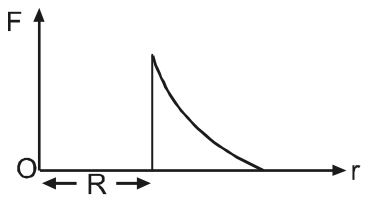
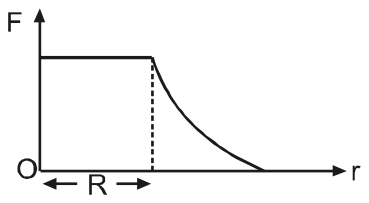
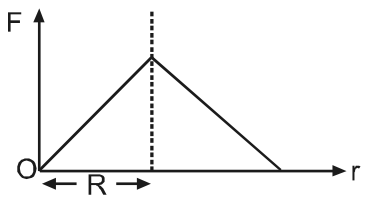
Which one of the following plots represents the variation of gravitational field on a particle with distance r due to a thin spherical shell of radius R? (r is measured from the centre of the spherical shell)
- 1
- 2
- 3
- 4
Show answer and solution
Correct: option 2
Inside a thin spherical shell () the gravitational field is zero. Outside () the shell acts like a point mass at its centre, so the field is : it jumps to at the surface and then falls off as . The plot that is zero up to R and then drops along a curve is option (2).
Question 47AIPMT 2011 Prelims, Q170
A planet moving along an elliptical orbit is closest to the sun at a distance and farthest away at a distance of . If and are the linear velocities at these points respectively, then the ratio is:
- 1
- 2
- 3
- 4
Show answer and solution
Correct: option 2,
The sun's pull is a central force, so the planet's angular momentum is conserved. At the nearest and farthest points the velocity is perpendicular to the radius, so and .
Question 48AIPMT 2011 Prelims, Q173
A body projected vertically from the earth reaches a height equal to earth's radius before returning to the earth. The power exerted by the gravitational force is greatest:
- 1at the highest position of the body
- 2at the instant just before the body hits the earth
- 3it remains constant all through
- 4at the instant just after the body is projected
Show answer and solution
Correct: option 2, at the instant just before the body hits the earth
Power . Just before the body hits the earth the gravitational force is at its largest (the body is nearest the earth), the speed is at its largest, and force and velocity point the same way, so the power is greatest. Just after projection the product has the same size but is negative, and at the top the velocity is zero.
Question 49AIPMT 2011 Mains, Q114
A particle of mass M is situated at the centre of spherical shell of mass and radius a. The magnitude of the gravitational potential at a point situated at a/2 distance from the centre, will be:
- 1
- 2
- 3
- 4
Show answer and solution
Correct: option 2,
Take the shell to have the same mass M as the particle. Inside a shell the potential is the same everywhere and equals its surface value, . The particle at the centre gives at a distance a/2. The total is , of magnitude .
Question 50AIPMT 2010 Mains, Q11
The additional kinetic energy to be provided to a satellite of mass m revolving around a planet of mass M, to transfer it from a circular orbit of radius to another of radius is
- 1
- 2
- 3
- 4
Show answer and solution
Correct: option 4,
The total energy of a satellite in a circular orbit of radius r is . The energy that must be supplied is the difference of the total energies in the two orbits: .
Question 51AIPMT 2010 Mains, Q22
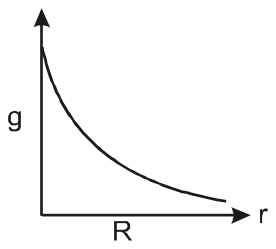
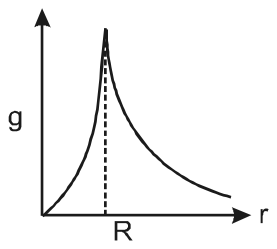
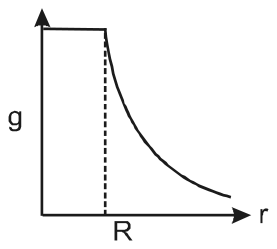
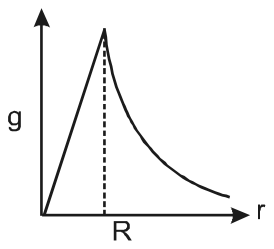
The dependence of acceleration due to gravity g on the distance r from the centre of the earth, assumed to be a sphere of radius R of uniform density is as shown in figures below. The correct figure is.
- 1
- 2
- 3
- 4
Show answer and solution
Correct: option 4
Inside a sphere of uniform density only the mass within radius r attracts, which gives : a straight line rising from zero at the centre to its maximum at . Outside, the whole mass acts as if at the centre and , a falling curve. The graph with a straight rise up to R followed by this fall is figure (4).
Question 52AIPMT 2010 Prelims, Q6
The radii of circular orbits of two satellites A and B of the earth, are 4R and R, respectively. If the speed of satellite A is 3V, then the speed of satellite B will be
- 1
- 26V
- 312 V
- 4
Show answer and solution
Correct: option 2, 6V
The orbital speed is , so it varies as . Then , and .
Question 53AIPMT 2010 Prelims, Q22
A particle of mass M is situated at the center of a spherical shell of same mass and radius a. The gravitational potential at a point situated at distance from the centre, will be
- 1
- 2
- 3
- 4
Show answer and solution
Correct: option 1,
The point lies inside the shell, where the shell's potential is constant and equal to its surface value . The particle at the centre contributes . Adding the two gives .
Question 54AIPMT 2009 Prelims, Q19
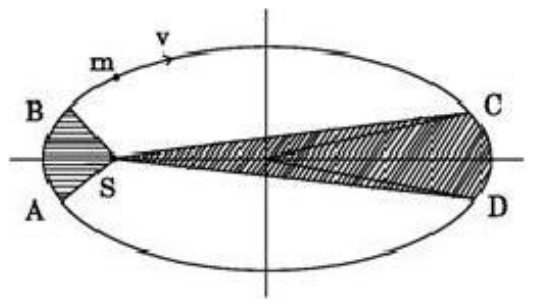
The Figure shows elliptical orbit of a planet m about the sun S. The shaded area SCD is twice the shaded area SAB. If is the time for the planet to move from C to D and is the time to move from A to B then:
- 1
- 2
- 3
- 4
Show answer and solution
Correct: option 2,
By Kepler's second law the line joining the sun and the planet sweeps out equal areas in equal times, so the time taken is proportional to the area swept. Area SCD is twice area SAB, hence .
Question 55AIPMT 2007 Prelims, Q163
Two satellites of earth, and are moving in the same orbit. The mass of is four times the mass of . Which one of the following statements is true?
- 1The kinetic energies of the two satellites are equal.
- 2The time period of is four times that of .
- 3The potential energies of earth and satellite in the two cases are equal.
- 4 and are moving with the same speed.
Show answer and solution
Correct: option 4, and are moving with the same speed.
The orbital speed depends only on the earth's mass and the orbit radius, not on the satellite's mass, so both satellites move with the same speed and the same period. Their kinetic and potential energies are proportional to their own masses, so those differ. Option (4) is true.
Question 56AIPMT 2006 Prelims, Q34
The Earth is assumed to be a sphere of radius R. A platform is arranged at a height R from the surface of the Earth. The escape velocity of a body from this platform is fv, where v is its escape velocity from the surface of the Earth. The value of f is:-
- 1
- 2
- 3
- 4
Show answer and solution
Correct: option 2,
Escape velocity from a distance from the Earth's centre is . At the surface ; on the platform . So the escape velocity from the platform is , and .
Question 57AIPMT 2005 Prelims, Q25
For a satellite moving in an orbit around the earth, the ratio of kinetic energy to potential energy is
- 1
- 22
- 3
- 4
Show answer and solution
Correct: option 4,
For a circular orbit , so the kinetic energy is while the potential energy is . The magnitude of the ratio of kinetic to potential energy is .
Question 58AIPMT 2005 Prelims, Q41
Imagine a new planet having the same density as that of earth but it is 3 times bigger than the earth in size. If the acceleration due to gravity on the surface of earth is g and that on the surface of the new planet is g', then
- 1g' = 3g
- 2g' = 9g
- 3g' = g/9
- 4g' = 27g
Show answer and solution
Correct: option 1, g' = 3g
, so for the same density g is proportional to the radius. A planet with 3 times the radius has g' = 3g.
Question 59AIPMT 2004 Prelims, Q10
The density of newly discovered planet is twice that of earth. The acceleration due to gravity at the surface of the planet is equal to that at the surface of the earth. If the radius of the earth is R, the radius of the planet would be:-
- 1
- 2
- 3
- 4
Show answer and solution
Correct: option 3,
, so . With the same and twice the density, the radius of the planet must be half that of the earth, .
Question 60AIPMT 2003 Prelims, Q7
The acceleration due to gravity on the planet A is 9 times the acceleration due to gravity on planet B. A man jumps to a height of 2m on the surface of A. What is the height of jump by the same person on the planet B.
- 12/9 m
- 218 m
- 36 m
- 42/3 m
Show answer and solution
Correct: option 2, 18 m
The man leaves the ground with the same speed on both planets, and the height reached is , inversely proportional to . Gravity on B is 9 times weaker than on A, so the jump is 9 times higher: m.
Question 61AIPMT 2003 Prelims, Q12
Two spheres of masses m and M are situated in air and the gravitational force between them is F. The space around the masses is now filled with a liquid of specific density 3. The gravitational force will now be:
- 13F
- 2F
- 3F/3
- 4F/9
Show answer and solution
Correct: option 2, F
The gravitational force between two masses, , does not depend on the medium between them; unlike the electric force there is no medium constant. The force therefore stays F.
Question 62AIPMT 2002 Prelims, Q24
A body of mass m is placed on earth surface which is taken from earth surface to a height of h = 3R then change in gravitational potential energy is:-
- 1
- 2
- 3
- 4
Show answer and solution
Correct: option 3,
, using . With this is .
Question 63AIPMT 2001 Prelims, Q20
With what velocity should a particle be projected so that its height becomes equal to radius of earth -
- 1
- 2
- 3
- 4
Show answer and solution
Correct: option 1,
At height the particle is from the centre and momentarily at rest. Energy conservation: , so and .
Question 64AIPMT 2000 Prelims, Q10
A body of weight 72 N moves from the surface of earth at a height half of the radius of the earth, then gravitational force exerted on it will be:
- 136 N
- 232 N
- 3144 N
- 450 N
Show answer and solution
Correct: option 2, 32 N
Gravitational force varies as from the centre. At height the distance is , so the force is N.
Question 65AIPMT 2000 Prelims, Q44
For a planet having mass equal to mass of the earth but radius is one fourth of radius of the earth. Then escape velocity for this planet will be
- 111.2 km/s
- 222.4 km/s
- 35.6 km/s
- 444.8 km/s
Show answer and solution
Correct: option 2, 22.4 km/s
. With the same mass and , km/s.
Question 66AIPMT 1999 Prelims, Q41
If radius of earth shrinks by 1% then for acceleration due to gravity:
- 1No change at poles
- 2No change at equator
- 3Max. change at equator
- 4Equal change at all locations
Show answer and solution
Correct: option 4, Equal change at all locations
With the mass unchanged, at the surface. A 1% decrease in raises by about 2%, and this formula is the same for every point on the surface, so (leaving aside the small effect of rotation) the change is equal at all locations.
Question 67AIPMT 1999 Prelims, Q42
Rohini satellite is at a height of 500 km. and Insat-B is at a height of 3600 km. from surface of earth then relation between their orbital velocity (, ) is:
- 1
- 2
- 3
- 4No relation
Show answer and solution
Correct: option 1,
The orbital velocity is , where is the distance from the centre of the earth. The satellite in the lower orbit moves faster. Rohini is lower than Insat-B, so its orbital velocity is the greater one: (the options print the second symbol as ).
Question 68AIPMT 1999 Prelims, Q43
For moon, its mass is 1/81 of earth mass and its diameter is 1/3.7 of earth dia. If acceleration due to gravity at earth surface is then at moon its value is:
- 1
- 2
- 3
- 4
Show answer and solution
Correct: option 2,
, so .