Questions with solutions
Question 1NEET 2026 Re-exam, Q33
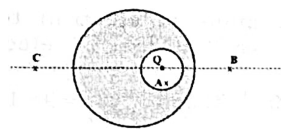
A point charge Q is placed inside a cavity within a solid isolated conducting sphere. Consider points A, B and C as shown in the figure, where the magnitudes of the electric fields are , and , respectively. The points B and C are at the same distance from the center of the solid sphere. The correct option is:
- 1,
- 2,
- 3,
- 4,
Show answer and solution
Correct: option 2, ,
Point A lies inside the cavity, where the field of the charge Q (and of the charge induced on the cavity wall) is not zero, so . The conductor shields the outside from the position of the charge: the charge Q induced on the outer surface spreads uniformly, so the field outside is that of a point charge at the centre of the sphere. B and C are equally far from the centre, so . This is option (2).
Question 2NEET 2025, Q28
Two identical charged conducting spheres A and B have their centres separated by a certain distance. Charge on each sphere is q and the force of repulsion between them is F. A third identical uncharged conducting sphere is brought in contact with sphere A first and then with B and finally removed from both. New force of repulsion between spheres A and B (Radii of A and B are negligible compared to the distance of separation so that for calculating force between them they can be considered as point charges) is best given as:
- 1
- 2
- 3
- 4
Show answer and solution
Correct: option 4,
Identical spheres share charge equally on contact. Touching A, the third sphere and A each end with . Touching B, the total is shared, leaving B with . The force is proportional to the product of the charges, so the new force is , option (4).
Question 3NEET 2024 Re-exam, Q3
A metal cube of side 5 cm is charged with 6 μC. The surface charge density on the cube is
- 1
- 2
- 3
- 4
Show answer and solution
Correct: option 4,
The charge on a conductor spreads over its whole outer surface. A cube has six faces, so the area is . Then .
Question 4NEET 2023, Q5
If over a surface, then:
- 1the number of flux lines entering the surface must be equal to the number of flux lines leaving it.
- 2the magnitude of electric field on the surface is constant.
- 3all the charges must necessarily be inside the surface.
- 4the electric field inside the surface is necessarily uniform.
Show answer and solution
Correct: option 1, the number of flux lines entering the surface must be equal to the number of flux lines leaving it.
Zero net flux through a closed surface means, by Gauss's law, that the net charge enclosed is zero. Then every field line that enters the surface also leaves it, so the number entering equals the number leaving, option (1). Nothing follows about the field being constant or uniform.
Question 5NEET 2023, Q32
An electric dipole is placed at an angle of with an electric field of intensity . It experiences a torque equal to 4 N m. Calculate the magnitude of charge on the dipole, if the dipole length is 2 cm.
- 18 mC
- 26 mC
- 34 mC
- 42 mC
Show answer and solution
Correct: option 4, 2 mC
. So C mC, option (4).
Question 6NEET 2023 Manipur, Q3
A charge is placed at the centre of a cube. The flux coming out from any one of its faces will be (in SI unit)
- 1
- 2
- 3
- 4
Show answer and solution
Correct: option 2,
By Gauss's law the total flux through the cube is with . The charge is at the centre, so by symmetry the six faces share the flux equally. Flux through one face .
Question 7NEET 2023 Manipur, Q14
According to Gauss law of electrostatics, electric flux through a closed surface depends on
- 1The shape of the surface
- 2The volume enclosed by the surface
- 3The area of the surface
- 4The quantity of charges enclosed by the surface
Show answer and solution
Correct: option 4, The quantity of charges enclosed by the surface
Gauss's law states . The flux is fixed by the net charge enclosed alone, and not by the shape, area or volume of the surface.
Question 8NEET 2022, Q49
Two point charges and are placed at a distance of L, as shown in the figure.
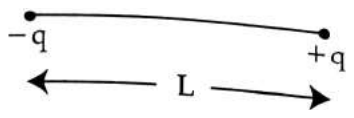
The magnitude of electric field intensity at a distance R () varies as:
- 1
- 2
- 3
- 4
Show answer and solution
Correct: option 3,
Equal and opposite charges a distance L apart form an electric dipole of moment . Far from a dipole () the field is of the form times a factor that depends only on direction, so it varies as , option (3).
Question 9NEET 2022 Re-exam, Q42
The ratio of Coulomb's electrostatic force to the gravitational force between an electron and a proton separated by some distance is . The ratio of the proportionality constant, to the Gravitational constant G is nearly (Given that the charge of the proton and electron each = C, the mass of the electron = kg, the mass of the proton = kg):
- 1
- 2
- 3
- 4
Show answer and solution
Correct: option 2,
, so . This is nearly , option (2).
Question 10NEET 2021, Q4
A dipole is placed in an electric field as shown. In which direction will it move?
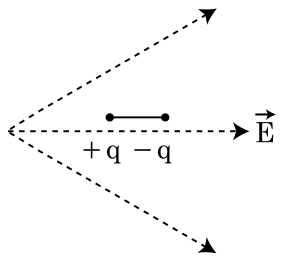
- 1towards the left as its potential energy will increase.
- 2towards the right as its potential energy will decrease.
- 3towards the left as its potential energy will decrease.
- 4towards the right as its potential energy will increase.
Show answer and solution
Correct: option 2, towards the right as its potential energy will decrease.
The field lines spread out towards the right, so the field is stronger on the left, where the charge sits. The force on (along the field, to the right) is larger than the force on (to the left), so the net force is to the right. A system moves on its own in the direction that lowers its potential energy, so the energy decreases.
Question 11NEET 2020, Q159
A spherical conductor of radius 10 cm has a charge of distributed uniformly. What is the magnitude of electric field at a point 15 cm from the centre of the sphere?
- 1
- 2
- 3
- 4
Show answer and solution
Correct: option 2,
The point is outside the sphere (15 cm > 10 cm), so the charge acts as if it were at the centre: .
Question 12NEET 2020 Phase 2, Q99
The acceleration of an electron due to the mutual attraction between the electron and a proton when they are apart is,
(, )
(Take )
- 1
- 2
- 3
- 4
Show answer and solution
Correct: option 2,
The Coulomb force is . The acceleration of the electron is .
Question 13NEET 2020 Phase 2, Q135
The electric field at a point on the equatorial plane at a distance from the centre of a dipole having dipole moment is given by,
( separation of two charges forming the dipole, - permittivity of free space)
- 1
- 2
- 3
- 4
Show answer and solution
Correct: option 3,
On the equatorial plane the fields of the two charges have equal size; their components along the perpendicular cancel and the components parallel to the dipole axis add, pointing from the positive charge towards the negative charge, which is opposite to the dipole moment. For much larger than the separation the result is . The field on the axis is twice as large and along , which is option (1).
Question 14NEET 2019, Q25
A hollow metal sphere of radius R is uniformly charged. The electric field due to the sphere at a distance r from the centre:
- 1increases as r increases for and for
- 2zero as r increases for , decreases as r increases for
- 3zero as r increases for , increases as r increases for
- 4decreases as r increases for and for
Show answer and solution
Correct: option 2, zero as r increases for , decreases as r increases for
By the Gauss law a surface inside the hollow sphere encloses no charge, so for . Outside, the sphere acts like a point charge at its centre, , which decreases as r increases.
Question 15NEET 2019, Q36
Two parallel infinite line charges with linear charge densities C/m and C/m are placed at a distance of 2R in free space. What is the electric field mid-way between the two line charges?
- 1zero
- 2 N/C
- 3 N/C
- 4 N/C
Show answer and solution
Correct: option 3, N/C
The midpoint is at distance R from each line, and each produces a field . The field of the positive line points away from it and that of the negative line points towards it, so at the midpoint both are in the same direction and add: N/C.
Question 16NEET 2019, Q37
Two point charges A and B, having charges and respectively, are placed at certain distance apart and force acting between them is F. If 25% charge of A is transferred to B, then force between the charges becomes:
- 1F
- 2
- 3
- 4
Show answer and solution
Correct: option 2,
After the transfer A has and B has . The force is proportional to the product of the magnitudes, so .
Question 17NEET 2019 Odisha, Q13
A sphere encloses an electric dipole with charges C. What is the total electric flux across the sphere?
- 1
- 2
- 3
- 4Zero
Show answer and solution
Correct: option 4, Zero
By Gauss's law the flux through a closed surface is . A dipole has charges and , so the net enclosed charge is zero and the total flux is zero.
Question 18NEET 2018, Q22
An electron falls from rest through a vertical distance h in a uniform and vertically upward directed electric field E. The direction of electric field is now reversed, keeping its magnitude the same. A proton is allowed to fall from rest in it through the same vertical distance h. The time of fall of the electron, in comparison to the time of fall of the proton is
- 110 times greater
- 25 times greater
- 3smaller
- 4equal
Show answer and solution
Correct: option 3, smaller
Both particles feel a force of the same size eE, so and . Time is proportional to , and the electron is far lighter than the proton, so the electron's time of fall is smaller.
Question 19NEET 2017, Q10
Suppose the charge of a proton and an electron differ slightly. One of them is , the other is . If the net of electrostatic force and gravitational force between two hydrogen atoms placed at a distance d (much greater than atomic size) apart is zero, then is of the order of [Given mass of hydrogen kg]
- 1 C
- 2 C
- 3 C
- 4 C
Show answer and solution
Correct: option 3, C
Each hydrogen atom would carry a net charge . The electric repulsion balances the gravitational attraction: . So C, of the order of C.
Question 20NEET 2016 Phase 1, Q9
Two identical charged spheres suspended from a common point by two massless strings of lengths , are initially at a distance d (d << ) apart because of their mutual repulsion. The charges begin to leak from both the spheres at a constant rate. As a result, the spheres approach each other with a velocity . Then varies as a function of the distance between the spheres, as:
- 1
- 2
- 3
- 4
Show answer and solution
Correct: option 3,
For small angles, equilibrium gives , so . Differentiating, . Since is constant, .
Question 21NEET 2016 Phase 2, Q23
An electric dipole is placed at an angle of with an electric field intensity N/C. It experiences a torque equal to 4 N m. The charge on the dipole, if the dipole length is 2 cm, is
- 18 mC
- 22 mC
- 35 mC
- 47 C
Show answer and solution
Correct: option 2, 2 mC
Torque on a dipole is , where is the dipole length. So C mC, option (2).
Question 22AIPMT 2015, Q176
The electric field in a certain region is acting radially outward and is given by E = Ar. A charge contained in a sphere of radius 'a' centred at the origin of the field, will be given by:
- 1
- 2
- 3
- 4
Show answer and solution
Correct: option 2,
On the surface of the sphere the field has the same magnitude everywhere and is normal to the surface, so the outward flux is . By Gauss's law the enclosed charge is , option (2).
Question 23NEET 2013, Q179
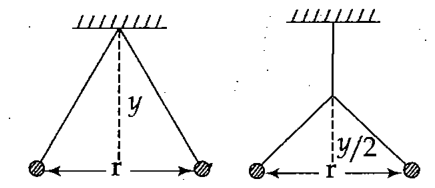
Two pith balls carrying equal charges are suspended from a common point by strings of equal length, the equilibrium separation between them is r. Now the strings are rigidly clamped at half the height. The equilibrium separation between the balls now become:
- 1
- 2
- 3
- 4
Show answer and solution
Correct: option 1,
For each ball the string makes an angle with the vertical where , with . This gives , so . Halving the height to halves , and the new separation is .
Question 24NEET 2013 Karnataka, Q147
A charge 'q' is placed at the centre of the line joining two equal charges 'Q'. The system of the three charges will be in equilibrium if 'q' is equal to:
- 1
- 2
- 3
- 4
Show answer and solution
Correct: option 1,
Let the charges be a distance apart, with at the middle. is always in equilibrium by symmetry. For one end charge: , which gives .
Question 25AIPMT 2012 Prelims, Q44
What is the flux through a cube of side 'a' if a point charge of q is at one of its corner:
- 1
- 2
- 3
- 4
Show answer and solution
Correct: option 2,
Eight such cubes can be stacked around the corner so that the charge sits at the centre of a larger cube of side 2a. By Gauss's law the total flux through that larger cube is , and by symmetry each of the eight cubes gets an equal share, so the flux through one cube is .
Question 26AIPMT 2011 Prelims, Q159
A charge Q is enclosed by a Gaussian spherical surface of radius R. If the radius is doubled, then the outward electric flux will:
- 1increase four times
- 2be reduced to half
- 3remain the same
- 4be doubled
Show answer and solution
Correct: option 3, remain the same
By Gauss's law the flux through a closed surface is . It depends only on the charge inside, not on the size of the surface, so it stays the same.
Question 27AIPMT 2010 Mains, Q4
The electric field at a distance from the centre of a charged conducting spherical shell of radius R is E. The electric field at a distance from the centre of the sphere is
- 1zero
- 2E
- 3
- 4
Show answer and solution
Correct: option 1, zero
The point at lies inside the conducting shell. A Gaussian surface drawn there encloses no charge, because all the charge sits on the surface of the shell, so the field inside is zero whatever its value outside.
Question 28AIPMT 2010 Prelims, Q43
Two positive ions, each carrying a charge q, are separated by a distance d. If F is the force of repulsion between the ions, the number of electrons missing from each ion will be (e being the charge on an electron)
- 1
- 2
- 3
- 4
Show answer and solution
Correct: option 3,
Coulomb's law gives , so . Each ion has lost n electrons with , hence .
Question 29AIPMT 2010 Prelims, Q45
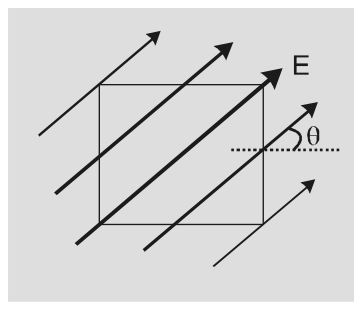
A square surface of side L meter in the plane of the paper is placed in a uniform electric field E (volt/m) acting along the same plane at an angle with the horizontal side of the square as shown in figure. The electric flux linked to the surface in units of volt × meter is
- 1
- 2
- 3
- 4zero
Show answer and solution
Correct: option 4, zero
Flux is , where the area vector is perpendicular to the surface. Here the field lies in the plane of the square, so it is at 90° to the area vector whatever the angle is. No field lines pass through the surface and the flux is zero.
Question 30AIPMT 2008 Prelims, Q26
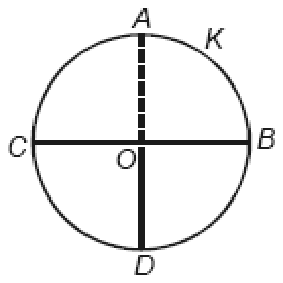
A thin conducting ring of radius R is given a charge +Q. The electric field at the centre O of the ring due to the charge on the part AKB of the ring is E. The electric field at the centre due to the charge on the part ACDB of the ring is
- 13 E along OK
- 23 E along KO
- 3E along OK
- 4E along KO
Show answer and solution
Correct: option 3, E along OK
The charge is spread evenly round the ring, so the total field at the centre is zero. The positive charge on arc AKB pushes a positive test charge at O away from K, so its field E points along KO. The rest of the ring, ACDB, must cancel it: its field has the same magnitude E and points along OK.
Question 31AIPMT 2007 Prelims, Q175
Three point charges +q, -2q and +q are placed at points (x = 0, y = a, z = 0), (x = 0, y = 0, z = 0) and (x = a, y = 0, z = 0) respectively. The magnitude and direction of the electric dipole moment vector of this charge assembly are
- 1 along +x direction
- 2 along +y direction
- 3 along the line joining points (x = 0, y = 0, z = 0) and (x = a, y = a, z = 0)
- 4 along the line joining points (x = 0, y = 0, z = 0) and (x = a, y = a, z = 0)
Show answer and solution
Correct: option 3, along the line joining points (x = 0, y = 0, z = 0) and (x = a, y = a, z = 0)
Split the -2q at the origin into two charges -q. One pairs with the +q on the y-axis to give a dipole moment qa along +y, the other pairs with the +q on the x-axis to give qa along +x. These two perpendicular moments add to at to both axes, that is along the line from the origin to (a, a, 0). Option (3).
Question 32AIPMT 2006 Prelims, Q43
An electric dipole of moment is lying along a uniform electric field . The work done in rotating the dipole by is:-
- 1
- 2
- 3
- 4
Show answer and solution
Correct: option 4,
The potential energy of a dipole is . It starts at with and ends at with . The work done is the change, .
Question 33AIPMT 2006 Prelims, Q46
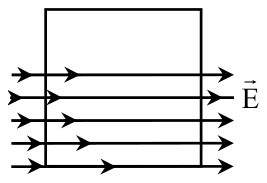
A square surface of side L metres is in the plane of the paper. A uniform electric field (volt/m), also in the plane of the paper, is limited only to the lower half of the square surface, (see figure). The electric flux in SI units associated with the surface is:-
- 1
- 2
- 3Zero
- 4
Show answer and solution
Correct: option 3, Zero
Flux is , where is the angle between the field and the normal to the surface. The field lies in the plane of the square, so it is perpendicular to the normal () and no field line passes through the surface. The flux is zero, however much of the square the field covers.
Question 34AIPMT 2004 Prelims, Q4
The unit of permittivity of free space is:-
- 1Newton metre/Coulomb
- 2Coulomb/Newton metre
- 3Coulomb/(Newton metre)
- 4Coulomb/Newton metre
Show answer and solution
Correct: option 2, Coulomb/Newton metre
From Coulomb's law , so , which has the unit Coulomb/Newton metre.
Question 35AIPMT 2004 Prelims, Q44
An electric dipole has the magnitude of its charge as q and its dipole moment is p. It is placed in a uniform electric field E. If its dipole moment is along the direction of the field, the force on it and its potential energy are respectively:-
- 1q.E and p.E
- 2zero and minimum
- 3q.E and maximum
- 42q.E and minimum
Show answer and solution
Correct: option 2, zero and minimum
In a uniform field the forces and on the two charges cancel, so the net force is zero. The potential energy is ; with the dipole moment along the field and , its minimum value.
Question 36AIPMT 2003 Prelims, Q24
A charge q is located at the centre of a cube. The electric flux through any face is -
- 1
- 2
- 3
- 4
Show answer and solution
Correct: option 2,
By Gauss's law the total flux through the cube is , and by symmetry it is shared equally by the six faces: each. Multiplying top and bottom by writes this as .
Question 37AIPMT 2003 Prelims, Q25
An electron is moving round the nucleus of a hydrogen atom in a circular orbit of radius r. The coulomb force between the two is -
(where )
- 1
- 2
- 3
- 4
Show answer and solution
Correct: option 4,
The charges are and , so ; the minus sign shows attraction. Writing gives .
Question 38AIPMT 2001 Prelims, Q13
A charge Q C is placed at the centre of cube, the flux coming out from any surfaces will be:
- 1
- 2
- 3
- 4
Show answer and solution
Correct: option 1,
By Gauss's law the total flux through the cube is with C. The charge is at the centre, so the flux is shared equally by the six faces: each face gets .
Question 39AIPMT 2001 Prelims, Q37
A dipole of moment is placed in uniform electric field then torque acting on it is given by:
- 1
- 2
- 3
- 4
Show answer and solution
Correct: option 2,
The two charges of the dipole feel equal and opposite forces , forming a couple of magnitude that turns towards . In vector form this is .
Question 40AIPMT 2000 Prelims, Q19
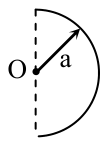
Electric field at centre O of semicircle of radius 'a' having linear charge density given is given by
- 1
- 2
- 3
- 4
Show answer and solution
Correct: option 3,
An element carries charge and gives a field at O. By symmetry only the components along the axis of the semicircle add: .
Question 41AIPMT 2000 Prelims, Q22
A charge Q is situated at the corner of a cube, the electric flux passed through all the six faces of the cube is:
- 1
- 2
- 3
- 4
Show answer and solution
Correct: option 2,
Eight identical cubes can be stacked around the corner so that the charge sits at the centre of a larger cube, through which the total flux is by Gauss's law. By symmetry each of the eight cubes gets an equal share, so the flux through the given cube is .
Question 42AIPMT 1999 Prelims, Q16
In millikan oil drop experiment a charged drop falls with a terminal velocity V. If an electric field E is applied vertically upwards it moves with terminal velocity 2V in upward direction. If electric field reduces to E/2 then its terminal velocity will be -
- 1
- 2
- 3
- 4
Show answer and solution
Correct: option 1,
The viscous force is proportional to the speed, . Falling freely: . With field : , so . With field the upward electric force is , and the net driving force is upward, so the terminal velocity is (upward).
Question 43AIPMT 1998 Prelims, Q2
A hollow sphere of radius 1m is given a positive charge of . The electric field at the centre of hollow sphere will be:
- 1
- 2
- 3Zero
- 4Infinite
Show answer and solution
Correct: option 3, Zero
The charge sits on the surface of the hollow sphere. A Gaussian surface drawn anywhere inside encloses no charge, so by Gauss's law the field at every inside point, including the centre, is zero.
Question 44AIPMT 1998 Prelims, Q38
A charge q is placed in an uniform electric field E. If it is released, then the K.E of the charge after travelling distance y will be:
- 1qEy
- 22qEy
- 3
- 4
Show answer and solution
Correct: option 1, qEy
The field exerts a constant force qE on the charge. Starting from rest, the kinetic energy gained equals the work done by this force over the distance y, which is qEy.
Question 45AIPMT 1998 Prelims, Q40
Electric field at the equator of a dipole is E. If strength and distance is now doubled then the electric field will be:
- 1E/2
- 2E/8
- 3E/4
- 4E
Show answer and solution
Correct: option 3, E/4
On the equatorial line of a short dipole . Doubling the dipole strength p doubles the field, and doubling r divides it by 8, so the new field is .
Question 46AIPMT 1998 Prelims, Q49
A point Q lies on the perpendicular bisector of an electrical dipole of dipole moment p. If the distance of Q from the dipole is r (much larger than the size of the dipole), then the electric field at Q is proportional to:
- 1 and
- 2 and
- 3 and
- 4 and
Show answer and solution
Correct: option 4, and
On the perpendicular bisector (equatorial line) of a short dipole the field is . It is proportional to p and to .