NEET Physics

Mechanical Properties of Solids

15
questions
15
from past papers
15 min
chapter test
Lesson · 20 minStress, strain and Young's modulusHow hard a wire is being pulled, how much it stretches, what the stress–strain curve shows, and the energy a stretched wire stores.

Questions with solutions

Question 1NEET 2026, Q18

Match List I with List II:

List IList II
A. Young's ModulusI. ΔdΔL(Ld)
B. CompressibilityII. F LA (ΔL)
C. Bulk ModulusIII. −1ΔP(ΔVV)
D. Poisson's RatioIV. −P(VΔV)

Choose the correct answer from the options given below:

  1. 1A-I, B-IV, C-III, D-II
  2. 2A-IV, B-I, C-II, D-III
  3. 3A-III, B-II, C-I, D-IV
  4. 4A-II, B-III, C-IV, D-I
Show answer and solution

Correct: option 4, A-II, B-III, C-IV, D-I

Young's modulus is longitudinal stress over longitudinal strain, F/AΔL/L=FLA ΔL (A-II). Bulk modulus is pressure over volume strain, −PΔV/V (C-IV), and compressibility is its reciprocal, −1ΔPΔVV (B-III). Poisson's ratio is lateral strain over longitudinal strain, Δd/dΔL/L (D-I).

Question 2NEET 2024, Q34

The maximum elongation of a steel wire of 1 m length if the elastic limit of steel and its Young's modulus, respectively, are 8×10⁸ N m−2 and 2×10¹¹ N m−2, is:

  1. 18 mm
  2. 24 mm
  3. 30.4 mm
  4. 440 mm
Show answer and solution

Correct: option 2, 4 mm

The largest stress the wire can take is the elastic limit. From Y=stressΔL/L, ΔL=stress×LY=8×108×12×1011=4×10⁻³ m =4 mm, option (2).

Question 3NEET 2023, Q1

Let a wire be suspended from the ceiling (rigid support) and stretched by a weight W attached at its free end. The longitudinal stress at any point of cross-sectional area A of the wire is:

  1. 12W/A
  2. 2W/A
  3. 3W/2A
  4. 4Zero
Show answer and solution

Correct: option 2, W/A

In equilibrium the tension in the wire is W at every cross-section (the weight of the wire itself is ignored). Stress is the restoring force per unit area, so it is W/A, which is option (2).

Question 4NEET 2023 Manipur, Q7

The amount of elastic potential energy per unit volume (in SI unit) of a steel wire of length 100 cm to stretch it by 1 mm is (if Young's modulus of the wire =2.0×10¹¹ N m−2)

  1. 1107
  2. 2105
  3. 31011
  4. 41017
Show answer and solution

Correct: option 2, 105

Energy per unit volume =12×stress×strain=12Y(strain)2. Strain =1 mm1000 mm=10−3. So u=12×2.0×1011×10−6=105 J m−3.

Question 5NEET 2022, Q43

Given below are two statements: One is labelled as Assertion (A) and the other is labelled as Reason (R). Assertion (A): The stretching of a spring is determined by the shear modulus of the material of the spring. Reason (R): A coil spring of copper has more tensile strength than a steel spring of same dimensions. In the light of the above statements, choose the most appropriate answer from the options given below:

  1. 1(A) is false but (R) is true
  2. 2Both (A) and (R) are true and (R) is the correct explanation of (A)
  3. 3Both (A) and (R) are true and (R) is not the correct explanation of (A)
  4. 4(A) is true but (R) is false
Show answer and solution

Correct: option 4, (A) is true but (R) is false

When a coil spring is stretched its wire is twisted, not lengthened, so the extension depends on the shear modulus of the material: (A) is true. Steel is stronger and more elastic than copper, so a copper spring does not have more tensile strength than a steel one of the same size: (R) is false. Option (4).

Question 6NEET 2020, Q178

A wire of length L, area of cross section A is hanging from a fixed support. The length of the wire changes to L1 when mass M is suspended from its free end. The expression for Young's modulus is:

  1. 1MgL1AL
  2. 2Mg(L1−L)AL
  3. 3MgLAL1
  4. 4MgLA(L1−L)
Show answer and solution

Correct: option 4, MgLA(L1−L)

Young's modulus is stress divided by strain. The stress is MgA and the strain is the extension over the original length, L1−LL. So Y=Mg/A(L1−L)/L=MgLA(L1−L).

Question 7NEET 2019, Q1

When a block of mass M is suspended by a long wire of length L, the length of the wire becomes (L+l). The elastic potential energy stored in the extended wire is:

  1. 1Mgl
  2. 2MgL
  3. 312Mgl
  4. 412MgL
Show answer and solution

Correct: option 3, 12Mgl

The stretching force grows from zero to Mg as the wire extends by l, so the energy stored is the average force times the extension: U=12×Mg×l=12Mgl. The other half of the lost gravitational energy Mgl is dissipated as the block settles.

Question 8NEET 2019 Odisha, Q16

The stress-strain curves are drawn for two different materials X and Y. It is observed that the ultimate strength point and the fracture point are close to each other for material X but are far apart for material Y. We can say that materials X and Y are likely to be (respectively),

  1. 1brittle and plastic
  2. 2plastic and ductile
  3. 3ductile and brittle
  4. 4brittle and ductile
Show answer and solution

Correct: option 4, brittle and ductile

A material that breaks soon after reaching its ultimate strength is brittle, so X is brittle. A material that stretches a lot between the ultimate strength point and the fracture point is ductile, so Y is ductile.

Question 9NEET 2018, Q44

Two wires are made of the same material and have the same volume. The first wire has cross-sectional area A and the second wire has cross-sectional area 3A. If the length of the first wire is increased by Δl on applying a force F, how much force is needed to stretch the second wire by the same amount ?

  1. 14 F
  2. 26 F
  3. 39 F
  4. 4F
Show answer and solution

Correct: option 3, 9 F

F=YA ΔlL. Same volume means the second wire has length L3 when its area is 3A. So F2=Y(3A) ΔlL/3=9 YA ΔlL=9F.

Question 10NEET 2017, Q32

The bulk modulus of a spherical object is 'B'. If it is subjected to uniform pressure 'p', the fractional decrease in radius is

  1. 1pB
  2. 2B3p
  3. 33pB
  4. 4p3B
Show answer and solution

Correct: option 4, p3B

From the bulk modulus, the fractional decrease in volume is ΔVV=pB. For a sphere V∝r3, so ΔVV=3Δrr. Hence Δrr=p3B.

Question 11AIPMT 2015, Q162

The approximate depth of an ocean is 2700 m. The compressibility of water is 45.4×10⁻¹¹ Pa−1 and density of water is 103 kg/m3. What fractional compression of water will be obtained at the bottom of the ocean?

  1. 11.0×10⁻²
  2. 21.2×10⁻²
  3. 31.4×10⁻²
  4. 40.8×10⁻²
Show answer and solution

Correct: option 2, 1.2×10⁻²

The extra pressure at the bottom is P=ρgh=103×9.8×2700≈2.65×10⁷ Pa. Compressibility is the reciprocal of the bulk modulus, so the fractional compression is ΔVV=P×compressibility=2.65×107×45.4×10−11≈1.2×10⁻², option (2).

Question 12AIPMT 2015 Re-test, Q140

The Young's modulus of steel is twice that of brass. Two wires of same length and of same area of cross section, one of steel and another of brass are suspended from the same roof. If we want the lower ends of the wires to be at the same level, then the weights added to the steel and brass wires must be in the ratio of:

  1. 11 : 1
  2. 21 : 2
  3. 32 : 1
  4. 44 : 1
Show answer and solution

Correct: option 3, 2 : 1

Extension Δl=WLAY. With the same L and A, equal extensions need WsYs=WbYb, so WsWb=YsYb=2. The steel wire must carry twice the weight: 2 : 1.

Question 13AIPMT 2014, Q122

Copper of fixed volume 'V' is drawn into wire of length 'l'. When this wire is subjected to a constant force 'F', the extension produced in the wire is 'Δl'. Which of the following graphs is a straight line?

  1. 1Δl versus l
  2. 2Δl versus 1/l
  3. 3Δl versus l2
  4. 4Δl versus 1/l2
Show answer and solution

Correct: option 3, Δl versus l2

Young's modulus gives Δl=FlAY. The volume is fixed, so the cross-section is A=Vl and Δl=Fl2VY. With F, V and Y constant, Δl∝l2, so the graph of Δl against l2 is a straight line, option (3).

Question 14NEET 2013, Q145

The following four wires are made of the same material. Which of these will have the largest extension when the same tension is applied?

  1. 1length = 100 cm, diameter = 1 mm
  2. 2length = 200 cm, diameter = 2 mm
  3. 3length = 300 cm, diameter = 3 mm
  4. 4length = 50 cm, diameter = 0.5 mm
Show answer and solution

Correct: option 4, length = 50 cm, diameter = 0.5 mm

Extension is ΔL=FLAY, so for the same force and material it is proportional to Ld2. In cm and mm the four values are 1001=100, 2004=50, 3009≈33 and 500.25=200. The 50 cm wire of diameter 0.5 mm stretches the most.

Question 15NEET 2013 Karnataka, Q151

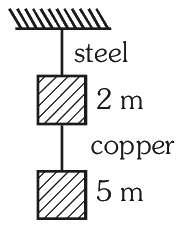
If the ratio of diameters, lengths and Young's modulus of steel and copper wires shown in the figure are p, q and s respectively, then the corresponding ratio of increase in their lengths would be:

Figure for question 15
  1. 15q(7sp2)
  2. 27q(5sp2)
  3. 32q(5sp)
  4. 47q(5sp)
Show answer and solution

Correct: option 2, 7q(5sp2)

The extension is ΔL=FLAY with A∝d2. The steel wire holds both blocks, a load of 7mg, while the copper wire holds only the lower block, 5mg. So ΔLsΔLc=75×qp2s=7q5sp2.