Questions with solutions
Question 1NEET 2026, Q19
In a concave lens, a ray of light emanating from the object parallel to the principal axis of the lens, after refraction:
- 1emerges parallel to the principal axis.
- 2appears to diverge from the first principal focus.
- 3passes through 2F, which is the radius of curvature of the lens.
- 4passes through the second principal focus.
Show answer and solution
Correct: option 2, appears to diverge from the first principal focus.
A concave lens is a diverging lens. A ray parallel to the principal axis bends away from the axis after refraction, and when traced backwards it appears to come from the principal focus on the same side as the object. It does not actually pass through any focus, so option (2) is the correct description.
Question 2NEET 2026, Q23
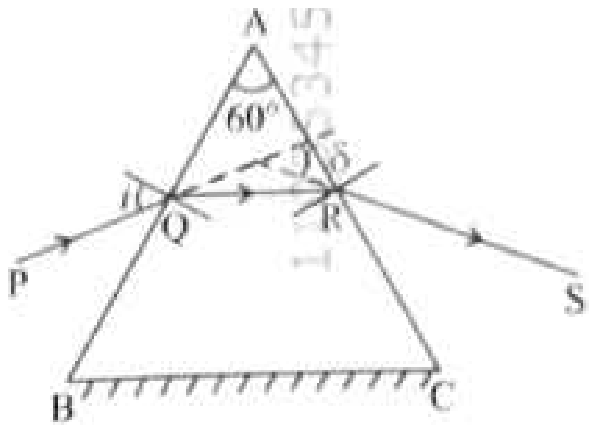
A ray of monochromatic light is passing through an equilateral prism (ABC) as shown in the figure. The refracted ray (QR) is parallel to its base (BC) and the angle of incidence (i) is . Then the angle of deviation () is:
- 1
- 2
- 3
- 4
Show answer and solution
Correct: option 1,
When the ray inside the prism is parallel to the base, the path is symmetric, so the angle of emergence equals the angle of incidence: . The deviation is .
Question 3NEET 2026 Re-exam, Q20
Which of the following measurements require 'index correction'?
- 1Measurement of resistance of a wire using meter bridge
- 2Measurement of gravitational acceleration using simple pendulum
- 3Measurement of focal length of lenses using optical bench
- 4Measurement of speed of sound using resonance tube
Show answer and solution
Correct: option 3, Measurement of focal length of lenses using optical bench
On an optical bench the distances are read from the index marks of the uprights, which need not be in line with the optical centre of the lens or the tips of the needles. The difference between the real distance and the reading is the index correction, applied when finding the focal length of a lens or mirror. The other three experiments use end correction or no such correction, so option (3) is right.
Question 4NEET 2026 Re-exam, Q22
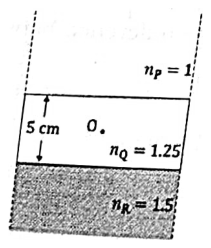
Consider three media P, Q and R with refractive indices 1, 1.25, and 1.5, respectively. The medium Q having a thickness of 5 cm is placed between extended media P and R as shown in the figure. An object O is placed at the center of medium Q. If viewed from medium P near the normal direction, the apparent depth of O is . For similar observation from medium R, the apparent depth is . The value of , in cm, is:
- 10
- 21
- 32
- 43
Show answer and solution
Correct: option 2, 1
The object is 2.5 cm from each face of Q. For near-normal viewing, apparent depth real depth . From P: cm. From R: cm. The difference is 1 cm, option (2).
Question 5NEET 2026 Re-exam, Q29
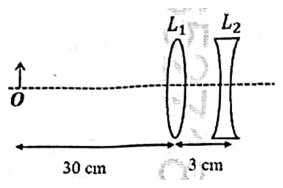
The lens combination as shown in the figure, consists of two lenses, and , of the focal lengths cm and cm, respectively. The position of the image formed is:
- 120 cm to the left of the concave lens
- 260 cm to the left of the concave lens
- 330 cm to the right of the concave lens
- 460 cm to the right of the concave lens
Show answer and solution
Correct: option 2, 60 cm to the left of the concave lens
For : cm, cm, so and cm. This image would lie cm to the right of , so it is a virtual object with cm for the concave lens. Then , so cm: the final image is 60 cm to the left of the concave lens, option (2).
Question 6NEET 2025, Q2
A microscope has an objective of focal length 2 cm, eyepiece of focal length 4 cm and the tube length of 40 cm. If the distance of distinct vision of eye is 25 cm, the magnification in the microscope is
- 1100
- 2125
- 3150
- 4250
Show answer and solution
Correct: option 2, 125
For a compound microscope the magnification is approximately . Here , which is option (2).
Question 7NEET 2025, Q13
In a certain camera, a combination of four similar thin convex lenses are arranged axially in contact. Then the power of the combination and the total magnification in comparison to the power () and magnification () for each lens will be, respectively -
- 1 and
- 2 and
- 3 and
- 4 and
Show answer and solution
Correct: option 3, and
For thin lenses in contact the powers add, so the combination has power . The image of one lens is the object of the next, so the magnifications multiply: . That is option (3).
Question 8NEET 2024, Q6
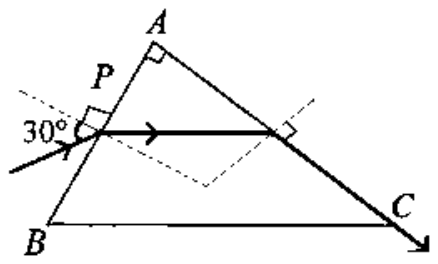
A light ray enters through a right angled prism at point with the angle of incidence as shown in figure. It travels through the prism parallel to its base and emerges along the face . The refractive index of the prism is:
- 1
- 2
- 3
- 4
Show answer and solution
Correct: option 3,
Let the angle of refraction at be and the angle of incidence on face be . The prism angle at is , so . The ray emerges along , so is the critical angle: . At : , so , which gives and , option (3).
Question 9NEET 2024, Q36
A small telescope has an objective of focal length 140 cm and an eye piece of focal length 5.0 cm. The magnifying power of telescope for viewing a distant object is:
- 132
- 234
- 328
- 417
Show answer and solution
Correct: option 3, 28
For a telescope in normal adjustment the magnifying power is , option (3).
Question 10NEET 2024 Re-exam, Q20
Given below are two statements:
Statement I: Image formation needs regular reflection and/or refraction.
Statement II: The variety in colour of objects we see around us is due to the constituent colours of the light incident on them.
In the light of the above statements, choose the most appropriate answer from the options given below:
- 1Statement I is correct but statement II is incorrect
- 2Statement I is incorrect but Statement II is correct
- 3Both Statement I and Statement II are correct
- 4Both Statement I and Statement II are incorrect
Show answer and solution
Correct: option 3, Both Statement I and Statement II are correct
Statement I is correct: an image forms only when rays from a point meet (or appear to meet) at a point again, which needs regular reflection or refraction, not diffuse scattering. Statement II is correct: an object shows the colours it reflects or transmits out of those present in the incident light, so the colours we see depend on the constituent colours of that light. Both statements are correct.
Question 11NEET 2023, Q10
Light travels a distance in time in air and in time in another denser medium. What is the critical angle for this medium?
- 1
- 2
- 3
- 4
Show answer and solution
Correct: option 4,
The speed in air is and in the medium . The refractive index of the medium is , and . So , option (4).
Question 12NEET 2023, Q36
Two thin lenses are of same focal lengths (), but one is convex and the other one is concave. When they are placed in contact with each other, the equivalent focal length of the combination will be:
- 1Zero
- 2
- 3
- 4Infinite
Show answer and solution
Correct: option 4, Infinite
For thin lenses in contact . The power is zero, so the focal length is infinite, option (4).
Question 13NEET 2023, Q41
In the figure shown here, what is the equivalent focal length of the combination of lenses (Assume that all layers are thin)?
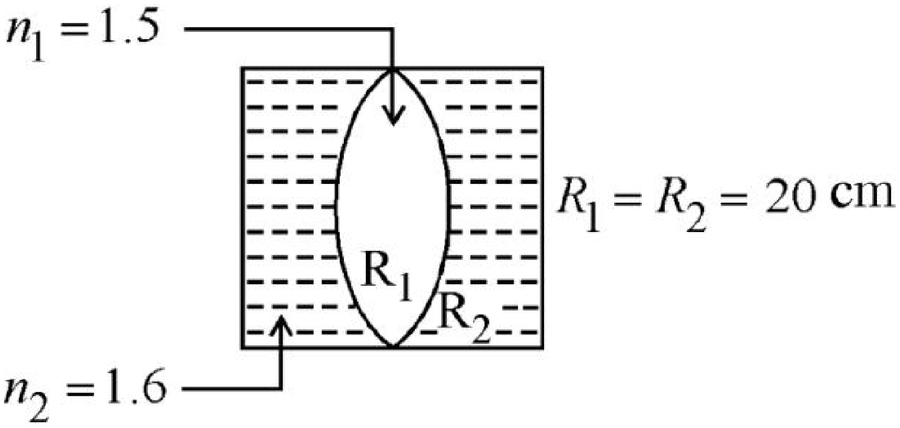
- 140 cm
- 2 cm
- 3 cm
- 4 cm
Show answer and solution
Correct: option 3, cm
The system is three thin lenses in contact: a plano-concave liquid lens (), the equiconvex lens () and another plano-concave liquid lens. For the convex lens . For each liquid lens . Adding, , so cm, option (3).
Question 14NEET 2023 Manipur, Q18
A horizontal ray of light is incident on the right-angled prism with prism angle . If the refractive index of the material of the prism is 1.5, then the angle of emergence will be
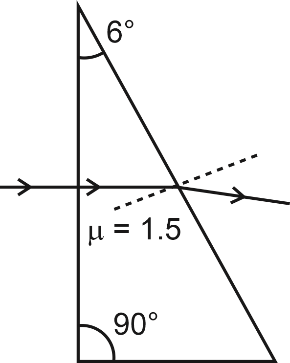
- 1
- 2
- 3
- 4
Show answer and solution
Correct: option 3,
The ray meets the vertical face normally and passes straight in. It then meets the slanted face at an angle of incidence equal to the prism angle, . Snell's law at that face: , and for small angles .
Question 15NEET 2023 Manipur, Q30
A lens is made up of 3 different transparent media as shown in figure. A point object O is placed on its axis beyond . How many real images will be obtained on the other side?
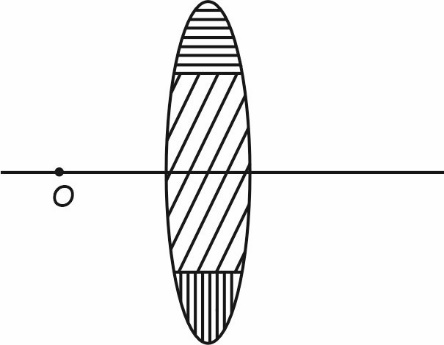
- 1No image will be formed
- 23
- 32
- 41
Show answer and solution
Correct: option 2, 3
The focal length of a lens depends on the refractive index of its material. The three parts of this lens are made of three different media, so they have three different focal lengths and each part forms its own real image of O at a different point on the axis. Three images are obtained.
Question 16NEET 2023 Manipur, Q34
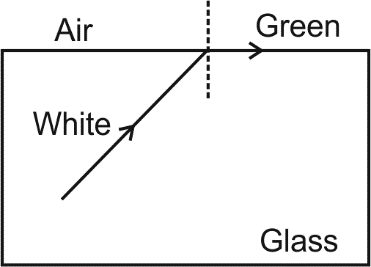
Which set of colours will come out in air for a situation shown in figure?
- 1Orange, Red and Violet
- 2Blue, Green and Yellow
- 3Yellow, Orange and Red
- 4All
Show answer and solution
Correct: option 3, Yellow, Orange and Red
Green light just grazes the surface, so the angle of incidence equals the critical angle for green. Since and is smaller for longer wavelengths, yellow, orange and red have a larger critical angle than green and are refracted out into air. Blue, indigo and violet have a smaller critical angle and are totally internally reflected.
Question 17NEET 2023 Manipur, Q39
An object is mounted on a wall. Its image of equal size is to be obtained on a parallel wall with the help of a convex lens placed between these walls. The lens is kept at distance in front of the second wall. The required focal length of the lens will be
- 1
- 2
- 3Less than
- 4More than but less than
Show answer and solution
Correct: option 1,
A convex lens gives a real image of the same size as the object only when the object is at , and the image is then also at on the other side. The image distance is the distance from the lens to the second wall, so and .
Question 18NEET 2022, Q8
A biconvex lens has radii of curvature, 20 cm each. If the refractive index of the material of the lens is 1.5, the power of the lens is:
- 1infinity
- 2+2 D
- 3+20 D
- 4+5 D
Show answer and solution
Correct: option 4, +5 D
Lens maker's formula with cm and cm: , so cm m. Power D, option (4).
Question 19NEET 2022, Q30
A light ray falls on a glass surface of refractive index , at an angle . The angle between the refracted and reflected rays would be:
- 1
- 2
- 3
- 4
Show answer and solution
Correct: option 4,
Snell's law: , so . The reflected ray makes with the normal. The angle between the reflected and refracted rays is , option (4). (This is incidence at the Brewster angle, since .)
Question 20NEET 2022, Q38
Two transparent media A and B are separated by a plane boundary. The speed of light in those media are m/s and m/s, respectively. The critical angle for a ray of light for these two media is:
- 1
- 2
- 3
- 4
Show answer and solution
Correct: option 3,
Light is slower in A, so A is the denser medium. At the critical angle , so , option (3).
Question 21NEET 2022 Re-exam, Q3
During a cloudy day, a primary and a secondary rainbow may be created, then the:
- 1secondary rainbow is due to single internal reflection and is formed above the primary one.
- 2primary rainbow is due to double internal reflection and is formed above the secondary one.
- 3primary rainbow is due to double internal reflection and is formed below the secondary one.
- 4secondary rainbow is due to double internal reflection and is formed above the primary one.
Show answer and solution
Correct: option 4, secondary rainbow is due to double internal reflection and is formed above the primary one.
The primary rainbow comes from light that is refracted, reflected once inside the raindrop and refracted out. The secondary rainbow comes from two internal reflections; it is fainter, has its colours reversed and is seen at a larger angle, so it lies above the primary one. This is option (4).
Question 22NEET 2022 Re-exam, Q45
An astronomical refracting telescope is being used by an observer to observe planets in normal adjustment. The focal lengths of the objective and eye piece used in the construction of the telescope are 20 m and 2 cm respectively. Consider the following statements about the telescope:
(a) The distance between the objective and eye piece is 20.02 m
(b) The magnification of the telescope is (–) 1000
(c) The image of the planet is erect and diminished
(d) The aperture of eye piece is smaller than that of objective
The correct statements are:
- 1(a), (b) and (d)
- 2(a), (b) and (c)
- 3(b), (c) and (d)
- 4(c), (d) and (a)
Show answer and solution
Correct: option 1, (a), (b) and (d)
In normal adjustment the tube length is m, so (a) is correct. The magnification is , so (b) is correct. The negative sign means the final image is inverted, so (c) is wrong. The objective has a large aperture to gather light while the eye piece is small, so (d) is correct. Option (1).
Question 23NEET 2021, Q5
A lens of large focal length and large aperture is best suited as an objective of an astronomical telescope since:
- 1a large aperture contributes to the quality and visibility of the images.
- 2a large area of the objective ensures better light gathering power.
- 3a large aperture provides a better resolution.
- 4all of the above.
Show answer and solution
Correct: option 4, all of the above.
A wide objective collects more light, so faint objects become visible and images are brighter, and its resolving power rises with the aperture D. A large focal length gives a large magnification . Every statement is true, so the answer is all of the above.
Question 24NEET 2021, Q9
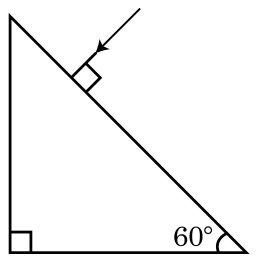
Find the value of the angle of emergence from the prism. Refractive index of the glass is .
- 1
- 2
- 3
- 4
Show answer and solution
Correct: option 1,
The ray enters the slanted face along the normal, so it is not bent there. The third angle of the prism is , so the ray meets the vertical face at an angle of incidence of . Snell's law: , so and .
Question 25NEET 2021, Q11
A convex lens 'A' of focal length 20 cm and a concave lens 'B' of focal length 5 cm are kept along the same axis with a distance 'd' between them. If a parallel beam of light falling on 'A' leaves 'B' as a parallel beam, then the distance 'd' in cm will be:
- 125
- 215
- 350
- 430
Show answer and solution
Correct: option 2, 15
Lens A converges the parallel beam towards its focus, 20 cm behind it. For the beam to leave the concave lens parallel, that point must be the focus of B, 5 cm behind B. So cm (in general with cm).
Question 26NEET 2021, Q37
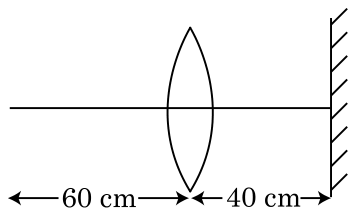
A point object is placed at a distance of 60 cm from a convex lens of focal length 30 cm. If a plane mirror were put perpendicular to the principal axis of the lens and at a distance of 40 cm from it, the final image would be formed at a distance of:
- 120 cm from the lens, it would be a real image.
- 230 cm from the lens, it would be a real image.
- 330 cm from the plane mirror, it would be a virtual image.
- 420 cm from the plane mirror, it would be a virtual image.
Show answer and solution
Correct: option 4, 20 cm from the plane mirror, it would be a virtual image.
The object is at 2f, so the lens alone would form an image 60 cm beyond it, 20 cm behind the mirror. The mirror reflects this to a point 20 cm in front of the mirror, which is 20 cm from the lens. The returning light meets the lens with this point inside the focal length: , a virtual image 60 cm from the lens on the mirror side, that is 20 cm behind the plane mirror.
Question 27NEET 2020, Q165
A ray is incident at an angle of incidence on one surface of a small angle prism (with angle of prism A) and emerges normally from the opposite surface. If the refractive index of the material of the prism is , then the angle of incidence is nearly equal to:
- 1
- 2
- 3
- 4
Show answer and solution
Correct: option 3,
The ray emerges normally, so the angle of incidence inside the prism at the second face is , and since , . Snell's law at the first face gives . For a small-angle prism both angles are small, so .
Question 28NEET 2020 Phase 2, Q98
An object is placed on the principal axis of a concave mirror at a distance of ( is the focal length). The image will be at,
- 1
- 2
- 3
- 4
Show answer and solution
Correct: option 4,
With the sign convention, the object distance is and the focal length of the concave mirror is . The mirror formula gives , so . The image is real, in front of the mirror.
Question 29NEET 2020 Phase 2, Q114
If the critical angle for total internal reflection from a medium to vacuum is , then velocity of light in the medium is,
- 1
- 2
- 3
- 4
Show answer and solution
Correct: option 1,
The refractive index of the medium is . The speed of light in it is .
Question 30NEET 2020 Phase 2, Q122
A plano-convex lens of unknown material and unknown focal length is given. With the help of a spherometer we can measure the,
- 1radius of curvature of the curved surface
- 2aperture of the lens
- 3refractive index of the material
- 4focal length of the lens
Show answer and solution
Correct: option 1, radius of curvature of the curved surface
A spherometer measures the height of a curved surface above the plane of its three legs, which are a distance apart. From this the radius of curvature is found: . It cannot give the refractive index or the focal length on its own.
Question 31NEET 2020 Phase 2, Q123
The power of a biconvex lens is 10 dioptre and the radius of curvature of each surface is 10 cm. Then the refractive index of the material of the lens is,
- 1
- 2
- 3
- 4
Show answer and solution
Correct: option 3,
By the lens maker's formula, for a biconvex lens with equal radii. With and : , so .
Question 32NEET 2019, Q11
Two similar thin equi-convex lenses, of focal length each, are kept coaxially in contact with each other such that the focal length of the combination is . When the space between the two lenses is filled with glycerin (which has the same refractive index () as that of glass) then the equivalent focal length is . The ratio will be:
- 12 : 1
- 21 : 2
- 32 : 3
- 43 : 4
Show answer and solution
Correct: option 2, 1 : 2
Two lenses in contact: , so . The glycerin fills a biconcave gap with the same radii and the same index, so it acts as a lens of focal length . Then , so and .
Question 33NEET 2019, Q15
Pick the wrong answer in the context with rainbow.
- 1When the light rays undergo two internal reflections in a water drop, a secondary rainbow is formed.
- 2The order of colours is reversed in the secondary rainbow.
- 3An observer can see a rainbow when his front is towards the sun.
- 4Rainbow is a combined effect of dispersion, refraction and reflection of sunlight.
Show answer and solution
Correct: option 3, An observer can see a rainbow when his front is towards the sun.
A rainbow is seen only when the sun is behind the observer, because the drops send the light back towards the side the sun is on. So the statement that the observer faces the sun is wrong. The other three statements are correct: two internal reflections give the secondary bow, its colours are reversed, and the rainbow comes from dispersion, refraction and reflection together.
Question 34NEET 2019, Q28
In total internal reflection when the angle of incidence is equal to the critical angle for the pair of media in contact, what will be angle of refraction?
- 1
- 2
- 3equal to angle of incidence
- 4
Show answer and solution
Correct: option 4,
The critical angle is defined as the angle of incidence in the denser medium for which the refracted ray just grazes the interface, that is, the angle of refraction is .
Question 35NEET 2019 Odisha, Q37
An equiconvex lens has power . It is cut into two symmetrical halves by a plane containing the principal axis. The power of one part will be,
- 1
- 2
- 30
- 4
Show answer and solution
Correct: option 2,
A cut along a plane containing the principal axis leaves both curved surfaces of each half with the same radii of curvature and the same refractive index. By the lens maker's formula the focal length is unchanged, so the power of each part is still (only the aperture and brightness are reduced).
Question 36NEET 2019 Odisha, Q39
A double convex lens has focal length 25 cm. The radius of curvature of one of the surfaces is double of the other. Find the radii if the refractive index of the material of the lens is 1.5.
- 118.75 cm, 37.5 cm
- 250 cm, 100 cm
- 3100 cm, 50 cm
- 425 cm, 50 cm
Show answer and solution
Correct: option 1, 18.75 cm, 37.5 cm
Lens maker's formula with radii and : . So cm and cm.
Question 37NEET 2018, Q10
An astronomical refracting telescope will have large angular magnification and high angular resolution, when it has an objective lens of
- 1large focal length and large diameter
- 2large focal length and small diameter
- 3small focal length and large diameter
- 4small focal length and small diameter
Show answer and solution
Correct: option 1, large focal length and large diameter
Angular magnification is , so a large objective focal length gives large magnification. The smallest angle resolved is , so a large diameter D gives high resolution. Hence large focal length and large diameter.
Question 38NEET 2018, Q19
The refractive index of the material of a prism is and the angle of the prism is . One of the two refracting surfaces of the prism is made a mirror inwards, by silver coating. A beam of monochromatic light entering the prism from the other face will retrace its path (after reflection from the silvered surface) if its angle of incidence on the prism is
- 1
- 2
- 3
- 4zero
Show answer and solution
Correct: option 2,
To retrace its path the ray must hit the silvered face normally, so the angle of incidence there is zero and the angle of refraction at the first face is . Snell's law gives , so .
Question 39NEET 2018, Q20
An object is placed at a distance of 40 cm from a concave mirror of focal length 15 cm. If the object is displaced through a distance of 20 cm towards the mirror, the displacement of the image will be
- 130 cm towards the mirror
- 236 cm away from the mirror
- 330 cm away from the mirror
- 436 cm towards the mirror
Show answer and solution
Correct: option 2, 36 cm away from the mirror
Mirror formula with cm. For cm: , so cm. For cm: , so cm. The image moves from 24 cm to 60 cm, that is 36 cm away from the mirror.
Question 40NEET 2017, Q33
The ratio of resolving powers of an optical microscope for two wavelengths Å and Å is:
- 18 : 27
- 29 : 4
- 33 : 2
- 416 : 81
Show answer and solution
Correct: option 3, 3 : 2
The resolving power of a microscope is , so it is inversely proportional to the wavelength. The ratio is .
Question 41NEET 2017, Q42
A beam of light from a source L is incident normally on a plane mirror fixed at a certain distance from the source. The beam is reflected back as a spot on a scale placed just above the source L. When the mirror is rotated through a small angle , the spot of the light is found to move through a distance on the scale. The angle is given by:
- 1
- 2
- 3
- 4
Show answer and solution
Correct: option 1,
When a mirror turns through , the reflected ray turns through . For a small angle the spot moves on the scale at distance x. So .
Question 42NEET 2017, Q44
A thin prism having refracting angle 10° is made of glass of refractive index 1.42. This prism is combined with another thin prism of glass of refractive index 1.7. This combination produces dispersion without deviation. The refracting angle of second prism should be:
- 14°
- 26°
- 38°
- 410°
Show answer and solution
Correct: option 2, 6°
A thin prism deviates light by . For no net deviation the two deviations must be equal and opposite: . So .
Question 43NEET 2016 Phase 1, Q22
The angle of incidence for a ray of light at a refracting surface of a prism is 45°. The angle of prism is 60°. If the ray suffers minimum deviation through the prism, the angle of minimum deviation and refractive index of the material of the prism respectively, are:
- 1
- 2
- 3
- 4
Show answer and solution
Correct: option 2,
At minimum deviation , so and . Then .
Question 44NEET 2016 Phase 1, Q32
A astronomical telescope has objective and eyepiece of focal lengths 40 cm and 4 cm respectively. To view an object 200 cm away from the objective, the lenses must be separated by a distance:
- 137.3 cm
- 246.0 cm
- 350.0 cm
- 454.0 cm
Show answer and solution
Correct: option 4, 54.0 cm
For the objective, , so the image forms 50 cm behind it. For relaxed viewing this image lies at the focus of the eyepiece, so the separation is cm.
Question 45NEET 2016 Phase 1, Q44
Match the corresponding entries of column 1 with column 2. [Where m is the magnification produced by the mirror]
| Column 1 | Column 2 |
|---|
| (A) | (a) Convex mirror |
| (B) | (b) Concave mirror |
| (C) | (c) Real image |
| (D) | (d) Virtual image |
- 1A-b and c, B-b and c, C-b and d, D-a and d
- 2A-a and c, B-a and d, C-a and b, D-c and d
- 3A-a and d, B-b and c, C-b and d, D-b and c
- 4A-c and d, B-b and d, C-b and c, D-a and d
Show answer and solution
Correct: option 1, A-b and c, B-b and c, C-b and d, D-a and d
Negative magnification means an inverted, real image, which only a concave mirror forms: A and B are concave mirror and real image. An erect, enlarged image () is the virtual image of a concave mirror, so C is concave mirror and virtual image. An erect, diminished image () is the virtual image of a convex mirror, so D is convex mirror and virtual image.
Question 46NEET 2016 Phase 2, Q34
Two identical glass () equiconvex lenses of focal length each are kept in contact. The space between the two lenses is filled with water (). The focal length of the combination is
- 1
- 2
- 3
- 4
Show answer and solution
Correct: option 4,
For each glass lens , so . The water between them forms a biconcave lens with the same radii: . For thin lenses in contact, , so , option (4).
Question 47NEET 2016 Phase 2, Q35
An air bubble in a glass slab with refractive index 1.5 (near normal incidence) is 5 cm deep when viewed from one surface and 3 cm deep when viewed from the opposite face. The thickness (in cm) of the slab is
- 18
- 210
- 312
- 416
Show answer and solution
Correct: option 3, 12
Real depth = refractive index apparent depth. The bubble's real distances from the two faces are cm and cm. The thickness of the slab is their sum, cm, option (3).
Question 48NEET 2016 Phase 2, Q37
A person can see clearly objects only when they lie between 50 cm and 400 cm from his eyes. In order to increase the maximum distance of distinct vision to infinity, the type and power of the correcting lens, the person has to use, will be
- 1convex, +2.25 diopter
- 2concave, diopter
- 3concave, diopter
- 4convex, +0.15 diopter
Show answer and solution
Correct: option 2, concave, diopter
The far point is at 400 cm, so the lens must form the image of an object at infinity at 400 cm in front of the eye: , cm. Then , so m and D. A negative power means a concave lens, option (2).
Question 49AIPMT 2015, Q151
The refracting angle of a prism is A, and refractive index of the material of the prism is . The angle of minimum deviation is:-
- 1
- 2
- 3
- 4
Show answer and solution
Correct: option 1,
At minimum deviation . Putting gives . So and , option (1).
Question 50AIPMT 2015, Q157
Two identical thin plano-convex glass lenses (refractive index 1.5) each having radius of curvature of 20 cm are placed with their convex surfaces in contact at the centre. The intervening space is filled with oil of refractive index 1.7. The focal length of the combination is:-
- 1
- 2
- 3
- 4
Show answer and solution
Correct: option 2,
Treat the system as three thin lenses in contact. Each plano-convex glass lens has . The oil between the convex faces forms a biconcave lens with both radii 20 cm: . Adding powers, , so , option (2).
Question 51AIPMT 2015 Re-test, Q177
In an astronomical telescope in normal adjustment a straight black line of length L is drawn on inside part of objective lens. The eye-piece forms a real image of this line. The length of this image is I. The magnification of the telescope is:
- 1
- 2
- 3
- 4
Show answer and solution
Correct: option 1,
In normal adjustment the lenses are apart, so the line on the objective is an object at distance from the eye-piece. From the lens formula, , so and the size ratio is . The telescope's magnification is .
Question 52AIPMT 2015 Re-test, Q180
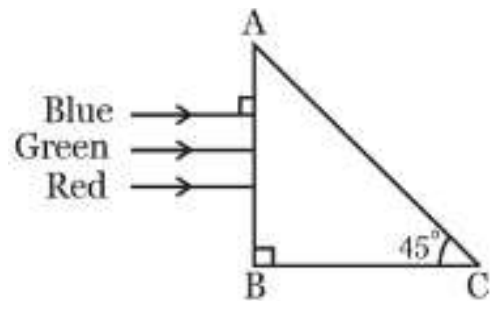
A beam of light consisting of red, green and blue colours is incident on a right angled prism. The refractive index of the material of the prism for the above red, green and blue wavelengths are 1.39, 1.44 and 1.47, respectively.
- 1separate the red colour part from the green and blue colours
- 2separate the blue colour part from the red and green colours
- 3separate all the three colours from one another
- 4not separate the three colours at all
Show answer and solution
Correct: option 1, separate the red colour part from the green and blue colours
The beam enters face AB normally and meets the slanted face AC at . Total internal reflection needs , that is . Green (1.44) and blue (1.47) satisfy this and are totally reflected, while red (1.39) does not and passes out through AC. So red is separated from green and blue.
Question 53AIPMT 2014, Q120
If the focal length of objective lens is increased then magnifying power of:
- 1microscope will decrease but that of telescope will increase.
- 2microscope will increase but that of telescope decrease.
- 3microscope and telescope both will increase.
- 4microscope and telescope both will decrease.
Show answer and solution
Correct: option 1, microscope will decrease but that of telescope will increase.
For a compound microscope the magnifying power is about , so a longer objective focal length lowers it. For a telescope it is , so a longer raises it. That is option (1).
Question 54AIPMT 2014, Q126
The angle of a prism is 'A'. One of its refracting surfaces is silvered. Light rays falling at an angle of incidence 2A on the first surface returns back through the same path after suffering reflection at the silvered surface. The refractive index , of the prism is:
- 1
- 2
- 3
- 4
Show answer and solution
Correct: option 3,
To retrace its path the ray must meet the silvered face at right angles, so the angle of incidence there is zero and the angle of refraction at the first face is . Snell's law at the first face: , so , option (3).
Question 55NEET 2013, Q169
A plano convex lens fits exactly into a plano concave lens. Their plane surfaces are parallel to each other. If lenses are made of different materials of refractive indices and and R is the radius of curvature of the curved surface of the lenses, then the focal length of the combination is:
- 1
- 2
- 3
- 4
Show answer and solution
Correct: option 2,
The plano-convex lens has and the plano-concave lens has . For lenses in contact the powers add: , so .
Question 56NEET 2013, Q177
For a normal eye, the cornea of eye provides a converging power of 40 D and the least converging power of the eye lens behind the cornea is 20 D. Using this information, the distance between the retina and the cornea - eye lens can be estimated to be:
- 12.5 cm
- 21.67 cm
- 31.5 cm
- 45 cm
Show answer and solution
Correct: option 2, 1.67 cm
With the eye lens at its least power the eye is relaxed and focuses parallel rays from a distant object on the retina. The total power is D, so the focal length, which equals the distance to the retina, is cm.
Question 57NEET 2013 Karnataka, Q155
The reddish appearance of the sun at sunrise and sunset is due to:
- 1the scattering of light
- 2the polarisation of light
- 3the colour of the sun
- 4the colour of the sky
Show answer and solution
Correct: option 1, the scattering of light
At sunrise and sunset the light travels a long path through the atmosphere. Rayleigh scattering () removes most of the blue from the direct beam, so the light that reaches the eye is mainly red.
Question 58NEET 2013 Karnataka, Q178
Two plane mirrors are inclined at 70°. A ray incident on one mirror at angle, after reflection falls on second mirror and is reflected from there parallel to first mirror. The value of is:
- 145°
- 230°
- 355°
- 450°
Show answer and solution
Correct: option 4, 50°
The final ray is parallel to the first mirror, so it makes 70° with the second mirror; by the law of reflection the ray arriving at the second mirror also makes 70° with it. In the triangle formed by the two mirrors and this ray, the ray makes with the first mirror. The angle of incidence, measured from the normal, is .
Question 59AIPMT 2012 Prelims, Q13
When a biconvex lens of glass having refractive index 1.47 is dipped in a liquid, it acts as a plane sheet of glass. This implies that the liquid must have refractive index.
- 1equal to that of glass
- 2less than one
- 3greater than that of glass
- 4less than that of glass
Show answer and solution
Correct: option 1, equal to that of glass
By the lens maker's formula . A plane sheet has infinite focal length, so , which needs : the liquid has the same refractive index as the glass and light is not bent at the surfaces.
Question 60AIPMT 2012 Prelims, Q34
A ray of light is incident at an angle of incidence, i, on one face of prism of angle A (assumed to be small) and emerges normally from the opposite face. If the refractive index of the prism is , the angle of incidence i, is nearly equal to:
- 1
- 2
- 3
- 4
Show answer and solution
Correct: option 1,
The ray leaves the second face normally, so the angle of incidence inside at that face is , and since , . Snell's law at the first face gives , and for small angles .
Question 61AIPMT 2012 Prelims, Q36
A concave mirror of focal length '' is placed at a distance of 'd' from a convex lens of focal length ''. A beam of light coming from infinity and falling on this convex lens – concave mirror combination returns to infinity. The distance 'd' must equal:
- 1
- 2
- 3
- 4
Show answer and solution
Correct: option 3,
The lens brings the parallel beam to its focus, a distance behind it. For the light to go back as a parallel beam it must retrace its path, so the rays must meet the mirror normally, which happens when that focus is at the mirror's centre of curvature, in front of the mirror. Hence .
Question 62AIPMT 2012 Prelims, Q48
The magnifying power of a telescope is 9. When it is adjusted for parallel rays the distance between the objective and eyepiece is 20 cm. The focal length of lenses are:
- 110 cm, 10 cm
- 215 cm, 5 cm
- 318 cm, 2 cm
- 411 cm, 9 cm
Show answer and solution
Correct: option 3, 18 cm, 2 cm
For a telescope in normal adjustment the magnifying power is and the tube length is . So , giving and .
Question 63AIPMT 2012 Mains, Q23
For the angle of minimum deviation of a prism to be equal to its refracting angle, the prism must be made of a material whose refractive index:
- 1lies between and 1
- 2lies between 2 and
- 3is less than 1
- 4is greater than 2
Show answer and solution
Correct: option 2, lies between 2 and
With , the prism formula gives . At minimum deviation the angle of incidence is , which must lie between 0° and 90°. So lies between 1 and , and n lies between 2 and .
Question 64AIPMT 2012 Mains, Q24
A rod of length 10 cm lies along the principal axis of a concave mirror of focal length 10 cm in such a way that its end closer to the pole is 20 cm away from the mirror. The length of the image is:
- 110 cm
- 215 cm
- 32.5 cm
- 45 cm
Show answer and solution
Correct: option 4, 5 cm
The near end is at 20 cm, which is the centre of curvature (), so its image is also at 20 cm. The far end is at 30 cm: , so its image is at 15 cm from the mirror. The image of the rod stretches from 15 cm to 20 cm, a length of 5 cm.
Question 65AIPMT 2011 Prelims, Q154
Which of the following is not due to total internal reflection?
- 1working of optical fibre
- 2difference between apparent and real depth of pond
- 3mirage on hot summer days
- 4brilliance of diamond
Show answer and solution
Correct: option 2, difference between apparent and real depth of pond
A pond looks shallower than it is because light bends on leaving the water, which is ordinary refraction. Optical fibres, mirages and the sparkle of a diamond all depend on total internal reflection.
Question 66AIPMT 2011 Prelims, Q185
A biconvex lens has a radius of curvature of magnitude 20 cm. Which one of the following options describe best the image formed of an object of height 2 cm placed 30 cm from the lens?
- 1Virtual, upright, height = 1 cm
- 2Virtual, upright, height = 0.5 cm
- 3Real, inverted, height = 4 cm
- 4Real, inverted, height = 1cm
Show answer and solution
Correct: option 3, Real, inverted, height = 4 cm
The refractive index is not given; taking the usual value 1.5 for glass, , so cm. With cm: , so cm, a real image. Magnification , so the image is inverted and cm high.
Question 67AIPMT 2011 Mains, Q106
A thin prism of angle 15° made of glass of refractive index is combined with another prism of glass of refractive index . The combination of the prism produces dispersion without deviation. The angle of the second prism should be:
- 17°
- 210°
- 312°
- 45°
Show answer and solution
Correct: option 2, 10°
A thin prism deviates light by . For no net deviation the two prisms, placed opposite to each other, must give equal deviations: , so .
Question 68AIPMT 2011 Mains, Q119
A converging beam of rays is incident on a diverging lens. Having passed through the lens the rays intersect at a point 15 cm from the lens on the opposite side. If the lens is removed the point where the rays meets will move 5 cm closer to the lens. The focal length of the lens is:
- 1- 10 cm
- 220 cm
- 3- 30 cm
- 45 cm
Show answer and solution
Correct: option 3, - 30 cm
Without the lens the rays would meet 10 cm behind it, so that point is a virtual object with cm. With the lens the image is at cm. The lens formula gives , so cm.
Question 69AIPMT 2010 Mains, Q8
The speed of light in media and are m/s and m/s respectively. A ray of light enters from medium to at an incidence angle i. If the ray suffers total internal reflection, the value of i is
- 1Equal to
- 2Equal to or less than
- 3Equal to or greater than
- 4Less than
Show answer and solution
Correct: option 3, Equal to or greater than
Light is slower in , so is the denser medium and total internal reflection is possible on going from to . The critical angle is given by . Total internal reflection needs the angle of incidence to be at least the critical angle, .
Question 70AIPMT 2010 Mains, Q9
A ray of light is incident on a 60° prism at the minimum deviation position. The angle of refraction at the first face (i.e., incident face) of the prism is
- 1zero
- 230°
- 345°
- 460°
Show answer and solution
Correct: option 2, 30°
For a prism . At minimum deviation the ray passes symmetrically, so .
Question 71AIPMT 2010 Prelims, Q9
A ray of light travelling in a transparent medium of refractive index , falls on a surface separating the medium from air at an angle of incidence of 45°. For which of the following value of the ray can undergo total internal reflection?
- 1
- 2
- 3
- 4
Show answer and solution
Correct: option 3,
Total internal reflection needs the angle of incidence to exceed the critical angle, , that is . Of the given values only is larger than 1.414.
Question 72AIPMT 2010 Prelims, Q35
A lens having focal length f and aperture of diameter d forms an image of intensity I. Aperture of diameter in central region of lens is covered by a black paper. Focal length of lens and intensity of image now will be respectively
- 1f and
- 2 and
- 3f and
- 4 and
Show answer and solution
Correct: option 3, f and
Covering part of a lens does not change its curvature or material, so the focal length stays f. The intensity of the image is proportional to the area that lets light through. The covered disc has half the diameter, so it is of the area; the remaining of the area gives intensity .
Question 73AIPMT 2008 Prelims, Q23
Two thin lenses of focal lengths and are in contact and coaxial. The power of the combinations is
- 1
- 2
- 3
- 4
Show answer and solution
Correct: option 1,
Powers of thin lenses in contact add: .
Question 74AIPMT 2008 Prelims, Q24
A boy is trying to start a fire by focusing Sunlight on a piece of paper using an equiconvex lens of focal length 10 cm. The diameter of the Sun is m and its mean distance from the earth is m. What is the diameter of the Sun's image on the paper?
- 1 m
- 2 m
- 3 m
- 4 m
Show answer and solution
Correct: option 2, m
The Sun is so far away that its image forms in the focal plane, 10 cm from the lens. Object and image subtend the same angle at the lens, so and m.
Question 75AIPMT 2007 Prelims, Q167
The frequency of a light wave in a material is Hz and wavelength is 5000 Å. The refractive index of material will be
- 11.33
- 21.40
- 31.50
- 43.00
Show answer and solution
Correct: option 4, 3.00
Speed of light in the material is . The refractive index is , option (4).
Question 76AIPMT 2006 Prelims, Q18
A microscope is focused on a mark on a piece of paper and then a slab of glass of thickness 3 cm and refractive index 1.5 is placed over the mark. How should the microscope be moved to get the mark in focus again:-
- 11 cm upward
- 24.5 cm downward
- 31 cm downward
- 42 cm upward
Show answer and solution
Correct: option 1, 1 cm upward
Seen through the slab the mark appears raised by . The image is 1 cm nearer the microscope, so the microscope must be raised by 1 cm to keep the same working distance.
Question 77AIPMT 2006 Prelims, Q42
A convex lens and a concave lens, each having same focal length of 25 cm, are put in contact to form a combination of lenses. The power in diopters of the combination is:-
- 125
- 250
- 3Infinite
- 4Zero
Show answer and solution
Correct: option 4, Zero
Powers of thin lenses in contact add. The convex lens has and the concave lens , so the combination has power (its focal length is infinite).
Question 78AIPMT 2004 Prelims, Q11
A beam of light composed of red and green rays is incident obliquely at a point on the face of a rectangular glass slab. When coming out on the opposite parallel face, the red and green rays emerge from:-
- 1Two points propagating in two different parallel directions
- 2One point propagating in two different directions through slab
- 3One point propagating in the same direction through slab
- 4Two points propagating in two different non parallel directions
Show answer and solution
Correct: option 1, Two points propagating in two different parallel directions
Glass has different refractive indices for red and green, so the two colours are refracted by different angles inside the slab and reach the opposite face at two different points. Each ray leaves a parallel-sided slab parallel to its incident direction, and the incident direction is the same for both, so the two emergent rays are parallel to each other.
Question 79AIPMT 2004 Prelims, Q13
The refractive index of the material of a prism is and its refracting angle is . One of the refracting surfaces of the prism is made a mirror inwards. A beam of monochromatic light entering the prism from the other face will retrace its path after reflection from the mirrored surface if its angle of incidence on the prism is:-
- 1
- 2
- 3
- 4
Show answer and solution
Correct: option 4,
To retrace its path the ray must strike the mirrored face normally, so and . Snell's law at the first face gives , so .
Question 80AIPMT 2003 Prelims, Q14
A convex lens is dipped in a liquid whose refractive index is equal to the refractive index of the lens. Then its focal length will
- 1Become zero
- 2Become infinite
- 3Become small, but non-zero
- 4Remain unchanged
Show answer and solution
Correct: option 2, Become infinite
By the lens maker's formula . When the two refractive indices are equal the first bracket is zero, so and the focal length becomes infinite: light passes through without bending.
Question 81AIPMT 2003 Prelims, Q19
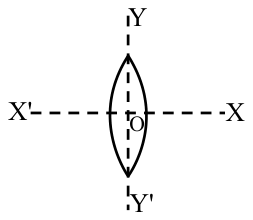
A equiconvex lens is cut into two halves along (i) XOX' and (ii) YOY' as shown in the figure. Let f, f' f" be the focal lengths of the complete lens, of each half in case (i), and of each half in case (ii), respectively
Choose the correct statement from the following-
- 1f' = f, f" = 2f
- 2f' = 2f, f" = f
- 3f' = f, f" = f
- 4f' = 2f, f" = 2f
Show answer and solution
Correct: option 1, f' = f, f" = 2f
Cutting along XOX' (the principal axis) leaves both curved surfaces with the same radii, so each half still has focal length f' = f. Cutting along YOY' gives two plano-convex lenses, each with only one curved surface and so half the power: from for the whole lens, each half has as its power, so f" = 2f.
Question 82AIPMT 2002 Prelims, Q4
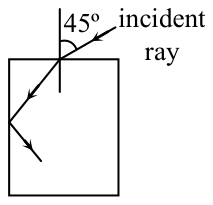
For the given incident ray as shown in figure, the condition of total internal reflection of this ray the minimum refractive index of prism will be:-
- 1
- 2
- 3
- 4
Show answer and solution
Correct: option 3,
At the top face , so . The refracted ray meets the vertical side face at angle of incidence , and total internal reflection needs . Squaring, , which gives , so the minimum is .
Question 83AIPMT 2002 Prelims, Q15
A bulb is located on a wall. Its image is to be obtained on a parallel wall with the help of convex lens. If the distance between parallel walls is 'd' then required focal length of lens placed in between the walls is:-
- 1Only
- 2Only
- 3More than but less than
- 4Less than or equal to
Show answer and solution
Correct: option 4, Less than or equal to
For a convex lens the least distance between a real object and its real image is . A real image on the other wall is possible only if , that is .
Question 84AIPMT 2001 Prelims, Q21
A disc is placed on a surface of pond which has refractive index . A source of light is placed 4 m below the surface of liquid. The minimum radius of disc will be so light is not coming out
- 1
- 23m
- 36m
- 44m
Show answer and solution
Correct: option 2, 3m
Light escapes only inside a cone of half-angle equal to the critical angle , where , so . The disc must cover the circle of radius m; rays beyond it are totally internally reflected.
Question 85AIPMT 2001 Prelims, Q22
A ray of light travelling in air has wavelength , frequency n, velocity v and intensity I. If this ray enters into water then these parameter are , n', v' and I' respectively. Which relation is correct
- 1
- 2n = n'
- 3v = v'
- 4I = I'
Show answer and solution
Correct: option 2, n = n'
Frequency is fixed by the source and does not change when light passes from one medium to another, so n = n'. The speed and wavelength both fall in water, and the intensity falls because part of the light is reflected at the surface.
Question 86AIPMT 2001 Prelims, Q25
Optical fibre are based on:
- 1Total internal reflection
- 2Less scattering
- 3Refraction
- 4Less absorption coefficient
Show answer and solution
Correct: option 1, Total internal reflection
Light entering the denser core of a fibre strikes the core-cladding boundary at more than the critical angle and is totally internally reflected again and again, so it is guided along the fibre with very little loss.
Question 87AIPMT 2000 Prelims, Q11
Rainbow is formed due to:
- 1Scattering & refraction
- 2Total internal reflection & dispersion
- 3Reflection only
- 4Diffraction and dispersion
Show answer and solution
Correct: option 2, Total internal reflection & dispersion
Sunlight entering a raindrop is refracted and split into colours (dispersion), reflected internally at the back of the drop, and refracted out again. Of the choices, internal reflection with dispersion describes this.
Question 88AIPMT 2000 Prelims, Q13
For a plane convex lens () has radius of curvature 10 cm. It is silvered on its plane surface. Find focal length after silvering:
- 110 cm
- 220 cm
- 315 cm
- 425 cm
Show answer and solution
Correct: option 1, 10 cm
Focal length of the lens: , so cm. With the plane face silvered, light passes through the lens twice and reflects from a plane mirror (infinite focal length), so and cm.
Question 89AIPMT 2000 Prelims, Q42
A tall man of height 6 feet, want to see his full image. Then required minimum length of the mirror will be:
- 112 feet
- 23 feet
- 36 feet
- 4Any length
Show answer and solution
Correct: option 2, 3 feet
In a plane mirror, a ray from the feet (or the top of the head) reaches the eye after reflecting at a point midway in height between the eye and the feet (or head). So the mirror needs to be only half the person's height: feet.
Question 90AIPMT 2000 Prelims, Q49
A bubble in glass slab () when viewed from one side appears at 5 cm and 2 cm from other side, then thickness of slab is:
- 13.75 cm
- 23 cm
- 310.5 cm
- 42.5 cm
Show answer and solution
Correct: option 3, 10.5 cm
Real depth apparent depth. The real distances of the bubble from the two faces are cm and cm, so the thickness is cm.
Question 91AIPMT 1999 Prelims, Q38
For a prism its refractive index is cot A/2 then minimum angle of deviation is:
- 1180 – A
- 2180 – 2A
- 390 – A
- 4A/2
Show answer and solution
Correct: option 2, 180 – 2A
At minimum deviation . Setting this equal to gives . So and .
Question 92AIPMT 1999 Prelims, Q49
In compound microscope the magnification is 95, and the distance of object from objective lens 1/3.8 cm and focal length of objective is cm. What is the magnification of eye pieces when final image is formed at least distance of distinct vision:
- 15
- 210
- 3100
- 4None
Show answer and solution
Correct: option 1, 5
For the objective, with cm and cm: , so cm. The magnification of the objective is . Total magnification = objective × eyepiece, so the eyepiece gives .
Question 93AIPMT 1998 Prelims, Q19
Light enters at an angle of incidence in a transparent rod of refractive index n. For what value of the refractive index of the material of the rod, the light once entered into it will not leave it through its lateral face whatsoever be the value of angle of incidence:
- 1
- 21.0
- 31.3
- 41.4
Show answer and solution
Correct: option 1,
If the ray is refracted at angle r at the end face, it meets the lateral face at , and this must exceed the critical angle: . The hardest case is grazing incidence, where . Then gives . So the rod traps all the light when n is greater than (about 1.414), which none of the other values satisfies.