Questions with solutions
Question 1NEET 2026 Re-exam, Q24
The temperature of a metallic sphere of radius R is increased by a small amount . If the linear coefficient of thermal expansion of the metal is , the approximate increase in the volume of the sphere is:
- 1
- 2
- 3
- 4
Show answer and solution
Correct: option 3,
The coefficient of volume expansion is , so , option (3).
Question 2NEET 2025, Q19
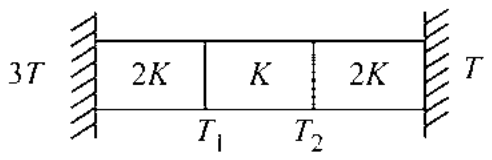
Three identical heat conducting rods are connected in series as shown in the figure. The rods on the sides have thermal conductivity while that in the middle has thermal conductivity . The left end of the combination is maintained at temperature and the right end at . The rods are thermally insulated from outside. In steady state, temperature at the left junction is and that at the right junction is . The ratio is
- 1
- 2
- 3
- 4
Show answer and solution
Correct: option 3,
Thermal resistance is , so if the middle rod has resistance the side rods have each, and the total is . The same heat current flows through all three, so the total drop of divides as , and . Hence and , giving , option (3).
Question 3NEET 2024, Q43
A metallic bar of Young's modulus, and coefficient of linear thermal expansion , length 1 m and area of cross-section is heated from C to C without expansion or bending. The compressive force developed in it is:
- 1 N
- 2 N
- 3 N
- 4 N
Show answer and solution
Correct: option 3, N
The bar is not allowed to expand, so the thermal strain is cancelled by a compressive strain. The force is N N, option (3).
Question 4NEET 2024 Re-exam, Q23
Given below are two statements: One is labelled as Assertion A and the other is labelled as Reason R.
Assertion A: Houses made of concrete roofs overlaid with foam keep the room hotter during summer.
Reason R: The layer of foam insulation prohibits heat transfer, as it contains air pockets.
In the light of the above statements, choose the correct answer from the options given below.
- 1A is true but R is false.
- 2A is false but R is true.
- 3Both A and R are true and R is the correct explanation of A.
- 4Both A and R true but R is NOT the correct explanation of A.
Show answer and solution
Correct: option 2, A is false but R is true.
Foam holds trapped air, and air is a poor conductor of heat, so the foam layer cuts down the heat conducted through the roof: R is true. For that very reason the room stays cooler in summer, not hotter, so A is false.
Question 5NEET 2024 Re-exam, Q26
Water is used as a coolant in a nuclear reactor because of its
- 1high thermal expansion coefficient
- 2high specific heat capacity
- 3low density
- 4low boiling point
Show answer and solution
Correct: option 2, high specific heat capacity
A coolant must carry away a lot of heat without its own temperature rising much. Water has a very high specific heat capacity, so a given mass absorbs a large amount of heat for a small rise in temperature.
Question 6NEET 2022 Re-exam, Q41
Two rods one made of copper and other made of steel of same length and same cross sectional area are joined together. The thermal conductivity of copper and steel are 385 J s K m and 50 J s K m respectively. The free ends of copper and steel are held at 100°C and 0°C respectively. The temperature at the junction is, nearly:
- 188.5°C
- 212°C
- 350°C
- 473°C
Show answer and solution
Correct: option 1, 88.5°C
In the steady state the same heat current flows through both rods. With equal lengths and areas, , so °C, option (1). The junction is close to the copper end's temperature because copper conducts far better.
Question 7NEET 2021, Q28
A cup of coffee cools from to in t minutes, when the room temperature is . The time taken by a similar cup of coffee to cool from to at a room temperature same at is:
- 1
- 2
- 3
- 4
Show answer and solution
Correct: option 2,
Newton's law of cooling in average form: . First case: . Second case: . Dividing, , so .
Question 8NEET 2020, Q173
The quantities of heat required to raise the temperature of two solid copper spheres of radii and () through 1 K are in the ratio:
- 1
- 2
- 3
- 4
Show answer and solution
Correct: option 1,
Heat needed is . Both spheres are copper (same specific heat and density) and the temperature rise is the same, so . The ratio is .
Question 9NEET 2020 Phase 2, Q91
Three stars A, B, C have surface temperatures , , respectively. Star A appears bluish, star B appears reddish and star C yellowish. Hence,
- 1
- 2
- 3
- 4
Show answer and solution
Correct: option 3,
By Wien's displacement law is constant, so a hotter star radiates most strongly at a shorter wavelength. Blue has the shortest wavelength, then yellow, then red, so the bluish star A is hottest and the reddish star B is coolest: .
Question 10NEET 2019, Q14
A copper rod of 88 cm and an aluminium rod of unknown length have their increase in length independent of increase in temperature. The length of aluminium rod is: ( and )
- 16.8 cm
- 2113.9 cm
- 388 cm
- 468 cm
Show answer and solution
Correct: option 4, 68 cm
The condition means both rods expand by the same amount for any temperature rise, so their difference in length stays fixed: . Hence cm.
Question 11NEET 2019, Q20
The unit of thermal conductivity is:
- 1
- 2
- 3
- 4
Show answer and solution
Correct: option 4,
From , , with unit .
Question 12NEET 2019 Odisha, Q18
A deep rectangular pond of surface area A, containing water (density = , specific heat capacity = ), is located in a region where the outside air temperature is at a steady value of . The thickness of the frozen ice layer in this pond, at a certain instant is . Taking the thermal conductivity of ice as , and its specific latent heat of fusion as , the rate of increase of the thickness of ice layer, at this instant, would be given by
- 1
- 2
- 3
- 4
Show answer and solution
Correct: option 1,
Water just below the ice is at and the air is at , so heat is conducted through the ice at the rate . This heat comes from freezing a layer in time : . Equating, .
Question 13NEET 2019 Odisha, Q22
An object kept in a large room having air temperature of takes 12 minutes to cool from to .
The time taken to cool for the same object from to would be nearly,
- 120 min
- 215 min
- 310 min
- 412 min
Show answer and solution
Correct: option 2, 15 min
By Newton's law of cooling the rate of cooling is proportional to the average excess temperature. First interval: . Second interval: . Dividing, min.
Question 14NEET 2018, Q43
The power radiated by a black body is P and it radiates maximum energy at wavelength, . If the temperature of the black body is now changed so that it radiates maximum energy at wavelength , the power radiated by it becomes nP. The value of n is
- 1
- 2
- 3
- 4
Show answer and solution
Correct: option 1,
Wien's law: is constant, so when becomes the temperature becomes . Stefan's law: , so .
Question 15NEET 2017, Q11
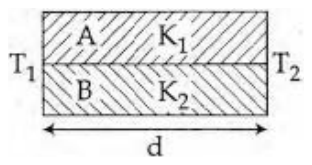
Two rods A and B of different materials are welded together as shown in figure. Their thermal conductivities are and . The thermal conductivity of the composite rod will be:
- 1
- 2
- 3
- 4
Show answer and solution
Correct: option 1,
The two rods lie side by side between the same temperatures and , so they conduct in parallel and the heat currents add. With equal cross-section A and length d: . So .
Question 16NEET 2017, Q35
A spherical black body with a radius of 12 cm radiates 450 watt power at 500 K. If the radius were halved and the temperature doubled, the power radiated in watt would be:
- 1225
- 2450
- 31000
- 41800
Show answer and solution
Correct: option 4, 1800
By Stefan's law , so . Halving the radius multiplies the power by and doubling the temperature multiplies it by . The new power is W.
Question 17NEET 2016 Phase 1, Q15
A black body is at a temperature of 5760 K. The energy of radiation emitted by the body at wavelength 250 nm is , at wavelength 500 nm is and that at 1000 nm is . Wien's constant, nmK. Which of the following is correct?
- 1
- 2
- 3
- 4
Show answer and solution
Correct: option 4,
By Wien's law the emission peaks at nm. So is the maximum and is greater than ; the energies at 250 nm and 1000 nm are smaller but not zero.
Question 18NEET 2016 Phase 1, Q16
Coefficient of linear expansion of brass and steel rods are and . Lengths of brass and steel rods are and respectively. If is maintained same at all temperatures, which one of the following relations holds good?
- 1
- 2
- 3
- 4
Show answer and solution
Correct: option 4,
For the difference to stay fixed both rods must expand by the same amount for any temperature rise : , so .
Question 19NEET 2016 Phase 1, Q35
A piece of ice falls from a height h so that it melts completely. Only one-quarter of the heat produced is absorbed by the ice and all energy of ice gets converted into heat during its fall. The value of h is:
[Latent heat of ice is J/kg and g = 10 N/kg]
- 134 km
- 2544 km
- 3136 km
- 468 km
Show answer and solution
Correct: option 3, 136 km
One quarter of the potential energy melts the ice: . So m km.
Question 20NEET 2016 Phase 2, Q15
Two identical bodies are made of a material for which the heat capacity increases with temperature. One of these is at 100 °C, while the other one is at 0 °C. If the two bodies are brought into contact, then, assuming no heat loss, the final common temperature is
- 150 °C
- 2more than 50 °C
- 3less than 50 °C but greater than 0 °C
- 40 °C
Show answer and solution
Correct: option 2, more than 50 °C
Heat lost by the hot body equals heat gained by the cold one. Because the heat capacity is larger at higher temperatures, the hot body gives out more heat per degree of cooling than the cold body takes in per degree of warming. So the hot body cools by less than the cold body warms, and the common temperature ends up above the midpoint: more than 50 °C, option (2).
Question 21NEET 2016 Phase 2, Q16
A body cools from a temperature to in 10 minutes. The room temperature is . Assume that Newton's law of cooling is applicable. The temperature of the body at the end of next 10 minutes will be
- 1
- 2
- 3
- 4
Show answer and solution
Correct: option 2,
Under Newton's law of cooling the temperature excess over the surroundings falls by the same factor in equal times. In the first 10 minutes the excess goes from to , that is, it halves. In the next 10 minutes it halves again to , so the body is at , option (2).
Question 22AIPMT 2015, Q144
On observing light from three different stars P, Q and R, it was found that intensity of violet color is maximum in the spectrum of P, the intensity of green colour is maximum in the spectrum of R and the intensity of red colour is maximum in the spectrum of Q. If , and are the respective absolute temperatures of P, Q and R, then it can be concluded from the above observation that:
- 1
- 2
- 3
- 4
Show answer and solution
Correct: option 1,
By Wien's displacement law is constant, so the star whose spectrum peaks at the shortest wavelength is the hottest. Violet has a shorter wavelength than green, and green shorter than red, so . Therefore , option (1).
Question 23AIPMT 2015, Q177
The two ends of a metal rod are maintained at temperatures and . The rate of heat flow in the rod is found to be 4.0 J/s. If the ends are maintained at temperatures and , the rate of heat flow will be:
- 116.8 J/s
- 28.0 J/s
- 34.0 J/s
- 444.0 J/s
Show answer and solution
Correct: option 3, 4.0 J/s
In steady conduction the rate of heat flow is : it depends on the temperature difference between the ends, not on the temperatures themselves. The difference is in both cases and the rod is the same, so the rate stays 4.0 J/s, option (3).
Question 24AIPMT 2015 Re-test, Q178
The value of coefficient of volume expansion of glycerin is . The fractional change in the density of glycerin for a rise of in its temperature, is:
- 10.010
- 20.015
- 30.020
- 40.025
Show answer and solution
Correct: option 3, 0.020
Mass is fixed, so density falls as volume grows: , and for small the fractional change is (a decrease).
Question 25AIPMT 2014, Q97
Steam at 100°C is passed into 20 g of water at 10°C. When water acquires a temperature of 80°C, the mass of water present will be:
[Take specific heat of water = and latent heat of steam = ]
- 122.5 g
- 224 g
- 331.5 g
- 442.5 g
Show answer and solution
Correct: option 1, 22.5 g
Let grams of steam condense. Heat given out cal. Heat taken in by the water cal. So and the water present is , option (1).
Question 26AIPMT 2014, Q112
Certain quantity of water cools from 70°C to 60°C in the first 5 minutes and to 54°C in the next 5 minutes. The temperature of the surroundings is:
- 110°C
- 245°C
- 320°C
- 442°C
Show answer and solution
Correct: option 2, 45°C
By Newton's law of cooling the rate of fall of temperature is proportional to the mean excess temperature. First interval: ; second: . Dividing, , so and °C, option (2).
Question 27NEET 2013, Q147
A piece of iron is heated in a flame. It first becomes dull red then becomes reddish yellow and finally turns to white hot. The correct explanation for the above observation is possible by using:
- 1Wien's displacement Law
- 2Kirchhoff's Law
- 3Newton's Law of cooling
- 4Stefan's Law
Show answer and solution
Correct: option 1, Wien's displacement Law
Wien's displacement law, , says the wavelength of peak emission becomes shorter as the temperature rises. So the colour of the glowing iron shifts from red towards yellow and then white as it gets hotter.
Question 28NEET 2013 Karnataka, Q160
Two metal rods 1 and 2 of same lengths have same temperature difference between their ends. Their thermal conductivities are and and cross sectional areas and , respectively. If the rate of the heat conduction in 1 is four times that in 2, then:
- 1
- 2
- 3
- 4
Show answer and solution
Correct: option 1,
The rate of conduction is . With the same and the rate is proportional to , so a rate four times as large means .
Question 29NEET 2013 Karnataka, Q177
The density of water at 20° C is and at 40° C . The coefficient of volume expansion of water is:
- 1 / °C
- 2 / °C
- 3 / °C
- 4 / °C
Show answer and solution
Correct: option 1, / °C
For a fixed mass, , so per °C.
Question 30AIPMT 2012 Prelims, Q16
If the radius of a star is R and it acts as a black body, what would be the temperature of the star, in which the rate of energy production is Q?
( stands for Stefan's constant)
- 1
- 2
- 3
- 4
Show answer and solution
Correct: option 4,
In the steady state the star radiates energy as fast as it is produced. For a black body of surface area , Stefan's law gives , so .
Question 31AIPMT 2012 Prelims, Q31
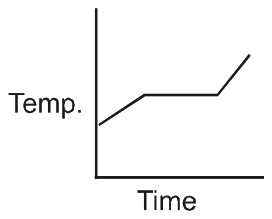
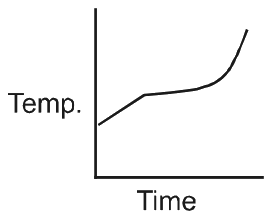
Liquid oxygen at 50 K is heated to 300 K at constant pressure of 1 atm. The rate of heating is constant. Which one of the following graphs represents the variation of temperature with time?
- 1
- 2
- 3
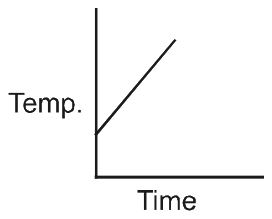
- 4
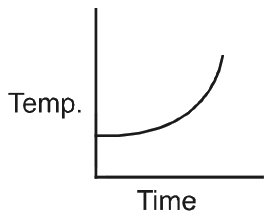
Show answer and solution
Correct: option 1
With steady heating the temperature of the liquid first rises steadily to its boiling point (about 90 K at 1 atm). While it boils the heat goes into the change of state and the temperature stays constant, giving a flat part. Once it is all gas the temperature rises steadily again up to 300 K. The graph with rise, flat part and rise is option (1).
Question 32AIPMT 2012 Mains, Q10
A slab of stone of area and thickness 0.1 m is exposed on the lower surface to steam at 100°C. A block of ice at 0°C rests on the upper surface of the slab. In one hour 4.8 kg of ice is melted. The thermal conductivity of slab is:
(Given latent heat of fusion of ice = ):
- 11.24 J/m/s/°C
- 21.29 J/m/s/°C
- 32.05 J/m/s/°C
- 41.02 J/m/s/°C
Show answer and solution
Correct: option 1, 1.24 J/m/s/°C
Heat conducted through the slab in time t melts the ice: . So J/m/s/°C.
Question 33AIPMT 2010 Prelims, Q11
A cylindrical metallic rod in thermal contact with two reservoirs of heat at its two ends conducts an amount of heat Q in time t. The metallic rod is melted and the material is formed into a rod of half the radius of the original rod. What is the amount of heat conducted by the new rod, when placed in thermal contact with the two reservoirs in time t?
- 1
- 2
- 32Q
- 4
Show answer and solution
Correct: option 2,
Heat conducted in time t is , proportional to . Halving the radius makes the area , and since the volume of metal is unchanged the length becomes . So falls by a factor of 16 and the new rod conducts .
Question 34AIPMT 2010 Prelims, Q37
The total radiant energy per unit area, normal to the direction of incidence, received at a distance R from the centre of a star of radius r, whose outer surface radiates as a black body at a temperature T K is given by
(where is Stefan's constant)
- 1
- 2
- 3
- 4
Show answer and solution
Correct: option 1,
By Stefan's law the star radiates a total power . At distance R this power is spread evenly over a sphere of area , so the energy received per unit area per second is .
Question 35AIPMT 2009 Prelims, Q10
The two ends of a rod of length L and a uniform cross-sectional area A are kept at two temperatures and (). The rate of heat transfer, through the rod in a steady state is given by:
- 1
- 2
- 3
- 4
Show answer and solution
Correct: option 3,
In steady-state conduction the heat current is proportional to the area and to the temperature gradient , with the thermal conductivity as the constant: .
Question 36AIPMT 2009 Prelims, Q20
A black body at 227°C radiates heat at the rate of 7 Cals/cms. At a temperature of 727°C, the rate of heat radiated in the same units will be:
- 150
- 2112
- 380
- 460
Show answer and solution
Correct: option 2, 112
By Stefan's law the power radiated per unit area is proportional to with in kelvin. The temperatures are 500 K and 1000 K, so the rate rises by a factor , giving .
Question 37AIPMT 2008 Prelims, Q15
On a new scale of temperature (which is linear) and called the W scale, the freezing and boiling points of water are and respectively. What will be the temperature on the new scale, corresponding to a temperature of on the Celsius scale?
- 1
- 2
- 3
- 4
Show answer and solution
Correct: option 3,
Both scales are linear, so . Each Celsius degree is 2 degrees on the W scale, so .
Question 38AIPMT 2007 Prelims, Q164
Assuming the sun to have a spherical outer surface of radius r, radiating like a black body at temperature , the power received by a unit surface, (normal to the incident rays) at a distance R from the center of the sun is (where is the Stefan's constant).
- 1
- 2
- 3
- 4
Show answer and solution
Correct: option 1,
The sun radiates total power , with the temperature in kelvin. At distance R this is spread over a sphere of area , so the power per unit area is . The key gives option (1), which is meant to be this expression; the source copy prints R in place of in it.
Question 39AIPMT 2007 Prelims, Q166
A black body is at . It emits energy at a rate which is proportional to
- 1
- 2
- 3
- 4
Show answer and solution
Correct: option 3,
By Stefan's law the rate of emission is proportional to the fourth power of the absolute temperature. K, so the rate is proportional to , option (3).
Question 40AIPMT 2006 Prelims, Q7
A black body at emits radiations with maximum intensity at a wavelength of 5000 Å. The temperature of the body is increased by , the maximum intensity will be observe at:-
- 14000 Å
- 25000 Å
- 36000 Å
- 43000 Å
Show answer and solution
Correct: option 4, 3000 Å
Wien's displacement law says is constant. The temperatures are and . So Å.
Question 41AIPMT 2005 Prelims, Q39
Which of the following circular rods, (given radius r and length ) each made of the same energy material and whose ends are maintained at the same temperature will conduct most heat
- 1;
- 2;
- 3;
- 4;
Show answer and solution
Correct: option 2, ;
The rate of heat conduction is for the same material and temperature difference. In units of the four rods give 2, 4, and 1. The largest is for , .
Question 42AIPMT 2004 Prelims, Q26
If denotes the wavelength at which the radioactive emission from a black body at a temperature T K is maximum, then:-
- 1 is independent of T
- 2
- 3
- 4
Show answer and solution
Correct: option 3,
Wien's displacement law states that is a constant for a black body. So the wavelength of maximum emission is inversely proportional to the absolute temperature: .
Question 43AIPMT 2003 Prelims, Q20
We consider the radiation emitted by the human body. Which of the following statements is true:
- 1The radiation emitted is in the infrared region
- 2The radiation is emitted only during the day
- 3The radiation is emitted during the summers and absorbed during the winters
- 4The radiation emitted lies in the ultraviolet region and hence is not visible
Show answer and solution
Correct: option 1, The radiation emitted is in the infrared region
Every body above absolute zero radiates all the time. At body temperature (about 310 K) Wien's law gives a peak wavelength near m, which lies in the infrared.
Question 44AIPMT 2003 Prelims, Q22
Consider a compound slab consisting of two different materials having equal thicknesses and thermal conductivities K and 2K, respectively. The equivalent thermal conductivity of the slab is -
- 12/6 K
- 2
- 33K
- 44/3 K
Show answer and solution
Correct: option 4, 4/3 K
Heat flows through the two layers one after the other, so their thermal resistances add: . This gives .
Question 45AIPMT 2002 Prelims, Q16
The Wien's displacement law express relation between:-
- 1Wavelength corresponding to maximum energy and temperature
- 2Radiation energy and wavelength
- 3Temperature and wavelength
- 4Colour of light and temperature
Show answer and solution
Correct: option 1, Wavelength corresponding to maximum energy and temperature
Wien's displacement law is , a constant, where is the wavelength at which the emitted energy is maximum and T is the absolute temperature of the body. So it relates the wavelength of maximum energy to temperature.
Question 46AIPMT 2002 Prelims, Q17
Which of the following is best close to an ideal black body:-
- 1Black lamp
- 2Cavity maintained at constant temperature
- 3Platinum black
- 4A lump of charcoal heated to high temp.
Show answer and solution
Correct: option 2, Cavity maintained at constant temperature
A small hole in a cavity kept at a constant temperature absorbs practically all radiation that enters, because the radiation is trapped by repeated reflections inside, and it emits radiation characteristic of that temperature. Lamp black and platinum black absorb only about 96 to 98 percent, so the cavity is the closest to an ideal black body.
Question 47AIPMT 2002 Prelims, Q18
For a black body at temperature 727°C, its radiating power is 60 watt and temperature of surrounding is 227°C. If temperature of black body is changed to 1227°C then its radiating power will be:-
- 1304 W
- 2320 W
- 3240 W
- 4120 W
Show answer and solution
Correct: option 2, 320 W
Net power radiated is proportional to . With K, the first case gives and the second gives . So W.
Question 48AIPMT 2002 Prelims, Q19
Consider two rods of same length and different specific heats (, ), conductivities (, ) and area of cross-sections (, ) and both having temperature and at their ends. If rate of loss of heat due to conduction is equal, then:-
- 1
- 2
- 3
- 4
Show answer and solution
Correct: option 1,
The rate of heat conduction is . The length and the end temperatures are the same for both rods, so equal rates need . Specific heat does not enter the steady conduction rate.
Question 49AIPMT 2001 Prelims, Q7
A black body has wavelength corresponding to maximum energy at 2000 K. Its wavelength corresponding to maximum energy at 3000 K will be:
- 1
- 2
- 3
- 4
Show answer and solution
Correct: option 2,
Wien's displacement law gives constant. So , which gives .
Question 50AIPMT 2001 Prelims, Q23
A cylindrical rod having temperature and at its end. The rate of flow of heat cal/sec. If all the linear dimension are doubled keeping temperature remain const. then rate of flow of heat will be:
- 1
- 2
- 3
- 4
Show answer and solution
Correct: option 2,
The rate of heat flow is . Doubling every linear dimension makes the area and the length , so the rate becomes times: .
Question 51AIPMT 2000 Prelims, Q12
Gravitational force is required for:
- 1Stirring of liquid
- 2Convection
- 3Conduction
- 4Radiation
Show answer and solution
Correct: option 2, Convection
Natural convection happens because heated fluid becomes less dense and rises while cooler, denser fluid sinks. This buoyancy exists only where there is gravity. Conduction and radiation do not need it.
Question 52AIPMT 1999 Prelims, Q23
A sphere maintained at temperature 600 K, has cooling rate R in an external environment of 200 K temp. If its temp. falls to 400 K then its cooling rate will be -
- 1
- 2
- 3
- 4None
Show answer and solution
Correct: option 1,
By Stefan's law the net rate of loss of heat is proportional to . At 600 K: . At 400 K: . The new rate is .
Question 53AIPMT 1999 Prelims, Q39
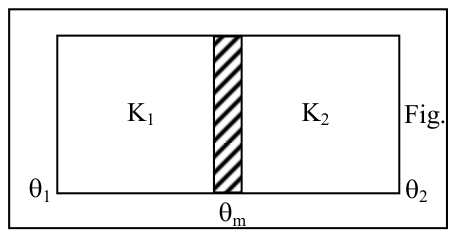
Two conducting slabs of heat conductivity and are joined as shown in fig. The temp. at ends of the slabs are and () the, final temp. () of junction is:
- 1
- 2
- 3
- 4None
Show answer and solution
Correct: option 1,
In the steady state the same heat current flows through both slabs. Taking the slabs to have the same thickness and area (as drawn), . Solving, .
Question 54AIPMT 1998 Prelims, Q45
Radiation energy corresponding to the temperature T of the sun is E. If its temperature is doubled, then its radiation energy will be:
- 132 E
- 216 E
- 38 E
- 44 E
Show answer and solution
Correct: option 2, 16 E
By Stefan's law the energy radiated is proportional to . Doubling the temperature multiplies it by , giving 16 E.