Questions with solutions
Question 1NEET 2026, Q15
Five capacitors of capacitances and are connected as shown, along with a battery of .
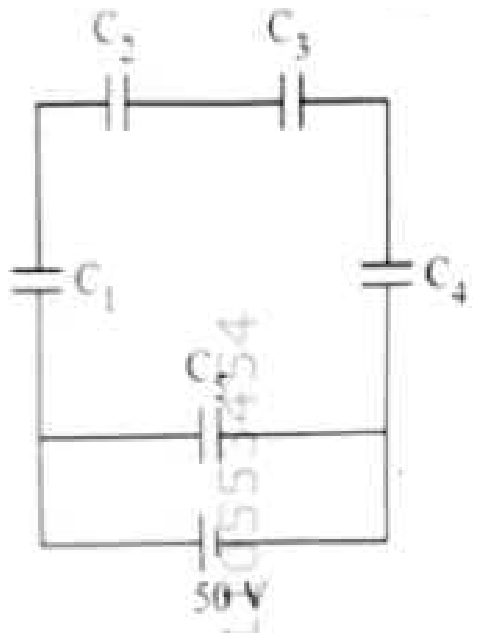
The equivalent capacitance and the charges on each capacitor respectively are:
- 1, on all capacitors
- 2, on all capacitors
- 3, on to and on
- 4, on to and on
Show answer and solution
Correct: option 1, , on all capacitors
, , and are in series, giving , and this chain is in parallel with across the battery. The equivalent capacitance is . Each series capacitor carries the charge of the chain, , and carries as well. So every capacitor has .
Question 2NEET 2026, Q31
Consider two uncharged capacitors of equal capacitance . One of them is charged by a supply and disconnected. Now this capacitor is connected to the uncharged capacitor. The amount of electrostatic energy lost in the process is:
- 1
- 2
- 3
- 4
Show answer and solution
Correct: option 2,
Initial energy . When the charge is shared between two equal capacitors the voltage halves to 50 V and the capacitance doubles, so the final energy is . The energy lost is .
Question 3NEET 2026, Q41
Which of the following statements are correct?
A. Inside a conductor, the electrostatic field is zero.
B. Electric field at the surface of a charged conductor does not depend on its surface charge density.
C. The interior of a charged conductor can have no excess charge in the static situation.
D. At the surface of a charged conductor, the electrostatic field must be normal to the surface at every point.
E. The electrostatic potential is zero everywhere inside a charged conductor.
Choose the correct answer from the options given below:
- 1C, D and E only
- 2A, B and D only
- 3A, C and D only
- 4A, C and E only
Show answer and solution
Correct: option 3, A, C and D only
A, C and D are standard properties of a conductor in electrostatic equilibrium: the field inside is zero, any excess charge lies on the surface, and the field at the surface is normal to it. B is false because the surface field is , which depends on the surface charge density. E is false because the potential inside is constant and equal to its value at the surface, not necessarily zero.
Question 4NEET 2026 Re-exam, Q9
Three identical capacitors , and , each of the capacitance C, are connected to a battery of voltage , as shown in the figure. If the energy stored in the capacitor and total energy stored in the system are and , respectively, then the ratio is:
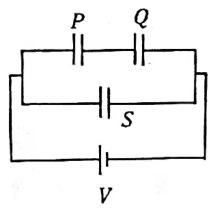
- 12/3
- 21/3
- 31/2
- 41/6
Show answer and solution
Correct: option 4, 1/6
and are in series across the battery, so each has and . is directly across the battery. The total capacitance is , so . The ratio is , option (4).
Question 5NEET 2026 Re-exam, Q21
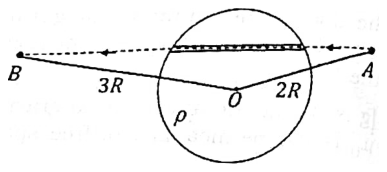
A unit positive point charge is taken slowly through an infinitesimally thin tube that is inside a charged dielectric sphere of radius , having uniform positive charge density , as shown in the figure. The initial and final positions of the charge are marked by and at distances and respectively, from the centre of the sphere. In this process, the magnitude of the total work done on the point charge is . The value of is:
( is the permittivity of vacuum)
- 12
- 26
- 39
- 418
Show answer and solution
Correct: option 4, 18
The electrostatic force is conservative, so the work depends only on the end points, both of which are outside the sphere. With , the potential outside is . For a unit charge , so , option (4).
Question 6NEET 2026 Re-exam, Q34
Consider a fixed uniformly charged insulating sphere with radius R and total charge . A point charge () with mass m is released from rest at a distance of 3R from the centre of the charged sphere. When the point charge reaches the surface of the sphere, its speed is:
( is the permittivity of vacuum, neglect gravitational forces).
- 1
- 2
- 3
- 4
Show answer and solution
Correct: option 3,
Outside the sphere the potential is that of a point charge Q at the centre. The loss of potential energy equals the kinetic energy gained: . So , option (3).
Question 7NEET 2025, Q20
The plates of a parallel plate capacitor are separated by . Two slabs of different dielectric constant and with thickness and , respectively are inserted in the capacitor. Due to this, the capacitance becomes two times larger than when there is nothing between the plates.
If , the value of is:
- 12.66
- 22.33
- 31.60
- 41.33
Show answer and solution
Correct: option 1, 2.66
The slabs and the remaining air gap of act in series, so . For the denominator must be , so . Putting gives , so , option (1).
Question 8NEET 2025, Q35
An electric dipole with dipole moment Cm is aligned with the direction of a uniform electric field of magnitude N/C. The dipole is then rotated through an angle of with respect to the electric field. The change in the potential energy of the dipole is:
- 10.8 J
- 21.0 J
- 31.2 J
- 41.5 J
Show answer and solution
Correct: option 2, 1.0 J
The potential energy of a dipole in a field is . Going from to the change is J, option (2).
Question 9NEET 2024, Q14
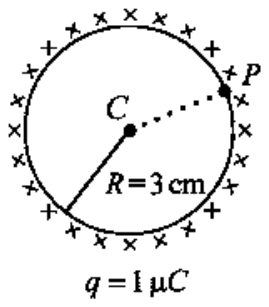
A thin spherical shell is charged by some source. The potential difference between the two points and (in ) shown in the figure is:
(Take SI units)
- 1zero
- 2
- 3
- 4
Show answer and solution
Correct: option 1, zero
The electric field inside a charged spherical shell is zero, so the potential is the same everywhere inside and equal to its value on the surface. is the centre and is on the surface, so both are at the same potential and the potential difference is zero, option (1).
Question 10NEET 2024, Q17
Given below are two statements: one is labelled as Assertion A and the other is labelled as Reason R.
Assertion A: The potential () at any axial point, at 2 m distance () from the centre of the dipole of dipole moment vector of magnitude, C m, is .
(Take SI units)
Reason R: , where is the distance of any axial point, situated at 2 m from the centre of the dipole.
In the light of the above statements, choose the correct answer from the options given below:
- 1A is false but R is true.
- 2Both A and R are true and R is the correct explanation of A.
- 3Both A and R are true and R is NOT the correct explanation of A.
- 4A is true but R is false.
Show answer and solution
Correct: option 4, A is true but R is false.
On the axis of a dipole the potential is V, so A is true. The formula in R has an extra factor of 2 (that factor belongs to the axial electric field, not the potential), so R is false. This is option (4).
Question 11NEET 2024, Q30
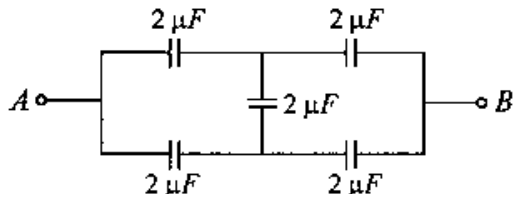
In the following circuit, the equivalent capacitance between terminal and terminal is:
- 1
- 2
- 3
- 4
Show answer and solution
Correct: option 2,
The five equal capacitors form a balanced Wheatstone bridge, so the two ends of the middle capacitor are at the same potential and it carries no charge. What remains is two branches in parallel, each with two capacitors in series ( each). The equivalent capacitance is , option (2).
Question 12NEET 2024, Q37
If the plates of a parallel plate capacitor connected to a battery are moved close to each other, then
A. the charge stored in it, increases.
B. the energy stored in it, decreases.
C. its capacitance increases.
D. the ratio of charge to its potential remains the same.
E. the product of charge and voltage increases.
Choose the most appropriate answer from the options given below:
- 1A, B and C only
- 2A, B and E only
- 3A, C and E only
- 4B, D and E only
Show answer and solution
Correct: option 3, A, C and E only
With the battery connected the voltage stays fixed. Bringing the plates closer raises (C is true), so the charge rises (A is true) and the product rises (E is true). The energy increases, so B is false, and the ratio changes, so D is false. The answer is A, C and E, option (3).
Question 13NEET 2024 Re-exam, Q11
A 12 pF capacitor is connected to a 50 V battery, the electrostatic energy stored in the capacitor in nJ is
- 115
- 27.5
- 30.3
- 4150
Show answer and solution
Correct: option 1, 15
J, which is 15 nJ.
Question 14NEET 2024 Re-exam, Q19
The capacitance of a capacitor with charge and a potential difference depends on:
- 1both and
- 2the geometry of the capacitor
- 3 only
- 4 only
Show answer and solution
Correct: option 2, the geometry of the capacitor
is only a way of measuring capacitance: doubling doubles and the ratio stays the same. Its value is fixed by the shape, size and spacing of the conductors (and the medium between them), for example for parallel plates.
Question 15NEET 2024 Re-exam, Q37
The value of electric potential at a distance of 9 cm from the point charge C is
:
- 1 V
- 244.4 V
- 3 V
- 4 V
Show answer and solution
Correct: option 4, V
V.
Question 16NEET 2023, Q3
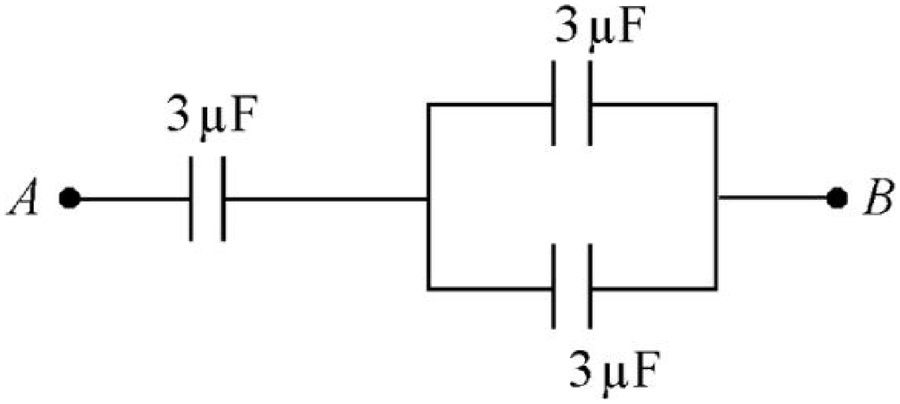
The equivalent capacitance of the system shown in the following circuit is:
- 1
- 2
- 3
- 4
Show answer and solution
Correct: option 1,
The two capacitors on the right are in parallel and add to . This is in series with the capacitor, so , which is option (1).
Question 17NEET 2023, Q39
An electric dipole is placed as shown in the figure.
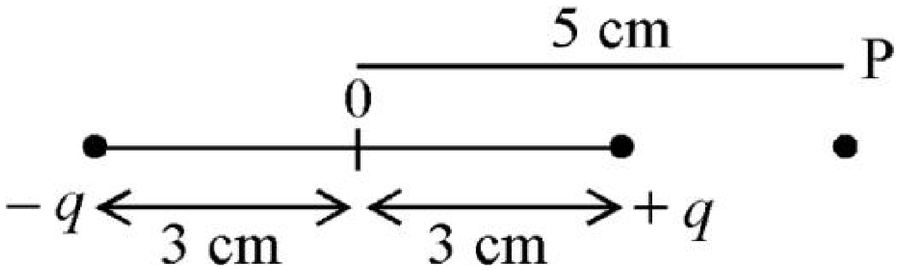
The electric potential (in V) at point P due to the dipole is ( = permittivity of free space and ):
- 1
- 2
- 3
- 4
Show answer and solution
Correct: option 1,
P lies on the axis, 5 cm from the centre O, so it is cm from and cm from . V, option (1).
Question 18NEET 2023 Manipur, Q27
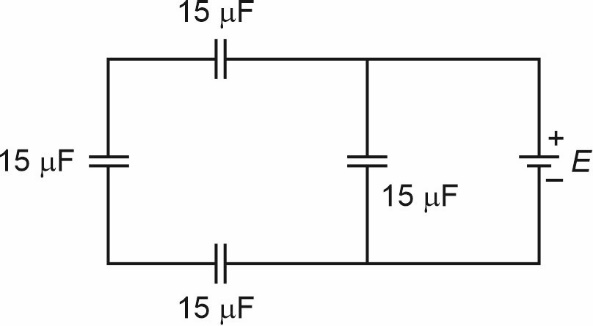
The equivalent capacitance of the arrangement shown in figure is
- 1
- 2
- 3
- 4
Show answer and solution
Correct: option 2,
The capacitor in the middle arm is connected directly across the cell. The other three capacitors (top, left and bottom) form one series chain across the same two points, of capacitance . The two are in parallel: .
Question 19NEET 2023 Manipur, Q46
If a conducting sphere of radius is charged. Then the electric field at a distance () from the centre of the sphere would be, ( = potential on the surface of the sphere)
- 1
- 2
- 3
- 4
Show answer and solution
Correct: option 1,
Outside a charged conducting sphere the field is that of a point charge at the centre, . The surface potential is , so . Substituting, .
Question 20NEET 2022, Q2
Two hollow conducting spheres of radii and () have equal charges. The potential would be:
- 1dependent on the material property of the sphere
- 2more on bigger sphere
- 3more on smaller sphere
- 4equal on both the spheres
Show answer and solution
Correct: option 3, more on smaller sphere
The potential of a charged conducting sphere is . For the same charge the potential is inversely proportional to the radius, so the smaller sphere (radius ) is at the higher potential, option (3).
Question 21NEET 2022, Q27
The angle between the electric lines of force and the equipotential surface is:
- 1
- 2
- 3
- 4
Show answer and solution
Correct: option 4,
No work is done in moving a charge along an equipotential surface, so the electric field can have no component along the surface. The field lines therefore cut the surface at right angles, , option (4).
Question 22NEET 2022, Q50
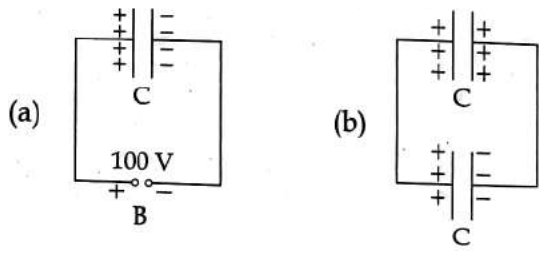
A capacitor of capacitance C = 900 pF is charged fully by 100 V battery B as shown in figure (a). Then it is disconnected from the battery and connected to another uncharged capacitor of capacitance C = 900 pF as shown in figure (b). The electrostatic energy stored by the system (b) is:
- 1 J
- 2 J
- 3 J
- 4 J
Show answer and solution
Correct: option 4, J
Initial energy J. The charge is then shared equally between two equal capacitors, so the common potential is 50 V and J, option (4). The other half is lost as heat and radiation.
Question 23NEET 2022 Re-exam, Q8
The distance between the two plates of a parallel plate capacitor is doubled and the area of each plate is halved. If C is its initial capacitance, its final capacitance is equal to
- 1
- 2
- 3
- 4
Show answer and solution
Correct: option 1,
For a parallel plate capacitor . With and , the new capacitance is , option (1).
Question 24NEET 2022 Re-exam, Q29
The effective capacitances of two capacitors are and , when they are connected in series and parallel respectively. The capacitance of two capacitors are:
- 1,
- 2,
- 3,
- 4,
Show answer and solution
Correct: option 4, ,
In parallel , and in series , so (in units). Two numbers with sum 16 and product 48 are 12 and 4. So the capacitors are and , option (4).
Question 25NEET 2022 Re-exam, Q44
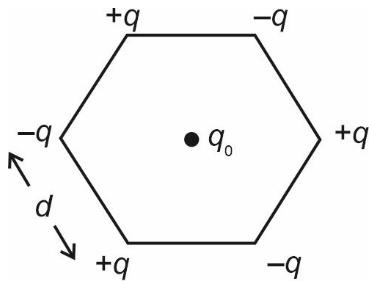
Six charges , , , , , and are fixed at the corners of a hexagon of side as shown in the figure. The work done in bringing a charge to the centre of the hexagon from infinity is
( – permittivity of free space)
- 1
- 2Zero
- 3
- 4
Show answer and solution
Correct: option 2, Zero
Every corner of a regular hexagon is at the same distance from the centre. The potential at the centre is . Work done in bringing from infinity is , option (2).
Question 26NEET 2021, Q1
Two charged spherical conductors of radius and are connected by a wire. Then the ratio of surface charge densities of the spheres is:
- 1
- 2
- 3
- 4
Show answer and solution
Correct: option 2,
Connected conductors are at the same potential, so . With this gives , so .
Question 27NEET 2021, Q20
Polar molecules are the molecules:
- 1having zero dipole moment.
- 2acquire a dipole moment only in the presence of electric field due to displacement of charges.
- 3acquire a dipole moment only when magnetic field is absent.
- 4having a permanent electric dipole moment.
Show answer and solution
Correct: option 4, having a permanent electric dipole moment.
In a polar molecule (such as HCl or water) the centres of positive and negative charge do not coincide even without an external field, so it has a permanent electric dipole moment. Option (2) describes a non-polar molecule, which gets only an induced dipole moment in a field.
Question 28NEET 2021, Q21
A parallel plate capacitor has a uniform electric field '' in the space between the plates. If the distance between the plates is 'd' and the area of each plate is 'A', the energy stored in the capacitor is: ( = permittivity of free space)
- 1
- 2
- 3
- 4
Show answer and solution
Correct: option 3,
The energy per unit volume of an electric field is . The field fills the volume between the plates, so the stored energy is .
Question 29NEET 2021, Q22
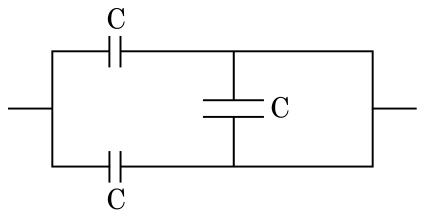
The equivalent capacitance of the combination shown in the figure is:
- 13C
- 22C
- 3C/2
- 43C/2
Show answer and solution
Correct: option 2, 2C
Both plates of the middle capacitor are joined to the same connecting wire, so it is short-circuited and holds no charge. The remaining two capacitors are each connected directly between the two terminals, so they are in parallel: .
Question 30NEET 2021, Q47
Twenty seven drops of same size are charged at 220 V each. They combine to form a bigger drop. Calculate the potential of the bigger drop.
- 1660 V
- 21320 V
- 31520 V
- 41980 V
Show answer and solution
Correct: option 4, 1980 V
Volume is conserved, so the big drop has radius , and its charge is . Its potential is V.
Question 31NEET 2020, Q141
In a certain region of space with volume , the electric potential is found to be 5 V throughout. The magnitude of electric field in this region is:
- 1zero
- 20.5 N/C
- 31 N/C
- 45 N/C
Show answer and solution
Correct: option 1, zero
The electric field is the rate at which the potential changes with position, . The potential is the same (5 V) everywhere in the region, so it does not change with position and the field is zero. The volume given is not needed.
Question 32NEET 2020, Q144
A short electric dipole has a dipole moment of . The electric potential due to the dipole at a point at a distance of 0.6 m from the centre of the dipole, situated on a line making an angle of 60° with the dipole axis is:
- 150 V
- 2200 V
- 3400 V
- 4zero
Show answer and solution
Correct: option 2, 200 V
For a short dipole . Here .
Question 33NEET 2020, Q167
The capacitance of a parallel plate capacitor with air as medium is . With the introduction of a dielectric medium, the capacitance becomes . The permittivity of the medium is:
()
- 1
- 2
- 3
- 4
Show answer and solution
Correct: option 3,
Filling the capacitor with a dielectric multiplies the capacitance by the dielectric constant, so . The permittivity of the medium is .
Question 34NEET 2020 Phase 2, Q109
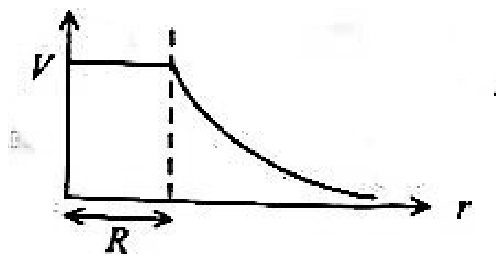
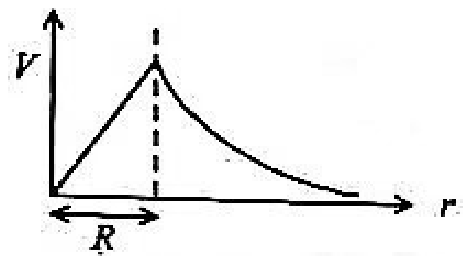
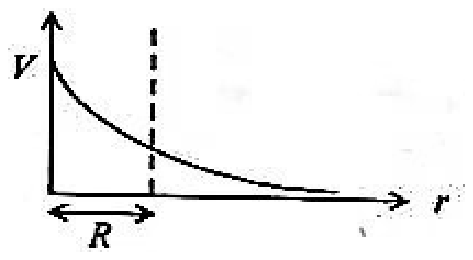
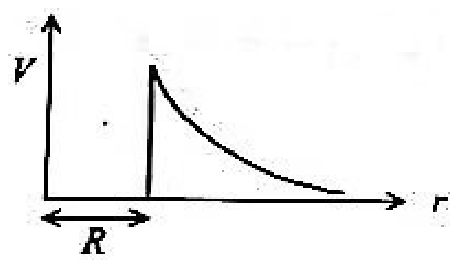
The variation of electrostatic potential with radial distance from the centre of a positively charged metallic thin shell of radius is given by the graph
- 1
- 2
- 3
- 4
Show answer and solution
Correct: option 1
Inside a charged conducting shell the electric field is zero, so the potential stays constant at its surface value for all . Outside, the shell acts like a point charge and falls off as . The graph that is flat up to and then decreases is option (1).
Question 35NEET 2020 Phase 2, Q128
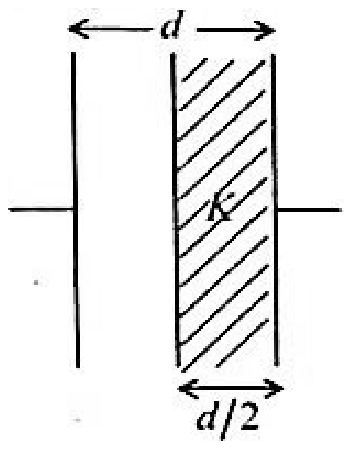
A parallel plate capacitor having cross-sectional area and separation has air in between the plates. Now an insulating slab of same area but thickness is inserted between the plates as shown in figure having dielectric constant . The ratio of new capacitance to its original capacitance will be,
- 18:5
- 26:5
- 34:1
- 42:1
Show answer and solution
Correct: option 1, 8:5
The original capacitance is . With a slab of thickness , . So .
Question 36NEET 2019 Odisha, Q5
Two metal spheres, one of radius and the other of radius respectively have the same surface charge density . They are brought in contact and separated. What will be the new surface charge densities on them?
- 1
- 2
- 3
- 4
Show answer and solution
Correct: option 2,
Total charge is . In contact the potentials become equal, so the charge divides in the ratio of the radii, 1 : 2, giving and . Dividing by the areas and gives and .
Question 37NEET 2019 Odisha, Q14
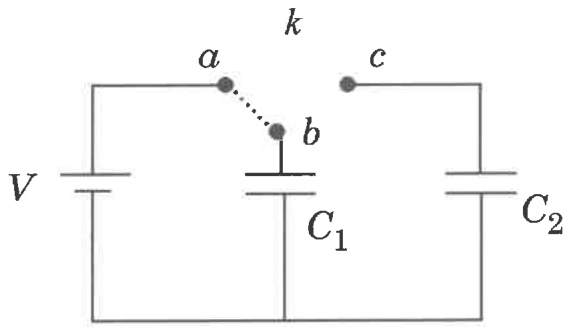
Two identical capacitors and of equal capacitance are connected as shown in the circuit. Terminals a and b of the key k are connected to charge capacitor using battery of emf volt. Now disconnecting a and b the terminals b and c are connected. Due to this, what will be the percentage loss of energy?
- 150 %
- 225 %
- 375 %
- 40 %
Show answer and solution
Correct: option 1, 50 %
Initially holds charge and energy . When it is joined to the identical uncharged , the charge is shared equally and the common potential is , so the final energy is . Half of the energy is lost, that is 50 %.
Question 38NEET 2018, Q23
The electrostatic force between the metal plates of an isolated parallel plate capacitor C having a charge Q and area A, is
- 1proportional to the square root of the distance between the plates.
- 2linearly proportional to the distance between the plates.
- 3independent of the distance between the plates.
- 4inversely proportional to the distance between the plates.
Show answer and solution
Correct: option 3, independent of the distance between the plates.
One plate produces a field at the other plate, so the force is . For an isolated capacitor Q is fixed, and the plate separation does not appear, so the force is independent of the distance between the plates.
Question 39NEET 2017, Q12
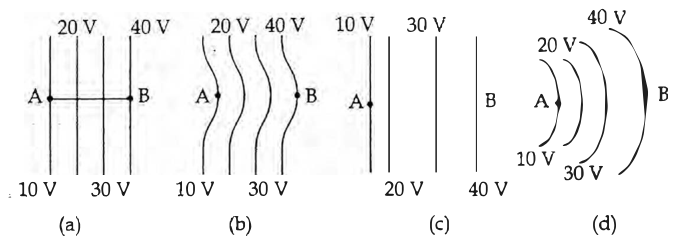
The diagrams below show regions of equipotentials.
A positive charge is moved from A to B in each diagram.
- 1Maximum work is required to move q in figure (c).
- 2In all the four cases the work done is the same.
- 3Minimum work is required to move q in figure (a).
- 4Maximum work is required to move q in figure (b).
Show answer and solution
Correct: option 2, In all the four cases the work done is the same.
Work done in moving a charge depends only on the potential difference: . In every diagram A is on the 20 V surface and B is on the 40 V surface, so V each time. The shape and spacing of the equipotentials do not matter, so the work is the same in all four cases.
Question 40NEET 2017, Q17
A capacitor is charged by a battery. The battery is removed and another identical uncharged capacitor is connected in parallel. The total electrostatic energy of resulting system
- 1increases by a factor of 4
- 2decreases by a factor of 2
- 3remains the same
- 4increases by a factor of 2
Show answer and solution
Correct: option 2, decreases by a factor of 2
With the battery removed the charge Q stays fixed. Joining an identical capacitor in parallel doubles the capacitance to 2C. Energy is , so it changes from to , half of the first value. The lost half is dissipated as heat and radiation while the charge is shared.
Question 41NEET 2016 Phase 1, Q5
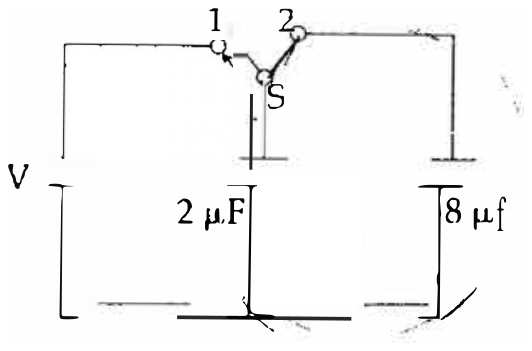
A capacitor of is charged as shown in the diagram. When the switch S is turned to position 2, the percentage of its stored energy dissipated is:
- 10%
- 220%
- 375%
- 480%
Show answer and solution
Correct: option 4, 80%
The initial energy is (in J for V in volts). At position 2 the charge is shared between and , giving a common potential and energy . So of the energy, that is 80%, is dissipated.
Question 42NEET 2016 Phase 2, Q24
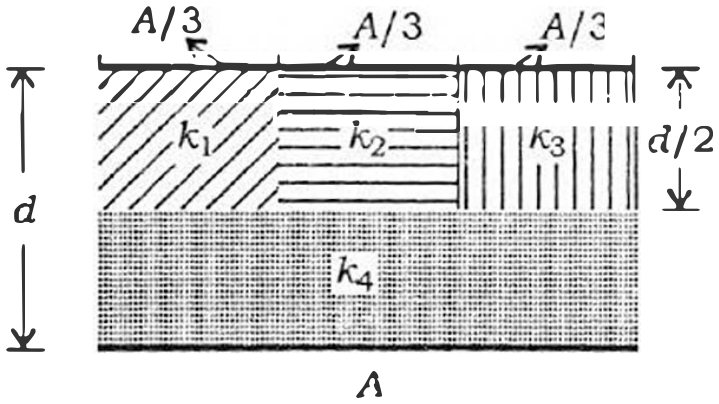
A parallel-plate capacitor of area , plate separation and capacitance is filled with four dielectric materials having dielectric constants , , and as shown in the figure below. If a single dielectric material is to be used to have the same capacitance in this capacitor, then its dielectric constant is given by
- 1
- 2
- 3
- 4
Show answer and solution
Correct: option 3,
The top half holds three slabs side by side (in parallel), each of area and thickness : . The bottom slab has area and thickness : . These two are in series and must equal : , that is , option (3).
Question 43AIPMT 2015, Q149
A parallel plate air capacitor of capacitance C is connected to a cell of emf V and then disconnected from it. A dielectric slab of dielectric constant K, which can just fill the air gap of the capacitor, is now inserted in it. Which of the following is incorrect?
- 1The energy stored in the capacitor decreases K times.
- 2The change in energy stored is .
- 3The charge on the capacitor is not conserved.
- 4The potential difference between the plates decreases K times.
Show answer and solution
Correct: option 3, The charge on the capacitor is not conserved.
Once the cell is disconnected the plates are isolated, so the charge cannot change. The capacitance becomes KC, so the potential difference falls K times and the energy also falls K times, a change of . Statements (1), (2) and (4) are true, so the incorrect one is (3).
Question 44AIPMT 2015 Re-test, Q147
A parallel plate air capacitor has capacity 'C', distance of separation between plates is 'd' and potential difference 'V' is applied between the plates. Force of attraction between the plates of the parallel plate air capacitor is:
- 1
- 2
- 3
- 4
Show answer and solution
Correct: option 3,
One plate sits in the field of the other, , so the force is . With and (so ): .
Question 45AIPMT 2015 Re-test, Q169
If potential (in volts) in a region is expressed as , the electric field (in N/C) at point (1, 1, 0) is:
- 1
- 2
- 3
- 4
Show answer and solution
Correct: option 3,
. At (1, 1, 0) this is .
Question 46AIPMT 2014, Q91
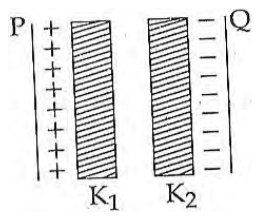
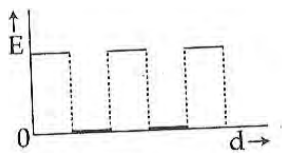
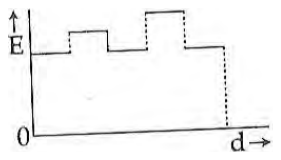
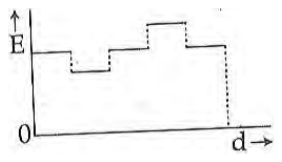
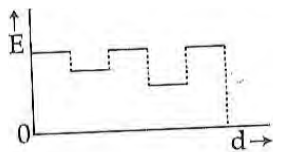
Two thin dielectric slabs of dielectric constants and () are inserted between plates of a parallel plate capacitor, as shown in the figure. The variation of electric field 'E' between the plates with distance 'd' as measured from plate P is correctly shown by:
- 1
- 2
- 3
- 4
Show answer and solution
Correct: option 4
In the air gaps the field has its full value . Inside a slab of dielectric constant the field drops to , so it is lower in both slabs and lowest in the second slab because . Between and outside the slabs it returns to . Only graph (4) shows a small dip followed by a deeper dip with the same level elsewhere.
Question 47AIPMT 2014, Q94
In a region, the potential is represented by , where V is in volts and x, y, z are in meters. The electric force experienced by a charge of 2 coulomb situated at point (1, 1, 1) is:
- 1
- 2
- 330 N
- 424 N
Show answer and solution
Correct: option 1,
The field is . Here , and at (1, 1, 1). So and , option (1).
Question 48AIPMT 2014, Q132
A conducting sphere of radius R is given a charge Q. The electric potential and the electric field at the centre of the sphere respectively are:
- 1Both are zero
- 2Zero and
- 3 and Zero
- 4 and
Show answer and solution
Correct: option 3, and Zero
The charge sits on the surface of a conductor, so the field everywhere inside, including the centre, is zero. Because the field inside is zero the potential is the same throughout and equals its surface value . That is option (3).
Question 49NEET 2013, Q137
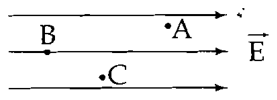
A, B and C are three points in a uniform electric field. The electric potential is:
- 1maximum at B
- 2maximum at C
- 3same at all the three points A, B and C.
- 4maximum at A
Show answer and solution
Correct: option 1, maximum at B
Potential falls along the direction of the electric field. The field points to the right and B lies furthest to the left (furthest back along the field lines), so B is at the highest potential.
Question 50NEET 2013 Karnataka, Q146
An electric dipole of dipole moment p is aligned parallel to a uniform electric field E. The energy required to rotate the dipole by 90° is:
- 1
- 2
- 3infinite
- 4
Show answer and solution
Correct: option 2,
The potential energy of a dipole in a field is . At it is and at it is , so the work needed is .
Question 51AIPMT 2012 Prelims, Q6
An electric dipole of moment 'p' is placed in an electric field of intensity 'E'. The dipole acquires a position such that the axis of the dipole makes an angle with the direction of the field. Assuming that the potential energy of the dipole to be zero when , the torque and the potential energy of the dipole will respectively be:
- 1,
- 2,
- 3,
- 4,
Show answer and solution
Correct: option 1, ,
The torque on a dipole is . The potential energy is the work done in turning the dipole from the reference angle to : .
Question 52AIPMT 2012 Prelims, Q26
Four point charges −Q, −q, 2q and 2Q are placed, one at each corner of the square. The relation between Q and q for which the potential at the centre of the square is zero is:
- 1
- 2
- 3
- 4
Show answer and solution
Correct: option 1,
All four corners are at the same distance from the centre, so the potential there is proportional to the sum of the charges: . This is zero when .
Question 53AIPMT 2012 Mains, Q14
A parallel plate capacitor has a uniform electric field E in the space between the plates. If the distance between the plates is d and area of each plate is A, the energy stored in the capacitor is:
- 1
- 2
- 3
- 4
Show answer and solution
Correct: option 3,
The energy density of an electric field is and the field fills the volume between the plates, so . The same follows from with and .
Question 54AIPMT 2012 Mains, Q15
Two metallic spheres of radii 1 cm and 3 cm are given charges of C and C, respectively. If these are connected by a conducting wire, the final charge on the bigger sphere is:
- 1 C
- 2 C
- 3 C
- 4 C
Show answer and solution
Correct: option 2, C
The total charge C is conserved. After connection both spheres are at the same potential , so charge divides in the ratio of the radii, 1 : 3. The bigger sphere holds C.
Question 55AIPMT 2011 Prelims, Q169
A parallel plate condenser has a uniform electric field E(V/m) in the space between the plates. If the distance between the plates is d(m) and area of each plate is A() the energy (joules) stored in the condenser is:
- 1
- 2
- 3
- 4
Show answer and solution
Correct: option 4,
The energy stored per unit volume of an electric field is , and the field fills the volume between the plates. So . The same result follows from with and .
Question 56AIPMT 2011 Prelims, Q188
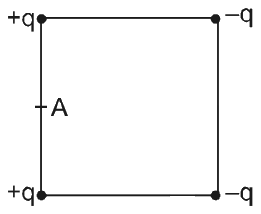
Four electric charges +q, +q, –q and –q are placed at the corners of a square of side (see figure). The electric potential at point A, midway between the two charges +q and +q, is:
- 1
- 2
- 3
- 4Zero
Show answer and solution
Correct: option 3,
Take the side of the square as , the symbol the options use. A is at distance from each +q and at distance from each –q. Potential is a scalar, so .
Question 57AIPMT 2011 Mains, Q104
The electric potential V at any point (x, y, z), all in meters in space is given by volt. The electric field at the point (1, 0, 2) in volt/meter is:
- 18 along positive X-axis
- 216 along negative X-axis
- 316 along positive X-axis
- 48 along negative X-axis
Show answer and solution
Correct: option 4, 8 along negative X-axis
The potential depends only on x, so the field has only an x-component: . At this is V/m, that is 8 V/m along the negative X-axis.
Question 58AIPMT 2011 Mains, Q120
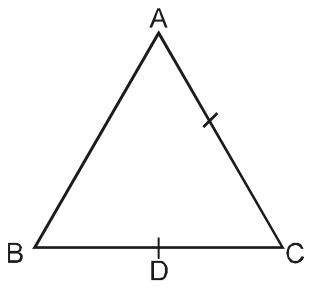
Three charges, each +q, are placed at the corners of an isosceles triangle ABC of sides BC and AC, 2a. D and E are the mid points of BC and CA. The work done in taking a charge Q from D to E is:
- 1
- 2
- 3zero
- 4
Show answer and solution
Correct: option 3, zero
D is at distance a from the charges at B and C and at distance AD from the charge at A. E is at distance a from the charges at A and C and at distance BE from the charge at B. Since AC = BC, the medians AD and BE are equal, so the potentials at D and E are the same. The work done is .
Question 59AIPMT 2010 Mains, Q3
Two parallel metal plates having charges +Q and –Q face each other at a certain distance between them. If the plates are now dipped in kerosene oil tank, the electric field between the plates will
- 1become zero
- 2increase
- 3decrease
- 4remains same
Show answer and solution
Correct: option 3, decrease
The charge on the isolated plates stays the same, so the field in vacuum is . With a dielectric of constant K between the plates it becomes . Kerosene has , so the field decreases.
Question 60AIPMT 2010 Prelims, Q46
A series combination of capacitors, each of value is charged by a source of potential difference 4V. When another parallel combination of capacitors, each of value , is charged by a source of potential difference V, it has the same (total) energy stored in it, as the first combination has. The value of , in terms of , is then
- 1
- 2
- 3
- 4
Show answer and solution
Correct: option 4,
The series combination has capacitance and stores . The parallel combination has capacitance and stores . Equating the two gives .
Question 61AIPMT 2009 Prelims, Q26
Three concentric spherical shells have radii a, b and c (a < b < c) and have surface charge densities , and respectively. If , and denote the potentials of the three shells, then for c = a + b, we have:
- 1
- 2
- 3
- 4
Show answer and solution
Correct: option 4,
A shell of radius and charge density gives potential at points inside it and at distance outside. Adding the three shells: , and . With , , so , while differs because .
Question 62AIPMT 2009 Prelims, Q38
Three capacitors each of capacitance C and of breakdown voltage V are joined in series. The capacitance and breakdown voltage of the combination will be:
- 1,
- 2,
- 3,
- 4,
Show answer and solution
Correct: option 2, ,
For equal capacitors in series , so . The applied voltage divides equally among the three, so each reaches its limit only when the total is .
Question 63AIPMT 2009 Prelims, Q45
The electric potential at a point (x, y, z) is given by
The electric field at that point is:
- 1
- 2
- 3
- 4
Show answer and solution
Correct: option 4,
The field is the negative gradient of the potential. , and . So .
Question 64AIPMT 2008 Prelims, Q25
The energy required to charge a parallel plate condenser of plate separation d and plate area of cross-section A such that the uniform electric field between the plates is E, is
- 1
- 2
- 3
- 4
Show answer and solution
Correct: option 1,
The energy stored in the charged condenser is with and , which gives . This is the energy density times the volume between the plates, and it is the keyed answer. (A battery charging the condenser at constant voltage supplies , twice this, with half lost as heat; the key counts the stored energy.)
Question 65AIPMT 2008 Prelims, Q27
The electric potential at a point in free space due to a charge Q coulomb is volts. The electric field at that point is
- 1 volt/m
- 2 volt/m
- 3 volt/m
- 4 volt/m
Show answer and solution
Correct: option 2, volt/m
gives . The field of a point charge is volt/m.
Question 66AIPMT 2007 Prelims, Q176
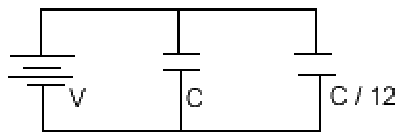
Two condensers, one of capacity C and the other of capacity C/2, are connected to a V-volt battery, as shown. The work done in charging fully both the condensers is
- 1
- 2
- 3
- 4
Show answer and solution
Correct: option 4,
Both condensers are connected across the battery, so they are in parallel and the total capacity is . The energy stored when fully charged is , option (4).
Question 67AIPMT 2006 Prelims, Q44
A parallel plate air capacitor is charged to a potential difference of V volts. After disconnecting the charging battery the distance between the plates of the capacitor is increased using an insulating handle. As a result the potential difference between the plates:-
- 1Decreases
- 2Does not change
- 3Becomes zero
- 4Increases
Show answer and solution
Correct: option 4, Increases
With the battery removed the charge on the plates cannot change. Increasing the separation lowers the capacitance , so rises. Equivalently, the field between the plates stays the same and grows with .
Question 68AIPMT 2005 Prelims, Q7
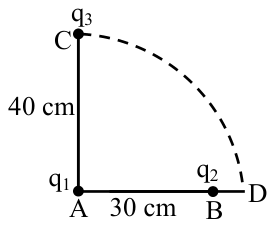
Two charges and are placed 30 cm apart, as shown in the figure. A third charge is moved along the arc of a circle of radius 40 cm from C to D. The change in the potential energy of the system is , where k is
- 1
- 2
- 3
- 4
Show answer and solution
Correct: option 1,
The arc is centred on , so the distance of from stays 0.4 m and that part of the energy does not change. The distance from changes from at C to at D. So , giving .
Question 69AIPMT 2005 Prelims, Q10
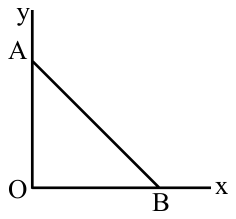
As per this diagram a point charge +q is placed at the origin O. Work done in taking another point charge –Q from the point A coordinates (0, a) to another point B coordinates (a, 0) along the straight path AB is
- 1
- 2zero
- 3
- 4
Show answer and solution
Correct: option 2, zero
A and B are both at distance a from the charge +q, so they are at the same potential . Work done by the electrostatic field depends only on the end points, and whatever the path.
Question 70AIPMT 2005 Prelims, Q32
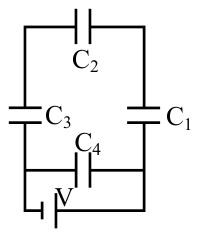
A network of four capacitors of capacity equal to , , and are connected to a battery as shown in the figure. The ratio of the charges on and is
- 1
- 2
- 3
- 4
Show answer and solution
Correct: option 3,
, and are in series across the battery, and is directly across it. The series combination is , so and the charge on is . The charge on is , so the ratio is .
Question 71AIPMT 2004 Prelims, Q24
A bullet of mass 2 g is having a charge of 2 C. Through what potential difference must it be accelerated, starting from rest, to acquire a speed of 10 m/s?
- 150 kV
- 25V
- 350 V
- 45kV
Show answer and solution
Correct: option 1, 50 kV
The work done by the field equals the kinetic energy gained: . So V = 50 kV.
Question 72AIPMT 2003 Prelims, Q32
Three capacitors each of capacity are to be connected in such a way that the effective capacitance of . This can be done by -
- 1connecting all of them in series
- 2connecting them in parallel
- 3connecting two in series and one in parallel
- 4connecting two in parallel and one in series
Show answer and solution
Correct: option 3, connecting two in series and one in parallel
Two capacitors in series give ; the third in parallel with this pair adds directly: . The other arrangements give , and .
Question 73AIPMT 2002 Prelims, Q39
Some charge is being given to a conductor. Then its potential:-
- 1Is maximum at surface
- 2Is maximum at centre
- 3Is remain same throughout the conductor
- 4Is maximum somewhere between surface and centre
Show answer and solution
Correct: option 3, Is remain same throughout the conductor
In electrostatic equilibrium the electric field inside a conductor is zero, so no work is done in moving a charge between any two points of it. The whole conductor, surface and interior, is therefore at one potential.
Question 74AIPMT 2002 Prelims, Q42
A capacitor of capacity charged upto V volt and then connected to an uncharged capacitor . Then final P.D. across each will be
- 1
- 2
- 3
- 4
Show answer and solution
Correct: option 2,
The charge is conserved and is shared until both capacitors have the same potential difference. Common P.D. .
Question 75AIPMT 2002 Prelims, Q43
Identical charges (–q) are placed at each corner of a cube of side 'b' then electrical potential energy of charge (+q) which is placed at centre of cube will be
- 1
- 2
- 3
- 4
Show answer and solution
Correct: option 3,
Each corner is at a distance of half the body diagonal, , from the centre. The energy of +q with the eight charges is .
Question 76AIPMT 2001 Prelims, Q29
Energy per unit volume for a capacitor having area A and separation d kept at potential difference V is given by:
- 1
- 2
- 3
- 4
Show answer and solution
Correct: option 1,
The energy density of an electric field is , and between the plates . So the energy per unit volume is . Options (3) and (4) are the total energy, not the energy per unit volume.
Question 77AIPMT 2000 Prelims, Q5
A capacitor is charged with a battery and energy stored is U. After disconnecting battery another capacitor of same capacity is connected in parallel with it. Then energy stored in each capacitor is:
- 1U/2
- 2U/4
- 34 U
- 42 U
Show answer and solution
Correct: option 2, U/4
With the battery removed the charge is fixed and is shared equally, so each capacitor holds . Energy of each .
Question 78AIPMT 1999 Prelims, Q8
The effective capacity of the network between terminals A and B is -
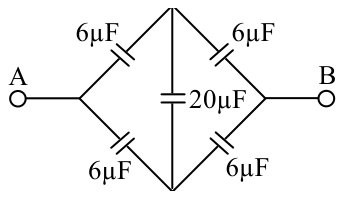
- 16 μF
- 220 μF
- 33 μF
- 410 μF
Show answer and solution
Correct: option 1, 6 μF
The four 6 μF capacitors form a balanced Wheatstone bridge, so there is no potential difference across the 20 μF capacitor and it can be removed. Each path from A to B is then two 6 μF capacitors in series (3 μF), and the two paths in parallel give μF.
Question 79AIPMT 1999 Prelims, Q13
Eight equals charged tiny drops are combined to form a big drop. If the potential on each drop is 10V then potential of big drop will be -
- 140V
- 210V
- 330V
- 420V
Show answer and solution
Correct: option 1, 40V
Volume is conserved, so the big drop has radius , and its charge is . Its potential is V. In general .
Question 80AIPMT 1999 Prelims, Q29
The energy and capacity of a charged parallel plate capacitor are E and C respectively. Now a dielectric slab of is inserted in it then energy and capacity becomes (Assuming charge on plates remains constant)
- 16E, 6C
- 2E, C
- 3, 6C
- 4E, 6C
Show answer and solution
Correct: option 3, , 6C
The dielectric multiplies the capacity by , so it becomes . With the charge fixed, the energy is , which is inversely proportional to the capacity, so it becomes .