Questions with solutions
Question 1NEET 2026, Q164
Male frogs can be distinguished from female frogs due to the presence of:
A. Bulging eyes
B. Vocal sacs
C. Webbed digits in feet
D. Copulatory pad on first digit of fore limbs
E. Olive green-coloured skin with dark irregular spots
Choose the correct answer from the options given below:
- 1B and D only
- 2B and C only
- 3A and B only
- 4C and E only
Show answer and solution
Correct: option 1, B and D only
Male frogs have sound-producing vocal sacs and a copulatory pad on the first digit of the fore limbs; both are absent in females. Bulging eyes, webbed feet and the olive green skin with dark spots are found in both sexes.
Question 2NEET 2026, Q166
Choose the correct statements regarding frog's anatomy:
A. Hepatic portal system is the special venous connection between liver and intestine.
B. There are twelve pairs of cranial nerves arising from the brain.
C. The ureters and oviducts open separately into the cloaca in female frogs.
D. Hind-brain consists of cerebellum, medulla oblongata and optic lobes.
E. Sinus venosus joins the right atrium of heart.
Choose the correct answer from the options given below:
- 1B and D only
- 2A, C and E only
- 3A, B and C only
- 4B and C only
Show answer and solution
Correct: option 2, A, C and E only
A, C and E are correct: the hepatic portal system connects the intestine and liver, the ureters and oviducts of the female open separately into the cloaca, and the sinus venosus joins the right atrium. A frog has ten pairs of cranial nerves, not twelve, so B is wrong. The optic lobes belong to the mid-brain; the hind-brain is the cerebellum and medulla oblongata, so D is wrong.
Question 3NEET 2026 Re-exam, Q103
In water, frogs respire using ________.
- 1skin
- 2buccal cavity
- 3lungs
- 4trachea
Show answer and solution
Correct: option 1, skin
In water the frog's moist skin acts as the respiratory organ: dissolved oxygen diffuses in through it (cutaneous respiration). On land the buccal cavity, skin and lungs are all used.
Question 4NEET 2026 Re-exam, Q135
In frogs, the number of pairs of cranial nerves arising from the brain are ________.
- 16
- 29
- 310
- 412
Show answer and solution
Correct: option 3, 10
A frog has ten pairs of cranial nerves arising from the brain. Twelve pairs is the number in humans and other mammals.
Question 5NEET 2025, Q94
What is the name of the blood vessel that carries deoxygenated blood from the body to the heart in a frog?
- 1Aorta
- 2Pulmonary artery
- 3Pulmonary vein
- 4Vena cava
Show answer and solution
Correct: option 4, Vena cava
In the frog, deoxygenated blood from the body is collected by the major veins called venae cavae, which open into the sinus venosus joined to the right atrium. The aorta carries blood away from the heart, and the pulmonary vessels run between the heart and the lungs. So the answer is the vena cava.
Question 6NEET 2025, Q107
Which of the following statement is correct about location of the male frog copulatory pad?
- 1First and Second digit of fore limb
- 2First digit of hind limb
- 3Second digit of fore limb
- 4First digit of the fore limb
Show answer and solution
Correct: option 4, First digit of the fore limb
A male frog is told from a female by its sound-producing vocal sacs and by a copulatory pad on the first digit of each fore limb. The pad helps the male hold the female during amplexus.
Question 7NEET 2025, Q169
In frog, the Renal portal system is a special venous connection that acts to link:
- 1Liver and intestine
- 2Liver and kidney
- 3Kidney and intestine
- 4Kidney and lower part of body
Show answer and solution
Correct: option 4, Kidney and lower part of body
In the frog the renal portal system is a venous connection between the kidney and the lower parts of the body. The hepatic portal system is the one that links the liver and intestine.
Question 8NEET 2025, Q175
Frogs respire in water by skin and buccal cavity and on land by skin, buccal cavity and lungs.
Choose the correct answer from the following:
- 1The statement is true for water but false for land
- 2The statement is true for both the environment
- 3The statement is false for water but true for land
- 4The statement is false for both the environment
Show answer and solution
Correct: option 3, The statement is false for water but true for land
In water a frog respires only through its skin (cutaneous respiration), so the part about water is false. On land the skin, the buccal cavity and the lungs all act as respiratory organs, so the part about land is true.
Question 9NEET 2024, Q179
In both sexes of cockroach, a pair of jointed filamentous structures called anal cerci are present on:
- 111th segment
- 25th segment
- 310th segment
- 48th and 9th segment
Show answer and solution
Correct: option 3, 10th segment
In both male and female cockroaches the 10th abdominal segment carries a pair of jointed filamentous anal cerci. (The anal styles, found only in males, are on the 9th segment.)
Question 10NEET 2024, Q190
Match List I with List II:
| List I | List II |
|---|
| A. Unicellular glandular epithelium | I. Salivary glands |
| B. Compound epithelium | II. Pancreas |
| C. Multicellular glandular epithelium | III. Goblet cells of alimentary canal |
| D. Endocrine glandular epithelium | IV. Moist surface of buccal cavity |
Choose the correct answer from the options given below:
- 1A-II, B-I, C-IV, D-III
- 2A-II, B-I, C-III, D-IV
- 3A-IV, B-III, C-I, D-II
- 4A-III, B-IV, C-I, D-II
Show answer and solution
Correct: option 4, A-III, B-IV, C-I, D-II
Goblet cells of the alimentary canal are single isolated gland cells (unicellular glands). Compound epithelium covers the moist surface of the buccal cavity. Salivary glands are clusters of cells (multicellular glands). The islets of the pancreas are endocrine glandular tissue that pours hormones into the blood. So A-III, B-IV, C-I, D-II.
Question 11NEET 2024, Q194
Match List I with List II related to digestive system of cockroach.
| List I | List II |
|---|
| A. The structures used for storing of food. | I. Gizzard |
| B. Ring of 6-8 blind tubules at junction of foregut and midgut. | II. Gastric Caeca |
| C. Ring of 100-150 yellow coloured thin filaments at junction of midgut and hindgut. | III. Malpighian tubules |
| D. The structures used for grinding the food. | IV. Crop |
Choose the correct answer from the options given below:
- 1A-III, B-II, C-IV, D-I
- 2A-IV, B-II, C-III, D-I
- 3A-I, B-II, C-III, D-IV
- 4A-IV, B-III, C-II, D-I
Show answer and solution
Correct: option 2, A-IV, B-II, C-III, D-I
In the cockroach the crop is a sac that stores food, and the gizzard (proventriculus) grinds it. A ring of 6-8 blind tubules, the gastric caeca, lies at the junction of foregut and midgut. A ring of 100-150 yellow thin Malpighian tubules lies at the junction of midgut and hindgut. So A-IV, B-II, C-III, D-I.
Question 12NEET 2024 Re-exam, Q161
Which of the following statements is correct about the type of junction and their role in our body?
- 1Adhering junctions facilitate the cells to communicate with each other.
- 2Tight junctions help to stop substances from leaking across a tissue.
- 3Tight junctions help to perform cementing to keep neighbouring cells together.
- 4Gap junctions help to create gap between the cells and tissues.
Show answer and solution
Correct: option 2, Tight junctions help to stop substances from leaking across a tissue.
Tight junctions seal neighbouring cells so that substances cannot leak across the tissue. Cementing neighbouring cells together is the work of adhering junctions, and communication between cells is the work of gap junctions, which connect the cytoplasm of adjoining cells. Only statement (2) gives the right role.
Question 13NEET 2024 Re-exam, Q174
Which of the following is/are present in female cockroach?
A. Collateral gland
B. Mushroom gland
C. Spermatheca
D. Anal style
E. Phallic gland
Choose the most appropriate answer from the options given below:
- 1B and D only
- 2B and E only
- 3A only
- 4A and C only
Show answer and solution
Correct: option 4, A and C only
The female cockroach has collateral glands and a pair of spermathecae, which open into the genital chamber. The mushroom gland, the anal styles and the phallic gland belong to the male. So only A and C are found in the female.
Question 14NEET 2024 Re-exam, Q177
In which of the following connective tissues, the cells secrete fibres of collagen or elastin?
A. Cartilage
B. Bone
C. Adipose tissue
D. Blood
E. Areolar tissue
Choose the most appropriate answer from the options given below:
- 1D, C, D and E only
- 2A, D, C and E only
- 3B, C and D only
- 4A, C and D only
Show answer and solution
Correct: option 2, A, D, C and E only
In every connective tissue except blood the cells secrete fibres of the structural proteins collagen or elastin. Cartilage, bone, adipose tissue and areolar tissue therefore qualify, and blood, whose matrix is the fibre-free plasma, does not. The four tissues are A, B, C and E. The keyed option (2) is the one meant for this set, but the available copy of the paper prints the letter D in place of B in options (1) and (2), so option (2) reads "A, D, C and E only".
Question 15NEET 2024 Re-exam, Q198
Match List I with List II:
| List - I | List - II |
|---|
| A. Squamous Epithelium | I. Goblet cells of alimentary canal |
| B. Ciliated Epithelium | II. Inner lining of pancreatic ducts |
| C. Glandular Epithelium | III. Walls of blood vessels |
| D. Compound Epithelium | IV. Inner surface of Fallopian tubes |
Choose the correct answer from the options given below:
- 1A-II, B-III, C-I, D-IV
- 2A-II, B-IV, C-III, D-I
- 3A-III, B-I, C-II, D-IV
- 4A-III, B-IV, C-I, D-II
Show answer and solution
Correct: option 4, A-III, B-IV, C-I, D-II
Squamous epithelium, a single layer of flat cells, lines the walls of blood vessels. Ciliated epithelium lines the inner surface of hollow organs such as the Fallopian tubes and bronchioles. Goblet cells of the alimentary canal are unicellular glandular epithelium. Compound epithelium, made of more than one layer, lines the inner surface of the ducts of the pancreas and salivary glands. So A-III, B-IV, C-I, D-II.
Question 16NEET 2023, Q168
Given below are two statements:
Statement I: Ligaments are dense irregular tissue.
Statement II: Cartilage is dense regular tissue.
In the light of the above statements, choose the correct answer from the options given below:
- 1Both Statement I and Statement II are true.
- 2Both Statement I and Statement II are false.
- 3Statement I is true but Statement II is false.
- 4Statement I is false but Statement II is true.
Show answer and solution
Correct: option 2, Both Statement I and Statement II are false.
Both statements are false. Ligaments (and tendons) are dense regular connective tissue, with collagen fibres in parallel rows. Cartilage is not a dense connective tissue at all; it is a specialised connective tissue, like bone and blood. So option (2) is right.
Question 17NEET 2023, Q192
Match List I with List II.
| List I | List II |
|---|
| A. Mast cells | I. Ciliated epithelium |
| B. Inner surface of bronchiole | II. Areolar connective tissue |
| C. Blood | III. Cuboidal epithelium |
| D. Tubular parts of nephron | IV. specialised connective tissue |
Choose the correct answer from the options given below:
- 1A-I, B-II, C-IV, D-III
- 2A-II, B-III, C-I, D-IV
- 3A-II, B-I, C-IV, D-III
- 4A-III, B-IV, C-II, D-I
Show answer and solution
Correct: option 3, A-II, B-I, C-IV, D-III
Mast cells are found in areolar connective tissue (II). The inner surface of the bronchioles is lined by ciliated epithelium (I). Blood is a specialised connective tissue (IV). The tubular parts of the nephron are lined by cuboidal epithelium (III). This is option (3).
Question 18NEET 2023, Q193
Which of the following is characteristic feature of cockroach regarding sexual dimorphism?
- 1Dark brown body colour and anal cerci
- 2Presence of anal styles
- 3Presence of sclerites
- 4Presence of anal cerci
Show answer and solution
Correct: option 2, Presence of anal styles
Male and female cockroaches both have a dark brown body, sclerites and a pair of anal cerci. Only the male has a pair of short, thread-like anal styles on the 9th sternum, so the anal styles distinguish the sexes. This is option (2).
Question 19NEET 2023, Q195
In cockroach, excretion is brought about by-
A. Phallic gland
B. Uricose gland
C. Nephrocytes
D. Fat body
E. Collateral glands
Choose the correct answer from the options given below:
- 1A and E only
- 2A, B and E only
- 3B, C and D only
- 4B and D only
Show answer and solution
Correct: option 3, B, C and D only
In the cockroach excretion is done by the Malpighian tubules, and the fat body, nephrocytes and uricose glands also help. The phallic gland (male) and the collateral glands (female) are parts of the reproductive system. So B, C and D, option (3).
Question 20NEET 2023 Manipur, Q161
Given below are two statements:
Statement I: Goblet cells are unicellular glands.
Statement II: Earwax is the secretion of exocrine gland.
In the light of the above statements, choose the correct answer from the options given below:
- 1Both Statement I and Statement II are true
- 2Both Statement I and Statement II are false
- 3Statement I is true but Statement II is false
- 4Statement I is false but Statement II is true
Show answer and solution
Correct: option 1, Both Statement I and Statement II are true
Glandular epithelium may be unicellular, as in the isolated goblet cells of the alimentary canal, or multicellular. Exocrine glands release mucus, saliva, earwax, oil, milk and digestive enzymes through ducts. Both statements are true.
Question 21NEET 2023 Manipur, Q175
- 1Ureotelic only
- 2Ureotelic and Uricotelic
- 3Ammonotelic only
- 4Uricotelic only
Show answer and solution
Correct: option 4, Uricotelic only
In the cockroach the Malpighian tubules take up nitrogenous wastes and change them into uric acid, which is passed out through the hindgut. An animal that excretes uric acid is uricotelic.
Question 22NEET 2023 Manipur, Q189
Given below are two statements:
Statement I: In cockroach, the forewings are transparent and prothoracic in origin.
Statement II: In cockroach, the hind wings are opaque, leathery and mesothoracic in origin.
In the light of the above statements, choose the correct answer from the options given below:
- 1Both Statement I and Statement II are true
- 2Both Statement I and Statement II are false
- 3Statement I is correct but Statement II is false
- 4Statement I is incorrect but Statement II is true
Show answer and solution
Correct: option 2, Both Statement I and Statement II are false
In the cockroach the forewings (tegmina) arise from the mesothorax and are opaque, dark and leathery, while the hind wings arise from the metathorax and are transparent and membranous. Both statements give the wrong texture and the wrong segment, so both are false.
Question 23NEET 2023 Manipur, Q198
Match List-I with List-II.
| List-I | List-II |
|---|
| (A) Columnar epithelium | (I) Ducts of glands |
| (B) Ciliated epithelium | (II) Inner lining of stomach and intestine |
| (C) Squamous epithelium | (III) Inner lining of bronchioles |
| (D) Cuboidal epithelium | (IV) Endothelium |
Choose the correct answer from the options given below:
- 1A-II, B-III, C-I, D-IV
- 2A-II, B-III, C-IV, D-I
- 3A-III, B-II, C-I, D-IV
- 4A-III, B-II, C-IV, D-I
Show answer and solution
Correct: option 2, A-II, B-III, C-IV, D-I
Columnar epithelium lines the stomach and intestine, ciliated epithelium lines hollow organs such as the bronchioles, squamous epithelium forms the endothelium of blood vessels, and cuboidal epithelium is found in the ducts of glands. So A-II, B-III, C-IV, D-I.
Question 24NEET 2022, Q161
Which of the following is not a connective tissue?
- 1Neuroglia
- 2Blood
- 3Adipose tissue
- 4Cartilage
Show answer and solution
Correct: option 1, Neuroglia
Neuroglia are the supporting cells of neural tissue. Blood is a fluid connective tissue, adipose tissue is a loose connective tissue and cartilage is a specialised connective tissue.
Question 25NEET 2022, Q167
Tegmina in cockroach, arises from:
- 1Prothorax and Mesothorax
- 2Prothorax
- 3Mesothorax
- 4Metathorax
Show answer and solution
Correct: option 3, Mesothorax
The forewings of the cockroach, called tegmina, are opaque, dark and leathery and arise from the mesothorax. The transparent, membranous hind wings used in flight arise from the metathorax.
Question 26NEET 2022, Q187
Match List-I with List-II.
| List-I | List-II |
|---|
| (a) Bronchioles | (i) Dense Regular Connective Tissue |
| (b) Goblet cell | (ii) Loose Connective Tissue |
| (c) Tendons | (iii) Glandular Tissue |
| (d) Adipose Tissue | (iv) Ciliated Epithelium |
Choose the correct answer from the options given below:
- 1a-iii, b-iv, c-ii, d-i
- 2a-iv, b-iii, c-i, d-ii
- 3a-i, b-ii, c-iii, d-iv
- 4a-ii, b-i, c-iv, d-iii
Show answer and solution
Correct: option 2, a-iv, b-iii, c-i, d-ii
Bronchioles are lined by ciliated epithelium (iv). A goblet cell is a unicellular gland, so it is glandular tissue (iii). Tendons are dense regular connective tissue (i). Adipose tissue is a loose connective tissue (ii).
Question 27NEET 2022 Re-exam, Q152
Which of the following types of epithelium is present in the bronchioles and Fallopian tubes?
- 1Stratified squamous epithelium
- 2Simple squamous epithelium
- 3Simple columnar epithelium
- 4Ciliated epithelium
Show answer and solution
Correct: option 4, Ciliated epithelium
The inner surface of hollow organs such as the bronchioles and the Fallopian tubes is lined by ciliated epithelium. The beating cilia move particles, mucus or the ovum in one direction over the surface.
Question 28NEET 2022 Re-exam, Q158
Choose the correct statement about a muscular tissue
- 1Smooth muscles are multinucleated and involuntary.
- 2Skeletal muscle fibres are uninucleated and found in parallel bundles.
- 3Intercalated discs allow the cardiac muscle cells to contract as a unit.
- 4The walls of blood vessels are made up of columnar epithelium.
Show answer and solution
Correct: option 3, Intercalated discs allow the cardiac muscle cells to contract as a unit.
Communication junctions at the intercalated discs let a signal pass from one cardiac muscle cell to the next, so the cells contract as a unit. Smooth muscle fibres are uninucleate, skeletal muscle fibres are multinucleate, and the walls of blood vessels have smooth muscle and squamous epithelium, not columnar epithelium.
Question 29NEET 2022 Re-exam, Q172
Match List-I with List-II regarding the organs of Cockroach:
| List-I | List-II |
|---|
| (a) Crop | (i) Grinding the food particles |
| (b) Proventriculus | (ii) Secretion of digestive juice |
| (c) Hepatic caecae | (iii) Removal of nitrogenous waste |
| (d) Malpighian tubules | (iv) Storage of food |
Choose the correct answer from the options given below:
- 1a-i, b-iv, c-iii, d-ii
- 2a-iv, b-i, c-ii, d-iii
- 3a-iii, b-ii, c-i, d-iv
- 4a-ii, b-iv, c-i, d-iii
Show answer and solution
Correct: option 2, a-iv, b-i, c-ii, d-iii
The crop stores food (iv). The proventriculus or gizzard grinds the food with its chitinous teeth (i). The hepatic caecae secrete digestive juice (ii). The Malpighian tubules remove nitrogenous waste (iii). So a-iv, b-i, c-ii, d-iii.
Question 30NEET 2022 Re-exam, Q177
Choose the correct statements:
(a) Bones support and protect softer tissues and organs
(b) Weight bearing function is served by limb bones
(c) Ligament is the site of production of blood cells.
(d) Adipose tissue is specialised to store fats.
(e) Tendons attach one bone to another.
Choose the most appropriate answer from the options given below:
- 1(a), (b) and (e) only
- 2(a), (b) and (d) only
- 3(b), (c) and (e) only
- 4(a), (c) and (d) only
Show answer and solution
Correct: option 2, (a), (b) and (d) only
(a), (b) and (d) are correct: bone supports and protects soft tissues, the limb bones bear weight, and adipose tissue stores fat. (c) is wrong because blood cells are produced in the bone marrow. (e) is wrong because tendons join muscle to bone; ligaments join bone to bone.
Question 31NEET 2022 Re-exam, Q195
Excretion in cockroach is performed by all, EXCEPT:
- 1Hepatic caeca
- 2Uricose glands
- 3Malpighian tubules
- 4Fat body
Show answer and solution
Correct: option 1, Hepatic caeca
In the cockroach, excretion is carried out by the Malpighian tubules, helped by the fat body, nephrocytes and uricose glands. The hepatic caeca secrete digestive juice and take no part in excretion.
Question 32NEET 2021, Q169
Which of the following statements wrongly represents the nature of smooth muscle?
- 1These muscle have no striations
- 2They are involuntary muscles
- 3Communication among the cells is performed by intercalated discs
- 4These muscles are present in the wall of blood vessels
Show answer and solution
Correct: option 3, Communication among the cells is performed by intercalated discs
Smooth muscle fibres are unstriated, involuntary and found in the walls of blood vessels, the stomach and the intestine. Intercalated discs are the communication junctions of cardiac muscle, not of smooth muscle, so that statement is the wrong one.
Question 33NEET 2021, Q173
Which of the following characteristics is incorrect with respect to cockroach?
- 1A ring of gastric caeca is present at the junction of midgut and hind gut.
- 2Hypopharynx lies within the cavity enclosed by the mouth parts.
- 3In females, 7th-9th sterna together form a genital pouch.
- 410th abdominal segment in both sexes, bears a pair of anal cerci.
Show answer and solution
Correct: option 1, A ring of gastric caeca is present at the junction of midgut and hind gut.
In the cockroach the ring of 6 to 8 gastric (hepatic) caeca lies at the junction of the foregut and the midgut. What lies at the junction of midgut and hindgut is the ring of Malpighian tubules, so statement (1) is incorrect. The other three statements are true.
Question 34NEET 2021, Q194
Identify the types of cell junctions that help to stop the leakage of the substances across a tissue and facilitation of communication with neighbouring cells via rapid transfer of ions and molecules.
- 1Gap junctions and Adhering junctions, respectively.
- 2Tight junctions and Gap junctions, respectively.
- 3Adhering junctions and Tight junctions, respectively.
- 4Adhering junctions and Gap junctions, respectively.
Show answer and solution
Correct: option 2, Tight junctions and Gap junctions, respectively.
Tight junctions stop substances from leaking across a tissue. Gap junctions connect the cytoplasm of adjoining cells so that ions and small molecules pass quickly between them. Adhering junctions only cement neighbouring cells together.
Question 35NEET 2021, Q200
Following are the statements about prostomium of earthworm.
(a) It serves as a covering for mouth.
(b) It helps to open cracks in the soil into which it can crawl.
(c) It is one of the sensory structures.
(d) It is the first body segment.
Choose the correct answer from the options given below.
- 1(a), (b) and (c) are correct
- 2(a), (b) and (d) are correct
- 3(a), (b), (c) and (d) are correct
- 4(b) and (c) are correct
Show answer and solution
Correct: option 1, (a), (b) and (c) are correct
The prostomium is a lobe that covers the mouth, works as a wedge to force open cracks in the soil, and is sensory in function. It is not a segment: the first body segment is the peristomium, which bears the mouth. So (a), (b) and (c) are correct.
Question 36NEET 2020, Q52
Goblet cells of alimentary canal are modified from:
- 1Squamous epithelial cells
- 2Columnar epithelial cells
- 3Chondrocytes
- 4Compound epithelial cells
Show answer and solution
Correct: option 2, Columnar epithelial cells
Goblet cells are unicellular mucus-secreting glands found in the lining of the alimentary canal. They are isolated columnar epithelial cells that have become specialised for secretion.
Question 37NEET 2020, Q113
If the head of cockroach is removed, it may live for few days because:
- 1the supra-oesophageal ganglia of the cockroach are situated in ventral part of abdomen.
- 2the cockroach does not have nervous system.
- 3the head holds a small proportion of a nervous system while the rest is situated along the ventral part of its body.
- 4the head holds a 1/3rd of a nervous system while the rest is situated along the dorsal part of its body.
Show answer and solution
Correct: option 3, the head holds a small proportion of a nervous system while the rest is situated along the ventral part of its body.
The nervous system of a cockroach is a series of segmentally arranged ganglia joined by paired connectives on the ventral side: three ganglia in the thorax and six in the abdomen. Only a small part lies in the head, so a headless cockroach can survive for some days.
Question 38NEET 2020, Q115
Cuboidal epithelium with brush border of microvilli is found in:
- 1lining of intestine
- 2ducts of salivary glands
- 3proximal convoluted tubule of nephron
- 4eustachian tube
Show answer and solution
Correct: option 3, proximal convoluted tubule of nephron
The proximal convoluted tubule of the nephron is lined by simple cuboidal epithelium whose microvilli form a brush border that increases the surface for reabsorption. The intestine is lined by columnar epithelium.
Question 39NEET 2020 Phase 2, Q49
In cockroach, identify the parts of the foregut in correct sequence:
- 1Mouth Crop Pharynx Oesophagus Gizzard
- 2Mouth Gizzard Crop Pharynx Oesophagus
- 3Mouth Pharynx Oesophagus Crop Gizzard
- 4Mouth Oesophagus Pharynx Crop Gizzard
Show answer and solution
Correct: option 3, Mouth Pharynx Oesophagus Crop Gizzard
In the cockroach the mouth opens into a short tubular pharynx, which leads to a narrow oesophagus. The oesophagus opens into the sac-like crop where food is stored, and the crop is followed by the gizzard (proventriculus) that grinds the food. So the order is mouth, pharynx, oesophagus, crop, gizzard.
Question 40NEET 2020 Phase 2, Q60
Match the following columns with reference to cockroach and select the correct option:
| Column - I | Column - II |
|---|
| (a) Grinding of the food particles | (i) Hepatic caecal |
| (b) Secrete gastric juice | (ii) 10th segment |
| (c) 10 pairs | (iii) Proventriculus |
| (d) Anal cerci | (iv) Spiracles |
| (v) Alary muscles |
- 1a-iv, b-iii, c-v, d-ii
- 2a-i, b-iv, c-iii, d-ii
- 3a-ii, b-iii, c-i, d-iv
- 4a-iii, b-i, c-iv, d-ii
Show answer and solution
Correct: option 4, a-iii, b-i, c-iv, d-ii
The proventriculus (gizzard) grinds the food. The hepatic caeca at the junction of foregut and midgut secrete digestive juice. A cockroach has 10 pairs of spiracles, and the anal cerci are borne on the 10th abdominal segment. So the matching is a-iii, b-i, c-iv, d-ii; alary muscles are left over.
Question 41NEET 2020 Phase 2, Q76
Select the incorrectly matched pair from following:
- 1Neurons – Nerve cells
- 2Fibroblast – Areolar tissue
- 3Osteocytes – Bone cells
- 4Chondrocytes – Smooth muscle cells
Show answer and solution
Correct: option 4, Chondrocytes – Smooth muscle cells
Chondrocytes are the cells of cartilage, enclosed in small cavities in its matrix; they are not smooth muscle cells. The other pairs are right: neurons are nerve cells, fibroblasts are found in areolar tissue and osteocytes are bone cells.
Question 42NEET 2019, Q101
Select the correct sequence of organs in the alimentary canal of cockroach starting from mouth:
- 1Pharynx Oesophagus Crop Gizzard Ileum Colon Rectum
- 2Pharynx Oesophagus Gizzard Crop Ileum Colon Rectum
- 3Pharynx Oesophagus Gizzard Ileum Crop Colon Rectum
- 4Pharynx Oesophagus Ileum Crop Gizzard Colon Rectum
Show answer and solution
Correct: option 1, Pharynx Oesophagus Crop Gizzard Ileum Colon Rectum
In the cockroach the mouth opens into a short pharynx and a narrow oesophagus, which widens into the crop for storing food. The crop is followed by the gizzard (proventriculus) for grinding, then the midgut, and the hindgut made of ileum, colon and rectum. So crop comes before gizzard and both come before the ileum.
Question 43NEET 2019, Q104
The ciliated epithelial cells are required to move particles or mucus in a specific direction. In humans, these cells are mainly present in:
- 1Bile duct and Bronchioles
- 2Fallopian tubes and Pancreatic duct
- 3Eustachian tube and Salivary duct
- 4Bronchioles and Fallopian tubes
Show answer and solution
Correct: option 4, Bronchioles and Fallopian tubes
Ciliated epithelium lines the inner surface of hollow organs such as the bronchioles, where it moves mucus, and the fallopian tubes, where it moves the ovum. Bile, pancreatic and salivary ducts are not lined by ciliated epithelium.
Question 44NEET 2019 Odisha, Q113
Match the following cell structure with its characteristic feature:
| |
|---|
| (a) Tight junctions | (i) Cement neighbouring cells together to form sheet |
| (b) Adhering junctions | (ii) Transmit information through chemical to another cells |
| (c) Gap junctions | (iii) Establish a barrier to prevent leakage of fluid across epithelial cells |
| (d) Synaptic junctions | (iv) Cytoplasmic channels to facilitate communication between adjacent cells |
Select correct option from the following:
- 1a-iii, b-i, c-iv, d-ii
- 2a-iv, b-iii, c-i, d-ii
- 3a-ii, b-iv, c-i, d-iii
- 4a-iv, b-ii, c-i, d-iii
Show answer and solution
Correct: option 1, a-iii, b-i, c-iv, d-ii
Tight junctions stop substances from leaking across an epithelium (iii). Adhering junctions cement neighbouring cells together (i). Gap junctions connect the cytoplasm of adjoining cells so that ions and small molecules pass quickly between them (iv). Synaptic junctions pass information to the next cell through a chemical, the neurotransmitter (ii). So a-iii, b-i, c-iv, d-ii.
Question 45NEET 2019 Odisha, Q114
Which of the following statements is INCORRECT?
- 1A pair of spermatheca is present in the 6th segment of female cockroach.
- 2Female cockroach possesses sixteen ovarioles in the ovaries.
- 3Cockroaches exhibit mosaic vision with less sensitivity and more resolution.
- 4A mushroom-shaped gland is present in the 6th-7th abdominal segments of male cockroach.
Show answer and solution
Correct: option 3, Cockroaches exhibit mosaic vision with less sensitivity and more resolution.
The compound eye of the cockroach, with about 2000 ommatidia, gives mosaic vision that has more sensitivity but less resolution, the opposite of what the statement says. The other statements are correct: each ovary has eight ovarioles (sixteen in all), the pair of spermathecae lies in the 6th segment, and the mushroom gland of the male lies in the 6th-7th abdominal segments.
Question 46NEET 2018, Q149
Which of the following features is used to identify a male cockroach from a female cockroach ?
- 1Forewings with darker tegmina
- 2Presence of caudal styles
- 3Presence of a boat shaped sternum on the 9th abdominal segment
- 4Presence of anal cerci
Show answer and solution
Correct: option 2, Presence of caudal styles
Males carry a pair of short thread-like anal (caudal) styles on the 9th sternum, which females lack. Anal cerci and tegmina are present in both sexes, and the boat-shaped sternum is the 7th sternum of the female.
Question 47NEET 2017, Q162
Select the correct route for the passage of sperms in male frogs:
- 1Testes Bidder's canal Kidney Vasa efferentia Urinogenital duct Cloaca
- 2Testes Vasa efferentia Kidney Seminal Vesicle Urinogenital duct Cloaca
- 3Testes Vasa efferentia Bidder's canal Ureter Cloaca
- 4Testes Vasa efferentia Kidney Bidder's canal Urinogenital duct Cloaca
Show answer and solution
Correct: option 4, Testes Vasa efferentia Kidney Bidder's canal Urinogenital duct Cloaca
In the male frog, 10 to 12 vasa efferentia leave each testis and enter the kidney of the same side, where they open into Bidder's canal. Bidder's canal joins the urinogenital duct, which leaves the kidney and opens into the cloaca. That order is option (4).
Question 48NEET 2016 Phase 1, Q142
Which type of tissue correctly matches with its location?
Tissue - Location
- 1Smooth muscle - Wall of intestine
- 2Areolar tissue - Tendons
- 3Transitional epithelium - Tip of nose
- 4Cuboidal epithelium - Lining of stomach
Show answer and solution
Correct: option 1, Smooth muscle - Wall of intestine
Smooth (involuntary) muscle forms the wall of hollow organs such as the intestine. Tendons are dense regular connective tissue, not areolar tissue; the tip of the nose has cartilage, while transitional epithelium lines the urinary bladder; and the stomach is lined by columnar epithelium, not cuboidal.
Question 49NEET 2016 Phase 2, Q140
In male cockroaches, sperms are stored in which part of the reproductive system?
- 1Seminal vesicles
- 2Mushroom glands
- 3Testes
- 4Vas deferens
Show answer and solution
Correct: option 1, Seminal vesicles
In the male cockroach the sperms pass from the testes through the vasa deferentia and are stored in the seminal vesicles, where they are glued together into bundles called spermatophores. The mushroom gland is an accessory gland, not the storage site.
Question 50NEET 2016 Phase 2, Q141
- 1involuntary, fusiform, non-striated
- 2voluntary, multinucleate, cylindrical
- 3involuntary, cylindrical, striated
- 4voluntary, spindle-shaped, uninucleate
Show answer and solution
Correct: option 1, involuntary, fusiform, non-striated
Smooth muscle fibres are spindle-shaped (fusiform), have a single nucleus, show no striations and are not under the control of the will. Voluntary, multinucleate, cylindrical fibres describe skeletal muscle.
Question 51AIPMT 2015, Q119
The terga, sterna and pleura of cockroach body are joined by:
- 1Muscular tissue
- 2Arthrodial membrane
- 3Cartilage
- 4Cementing glue
Show answer and solution
Correct: option 2, Arthrodial membrane
The hard plates (sclerites) of the cockroach exoskeleton, the dorsal terga, ventral sterna and lateral pleura, are joined to each other by a thin, flexible articular membrane called the arthrodial membrane.
Question 52AIPMT 2015 Re-test, Q75
The function of the gap junction is to:
- 1stop substance from leaking across a tissue.
- 2performing cementing to keep neighbouring cells together.
- 3facilitate communication between adjoining cells by connecting the cytoplasm for rapid transfer of ions, small molecules and some large molecules.
- 4separate two cells from each other.
Show answer and solution
Correct: option 3, facilitate communication between adjoining cells by connecting the cytoplasm for rapid transfer of ions, small molecules and some large molecules.
Gap junctions connect the cytoplasm of adjoining cells so that ions and small molecules pass quickly from one to the other. Stopping leakage is the work of tight junctions, and cementing is done by adhering junctions.
Question 53AIPMT 2015 Re-test, Q81
The body cells in cockroach discharge their nitrogenous waste in the haemolymph mainly in the form of:
- 1Calcium carbonate
- 2Ammonia
- 3Potassium urate
- 4Urea
Show answer and solution
Correct: option 3, Potassium urate
The cockroach is uricotelic. Its cells release nitrogenous waste into the haemolymph as soluble potassium urate, which the Malpighian tubules take up and convert to uric acid for excretion.
Question 54AIPMT 2014, Q41
Choose the correctly matched pair:
- 1Inner surface of bronchioles - squamous epithelium
- 2Inner lining of salivary ducts - Ciliated epithelium
- 3Moist surface of buccal cavity - Glandular epithelium
- 4Tubular parts of nephrons - Cuboidal epithelium
Show answer and solution
Correct: option 4, Tubular parts of nephrons - Cuboidal epithelium
Cuboidal epithelium lines the ducts of glands and the tubular parts of nephrons, where it secretes and absorbs. Bronchioles are lined by ciliated epithelium, salivary ducts by compound epithelium, and the moist surface of the buccal cavity by compound (stratified) epithelium.
Question 55AIPMT 2014, Q71
Choose the correctly matched pair:
- 1Cartilage - Loose connective tissue
- 2Tendon - Specialized connective tissue
- 3Adipose tissue - Dense connective tissue
- 4Areolar tissue - Loose connective tissue
Show answer and solution
Correct: option 4, Areolar tissue - Loose connective tissue
Areolar tissue and adipose tissue are the two loose connective tissues, so pair (4) is correct. Tendons are dense regular connective tissue, and cartilage, bone and blood are the specialised connective tissues.
Question 56NEET 2013, Q82
What external changes are visible after the last moult of a cockroach nymph?
- 1Anal cerci develop
- 2Both fore wings and hind wings develop
- 3Labium develops
- 4Mandibles become harder
Show answer and solution
Correct: option 2, Both fore wings and hind wings develop
The nymph of a cockroach looks like the adult but has only wing pads. After the last moult the adult appears with fully developed fore wings and hind wings. Anal cerci, labium and mandibles are already present in the nymph.
Question 57NEET 2013 Karnataka, Q54
Identify the tissue shown in the diagram and match with its characteristics and its location:-
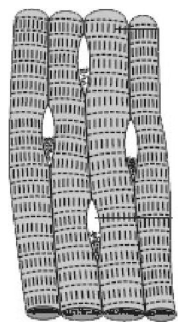
- 1Smooth muscles, show branching, found in the walls of the heart.
- 2Cardiac muscles, unbranched muscles, found in the walls of the heart
- 3Striated muscles, tapering at both-ends, attached with the bones of the ribs
- 4Skeletal muscle, shows striations and closely attached with the bones of the limbs
Show answer and solution
Correct: option 4, Skeletal muscle, shows striations and closely attached with the bones of the limbs
The diagram shows long, cylindrical, unbranched fibres with cross striations lying in parallel, which is skeletal muscle; it is attached to the bones, for example of the limbs. Smooth muscle fibres are spindle shaped and unstriated, and cardiac fibres are branched.
Question 58NEET 2013 Karnataka, Q60
Select the correct option with respect to Cockroaches:-
- 1Malpighian tubules convert nitrogenous wastes into urea
- 2Males bear short and styles not present in females
- 3Nervous system comprises of a dorsal nerve cord and ten pairs of ganglion
- 4The fore wings are tegmina which are used in flight
Show answer and solution
Correct: option 2, Males bear short and styles not present in females
Male cockroaches carry a pair of short anal styles on the ninth sternum, which females lack. The Malpighian tubules form uric acid, the nerve cord is ventral, and the leathery tegmina only cover the hind wings, which are the ones used in flight.
Question 59NEET 2013 Karnataka, Q133
Which one of the following is one of the paths followed by air/ during respiration in an adult male Periplaneta americana as it enters the animal body?
- 1Spiracle in metathorax, trachea, tracheoles, oxygen diffuses into cells
- 2Mouth, bronchial tube, trachea, oxygen enters cells
- 3Spiracles in prothorax, tracheoles, trachea oxygen diffuses into cells
- 4Hypopharynx, mouth, pharynx, trachea, tissues
Show answer and solution
Correct: option 1, Spiracle in metathorax, trachea, tracheoles, oxygen diffuses into cells
A cockroach breathes through 10 pairs of spiracles, 2 thoracic (on the mesothorax and metathorax) and 8 abdominal. Air goes from a spiracle into tracheae, then into the finer tracheoles, from where oxygen diffuses into the cells. There is no spiracle on the prothorax, and air does not enter through the mouth.
Question 60AIPMT 2012 Prelims, Q66
Pheretima and its close relatives derive nourishment from:
- 1sugarcane roots
- 2decaying fallen leaves and soil organic matter.
- 3soil insects
- 4small pieces of fresh fallen leaves of maize, etc.
Show answer and solution
Correct: option 2, decaying fallen leaves and soil organic matter.
Pheretima is an earthworm. It swallows soil and feeds on the decaying leaves and other organic matter mixed in it, passing the rest out as worm castings.
Question 61AIPMT 2012 Prelims, Q112
Compared to those of humans, the erythrocytes in frog are
- 1Without nucleus but with haemoglobin
- 2nucleated and with haemoglobin
- 3very much smaller and fewer
- 4nucleated and without haemoglobin.
Show answer and solution
Correct: option 2, nucleated and with haemoglobin
Mature human red blood cells lose their nucleus, but those of the frog (like those of fishes, reptiles and birds) keep it. Frog erythrocytes are oval, nucleated, larger than human ones, and contain the red pigment haemoglobin.
Question 62AIPMT 2012 Prelims, Q149
Select the correct statement from the ones given below with respect to Periplaneta americana.
- 1Nervous system located dorsally, consists of segmentally arranged ganglia joined by a pair of longitudinal connectives.
- 2Males bear a pair of short thread like anal styles.
- 3There are 16 very long Malpighian tubules present at the junctions of midgut and hindgut.
- 4Grinding of food is carried out only by the mouth parts.
Show answer and solution
Correct: option 2, Males bear a pair of short thread like anal styles.
Male cockroaches carry a pair of short, thread-like anal styles on the 9th sternum, which females lack. The nerve cord of the cockroach is ventral, not dorsal; there are 100 to 150 Malpighian tubules, not 16; and food is also ground in the gizzard (proventriculus), which has six chitinous teeth.
Question 63AIPMT 2012 Mains, Q100
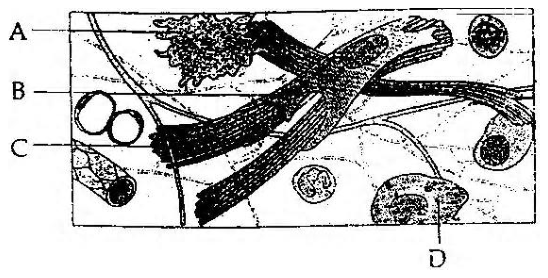
Given below is the diagrammatic sketch of a certain type of connective tissue. Identify the parts labelled A, B, C and D, and select the right option about them.
- 1A-Macrophage, B-Fibroblast, C-Collagen fibres, D-Mast cells
- 2A-Mast cell, B-Macrophage, C-Fibroblast, D-Collagen fibres
- 3A-Macrophage, B-Collagen fibres, C-Fibroblast, D-Mast cell
- 4A-Mast cell, B-Collagen fibres, C-Fibroblast, D-Macrophage
Show answer and solution
Correct: option 1, A-Macrophage, B-Fibroblast, C-Collagen fibres, D-Mast cells
The sketch is areolar (loose connective) tissue. A is the irregular cell with many processes, a macrophage; B is a fibroblast, the cell that secretes the fibres; C is a bundle of collagen fibres; D is the granule-filled mast cell.
Question 64AIPMT 2012 Mains, Q104
The supportive skeletal structures in the human external ears and in the nose tip are examples of:
- 1ligament
- 2areolar tissue
- 3bone
- 4cartilage
Show answer and solution
Correct: option 4, cartilage
The pinna of the ear and the tip of the nose are firm yet flexible because they are supported by cartilage, a skeletal connective tissue with a pliable matrix. Bone would be rigid, and ligament and areolar tissue give no such support.
Question 65AIPMT 2012 Mains, Q105
The four sketches (A, B, C and D) given below, represent four different types of animal tissues. Which one of these is correctly identified in the options given, along with its correct location and function?
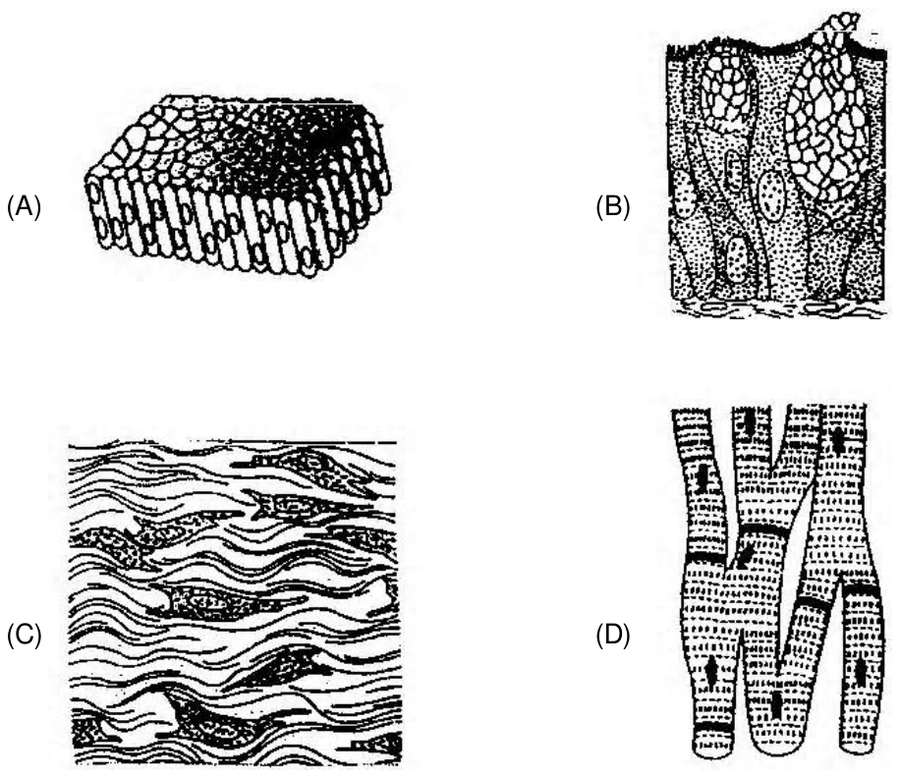
Tissue - Location - Function
- 1(B) Glandular epithelium - Intestine - Secretion
- 2(C) Collagen fibres - Cartilage - Attach skeletal muscles to bones
- 3(D) Smooth muscle tissue - Heart - Heart contraction
- 4(A) Columnar epithelium - Nephron - Secretion and absorption
Show answer and solution
Correct: option 1, (B) Glandular epithelium - Intestine - Secretion
Sketch B shows a multicellular glandular epithelium, which is found in the lining of the gut and secretes. C is dense connective tissue of the kind found in tendons, not cartilage; D shows branched striated fibres with intercalated discs, which is cardiac muscle, not smooth muscle; the tubules of the nephron are lined by cuboidal, not columnar, epithelium.
Question 66AIPMT 2012 Mains, Q107
Which one of the following characteristics is common both in humans and adult frogs?
- 1Four - chambered heart
- 2Internal fertilisation
- 3Nucleated RBCs
- 4Ureotelic mode of excretion
Show answer and solution
Correct: option 4, Ureotelic mode of excretion
Both humans and adult frogs excrete urea, so both are ureotelic. The frog has a three-chambered heart, external fertilisation and nucleated RBCs, whereas humans have a four-chambered heart, internal fertilisation and RBCs without a nucleus.
Question 67AIPMT 2011 Prelims, Q55
One very special feature in the earthworm Pheretima is that
- 1Fertilisation for eggs occurs inside the body
- 2The typhlosole greatly increases the effective absorption area of the digested food in the intestine
- 3The S- shaped setae embedded in the integument are the defensive weapons used against the enemies
- 4It has a long dorsal tubular heart
Show answer and solution
Correct: option 2, The typhlosole greatly increases the effective absorption area of the digested food in the intestine
The typhlosole is an internal median fold of the dorsal wall of the intestine that increases the surface for absorption. Fertilisation in the earthworm takes place outside the body in the cocoon, the setae are used for locomotion, and the earthworm has several pairs of lateral hearts, not one long dorsal tubular heart.
Question 68AIPMT 2011 Prelims, Q99
The ciliated columnar epithelial cells in humans are known to occur in:
- 1Eustachian tube and stomach lining
- 2Bronchioles and Fallopian tubes
- 3Bile duct and oesophagus
- 4Fallopian tubes and urethra
Show answer and solution
Correct: option 2, Bronchioles and Fallopian tubes
Ciliated epithelium lines hollow organs where particles or mucus must be moved in one direction, such as the bronchioles and the Fallopian tubes. The stomach lining, bile duct, oesophagus and urethra are not ciliated.
Question 69AIPMT 2011 Prelims, Q115
Which of the following is correctly stated as it happens in the common cockroach?
- 1Malpighian tubules are excretory organs projecting out from the colon.
- 2Oxygen is transported by haemoglobin in blood
- 3Nitrogenous excretory product is urea.
- 4The food is ground by mandibles and gizzard
Show answer and solution
Correct: option 4, The food is ground by mandibles and gizzard
In the cockroach the mandibles cut and chew the food and the gizzard (proventriculus), with its six chitinous teeth, grinds it further. The Malpighian tubules arise at the junction of midgut and hindgut, not from the colon; oxygen reaches the tissues directly through tracheae, as the haemolymph has no haemoglobin; and the excretory product is uric acid.
Question 70AIPMT 2011 Mains, Q41
The cells lining the blood vessels belong to the category of:
- 1Smooth muscle tissue
- 2Squamous epithelium
- 3Columnar epithelium
- 4Connective tissue
Show answer and solution
Correct: option 2, Squamous epithelium
The inner lining of blood vessels (the endothelium) is a single layer of thin, flat cells with irregular boundaries. That is simple squamous epithelium, which suits a surface across which substances diffuse. Smooth muscle and connective tissue lie in the wall outside this lining, not at the surface facing the blood.
Question 71AIPMT 2011 Mains, Q49
Frogs differ from humans in possessing:
- 1paired cerebral hemispheres
- 2hepatic portal system
- 3nucleated red blood cells
- 4thyroid as well as parathyroid
Show answer and solution
Correct: option 3, nucleated red blood cells
The red blood cells of a frog keep their nucleus, while mature human red blood cells have none. Paired cerebral hemispheres, a hepatic portal system, and thyroid and parathyroid glands are found in both frogs and humans, so they are not differences.
Question 72AIPMT 2011 Mains, Q60
Consider the following four statements (A-D) related to the common frog Rana tigrina, and select the correct option stating which ones are true (T) and which ones are false (F)
Statements:
(A) On dry land it would die due to lack of its mouth is forcibly kept closed for a few days
(B) It has four-chambered heart
(C) On dry land it turns uricotelic from ureotelic
(D) Its life-history is carried out in pond water
Options:
(A), (B), (C), (D)
- 1T, F, F, T
- 2T, T, F, F
- 3F, F, T, T
- 4F, T, T, F
Show answer and solution
Correct: option 1, T, F, F, T
(A) is taken as true: on dry land the skin dries and cannot take in oxygen, and with the mouth held shut the frog cannot pump air into its lungs either. (B) is false, because a frog's heart has three chambers, two atria and one ventricle. (C) is false, because an adult frog stays ureotelic. (D) is true, because the eggs are laid and fertilised in water and the tadpole develops there.
Question 73AIPMT 2011 Mains, Q63
Which one of the following structures in Pheretima is correctly matched with its function
- 1Clitellum - secretes cocoon
- 2Gizzard - absorbs digested food
- 3Setae- defence against predators
- 4Typhlosole - storage of extra nutrients
Show answer and solution
Correct: option 1, Clitellum - secretes cocoon
In the earthworm the clitellum, a glandular band over segments 14 to 16, secretes the cocoon in which the eggs and sperm are placed. The gizzard grinds food, the setae help in locomotion, and the typhlosole is an internal fold of the intestine that increases the area for absorption.
Question 74AIPMT 2011 Mains, Q80
Ureters act as urogenital ducts in:
- 1human males
- 2human females
- 3frog's both males and females
- 4frog's males
Show answer and solution
Correct: option 4, frog's males
In a male frog the sperm pass from the testes through the vasa efferentia into the kidney and leave by the ureter, so the ureter carries both urine and sperm and acts as a urogenital duct. In a female frog the ureters and oviducts open separately into the cloaca. In humans the ureters carry only urine.
Question 75AIPMT 2010 Mains, Q94
Which one of the following pairs of structure is correctly matched with their correct description
| Structures | Description |
|---|
| Premolars and molars | 20 in all and 3-rooted |
| Tibia and fibula | Both form parts of knee joint |
| Cartilage and cornea | No blood supply but do require oxygen for respiratory need |
| Shoulder joint and elbow joint | Ball and socket type of joint |
- 1Premolars and molars – 20 in all and 3-rooted
- 2Tibia and fibula – Both form parts of knee joint
- 3Cartilage and cornea – No blood supply but do require oxygen for respiratory need
- 4Shoulder joint and elbow joint – Ball and socket type of joint
Show answer and solution
Correct: option 3, Cartilage and cornea – No blood supply but do require oxygen for respiratory need
Cartilage and the cornea have no blood vessels, yet their living cells still need oxygen, which reaches them by diffusion. An adult has 8 premolars and 12 molars, and they are not all 3-rooted; the fibula does not take part in the knee joint; the elbow is a hinge joint, not a ball and socket joint.
Question 76AIPMT 2010 Prelims, Q133
The kind of epithelium which forms the inner walls of blood vessels is
- 1columnar epithelium
- 2ciliated columnar epithelium
- 3squamous epithelium
- 4cuboidal epithelium
Show answer and solution
Correct: option 3, squamous epithelium
The inner lining of blood vessels (the endothelium) is a single layer of thin, flat cells with irregular edges, which is simple squamous epithelium. The same tissue lines the air sacs of the lungs, where a thin diffusion surface is also needed.
Question 77AIPMT 2009 Prelims, Q51
Which one of the following is correct pairing of a body part and the kind of muscle tissue that moves it?
- 1Biceps of upper arm - Smooth muscle fibres
- 2Abdominal wall - Smooth muscle
- 3Iris - Involuntary smooth muscle
- 4Heart wall - Involuntary unstriated muscle
Show answer and solution
Correct: option 2, Abdominal wall - Smooth muscle
The biceps and the muscles of the abdominal wall are skeletal (striated, voluntary) muscles, and the heart wall is cardiac muscle, which is striated and involuntary. The iris is moved by involuntary smooth muscle, so by this working the correct pairing is option (3). The answer key supplied with this copy of the paper marks option (2), and that is the answer recorded here.
Question 78AIPMT 2009 Prelims, Q52
The epithelial tissue present on the inner surface of bronchioles and fallopian tubes is:
- 1Glandular
- 2Ciliated
- 3Squamous
- 4Cuboidal
Show answer and solution
Correct: option 2, Ciliated
Bronchioles and fallopian tubes are lined by ciliated epithelium. The beating cilia move mucus and particles in the airways and the ovum in the fallopian tube in one direction.
Question 79AIPMT 2009 Prelims, Q67
The cell junctions called tight, adhering and gap junctions are found in:
- 1Connective tissue
- 2Epithelial tissue
- 3Neural tissue
- 4Muscular tissue
Show answer and solution
Correct: option 2, Epithelial tissue
Epithelial cells are closely packed with little intercellular matrix and are held together by tight junctions (stop leakage), adhering junctions (cement neighbouring cells) and gap junctions (allow exchange of ions and small molecules).
Question 80AIPMT 2009 Prelims, Q69
If a live earthworm is pricked with a needle on its outer surface without damaging its gut, the fluid that comes out is:
- 1coelomic fluid
- 2haemolymph
- 3slimy mucus
- 4excretory fluid
Show answer and solution
Correct: option 1, coelomic fluid
The space between the body wall and the gut of an earthworm is a true coelom filled with coelomic fluid. A needle that passes through the body wall without reaching the gut enters this cavity, so coelomic fluid comes out. Earthworms have a closed blood system and no haemolymph.
Question 81AIPMT 2009 Prelims, Q149
Which one of the following correctly describes the location of some body parts in the earthworm Pheretima?
- 1Four pairs of spermathecae in 4 - 7 segments.
- 2One pair of ovaries attached at intersegmental septum of 14th and 15th segments.
- 3Two pairs of testes in 10th and 11th segments.
- 4Two pairs of accessory glands in 16 - 18 segments.
Show answer and solution
Correct: option 3, Two pairs of testes in 10th and 11th segments.
Pheretima has two pairs of testes, one pair each in the 10th and 11th segments. Its four pairs of spermathecae lie in segments 6 to 9, the pair of ovaries is at the septum between segments 12 and 13, and the two pairs of accessory glands are in segments 17 and 19.
Question 82AIPMT 2009 Prelims, Q150
The kind of tissue that forms the supportive structure in our pinna (external ears) is also found in:
- 1nails
- 2ear ossicles
- 3tip of the nose
- 4vertebrae
Show answer and solution
Correct: option 3, tip of the nose
The pinna is supported by elastic cartilage. Cartilage also supports the tip of the nose. Nails are made of keratin, and ear ossicles and vertebrae are bone.
Question 83AIPMT 2008 Prelims, Q145
Which one of the following is the true description about an animal concerned?
- 1Cockroach - 10 pairs of spiracles (2 pairs on thorax and 8 pairs on abdomen)
- 2Earthworm - The alimentary canal consists of a sequence of pharynx, oesophagus, stomach, gizzard and intestine
- 3Frog - Body divisible into three regions - head, neck and trunk
- 4Rat - Left kidney is slightly higher in position than the right one
Show answer and solution
Correct: option 1, Cockroach - 10 pairs of spiracles (2 pairs on thorax and 8 pairs on abdomen)
A cockroach has 10 pairs of spiracles, 2 thoracic and 8 abdominal. In the earthworm the gizzard comes before the stomach, the frog has no neck (only head and trunk), and in the rat the right kidney lies slightly higher than the left.
Question 84AIPMT 2007 Prelims, Q55
In which one of the following preparations are you likely to come across cell junctions most frequently?
- 1Hyaline cartilage
- 2Ciliated epithelium
- 3Thrombocytes
- 4Tendon
Show answer and solution
Correct: option 2, Ciliated epithelium
Cell junctions (tight, adhering and gap junctions) join cells that lie closely packed, which is the case in epithelial tissue. In cartilage and tendon the cells are scattered in a large amount of matrix or fibres, and thrombocytes are free cell fragments in blood. So ciliated epithelium shows the most junctions.
Question 85AIPMT 2006 Prelims, Q173
Areolar connective tissue joins
- 1Fat body with muscles
- 2Integument with muscles
- 3Bones with muscles
- 4Bones with bones
Show answer and solution
Correct: option 2, Integument with muscles
Areolar tissue is loose connective tissue lying under the skin, where it attaches the integument to the muscles beneath and supports epithelia. Bones are joined to muscles by tendons and to other bones by ligaments, which are dense connective tissues.
Question 86AIPMT 2006 Prelims, Q174
- 1Hippurin
- 2Myoglobin
- 3Histamine
- 4Haemoglobin
Show answer and solution
Correct: option 3, Histamine
Mast cells of connective tissue contain granules of histamine (along with heparin and serotonin). Histamine released from them widens blood vessels and is responsible for inflammatory and allergic reactions. Myoglobin and haemoglobin are oxygen-binding proteins of muscle and red blood cells.
Question 87AIPMT 2005 Prelims, Q119
Four healthy people in their twenties got involved in injuries resulting in damage and death of a few cell of the following. Which of the cells are least likely to be replaced by new cells
- 1Osteocytes
- 2Liver cells
- 3Neurons
- 4Malpighian layer of the skin
Show answer and solution
Correct: option 3, Neurons
Mature neurons have lost the ability to divide, so neurons that die are generally not replaced. Bone, liver and the Malpighian (germinative) layer of the skin all keep the capacity to produce new cells and regenerate.
Question 88AIPMT 2004 Prelims, Q160
Mast cells of connective tissue contain -
- 1Heparin and histamine
- 2Heparin and calcitonin
- 3Serotonin and melanin
- 4Vasopressin and relaxin
Show answer and solution
Correct: option 1, Heparin and histamine
Mast cells of areolar connective tissue hold granules of heparin (an anticoagulant) and histamine (a vasodilator released in inflammation and allergy); they also release serotonin. Calcitonin, melanin, vasopressin and relaxin come from the thyroid, melanocytes, the hypothalamus and the ovary, not from mast cells.
Question 89AIPMT 2003 Prelims, Q109
Which one of the following contains the largest quantity of extracellular material:
- 1Striated muscle
- 2Areolar tissue
- 3Stratified epithelium
- 4Myelinated nerve fibres
Show answer and solution
Correct: option 2, Areolar tissue
Areolar tissue is a loose connective tissue: its few cells lie far apart in an abundant matrix of ground substance and fibres. Muscle, epithelium and nerve fibres consist of closely packed cells with very little intercellular material.
Question 90AIPMT 2002 Prelims, Q114
Which cartilage is present on the end of long bones -
- 1Calcified cartilage
- 2Hyaline cartilage
- 3Elastic cartilage
- 4Fibrous cartilage
Show answer and solution
Correct: option 2, Hyaline cartilage
The ends of long bones are capped by articular cartilage, which is hyaline cartilage. It gives a smooth, glassy surface that reduces friction at the joint. Elastic cartilage is found in the pinna and epiglottis and fibrous cartilage in the intervertebral discs.
Question 91AIPMT 2002 Prelims, Q115
- 1U.V. rays
- 2Visible rays
- 3Infrared rays
- 4X-rays
Show answer and solution
Correct: option 1, U.V. rays
Melanin is the dark pigment made by melanocytes of the skin. It absorbs ultraviolet radiation from sunlight and so protects the deeper cells and their DNA from U.V. damage.
Question 92AIPMT 2001 Prelims, Q192
Which cells do not form layer and remains structurally separate:
- 1Epithelial cells
- 2Muscle cells
- 3Nerve cells
- 4Gland cells
Show answer and solution
Correct: option 3, Nerve cells
Neurons do not join into sheets. Each one stays a separate unit and meets the next only at synapses, where a gap lies between them. Epithelial and gland cells form layers, and muscle cells are bound into bundles.
Question 93AIPMT 2001 Prelims, Q193
During an injury Nasal septum gets damaged and for its recovery which cartilage preferred:
- 1Elastic cartilage
- 2Hyaline cartilage
- 3Calcified cartilage
- 4Fibrous cartilage
Show answer and solution
Correct: option 2, Hyaline cartilage
The nasal septum is made of hyaline cartilage, so the same kind of cartilage is the right one to repair it. Elastic cartilage is found in the ear pinna and epiglottis, and fibrous cartilage in the intervertebral discs.
Question 94AIPMT 2000 Prelims, Q128
Reason, why hair loss is more in old age:
- 1Reduction of blood supply
- 2Decrease in protein synthesis
- 3Low energy production
- 4Reduced storage of glycogen
Show answer and solution
Correct: option 1, Reduction of blood supply
The key gives reduction of blood supply. Hair follicles are nourished by the capillaries of the dermal papilla; with age the circulation to the skin falls, the follicles are poorly nourished and shrink, and hair is lost faster than it is replaced.
Question 95AIPMT 2000 Prelims, Q143
- 1Sweat = temperature regulation
- 2Saliva = sense of food taste
- 3Sebum = sexual attraction
- 4Humerus = Hind leg
Show answer and solution
Correct: option 1, Sweat = temperature regulation
Evaporation of sweat takes heat from the skin and so cools the body. Saliva moistens food and begins starch digestion, sebum oils the skin and hair, and the humerus is the bone of the upper arm (fore limb).
Question 96AIPMT 2000 Prelims, Q144
Which gland secretes odourous secretion in mammals:
- 1Bartholins
- 2Prostate
- 3Anal gland
- 4Liver-bile
Show answer and solution
Correct: option 3, Anal gland
Many mammals have anal (scent) glands whose strong-smelling secretion is used to mark territory and to signal to other animals. Bartholin's glands secrete a lubricating fluid, the prostate adds fluid to semen, and the liver secretes bile.
Question 97AIPMT 2000 Prelims, Q145
Characteristic of simple epithelium is:
- 1They are arranged indiscriminately
- 2They make a definite layer
- 3Continue to divide and help in organ function
- 4None
Show answer and solution
Correct: option 2, They make a definite layer
A simple epithelium is a single, regular layer of closely packed cells all resting on a basement membrane, so its cells form one definite layer rather than an irregular mass.
Question 98AIPMT 2000 Prelims, Q167
Primary function of enteronephric nephridia of Pheretima:
- 1Osmoregulation
- 2Excretion of nitrogenous waste
- 3Respiration
- 4Locomotion
Show answer and solution
Correct: option 2, Excretion of nitrogenous waste
Nephridia are the excretory organs of the earthworm, and the key takes their main work to be the removal of nitrogenous waste. Enteronephric nephridia (the septal and pharyngeal ones) pour this waste into the gut instead of to the outside, which also lets the worm reabsorb water. Because that water saving is the special feature of the enteronephric type, many books give osmoregulation as the answer; the key used here gives excretion.
Question 99AIPMT 2000 Prelims, Q178
Proteoglycan in cartilages which is part of polysaccharide:
- 1Chondroitin
- 2Ossein
- 3Cassin
- 4Cartilegen
Show answer and solution
Correct: option 1, Chondroitin
The matrix of cartilage is made of proteoglycans whose polysaccharide part is chondroitin sulphate. Ossein is the protein of the bone matrix.
Question 100AIPMT 1999 Prelims, Q180
- 1Yellow fibres + Elastic fibres
- 2Yellow fibres + Collagen (white) fibres
- 3Yellow fibres + Muscle fibres
- 4White fibres + Muscle fibres
Show answer and solution
Correct: option 2, Yellow fibres + Collagen (white) fibres
A ligament joins bone to bone and must stretch a little. It is dense connective tissue made mainly of yellow elastic fibres together with some white collagen fibres. Yellow fibres and elastic fibres are the same thing, and muscle fibres are not part of a ligament.
Question 101AIPMT 1999 Prelims, Q181
- 1Non Elastic connective tissue
- 2White Elastic tissue
- 3Collagen (white) fibres + Muscle fibres
- 4Only collagen fibres
Show answer and solution
Correct: option 4, Only collagen fibres
A tendon joins a muscle to a bone and has to be strong and inextensible. It is dense regular connective tissue made of parallel bundles of white collagen fibres only, with rows of fibroblasts between them. It has no muscle fibres, and white fibres are not elastic.
Question 102AIPMT 1998 Prelims, Q168
- 1Mast cells
- 2Fibroblast
- 3Histiocytes
- 4Plasma cells
Show answer and solution
Correct: option 1, Mast cells
Mast cells of connective tissue release histamine (along with heparin and serotonin), which widens blood vessels in inflammation and allergy. Fibroblasts make fibres, histiocytes are phagocytes and plasma cells make antibodies.