Questions with solutions
Question 1NEET 2026, Q128
The Respiratory Quotient (RQ) of a biomolecule used for respiration, as per the above equation, would be:
- 1Less than 0.5
- 2Between 0.5 and 0.95
- 3Between 1.25 and 2
- 41.0
Show answer and solution
Correct: option 2, Between 0.5 and 0.95
RQ is the volume of evolved divided by the volume of consumed. Here , the value for a fat (tripalmitin), which lies between 0.5 and 0.95.
Question 2NEET 2026, Q135
Match List I with List II:
| List I (Process) | List II (Location) |
|---|
| A. Glycolysis | I. Inner mitochondrial membrane |
| B. ETS | II. Mitochondrial matrix |
| C. Accumulation of protons | III. Cytoplasm |
| D. Krebs' cycle | IV. Intermembrane space |
Choose the correct answer from the options given below:
- 1A-I, B-IV, C-III, D-II
- 2A-III, B-I, C-IV, D-II
- 3A-IV, B-II, C-I, D-III
- 4A-II, B-III, C-IV, D-I
Show answer and solution
Correct: option 2, A-III, B-I, C-IV, D-II
Glycolysis takes place in the cytoplasm (A-III). The electron transport system sits on the inner mitochondrial membrane (B-I). Protons pumped by the ETS accumulate in the intermembrane space (C-IV). The Krebs' cycle runs in the mitochondrial matrix (D-II).
Question 3NEET 2026 Re-exam, Q109
How many molecules of pyruvic acid are produced at the end of glycolysis from 206 molecules of glucose?
- 1206
- 2309
- 3103
- 4412
Show answer and solution
Correct: option 4, 412
In glycolysis one six-carbon glucose is split into two three-carbon molecules of pyruvic acid. So 206 molecules of glucose give molecules of pyruvic acid.
Question 4NEET 2025, Q91
The complex II of mitochondrial electron transport chain is also known as
- 1Cytochrome
- 2Succinate dehydrogenase
- 3Cytochrome c oxidase
- 4NADH dehydrogenase
Show answer and solution
Correct: option 2, Succinate dehydrogenase
The complexes of the mitochondrial electron transport chain are: complex I, NADH dehydrogenase; complex II, succinate dehydrogenase, which passes electrons from to ubiquinone; complex III, cytochrome ; complex IV, cytochrome c oxidase. So complex II is succinate dehydrogenase.
Question 5NEET 2024, Q139
Match List I with List II
| List I | List II |
|---|
| A. Citric acid cycle | I. Cytoplasm |
| B. Glycolysis | II. Mitochondrial matrix |
| C. Electron transport system | III. Intermembrane space of mitochondria |
| D. Proton gradient | IV. Inner mitochondrial membrane |
Choose the correct answer from the options given below:
- 1A-IV, B-III, C-II, D-I
- 2A-I, B-II, C-III, D-IV
- 3A-II, B-I, C-IV, D-III
- 4A-III, B-IV, C-I, D-II
Show answer and solution
Correct: option 3, A-II, B-I, C-IV, D-III
The citric acid cycle runs in the mitochondrial matrix (A-II) and glycolysis in the cytoplasm (B-I). The electron transport system is located in the inner mitochondrial membrane (C-IV), and it pumps protons into the intermembrane space, where the proton gradient builds up (D-III).
Question 6NEET 2024, Q147
Identify the step in tricarboxylic acid cycle, which does not involve oxidation of substrate.
- 1Isocitrate -ketoglutaric acid
- 2Malic acid Oxaloacetic acid
- 3Succinic acid Malic acid
- 4Succinyl-CoA Succinic acid
Show answer and solution
Correct: option 4, Succinyl-CoA Succinic acid
The conversion of succinyl-CoA to succinic acid is a substrate level phosphorylation that forms GTP; no hydrogen is removed. The other three steps involve oxidation, with reduced in the isocitrate and malic acid steps and FAD reduced when succinic acid is oxidised.
Question 7NEET 2024 Re-exam, Q123
Match List-I with List-II:
| List-I | List-II |
|---|
| A. ETS Complex I | I. NADH Dehydrogenase |
| B. ETS Complex II | II. Cytochrome |
| C. ETS Complex III | III. Cytochrome C oxidase |
| D. ETS Complex IV | IV. Succinate Dehydrogenase |
Choose the correct answer from the options given below:
- 1A-IV, B-I, C-III, D-II
- 2A-I, B-IV, C-II, D-III
- 3A-III, B-I, C-IV, D-II
- 4A-I, B-II, C-IV, D-III
Show answer and solution
Correct: option 2, A-I, B-IV, C-II, D-III
In the mitochondrial electron transport system, complex I is NADH dehydrogenase (A-I), complex II is succinate dehydrogenase (B-IV), complex III is the cytochrome complex (C-II), and complex IV is cytochrome c oxidase, which passes the electrons to oxygen (D-III).
Question 8NEET 2024 Re-exam, Q125
Which of the following are correct about cellular respiration?
A. Cellular respiration is the breaking of C-C bonds of complex organic molecules by oxidation.
B. The entire cellular respiration takes place in Mitochondria.
C. Fermentation takes place under anaerobic condition in germinating seeds.
D. The fate of pyruvate formed during glycolysis depends on the type of organism also.
E. Water is formed during respiration as a result of accepting electrons and getting reduced.
Choose the correct answer from the options given below:
- 1A, C, D, E only
- 2A, B, E only
- 3A, B, C, E only
- 4B, C, D, E only
Show answer and solution
Correct: option 1, A, C, D, E only
B is wrong because glycolysis, the first stage of respiration, takes place in the cytoplasm, not in the mitochondria. The rest are correct: respiration breaks C-C bonds by oxidation (A); germinating seeds ferment when oxygen is lacking (C); what happens to pyruvate depends on the organism and on oxygen supply (D); and oxygen, the final electron acceptor, is reduced to water (E).
Question 9NEET 2023, Q135
Given below are two statements: One is labelled as Assertion A and the other is labelled as Reason R:
Assertion A: ATP is used at two steps in glycolysis.
Reason R: First ATP is used in converting glucose into glucose-6-phosphate and second ATP is used in conversion of fructose-6-phosphate into fructose-1-6-diphosphate.
In the light of the above statements, choose the correct answer from the options given below:
- 1Both A and R are true and R is the correct explanation of A.
- 2Both A and R are true but R is NOT the correct explanation of A.
- 3A is true but R is false.
- 4A is false but R is true.
Show answer and solution
Correct: option 1, Both A and R are true and R is the correct explanation of A.
Glycolysis spends ATP at two steps: when glucose is phosphorylated to glucose-6-phosphate, and when fructose-6-phosphate is phosphorylated to fructose-1,6-bisphosphate. Both A and R are true and R names exactly the two steps of A.
Question 10NEET 2023, Q139
Match List I with List II:
| List I | List II |
|---|
| A. Oxidative decarboxylation | I. Citrate synthase |
| B. Glycolysis | II. Pyruvate dehydrogenase |
| C. Oxidative phosphorylation | III. Electron transport system |
| D. Tricarboxylic acid cycle | IV. EMP pathway |
Choose the correct answer from the options given below:
- 1A-III, B-IV, C-II, D-I
- 2A-II, B-IV, C-I, D-III
- 3A-III, B-I, C-II, D-IV
- 4A-II, B-IV, C-III, D-I
Show answer and solution
Correct: option 4, A-II, B-IV, C-III, D-I
Oxidative decarboxylation of pyruvate to acetyl CoA is catalysed by pyruvate dehydrogenase (A-II). Glycolysis is also called the EMP pathway (B-IV). Oxidative phosphorylation is ATP synthesis driven by the electron transport system (C-III). The tricarboxylic acid cycle starts with citrate synthase joining acetyl CoA to oxaloacetic acid (D-I).
Question 11NEET 2023 Manipur, Q118
Fatty acids are connected with the respiratory pathway through:
- 1Dihydroxy acetone phosphate
- 2Pyruvic acid
- 3Acetyl CoA
- 4-Ketoglutaric acid
Show answer and solution
Correct: option 3, Acetyl CoA
Fats are first split into glycerol and fatty acids. The fatty acids are broken down to acetyl CoA, which enters the Krebs cycle, whereas glycerol enters as a triose phosphate. So fatty acids join the pathway at acetyl CoA, option (3).
Question 12NEET 2023 Manipur, Q128
How many times decarboxylation occurs during each TCA cycle?
- 1Once
- 2Twice
- 3Thrice
- 4Many
Show answer and solution
Correct: option 2, Twice
In one turn of the cycle is released at two steps: when isocitrate (through oxalosuccinate) forms -ketoglutarate, and when -ketoglutarate forms succinyl CoA. So decarboxylation occurs twice, option (2).
Question 13NEET 2022, Q127
What amount of energy is released from glucose during lactic acid fermentation?
- 1Less than 7%
- 2Approximately 15%
- 3More than 18%
- 4About 10%
Show answer and solution
Correct: option 1, Less than 7%
Fermentation oxidises glucose only partly. In both lactic acid and alcoholic fermentation less than seven per cent of the energy in glucose is released, and not all of that is trapped as ATP.
Question 14NEET 2022, Q129
What is the net gain of ATP when each molecule of glucose is converted to two molecules of pyruvic acid?
- 1Eight
- 2Four
- 3Six
- 4Two
Show answer and solution
Correct: option 4, Two
In glycolysis four ATP are formed directly (two from each triose) and two ATP are used up in the early phosphorylation steps. The net direct gain is ATP per glucose.
Question 15NEET 2022 Re-exam, Q106
The 5-C compound formed during TCA cycle is
- 1Fumaric acid
- 2-ketoglutaric acid
- 3Oxalo succinic acid
- 4Succinic acid
Show answer and solution
Correct: option 2, -ketoglutaric acid
-ketoglutaric acid has five carbon atoms; it forms when the six-carbon isocitrate loses one . Oxalosuccinic acid has six carbons, while succinic acid and fumaric acid have four each.
Question 16NEET 2022 Re-exam, Q131
The number of time(s) decarboxylation of isocitrate occurs during single TCA cycle is
- 1Four
- 2One
- 3Two
- 4Three
Show answer and solution
Correct: option 3, Two
The keyed answer follows the NCERT description: after citrate is isomerised to isocitrate, "two successive steps of decarboxylation" follow, giving first -ketoglutaric acid and then succinyl-CoA, so two are released per turn of the cycle. Read strictly, isocitrate itself loses only one (the second is lost by -ketoglutarate), so "One" can also be argued; the key takes "Two".
Question 17NEET 2022 Re-exam, Q132
Match List-I with List-II
| List-I | List-II |
|---|
| (a) Porins | (i) Pink coloured nodules |
| (b) leg haemoglobin | (ii) Lumen of thylakoid |
| (c) accumulation | (iii) Amphibolic pathway |
| (d) Respiration | (iv) Huge pores in outer membrane of mitochondria |
Choose the correct answer from the options given below.
- 1a-ii, b-iv, c-i, d-iii
- 2a-ii, b-i, c-iv, d-iii
- 3a-iv, b-i, c-ii, d-iii
- 4a-iii, b-iv, c-ii, d-i
Show answer and solution
Correct: option 3, a-iv, b-i, c-ii, d-iii
Porins are proteins that form huge pores in the outer membranes of mitochondria, plastids and some bacteria (iv). Leghaemoglobin gives healthy root nodules their pink colour (i). During the light reaction protons accumulate in the lumen of the thylakoid (ii). The respiratory pathway is amphibolic because it serves both breakdown and synthesis (iii).
Question 18NEET 2021, Q136
Which of the following statements is incorrect?
- 1During aerobic respiration, role of oxygen is limited to the terminal stage.
- 2In ETC (Electron Transport Chain), one molecule of gives rise to 2 ATP molecules, and one gives rise to 3 ATP molecules.
- 3ATP is synthesized through complex V.
- 4Oxidation-reduction reactions produce proton gradient in respiration.
Show answer and solution
Correct: option 2, In ETC (Electron Transport Chain), one molecule of gives rise to 2 ATP molecules, and one gives rise to 3 ATP molecules.
The numbers in statement (2) are swapped. Oxidation of one gives 3 ATP and one gives 2 ATP. The other statements are correct: oxygen acts only as the final hydrogen acceptor, ATP synthase is complex V, and electron transport builds the proton gradient.
Question 19NEET 2020, Q129
The number of substrate level phosphorylations in one turn of citric acid cycle is:
- 1Zero
- 2One
- 3Two
- 4Three
Show answer and solution
Correct: option 2, One
In one turn of the citric acid cycle a single substrate level phosphorylation occurs, when succinyl-CoA is converted to succinic acid and a molecule of GTP (which gives ATP) is formed.
Question 20NEET 2020 Phase 2, Q36
Pyruvate dehydrogenase activity during aerobic respiration requires:
- 1Iron
- 2Cobalt
- 3Magnesium
- 4Calcium
Show answer and solution
Correct: option 3, Magnesium
Pyruvate is oxidatively decarboxylated to acetyl CoA in the mitochondrial matrix by pyruvate dehydrogenase, a reaction that needs NAD, coenzyme A and magnesium ions: pyruvic acid + CoA + NAD acetyl CoA + + NADH + .
Question 21NEET 2019, Q95
Respiratory Quotient (RQ) value of tripalmitin is:
- 10.9
- 20.7
- 30.07
- 40.09
Show answer and solution
Correct: option 2, 0.7
Tripalmitin is a fat. Its complete oxidation is , so RQ . Fats always give an RQ below 1 because they need more oxygen than the carbon dioxide they release.
Question 22NEET 2019, Q148
Conversion of glucose to glucose-6-phosphate, the first irreversible reaction of glycolysis, is catalyzed by:
- 1Aldolase
- 2Hexokinase
- 3Enolase
- 4Phosphofructokinase
Show answer and solution
Correct: option 2, Hexokinase
Hexokinase transfers a phosphate from ATP to glucose to give glucose-6-phosphate, the first step of glycolysis. Phosphofructokinase acts later on fructose-6-phosphate, aldolase splits fructose-1,6-bisphosphate, and enolase forms phosphoenolpyruvate.
Question 23NEET 2019 Odisha, Q142
Where is the respiratory electron transport system (ETS) located in plants?
- 1Inner mitochondrial membrane
- 2Intermembrane space
- 3Mitochondrial matrix
- 4Outer mitochondrial membrane
Show answer and solution
Correct: option 1, Inner mitochondrial membrane
The electron carriers (complexes I to IV) and ATP synthase (complex V) are embedded in the inner mitochondrial membrane. Electrons from NADH and pass along them to oxygen while protons are pumped into the intermembrane space. The Krebs cycle, by contrast, runs in the matrix.
Question 24NEET 2018, Q96
What is the role of in cellular respiration ?
- 1It is a nucleotide source for ATP synthesis.
- 2It functions as an electron carrier.
- 3It functions as an enzyme.
- 4It is the final electron acceptor for anaerobic respiration.
Show answer and solution
Correct: option 2, It functions as an electron carrier.
is a coenzyme that accepts electrons and hydrogen from substrates in glycolysis and the Krebs cycle to become , and then hands them to the electron transport system. It is therefore an electron carrier, not an enzyme or a terminal acceptor.
Question 25NEET 2018, Q170
Which of these statements is incorrect ?
- 1Glycolysis operates as long as it is supplied with NAD that can pick up hydrogen atoms.
- 2Glycolysis occurs in cytosol.
- 3Enzymes of TCA cycle are present in mitochondrial matrix.
- 4Oxidative phosphorylation takes place in outer mitochondrial membrane.
Show answer and solution
Correct: option 4, Oxidative phosphorylation takes place in outer mitochondrial membrane.
Oxidative phosphorylation is carried out by the electron transport system and ATP synthase, which are located in the inner mitochondrial membrane, not the outer one. The other three statements are correct.
Question 26NEET 2017, Q138
Which statement is wrong for Krebs' cycle?
- 1There are three points in the cycle where is reduced to
- 2There is one point in the cycle where is reduced to
- 3During conversion of succinyl CoA to succinic acid, a molecule of GTP is synthesised
- 4The cycle starts with condensation of acetyl group (acetyl CoA) with pyruvic acid to yield citric acid
Show answer and solution
Correct: option 4, The cycle starts with condensation of acetyl group (acetyl CoA) with pyruvic acid to yield citric acid
The cycle begins when the acetyl group of acetyl CoA condenses with oxaloacetic acid (not pyruvic acid) and water to give citric acid, so statement (4) is wrong. The other three are true: one turn has three NAD reductions, one FAD reduction and one GTP formed by substrate-level phosphorylation at the succinyl CoA step.
Question 27NEET 2016 Phase 2, Q108
Which of the following biomolecules is common to respiration-mediated breakdown of fats, carbohydrates and proteins?
- 1Glucose-6-phosphate
- 2Fructose 1,6-bisphosphate
- 3Pyruvic acid
- 4Acetyl CoA
Show answer and solution
Correct: option 4, Acetyl CoA
Carbohydrates give pyruvate, which is converted to acetyl CoA; fatty acids are broken down directly to acetyl CoA; and amino acids, after deamination, also enter the pathway as pyruvate, acetyl CoA or Krebs cycle acids. Acetyl CoA is the common entry point into the Krebs cycle for all three, whereas the other options belong only to glycolysis.
Question 28NEET 2016 Phase 2, Q142
Oxidative phosphorylation is
- 1formation of ATP by transfer of phosphate group from a substrate to ADP
- 2oxidation of phosphate group in ATP
- 3addition of phosphate group to ATP
- 4formation of ATP by energy released from electrons removed during substrate oxidation
Show answer and solution
Correct: option 4, formation of ATP by energy released from electrons removed during substrate oxidation
In oxidative phosphorylation the electrons removed from substrates (carried as NADH and ) pass down the electron transport system, and the energy released is used to make ATP from ADP and inorganic phosphate. Option (1) describes substrate-level phosphorylation instead.
Question 29AIPMT 2014, Q90
In which one of the following processes is not released?
- 1Lactate fermentation
- 2Aerobic respiration in plants
- 3Aerobic respiration in animals
- 4Alcoholic fermentation
Show answer and solution
Correct: option 1, Lactate fermentation
In lactate fermentation pyruvic acid is simply reduced to lactic acid by lactate dehydrogenase, with no loss of carbon, so no is formed. Alcoholic fermentation releases when pyruvic acid is converted to ethanol, and aerobic respiration releases it in the link reaction and the Krebs cycle.
Question 30NEET 2013, Q122
Which of the metabolites is common to respiration-mediated breakdown of fats, carbohydrates and proteins?
- 1Fructose 1, 6 - bisphosphate
- 2Pyruvic acid
- 3Acetyl CoA
- 4Glucose - 6 - phosphate
Show answer and solution
Correct: option 3, Acetyl CoA
Carbohydrates give pyruvate, which is converted to acetyl CoA; fatty acids are broken down to acetyl CoA; and amino acids, after deamination, also enter as pyruvate, acetyl CoA or Krebs cycle acids. Acetyl CoA is the point where all three routes meet before the Krebs cycle. The other options belong to glycolysis, which fatty acids do not pass through.
Question 31NEET 2013, Q132
The three boxes in this diagram represent the three major biosynthetic pathways in aerobic respiration. Arrows represent net reactants or products.
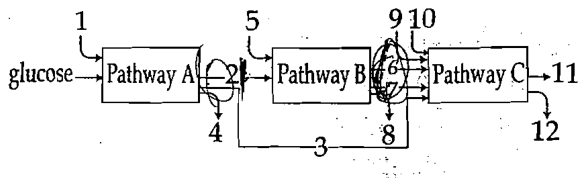
Arrows numbered 4, 8 and 12 can all be:
- 1ATP
- 2
- 3 or
- 4NADH
Show answer and solution
Correct: option 1, ATP
Pathway A is glycolysis, B the Krebs cycle and C the electron transport system. Arrows 4, 8 and 12 are products leaving each of the three pathways. ATP is the one product formed in all three: by substrate-level phosphorylation in glycolysis and the Krebs cycle, and by oxidative phosphorylation in the electron transport system. NADH is used up, not produced, in pathway C.
Question 32AIPMT 2011 Mains, Q54
In mitochondria, protons accumulate in the
- 1Outer membrane
- 2Inner membrane
- 3Intermembrane space
- 4Matrix
Show answer and solution
Correct: option 3, Intermembrane space
As electrons pass along the electron transport chain in the inner membrane, protons are pumped out of the matrix into the space between the inner and outer membranes. They build up there and form a proton gradient. Their return to the matrix through ATP synthase drives the making of ATP.
Question 33AIPMT 2010 Prelims, Q157
The energy-releasing metabolic process in which substrate is oxidised without an external electron acceptor is called.
- 1Fermentation
- 2Aerobic respiration
- 3Photorespiration
- 4Glycolysis
Show answer and solution
Correct: option 4, Glycolysis
The answer key of the source copy gives Glycolysis: glucose is partly oxidised to pyruvic acid with a net gain of 2 ATP, and no oxygen is used in these steps. Note that the description fits fermentation more exactly, because there the NADH formed is reoxidised by an organic molecule made in the pathway itself (pyruvic acid or acetaldehyde) and no outside electron acceptor is needed at all; glycolysis alone leaves NADH that still has to be reoxidised. Aerobic respiration uses as the external acceptor.
Question 34AIPMT 2009 Prelims, Q102
Aerobic respiratory pathway is appropriately termed:
- 1Parabolic
- 2Amphibolic
- 3Anabolic
- 4Catabolic
Show answer and solution
Correct: option 2, Amphibolic
The respiratory pathway breaks down substrates (catabolism), but its intermediates are also withdrawn to build fatty acids, amino acids and other compounds (anabolism). A pathway that serves both purposes is called amphibolic.
Question 35AIPMT 2008 Prelims, Q131
The chemiosmotic coupling hypothesis of oxidative phosphorylation proposes that adenosine triphosphate (ATP) is formed because
- 1There is a change in the permeability of the inner mitochondrial membrane toward adenosine diphosphate (ADP)
- 2High energy bonds are formed in mitochondrial proteins
- 3ADP is pumped out of the matrix into the intermembrane space
- 4A proton gradient forms across the inner membrane
Show answer and solution
Correct: option 4, A proton gradient forms across the inner membrane
In Mitchell's chemiosmotic hypothesis, electron transport pumps protons from the matrix into the intermembrane space. The resulting proton gradient across the inner membrane drives protons back through ATP synthase, and this flow makes ATP.
Question 36AIPMT 2008 Prelims, Q140
The energy releasing process in which the substrate is oxidised without an external electron acceptor is called
- 1Glycolysis
- 2Fermentation
- 3Photorespiration
- 4Aerobic respiration
Show answer and solution
Correct: option 2, Fermentation
In fermentation the electrons removed from the substrate are passed to an organic molecule formed from the substrate itself (pyruvate or acetaldehyde), not to an outside acceptor such as oxygen. Aerobic respiration uses oxygen as the external acceptor.
Question 37AIPMT 2007 Prelims, Q7
The overall goal of glycolysis, Krebs cycle and the electron transport system is the formation of:
- 1Nucleic acids
- 2ATP in small stepwise units
- 3ATP in one large oxidation reaction
- 4Sugars
Show answer and solution
Correct: option 2, ATP in small stepwise units
Aerobic respiration oxidises glucose through many small steps, and the energy released at these steps is trapped as ATP a little at a time. Releasing it in one large oxidation would waste most of it as heat.
Question 38AIPMT 2007 Prelims, Q38
All enzymes of TCA cycle are located in the mitochondrial matrix except one which is located in inner mitochondrial membranes in eukaryotes and in cytosol in prokaryotes. This enzyme is:
- 1succinate dehydrogenase
- 2lactate dehydrogenase
- 3isocitrate dehydrogenase
- 4malate dehydrogenase
Show answer and solution
Correct: option 1, succinate dehydrogenase
Succinate dehydrogenase is bound to the inner mitochondrial membrane, where it is also complex II of the electron transport chain. Isocitrate and malate dehydrogenases are matrix enzymes, and lactate dehydrogenase is not a TCA cycle enzyme.
Question 39AIPMT 2006 Prelims, Q136
How many ATP molecules could maximally be generated from one molecule of glucose, if the complete oxidation of one mole of glucose to and yields 686 kcal and the useful chemical energy available in the high energy phosphate bond of one mole of ATP is 12 kcal?
- 1Two
- 2Thirty
- 3Fifty-seven
- 4One
Show answer and solution
Correct: option 3, Fifty-seven
If all the energy were captured, the number of ATP would be the total energy divided by the energy per ATP: . So at most fifty-seven ATP molecules could be formed per molecule of glucose.
Question 40AIPMT 2005 Prelims, Q102
During which stage in the complete oxidation of glucose are the greatest number of ATP molecules formed from ADP
- 1Glycolysis
- 2Krebs cycle
- 3Electron transport chain
- 4Conversion of pyruvic acid to acetyl CoA
Show answer and solution
Correct: option 3, Electron transport chain
Glycolysis and the Krebs cycle each give only a small direct yield of ATP (2 each per glucose), and the link reaction gives none directly. Most of the ATP is made when the NADH and formed in these stages are oxidised in the electron transport chain by oxidative phosphorylation.
Question 41AIPMT 2004 Prelims, Q139
In glycolysis, during oxidation electrons are removed by -
- 1Glyceraldehyde-3-phosphate
- 2
- 3Molecular oxygen
- 4ATP
Show answer and solution
Correct: option 2,
The only oxidation step of glycolysis is the conversion of glyceraldehyde-3-phosphate to 1,3-bisphosphoglycerate. The electrons (as hydrogen) taken from glyceraldehyde-3-phosphate are accepted by , which becomes NADH. Oxygen takes no part in glycolysis.
Question 42AIPMT 2003 Prelims, Q116
In which one of the following do the two names refer to one and the same thing:
- 1Kreb's cycle and Calvin cycle
- 2Tricarboxylic acid cycle and citric acid cycle
- 3Citric acid cycle and Calvin cycle
- 4Tricarboxylic acid cycle and urea cycle
Show answer and solution
Correct: option 2, Tricarboxylic acid cycle and citric acid cycle
The Krebs cycle of aerobic respiration is also called the citric acid cycle, after its first product, and the tricarboxylic acid (TCA) cycle, because citric acid has three carboxyl groups. The Calvin cycle belongs to photosynthesis and the urea cycle to nitrogen excretion.
Question 43AIPMT 2003 Prelims, Q189
In alcohol fermentation:-
- 1Triose phosphate is the electron donor while acetaldehyde is the electron acceptor
- 2Triose phosphate is the electron donor while pyruvic acid is the electron acceptor
- 3There is no electron donor
- 4Oxygen is the electron acceptor
Show answer and solution
Correct: option 1, Triose phosphate is the electron donor while acetaldehyde is the electron acceptor
In glycolysis glyceraldehyde 3-phosphate (a triose phosphate) is oxidised and its electrons go to NAD, giving NADH. In alcoholic fermentation pyruvic acid is first decarboxylated to acetaldehyde, and the NADH then reduces acetaldehyde to ethanol. So triose phosphate is the donor and acetaldehyde the final acceptor.
Question 44AIPMT 2002 Prelims, Q162
How many ATP molecules produced by Aerobic oxidation of one molecule of glucose:-
- 12
- 24
- 338
- 434
Show answer and solution
Correct: option 3, 38
Complete aerobic oxidation of one glucose gives 2 ATP in glycolysis, 2 ATP (GTP) in the Krebs cycle and 34 ATP from oxidative phosphorylation of 10 NADH and 2 , a total of 38 ATP in the classical count.
Question 45AIPMT 2001 Prelims, Q177
- 1Metallo flavo protein
- 2Fe containing porphyrin pigment
- 3Glycoprotein
- 4Lipid
Show answer and solution
Correct: option 2, Fe containing porphyrin pigment
Cytochromes are electron carriers whose prosthetic group is haem, an iron-containing porphyrin ring. The iron changes between and as electrons pass along the chain.
Question 46AIPMT 1999 Prelims, Q94
How many ATP will be formed by oxidation of 1 mole glucose:
- 136
- 240
- 324
- 432
Show answer and solution
Correct: option 1, 36
Complete aerobic oxidation of one glucose gives, by the classical count, 38 ATP in all; in most eukaryotic cells 2 ATP are spent carrying the NADH made in glycolysis into the mitochondria, leaving a net gain of 36 ATP. Of the options given, 36 is the accepted figure.
Question 47AIPMT 1999 Prelims, Q158
Which of the following yield maximum energy:
- 1By glycolysis in a sprinter
- 2Aerobic respiration in germinating seeds
- 3Fermentation by yeast
- 4Anaerobic respiration
Show answer and solution
Correct: option 2, Aerobic respiration in germinating seeds
Aerobic respiration oxidises glucose completely to and water and yields about 36 to 38 ATP per glucose. Glycolysis alone, fermentation and other anaerobic pathways oxidise glucose only partly and give a net gain of just 2 ATP per glucose.
Question 48AIPMT 1998 Prelims, Q161
Oxidation of palmitic and yield:
- 1129 ATP
- 2132 ATP
- 336 ATP
- 476 ATP
Show answer and solution
Correct: option 1, 129 ATP
The question refers to palmitic acid, a 16-carbon fatty acid. Seven rounds of beta-oxidation give 7 (14 ATP), 7 NADH (21 ATP) and 8 acetyl CoA, each worth 12 ATP in the Krebs cycle (96 ATP). That is 131 ATP, and 2 ATP are spent to activate the fatty acid, leaving 129 ATP.