Questions with solutions
Question 1NEET 2026, Q145
Arrange the following events occurring in Renin-Angiotensin mechanism in the correct order:
A. Increase in blood pressure and Glomerular filtration rate.
B. Reabsorption of and water from distal parts of tubule due to Aldosterone.
C. Fall in Glomerular filtration rate.
D. Vasoconstriction by Angiotensin II and release of Aldosterone.
E. Renin converts Angiotensinogen into Angiotensin I, followed by Angiotensin II.
Choose the correct answer from the options given below:
- 1C, A, B, D, E
- 2A, D, B, E, C
- 3A, C, E, B, D
- 4C, E, D, B, A
Show answer and solution
Correct: option 4, C, E, D, B, A
A fall in glomerular blood flow or filtration rate (C) makes the JG cells release renin, which converts angiotensinogen to angiotensin I and then angiotensin II (E). Angiotensin II constricts blood vessels and makes the adrenal cortex release aldosterone (D). Aldosterone causes reabsorption of and water from the distal parts of the tubule (B), and blood pressure and GFR rise (A). The order is C, E, D, B, A.
Question 2NEET 2026, Q175
The JGA (Juxta Glomerular Apparatus) is a special sensitive region formed by cellular modifications in _______ related to the same nephron.
- 1Distal convoluted tubule and efferent renal arteriole
- 2Proximal convoluted tubule and afferent renal arteriole
- 3Distal convoluted tubule and afferent renal arteriole
- 4Proximal convoluted tubule and efferent renal arteriole
Show answer and solution
Correct: option 3, Distal convoluted tubule and afferent renal arteriole
The juxta glomerular apparatus is formed by modified cells of the distal convoluted tubule and of the afferent arteriole at the place where the two touch.
Question 3NEET 2026 Re-exam, Q157
Which of the following statements about the reabsorption process in Henle's loop are correct?
(a) The descending limb of Henle's loop is permeable to water but almost impermeable to electrolytes.
(b) Urine gets concentrated in Henle's loop.
(c) Reabsorption of and water takes place in Henle's loop.
(d) Active or passive transport of electrolytes occurs in the ascending limb of Henle's loop.
Choose the correct answer from the options given below:
- 1(a) and (b) only
- 2(b), (c) and (d) only
- 3(a), (b) and (c) only
- 4(a), (b) and (d) only
Show answer and solution
Correct: option 4, (a), (b) and (d) only
The descending limb lets water out but almost no electrolytes, so the filtrate gets concentrated as it moves down: (a) and (b) are correct. The ascending limb is impermeable to water and moves electrolytes out actively or passively: (d) is correct. The key does not accept (c); water and are not reabsorbed together in the loop, each leaves in a different limb. So the answer is (a), (b) and (d) only.
Question 4NEET 2025, Q125
Which of the following diagrams is correct with regard to the proximal (P) and distal (D) tubule of the Nephron.
- 1
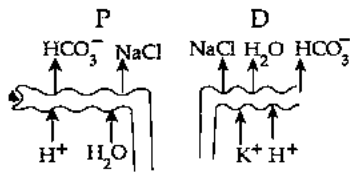
- 2
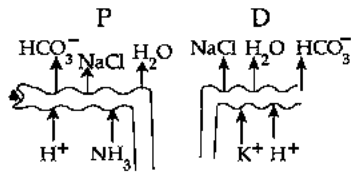
- 3
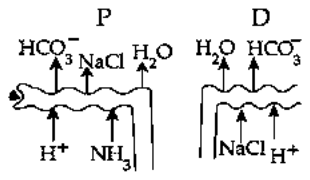
- 4
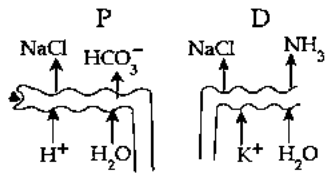
Show answer and solution
Correct: option 2
The proximal tubule reabsorbs , NaCl and water and secretes and into the filtrate. The distal tubule reabsorbs NaCl, water and and secretes and . Only diagram (2) shows all of these movements in the right directions.
Question 5NEET 2024, Q169
Given below are two statements:
Statement I: In the nephron, the descending limb of loop of Henle is impermeable to water and permeable to electrolytes.
Statement II: The proximal convoluted tubule is lined by simple columnar brush border epithelium and increases the surface area for reabsorption.
In the light of the above statements, choose the correct answer from the options given below:
- 1Statement I is false but Statement II is true
- 2Both Statement I and Statement II are true
- 3Both Statement I and Statement II are false
- 4Statement I is true but Statement II is false
Show answer and solution
Correct: option 3, Both Statement I and Statement II are false
The descending limb of the loop of Henle is permeable to water and almost impermeable to electrolytes; it is the ascending limb that is impermeable to water. So Statement I is false. The proximal convoluted tubule is lined by simple cuboidal (not columnar) brush border epithelium, so Statement II is also false.
Question 6NEET 2024, Q197
Choose the correct statement given below regarding juxta medullary nephron.
- 1Juxta medullary nephrons outnumber the cortical nephrons.
- 2Juxta medullary nephrons are located in the columns of Bertini.
- 3Renal corpuscle of juxta medullary nephron lies in the outer portion of the renal medulla.
- 4Loop of Henle of juxta medullary nephron runs deep into medulla.
Show answer and solution
Correct: option 4, Loop of Henle of juxta medullary nephron runs deep into medulla.
Most nephrons are cortical, with a short loop of Henle. In the fewer juxta medullary nephrons the renal corpuscle still lies in the cortex (close to the medulla), but the loop of Henle is very long and runs deep into the medulla. Only the last statement is correct.
Question 7NEET 2024 Re-exam, Q182
Diuresis is prevented by:
- 1Renin from JG cell via switching off the osmoreceptors
- 2ANF from adrenal medulla
- 3Aldosterone from adrenal medulla
- 4Vasopressin from Neurohypophysis
Show answer and solution
Correct: option 4, Vasopressin from Neurohypophysis
Diuresis is the loss of a large volume of water in the urine. Vasopressin (ADH), released from the neurohypophysis, makes the distal tubule and collecting duct take back water and so prevents diuresis. ANF comes from the atria of the heart and works against water retention, and aldosterone comes from the adrenal cortex, not the medulla.
Question 8NEET 2024 Re-exam, Q191
Given below are two statements:
Statement I: Concentrated urine is formed due to counter current mechanism in nephron.
Statement II: Counter current mechanism helps to maintain osmotic gradient in the medullary interstitium.
In the light of the above statements, choose the most appropriate answer from the options given below.
- 1Statement I is correct but Statement II is incorrect.
- 2Statement I is incorrect but Statement II is correct.
- 3Both Statement I and Statement II are correct.
- 4Both Statement I and Statement II are incorrect.
Show answer and solution
Correct: option 3, Both Statement I and Statement II are correct.
The opposite flow of filtrate in the two limbs of Henle's loop, and of blood in the two limbs of the vasa recta, is the counter current mechanism. It keeps the osmolarity of the medullary interstitium rising from the cortex to the inner medulla. This gradient draws water out of the collecting duct, so concentrated urine is formed. Both statements are correct.
Question 9NEET 2023, Q165
Match List I with List II.
| List I | List II |
|---|
| A. Taenia | I. Nephridia |
| B. Paramoecium | II. Contractile vacuole |
| C. Periplaneta | III. Flame cells |
| D. Pheretima | IV. Uricose gland |
Choose the correct answer from the options given below:
- 1A-I, B-II, C-III, D-IV
- 2A-I, B-II, C-IV, D-III
- 3A-III, B-II, C-IV, D-I
- 4A-II, B-I, C-IV, D-III
Show answer and solution
Correct: option 3, A-III, B-II, C-IV, D-I
Taenia (tapeworm) is a flatworm and excretes through flame cells (III). Paramoecium uses a contractile vacuole for osmoregulation (II). Periplaneta (cockroach) has uricose glands, besides Malpighian tubules, that help in excretion (IV). Pheretima (earthworm) has nephridia (I). This is option (3).
Question 10NEET 2023, Q180
Given below are statements: one is labelled as Assertion A and the other is labelled as Reason R.
Assertion A: Nephrons are of two types: Cortical & Juxta medullary, based on their relative position in cortex and medulla.
Reason R: Juxta medullary nephrons have short loop of Henle whereas, cortical nephrons have longer loop of Henle.
In the light of the above statements, choose the correct answer from the options given below:
- 1Both A and R are true and R is the correct explanation of A.
- 2Both A and R are true but R is NOT the correct explanation of A.
- 3A is true but R is false.
- 4A is false but R is true.
Show answer and solution
Correct: option 3, A is true but R is false.
A is true: nephrons are cortical or juxtamedullary according to where they lie in the cortex and medulla. R is false because it is the wrong way round: cortical nephrons have a short loop of Henle that goes only a little into the medulla, while juxtamedullary nephrons have a very long loop that runs deep into the medulla. So option (3) is right.
Question 11NEET 2023, Q198
Which of the following statements are correct?
A. An excessive loss of body fluid from the body switches off osmoreceptors.
B. ADH facilitates water reabsorption to prevent diuresis.
C. ANF causes vasodilation.
D. ADH causes increase in blood pressure.
E. ADH is responsible for decrease in GFR.
Choose the correct answer from the options given below:
- 1A and B only
- 2B, C and D only
- 3A, B and E only
- 4C, D and E only
Show answer and solution
Correct: option 2, B, C and D only
A is wrong: an excessive loss of body fluid activates the osmoreceptors, it does not switch them off. B is correct: ADH makes the later parts of the tubule reabsorb water and so prevents diuresis. C is correct: ANF causes vasodilation and lowers blood pressure. D is correct: ADH constricts blood vessels and raises blood pressure. E is wrong: the rise in blood pressure increases glomerular blood flow and so the GFR. So B, C and D, option (2).
Question 12NEET 2023 Manipur, Q173
Given below are two statements: one is labelled as Assertion (A) and the other is labelled as Reason (R).
Assertion (A): Ascending limb of loop of Henle is impermeable to water and allows transport of electrolytes actively or passively.
Reason (R): Dilution of filtrate takes place due to efflux of electrolytes in the medullary fluid.
In the light of the above statements, choose the correct answer from the options given below:
- 1Both (A) and (R) are true and (R) is the correct explanation of (A)
- 2Both (A) and (R) are true but (R) is not the correct explanation of (A)
- 3(A) is true but (R) is false
- 4(A) is false but (R) is true
Show answer and solution
Correct: option 1, Both (A) and (R) are true and (R) is the correct explanation of (A)
The ascending limb of the loop of Henle does not let water through but lets electrolytes pass out, by diffusion in the thin part and by active transport in the thick part, so (A) is true. As electrolytes leave for the medullary fluid while water stays behind, the filtrate becomes dilute as it moves up, so (R) is true. The key treats the two as one linked account of this limb and takes (R) as the explanation of (A).
Question 13NEET 2023 Manipur, Q186
Arrange the events of Renin – Angiotensin mechanism in correct sequence.
(A) Activation of JG cells and release of renin.
(B) Angiotensin II activates release of aldosterone.
(C) Fall in glomerular blood pressure.
(D) Reabsorption of and water from distal convoluted tubule.
(E) Angiotensinogen is converted to Angiotensin I and then to Angiotensin II.
Choose the correct answer from the options given below:
- 1(A), (D), (C), (B), (E)
- 2(B), (A), (E), (D), (C)
- 3(C), (A), (E), (B), (D)
- 4(A), (D), (E), (C), (B)
Show answer and solution
Correct: option 3, (C), (A), (E), (B), (D)
A fall in glomerular blood pressure or flow (C) activates the JG cells to release renin (A). Renin converts angiotensinogen to angiotensin I, which is then changed to angiotensin II (E). Angiotensin II makes the adrenal cortex release aldosterone (B), which causes reabsorption of sodium ions and water from the distal parts of the tubule (D). The order is (C), (A), (E), (B), (D).
Question 14NEET 2022, Q156
Nitrogenous waste is excreted in the form of pellet or paste by:
- 1Pavo
- 2Ornithorhynchus
- 3Salamandra
- 4Hippocampus
Show answer and solution
Correct: option 1, Pavo
Uricotelic animals (reptiles, birds, land snails and insects) excrete uric acid as a pellet or paste with very little loss of water. Pavo (peacock) is a bird. Ornithorhynchus is a mammal and Salamandra an amphibian (both ureotelic), and Hippocampus is a bony fish (ammonotelic).
Question 15NEET 2022 Re-exam, Q196
Select the correct statements.
(a) Angiotensin II activates the cortex of adrenal gland to release aldosterone.
(b) Aldosterone leads to increase in blood pressure.
(c) ANF acts as a check on renin-angiotensin mechanism.
(d) ADH causes vasodilation.
(e) Vasopressin is released from adenohypophysis.
Choose the most appropriate answer from the options given below:
- 1(a), (b) and (c) only
- 2(a), (b) and (e) only
- 3(c), (d) and (e) only
- 4(b), (c) and (d) only
Show answer and solution
Correct: option 1, (a), (b) and (c) only
(a), (b) and (c) are correct: angiotensin II makes the adrenal cortex release aldosterone, aldosterone causes reabsorption of sodium and water and so raises blood pressure, and ANF causes vasodilation and checks the renin-angiotensin mechanism. (d) is wrong because ADH constricts blood vessels. (e) is wrong because vasopressin (ADH) is released from the neurohypophysis.
Question 16NEET 2020, Q49
Presence of which of the following conditions in urine are indicative of Diabetes Mellitus?
- 1Uremia and Ketonuria
- 2Uremia and Renal Calculi
- 3Ketonuria and Glycosuria
- 4Renal calculi and Hyperglycaemia
Show answer and solution
Correct: option 3, Ketonuria and Glycosuria
In diabetes mellitus glucose is not taken up by cells, so it spills into the urine (glycosuria), and the heavy use of fat for energy produces ketone bodies that also appear in the urine (ketonuria). Uremia and renal calculi are kidney disorders, and hyperglycaemia is a condition of the blood, not of urine.
Question 17NEET 2020, Q76
Which of the following would help in prevention of diuresis?
- 1More water reabsorption due to undersecretion of ADH
- 2Reabsorption of and water from renal tubules due to aldosterone
- 3Atrial natriuretic factor causes vasoconstriction
- 4Decrease in secretion of renin by JG cells
Show answer and solution
Correct: option 2, Reabsorption of and water from renal tubules due to aldosterone
Diuresis is the passing of a large volume of urine, so it is prevented by anything that makes the tubules take back more water. Aldosterone causes reabsorption of and water from the distal parts of the tubule. Undersecretion of ADH lowers water reabsorption, atrial natriuretic factor causes vasodilation, and less renin means less aldosterone, so the other options would increase urine output or are untrue.
Question 18NEET 2020 Phase 2, Q48
Select the correct statement:
- 1Angiotensin II is a powerful vasodilator.
- 2Counter current pattern of blood flow is not observed in vasa recta.
- 3Reduction in Glomerular Filtration Rate activates JG cells to release renin.
- 4Atrial Natriuretic Factor increases the blood pressure.
Show answer and solution
Correct: option 3, Reduction in Glomerular Filtration Rate activates JG cells to release renin.
A fall in glomerular blood flow or filtration rate makes the juxtaglomerular cells release renin, which starts the renin-angiotensin mechanism. Angiotensin II is a vasoconstrictor, not a vasodilator. Blood in the two limbs of the vasa recta does flow in a counter current pattern, and Atrial Natriuretic Factor causes vasodilation and lowers the blood pressure.
Question 19NEET 2020 Phase 2, Q66
The increase in osmolarity from outer to inner medullary interstitium is maintained due to:
(i) Close proximity between Henle's loop and vasa recta
(ii) Counter current mechanism
(iii) Selective secretion of and hydrogen ions in PCT
(iv) Higher blood pressure in glomerular capillaries
- 1(iii) and (iv)
- 2(i), (ii) and (iii)
- 3(i) and (ii)
- 4Only (ii)
Show answer and solution
Correct: option 3, (i) and (ii)
The osmolarity gradient of the medulla, from about 300 mOsmol/L in the cortex to about 1200 mOsmol/L in the inner medulla, is kept up by the counter current flow in the two limbs of Henle's loop and of the vasa recta, helped by their lying close together. Secretion of ions in the PCT controls pH and ionic balance, and glomerular blood pressure drives filtration; neither maintains the gradient. So (i) and (ii) are right.
Question 20NEET 2019, Q132
Which of the following factors is responsible for the formation of concentrated urine?
- 1Low levels of antidiuretic hormone.
- 2Maintaining hyperosmolarity towards inner medullary interstitium in the kidneys.
- 3Secretion of erythropoietin by Juxtaglomerular complex.
- 4Hydrostatic pressure during glomerular filtration.
Show answer and solution
Correct: option 2, Maintaining hyperosmolarity towards inner medullary interstitium in the kidneys.
The counter current mechanism of Henle's loop and the vasa recta keeps the medullary interstitium increasingly concentrated, from about 300 mOsmol/L in the cortex to about 1200 mOsmol/L in the inner medulla. This gradient draws water out of the collecting duct and so concentrates the urine. Low ADH would do the opposite and give dilute urine.
Question 21NEET 2019, Q163
Use of an artificial kidney during hemodialysis may result in:
(a) Nitrogenous waste build-up in the body
(b) Non-elimination of excess potassium ions
(c) Reduced absorption of calcium ions from gastro-intestinal tract
(d) Reduced RBC production
Which of the following options is the most appropriate?
- 1(a) and (b) are correct
- 2(b) and (c) are correct
- 3(c) and (d) are correct
- 4(a) and (d) are correct
Show answer and solution
Correct: option 3, (c) and (d) are correct
The dialyser does remove nitrogenous wastes and excess potassium, so (a) and (b) do not happen. It cannot replace the endocrine work of the kidney: no erythropoietin is made, so RBC production falls (d), and vitamin D is not converted to active calcitriol, so less calcium is absorbed from the gut (c).
Question 22NEET 2019 Odisha, Q128
Match the following parts of a nephron with their function:
| |
|---|
| (a) Descending limb of Henle's loop | (i) Reabsorption of salts only |
| (b) Proximal convoluted tubule | (ii) Reabsorption of water only |
| (c) Ascending limb of Henle's loop | (iii) Conditional reabsorption of sodium ions and water |
| (d) Distal convoluted tubule | (iv) Reabsorption of ions, water and organic nutrients |
Select the correct option from the following:
- 1a-i, b-iv, c-ii, d-iii
- 2a-iv, b-i, c-iii, d-ii
- 3a-i, b-iii, c-ii, d-iv
- 4a-ii, b-iv, c-i, d-iii
Show answer and solution
Correct: option 4, a-ii, b-iv, c-i, d-iii
The descending limb of Henle's loop is permeable to water but almost impermeable to electrolytes, so only water is reabsorbed (ii). The proximal convoluted tubule reabsorbs most of the ions and water and nearly all the nutrients (iv). The ascending limb is impermeable to water and lets out salts only (i). The distal convoluted tubule reabsorbs sodium ions and water conditionally, under hormonal control (iii). So a-ii, b-iv, c-i, d-iii.
Question 23NEET 2019 Odisha, Q129
Match the items in Column - I with those in Column - II:
| Column - I | Column - II |
|---|
| (a) Podocytes | (i) Crystallised oxalates |
| (b) Protonephridia | (ii) Annelids |
| (c) Nephridia | (iii) Amphioxus |
| (d) Renal calculi | (iv) Filtration slits |
Select the correct option from the following:
- 1a-iv, b-iii, c-ii, d-i
- 2a-iv, b-ii, c-iii, d-i
- 3a-iii, b-iv, c-ii, d-i
- 4a-iii, b-ii, c-iv, d-i
Show answer and solution
Correct: option 1, a-iv, b-iii, c-ii, d-i
Podocytes of Bowman's capsule leave small gaps called filtration slits (iv). Protonephridia or flame cells are the excretory structures of flatworms, rotifers, some annelids and Amphioxus (iii). Nephridia are the excretory organs of earthworms and other annelids (ii). Renal calculi are stones of crystallised salts such as oxalates (i). So a-iv, b-iii, c-ii, d-i.
Question 24NEET 2018, Q163
Match the items given in Column I with those in Column II and select the correct option given below :
| Column I | | Column II |
|---|
| a. | Glycosuria | i. | Accumulation of uric acid in joints |
| b. | Gout | ii. | Mass of crystallised salts within the kidney |
| c. | Renal calculi | iii. | Inflammation in glomeruli |
| d. | Glomerular nephritis | iv. | Presence of glucose in urine |
- 1a-ii, b-iii, c-i, d-iv
- 2a-i, b-ii, c-iii, d-iv
- 3a-iii, b-ii, c-iv, d-i
- 4a-iv, b-i, c-ii, d-iii
Show answer and solution
Correct: option 4, a-iv, b-i, c-ii, d-iii
Glycosuria is the presence of glucose in urine (iv). Gout is inflammation of joints from accumulated uric acid crystals (i). Renal calculi are stones of crystallised salts in the kidney (ii). Glomerular nephritis is inflammation of the glomeruli (iii).
Question 25NEET 2018, Q164
Match the items given in Column I with those in Column II and select the correct option given below :
| Column I (Function) | | Column II (Part of Excretory System) |
|---|
| a. | Ultrafiltration | i. | Henle’s loop |
| b. | Concentration of urine | ii. | Ureter |
| c. | Transport of urine | iii. | Urinary bladder |
| d. | Storage of urine | iv. | Malpighian corpuscle |
| | v. | Proximal convoluted tubule |
- 1a-v, b-iv, c-i, d-ii
- 2a-iv, b-i, c-ii, d-iii
- 3a-iv, b-v, c-ii, d-iii
- 4a-v, b-iv, c-i, d-iii
Show answer and solution
Correct: option 2, a-iv, b-i, c-ii, d-iii
Ultrafiltration of blood takes place in the Malpighian corpuscle (iv). Urine is concentrated by the counter-current mechanism of Henle's loop (i). The ureter carries urine from the kidney (ii) and the urinary bladder stores it (iii).
Question 26NEET 2017, Q154
A decrease in blood pressure/volume will not cause the release of:
- 1Renin
- 2Atrial Natriuretic Factor
- 3Aldosterone
- 4ADH
Show answer and solution
Correct: option 2, Atrial Natriuretic Factor
A fall in blood pressure or volume triggers the mechanisms that raise it: renin from the JG cells, then aldosterone through angiotensin II, and ADH. Atrial Natriuretic Factor is released when blood pressure rises and it lowers the pressure, so it is not released here.
Question 27NEET 2017, Q157
Which of the following statements is correct?
- 1The ascending limb of loop of Henle is impermeable to water.
- 2The descending limb of loop of Henle is impermeable to water.
- 3The ascending limb of loop of Henle is permeable to water.
- 4The descending limb of loop of Henle is permeable to electrolytes.
Show answer and solution
Correct: option 1, The ascending limb of loop of Henle is impermeable to water.
The descending limb of the loop of Henle is permeable to water but almost impermeable to electrolytes. The ascending limb is the opposite: impermeable to water but it lets electrolytes out. Only statement (1) matches this.
Question 28NEET 2016 Phase 1, Q167
In mammals, which blood vessel would normally carry largest amount of urea?
- 1Renal Vein
- 2Dorsal Aorta
- 3Hepatic Vein
- 4Hepatic Portal Vein
Show answer and solution
Correct: option 3, Hepatic Vein
Urea is made in the liver by the ornithine cycle, so the blood leaving the liver in the hepatic vein carries the most urea. The renal vein carries the least, because the kidney has just removed urea from that blood.
Question 29NEET 2016 Phase 2, Q158
The part of nephron involved in active reabsorption of sodium is
- 1distal convoluted tubule
- 2proximal convoluted tubule
- 3Bowman's capsule
- 4descending limb of Henle's loop
Show answer and solution
Correct: option 2, proximal convoluted tubule
About 70 to 80 per cent of the filtered electrolytes, including most of the , are reabsorbed actively in the proximal convoluted tubule. The Bowman's capsule only filters and the descending limb of Henle's loop is almost impermeable to electrolytes. The distal tubule also reabsorbs some sodium, but only conditionally, so the proximal tubule is the keyed answer.
Question 30AIPMT 2015, Q85
Which of the following does not favour the formation of large quantities of dilute urine?
- 1Caffeine
- 2Renin
- 3Atrial-natriuretic factor
- 4Alcohol
Show answer and solution
Correct: option 2, Renin
Renin starts the renin-angiotensin mechanism: angiotensin II raises blood pressure and releases aldosterone, which increases reabsorption of and water, so less urine is formed. Caffeine and alcohol are diuretics (alcohol suppresses ADH), and atrial natriuretic factor opposes the renin-angiotensin mechanism and increases urine output.
Question 31AIPMT 2015, Q95
Removal of proximal convoluted tubule from the nephron will result in:
- 1More concentrated urine
- 2No change in quality and quantity of urine
- 3No urine formation
- 4More diluted urine
Show answer and solution
Correct: option 4, More diluted urine
The proximal convoluted tubule reabsorbs about 70 to 80 per cent of the water and electrolytes of the filtrate. Without it most of that water would stay in the tubule, giving a large volume of more dilute urine.
Question 32AIPMT 2015 Re-test, Q91
Human urine is usually acidic because:
- 1hydrogen ions are actively secreted into the filtrate.
- 2the sodium transporter exchanges one hydrogen ion for each sodium ion, in peritubular capillaries.
- 3excreted plasma proteins are acidic.
- 4potassium and sodium exchange generates acidity.
Show answer and solution
Correct: option 1, hydrogen ions are actively secreted into the filtrate.
The cells of the renal tubule, mainly in the proximal and distal convoluted tubules, actively secrete ions into the filtrate to keep the pH of blood steady. This secreted acid makes the urine slightly acidic (pH about 6). Plasma proteins are not normally excreted, and the sodium-hydrogen exchange takes place across the tubule cells, not in the peritubular capillaries.
Question 33AIPMT 2014, Q70
Which of the following causes an increase in sodium reabsorption in the distal convoluted tubule?
- 1Decrease in antidiuretic hormone levels
- 2Increase in aldosterone levels
- 3Increase in antidiuretic hormone levels
- 4Decrease in aldosterone levels
Show answer and solution
Correct: option 2, Increase in aldosterone levels
Aldosterone from the adrenal cortex acts on the distal parts of the nephron and increases the reabsorption of sodium ions and water. A rise in aldosterone therefore raises sodium reabsorption in the distal convoluted tubule. Antidiuretic hormone mainly controls the reabsorption of water, not sodium.
Question 34NEET 2013, Q135
Figure shows human urinary system with structures labelled A to D. Select option which correctly identifies them and gives their characteristics and/or functions.
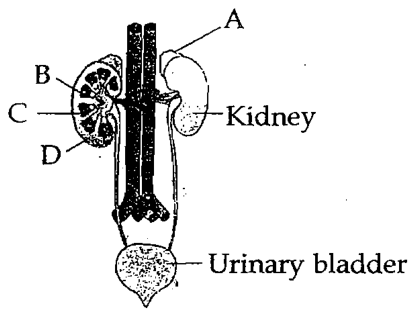
- 1B - Pelvis - broad funnel shaped space inner to hilum, directly connected to loops of Henle.
- 2C - Medulla - inner zone of kidney and contains complete nephrons.
- 3D - Cortex - outer part of kidney and do not contain any part of nephrons.
- 4A - Adrenal gland - located at the anterior part of kidney. Secrete Catecholamines which stimulate glycogen breakdown.
Show answer and solution
Correct: option 4, A - Adrenal gland - located at the anterior part of kidney. Secrete Catecholamines which stimulate glycogen breakdown.
A is the adrenal gland, which sits on top of the kidney; its medulla secretes the catecholamines adrenaline and noradrenaline, which stimulate glycogen breakdown, so (4) is correct. The pelvis receives urine from the collecting ducts, not directly from loops of Henle. The medulla holds only the loops of Henle and collecting ducts, and the cortex contains the Malpighian corpuscles and convoluted tubules.
Question 35NEET 2013 Karnataka, Q75
Select the option which shows correct matching of animal with excretory organs and excretory product:
Animal - Excretory organs - Excretory product
- 1Labeo (Rohu) - Nephridial tubes - Ammonia
- 2Salamander - Kidney - Urea
- 3Peacock - Kidney - Urea
- 4Housefly - Renal tubules - Uric acid
Show answer and solution
Correct: option 2, Salamander - Kidney - Urea
A salamander is an amphibian: it excretes urea through kidneys. Labeo excretes ammonia but through kidneys and gills, not nephridia; a peacock, being a bird, excretes uric acid; a housefly excretes uric acid through Malpighian tubules, not renal tubules.
Question 36AIPMT 2012 Prelims, Q75
The maximum amount of electrolytes and water (70 - 80 percent) from the glomerular filtrate is reabsorbed in which part of the nephron?
- 1Ascending limb of loop of Henle
- 2Distal convoluted tubule
- 3Proximal convoluted tubule
- 4Descending limb of loop of Henle
Show answer and solution
Correct: option 3, Proximal convoluted tubule
The proximal convoluted tubule is lined by brush-border cuboidal epithelium with a very large surface area. It reabsorbs nearly all the essential nutrients and 70 to 80 percent of the electrolytes and water of the filtrate.
Question 37AIPMT 2012 Mains, Q101
Which one of the following options gives the correct categorisation of six animals according to the type of nitrogenous wastes (A, B, C), they give out?
A - AMMONOTELIC, B - UREOTELIC, C - URICOTELIC
- 1A: Pigeon, Humans; B: Aquatic Amphibia, Lizards; C: Cockroach, Frog
- 2A: Frog, Lizards; B: Aquatic Amphibia, Humans; C: Cockroach, Pigeon
- 3A: Aquatic Amphibia; B: Frog, Humans; C: Pigeon, Lizards, Cockroach
- 4A: Aquatic Amphibia; B: Cockroach, Humans; C: Frog, Pigeon, Lizards
Show answer and solution
Correct: option 3, A: Aquatic Amphibia; B: Frog, Humans; C: Pigeon, Lizards, Cockroach
Aquatic amphibians have plenty of water and excrete ammonia (ammonotelic). The adult frog and humans excrete urea (ureotelic). Pigeon, lizards and cockroach conserve water by excreting uric acid (uricotelic), as birds, reptiles and insects do.
Question 38AIPMT 2012 Mains, Q106
A fall in glomerular filtration rate (GFR) activates:
- 1juxta glomerular cells to release renin
- 2adrenal cortex to release aldosterone
- 3adrenal medulla to release adrenaline
- 4posterior pituitary to release vasopressin
Show answer and solution
Correct: option 1, juxta glomerular cells to release renin
A fall in GFR (or in glomerular blood flow or pressure) is sensed by the juxtaglomerular apparatus, whose JG cells release renin. Renin converts angiotensinogen to angiotensin I, which becomes angiotensin II; this raises blood pressure and, by a later step, stimulates aldosterone release, restoring the GFR.
Question 39AIPMT 2011 Prelims, Q66
Which one of the following is not a part of a renal pyramid.
- 1Peritubular capillaries
- 2Convoluted tubules
- 3Collecting ducts
- 4Loops of Henle
Show answer and solution
Correct: option 2, Convoluted tubules
The renal pyramids are the conical masses of the medulla, which contain the loops of Henle and the collecting ducts with their blood vessels. The proximal and distal convoluted tubules lie in the cortex, so they are not part of a pyramid.
Question 40AIPMT 2011 Prelims, Q108
Which one of the following correctly explains the function of a specific part of a human nephron?
- 1Podocytes : Create minute spaces (slit pores) for the filtration of blood into the Bowman's capsule
- 2Henle's loop : most reabsorption of the major substances from the glomerular filtrate
- 3Distal convoluted tubule : reabsorption of ions into the surrounding blood capillaries
- 4Afferent arteriole : carries the blood away from the glomerulus towards renal vein.
Show answer and solution
Correct: option 1, Podocytes : Create minute spaces (slit pores) for the filtration of blood into the Bowman's capsule
Podocytes are the epithelial cells of Bowman's capsule; the gaps between their processes are the filtration slits (slit pores) through which the filtrate passes. Most reabsorption happens in the proximal convoluted tubule, not Henle's loop; the distal tubule secretes rather than reabsorbing it; and the afferent arteriole brings blood to the glomerulus.
Question 41AIPMT 2011 Prelims, Q113
Which one of the following statements is correct with respect to kidney function regulation?
- 1When someone drinks lot of water, ADH release is suppressed.
- 2Exposure to cold temperature blood flow stimulates formation of Angiotensin II.
- 3An increase in glomerular blood flow stimulates formation of Angiotensin II.
- 4During summer when body loses lot of water by evaporation, the release of ADH is suppressed.
Show answer and solution
Correct: option 1, When someone drinks lot of water, ADH release is suppressed.
Drinking a lot of water raises the body fluid volume and lowers its osmolarity, which switches off the osmoreceptors and suppresses ADH release, so dilute urine is passed. Angiotensin II is formed when glomerular blood flow or pressure falls (renin from the JG cells), not when it rises, and water loss in summer increases ADH release.
Question 42AIPMT 2011 Prelims, Q125
Uricotelic mode of passing out nitrogenous wastes is found in:
- 1Reptiles and Birds
- 2Birds and Annelids
- 3Amphibians and Reptiles
- 4Insects and Amphibians
Show answer and solution
Correct: option 1, Reptiles and Birds
Reptiles, birds, land snails and insects excrete uric acid, which needs very little water, and are called uricotelic. Annelids are ammonotelic or ureotelic and adult amphibians are ureotelic, so only the pair reptiles and birds is fully uricotelic.
Question 43AIPMT 2010 Mains, Q99
In which one of the following organisms its excretory organs are correctly stated
- 1Frog – Kidneys, skin and buccal epithelium
- 2Humans – Kidneys, sebaceous glands and tear glands
- 3Earthworm – Pharyngeal, integumentary and septal nephridia
- 4Cockroach – Malpighian tubules and enteric caeca
Show answer and solution
Correct: option 3, Earthworm – Pharyngeal, integumentary and septal nephridia
The earthworm excretes through three kinds of nephridia: pharyngeal, integumentary and septal. Buccal epithelium of the frog is a respiratory surface, tear glands are not excretory organs, and the enteric (hepatic) caeca of the cockroach secrete digestive juice.
Question 44AIPMT 2010 Prelims, Q114
Which one of the following statements in regard to the excretion by the human kidneys is correct
- 1Distal convoluted tubule is incapable of reabsorbing
- 2Nearly 99 per cent of the glomerular filtrate is reabsorbed by the renal tubules
- 3Ascending limb of loop of Henle is impermeable to electrolytes
- 4Descending limb of loop of Henle is impermeable to water
Show answer and solution
Correct: option 2, Nearly 99 per cent of the glomerular filtrate is reabsorbed by the renal tubules
The kidneys form about 180 litres of filtrate a day but only about 1.5 litres of urine, so nearly 99 per cent of the filtrate is taken back by the renal tubules. The other statements are wrong: the distal convoluted tubule can reabsorb bicarbonate ions, the ascending limb is permeable to electrolytes but not to water, and the descending limb is permeable to water.
Question 45AIPMT 2010 Prelims, Q163
The principal nitrogenous excretory compound in humans is synthesised
- 1In kidneys as well eliminated by kidneys
- 2In liver and also eliminated by the same through bile
- 3In the liver, but eliminated mostly through kidneys
- 4In kidneys but eliminated mostly through liver
Show answer and solution
Correct: option 3, In the liver, but eliminated mostly through kidneys
Humans are ureotelic: the main nitrogenous waste is urea. Ammonia is converted to urea in the liver by the ornithine cycle, the urea is carried in the blood to the kidneys, and the kidneys filter it out into urine.
Question 46AIPMT 2009 Prelims, Q68
What will happen if the stretch receptors of the urinary bladder wall are totally removed?
- 1Micturition will continue
- 2Urine will continue to collect normally in the bladder
- 3There will be no micturition
- 4Urine will not collect in the bladder
Show answer and solution
Correct: option 3, There will be no micturition
Micturition is a reflex started by the stretch receptors in the bladder wall, which signal the CNS when the bladder fills. Without these receptors no signal is sent, the micturition reflex is not set off, and so there will be no micturition.
Question 47AIPMT 2009 Prelims, Q118
Uric acid is the chief nitrogenous component of the excretory products of:
- 1Earthworm
- 2Cockroach
- 3Frog
- 4Man
Show answer and solution
Correct: option 2, Cockroach
Insects such as the cockroach are uricotelic: their Malpighian tubules remove nitrogen as uric acid, which saves water. Earthworm, adult frog and man are mainly ureotelic.
Question 48AIPMT 2007 Prelims, Q58
A person who is on a long hunger strike and is surviving only on water, will have:
- 1less urea in his urine
- 2more sodium in his urine
- 3less amino acids in his urine
- 4more glucose in his blood.
Show answer and solution
Correct: option 1, less urea in his urine
Urea is made in the liver from the nitrogen of amino acids, most of which come from dietary protein. With no food intake for a long time there is no dietary protein to deaminate and the body conserves its own protein, so less urea is formed and less is excreted. Sodium is conserved and blood glucose tends to fall, not rise.
Question 49AIPMT 2006 Prelims, Q180
- 1Ureotelic when plenty of water is available
- 2Uricotelic when plenty of water is available
- 3Uricotelic under conditions of water scarcity
- 4Ammonotelic when plenty of water is available.
Show answer and solution
Correct: option 4, Ammonotelic when plenty of water is available.
Ammonia is very toxic and needs a lot of water to be flushed out. When water is plentiful the earthworm excretes mainly ammonia (ammonotelic); in drier conditions it switches to urea (ureotelic). It does not excrete uric acid as its main waste.
Question 50AIPMT 2006 Prelims, Q200
Angiotensinogen is a protein produced and secreted by
- 1Macula densa cells
- 2Endothelial cells (cells lining the blood vessels)
- 3Liver cells
- 4Juxtaglomerular (JG) cells
Show answer and solution
Correct: option 3, Liver cells
Angiotensinogen is a plasma protein made by the liver. The juxtaglomerular cells of the kidney release renin, which converts angiotensinogen to angiotensin I; this is then changed to angiotensin II.
Question 51AIPMT 2005 Prelims, Q117
In ornithine cycle which of the following wastes are removed from the blood
- 1 and ammonia
- 2Ammonia and urea
- 3 and urea
- 4Urea and urine
Show answer and solution
Correct: option 1, and ammonia
In the ornithine (urea) cycle of the liver, ammonia and carbon dioxide are taken up and combined to form urea. So the two wastes removed from the blood are and ammonia; urea is the product, not something removed by the cycle.
Question 52AIPMT 2005 Prelims, Q139
The net pressure gradient that causes the fluid to filter out of the glomeruli into the capsule is
- 120 mm Hg
- 250 mm Hg
- 375 mm Hg
- 430 mm Hg
Show answer and solution
Correct: option 1, 20 mm Hg
The net (effective) filtration pressure is the glomerular blood pressure minus the two pressures that oppose filtration: the colloid osmotic pressure of the blood and the pressure of the fluid in the capsule. With the textbook values of about 70, 30 and 20 mm Hg, this is mm Hg.
Question 53AIPMT 2005 Prelims, Q198
A person is undergoing prolonged fasting. His urine will be found to contain abnormal quantities of
- 1Fats
- 2Amino acids
- 3Ketones
- 4Glucose
Show answer and solution
Correct: option 3, Ketones
During a long fast the stored glycogen runs out and the body burns fat for energy. The liver turns the fatty acids into ketone bodies faster than the tissues can use them, so they build up in the blood and pass out in the urine (ketonuria).
Question 54AIPMT 2004 Prelims, Q159
A terrestrial animal must be able to -
- 1Conserve water
- 2Actively pump salts out through the skin
- 3Excrete large amounts of salts in urine
- 4Excrete large amounts of water in urine
Show answer and solution
Correct: option 1, Conserve water
On land the body keeps losing water by evaporation and in urine, and water is not always available, so the main need is to conserve water (concentrated urine, a waterproof body covering, uric acid or urea as waste). Passing large amounts of water in urine is the need of a freshwater animal, and getting rid of excess salt is the need of a marine one.
Question 55AIPMT 2004 Prelims, Q161
Uricotelism is found in -
- 1Fishes and Fresh water protozoans
- 2Birds, reptiles and insects
- 3Frogs and toads
- 4Mammals and birds
Show answer and solution
Correct: option 2, Birds, reptiles and insects
Uricotelic animals excrete nitrogen as uric acid, a nearly insoluble paste that saves water: birds, reptiles, insects and land snails. Bony fishes and freshwater protozoans are ammonotelic, while adult frogs, toads and mammals are ureotelic.
Question 56AIPMT 2003 Prelims, Q110
If Henle's loop were absent from mammalian nephron, which of the following is to be expected:
- 1There will be no urine formation
- 2There will be hardly any change in the quality and quantity of urine formed
- 3The urine will be more concentrated
- 4The urine will be more dilute
Show answer and solution
Correct: option 4, The urine will be more dilute
Henle's loop sets up the counter-current mechanism that makes the medulla hypertonic, and this is what allows water to be drawn out of the collecting duct. Without the loop filtration would still take place, but the urine could not be concentrated, so it would be more dilute.
Question 57AIPMT 2000 Prelims, Q126
Concentration of urine depends upon which organ:
- 1Bowman's capsule
- 2Length of Henle's loop
- 3P.C.T.
- 4Network of capillaries arising from glomerulus
Show answer and solution
Correct: option 2, Length of Henle's loop
The loop of Henle works as a counter-current system that builds up a high solute concentration in the medulla, which draws water out of the collecting duct. The longer the loop, the steeper this gradient and the more concentrated the urine.
Question 58AIPMT 2000 Prelims, Q131
Conversion of ammonia to urea is done by ……… Cycle:
- 1Ornithine cycle
- 2Arginine cycle
- 3Fumaric cycle
- 4Citrulline cycle
Show answer and solution
Correct: option 1, Ornithine cycle
In the liver, ammonia and carbon dioxide are converted to urea by the urea cycle, which is named the ornithine cycle (Krebs-Henseleit cycle) because ornithine is the carrier that is regenerated at the end of each turn.
Question 59AIPMT 1999 Prelims, Q137
Which hormone is concerned with the concentration of urine:
- 1Oxytocin
- 2Vasopressin
- 3Prolactin
- 4Cortisol
Show answer and solution
Correct: option 2, Vasopressin
Vasopressin (ADH) makes the distal tubule and collecting duct permeable to water, so more water is reabsorbed and the urine becomes concentrated. Without it a large volume of dilute urine is passed.