Questions with solutions
Question 1NEET 2026, Q113
Which one of the following disorders is caused by the substitution of Glutamic acid (Glu) by Valine (Val) at the sixth position of the beta globin chain of the haemoglobin molecule?
- 1Haemophilia
- 2Thalassemia
- 3Sickle-cell anaemia
- 4Phenylketonuria
Show answer and solution
Correct: option 3, Sickle-cell anaemia
In sickle-cell anaemia a single base change (GAG to GUG) in the beta globin gene replaces glutamic acid with valine at the sixth position. The altered haemoglobin polymerises under low oxygen and makes the red cells sickle shaped.
Question 2NEET 2026, Q114
Match List I with List II:
| List I | List II |
|---|
| A. Incomplete dominance | I. Human skin colour |
| B. Co-dominance | II. Inheritance of flower colour in Antirrhinum sp. |
| C. Pleiotropy | III. Phenylketonuria disease in humans |
| D. Polygenic inheritance | IV. ABO blood groups |
Choose the correct answer from the options given below:
- 1A-II, B-IV, C-III, D-I
- 2A-I, B-III, C-II, D-IV
- 3A-II, B-I, C-III, D-IV
- 4A-I, B-IV, C-III, D-II
Show answer and solution
Correct: option 1, A-II, B-IV, C-III, D-I
Flower colour in Antirrhinum (snapdragon) shows incomplete dominance (A-II). ABO blood groups show co-dominance, seen in the AB group (B-IV). Phenylketonuria is a pleiotropy example, since one gene produces several effects (C-III). Human skin colour is controlled by several genes, which is polygenic inheritance (D-I).
Question 3NEET 2026, Q118
Which of the following statements are true with reference to the sex-determination in honeybees?
A. An offspring formed from the union of a sperm and an egg, develops as a female (queen or worker).
B. An unfertilized egg develops as a male by parthenogenesis.
C. A male has half the number of chromosomes than that of a female.
D. Males produce sperms by meiosis.
E. Honeybees have a haplodiploid sex-determination system.
Choose the correct answer from the options given below:
- 1B, C, D and E only
- 2A, B, C and D only
- 3A, B, D and E only
- 4A, B, C and E only
Show answer and solution
Correct: option 4, A, B, C and E only
Honeybees have haplodiploid sex determination: fertilised eggs become diploid females (32 chromosomes) and unfertilised eggs develop by parthenogenesis into haploid males (16 chromosomes). So A, B, C and E are true. D is false because haploid males make sperms by mitosis.
Question 4NEET 2026, Q137
The sixth mutant codon of beta globin gene causing polymerization of Haemoglobin and change in RBC shape is _______.
- 1CAG
- 2GUG
- 3AUG
- 4GAG
Show answer and solution
Correct: option 2, GUG
In sickle-cell anaemia the sixth codon of the beta globin mRNA changes from GAG (glutamic acid) to GUG (valine). The mutant haemoglobin polymerises under low oxygen and the RBC becomes sickle-shaped, so the mutant codon is GUG.
Question 5NEET 2026, Q144
What is the probability of having children with 'O' blood group, where both mother and father are heterozygous for 'A' and 'B' blood group, respectively?
- 150%
- 20%
- 375%
- 425%
Show answer and solution
Correct: option 4, 25%
The parents are and . The cross gives (AB), (A), (B) and (O) in equal proportion, so the chance of an O group child is 1 in 4, that is 25%.
Question 6NEET 2026, Q154
In a population of a grasshopper species, the chromosome number of some members is 23 and some other members possess 24 chromosomes.
The 23 and 24 chromosome-bearing members in this species are _______.
- 1all males
- 2all females
- 3females and males, respectively
- 4males and females, respectively
Show answer and solution
Correct: option 4, males and females, respectively
Grasshoppers show XO type sex determination. The female has two X chromosomes and the male has only one, so the male has one chromosome fewer: 23 in males and 24 in females.
Question 7NEET 2026 Re-exam, Q138
Given below are two statements:
Statement I: Down's syndrome is caused by the absence of one of the X-chromosomes.
Statement II: Turner's syndrome is caused by the presence of an additional copy of the chromosomes.
In the light of the above statements, choose the correct answer from the options given below:
- 1Both Statement I and Statement II are correct
- 2Both Statement I and Statement II are incorrect
- 3Statement I is correct but Statement II is incorrect
- 4Statement I is incorrect but Statement II is correct
Show answer and solution
Correct: option 2, Both Statement I and Statement II are incorrect
The two causes are swapped. Down's syndrome comes from an extra copy of chromosome 21 (trisomy 21), and Turner's syndrome comes from the absence of one X chromosome (45, XO). Both statements are therefore incorrect.
Question 8NEET 2026 Re-exam, Q169
For a person with blood group 'O', which of the following is not a possible combination of parents' blood group genotypes?
- 1Father: and Mother:
- 2Father: and Mother:
- 3Father: and Mother:
- 4Father: and Mother:
Show answer and solution
Correct: option 4, Father: and Mother:
A person with blood group O has the genotype and must get one allele from each parent. In the first three options both parents carry . A father with genotype has no allele to pass on, so that combination is not possible.
Question 9NEET 2026 Re-exam, Q175
Given below are two statements: one is labelled as Assertion A and the other is labelled as Reason R.
Assertion A: In an experiment, Mendel observed that the F1 progeny plants are all tall and none are dwarf.
Reason R: Stem height is a contrasting trait, with tall being dominant and dwarf being recessive.
In the light of the above statements, choose the most appropriate answer from the options given below:
- 1Both A and R are correct and R is the correct explanation of A
- 2Both A and R are correct but R is not the correct explanation of A
- 3A is correct but R is not correct
- 4A is not correct but R is correct
Show answer and solution
Correct: option 1, Both A and R are correct and R is the correct explanation of A
When Mendel crossed true-breeding tall and dwarf pea plants, every F1 plant was tall. This happens because the F1 plants are heterozygous and the factor for tall is dominant over the factor for dwarf. Both are correct and R explains A.
Question 10NEET 2025, Q130
What is the pattern of inheritance for polygenic trait?
- 1Mendelian inheritance pattern
- 2Non-mendelian inheritance pattern
- 3Autosomal dominant pattern
- 4X-linked recessive inheritance pattern
Show answer and solution
Correct: option 2, Non-mendelian inheritance pattern
A polygenic trait, such as human skin colour or height, is controlled by three or more genes whose effects add up, giving a continuous range of phenotypes instead of the distinct classes and ratios of Mendel's one gene, two allele crosses. It is therefore a non-mendelian pattern of inheritance.
Question 11NEET 2025, Q145
Genes R and Y follow independent assortment. If RRYY produce round yellow seeds and rryy produce wrinkled green seeds, what will be the phenotypic ratio of the F2 generation?
- 1Phenotypic ratio - 1 : 2 : 1
- 2Phenotypic ratio - 3 : 1
- 3Phenotypic ratio - 9 : 3 : 3 : 1
- 4Phenotypic ratio - 9 : 7
Show answer and solution
Correct: option 3, Phenotypic ratio - 9 : 3 : 3 : 1
The F1 is RrYy. With independent assortment each gene gives 3 : 1 in the F2, and the two combine as (3 : 1) × (3 : 1) = 9 round yellow : 3 round green : 3 wrinkled yellow : 1 wrinkled green.
Question 12NEET 2025, Q152
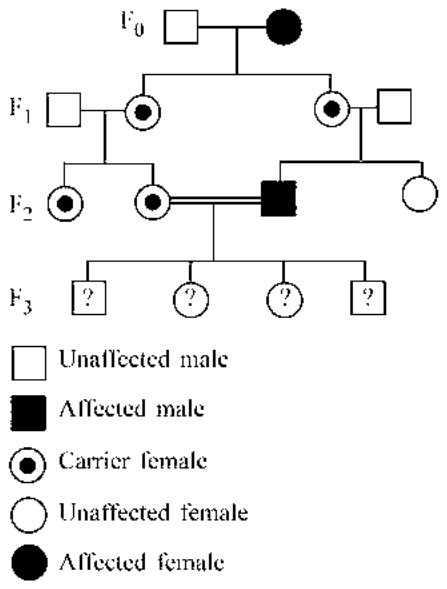
With the help of given pedigree, find out the probability for the birth of a child having no disease and being a carrier (has the disease mutation in one allele of the gene) in generation.
- 11/4
- 21/2
- 31/8
- 4Zero
Show answer and solution
Correct: option 1, 1/4
Only females are shown as carriers and an affected mother gives carrier daughters, so the trait is X-linked recessive. The parents are a carrier female () and an affected male (). Their children are (affected daughter), (carrier daughter), (affected son) and (normal son), each with probability 1/4. Only the carrier daughter is unaffected and a carrier, so the probability is 1/4.
Question 13NEET 2024, Q104
In a plant, black seed color (BB/Bb) is dominant over white seed color (bb). In order to find out the genotype of the black seed plant, with which of the following genotype will you cross it?
- 1BB/Bb
- 2BB
- 3bb
- 4Bb
Show answer and solution
Correct: option 3, bb
This is a test cross: the plant with the dominant phenotype is crossed with the homozygous recessive (bb). If all the progeny are black the plant is BB; if black and white appear in a 1 : 1 ratio it is Bb.
Question 14NEET 2024, Q111
A pink flowered Snapdragon plant was crossed with a red flowered Snapdragon plant. What type of phenotype/s is/are expected in the progeny?
- 1Red, Pink as well as white flowered plants
- 2Only red flowered plants
- 3Red flowered as well as pink flowered plants
- 4Only pink flowered plants
Show answer and solution
Correct: option 3, Red flowered as well as pink flowered plants
Flower colour in snapdragon shows incomplete dominance: red is RR, pink is Rr and white is rr. The cross Rr RR gives RR and Rr in a 1 : 1 ratio, so the progeny are red and pink flowered plants.
Question 15NEET 2024, Q120
Which one of the following can be explained on the basis of Mendel's Law of Dominance?
A. Out of one pair of factors one is dominant and the other is recessive.
B. Alleles do not show any expression and both the characters appear as such in generation.
C. Factors occur in pairs in normal diploid plants.
D. The discrete unit controlling a particular character is called factor.
E. The expression of only one of the parental characters is found in a monohybrid cross.
Choose the correct answer from the options given below:
- 1A, B, C, D and E
- 2A, B and C only
- 3A, C, D and E only
- 4B, C and D only
Show answer and solution
Correct: option 3, A, C, D and E only
The Law of Dominance says that characters are controlled by discrete units called factors (D), that factors occur in pairs (C), and that in a dissimilar pair one factor dominates the other (A). This explains why only one parental character is expressed in the of a monohybrid cross (E). Statement B does not follow from the Law of Dominance, so A, C, D and E are correct.
Question 16NEET 2024, Q123
Match List I with List II
| List I | List II |
|---|
| A. Two or more alternative forms of a gene | I. Back cross |
| B. Cross of progeny with homozygous recessive parent | II. Ploidy |
| C. Cross of progeny with any of the parents | III. Allele |
| D. Number of chromosome sets in plant | IV. Test cross |
Choose the correct answer from the options given below:
- 1A-IV, B-III, C-II, D-I
- 2A-I, B-II, C-III, D-IV
- 3A-II, B-I, C-III, D-IV
- 4A-III, B-IV, C-I, D-II
Show answer and solution
Correct: option 4, A-III, B-IV, C-I, D-II
Alternative forms of a gene are alleles (A-III). A cross of the with the homozygous recessive parent is a test cross (B-IV), and a cross of the with any of the parents is a back cross (C-I). The number of chromosome sets is the ploidy (D-II).
Question 17NEET 2024, Q180
Match List I with List II:
| List I | List II |
|---|
| A. Down's syndrome | I. 11th chromosome |
| B. -Thalassemia | II. 'X' chromosome |
| C. -Thalassemia | III. 21st chromosome |
| D. Klinefelter's syndrome | IV. 16th chromosome |
Choose the correct answer from the options given below:
- 1A-IV, B-I, C-II, D-III
- 2A-I, B-II, C-III, D-IV
- 3A-II, B-III, C-IV, D-I
- 4A-III, B-IV, C-I, D-II
Show answer and solution
Correct: option 4, A-III, B-IV, C-I, D-II
Down's syndrome is trisomy of chromosome 21. -Thalassemia is controlled by the genes HBA1 and HBA2 on chromosome 16, and -Thalassemia by the gene HBB on chromosome 11. Klinefelter's syndrome (XXY) is due to an extra X chromosome. So A-III, B-IV, C-I, D-II.
Question 18NEET 2024, Q200
As per ABO blood grouping system, the blood group of father is , mother is and child is . Their respective genotype can be
A. / /
B. / /
C. / /
D. / /
E. / /
Choose the most appropriate answer from the options given below:
- 1D & E only
- 2A only
- 3B only
- 4C & B only
Show answer and solution
Correct: option 2, A only
A child of group O has the genotype , so it must receive one allele from each parent. The father of group B must therefore be and the mother of group A must be . Only set A gives father , mother and child .
Question 19NEET 2024 Re-exam, Q104
Given below are two statements:
Statement I: When many alleles of a single gene govern a character, it is called polygenic inheritance.
Statement II: In Polygenic inheritance, the effect of each allele is additive.
In the light of the above statements, choose the correct answer from the options given below.
- 1Statement I is true but Statement II is false
- 2Statement I is false but Statement II is true
- 3Both Statement I and Statement II are true
- 4Both Statement I and Statement II are false
Show answer and solution
Correct: option 2, Statement I is false but Statement II is true
Statement I is false: many alleles of one gene is multiple allelism (as in ABO blood groups), whereas polygenic inheritance means a trait controlled by several different genes. Statement II is true: in polygenic inheritance each dominant allele adds a little to the phenotype, as in human skin colour.
Question 20NEET 2024 Re-exam, Q107
Match List-I with List-II:
| List-I (Type of Inheritance) | List-II (Example) |
|---|
| A. Incomplete dominance | I. Blood groups in human |
| B. Co-dominance | II. Flower colour in Antirrhinum |
| C. Pleiotropy | III. Skin colour in human |
| D. Polygenic inheritance | IV. Phenylketonuria |
Choose the correct answer from the options given below:
- 1A-III, B-IV, C-II, D-I
- 2A-II, B-I, C-IV, D-III
- 3A-II, B-III, C-I, D-IV
- 4A-IV, B-I, C-III, D-II
Show answer and solution
Correct: option 2, A-II, B-I, C-IV, D-III
Flower colour in Antirrhinum (snapdragon) shows incomplete dominance: red crossed with white gives pink (A-II). ABO blood groups show co-dominance, since both alleles are expressed in group AB (B-I). Phenylketonuria is pleiotropy, one gene with several effects (C-IV). Human skin colour is controlled by several genes, which is polygenic inheritance (D-III).
Question 21NEET 2024 Re-exam, Q128
Given below are two statements:
Statement I: Failure of segregation of chromatids during cell cycle resulting in the gain or loss of whole set of chromosome in an organism is known as aneuploidy.
Statement II: Failure of cytokinesis after anaphase stage of cell division results in the gain or loss of a chromosome is called polyploidy.
In the light of the above statements, choose the correct answer from the options given below:
- 1Statement I is true but Statement II is false
- 2Statement I is false but Statement II is true
- 3Both Statement I and Statement II are true
- 4Both Statement I and Statement II are false
Show answer and solution
Correct: option 4, Both Statement I and Statement II are false
The two definitions have been swapped, so both are false. Aneuploidy is the gain or loss of one or a few chromosomes, caused by failure of chromatids to segregate. Polyploidy is the gain of a whole set of chromosomes, caused by failure of cytokinesis after telophase.
Question 22NEET 2024 Re-exam, Q148
When a tall pea plant with round seeds was selfed, it produced the progeny of:
(a) Tall plants with round seeds and
(b) Tall plants with wrinkled seeds.
Identify the genotype of the parent plant.
- 1TtRr
- 2TtRR
- 3TTRR
- 4TTRr
Show answer and solution
Correct: option 4, TTRr
All the progeny are tall, so the parent is pure for height: TT. Seed shape separates into round and wrinkled, so the parent is heterozygous for it: Rr. The genotype is TTRr, which on selfing gives tall round and tall wrinkled plants in a 3:1 ratio.
Question 23NEET 2024 Re-exam, Q187
Aneuploidy is a chromosomal disorder where chromosome number is not the exact copy of its haploid set of chromosomes, due to:
(a) Substitution
(b) Addition
(c) Deletion
(d) Translocation
(e) Inversion
Choose the most appropriate answer from the options given below:
- 1(c) and (d) only
- 2(d) and (e) only
- 3(a) and (b) only
- 4(b) and (c) only
Show answer and solution
Correct: option 4, (b) and (c) only
Aneuploidy is the gain or loss of one or more chromosomes, caused by chromatids failing to separate during cell division. A gain is an addition (as in trisomy 21, Down's syndrome) and a loss is a deletion (as in Turner's syndrome, 45 with XO). Substitution, translocation and inversion change a gene or the structure of a chromosome, not the chromosome number.
Question 24NEET 2024 Re-exam, Q195
The mother has A+ blood group the father has B+ and the child is A+. What can be the possibility of genotypes of all three, respectively?
(A) | |
(B) | |
(C) | |
(D) | |
(E) | |
Choose the correct answer from the option given below:
- 1C and D
- 2D and A
- 3A and B
- 4B and E
Show answer and solution
Correct: option 4, B and E
A group A child of a group B father cannot have received from him, so the father gave and must be , and the child is . The came from the mother, who can be or . This fits (B) and (E). In (A) the child's genotype is group B, in (C) the mother is group B and the child AB, and in (D) an father could not give .
Question 25NEET 2023, Q105
The phenomenon of pleiotropism refers to
- 1presence of several alleles of a single gene controlling a single crossover.
- 2presence of two alleles, each of the two genes controlling a single trait.
- 3a single gene affecting multiple phenotypic expression.
- 4more than two genes affecting a single character.
Show answer and solution
Correct: option 3, a single gene affecting multiple phenotypic expression.
In pleiotropy one gene produces several phenotypic effects, as in phenylketonuria, where a single gene defect causes mental retardation and reduced hair and skin pigmentation. Several genes affecting one character is polygenic inheritance, and several alleles of one gene is multiple allelism.
Question 26NEET 2023, Q134
Frequency of recombination between gene pairs on same chromosome as a measure of the distance between genes to map their position on chromosome, was used for the first time by
- 1Thomas Hunt Morgan
- 2Sutton and Boveri
- 3Alfred Sturtevant
- 4Henking
Show answer and solution
Correct: option 3, Alfred Sturtevant
Alfred Sturtevant, a student of Morgan, used the frequency of recombination between gene pairs on the same chromosome as a measure of the distance between them and so made the first genetic maps. Morgan discovered linkage and recombination, Sutton and Boveri gave the chromosomal theory, and Henking observed the X body.
Question 27NEET 2023, Q138
Which of the following statements are correct about Klinefelter’s Syndrome?
A. This disorder was first described by Langdon Down (1866).
B. Such an individual has overall masculine development. However, the feminine development is also expressed.
C. The affected individual is short statured.
D. Physical, psychomotor and mental development is retarded.
E. Such individuals are sterile.
Choose the correct answer from the options given below:
- 1A and B only
- 2C and D only
- 3B and E only
- 4A and E only
Show answer and solution
Correct: option 3, B and E only
Klinefelter syndrome is caused by an extra X chromosome (47, XXY). The individual has overall masculine development with some feminine development such as gynaecomastia, and is sterile, so B and E are correct. A, C and D describe Down syndrome: it was described by Langdon Down in 1866, and the affected person is short statured with retarded physical, psychomotor and mental development.
Question 28NEET 2023, Q154
Which one of the following symbols represents mating between relatives in human pedigree analysis?
- 1
- 2
- 3
- 4
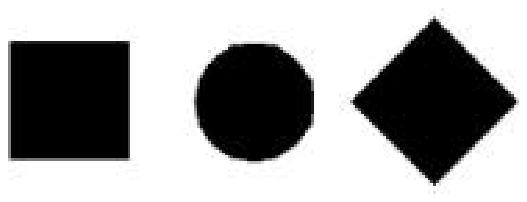
Show answer and solution
Correct: option 2
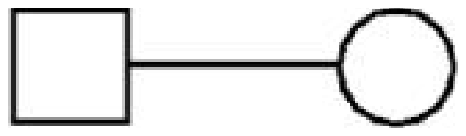
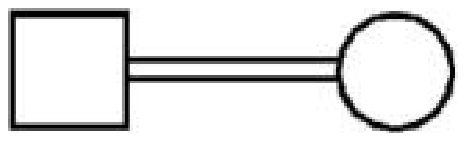
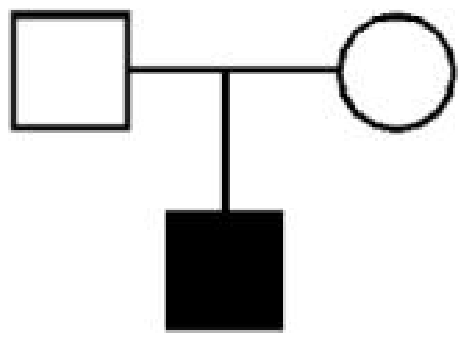
In a pedigree chart a square is a male and a circle is a female. A single horizontal line joining them shows a mating, and a double line shows a mating between relatives (a consanguineous mating). Option (2) has the double line. Option (3) shows parents with an affected male child, and option (4) shows affected individuals.
Question 29NEET 2023, Q182
Broad palm with single palm crease is visible in a person suffering from-
- 1Down’s syndrome
- 2Turner’s syndrome
- 3Klinefelter’s syndrome
- 4Thalassemia
Show answer and solution
Correct: option 1, Down’s syndrome
Down's syndrome is caused by trisomy of chromosome 21. The affected person is short, with a small round head, a furrowed tongue, a partially open mouth and a broad palm with a characteristic single palm crease. So option (1) is right.
Question 30NEET 2023 Manipur, Q111
Match List-I with List-II.
| List-I (Type of cross) | List-II (Phenotypic ratio) |
|---|
| (A) Monohybrid Cross | (I) 1 : 1 |
| (B) Dihybrid Cross | (II) 1 : 2 : 1 |
| (C) Incomplete dominance | (III) 3 : 1 |
| (D) Test Cross | (IV) 9 : 3 : 3 : 1 |
Choose the correct answer from the options given below:
- 1A-II, B-III, C-IV, D-I
- 2A-IV, B-III, C-I, D-II
- 3A-III, B-IV, C-II, D-I
- 4A-II, B-IV, C-III, D-I
Show answer and solution
Correct: option 3, A-III, B-IV, C-II, D-I
The F2 of a monohybrid cross with complete dominance shows 3 : 1 (A-III) and that of a dihybrid cross 9 : 3 : 3 : 1 (B-IV). With incomplete dominance the heterozygote looks different, so the phenotypic ratio equals the genotypic ratio 1 : 2 : 1 (C-II). A test cross of a heterozygote with the recessive parent gives 1 : 1 (D-I). This is option (3).
Question 31NEET 2023 Manipur, Q120
A heterozygous pea plant with violet flowers was crossed with a homozygous pea plant with white flowers. Violet is dominant over white. Which one of the following represents the expected combinations among 40 progenies formed?
- 1All 40 produced violet flowers
- 2All 40 produced white flowers
- 330 produced violet and 10 produced white flowers
- 420 produced violet and 20 produced white flowers
Show answer and solution
Correct: option 4, 20 produced violet and 20 produced white flowers
The cross is Vv x vv, a test cross. The heterozygote gives gametes V and v in equal numbers and the white parent gives only v, so half the progeny are Vv (violet) and half vv (white). Out of 40 that is 20 violet and 20 white, option (4).
Question 32NEET 2023 Manipur, Q132
In which disorder change of single base pair in the gene for beta globin chain results in change of glutamic acid to valine?
- 1Haemophilia
- 2Phenylketonuria
- 3Thalassemia
- 4Sickle cell anaemia
Show answer and solution
Correct: option 4, Sickle cell anaemia
In sickle cell anaemia a single base change (GAG to GUG in the mRNA codon) at the sixth position of the beta globin chain replaces glutamic acid by valine. Thalassemia affects the amount of globin made, not its sequence. So the answer is option (4).
Question 33NEET 2023 Manipur, Q142
A certain plant homozygous for yellow seeds and red flowers was crossed with a plant homozygous for green seeds and white flowers. The plants had yellow seeds and pink flowers. The plants were selfed to get progeny. Assuming independent assortment of the two characters, how many phenotypic categories are expected for these characters in the generation?
- 14
- 26
- 39
- 416
Show answer and solution
Correct: option 2, 6
Seed colour shows complete dominance (yellow over green), so it gives 2 phenotypes in the . Flower colour shows incomplete dominance (the hybrid is pink), so it gives 3 phenotypes: red, pink and white. With independent assortment the number of combinations is , option (2).
Question 34NEET 2023 Manipur, Q183
Select the correct statements about sickle cell anaemia.
(A) There is a change in gene for beta globin.
(B) In the beta globin, there is valine in the place of Lysine.
(C) It is an example of point mutation.
(D) In the normal gene U is replaced by A.
Choose the correct answer from the options given below:
- 1(A), (B) and (D) only
- 2(A) and (C) only
- 3(B), (C) and (D) only
- 4(B) and (D) only
Show answer and solution
Correct: option 2, (A) and (C) only
Sickle cell anaemia comes from a single base change (a point mutation) in the gene for the beta globin chain, so (A) and (C) are correct. The change replaces glutamic acid, not lysine, by valine at the sixth position, so (B) is wrong. The codon GAG becomes GUG, that is A is replaced by U in the mRNA, and a gene (DNA) has no U, so (D) is wrong.
Question 35NEET 2023 Manipur, Q197
Select the correct statement/s with respect to mechanism of sex determination in Grasshopper.
(A) It is an example of female heterogamety.
(B) Male produces two different types of gametes either with or without X chromosome.
(C) Total number of chromosomes (autosomes and sex chromosomes) is same in both males and females.
(D) All eggs bear an additional X chromosome besides the autosomes.
Choose the correct answer from the options given below:
- 1(A) only
- 2(A) and (C) only
- 3(B) and (D) only
- 4(A), (C) and (D) only
Show answer and solution
Correct: option 3, (B) and (D) only
The grasshopper has XO type sex determination: females are XX and males have a single X. The male therefore makes two kinds of sperm, with and without an X (male heterogamety), while every egg carries one X besides the autosomes, so (B) and (D) are correct. (A) is wrong, and (C) is wrong because the male has one chromosome fewer than the female.
Question 36NEET 2022, Q126
XO type of sex determination can be found in:
- 1Monkeys
- 2Drosophila
- 3Birds
- 4Grasshoppers
Show answer and solution
Correct: option 4, Grasshoppers
In grasshoppers the female has two X chromosomes and the male has only one X and no Y, the XO type. Monkeys and Drosophila have the XY type and birds have the ZW type.
Question 37NEET 2022, Q135
Given below are two statements:
Statement I:
Mendel studied seven pairs of contrasting traits in pea plants and proposed the Laws of Inheritance
Statement II:
Seven characters examined by Mendel in his experiment on pea plants were seed shape and colour, flower colour, pod shape and colour, flower position and stem height
In the light of the above statements, choose the correct answer from the options given below:
- 1Statement I is incorrect but Statement II is correct
- 2Both Statement I and Statement II are correct
- 3Both Statement I and Statement II are incorrect
- 4Statement I is correct but Statement II is incorrect
Show answer and solution
Correct: option 2, Both Statement I and Statement II are correct
Mendel worked with seven pairs of contrasting traits of garden pea and from them proposed the laws of inheritance. The seven characters were seed shape, seed colour, flower colour, pod shape, pod colour, flower position and stem height, exactly the list in Statement II. Both statements are correct.
Question 38NEET 2022, Q142
Which of the following occurs due to the presence of autosome linked dominant trait?
- 1Thalassemia
- 2Sickle cell anaemia
- 3Myotonic dystrophy
- 4Haemophilia
Show answer and solution
Correct: option 3, Myotonic dystrophy
Myotonic dystrophy is an autosomal dominant disorder. Thalassemia and sickle cell anaemia are autosomal recessive, and haemophilia is a sex-linked (X-linked) recessive disorder.
Question 39NEET 2022, Q150
Given below are two statements: one is labelled as Assertion (A) and the other is labelled as Reason (R).
Assertion (A):
Mendel's law of Independent assortment does not hold good for the genes that are located closely on the same chromosome.
Reason (R):
Closely located genes assort independently.
In the light of the above statements, choose the correct answer from the options given below:
- 1(A) is not correct but (R) is correct
- 2Both (A) and (R) are correct and (R) is the correct explanation of (A)
- 3Both (A) and (R) are correct but (R) is not the correct explanation of (A)
- 4(A) is correct but (R) is not correct
Show answer and solution
Correct: option 4, (A) is correct but (R) is not correct
Genes lying close together on the same chromosome are linked and tend to be inherited together, giving far more parental than recombinant types, so the law of independent assortment does not apply to them: the assertion is correct. The reason says the opposite of this and is false.
Question 40NEET 2022, Q188
The recombination frequency between the genes a & c is 5%, b & c is 15%, b & d is 9%, a & b is 20%, c & d is 24% and a & d is 29%. What will be the sequence of these genes on a linear chromosome?
- 1a, c, b, d
- 2a, d, b, c
- 3d, b, a, c
- 4a, b, c, d
Show answer and solution
Correct: option 1, a, c, b, d
Recombination frequency is taken as the map distance. The largest distance, 29, is between a and d, so they are at the two ends. Placing c 5 units from a and b 15 units further on gives a-b = 20, and b-d = 9 gives c-d = 15 + 9 = 24 and a-d = 5 + 15 + 9 = 29, which match all the data. The order is a, c, b, d.
Question 41NEET 2022, Q191
If a colour blind female marries a man whose mother was also colour blind, what are the chances of her progeny having colour blindness?
- 1100%
- 225%
- 350%
- 475%
Show answer and solution
Correct: option 1, 100%
Colour blindness is X-linked recessive. The female is . The man received his only X from his colour blind mother (), so he is . Every daughter is and every son is , so 100% of the progeny are colour blind.
Question 42NEET 2022 Re-exam, Q101
Given below are two statements:
Statement I: Sickle cell anaemia and Haemophilia are autosomal dominant traits.
Statement II: Sickle cell anaemia and Haemophilia are disorders of the blood.
In the light of the above statements, choose the correct answer from the options given below:
- 1Statement I is incorrect but Statement II is correct
- 2Both Statement I and Statement II are correct
- 3Both Statement I and Statement II are incorrect
- 4Statement I is correct but Statement II is incorrect
Show answer and solution
Correct: option 1, Statement I is incorrect but Statement II is correct
Sickle cell anaemia is an autosomal recessive trait and haemophilia is a sex-linked (X-linked) recessive trait, so Statement I is incorrect. Both are blood disorders: one affects haemoglobin in red blood cells and the other affects clotting of blood, so Statement II is correct.
Question 43NEET 2022 Re-exam, Q115
The chromosomal theory of inheritance was proposed by
- 1Robert Brown
- 2Thomas Morgan
- 3Sutton and Boveri
- 4Gregor Mendel
Show answer and solution
Correct: option 3, Sutton and Boveri
Sutton and Boveri noted in 1902 that the behaviour of chromosomes in meiosis parallels the behaviour of Mendel's factors, and Sutton combined the two ideas into the chromosomal theory of inheritance. Morgan later verified it experimentally in Drosophila.
Question 44NEET 2022 Re-exam, Q139
What is the expected percentage of progeny with yellow and inflated pod in dihybrid cross experiment involving pea plants with green coloured, inflated pod and yellow coloured constricted pod?
- 19%
- 2100%
- 356.25%
- 418.75%
Show answer and solution
Correct: option 4, 18.75%
In pea, green pod colour is dominant over yellow and inflated pod shape is dominant over constricted. The is heterozygous for both genes and the shows 9 green inflated : 3 green constricted : 3 yellow inflated : 1 yellow constricted. Yellow inflated is .
Question 45NEET 2022 Re-exam, Q141
If a female individual is with small round head, furrowed tongue, partially open mouth and broad palm with characteristic palm crease. Also the physical, psychomotor and mental development is retarded. The karyotype analysis of such an individual will show:
- 1Trisomy of chromosome 21
- 247 chromosomes with XXY sex chromosomes
- 345 chromosomes with XO sex chromosomes
- 447 chromosomes with XYY sex chromosomes
Show answer and solution
Correct: option 1, Trisomy of chromosome 21
These are the features of Down's syndrome, which is caused by an extra copy of chromosome 21 (trisomy 21). XXY is Klinefelter's syndrome, which affects males, and XO is Turner's syndrome, which shows sterile females with rudimentary ovaries, not these features.
Question 46NEET 2022 Re-exam, Q161
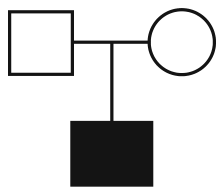
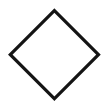
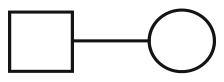
Select the incorrect match regarding the symbols used in Pedigree analysis:
- 1Parent with male child affected with disease
- 2Sex unspecified
- 3Affected individual

- 4Consanguineous mating
Show answer and solution
Correct: option 4, Consanguineous mating
A square and a circle joined by a single line show an ordinary mating. Consanguineous mating (between relatives) is shown by a double line, so the fourth match is wrong. The other three are right: a shaded square under the parents is an affected male child, a diamond is sex unspecified, and a shaded symbol is an affected individual.
Question 47NEET 2022 Re-exam, Q190
A normal girl, whose mother is haemophilic marries a male with no ancestral history of haemophilia. What will be the possible phenotypes of the offspring?
(a) Haemophilic son and haemophilic daughter.
(b) Haemophilic son and carrier daughter.
(c) Normal daughter and normal son.
(d) Normal son and haemophilic daughter.
Choose the most appropriate answer from the options given below:
- 1(b) and (d) only
- 2(a) and (b) only
- 3(b) and (c) only
- 4(a) and (d) only
Show answer and solution
Correct: option 3, (b) and (c) only
Haemophilia is X-linked recessive. The girl got one X from her haemophilic mother, so she is a carrier (); her husband is normal (). Their sons are either normal or haemophilic, and their daughters are either normal or carriers. No daughter can be haemophilic, because every daughter gets a normal X from the father. So (b) and (c) are possible.
Question 48NEET 2021, Q126
The production of gametes by the parents, formation of zygotes, the and plants, can be understood from a diagram called:
- 1Bullet square
- 2Punch square
- 3Punnett square
- 4Net square
Show answer and solution
Correct: option 3, Punnett square
The Punnett square, devised by Reginald C. Punnett, is a grid that shows the gametes of the parents and all the possible zygotes they can form. The other names are made up.
Question 49NEET 2021, Q177
In a cross between a male and female, both heterozygous for sickle cell anaemia gene, what percentage of the progeny will be diseased?
- 150%
- 275%
- 325%
- 4100%
Show answer and solution
Correct: option 3, 25%
Sickle-cell anaemia is autosomal recessive; only the homozygous individuals are diseased. The cross gives 1 : 2 : 1 , so 25% of the progeny are diseased.
Question 50NEET 2020, Q50
Experimental verification of the chromosomal theory of inheritance was done by:
- 1Mendel
- 2Sutton
- 3Boveri
- 4Morgan
Show answer and solution
Correct: option 4, Morgan
Sutton and Boveri proposed the chromosomal theory of inheritance. Thomas Hunt Morgan and his colleagues verified it experimentally through their work on sex-linked genes in the fruit fly Drosophila melanogaster.
Question 51NEET 2020, Q73
Select the correct match.
- 1Haemophilia - Y linked
- 2Phenylketonuria - Autosomal dominant trait
- 3Sickle cell anaemia - Autosomal recessive trait, chromosome-11
- 4Thalassemia - X linked
Show answer and solution
Correct: option 3, Sickle cell anaemia - Autosomal recessive trait, chromosome-11
Sickle cell anaemia is an autosomal recessive disorder caused by a mutation in the beta globin gene on chromosome 11, so (3) is correctly matched. Haemophilia is X-linked recessive, phenylketonuria is autosomal recessive, and thalassemia is autosomal recessive.
Question 52NEET 2020, Q114
How many true breeding pea plant varieties did Mendel select as pairs, which were similar except in one character with contrasting traits?
- 14
- 22
- 314
- 48
Show answer and solution
Correct: option 3, 14
Mendel studied seven characters of the garden pea, each with two contrasting traits, and used a true breeding variety for each trait. That makes true breeding varieties.
Question 53NEET 2020, Q131
Identify the wrong statement with reference to the gene 'I' that controls ABO blood groups.
- 1The gene (I) has three alleles.
- 2A person will have only two of the three alleles.
- 3When and are present together, they express same type of sugar.
- 4Allele 'i' does not produce any sugar.
Show answer and solution
Correct: option 3, When and are present together, they express same type of sugar.
Gene I has three alleles, , and i, of which a diploid person carries two. and produce slightly different sugars and i produces none. When and are together both express their own sugar (co-dominance), so statement (3) is wrong.
Question 54NEET 2020 Phase 2, Q14
Chromosomal theory of inheritance was proposed by:
- 1Bateson and Punnet
- 2T. H. Morgan
- 3Watson and Crick
- 4Sutton and Boveri
Show answer and solution
Correct: option 4, Sutton and Boveri
Sutton and Boveri noted in 1902 that the behaviour of chromosomes during meiosis runs parallel to the behaviour of Mendel's factors, and Sutton combined this with Mendel's laws as the chromosomal theory of inheritance. Morgan later verified it experimentally in Drosophila, and Watson and Crick gave the structure of DNA.
Question 55NEET 2020 Phase 2, Q29
The number of contrasting characters studied by Mendel for his experiments was:
- 14
- 22
- 37
- 414
Show answer and solution
Correct: option 3, 7
Mendel chose seven characters of the garden pea, each with a pair of contrasting traits: stem height, flower colour, flower position, pod shape, pod colour, seed shape and seed colour. The key therefore takes the answer as 7 (the seven pairs give 14 individual traits).
Question 56NEET 2020 Phase 2, Q80
The best example for pleiotropy is:
- 1Phenylketonuria
- 2Colour Blindness
- 3ABO Blood group
- 4Skin colour
Show answer and solution
Correct: option 1, Phenylketonuria
In pleiotropy a single gene has several phenotypic effects. In phenylketonuria one mutated gene, for the enzyme phenylalanine hydroxylase, causes mental retardation and also reduced hair and skin pigmentation. ABO blood group shows multiple alleles and co-dominance, and skin colour is polygenic.
Question 57NEET 2019, Q121
Select the incorrect statement.
- 1Male fruit fly is heterogametic.
- 2In male grasshoppers, 50% of sperms have no sex-chromosome.
- 3In domesticated fowls, sex of progeny depends on the type of sperm rather than egg.
- 4Human males have one of their sex-chromosome much shorter than the other.
Show answer and solution
Correct: option 3, In domesticated fowls, sex of progeny depends on the type of sperm rather than egg.
Birds have ZW females and ZZ males, so the female is heterogametic and the sex of the chick depends on which egg (Z or W) is fertilised, not on the sperm. Statement (3) is therefore incorrect. The other three are true: male Drosophila is XY, male grasshoppers are XO so half the sperms carry no sex chromosome, and the human Y is much shorter than the X.
Question 58NEET 2019, Q129
What map unit (Centimorgan) is adopted in the construction of genetic maps?
- 1A unit of distance between two expressed genes, representing 10% cross over.
- 2A unit of distance between two expressed genes, representing 100% cross over.
- 3A unit of distance between genes on chromosomes, representing 1% cross over.
- 4A unit of distance between genes on chromosomes, representing 50% cross over.
Show answer and solution
Correct: option 3, A unit of distance between genes on chromosomes, representing 1% cross over.
Sturtevant used the frequency of recombination between gene pairs on the same chromosome as a measure of the distance between them. One map unit, or centimorgan, is the distance that gives 1% crossing over (recombination).
Question 59NEET 2019, Q147
In Antirrhinum (Snapdragon), a red flower was crossed with a white flower and in generation, pink flowers were obtained. When pink flowers were selfed, the generation showed white, red and pink flowers. Choose the incorrect statement from the following:
- 1This experiment does not follow the Principle of Dominance.
- 2Pink colour in is due to incomplete dominance.
- 3Ratio of is (Red) : (Pink) : (White)
- 4Law of Segregation does not apply in this experiment.
Show answer and solution
Correct: option 4, Law of Segregation does not apply in this experiment.
Flower colour in snapdragon shows incomplete dominance: the heterozygote Rr is pink, so the Principle of Dominance is not followed and is 1 red : 2 pink : 1 white. The reappearance of pure red and white in shows that the two alleles separated unchanged during gamete formation, so the Law of Segregation does apply. Statement (4) is the incorrect one.
Question 60NEET 2019, Q165
The frequency of recombination between gene pairs on the same chromosome as a measure of the distance between genes was explained by:
- 1T.H. Morgan
- 2Gregor J. Mendel
- 3Alfred Sturtevant
- 4Sutton Boveri
Show answer and solution
Correct: option 3, Alfred Sturtevant
Alfred Sturtevant, a student of Morgan, used the frequency of recombination between gene pairs on the same chromosome as a measure of the distance between the genes and so 'mapped' their positions on the chromosome. Morgan described linkage and recombination, but the mapping idea was Sturtevant's.
Question 61NEET 2019, Q176
What is the genetic disorder in which an individual has an overall masculine development, gynaecomastia, and is sterile?
- 1Turner's syndrome
- 2Klinefelter's syndrome
- 3Edward syndrome
- 4Down's syndrome
Show answer and solution
Correct: option 2, Klinefelter's syndrome
Klinefelter's syndrome is caused by an extra X chromosome in a male (47, XXY). The person has overall masculine development but also shows feminine features such as gynaecomastia (development of breasts) and is sterile. Turner's syndrome (45, X0) gives a sterile female.
Question 62NEET 2019 Odisha, Q91
In a marriage between male with blood group A and female with blood group B, the progeny had either blood group AB or B. What could be the possible genotype of parents?
- 1 (Male); (Female)
- 2 (Male); (Female)
- 3 (Male); (Female)
- 4 (Male); (Female)
Show answer and solution
Correct: option 3, (Male); (Female)
A child of group B must get from the mother and from the father, so the father is . No child is A or O, so the mother never passes on and is . The cross gives only (AB) and (B).
Question 63NEET 2019 Odisha, Q125
Match the items of Column - I with Column - II:
| Column - I | Column - II |
|---|
| (a) XX-XO method of Sex Determination | (i) Turner's syndrome |
| (b) XX-XY method of Sex Determination | (ii) Female heterogametic |
| (c) Karyotype-45 | (iii) Grasshopper |
| (d) ZW-ZZ method of Sex Determination | (iv) Female homogametic |
Select the correct option from the following:
- 1a-iii, b-iv, c-i, d-ii
- 2a-iv, b-ii, c-i, d-iii
- 3a-ii, b-iv, c-i, d-iii
- 4a-i, b-iv, c-ii, d-iii
Show answer and solution
Correct: option 1, a-iii, b-iv, c-i, d-ii
The XX-XO method is found in the grasshopper (iii). In the XX-XY method the female is XX and makes one kind of gamete, so she is homogametic (iv). A karyotype of 45 chromosomes (44 + XO) is Turner's syndrome (i). In the ZW-ZZ method of birds the female is ZW, so she is heterogametic (ii). So a-iii, b-iv, c-i, d-ii.
Question 64NEET 2019 Odisha, Q166
The production of gametes by the parents, the formation of zygotes, the and plants, can be understood using
- 1Punnett square
- 2Venn diagram
- 3Pie diagram
- 4A pyramid diagram
Show answer and solution
Correct: option 3, Pie diagram
The Punnett square, developed by Reginald C. Punnett, is a diagram with the gametes of the two parents written along the top row and the left column. The boxes then show every possible zygote, so it gives the genotypes of the and plants and the probability of each.
Question 65NEET 2019 Odisha, Q178
In which genetic condition, each cell in the affected person, has three sex chromosomes XXY?
- 1Phenylketonuria
- 2Turner's Syndrome
- 3Thalassemia
- 4Klinefelter's Syndrome
Show answer and solution
Correct: option 1, Phenylketonuria
An extra X chromosome in a male gives the karyotype 47, XXY, which is Klinefelter's syndrome; the person is a sterile male with some feminine development such as gynaecomastia. Turner's syndrome is 45, X0, and phenylketonuria and thalassemia are autosomal recessive gene disorders, not chromosome number disorders.
Question 66NEET 2018, Q104
Which of the following pairs is wrongly matched ?
- 1XO type sex determination : Grasshopper
- 2ABO blood grouping : Co-dominance
- 3Starch synthesis in pea : Multiple alleles
- 4T.H. Morgan : Linkage
Show answer and solution
Correct: option 3, Starch synthesis in pea : Multiple alleles
Starch synthesis in pea seeds is controlled by one gene with two alleles (B and b); it shows pleiotropy and, for starch grain size, incomplete dominance, not multiple alleles. Grasshoppers do have XO sex determination, ABO grouping shows co-dominance ( and ), and Morgan described linkage.
Question 67NEET 2018, Q105
Select the correct statement :
- 1Spliceosomes take part in translation.
- 2Punnett square was developed by a British scientist.
- 3Franklin Stahl coined the term "linkage".
- 4Transduction was discovered by S. Altman.
Show answer and solution
Correct: option 2, Punnett square was developed by a British scientist.
The Punnett square was devised by the British geneticist Reginald C. Punnett. Spliceosomes remove introns from hnRNA (splicing, not translation), the term linkage was coined by Morgan, and transduction was discovered by Zinder and Lederberg (Altman is known for ribozymes).
Question 68NEET 2018, Q159
A woman has an X-linked condition on one of her X chromosomes. This chromosome can be inherited by
- 1Only grandchildren
- 2Only sons
- 3Only daughters
- 4Both sons and daughters
Show answer and solution
Correct: option 4, Both sons and daughters
A mother gives one of her two X chromosomes to every child, whether son or daughter. So the X carrying the condition can pass to both sons and daughters, each with a probability of one half.
Question 69NEET 2018, Q180
Which of the following characteristics represent ‘Inheritance of blood groups’ in humans ?
a. Dominance
b. Co-dominance
c. Multiple allele
d. Incomplete dominance
e. Polygenic inheritance
- 1b, d and e
- 2a, b and c
- 3b, c and e
- 4a, c and e
Show answer and solution
Correct: option 2, a, b and c
ABO blood groups are controlled by one gene with three alleles, , and (multiple alleles). and are dominant over (dominance), and together both are expressed, giving group AB (co-dominance). There is no incomplete dominance or polygenic inheritance, so a, b and c.
Question 70NEET 2017, Q128
A disease caused by an autosomal primary non-disjunction is
- 1Down's Syndrome
- 2Klinefelter's Syndrome
- 3Turner's Syndrome
- 4Sickle Cell Anemia
Show answer and solution
Correct: option 1, Down's Syndrome
Down's syndrome is trisomy of chromosome 21, an autosome, caused by non-disjunction during gamete formation. Klinefelter's (XXY) and Turner's (XO) syndromes arise from non-disjunction of sex chromosomes, and sickle cell anaemia is a gene mutation.
Question 71NEET 2017, Q134
The genotypes of a Husband and Wife are and .
Among the blood types of their children, how many different genotypes and phenotypes are possible?
- 13 genotypes ; 3 phenotypes
- 23 genotypes ; 4 phenotypes
- 34 genotypes ; 3 phenotypes
- 44 genotypes ; 4 phenotypes
Show answer and solution
Correct: option 3, 4 genotypes ; 3 phenotypes
The gametes are , from one parent and , from the other. The children can be , , or : 4 genotypes. and are both group A, is AB and is B: 3 phenotypes.
Question 72NEET 2017, Q147
Among the following characters, which one was not considered by Mendel in his experiments on pea?
- 1Stem - Tall or Dwarf
- 2Trichomes - Glandular or non-glandular
- 3Seed - Green or Yellow
- 4Pod - Inflated or Constricted
Show answer and solution
Correct: option 2, Trichomes - Glandular or non-glandular
Mendel studied seven characters in pea: stem height, flower colour, flower position, pod shape, pod colour, seed shape and seed colour. Trichomes were not one of them.
Question 73NEET 2017, Q151
Which one from those given below is the period for Mendel's hybridization experiments?
- 11856 - 1863
- 21840 - 1850
- 31857 - 1869
- 41870 - 1877
Show answer and solution
Correct: option 1, 1856 - 1863
Mendel carried out his hybridisation experiments on garden pea for seven years, from 1856 to 1863.
Question 74NEET 2017, Q179
Thalassemia and sickle cell anemia are caused due to a problem in globin molecule synthesis. Select the correct statement.
- 1Both are due to a qualitative defect in globin chain synthesis.
- 2Both are due to a quantitative defect in globin chain synthesis.
- 3Thalassemia is due to less synthesis of globin molecules.
- 4Sickle cell anemia is due to a quantitative problem of globin molecules.
Show answer and solution
Correct: option 3, Thalassemia is due to less synthesis of globin molecules.
Thalassemia is a quantitative problem: too few globin chains are made. Sickle cell anemia is a qualitative problem: the beta chain is made in normal amount but with valine in place of glutamic acid. Only statement (3) fits.
Question 75NEET 2016 Phase 1, Q96
Which of the following most appropriately describes haemophilia?
- 1Recessive gene disorder
- 2X-linked recessive gene disorder
- 3Chromosomal disorder
- 4Dominant gene disorder
Show answer and solution
Correct: option 2, X-linked recessive gene disorder
Haemophilia is caused by a recessive allele of a gene on the X chromosome, so it passes from a carrier mother to her sons. It is a gene (Mendelian) disorder, not a chromosomal one, and the most exact description is X-linked recessive gene disorder.
Question 76NEET 2016 Phase 1, Q119
A tall true breeding garden pea plant is crossed with a dwarf true breeding garden pea plant. When the plants were selfed the resulting genotypes were in the ratio of:
- 11 : 2 : 1 :: Tall homozygous : Tall heterozygous : Dwarf
- 21 : 2 : 1 :: Tall heterozygous : Tall homozygous : Dwarf
- 33 : 1 :: Tall : Dwarf
- 43 : 1 :: Dwarf : Tall
Show answer and solution
Correct: option 1, 1 : 2 : 1 :: Tall homozygous : Tall heterozygous : Dwarf
TT crossed with tt gives plants that are all Tt. Selfing Tt gives 1 TT : 2 Tt : 1 tt, that is 1 tall homozygous : 2 tall heterozygous : 1 dwarf. The 3 : 1 ratio is the phenotypic ratio, but the question asks for genotypes.
Question 77NEET 2016 Phase 1, Q128
Pick out the correct statements:
(a) Haemophilia is a sex-linked recessive disease.
(b) Down's syndrome is due to aneuploidy.
(c) Phenylketonuria is an autosomal recessive gene disorder.
(d) Sickle cell anaemia is an X-linked recessive gene disorder.
- 1(a) and (d) are correct.
- 2(b) and (d) are correct.
- 3(a), (c) and (d) are correct.
- 4(a), (b) and (c) are correct.
Show answer and solution
Correct: option 4, (a), (b) and (c) are correct.
Haemophilia is X-linked (sex-linked) recessive, Down's syndrome is trisomy of chromosome 21, which is an aneuploidy, and phenylketonuria is autosomal recessive, so (a), (b) and (c) are correct. Sickle cell anaemia is an autosomal recessive disorder, the gene being on chromosome 11, so (d) is wrong.
Question 78NEET 2016 Phase 1, Q170
In a testcross involving dihybrid flies, more parental-type offspring were produced than the recombinant-type offspring. This indicates:
- 1The two genes are located on two different chromosomes.
- 2Chromosomes failed to separate during meiosis.
- 3The two genes are linked and present on the same chromosome.
- 4Both of the characters are controlled by more than one gene.
Show answer and solution
Correct: option 3, The two genes are linked and present on the same chromosome.
If the two genes assorted independently, a dihybrid test cross would give parental and recombinant types in equal numbers (1:1:1:1). An excess of parental types means the genes tend to be inherited together because they are linked on the same chromosome, with recombinants arising only by crossing over, as Morgan found in Drosophila.
Question 79NEET 2016 Phase 2, Q121
The mechanism that causes a gene to move from one linkage group to another is called
- 1inversion
- 2duplication
- 3translocation
- 4crossing-over
Show answer and solution
Correct: option 3, translocation
A linkage group corresponds to one chromosome. In translocation a segment is transferred to a non-homologous chromosome, so its genes join a different linkage group. Inversion and duplication rearrange genes within the same chromosome, and crossing-over exchanges segments between homologues of the same linkage group.
Question 80NEET 2016 Phase 2, Q123
- 1one that is able to breed on its own
- 2produced due to cross-pollination among unrelated plants
- 3near homozygous and produces offspring of its own kind
- 4always homozygous recessive in its genetic constitution
Show answer and solution
Correct: option 3, near homozygous and produces offspring of its own kind
A true breeding line, obtained by continued self-pollination, is homozygous for the trait and shows stable inheritance of it over generations, giving offspring of its own kind. It may be homozygous dominant or homozygous recessive, so option (4) is too narrow.
Question 81NEET 2016 Phase 2, Q165
If a colour-blind man marries a woman who is homozygous for normal colour vision, the probability of their son being colour-blind is
- 10
- 20.5
- 30.75
- 41
Show answer and solution
Correct: option 1, 0
Colour blindness is X-linked recessive. The father is and the mother . A son gets his Y from the father and his X from the mother, and both of her X chromosomes are normal, so no son can be colour-blind. The probability is 0.
Question 82AIPMT 2015, Q60
A man with blood group 'A' marries a woman with blood group 'B'. What are all the possible blood groups of their offsprings?
- 1A, B and AB only
- 2A, B, AB and O
- 3O only
- 4A and B only
Show answer and solution
Correct: option 2, A, B, AB and O
A person of group A may be or , and a person of group B may be or . If both are heterozygous, the cross gives (AB), (A), (B) and (O). So all four groups are possible.
Question 83AIPMT 2015, Q64
How many pairs of contrasting characters in pea plants were studied by Mendel in his experiments?
- 1Six
- 2Eight
- 3Seven
- 4Five
Show answer and solution
Correct: option 3, Seven
Mendel worked with seven pairs of contrasting characters in garden pea: stem height, flower colour, flower position, pod shape, pod colour, seed shape and seed colour.
Question 84AIPMT 2015, Q73
The movement of a gene from one linkage group to another is called:
- 1Duplication
- 2Translocation
- 3Crossing over
- 4Inversion
Show answer and solution
Correct: option 2, Translocation
Each chromosome is one linkage group. When a segment carrying a gene moves to a non-homologous chromosome, it changes its linkage group; this is translocation. Crossing over exchanges segments between homologous chromosomes (the same linkage group), and duplication and inversion change a segment within the same chromosome.
Question 85AIPMT 2015, Q103
Multiple alleles are present:
- 1At different loci on the same chromosome
- 2At the same locus of the chromosome
- 3On non-sister chromatids
- 4On different chromosomes
Show answer and solution
Correct: option 2, At the same locus of the chromosome
Multiple alleles are more than two alternative forms of one gene, so they all occupy the same locus on homologous chromosomes. The ABO blood group gene with its three alleles is the usual example.
Question 86AIPMT 2015, Q108
Which is the most common mechanism of genetic variation in the population of sexually reproducing organism?
- 1Chromosomal aberrations
- 2Genetic drift
- 3Recombination
- 4Transduction
Show answer and solution
Correct: option 3, Recombination
In sexual reproduction crossing over and independent assortment during meiosis, followed by random fertilisation, reshuffle genes in every generation. This recombination is far more frequent than chromosomal aberrations or drift, and transduction occurs only in bacteria.
Question 87AIPMT 2015, Q117
- 1true breeding homozygotes
- 2different molecular forms of a gene
- 3heterozygotes
- 4different phenotype
Show answer and solution
Correct: option 2, different molecular forms of a gene
Alleles are alternative forms of the same gene that differ slightly in their DNA sequence and code for a pair of contrasting traits. Homozygote and heterozygote describe an individual's genotype, not the alleles themselves.
Question 88AIPMT 2015, Q134
An abnormal human baby with 'XXX' sex chromosomes was born due to:
- 1formation of abnormal ova in the mother
- 2fusion of two ova and one sperm
- 3fusion of two sperms and one ovum
- 4formation of abnormal sperms in the father
Show answer and solution
Correct: option 1, formation of abnormal ova in the mother
Non-disjunction of the X chromosomes during oogenesis gives an abnormal ovum with two X chromosomes. When it is fertilised by a normal X-carrying sperm the zygote is XXX. This is the most common cause, so the abnormal ovum is the keyed answer.
Question 89AIPMT 2015 Re-test, Q59
A colour blind man marries a woman with normal sight who has no history of colour blindness in her family. What is the probability of their grandson being colour blind?
- 10.25
- 20.5
- 31
- 4Nil
Show answer and solution
Correct: option 2, 0.5
Colour blindness is X-linked recessive. The father () and the normal mother () have normal sons () and carrier daughters (). A son of a carrier daughter (with a normal husband) gets from her with probability , so a grandson through a daughter is colour blind with probability 0.5, which is the keyed answer. Grandsons through the sons are all normal, so counted over all grandsons the chance would be 0.25; the key takes the daughter's sons.
Question 90AIPMT 2015 Re-test, Q63
The term "linkage" was coined by:
- 1W. Sutton
- 2T.H. Morgan
- 3T. Boveri
- 4G. Mendel
Show answer and solution
Correct: option 2, T.H. Morgan
T.H. Morgan, working on Drosophila, found that genes on the same chromosome tend to be inherited together and coined the term linkage for this physical association. Sutton and Boveri proposed the chromosomal theory of inheritance.
Question 91AIPMT 2015 Re-test, Q90
- 1controls multiple traits in an individual.
- 2is expressed only in primitive plants.
- 3is a gene evolved during Pliocene.
- 4controls a trait only in combination with another gene
Show answer and solution
Correct: option 1, controls multiple traits in an individual.
Pleiotropy is the condition in which a single gene affects several phenotypic traits, as the gene for phenylketonuria affects mental development, hair and skin pigmentation.
Question 92AIPMT 2015 Re-test, Q104
In his classic experiments on pea plants, Mendel did not use:
- 1Flower position
- 2Seed colour
- 3Pod length
- 4Seed shape
Show answer and solution
Correct: option 3, Pod length
Mendel studied seven characters of the pea plant: stem height, flower colour, flower position, pod shape, pod colour, seed shape and seed colour. Pod length is not among them.
Question 93AIPMT 2015 Re-test, Q107
A gene showing codominance has:
- 1both alleles independently expressed in the heterozygote
- 2one allele dominant on the other
- 3alleles tightly linked on the same chromosome
- 4alleles that are recessive to each other
Show answer and solution
Correct: option 1, both alleles independently expressed in the heterozygote
In codominance both alleles of a gene express themselves fully in the heterozygote, as with the and alleles that together give blood group AB. Neither allele masks the other.
Question 94AIPMT 2015 Re-test, Q123
In the following human pedigree, the filled symbols represent the affected individuals. Identify the type of given pedigree.
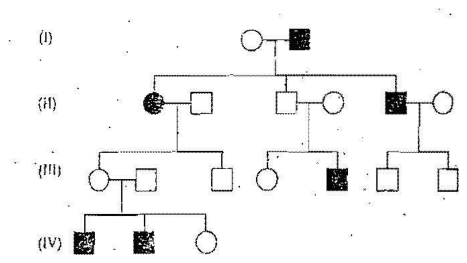
- 1X-linked dominant
- 2Autosomal dominant
- 3X-linked recessive
- 4Autosomal recessive
Show answer and solution
Correct: option 4, Autosomal recessive
In generations III and IV affected children are born to parents who are both unaffected, so the trait is recessive. It is not X-linked recessive, because the affected woman in generation II has an unaffected son, whereas every son of an affected mother would receive her X chromosome and be affected. The trait is therefore autosomal recessive.
Question 95AIPMT 2014, Q34
A man whose father was colour blind marries a woman who had a colour blind mother and normal father. What percentage of male children of this couple will be colour blind?
- 175%
- 225%
- 30%
- 450%
Show answer and solution
Correct: option 4, 50%
Colour blindness is X-linked recessive. The man gets only the Y chromosome from his father, so his father's condition does not matter; a son's X comes from the mother anyway. The woman received an affected X from her colour blind mother and a normal X from her father, so she is a carrier. Each son gets one of her two X chromosomes, so 50% of the sons will be colour blind.
Question 96AIPMT 2014, Q48
A human female with Turner's syndrome:
- 1is able to produce children with normal husband.
- 2has 45 chromosomes with XO.
- 3has one additional X chromosome.
- 4exhibits male characters.
Show answer and solution
Correct: option 2, has 45 chromosomes with XO.
Turner's syndrome is caused by the absence of one X chromosome, so the karyotype is 44 + XO, a total of 45 chromosomes. Such females are sterile because the ovaries are rudimentary, and they lack secondary sexual characters rather than showing male ones. An additional X chromosome is seen in conditions such as Klinefelter's syndrome, not here.
Question 97AIPMT 2014, Q57
Fruit colour in squash is an example of:
- 1Inhibitory genes
- 2Recessive epistasis
- 3Dominant epistasis
- 4Complementary genes
Show answer and solution
Correct: option 3, Dominant epistasis
In summer squash a dominant gene W gives white fruit and hides the effect of the colour gene Y/y, whatever its alleles. A dominant allele of one gene masking another gene is dominant epistasis, and it gives the ratio 12 white : 3 yellow : 1 green in the F2 generation.
Question 98NEET 2013, Q51
If two persons with 'AB' blood group marry and have sufficiently large number of children, these children could be classified as 'A' blood group : 'AB' blood group : 'B' blood group in 1 : 2 : 1 ratio. Modern technique of protein electrophoresis reveals presence of both 'A' and 'B' type proteins in 'AB' blood group individuals. This is an example of:
- 1Incomplete dominance
- 2Partial dominance
- 3Complete dominance
- 4Codominance
Show answer and solution
Correct: option 4, Codominance
In an AB person both alleles, and , are fully expressed, so both A and B proteins are found. When both alleles of a pair show their own effect side by side in the heterozygote, it is codominance. In incomplete dominance the heterozygote would show a blended, in-between character instead.
Question 99NEET 2013, Q71
Which Mendelian idea is depicted by a cross in which the generation resembles both the parents?
- 1law of dominance
- 2inheritance of one gene
- 3co-dominance
- 4incomplete dominance
Show answer and solution
Correct: option 3, co-dominance
When the shows the characters of both parents together, both alleles are being expressed in the heterozygote. That is co-dominance, as in the AB blood group. Under dominance the resembles only one parent, and under incomplete dominance it is in between the two.
Question 100NEET 2013, Q73
If both parents are carriers for thalassemia, which is an autosomal recessive disorder, what are the chances of pregnancy resulting in an affected child?
- 150%
- 225%
- 3100%
- 4no chance
Show answer and solution
Correct: option 2, 25%
Both parents are heterozygous (Aa). The cross Aa x Aa gives AA : Aa : aa in the ratio 1 : 2 : 1. Only aa children are affected, which is 1 in 4, or 25%.
Question 101NEET 2013, Q87
Which of the following statements is not true of two genes that show 50% recombination frequency?
- 1The genes are tightly linked
- 2The genes show independent assortment
- 3If the genes are present on the same chromosome, they undergo more than one crossovers in every meiosis
- 4The genes may be on different chromosomes
Show answer and solution
Correct: option 1, The genes are tightly linked
A recombination frequency of 50% is what independent assortment gives. It is seen when the genes are on different chromosomes, or so far apart on one chromosome that crossing over between them happens in every meiosis. Tightly linked genes show very little recombination, so statement (1) is not true.
Question 102NEET 2013, Q89
The incorrect statement with regard to Haemophilia is:
- 1It is a recessive disease
- 2It is a dominant disease
- 3A single protein involved in the clotting of blood is affected
- 4It is a sex-linked disease
Show answer and solution
Correct: option 2, It is a dominant disease
Haemophilia is a sex-linked (X-linked) recessive disease in which a single protein of the blood-clotting cascade is affected. It is not a dominant disease, so statement (2) is the incorrect one.
Question 103NEET 2013 Karnataka, Q69
In our society women are blamed for producing female children. Choose the correct answer for the sex-determination in humans:
- 1due to some defect like aspermia in man
- 2due to the genetic make up of the particular sperm which fertilizes the egg
- 3due to the genetic make up of the egg
- 4due to some defect in the women
Show answer and solution
Correct: option 2, due to the genetic make up of the particular sperm which fertilizes the egg
All human eggs carry an X chromosome, while sperms carry either X or Y. The sex of the child therefore depends on which type of sperm fertilises the egg: X gives a girl and Y gives a boy.
Question 104NEET 2013 Karnataka, Q88
Down's syndrome in humans is due to:
- 1Three 'X' chromosomes
- 2Three copies of chromosome 21
- 3Monosomy
- 4Two 'Y' chromosomes
Show answer and solution
Correct: option 2, Three copies of chromosome 21
Down's syndrome is trisomy of chromosome 21: the person has three copies of it and 47 chromosomes in all.
Question 105NEET 2013 Karnataka, Q99
Which one is the incorrect statement with regards to the importance of pedigree analysis?
- 1It confirms that DNA is the carrier of genetic information
- 2It helps to understand whether the trait in question is dominant or recessive
- 3It confirms that the trait is linked to one of the autosome
- 4It helps to trace the inheritance of a specific trait
Show answer and solution
Correct: option 1, It confirms that DNA is the carrier of genetic information
A pedigree follows a trait through the generations of a family and shows whether it is dominant or recessive and autosomal or sex-linked. It says nothing about the chemical nature of the genetic material; that was shown by experiments such as Hershey and Chase's.
Question 106AIPMT 2012 Prelims, Q94
A normal-visioned man whose father was colour-blind, marries a woman whose father was also colour-blind. They have their first child as a daughter. What are the chances that this child would be colour-blind?
- 1100%
- 2zero percent
- 325%
- 450%
Show answer and solution
Correct: option 2, zero percent
Colour blindness is X-linked recessive. The man has normal vision, so his only X carries the normal allele (he received Y, not X, from his father). Every daughter gets this normal X from him, so she can at most be a carrier (the mother is a carrier because her father was colour-blind). The chance of a colour-blind daughter is zero.
Question 107AIPMT 2012 Prelims, Q137
generation in a Mendelian cross showed that both genotypic and phenotypic ratios are same as 1 : 2 : 1. It represents a case of:
- 1Co-dominance
- 2Dihybrid cross
- 3Monohybrid cross with complete dominance
- 4Monohybrid cross with incomplete dominance
Show answer and solution
Correct: option 4, Monohybrid cross with incomplete dominance
A monohybrid cross always gives the genotypic ratio 1 : 2 : 1. With complete dominance the heterozygote looks like the dominant parent, so the phenotypic ratio is 3 : 1. When dominance is incomplete, as in flower colour of snapdragon, the heterozygote has an intermediate phenotype, so the phenotypic ratio also becomes 1 : 2 : 1 (red : pink : white). A dihybrid cross gives 9 : 3 : 3 : 1.
Question 108AIPMT 2012 Mains, Q67
Which one of the following is a wrong statement regarding mutations?
- 1Deletion and insertion of base pairs cause frame-shift mutations
- 2Cancer cells commonly show chromosomal aberrations
- 3UV and Gamma rays are mutagens
- 4Change in a single base pair of DNA does not cause mutation
Show answer and solution
Correct: option 4, Change in a single base pair of DNA does not cause mutation
A change in a single base pair is itself a mutation, called a point mutation; sickle-cell anaemia arises this way. So statement (4) is wrong. Insertions and deletions shift the reading frame, cancer cells often carry chromosomal aberrations, and UV and gamma rays are physical mutagens.
Question 109AIPMT 2012 Mains, Q68
A test cross is carried out to:
- 1determine the genotype of a plant at .
- 2predict whether two traits are linked.
- 3assess the number of alleles of a gene.
- 4determine whether two species or varieties will breed successfully.
Show answer and solution
Correct: option 1, determine the genotype of a plant at .
In a test cross a plant showing the dominant trait is crossed with the homozygous recessive parent. If all the offspring are dominant the plant is homozygous; if half are recessive it is heterozygous. The cross is thus used to find the unknown genotype of a dominant plant, for example one from the generation.
Question 110AIPMT 2012 Mains, Q99
Represented below is the inheritance pattern of a certain type of traits in humans. Which one of the following conditions could be an example of this pattern?
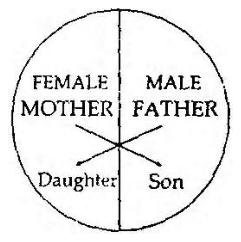
- 1Phenylketonuria
- 2Sickle cell anaemia
- 3Haemophilia
- 4Thalassemia
Show answer and solution
Correct: option 3, Haemophilia
The diagram shows criss-cross inheritance: the trait passes from mother to son and from father to daughter. This is the pattern of an X-linked trait, because a son gets his only X chromosome from his mother and a father passes his X only to daughters. Haemophilia is X-linked recessive; the other three are autosomal recessive disorders.
Question 111AIPMT 2011 Prelims, Q69
Which one of the following conditions correctly describes the manner of determining the sex in the given example
- 1Homozygous sex chromosomes (ZZ) determine female sex in Birds .
- 2XO type of sex chromosomes determine male sex in grasshopper
- 3XO condition in human as found in Turner Syndrome, determines female sex.
- 4Homozygous sex chromosomes (XX) produce male in Drosophila.
Show answer and solution
Correct: option 2, XO type of sex chromosomes determine male sex in grasshopper
In grasshoppers the female is XX and the male has a single X (XO), so the XO condition gives a male. In birds ZZ is male, in Drosophila XX is female, and although a Turner's individual (XO) is female, in humans sex is decided by the presence or absence of the Y chromosome, not by the XO condition.
Question 112AIPMT 2011 Prelims, Q131
Mutations can be induced with:
- 1Infra red radiations
- 2I A A
- 3Ethylene
- 4Gamma radiations
Show answer and solution
Correct: option 4, Gamma radiations
Gamma rays are high-energy ionising radiation that damage DNA and are a standard physical mutagen, used in mutation breeding. Infra-red radiation has too little energy to alter DNA, and IAA and ethylene are plant growth regulators.
Question 113AIPMT 2011 Mains, Q52
Test cross in plants or in Drosophila involves crossing
- 1between two genotypes with recessive trait
- 2between two hybrids
- 3the hybrid with a double recessive genotype.
- 4between two genotypes with dominant trait
Show answer and solution
Correct: option 3, the hybrid with a double recessive genotype.
In a test cross an individual showing the dominant trait, such as an hybrid, is crossed with the homozygous recessive parent type. Because the recessive parent contributes only recessive alleles, the offspring ratio shows directly which gametes the tested individual makes, and so its genotype. A cross between two hybrids is selfing, which gives the generation.
Question 114AIPMT 2011 Mains, Q77
Which one of the following conditions of the zygotic cell would lead to the birth of a normal human female child?
- 1two X chromosomes
- 2only one Y chromosome
- 3only one X chromosome
- 4one X and one Y chromosome
Show answer and solution
Correct: option 1, two X chromosomes
A normal human female has 44 autosomes and two X chromosomes (XX), formed when an egg carrying X is fertilised by a sperm carrying X. A zygote with one X and one Y develops into a male, and one with only a single X (XO) gives Turner's syndrome.
Question 115AIPMT 2010 Mains, Q66
A cross in which an organism showing a dominant phenotype crossed with the recessive parent in order to know its genotype is called
- 1Dihybrid cross
- 2Monohybrid cross
- 3Back cross
- 4Test cross
Show answer and solution
Correct: option 4, Test cross
Crossing an individual of dominant phenotype with the homozygous recessive to find out whether it is homozygous or heterozygous is a test cross. All-dominant offspring mean it is homozygous; a 1 : 1 ratio means it is heterozygous. A back cross is a cross with either parent.
Question 116AIPMT 2010 Mains, Q79
In Antirrhinum two plants with pink flowers were hybridized. The F1 plants produced red, pink and white flowers in the proportion of 1 red, 2 pink and 1 white. What could be the genotype of the two plants used for hybridization? Red flower colour is determined by RR, and white by rr genes.
- 1rr
- 2rrr
- 3RR
- 4Rr
Show answer and solution
Correct: option 4, Rr
Flower colour in Antirrhinum shows incomplete dominance, so the heterozygote Rr is pink. Rr x Rr gives 1 RR (red) : 2 Rr (pink) : 1 rr (white), the ratio stated. Both pink parents are therefore Rr.
Question 117AIPMT 2010 Mains, Q83
The fruit fly Drosophila melanogaster was found to be very suitable for experimental verification of chromosomal theory of inheritance by Morgan and his colleagues because
- 1It completes life cycle in about two weeks
- 2It reproduces parthenogenetically
- 3A single mating produces two young flies
- 4Smaller female is easily recognisable from larger male
Show answer and solution
Correct: option 1, It completes life cycle in about two weeks
Drosophila can be grown on a simple medium and finishes its life cycle in about two weeks, so many generations can be studied quickly. It reproduces sexually, one mating gives a large number of offspring, and it is the male that is smaller than the female, so the other options are wrong.
Question 118AIPMT 2010 Mains, Q91
ABO blood grouping is controlled by gene I which has three alleles and show co-dominance. There are six genotypes. How many phenotypes in all are possible
- 1Five
- 2Six
- 3Three
- 4Four
Show answer and solution
Correct: option 4, Four
The three alleles , and give six genotypes. and both give group A, and both give group B, gives group AB (co-dominance) and gives group O. That makes four phenotypes: A, B, AB and O.
Question 119AIPMT 2010 Mains, Q116
Study the pedigree chart of a certain family given below and select the correct conclusion which can be drawn for the character.
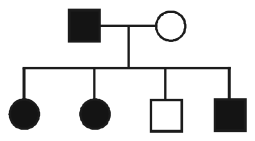
- 1The male parent is homozygous dominant
- 2The female parent is heterozygous
- 3The parents could not have had a normal daughter for this character
- 4The trait under study could not be colour-blindness.
Show answer and solution
Correct: option 4, The trait under study could not be colour-blindness.
The answer key of the source copy gives option (4). The chart shows an affected father and an unaffected mother with two affected daughters, one normal son and one affected son. (1) is ruled out because a homozygous dominant father would have only affected children, and (3) is ruled out because a normal daughter is possible. Note that the chart does fit colour-blindness if the mother is a carrier (colour-blind father and carrier mother can have colour-blind daughters and both kinds of sons), so many books give option (2) for this question.
Question 120AIPMT 2010 Prelims, Q111
Which one of the following symbols and its representation used in human pedigree analysis is correct
- 1

- 2

- 3

- 4

Show answer and solution
Correct: option 4
In a pedigree chart a square stands for a male and a circle for a female, and the symbol is shaded when the person is affected. So an open circle is an unaffected female, an open square is an unaffected male, and a shaded diamond is an affected person of unspecified sex. A double line joining a square and a circle shows mating between relatives (a consanguineous mating), so option (4) is the only correct pair.
Question 121AIPMT 2010 Prelims, Q149
Which one of the following cannot be explained on the basis of Mendel's Law of Dominance
- 1Out of one pair of factors one is dominant, and the other recessive
- 2Alleles do not show any blending and both the characters recover as such in generation.
- 3Factors occur in pairs
- 4The discrete unit controlling a particular character is called a factor
Show answer and solution
Correct: option 2, Alleles do not show any blending and both the characters recover as such in generation.
The law of dominance says that characters are controlled by discrete units called factors, that factors occur in pairs, and that in an unlike pair one factor is dominant and the other recessive. The fact that the two alleles do not blend and both parental characters come back unchanged in the generation is explained by the law of segregation, not by dominance.
Question 122AIPMT 2010 Prelims, Q150
ABO blood groups in humans are controlled by the gene I. It has three alleles - , and i. Since there are three different alleles, six different genotypes are possible. How many phenotypes can occur
- 1One
- 2Four
- 3Two
- 4Three
Show answer and solution
Correct: option 2, Four
and are both dominant over i and are co-dominant with each other. Genotypes and give group A, and give group B, gives group AB, and ii gives group O. So the six genotypes give four phenotypes: A, B, AB and O.
Question 123AIPMT 2010 Prelims, Q156
Select the correct statement from the ones given below with respect to dihybrid cross.
- 1Genes far apart on the same chromosomes show very few recombinations
- 2Genes loosely linked on the same chromosome show similar recombinations as the tightly linked ones
- 3Tightly linked genes on the same chromosome show very few recombinations
- 4Tightly linked genes on the same chromosomes show higher recombinations
Show answer and solution
Correct: option 3, Tightly linked genes on the same chromosome show very few recombinations
Morgan found that genes lying close together on a chromosome are tightly linked and are mostly inherited together, giving very few recombinants. Genes far apart are loosely linked and give many more recombinants. So only the statement that tightly linked genes show very few recombinations is correct.
Question 124AIPMT 2010 Prelims, Q195
The genotype of a plant showing the dominant phenotype can be determined by
- 1Dihybrid cross
- 2Pedigree analysis
- 3Back cross
- 4Test cross
Show answer and solution
Correct: option 4, Test cross
A plant with the dominant phenotype may be homozygous or heterozygous. In a test cross it is crossed with the homozygous recessive parent: if all the offspring show the dominant trait it is homozygous, and if they come in a 1 : 1 ratio it is heterozygous.
Question 125AIPMT 2009 Prelims, Q53
Study the pedigree chart given below:
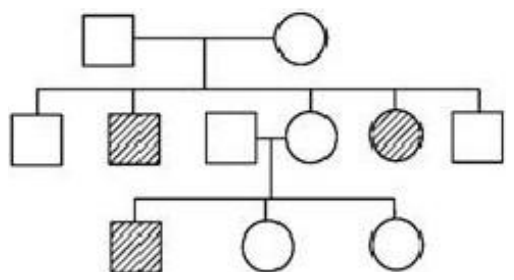
- 1Inheritance of a condition like phenylketonuria as an autosomal recessive trait
- 2The pedigree chart is wrong as this is not possible
- 3Inheritance of a recessive sex-linked disease like haemophilia
- 4Inheritance of a sex-linked inborn error of metabolism like phenylketonuria
Show answer and solution
Correct: option 1, Inheritance of a condition like phenylketonuria as an autosomal recessive trait
Two unaffected parents have affected children, so the trait is recessive and both parents are carriers. One affected child is a daughter; a recessive X-linked trait would need an affected father for that, and the father is unaffected, so the gene is autosomal. Phenylketonuria is an autosomal recessive disorder, which fits option (1).
Question 126AIPMT 2009 Prelims, Q77
- 1caused by substitution of valine by glutamic acid in the beta globin chain of haemoglobin
- 2caused by a change in a single base pair of DNA
- 3characterized by elongated sickle like RBCs with a nucleus
- 4an autosomal linked dominant trait
Show answer and solution
Correct: option 2, caused by a change in a single base pair of DNA
Sickle cell anaemia is due to a point mutation: a single base change (GAG to GUG in the mRNA codon) in the gene for the beta globin chain. It replaces glutamic acid by valine, the reverse of what option (1) says. The disease is autosomal recessive and human RBCs have no nucleus.
Question 127AIPMT 2009 Prelims, Q123
Select the incorrect statement from the following:
- 1Galactosemia is an inborn error of metabolism
- 2Small population size results in random genetic drift in a population
- 3Baldness is a sex-limited trait
- 4Linkage is an exception to the principle of independent assortment in heredity
Show answer and solution
Correct: option 3, Baldness is a sex-limited trait
Pattern baldness is a sex-influenced trait: the autosomal gene is present in both sexes but behaves as dominant in males and recessive in females. A sex-limited trait is expressed in one sex only, such as milk production. The other three statements are correct.
Question 128AIPMT 2008 Prelims, Q120
Haploids are more suitable for mutation studies than the diploids. This is because
- 1All mutations, whether dominant or recessive are expressed in haploids
- 2Haploids are reproductively more stable than diploids
- 3Mutagens penetrate in haploids more effectively than diploids
- 4Haploids are more abundant in nature than diploids
Show answer and solution
Correct: option 1, All mutations, whether dominant or recessive are expressed in haploids
A haploid has only one copy of each gene. There is no second allele to mask a recessive mutation, so every mutation, dominant or recessive, shows up in the phenotype and can be detected at once.
Question 129AIPMT 2008 Prelims, Q122
Which one of the following conditions in humans is correctly matched with its chromosomal abnormality/ linkage?
- 1Down syndrome - 44 autosomes + XO
- 2Klinefelter syndrome - 44 autosomes + XXY
- 3Colour blindness - Y-linked
- 4Erythroblastosis foetalis - X-linked
Show answer and solution
Correct: option 2, Klinefelter syndrome - 44 autosomes + XXY
Klinefelter syndrome is 44 autosomes + XXY (47 chromosomes). 44 + XO is Turner syndrome, not Down syndrome (which is trisomy 21). Colour blindness is X-linked, and erythroblastosis foetalis is due to Rh incompatibility, an autosomal trait.
Question 130AIPMT 2007 Prelims, Q8
If the mean and the median pertaining to a certain character of a population are of the same value, the following is most likely to occur:
- 1a skewed curve
- 2a normal distribution
- 3a bi-modal distribution
- 4a T-shaped curve
Show answer and solution
Correct: option 2, a normal distribution
In a normal distribution the curve is bell-shaped and symmetrical, so the mean and the median (and the mode) fall at the same value. In a skewed curve the mean is pulled away from the median.
Question 131AIPMT 2007 Prelims, Q76
In the hexaploid wheat, the haploid (n) and basic (x) numbers of chromosomes are:
- 1n = 21 and x = 7
- 2n = 7 and x = 21
- 3n = 21 and x = 21
- 4n = 21 and x = 14
Show answer and solution
Correct: option 1, n = 21 and x = 7
Bread wheat is hexaploid with chromosomes. The basic number is therefore , and the haploid (gametic) number is .
Question 132AIPMT 2007 Prelims, Q79
Inheritance of skin colour in humans is an example of:
- 1codominance
- 2chromosomal aberration
- 3point mutation
- 4polygenic inheritance
Show answer and solution
Correct: option 4, polygenic inheritance
Human skin colour is controlled by several genes (usually described as three pairs), each dominant allele adding a little more melanin. A trait controlled by many genes with additive effects, giving a continuous range of phenotypes, shows polygenic inheritance.
Question 133AIPMT 2007 Prelims, Q80
A common test to find the genotype of a hybrid is by:
- 1crossing of one progeny with male parent
- 2crossing of one progeny with male parent
- 3crossing of one progeny with female parent
- 4studying the sexual behaviour of progenies.
Show answer and solution
Correct: option 1, crossing of one progeny with male parent
The genotype of a hybrid is found by a test cross, in which the hybrid is crossed back to a parent (the recessive one), and the ratio in the offspring shows whether it is heterozygous. Only the first option describes a cross of the hybrid back to a parent.
Question 134AIPMT 2007 Prelims, Q82
Two genes R and Y are located very close on the chromosomal linkage map of maize plant. When RRYY and rryy genotypes are hybridized, the segregation will show:
- 1Higher number of the parental types.
- 2Higher number of the recombinant types.
- 3Segregation in the expected 9: 3: 3: 1 ratio.
- 4Segregation in 3:1 ratio.
Show answer and solution
Correct: option 1, Higher number of the parental types.
Genes lying very close together on a chromosome are tightly linked, so crossing over between them is rare. The plant therefore forms mostly parental gametes (RY and ry) and few recombinant ones, and the shows many more parental types than recombinants instead of the 9:3:3:1 ratio of independent assortment.
Question 135AIPMT 2007 Prelims, Q85
In pea plants, yellow seeds are dominant to green. If a heterozygous yellow seeded plant is crossed with a green seeded plant, what ratio of yellow and green seeded plants would you expect in generation?
- 13 : 1
- 250 : 50
- 39 : 1
- 41 : 3
Show answer and solution
Correct: option 2, 50 : 50
The cross is Yy × yy, a test cross. The heterozygous parent gives Y and y gametes in equal numbers and the green parent gives only y, so the offspring are Yy (yellow) and yy (green) in a 1 : 1 ratio, that is 50 : 50.
Question 136AIPMT 2007 Prelims, Q95
A human male produces sperms with genotypes AB, Ab, aB and ab pertaining to two diallelic characters in equal proportions. What is the corresponding genotype of this person?
- 1AABB
- 2AaBb
- 3AaBB
- 4AABb
Show answer and solution
Correct: option 2, AaBb
The number of gamete types is , where is the number of heterozygous gene pairs. Four types of sperm (AB, Ab, aB, ab) in equal numbers need both pairs to be heterozygous, so the genotype is AaBb. AABB gives one type, and AaBB or AABb give only two.
Question 137AIPMT 2006 Prelims, Q120
Which one of the following is the most suitable medium for culture of Drosophila melanogaster?
- 1Moist bread
- 2Agar-agar
- 3Ripe banana
- 4cow dung
Show answer and solution
Correct: option 3, Ripe banana
Drosophila melanogaster is the fruit fly. It feeds and breeds on the yeast growing on ripe, fermenting fruit, so it is easily raised in the laboratory on ripe banana.
Question 138AIPMT 2006 Prelims, Q123
Phenotype of an organism is the result of-
- 1Mutations and linkages
- 2Cytoplasmic effects and nutrition
- 3Environmental changes and sexual dimorphism
- 4Genotype and environment interactions
Show answer and solution
Correct: option 4, Genotype and environment interactions
The phenotype is the observable form of a character. It is produced by the genes an organism carries (its genotype) as they are expressed in a particular environment, so it is the result of genotype and environment acting together.
Question 139AIPMT 2006 Prelims, Q128
In which mode of inheritance do you expect more maternal influence among the offspring?
- 1Autosomal
- 2Cytoplasmic
- 3Y-linked
- 4X-linked
Show answer and solution
Correct: option 2, Cytoplasmic
Genes of mitochondria and chloroplasts lie in the cytoplasm. The zygote gets almost all its cytoplasm from the egg and hardly any from the sperm, so cytoplasmic characters are passed on by the mother alone.
Question 140AIPMT 2006 Prelims, Q132
How many different kinds of gametes will be produced by a plant having the genotype AABbCC?
- 1Three
- 2Four
- 3Nine
- 4Two
Show answer and solution
Correct: option 4, Two
The number of kinds of gametes is , where n is the number of heterozygous gene pairs. Only Bb is heterozygous, so n = 1 and there are two kinds: ABC and AbC.
Question 141AIPMT 2006 Prelims, Q162
Which one of the following is an example of polygenic inheritance?
- 1Flower colour in Mirabilis jalapa
- 2Production of male honey bee
- 3Pod shape in garden pea
- 4Skin colour in humans
Show answer and solution
Correct: option 4, Skin colour in humans
A polygenic trait is controlled by several genes whose effects add up, giving a continuous range of phenotypes. Human skin colour is the classic case. Flower colour in Mirabilis jalapa shows incomplete dominance of one gene, pod shape in pea is a single-gene Mendelian trait, and male honey bees arise by haploid parthenogenesis.
Question 142AIPMT 2006 Prelims, Q168
In Mendel's experiments with garden pea, round seed shape (RR) was dominant over wrinkled seeds (rr), yellow cotyledon (YY) was dominant over green cotyledon (yy). What are the expected phenotypes in the generation of the cross RRYY rryy?
- 1Only round seeds with green cotyledons
- 2Only wrinkled seeds with yellow cotyledons
- 3Only wrinkled seeds with green cotyledons
- 4Round seeds with yellow cotyledons, and wrinkled seeds with yellow cotyledons
Show answer and solution
Correct: option 4, Round seeds with yellow cotyledons, and wrinkled seeds with yellow cotyledons
The is RrYy, and selfing it gives the 9 : 3 : 3 : 1 ratio of round yellow, round green, wrinkled yellow and wrinkled green. The therefore has several phenotypes, so the three options beginning with "Only" are wrong. Option (4) names two phenotypes that do appear in the and is the only acceptable choice, although it does not list all four.
Question 143AIPMT 2006 Prelims, Q171
- 1Crossing between two genotypes with recessive trait
- 2Crossing between two hybrids
- 3Crossing the hybrid with a double recessive genotype
- 4Crossing between two genotypes with dominant trait
Show answer and solution
Correct: option 3, Crossing the hybrid with a double recessive genotype
In a test cross an individual showing the dominant phenotype, such as an hybrid, is crossed with the homozygous recessive. Because the recessive parent contributes only recessive alleles, the offspring ratio reveals the genotype of the individual being tested.
Question 144AIPMT 2006 Prelims, Q175
If a colourblind woman marries a normal visioned man, their sons will be
- 1All normal visioned
- 2One-half colourblind and one-half normal
- 3Three-fourths colourblind and one-fourth normal
- 4All colourblind
Show answer and solution
Correct: option 4, All colourblind
Colour blindness is an X-linked recessive trait. A colourblind woman is , and every son gets his single X from his mother and a Y from his father. All sons are therefore and colourblind, while all daughters are carriers.
Question 145AIPMT 2006 Prelims, Q176
Cri-du-chat syndrome in humans is caused by the
- 1Fertilization of an XX egg by a normal Y-bearing sperm
- 2Loss of half of the short arm of chromosome 5
- 3Loss of half of the long arm of chromosome 5
- 4Trisomy of 21st chromosome
Show answer and solution
Correct: option 2, Loss of half of the short arm of chromosome 5
Cri-du-chat (cat-cry) syndrome results from a deletion in the short (p) arm of chromosome 5. An XX egg fertilised by a Y sperm gives Klinefelter's syndrome (XXY), and trisomy 21 gives Down's syndrome.
Question 146AIPMT 2006 Prelims, Q199
Both sickle cell anemia and Huntington's chorea are
- 1Bacteria-related diseases
- 2Congenital disorders
- 3Pollutant-induced disorders
- 4Virus-related diseases
Show answer and solution
Correct: option 2, Congenital disorders
Both are inherited genetic disorders, present from birth in the genes: sickle cell anaemia is autosomal recessive and Huntington's chorea is autosomal dominant. Neither is caused by a microbe or a pollutant, so they are congenital disorders.
Question 147AIPMT 2005 Prelims, Q144
The salivary gland chromosomes in the dipteran larva, are useful in gene mapping because
- 1They have endoreduplicated chromosomes
- 2These are fused
- 3These are easy to stain
- 4These are much longer in size
Show answer and solution
Correct: option 1, They have endoreduplicated chromosomes
Salivary gland (polytene) chromosomes are formed by repeated replication of the DNA without separation of the strands (endoreduplication). The many aligned strands give a fixed pattern of dark bands and light interbands, and genes can be located against these bands.
Question 148AIPMT 2005 Prelims, Q156
In order to find out the different types of gametes produced by a pea plants having the genotype AaBb, it should be crossed to a plant with the genotype
- 1AaBb
- 2aabb
- 3AABB
- 4aaBB
Show answer and solution
Correct: option 2, aabb
This is a test cross. The double recessive parent aabb gives only ab gametes, which hide nothing, so the phenotype of each offspring shows directly which gamete (AB, Ab, aB or ab) came from the AaBb plant. With any parent carrying a dominant allele, some gamete types would be masked.
Question 149AIPMT 2005 Prelims, Q161
Which of the following is not a hereditary disease
- 1Haemophilia
- 2Cretinism
- 3Cystic fibrosis
- 4Thalassemia
Show answer and solution
Correct: option 2, Cretinism
Haemophilia (X-linked recessive), cystic fibrosis and thalassemia (both autosomal recessive) are caused by faulty genes passed on from the parents. Cretinism is a hormone deficiency disorder: too little thyroid hormone in infancy, often from lack of iodine, stunts growth and mental development.
Question 150AIPMT 2005 Prelims, Q164
A woman with normal vision, but whose father was colour blind, marries a colour blind man. Suppose that the fourth child of this couple was a boy. This boy
- 1Must have normal colour vision
- 2May be colour blind or may be normal vision
- 3Will be partially colour blind since he is heterozygous for the colour blind mutant allele.
- 4Must be colour blind
Show answer and solution
Correct: option 2, May be colour blind or may be normal vision
Colour blindness is X-linked recessive. The woman received her father's only X, so she is a carrier (). A son gets his X from his mother and Y from his father, so he has an equal chance of receiving the normal X or the X with the colour blindness allele. He may therefore be normal or colour blind; a male has one X and cannot be heterozygous.
Question 151AIPMT 2005 Prelims, Q179
Haemophilia is more commonly seen in human males than in human females because
- 1This disease is due to a Y-linked recessive mutation
- 2This disease is due to an X-linked recessive mutation
- 3This disease is due to an X-linked dominant mutation
- 4A greater proportion of girls die in infancy
Show answer and solution
Correct: option 2, This disease is due to an X-linked recessive mutation
The haemophilia allele is recessive and lies on the X chromosome. A male has only one X, so a single copy of the allele makes him haemophilic. A female needs the allele on both X chromosomes, which requires a haemophilic father and at least a carrier mother, and that is rare.
Question 152AIPMT 2005 Prelims, Q185
A woman with 47 chromosomes due to three copies of chromosome 21 is characterized by
- 1Turner syndrome
- 2Down syndrome
- 3Superfemaleness
- 4Triploidy
Show answer and solution
Correct: option 2, Down syndrome
Three copies of chromosome 21 (trisomy 21) is Down syndrome. Turner syndrome is 45, X; a superfemale has an extra X chromosome (47, XXX); and triploidy means three complete sets, 69 chromosomes.
Question 153AIPMT 2005 Prelims, Q186
A man and a woman, who do not show any apparent signs of a certain inherited disease, have seven children (2 daughter and 5 sons). Three of the sons suffer from the given disease but none of the daughters are affected. Which of the following mode of inheritance do you suggest for this disease
- 1Sex-limited recessive
- 2Autosomal dominant
- 3Sex-linked recessive
- 4Sex-linked dominant
Show answer and solution
Correct: option 3, Sex-linked recessive
Unaffected parents with affected children means the allele is recessive, which rules out both dominant options. Only sons are affected, and only some of them, which fits a carrier mother () and a normal father: half the sons get the faulty X and show the disease, while every daughter gets a normal X from the father and is unaffected. This is sex-linked (X-linked) recessive inheritance.
Question 154AIPMT 2005 Prelims, Q190
Genes for cytoplasmic male sterility in plants are generally located in
- 1Nuclear genome
- 2Chloroplast genome
- 3Cytosol
- 4Mitochondrial genome
Show answer and solution
Correct: option 4, Mitochondrial genome
Cytoplasmic male sterility is passed on through the egg cytoplasm only, so its genes are outside the nucleus. They have been traced to the mitochondrial DNA, as in maize, where altered mitochondrial genes stop normal pollen from forming. The cytosol itself has no genes.
Question 155AIPMT 2004 Prelims, Q109
A normal woman, whose father was colour-blind is married to a normal man. The sons would be :-
- 150% colour-blind
- 2All normal
- 3All colour-blind
- 475 % colour-blind
Show answer and solution
Correct: option 1, 50% colour-blind
Colour blindness is X-linked recessive. The woman received her father's X, so she is a carrier (). Each son gets his X from her, with an equal chance of or , and a Y from the normal father. So half of the sons are colour-blind.
Question 156AIPMT 2004 Prelims, Q122
Extranuclear inheritance is a consequence of presence of genes in -
- 1Endoplasmic reticulum & mitochondria
- 2Ribosomes and chloroplast
- 3Lysosomes and ribosomes
- 4Mitochondria and chloroplasts
Show answer and solution
Correct: option 4, Mitochondria and chloroplasts
Mitochondria and chloroplasts have their own DNA, and the genes on it are passed on through the cytoplasm, usually of the egg, and not through the nucleus. Endoplasmic reticulum, ribosomes and lysosomes carry no genes.
Question 157AIPMT 2004 Prelims, Q125
The recessive genes located on X-chromosomes in humans are always-
- 1Sub-lethal
- 2Expressed in males
- 3Expressed in females
- 4Lethal
Show answer and solution
Correct: option 2, Expressed in males
A male has only one X chromosome and the Y carries no matching allele, so he is hemizygous: any recessive gene on his X is expressed. A female expresses it only when both of her X chromosomes carry it.
Question 158AIPMT 2004 Prelims, Q131
In a mutational event, when adenine is replaced by guanine, it is a case of -
- 1Transcription
- 2Transition
- 3Transversion
- 4Frameshift mutation
Show answer and solution
Correct: option 2, Transition
Adenine and guanine are both purines. Replacing a purine by another purine (or a pyrimidine by another pyrimidine) is a transition. A transversion swaps a purine for a pyrimidine or the reverse, and a frameshift comes from adding or losing a base.
Question 159AIPMT 2004 Prelims, Q142
A male human is heterozygous for autosomal genes A and B and is also hemizygous for hemophilic gene h. What proportion of his sperms will be abh :-
- 11/32
- 21/16
- 31/4
- 41/8
Show answer and solution
Correct: option 4, 1/8
His genotype is . A sperm gets a with chance 1/2, b with chance 1/2, and the X chromosome carrying h (rather than the Y) with chance 1/2. Assorting independently, the proportion of abh sperms is .
Question 160AIPMT 2004 Prelims, Q146
A self-fertilizing trihybrid plant forms :-
- 14 different gametes and 16 different zygotes
- 28 different gametes and 16 different zygotes
- 38 different gametes and 32 different zygotes
- 48 different gametes and 64 different zygotes
Show answer and solution
Correct: option 4, 8 different gametes and 64 different zygotes
A plant heterozygous for three genes forms kinds of gametes. On selfing, 8 kinds of male gametes meet 8 kinds of female gametes, giving zygote combinations in the Punnett square.
Question 161AIPMT 2004 Prelims, Q149
Lack of independent assortment of two genes A and B in fruit fly Drosophila is due to :-
- 1Recombination
- 2Linkage
- 3Crossing over
- 4Repulsion
Show answer and solution
Correct: option 2, Linkage
Genes lying on the same chromosome tend to be inherited together, which is called linkage, so they do not assort independently. Crossing over and recombination work the other way and separate linked genes.
Question 162AIPMT 2004 Prelims, Q175
In a plant red fruit (R) is dominant over yellow fruit (r) and tallness (T) is dominant over shortness (t). If a plant with RRTt genotype is crossed with a plant that is rrtt
- 150% will be tall with red fruit
- 275% will be tall with red fruit
- 3All the offspring will be tall with red fruit
- 425% will be tall with red fruit
Show answer and solution
Correct: option 1, 50% will be tall with red fruit
RRTt gives gametes RT and Rt in equal numbers; rrtt gives only rt. The offspring are RrTt (red, tall) and Rrtt (red, short) in a 1 : 1 ratio. All are red, but only half are tall, so 50% are tall with red fruit.
Question 163AIPMT 2004 Prelims, Q183
One of the parents of a cross has a mutation in its mitochondria. In that cross, that parent is taken as a male. During segregation of progenies that mutation is found in -
- 1None of the progenies
- 2All the progenies
- 350% of the progenies
- 41/3 of the progenies
Show answer and solution
Correct: option 1, None of the progenies
Mitochondria are passed on only through the cytoplasm of the egg (maternal inheritance); the male gamete adds almost no cytoplasm to the zygote. A mitochondrial mutation carried by the male parent therefore does not reach the , and so none of the have it.
Question 164AIPMT 2003 Prelims, Q117
Down's syndrome is caused by an extra copy of chromosome number 21. What percentage of offspring produced by an affected mother and a normal father would be affected by this disorder:
- 1100%
- 275%
- 350%
- 425%
Show answer and solution
Correct: option 3, 50%
The affected mother has three copies of chromosome 21. At meiosis two copies go to one pole and one to the other, so half her eggs carry two copies and half carry one. With a normal sperm, half the offspring get three copies and are affected: 50%.
Question 165AIPMT 2003 Prelims, Q136
Which of the following discoveries resulted in a Nobel Prize:
- 1X-rays induce sex-linked recessive lethal mutations
- 2Cytoplasmic inheritance
- 3Recombination of linked genes
- 4Genetic engineering
Show answer and solution
Correct: option 1, X-rays induce sex-linked recessive lethal mutations
H. J. Muller showed in 1927 that X-rays greatly increase the rate of mutation in Drosophila, detecting the mutations as sex-linked recessive lethals. He received the Nobel Prize in 1946 for this discovery.
Question 166AIPMT 2003 Prelims, Q137
The linkage map of X-chromosome of fruitfly has 66 units, with yellow body gene (y) at one end and bobbed hair (b) gene at the other end. The recombination frequency between these two genes (y and b) should be:
- 160%
- 2> 50%
- 3≤ 50%
- 4100%
Show answer and solution
Correct: option 3, ≤ 50%
Map distances add up along a chromosome, but the recombination frequency actually observed between two genes can never be more than 50%, because double and multiple crossovers between distant genes restore the parental combinations. Genes 66 units apart behave as if assorting independently, so the frequency is at most 50%.
Question 167AIPMT 2003 Prelims, Q138
Genes for cytoplasmic male sterility in plants are generally located in:
- 1Chloroplast genome
- 2Mitochondrial genome
- 3Nuclear-genome
- 4Cytosol
Show answer and solution
Correct: option 2, Mitochondrial genome
Cytoplasmic male sterility, as in maize, is inherited through the female parent because the genes responsible lie in the mitochondrial DNA. They make the pollen fail to develop.
Question 168AIPMT 2003 Prelims, Q142
Two crosses between the same pair of genotypes or phenotypes in which the sources of the gametes are reversed in one cross, is known as:
- 1Test cross
- 2Reciprocal cross
- 3Dihybrid cross
- 4Reverse cross
Show answer and solution
Correct: option 2, Reciprocal cross
In a reciprocal cross the same two types are crossed twice with the sexes exchanged: the type used as the female parent in the first cross is the male parent in the second. A test cross is a cross of an individual with the recessive parent type.
Question 169AIPMT 2003 Prelims, Q144
The genes controlling the seven pea characters studied by Mendel are now known to be located on how many different chromosomes:
- 1Seven
- 2Six
- 3Five
- 4Four
Show answer and solution
Correct: option 4, Four
The pea has seven pairs of chromosomes, but Mendel's seven genes lie on only four of them: chromosomes 1, 4, 5 and 7. The genes on the same chromosome are far enough apart to assort almost independently.
Question 170AIPMT 2003 Prelims, Q145
Which one of the following traits of garden pea studied by Mendel was a recessive feature:
- 1Axial flower position
- 2Green seed colour
- 3Green pod colour
- 4Round seed shape
Show answer and solution
Correct: option 2, Green seed colour
For seed colour yellow is dominant and green is recessive. Axial flower position, green pod colour and round seed shape are all dominant traits (their recessive forms are terminal, yellow and wrinkled).
Question 171AIPMT 2003 Prelims, Q146
Which one of the following conditions though harmful in itself, is also a potential saviour from a mosquito borne infectious disease:
- 1Thalassaemia
- 2Sickle cell anaemia
- 3Pernicious anaemia
- 4Leukemia
Show answer and solution
Correct: option 2, Sickle cell anaemia
People heterozygous for the sickle cell gene are resistant to malaria, which is spread by the Anopheles mosquito, because the malarial parasite cannot grow well in their red blood cells. This is why the gene remains common in malarial regions.
Question 172AIPMT 2003 Prelims, Q147
Pattern baldness, moustaches and beard in human males are examples of:
- 1Sex linked traits
- 2Sex limited traits
- 3Sex differentiating traits
- 4Sex-determining traits
Show answer and solution
Correct: option 2, Sex limited traits
The genes for these traits are on autosomes and are present in both sexes, but they are expressed in males only (or mainly), under the influence of male hormones. Such traits are called sex limited; sex linked traits are those whose genes lie on the sex chromosomes.
Question 173AIPMT 2003 Prelims, Q149
When a cluster of genes show linkage behaviour they:
- 1Do not show a chromosome map
- 2Show recombination during meiosis
- 3Do not show independent assortment
- 4Induce cell division
Show answer and solution
Correct: option 3, Do not show independent assortment
Linked genes lie on the same chromosome and tend to be inherited together, so they do not assort independently as Mendel's second law would predict. The parental combinations appear more often than the recombinants.
Question 174AIPMT 2003 Prelims, Q152
Christmas disease is another name for:-
- 1Haemophilia B
- 2Hepatitis B
- 3Down's syndrome
- 4Sleeping sickness
Show answer and solution
Correct: option 1, Haemophilia B
Haemophilia B is caused by deficiency of clotting factor IX, which is also called the Christmas factor after the first patient described. Hence it is known as Christmas disease.
Question 175AIPMT 2003 Prelims, Q153
In Drosophila, the sex is determined by:-
- 1The ratio of number of X-chromosomes to the sets of autosomes
- 2X and Y chromosomes
- 3The ratio of pairs of X-chromosomes to the pairs of autosomes
- 4Whether the egg is fertilized or develops parthenogenetically
Show answer and solution
Correct: option 1, The ratio of number of X-chromosomes to the sets of autosomes
Bridges' genic balance theory says that sex in Drosophila depends on the X/A ratio, the number of X chromosomes divided by the number of haploid sets of autosomes. A ratio of 1.0 gives a female and 0.5 gives a male; the Y chromosome is needed only for fertility.
Question 176AIPMT 2003 Prelims, Q198
Genetic Map is one that:-
- 1Establishes sites of the genes on a chromosome
- 2Establishes the various stages in gene evolution
- 3Shows the stages during the cell division
- 4Shows the distribution of various species in a region
Show answer and solution
Correct: option 1, Establishes sites of the genes on a chromosome
A genetic (linkage) map shows the order of genes on a chromosome and the relative distances between them, worked out from recombination frequencies. It was first prepared by Sturtevant for Drosophila.
Question 177AIPMT 2002 Prelims, Q103
Which of the following is correct match -
- 1Down Syndrome = 21st Chromosome
- 2Sickle cell anaemia = X – Chromosome
- 3Haemophilia = Y – Chromosome
- 4Parkinson Disease = X & Y Chromosome
Show answer and solution
Correct: option 1, Down Syndrome = 21st Chromosome
Down syndrome is trisomy of chromosome 21, so the first pair is correct. Sickle cell anaemia is an autosomal recessive disorder (the beta-globin gene is on chromosome 11), haemophilia is X-linked recessive and not Y-linked, and Parkinson disease is not a sex-chromosome disorder.
Question 178AIPMT 2002 Prelims, Q106
Change in sequence of nucleotide in DNA is called as -
- 1Mutagen
- 2Mutation
- 3Recombination
- 4Translation
Show answer and solution
Correct: option 2, Mutation
A mutation is a heritable change in the nucleotide sequence of DNA. A mutagen is the agent that causes such a change, recombination is the reshuffling of existing genes, and translation is the synthesis of a polypeptide on mRNA.
Question 179AIPMT 2002 Prelims, Q176
Which of the following is the example of sex linked disease:-
- 1AIDS
- 2Colour blindness
- 3Syphilis
- 4Gonorrhoea
Show answer and solution
Correct: option 2, Colour blindness
Colour blindness is caused by a recessive gene on the X chromosome, so it is a sex-linked disorder. AIDS, syphilis and gonorrhoea are sexually transmitted infections, not inherited sex-linked diseases.
Question 180AIPMT 2002 Prelims, Q180
Which of the following is the example of pleiotropic gene:-
- 1Haemophilia
- 2Thalassemia
- 3Sickle cell anaemia
- 4Colour blindness
Show answer and solution
Correct: option 3, Sickle cell anaemia
A pleiotropic gene affects several characters. The sickle cell gene changes haemoglobin and, as a result, causes sickling of red cells, anaemia, blocked capillaries, organ damage and also resistance to malaria, so it is the standard example of pleiotropy.
Question 181AIPMT 2002 Prelims, Q181
A gene said to be dominant if:-
- 1It express it's effect only in homozygous stage
- 2It expressed only in heterozygous condition
- 3It expressed both in homozygous and heterozygous condition
- 4It never expressed in any condition
Show answer and solution
Correct: option 3, It expressed both in homozygous and heterozygous condition
A dominant allele shows its effect whether it is present in two copies (AA) or one copy (Aa). A recessive allele is expressed only in the homozygous condition.
Question 182AIPMT 2002 Prelims, Q185
A plant of -generation with genotype "AABbCC". On selfing of this plant what is the phenotypic ratio in -generation:-
- 13 : 1
- 21 : 1
- 39 : 3 : 3 : 1
- 427 : 9 : 9 : 9 : 3 : 3 : 3 : 1
Show answer and solution
Correct: option 1, 3 : 1
The plant is homozygous for A and C and heterozygous only for B, so it behaves as a monohybrid. Selfing Bb gives BB : Bb : bb = 1 : 2 : 1, which is a phenotypic ratio of 3 : 1.
Question 183AIPMT 2002 Prelims, Q187
A diseased man marries a normal woman. They get three daughter and five sons. All the daughter were diseased and sons were normal. The gene of this disease is:-
- 1Sex linked dominant
- 2Sex linked recessive
- 3Sex limited character
- 4Autosomal dominant
Show answer and solution
Correct: option 1, Sex linked dominant
A father gives his X chromosome to all his daughters and his Y to all his sons. Every daughter is affected and no son is, so the gene is on the father's X chromosome, and since one copy is enough to affect the daughters (the mother is normal) it is dominant: X-linked dominant.
Question 184AIPMT 2002 Prelims, Q197
There are three genes a, b and c. The percentage of crossing over between a and b is 20%, b and c is 28% and a and c is 8%. What is the sequence of genes on chromosome
- 1b, a, c
- 2a, b, c
- 3a, c, b
- 4None
Show answer and solution
Correct: option 1, b, a, c
Crossing over percentage measures map distance. The largest distance, 28 units, is between b and c, so they are the outer genes and a lies between them: b to a is 20 and a to c is 8, and 20 + 8 = 28. The order is b, a, c.
Question 185AIPMT 2001 Prelims, Q101
Independent assortment of genes does not takes place when:-
- 1Genes are located on homologous chromosomes
- 2Genes are linked and located on same chromosome
- 3Genes are located on non-homologous chromosome
- 4All the above
Show answer and solution
Correct: option 2, Genes are linked and located on same chromosome
Independent assortment needs the two genes to separate freely at meiosis, which happens when they lie on different (non-homologous) chromosomes. Genes that are linked on the same chromosome travel together into the gametes, so they do not assort independently.
Question 186AIPMT 2001 Prelims, Q105
Mendel obtained wrinkled seeds in pea due to deposition of sugars instead of starch. It was due to which enzyme:-
- 1Amylase
- 2Invertase
- 3Diastase
- 4Absence of starch branching enzyme
Show answer and solution
Correct: option 4, Absence of starch branching enzyme
Round pea seeds have the starch branching enzyme, which turns sugar into branched starch. In the recessive (rr) seeds this enzyme is missing, so sugar builds up, the seed takes in more water and then wrinkles as it dries.
Question 187AIPMT 2001 Prelims, Q108
Ratio of complementary genes is:-
- 19 : 3 : 4
- 212 : 3 : 1
- 39 : 3 : 3 : 4
- 49 : 7
Show answer and solution
Correct: option 4, 9 : 7
With complementary genes the character appears only when a dominant allele of both genes is present (A_B_, 9 out of 16). The other three classes (3 + 3 + 1 = 7) look alike, so the ratio is 9 : 7. 9 : 3 : 4 is recessive epistasis and 12 : 3 : 1 is dominant epistasis.
Question 188AIPMT 2001 Prelims, Q109
When dominant and recessive alleles express itself together it is called:-
- 1Co-dominance
- 2Dominance
- 3Amphidominance
- 4Pseudo dominance
Show answer and solution
Correct: option 1, Co-dominance
When both alleles of a pair show their effect side by side in the heterozygote, neither hiding the other, the condition is co-dominance. The AB blood group, in which both and are expressed, is the usual example.
Question 189AIPMT 2001 Prelims, Q110
A and B genes are linked. What shall be genotype of progeny in a cross between AB/ab and ab/ab:-
- 1AAbb and aabb
- 2AaBb and aabb
- 3AABB and aabb
- 4None
Show answer and solution
Correct: option 2, AaBb and aabb
With linkage the AB/ab parent forms only the parental gametes AB and ab, and the ab/ab parent forms only ab. The progeny are therefore AB/ab (AaBb) and ab/ab (aabb).
Question 190AIPMT 2001 Prelims, Q112
Probability of four son to a couple is:-
- 1
- 2
- 3
- 4
Show answer and solution
Correct: option 3,
Each child is a son with probability , and each birth is independent. The probability of four sons is .
Question 191AIPMT 2001 Prelims, Q113
Two nonallelic genes produces the new phenotype when present together but fail to do so independently then it is called:-
- 1Epistasis
- 2Polygene
- 3Non complementary gene
- 4Complementary gene
Show answer and solution
Correct: option 4, Complementary gene
Two non-allelic genes that give a character only when both are present in the dominant form, and not when either is alone, are complementary genes (9 : 7 ratio in the ). In epistasis one gene hides the effect of another, and polygenes add up their effects.
Question 192AIPMT 2001 Prelims, Q162
Male XX and female XY sometime occur due to
- 1Deletion
- 2Transfer of segments in X and Y chromosomes
- 3Aneuploidy
- 4Hormonal imbalance
Show answer and solution
Correct: option 2, Transfer of segments in X and Y chromosomes
Maleness depends on the testis-determining region of the Y chromosome. If abnormal exchange between X and Y moves this segment to an X, an XX individual becomes male, and a Y that has lost it gives an XY female. The chromosome number is normal, so it is not aneuploidy.
Question 193AIPMT 2001 Prelims, Q163
No. of Barr body in XXXX female:
- 11
- 22
- 33
- 44
Show answer and solution
Correct: option 3, 3
Only one X chromosome stays active in a cell and every other X is condensed into a Barr body. Number of Barr bodies = number of X chromosomes .
Question 194AIPMT 2001 Prelims, Q166
Extranuclear inheritance occurs in:
- 1Killer Paramaecium
- 2Killer Amoeba
- 3Euglena
- 4Hydra
Show answer and solution
Correct: option 1, Killer Paramaecium
The killer trait of Paramecium is carried by kappa particles in the cytoplasm, which pass to the offspring with the cytoplasm and not through nuclear genes. It is a standard example of extranuclear (cytoplasmic) inheritance.
Question 195AIPMT 2001 Prelims, Q187
Sickle cell anaemia is due to:
- 1Change of Amino Acid in -chain of Haemoglobin
- 2Change of Amino Acid in -chain of Haemoglobin
- 3Change of Amino acid in both and chain of Haemoglobin
- 4Change of Amino acid either or chain of Haemoglobin
Show answer and solution
Correct: option 2, Change of Amino Acid in -chain of Haemoglobin
In sickle cell anaemia a point mutation (GAG to GUG) replaces glutamic acid with valine at the sixth position of the -globin chain. The -chain is unchanged.
Question 196AIPMT 2000 Prelims, Q108
According to mendelism which character is showing dominance:
- 1Terminal position of flower
- 2Green colour in seed coat
- 3Wrinkled seed
- 4Green pod colour
Show answer and solution
Correct: option 4, Green pod colour
In Mendel's pea characters, green pod colour is dominant over yellow. Terminal flower position and wrinkled seed are recessive, and green seed colour is also the recessive form, so option (4) is the dominant character.
Question 197AIPMT 2000 Prelims, Q109
Due to the cross between TTRr × ttrr the resultant progenies showed how many percent plants tall, red flowered:
- 150%
- 275%
- 325%
- 4100%
Show answer and solution
Correct: option 1, 50%
TT × tt gives only Tt, so every plant is tall. Rr × rr gives Rr and rr in a 1 : 1 ratio, so half the plants are red flowered. Tall and red flowered plants are therefore 100% × 50% = 50%.
Question 198AIPMT 2000 Prelims, Q179
Mongolian idiots are due to trisomy in 21st chromosome is called:
- 1Down's syndrome
- 2Turner's syndrome
- 3Klinefelter's syndrome
- 4Triplex syndrome
Show answer and solution
Correct: option 1, Down's syndrome
An extra copy of chromosome 21 (trisomy 21) causes Down's syndrome, which used to be called mongolism. Turner's syndrome is XO and Klinefelter's syndrome is XXY.
Question 199AIPMT 2000 Prelims, Q185
In Drosophila the XXY condition leads to femaleness whereas in human beings the same condition leads to Klinefelter's syndrome in male. It proves:
- 1In human beings Y chromosome is active in sex determination
- 2Y chromosome is active in sex determination in both human beings and Drosophila
- 3In Drosophila Y-chromosome decides femaleness
- 4Y chromosome of man have genes for syndrome
Show answer and solution
Correct: option 1, In human beings Y chromosome is active in sex determination
An XXY human is male, so the presence of the Y chromosome decides maleness in man. An XXY Drosophila is female because its sex depends on the ratio of X chromosomes to autosomes, and the Y plays no part in deciding sex.
Question 200AIPMT 2000 Prelims, Q197
Most of the mutations are:
- 1Harmful
- 2Harmful and recessive
- 3Beneficial
- 4Dominant
Show answer and solution
Correct: option 2, Harmful and recessive
A mutation is a random change in a gene, so it usually spoils a working gene and is harmful, and it is usually recessive to the normal allele. Option (2) states both features and is therefore the most complete answer.
Question 201AIPMT 1999 Prelims, Q133
The allele for tallness is dominant over that of dwarfness. This is called:
- 1Law of independent assortment
- 2Law of segregation
- 3Law of unit character
- 4Law of dominance
Show answer and solution
Correct: option 4, Law of dominance
When two different alleles of a gene are together, one (here tall) shows itself and hides the other (dwarf). This is Mendel's law of dominance. Segregation deals with the separation of alleles into gametes, and independent assortment with two or more genes.
Question 202AIPMT 1999 Prelims, Q135
What ratio is expected in offsprings if father is colour blind and mother's father was colour blind:
- 150% daughter – colour blind
- 2All the sons are colour blind
- 3All the daughters colour blind
- 4All the sons are normal
Show answer and solution
Correct: option 1, 50% daughter – colour blind
Colour blindness is X-linked recessive. The father is . The mother received from her colour blind father, so she is a carrier, . Daughters get from the father and either or from the mother, so half of the daughters are colour blind. Half of the sons are colour blind too, so neither of the two options about all the sons holds.
Question 203AIPMT 1999 Prelims, Q136
When AABBcc is crossed with AaBbCc then the ratio of hybrid for all the three genes is:
- 11/8
- 21/4
- 31/16
- 41/32
Show answer and solution
Correct: option 1, 1/8
Take each gene separately. AA Aa gives Aa with probability , BB Bb gives Bb with probability , and cc Cc gives Cc with probability . The chance of AaBbCc is .
Question 204AIPMT 1999 Prelims, Q166
Fraternal twin one baby is haemophilic while baby's brother is normal then which statement is true:
- 1Baby is male
- 2Baby is female
- 3Mother is heterozygous
- 4Mother is homozygous
Show answer and solution
Correct: option 3, Mother is heterozygous
Haemophilia is X-linked recessive, and a son gets his X chromosome from his mother. Fraternal twins come from two different eggs. One child received the X carrying the haemophilia allele and the normal brother received the X with the normal allele, so the mother must carry both alleles: she is heterozygous (a carrier). The sex of the affected baby cannot be fixed from this information.
Question 205AIPMT 1999 Prelims, Q189
Minor change in gene's structure is called:
- 1Reversible mutation
- 2Point mutation
- 3Forward mutation
- 4Back ward mutation
Show answer and solution
Correct: option 2, Point mutation
A change in a single base pair of a gene, by substitution, addition or deletion, is the smallest change a gene can undergo and is called a point mutation. Sickle-cell anaemia is the classic example. Forward and backward (reverse) mutations describe the direction of a change, not its size.
Question 206AIPMT 1998 Prelims, Q101
If Mendel might have studied 7 pairs of characters in a plant with 12 chromosomes instead of 14 then:
- 1He could not discovered independent assortment
- 2He might have discovered linkage
- 3He might have discovered crossing over
- 4He might have not observed dominance
Show answer and solution
Correct: option 1, He could not discovered independent assortment
Pea has 14 chromosomes, that is 7 pairs, so each of Mendel's 7 characters could sit on a different pair and assort freely. With 12 chromosomes there are only 6 pairs, so at least two of the 7 characters would lie on the same chromosome and be inherited together. Those two would not give the 9:3:3:1 ratio, so the law of independent assortment could not have been framed, which is the keyed option (1).
Question 207AIPMT 1998 Prelims, Q106
AA Bb Cc genotypes form how many types of gametes:
- 14
- 28
- 32
- 46
Show answer and solution
Correct: option 1, 4
The number of gamete types is , where is the number of heterozygous gene pairs. AA is homozygous, Bb and Cc are heterozygous, so and types: ABC, ABc, AbC and Abc.
Question 208AIPMT 1998 Prelims, Q114
If a female having gene for haemophilia and colour-blindness on its one X-chromosome marries a normal male then what are the chances in their offsprings:
- 150% son diseased and 50% normal
- 2All normal offsprings
- 3100% daughters are carrier
- 4100% son diseased
Show answer and solution
Correct: option 1, 50% son diseased and 50% normal
Write the mother as and the father as . A son gets his X from the mother: half the sons get and have both disorders, half get the normal X and are normal. Daughters get a normal X from the father, so none is affected and only half are carriers. So option (1) is correct.
Question 209AIPMT 1998 Prelims, Q115
First child of a normal male and female is albino, what are the chances of second child to be albino:
- 125%
- 250%
- 375%
- 4100%
Show answer and solution
Correct: option 1, 25%
Albinism is autosomal recessive, so an albino child (aa) from normal parents shows both parents are carriers (Aa). Aa × Aa gives aa with probability 1/4. Each birth is an independent event, so the chance for the second child is again 25%.
Question 210AIPMT 1998 Prelims, Q117
Point mutation induced by:
- 1Adenine
- 2Guanine
- 33-cytosine
- 4Bromouracil
Show answer and solution
Correct: option 4, Bromouracil
5-Bromouracil is a base analogue of thymine. It gets built into DNA in place of thymine and then sometimes pairs with guanine instead of adenine, so an A-T pair is changed to G-C, a single base (point) mutation. Adenine and guanine are the normal bases.
Question 211AIPMT 1998 Prelims, Q118
Reason for trisomy in Down's syndrome:
- 1Non disjunction during sperm formation
- 2Non disjunction during egg formation
- 3Non disjunction at the time of egg or sperm formation
- 4Addition of one extra chromosome during mitosis
Show answer and solution
Correct: option 3, Non disjunction at the time of egg or sperm formation
Down's syndrome is trisomy of chromosome 21. The extra chromosome comes from a gamete with two copies of 21, produced when the pair fails to separate in meiosis. This non-disjunction can happen while either the egg or the sperm is formed (more often the egg), so option (3) is the complete statement.
Question 212AIPMT 1998 Prelims, Q119
Multivalent chromosome form by:
- 1Inversion
- 2Deletion
- 3Reciprocal translocation
- 4Point mutation
Show answer and solution
Correct: option 3, Reciprocal translocation
In a reciprocal translocation two non-homologous chromosomes exchange segments. At meiosis the two translocated and the two normal chromosomes must all pair together, giving a cross-shaped group of four (a multivalent) in place of two bivalents. Inversions give loops and deletions give a buckle, not multivalents.
Question 213AIPMT 1998 Prelims, Q167
What occurs in crossing over:
- 1Recombination
- 2Mutation
- 3Independent assortment
- 4None
Show answer and solution
Correct: option 1, Recombination
In crossing over, non-sister chromatids of homologous chromosomes exchange segments during pachytene. This produces new combinations of linked genes, which is recombination. Independent assortment is about genes on different chromosomes.
Question 214AIPMT 1998 Prelims, Q171
Mental retardness in man occur due to:
- 1Loss of one X chromosome
- 2Addition of one X chromosome
- 3Slight growth in Y
- 4Overgrowth in Y
Show answer and solution
Correct: option 2, Addition of one X chromosome
A man with an extra X chromosome (47, XXY) has Klinefelter's syndrome: underdeveloped testes, sterility, some female features and often slow mental development. Loss of an X in a male (YO) is not viable, and changes in the size of the Y do not cause this.
Question 215AIPMT 1998 Prelims, Q181
- 1Two codominant and one recessive allele
- 2Two codominant and two recessive allele
- 3Two incompletely dominant genes
- 4Two pseudo alleles
Show answer and solution
Correct: option 1, Two codominant and one recessive allele
The gene I has three alleles. and are codominant, since both are expressed in the AB group, and is recessive to both. So there are two codominant alleles and one recessive allele.