Questions with solutions
Question 1NEET 2023, Q109
Which micronutrient is required for splitting of water molecule during photosynthesis?
- 1manganese
- 2molybdenum
- 3magnesium
- 4copper
Show answer and solution
Correct: option 1, manganese
The water-splitting (oxygen-evolving) complex of photosystem II needs manganese, along with chloride, so manganese is the micronutrient required for photolysis of water. Magnesium is a macronutrient found in chlorophyll.
Question 2NEET 2023, Q149
Match List I with List II:
| List I | List II |
|---|
| A. Iron | I. Synthesis of auxin |
| B. Zinc | II. Component of nitrate reductase |
| C. Boron | III. Activator of catalase |
| D. Molybdenum | IV. Cell elongation and differentiation |
Choose the correct answer from the options given below:
- 1A-III, B-II, C-I, D-IV
- 2A-II, B-III, C-IV, D-I
- 3A-III, B-I, C-IV, D-II
- 4A-II, B-IV, C-I, D-III
Show answer and solution
Correct: option 3, A-III, B-I, C-IV, D-II
Iron activates the enzyme catalase (A-III). Zinc is needed for the synthesis of auxin (B-I). Boron is needed for cell elongation and cell differentiation (C-IV). Molybdenum is a component of nitrate reductase and nitrogenase (D-II).
Question 3NEET 2023 Manipur, Q136
Which of the following mineral ion is not remobilized in plants?
- 1Nitrogen
- 2Phosphorus
- 3Potassium
- 4Calcium
Show answer and solution
Correct: option 4, Calcium
Nitrogen, phosphorus and potassium are readily withdrawn from old, senescing leaves and sent to young parts. Calcium is a structural element (for example in the middle lamella) and is not remobilised. So the answer is option (4).
Question 4NEET 2023 Manipur, Q137
Match Column-I with Column-II.
| Column-I | Column-II |
|---|
| (A) Nitrococcus | (I) Denitrification |
| (B) Rhizobium | (II) Conversion of ammonia to nitrite |
| (C) Thiobacillus | (III) Conversion of nitrite to nitrate |
| (D) Nitrobacter | (IV) Conversion of atmospheric nitrogen to ammonia |
Choose the correct option.
- 1A-II, B-IV, C-I, D-III
- 2A-I, B-II, C-III, D-IV
- 3A-III, B-I, C-IV, D-II
- 4A-IV, B-III, C-II, D-I
Show answer and solution
Correct: option 1, A-II, B-IV, C-I, D-III
Nitrococcus (like Nitrosomonas) oxidises ammonia to nitrite (A-II) and Nitrobacter oxidises nitrite to nitrate (D-III); together these are nitrification. Rhizobium fixes atmospheric nitrogen into ammonia (B-IV). Thiobacillus (and Pseudomonas) carries out denitrification (C-I). This is option (1).
Question 5NEET 2022, Q116
Which one of the following produces nitrogen fixing nodules on the roots of Alnus?
- 1Beijernickia
- 2Rhizobium
- 3Frankia
- 4Rhodospirillum
Show answer and solution
Correct: option 3, Frankia
Frankia is a nitrogen-fixing microbe that forms root nodules on non-leguminous plants such as Alnus. Rhizobium nodulates legumes, while Beijerinckia and Rhodospirillum are free-living nitrogen fixers that form no nodules.
Question 6NEET 2022, Q130
Match List-I with List-II.
| List-I | List-II |
|---|
| (a) Manganese | (i) Activates the enzyme catalase |
| (b) Magnesium | (ii) Required for pollen germination |
| (c) Boron | (iii) Activates enzymes of respiration |
| (d) Iron | (iv) Functions in splitting of water during photosynthesis |
Choose the correct answer from the options given below:
- 1a-iii, b-i, c-ii, d-iv
- 2a-iii, b-iv, c-i, d-ii
- 3a-iv, b-iii, c-ii, d-i
- 4a-iv, b-i, c-ii, d-iii
Show answer and solution
Correct: option 3, a-iv, b-iii, c-ii, d-i
Manganese takes part in the splitting of water that releases oxygen in photosynthesis (iv). Magnesium activates the enzymes of respiration and photosynthesis (iii). Boron is needed for pollen germination (ii). Iron activates the enzyme catalase (i).
Question 7NEET 2022 Re-exam, Q123
Which of the following protects nitrogenase inside the root nodule of a leguminous plant?
- 1Glutamate dehydrogenase
- 2Catalase
- 3leg haemoglobin
- 4Transaminase
Show answer and solution
Correct: option 3, leg haemoglobin
Nitrogenase is extremely sensitive to molecular oxygen. The nodule contains leghaemoglobin, a pink pigment that acts as an oxygen scavenger and keeps the enzyme in a low-oxygen environment.
Question 8NEET 2022 Re-exam, Q146
Which of the following pair represents free living nitrogen fixing aerobic bacteria?
- 1Pseudomonas and Thiobacillus
- 2Rhizobium and Frankia
- 3Azotobacter and Beijernickia
- 4Anabaena and Rhodospirillum
Show answer and solution
Correct: option 3, Azotobacter and Beijernickia
Azotobacter and Beijernickia are free-living aerobic nitrogen fixers. Rhizobium and Frankia fix nitrogen in symbiosis, Rhodospirillum is anaerobic and Anabaena is a cyanobacterium, while Pseudomonas and Thiobacillus are denitrifying bacteria.
Question 9NEET 2021, Q137
Match Column - I with Column - II.
| Column - I | Column - II |
|---|
| (a) Nitrococcus | (i) Denitrification |
| (b) Rhizobium | (ii) Conversion of ammonia to nitrite |
| (c) Thiobacillus | (iii) Conversion of nitrite to nitrate |
| (d) Nitrobacter | (iv) Conversion of atmospheric nitrogen to ammonia |
Choose the correct answer from options given below.
- 1a-ii, b-iv, c-i, d-iii
- 2a-i, b-ii, c-iii, d-iv
- 3a-iii, b-i, c-iv, d-ii
- 4a-iv, b-iii, c-ii, d-i
Show answer and solution
Correct: option 1, a-ii, b-iv, c-i, d-iii
Nitrococcus oxidises ammonia to nitrite (ii). Rhizobium fixes atmospheric nitrogen into ammonia (iv). Thiobacillus carries out denitrification (i). Nitrobacter oxidises nitrite to nitrate (iii). So a-ii, b-iv, c-i, d-iii.
Question 10NEET 2020, Q85
Match the following concerning essential elements and their functions in plants:
| |
|---|
| (a) Iron | (i) Photolysis of water |
| (b) Zinc | (ii) Pollen germination |
| (c) Boron | (iii) Required for chlorophyll biosynthesis |
| (d) Manganese | (iv) IAA biosynthesis |
Select the correct option:
- 1a-ii, b-i, c-iv, d-iii
- 2a-iv, b-iii, c-ii, d-i
- 3a-iii, b-iv, c-ii, d-i
- 4a-iv, b-i, c-ii, d-iii
Show answer and solution
Correct: option 3, a-iii, b-iv, c-ii, d-i
Iron is essential for the formation of chlorophyll (a-iii). Zinc is needed for the synthesis of auxin, IAA (b-iv). Boron is required for pollen germination (c-ii). Manganese takes part in the splitting of water to release oxygen during photosynthesis (d-i).
Question 11NEET 2020, Q120
The product(s) of reaction catalyzed by nitrogenase in root nodules of leguminous plants is/are:
- 1Ammonia alone
- 2Nitrate alone
- 3Ammonia and oxygen
- 4Ammonia and hydrogen
Show answer and solution
Correct: option 4, Ammonia and hydrogen
Nitrogenase reduces nitrogen as . The products are ammonia and hydrogen.
Question 12NEET 2020 Phase 2, Q12
Which of the following elements helps in maintaining the structure of ribosomes?
- 1Zinc
- 2Copper
- 3Molybdenum
- 4Magnesium
Show answer and solution
Correct: option 4, Magnesium
Magnesium ions hold the two ribosomal subunits together and so help to maintain ribosome structure; magnesium is also part of chlorophyll and activates enzymes of respiration and photosynthesis. Zinc, copper and molybdenum act mainly as enzyme activators or cofactors.
Question 13NEET 2020 Phase 2, Q18
In Glycine max, the product of biological nitrogen fixation is transported from the root nodules to other parts as:
- 1Glutamate
- 2Nitrates
- 3Ureides
- 4Ammonia
Show answer and solution
Correct: option 3, Ureides
In the nodules of some plants such as soybean (Glycine max), fixed nitrogen is exported through the xylem as ureides, which have a very high nitrogen to carbon ratio. Ammonia is the first product of fixation but is toxic and is not transported as such.
Question 14NEET 2019, Q131
Thiobacillus is a group of bacteria helpful in carrying out:
- 1Nitrogen fixation
- 2Chemoautotrophic fixation
- 3Nitrification
- 4Denitrification
Show answer and solution
Correct: option 4, Denitrification
In the nitrogen cycle, nitrate in the soil is reduced back to nitrogen gas by denitrification, which is carried out by bacteria such as Pseudomonas and Thiobacillus. Nitrification is done by Nitrosomonas, Nitrococcus and Nitrobacter, and nitrogen fixation by Rhizobium, Azotobacter and others.
Question 15NEET 2019 Odisha, Q140
Which of the following bacteria reduce nitrate in soil into nitrogen?
- 1Thiobacillus
- 2Nitrosomonas
- 3Nitrobacter
- 4Nitrococcus
Show answer and solution
Correct: option 4, Nitrococcus
Reduction of nitrate to nitrogen gas is denitrification, carried out by Pseudomonas and Thiobacillus. Nitrosomonas and Nitrococcus oxidise ammonia to nitrite, and Nitrobacter oxidises nitrite to nitrate; these are nitrifying bacteria. So the denitrifier in the list is Thiobacillus.
Question 16NEET 2018, Q95
Which of the following elements is responsible for maintaining turgor in cells ?
- 1Potassium
- 2Sodium
- 3Magnesium
- 4Calcium
Show answer and solution
Correct: option 1, Potassium
Potassium ions are the main osmotically active solute in plant cells. Their accumulation draws water in, so potassium maintains cell turgidity and also controls the opening and closing of stomata.
Question 17NEET 2018, Q97
In which of the following forms is iron absorbed by plants ?
- 1Free element
- 2Ferrous
- 3Ferric
- 4Both ferric and ferrous
Show answer and solution
Correct: option 3, Ferric
According to NCERT, plants obtain iron in the form of ferric ions (). Inside the plant it is reversibly oxidised and reduced between and during electron transfer, but the absorbed form is ferric.
Question 18NEET 2016 Phase 1, Q98
In which of the following, all three are macronutrients?
- 1Boron, zinc, manganese
- 2Iron, copper, molybdenum
- 3Molybdenum, magnesium, manganese
- 4Nitrogen, nickel, phosphorus
Show answer and solution
Correct: option 1, Boron, zinc, manganese
The examiners dropped this question and gave every candidate the 4 marks.
This question was dropped: the official answer key gave 4 marks to every candidate. Every option contains at least one micronutrient (boron, zinc, manganese, iron, copper, molybdenum and nickel are all micronutrients), so none of the four lists three macronutrients. The macronutrients are C, H, O, N, P, K, S, Ca and Mg.
Question 19NEET 2016 Phase 2, Q112
Which is essential for the growth of root tip?
- 1Zn
- 2Fe
- 3Ca
- 4Mn
Show answer and solution
Correct: option 3, Ca
Calcium is needed by meristematic and differentiating tissues: it forms calcium pectate in the middle lamella of new cell walls and is used in forming the mitotic spindle. Root and shoot tips therefore cannot grow without Ca.
Question 20AIPMT 2015, Q49
Minerals known to be required in large amounts for plant growth include:
- 1calcium, magnesium, manganese, copper
- 2potassium, phosphorus, selenium, boron
- 3magnesium, sulphur, iron, zinc
- 4phosphorus, potassium, sulphur, calcium
Show answer and solution
Correct: option 4, phosphorus, potassium, sulphur, calcium
Macronutrients are needed in large amounts: C, H, O, N, P, K, S, Ca and Mg. Phosphorus, potassium, sulphur and calcium are all macronutrients. Each of the other options includes micronutrients (manganese, copper, boron, iron, zinc) or selenium, which is not an essential element at all.
Question 21AIPMT 2015 Re-test, Q79
During biological nitrogen fixation, inactivation of nitrogenase by oxygen poisoning is prevented by:
- 1Cytochrome
- 2Leghaemoglobin
- 3Xanthophyll
- 4Carotene
Show answer and solution
Correct: option 2, Leghaemoglobin
Nitrogenase is very sensitive to oxygen. In root nodules the pink pigment leghaemoglobin binds oxygen and acts as an oxygen scavenger, keeping the free oxygen level low enough for the enzyme to work.
Question 22AIPMT 2014, Q84
Deficiency symptoms of nitrogen and potassium are visible first in:
- 1Buds
- 2Senescent leaves
- 3Young leaves
- 4Roots
Show answer and solution
Correct: option 2, Senescent leaves
Nitrogen and potassium are mobile elements. When they are in short supply the plant moves them out of old, senescing leaves to the young growing parts, so the deficiency symptoms show first in the older leaves. Immobile elements such as calcium and sulphur show symptoms first in young tissues.
Question 23NEET 2013, Q80
The first stable product of fixation of atmospheric nitrogen in leguminous plants is:
- 1Ammonia
- 2
- 3Glutamate
- 4
Show answer and solution
Correct: option 1, Ammonia
In the root nodules the enzyme nitrogenase reduces to ammonia, which is the first stable product of nitrogen fixation. Ammonia is then used to form amino acids such as glutamate. Nitrite and nitrate are formed in the soil by nitrification, not by fixation.
Question 24AIPMT 2012 Prelims, Q70
Best defined function of Manganese in green plants is:
- 1Photolysis of water
- 2Calvin cycle
- 3Nitrogen fixation
- 4Water absorption
Show answer and solution
Correct: option 1, Photolysis of water
Manganese is needed for the splitting of water in photosystem II, which releases oxygen during the light reaction. This is its best defined role.
Question 25AIPMT 2012 Prelims, Q93
Which one of the following is correctly matched?
- 1Passive transport of nutrients - ATP
- 2Apoplast - Plasmodesmata
- 3Potassium - Readily immobilisation
- 4Bakane of rice seedlings - F. Skoog
Show answer and solution
Correct: option 3, Potassium - Readily immobilisation
Passive transport uses no ATP, plasmodesmata belong to the symplast and not the apoplast, and the bakanae disease of rice seedlings was studied by E. Kurosawa, not F. Skoog. Potassium is an element that is readily mobilised within the plant, so option (3) is the intended match; the paper prints "immobilisation", which appears to be a misprint for "mobilisation".
Question 26AIPMT 2012 Prelims, Q109
Which one of the following is wrong statement?
- 1Anabaena and Nostoc are capable of fixing nitrogen in free living state also.
- 2Root nodule forming nitrogen fixers live as aerobes under free-living conditions.
- 3Phosphorus is a constituent of cell membranes, certain nucleic acids and all proteins.
- 4Nitrosomonas and Nitrobacter are chemoautotrophs.
Show answer and solution
Correct: option 3, Phosphorus is a constituent of cell membranes, certain nucleic acids and all proteins.
Phosphorus is a constituent of cell membranes (phospholipids), of all nucleic acids and nucleotides, and of only certain proteins, so the statement has "certain" and "all" the wrong way round. The others are true: Anabaena and Nostoc fix nitrogen both free-living and in symbiosis, Rhizobium lives as an aerobe in the soil and fixes nitrogen only inside the nodule, and the nitrifying bacteria Nitrosomonas and Nitrobacter are chemoautotrophs.
Question 27AIPMT 2012 Mains, Q76
For its action, nitrogenase requires:
- 1High input of energy
- 2Light
- 3
- 4Super oxygen radicals
Show answer and solution
Correct: option 1, High input of energy
Nitrogenase reduces to ammonia at a very high energy cost: 8 ATP are used for each formed (16 ATP per ). The enzyme is damaged by oxygen and needs anaerobic conditions, so oxygen radicals are of no help.
Question 28AIPMT 2011 Prelims, Q62
Which one of the following elements in plants is not remobilised
- 1Phosphorus
- 2Calcium
- 3Potassium
- 4Sulphur
Show answer and solution
Correct: option 2, Calcium
Calcium is a structural element, built into the middle lamella as calcium pectate, so it is not withdrawn from older tissues; its deficiency shows first in young parts. Phosphorus and potassium are readily mobilised, and sulphur is moved to some extent.
Question 29AIPMT 2011 Prelims, Q93
- 1Oxidize ammonia to nitrates
- 2Convert free nitrogen to nitrogen compounds
- 3Convert proteins into ammonia
- 4reduce nitrates to free nitrogen
Show answer and solution
Correct: option 1, Oxidize ammonia to nitrates
Nitrification is the oxidation of ammonia first to nitrite (Nitrosomonas, Nitrococcus) and then to nitrate (Nitrobacter). The other options describe nitrogen fixation, ammonification and denitrification.
Question 30AIPMT 2011 Prelims, Q118
The function of leghaemoglobin in the root nodules of legumes is:
- 1inhibition of nitrogenase activity
- 2oxygen removal
- 3nodule differentiation
- 4expression of nif gene
Show answer and solution
Correct: option 2, oxygen removal
Nitrogenase is extremely sensitive to molecular oxygen. Leghaemoglobin, the pink pigment of the nodule, binds oxygen and acts as an oxygen scavenger, keeping the free oxygen level low enough for nitrogenase to work.
Question 31AIPMT 2011 Mains, Q70
Which one of the following is not an essential mineral element for plants while the remaining three are
- 1Iron
- 2Manganese
- 3Cadmium
- 4Phosphorus
Show answer and solution
Correct: option 3, Cadmium
Phosphorus is an essential macronutrient, and iron and manganese are essential micronutrients for plants. Cadmium is not among the essential elements; it is a toxic heavy metal that harms plants.
Question 32AIPMT 2011 Mains, Q78
Which one of the following is essential for photolysis of water?
- 1Manganese
- 2zinc
- 3copper
- 4Boron
Show answer and solution
Correct: option 1, Manganese
The splitting of water during the light reaction takes place at photosystem II, in a water-splitting complex that contains manganese. Manganese, along with chloride and calcium ions, is needed for this step, which releases oxygen, protons and electrons.
Question 33AIPMT 2010 Mains, Q84
Leguminous plants are able to fix atmospheric nitrogen through the process of symbiotic nitrogen fixation. Which one of the following statements is not correct during this process of nitrogen fixation
- 1Nitrogenase is insensitive to oxygen
- 2Leghaemoglobin scavenges oxygen and is pinkish in colour
- 3Nodules act as sites nitrogen fixation
- 4The enzyme nitrogenase catalyses the conversion of atmospheric to
Show answer and solution
Correct: option 1, Nitrogenase is insensitive to oxygen
Nitrogenase is highly sensitive to molecular oxygen and works only in anaerobic conditions, so statement (1) is the incorrect one. The pink pigment leghaemoglobin in the nodule removes oxygen to protect the enzyme, the nodules are the sites of fixation, and nitrogenase reduces to .
Question 34AIPMT 2010 Mains, Q120
Study the cycle shown below and select the option which gives correct words for all the four blanks A, B, C and D.
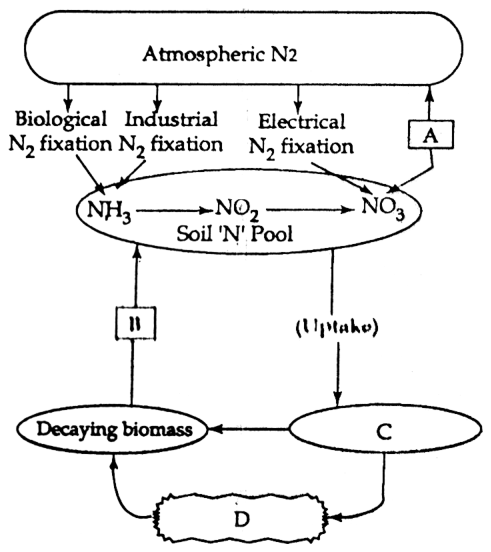
- 1A-Denitrification, B-Nitrification, C-Plants, D-Animals
- 2A-Nitrification, B-Ammonification, C-Animals, D-Plants
- 3A-Denitrification, B-Ammonification, C-Plants, D-Animals
- 4A-Nitrification, B-Denitrification, C-Animals, D-Plants
Show answer and solution
Correct: option 3, A-Denitrification, B-Ammonification, C-Plants, D-Animals
This is the nitrogen cycle. A returns nitrate of the soil to atmospheric , which is denitrification. B turns decaying biomass into ammonia, which is ammonification. C takes up nitrate from the soil, so it is plants, and D, which feeds on plants and then adds to the decaying biomass, is animals.
Question 35AIPMT 2010 Prelims, Q119
Which one of the following is not a micronutrient
- 1Magnesium
- 2Zinc
- 3Boron
- 4Molybdenum
Show answer and solution
Correct: option 1, Magnesium
Macronutrients are needed by plants in large amounts: C, H, O, N, P, K, S, Ca and Mg. Magnesium, a part of chlorophyll, is therefore a macronutrient. Zinc, boron and molybdenum are needed only in traces and are micronutrients.
Question 36AIPMT 2010 Prelims, Q146
An element playing important role in nitrogen fixation is
- 1Copper
- 2Manganese
- 3Zinc
- 4Molybdenum
Show answer and solution
Correct: option 4, Molybdenum
Nitrogenase, the enzyme that reduces atmospheric nitrogen to ammonia, is a Mo-Fe protein. Molybdenum is also part of nitrate reductase. So molybdenum is the element with a key role in nitrogen fixation and nitrogen metabolism.
Question 37AIPMT 2010 Prelims, Q182
One of the free-living anaerobic nitrogen-fixer is
- 1Rhodospirillum
- 2Rhizobium
- 3Azotobacter
- 4Beijerinckia
Show answer and solution
Correct: option 3, Azotobacter
The answer key of the source copy gives Azotobacter, which is a free-living nitrogen fixer of the soil. Note that the textbook lists Azotobacter and Beijerinckia as free-living aerobic nitrogen fixers and Rhodospirillum as the free-living anaerobic one, so Rhodospirillum is the answer that fits the word anaerobic. Rhizobium is symbiotic.
Question 38AIPMT 2009 Prelims, Q54
Manganese is required in:
- 1Plant cell wall formation
- 2Photolysis of water during photosynthesis
- 3Chlorophyll synthesis
- 4Nucleic acid synthesis
Show answer and solution
Correct: option 2, Photolysis of water during photosynthesis
Manganese is part of the water-splitting complex of photosystem II. Its best defined role is in the photolysis of water, which releases oxygen during photosynthesis.
Question 39AIPMT 2009 Prelims, Q141
Which of the following is a symbiotic nitrogen fixer?
- 1Azotobacter
- 2Frankia
- 3Azolla
- 4Glomus
Show answer and solution
Correct: option 2, Frankia
Frankia is a nitrogen-fixing actinomycete that lives in root nodules of non-legumes such as Alnus and Casuarina. Azotobacter fixes nitrogen but is free-living, Azolla is a fern (its partner Anabaena does the fixing), and Glomus is a mycorrhizal fungus that helps in phosphorus uptake.
Question 40AIPMT 2008 Prelims, Q139
Nitrogen fixation in root nodules of Alnus is brought about by
- 1Azorhizobium
- 2Bradyrhizobium
- 3Clostridium
- 4Frankia
Show answer and solution
Correct: option 4, Frankia
Frankia, a filamentous actinomycete, forms nitrogen-fixing root nodules on non-leguminous plants such as Alnus. The rhizobia nodulate legumes, and Clostridium is a free-living nitrogen fixer.
Question 41AIPMT 2007 Prelims, Q46
Which of the following is a flowering plant with nodules containing filamentous nitrogen-fixing microorganism?
- 1Cicer arietinum
- 2Casuarina equisetifolia
- 3Crotalaria juncea
- 4Cycas revoluta
Show answer and solution
Correct: option 2, Casuarina equisetifolia
The root nodules of Casuarina contain Frankia, a filamentous nitrogen-fixing actinomycete. Cicer and Crotalaria are legumes with the rod-shaped bacterium Rhizobium, and Cycas is a gymnosperm, not a flowering plant.
Question 42AIPMT 2007 Prelims, Q48
Which one of the following elements is not an essential micronutrient for plant growth?
- 1Ca
- 2Mn
- 3Zn
- 4Cu
Show answer and solution
Correct: option 1, Ca
Calcium is needed in large amounts and is a macronutrient. Manganese, zinc and copper are needed only in traces and are micronutrients.
Question 43AIPMT 2007 Prelims, Q91
A plant requires magnesium for:
- 1Cell wall development
- 2Holding cells together
- 3Protein synthesis
- 4Chlorophyll synthesis
Show answer and solution
Correct: option 4, Chlorophyll synthesis
Magnesium is the central atom of the porphyrin ring of the chlorophyll molecule, so it is needed for making chlorophyll, and its deficiency causes chlorosis. Cell wall development and holding cells together (calcium pectate of the middle lamella) are roles of calcium.
Question 44AIPMT 2006 Prelims, Q110
Farmers in a particular region were concerned that pre-mature yellowing of leaves of a pulse crop might cause decrease in the yield. Which treatment could be most beneficial to obtain maximum seed yield?
- 1Frequent irrigation of the crop
- 2Treatment of the plants with cytokinins alongwith a small dose of nitrogenous fertilizer
- 3Removal of all yellow leaves and spraying the remaining green leaves with 2,4,5-trichlorophenoxy acetic acid
- 4Application of iron and magnesium to promote synthesis of chlorophyll
Show answer and solution
Correct: option 4, Application of iron and magnesium to promote synthesis of chlorophyll
Yellowing of leaves is chlorosis, a loss of chlorophyll. Magnesium is part of the chlorophyll molecule and iron is needed for its synthesis, so supplying these two restores the green colour and photosynthesis. A pulse crop fixes its own nitrogen, so nitrogenous fertilizer is not the need, and 2,4,5-T is a herbicide.
Question 45AIPMT 2006 Prelims, Q142
Sulphur is an important nutrient for optimum growth and productivity in-
- 1Pulse crops
- 2Cereals
- 3Fibre crops
- 4Oilseed crops
Show answer and solution
Correct: option 4, Oilseed crops
Oilseed crops such as mustard and groundnut have a high sulphur requirement, as sulphur is needed for oil formation and for sulphur-containing amino acids and compounds. Their yield and oil content fall when sulphur is short.
Question 46AIPMT 2005 Prelims, Q111
The deficiencies of micronutrients, not only affects growth of plants but also vital functions such as photosynthetic and mitochondrial electron flow. Among the list given below, which group of three elements shall affect most, both photosynthetic and mitochondrial electron transport
- 1Ca, K, Na
- 2Co, Ni, Mo
- 3Mn, Co, Ca
- 4Cu, Mn, Fe
Show answer and solution
Correct: option 4, Cu, Mn, Fe
Iron is part of the cytochromes and iron-sulphur proteins of both electron transport chains, copper is part of plastocyanin in chloroplasts and cytochrome oxidase in mitochondria, and manganese is needed for the splitting of water in photosystem II. So a shortage of Cu, Mn and Fe affects electron flow the most.
Question 47AIPMT 2005 Prelims, Q116
All of the following statements concerning the Actinomycetous filamentous soil bacterium Frankia are correct EXCEPT that Frankia
- 1Forms specialized vesicles in which the nitrogenase is protected from oxygen by a chemical barrier involving triterpene hopanoids
- 2Can induce root nodules on many plant species
- 3Like Rhizobium, it usually infects its host plant through root hair deformation and stimulates cell proliferation in the host's cortex
- 4Cannot fix nitrogen in the free-living state
Show answer and solution
Correct: option 2, Can induce root nodules on many plant species
Frankia is a filamentous actinomycete that forms nitrogen-fixing root nodules on non-leguminous plants such as Alnus and Casuarina. It infects through deformed root hairs and fixes nitrogen inside vesicles whose hopanoid-rich walls keep oxygen away from nitrogenase. The answer key used for this paper gives option (2). Note that Frankia is known to fix nitrogen in the free-living state as well as in nodules, which makes statement (4) the one that is not true of it; the keyed answer is kept here as it stands in the key.
Question 48AIPMT 2004 Prelims, Q151
If by radiation all nitrogenase enzyme are inactivated, then there will be no:-
- 1Fixation of atmospheric nitrogen
- 2Conversion from nitrate to nitrite in legumes
- 3Conversion from ammonium to nitrate in soil
- 4Fixation of nitrogen in legumes
Show answer and solution
Correct: option 4, Fixation of nitrogen in legumes
Nitrogenase is the enzyme of biological nitrogen fixation: it reduces to ammonia inside the root nodules of legumes, so without it legumes fix no nitrogen. Atmospheric nitrogen can still be fixed without the enzyme, by lightning and by industry, so option (1) is not strictly true. Nitrate to nitrite needs nitrate reductase and ammonium to nitrate is done by nitrifying bacteria, neither of which uses nitrogenase.
Question 49AIPMT 2004 Prelims, Q156
The most abundant element present in the plant is:-
- 1Nitrogen
- 2Manganese
- 3Iron
- 4Carbon
Show answer and solution
Correct: option 4, Carbon
Plant dry matter is mostly carbohydrate (cellulose, starch), protein and lipid, all built on carbon skeletons, so carbon is the most abundant of the four elements listed (about 45% of dry weight). Nitrogen is only about 1 to 4%, and iron and manganese are micronutrients present in traces.
Question 50AIPMT 2003 Prelims, Q158
The major role of minor elements inside living organisms is to act as:-
- 1co-factors of enzymes
- 2Building blocks of important amino acids
- 3Constituent of hormones
- 4Binder of cell structure
Show answer and solution
Correct: option 1, co-factors of enzymes
Minor elements (micronutrients such as Zn, Mn, Cu, Mo and Fe) are needed only in traces, mainly as activators or cofactors of enzymes. Building amino acids and cell structures is the work of major elements such as C, H, O, N and S.
Question 51AIPMT 2003 Prelims, Q160
The major portion of the dry weight of plants comprises of:-
- 1Nitrogen, phosphorus and potassium
- 2Calcium, magnesium and sulphur
- 3Carbon, nitrogen and hydrogen
- 4Carbon, hydrogen and oxygen
Show answer and solution
Correct: option 4, Carbon, hydrogen and oxygen
Plant dry matter is mostly carbohydrate (cellulose, starch) and other organic compounds, so carbon, hydrogen and oxygen together make up well over 90% of the dry weight. Mineral elements form only a small part.
Question 52AIPMT 2003 Prelims, Q161
Which one of the following mineral elements plays an important role in biological nitrogen fixation:-
- 1Copper
- 2Manganese
- 3Zinc
- 4Molybdenum
Show answer and solution
Correct: option 4, Molybdenum
Nitrogenase, the enzyme that reduces to ammonia, is a Mo-Fe protein, so molybdenum is essential for biological nitrogen fixation.
Question 53AIPMT 2003 Prelims, Q168
Plants deficient of element zinc, show its effect on the biosynthesis of plant growth hormone -
- 1Auxin
- 2Cytokinin
- 3Ethylene
- 4Abscissic acid
Show answer and solution
Correct: option 1, Auxin
Zinc is required for the synthesis of tryptophan, the precursor of indole acetic acid. Zinc-deficient plants therefore make less auxin and show stunted growth with small leaves.
Question 54AIPMT 2003 Prelims, Q184
Boron in green plants assists in:-
- 1Activation of enzymes
- 2Acting of enzyme cofactor
- 3Photosynthesis
- 4Sugar transport
Show answer and solution
Correct: option 4, Sugar transport
Boron is needed for the movement of sugars through the phloem (as well as for pollen germination and cell elongation). It is not known mainly as an enzyme activator, so sugar transport is the answer.
Question 55AIPMT 2003 Prelims, Q197
Gray spots of oat are caused by deficiency of:-
- 1Cu
- 2Zn
- 3Mn
- 4Fe
Show answer and solution
Correct: option 3, Mn
Manganese deficiency in oats produces greyish-brown spots and streaks on the leaves, the disease called grey speck or grey spot of oats.
Question 56AIPMT 2002 Prelims, Q163
Choose the correct match
Bladderwort, sundew, venus flytrap:-
- 1Nepenthes, Dionaea, Drosera
- 2Nepenthes, Utricularia, Vanda
- 3Utricularia, Drosera, Dionaea
- 4Dionaea, Trapa, Vanda
Show answer and solution
Correct: option 3, Utricularia, Drosera, Dionaea
These are insectivorous plants: bladderwort is Utricularia, sundew is Drosera and Venus flytrap is Dionaea. Nepenthes is the pitcher plant, Vanda is an epiphytic orchid and Trapa is the water chestnut.
Question 57AIPMT 2001 Prelims, Q134
What is the best pH of the soil for cultivation of plants:-
- 13.4 – 5.4
- 26.5 – 7.5
- 34.5 – 8.5
- 45.5 – 6.5
Show answer and solution
Correct: option 4, 5.5 – 6.5
Most crop plants grow best in slightly acidic soil, because the mineral nutrients are most available to the roots at about pH 5.5 to 6.5. In strongly acidic or alkaline soil several nutrients become unavailable.
Question 58AIPMT 2001 Prelims, Q155
Enzyme first used for nitrogen fixation:
- 1Nitrogenase
- 2Nitroreductase
- 3Transferase
- 4Transaminase
Show answer and solution
Correct: option 1, Nitrogenase
The first step of biological nitrogen fixation is the reduction of to ammonia, and this is done by nitrogenase. Transaminases act later, when the ammonia is built into amino acids.
Question 59AIPMT 2001 Prelims, Q157
Passive absorption of minerals depend on
- 1Temperature
- 2Temperature and metabolic inhibitor
- 3Metabolic inhibitor
- 4Humidity
Show answer and solution
Correct: option 1, Temperature
Passive absorption is diffusion of ions along their gradient and uses no metabolic energy, so metabolic inhibitors do not affect it. Being a physical process, its rate still changes with temperature.
Question 60AIPMT 2001 Prelims, Q172
Element necessary for the middle lamella
- 1Ca
- 2Zn
- 3K
- 4Cu
Show answer and solution
Correct: option 1, Ca
The middle lamella that cements neighbouring plant cells is made mainly of calcium pectate (with some magnesium pectate), so calcium is needed to form it.
Question 61AIPMT 2001 Prelims, Q182
Roots of which plant contains a red pigment which have affinity for oxygen:
- 1Carrot
- 2Soyabean
- 3Mustard
- 4Radish
Show answer and solution
Correct: option 2, Soyabean
Soyabean is a legume, and its root nodules contain leghaemoglobin, a red pigment that binds oxygen and so protects nitrogenase. Carrot, mustard and radish do not form such nodules.
Question 62AIPMT 2000 Prelims, Q102
When the plants are grown in magnesium deficient but urea rich soil; the symptoms expressed are:
- 1Yellowish leaves
- 2Colourless petiole
- 3Dark green leaves
- 4Shoot apex die
Show answer and solution
Correct: option 1, Yellowish leaves
Magnesium is the central atom of the chlorophyll molecule. Even with plenty of nitrogen from urea, chlorophyll cannot be made without magnesium, so the leaves lose their green colour and turn yellow (chlorosis).
Question 63AIPMT 2000 Prelims, Q104
Plants take zinc in form of:
- 1
- 2
- 3
- 4
Show answer and solution
Correct: option 2,
Mineral elements are absorbed by roots as ions from the soil solution. Zinc is taken up as the divalent cation , not as a compound or as the free metal.
Question 64AIPMT 1999 Prelims, Q148
Nitrogen fixing bacteria converts:
- 1
- 2 Nitrates
- 3
- 4
Show answer and solution
Correct: option 1,
Nitrogen fixation is the reduction of atmospheric to ammonia by the enzyme nitrogenase. Options (2) and (3) are steps of nitrification, and option (4) is denitrification.
Question 65AIPMT 1999 Prelims, Q160
Insectivorous plants grow in the soil which is deficient in:
- 1Mg
- 2Ca
- 3P
- 4N
Show answer and solution
Correct: option 4, N
Insectivorous plants are green and make their own carbohydrates, but they grow in waterlogged or marshy soils that are poor in nitrogen. They trap and digest insects to obtain the nitrogen they lack.
Question 66AIPMT 1999 Prelims, Q161
Which pair is of insectivorous plants:
- 1Drosera and Vallisneria
- 2Utricularia and Hydrilla
- 3Aldrovanda and Utricularia
- 4Rafflesia and Dionaea
Show answer and solution
Correct: option 3, Aldrovanda and Utricularia
Aldrovanda (waterwheel plant) and Utricularia (bladderwort) are both insectivorous. In the other pairs only one member is: Drosera and Dionaea are insectivorous, but Vallisneria and Hydrilla are ordinary submerged hydrophytes and Rafflesia is a total root parasite.