Questions with solutions
Question 1NEET 2026, Q155
The WBC count of a person's blood sample is 8000/cu.mm. How many eosinophils and lymphocytes would be in the same blood sample approximately?
- 1160 – 240/cu.mm and 1600 – 2000/cu.mm, respectively
- 2100 – 120/cu.mm and 160 – 200/cu.mm, respectively
- 3300 – 500/cu.mm and 500 – 700/cu.mm, respectively
- 4300 – 500/cu.mm and 1200 – 1500/cu.mm, respectively
Show answer and solution
Correct: option 1, 160 – 240/cu.mm and 1600 – 2000/cu.mm, respectively
Eosinophils are 2 to 3 per cent of the WBCs and lymphocytes are 20 to 25 per cent. Of 8000 cells that is to eosinophils and to lymphocytes per cu.mm.
Question 2NEET 2026, Q167
Select the incorrect statements with reference to Rh grouping.
A. Erythroblastosis foetalis is a condition observed having foetus with blood and mother with blood.
B. Rh antigen is observed on RBCs in the majority of human beings.
C. Before blood transfusion, Rh group should also be matched.
D. Rh incompatibility is observed when a pregnant mother is and the foetus is .
E. Erythroblastosis foetalis can be avoided by administering anti-Rh antibodies to the mother immediately after the delivery of the second child.
Choose the answer from the options given below:
- 1A and E only
- 2A and B only
- 3B and C only
- 4C and D only
Show answer and solution
Correct: option 1, A and E only
Erythroblastosis foetalis arises when the mother is and the foetus is , so A states it the wrong way round. It is prevented by giving anti-Rh antibodies to the mother immediately after the delivery of the first child, not the second, so E is also incorrect. B, C and D are true: about 80 per cent of humans are Rh positive, Rh group is matched before transfusion, and D gives the correct incompatible pair.
Question 3NEET 2026 Re-exam, Q115
The number of action potentials generated by sino-arterial node (SAN) in a healthy human is ________ per minute.
- 128 - 30
- 270 - 75
- 3100 - 110
- 4120 - 140
Show answer and solution
Correct: option 2, 70 - 75
The SA node is the pacemaker of the heart and sets the heartbeat by generating the largest number of action potentials, 70 to 75 per minute. This is why the normal heart rate is about 72 beats per minute.
Question 4NEET 2026 Re-exam, Q117
Which of the following statements is incorrect?
- 1Blood coagulates in response to an injury
- 2Blood clot consists of fibrins
- 3Fibrin is produced from fibrinogen
- 4Fibrinogen is produced from fibrin
Show answer and solution
Correct: option 4, Fibrinogen is produced from fibrin
Blood clots in response to injury. The clot is a network of fibrin threads, and fibrin is formed from the inactive plasma protein fibrinogen by the enzyme thrombin. The change runs from fibrinogen to fibrin, never the other way, so statement (4) is the incorrect one.
Question 5NEET 2026 Re-exam, Q149
The opening between the right atrium and the right ventricle is guarded by __________.
- 1bicuspid valve
- 2tricuspid valve
- 3semilunar valve
- 4sino-atrial node
Show answer and solution
Correct: option 2, tricuspid valve
The right atrio-ventricular opening is guarded by a valve of three flaps, the tricuspid valve. The bicuspid (mitral) valve is on the left side, semilunar valves guard the openings into the arteries, and the sino-atrial node is the pacemaker, not a valve.
Question 6NEET 2025, Q112
Cardiac activities of the heart are regulated by:
A. Nodal tissue
B. A special neural centre in the medulla oblongata
C. Adrenal medullary hormones
D. Adrenal cortical hormones
Choose the correct answer from the options given below:
- 1A, B and C Only
- 2A, B, C and D
- 3A, C and D Only
- 4A, B and D Only
Show answer and solution
Correct: option 1, A, B and C Only
The heart beat is started and kept going by the nodal tissue (A), which is why the heart is myogenic. A centre in the medulla oblongata changes the rate through the autonomic nervous system (B), and adrenal medullary hormones, adrenaline and noradrenaline, raise the cardiac output (C). Adrenal cortical hormones are not listed among the regulators of cardiac activity. So A, B and C only.
Question 7NEET 2024, Q154
Following are the stages of pathway for conduction of an action potential through the heart:
A. AV bundle
B. Purkinje fibres
C. AV node
D. Bundle branches
E. SA node
Choose the correct sequence of pathway from the options given below:
- 1E-A-D-B-C
- 2E-C-A-D-B
- 3A-E-C-B-D
- 4B-D-E-C-A
Show answer and solution
Correct: option 2, E-C-A-D-B
The impulse starts in the SA node (the pacemaker), reaches the AV node, passes down the AV bundle (bundle of His), then its right and left bundle branches, and finally spreads through the Purkinje fibres in the ventricular wall. The order is E-C-A-D-B.
Question 8NEET 2024, Q191
Match List I with List II:
| List I | List II |
|---|
| A. P wave | I. Heart muscles are electrically silent. |
| B. QRS complex | II. Depolarisation of ventricles. |
| C. T wave | III. Depolarisation of atria. |
| D. T-P gap | IV. Repolarisation of ventricles. |
Choose the correct answer from the options given below:
- 1A-IV, B-II, C-I, D-III
- 2A-I, B-III, C-IV, D-II
- 3A-III, B-II, C-IV, D-I
- 4A-II, B-III, C-I, D-IV
Show answer and solution
Correct: option 3, A-III, B-II, C-IV, D-I
In an ECG the P wave is the depolarisation of the atria, the QRS complex is the depolarisation of the ventricles, and the T wave is the repolarisation of the ventricles. Between the end of T and the next P there is no electrical activity in the heart muscle. So A-III, B-II, C-IV, D-I.
Question 9NEET 2024 Re-exam, Q156
A person with blood group can receive the blood transfusion from which of the following types?
A.
B.
C.
D.
E.
Choose the correct answer from the options given below:
- 1D and E only
- 2D only
- 3A and B only
- 4C and D only
Show answer and solution
Correct: option 4, C and D only
A person of group A has anti-B antibodies in the plasma, so blood that carries the B antigen (groups B and AB) cannot be given. An Rh-negative person must also not receive Rh-positive blood, because it would lead to anti-Rh antibodies. That leaves A Rh-negative (the same group) and O Rh-negative (no A, B or Rh antigen), which are C and D.
Question 10NEET 2024 Re-exam, Q185
‘Lub’ sound of Heart is caused by the___________.
- 1closure of the semilunar valves
- 2opening of tricuspid and bicuspid valves
- 3opening of the semilunar valves
- 4closure of the tricuspid and bicuspid valves
Show answer and solution
Correct: option 4, closure of the tricuspid and bicuspid valves
The first heart sound, lub, is made when the tricuspid and bicuspid valves close at the start of ventricular systole. The second sound, dub, is made when the semilunar valves close. The opening of valves makes no sound.
Question 11NEET 2023, Q174
Match List I with List II.
| List I | List II |
|---|
| A. P-wave | I. Beginning of systole |
| B. Q-wave | II. Repolarisation of ventricles |
| C. QRS complex | III. Depolarisation of atria |
| D. T-wave | IV. Depolarisation of ventricles |
Choose the correct answer from the options given below:
- 1A-III, B-I, C-IV, D-II
- 2A-IV, B-III, C-II, D-I
- 3A-II, B-IV, C-I, D-III
- 4A-I, B-II, C-III, D-IV
Show answer and solution
Correct: option 1, A-III, B-I, C-IV, D-II
In an ECG the P-wave is the depolarisation of the atria (III). The QRS complex is the depolarisation of the ventricles (IV), and ventricular systole begins shortly after the Q-wave, so the Q-wave marks the beginning of systole (I). The T-wave is the repolarisation of the ventricles (II). This is option (1).
Question 12NEET 2023, Q200
Which of the following statements are correct?
A. Basophils are most abundant cells of the total WBCs
B. Basophils secrete histamine, serotonin and heparin
C. Basophils are involved in inflammatory response
D. Basophils have kidney shaped nucleus
E. Basophils are agranulocytes
Choose the correct answer from the options given below:
- 1D and E only
- 2C and E only
- 3B and C only
- 4A and B only
Show answer and solution
Correct: option 3, B and C only
Basophils are the least abundant white blood cells (0.5 to 1 per cent); neutrophils are the most abundant, so A is wrong. They secrete histamine, serotonin and heparin and take part in inflammatory reactions, so B and C are correct. A kidney-shaped nucleus belongs to monocytes, and basophils are granulocytes, so D and E are wrong. This is option (3).
Question 13NEET 2023 Manipur, Q168
Match List-I with List-II
| List-I (ECG) | List-II (Electrical activity of heart) |
|---|
| (A) P-wave | (I) Depolarisation of ventricles |
| (B) QRS complex | (II) End of systole |
| (C) T wave | (III) Depolarisation of atria |
| (D) End of T wave | (IV) Repolarisation of ventricles |
Choose the correct answer from the options given below:
- 1A-IV, B-III, C-I, D-II
- 2A-III, B-I, C-IV, D-II
- 3A-IV, B-I, C-III, D-II
- 4A-I, B-IV, C-III, D-II
Show answer and solution
Correct: option 2, A-III, B-I, C-IV, D-II
In an ECG the P-wave is the depolarisation of the atria, the QRS complex is the depolarisation of the ventricles, the T wave is the repolarisation of the ventricles and the end of the T wave marks the end of systole. So A-III, B-I, C-IV, D-II.
Question 14NEET 2023 Manipur, Q171
Match List - I with List - II.
| List - I | List - II |
|---|
| (A) Eosinophils | (I) 6 - 8% |
| (B) Lymphocytes | (II) 2 - 3% |
| (C) Neutrophils | (III) 20 - 25% |
| (D) Monocytes | (IV) 60 - 65% |
Choose the correct answer from the options given below:
- 1A-II, B-III, C-IV, D-I
- 2A-II, B-III, C-I, D-IV
- 3A-IV, B-I, C-II, D-III
- 4A-IV, B-I, C-III, D-II
Show answer and solution
Correct: option 1, A-II, B-III, C-IV, D-I
Of the total white blood cells, neutrophils are the most abundant at 60-65%, lymphocytes are 20-25%, monocytes 6-8% and eosinophils 2-3%. So A-II, B-III, C-IV, D-I.
Question 15NEET 2022, Q153
Given below are two statements:
Statement I: The coagulum is formed of network of threads called thrombins.
Statement II: Spleen is the graveyard of erythrocytes.
In the light of the above statements, choose the most appropriate answer from the options given below:
- 1Statement I is incorrect but Statement II is correct
- 2Both Statement I and Statement II are correct
- 3Both Statement I and Statement II are incorrect
- 4Statement I is correct but Statement II is incorrect
Show answer and solution
Correct: option 1, Statement I is incorrect but Statement II is correct
The threads of a clot are fibrins; thrombin is the enzyme that converts fibrinogen into fibrin, so Statement I is incorrect. Worn-out red blood cells are destroyed in the spleen, which is therefore called the graveyard of RBCs, so Statement II is correct.
Question 16NEET 2022, Q189
Which one of the following statements is correct?
- 1Increased ventricular pressure causes closing of the semilunar valves.
- 2The atrio-ventricular node (AVN) generates an action potential to stimulate atrial contraction
- 3The tricuspid and the bicuspid valves open due to the pressure exerted by the simultaneous contraction of the atria
- 4Blood moves freely from atrium to the ventricle during joint diastole.
Show answer and solution
Correct: option 4, Blood moves freely from atrium to the ventricle during joint diastole.
In joint diastole all four chambers are relaxed, the tricuspid and bicuspid valves are open and blood flows freely from the atria into the ventricles. Increased ventricular pressure opens the semilunar valves, the action potential for atrial contraction comes from the SA node, and the AV valves open because ventricular pressure falls, not because the atria contract.
Question 17NEET 2022 Re-exam, Q180
A unique vascular connection between the digestive tract and liver is called______.
- 1Hepato-cystic system
- 2Hepato-pancreatic system
- 3Hepatic portal system
- 4Renal portal system
Show answer and solution
Correct: option 3, Hepatic portal system
The hepatic portal vein carries blood from the intestine to the liver before it reaches the systemic circulation. This connection is the hepatic portal system.
Question 18NEET 2022 Re-exam, Q188
Arrange the following formed elements in the decreasing order of their abundance in blood in humans:
(a) Platelets
(b) Neutrophils
(c) Erythrocytes
(d) Eosinophils
(e) Monocytes
Choose the most appropriate answer from the options given below:
- 1(a), (c), (b), (d), (e)
- 2(c), (a), (b), (e), (d)
- 3(c), (b), (a), (e), (d)
- 4(d), (e), (b), (a), (c)
Show answer and solution
Correct: option 2, (c), (a), (b), (e), (d)
Erythrocytes are the most abundant (about 5 million per cubic mm), then platelets (1.5 to 3.5 lakh per cubic mm). Among the leucocytes (6000 to 8000 per cubic mm), neutrophils are 60-65%, monocytes 6-8% and eosinophils 2-3%. So the order is (c), (a), (b), (e), (d).
Question 19NEET 2021, Q174
Persons with ‘AB’ blood group are called as “Universal recipients”. This is due to:
- 1Absence of antigens A and B on the surface of RBCs
- 2Absence of antigens A and B in plasma
- 3Presence of antibodies, anti-A and anti-B, on RBCs
- 4Absence of antibodies, anti-A and anti-B, in plasma
Show answer and solution
Correct: option 4, Absence of antibodies, anti-A and anti-B, in plasma
A person of group AB has both antigens A and B on the RBCs and neither anti-A nor anti-B antibodies in the plasma. With no antibodies to attack donor cells, such a person can receive blood of any ABO group.
Question 20NEET 2021, Q178
Which enzyme is responsible for the conversion of inactive fibrinogens to fibrins?
- 1Thrombin
- 2Renin
- 3Epinephrine
- 4Thrombokinase
Show answer and solution
Correct: option 1, Thrombin
In clotting, thrombin converts the inactive fibrinogen of plasma into fibrin threads. Thrombokinase acts one step earlier, converting prothrombin into thrombin.
Question 21NEET 2020, Q81
The QRS complex in a standard ECG represents:
- 1Repolarisation of auricles
- 2Depolarisation of auricles
- 3Depolarisation of ventricles
- 4Repolarisation of ventricles
Show answer and solution
Correct: option 3, Depolarisation of ventricles
In an ECG the P wave shows depolarisation of the atria, the QRS complex shows depolarisation of the ventricles (which starts ventricular contraction), and the T wave shows repolarisation of the ventricles.
Question 22NEET 2020, Q99
Match the following columns and select the correct option.
| Column - I | Column - II |
|---|
| (a) Eosinophils | (i) Immune response |
| (b) Basophils | (ii) Phagocytosis |
| (c) Neutrophils | (iii) Release histaminase, destructive enzymes |
| (d) Lymphocytes | (iv) Release granules containing histamine |
- 1a-iii, b-iv, c-ii, d-i
- 2a-iv, b-i, c-ii, d-iii
- 3a-i, b-ii, c-iv, d-iii
- 4a-ii, b-i, c-iii, d-iv
Show answer and solution
Correct: option 1, a-iii, b-iv, c-ii, d-i
Eosinophils release histaminase and destructive enzymes (iii). Basophils release granules containing histamine (iv). Neutrophils are phagocytic cells (ii). Lymphocytes carry out the immune response (i). This is a-iii, b-iv, c-ii, d-i.
Question 23NEET 2020 Phase 2, Q77
Which of the following is associated with decrease in cardiac output?
- 1Parasympathetic neural signals
- 2Pneumotaxic centre
- 3Adrenal medullary hormones
- 4Sympathetic nerves
Show answer and solution
Correct: option 1, Parasympathetic neural signals
Parasympathetic signals slow the heart beat and the conduction of the action potential, so the cardiac output falls. Sympathetic nerves and the hormones of the adrenal medulla do the opposite and raise the cardiac output. The pneumotaxic centre controls breathing, not the heart.
Question 24NEET 2020 Phase 2, Q82
Which of the following conditions cause erythroblastosis foetalis?
- 1Mother and foetus
- 2Both mother and foetus
- 3Both mother and foetus
- 4Mother and foetus
Show answer and solution
Correct: option 1, Mother and foetus
An Rh negative mother carrying an Rh positive foetus is exposed to the foetal Rh antigen during the delivery of the first child and starts making antibodies against it. In a later pregnancy these antibodies cross the placenta and destroy the red blood cells of an Rh positive foetus. This is erythroblastosis foetalis.
Question 25NEET 2019, Q105
Match the Column - I with Column - II:
| Column - I | | Column - II |
|---|
| (a) | P-wave | (i) | Depolarisation of ventricles |
| (b) | QRS complex | (ii) | Repolarisation of ventricles |
| (c) | T-wave | (iii) | Coronary ischemia |
| (d) | Reduction in the size of T-wave | (iv) | Depolarisation of atria |
| | (v) | Repolarisation of atria |
Select the correct option.
- 1a-iv, b-i, c-ii, d-iii
- 2a-iv, b-i, c-ii, d-v
- 3a-ii, b-i, c-v, d-iii
- 4a-ii, b-iii, c-v, d-iv
Show answer and solution
Correct: option 1, a-iv, b-i, c-ii, d-iii
In an ECG the P-wave shows depolarisation of the atria (iv), the QRS complex shows depolarisation of the ventricles (i) and the T-wave shows repolarisation of the ventricles (ii). A reduced T-wave means the heart muscle is getting too little oxygen, as in coronary ischemia (iii). So a-iv, b-i, c-ii, d-iii.
Question 26NEET 2019, Q130
What would be the heart rate of a person if the cardiac output is 5 L, blood volume in the ventricles at the end of diastole is 100 mL and at the end of ventricular systole is 50 mL?
- 150 beats per minute
- 275 beats per minute
- 3100 beats per minute
- 4125 beats per minute
Show answer and solution
Correct: option 3, 100 beats per minute
Stroke volume = end-diastolic volume end-systolic volume mL. Cardiac output = stroke volume heart rate, so heart rate beats per minute.
Question 27NEET 2019 Odisha, Q103
All the components of the nodal tissue are autoexcitable. Why does the SA node act as the normal pacemaker?
- 1Only SA node can convey the action potential to the other components.
- 2SA node has the highest rate of depolarisation.
- 3SA node has the lowest rate of depolarisation.
- 4SA node is the only component to generate the threshold potential.
Show answer and solution
Correct: option 2, SA node has the highest rate of depolarisation.
Every part of the nodal tissue can generate action potentials by itself, but the SA node does so at the highest rate, about 70 to 75 per minute. Its impulse reaches the other parts before they fire on their own, so the SA node sets the rhythm of the whole heart.
Question 28NEET 2019 Odisha, Q104
A specialised nodal tissue embedded in the lower corner of the right atrium, close to Atrio-ventricular septum, delays the spreading of impulses to heart apex for about 0.1 sec. This delay allows -
- 1blood to enter pulmonary arteries.
- 2the atria to empty completely.
- 3blood to enter aorta.
- 4the ventricles to empty completely.
Show answer and solution
Correct: option 2, the atria to empty completely.
The tissue described is the AV node. The short delay there holds back ventricular excitation until the atria have finished contracting, so the atria empty completely into the ventricles before the ventricles start to contract. Blood enters the aorta and pulmonary arteries only later, during ventricular systole.
Question 29NEET 2018, Q137
Match the items given in Column I with those in Column II and select the correct option given below :
| Column I | | Column II |
|---|
| a. | Tricuspid valve | i. | Between left atrium and left ventricle |
| b. | Bicuspid valve | ii. | Between right ventricle and pulmonary artery |
| c. | Semilunar valve | iii. | Between right atrium and right ventricle |
- 1a-i, b-ii, c-iii
- 2a-i, b-iii, c-ii
- 3a-iii, b-i, c-ii
- 4a-ii, b-i, c-iii
Show answer and solution
Correct: option 3, a-iii, b-i, c-ii
The tricuspid valve guards the opening between the right atrium and right ventricle (iii). The bicuspid (mitral) valve lies between the left atrium and left ventricle (i). Semilunar valves guard the openings of the ventricles into the pulmonary artery and aorta, so of the choices given it is between the right ventricle and pulmonary artery (ii).
Question 30NEET 2018, Q166
Match the items given in Column I with those in Column II and select the correct option given below :
| Column I | | Column II |
|---|
| a. | Fibrinogen | i. | Osmotic balance |
| b. | Globulin | ii. | Blood clotting |
| c. | Albumin | iii. | Defence mechanism |
- 1a-i, b-iii, c-ii
- 2a-i, b-ii, c-iii
- 3a-iii, b-ii, c-i
- 4a-ii, b-iii, c-i
Show answer and solution
Correct: option 4, a-ii, b-iii, c-i
Among the plasma proteins, fibrinogen is needed for clotting of blood (ii), globulins are mainly involved in the defence mechanisms of the body (iii), and albumins help maintain osmotic balance (i).
Question 31NEET 2017, Q98
Adult human RBCs are enucleate. Which of the following statement(s) is/are most appropriate explanation for this feature?
(a) They do not need to reproduce
(b) They are somatic cells
(c) They do not metabolize
(d) All their internal space is available for oxygen transport
- 1Only (d)
- 2Only (a)
- 3(a), (c) and (d)
- 4(b) and (c)
Show answer and solution
Correct: option 3, (a), (c) and (d)
The official key gives (a), (c) and (d). Losing the nucleus leaves the whole cell free to be packed with haemoglobin for oxygen transport (d), and a mature RBC does not divide, so it has no need of a nucleus for reproduction (a). The key also accepts (c), although mature RBCs do carry out some metabolism (anaerobic glycolysis), which is why many texts treat (d) alone as the best explanation. Being a somatic cell (b) explains nothing, since most somatic cells have a nucleus.
Question 32NEET 2017, Q99
The hepatic portal vein drains blood to liver from
- 1Heart
- 2Stomach
- 3Kidneys
- 4Intestine
Show answer and solution
Correct: option 4, Intestine
The hepatic portal vein carries nutrient-rich blood from the intestine to the liver before it reaches the general circulation. This is the hepatic portal system.
Question 33NEET 2017, Q137
Frog's heart when taken out of the body continues to beat for sometime.
Select the best option from the following statements.
(a) Frog is a poikilotherm.
(b) Frog does not have any coronary circulation.
(c) Heart is "myogenic" in nature.
(d) Heart is autoexcitable.
Options:
- 1Only (c)
- 2Only (d)
- 3(a) and (b)
- 4(c) and (d)
Show answer and solution
Correct: option 4, (c) and (d)
The frog's heart is myogenic: the beat starts in its own muscle (the nodal tissue), not from a nerve, which means it is autoexcitable. That is why it keeps beating for a while outside the body, so (c) and (d) both explain it. Being a poikilotherm or lacking coronary circulation does not make a heart beat on its own.
Question 34NEET 2016 Phase 1, Q161
Blood pressure in the pulmonary artery is:
- 1same as that in the aorta.
- 2more than that in the carotid.
- 3more than that in the pulmonary vein.
- 4less than that in the venae cavae.
Show answer and solution
Correct: option 3, more than that in the pulmonary vein.
Blood flows from higher to lower pressure: the right ventricle pumps it into the pulmonary artery, through the lung capillaries, and it returns through the pulmonary veins, so the pressure in the pulmonary artery is higher than in the pulmonary vein. It is much lower than in the aorta and the carotid artery, which belong to the high-pressure systemic circuit, and higher than in the venae cavae.
Question 35NEET 2016 Phase 2, Q152
Name the blood cells, whose reduction in number can cause clotting disorder, leading to excessive loss of blood from the body.
- 1Erythrocytes
- 2Leucocytes
- 3Neutrophils
- 4Thrombocytes
Show answer and solution
Correct: option 4, Thrombocytes
Thrombocytes (blood platelets) release the substances that start blood coagulation. A fall in their number slows clotting and leads to excessive bleeding.
Question 36NEET 2016 Phase 2, Q155
Serum differs from blood in
- 1lacking globulins
- 2lacking albumins
- 3lacking clotting factors
- 4lacking antibodies
Show answer and solution
Correct: option 3, lacking clotting factors
Serum is the fluid left after blood has clotted, so it is plasma without the clotting factors such as fibrinogen. It still contains albumins, globulins and antibodies.
Question 37AIPMT 2015, Q72
Which one of the following is correct?
- 1Serum = Blood + Fibrinogen
- 2Lymph = Plasma + RBC + WBC
- 3Blood = Plasma + RBC + WBC
- 4Plasma = Blood – Lymphocytes
Show answer and solution
Correct: option 3, Blood = Plasma + RBC + WBC
Blood is made of plasma and the formed elements (RBC, WBC and platelets), so the third relation is the correct one among those given. Serum is plasma without the clotting factors, lymph has no RBC, and plasma is blood without all of its formed elements, not just the lymphocytes.
Question 38AIPMT 2015, Q107
Erythropoiesis starts in:
- 1Liver
- 2Spleen
- 3Red bone marrow
- 4Kidney
Show answer and solution
Correct: option 3, Red bone marrow
Erythropoiesis is the formation of red blood cells. In the adult they are formed in the red bone marrow, which is the keyed answer. Note that in the foetus red cell formation begins earlier, in the yolk sac and then the liver and spleen, so the word "starts" can also be read as pointing to the liver; another unofficial key for this paper gives option (1).
Question 39AIPMT 2015, Q109
Blood pressure in the mammalian aorta is maximum during:
- 1Diastole of the right ventricle
- 2Systole of the left ventricle
- 3Diastole of the right atrium
- 4Systole of the left atrium
Show answer and solution
Correct: option 2, Systole of the left ventricle
The left ventricle pumps blood into the aorta. When it contracts, blood is forced into the aorta and the pressure there reaches its peak (systolic pressure).
Question 40AIPMT 2015 Re-test, Q49
Which one of the following animals has two separate circulatory pathways?
- 1Shark
- 2Frog
- 3Lizard
- 4Whale
Show answer and solution
Correct: option 4, Whale
Complete double circulation, with fully separate pulmonary and systemic pathways, needs a four-chambered heart, which is found in birds and mammals. The whale is a mammal. A shark has single circulation, and the frog and lizard have a three-chambered heart with mixing of blood (incomplete double circulation).
Question 41AIPMT 2015 Re-test, Q121
Doctors use stethoscope to hear the sounds produced during each cardiac cycle. The second sound is heard when:
- 1AV node receives signal from SA node
- 2AV valves open up
- 3Ventricular walls vibrate due to gushing in of blood from atria
- 4Semilunar valves close down after the blood flows into vessels from ventricles
Show answer and solution
Correct: option 4, Semilunar valves close down after the blood flows into vessels from ventricles
The first heart sound (lub) is made by the closing of the tricuspid and bicuspid valves at the start of ventricular systole. The second sound (dub) is made by the closing of the semilunar valves at the end of ventricular systole, after blood has been pushed into the aorta and the pulmonary artery.
Question 42AIPMT 2014, Q13
How do parasympathetic neural signals affect the working of the heart?
- 1Heart rate decreases but cardiac output increases.
- 2Reduce both heart rate and cardiac output.
- 3Heart rate is increased without affecting the cardiac output.
- 4Both heart rate and cardiac output increase.
Show answer and solution
Correct: option 2, Reduce both heart rate and cardiac output.
Parasympathetic signals decrease the rate of heart beat and the speed of conduction of the action potential, and so the cardiac output falls as well. Sympathetic signals do the opposite.
Question 43AIPMT 2014, Q19
Person with blood group AB is considered as universal recipient because he has:
- 1both A and B antigens in the plasma but no antibodies.
- 2both A and B antigens on RBC but no antibodies in the plasma.
- 3both A and B antibodies in the plasma.
- 4no antigen on RBC and no antibody in the plasma.
Show answer and solution
Correct: option 2, both A and B antigens on RBC but no antibodies in the plasma.
A person of group AB has antigens A and B on the red blood cells and neither anti-A nor anti-B antibodies in the plasma. With no antibodies to attack donor cells, such a person can receive blood of any group.
Question 44NEET 2013, Q70
The diagram given here is the standard ECG of a normal person. The P-wave represents the:
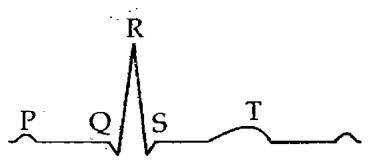
- 1Initiation of the ventricular contraction
- 2Beginning of the systole
- 3End of systole
- 4Contraction of both the atria
Show answer and solution
Correct: option 4, Contraction of both the atria
The P-wave is the electrical excitation (depolarisation) of the atria, which leads to the contraction of both atria. The QRS complex marks the depolarisation of the ventricles and the start of ventricular contraction, and the end of the T-wave marks the end of systole.
Question 45NEET 2013, Q114
Figure shows schematic plan of blood circulation in humans with labels A to D. Identify the label and give its function/s.
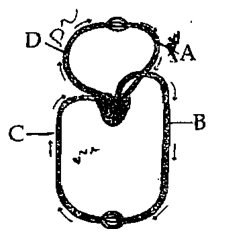
- 1B - Pulmonary artery - takes blood from heart to lungs,
- 2C - Vena Cava - takes blood from body parts to right auricle,
- 3D - Dorsal aorta - takes blood from heart to body parts,
- 4A - Pulmonary vein - takes impure blood from body parts,
Show answer and solution
Correct: option 2, C - Vena Cava - takes blood from body parts to right auricle,
The upper loop is the pulmonary circulation and the lower loop the systemic circulation. C is the vena cava, which returns deoxygenated blood from the body to the right auricle; this blood has a of about 45 mm Hg, so (2) is correct. D is the pulmonary artery and A the pulmonary vein (which carries oxygenated blood from the lungs), and B is the dorsal aorta.
Question 46NEET 2013 Karnataka, Q46
Figure shows blood circulation in humans with labels A to D. Select the option which gives correct identification of label and functions of the part:-
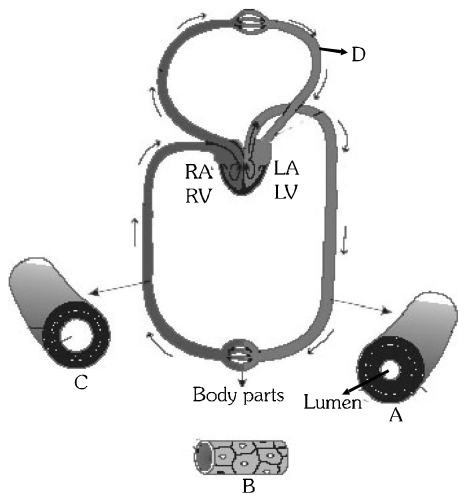
- 1B - Capillary - thin without muscle layers and wall two cell thick
- 2C - Vein - thin walled and blood flows in jerks/spurts
- 3D - Pulmonary vein - takes oxygenated blood to heart
- 4A - Artery - thick walled and blood flows evenly
Show answer and solution
Correct: option 3, D - Pulmonary vein - takes oxygenated blood to heart
D is the vessel leaving the lung loop and entering the left atrium, so it is a pulmonary vein carrying oxygenated blood at a partial pressure of oxygen of about 95 mm Hg. A capillary wall is only one cell thick, blood in a vein flows evenly and not in spurts, and blood in an artery flows in spurts, so the other options fail.
Question 47NEET 2013 Karnataka, Q57
The figure shows a human blood cell. Identify it and give its characteristics:-
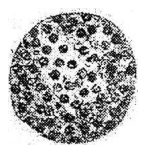
Blood cell - Characteristics
- 1Basophil - Secrete serotonin, inflammatory response
- 2B-lymphocyte - form about 20% of blood cells involved in immune response
- 3Neutrophil - Most abundant blood cell, phagocytic
- 4Monocyte - Life span 3 days, produce antibodies
Show answer and solution
Correct: option 1, Basophil - Secrete serotonin, inflammatory response
The cell is packed with coarse granules that hide the nucleus, which is how a basophil looks. Basophils secrete histamine, serotonin and heparin and take part in inflammatory reactions. Lymphocytes and monocytes are agranulocytes, and neutrophils are the most abundant white cells, not the most abundant blood cells.
Question 48AIPMT 2012 Prelims, Q73
A certain road accident patient with unknown blood group needs immediate blood transfusion. His one doctor friend at once offers his blood. What was the blood group of the donor?
- 1Blood group B
- 2Blood group AB
- 3Blood group O
- 4Blood group A
Show answer and solution
Correct: option 3, Blood group O
Red cells of group O carry neither antigen A nor antigen B, so they are not clumped by the antibodies of any recipient. A person of group O is a universal donor and can give blood when the patient's group is not known.
Question 49AIPMT 2012 Mains, Q109
Which one of the following human organs is often called the "graveyard" of RBCs?
- 1Gall bladder
- 2Kidney
- 3Spleen
- 4Liver
Show answer and solution
Correct: option 3, Spleen
Red blood cells live for about 120 days, after which the worn-out cells are destroyed in the spleen. For this reason the spleen is called the graveyard of RBCs.
Question 50AIPMT 2011 Prelims, Q77
'Bundle of His' is a part of which one of the following organs in humans
- 1Brain
- 2Heart
- 3Kidney
- 4Pancreas
Show answer and solution
Correct: option 2, Heart
The bundle of His is the atrioventricular bundle of nodal fibres that runs from the AV node through the interventricular septum and carries the impulse to the ventricles of the heart.
Question 51AIPMT 2011 Prelims, Q87
Which one of the following plasma proteins is involved in the coagulation of blood?
- 1an albumin
- 2serum amylase
- 3a globulin
- 4Fibrinogen
Show answer and solution
Correct: option 4, Fibrinogen
During clotting thrombin converts the soluble plasma protein fibrinogen into insoluble fibrin threads, which form the clot. Albumins maintain osmotic balance and globulins are mainly involved in defence.
Question 52AIPMT 2011 Prelims, Q110
Arteries are best defined as the vessels which:
- 1supply oxygenated blood to the different organs
- 2break up into capillaries which reunite to form one visceral organ
- 3break up into capillaries which reunite to form a vein
- 4carry blood from one visceral organ to another visceral organ
Show answer and solution
Correct: option 2, break up into capillaries which reunite to form one visceral organ
The source key marks option (2). An artery is a vessel that carries blood away from the heart and breaks up into capillaries in an organ; these capillaries then reunite into a venule and a vein. Option (1) fails because the pulmonary artery carries deoxygenated blood, and option (4) describes a portal vessel. Option (2) as printed in this copy does not read as a clear statement (capillaries reunite into a vein, not an organ), so treat this question with care.
Question 53AIPMT 2011 Prelims, Q127
Which one of the following statements is correct regarding blood pressure:
- 1130/90 mmHg is considered high and requires treatment
- 2100/55 mmHg is considered an ideal blood pressure
- 3105/50 mmHg makes one very active
- 4190/110 mmHg may harm vital organs like brain and kidney
Show answer and solution
Correct: option 4, 190/110 mmHg may harm vital organs like brain and kidney
Normal blood pressure is about 120/80 mmHg, and a sustained reading of 140/90 mmHg or more is hypertension. A pressure as high as 190/110 mmHg can lead to heart disease and damage vital organs such as the brain and kidneys.
Question 54AIPMT 2011 Prelims, Q149
A person with unknown blood group under ABO system, has suffered much blood loss in an accident and needs immediate blood transfusion. His one friend who has a valid certificate of his own blood type, offers blood donation without delay. What would have been the type of blood group of the donor friend.
- 1Type B
- 2Type AB
- 3Type O
- 4Type A
Show answer and solution
Correct: option 3, Type O
Blood can be given without knowing the recipient's group only if the donor's red cells carry neither antigen A nor antigen B, so that no antibody in the recipient's plasma can clump them. That is group O, the universal donor.
Question 55AIPMT 2011 Mains, Q62
Given below is the ECG of a normal human. Which one of its components is correctly interpreted below
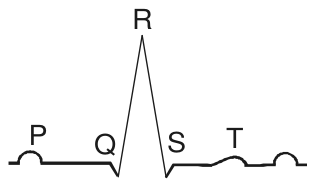
- 1Complex QRS-One complete Pulse
- 2Peak T - Initiation of total cardiac contraction
- 3Peak P and Peak R together - systolic and diastolic blood pressures
- 4Peak P- Initiation of left atrial contraction only
Show answer and solution
Correct: option 3, Peak P and Peak R together - systolic and diastolic blood pressures
The answer key used for this paper gives option (3). In an ECG the P wave marks the depolarisation of both atria, which starts atrial contraction; the QRS complex marks the depolarisation of the ventricles, which starts ventricular systole; and the T wave marks ventricular repolarisation. An ECG records electrical activity and does not measure blood pressure, so the keyed option is doubtful. Since one QRS complex occurs with every ventricular beat, and each beat gives one pulse, many textbooks prefer option (1).
Question 56AIPMT 2010 Mains, Q80
Fastest distribution of some injectable material / medicine and with no risk of any kind can be achieved by injecting it into the
- 1Lymph vessels
- 2Muscles
- 3Arteries
- 4Veins
Show answer and solution
Correct: option 4, Veins
A substance injected into a vein goes straight to the heart and is pumped to the whole body within moments. Veins lie near the surface and carry blood at low pressure, so the injection is safe. Arteries are deep and under high pressure, and muscles and lymph vessels pass the material on slowly.
Question 57AIPMT 2010 Mains, Q87
The haemoglobin content per 100 ml of blood of a normal healthy adult is
- 112 - 16 g
- 25 - 11 g
- 325 -30 g
- 417 - 20 g
Show answer and solution
Correct: option 1, 12 - 16 g
A healthy adult has about 12 to 16 g of haemoglobin in every 100 ml of blood.
Question 58AIPMT 2010 Mains, Q92
Given below are four statements (a-d) regarding human blood circulatory system
(a) Arteries are thick-walled and have narrow lumen as compared to veins
(b) Angina is acute chest pain when the blood circulation of the brain is reduced
(c) Persons with blood group AB can donate blood to any person with any blood group under ABO system
(d) Calcium ions play a very important role in blood clotting
Which two of the above statements are correct
- 1(c) and (d)
- 2(a) and (d)
- 3(a) and (b)
- 4(b) and (c)
Show answer and solution
Correct: option 2, (a) and (d)
(a) is correct: arteries have thicker walls and a narrower lumen than veins. (d) is correct: calcium ions are needed for blood clotting. (b) is wrong because angina is chest pain caused by too little blood reaching the heart muscle, not the brain. (c) is wrong because group AB is the universal recipient; the universal donor is group O.
Question 59AIPMT 2010 Prelims, Q102
If due to some injury the chordae tendinae of the tricuspid valve of the human heart is partially non-functional, what will be the immediate effect
- 1The pacemaker will stop working
- 2The blood will tend to flow into the left atrium
- 3The flow of blood into the pulmonary artery will be reduced
- 4The flow of blood into the aorta will be slowed down
Show answer and solution
Correct: option 3, The flow of blood into the pulmonary artery will be reduced
The chordae tendinae hold the flaps of the tricuspid valve shut when the right ventricle contracts. If they fail, the valve leaks and part of the blood goes back into the right atrium instead of forward. Less blood is therefore pushed from the right ventricle into the pulmonary artery. The pacemaker and the left side of the heart are not directly affected at once.
Question 60AIPMT 2009 Prelims, Q70
The most popularly known blood grouping is the ABO grouping. It is named ABO and not ABC, because "O" in it refers to having:
- 1overdominance of this type on the genes for A and B types
- 2one antibody only - either anti-A or anti-B on the RBCs
- 3no antigens A and B on RBCs
- 4other antigens besides A and B on RBCs
Show answer and solution
Correct: option 3, no antigens A and B on RBCs
The groups are named after the antigens on the surface of the RBCs. Group O cells carry neither antigen A nor antigen B (the O stands for zero, or null), while the plasma has both anti-A and anti-B antibodies.
Question 61AIPMT 2009 Prelims, Q76
Compared to blood our lymph has:
- 1plasma without proteins
- 2more WBCs and no RBCs
- 3more RBCs and less WBCs
- 4no plasma
Show answer and solution
Correct: option 2, more WBCs and no RBCs
Lymph is tissue fluid that has entered the lymphatic vessels. It has no RBCs, a lower protein content than blood plasma, and many lymphocytes, so it has more WBCs and no RBCs.
Question 62AIPMT 2009 Prelims, Q83
- 1Mature RBCs
- 2A mature spermatozoan
- 3Hair root
- 4An enucleated ovum
Show answer and solution
Correct: option 1, Mature RBCs
Mature human RBCs lose their nucleus and their mitochondria, so they contain no DNA. A sperm and hair root cells have nuclei, and an enucleated ovum still has DNA in its mitochondria.
Question 63AIPMT 2009 Prelims, Q117
In a standard ECG which one of the following alphabets is the correct representation of the respective activity of the human heart?
- 1S - start of systole
- 2T - end of diastole
- 3P - depolarisation of the atria
- 4R - repolarisation of ventricles
Show answer and solution
Correct: option 3, P - depolarisation of the atria
The P wave represents depolarisation of the atria, which leads to atrial contraction. The QRS complex is ventricular depolarisation (systole starts just after Q), and the T wave is ventricular repolarisation, its end marking the end of systole.
Question 64AIPMT 2009 Prelims, Q130
Globulins contained in human blood plasma are primarily involved in:
- 1osmotic balance of body fluids
- 2oxygen transport in the blood
- 3clotting of blood
- 4defence mechanisms of body
Show answer and solution
Correct: option 4, defence mechanisms of body
Plasma globulins, in particular the gamma globulins (antibodies), take part in the defence of the body. Osmotic balance is mainly the work of albumins, clotting needs fibrinogen, and oxygen is carried by haemoglobin in red blood cells.
Question 65AIPMT 2008 Prelims, Q144
Which type of white blood cells are concerned with the release of histamine and the natural anticoagulant heparin?
- 1Monocytes
- 2Neutrophils
- 3Basophils
- 4Eosinophils
Show answer and solution
Correct: option 3, Basophils
Basophils, like the mast cells of tissues, secrete histamine, serotonin and heparin and take part in inflammatory reactions.
Question 66AIPMT 2008 Prelims, Q155
The most active phagocytic white blood cells are
- 1Neutrophils and monocytes
- 2Neutrophils and eosinophils
- 3Lymphocytes and macrophages
- 4Eosinophils and lymphocytes
Show answer and solution
Correct: option 1, Neutrophils and monocytes
Neutrophils and monocytes are the main phagocytes of blood: they engulf and digest microbes and debris. Lymphocytes act through immune responses, and eosinophils are concerned mainly with allergy and parasites.
Question 67AIPMT 2008 Prelims, Q157
In humans, blood passes from the post caval to the diastolic right atrium of heart due to
- 1Pressure difference between the post caval and atrium
- 2Pushing open of the venous valves
- 3Suction pull
- 4Stimulation of the sino auricular node
Show answer and solution
Correct: option 1, Pressure difference between the post caval and atrium
Blood flows from higher to lower pressure. When the right atrium is relaxed (diastole) its pressure is lower than that in the post caval vein, so blood flows into it passively.
Question 68AIPMT 2007 Prelims, Q49
If you suspect major deficiency of antibodies in person, to which of the following would you look for confirmatory evidence?
- 1Haemocytes
- 2Serum albumins
- 3Serum globulins
- 4Fibrinogen in the plasma
Show answer and solution
Correct: option 3, Serum globulins
Antibodies are immunoglobulins, which form the gamma globulin fraction of the serum proteins. A fall in serum globulins therefore confirms an antibody deficiency. Albumins maintain osmotic pressure and fibrinogen is for clotting.
Question 69AIPMT 2007 Prelims, Q51
Which one of the following mammalian cells is not capable of metabolising glucose to carbon-dioxide aerobically?
- 1Red blood cells
- 2White blood cells
- 3Unstriated muscle cells
- 4Liver cells
Show answer and solution
Correct: option 1, Red blood cells
Aerobic breakdown of glucose to carbon dioxide (Krebs cycle and electron transport) takes place in mitochondria. Mature mammalian red blood cells have no mitochondria, so they get their energy only from anaerobic glycolysis. The other three cell types all have mitochondria.
Question 70AIPMT 2007 Prelims, Q56
A drop of each of the following, is placed separately on four slides. Which of them will not coagulate?
- 1Whole blood from pulmonary vein
- 2Blood plasma
- 3Blood serum
- 4Sample from the thoracic duct of lymphatic system
Show answer and solution
Correct: option 3, Blood serum
Clotting needs fibrinogen and the other clotting factors. Serum is the fluid left after blood has clotted, that is plasma without fibrinogen and the used-up clotting factors, so it cannot coagulate. Whole blood, plasma and lymph all still contain fibrinogen and can clot.
Question 71AIPMT 2006 Prelims, Q109
Examination of blood of a person suspected of having anemia, shows large, immature, nucleated erythrocytes without haemoglobin. Supplementing his diet with which of the following is likely to alleviate his symptoms?
- 1Thiamine
- 2Folic acid and cobalamine
- 3Riboflavin
- 4Iron compounds
Show answer and solution
Correct: option 2, Folic acid and cobalamine
Large, immature, nucleated red cells are the sign of megaloblastic anaemia, in which red cells fail to mature. Maturation needs folic acid and vitamin B12 (cobalamine) for DNA synthesis, so these two are given. Iron deficiency instead gives small, pale cells.
Question 72AIPMT 2006 Prelims, Q184
Which one of the following has an open circulatory system?
- 1Pheretima
- 2Periplaneta
- 3Hirudinaria
- 4Octopus
Show answer and solution
Correct: option 2, Periplaneta
In an open circulatory system the blood leaves the vessels and bathes the organs in body spaces (a haemocoel). This is found in arthropods such as the cockroach Periplaneta. The earthworm Pheretima and the cephalopod Octopus have closed systems, and the leech Hirudinaria has a system of haemocoelomic channels.
Question 73AIPMT 2005 Prelims, Q104
G-6-P dehydrogenase deficiency is associated with haemolysis of
- 1Leucocytes
- 2Lymphocytes
- 3Platelets
- 4RBCs
Show answer and solution
Correct: option 4, RBCs
Glucose-6-phosphate dehydrogenase supplies the NADPH that red blood cells need to keep glutathione reduced and so protect themselves from oxidative damage. When the enzyme is deficient, the RBCs are damaged by oxidants and break down (haemolysis).
Question 74AIPMT 2005 Prelims, Q166
Which of the following substances, if introduced into the blood stream, would cause coagulation of blood at the site of its introduction
- 1Thromboplastin
- 2Fibrinogen
- 3Heparin
- 4Prothrombin
Show answer and solution
Correct: option 1, Thromboplastin
Thromboplastin, normally released by injured tissue and platelets, starts clotting: with calcium ions it helps convert prothrombin to thrombin, which turns fibrinogen into fibrin. Fibrinogen and prothrombin are already present in the blood in inactive form, and heparin prevents clotting. So only thromboplastin would set off a clot where it is introduced.
Question 75AIPMT 2004 Prelims, Q102
You are required to draw blood from a patient and to keep it in a test tube for analysis of blood corpuscles and plasma. You are also provided with the following four types of test tubes. Which of them will you not use for the purpose?
- 1Chilled test tube
- 2Test tube containing heparin
- 3Test tube containing sodium oxalate
- 4Test tube containing calcium bicarbonate
Show answer and solution
Correct: option 4, Test tube containing calcium bicarbonate
To study corpuscles and plasma the blood must stay unclotted. Chilling slows the clotting enzymes, heparin blocks thrombin, and sodium oxalate removes the calcium ions needed for clotting. Calcium bicarbonate supplies calcium ions, which promote clotting, so that tube cannot be used.
Question 76AIPMT 2004 Prelims, Q103
The cardiac pacemaker in a patient fails to function normally. The doctors find that an artificial pacemaker is to be grafted in him. It is likely that it will be grafted at the site of -
- 1Purkinje system
- 2Sinuatrial node
- 3Atrioventricular node
- 4Atrioventricular bundle
Show answer and solution
Correct: option 2, Sinuatrial node
The natural pacemaker of the heart is the sino-atrial node in the wall of the right atrium, which starts each heartbeat. An artificial pacemaker replaces its function, so it is placed to act at the site of the SA node.
Question 77AIPMT 2004 Prelims, Q171
In the ABO system of blood groups if both antigens are present but no antibody, the blood group of the individual would be:-
- 1O
- 2AB
- 3A
- 4B
Show answer and solution
Correct: option 2, AB
Group AB has both antigens A and B on the red cells and neither anti-A nor anti-B in the plasma. Group O is the opposite (no antigen, both antibodies), and groups A and B each have one antigen and the antibody against the other.
Question 78AIPMT 2003 Prelims, Q107
Bundle of His is a network of:
- 1Muscle fibres distributed throughout the heart walls
- 2Muscle fibres found only in the ventricle wall
- 3Nerve fibres distributed in ventricles
- 4Nerve fibres found throughout the heart
Show answer and solution
Correct: option 2, Muscle fibres found only in the ventricle wall
The bundle of His is part of the conducting system of the heart, which is made of specialised cardiac muscle fibres (nodal tissue), not nerves. It starts from the AV node, runs in the interventricular septum and spreads as Purkinje fibres in the ventricular walls only.
Question 79AIPMT 2003 Prelims, Q139
Systemic heart refers to:
- 1The heart that contracts under stimulation from nervous system
- 2Left auricle and left ventricle in higher vertebrates
- 3Entire heart in lower vertebrates
- 4The two ventricles together in humans
Show answer and solution
Correct: option 2, Left auricle and left ventricle in higher vertebrates
In birds and mammals the left auricle and left ventricle receive oxygenated blood and pump it to the whole body through the systemic circulation, so this side is called the systemic heart. The right side, which sends blood to the lungs, is the pulmonary heart.
Question 80AIPMT 2002 Prelims, Q113
Impulse of heart beat originates from:-
- 1S.A. Node
- 2A. V. Node
- 3Vagus Nerve
- 4Cardiac Nerve
Show answer and solution
Correct: option 1, S.A. Node
The human heart is myogenic. The sino-atrial (S.A.) node in the wall of the right atrium generates the impulse by itself at the highest rate and so acts as the pacemaker; the A.V. node only relays it to the ventricles. Nerves merely change the rate of the beat.
Question 81AIPMT 2002 Prelims, Q116
Continuous bleeding from an injured part of body is due to deficiency of:-
- 1Vitamin - A
- 2Vitamin - B
- 3Vitamin - K
- 4Vitamin - E
Show answer and solution
Correct: option 3, Vitamin - K
Vitamin K is needed by the liver to make prothrombin and several other clotting factors. Without it blood does not clot properly, so bleeding from a wound continues. That is why it is called the anti-haemorrhagic vitamin.
Question 82AIPMT 2002 Prelims, Q118
Which of the following statement is true for Lymph:-
- 1WBC and serum
- 2All components of blood except RBCs and some proteins
- 3RBCs, WBCs and Plasma
- 4RBCs, Proteins and Platelets
Show answer and solution
Correct: option 2, All components of blood except RBCs and some proteins
Lymph is tissue fluid that has entered the lymph vessels. It is formed by filtration of blood through capillary walls, so it has plasma and white blood cells (mainly lymphocytes) but lacks red blood cells and the larger plasma proteins, which cannot pass through.
Question 83AIPMT 2001 Prelims, Q189
What is correct for Blood group 'O':
- 1No antigens but both a and b antibodies are present
- 2A antigen and b antibody
- 3Antigen and Antibody both absent
- 4A and B antigens and a, b, antibodies
Show answer and solution
Correct: option 1, No antigens but both a and b antibodies are present
Red cells of group O carry neither antigen A nor antigen B, while the plasma has both anti-A and anti-B antibodies. That is why group O is the universal donor.
Question 84AIPMT 2000 Prelims, Q127
In which point pulmonary artery is different from pulmonary vein:
- 1Its lumen is broad
- 2Its wall is thick
- 3It have valves
- 4It does not possess endothelium
Show answer and solution
Correct: option 2, Its wall is thick
Like all arteries, the pulmonary artery carries blood pumped under pressure from the ventricle and has a thick, muscular and elastic wall with a narrower lumen. The pulmonary vein has a thin wall and a wider lumen; both are lined by endothelium.
Question 85AIPMT 2000 Prelims, Q140
Erythroblastosis foetalis is caused when:
- 1 female & male
- 2 female & male
- 3 female & male
- 4 female & male
Show answer and solution
Correct: option 1, female & male
The disease arises when an Rh-negative mother carries an Rh-positive foetus, which needs an Rh-positive father. Antibodies the mother formed against the Rh antigen during an earlier such pregnancy cross the placenta and destroy the red blood cells of the foetus.
Question 86AIPMT 2000 Prelims, Q142
Which statement is true for WBC:
- 1Non nucleated
- 2In deficiency cancer is caused
- 3Manufactured in thymus
- 4Can squeeze through blood capillaries
Show answer and solution
Correct: option 4, Can squeeze through blood capillaries
White blood cells can change shape and pass out through the walls of capillaries into the tissues, a process called diapedesis. They are nucleated, blood cancer (leukaemia) is an excess and not a deficiency of them, and they are produced mainly in the bone marrow.
Question 87AIPMT 1999 Prelims, Q138
Ventricular contraction in command of:
- 1S.A. Node
- 2A.V. Node
- 3Purkinje fibers
- 4Papillary muscles
Show answer and solution
Correct: option 1, S.A. Node
The key gives the S.A. node. Every heartbeat starts as an impulse from the sino-atrial node, the pacemaker; the impulse passes over the atria to the A.V. node and then through the bundle of His and the Purkinje fibres to the ventricles. On this view the whole beat, ventricular contraction included, is commanded by the S.A. node, while the A.V. node and Purkinje fibres only carry its impulse onward.
Question 88AIPMT 1999 Prelims, Q155
Which of following occurs in maximum concentration in blood plasma (ECF):
- 1
- 2
- 3
- 4
Show answer and solution
Correct: option 4,
Sodium is the chief cation of the extracellular fluid, at about 140 mEq per litre of plasma, far above calcium, magnesium and potassium, which are each present at only a few mEq per litre. Potassium and magnesium are mainly intracellular ions.
Question 89AIPMT 1999 Prelims, Q194
Agglutination occurs in blood present in a test tube. This indicate:
- 1Antibodies are present in plasma
- 2Antigens are present on R.B.C.
- 3Antigens are present in plasma
- 4Antibodies are present on R.B.C.
Show answer and solution
Correct: option 2, Antigens are present on R.B.C.
Agglutination is the clumping of red cells when antibodies bind to antigens on the red cell surface. The blood group antigens A and B are on the surface of the RBCs, while the antibodies are in the plasma. Clumping can take place only if the red cells carry the antigen, so it shows that antigens are present on the RBCs.
Question 90AIPMT 1998 Prelims, Q169
Arterial blood pressure in human beings:
- 1120 and 80 mm Hg
- 2150 and 100 mm Hg
- 350 and 100 mm Hg
- 4None
Show answer and solution
Correct: option 1, 120 and 80 mm Hg
In a healthy adult the systolic (pumping) pressure is about 120 mm Hg and the diastolic (resting) pressure about 80 mm Hg, written as 120/80.