Questions with solutions
Question 1NEET 2026, Q94
Match List I with List II:
| List I | List II |
|---|
| A. Productivity | I. Gross primary productivity minus respiration losses |
| B. Net primary productivity | II. Rate of formation of new organic matter by consumers |
| C. Gross primary productivity | III. Rate of biomass production |
| D. Secondary productivity | IV. Rate of production of organic matter during photosynthesis |
Choose the correct answer from the options given below:
- 1A-I, B-II, C-III, D-IV
- 2A-III, B-I, C-IV, D-II
- 3A-III, B-I, C-II, D-IV
- 4A-I, B-III, C-IV, D-II
Show answer and solution
Correct: option 2, A-III, B-I, C-IV, D-II
Productivity is the rate of biomass production (III). Net primary productivity is gross primary productivity minus respiration losses (I). Gross primary productivity is the rate of production of organic matter during photosynthesis (IV). Secondary productivity is the rate of formation of new organic matter by consumers (II).
Question 2NEET 2026, Q99
Match List I with List II:
| List I | List II |
|---|
| A. Decomposition | I. Accumulation of dark coloured amorphous colloidal substance |
| B. Detritus | II. Release of inorganic nutrients by the activity of microbes in soil |
| C. Mineralisation | III. Breaking down of complex organic matter into inorganic substances |
| D. Humification | IV. Dead remains of plants and animals including fecal matter |
Choose the correct answer from the options given below:
- 1A-I, B-II, C-III, D-IV
- 2A-IV, B-III, C-I, D-II
- 3A-III, B-IV, C-II, D-I
- 4A-III, B-II, C-I, D-IV
Show answer and solution
Correct: option 3, A-III, B-IV, C-II, D-I
Decomposition is the breakdown of complex organic matter into inorganic substances (III). Detritus is the dead remains of plants and animals, including fecal matter (IV). Mineralisation is the release of inorganic nutrients from humus by microbes (II). Humification is the accumulation of humus, a dark coloured amorphous colloidal substance (I).
Question 3NEET 2026, Q149
Ecological pyramids represent the relationship between the organisms at different trophic levels and they are generally inverted for:
- 1Pyramid of energy in pond ecosystem
- 2Pyramid of biomass in sea
- 3Pyramid of number in grassland
- 4Pyramid of biomass in grassland
Show answer and solution
Correct: option 2, Pyramid of biomass in sea
In the sea the standing biomass of the fishes is far greater than that of the phytoplankton they depend on, so the pyramid of biomass is generally inverted. The pyramid of energy is never inverted, and the pyramids of number and biomass in a grassland are upright.
Question 4NEET 2026 Re-exam, Q146
Which of the following are primary consumers in a food chain?
- 1Parasites
- 2Predators
- 3Herbivores
- 4Carnivores
Show answer and solution
Correct: option 3, Herbivores
Primary consumers feed directly on the producers, the green plants. These are the herbivores. Carnivores and predators eat other animals and stand at higher trophic levels.
Question 5NEET 2026 Re-exam, Q178
Which of the following statements are correct?
(a) Energy flow from producers to consumers is unidirectional
(b) Energy pyramid can never be inverted
(c) Transfer of energy follows the 1% law
Choose the correct answer from the options given below:
- 1(a), (b) and (c)
- 2(a) and (b) only
- 3(a) and (c) only
- 4(b) and (c) only
Show answer and solution
Correct: option 2, (a) and (b) only
Energy flows one way, from the sun to producers and on to consumers, so (a) is correct. Energy is lost as heat at every step, so the pyramid of energy is always upright: (b) is correct. Only 10 per cent of the energy passes to the next trophic level (the 10 per cent law), so (c) is wrong.
Question 6NEET 2025, Q100
Given below are two statements:
Statement I: The primary source of energy in an ecosystem is solar energy.
Statement II: The rate of production of organic matter during photosynthesis in an ecosystem is called net primary productivity (NPP).
In the light of the above statements, choose the most appropriate answer from the options given below:
- 1Both statement I and statement II are correct
- 2Both statement I and statement II are incorrect
- 3Statement I is correct but statement II is incorrect
- 4Statement I is incorrect but statement II is correct
Show answer and solution
Correct: option 3, Statement I is correct but statement II is incorrect
Statement I is correct: the sun is the source of energy for all ecosystems except deep-sea hydrothermal ones. Statement II is incorrect: the rate of production of organic matter during photosynthesis is gross primary productivity (GPP); net primary productivity is GPP minus the losses in plant respiration.
Question 7NEET 2025, Q150
Which of the following is the unit of productivity of an Ecosystem?
- 1
- 2
- 3
- 4
Show answer and solution
Correct: option 4,
Productivity is the rate of biomass or energy production per unit area over a period of time, so it needs a time unit: or . The options without time describe only an amount per area or volume.
Question 8NEET 2025, Q170
Given below are two statements:
Statement I: In ecosystem, there is unidirectional flow of energy of sun from producers to consumers.
Statement II: Ecosystems are exempted from 2nd law of thermodynamics.
In the light of the above statements, choose the most appropriate answer from the options given below:
- 1Both statement I and statement II are correct
- 2Both statement I and statement II are incorrect
- 3Statement I is correct but statement II is incorrect
- 4Statement I is incorrect but statement II is correct
Show answer and solution
Correct: option 3, Statement I is correct but statement II is incorrect
Statement I is correct: solar energy trapped by producers passes one way to consumers and is never returned. Statement II is incorrect: ecosystems obey the second law of thermodynamics and need a constant supply of energy to counter the tendency towards disorder.
Question 9NEET 2024, Q144
In an ecosystem if the Net Primary Productivity (NPP) of first trophic level is , what would be the GPP (Gross Primary Productivity) of the third trophic level of the same ecosystem?
- 1
- 2
- 3
- 4
Show answer and solution
Correct: option 4,
By the 10 per cent law only about 10% of the energy of one trophic level passes on to the next. The official answer key gives , which is one such 10% step down from the of the producers. Note that if the producers are counted as the first trophic level, reaches the second level and the third, so a strict count gives option (3); the answer here follows the official key.
Question 10NEET 2024 Re-exam, Q140
Consider the pyramid of energy of an ecosystem given below:
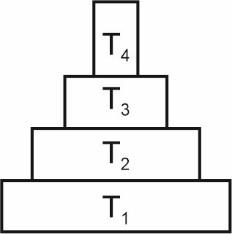
If is equivalent to 1000 J, what is the value at
- 1 J
- 2 J
- 310,000 J
- 410,00,000 J
Show answer and solution
Correct: option 4, 10,00,000 J
By the 10 per cent law only about one-tenth of the energy passes from one trophic level to the next, so each lower level holds ten times more. Going down three steps from to : J.
Question 11NEET 2024 Re-exam, Q143
Which one of the following is not a limitation of ecological pyramids?
- 1Saprophytes are not given any place of ecological pyramids
- 2It assumes a simple food chain, that almost never exists in nature
- 3It accommodates a food web
- 4It does not take into account the same species belonging to two or more trophic levels
Show answer and solution
Correct: option 3, It accommodates a food web
The limitations of ecological pyramids are that they assume a simple food chain, ignore a species that feeds at two or more trophic levels, give no place to saprophytes, and do not accommodate a food web. Option (3) says the opposite of a real limitation, so it is the one that is not a limitation.
Question 12NEET 2023, Q121
Identify the correct statements:
A. Detrivores perform fragmentation.
B. The humus is further degraded by some microbes during mineralization.
C. Water soluble inorganic nutrients go down into the soil and get precipitated by a process called leaching.
D. The detritus food chain begins with living organisms.
E. Earthworms break down detritus into smaller particles by a process called catabolism.
Choose the correct answer from the options given below:
- 1A, B, C only
- 2B, C, D only
- 3C, D, E only
- 4D, E, A only
Show answer and solution
Correct: option 1, A, B, C only
A is correct: detritivores such as earthworms break detritus into smaller particles, which is fragmentation. B is correct: microbes degrade humus and release inorganic nutrients in mineralisation. C is correct: in leaching, water-soluble inorganic nutrients go down into the soil and are precipitated. D is wrong because the detritus food chain begins with dead organic matter, and E is wrong because the action of the earthworm is fragmentation, while catabolism is the enzymatic breakdown by bacteria and fungi.
Question 13NEET 2023, Q127
In the equation
GPP − R = NPP
GPP is Gross Primary Productivity
NPP is Net Primary Productivity
R here is __________.
- 1Photosynthetically active radiation
- 2Respiratory quotient
- 3Respiratory loss
- 4Reproductive allocation
Show answer and solution
Correct: option 3, Respiratory loss
Gross primary productivity is the rate at which producers make organic matter. Part of it is used up by the plants in respiration, and what is left is the net primary productivity, so R is the respiratory loss.
Question 14NEET 2023 Manipur, Q109
Match List-I with List-II.
| List-I | List-II |
|---|
| (A) Hydrarch succession | (I) Gradual change in the species composition |
| (B) Xerarch succession | (II) Faster and climax reached quickly |
| (C) Ecological succession | (III) Lichens to mesic conditions |
| (D) Secondary succession | (IV) Phytoplankton to mesic conditions |
Choose the correct answer from the options given below:
- 1A-I, B-IV, C-II, D-III
- 2A-IV, B-III, C-I, D-II
- 3A-IV, B-II, C-III, D-I
- 4A-III, B-I, C-IV, D-II
Show answer and solution
Correct: option 2, A-IV, B-III, C-I, D-II
Hydrarch succession starts in water with phytoplankton and moves towards mesic conditions (A-IV). Xerarch succession starts on dry bare rock with lichens and also moves towards mesic conditions (B-III). Ecological succession is the gradual, fairly predictable change in species composition of an area (C-I). Secondary succession starts where soil is already present, so it is faster and the climax is reached more quickly (D-II). This is option (2).
Question 15NEET 2023 Manipur, Q121
The amount of nutrients such as carbon, nitrogen, potassium and calcium present in the soil at any given time is referred to as:
- 1Humus
- 2Detritus
- 3Standing state
- 4Standing crop
Show answer and solution
Correct: option 3, Standing state
The amount of mineral nutrients present in the soil at a given time is the standing state. Standing crop is the mass of living material at a trophic level, detritus is dead organic remains and humus is the dark partly decomposed matter formed from it. So the answer is option (3).
Question 16NEET 2022, Q128
Given below are two statements:
Statement I:
Decomposition is a process in which the detritus is degraded into simpler substances by microbes.
Statement II:
Decomposition is faster if the detritus is rich in lignin and chitin
In the light of the above statements, choose the correct answer from the options given below:
- 1Statement I is incorrect but Statement II is correct
- 2Both Statement I and Statement II are correct
- 3Both Statement I and Statement II are incorrect
- 4Statement I is correct but Statement II is incorrect
Show answer and solution
Correct: option 4, Statement I is correct but Statement II is incorrect
Statement I is the definition of decomposition and is correct. Statement II is wrong: detritus rich in lignin and chitin decomposes slowly, while detritus rich in nitrogen and water-soluble substances such as sugars decomposes quickly.
Question 17NEET 2022, Q139
Which one of the following will accelerate phosphorus cycle?
- 1Rain fall and storms
- 2Burning of fossil fuels
- 3Volcanic activity
- 4Weathering of rocks
Show answer and solution
Correct: option 4, Weathering of rocks
Rocks are the natural reservoir of phosphorus, which they hold as phosphates. Weathering releases small amounts of phosphate into the soil solution, from where plants take it up, so faster weathering speeds up the cycle. Phosphorus has no gaseous phase, so rain, fuel burning and volcanoes add almost nothing.
Question 18NEET 2022, Q168
Detritivores breakdown detritus into smaller particles. This process is called:
- 1Decomposition
- 2Catabolism
- 3Fragmentation
- 4Humification
Show answer and solution
Correct: option 3, Fragmentation
Fragmentation is the step of decomposition in which detritivores such as earthworms break detritus into smaller particles. Catabolism is the enzymatic breakdown by bacteria and fungi, and humification is the formation of humus.
Question 19NEET 2022 Re-exam, Q108
All successions irrespective of the habitat proceed to which type of climax community?
- 1Edaphic
- 2Xeric
- 3Mesic
- 4Hydrophytic
Show answer and solution
Correct: option 3, Mesic
Hydrarch succession moves from wet towards medium water conditions and xerarch succession moves from dry towards medium water conditions. So every succession, whether it starts in water or on dry land, ends in a mesic (medium water) climax community.
Question 20NEET 2022 Re-exam, Q122
The pioneer species in a hydrarch succession are
- 1Filamentous algae
- 2Free-floating angiosperms
- 3Submerged rooted plants
- 4Phytoplanktons
Show answer and solution
Correct: option 4, Phytoplanktons
In primary succession in water the pioneers are the small phytoplanktons. They are replaced with time by rooted submerged plants, then rooted floating angiosperms, free-floating plants, reed swamp, marsh meadow, scrub and finally trees.
Question 21NEET 2022 Re-exam, Q125
The species that come to appear in bare area are called
- 1Species of seral community
- 2Pioneer species
- 3Invasive species
- 4Competitive species
Show answer and solution
Correct: option 2, Pioneer species
The species that invade a bare area first are called pioneer species, for example lichens on bare rock and phytoplanktons in water. The communities that follow them are the seral communities.
Question 22NEET 2022 Re-exam, Q140
Match List-I with List-II:
| List-I | List-II |
|---|
| (a) Carbon dissolved in oceans | (i) 55 billion tons |
| (b) Annual fixation of carbon through photosynthesis | (ii) 71% |
| (c) PAR captured by plants | (iii) kg |
| (d) Productivity of oceans | (iv) 2 to 10% |
Choose the correct answer from the options given below:
- 1a-iii, b-ii, c-i, d-iv
- 2a-ii, b-iv, c-iii, d-i
- 3a-iii, b-iv, c-ii, d-i
- 4a-ii, b-iii, c-iv, d-i
Show answer and solution
Correct: option 4, a-ii, b-iii, c-iv, d-i
About 71% of global carbon is dissolved in the oceans (ii). Plants capture only 2 to 10% of the photosynthetically active radiation (iv), and the annual net primary productivity of the oceans is 55 billion tons (i). That leaves (iii) for the carbon fixed each year through photosynthesis; the textbook figure is kg, so the exponent printed in the list looks like a misprint, but the matching is not affected.
Question 23NEET 2022 Re-exam, Q160
The amount of biomass or organic matter produced per unit area over a time period by plants during photosynthesis is called
- 1Net primary production
- 2Secondary production
- 3Primary production
- 4Gross primary production
Show answer and solution
Correct: option 4, Gross primary production
The answer given for this paper is gross primary production: the organic matter made in photosynthesis before any of it is used up in the respiration of the plants. Net primary production is what remains after respiration, and secondary production is the formation of new organic matter by consumers. Note that NCERT uses these exact words to define primary production, option (3), so that option can also be argued.
Question 24NEET 2021, Q110
The amount of nutrients, such as carbon, nitrogen, phosphorus and calcium present in the soil at any given time, is referred as:
- 1Climax
- 2Climax community
- 3Standing state
- 4Standing crop
Show answer and solution
Correct: option 3, Standing state
The quantity of nutrients present in the soil at a given time is the standing state. Standing crop is the mass of living material at each trophic level at a given time, and climax refers to the final stage of succession.
Question 25NEET 2021, Q121
Which of the following statements is not correct?
- 1Pyramid of biomass in sea is generally inverted.
- 2Pyramid of biomass in sea is generally upright.
- 3Pyramid of energy is always upright.
- 4Pyramid of numbers in a grassland ecosystem is upright.
Show answer and solution
Correct: option 2, Pyramid of biomass in sea is generally upright.
In the sea the biomass of fishes is far greater than that of the phytoplankton they depend on, so the pyramid of biomass is generally inverted, not upright. The pyramid of energy is always upright because energy is lost at each transfer, and the grassland pyramid of numbers is upright.
Question 26NEET 2021, Q122
In the equation GPP − R = NPP
R represents:
- 1Radiant energy
- 2Retardation factor
- 3Environment factor
- 4Respiration losses
Show answer and solution
Correct: option 4, Respiration losses
Gross primary productivity (GPP) is the total rate of organic matter production in photosynthesis. Plants use part of it in respiration (R). What is left is the net primary productivity (NPP), so R stands for respiration losses.
Question 27NEET 2020, Q75
In relation to Gross primary productivity and Net primary productivity of an ecosystem, which one of the following statements is correct?
- 1Gross primary productivity is always less than net primary productivity.
- 2Gross primary productivity is always more than net primary productivity.
- 3Gross primary productivity and Net primary productivity are one and same.
- 4There is no relationship between Gross primary productivity and Net primary productivity.
Show answer and solution
Correct: option 2, Gross primary productivity is always more than net primary productivity.
Gross primary productivity (GPP) is the total rate of production of organic matter by photosynthesis. Plants use part of it in respiration (R), and what is left is net primary productivity: NPP = GPP - R. Since R is never zero, GPP is always more than NPP.
Question 28NEET 2020, Q80
Match the trophic levels with their correct species examples in grassland ecosystem.
| |
|---|
| (a) Fourth trophic level | (i) Crow |
| (b) Second trophic level | (ii) Vulture |
| (c) First trophic level | (iii) Rabbit |
| (d) Third trophic level | (iv) Grass |
Select the correct option:
- 1a-ii, b-iii, c-iv, d-i
- 2a-iii, b-ii, c-i, d-iv
- 3a-iv, b-iii, c-ii, d-i
- 4a-i, b-ii, c-iii, d-iv
Show answer and solution
Correct: option 1, a-ii, b-iii, c-iv, d-i
Grass is the producer and forms the first trophic level (c-iv). The rabbit eats grass, so it is a primary consumer at the second level (b-iii). The crow is taken as the secondary consumer at the third level (d-i) and the vulture as the top consumer at the fourth level (a-ii).
Question 29NEET 2020 Phase 2, Q4
Which of the following statements is incorrect regarding the phosphorus cycle?
- 1Phosphorus solubilising bacteria facilitate the release of phosphorus from organic remains
- 2There is appreciable respiratory release of phosphorus into atmosphere
- 3It is sedimentary cycle
- 4Phosphates are the major form of phosphorus reservoir
Show answer and solution
Correct: option 2, There is appreciable respiratory release of phosphorus into atmosphere
Phosphorus has a sedimentary cycle: its reservoir is rock, where it is held as phosphates, and decomposers such as phosphate solubilising bacteria release it from dead organic matter. Unlike carbon, it has no gaseous phase worth the name, so there is no respiratory release of phosphorus into the atmosphere. That statement is the incorrect one.
Question 30NEET 2020 Phase 2, Q7
Which of the following statements is incorrect?
- 1Energy content gradually increases from first to fourth trophic level
- 2Number of individuals decreases from first trophic level to fourth trophic level
- 3Energy content gradually decreases from first to fourth trophic level
- 4Biomass decreases from first to fourth trophic level
Show answer and solution
Correct: option 1, Energy content gradually increases from first to fourth trophic level
Only about 10 per cent of the energy at one trophic level passes to the next, so energy content falls at every step and the pyramid of energy is always upright. In a typical ecosystem numbers and biomass also fall from producers to top carnivores. The statement that energy increases up the trophic levels is therefore incorrect.
Question 31NEET 2020 Phase 2, Q68
The rate of decomposition is faster in the ecosystem due to following factors EXCEPT:
- 1Warm and moist environment
- 2Presence of aerobic soil microbes
- 3Detritus richer in lignin and chitin
- 4Detritus rich in sugars
Show answer and solution
Correct: option 3, Detritus richer in lignin and chitin
Decomposition needs oxygen and is quickest in a warm and moist environment, and when the detritus is rich in nitrogen and water-soluble substances such as sugars. Detritus rich in lignin and chitin breaks down slowly. So lignin and chitin are the exception.
Question 32NEET 2019, Q137
Which of the following ecological pyramids is generally inverted?
- 1Pyramid of numbers in grassland
- 2Pyramid of energy
- 3Pyramid of biomass in a forest
- 4Pyramid of biomass in a sea
Show answer and solution
Correct: option 4, Pyramid of biomass in a sea
In the sea the producers are tiny phytoplankton with a very small standing biomass at any moment, while the zooplankton and fishes that feed on them weigh far more. So the pyramid of biomass in a sea is inverted. The pyramid of energy is always upright, and the grassland number pyramid and forest biomass pyramid are upright too.
Question 33NEET 2018, Q115
What type of ecological pyramid would be obtained with the following data ?
Secondary consumer : 120 g
Primary consumer : 60 g
Primary producer : 10 g
- 1Upright pyramid of numbers
- 2Pyramid of energy
- 3Inverted pyramid of biomass
- 4Upright pyramid of biomass
Show answer and solution
Correct: option 3, Inverted pyramid of biomass
The data are masses in grams, so this is a pyramid of biomass. The biomass increases from the producer (10 g) to the primary consumer (60 g) to the secondary consumer (120 g), giving a narrow base and a broad top, which is an inverted pyramid of biomass as seen in aquatic ecosystems.
Question 34NEET 2017, Q127
Which ecosystem has the maximum biomass?
- 1Forest ecosystem
- 2Grassland ecosystem
- 3Pond ecosystem
- 4Lake ecosystem
Show answer and solution
Correct: option 1, Forest ecosystem
A forest holds very large, long-lived producers (trees), so the standing mass of living matter per unit area is far greater than in a grassland, pond or lake.
Question 35NEET 2017, Q133
Presence of plants arranged into well defined vertical layers depending on their height can be seen best in:
- 1Tropical Savannah
- 2Tropical Rain Forest
- 3Grassland
- 4Temperate Forest
Show answer and solution
Correct: option 2, Tropical Rain Forest
The vertical distribution of species in layers is called stratification. It is best developed in a tropical rain forest, which has tall emergent trees, a canopy, smaller trees, shrubs and a ground layer of herbs.
Question 36NEET 2016 Phase 1, Q121
Which one of the following is a characteristic feature of cropland ecosystem?
- 1Absence of soil organisms
- 2Least genetic diversity
- 3Absence of weeds
- 4Ecological succession
Show answer and solution
Correct: option 2, Least genetic diversity
A cropland is a man-made ecosystem in which one crop variety is grown over a large area (monoculture), so its genetic diversity is very low. Soil organisms and weeds are still present, and succession is prevented by repeated cultivation.
Question 37NEET 2016 Phase 1, Q152
The term ecosystem was coined by:
- 1E.P. Odum
- 2A.G. Tansley
- 3E. Haeckel
- 4E. Warming
Show answer and solution
Correct: option 2, A.G. Tansley
The term ecosystem was introduced by A.G. Tansley in 1935 for the living community together with its physical environment. Haeckel coined the term ecology, and Odum and Warming were later and earlier ecologists who did not coin this term.
Question 38NEET 2016 Phase 1, Q157
Which of the following would appear as the pioneer organisms on bare rocks?
- 1Lichens
- 2Liverworts
- 3Mosses
- 4Green algae
Show answer and solution
Correct: option 1, Lichens
In primary succession on bare rock (a xerarch succession) the pioneers are lichens. They secrete acids that dissolve the rock and start the formation of soil, which later allows mosses and other bryophytes to grow.
Question 39NEET 2016 Phase 2, Q131
The primary producers of the deep-sea hydrothermal vent ecosystem are
- 1green algae
- 2chemosynthetic bacteria
- 3blue-green algae
- 4coral reefs
Show answer and solution
Correct: option 2, chemosynthetic bacteria
No sunlight reaches deep-sea vents, so photosynthesis is not possible there. The food chain is supported by chemosynthetic bacteria (archaebacteria) that obtain energy by oxidising inorganic compounds such as hydrogen sulphide from the vent.
Question 40AIPMT 2015, Q102
Vertical distribution of different species occupying different levels in a biotic community is known as:
- 1Stratification
- 2Zonation
- 3Pyramid
- 4Divergence
Show answer and solution
Correct: option 1, Stratification
Stratification is the vertical layering of species in a community, such as trees in the top layer of a forest, shrubs in the second and herbs and grasses at the bottom.
Question 41AIPMT 2015, Q104
The mass of living material at a trophic level at a particular time is called:
- 1Standing state
- 2Net primary productivity
- 3Standing crop
- 4Gross primary productivity
Show answer and solution
Correct: option 3, Standing crop
Standing crop is the mass of living matter (biomass) at a trophic level at a given time. Standing state is the amount of nutrients in the soil, and the productivity terms are rates of biomass production.
Question 42AIPMT 2015, Q106
In an ecosystem the rate of production of organic matter during photosynthesis is termed as:
- 1Gross primary productivity
- 2Secondary productivity
- 3Net productivity
- 4Net primary productivity
Show answer and solution
Correct: option 1, Gross primary productivity
Gross primary productivity is the rate at which organic matter is produced during photosynthesis. Net primary productivity is what is left after the plants' own respiration, and secondary productivity is the rate of formation of new organic matter by consumers.
Question 43AIPMT 2015, Q129
Secondary Succession takes place on/in:
- 1Degraded forest
- 2Newly created pond
- 3Newly cooled lava
- 4Bare rock
Show answer and solution
Correct: option 1, Degraded forest
Secondary succession begins where an earlier community has been destroyed but soil is still present, as in a degraded or burnt forest or abandoned farmland. Bare rock, newly cooled lava and a newly created pond have never had life, so they show primary succession.
Question 44AIPMT 2015 Re-test, Q50
Most animals that live in deep oceanic waters are:
- 1detritivores
- 2primary consumers
- 3secondary consumers
- 4tertiary consumers
Show answer and solution
Correct: option 1, detritivores
No light reaches the deep ocean, so there are no producers there. Most animals of that zone depend on the dead organic matter that sinks from the upper layers, which makes them detritivores.
Question 45AIPMT 2015 Re-test, Q54
In which of the following both pairs have correct combination?
- 1Gaseous nutrient cycle - Sulphur and Phosphorus
Sedimentary nutrient cycle - Carbon and Nitrogen
- 2Gaseous nutrient cycle - Carbon and Nitrogen
Sedimentary nutrient cycle - Sulphur and Phosphorus
- 3Gaseous nutrient cycle - Carbon and sulphur
Sedimentary nutrient cycle - Nitrogen and Phosphorus
- 4Gaseous nutrient cycle - Nitrogen and sulphur
Sedimentary nutrient cycle - Carbon and Phosphorus
Show answer and solution
Correct: option 2, Gaseous nutrient cycle - Carbon and Nitrogen
Sedimentary nutrient cycle - Sulphur and Phosphorus
In a gaseous cycle the main reservoir is the atmosphere, as for carbon and nitrogen. In a sedimentary cycle the reservoir is the earth's crust, as for sulphur and phosphorus. Only option (2) has both pairs right.
Question 46AIPMT 2015 Re-test, Q122
During ecological succession:
- 1the changes lead to a community that is in near equilibrium with the environment and is called pioneer community
- 2the gradual and predictable change in species composition occurs in a given area
- 3the establishment of a new biotic community is very fast in its primary phase.
- 4the numbers and types of animals remain constant
Show answer and solution
Correct: option 2, the gradual and predictable change in species composition occurs in a given area
Ecological succession is the gradual and fairly predictable change in the species composition of a given area. The community in near equilibrium with the environment is the climax community, not the pioneer community; primary succession is very slow; and the numbers and kinds of animals change along with the vegetation.
Question 47AIPMT 2014, Q10
If 20 J of energy is trapped at producer level, then how much energy will be available to peacock as food in the following chain?
plant mice snake peacock
- 10.0002 J
- 20.02 J
- 30.002 J
- 40.2 J
Show answer and solution
Correct: option 2, 0.02 J
By the 10 per cent law only one tenth of the energy passes to the next trophic level. Plant 20 J, mice 2 J, snake 0.2 J, peacock 0.02 J.
Question 48AIPMT 2014, Q30
Match the following and select the correct option:
| |
|---|
| (a) Earthworm | (i) Pioneer species |
| (b) Succession | (ii) Detritivore |
| (c) Ecosystem service | (iii) Natality |
| (d) Population growth | (iv) Pollination |
- 1a-ii, b-i, c-iv, d-iii
- 2a-i, b-ii, c-iii, d-iv
- 3a-iv, b-i, c-iii, d-ii
- 4a-iii, b-ii, c-iv, d-i
Show answer and solution
Correct: option 1, a-ii, b-i, c-iv, d-iii
The earthworm is a detritivore that breaks down detritus (ii). Succession begins with pioneer species (i). Pollination is an ecosystem service (iv). Natality, the number of births, adds to population growth (iii). So a-ii, b-i, c-iv, d-iii.
Question 49AIPMT 2014, Q33
Given below is a simplified model of phosphorus cycling in a terrestrial ecosystem with four blanks (A-D). Identify the blanks.
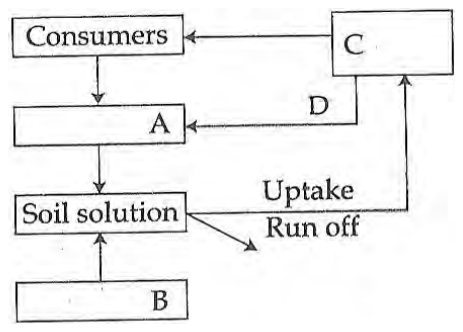
- 1Producers, Litter fall, Rock minerals, Detritus
- 2Rock minerals, Detritus, Litter fall, Producers
- 3Litter fall, Producers, Rock minerals, Detritus
- 4Detritus, Rock minerals, Producer, Litter fall
Show answer and solution
Correct: option 4, Detritus, Rock minerals, Producer, Litter fall
Rock minerals (B) weather and release phosphate into the soil solution. Producers (C) take it up from the soil solution and pass it to consumers. Dead remains of consumers and the litter fall (D) from producers form detritus (A), which decomposers break down to return phosphate to the soil solution. So A is detritus, B rock minerals, C producers and D litter fall.
Question 50NEET 2013, Q81
Natural reservoir of phosphorus is:
- 1Animal bones
- 2Rock
- 3Fossils
- 4Sea water
Show answer and solution
Correct: option 2, Rock
The natural reservoir of phosphorus is rock, which holds it as phosphates. Weathering releases small amounts into the soil solution, from where plants absorb it. Unlike carbon, phosphorus has no significant gaseous phase in its cycle.
Question 51NEET 2013, Q101
Which one of the following processes during decomposition is correctly described?
- 1Humification - Leads to the accumulation of a dark coloured substance humus which undergoes microbial action at a very fast rate
- 2Catabolism - Last step in the decomposition under fully anaerobic condition
- 3Leaching - Water soluble inorganic nutrients rise to the top layers of soil
- 4Fragmentation - Carried out by organisms such as earthworm
Show answer and solution
Correct: option 4, Fragmentation - Carried out by organisms such as earthworm
Detritivores such as earthworms break detritus into small pieces; this is fragmentation, so (4) is correct. Humus is decomposed very slowly, not fast. Catabolism is the enzymatic breakdown by bacteria and fungi and is not the last step, and decomposition is mostly aerobic. In leaching, soluble nutrients move down into the soil, not up.
Question 52NEET 2013, Q117
Secondary productivity is rate of formation of new organic matter by:
- 1Parasite
- 2Consumer
- 3Decomposer
- 4Producer
Show answer and solution
Correct: option 2, Consumer
Primary productivity is the rate at which producers make organic matter by photosynthesis. Secondary productivity is the rate at which consumers form new organic matter from the food they assimilate.
Question 53NEET 2013 Karnataka, Q122
Which two distinct microbial processes are responsible for the release of fixed nitrogen as dinitrogen gas () to the atmosphere?
- 1Aerobic nitrate oxidation, and nitrite reduction
- 2Decomposition of organic nitrogen, and conversion of dinitrogen to ammonium compounds
- 3Enteric fermentation in cattle, and nitrogen fixation by Rhizobium in root nodules of legumes
- 4Anaerobic ammonium oxidation, and denitrification
Show answer and solution
Correct: option 4, Anaerobic ammonium oxidation, and denitrification
Denitrification by bacteria such as Pseudomonas reduces nitrate to , and anaerobic ammonium oxidation (anammox) combines ammonium with nitrite to give . The other options describe processes that fix nitrogen or only change one fixed form into another.
Question 54NEET 2013 Karnataka, Q127
Which one of the following is a primary consumer in maize field ecosystem?
- 1Grasshopper
- 2Wolf
- 3Phytoplankton
- 4Lion
Show answer and solution
Correct: option 1, Grasshopper
A primary consumer is a herbivore feeding on the producers. In a maize field the grasshopper eats the plants. Wolf and lion are carnivores, and phytoplankton are producers of water bodies.
Question 55NEET 2013 Karnataka, Q129
When man eats fish which feeds on zooplankton which have eaten small plants, the producer in the chain is:
- 1Small plants
- 2Fish
- 3Man
- 4Zooplankton
Show answer and solution
Correct: option 1, Small plants
The chain is small plants, zooplankton, fish, man. Producers are the photosynthetic organisms at the start of a food chain, here the small plants; the others are consumers.
Question 56AIPMT 2012 Prelims, Q79
Which one of the following is not a gaseous biogeochemical cycle in ecosystem?
- 1Sulphur cycle
- 2Phosphorus cycle
- 3Nitrogen cycle
- 4Carbon cycle
Show answer and solution
Correct: option 2, Phosphorus cycle
The reservoir of phosphorus is rock in the earth's crust and the element has no significant gaseous phase, so its cycle is sedimentary. Carbon and nitrogen have their reservoir in the atmosphere, and sulphur also has gaseous forms.
Question 57AIPMT 2012 Prelims, Q88
Identify the possible link "A" in the following food chain:
Plant insect frog "A" Eagle
- 1Rabbit
- 2Wolf
- 3Cobra
- 4Parrot
Show answer and solution
Correct: option 3, Cobra
"A" must be an animal that eats frogs and is itself eaten by eagles. A cobra fits. Rabbit and parrot are plant eaters, and a wolf neither feeds on frogs nor is prey for an eagle.
Question 58AIPMT 2012 Prelims, Q90
Given below is an imaginary pyramid of numbers. What could be one of the possibilities about certain organisms at some of the different levels?
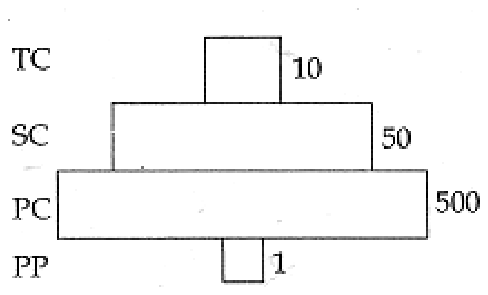
- 1Level PC is "insects" and level SC is "small insectivorous birds".
- 2Level PP is "phytoplanktons" in sea and "Whale" on top level TC
- 3Level one PP is "pipal trees" and the level SC is "sheep".
- 4Level PC is "rats" and level SC is "cats".
Show answer and solution
Correct: option 1, Level PC is "insects" and level SC is "small insectivorous birds".
The pyramid has a single producer supporting 500 primary consumers, 50 secondary consumers and 10 tertiary consumers. That fits one large tree feeding many insects, which are eaten by fewer small insectivorous birds. Phytoplankton would be far more numerous than one, sheep are herbivores and not secondary consumers, and a single producer could not support 500 rats.
Question 59AIPMT 2012 Prelims, Q99
Which one of the following is not a functional unit of an ecosystem
- 1Energy flow
- 2Decomposition
- 3Productivity
- 4Stratification
Show answer and solution
Correct: option 4, Stratification
The functional aspects of an ecosystem are productivity, decomposition, energy flow and nutrient cycling. Stratification, the vertical distribution of species in layers, is a structural feature.
Question 60AIPMT 2012 Prelims, Q132
The upright pyramid of number is absent in
- 1Pond
- 2Forest
- 3Lake
- 4Grassland
Show answer and solution
Correct: option 2, Forest
In a pond, lake or grassland the producers are very numerous and the numbers fall at each higher trophic level, giving an upright pyramid. In a forest a few large trees support a much larger number of insects and birds, so the pyramid of number is not upright (it is inverted or spindle shaped).
Question 61AIPMT 2012 Mains, Q82
The rate of formation of new organic matter by rabbit in a grassland, is called:
- 1Net productivity
- 2Secondary productivity
- 3Net primary productivity
- 4Gross primary productivity
Show answer and solution
Correct: option 2, Secondary productivity
A rabbit is a herbivore, that is, a consumer. The rate at which consumers form new organic matter is secondary productivity. Primary productivity (gross or net) refers only to producers, the green plants.
Question 62AIPMT 2012 Mains, Q84
The second stage of hydrosere is occupied by plants like:
- 1Azolla
- 2Typha
- 3Salix
- 4Vallisneria
Show answer and solution
Correct: option 4, Vallisneria
A hydrosere begins with the phytoplankton stage. The second stage is that of rooted submerged plants such as Hydrilla and Vallisneria. Azolla is a free-floating plant, Typha belongs to the reed-swamp stage and Salix to the much later woodland stage.
Question 63AIPMT 2012 Mains, Q114
Identify the likely organisms (a), (b), (c) and (d) in the food web shown below:
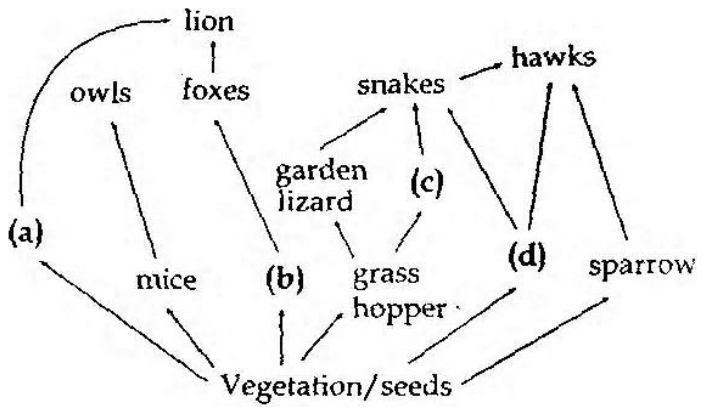
- 1a-deer, b-rabbit, c-frog, d-rat
- 2a-dog, b-squirrel, c-bat, d-deer
- 3a-rat, b-dog, c-tortoise, d-crow
- 4a-squirrel, b-cat, c-rat, d-pigeon
Show answer and solution
Correct: option 1, a-deer, b-rabbit, c-frog, d-rat
(a) feeds on vegetation and is eaten by the lion, so it is a large herbivore such as deer. (b) is a herbivore eaten by foxes, a rabbit. (c) eats grasshoppers and is eaten by snakes, a frog. (d) eats vegetation or seeds and is eaten by snakes and hawks, a rat.
Question 64AIPMT 2011 Prelims, Q57
Mass of living matter at a trophic level in an area at any time is called
- 1Standing crop
- 2Detritus
- 3Humus
- 4Standing state
Show answer and solution
Correct: option 1, Standing crop
Each trophic level holds a certain mass of living material at a given time, called the standing crop, measured as biomass or number per unit area. Standing state refers to the amount of nutrients in the soil, and detritus and humus are dead organic matter.
Question 65AIPMT 2011 Prelims, Q65
Of the total incident solar radiation the proportion of PAR is:
- 1About 70%
- 2About 60%
- 3Less than 50%
- 4More than 80%
Show answer and solution
Correct: option 3, Less than 50%
Photosynthetically active radiation (400 to 700 nm) makes up less than 50 per cent of the solar radiation that reaches the earth.
Question 66AIPMT 2011 Prelims, Q85
Large Woody Vines are more commonly found in:
- 1Temperate forest
- 2Mangroves
- 3Tropical rainforests
- 4Alpine forests
Show answer and solution
Correct: option 3, Tropical rainforests
Large woody climbers, called lianas, are typical of tropical rainforests, where they climb the tall trees to reach light above the dense canopy.
Question 67AIPMT 2011 Prelims, Q104
Which one of the following statements is correct for secondary succession?
- 1It begins on a bare rock
- 2It occurs on a deforested site
- 3It follows primary succession
- 4It is similar to primary succession except that it has a relatively fast pace
Show answer and solution
Correct: option 2, It occurs on a deforested site
Secondary succession starts in an area where the natural vegetation has been destroyed but the soil remains, such as a deforested or burnt site or abandoned farmland. Succession on bare rock is primary succession, and secondary succession does not have to follow a primary one.
Question 68AIPMT 2011 Prelims, Q123
Which one of the following statements for pyramid of energy is incorrect, whereas the remaining three are correct?
- 1Its base is broad
- 2It shows energy content of different trophic level organisms
- 3It is inverted in shape
- 4It is upright in shape
Show answer and solution
Correct: option 3, It is inverted in shape
Energy is lost as heat at every transfer, so each trophic level holds less energy than the one below it. The pyramid of energy therefore has a broad base and is always upright; it can never be inverted.
Question 69AIPMT 2011 Mains, Q37
Which one of the following animals may occupy more than one trophic levels in the same ecosystem at the same time?
- 1Sparrow
- 2Lion
- 3Goat
- 4Frog
Show answer and solution
Correct: option 1, Sparrow
A sparrow eats seeds and grains, which makes it a primary consumer, and it also eats insects, which makes it a secondary consumer. So it occupies two trophic levels at the same time. A goat is only a herbivore, and the lion and the frog are carnivores.
Question 70AIPMT 2011 Mains, Q38
Both, hydrarch and xerarch successions lead to:
- 1Medium water conditions
- 2Xeric conditions
- 3Highly dry conditions
- 4Excessive wet conditions
Show answer and solution
Correct: option 1, Medium water conditions
Hydrarch succession starts in wet areas and moves towards drier conditions, while xerarch succession starts in dry areas and moves towards wetter conditions. Both end in mesic conditions, where water is neither too scarce nor in excess.
Question 71AIPMT 2011 Mains, Q55
The breakdown of detritus into smaller particles by earthworm is a process called
- 1Humification
- 2Fragmentation
- 3Mineralisation
- 4Catabolism
Show answer and solution
Correct: option 2, Fragmentation
Detritivores such as earthworms break detritus into smaller particles, and this first step of decomposition is called fragmentation. Catabolism is the enzymatic breakdown of detritus by bacteria and fungi. Humification is the formation of dark humus, and mineralisation is the release of inorganic nutrients from humus.
Question 72AIPMT 2010 Mains, Q115
Which of the following representations shows the pyramid of number in a forest ecosystem
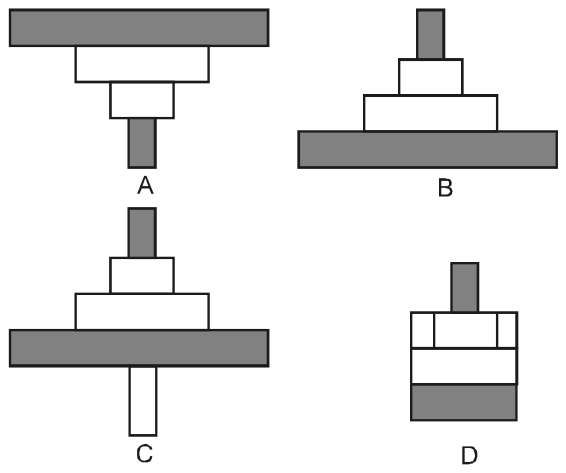
- 1C
- 2D
- 3A
- 4B
Show answer and solution
Correct: option 4, B
The answer key gives figure B, an upright pyramid: the producers form the broad base and the number of individuals falls at each higher trophic level, ending with a few top carnivores.
Question 73AIPMT 2010 Prelims, Q162
The biomass available for consumption by the herbivores and decomposers is called
- 1Secondary productivity
- 2Standing crop
- 3Gross primary productivity
- 4Net primary productivity
Show answer and solution
Correct: option 4, Net primary productivity
Gross primary productivity is the total organic matter made by photosynthesis. Plants use a part of it in respiration; what is left is net primary productivity (NPP = GPP - R). This is the biomass available to herbivores and decomposers.
Question 74AIPMT 2009 Prelims, Q110
The correct sequence of plants in a hydrosere is:
- 1Volvox Hydrilla Pistia Scirpus Lantana Oak
- 2Pistia Volvox Scirpus Hydrilla Oak Lantana
- 3Oak Lantana Volvox Hydrilla Pistia Scirpus
- 4Oak Lantana Scirpus Pistia Hydrilla Volvox
Show answer and solution
Correct: option 1, Volvox Hydrilla Pistia Scirpus Lantana Oak
A hydrosere starts in open water and ends in forest: phytoplankton (Volvox), rooted submerged plants (Hydrilla), free-floating plants (Pistia), reed-swamp plants (Scirpus), then shrubs (Lantana) and finally trees (Oak). Only the first option follows this order.
Question 75AIPMT 2009 Prelims, Q143
Which one of the following types of organisms occupy more than one trophic level in a pond ecosystem?
- 1Fish
- 2Zooplankton
- 3Frog
- 4Phytoplankton
Show answer and solution
Correct: option 1, Fish
Fish in a pond feed at several levels: some eat phytoplankton, some eat zooplankton, and larger ones eat smaller fish, so fish occupy more than one trophic level. Phytoplankton are always producers and zooplankton primary consumers.
Question 76AIPMT 2008 Prelims, Q171
About 70% of total global carbon is found in
- 1Forests
- 2Grasslands
- 3Agroecosystems
- 4Oceans
Show answer and solution
Correct: option 4, Oceans
About 71% of the global carbon is dissolved in the oceans. This oceanic reservoir also regulates the amount of carbon dioxide in the atmosphere.
Question 77AIPMT 2008 Prelims, Q174
The slow rate of decomposition of fallen logs in nature is due to their
- 1Low cellulose content
- 2Low moisture content
- 3Poor nitrogen content
- 4Anaerobic environment around them
Show answer and solution
Correct: option 2, Low moisture content
Decomposers need moisture to grow and work, and a dry log gives them little water, so it decays slowly; this is the keyed answer. The woody material of logs is also rich in lignin and poor in nitrogen, which slows decomposition as well.
Question 78AIPMT 2008 Prelims, Q175
Consider the following statements concerning food chains
(a) Removal of 80% tigers from an area resulted in greatly increased growth of vegetation
(b) Removal of most of the carnivores resulted in an increased population of deers
(c) The length of food chains is generally limited to 3-4 trophic levels due to energy loss
(d) The length of food chains may vary from 2 to 8 trophic levels.
Which two of the above statements are correct?
- 1a, b
- 2b, c
- 3c, d
- 4a, d
Show answer and solution
Correct: option 2, b, c
(b) is correct: with fewer carnivores the deer are less preyed upon and increase. (c) is correct: only about 10% of energy passes to the next level, so chains rarely go beyond 3 to 4 levels. (a) is wrong because fewer tigers means more herbivores and less vegetation, and (d) is wrong because chains do not reach 8 levels.
Question 79AIPMT 2007 Prelims, Q65
Which one of the following ecosystem types has the highest annual net primary productivity?
- 1Temperate deciduous forest
- 2Tropical rain forest
- 3Tropical deciduous forest
- 4Temperate evergreen forest
Show answer and solution
Correct: option 2, Tropical rain forest
Net primary productivity depends on sunlight, temperature and water. A tropical rain forest has high temperature, strong light and heavy rain throughout the year, so plants grow all year round and its annual net primary productivity is the highest of the four forest types.
Question 80AIPMT 2006 Prelims, Q116
Which one of the following is not used for construction of ecological pyramids?
- 1Dry weight
- 2Number of individuals
- 3Rate of energy flow
- 4Fresh weight
Show answer and solution
Correct: option 4, Fresh weight
Ecological pyramids are of number (individuals), biomass (dry weight) and energy (rate of energy flow). Fresh weight is not used because the water content of organisms varies widely and would distort the comparison.
Question 81AIPMT 2005 Prelims, Q163
More than 70% of world's fresh water is contained in
- 1Antarctica
- 2Polar ice
- 3Glaciers and Mountains
- 4Greenland
Show answer and solution
Correct: option 2, Polar ice
Only about 2.5 to 3 per cent of the earth's water is fresh, and most of that is frozen. The polar ice of Antarctica and the Arctic region (including Greenland) holds the bulk of it, more than two thirds, so polar ice is the answer that covers the whole store. Antarctica or Greenland alone is only a part of it.
Question 82AIPMT 2004 Prelims, Q148
Which of the following is expected to have the highest value () in a grassland ecosystem : -
- 1Tertiary production
- 2Gross production (GP)
- 3Net production (NP)
- 4Secondary production
Show answer and solution
Correct: option 2, Gross production (GP)
Gross primary production is the total organic matter made by the producers. Net production is what is left after their respiration, and secondary and tertiary production at the consumer levels are smaller still because energy is lost at each transfer. So gross production has the highest value.
Question 83AIPMT 2004 Prelims, Q184
An ecosystem which can be easily damaged but can recover after some time if damaging effect stops will be having -
- 1High stability and low resilience
- 2Low stability and low resilience
- 3High stability and high resilience
- 4Low stability and high resilience
Show answer and solution
Correct: option 4, Low stability and high resilience
Stability (resistance) is the ability to stay unchanged under a disturbance; being easily damaged means low stability. Resilience is the ability to return to the original state once the disturbance stops; recovering after some time means high resilience.
Question 84AIPMT 2002 Prelims, Q159
Bamboo plant is growing in a far forest then what will be the trophic level of it:-
- 1First trophic level ()
- 2Second trophic level ()
- 3Third trophic level ()
- 4Fourth trophic level ()
Show answer and solution
Correct: option 1, First trophic level ()
Bamboo is a green plant that makes its own food by photosynthesis, so it is a producer. Producers always occupy the first trophic level, wherever they grow.
Question 85AIPMT 2001 Prelims, Q174
- 1Monera and fungi
- 2Fungi and plants
- 3Protista and Animalia
- 4Anibalia and Mogna
Show answer and solution
Correct: option 1, Monera and fungi
Dead plant matter is broken down by saprotrophic bacteria (kingdom Monera) and fungi, which secrete enzymes on the remains and absorb the products. Plants are producers and animals are consumers.
Question 86AIPMT 2000 Prelims, Q118
Which is the reason for highest biomass in aquatic ecosystem:
- 1Nano plankton, blue green algae, green algae
- 2Sea grass, and slime molds
- 3Benthonic and brown algae
- 4Diatoms
Show answer and solution
Correct: option 3, Benthonic and brown algae
The key gives benthonic and brown algae. Planktonic forms are tiny and short-lived, so their standing mass at any moment is small, whereas attached bottom-dwelling algae such as the large brown kelps have big, long-lived bodies and build up a large standing biomass.
Question 87AIPMT 1999 Prelims, Q124
Percentage energy transferred to higher trophic level in food chain is:
- 11%
- 210%
- 390%
- 4100%
Show answer and solution
Correct: option 2, 10%
By Lindeman's ten per cent law only about 10% of the energy of one trophic level is passed on to the next. The rest is lost as heat in respiration or remains unused.
Question 88AIPMT 1999 Prelims, Q129
Biotic and abiotic components form:
- 1Community
- 2Society
- 3Population
- 4Species
Show answer and solution
Correct: option 1, Community
The key gives Community. Strictly, living (biotic) and non-living (abiotic) components together make an ecosystem, and a community is only the living part: all the populations of an area. Ecosystem is not among the options printed in this copy, and community is the nearest of the four.
Question 89AIPMT 1999 Prelims, Q172
Maximum photosynthesis takes place by:
- 1Phytoplankton
- 2Zooplankton
- 3Marsh plants
- 4Woody plants
Show answer and solution
Correct: option 1, Phytoplankton
Oceans cover about 70% of the earth's surface, and the phytoplankton living in them (diatoms, dinoflagellates and other algae) are credited with the largest share of the world's photosynthesis. Zooplankton are animals and do not photosynthesise.
Question 90AIPMT 1998 Prelims, Q162
Total amount of energy trapped by green plants in food is called:
- 1Gross primary production
- 2Net primary production
- 3Standing crop
- 4Standing state
Show answer and solution
Correct: option 1, Gross primary production
The total organic matter made by photosynthesis is the gross primary production. Net primary production is what remains after the plants' own respiration is subtracted. Standing crop is the living mass present at one time, and standing state is the amount of nutrients in the soil.
Question 91AIPMT 1998 Prelims, Q166
Bacteria are essential in carbon cycle as:
- 1Decomposer
- 2Synthesizer
- 3Consumer
- 4Pri. Producer
Show answer and solution
Correct: option 1, Decomposer
Bacteria break down dead plants, animals and wastes and release their carbon as . Without this decomposition the carbon would stay locked in dead matter and the cycle would stop.