Questions with solutions
Question 1NEET 2026, Q139
Which one of the following is an appropriate example of 'sexual deceit'?
- 1Female wasp and fig
- 2Cuckoo and crow
- 3Ophrys and bumblebee
- 4Sea anemone and clown fish
Show answer and solution
Correct: option 3, Ophrys and bumblebee
The Mediterranean orchid Ophrys has a petal that looks like a female bee. The male bee tries to mate with the flower (pseudocopulation) and carries pollen from flower to flower, which is sexual deceit. Fig and wasp is mutualism, cuckoo and crow is brood parasitism, and sea anemone and clown fish is commensalism.
Question 2NEET 2026, Q165
Which of the following equations depicts Verhulst-Pearl logistic population growth?
- 1
- 2
- 3
- 4
Show answer and solution
Correct: option 1,
Logistic growth is , where is the population density, the intrinsic rate of natural increase and the carrying capacity. The factor slows growth to zero as approaches .
Question 3NEET 2026, Q180
Choose the correct statements regarding population interactions between two species.
A. In both parasitism and commensalism, only one species benefits and the other species is harmed.
B. Both species benefit in mutualism.
C. Both species benefit in commensalism.
D. In parasitism, only one species benefits and the other species is harmed.
E. In amensalism, one species is harmed and the other is unaffected.
Choose the correct answer from the options given below:
- 1A and D only
- 2A and B only
- 3B and E only
- 4B, D and E only
Show answer and solution
Correct: option 4, B, D and E only
Mutualism benefits both species (B), parasitism benefits the parasite and harms the host (D), and in amensalism one species is harmed while the other is unaffected (E). In commensalism one species benefits and the other is neither harmed nor benefited, so A and C are wrong.
Question 4NEET 2026 Re-exam, Q161
Consider a population of 10 million cells. Given the per-capita birth rate of 0.002 (per unit time) and the per-capita death rate of 0.002 (per unit time), the expected number of cells after 10 generations is __________.
- 11 million
- 25 million
- 310 million
- 4100 million
Show answer and solution
Correct: option 3, 10 million
The intrinsic rate of increase is . With , , so the population does not change and stays at 10 million.
Question 5NEET 2026 Re-exam, Q163
Given below are two statements: one is labelled as Assertion A and the other is labelled as Reason R.
Assertion A: The logistic growth model of populations is considered more realistic than the exponential growth model.
Reason R: Resources are finite.
In the light of the above statements, choose the most appropriate answer from the options given below:
- 1Both A and R are correct and R is the correct explanation of A
- 2Both A and R are correct but R is not the correct explanation of A
- 3A is correct but R is not correct
- 4A is not correct but R is correct
Show answer and solution
Correct: option 1, Both A and R are correct and R is the correct explanation of A
No population in nature has unlimited resources, so growth cannot stay exponential; it slows as the population nears the carrying capacity, which is what the logistic model describes. Both A and R are correct, and the finite resources are the reason the logistic model is more realistic.
Question 6NEET 2026 Re-exam, Q174
Match List-I with List-II.
| List-I | List-II |
|---|
| A. Both species are harmed | I. Predation |
| B. One species is harmed and the other is benefited | II. Mutualism |
| C. Both species are benefited | III. Competition |
| D. One is benefited while the other has no effect | IV. Commensalism |
Choose the correct answer from the options given below:
- 1A-III, B-IV, C-II, D-I
- 2A-I, B-II, C-III, D-IV
- 3A-II, B-I, C-IV, D-III
- 4A-III, B-I, C-II, D-IV
Show answer and solution
Correct: option 4, A-III, B-I, C-II, D-IV
Competition harms both species (III). In predation one species gains and the other is harmed (I). Mutualism benefits both (II). In commensalism one species benefits and the other is unaffected (IV). So A-III, B-I, C-II, D-IV.
Question 7NEET 2025, Q97
Epiphytes that are growing on a mango branch is an example of which of the following?
- 1Commensalism
- 2Mutualism
- 3Predation
- 4Amensalism
Show answer and solution
Correct: option 1, Commensalism
An epiphyte such as an orchid gets support and a place in the light from the mango branch, while the mango tree is neither helped nor harmed. An interaction in which one species benefits and the other is unaffected is commensalism.
Question 8NEET 2025, Q133
Who is known as the father of Ecology in India?
- 1S. R. Kashyap
- 2Ramdeo Misra
- 3Ram Udar
- 4Birbal Sahni
Show answer and solution
Correct: option 2, Ramdeo Misra
Ramdeo Misra is known as the Father of Ecology in India; he set up the teaching and research of ecology at Banaras Hindu University. S. R. Kashyap and Ram Udar worked on bryophytes, and Birbal Sahni was a palaeobotanist.
Question 9NEET 2025, Q157
Given below are two statements:
Statement I: Fig fruit is a non-vegetarian fruit as it has enclosed fig wasps in it.
Statement II: Fig wasp and fig tree exhibit mutual relationship as fig wasp completes its life cycle in fig fruit and fig fruit gets pollinated by fig wasp.
In the light of the above statements, choose the most appropriate answer from the options given below:
- 1Both statement I and statement II are correct
- 2Both statement I and statement II are incorrect
- 3Statement I is correct but statement II is incorrect
- 4Statement I is incorrect but statement II is correct
Show answer and solution
Correct: option 2, Both statement I and statement II are incorrect
The official key marks both statements as incorrect. Statement I is wrong because a fig is a plant product; wasps developing inside it do not make it non-vegetarian. Statement II is taken as wrong because of its wording: the wasp pollinates the fig inflorescence (the flowers), not the fruit, and it uses the fruit only for laying eggs and feeding its larvae on some developing seeds. Note that the fig and its wasp are a standard example of mutualism, so many readers would judge Statement II correct; the answer here follows the key.
Question 10NEET 2025, Q180
Which one of the following equations represents the Verhulst-Pearl Logistic Growth of population?
- 1
- 2
- 3
- 4
Show answer and solution
Correct: option 2,
Logistic growth is , where is the population density, the intrinsic rate of natural increase and the carrying capacity. Growth slows as approaches .
Question 11NEET 2024, Q105
The equation of Verhulst-Pearl logistic growth is
.
From this equation, indicates:
- 1Population density
- 2Intrinsic rate of natural increase
- 3Biotic potential
- 4Carrying capacity
Show answer and solution
Correct: option 4, Carrying capacity
In the logistic growth equation is the population density at time , is the intrinsic rate of natural increase and is the carrying capacity, the largest population the habitat can support.
Question 12NEET 2024, Q187
Given below are two statements:
Statement I: Gause's competitive exclusion principle states that two closely related species competing for different resources cannot exist indefinitely.
Statement II: According to Gause's principle, during competition, the inferior will be eliminated. This may be true if resources are limiting.
In the light of the above statements, choose the correct answer from the options given below:
- 1Statement I is false but Statement II is true.
- 2Both Statement I and Statement II are true.
- 3Both Statement I and Statement II are false.
- 4Statement I is true but Statement II is false.
Show answer and solution
Correct: option 1, Statement I is false but Statement II is true.
Gause's principle says that two closely related species competing for the same resources cannot co-exist indefinitely, and the competitively inferior one is eventually eliminated; this holds when resources are limiting. Statement I says "different resources", so it is false. Statement II is true.
Question 13NEET 2024 Re-exam, Q147
When will the population density increase, under special conditions?
When the number of:
- 1Deaths exceeds number of births and also number of emigrants equals number of immigrants.
- 2Births plus number of immigrants equals number of deaths plus number of emigrants.
- 3Births plus number of emigrants is more than the number of deaths plus number of immigrants.
- 4Births plus number of immigrants is more than the sum of number of deaths and number of emigrants.
Show answer and solution
Correct: option 4, Births plus number of immigrants is more than the sum of number of deaths and number of emigrants.
Population density changes as . Births (B) and immigration (I) add to the population, while deaths (D) and emigration (E) take away from it. The density rises only when is more than .
Question 14NEET 2024 Re-exam, Q151
Match List-I with List-II:
| List I | List II |
|---|
| A. Predator | I. Ophrys |
| B. Mutualism | II. Pisaster |
| C. Parasitism | III. Female wasp and fig |
| D. Sexual deceit | IV. Plasmodium |
Choose the correct answer from the options given below:
- 1A-III, B-II, C-I, D-IV
- 2A-IV, B-I, C-II, D-III
- 3A-II, B-II, C-I, D-IV
- 4A-II, B-III, C-IV, D-I
Show answer and solution
Correct: option 4, A-II, B-III, C-IV, D-I
Pisaster is a starfish that preys on the invertebrates of the rocky intertidal zone, so it is the predator. The fig and its female wasp pollinator depend on each other, which is mutualism. Plasmodium lives inside its host as a parasite. The orchid Ophrys gets pollinated by sexual deceit, because one of its petals looks like a female bee. So A-II, B-III, C-IV, D-I.
Question 15NEET 2024 Re-exam, Q167
Match List-I with List-II.
| List-I | List-II |
|---|
| A. Migratory flamingoes and resident fish in South American lakes | I. Interference competition |
| B. Abingdon tortoise became extinct after introduction of goats in their habitat | II. Competitive release |
| C. Chathamalus expands its distributional range in the absence of Balanus | III. Resource Partitioning |
| D. Five closely related species of Warblers feeding in different locations on same tree | IV. Interspecific competition |
Choose the correct answer from the options given below:
- 1A-I, B-IV, C-III, D-II
- 2A-IV, B-I, C-II, D-III
- 3A-III, B-I, C-II, D-IV
- 4A-II, B-IV, C-III, D-I
Show answer and solution
Correct: option 2, A-IV, B-I, C-II, D-III
Flamingoes and fish are unrelated species that compete for the same zooplankton, an example of interspecific competition. A species that widens its range when its competitor is removed, as Chathamalus does without Balanus, shows competitive release. MacArthur's warblers avoid competition by feeding in different parts of the same tree, which is resource partitioning. That leaves the Abingdon tortoise, driven out by the goats, for interference competition. So A-IV, B-I, C-II, D-III.
Question 16NEET 2024 Re-exam, Q196
What do ‘a’ and ‘b’ represent in the following population growth curve?
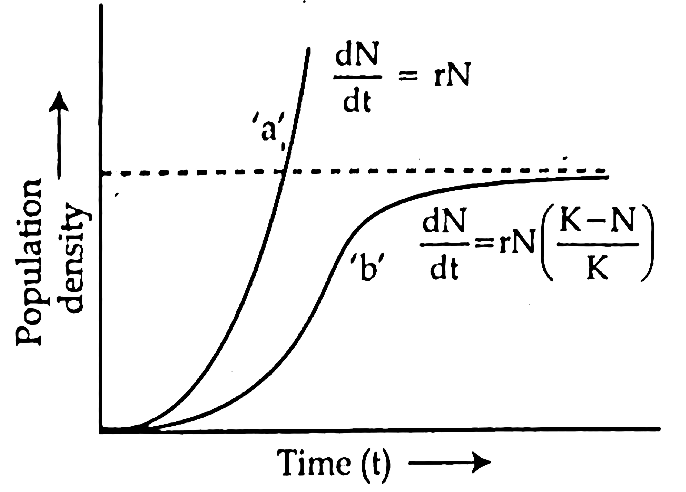
- 1‘a’ represents exponential growth when responses are not limiting the growth; and ‘b’ represents logistic growth when responses are limiting the growth.
- 2‘a’ represents logistic growth when responses are not limiting the growth; ‘b’ represents exponential growth when responses are limiting the growth.
- 3‘a’ represents carrying capacity and ‘b’ shows logistic growth when responses are limiting the growth.
- 4‘a’ represents exponential growth when responses are not limiting the growth and ‘b’ shows carrying capacity.
Show answer and solution
Correct: option 1, ‘a’ represents exponential growth when responses are not limiting the growth; and ‘b’ represents logistic growth when responses are limiting the growth.
Curve a is J-shaped and follows , which is exponential growth: the population keeps rising faster and faster because nothing limits it. Curve b is S-shaped and follows , which is logistic growth: limits slow the growth until the population levels off at the carrying capacity K, shown by the dashed line.
Question 17NEET 2023, Q147
Match List I with List II:
| List I (Interaction) | List II (Species A and B) |
|---|
| A. Mutualism | I. +(A), O(B) |
| B. Commensalism | II. −(A), O(B) |
| C. Amensalism | III. +(A), −(B) |
| D. Parasitism | IV. +(A), +(B) |
Choose the correct answer from the options given below:
- 1A-IV, B-II, C-I, D-III
- 2A-IV, B-I, C-II, D-III
- 3A-IV, B-III, C-I, D-II
- 4A-III, B-I, C-IV, D-II
Show answer and solution
Correct: option 2, A-IV, B-I, C-II, D-III
Here + means the species benefits, − means it is harmed and O means it is unaffected. In mutualism both species benefit, so A-IV. In commensalism one benefits and the other is unaffected, so B-I. In amensalism one is harmed and the other is unaffected, so C-II. In parasitism the parasite benefits and the host is harmed, so D-III.
Question 18NEET 2023, Q148
Given below are two statements:
Statement I: Gause’s ‘Competitive Exclusion Principle’ states that two closely related species competing for the same resources cannot co-exist indefinitely and competitively inferior one will be eliminated eventually.
Statement II: In general, carnivores are more adversely affected by competition than herbivores.
In the light of the above statements, choose the correct answer from the options given below:
- 1Both Statement I and Statement II are true.
- 2Both Statement I and Statement II are false.
- 3Statement I is correct but Statement II is false.
- 4Statement I is incorrect but Statement II is true.
Show answer and solution
Correct: option 3, Statement I is correct but Statement II is false.
Statement I is the correct statement of the Competitive Exclusion Principle of Gause. Statement II is false: in general, herbivores and plants are more adversely affected by competition than carnivores.
Question 19NEET 2023, Q167
Match List I with List II.
| List I (Interacting species) | List II (Name of Interaction) |
|---|
| A. A Leopard and a Lion in a forest/grassland | I. Competition |
| B. A Cuckoo laying egg in a Crow’s nest | II. Brood parasitism |
| C. Fungi and root of a higher plant in Mycorrhizae | III. Mutualism |
| D. A cattle egret and a Cattle in a field | IV. Commensalism |
Choose the correct answer from the options given below:
- 1A-I, B-II, C-III, D-IV
- 2A-I, B-II, C-IV, D-III
- 3A-III, B-IV, C-I, D-II
- 4A-II, B-III, C-I, D-IV
Show answer and solution
Correct: option 1, A-I, B-II, C-III, D-IV
A leopard and a lion hunt the same prey, so they compete (I). A cuckoo laying its egg in a crow's nest is brood parasitism (II). In mycorrhizae the fungus and the plant root both benefit, which is mutualism (III). The cattle egret feeds on insects stirred up by grazing cattle while the cattle are unaffected, which is commensalism (IV). This is option (1).
Question 20NEET 2023, Q186
Match List I with List II.
| List I | List II |
|---|
| A. Logistic growth | I. Unlimited resource availability condition |
| B. Exponential growth | II. Limited resource availability condition |
| C. Expanding age pyramid | III. The percent individuals of pre-reproductive age is largest followed by reproductive and post reproductive age groups |
| D. Stable age pyramid | IV. The percent individuals of pre-reproductives and reproductive age group are same |
Choose the correct answer from the options given below:
- 1A-II, B-I, C-III, D-IV
- 2A-II, B-III, C-I, D-IV
- 3A-II, B-IV, C-I, D-III
- 4A-II, B-IV, C-III, D-I
Show answer and solution
Correct: option 1, A-II, B-I, C-III, D-IV
Logistic growth happens when resources are limited (II), and exponential growth when resources are unlimited (I). An expanding age pyramid is broad at the base: the pre-reproductive group is the largest, then the reproductive, then the post-reproductive (III). In a stable pyramid the pre-reproductive and reproductive groups are about the same size (IV). This is option (1).
Question 21NEET 2023 Manipur, Q105
Plants offer rewards to animals in the form of pollen and nectar and the animals facilitate the pollination process. This is an example of:
- 1Commensalism
- 2Mutualism
- 3Amensalism
- 4Competition
Show answer and solution
Correct: option 2, Mutualism
Both partners gain: the animal gets food (pollen and nectar) and the plant gets its pollen carried. An interaction in which both species benefit is mutualism, option (2).
Question 22NEET 2023 Manipur, Q129
For chemical defence against herbivores, Calotropis has
- 1toxic ricin
- 2distasteful quinine
- 3cardiac glycosides
- 4strychnine
Show answer and solution
Correct: option 3, cardiac glycosides
Calotropis, a common weed of abandoned fields, produces highly poisonous cardiac glycosides, which is why cattle and goats do not browse it. So the answer is option (3).
Question 23NEET 2023 Manipur, Q162
If there are 250 snails in a pond, and within a year their number increases to 2500 by reproduction. What should be their birth rate per snail per year?
- 125
- 215
- 310
- 49
Show answer and solution
Correct: option 4, 9
New individuals added in the year = 2500 − 250 = 2250. Birth rate = number of births divided by the initial population = 2250/250 = 9 per snail per year.
Question 24NEET 2023 Manipur, Q199
Given below are two statements: one is labelled as Assertion (A) and the other is labelled as Reason (R).
Assertion (A): A person goes to high altitude and experiences “Altitude Sickness” with symptoms like breathing difficulty and heart palpitations.
Reason (R): Due to low atmospheric pressure at high altitude, the body does not get sufficient oxygen.
In the light of the above statements, choose the correct answer from the options given below:
- 1Both (A) and (R) are true and (R) is the correct explanation of (A)
- 2Both (A) and (R) are true but (R) is not the correct explanation of (A)
- 3(A) is true but (R) is false
- 4(A) is false but (R) is true
Show answer and solution
Correct: option 1, Both (A) and (R) are true and (R) is the correct explanation of (A)
At high altitude the atmospheric pressure, and with it the partial pressure of oxygen, is low, so the blood takes up less oxygen. This shortage is what produces the nausea, fatigue, breathlessness and heart palpitations of altitude sickness. Both are true and (R) explains (A).
Question 25NEET 2022, Q120
Which one of the following statements cannot be connected to Predation?
- 1It is necessitated by nature to maintain the ecological balance
- 2It helps in maintaining species diversity in a community
- 3It might lead to extinction of a species
- 4Both the interacting species are negatively impacted
Show answer and solution
Correct: option 4, Both the interacting species are negatively impacted
In predation the predator benefits (+) and the prey is harmed (-). Both species being harmed describes competition. Predators do keep prey populations in check, maintain species diversity by reducing competition among prey, and an over-efficient predator can drive its prey to extinction.
Question 26NEET 2022, Q147
While explaining interspecific interaction of population, (+) sign is assigned for beneficial interaction, (-) sign is assigned for detrimental interaction and (0) for neutral interaction. Which of the following interactions can be assigned (+) for one species and (-) for another species involved in the interaction?
- 1Competition
- 2Predation
- 3Amensalism
- 4Commensalism
Show answer and solution
Correct: option 2, Predation
In predation the predator gains (+) and the prey loses (-). Competition is (-, -), amensalism is (-, 0) and commensalism is (+, 0).
Question 27NEET 2022, Q169
If '8' Drosophila in a laboratory population of '80' died during a week, the death rate in the population is ________ individuals per Drosophila per week.
- 1zero
- 20.1
- 310
- 41.0
Show answer and solution
Correct: option 2, 0.1
Death rate per individual is the number of deaths divided by the population size: individuals per Drosophila per week.
Question 28NEET 2022 Re-exam, Q173
Two butterfly species are competing for the same nectar of a flower in a garden. To survive and coexist together, they may avoid competition in the same garden by:
- 1Predating on each other
- 2Feeding at the same time
- 3Choosing different foraging patterns
- 4Increasing time spent on attacking each other
Show answer and solution
Correct: option 3, Choosing different foraging patterns
Competing species can coexist by resource partitioning: they use the same resource in different ways, for example by feeding at different times or with different foraging patterns. That lowers the competition instead of removing one species.
Question 29NEET 2021, Q109
Amensalism can be represented as:
- 1Species A (−); Species B (0)
- 2Species A (+); Species B (+)
- 3Species A (−); Species B (−)
- 4Species A (+); Species B (0)
Show answer and solution
Correct: option 1, Species A (−); Species B (0)
In amensalism one species is harmed while the other is unaffected, so it is written (−) and (0). (+)(+) is mutualism, (−)(−) is competition and (+)(0) is commensalism.
Question 30NEET 2021, Q112
In spite of interspecific competition in nature, which mechanism the competing species might have evolved for their survival?
- 1Resource partitioning
- 2Competitive release
- 3Mutualism
- 4Predation
Show answer and solution
Correct: option 1, Resource partitioning
Two species competing for the same resource can coexist by resource partitioning, for example by feeding at different times or in different places. MacArthur's warblers on the same tree did this. This avoids competitive exclusion.
Question 31NEET 2021, Q146
In the exponential growth equation
, e represents:
- 1The base of number logarithms
- 2The base of exponential logarithms
- 3The base of natural logarithms
- 4The base of geometric logarithms
Show answer and solution
Correct: option 3, The base of natural logarithms
In , is the population after time , the starting population and the intrinsic rate of natural increase. The constant e (about 2.718) is the base of natural logarithms.
Question 32NEET 2021, Q190
Assertion (A):
A person goes to high altitude and experiences ‘altitude sickness’ with symptoms like breathing difficulty and heart palpitations.
Reason (R):
Due to low atmospheric pressure at high altitude, the body does not get sufficient oxygen.
In the light of the above statements, choose the correct answer from the options given below.
- 1Both (A) and (R) are true and (R) is the correct explanation of (A)
- 2Both (A) and (R) are true but (R) is not the correct explanation of (A)
- 3(A) is true but (R) is false
- 4(A) is false but (R) is true
Show answer and solution
Correct: option 1, Both (A) and (R) are true and (R) is the correct explanation of (A)
At high altitude the atmospheric pressure is low, so the body does not get enough oxygen. This shortage is what produces altitude sickness, with nausea, fatigue, breathing difficulty and heart palpitations. Both statements are true and the reason explains the assertion.
Question 33NEET 2021, Q197
Match List - I with List - II.
| List - I | List - II |
|---|
| (a) Allen's Rule | (i) Kangaroo rat |
| (b) Physiological adaptation | (ii) Desert lizard |
| (c) Behavioural adaptation | (iii) Marine fish at depth |
| (d) Biochemical adaptation | (iv) Polar seal |
Choose the correct answer from the options given below.
- 1a-iv, b-ii, c-iii, d-i
- 2a-iv, b-i, c-iii, d-ii
- 3a-iv, b-i, c-ii, d-iii
- 4a-iv, b-iii, c-ii, d-i
Show answer and solution
Correct: option 3, a-iv, b-i, c-ii, d-iii
Allen's rule, shorter ears and limbs in colder climates, fits polar mammals such as the seal (iv). The kangaroo rat meets its water needs from internal fat oxidation and concentrates its urine, a physiological adaptation (i). Desert lizards bask and move into shade to manage body temperature, a behavioural adaptation (ii). Marine fish at great depth cope with the crushing pressure through biochemical adaptations (iii). So a-iv, b-i, c-ii, d-iii.
Question 34NEET 2020, Q51
Which of the following is not an attribute of a population?
- 1Sex ratio
- 2Natality
- 3Mortality
- 4Species interaction
Show answer and solution
Correct: option 4, Species interaction
A population is a group of individuals of one species, and it has attributes such as birth rate (natality), death rate (mortality), sex ratio and age distribution. Species interaction happens between populations of different species, so it is a feature of a community, not of a population.
Question 35NEET 2020 Phase 2, Q5
Match the items in Column I with those in Column II:
| Column I | Column II |
|---|
| (a) Herbivores-Plants | (i) Commensalism |
| (b) Mycorrhiza-Plants | (ii) Mutualism |
| (c) Sheep-Cattle | (iii) Predation |
| (d) Orchid-Tree | (iv) Competition |
Select the correct option from following:
- 1a-iii, b-ii, c-iv, d-i
- 2a-ii, b-i, c-iii, d-iv
- 3a-i, b-iii, c-iv, d-ii
- 4a-iv, b-ii, c-i, d-iii
Show answer and solution
Correct: option 1, a-iii, b-ii, c-iv, d-i
Herbivores feeding on plants count as predation in the ecological sense (iii). Mycorrhizal fungi and plant roots both gain, which is mutualism (ii). Sheep and cattle graze the same pasture and so compete (iv). An orchid growing as an epiphyte on a tree benefits while the tree is unaffected, which is commensalism (i).
Question 36NEET 2020 Phase 2, Q22
The impact of immigration on population density is:
- 1Both positive and negative
- 2Neutralized by natality
- 3Positive
- 4Negative
Show answer and solution
Correct: option 3, Positive
Immigration is the arrival of individuals of the same species from elsewhere, so like natality it adds to the population: . Its effect on population density is therefore positive, while mortality and emigration are negative.
Question 37NEET 2019 Odisha, Q108
Carnivorous animals - lions and leopards, occupy the same niche but lions predate mostly larger animals and leopards take smaller ones. This mechanism of competition is referred to as -
- 1Resource partitioning
- 2Competitive exclusion
- 3Character displacement
- 4Altruism
Show answer and solution
Correct: option 1, Resource partitioning
Two species competing for the same resource can coexist if they divide it, for example by feeding at different times, in different places or on different sizes of prey. Lions taking larger prey and leopards taking smaller prey is such a division, called resource partitioning. Competitive exclusion would mean one of the two species is eliminated.
Question 38NEET 2019 Odisha, Q155
Between which among the following, the relationship is not an example of commensalism?
- 1Sea Anemone and Clown fish
- 2Female wasp and fig species
- 3Orchid and the tree on which it grows
- 4Cattle Egret and grazing cattle
Show answer and solution
Correct: option 3, Orchid and the tree on which it grows
In commensalism one species benefits and the other is neither harmed nor helped: the orchid growing as an epiphyte on a tree, the cattle egret feeding on insects stirred up by grazing cattle, and the clown fish protected among the stinging tentacles of the sea anemone. The fig and its wasp both benefit (the wasp pollinates the fig and the fig gives it a place to lay eggs and seeds for its larvae), which is mutualism, not commensalism.
Question 39NEET 2018, Q111
- 1Number of individuals leaving the habitat
- 2Birth rate
- 3Death rate
- 4Number of individuals entering a habitat
Show answer and solution
Correct: option 2, Birth rate
Natality is the number of births in a population during a given period, that is, the birth rate. Death rate is mortality, individuals leaving is emigration and individuals entering is immigration.
Question 40NEET 2018, Q114
- 1the range of temperature that the organism needs to live
- 2the physical space where an organism lives
- 3all the biological factors in the organism's environment
- 4the functional role played by the organism where it lives
Show answer and solution
Correct: option 4, the functional role played by the organism where it lives
The ecological niche of an organism is its functional role in the ecosystem: the resources it uses, the conditions it tolerates and its interactions. The physical space where it lives is its habitat, and the other options cover only one part of the environment.
Question 41NEET 2018, Q153
Which one of the following population interactions is widely used in medical science for the production of antibiotics ?
- 1Parasitism
- 2Mutualism
- 3Commensalism
- 4Amensalism
Show answer and solution
Correct: option 4, Amensalism
In amensalism one species is harmed while the other is unaffected. Antibiotic production is of this kind (antibiosis): for example Penicillium secretes penicillin, which kills bacteria without any effect on the mould itself.
Question 42NEET 2018, Q156
In a growing population of a country,
- 1reproductive and pre-reproductive individuals are equal in number.
- 2reproductive individuals are less than the post-reproductive individuals.
- 3pre-reproductive individuals are more than the reproductive individuals.
- 4pre-reproductive individuals are less than the reproductive individuals.
Show answer and solution
Correct: option 3, pre-reproductive individuals are more than the reproductive individuals.
An expanding population has a triangular age pyramid with a broad base: the pre-reproductive group is the largest, larger than the reproductive group, which in turn is larger than the post-reproductive group.
Question 43NEET 2017, Q116
Mycorrhizae are the example of:
- 1Fungistasis
- 2Amensalism
- 3Antibiosis
- 4Mutualism
Show answer and solution
Correct: option 4, Mutualism
A mycorrhiza is an association between a fungus and the roots of a higher plant. The fungus helps the plant absorb nutrients such as phosphorus and the plant gives the fungus carbohydrates. Both benefit, so it is mutualism.
Question 44NEET 2017, Q120
Plants which produce characteristic pneumatophores and show vivipary belong to:
- 1Mesophytes
- 2Halophytes
- 3Psammophytes
- 4Hydrophytes
Show answer and solution
Correct: option 2, Halophytes
Mangroves such as Rhizophora grow in saline swamps and are halophytes. Their roots grow upwards as pneumatophores to take in air, and their seeds germinate while still on the parent plant (vivipary).
Question 45NEET 2017, Q143
Asymptote in a logistic growth curve is obtained when:
- 1The value of 'r' approaches zero
- 2K = N
- 3K > N
- 4K < N
Show answer and solution
Correct: option 2, K = N
In logistic growth . When the population size N reaches the carrying capacity K the bracket becomes zero, growth stops and the curve flattens into its asymptote. So the asymptote is reached when K = N.
Question 46NEET 2016 Phase 1, Q91
Gause's principle of competitive exclusion states that:
- 1More abundant species will exclude the less abundant species through competition.
- 2Competition for the same resources excludes species having different food preferences.
- 3No two species can occupy the same niche indefinitely for the same limiting resources.
- 4Larger organisms exclude smaller ones through competition.
Show answer and solution
Correct: option 3, No two species can occupy the same niche indefinitely for the same limiting resources.
Gause's principle says that two closely related species competing for the same limiting resources cannot coexist indefinitely; the competitively inferior one is eventually eliminated. In other words, two species cannot go on occupying the same niche, which is option (3). Abundance, body size and food preference are not part of the principle.
Question 47NEET 2016 Phase 1, Q155
When does the growth rate of a population following the logistic model equal zero? The logistic model is given as :
- 1when is exactly one.
- 2when nears the carrying capacity of the habitat.
- 3when equals zero.
- 4when death rate is greater than birth rate.
Show answer and solution
Correct: option 1, when is exactly one.
In the growth rate is zero when the bracket is zero, that is when and the population has reached the carrying capacity . When is only near the growth is small but not zero, and a death rate above the birth rate would make the growth negative.
Question 48NEET 2016 Phase 2, Q132
Which of the following is correct for r-selected species?
- 1Large number of progeny with small size
- 2Large number of progeny with large size
- 3Small number of progeny with small size
- 4Small number of progeny with large size
Show answer and solution
Correct: option 1, Large number of progeny with small size
r-selected species maximise their rate of increase: they produce a very large number of small offspring with little parental investment in each, as in oysters and pelagic fishes. A small number of large offspring is the K-selected strategy.
Question 49NEET 2016 Phase 2, Q133
If '+' sign is assigned to beneficial interaction, '–' sign to detrimental and '0' sign to neutral interaction, then the population interaction represented by '+' '–' refers to
- 1mutualism
- 2amensalism
- 3commensalism
- 4parasitism
Show answer and solution
Correct: option 4, parasitism
In parasitism one species (the parasite) benefits and the other (the host) is harmed, which is (+, –). Mutualism is (+, +), commensalism is (+, 0) and amensalism is (–, 0).
Question 50NEET 2016 Phase 2, Q177
The principle of competitive exclusion was stated by
- 1C. Darwin
- 2G. F. Gause
- 3MacArthur
- 4Verhulst and Pearl
Show answer and solution
Correct: option 2, G. F. Gause
Gause's competitive exclusion principle says that two closely related species competing for the same resources cannot coexist indefinitely; the weaker competitor is eventually eliminated. Verhulst and Pearl are linked with logistic growth and MacArthur with resource partitioning in warblers.
Question 51AIPMT 2015, Q79
Most animals are tree dwellers in a:
- 1Thorn woodland
- 2Temperate deciduous forest
- 3Tropical rain forest
- 4Coniferous forest
Show answer and solution
Correct: option 3, Tropical rain forest
A tropical rain forest has a dense, many-layered canopy that cuts off light from the forest floor, so most of the food (leaves, flowers, fruits) is up in the trees. Most of its animals are therefore arboreal.
Question 52AIPMT 2015, Q131
The following graph depicts changes in two populations (A and B) of herbivores in a grassy field. A possible reason for these changes is that:
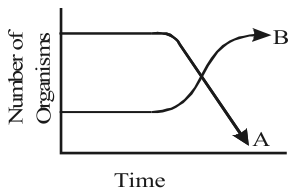
- 1Population B competed more successfully for food than population A
- 2Population A produced more offspring than population B
- 3Population A consumed the members of population B
- 4Both plant populations in this habitat decreased
Show answer and solution
Correct: option 1, Population B competed more successfully for food than population A
In the graph population A falls while population B rises and levels off at a higher number. Both are herbivores using the same grass, so the likely reason is competition in which B gets the food more successfully and A declines. Herbivores do not eat each other, and a fall in the plants would have reduced both.
Question 53AIPMT 2015 Re-test, Q51
An association of individuals of different species living in the same habitat and having functional interactions is
- 1Population
- 2Ecological niche
- 3Biotic community
- 4Ecosystem
Show answer and solution
Correct: option 3, Biotic community
A population has individuals of one species only. Populations of different species that live together in one habitat and interact form a biotic community. An ecosystem would also include the non-living environment, and a niche is the functional role of a species.
Question 54AIPMT 2015 Re-test, Q58
In which of the following interactions both partners are adversely affected?
- 1Mutualism
- 2Competition
- 3Predation
- 4Parasitism
Show answer and solution
Correct: option 2, Competition
Competition is a (-, -) interaction: both species lose because they share a limited resource. Mutualism benefits both (+, +), while predation and parasitism benefit one partner and harm the other (+, -).
Question 55AIPMT 2014, Q31
Just as a person moving from Delhi to Shimla to escape the heat for the duration of hot summer, thousands of migratory birds from Siberia and other extremely cold northern regions move to:
- 1Keolado National Park
- 2Western Ghat
- 3Meghalaya
- 4Corbett National Park
Show answer and solution
Correct: option 1, Keolado National Park
Migration is one way of escaping a stressful habitat for a time. Every winter the Keolado National Park at Bharatpur in Rajasthan hosts thousands of migratory birds from Siberia and other very cold northern regions.
Question 56NEET 2013, Q96
A sedentary sea anemone gets attached to the shell lining of hermit crab. The association is:
- 1Symbiosis
- 2Commensalism
- 3Amensalism
- 4Ectoparasitism
Show answer and solution
Correct: option 1, Symbiosis
The sea anemone is carried to new feeding grounds and gets scraps of the crab's food, while its stinging cells protect the hermit crab from predators. Both partners benefit, so the association is a symbiosis (mutualism), not commensalism in which only one partner gains.
Question 57NEET 2013, Q111
A biologist studied the population of rats in a barn. He found that the average natality was 250, average mortality 240, immigration 20 and emigration 30. The net increase in population is:
- 115
- 205
- 3zero
- 410
Show answer and solution
Correct: option 3, zero
Net change = (births + immigration) - (deaths + emigration) = . The population does not change in size.
Question 58NEET 2013 Karnataka, Q74
The age pyramid with broad base indicates:
- 1high percentage of old individuals
- 2low percentage of young individuals
- 3a stable population
- 4high percentage of young individuals
Show answer and solution
Correct: option 4, high percentage of young individuals
The base of an age pyramid is the pre-reproductive group. A broad base means a high proportion of young individuals, which is the sign of an expanding population.
Question 59NEET 2013 Karnataka, Q84
Which one of the following is not a parasitic adaptation?
- 1Development of adhesive organs
- 2Loss of digestive organs
- 3Loss of reproductive capacity
- 4Loss of unnecessary sense organs
Show answer and solution
Correct: option 3, Loss of reproductive capacity
Parasites have a very high reproductive capacity, which makes up for the heavy loss of eggs and larvae while reaching a new host. Adhesive organs and the loss of the digestive system and of unneeded sense organs are typical parasitic adaptations.
Question 60NEET 2013 Karnataka, Q93
Benthic organism are affected most by:
- 1Light reaching the forest floor
- 2Surface turbulence of water
- 3Sediment characteristics of aquatic ecosystems
- 4Water-holding capacity of soil
Show answer and solution
Correct: option 3, Sediment characteristics of aquatic ecosystems
Benthic organisms live on or in the bottom of a water body. The nature of the bottom sediment therefore decides which of them can live there, more than light on land, surface waves or soil properties.
Question 61AIPMT 2012 Prelims, Q139
People who have migrated from the plains to an area adjoining Rohtang Pass about six months back:
- 1have more RBCs and their haemoglobin has a lower binding affinity to .
- 2are not physically fit to play games like football.
- 3suffer from altitude sickness with symptoms like nausea, fatigue, etc.
- 4have the usual RBC count but their haemoglobin has very high binding affinity to .
Show answer and solution
Correct: option 1, have more RBCs and their haemoglobin has a lower binding affinity to .
At high altitude the low atmospheric pressure gives the body too little oxygen, and a newcomer suffers altitude sickness for a short time. The body then acclimatises: it makes more red blood cells, lowers the binding affinity of haemoglobin for oxygen so that oxygen is released more readily to tissues, and raises the breathing rate. After six months these people are acclimatised, so they no longer have altitude sickness and can be physically active.
Question 62AIPMT 2012 Mains, Q83
Cuscuta is an example of:
- 1Ectoparasitism
- 2Brood parasitism
- 3Predation
- 4Endoparasitism
Show answer and solution
Correct: option 1, Ectoparasitism
Cuscuta (dodder) is a leafless parasitic plant that twines around the outside of its host and draws food through haustoria. Since it lives on the external surface of the host it is an ectoparasite. Brood parasitism is seen in birds such as the cuckoo.
Question 63AIPMT 2011 Prelims, Q56
What type of human population is represented by the following age pyramid
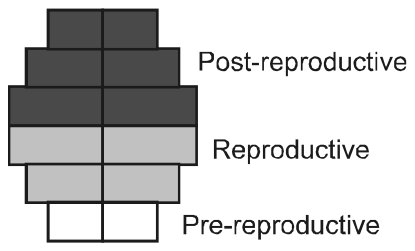
- 1Vanishing population
- 2Stable population
- 3Declining population
- 4Expanding population
Show answer and solution
Correct: option 3, Declining population
The pyramid is narrowest at the base: the pre-reproductive group is the smallest and the post-reproductive group is large. With few young individuals to replace the older ones the population will shrink, so this urn-shaped pyramid shows a declining population.
Question 64AIPMT 2011 Prelims, Q102
Consider the following four conditions (a - d) and select the correct pair of them as adaptation to environment in desert lizards.
The conditions:
(a) burrowing in soil to escape high temperature
(b) losing heat rapidly from the body during high temperature
(c) bask in sun when temperature is low
(d) insulating body due to thick fatty dermis
Options:
- 1(c), (d)
- 2(a), (c)
- 3(b), (d)
- 4(a), (b)
Show answer and solution
Correct: option 2, (a), (c)
Desert lizards cannot regulate body temperature physiologically, so they do it by behaviour. They bask in the sun when their body temperature falls below the comfort range (c) and move into shade or burrow into the soil when it gets too hot (a). They neither lose heat rapidly by a physiological route (b) nor have an insulating fatty dermis (d).
Question 65AIPMT 2011 Prelims, Q111
Which one of the following is categorised as a parasite in true sense?
- 1The female Anopheles bites and sucks blood from humans
- 2Human foetus developing inside the uterus draws nourishment from the mother
- 3Head louse living on the human scalp as well as laying eggs on human hair
- 4The cuckoo (koel) lays its eggs in crow's nest.
Show answer and solution
Correct: option 3, Head louse living on the human scalp as well as laying eggs on human hair
A true parasite lives on or in its host, feeds on it and completes its life cycle there. The head louse lives on the scalp, sucks blood and lays its eggs on the hair. A female Anopheles only visits the host to feed, a foetus is the mother's own offspring, and the koel shows brood parasitism, where only the eggs are left with the host.
Question 66AIPMT 2011 Mains, Q67
Consider the following statements (A)-(D) each with one or two blanks.
(A) Bears go into __(1)__ during winter to __(2)__ cold weather
(B) A conical age pyramid with a broad base represents __(3)__ human population
(C) A wasp pollinating a fig flower is an example of __(4)__
(D) An area with high levels of species richness is known as __(5)__
Which one of the following options give the correct fill ups the respective blank numbers from (1) to (5) in the statements
- 1(2) - stable (4) commensalism, (5) marsh
- 2(1) - aestivation, (5) - escape, (3) - stable, (4) - mutualism
- 3(3) - expanding, (4) - commensalism, (5) biodiversity park
- 4(1)- hibernation, (2) - escape, (3) - expanding, (5) hot spot
Show answer and solution
Correct: option 4, (1)- hibernation, (2) - escape, (3) - expanding, (5) hot spot
Bears go into hibernation in winter to escape the cold, so (1) is hibernation and (2) is escape. A triangular age pyramid with a broad base shows many young individuals, which means an expanding population, so (3) is expanding. The fig and its wasp both benefit, so (4) is mutualism, not commensalism. A region of very high species richness is a hot spot, so (5) is hot spot. Only the last option has every entry right.
Question 67AIPMT 2011 Mains, Q90
The logistic population growth is expressed by the equation:
- 1
- 2
- 3
- 4
Show answer and solution
Correct: option 2,
When resources are limited, the growth rate is reduced by the fraction of the carrying capacity that is still unused, . This gives the Verhulst-Pearl logistic equation . The equation is exponential growth.
Question 68AIPMT 2010 Mains, Q81
Which one of the following is most appropriately defined
- 1Parasite is an organism which always lives inside the body of other organism and may kill it.
- 2Host is an organism which provides food to another organism.
- 3Amensalism is a relationship in which one species is benefited where as the other is unaffected.
- 4Predator is an organism that catches and kills other organism for food.
Show answer and solution
Correct: option 4, Predator is an organism that catches and kills other organism for food.
A predator captures, kills and eats its prey, so option (4) is an accurate definition. A parasite need not live inside the host (ectoparasites live on it), a host gives shelter as well as food and the word is not used for prey, and in amensalism one species is harmed while the other is unaffected (one benefiting with the other unaffected is commensalism).
Question 69AIPMT 2010 Prelims, Q124
Study the four statements (a-d) given below and select the two correct ones out of them
(a) A lion eating a deer and a sparrow feeding on grain are ecologically similar in being consumers
(b) Predator star fish Pisaster helps in maintaining species diversity of some invertebrates
(c) Predators ultimately lead to the extinction of prey species
(d) Production of chemicals such as nicotine, strychnine by the plants are metabolic disorders
The two correct statements are
- 1(c) and (d)
- 2(a) and (d)
- 3(a) and (b)
- 4(b) and (c)
Show answer and solution
Correct: option 3, (a) and (b)
(a) is correct: both the lion and the sparrow feed on other organisms, so both are consumers. (b) is correct: when Pisaster was removed from a rocky shore, more than ten invertebrate species died out through competition. (c) is wrong because predators are prudent and keep prey numbers in check without wiping them out. (d) is wrong because nicotine and strychnine are defence chemicals against grazers, not disorders. So (a) and (b) are the correct pair.
Question 70AIPMT 2010 Prelims, Q171
The figure given below is a diagrammatic representation of response of organisms to abiotic factors. What do a, b and c represent respectively
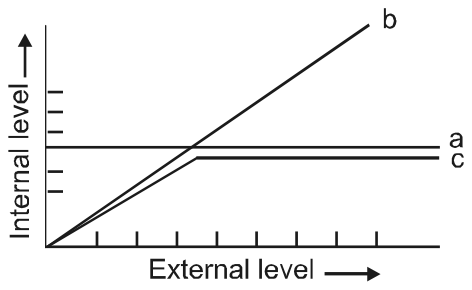
- 1a-regulator, b-partial regulator, c-Conformer
- 2a-partial regulator, b-regulator, c-Conformer
- 3a-regulator, b-conformer, c-partial regulator
- 4a-conformer, b-regulator, c-partial regulator
Show answer and solution
Correct: option 3, a-regulator, b-conformer, c-partial regulator
Line a is flat: the internal level stays constant whatever the external level, which is a regulator. Line b rises in step with the external level, which is a conformer. Line c follows the external level at first and then becomes constant, so the organism regulates only over a part of the range: a partial regulator.
Question 71AIPMT 2010 Prelims, Q194
Which one of the following is one of the characteristics of a biological community
- 1Natality
- 2Mortality
- 3Sex-ratio
- 4Stratification
Show answer and solution
Correct: option 3, Sex-ratio
The answer key of the source copy gives sex-ratio. Note that natality, mortality and sex ratio are all attributes of a population, that is, of the individuals of one species. A community is made of many species, and its characteristics include species composition, dominance and stratification (the vertical layering of species), so Stratification is the answer that fits the textbook.
Question 72AIPMT 2009 Prelims, Q103
A country with a high rate of population growth took measures to reduce it. The Figure below shows age-sex pyramids of populations A and B twenty years apart. Select the correct interpretation about them:
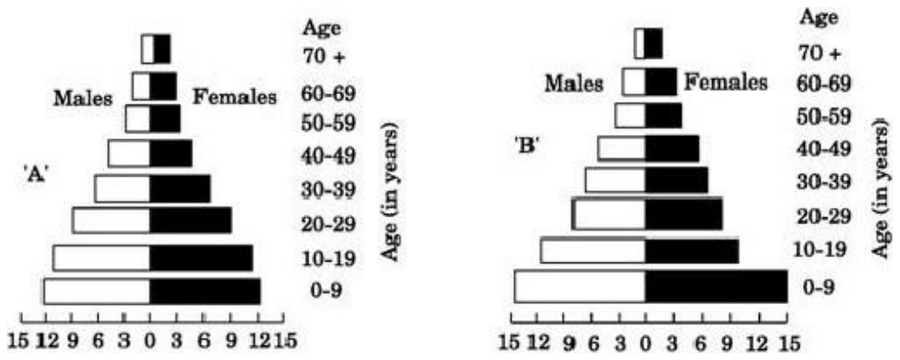
- 1"B" is earlier pyramid and shows stabilised growth rate.
- 2"B" is more recent showing that population is very young.
- 3"A" is the earlier pyramid and no change has occurred in the growth rate.
- 4"A" is more recent and shows slight reduction in the growth rate.
Show answer and solution
Correct: option 4, "A" is more recent and shows slight reduction in the growth rate.
Pyramid B has a very broad base, with the 0-9 group much larger than the 10-19 group, which is the shape of a rapidly growing population. In pyramid A the 0-9 group is about the same size as the 10-19 group, so fewer children are being added. Since the country acted to reduce growth, A is the later pyramid and shows a slight fall in the growth rate.
Question 73AIPMT 2009 Prelims, Q147
Reduction in vascular tissue, mechanical tissue and cuticle is characteristic of:
- 1Mesophytes
- 2Epiphytes
- 3Hydrophytes
- 4Xerophytes
Show answer and solution
Correct: option 3, Hydrophytes
Water plants are supported by the water around them and can absorb water over their whole surface. So they need little mechanical tissue, little xylem and almost no cuticle. Xerophytes show the opposite: thick cuticle and well-developed mechanical and vascular tissue.
Question 74AIPMT 2008 Prelims, Q170
Quercus species are the dominant component in
- 1Tropical rain forests
- 2Temperate deciduous forests
- 3Alpine forests
- 4Scrub forests
Show answer and solution
Correct: option 2, Temperate deciduous forests
Quercus is the oak. Oaks are broad-leaved trees that dominate temperate deciduous forests.
Question 75AIPMT 2008 Prelims, Q179
Consider the following four statements (a - d) about certain desert animals such as kangaroo rat.
(a) They have dark colour and high rate of reproduction and excrete solid urine
(b) They do not drink water, breathe at a slow rate to conserve water and have their body covered with thick hairs
(c) They feed on dry seeds and do not require drinking water
(d) They excrete very concentrated urine and do not use water to regulate body temperature
Which two of the above statements for such animals are true?
- 1a and b
- 2c and d
- 3b and c
- 4c and a
Show answer and solution
Correct: option 2, c and d
The kangaroo rat lives on dry seeds and meets its water needs from the water formed in its own metabolism, so it does not need to drink (c). It saves water by passing very concentrated urine and by not sweating to cool itself (d). Statements (a) and (b) contain features that are not true of it, such as dark colour, solid urine and thick hair.
Question 76AIPMT 2007 Prelims, Q3
Which one of the following is an example of negative feed back loop in humans?
- 1Secretion of sweat glands and constriction of skin blood vessels when it is too hot.
- 2Constriction of skin blood vessels and contraction of skeletal muscles when it is too cold.
- 3Secretion of tears after falling of sand particles into the eye
- 4Salivation of mouth at the sight of delicious food.
Show answer and solution
Correct: option 2, Constriction of skin blood vessels and contraction of skeletal muscles when it is too cold.
In a negative feedback loop the response opposes the change. When the body is too cold, skin vessels constrict to save heat and skeletal muscles contract (shivering) to make heat, bringing the temperature back up. Option 1 is wrong because skin vessels dilate, not constrict, when it is hot; tears and salivation are simple reflexes.
Question 77AIPMT 2007 Prelims, Q69
A high density of elephant population in an area can result in:
- 1Predation on one another
- 2Mutualism
- 3Intra specific competition
- 4Inter specific competition
Show answer and solution
Correct: option 3, Intra specific competition
When many individuals of one species live in the same area they need the same food, water and space, so they compete with each other. Competition among members of the same species is intraspecific competition.
Question 78AIPMT 2007 Prelims, Q70
Geometric representation of age structure is a characteristic of:
- 1Ecosystem
- 2Biotic community
- 3Population
- 4Landscape
Show answer and solution
Correct: option 3, Population
Age structure, the proportion of individuals in the pre-reproductive, reproductive and post-reproductive age groups, is an attribute of a population. It is drawn as an age pyramid, which is its geometric representation.
Question 79AIPMT 2007 Prelims, Q89
The population of an insect species shows an explosive increase in numbers during rainy season followed by its disappearance at the end of the season. What does this show?
- 1The population of its predators increases enormously.
- 2S-shaped or sigmoid growth of this insect.
- 3The food plants mature and die at the end of the rainy season.
- 4Its population growth curve is of J-type.
Show answer and solution
Correct: option 4, Its population growth curve is of J-type.
A population that grows exponentially and then crashes suddenly, instead of levelling off at a carrying capacity, gives a J-shaped growth curve. The explosive rise in the rainy season followed by the sudden disappearance is exactly this pattern.
Question 80AIPMT 2006 Prelims, Q107
Praying mantis is a good example of-
- 1Mullerian mimicry
- 2Warning colouration
- 3Social insects
- 4Camouflage
Show answer and solution
Correct: option 4, Camouflage
The green or brown body of a praying mantis blends with the leaves and twigs it sits on, hiding it from both its prey and its predators. This concealing resemblance to the surroundings is camouflage. It is neither a warningly coloured nor a social insect.
Question 81AIPMT 2006 Prelims, Q115
The formula for exponential population growth is-
- 1dt/dN = rN
- 2dN/rN = dt
- 3rN/dN = dt
- 4dN/dt = rN
Show answer and solution
Correct: option 4, dN/dt = rN
With unlimited resources, the rate of change of population size (dN/dt) is proportional to the population size N, with r the intrinsic rate of natural increase: dN/dt = rN. This gives a J-shaped growth curve.
Question 82AIPMT 2006 Prelims, Q117
- 1Active cooperation between two species
- 2Two different parasites on the same host
- 3Sharing of one or more resources between the two species
- 4Mutualism between two species
Show answer and solution
Correct: option 3, Sharing of one or more resources between the two species
A niche is the set of resources and conditions a species uses. When the niches of two species overlap, they use one or more of the same resources, such as food or space, which can lead to competition between them.
Question 83AIPMT 2005 Prelims, Q152
Animals have the innate ability to escape from predation. Examples for the same are given below. Select the incorrect example
- 1Colour change in chameleon
- 2Poison fangs in snakes
- 3Melanism in moths
- 4Enlargement of body size by swallowing air in puffer fish
Show answer and solution
Correct: option 4, Enlargement of body size by swallowing air in puffer fish
Colour change in a chameleon and dark colouring in moths are camouflage, and a puffer fish swells up with air or water to become too large and spiny to swallow; all three help the animal avoid being eaten. Poison fangs in snakes are mainly a tool for killing prey, so on the biology option (2) looks like the example that does not fit. The key used here gives option (4), and that answer is kept.
Question 84AIPMT 2005 Prelims, Q182
Which one of the following pairs in mismatched
- 1Savanna - acacia trees
- 2Coniferous forest - evergreen trees
- 3Tundra - permafrost
- 4Prairie - epiphytes
Show answer and solution
Correct: option 4, Prairie - epiphytes
A savanna is grassland with scattered trees such as acacia, coniferous forest is made of evergreen trees like pine and fir, and the tundra has permanently frozen subsoil (permafrost). A prairie is a temperate grassland with almost no trees, whereas epiphytes grow on trees and are typical of tropical rain forests. So prairie and epiphytes do not go together.
Question 85AIPMT 2005 Prelims, Q187
At which latitude, heat gain through insolation approximately equals heat loss through terrestrial radiation
- 1 North and South
- 2 North and South
- 3 North and South
- 4 North and South
Show answer and solution
Correct: option 4, North and South
Between the equator and the middle latitudes the earth receives more heat from the sun than it radiates back, and nearer the poles it loses more than it receives. The two are roughly equal at about North and South, which would be option (3); near the loss is clearly greater than the gain. The key used here gives option (4), and that answer is kept.
Question 86AIPMT 2004 Prelims, Q163
Certain characteristic demographic features of developing countries are -
- 1High fertility, high density, rapidly rising mortality rate and very young age distribution
- 2High infant mortality, low fertility, uneven population growth and a very young age distribution
- 3High mortality high density, uneven population growth and a very old age distribution
- 4High fertility, low or rapidly falling mortality rate, rapid population growth and a very young age distribution
Show answer and solution
Correct: option 4, High fertility, low or rapidly falling mortality rate, rapid population growth and a very young age distribution
In developing countries the birth rate stays high while better health care brings the death rate down quickly. The gap between the two gives rapid population growth and an age pyramid with a broad base, that is, a large share of young people.
Question 87AIPMT 2004 Prelims, Q185
In which of the following pairs is the specific characteristic of a soil not correctly matched:-
- 1Terra rossa – Most suitable for roses
- 2Chernozems – Richest soil in the world
- 3Black soil – Rich in calcium carbonate
- 4Laterite – Contains aluminium compound
Show answer and solution
Correct: option 1, Terra rossa – Most suitable for roses
Terra rossa means "red earth": a red, clayey soil formed over limestone, coloured by iron oxide. The name has nothing to do with roses, so pair (1) is wrong. Chernozems are the very fertile black soils of the grasslands, black cotton soil is rich in lime, and laterite is rich in iron and aluminium oxides.
Question 88AIPMT 2004 Prelims, Q191
In which one of the following habitats does the diurnal temperature of soil surface vary most?
- 1Forest
- 2Desert
- 3Grassland
- 4Shrub land
Show answer and solution
Correct: option 2, Desert
Bare, dry desert sand under a clear sky heats up strongly by day and loses heat quickly at night, because there is no plant cover, soil moisture or cloud to buffer it. In forest, grassland and shrub land the vegetation and soil water reduce the day-night swing.
Question 89AIPMT 2003 Prelims, Q113
Two opposite forces operate in the growth and development of every population. One of them relates to the ability to reproduce at a given rate. The force opposing it is called:
- 1Morbidity
- 2Fecundity
- 3Biotic potential
- 4Environmental resistance
Show answer and solution
Correct: option 4, Environmental resistance
The inherent ability of a population to reproduce at a given rate is its biotic potential. It is checked by the sum of the limiting factors of the environment, such as shortage of food and space, predators and disease, which together are called environmental resistance.
Question 90AIPMT 2003 Prelims, Q188
Mycorrhiza is an example of:-
- 1Symbiotic relationship
- 2Ectoparasitism
- 3Endoparasitism
- 4Decomposers
Show answer and solution
Correct: option 1, Symbiotic relationship
Mycorrhiza is an association between a fungus and the roots of a higher plant. The fungus supplies water and minerals, especially phosphorus, and receives sugars from the plant, so both gain: a symbiotic (mutualistic) relationship.
Question 91AIPMT 2002 Prelims, Q102
Significance of mimicry is -
- 1Attack (Offence)
- 2Protection (Defence)
- 3Both (1) & (2)
- 4Isolation
Show answer and solution
Correct: option 3, Both (1) & (2)
Mimicry is the resemblance of one organism to another organism or to its surroundings. It can protect the mimic from predators (protective mimicry, as in a harmless butterfly resembling a distasteful one) and it can also help a predator approach its prey unnoticed (aggressive mimicry, as in a praying mantis resembling a leaf or flower). So it serves both defence and offence.
Question 92AIPMT 2002 Prelims, Q105
In a population, unrestricted reproductive capacity is called as -
- 1Biotic potential
- 2Fertility
- 3Carrying capacity
- 4Birth rate
Show answer and solution
Correct: option 1, Biotic potential
Biotic potential is the maximum, inherent capacity of a population to reproduce when resources are unlimited and nothing checks its growth. Carrying capacity is the largest population the environment can support, and birth rate and fertility describe the actual reproduction achieved.
Question 93AIPMT 2002 Prelims, Q153
Which type of association is found in between entomophilous flower and pollinating agent:-
- 1Mutualism
- 2Commensalism
- 3Cooperation
- 4Co-evolution
Show answer and solution
Correct: option 1, Mutualism
An insect-pollinated flower gets its pollen carried, and the insect gets nectar or pollen as food. Both partners benefit, which is mutualism. In commensalism only one partner would benefit.
Question 94AIPMT 2002 Prelims, Q157
Two different species can not live for long duration in the same niche or habitat. This law is:-
- 1Allen's law
- 2Gause's law
- 3Competitive exclusion principle
- 4Weismann's theory
Show answer and solution
Correct: option 2, Gause's law
The statement that two species competing for the same resources cannot coexist indefinitely was given by Gause, so it is called Gause's law (it is also known as the competitive exclusion principle). The key gives Gause's law. Allen's law is about shorter extremities in cold climates and Weismann's theory is about the germplasm.
Question 95AIPMT 2002 Prelims, Q158
Which of the following is a correct pair:-
- 1Cuscuta – parasite
- 2Dischidia – insectivorous
- 3Opuntia – predator
- 4Capsella – hydrophyte
Show answer and solution
Correct: option 1, Cuscuta – parasite
Cuscuta (dodder) is a total stem parasite that has no chlorophyll and takes food from its host through haustoria. Dischidia is an epiphyte with pitcher-like leaves, Opuntia is a xerophyte and Capsella is a mesophytic land plant, so the other pairs are wrong.
Question 96AIPMT 1999 Prelims, Q131
The plant having the largest flower is:
- 1Total stem parasite
- 2Epiphyte
- 3Total root parasite
- 4Partial stem parasite
Show answer and solution
Correct: option 3, Total root parasite
The largest flower belongs to Rafflesia. It has no leaves or chlorophyll and lives entirely inside the roots of its host vine, taking all its food from them, so it is a total root parasite.
Question 97AIPMT 1999 Prelims, Q144
Exponential growth is shown by:
- 1Unicellular forms
- 2A cell in tissue culture
- 3Embryo
- 4Multicellular plants
Show answer and solution
Correct: option 2, A cell in tissue culture
The key gives a cell in tissue culture. In a culture with plenty of nutrients and space each cell divides into two and both daughter cells keep dividing, so the number doubles at each generation, which is exponential (geometric) growth. Growth in an embryo or a whole plant is soon limited and follows a sigmoid course.
Question 98AIPMT 1999 Prelims, Q191
What will be happen if the number of organism increased at a place:
- 1Inter species competition
- 2Intra species competition
- 3Both
- 4None
Show answer and solution
Correct: option 3, Both
More organisms in one place means more demand for the same limited food, space and other resources. Members of the same species then compete with one another (intraspecific competition), and so do different species that need the same resources (interspecific competition). Both kinds increase.
Question 99AIPMT 1998 Prelims, Q146
Acacia, Prosopis and Capparis belongs to:
- 1Deciduous forest
- 2Tropical forest
- 3Thorn forest
- 4Evergreen forest
Show answer and solution
Correct: option 3, Thorn forest
Acacia, Prosopis and Capparis are spiny, small-leaved xerophytes of dry regions with very little rain, such as Rajasthan. This vegetation is called thorn forest.
Question 100AIPMT 1998 Prelims, Q147
- 1Arboreal
- 2Fossorial
- 3Crepuscular
- 4Nocturnal
Show answer and solution
Correct: option 2, Fossorial
Desert animals escape the heat and the loss of water by living in burrows, where it is cooler and more humid; burrowing animals are called fossorial, which is the keyed answer. There are few trees, so they are not arboreal. Many desert animals also come out only at night.
Question 101AIPMT 1998 Prelims, Q188
In which biome a new plant may adapt soon:
- 1Tropical rain forest
- 2Desert
- 3Mangrove
- 4Sea island
Show answer and solution
Correct: option 1, Tropical rain forest
A tropical rain forest has warmth, plenty of water and a long growing season all through the year, so a newly arrived plant meets the least stress there. Deserts, mangroves and sea islands have harsh conditions such as drought, salt and wind.
Question 102AIPMT 1998 Prelims, Q198
Two opposite forces operate in the growth and development of every population. One of them related to the ability to reproduce at a given rate. The force opposite to it is called:
- 1Fecundity
- 2Environmental resistances
- 3Biotic control
- 4Mortality
Show answer and solution
Correct: option 2, Environmental resistances
The inborn capacity of a population to increase is its biotic potential. All the factors that hold this increase back, such as shortage of food and space, predators and disease, together make up the environmental resistance.