Questions with solutions
Question 1NEET 2026, Q172
The specific receptors for neurotransmitters in a synapse are present on _______.
- 1Post-synaptic membrane
- 2Pre-synaptic membrane
- 3Myelin sheath
- 4Schwann cell
Show answer and solution
Correct: option 1, Post-synaptic membrane
At a chemical synapse the neurotransmitter is released from the synaptic vesicles of the pre-synaptic neuron into the synaptic cleft and binds to its specific receptors on the post-synaptic membrane, which opens ion channels there.
Question 2NEET 2026 Re-exam, Q95
Which of the following is not a part of human central neural system?
- 1Arachnoid
- 2Dura mater
- 3Pia mater
- 4Pericardium
Show answer and solution
Correct: option 4, Pericardium
The brain is covered by three cranial meninges: the outer dura mater, the middle arachnoid and the inner pia mater. The pericardium is the double-walled sac around the heart, so it has nothing to do with the central neural system.
Question 3NEET 2024, Q165
Match List I with List II:
| List I | List II |
|---|
| A. Pons | I. Provides additional space for Neurons, regulates posture and balance. |
| B. Hypothalamus | II. Controls respiration and gastric secretions. |
| C. Medulla | III. Connects different regions of the brain. |
| D. Cerebellum | IV. Neuro secretory cells |
Choose the correct answer from the options given below:
- 1A-II, B-I, C-III, D-IV
- 2A-II, B-III, C-I, D-IV
- 3A-III, B-IV, C-II, D-I
- 4A-I, B-III, C-II, D-IV
Show answer and solution
Correct: option 3, A-III, B-IV, C-II, D-I
The pons is made of fibre tracts that connect different regions of the brain. The hypothalamus contains neurosecretory cells that release hypothalamic hormones. The medulla has the centres for respiration, cardiovascular reflexes and gastric secretions. The cerebellum has a much folded surface that gives room for many more neurons and it controls posture and balance. So A-III, B-IV, C-II, D-I.
Question 4NEET 2024, Q186
Given below are two statements:
Statement I: The cerebral hemispheres are connected by nerve tract known as corpus callosum.
Statement II: The brain stem consists of the medulla oblongata, pons and cerebrum.
In the light of the above statements, choose the most appropriate answer from the options given below:
- 1Statement I is incorrect but Statement II is correct.
- 2Both Statement I and Statement II are correct.
- 3Both Statement I and Statement II are incorrect.
- 4Statement I is correct but Statement II is incorrect.
Show answer and solution
Correct: option 4, Statement I is correct but Statement II is incorrect.
The two cerebral hemispheres are joined by a tract of nerve fibres called the corpus callosum, so Statement I is correct. The brain stem is made of the midbrain, pons and medulla oblongata; the cerebrum is not part of it, so Statement II is incorrect.
Question 5NEET 2024 Re-exam, Q181
Match List-I with List-II
| List-I | List-II |
|---|
| A. Schwann cells | I. Neurotransmitter |
| B. Synaptic knob | II. Cerebral cortex |
| C. Bipolar neurons | III. Myelin sheath |
| D. Multipolar neurons | IV. Retina |
Choose the correct answer from the options given below:
- 1A-III, B-I, C-IV, D-II
- 2A-I, B-IV, C-II, D-III
- 3A-IV, B-III, C-II, D-I
- 4A-II, B-III, C-I, D-IV
Show answer and solution
Correct: option 1, A-III, B-I, C-IV, D-II
Schwann cells wrap around the axon and form the myelin sheath. The synaptic knob at the end of an axon holds vesicles filled with neurotransmitter. Bipolar neurons, with one axon and one dendrite, are found in the retina of the eye. Multipolar neurons, with one axon and two or more dendrites, are found in the cerebral cortex. So A-III, B-I, C-IV, D-II.
Question 6NEET 2023, Q170
Match List I with List II with respect to human eye.
| List I | List II |
|---|
| A. Fovea | I. Visible coloured portion of eye that regulates diameter of pupil. |
| B. Iris | II. External layer of eye formed of dense connective tissue. |
| C. Blind spot | III. Point of greatest visual acuity or resolution. |
| D. Sclera | IV. Point where optic nerve leaves the eyeball and photoreceptor cells are absent. |
Choose the correct answer from the options given below:
- 1A-III, B-I, C-IV, D-II
- 2A-IV, B-III, C-II, D-I
- 3A-I, B-IV, C-III, D-II
- 4A-II, B-I, C-III, D-IV
Show answer and solution
Correct: option 1, A-III, B-I, C-IV, D-II
The fovea, packed with cones, is the point of greatest visual acuity (III). The iris is the visible coloured part of the eye and regulates the diameter of the pupil (I). The blind spot is where the optic nerve leaves the eyeball and there are no photoreceptor cells (IV). The sclera is the external layer of dense connective tissue (II). This is option (1).
Question 7NEET 2023, Q188
The parts of human brain that helps in regulation of sexual behaviour, expression of excitement, pleasure, rage, fear etc. are:
- 1Limbic system & hypothalamus
- 2Corpora quadrigemina & hippocampus
- 3Brain stem & epithalamus
- 4Corpus callosum and thalamus
Show answer and solution
Correct: option 1, Limbic system & hypothalamus
The inner parts of the cerebral hemispheres together with the amygdala and hippocampus form the limbic system. Along with the hypothalamus, it regulates sexual behaviour and the expression of emotional reactions such as excitement, pleasure, rage and fear, and motivation. So option (1) is right.
Question 8NEET 2023 Manipur, Q176
Brainstem of human brain consists of:
- 1Thalamus, Hypothalamus and Corpora quadrigemina
- 2Amygdala, Hippocampus and Corpus Callosum
- 3Mid-brain, Pons and Medulla Oblongata
- 4Forebrain, Cerebellum and Pons
Show answer and solution
Correct: option 3, Mid-brain, Pons and Medulla Oblongata
The brain stem is formed by three regions: the midbrain, the pons and the medulla oblongata. It connects the forebrain with the spinal cord; the cerebellum, thalamus and limbic structures are not part of it.
Question 9NEET 2023 Manipur, Q184
Given below are two statements:
Statement I: The nose contains mucus-coated receptors which are specialised for receiving the sense of smell and are called olfactory receptors.
Statement II: Wall of the eye ball has three layers. The external layer is called choroid (dense connective tissue), middle layer is sclera (thin pigmented layer) and internal layer is retina (ganglion cells, bipolar cells and photoreceptor cells).
In the light of the above statements, choose the correct answer from the options given below:
- 1Both Statement I and Statement II are true
- 2Both Statement I and Statement II are false
- 3Statement I is true but Statement II is false
- 4Statement I is false but Statement II is true
Show answer and solution
Correct: option 3, Statement I is true but Statement II is false
Statement I is true: the olfactory receptors of the nose are mucus-coated. Statement II swaps two layers: the outer layer of the eyeball is the sclera (dense connective tissue) and the middle layer is the choroid (thin, pigmented, rich in blood vessels); only the retina is described correctly. So Statement II is false.
Question 10NEET 2022, Q194
Select the incorrect statement regarding synapses:
- 1Impulse transmission across a chemical synapse is always faster than that across an electrical synapse.
- 2The membranes of presynaptic and postsynaptic neurons are in close proximity in an electrical synapse.
- 3Electrical current can flow directly from one neuron into the other across the electrical synapse.
- 4Chemical synapses use neurotransmitters
Show answer and solution
Correct: option 1, Impulse transmission across a chemical synapse is always faster than that across an electrical synapse.
Transmission across an electrical synapse is always faster than across a chemical synapse, because current flows directly between the closely placed membranes, while a chemical synapse depends on the release and binding of a neurotransmitter. Statement (1) says the opposite, so it is incorrect.
Question 11NEET 2022 Re-exam, Q199
Match List-I with List-II:
| List-I | List-II |
|---|
| (a) Multipolar neuron | (i) Somatic neural system |
| (b) Bipolar neuron | (ii) Cerebral cortex |
| (c) Myelinated nerve fibre | (iii) Retina of Eye |
| (d) Unmyelinated nerve fibre | (iv) Spinal nerves |
Choose the correct answer from the options given below:
- 1a-ii, b-iii, c-iv, d-i
- 2a-iii, b-i, c-iv, d-ii
- 3a-ii, b-iv, c-iii, d-i
- 4a-ii, b-iii, c-i, d-iv
Show answer and solution
Correct: option 1, a-ii, b-iii, c-iv, d-i
Multipolar neurons are found in the cerebral cortex (ii) and bipolar neurons in the retina of the eye (iii). Myelinated nerve fibres are found in spinal and cranial nerves (iv), and unmyelinated fibres in the autonomous and somatic neural systems (i). So a-ii, b-iii, c-iv, d-i.
Question 12NEET 2020, Q68
Match the following columns and select the correct option.
| Column - I | Column - II |
|---|
| (a) Organ of Corti | (i) Connects middle ear and pharynx |
| (b) Cochlea | (ii) Coiled part of the labyrinth |
| (c) Eustachian tube | (iii) Attached to the oval window |
| (d) Stapes | (iv) Located on the basilar membrane |
- 1a-ii, b-iii, c-i, d-iv
- 2a-iii, b-i, c-iv, d-ii
- 3a-iv, b-ii, c-i, d-iii
- 4a-i, b-ii, c-iv, d-iii
Show answer and solution
Correct: option 3, a-iv, b-ii, c-i, d-iii
The organ of Corti, which holds the hair cells, lies on the basilar membrane (a-iv). The cochlea is the coiled part of the labyrinth (b-ii). The Eustachian tube connects the middle ear cavity with the pharynx (c-i). The stapes is the ear ossicle attached to the oval window (d-iii).
Question 13NEET 2020 Phase 2, Q81
Match the following columns and select the correct option:
| Column - I | Column - II |
|---|
| (a) Rods and Cones | (i) Absence of photoreceptor cells |
| (b) Blind Spot | (ii) Cones are densely packed |
| (c) Fovea | (iii) Photoreceptor cells |
| (d) Iris | (iv) Visible coloured portion of the eye |
- 1a-ii, b-iii, c-i, d-iv
- 2a-iii, b-iv, c-ii, d-i
- 3a-ii, b-iv, c-iii, d-i
- 4a-iii, b-i, c-ii, d-iv
Show answer and solution
Correct: option 4, a-iii, b-i, c-ii, d-iv
Rods and cones are the photoreceptor cells of the retina. The blind spot, where the optic nerve leaves the eye, has no photoreceptor cells. The fovea is the point where only cones are densely packed, and the iris is the visible coloured portion of the eye. So the matching is a-iii, b-i, c-ii, d-iv.
Question 14NEET 2019, Q99
Which part of the brain is responsible for thermoregulation?
- 1Cerebrum
- 2Hypothalamus
- 3Corpus callosum
- 4Medulla oblongata
Show answer and solution
Correct: option 2, Hypothalamus
The hypothalamus contains the centres that control body temperature, as well as the urge for eating and drinking. The medulla controls respiration and cardiovascular reflexes, and the corpus callosum only connects the two cerebral hemispheres.
Question 15NEET 2019, Q164
Which of the following statements is correct?
- 1Cornea is an external, transparent and protective proteinaceous covering of the eye-ball.
- 2Cornea consists of dense connective tissue of elastin and can repair itself.
- 3Cornea is convex, transparent layer which is highly vascularised.
- 4Cornea consists of dense matrix of collagen and is the most sensitive portion of the eye.
Show answer and solution
Correct: option 4, Cornea consists of dense matrix of collagen and is the most sensitive portion of the eye.
The cornea is the transparent front part of the outer coat of the eye. It is made of a dense matrix of collagen, has no blood vessels, and is very richly supplied with nerve endings, which makes it the most sensitive part of the eye. It covers only the front of the eyeball (the rest is sclera) and is not made of elastin, so the other statements fail.
Question 16NEET 2019 Odisha, Q130
Which of the following receptors are specifically responsible for maintenance of balance of body and posture?
- 1Tectorial membrane and macula
- 2Crista ampullaris and macula
- 3Basilar membrane and otoliths
- 4Hair cells and organ of corti
Show answer and solution
Correct: option 2, Crista ampullaris and macula
Balance and posture are the work of the vestibular apparatus of the inner ear. Its receptors are the crista ampullaris in the ampulla of each semicircular canal and the macula in the utricle and saccule. The tectorial membrane, basilar membrane and organ of Corti belong to the cochlea and serve hearing.
Question 17NEET 2019 Odisha, Q131
Which of the following statements is not correct?
- 1Rods are very sensitive and contribute to daylight vision.
- 2In the knee-jerk reflex, stimulus is the stretching of muscle and response is its contraction.
- 3An action potential in an axon does not move backward because the segment behind is in a refractory phase.
- 4Depolarisation of hair cells of cochlea results in the opening of the mechanically gated potassium-ion channels.
Show answer and solution
Correct: option 1, Rods are very sensitive and contribute to daylight vision.
Rods are very sensitive to light, which is why they serve twilight (scotopic) vision; daylight (photopic) vision and colour vision are the work of the cones. So statement (1) is not correct. The knee-jerk is a stretch reflex, and an impulse cannot travel backward because the membrane just behind it is refractory.
Question 18NEET 2018, Q139
The transparent lens in the human eye is held in its place by
- 1smooth muscles attached to the iris
- 2ligaments attached to the iris
- 3ligaments attached to the ciliary body
- 4smooth muscles attached to the ciliary body
Show answer and solution
Correct: option 3, ligaments attached to the ciliary body
The lens is suspended by suspensory ligaments, and these ligaments are attached to the ciliary body. The iris only regulates the size of the pupil and does not hold the lens.
Question 19NEET 2018, Q142
Which of the following structures or regions is incorrectly paired with its function ?
- 1Hypothalamus : production of releasing hormones and regulation of temperature, hunger and thirst.
- 2Limbic system : consists of fibre tracts that interconnect different regions of brain; controls movement.
- 3Medulla oblongata : controls respiration and cardiovascular reflexes.
- 4Corpus callosum : band of fibers connecting left and right cerebral hemispheres.
Show answer and solution
Correct: option 2, Limbic system : consists of fibre tracts that interconnect different regions of brain; controls movement.
The limbic system (amygdala, hippocampus and related inner parts of the cerebrum) works with the hypothalamus to regulate emotions, motivation and sexual behaviour; it is not a set of fibre tracts controlling movement. The other three pairs are correct.
Question 20NEET 2018, Q169
Nissl bodies are mainly composed of
- 1Nucleic acids and SER
- 2DNA and RNA
- 3Proteins and lipids
- 4Free ribosomes and RER
Show answer and solution
Correct: option 4, Free ribosomes and RER
Nissl bodies (Nissl's granules) in the cell body and dendrites of a neuron are stacks of rough endoplasmic reticulum together with free ribosomes, and are sites of protein synthesis.
Question 21NEET 2017, Q152
Good vision depends on adequate intake of carotene-rich food.
Select the best option from the following statements.
(a) Vitamin A derivatives are formed from carotene.
(b) The photopigments are embedded in the membrane discs of the inner segment.
(c) Retinal is a derivative of Vitamin A.
(d) Retinal is a light absorbing part of all the visual photopigments.
Options:
- 1(a) and (b)
- 2(a), (c) and (d)
- 3(a) and (c)
- 4(b), (c) and (d)
Show answer and solution
Correct: option 2, (a), (c) and (d)
Carotene is converted to vitamin A, and retinal is an aldehyde of vitamin A, so (a) and (c) are true. Every visual pigment is an opsin joined to retinal, which is the part that absorbs light, so (d) is true. Statement (b) is false because the pigments sit in the membrane discs of the outer segment of rods and cones.
Question 22NEET 2017, Q168
Receptor sites for neurotransmitters are present on:
- 1membranes of synaptic vesicles
- 2pre-synaptic membrane
- 3tips of axons
- 4post-synaptic membrane
Show answer and solution
Correct: option 4, post-synaptic membrane
Neurotransmitter is released from the synaptic vesicles of the axon terminal into the synaptic cleft and binds to specific receptors on the post-synaptic membrane, where it opens ion channels.
Question 23NEET 2017, Q171
Myelin sheath is produced by:
- 1Schwann Cells and Oligodendrocytes
- 2Astrocytes and Schwann Cells
- 3Oligodendrocytes and Osteoclasts
- 4Osteoclasts and Astrocytes
Show answer and solution
Correct: option 1, Schwann Cells and Oligodendrocytes
Schwann cells form the myelin sheath around axons in the peripheral nervous system and oligodendrocytes do the same in the central nervous system. Osteoclasts are bone cells and astrocytes do not make myelin.
Question 24NEET 2016 Phase 1, Q104
Photosensitive compound in human eye is made up of:
- 1Guanosine and Retinol
- 2Opsin and Retinal
- 3Opsin and Retinol
- 4Transducin and Retinene
Show answer and solution
Correct: option 2, Opsin and Retinal
The photopigments of the rods and cones consist of a protein, opsin, joined to retinal, which is an aldehyde of vitamin A. Light makes retinal separate from opsin, which starts the nerve impulse. Retinol is vitamin A itself, not the form present in the pigment.
Question 25NEET 2016 Phase 2, Q149
Choose the correct statement.
- 1Nociceptors respond to changes in pressure.
- 2Meissner's corpuscles are thermoreceptors.
- 3Photoreceptors in the human eye are depolarized during darkness and become hyperpolarized in response to the light stimulus.
- 4Receptors do not produce graded potentials.
Show answer and solution
Correct: option 3, Photoreceptors in the human eye are depolarized during darkness and become hyperpolarized in response to the light stimulus.
In the dark, sodium channels of rods and cones stay open and the cells are depolarized; light closes these channels and the cells become hyperpolarized, so statement (3) is true. Nociceptors detect pain, Meissner's corpuscles detect touch, and receptor potentials are graded, so the others are false.
Question 26AIPMT 2015, Q59
A gymnast is able to balance his body upside down even in the total darkness because of:
- 1Vestibular apparatus
- 2Tectorial membrane
- 3Organ of corti
- 4Cochlea
Show answer and solution
Correct: option 1, Vestibular apparatus
Balance and body posture are sensed by the vestibular apparatus of the inner ear (the semicircular canals and the otolith organ), which works without any help from vision. The cochlea, the organ of Corti and the tectorial membrane are all concerned with hearing.
Question 27AIPMT 2015, Q122
Which of the following regions of the brain is incorrectly paired with its function?
- 1Cerebellum - language comprehension
- 2Corpus callosum - communication between the left and right cerebral cortices
- 3Cerebrum - calculation and contemplation
- 4Medulla oblongata - homeostatic control
Show answer and solution
Correct: option 1, Cerebellum - language comprehension
The cerebellum coordinates muscular activity and maintains balance and posture. Language comprehension is a function of the association areas of the cerebrum (Wernicke's area), so this pair is wrong. The other three pairs are correct.
Question 28AIPMT 2015 Re-test, Q55
In mammalian eye, the 'fovea' is the center of the visual field, where
- 1more rods than cones are found
- 2high density of cones occur, but has no rods.
- 3the optic nerve leaves the eye.
- 4only rods are present.
Show answer and solution
Correct: option 2, high density of cones occur, but has no rods.
The fovea is the thinned-out central pit of the macula lutea. Only cones are found there, packed very densely, which makes it the point of sharpest vision. The place where the optic nerve leaves the eye is the blind spot, which has no photoreceptors at all.
Question 29AIPMT 2015 Re-test, Q113
Destruction of the anterior horn cells of the spinal cord would result in loss of:
- 1integrating impulses
- 2sensory impulses
- 3voluntary motor impulses
- 4commissural impulses
Show answer and solution
Correct: option 3, voluntary motor impulses
The anterior (ventral) horn of the grey matter of the spinal cord holds the cell bodies of motor neurons that supply the skeletal muscles. If these cells are destroyed, voluntary motor impulses cannot reach the muscles. Sensory impulses enter through the posterior horn.
Question 30AIPMT 2014, Q6
Injury localized to the hypothalamus would most likely disrupt:
- 1regulation of body temperature.
- 2short-term memory.
- 3co-ordination during locomotion.
- 4executive functions, such as decision making.
Show answer and solution
Correct: option 1, regulation of body temperature.
The hypothalamus holds the centres that control body temperature and the urge to eat and drink. Memory and decision making belong to the cerebrum, and co-ordination during locomotion belongs to the cerebellum.
Question 31AIPMT 2014, Q59
Which one of the following statements is not correct?
- 1Rhodopsin is the purplish red protein present in rods only.
- 2Retinal is the light absorbing portion of visual photo pigments.
- 3In retina the rods have the photopigment rhodopsin while cones have three different photopigments.
- 4Retinal is a derivative of Vitamin C.
Show answer and solution
Correct: option 4, Retinal is a derivative of Vitamin C.
Retinal is the aldehyde of vitamin A, not a derivative of vitamin C, so statement (4) is the incorrect one. The other statements are true: rods contain the purplish-red pigment rhodopsin, cones have three different photopigments, and retinal is the light-absorbing part of these pigments.
Question 32NEET 2013, Q112
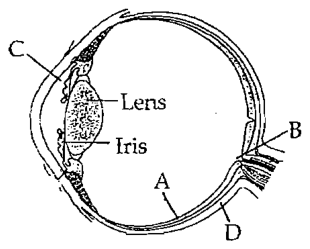
Parts A, B, C and D of the human eye are shown in the diagram. Select the option which gives correct identification along with its functions/characteristics:
- 1B - Blind spot - has only a few rods and cones.
- 2C - Aqueous chamber - reflects the light which does not pass through the lens.
- 3D - Choroid - its anterior part forms ciliary body.
- 4A - Retina - contains photo receptors - rods and cones.
Show answer and solution
Correct: option 4, A - Retina - contains photo receptors - rods and cones.
A is the retina, the innermost layer, which holds the photoreceptor cells (rods and cones), so (4) is correct. B is the blind spot, which has no rods or cones at all. C is the aqueous chamber, which is filled with a clear fluid and does not reflect light. D marks the outer wall of the eyeball (the sclera), not the choroid.
Question 33NEET 2013, Q115
The most abundant intracellular cation is:
- 1
- 2
- 3
- 4
Show answer and solution
Correct: option 3,
The sodium-potassium pump moves into the cell and out of it. So is the main cation inside cells, while is the main cation of the fluid outside them.
Question 34NEET 2013, Q129
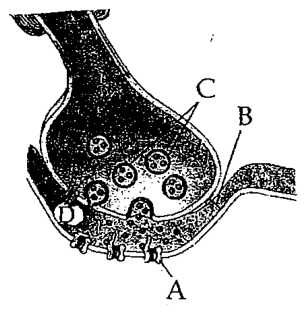
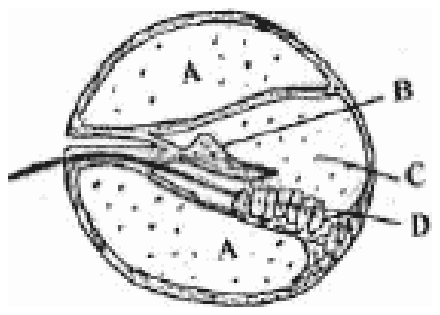
A diagram showing axon terminal and synapse is given. Identify correctly at least two of A - D.
- 1B - Synaptic connection
D -
- 2A - Neurotransmitter
B - Synaptic cleft
- 3C - Neurotransmitter
D -
- 4A - Receptor
C - Synaptic vesicles
Show answer and solution
Correct: option 4, A - Receptor
C - Synaptic vesicles
A marks the receptors on the post-synaptic membrane, B the synaptic cleft, C the synaptic vesicles inside the axon terminal, and D the neurotransmitter being released into the cleft. Only option (4) names two of the labels correctly.
Question 35NEET 2013 Karnataka, Q81
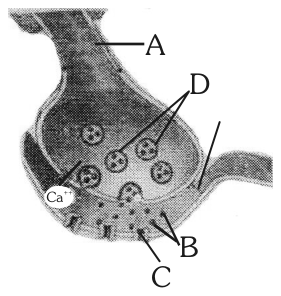
The figure shows an axon terminal and synapse. Select the option giving correct identifications of labels A-D:
- 1A-Action potential
C-Neurotransmitter
- 2B-Neurotransmitter
D-Receptor capsules
- 3C-Receptor
D-Synaptic vesicles
- 4A-Axon terminal
B-Serotonin complex
Show answer and solution
Correct: option 3, C-Receptor
D-Synaptic vesicles
A is the axon terminal, B the neurotransmitter molecules released into the synaptic cleft, C the receptors on the post-synaptic membrane, and D the synaptic vesicles inside the terminal. Only option (3) names both of its labels correctly.
Question 36NEET 2013 Karnataka, Q86
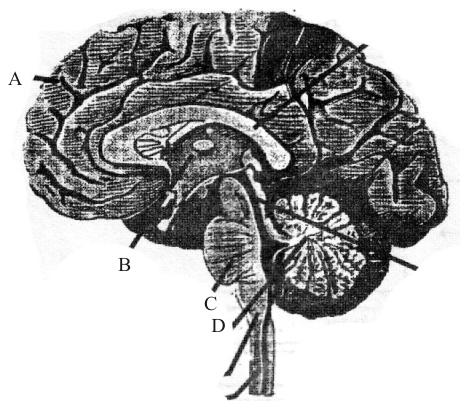
A sagittal section of human brain is shown here. Identify at least two labels from A-D:
- 1C-Mid brain
D-Cerebellum
- 2A-Cerebrum
C-Pons
- 3B-Corpus callosum
D-Medulla
- 4A-Cerebral hemispheres
B-Cerebellum
Show answer and solution
Correct: option 2, A-Cerebrum
C-Pons
A is the large folded cerebrum, C is the bulge of the pons on the brain stem, and D below it is the medulla. B points to the lower front part of the brain, which is neither the corpus callosum nor the cerebellum, so only option (2) has both labels right.
Question 37NEET 2013 Karnataka, Q114
Norepinephrine:
(a) is released by sympathetic fibers
(b) is released by parasympathetic fibers
(c) increases the heart rate
(d) decreases blood pressure
Which of the above said statements are correct?
- 1(a) and (c)
- 2(b) and (c)
- 3(b) and (d)
- 4(a) and (d)
Show answer and solution
Correct: option 1, (a) and (c)
Norepinephrine is the transmitter released by sympathetic nerve endings (parasympathetic fibres release acetylcholine). It speeds up the heart and raises blood pressure, so (a) and (c) are correct and (b) and (d) are wrong.
Question 38AIPMT 2012 Prelims, Q52
The human hind brain comprises three parts, one of which is:
- 1Spinal cord
- 2Corpus callosum
- 3Cerebellum
- 4Hypothalamus
Show answer and solution
Correct: option 3, Cerebellum
The hindbrain is made of the pons, the cerebellum and the medulla oblongata. The corpus callosum and hypothalamus belong to the forebrain, and the spinal cord is not part of the brain.
Question 39AIPMT 2012 Prelims, Q53
Which part of the human ear plays no role in hearing as such but is otherwise very much required?
- 1Eustachian tube
- 2Organ of corti
- 3Vestibular apparatus
- 4Ear ossicles
Show answer and solution
Correct: option 3, Vestibular apparatus
The vestibular apparatus (semicircular canals and the otolith organ) senses the position and movement of the head and so maintains balance and posture; it takes no part in hearing. The organ of Corti and the ear ossicles are directly involved in hearing, and the Eustachian tube equalises pressure across the eardrum.
Question 40AIPMT 2011 Prelims, Q133
When a neuron is in resting state i.e. not conducting any impulse, the axonal membrane is:
- 1Comparatively more permeable to ions and nearly impermeable to ions
- 2Equally permeable to both and ions
- 3Impermeable to both and ions
- 4Comparatively more permeable to ions and nearly impermeable to ions
Show answer and solution
Correct: option 4, Comparatively more permeable to ions and nearly impermeable to ions
In the resting state the axonal membrane is comparatively more permeable to and nearly impermeable to (and to the negatively charged proteins of the axoplasm). The outward leak of , together with the sodium-potassium pump, makes the outside positive and gives the resting potential.
Question 41AIPMT 2011 Prelims, Q136
The purplish red pigment rhodopsin contained in the rods type of photoreceptor cells of the human eye, is a derivative of:
- 1Vitamin
- 2Vitamin C
- 3Vitamin D
- 4Vitamin A
Show answer and solution
Correct: option 1, Vitamin
The source key marks option (1), Vitamin . Rhodopsin (visual purple) is made of the protein opsin and retinal, and retinal is the aldehyde of Vitamin A; this is why a lack of Vitamin A causes night blindness. The expected answer is therefore option (4), Vitamin A, and this key entry looks like an error.
Question 42AIPMT 2010 Mains, Q71
Select the answer with correct matching of the structure, its location and function.
- 1Structure: Blind spot; Location: Near the place where optic nerve leaves the eye; Function: Rods and cones are present but inactive here
- 2Structure: Eustachian tube; Location: Anterior part of internal ear; Function: Equalizes air pressure on either sides of tympanic membrane
- 3Structure: Cerebellum; Location: Mid brain; Function: Controls respiration and ganieie
- 4Structure: Hypothalamus; Location: Fore brain; Function: Controls Body temperature, urge for eating and drinking
Show answer and solution
Correct: option 4, Structure: Hypothalamus; Location: Fore brain; Function: Controls Body temperature, urge for eating and drinking
The hypothalamus lies at the base of the fore brain and has the centres for body temperature, hunger and thirst, so row 4 is fully correct. The blind spot has no rods or cones at all, the Eustachian tube joins the middle ear to the pharynx, and the cerebellum is part of the hind brain and controls balance and posture.
Question 43AIPMT 2010 Prelims, Q103
The nerve centres which control the body temperature and the urge for eating are contained in
- 1Pons
- 2Cerebellum
- 3Thalamus
- 4Hypothalamus
Show answer and solution
Correct: option 1, Pons
The answer key of the source copy marks option (1), Pons, and that keyed answer is recorded here. By the textbook, however, the centres for body temperature, hunger and thirst lie in the hypothalamus at the base of the thalamus, which is option (4). The pons mainly connects different regions of the brain, the cerebellum controls balance and posture, and the thalamus relays sensory and motor signals. The key appears to be in error for this question.
Question 44AIPMT 2009 Prelims, Q73
Alzheimer disease in humans is associated with the deficiency of:
- 1glutamic acid
- 2acetylcholine
- 3gamma aminobutyric acid (GABA)
- 4dopamine
Show answer and solution
Correct: option 2, acetylcholine
Alzheimer's disease involves loss of cholinergic neurons in the brain and a fall in the neurotransmitter acetylcholine. Dopamine deficiency is linked with Parkinson's disease.
Question 45AIPMT 2009 Prelims, Q98
Which part of human brain is concerned with the regulation of body temperature?
- 1Cerebellum
- 2Cerebrum
- 3Hypothalamus
- 4Medulla Oblongata
Show answer and solution
Correct: option 3, Hypothalamus
The hypothalamus contains the centres that control body temperature, as well as hunger and thirst. The cerebellum controls balance and the medulla controls respiration and cardiovascular reflexes.
Question 46AIPMT 2008 Prelims, Q148
Which one of the following is the correct difference between Rod Cells and Cone Cells of our retina?
- 1Distribution: Rod Cells - More concentrated in centre of retina; Cone Cells - Evenly distributed all over retina
- 2Visual acuity: Rod Cells - High; Cone Cells - Low
- 3Visual pigment contained: Rod Cells - Iodopsin; Cone Cells - Rhodopsin
- 4Overall function: Rod Cells - Vision in poor light; Cone Cells - Colour vision and detailed vision in bright light
Show answer and solution
Correct: option 4, Overall function: Rod Cells - Vision in poor light; Cone Cells - Colour vision and detailed vision in bright light
Rods work in dim light (scotopic vision); cones give colour vision and sharp vision in bright light. The other rows are reversed: cones are concentrated at the centre of the retina (fovea), cones have the higher acuity, and rods contain rhodopsin while cones contain iodopsin.
Question 47AIPMT 2008 Prelims, Q150
Given below is a diagrammatic cross section of a single loop of human cochlea
Which one of the following options correctly represents the names of three different parts?
- 1A : Perilymph, B : Tectorial membrane, C : Endolymph
- 2B : Tectorial membrane, C : Perilymph, D : Secretory cells
- 3C : Endolymph, D : Sensory hair cells, A : Serum
- 4D : Sensory hair cells, A : Endolymph, B : Tectorial membrane
Show answer and solution
Correct: option 1, A : Perilymph, B : Tectorial membrane, C : Endolymph
A marks the upper and lower chambers (scala vestibuli and scala tympani), which are filled with perilymph. B is the tectorial membrane lying over the organ of Corti, C is the middle chamber (scala media) filled with endolymph, and D is the sensory hair cells. Only option (1) names all its three parts correctly.
Question 48AIPMT 2008 Prelims, Q153
During the propagation of a nerve impulse, the action potential results from the movement of
- 1 ions from extracellular fluid to intracellular fluid
- 2 ions from extracellular fluid to intracellular fluid
- 3 ions from intracellular fluid to extracellular fluid
- 4 ions from intracellular fluid to extracellular fluid
Show answer and solution
Correct: option 1, ions from extracellular fluid to intracellular fluid
When a stimulus reaches threshold, voltage-gated sodium channels open and rushes in from the extracellular fluid down its concentration gradient. This reverses the polarity of the membrane (inside positive), which is the action potential. Outflow of potassium ions comes afterwards and restores the resting state.
Question 49AIPMT 2007 Prelims, Q59
Which one of the following pairs of structures distinguishes a nerve cell from other types of cell?
- 1Nucleus and mitochondria
- 2Perikaryon and dendrites
- 3Vacuoles and fibers
- 4Flagellum and medullary sheath
Show answer and solution
Correct: option 2, Perikaryon and dendrites
A neuron is made of a cell body, called the perikaryon or cyton, and processes, the dendrites and the axon. These terms and structures are peculiar to nerve cells. A nucleus and mitochondria are found in almost every cell, and a neuron has no flagellum.
Question 50AIPMT 2007 Prelims, Q61
During the transmission of nerve impulse through a nerve fibre, the potential on the inner side of the plasma membrane has which type of electric charge?
- 1First positive, then negative and again back to positive
- 2First negative, then positive and again back to negative
- 3First positive, then negative and continue to be negative
- 4First negative, then positive and continue to be positive.
Show answer and solution
Correct: option 2, First negative, then positive and again back to negative
At rest the inside of the axon membrane is negative (polarised). When the impulse arrives, sodium ions rush in and the inside becomes positive (depolarisation). Potassium ions then move out and the inside returns to negative (repolarisation). So the sequence is negative, positive, negative.
Question 51AIPMT 2007 Prelims, Q93
Bowman's glands are located in the:
- 1olfactory epithelium of our nose
- 2proximal end of uriniferous tubules
- 3anterior pituitary
- 4female reproductive system of cockroach
Show answer and solution
Correct: option 1, olfactory epithelium of our nose
Bowman's glands (olfactory glands) lie in the olfactory mucosa of the nose and secrete the mucus that keeps the olfactory epithelium moist and dissolves odour molecules. They should not be confused with Bowman's capsule, which is at the proximal end of the nephron.
Question 52AIPMT 2006 Prelims, Q138
Bowman's glands are found in-
- 1Olfactory epithelium
- 2External auditory canal
- 3Cortical nephrons only
- 4Juxtamedullary nephrons
Show answer and solution
Correct: option 1, Olfactory epithelium
Bowman's glands (olfactory glands) lie in the olfactory epithelium of the nose and secrete the mucus in which odour molecules dissolve. They are not the same as Bowman's capsule of the nephron.
Question 53AIPMT 2006 Prelims, Q163
Which one of the following does not act as a neurotransmitter?
- 1Acetylcholine
- 2Epinephrine
- 3Norepinephrine
- 4Cortisone
Show answer and solution
Correct: option 4, Cortisone
Acetylcholine, epinephrine and norepinephrine are all released at synapses and carry the signal to the next cell. Cortisone is a steroid hormone of the adrenal cortex and is not a neurotransmitter.
Question 54AIPMT 2005 Prelims, Q169
One of the examples of the action of the autonomous nervous system is
- 1Knee-jerk response
- 2Pupillary reflex
- 3Peristalsis of the intestines
- 4Swallowing of food
Show answer and solution
Correct: option 3, Peristalsis of the intestines
The autonomic nervous system controls involuntary activity of the internal organs, such as the movement of the smooth muscle of the gut, so peristalsis of the intestines is the keyed example. The knee jerk is a somatic spinal reflex acting on skeletal muscle, and swallowing begins as a voluntary act. The pupillary reflex also uses autonomic nerves to the iris, but the key used here gives option (3).
Question 55AIPMT 2005 Prelims, Q184
Parkinson's disease (characterized by tremors and progressive rigidity of limbs) is caused by degeneration of brain neurons that are involved in movement control and make use of neurotransmitter
- 1Norepinephrine
- 2Acetylcholine
- 3GABA
- 4Dopamine
Show answer and solution
Correct: option 4, Dopamine
In Parkinson's disease the neurons of the substantia nigra in the midbrain die off. These neurons release dopamine in the basal ganglia, which regulate movement, and the shortage of dopamine produces the tremors and rigidity.
Question 56AIPMT 2005 Prelims, Q188
In a man, abducens nerve is injured. Which one of the following functions will be affected
- 1Swallowing
- 2Movement of the eye ball
- 3Movement of the neck
- 4Movement of the tongue
Show answer and solution
Correct: option 2, Movement of the eye ball
The abducens is the sixth cranial nerve, a motor nerve to the lateral rectus muscle that turns the eyeball outwards. Injury to it affects movement of the eyeball. Swallowing depends on the glossopharyngeal and vagus nerves, the neck on the spinal accessory nerve and the tongue on the hypoglossal nerve.
Question 57AIPMT 2004 Prelims, Q128
In the resting state of the neural membrane, diffusion due to concentration gradients, if allowed, would drive :-
- 1 and out of the cell
- 2 into the cell
- 3 out of the cell
- 4 into the cell
Show answer and solution
Correct: option 2, into the cell
At rest is more concentrated outside the neuron and is more concentrated inside. Diffusion runs down the concentration gradient, so it would carry into the cell and out of it. Only the option with moving in fits.
Question 58AIPMT 2004 Prelims, Q133
Injury to vagus nerve in humans is not likely to affect -
- 1Gastrointestinal movements
- 2Pancreatic secretion
- 3Cardiac movements
- 4Tongue movements
Show answer and solution
Correct: option 4, Tongue movements
The vagus (10th cranial nerve) supplies the heart, the gut and digestive glands including the pancreas. Movements of the tongue are controlled by the hypoglossal (12th cranial) nerve, so they are not affected.
Question 59AIPMT 2003 Prelims, Q140
What used to be described as Nissl granules in a nerve cell are now identified as:
- 1Cell metabolites
- 2Fat granules
- 3Ribosomes
- 4Mitochondria
Show answer and solution
Correct: option 3, Ribosomes
Nissl granules are the basophilic bodies seen in the cell body and dendrites of a neuron. The electron microscope shows them to be stacks of rough endoplasmic reticulum with many ribosomes, the sites of protein synthesis.
Question 60AIPMT 2002 Prelims, Q123
Which of the following statement is correct for node of Ranvier of nerve:-
- 1Neurilemma is discontinuous
- 2Myelin sheath is discontinuous
- 3Both neurilemma & Myelin sheath are discontinuous
- 4Covered by myelin sheath
Show answer and solution
Correct: option 2, Myelin sheath is discontinuous
Nodes of Ranvier are the gaps between two neighbouring Schwann cells along a myelinated nerve fibre. At these points the myelin sheath is absent, that is, discontinuous, while the neurilemma continues over the node. This lets the impulse jump from node to node.
Question 61AIPMT 2001 Prelims, Q147
Characteristics character of human cornea
- 1Secreted by conjunctiva and glandular
- 2It has lacrimal gland which secrete tears
- 3Blood circulation is absent in cornea
- 4In old age it become harden and white layer deposit on it which causes the cataract
Show answer and solution
Correct: option 3, Blood circulation is absent in cornea
The cornea is the transparent front part of the outer coat of the eye and has no blood vessels; it gets its oxygen and food from the air, the tears and the aqueous humour. Cataract is the clouding of the lens, not of the cornea, and tears are made by the lacrimal gland, which is not part of the cornea.
Question 62AIPMT 2001 Prelims, Q169
When we migrate from dark to light, we fail to see for sometimes but after a time visibility becomes normal. It is example of
- 1Accommodation
- 2Adaptation
- 3Mutation
- 4Photoperiodism
Show answer and solution
Correct: option 2, Adaptation
On moving from dark into bright light the visual pigments are bleached and the pupil has to narrow, so vision is poor for a short while and then recovers. This adjustment of the eye to a change in light intensity is adaptation. Accommodation is the focusing of the lens for near and far objects.
Question 63AIPMT 2000 Prelims, Q141
Depolarization of axolema during nerve conduction takes place because of:
- 1Equal amount of & move out across axolema
- 2 move inside and move more out side
- 3More outside
- 4None
Show answer and solution
Correct: option 2, move inside and move more out side
On stimulation the sodium channels of the axon membrane open and ions rush into the axon, making the inside positive; this inflow is what depolarises the membrane. Of the options only (2) has moving inward; the outward movement of that follows restores the resting state.
Question 64AIPMT 2000 Prelims, Q146
Which food should be eaten in deficiency of Rhodopsin in eyes:
- 1Carrot & ripe papaya
- 2Guava, banana
- 3Mango & Potato
- 4None
Show answer and solution
Correct: option 1, Carrot & ripe papaya
Rhodopsin, the visual pigment of the rods, is made from the protein opsin and retinal, a derivative of vitamin A. Carrot and ripe papaya are rich in carotene, which the body converts to vitamin A.
Question 65AIPMT 1999 Prelims, Q117
Suspensory ligaments are found in:
- 1Brain
- 2Eyes
- 3Liver
- 4Pancreas
Show answer and solution
Correct: option 2, Eyes
In the eye the lens is held in place by suspensory ligaments that join it to the ciliary body. Pulling or slackening of these ligaments changes the shape of the lens during accommodation.
Question 66AIPMT 1999 Prelims, Q163
Deficiency of oxygen affects most the:
- 1Brain
- 2Skin
- 3Kidney
- 4Intestine
Show answer and solution
Correct: option 1, Brain
Brain cells have a very high metabolic rate, depend almost entirely on aerobic respiration of glucose and store hardly any oxygen or fuel. They begin to be damaged within a few minutes without oxygen, much sooner than skin, kidney or intestine.
Question 67AIPMT 1999 Prelims, Q197
Simplest reflex action in human is:
- 1Mono synaptic
- 2Bi synaptic
- 3Tri synaptic
- 4Poly synaptic
Show answer and solution
Correct: option 1, Mono synaptic
The simplest reflex arc has only two neurons, one sensory and one motor, with a single synapse between them in the spinal cord. The knee-jerk (stretch) reflex is of this monosynaptic type. Reflexes with interneurons have more synapses and are more complex.
Question 68AIPMT 1999 Prelims, Q199
Neuroglial cells associated with:
- 1Heart
- 2Kidney
- 3Brain
- 4Eyes
Show answer and solution
Correct: option 3, Brain
Neuroglial cells (astrocytes, oligodendrocytes, microglia and others) are the supporting cells of nervous tissue. They make up more than half the volume of the brain and spinal cord, where they support, protect and nourish the neurons.
Question 69AIPMT 1998 Prelims, Q184
Which destroys the acetyl choline esterase:
- 1Malathion
- 2CO
- 3KCN
- 4Colchicine
Show answer and solution
Correct: option 1, Malathion
Malathion is an organophosphate insecticide. Organophosphates inactivate acetylcholinesterase, so acetylcholine is not broken down at the synapse. CO binds haemoglobin, KCN blocks cytochrome oxidase and colchicine stops spindle formation.
Question 70AIPMT 1998 Prelims, Q197
Effect of anaesthetics on body:
- 1Inhibits Na-K pump
- 2Kills nerves
- 3Stops brain functions
- 4Inactivates skin cells
Show answer and solution
Correct: option 1, Inhibits Na-K pump
An anaesthetic stops nerve fibres from carrying impulses for a time by blocking the movement of sodium ions across the nerve membrane. Of the options, interference with the sodium-potassium ion movement is the one that describes this. The nerves are not killed and the effect wears off.