Questions with solutions
Question 1NEET 2026, Q100
In which one of the following, the ovules are not enclosed by an ovary wall and remain exposed?
- 1Selaginella
- 2Funaria
- 3Pinus
- 4Wolffia
Show answer and solution
Correct: option 3, Pinus
Naked ovules, not enclosed by an ovary wall, are the defining feature of gymnosperms, and Pinus is a gymnosperm. Selaginella is a pteridophyte and Funaria a moss, neither of which has ovules, while Wolffia is an angiosperm whose ovules are enclosed in an ovary.
Question 2NEET 2026 Re-exam, Q111
Given below are two statements:
Statement I: In gymnosperms, the male and female gametophytes remain within the sporangia.
Statement II: In gymnosperms, seeds are not covered.
In the light of the above statements, choose the most appropriate answer from the options given below:
- 1Both Statement I and Statement II are correct
- 2Both Statement I and Statement II are incorrect
- 3Statement I is correct but Statement II is incorrect
- 4Statement I is incorrect but Statement II is correct
Show answer and solution
Correct: option 1, Both Statement I and Statement II are correct
In gymnosperms the male and female gametophytes have no independent free-living existence; they stay inside the sporangia, which are retained on the sporophyte. Their ovules are not enclosed by an ovary wall, so the seeds are naked. Both statements are correct.
Question 3NEET 2026 Re-exam, Q121
Sphenopsida class belongs to ________.
- 1bryophytes
- 2angiosperms
- 3gymnosperms
- 4pteridophytes
Show answer and solution
Correct: option 4, pteridophytes
Pteridophytes are divided into four classes: Psilopsida, Lycopsida, Sphenopsida (for example Equisetum) and Pteropsida. So Sphenopsida belongs to the pteridophytes.
Question 4NEET 2025, Q111
Given below are the stages in the life cycle of pteridophytes. Arrange the following stages in the correct sequence.
A. Prothallus stage
B. Meiosis in spore mother cells
C. Fertilisation
D. Formation of archegonia and antheridia in gametophyte.
E. Transfer of antherozoids to the archegonia in presence of water.
Choose the correct answer from the options given below:
- 1B, A, D, E, C
- 2B, A, E, C, D
- 3D, E, C, A, B
- 4E, D, C, B, A
Show answer and solution
Correct: option 1, B, A, D, E, C
In the sporophyte, spore mother cells divide by meiosis to give haploid spores (B). A spore germinates into the prothallus, the gametophyte (A), which bears antheridia and archegonia (D). Antherozoids swim through water to the archegonium (E) and fuse with the egg (C). The order is B, A, D, E, C.
Question 5NEET 2025, Q119
The correct sequence of events in the life cycle of bryophytes is
A. Fusion of antherozoid with egg.
B. Attachment of gametophyte to substratum.
C. Reduction division to produce haploid spores.
D. Formation of sporophyte.
E. Release of antherozoids into water.
Choose the correct answer from the options given below:
- 1D, E, A, C, B
- 2B, E, A, C, D
- 3B, E, A, D, C
- 4D, E, A, B, C
Show answer and solution
Correct: option 3, B, E, A, D, C
The gametophyte, the main plant body, is fixed to the substratum by rhizoids (B). Its antheridia release antherozoids into water (E), and one fuses with the egg in the archegonium (A). The zygote grows into the sporophyte (D), in which some cells divide by meiosis to give haploid spores (C). The order is B, E, A, D, C.
Question 6NEET 2025, Q159
Which one of the following is the characteristic feature of gymnosperms?
- 1Seeds are enclosed in fruits.
- 2Seeds are naked.
- 3Seeds are absent.
- 4Gymnosperms have flowers for reproduction.
Show answer and solution
Correct: option 2, Seeds are naked.
In gymnosperms the ovules are not enclosed by an ovary wall, so the seeds that develop are naked. Enclosed seeds and flowers are features of angiosperms.
Question 7NEET 2025, Q162
Match List I with List II.
| List I | List II |
|---|
| A. Pteridophyte | I. Salvia |
| B. Bryophyte | II. Ginkgo |
| C. Angiosperm | III. Polytrichum |
| D. Gymnosperm | IV. Salvinia |
Choose the option with all correct matches.
- 1A-III, B-IV, C-II, D-I
- 2A-IV, B-III, C-I, D-II
- 3A-III, B-IV, C-I, D-II
- 4A-IV, B-III, C-II, D-I
Show answer and solution
Correct: option 2, A-IV, B-III, C-I, D-II
Salvinia is a water fern, a pteridophyte (IV). Polytrichum is a moss, a bryophyte (III). Salvia is a flowering plant, an angiosperm (I). Ginkgo is a gymnosperm (II). So A-IV, B-III, C-I, D-II.
Question 8NEET 2025, Q168
In bryophytes, the gemmae help in which one of the following?
- 1Sexual reproduction
- 2Asexual reproduction
- 3Nutrient absorption
- 4Gaseous exchange
Show answer and solution
Correct: option 2, Asexual reproduction
Gemmae are green, multicellular asexual buds formed in gemma cups on the thallus of liverworts such as Marchantia. They detach and grow into new plants, so they serve asexual reproduction.
Question 9NEET 2024, Q138
Read the following statements and choose the set of correct statements:
In the members of Phaeophyceae,
A. Asexual reproduction occurs usually by biflagellate zoospores.
B. Sexual reproduction is by oogamous method only.
C. Stored food is in the form of carbohydrates which is either mannitol or laminarin.
D. The major pigments found are chlorophyll a, c and carotenoids and xanthophyll.
E. Vegetative cells have a cellulosic wall, usually covered on the outside by gelatinous coating of algin.
Choose the correct answer from the options given below:
- 1A, B, C and E only
- 2A, B, C and D only
- 3B, C, D and E only
- 4A, C, D and E only
Show answer and solution
Correct: option 4, A, C, D and E only
In brown algae asexual reproduction is by biflagellate zoospores (A), food is stored as mannitol or laminarin (C), the pigments are chlorophyll a, c, carotenoids and xanthophylls (D), and the cellulosic wall is covered by a gelatinous coating of algin (E). Sexual reproduction may be isogamous, anisogamous or oogamous, so B is wrong.
Question 10NEET 2024 Re-exam, Q113
Identify the incorrect pair:
- 1Sphenopsida – Adiantum
- 2Pteropsida – Dryopteris
- 3Psilopsida – Psilotum
- 4Lycopsida – Selaginella
Show answer and solution
Correct: option 1, Sphenopsida – Adiantum
Adiantum is a fern and belongs to Pteropsida, along with Dryopteris and Pteris. Sphenopsida is the class of Equisetum. The other three pairs are right: Psilotum is in Psilopsida and Selaginella is in Lycopsida.
Question 11NEET 2024 Re-exam, Q114
Which of the following is the correct match?
- 1Gymnosperms: Cedrus, Pinus, Sequoia
- 2Angiosperms: Wolffia, Eucalyptus, Sequoia
- 3Bryophytes: Polytrichum, Polysiphonia, Sphagnum
- 4Pteridophytes: Equisetum, Ginkgo, Adiantum
Show answer and solution
Correct: option 1, Gymnosperms: Cedrus, Pinus, Sequoia
Cedrus, Pinus and Sequoia are all gymnosperms, so option (1) is fully correct. In the others one member is out of place: Sequoia is a gymnosperm, not an angiosperm; Polysiphonia is a red alga, not a bryophyte; and Ginkgo is a gymnosperm, not a pteridophyte.
Question 12NEET 2023, Q101
Given below are two statements: One is labelled as Assertion A and the other is labelled as Reason R:
Assertion A: The first stage of gametophyte in the life cycle of moss is protonema stage.
Reason R: Protonema develops directly from spores produced in capsule.
In the light of the above statements, choose the most appropriate answer from the options given below:
- 1Both A and R are correct and R is the correct explanation of A.
- 2Both A and R are correct but R is NOT the correct explanation of A.
- 3A is correct but R is not correct.
- 4A is not correct but R is correct.
Show answer and solution
Correct: option 1, Both A and R are correct and R is the correct explanation of A.
The moss gametophyte has two stages: the creeping, green, filamentous protonema and then the leafy stage. The protonema is the first stage because it is what a spore grows into directly when it germinates, so both A and R are correct and R explains A.
Question 13NEET 2023, Q131
Identify the pair of heterosporous pteridophytes among the following:
- 1Lycopodium and Selaginella
- 2Selaginella and Salvinia
- 3Psilotum and Salvinia
- 4Equisetum and Salvinia
Show answer and solution
Correct: option 2, Selaginella and Salvinia
Most pteridophytes are homosporous. Selaginella and Salvinia produce two kinds of spores, microspores and megaspores, so they are heterosporous. Lycopodium, Psilotum and Equisetum are homosporous.
Question 14NEET 2023, Q141
Given below are two statements: One is labelled as Assertion A and the other is labelled as Reason R:
Assertion A: In gymnosperms the pollen grains are released from the microsporangium and carried by air currents.
Reason R: Air currents carry the pollen grains to the mouth of the archegonia where the male gametes are discharged and pollen tube is not formed.
In the light of the above statements, choose the correct answer from the options given below:
- 1Both A and R are true and R is the correct explanation of A.
- 2Both A and R are true but R is NOT the correct explanation of A.
- 3A is true but R is false.
- 4A is false but R is true.
Show answer and solution
Correct: option 3, A is true but R is false.
In gymnosperms the pollen grains are released from the microsporangium and carried by air currents to the opening of the ovules, so A is true. There the pollen grain forms a pollen tube that carries the male gametes towards the archegonia and discharges them near their mouth. R says no pollen tube is formed, so R is false.
Question 15NEET 2023 Manipur, Q104
Which classes of algae possess pigment fucoxanthin and pigment phycoerythrin, respectively?
- 1Chlorophyceae and Rhodophyceae
- 2Rhodophyceae and Phaeophyceae
- 3Phaeophyceae and Chlorophyceae
- 4Phaeophyceae and Rhodophyceae
Show answer and solution
Correct: option 4, Phaeophyceae and Rhodophyceae
Fucoxanthin is the xanthophyll that gives brown algae (Phaeophyceae) their colour, and the red pigment r-phycoerythrin is characteristic of red algae (Rhodophyceae). In that order the classes are Phaeophyceae and Rhodophyceae, option (4).
Question 16NEET 2023 Manipur, Q123
Match List-I with List-II.
| List-I | List-II |
|---|
| (A) Pteropsida | (I) Psilotum |
| (B) Lycopsida | (II) Equisetum |
| (C) Psilopsida | (III) Adiantum |
| (D) Sphenopsida | (IV) Selaginella |
Choose the correct answer from the options given below:
- 1A-II, B-III, C-IV, D-I
- 2A-III, B-IV, C-I, D-II
- 3A-II, B-III, C-I, D-IV
- 4A-III, B-I, C-IV, D-II
Show answer and solution
Correct: option 2, A-III, B-IV, C-I, D-II
The four classes of pteridophytes and their examples are: Pteropsida, the ferns such as Adiantum (A-III); Lycopsida, Selaginella and Lycopodium (B-IV); Psilopsida, Psilotum (C-I); and Sphenopsida, Equisetum (D-II). This is option (2).
Question 17NEET 2023 Manipur, Q140
Which of the following statements is true?
- 1Most algal genera are diplontic
- 2Most bryophytes do not have haplo-diplontic life cycle
- 3All pteridophytes exhibit haplo-diplontic pattern
- 4Seed bearing plants follow haplontic pattern
Show answer and solution
Correct: option 3, All pteridophytes exhibit haplo-diplontic pattern
Most algae are haplontic, not diplontic. Bryophytes and pteridophytes both show the haplo-diplontic pattern, with a multicellular gametophyte and a multicellular sporophyte. Seed plants (gymnosperms and angiosperms) are diplontic. So the only true statement is option (3).
Question 18NEET 2022, Q104
Hydrocolloid carrageen is obtained from:
- 1Phaeophyceae only
- 2Chlorophyceae and Phaeophyceae
- 3Phaeophyceae and Rhodophyceae
- 4Rhodophyceae only
Show answer and solution
Correct: option 4, Rhodophyceae only
Carrageen is a water-holding substance (hydrocolloid) got from red algae, the Rhodophyceae. The brown algae give a different hydrocolloid, algin, so the answer is Rhodophyceae only.
Question 19NEET 2022, Q113
Which of the following is incorrectly matched?
- 1Volvox - Starch
- 2Ectocarpus - Fucoxanthin
- 3Ulothrix - Mannitol
- 4Porphyra - Floridian Starch
Show answer and solution
Correct: option 3, Ulothrix - Mannitol
Ulothrix is a green alga and green algae store starch. Mannitol (with laminarin) is the stored food of brown algae. Volvox (green alga) stores starch, Ectocarpus (brown alga) has fucoxanthin and Porphyra (red alga) stores floridean starch, so those three pairs are right.
Question 20NEET 2022, Q146
Match the plant with the kind of life cycle it exhibits:
| List-I | List-II |
|---|
| (a) Spirogyra | (i) Dominant diploid sporophyte vascular plant, with highly reduced male or female gametophyte |
| (b) Fern | (ii) Dominant haploid free-living gametophyte |
| (c) Funaria | (iii) Dominant diploid sporophyte alternating with reduced gametophyte called prothallus |
| (d) Cycas | (iv) Dominant haploid leafy gametophyte alternating with partially dependent multicellular sporophyte |
Choose the correct answer from the options given below:
- 1a-ii, b-iv, c-i, d-iii
- 2a-iv, b-i, c-ii, d-iii
- 3a-ii, b-iii, c-iv, d-i
- 4a-iii, b-iv, c-i, d-ii
Show answer and solution
Correct: option 3, a-ii, b-iii, c-iv, d-i
Spirogyra is a haplontic alga whose plant body is a free-living haploid gametophyte (ii). A fern has a dominant sporophyte and a small free-living gametophyte called the prothallus (iii). Funaria, a moss, has a dominant leafy gametophyte that bears a partly dependent sporophyte (iv). Cycas, a gymnosperm, has a dominant vascular sporophyte with highly reduced male and female gametophytes (i).
Question 21NEET 2022 Re-exam, Q112
Match List-I with List-II
| List-I | List-II |
|---|
| (a) Chlamydomonas | (i) Moss |
| (b) Cycas | (ii) Pteridophyte |
| (c) Selaginella | (iii) Alga |
| (d) Sphagnum | (iv) Gymnosperm |
Choose the correct answer from the options given below
- 1a-ii, b-iii, c-i, d-iv
- 2a-iii, b-i, c-ii, d-iv
- 3a-iii, b-iv, c-ii, d-i
- 4a-iii, b-ii, c-i, d-iv
Show answer and solution
Correct: option 3, a-iii, b-iv, c-ii, d-i
Chlamydomonas is a unicellular green alga (iii), Cycas is a gymnosperm (iv), Selaginella is a pteridophyte (ii) and Sphagnum is a moss (i). This gives a-iii, b-iv, c-ii, d-i.
Question 22NEET 2022 Re-exam, Q142
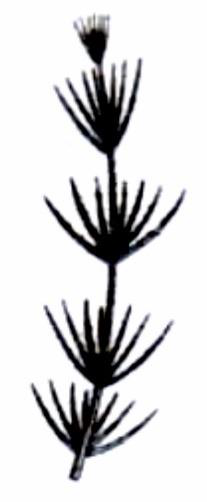
Read the following statements and identify the characters related to the alga shown in the diagram:
(a) It is a member of Chlorophyceae
(b) Food is stored in the form of starch
(c) It is monoecious plant showing oogonium and antheridium
(d) Food is stored in the form of laminarin or mannitol
(e) It shows dominance of pigments Chlorophyll a, c and Fucoxanthin
Choose the correct answer from the options given below:
- 1(c), (d) and (e) only
- 2(a), and (b) only
- 3(a), (b) and (c) only
- 4(a), (c) and (d) only
Show answer and solution
Correct: option 3, (a), (b) and (c) only
The diagram shows Chara, with whorls of branches at its nodes. Chara is a green alga (Chlorophyceae) that stores starch and bears both the antheridium and the oogonium on the same plant, so (a), (b) and (c) apply. Laminarin or mannitol as food reserve and the pigments chlorophyll a, c and fucoxanthin are characters of brown algae (Phaeophyceae).
Question 23NEET 2021, Q101
Which of the following plants is monoecious?
- 1Carica papaya
- 2Chara
- 3Marchantia polymorpha
- 4Cycas circinalis
Show answer and solution
Correct: option 2, Chara
A monoecious plant carries both male and female sex organs on the same individual. Chara bears the antheridium (globule) and oogonium (nucule) on the same plant. Papaya, Marchantia polymorpha and Cycas circinalis have separate male and female plants, so they are dioecious.
Question 24NEET 2021, Q103
- 1Mosses
- 2Pteridophytes
- 3Some Gymnosperms
- 4Some Liverworts
Show answer and solution
Correct: option 4, Some Liverworts
Gemmae are green, multicellular asexual buds formed in small gemma cups on the thallus of liverworts such as Marchantia. They detach and grow into new plants. So the answer is some liverworts.
Question 25NEET 2021, Q111
Which of the following algae contains mannitol as reserve food material?
- 1Ectocarpus
- 2Gracilaria
- 3Volvox
- 4Ulothrix
Show answer and solution
Correct: option 1, Ectocarpus
Brown algae (Phaeophyceae) store food as laminarin and mannitol, and Ectocarpus is a brown alga. Gracilaria is a red alga that stores floridean starch, while Volvox and Ulothrix are green algae that store starch.
Question 26NEET 2021, Q113
Genera like Selaginella and Salvinia produce two kinds of spores. Such plants are known as:
- 1Homosorus
- 2Heterosorus
- 3Homosporous
- 4Heterosporous
Show answer and solution
Correct: option 4, Heterosporous
Selaginella and Salvinia form small microspores and large megaspores. Plants that produce two kinds of spores are heterosporous; those producing one kind are homosporous.
Question 27NEET 2021, Q120
Which of the following algae produce Carrageen?
- 1Green algae
- 2Brown algae
- 3Red algae
- 4Blue-green algae
Show answer and solution
Correct: option 3, Red algae
Carrageen is a hydrocolloid obtained from the cell walls of red algae (Rhodophyceae). Brown algae give algin instead.
Question 28NEET 2020, Q53
Floridean starch has structure similar to:
- 1Starch and cellulose
- 2Amylopectin and glycogen
- 3Mannitol and algin
- 4Laminarin and cellulose
Show answer and solution
Correct: option 2, Amylopectin and glycogen
Floridean starch is the stored food of red algae (Rhodophyceae). It is a highly branched glucose polymer, very similar in structure to amylopectin and glycogen.
Question 29NEET 2020, Q63
Which of the following pairs is of unicellular algae?
- 1Laminaria and Sargassum
- 2Gelidium and Gracilaria
- 3Anabaena and Volvox
- 4Chlorella and Spirulina
Show answer and solution
Correct: option 4, Chlorella and Spirulina
Chlorella is a unicellular green alga and Spirulina is a microscopic blue-green alga treated here as unicellular; both are grown as protein-rich food supplements. Laminaria and Sargassum are large brown algae, Gelidium and Gracilaria are multicellular red algae, Anabaena is filamentous and Volvox is colonial.
Question 30NEET 2020, Q65
Strobili or cones are found in:
- 1Salvinia
- 2Pteris
- 3Marchantia
- 4Equisetum
Show answer and solution
Correct: option 4, Equisetum
In some pteridophytes the sporophylls are packed into compact structures called strobili or cones, as in Selaginella and Equisetum. Salvinia and Pteris are ferns without cones, and Marchantia is a liverwort (a bryophyte).
Question 31NEET 2020 Phase 2, Q8
Male and female gametophytes do not have an independent free living existence in:
- 1Algae
- 2Angiosperms
- 3Bryophytes
- 4Pteridophytes
Show answer and solution
Correct: option 2, Angiosperms
In seed plants the gametophytes are much reduced and stay inside the sporophyte: in angiosperms the male gametophyte is the pollen grain and the female gametophyte is the embryo sac inside the ovule. In bryophytes the gametophyte is the main plant body, in pteridophytes it is a free-living prothallus, and algal gametophytes are free living too.
Question 32NEET 2020 Phase 2, Q13
Phycoerythrin is the major pigment in:
- 1Blue green algae
- 2Green algae
- 3Brown algae
- 4Red algae
Show answer and solution
Correct: option 4, Red algae
Red algae (Rhodophyceae) owe their colour to the predominance of the red pigment r-phycoerythrin, along with chlorophyll a and d. Green algae are dominated by chlorophyll a and b, and brown algae by fucoxanthin.
Question 33NEET 2020 Phase 2, Q40
Which of the following statements is incorrect about gymnosperms?
- 1Male and female gametophytes are free living
- 2Most of them have narrow leaves with thick cuticle
- 3Their seeds are not covered
- 4They are heterosporous
Show answer and solution
Correct: option 1, Male and female gametophytes are free living
Gymnosperms are heterosporous, bear naked seeds, and conifers have needle-like leaves with a thick cuticle. Their male and female gametophytes have no independent free-living existence; they remain within the sporangia retained on the sporophyte. The first statement is therefore incorrect.
Question 34NEET 2019, Q146
From evolutionary point of view, retention of the female gametophyte with developing young embryo on the parent sporophyte for some time, is first observed in:
- 1Liverworts
- 2Mosses
- 3Pteridophytes
- 4Gymnosperms
Show answer and solution
Correct: option 3, Pteridophytes
In heterosporous pteridophytes such as Selaginella and Salvinia the megaspore germinates inside the megasporangium, so the female gametophyte and the young embryo stay on the parent sporophyte for a variable period. This is the precursor of the seed habit and is first seen in pteridophytes; gymnosperms show it later in evolution.
Question 35NEET 2018, Q130
Which of the following statements is correct ?
- 1Horsetails are gymnosperms.
- 2Selaginella is heterosporous, while Salvinia is homosporous.
- 3Ovules are not enclosed by ovary wall in gymnosperms.
- 4Stems are usually unbranched in both Cycas and Cedrus.
Show answer and solution
Correct: option 3, Ovules are not enclosed by ovary wall in gymnosperms.
Gymnosperms have naked ovules that are not enclosed by an ovary wall. Horsetails (Equisetum) are pteridophytes, Selaginella and Salvinia are both heterosporous, and the stem is unbranched in Cycas but branched in Cedrus.
Question 36NEET 2018, Q134
Winged pollen grains are present in
- 1Mango
- 2Cycas
- 3Mustard
- 4Pinus
Show answer and solution
Correct: option 4, Pinus
The pollen grain of Pinus has two air sacs (wings) formed by the exine, which help it to be carried by wind. Pollen of Cycas, mango and mustard is not winged.
Question 37NEET 2018, Q135
Which one is wrongly matched ?
- 1Gemma cups – Marchantia
- 2Biflagellate zoospores – Brown algae
- 3Uniflagellate gametes – Polysiphonia
- 4Unicellular organism – Chlorella
Show answer and solution
Correct: option 3, Uniflagellate gametes – Polysiphonia
Polysiphonia is a red alga, and red algae have no flagellated stage at all; their gametes are non-motile. Marchantia does bear gemma cups, brown algae have pear-shaped biflagellate zoospores, and Chlorella is a unicellular green alga.
Question 38NEET 2017, Q112
An example of colonial alga is:
- 1Chlorella
- 2Volvox
- 3Ulothrix
- 4Spirogyra
Show answer and solution
Correct: option 2, Volvox
Volvox forms a hollow spherical colony of many cells. Chlorella is unicellular, and Ulothrix and Spirogyra are filamentous.
Question 39NEET 2017, Q122
- 1Pinus - Dioecious
- 2Cycas - Dioecious
- 3Salvinia - Heterosporous
- 4Equisetum - Homosporous
Show answer and solution
Correct: option 1, Pinus - Dioecious
Pinus is monoecious: male and female cones are borne on the same tree, so calling it dioecious is the mismatch. Cycas is dioecious, Salvinia is a heterosporous pteridophyte and Equisetum is homosporous.
Question 40NEET 2017, Q129
Life cycle of Ectocarpus and Fucus respectively are:
- 1Haplontic, Diplontic
- 2Diplontic, Haplodiplontic
- 3Haplodiplontic, Diplontic
- 4Haplodiplontic, Haplontic
Show answer and solution
Correct: option 3, Haplodiplontic, Diplontic
Most algae are haplontic, but Ectocarpus is an exception with a haplo-diplontic life cycle, and Fucus is diplontic: its plant body is diploid and only the gametes are haploid.
Question 41NEET 2017, Q135
Zygotic meiosis is characteristic of:
- 1Marchantia
- 2Fucus
- 3Funaria
- 4Chlamydomonas
Show answer and solution
Correct: option 4, Chlamydomonas
Zygotic meiosis occurs in a haplontic life cycle, where the zygote is the only diploid cell and divides by meiosis. Chlamydomonas is haplontic. Fucus is diplontic (gametic meiosis), and Marchantia and Funaria are bryophytes with sporic meiosis.
Question 42NEET 2016 Phase 1, Q140
Select the correct statement:
- 1Gymnosperms are both homosporous and heterosporous
- 2Salvinia, Ginkgo and Pinus all are gymnosperms
- 3Sequoia is one of the tallest trees
- 4The leaves of gymnosperms are not well adapted to extremes of climate
Show answer and solution
Correct: option 3, Sequoia is one of the tallest trees
Sequoia, the giant redwood, is a gymnosperm and one of the tallest tree species. The other statements are wrong: all gymnosperms are heterosporous, Salvinia is a pteridophyte (a water fern), and gymnosperm leaves are well adapted to extremes of temperature, humidity and wind (needle shape, thick cuticle, sunken stomata).
Question 43NEET 2016 Phase 1, Q154
In bryophytes and pteridophytes, transport of male gametes requires:
- 1Wind
- 2Insects
- 3Birds
- 4Water
Show answer and solution
Correct: option 4, Water
The male gametes (antherozoids) of bryophytes and pteridophytes are flagellated and must swim through a film of water to reach the archegonium. This dependence on water for fertilisation is why these plants grow in moist places.
Question 44NEET 2016 Phase 2, Q95
Conifers are adapted to tolerate extreme environmental conditions because of
- 1broad hardy leaves
- 2superficial stomata
- 3thick cuticle
- 4presence of vessels
Show answer and solution
Correct: option 3, thick cuticle
Conifer leaves are needle-like with a small surface area, a thick cuticle and sunken stomata, all of which cut down water loss and let the plants survive extremes of temperature, humidity and wind. Their leaves are not broad, their stomata are not superficial, and they lack vessels.
Question 45NEET 2016 Phase 2, Q96
Which one of the following statements is wrong?
- 1Algae increase the level of dissolved oxygen in the immediate environment.
- 2Algin is obtained from red algae, and carrageenan from brown algae.
- 3Agar-agar is obtained from Gelidium and Gracilaria.
- 4Laminaria and Sargassum are used as food.
Show answer and solution
Correct: option 2, Algin is obtained from red algae, and carrageenan from brown algae.
Statement (2) has the sources swapped: algin comes from brown algae and carrageenan from red algae. The other statements are correct: algae release oxygen by photosynthesis, agar is from the red algae Gelidium and Gracilaria, and Laminaria and Sargassum are eaten.
Question 46AIPMT 2015, Q52
In which of the following gametophyte is not independent free living?
- 1Marchantia
- 2Pteris
- 3Pinus
- 4Funaria
Show answer and solution
Correct: option 3, Pinus
In bryophytes (Marchantia, Funaria) the gametophyte is the main free-living plant body, and in pteridophytes (Pteris) it is a small but independent prothallus. In gymnosperms such as Pinus the male and female gametophytes are highly reduced and stay inside the sporangia on the sporophyte, so they are not free living.
Question 47AIPMT 2015, Q71
Read the following five statements (A to E) and select the option with all correct statements:
(A) Mosses and Lichens are the first organisms to colonise a bare rock.
(B) Selaginella is a homosporous pteridophyte
(C) Coralloid roots in Cycas have VAM
(D) Main plant body in bryophytes is gametophytic, whereas in pteridophytes it is sporophytic
(E) In gymnosperms, male and female gametophytes are present within sporangia located on sporophyte
- 1(B), (C) and (D)
- 2(A), (D) and (E)
- 3(B), (C) and (E)
- 4(A), (C) and (D)
Show answer and solution
Correct: option 2, (A), (D) and (E)
(B) is wrong because Selaginella is heterosporous, producing microspores and megaspores. (C) is wrong because the coralloid roots of Cycas hold nitrogen-fixing cyanobacteria, not VAM (a fungal association). (D) and (E) are correct descriptions of the life cycles, and (A) is taken as correct since lichens and mosses are the early colonisers of bare rock. Only the option with (A), (D) and (E) avoids both wrong statements.
Question 48AIPMT 2015, Q112
Male gametes are flagellated in:
- 1Anabaena
- 2Ectocarpus
- 3Spirogyra
- 4Polysiphonia
Show answer and solution
Correct: option 2, Ectocarpus
Ectocarpus is a brown alga, and brown algae have pear-shaped gametes with two laterally attached flagella. Anabaena is a cyanobacterium with no gametes, Spirogyra has non-flagellated gametes, and the red alga Polysiphonia has non-motile male gametes.
Question 49AIPMT 2015, Q130
Which one of the following statements is wrong?
- 1Agar - agar is obtained from Gelidium and Gracilaria
- 2Chlorella and Spirulina are used as space food
- 3Mannitol is stored food in Rhodophyceae
- 4Algin and carragen are products of algae
Show answer and solution
Correct: option 3, Mannitol is stored food in Rhodophyceae
Red algae (Rhodophyceae) store food as floridean starch. Mannitol and laminarin are the stored food of brown algae (Phaeophyceae). The other statements are correct: agar comes from Gelidium and Gracilaria, Chlorella and Spirulina are protein-rich space food, and algin and carrageen are obtained from brown and red algae.
Question 50AIPMT 2015 Re-test, Q47
Which one is a wrong statement?
- 1Brown algae have chlorophyll a and c, and fucoxanthin
- 2Archegonia are found in Bryophyta, Pteridophyta and Gymnosperms
- 3Mucor has biflagellate zoospores
- 4Haploid endosperm is typical feature of gymnosperms
Show answer and solution
Correct: option 3, Mucor has biflagellate zoospores
Mucor is a zygomycete fungus; it reproduces asexually by non-motile sporangiospores and has no flagellated zoospores, so statement (3) is wrong. The other three are correct: brown algae have chlorophyll a, c and fucoxanthin, archegonia occur from bryophytes to gymnosperms, and the gymnosperm endosperm is the haploid female gametophyte.
Question 51AIPMT 2014, Q46
Male gametophyte with least number of cells is present in:
- 1Pinus
- 2Pteris
- 3Funaria
- 4Lilium
Show answer and solution
Correct: option 4, Lilium
The male gametophyte becomes steadily smaller from bryophytes to angiosperms. In Funaria it is the whole leafy plant, in Pteris a many-celled prothallus, and in Pinus the pollen grain still has prothallial cells. In Lilium, an angiosperm, the pollen grain is the male gametophyte and has only three cells at most (a vegetative cell and two male gametes), the fewest of the four.
Question 52AIPMT 2014, Q68
Which one of the following shows isogamy with non-flagellated gametes?
- 1Spirogyra
- 2Sargassum
- 3Ectocarpus
- 4Ulothrix
Show answer and solution
Correct: option 1, Spirogyra
In Spirogyra the two fusing gametes are similar in size and have no flagella; they come together through a conjugation tube. Ulothrix and Ectocarpus have flagellated isogametes, and Sargassum is oogamous.
Question 53AIPMT 2014, Q74
Which one of the following is wrong about Chara?
- 1Globule is male reproductive structure
- 2Upper oogonium and lower round antheridium.
- 3Globule and nucule present on the same plant.
- 4Upper antheridium and lower oogonium
Show answer and solution
Correct: option 4, Upper antheridium and lower oogonium
In Chara the male organ is the round globule (antheridium) and the female organ is the nucule (oogonium). Both are borne on the same plant at a node, with the nucule above and the globule below. So 'upper antheridium and lower oogonium' is the wrong statement.
Question 54AIPMT 2014, Q75
An alga which can be employed as food for human being is:
- 1Polysiphonia
- 2Ulothrix
- 3Chlorella
- 4Spirogyra
Show answer and solution
Correct: option 3, Chlorella
Chlorella is a unicellular green alga rich in protein. It is used as a food supplement, even by space travellers, along with Spirulina. The other three algae are not used as human food in this way.
Question 55AIPMT 2014, Q85
Which of the following is responsible for peat formation?
- 1Sphagnum
- 2Marchantia
- 3Riccia
- 4Funaria
Show answer and solution
Correct: option 1, Sphagnum
Sphagnum is a moss that grows in bogs. Its dead remains pile up over long periods and become compressed into peat, which is used as fuel and as packing material because it holds water well. Marchantia and Riccia are liverworts and Funaria is a common moss; none of them forms peat.
Question 56NEET 2013, Q48
Besides paddy fields, cyanobacteria are also found inside vegetative part of:
- 1Cycas
- 2Equisetum
- 3Psilotum
- 4Pinus
Show answer and solution
Correct: option 1, Cycas
Cycas has special coralloid roots that hold nitrogen-fixing cyanobacteria such as Anabaena and Nostoc. Pinus roots are associated with fungi (mycorrhiza), not cyanobacteria. So the answer is Cycas.
Question 57NEET 2013, Q67
Isogamous condition with non-flagellated gametes is found in:
- 1Spirogyra
- 2Volvox
- 3Fucus
- 4Chlamydomonas
Show answer and solution
Correct: option 1, Spirogyra
In Spirogyra the two gametes are similar in size and have no flagella; they fuse during conjugation. Chlamydomonas has flagellated gametes, and Volvox and Fucus are oogamous.
Question 58NEET 2013, Q88
Read the following statements (A-E) and answer the question which follows them.
(A) In liverworts, mosses, and ferns gametophytes are free-living
(B) Gymnosperms and some ferns are heterosporous
(C) Sexual reproduction in Fucus, Volvox and Albugo is oogamous
(D) The sporophyte in liverworts is more elaborate than that in mosses
(E) Both, Pinus and Marchantia are dioecious
How many of the above statements are correct?
- 1Two
- 2Three
- 3Four
- 4One
Show answer and solution
Correct: option 2, Three
A is correct: the gametophyte is free-living in liverworts, mosses and ferns. B is correct: all gymnosperms and a few ferns such as Selaginella and Salvinia are heterosporous. C is correct: all three are oogamous. D is wrong: the moss sporophyte is more elaborate than that of liverworts. E is wrong: Pinus is monoecious. So three statements are correct.
Question 59NEET 2013 Karnataka, Q59
The plant body is thalloid in:-
- 1Sphagnum
- 2Salvinia
- 3Marchantia
- 4Funaria
Show answer and solution
Correct: option 3, Marchantia
Marchantia is a liverwort with a flat, dorsiventral, dichotomously branched thallus. Sphagnum and Funaria are mosses with a leafy gametophyte, and Salvinia is a pteridophyte with stem and leaves.
Question 60NEET 2013 Karnataka, Q80
Which one of the following is wrongly matched?
- 1Spirogyra - Motile gametes
- 2Sargassum - Chlorophyll C
- 3Basidiomycetes - Puffballs
- 4Nostoc - Water blooms
Show answer and solution
Correct: option 1, Spirogyra - Motile gametes
Spirogyra reproduces sexually by conjugation, in which the gametes are non-flagellated and so non-motile. Sargassum is a brown alga with chlorophyll a and c, puffballs are basidiomycetes, and Nostoc is a cyanobacterium that forms blooms in water.
Question 61NEET 2013 Karnataka, Q90
What is common in all the three, Funaria, Dryopteris and Ginkgo?
- 1Presence of archegonia
- 2Well developed vascular tissues
- 3Independent gametophyte
- 4Independent sporophyte
Show answer and solution
Correct: option 1, Presence of archegonia
A moss (Funaria), a fern (Dryopteris) and a gymnosperm (Ginkgo) all bear archegonia as the female sex organ. Funaria has no vascular tissue and its sporophyte depends on the gametophyte, while the gametophyte of Ginkgo is not independent.
Question 62AIPMT 2012 Prelims, Q83
Cycas and Adiantum resemble each other in having:
- 1Seeds
- 2Motile Sperms
- 3Cambium
- 4Vessels
Show answer and solution
Correct: option 2, Motile Sperms
Adiantum is a fern and Cycas a gymnosperm, and both produce motile, multiciliate sperms. Seeds and cambium are present in Cycas but not in Adiantum, and vessels are absent in both.
Question 63AIPMT 2012 Prelims, Q102
Which one of the following is a correct statement?
- 1Pteridophyte gametophyte has a protonemal and leafy stage
- 2In gymnosperms female gametophyte is free-living
- 3Antheridiophores and archegoniophores are present in pteridophytes.
- 4Origin of seed habit can be traced in pteridophytes
Show answer and solution
Correct: option 4, Origin of seed habit can be traced in pteridophytes
Heterosporous pteridophytes such as Selaginella and Salvinia retain the megaspore and female gametophyte on the parent plant, which is the forerunner of the seed habit. The protonemal and leafy stages belong to mosses, antheridiophores and archegoniophores to the liverwort Marchantia, and the female gametophyte of gymnosperms stays inside the ovule and is never free-living.
Question 64AIPMT 2012 Mains, Q62
Read the following five statements (A - E) and answer as asked next to them.
(A) In Equisetum the female gametophyte is retained on the parent sporophyte.
(B) In Ginkgo male gametophyte is not independent.
(C) The sporophyte in Riccia is more developed than that in Polytrichum.
(D) Sexual reproduction in Volvox is isogamous.
(E) The spores of slime molds lack cell walls.
How many of the above statements are correct?
- 1Two
- 2Three
- 3Four
- 4One
Show answer and solution
Correct: option 4, One
Only (B) is correct: in gymnosperms such as Ginkgo the male gametophyte is highly reduced and stays inside the pollen grain. Equisetum is homosporous with a free-living prothallus, so (A) is wrong. Riccia has the simplest sporophyte (a capsule only) while Polytrichum has foot, seta and capsule, so (C) is wrong. Volvox is oogamous, and slime mould spores have true walls, so (D) and (E) are wrong.
Question 65AIPMT 2012 Mains, Q63
Which one of the following pairs is wrongly matched?
- 1Ginkgo - Archegonia
- 2Salvinia - Prothallus
- 3Viroids - RNA
- 4Mustard - Synergids
Show answer and solution
Correct: option 2, Salvinia - Prothallus
Ginkgo is a gymnosperm and bears archegonia, viroids are free RNA without a protein coat, and the embryo sac of mustard has two synergids. Salvinia is a heterosporous fern whose gametophytes are much reduced and develop within the spores rather than as a free-living prothallus, so this is the pair taken as wrongly matched.
Question 66AIPMT 2011 Prelims, Q54
A prokaryotic autotrophic nitrogen fixing symbiont is found in:
- 1Alnus
- 2Cycas
- 3Cicer
- 4Pisum
Show answer and solution
Correct: option 2, Cycas
The coralloid roots of Cycas house nitrogen-fixing cyanobacteria (Anabaena, Nostoc), which are prokaryotic and photosynthetic, so autotrophic. Alnus has Frankia, and Cicer and Pisum have Rhizobium, all of which fix nitrogen but are heterotrophic.
Question 67AIPMT 2011 Prelims, Q94
Archegoniophore is present in:
- 1Marchantia
- 2Chara
- 3Adiantum
- 4Funaria
Show answer and solution
Correct: option 1, Marchantia
In the liverwort Marchantia the archegonia are borne on a stalked, umbrella-like outgrowth of the female thallus called the archegoniophore. Funaria bears archegonia at the tip of the leafy shoot, Adiantum on the prothallus, and Chara is an alga without archegonia.
Question 68AIPMT 2011 Prelims, Q121
The gametophyte is not an independent, free living generation in:
- 1Polytrichum
- 2Adiantum
- 3Marchantia
- 4Pinus
Show answer and solution
Correct: option 4, Pinus
In bryophytes (Polytrichum, Marchantia) the gametophyte is the main free-living plant, and in pteridophytes (Adiantum) it is a small but independent prothallus. In gymnosperms such as Pinus the male and female gametophytes are reduced and stay inside the sporangia on the sporophyte, so they are not free living.
Question 69AIPMT 2011 Mains, Q59
Consider the following four statements whether they are correct or wrong
(A) The sporophyte in liverworts is more elaborate than that in mosses
(B) Salvinia is heterosporous
(C) The life-cycle in all seed-bearing plants is diplontic
(D) In pinus male and female cones are borne on different trees
- 1Statements (A) and (C)
- 2Statements (A) and (D)
- 3Statements (B) and (C)
- 4Statements (A) and (B)
Show answer and solution
Correct: option 2, Statements (A) and (D)
The keyed option names the two wrong statements. (A) is wrong because the sporophyte of mosses is more elaborate than that of liverworts. (D) is wrong because Pinus is monoecious: male and female cones are borne on the same tree. (B) is correct, since Salvinia produces two kinds of spores, and (C) is correct, since gymnosperms and angiosperms have a diplontic life cycle.
Question 70AIPMT 2011 Mains, Q64
Selaginella and Salvinia are considered to represent a significant step toward evolution of seed habit because:
- 1Female gametophyte is free and gets dispersed like seeds
- 2Female gametophyte lacks archegonia.
- 3Megaspores possess endosperm and embryo surrounded by seed coat.
- 4Embryo develops in female gametophyte which is retained on parent sporophyte.
Show answer and solution
Correct: option 4, Embryo develops in female gametophyte which is retained on parent sporophyte.
Selaginella and Salvinia are heterosporous. Their megaspore grows into a female gametophyte that stays on the parent sporophyte for some time, and the zygote develops into a young embryo inside it. Keeping the female gametophyte and embryo on the parent plant is the forerunner of the seed habit. The female gametophyte still has archegonia, and there is no seed coat or endosperm.
Question 71AIPMT 2011 Mains, Q85
Examine the figure given below and select the right option giving all the four parts (a, b, c and d) correctly identified.
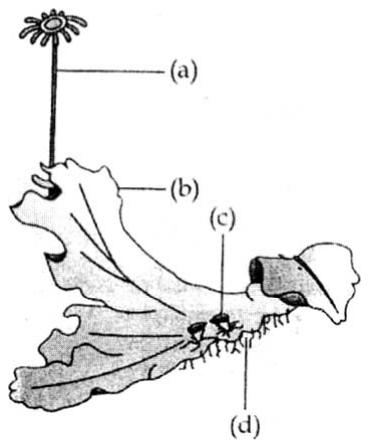
- 1a-Archegoniophore, b-Female thallus, c-Gemma cup, d-Rhizoids
- 2a-Archegoniophore, b-Female thallus, c-Bud, d-Foot
- 3a-Seta, b-Sporophyte, c-Protonema, d-Rhizoids
- 4a-Antheridiophore, b-Male thallus, c-Globule, d-Roots
Show answer and solution
Correct: option 1, a-Archegoniophore, b-Female thallus, c-Gemma cup, d-Rhizoids
The figure is a female thallus of the liverwort Marchantia. The stalked, star-shaped structure (a) is the archegoniophore that carries the archegonia, (b) is the flat female thallus, (c) is a gemma cup holding gemmae for asexual reproduction, and (d) are the rhizoids on the lower surface. A bryophyte has no true roots, and a protonema or seta is not what is shown.
Question 72AIPMT 2010 Mains, Q61
Which one of the following is monoecious
- 1Date palm
- 2Marchantia
- 3Cycas
- 4Pinus
Show answer and solution
Correct: option 4, Pinus
A monoecious plant bears male and female reproductive structures on the same plant. Pinus carries male and female cones on the same tree. Date palm, Marchantia and Cycas are dioecious, with separate male and female plants.
Question 73AIPMT 2010 Mains, Q108
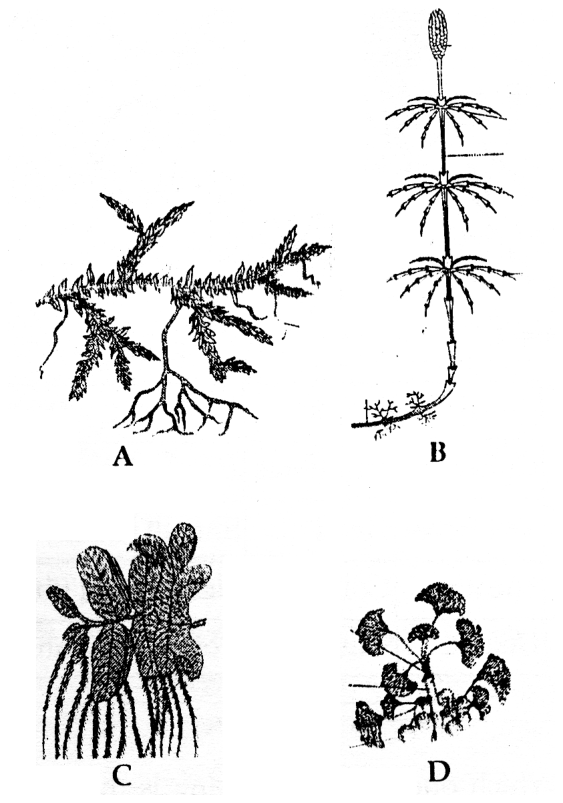
Examine the figures A, B, C and D. In which one of the four options all the items, A, B, C and D are correct
- 1A-Funaria, B-Adiantum, C-Salvinia, D-Riccia
- 2A-Chara, B-Marchantia, C-Fucus, D-Pinus
- 3A-Equisetum, B-Ginkgo, C-Selaginella, D-Lycopodium
- 4A-Selaginella, B-Equisetum, C-Salvinia, D-Ginkgo
Show answer and solution
Correct: option 4, A-Selaginella, B-Equisetum, C-Salvinia, D-Ginkgo
A is Selaginella, a creeping pteridophyte with small leaves and rhizophores. B is Equisetum (horsetail), with a jointed stem, whorled branches and a cone at the tip. C is Salvinia, a floating water fern. D is Ginkgo, a gymnosperm with fan-shaped leaves.
Question 74AIPMT 2010 Mains, Q114
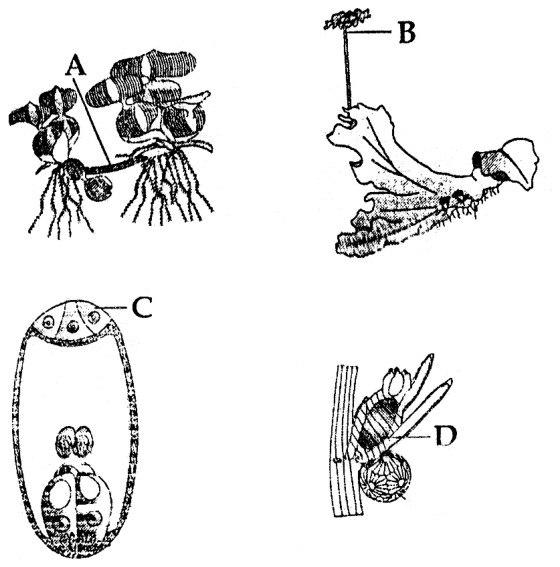
Examine the figures (A-D) given below and select the right option out of 1-4, in which all the four structures A, B, C and D are identified correctly.
Structures:
- 1A-Sucker, B-Seta, C-Megaspore mother cell, D-Gemma cup
- 2A-Rhizome, B-Sporangiophore, C-Polar cell, D-Globule
- 3A-Runner, B-Archegoniophore, C-Synergid, D-Antheridium
- 4A-Offset, B-Antheridiophore, C-Antipodals, D-Oogonium
Show answer and solution
Correct: option 4, A-Offset, B-Antheridiophore, C-Antipodals, D-Oogonium
A is the offset joining two plants of a floating plant such as Eichhornia. B is the stalked antheridiophore on the male thallus of Marchantia. C points to the three cells at the chalazal end of the embryo sac, the antipodals. D is the oogonium (nucule), the female sex organ of Chara.
Question 75AIPMT 2010 Prelims, Q161
Male and female gametophytes are independent and free-living in
- 1Castor
- 2Pinus
- 3Sphagnum
- 4Mustard
Show answer and solution
Correct: option 3, Sphagnum
Sphagnum is a moss. In bryophytes the gametophyte is the main, green, free-living plant body and it bears the sex organs. In Pinus (a gymnosperm) and in castor and mustard (angiosperms) the male and female gametophytes are very small and stay dependent on the sporophyte.
Question 76AIPMT 2010 Prelims, Q164
The chief water conducting elements of xylem in gymnosperms are
- 1Fibres
- 2Transfusion tissue
- 3Tracheids
- 4Vessels
Show answer and solution
Correct: option 3, Tracheids
The xylem of gymnosperms lacks vessels (they are found only in a few forms such as Gnetum). Water is conducted mainly by tracheids, which are long dead cells with tapering ends and pitted walls.
Question 77AIPMT 2010 Prelims, Q172
Algae have cell wall made up of
- 1Hemicellulose, pectins and proteins
- 2pectins, cellulose and proteins
- 3Cellulose, hemicellulose and pectins
- 4Cellulose, galactans and mannans
Show answer and solution
Correct: option 4, Cellulose, galactans and mannans
The cell wall of algae is made of cellulose together with galactans, mannans and minerals such as calcium carbonate. The wall of other plants is made of cellulose, hemicellulose, pectins and proteins. So the option with galactans and mannans is the one for algae.
Question 78AIPMT 2009 Prelims, Q90
Which one of the following plants is monoecious?
- 1Pinus
- 2Cycas
- 3Papaya
- 4Marchantia
Show answer and solution
Correct: option 1, Pinus
Pinus bears male and female cones on the same tree, so it is monoecious. Cycas, papaya and Marchantia have separate male and female plants and are dioecious.
Question 79AIPMT 2009 Prelims, Q97
Phylogenetic system of classification is based on:
- 1Morphological features
- 2Chemical constituents
- 3Floral characters
- 4Evolutionary relationships
Show answer and solution
Correct: option 4, Evolutionary relationships
A phylogenetic system arranges organisms according to their evolutionary relationships, on the assumption that members of a taxon share a common ancestor. Systems based on morphology or floral characters are artificial or natural systems, and one based on chemical constituents is chemotaxonomy.
Question 80AIPMT 2009 Prelims, Q106
Which one of the following has haplontic life cycle?
- 1Polytrichum
- 2Ustilago
- 3Wheat
- 4Funaria
Show answer and solution
Correct: option 2, Ustilago
In a haplontic life cycle the only diploid cell is the zygote, which undergoes meiosis. Polytrichum and Funaria are mosses with a haplo-diplontic cycle (a multicellular sporophyte on the gametophyte), and wheat is diplontic. That leaves the smut fungus Ustilago, in which the diploid phase is limited to a single cell that divides by meiosis.
Question 81AIPMT 2009 Prelims, Q108
Which one of the following is considered important in the development of seed habit?
- 1Heterospory
- 2Haplontic life cycle
- 3Free-living gametophyte
- 4Dependent sporophyte
Show answer and solution
Correct: option 1, Heterospory
Seed habit began with heterospory, the production of small microspores and large megaspores, as in Selaginella and Salvinia. Retention of the megaspore and the female gametophyte on the parent sporophyte, where the embryo then develops, is the forerunner of the seed.
Question 82AIPMT 2009 Prelims, Q113
Mannitol is the stored food in:
- 1Porphyra
- 2Fucus
- 3Gracilaria
- 4Chara
Show answer and solution
Correct: option 2, Fucus
Brown algae (Phaeophyceae) store food as laminarin and mannitol, and Fucus is a brown alga. Porphyra and Gracilaria are red algae that store floridean starch, and Chara is a green alga that stores starch.
Question 83AIPMT 2009 Prelims, Q116
Which one of the following is a vascular cryptogam?
- 1Ginkgo
- 2Marchantia
- 3Cedrus
- 4Equisetum
Show answer and solution
Correct: option 4, Equisetum
Vascular cryptogams are the pteridophytes: they have xylem and phloem but no seeds. Equisetum (horsetail) is a pteridophyte. Ginkgo and Cedrus are gymnosperms with seeds, and Marchantia is a bryophyte without vascular tissue.
Question 84AIPMT 2008 Prelims, Q101
Select one of the following of important features distinguishing Gnetum from Cycas and Pinus and showing affinities with angiosperms
- 1Embryo development and apical meristem
- 2Absence of resin duct and leaf venation
- 3Presence of vessel elements and absence of archegonia
- 4Perianth and two integuments
Show answer and solution
Correct: option 3, Presence of vessel elements and absence of archegonia
Gnetum is an advanced gymnosperm. Unlike Cycas and Pinus, its xylem has true vessels and its ovule has no archegonia, and both of these are features of angiosperms. So option (3) is correct.
Question 85AIPMT 2008 Prelims, Q103
Which one of the following is heterosporous?
- 1Equisetum
- 2Dryopteris
- 3Salvinia
- 4Adiantum
Show answer and solution
Correct: option 3, Salvinia
Salvinia, a water fern, produces two kinds of spores: small microspores and large megaspores. Equisetum, Dryopteris and Adiantum produce only one kind of spore, so they are homosporous.
Question 86AIPMT 2008 Prelims, Q104
In which one of the following male and female gametophytes do not have free living independent existence?
- 1Cedrus
- 2Pteris
- 3Funaria
- 4Polytrichum
Show answer and solution
Correct: option 1, Cedrus
Cedrus is a gymnosperm. In gymnosperms the male gametophyte is the reduced pollen grain and the female gametophyte stays inside the ovule on the sporophyte, so neither lives independently. In the mosses Funaria and Polytrichum the gametophyte is the main free-living plant, and in the fern Pteris the prothallus is free-living.
Question 87AIPMT 2007 Prelims, Q12
In the prothallus of vascular cryptogam, the antherozoids and eggs mature at different times. As a result:
- 1self fertilization is prevented
- 2there is no change in success rate of fertilization
- 3there is high degree of sterility
- 4one can conclude that the plant is apomictic
Show answer and solution
Correct: option 1, self fertilization is prevented
The prothallus of a pteridophyte usually bears both antheridia and archegonia. If the sperms and eggs of the same prothallus mature at different times, they cannot fuse with each other, so self fertilization is prevented and cross fertilization is favoured.
Question 88AIPMT 2007 Prelims, Q14
If you are asked to classify the various algae into distinct groups, which of the following characters you should choose?
- 1Chemical composition of the cell wall
- 2Types of pigments present in the cell
- 3Nature of stored food materials in the cell
- 4Structural organization of thallus.
Show answer and solution
Correct: option 2, Types of pigments present in the cell
The main groups of algae are named and separated by their pigments: green algae (chlorophyll a and b), brown algae (fucoxanthin) and red algae (phycoerythrin). So the type of pigment is the chief character used.
Question 89AIPMT 2007 Prelims, Q15
Flagellated male gametes are present in all the three of which one of the following sets?
- 1Riccia, Dryopteris and Cycas
- 2Anthoceros, Funaria and Spirogyra
- 3Zygnema, Saprolegnia and Hydrilla
- 4Fucus, Marsilea and Calotropis
Show answer and solution
Correct: option 1, Riccia, Dryopteris and Cycas
Bryophytes (Riccia) and pteridophytes (Dryopteris) have flagellated antherozoids, and Cycas is a gymnosperm with large multiciliate sperms. Spirogyra and Zygnema have non-motile gametes, and the angiosperms Hydrilla and Calotropis have non-flagellated male gametes.
Question 90AIPMT 2007 Prelims, Q16
In gymnosperms, the pollen chamber represents:
- 1the microsporangium in which pollen grains develop
- 2a cell in the pollen grain in which the sperms formed
- 3a cavity in the ovule in which pollen grains are stored after pollination
- 4an opening in the mega gametophyte through which the pollen tube approaches the egg.
Show answer and solution
Correct: option 3, a cavity in the ovule in which pollen grains are stored after pollination
In a gymnosperm ovule some nucellus cells just below the micropyle break down to leave a small cavity, the pollen chamber. Pollen grains drawn in through the micropyle rest here after pollination until they germinate.
Question 91AIPMT 2007 Prelims, Q17
Spore dissemination in some liverworts is aided by:
- 1peristome teeth
- 2elaters
- 3indusium
- 4calyptra
Show answer and solution
Correct: option 2, elaters
The capsule of liverworts such as Marchantia contains elaters, elongated hygroscopic cells that twist as they dry and throw out the spores. Peristome teeth belong to mosses, the indusium to fern sori, and the calyptra is a protective cap.
Question 92AIPMT 2006 Prelims, Q125
Moss peat is used as a packing material for sending flowers and live plants to distant places because-
- 1It is easily available
- 2It is hygroscopic
- 3It reduces transpiration
- 4It serves as a disinfectant
Show answer and solution
Correct: option 2, It is hygroscopic
Peat moss (Sphagnum) can absorb and hold many times its weight of water, that is, it is hygroscopic. Packed around live plants it keeps them moist during transport.
Question 93AIPMT 2006 Prelims, Q131
Conifers differ from grasses in the-
- 1Production of seeds from ovules
- 2Lack of xylem tracheids
- 3Absence of pollen tubes
- 4Formation of endosperm before fertilization
Show answer and solution
Correct: option 4, Formation of endosperm before fertilization
Conifers are gymnosperms: their endosperm is the haploid female gametophyte, formed before fertilisation. In grasses (angiosperms) the endosperm is triploid and forms after double fertilisation. Both groups have ovules, tracheids and pollen tubes.
Question 94AIPMT 2006 Prelims, Q144
In a moss the sporophyte-
- 1is partially parasitic on the gametophyte
- 2produces gametes that give rise to the gametophyte
- 3Arises from a spore produced from the gametophyte
- 4Manufactures food for itself, as well as for the gametophyte
Show answer and solution
Correct: option 1, is partially parasitic on the gametophyte
The moss sporophyte (foot, seta and capsule) stays attached to the gametophyte and draws water and minerals from it, but the green capsule makes some of its own food. So it is only partly dependent, or partially parasitic. It arises from the zygote and produces spores, not gametes.
Question 95AIPMT 2005 Prelims, Q103
Ectophloic siphonostele is found in
- 1Osmunda and Equisetum
- 2Adiantum and Cucurbitaceae
- 3Marsilea and Botrychium
- 4Dicksonia and Maiden hair fern
Show answer and solution
Correct: option 1, Osmunda and Equisetum
In an ectophloic siphonostele the central pith is surrounded by xylem, with phloem only on the outer side of the xylem. This type of stele is seen in Osmunda and Equisetum. Adiantum (maiden hair fern), Marsilea and Dicksonia have amphiphloic siphonosteles, with phloem on both sides of the xylem.
Question 96AIPMT 2005 Prelims, Q126
Match items in Column I with those in Column II
| Column I | Column II |
|---|
| (A) Peritrichous flagellation | (J) Ginkgo |
| (B) Living fossil | (K) Macrocystis |
| (C) Rhizophore | (L) Escherichia coli |
| (D) Smallest flowering plant | (M) Selaginella |
| (E) Largest Perennial alga | (N) Wolffia |
Select the correct answer with the following
- 1A-L, B-J, C-M, D-N, E-K
- 2A-K, B-J, C-L, D-M, E-N
- 3A-J, B-K, C-N, D-L, E-K
- 4A-N, B-L, C-K, D-N, E-J
Show answer and solution
Correct: option 1, A-L, B-J, C-M, D-N, E-K
Escherichia coli has flagella all over its surface (peritrichous). Ginkgo is called a living fossil. The rhizophore is the leafless root-bearing organ of Selaginella. Wolffia is the smallest flowering plant, and Macrocystis, a giant kelp, is the largest perennial alga. This gives A-L, B-J, C-M, D-N, E-K.
Question 97AIPMT 2005 Prelims, Q145
Top-shaped multiciliate male gametes, and the mature seed which bears only one embryo with two cotyledons, are characteristic features of
- 1Gamopetalous angiosperms
- 2Conifers
- 3Polypetalous angiosperms
- 4Cycads
Show answer and solution
Correct: option 4, Cycads
Cycads (for example Cycas) have large, top-shaped male gametes with a spiral band of many cilia, and their seed has a single embryo with two cotyledons. Conifers and angiosperms have non-motile male gametes.
Question 98AIPMT 2004 Prelims, Q136
Angiosperms have dominated the land flora primarily because of their -
- 1Property of producing large number of seeds
- 2Nature of self pollination
- 3Domestication by man
- 4Power of adaptability in diverse habitat
Show answer and solution
Correct: option 4, Power of adaptability in diverse habitat
Angiosperms grow in almost every habitat, from deserts to water and from the tropics to the cold regions, thanks to their varied forms, efficient vascular tissue and protected seeds. This ability to adapt to diverse habitats is the main reason for their dominance.
Question 99AIPMT 2004 Prelims, Q189
In oogamy fertilization involves -
- 1A large non-motile female gamete and a small motile male gamete
- 2A large non-motile female gamete and a small non-motile male gamete
- 3A large motile female gamete and a small non-motile male gamete
- 4A small non-motile female gamete and a large motile male gamete
Show answer and solution
Correct: option 1, A large non-motile female gamete and a small motile male gamete
Oogamy is the fusion of a large, non-motile egg with a small, motile male gamete (sperm or antherozoid), as in Volvox, Fucus and Chara. In isogamy the two gametes are alike, and in anisogamy both are motile but differ in size.
Question 100AIPMT 2004 Prelims, Q190
Which one of the following is living fossil -
- 1Moss
- 2Saccharomyces
- 3Spirogyra
- 4Cycas
Show answer and solution
Correct: option 4, Cycas
A living fossil is a surviving member of a group that was abundant in the geological past and has changed very little. Cycads flourished in the Mesozoic era and most are extinct; Cycas (like Ginkgo) survives with primitive features such as motile sperms.
Question 101AIPMT 2003 Prelims, Q179
Which one pair of examples will correctly represent the grouping Spermatophyta according to one of the schemes of classifying plants:-
- 1Acacia, Sugarcane
- 2Pinus, Cycas
- 3Rhizopus, Triticum
- 4Ginkgo, Pisum
Show answer and solution
Correct: option 4, Ginkgo, Pisum
Spermatophyta are the seed plants, made up of gymnosperms and angiosperms. Ginkgo (a gymnosperm) with Pisum (an angiosperm) represents both divisions of the group, whereas pair (1) has only angiosperms, pair (2) only gymnosperms, and Rhizopus is a fungus.
Question 102AIPMT 2003 Prelims, Q180
Plants reproducing by spores such as mosses and ferns are grouped under the general term:-
- 1Cryptogams
- 2Bryophytes
- 3Sporophytes
- 4Thallophytes
Show answer and solution
Correct: option 1, Cryptogams
Plants without flowers and seeds that reproduce by spores (algae, bryophytes and pteridophytes) are together called cryptogams. Bryophytes cover only the mosses and their relatives, not ferns.
Question 103AIPMT 2003 Prelims, Q183
- 1Cytoplasm of Chlorella
- 2Mycelium of a green mould such as Aspergillus
- 3Spore capsule of a moss
- 4Pollen tube of Pinus
Show answer and solution
Correct: option 3, Spore capsule of a moss
Chlorenchyma is a tissue of parenchyma cells containing chloroplasts. The capsule of a moss sporophyte has such green photosynthetic tissue in its wall and apophysis. Chlorella is a single cell, a mould has no chlorophyll, and a pollen tube is not a green tissue.
Question 104AIPMT 2003 Prelims, Q185
Which one of the following is categorised under living fossils:-
- 1Pinus
- 2Cycas
- 3Selaginella
- 4Metasequoia
Show answer and solution
Correct: option 2 or 4
The answer key accepts options 2 and 4.
A living fossil is a surviving member of a group that is otherwise known mostly from fossils and has changed little. Cycas is the usual textbook example among cycads, and Metasequoia (dawn redwood) was known only as a fossil until living trees were found in China. The key accepts both (2) and (4).
Question 105AIPMT 2003 Prelims, Q191
Sexual reproduction in Spirogyra is an advanced feature because it shows:-
- 1Different size of motile sex organs
- 2Same size of motile sex organs
- 3Morphologically different sex organs
- 4Physiologically differentiated sex organs
Show answer and solution
Correct: option 4, Physiologically differentiated sex organs
In the conjugation of Spirogyra the gametes are non-motile and look alike, but one moves through the conjugation tube (behaving as male) while the other stays in place (behaving as female). They are alike in form but different in behaviour, that is physiological anisogamy.
Question 106AIPMT 2003 Prelims, Q193
Which one of the following pairs of plants are not seed producers:-
- 1Fern and Funaria
- 2Funaria and Ficus
- 3Ficus and Chlamydomonas
- 4Punica and Pinus
Show answer and solution
Correct: option 1, Fern and Funaria
A fern is a pteridophyte and Funaria is a moss; both reproduce by spores and form no seeds. Ficus and Punica are angiosperms and Pinus is a gymnosperm, all seed plants, so only pair (1) has two non-seed plants.
Question 107AIPMT 2002 Prelims, Q139
Which of the following plants produces seeds but not flowers:-
- 1Maize
- 2Mint
- 3Peepal
- 4Pinus
Show answer and solution
Correct: option 4, Pinus
Pinus is a gymnosperm: it bears naked seeds on cones and has no flowers or fruits. Maize, mint and peepal are angiosperms, which all produce flowers.
Question 108AIPMT 2002 Prelims, Q177
- 1All angiosperms and some gymnosperm
- 2Most of the angiosperm and few gymnosperms
- 3All angiosperms, all gymnosperms and some pteridophyta
- 4All pteridophyta
Show answer and solution
Correct: option 2, Most of the angiosperm and few gymnosperms
Vessels are typical of angiosperms, but a few primitive angiosperms (for example Drimys and Trochodendron) lack them, so it is most, not all. Gymnosperms generally lack vessels, except a few such as Gnetum and Ephedra.
Question 109AIPMT 2001 Prelims, Q173
Cycas have two cotyledons but not included in angiosperms because of:
- 1Naked ovules
- 2Seems like monocot
- 3Circinate ptyxis
- 4Compound leaves
Show answer and solution
Correct: option 1, Naked ovules
The defining feature of angiosperms is that the ovules are enclosed in an ovary. In Cycas the ovules lie exposed on megasporophylls, so it is a gymnosperm even though its embryo has two cotyledons.
Question 110AIPMT 2000 Prelims, Q162
Aquatic fern is used to increase the yield in paddy crop:
- 1Azolla
- 2Salvinia
- 3Marsilea
- 4Isoetes
Show answer and solution
Correct: option 1, Azolla
Azolla is a small floating water fern whose leaves hold the nitrogen-fixing cyanobacterium Anabaena azollae. Grown in rice fields, it adds nitrogen to the soil and acts as a biofertiliser that raises the paddy yield.
Question 111AIPMT 2000 Prelims, Q163
Plant group with largest ovule, largest tree, and largest gametes:
- 1Gymnosperm
- 2Angiosperm
- 3Bryophyta
- 4Pteridophyta
Show answer and solution
Correct: option 1, Gymnosperm
Gymnosperms hold all three records: Cycas has the largest ovule and the largest male gametes and egg, and Sequoia, the giant redwood, is among the tallest and largest trees.
Question 112AIPMT 2000 Prelims, Q164
In ferns, Meiosis takes place at the time of:
- 1Spore formation
- 2Spore germination
- 3Gamete formation
- 4Antheridia and archegonia formation
Show answer and solution
Correct: option 1, Spore formation
The fern plant is a diploid sporophyte. Spore mother cells in its sporangia divide by meiosis to form haploid spores, so meiosis occurs at spore formation. The spores grow into a haploid prothallus that forms gametes by mitosis.
Question 113AIPMT 2000 Prelims, Q193
A student observed an algae with chl. 'a' 'd' and phycoerythrin it should belong to:
- 1Phaeophyta
- 2Rhodophyta
- 3Chlorophyta
- 4Bacillariophyta
Show answer and solution
Correct: option 2, Rhodophyta
Red algae (Rhodophyta) have chlorophyll a and d along with the red pigment phycoerythrin. Brown algae have chlorophyll a and c with fucoxanthin, and green algae have chlorophyll a and b.
Question 114AIPMT 1999 Prelims, Q127
Which of the following statement is true for bryophyta -
- 1Along with water absorption roots also provide anchorment to plants
- 2Sporophyte is dominant
- 3Gametophyte is dominant and sporophyte is mostly parasitic
- 4Gametophyte is parasitic
Show answer and solution
Correct: option 3, Gametophyte is dominant and sporophyte is mostly parasitic
In bryophytes the main, green, independent plant body is the haploid gametophyte. The sporophyte (foot, seta and capsule) stays attached to it and depends on it wholly or partly for food. Bryophytes have rhizoids, not true roots.
Question 115AIPMT 1999 Prelims, Q130
Endosperm in Gymnosperm is:
- 1Polyploid
- 2Diploid
- 3Triploid
- 4Haploid
Show answer and solution
Correct: option 4, Haploid
In gymnosperms the endosperm is the female gametophyte itself. It forms before fertilisation from the haploid megaspore, so it is haploid. The triploid endosperm formed by triple fusion is found only in angiosperms.
Question 116AIPMT 1999 Prelims, Q184
Funaria's male gametes are:
- 1Poly flagellate
- 2Mono flagellate
- 3Biflagellate
- 4Tetra flagellate
Show answer and solution
Correct: option 3, Biflagellate
Funaria is a moss. The antherozoids of all bryophytes are small, coiled and have two flagella, and they swim through a film of water to reach the archegonium. Multiflagellate male gametes are found in pteridophytes such as ferns.
Question 117AIPMT 1998 Prelims, Q103
Water is essential for bryophyta:
- 1For fertilization and homosporous nature
- 2Water should be filled in archegonium for fertilization
- 3Water is necessary for movement of sperm
- 4For dissemination of spores
Show answer and solution
Correct: option 3, Water is necessary for movement of sperm
The male gametes (antherozoids) of bryophytes are flagellated and must swim through a film of water from the antheridium to the archegonium. That is why bryophytes are called the amphibians of the plant kingdom. Spores are spread by air, not water, so option (3) is right.
Question 118AIPMT 1998 Prelims, Q124
True statement for Ulothrix:
- 1Filamentous thallus and flagellated reproductive structures
- 2Branched thallus
- 3Flagellated cells absent
- 4None of the above
Show answer and solution
Correct: option 1, Filamentous thallus and flagellated reproductive structures
Ulothrix is a green alga with an unbranched filament attached by a holdfast. It reproduces by flagellated zoospores (four flagella) and by biflagellate isogametes. So option (1) is true and (2) and (3) are false.
Question 119AIPMT 1998 Prelims, Q132
Which statement is wrong for Cycas:
- 1Xylem have vessels
- 2Female flowers well developed
- 3It has coralloid roots
- 4Circinate ptyxis
Show answer and solution
Correct: option 1, Xylem have vessels
Like most gymnosperms, Cycas has xylem made of tracheids only; vessels are absent, so statement (1) is wrong and is the keyed answer. Cycas does have coralloid roots with blue-green algae, and its young leaves are coiled (circinate ptyxis).
Question 120AIPMT 1998 Prelims, Q141
- 1Pinus
- 2Cycas
- 3Ephedra
- 4Sequoia
Show answer and solution
Correct: option 2, Cycas
Cycas has the largest male gametes in the plant kingdom: top-shaped, with a spiral band of many flagella, and big enough to be seen with the naked eye. In Pinus, Ephedra and Sequoia the male gametes are small and non-motile.
Question 121AIPMT 1998 Prelims, Q182
Walking fern name of Adiantum is due to:
- 1Dispersal by animals
- 2Reproduction by spores
- 3Vegetative reproduction
- 4Power of locomotion
Show answer and solution
Correct: option 3, Vegetative reproduction
In Adiantum the tip of a leaf bends down, touches the soil, forms roots and grows into a new plant. Repeating this, the fern seems to walk across the ground. This is vegetative reproduction, not real movement.
Question 122AIPMT 1998 Prelims, Q199
Transfusion tissue is present in the leaves of:
- 1Pinus
- 2Dryopteris
- 3Cycas
- 4Both (1) and (3)
Show answer and solution
Correct: option 4, Both (1) and (3)
Transfusion tissue, made of tracheids and parenchyma, carries water and food sideways in gymnosperm leaves that have no side veins. It is found in the needle of Pinus and in the leaflet of Cycas. Dryopteris is a fern and has none.