Questions with solutions
Question 1NEET 2026, Q141
Match List I with List II related to embryonic development at various months of pregnancy:
| List I | List II |
|---|
| A. The foetus movement starts and hair appears on the head | I. 24 weeks of pregnancy |
| B. The foetus develops limbs and digits | II. 20 weeks of pregnancy |
| C. The foetus develops external genital organs | III. 8 weeks of pregnancy |
| D. The foetus body is covered with fine hair; eyelids separate and eyelashes are formed | IV. 12 weeks of pregnancy |
Choose the correct answer from the options given below:
- 1A-III, B-II, C-IV, D-I
- 2A-II, B-IV, C-III, D-I
- 3A-IV, B-II, C-III, D-I
- 4A-II, B-III, C-IV, D-I
Show answer and solution
Correct: option 4, A-II, B-III, C-IV, D-I
Limbs and digits form by the end of the second month (8 weeks). Most organ systems including the external genital organs are formed by the end of the first trimester (12 weeks). The first movements and hair on the head appear in the fifth month (20 weeks). By the end of the second trimester (24 weeks) the body has fine hair, the eyelids separate and eyelashes form. So A-II, B-III, C-IV, D-I.
Question 2NEET 2026, Q143
Spermatogonia undergo a series of cell divisions to produce sperms. Select the correct statements from the following:
A. Spermatogonia always undergo meiotic cell division.
B. Primary spermatocytes divide mitotically to produce secondary spermatocytes.
C. Secondary spermatocytes, through their second meiotic division, produce haploid spermatids.
D. Spermatids produce spermatozoa through mitosis.
E. Spermatids transform into spermatozoa by spermiogenesis.
Choose the correct answer from the options given below:
- 1C and E only
- 2A, C and E only
- 3B, C and D only
- 4A and E only
Show answer and solution
Correct: option 1, C and E only
Spermatogonia multiply by mitosis, so A is wrong. A primary spermatocyte undergoes the first meiotic division to give two secondary spermatocytes, so B is wrong. Each secondary spermatocyte completes the second meiotic division to give haploid spermatids (C is right), and spermatids change into spermatozoa without dividing, by spermiogenesis (E is right, D is wrong).
Question 3NEET 2026, Q161
Arrange the following cell layers/structures around the female gamete, from outer to inner side:
A. Zona pellucida
B. Perivitelline space
C. Corona radiata
D. Plasma membrane of ovum
Choose the correct answer from the options given below:
- 1C, A, D, B
- 2C, A, B, D
- 3D, B, A, C
- 4A, C, B, D
Show answer and solution
Correct: option 2, C, A, B, D
The ovum is surrounded on the outside by the cells of the corona radiata, inside which lies the zona pellucida. Between the zona pellucida and the plasma membrane of the ovum is the perivitelline space. From outside inwards: C, A, B, D.
Question 4NEET 2026 Re-exam, Q143
Which of the following structure is not a part of the male reproductive system?
- 1Rete testis
- 2Epididymis
- 3Vasa efferentia
- 4Infundibulum
Show answer and solution
Correct: option 4, Infundibulum
Rete testis, vasa efferentia and epididymis are male ducts that carry sperm away from the seminiferous tubules. The infundibulum is the funnel-shaped end of the fallopian tube near the ovary, so it belongs to the female system.
Question 5NEET 2026 Re-exam, Q145
Given below are two statements:
Statement I: Ovulation is caused by LH surge leading to rupture of Graafian follicles.
Statement II: Graafian follicle remaining after ovulation transform into corpus luteum and secretes large amount of estrogen.
In the light of the above statements, choose the most appropriate answer from the options given below:
- 1Both Statement I and Statement II are correct
- 2Both Statement I and Statement II are incorrect
- 3Statement I is correct but Statement II is incorrect
- 4Statement I is incorrect but Statement II is correct
Show answer and solution
Correct: option 3, Statement I is correct but Statement II is incorrect
Statement I is correct: the mid-cycle LH surge ruptures the Graafian follicle and releases the ovum. Statement II is incorrect because the corpus luteum that forms from the remains of the follicle secretes large amounts of progesterone, not estrogen.
Question 6NEET 2026 Re-exam, Q166
Which of the following hormone is not secreted by human placenta?
- 1hCG
- 2Estrogen
- 3Progesterone
- 4LH
Show answer and solution
Correct: option 4, LH
The placenta secretes human chorionic gonadotropin (hCG), human placental lactogen, estrogens and progestogens. LH is a gonadotropin of the anterior pituitary, not of the placenta.
Question 7NEET 2026 Re-exam, Q173
The covering of ovum at ovulation is __________.
- 1endometrium
- 2zona radiata
- 3zona pellucida
- 4chorion
Show answer and solution
Correct: option 3, zona pellucida
The secondary oocyte forms a membrane around itself called the zona pellucida, and it is released at ovulation still surrounded by it. The endometrium is the lining of the uterus and the chorion is a membrane of the embryo.
Question 8NEET 2025, Q110
Match List-I with List-II.
| List-I | | List-II |
|---|
| A. | Head | I. | Enzymes |
| B. | Middle piece | II. | Sperm motility |
| C. | Acrosome | III. | Energy |
| D. | Tail | IV. | Genetic material |
Choose the correct answer from the options given below:
- 1A-IV, B-III, C-I, D-II
- 2A-IV, B-III, C-II, D-I
- 3A-III, B-IV, C-II, D-I
- 4A-III, B-II, C-I, D-IV
Show answer and solution
Correct: option 1, A-IV, B-III, C-I, D-II
The sperm head holds the haploid nucleus, the genetic material (A-IV). The middle piece is packed with mitochondria that supply energy (B-III). The acrosome is a cap filled with enzymes that help the sperm enter the ovum (C-I). The tail moves the sperm (D-II).
Question 9NEET 2025, Q123
Find the correct statements:
A. In human pregnancy, the major organ systems are formed at the end of 12 weeks.
B. In human pregnancy the major organ systems are formed at the end of 8 weeks.
C. In human pregnancy heart is formed after one month of gestation.
D. In human pregnancy, limbs and digits develop by the end of second month.
E. In human pregnancy the appearance of hair is usually observed in the fifth month.
Choose the correct answer from the options given below:
- 1A and E Only
- 2B and C Only
- 3B, C, D and E Only
- 4A, C, D and E Only
Show answer and solution
Correct: option 4, A, C, D and E Only
In human development the heart is formed after one month of pregnancy (C), limbs and digits develop by the end of the second month (D), most of the major organ systems are formed by the end of 12 weeks, the first trimester (A), and the first movements and hair on the head appear in the fifth month (E). B gives 8 weeks instead of 12 and is wrong. So A, C, D and E only.
Question 10NEET 2025, Q138
Consider the following:
A. The reductive division for the human female gametogenesis starts earlier than that of the male gametogenesis.
B. The gap between the first meiotic division and the second meiotic division is much shorter for males compared to females.
C. The first polar body is associated with the formation of the primary oocyte.
D. Luteinizing Hormone (LH) surge leads to disintegration of the endometrium and onset of menstrual bleeding.
Choose the correct answer from the options given below:
- 1A and B are true
- 2A and C are true
- 3B and D are true
- 4B and C are true
Show answer and solution
Correct: option 1, A and B are true
A is true: meiosis in oogonia begins in the foetal ovary, while in males it begins only at puberty. B is true: in males meiosis II follows meiosis I almost at once, whereas in females meiosis II is completed only at fertilisation. C is false because the first polar body forms along with the secondary oocyte. D is false because the LH surge causes ovulation; menstruation follows the fall in progesterone.
Question 11NEET 2025, Q147
The first menstruation is called:
- 1Menopause
- 2Menarche
- 3Diapause
- 4Ovulation
Show answer and solution
Correct: option 2, Menarche
The first menstruation, which begins at puberty, is called menarche. Menopause is the end of menstrual cycles.
Question 12NEET 2025, Q176
Twins are born to a family that lives next door to you. The twins are a boy and a girl. Which of the following must be true?
- 1They are monozygotic twins.
- 2They are fraternal twins.
- 3They were conceived through in vitro fertilization.
- 4They have 75% identical genetic content.
Show answer and solution
Correct: option 2, They are fraternal twins.
Monozygotic twins come from one zygote and are always of the same sex. A boy and a girl must have come from two separate eggs fertilised by two sperms, so they are fraternal (dizygotic) twins.
Question 13NEET 2024, Q153
Which of the following is not a component of Fallopian tube?
- 1Ampulla
- 2Uterine fundus
- 3Isthmus
- 4Infundibulum
Show answer and solution
Correct: option 2, Uterine fundus
The Fallopian tube (oviduct) has three parts: the funnel-shaped infundibulum near the ovary, the wider ampulla, and the narrow isthmus that joins the uterus. The fundus is the upper dome-shaped part of the uterus, not of the tube.
Question 14NEET 2024, Q155
Given below are two statements:
Statement I: The presence or absence of hymen is not a reliable indicator of virginity.
Statement II: The hymen is torn during the first coitus only.
In the light of the above statements, choose the correct answer from the options given below:
- 1Statement I is false but Statement II is true
- 2Both Statement I and Statement II are true
- 3Both Statement I and Statement II are false
- 4Statement I is true but Statement II is false
Show answer and solution
Correct: option 4, Statement I is true but Statement II is false
The hymen can also be torn by a sudden fall or jolt, insertion of a vaginal tampon, or active sports such as horse riding and cycling, and in some women it persists even after coitus. So Statement II is false, and for the same reason Statement I is true.
Question 15NEET 2024, Q157
Given below are two statements: one is labelled as Assertion A and the other is labelled as Reason R:
Assertion A: FSH acts upon ovarian follicles in female and Leydig cells in male.
Reason R: Growing ovarian follicles secrete estrogen in female while interstitial cells secrete androgen in male human being.
In the light of the above statements, choose the correct answer from the options given below:
- 1A is false but R is true
- 2Both A and R are true and R is the correct explanation of A.
- 3Both A and R are true but R is NOT the correct explanation of A.
- 4A is true but R is false
Show answer and solution
Correct: option 1, A is false but R is true
In males FSH acts on the Sertoli cells, not on the Leydig cells; it is LH that acts on the Leydig (interstitial) cells. So the assertion is false. The reason is a correct fact: growing follicles secrete estrogen and the interstitial cells secrete androgens.
Question 16NEET 2024, Q173
Given below are two statements: one is labelled as Assertion A and the other is labelled as Reason R:
Assertion A: Breast-feeding during initial period of infant growth is recommended by doctors for bringing a healthy baby.
Reason R: Colostrum contains several antibodies absolutely essential to develop resistance for the new born baby.
In the light of the above statements, choose the most appropriate answer from the options given below:
- 1A is not correct but R is correct.
- 2Both A and R are correct and R is the correct explanation of A.
- 3Both A and R are correct but R is NOT the correct explanation of A.
- 4A is correct but R is not correct.
Show answer and solution
Correct: option 2, Both A and R are correct and R is the correct explanation of A.
The milk produced in the first few days of lactation, called colostrum, is rich in antibodies (mainly IgA) that give the newborn passive immunity. This is exactly why doctors recommend breast-feeding in the early period, so both statements are correct and R explains A.
Question 17NEET 2024, Q188
Identify the correct option (A), (B), (C), (D) with respect to spermatogenesis.
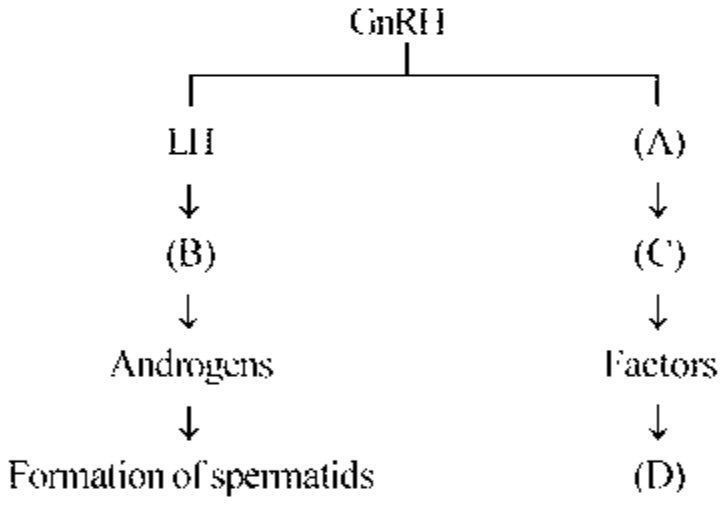
- 1ICSH, Leydig cells, Sertoli cells, spermatogenesis.
- 2FSH, Leydig cells, Sertoli cells, spermiogenesis
- 3ICSH, Interstitial cells, Leydig cells, spermiogenesis.
- 4FSH, Sertoli cells, Leydig cells, spermatogenesis.
Show answer and solution
Correct: option 2, FSH, Leydig cells, Sertoli cells, spermiogenesis
GnRH makes the pituitary release two gonadotropins, LH and FSH, so (A) is FSH. LH acts on the Leydig cells (B), which secrete androgens. FSH acts on the Sertoli cells (C), which secrete factors that help in spermiogenesis (D), the change of spermatids into sperms.
Question 18NEET 2024 Re-exam, Q164
Given below are two statements: One is labelled as Assertion A and the other is labelled as Reason R.
Assertion A: During menstrual cycle, the ovulation takes place approximately on 14th day.
Reason R: Rapid secretion of LH in the middle of menstrual cycle induces rupture of Graafian follicle and thereby the release of ovum.
In the light of the above statements, choose the most appropriate answer from the options given below.
- 1A is correct but R is not correct.
- 2A is not correct but R is correct.
- 3Both A and R are correct and R is the correct explanation of A.
- 4Both A and R are correct but R is NOT the correct explanation of A.
Show answer and solution
Correct: option 3, Both A and R are correct and R is the correct explanation of A.
In a 28-day cycle ovulation happens at about the 14th day. It happens then because LH rises sharply in the middle of the cycle (the LH surge), and this makes the Graafian follicle rupture and release the ovum. Both statements are correct and R is the cause of A.
Question 19NEET 2024 Re-exam, Q172
Arrange the following parts in human Mammary gland, traversing the route of milk ejection.
A. Mammary duct
B. Lactiferous duct
C. Mammary alveolus
D. Ampulla
E. Mammary tubule
Choose the correct answer from the options given below:
- 1
- 2
- 3
- 4
Show answer and solution
Correct: option 3,
Milk is secreted by the cells of the alveoli and stored in their cavities. The alveoli open into mammary tubules, the tubules of each lobe join to form a mammary duct, several mammary ducts join to form a wider mammary ampulla, and the ampulla is connected to the lactiferous duct through which milk is sucked out. The order is C, E, A, D, B.
Question 20NEET 2024 Re-exam, Q186
Match List-I with List-II relating to human female external genitalia.
| List I (Structures) | List II (Features) |
|---|
| a. Mons pubis | (i) A fleshy fold of tissue surrounding the vaginal opening |
| b. Clitoris | (ii) Fatty cushion of cells covered by skin and hair |
| c. Hymen | (iii) Tiny finger-like structure above labia minora |
| d. Labia majora | (iv) A thin membrane-like structure covering vaginal opening |
Choose the correct answer from the option given below:
- 1a-ii, b-iii, c-iv, d-i
- 2a-iv, b-iii, c-ii, d-i
- 3a-i, b-iv, c-iii, d-ii
- 4a-ii, b-iii, c-i, d-iv
Show answer and solution
Correct: option 1, a-ii, b-iii, c-iv, d-i
The mons pubis is a cushion of fatty tissue covered by skin and pubic hair. The clitoris is a tiny finger-like structure at the upper junction of the two labia minora. The hymen is a thin membrane that partly covers the opening of the vagina. The labia majora are fleshy folds of tissue that surround the vaginal opening. So a-ii, b-iii, c-iv, d-i.
Question 21NEET 2024 Re-exam, Q193
Match List-I with List-II:
| List-I | List-II |
|---|
| A. Parturition | I. Several antibodies for new-born babies |
| B. Placenta | II. Collection of ovum after ovulation |
| C. Colostrum | III. Foetal ejection reflex |
| D. Fimbriae | IV. Secretion of the hormone hCG |
Choose the correct answer from the option given below:
- 1A-III, B-IV, C-I, D-II
- 2A-I, B-IV, C-II, D-III
- 3A-II, B-III, C-IV, D-I
- 4A-III, B-IV, C-II, D-I
Show answer and solution
Correct: option 1, A-III, B-IV, C-I, D-II
Parturition is started by signals from the fully developed foetus and the placenta that set off the foetal ejection reflex. The placenta is also an endocrine tissue and secretes hCG. Colostrum, the milk of the first few days, carries several antibodies for the new-born. The fimbriae at the edge of the infundibulum collect the ovum after ovulation. So A-III, B-IV, C-I, D-II.
Question 22NEET 2023, Q152
Given below are two statements:
Statement I: Vas deferens receives a duct from seminal vesicle and opens into urethra as the ejaculatory duct.
Statement II: The cavity of the cervix is called cervical canal which along with vagina forms birth canal.
In the light of the above statements, choose the correct answer from the options given below:
- 1Both Statement I and Statement II are true.
- 2Both Statement I and Statement II are false.
- 3Statement I is correct but Statement II is false.
- 4Statement I incorrect but Statement II is true.
Show answer and solution
Correct: option 1, Both Statement I and Statement II are true.
Both statements are true. The vas deferens loops over the urinary bladder, joins the duct of the seminal vesicle and opens into the urethra as the ejaculatory duct. The cavity of the cervix is the cervical canal, and together with the vagina it forms the birth canal. So option (1) is right.
Question 23NEET 2023, Q162
Given below are two statements: one is labelled as Assertion A and the other is labelled as Reason R.
Assertion A: Endometrium is necessary for implantation of blastocyst.
Reason R: In the absence of fertilization, the corpus luteum degenerates that causes disintegration of endometrium.
In the light of the above statements, choose the correct answer from the options given below:
- 1Both A and R are true and R is the correct explanation of A.
- 2Both A and R are true but R is NOT the correct explanation of A.
- 3A is true but R is false.
- 4A is false but R is true.
Show answer and solution
Correct: option 2, Both A and R are true but R is NOT the correct explanation of A.
A is true: the blastocyst becomes embedded in the endometrium, so the endometrium is needed for implantation. R is also true: without fertilisation the corpus luteum degenerates, progesterone falls and the endometrium breaks down, which is menstruation. But R describes what happens when there is no pregnancy and does not explain why the endometrium is needed for implantation. So option (2) is right.
Question 24NEET 2023, Q172
Which of the following statements are correct regarding female reproductive cycle?
A. In non-primate mammals cyclical changes during reproduction are called oestrus cycle.
B. First menstrual cycle begins at puberty and is called menopause.
C. Lack of menstruation may be indicative of pregnancy.
D. Cyclic menstruation extends between menarche and menopause.
Choose the most appropriate answer from the options given below:
- 1A and D only
- 2A and B only
- 3A, B and C only
- 4A, C and D only
Show answer and solution
Correct: option 4, A, C and D only
A is correct: non-primate mammals such as cows and dogs have an oestrus cycle. B is wrong: the first menstruation at puberty is menarche; menopause is when the cycles stop. C is correct: a missed period may indicate pregnancy. D is correct: cyclic menstruation continues from menarche to menopause. So A, C and D, option (4).
Question 25NEET 2023 Manipur, Q163
Given below are two statements regarding oogenesis.
Statement I: The primary follicles get surrounded by more layers of granulosa cells, a theca and shows fluid filled cavity antrum. Now it is called secondary follicle.
Statement II: Graafian follicle ruptures to release the secondary oocyte from the ovary by the process called ovulation.
In the light of the above statements, choose the correct answer from the options given below:
- 1Both Statement I and Statement II are true
- 2Both Statement I and Statement II are false
- 3Statement I is correct but Statement II is false
- 4Statement I is incorrect but Statement II is true
Show answer and solution
Correct: option 4, Statement I is incorrect but Statement II is true
A primary follicle that gains more layers of granulosa cells and a new theca is a secondary follicle; the fluid filled antrum appears only later and is the mark of the tertiary follicle. So Statement I is incorrect. The mature Graafian follicle does rupture to release the secondary oocyte at ovulation, so Statement II is true.
Question 26NEET 2023 Manipur, Q180
Arrange the sequence of different hormones for their role during gametogenesis.
(A) Gonadotropin LH stimulates synthesis and secretion of Androgen
(B) Gonadotropin releasing hormone from hypothalamus
(C) Androgen stimulates spermatogenesis
(D) Gonadotropin FSH helps in the process of spermiogenesis
(E) Gonadotropins from anterior pituitary gland
Choose the correct answer from the options given below:
- 1(B),(E),(A),(C),(D)
- 2(D),(B),(A),(C),(E)
- 3(E),(A),(D),(B),(C)
- 4(C),(A),(D),(E),(B)
Show answer and solution
Correct: option 1, (B),(E),(A),(C),(D)
The chain starts with GnRH from the hypothalamus (B), which makes the anterior pituitary release the gonadotropins LH and FSH (E). LH acts on Leydig cells to produce androgens (A), androgens stimulate spermatogenesis (C), and FSH acts on Sertoli cells to help spermiogenesis (D). The order is (B), (E), (A), (C), (D).
Question 27NEET 2022, Q160
At which stage of life the oogenesis process is initiated?
- 1Adult
- 2Puberty
- 3Embryonic development stage
- 4Birth
Show answer and solution
Correct: option 3, Embryonic development stage
Oogenesis begins during embryonic development, when a couple of million oogonia are formed in each foetal ovary. They enter prophase I of meiosis and stay arrested there as primary oocytes; no more oogonia are formed after birth.
Question 28NEET 2022, Q163
Which of the following statements are true for spermatogenesis but do not hold true for Oogenesis?
(a) It results in the formation of haploid gametes
(b) Differentiation of gamete occurs after the completion of meiosis
(c) Meiosis occurs continuously in a mitotically dividing stem cell population
(d) It is controlled by the Luteinising hormone (LH) and Follicle Stimulating Hormone (FSH) secreted by the anterior pituitary
(e) It is initiated at puberty
Choose the most appropriate answer from the options given below:
- 1(b), (c) and (e) only
- 2(c) and (e) only
- 3(b) and (c) only
- 4(b), (d) and (e) only
Show answer and solution
Correct: option 1, (b), (c) and (e) only
Both processes give haploid gametes (a) and both are controlled by LH and FSH (d), so these are not differences. Only in spermatogenesis do the spermatids differentiate into sperms after meiosis is complete (b), do spermatogonia keep dividing by mitosis and entering meiosis continuously (c), and does the process start at puberty (e). Oogenesis starts in the embryo and meiosis is completed only at fertilisation. So (b), (c) and (e) only.
Question 29NEET 2022, Q171
Given below are two statements:
Statement I: The release of sperms into the seminiferous tubules is called spermiation.
Statement II: Spermiogenesis is the process of formation of sperms from spermatogonia.
In the light of the above statements, choose the most appropriate answer from the options given below:
- 1Statement I is incorrect but Statement II is correct
- 2Both Statement I and Statement II are correct
- 3Both Statement I and Statement II are incorrect
- 4Statement I is correct but Statement II is incorrect
Show answer and solution
Correct: option 4, Statement I is correct but Statement II is incorrect
After spermiogenesis the sperm heads lie embedded in the Sertoli cells and are then released into the lumen of the seminiferous tubules; this release is spermiation, so Statement I is taken as correct. Spermiogenesis is the transformation of spermatids into sperms; the formation of sperms from spermatogonia is spermatogenesis, so Statement II is incorrect.
Question 30NEET 2022 Re-exam, Q168
How many secondary spermatocytes are required to form 400 million spermatozoa?
- 1400 million
- 250 million
- 3100 million
- 4200 million
Show answer and solution
Correct: option 4, 200 million
Each secondary spermatocyte goes through the second meiotic division to give two spermatids, and each spermatid becomes one spermatozoon. So 400 million spermatozoa need 400/2 = 200 million secondary spermatocytes.
Question 31NEET 2022 Re-exam, Q170
Arrange the components of mammary gland. (from proximal to distal).
(a) Mammary duct
(b) Lactiferous duct
(c) Alveoli
(d) Mammary ampulla
(e) Mammary tubules
Choose the most appropriate answer from the options given below:
- 1(e) (c) (d) (b) (a)
- 2(c) (a) (d) (e) (b)
- 3(b) (c) (e) (d) (a)
- 4(c) (e) (a) (d) (b)
Show answer and solution
Correct: option 4, (c) (e) (a) (d) (b)
Milk is secreted into the alveoli, which open into mammary tubules. The tubules of each lobe join to form a mammary duct, several ducts join to form a wider mammary ampulla, and this connects to the lactiferous duct through which milk is sucked out. The order is (c), (e), (a), (d), (b).
Question 32NEET 2022 Re-exam, Q176
Given below are two statements: one is labelled as Assertion (A) and the other is labelled as Reason (R).
Assertion (A): During pregnancy the level of thyroxine is increased in the maternal blood.
Reason (R): Pregnancy is characterised by metabolic changes in the mother.
In the light of the above statements, choose the most appropriate answer from the options given below:
- 1(A) is not correct but (R) is correct
- 2Both (A) and (R) are correct and (R) is the correct explanation of (A)
- 3Both (A) and (R) are correct but (R) is not the correct explanation of (A)
- 4(A) is correct but (R) is not correct
Show answer and solution
Correct: option 2, Both (A) and (R) are correct and (R) is the correct explanation of (A)
During pregnancy the levels of hormones such as estrogens, progestogens, cortisol, prolactin and thyroxine rise several fold in the blood of the mother, so (A) is correct. These hormones are needed to support foetal growth and the metabolic changes in the mother, so (R) is correct. Thyroxine regulates metabolic rate, so the changed metabolism of the mother is the reason for its rise: (R) explains (A).
Question 33NEET 2021, Q163
Receptors for sperm binding in mammals are present on:
- 1Corona radiata
- 2Vitelline membrane
- 3Perivitelline space
- 4Zona pellucida
Show answer and solution
Correct: option 4, Zona pellucida
The sperm binds to receptor glycoproteins (ZP proteins) of the zona pellucida, the layer around the ovum. This contact triggers the acrosome reaction and the changes that block the entry of further sperms.
Question 34NEET 2021, Q189
Which of these is not an important component of initiation of parturition in humans?
- 1Increase in estrogen and progesterone ratio
- 2Synthesis of prostaglandins
- 3Release of Oxytocin
- 4Release of Prolactin
Show answer and solution
Correct: option 4, Release of Prolactin
Parturition is started by a rise in the estrogen to progesterone ratio, the synthesis of prostaglandins and the release of oxytocin, which together cause strong uterine contractions. Prolactin acts on milk production and has no part in starting labour.
Question 35NEET 2021, Q193
Which of the following secretes the hormone, relaxin, during the later phase of pregnancy?
- 1Graafian follicle
- 2Corpus luteum
- 3Foetus
- 4Uterus
Show answer and solution
Correct: option 2, Corpus luteum
Relaxin is secreted by the ovary in the later phase of pregnancy, and within the ovary its source is the corpus luteum. Of the options given, the corpus luteum is therefore the right one.
Question 36NEET 2020, Q62
Meiotic division of the secondary oocyte is completed:
- 1Prior to ovulation
- 2At the time of copulation
- 3After zygote formation
- 4At the time of fusion of a sperm with an ovum
Show answer and solution
Correct: option 4, At the time of fusion of a sperm with an ovum
The secondary oocyte is released at ovulation while arrested in metaphase of the second meiotic division. The entry of a sperm makes it complete meiosis II, giving the ovum (ootid) and the second polar body. So the division is completed at the time of fusion of the sperm with the ovum.
Question 37NEET 2020, Q125
Which of the following hormone levels will cause release of ovum (ovulation) from the graffian follicle?
- 1High concentration of Estrogen
- 2High concentration of Progesterone
- 3Low concentration of LH
- 4Low concentration of FSH
Show answer and solution
Correct: option 1, High concentration of Estrogen
Estrogen from the growing follicle peaks around the middle of the cycle, and this high level triggers the LH surge that ruptures the Graafian follicle and releases the ovum. Low LH or FSH cannot cause ovulation, and high progesterone belongs to the luteal phase after ovulation.
Question 38NEET 2020, Q135
Match the following columns and select the correct option.
| Column - I | Column - II |
|---|
| (a) Placenta | (i) Androgens |
| (b) Zona pellucida | (ii) Human Chorionic Gonadotropin (hCG) |
| (c) Bulbo-urethral glands | (iii) Layer of the ovum |
| (d) Leydig cells | (iv) Lubrication of the Penis |
- 1a-iv, b-iii, c-i, d-ii
- 2a-i, b-iv, c-ii, d-iii
- 3a-iii, b-ii, c-iv, d-i
- 4a-ii, b-iii, c-iv, d-i
Show answer and solution
Correct: option 4, a-ii, b-iii, c-iv, d-i
The placenta secretes hCG (ii). The zona pellucida is a layer around the ovum (iii). The secretion of the bulbo-urethral glands helps to lubricate the penis (iv). Leydig cells make androgens (i). This is a-ii, b-iii, c-iv, d-i.
Question 39NEET 2020 Phase 2, Q61
Match the following columns and select the correct option:
| Column - I | Column - II |
|---|
| (a) Ovary | (i) Human chorionic Gonadotropin |
| (b) Placenta | (ii) Estrogen & Progesterone |
| (c) Corpus luteum | (iii) Androgens |
| (d) Leydig cells | (iv) Progesterone only |
- 1a-i, b-ii, c-iii, d-iv
- 2a-i, b-iii, c-ii, d-iv
- 3a-ii, b-i, c-iv, d-iii
- 4a-iv, b-iii, c-ii, d-i
Show answer and solution
Correct: option 3, a-ii, b-i, c-iv, d-iii
The ovary secretes both estrogen and progesterone. The placenta produces human chorionic gonadotropin (hCG). The corpus luteum is matched with progesterone, its main hormone, and the Leydig cells of the testis make androgens. So the matching is a-ii, b-i, c-iv, d-iii.
Question 40NEET 2020 Phase 2, Q63
In human beings, at the end of 12 weeks (first trimester) of pregnancy, the following is observed:
- 1Most of the major organ systems are formed
- 2The head is covered with fine hair
- 3Movement of the foetus
- 4Eyelids and eyelashes are formed
Show answer and solution
Correct: option 1, Most of the major organ systems are formed
By the end of the first trimester (12 weeks) most of the major organ systems are formed; the limbs and external genital organs are well developed. The first movements of the foetus and hair on the head appear during the fifth month, and the eyelids separate and eyelashes form by about the end of 24 weeks.
Question 41NEET 2020 Phase 2, Q73
Select the correct option of haploid cells from the following groups:
- 1Secondary spermatocyte, First polar body, Ovum
- 2Spermatogonia, Primary spermatocyte, Spermatid
- 3Primary spermatocyte, Secondary spermatocyte, Second polar body
- 4Primary oocyte, Secondary oocyte, Spermatid
Show answer and solution
Correct: option 1, Secondary spermatocyte, First polar body, Ovum
Cells formed by the first meiotic division and later are haploid: secondary spermatocytes, secondary oocytes, polar bodies, spermatids, sperms and the ovum. Spermatogonia, primary spermatocytes and primary oocytes are diploid. Only option (1) has three haploid cells.
Question 42NEET 2019, Q116
Select the correct sequence for transport of sperm cells in male reproductive system.
- 1Testis Epididymis Vasa efferentia Rete testis Inguinal canal Urethra
- 2Seminiferous tubules Rete testis Vasa efferentia Epididymis Vas deferens Ejaculatory duct Urethra Urethral meatus
- 3Seminiferous tubules Vasa efferentia Epididymis Inguinal canal Urethra
- 4Testis Epididymis Vasa efferentia Vas deferens Ejaculatory duct Inguinal canal Urethra Urethral meatus
Show answer and solution
Correct: option 2, Seminiferous tubules Rete testis Vasa efferentia Epididymis Vas deferens Ejaculatory duct Urethra Urethral meatus
Sperms are made in the seminiferous tubules, which open into the rete testis. From there the vasa efferentia carry them to the epididymis, which continues as the vas deferens. The vas deferens joins the duct of the seminal vesicle to form the ejaculatory duct, which opens into the urethra, and the urethra opens outside through the urethral meatus.
Question 43NEET 2019, Q171
Extrusion of second polar body from egg nucleus occurs:
- 1after entry of sperm but before fertilization
- 2after fertilization
- 3before entry of sperm into ovum
- 4simultaneously with first cleavage
Show answer and solution
Correct: option 1, after entry of sperm but before fertilization
The ovulated secondary oocyte is arrested in meiosis II. Entry of the sperm makes it complete meiosis II, giving the ovum and the second polar body. Only after that do the sperm and ovum nuclei fuse, which is fertilisation proper. So the second polar body is extruded after sperm entry but before fertilisation.
Question 44NEET 2019 Odisha, Q122
Which of the following hormones is responsible for both the milk ejection reflex and the foetal ejection reflex?
- 1Oxytocin
- 2Relaxin
- 3Estrogen
- 4Prolactin
Show answer and solution
Correct: option 1, Oxytocin
Oxytocin from the posterior pituitary makes smooth muscle contract. It causes the strong uterine contractions of the foetal ejection reflex at birth, and it contracts the cells around the mammary alveoli to eject milk. Prolactin controls milk production, not ejection.
Question 45NEET 2019 Odisha, Q123
No new follicles develop in the luteal phase of the menstrual cycle because:
- 1LH levels are high in the luteal phase.
- 2Both FSH and LH levels are low in the luteal phase.
- 3Follicles do not remain in the ovary after ovulation.
- 4FSH levels are high in the luteal phase.
Show answer and solution
Correct: option 2, Both FSH and LH levels are low in the luteal phase.
In the luteal phase the corpus luteum secretes large amounts of progesterone (with some estrogen), which acts back on the hypothalamus and pituitary and keeps the release of the gonadotropins low. Follicles need FSH and LH to grow, so with both low no new follicle develops.
Question 46NEET 2018, Q143
The amnion of mammalian embryo is derived from
- 1mesoderm and trophoblast
- 2endoderm and mesoderm
- 3ectoderm and mesoderm
- 4ectoderm and endoderm
Show answer and solution
Correct: option 3, ectoderm and mesoderm
The amnion is formed of ectoderm on the inside and mesoderm on the outside. Endoderm with mesoderm forms the yolk sac and allantois instead.
Question 47NEET 2018, Q144
Hormones secreted by the placenta to maintain pregnancy are
- 1hCG, hPL, progestogens, estrogens
- 2hCG, hPL, estrogens, relaxin, oxytocin
- 3hCG, hPL, progestogens, prolactin
- 4hCG, progestogens, estrogens, glucocorticoids
Show answer and solution
Correct: option 1, hCG, hPL, progestogens, estrogens
The placenta acts as an endocrine tissue and secretes human chorionic gonadotropin (hCG), human placental lactogen (hPL), estrogens and progestogens. Oxytocin and prolactin come from the pituitary, relaxin from the ovary and glucocorticoids from the adrenal cortex.
Question 48NEET 2018, Q145
The difference between spermiogenesis and spermiation is
- 1In spermiogenesis spermatozoa from sertoli cells are released into the cavity of seminiferous tubules, while in spermiation spermatozoa are formed.
- 2In spermiogenesis spermatozoa are formed, while in spermiation spermatids are formed.
- 3In spermiogenesis spermatids are formed, while in spermiation spermatozoa are formed.
- 4In spermiogenesis spermatozoa are formed, while in spermiation spermatozoa are released from sertoli cells into the cavity of seminiferous tubules.
Show answer and solution
Correct: option 4, In spermiogenesis spermatozoa are formed, while in spermiation spermatozoa are released from sertoli cells into the cavity of seminiferous tubules.
Spermiogenesis is the transformation of spermatids into spermatozoa. Spermiation is the release of these spermatozoa, whose heads are embedded in Sertoli cells, into the lumen of the seminiferous tubules.
Question 49NEET 2018, Q162
Match the items given in Column I with those in Column II and select the correct option given below :
| Column I | | Column II |
|---|
| a. | Proliferative Phase | i. | Breakdown of endometrial lining |
| b. | Secretory Phase | ii. | Follicular Phase |
| c. | Menstruation | iii. | Luteal Phase |
- 1a-ii, b-iii, c-i
- 2a-i, b-iii, c-ii
- 3a-iii, b-ii, c-i
- 4a-iii, b-i, c-ii
Show answer and solution
Correct: option 1, a-ii, b-iii, c-i
The proliferative phase of the uterus coincides with the follicular phase of the ovary (ii). The secretory phase is the luteal phase, when the corpus luteum secretes progesterone (iii). Menstruation is the breakdown and shedding of the endometrial lining (i).
Question 50NEET 2017, Q126
- 1Rete testis
- 2Epididymis
- 3Vas deferens
- 4Female Reproductive tract
Show answer and solution
Correct: option 4, Female Reproductive tract
Capacitation is the final change that makes sperms able to fertilise the ovum. It takes place only after the sperms have entered the female reproductive tract.
Question 51NEET 2017, Q149
GnRH, a hypothalamic hormone, needed in reproduction, acts on
- 1anterior pituitary gland and stimulates secretion of LH and oxytocin.
- 2anterior pituitary gland and stimulates secretion of LH and FSH.
- 3posterior pituitary gland and stimulates secretion of oxytocin and FSH.
- 4posterior pituitary gland and stimulates secretion of LH and relaxin.
Show answer and solution
Correct: option 2, anterior pituitary gland and stimulates secretion of LH and FSH.
Gonadotropin releasing hormone from the hypothalamus acts on the anterior pituitary and makes it release the two gonadotropins, LH and FSH. Oxytocin is released from the posterior pituitary and relaxin comes from the ovary.
Question 52NEET 2016 Phase 1, Q111
Fertilization in humans is practically feasible only if:
- 1the sperms are transported into vagina just after the release of ovum in fallopian tube.
- 2the ovum and sperms are transported simultaneously to ampullary-isthmic junction of the fallopian tube.
- 3the ovum and sperms are transported simultaneously to ampullary-isthmic junction of the cervix.
- 4the sperms are transported into cervix within 48 hrs of release of ovum in uterus.
Show answer and solution
Correct: option 2, the ovum and sperms are transported simultaneously to ampullary-isthmic junction of the fallopian tube.
Fertilization takes place at the ampullary-isthmic junction of the fallopian tube. It can happen only if the ovum and the sperms reach this place at the same time, which is why not every act of copulation leads to pregnancy. The junction is a part of the oviduct, not of the cervix.
Question 53NEET 2016 Phase 1, Q117
Select the incorrect statement:
- 1FSH stimulates the sertoli cells which help in spermiogenesis.
- 2LH triggers ovulation in ovary.
- 3LH and FSH decrease gradually during the follicular phase.
- 4LH triggers secretion of androgens from the Leydig cells.
Show answer and solution
Correct: option 3, LH and FSH decrease gradually during the follicular phase.
During the follicular phase the secretion of LH and FSH rises gradually, stimulating follicle growth and oestrogen secretion, and both peak around the middle of the cycle. The statement that they decrease gradually is therefore incorrect. The other three statements are true.
Question 54NEET 2016 Phase 1, Q122
Changes in GnRH pulse frequency in females is controlled by circulating levels of:
- 1estrogen and progesterone
- 2estrogen and inhibin
- 3progesterone only
- 4progesterone and inhibin
Show answer and solution
Correct: option 1, estrogen and progesterone
The hypothalamus releases GnRH in pulses, and the ovarian steroids feed back on it. Rising oestrogen in the follicular phase increases the pulse frequency, while progesterone in the luteal phase slows it down. Inhibin acts mainly on the pituitary to reduce FSH, not on the GnRH pulses.
Question 55NEET 2016 Phase 1, Q133
Identify the correct statement on 'inhibin':
- 1Inhibits the secretion of LH, FSH and Prolactin.
- 2Is produced by granulose cells in ovary and inhibits the secretion of FSH.
- 3Is produced by granulose cells in ovary and inhibits the secretion of LH.
- 4Is produced by nurse cells in testes and inhibits the secretion of LH.
Show answer and solution
Correct: option 2, Is produced by granulose cells in ovary and inhibits the secretion of FSH.
Inhibin is a hormone made by the granulosa cells of the ovarian follicle (and by the Sertoli or nurse cells in the testis). It acts on the anterior pituitary and selectively suppresses the secretion of FSH, not of LH or prolactin.
Question 56NEET 2016 Phase 2, Q162
Which of the following depicts the correct pathway of transport of sperms?
- 1Rete testis Efferent ductules Epididymis Vas deferens
- 2Rete testis Epididymis Efferent ductules Vas deferens
- 3Rete testis Vas deferens Efferent ductules Epididymis
- 4Efferent ductules Rete testis Vas deferens Epididymis
Show answer and solution
Correct: option 1, Rete testis Efferent ductules Epididymis Vas deferens
Sperms leave the seminiferous tubules into the rete testis, pass through the vasa efferentia (efferent ductules) out of the testis into the epididymis, and from there enter the vas deferens.
Question 57NEET 2016 Phase 2, Q163
Match Column-I with Column-II and select the correct option using the codes given below
| Column-I | Column-II |
|---|
| a. Mons pubis | (i) Embryo formation |
| b. Antrum | (ii) Sperm |
| c. Trophectoderm | (iii) Female external genitalia |
| d. Nebenkern | (iv) Graafian follicle |
- 1a-iii, b-iv, c-ii, d-i
- 2a-iii, b-iv, c-i, d-ii
- 3a-iii, b-i, c-iv, d-ii
- 4a-i, b-iv, c-iii, d-ii
Show answer and solution
Correct: option 2, a-iii, b-iv, c-i, d-ii
The mons pubis is part of the female external genitalia (iii). The antrum is the fluid-filled cavity of the Graafian follicle (iv). The trophectoderm is the outer cell layer of the blastocyst, formed during embryo development (i). The nebenkern is the mitochondrial sheath in the middle piece of a sperm (ii). So a-iii, b-iv, c-i, d-ii.
Question 58NEET 2016 Phase 2, Q164
Several hormones like hCG, hPL, estrogen, progesterone are produced by
- 1ovary
- 2placenta
- 3fallopian tube
- 4pituitary
Show answer and solution
Correct: option 2, placenta
The placenta works as an endocrine tissue during pregnancy and secretes human chorionic gonadotropin (hCG), human placental lactogen (hPL), estrogens and progestogens. hCG and hPL are made only in pregnancy and not by the ovary or the pituitary.
Question 59AIPMT 2015, Q51
Which of these is not an important component of initiation of parturition in humans?
- 1Synthesis of prostaglandins
- 2Release of oxytocin
- 3Release of prolactin
- 4Increase in estrogen and progesterone ratio
Show answer and solution
Correct: option 3, Release of prolactin
Parturition begins when the estrogen to progesterone ratio rises, prostaglandins are made and oxytocin is released, which together bring about strong uterine contractions. Prolactin acts on the mammary glands for milk production and has no part in starting labour.
Question 60AIPMT 2015, Q78
Capacitation refers to changes in the:
- 1Ovum before fertilization
- 2Ovum after fertilization
- 3Sperm after fertilization
- 4Sperm before fertilization
Show answer and solution
Correct: option 4, Sperm before fertilization
Capacitation is the set of changes a sperm undergoes inside the female reproductive tract that make it able to fertilise the ovum. It therefore takes place in the sperm before fertilization.
Question 61AIPMT 2015, Q98
Which of the following cells during gametogenesis is normally diploid?
- 1Spermatid
- 2Spermatogonia
- 3Secondary polar body
- 4Primary polar body
Show answer and solution
Correct: option 2, Spermatogonia
Spermatogonia are the diploid germ cells that divide by mitosis before meiosis begins. Spermatids and both polar bodies are products of meiosis and are haploid.
Question 62AIPMT 2015 Re-test, Q60
Ectopic pregnancies are referred to as:
- 1Pregnancies terminated due to hormonal imbalance.
- 2Pregnancies with genetic abnormality.
- 3Implantation of embryo at site other than uterus.
- 4Implantation of defective embryo in the uterus
Show answer and solution
Correct: option 3, Implantation of embryo at site other than uterus.
"Ectopic" means out of place. In an ectopic pregnancy the embryo implants outside the uterus, most often in the fallopian tube.
Question 63AIPMT 2015 Re-test, Q93
Which of the following events is not associated with ovulation in human female?
- 1LH surge
- 2Decrease in estradiol
- 3Full development of Graafian follicle
- 4Release of secondary oocyte
Show answer and solution
Correct: option 2, Decrease in estradiol
Ovulation happens around day 14 when the fully grown Graafian follicle ruptures and releases the secondary oocyte, triggered by the LH surge. Estradiol from the growing follicle is at its peak just before ovulation and it is this high level that brings about the LH surge. So a decrease in estradiol is not a feature of ovulation.
Question 64AIPMT 2015 Re-test, Q102
In human females, meiosis-II is not completed until?
- 1birth
- 2puberty
- 3fertilization
- 4uterine implantation
Show answer and solution
Correct: option 3, fertilization
The secondary oocyte released at ovulation is arrested in metaphase of meiosis II. Only when a sperm enters it is the second division completed, giving the ovum and the second polar body. So meiosis II is completed at fertilization.
Question 65AIPMT 2015 Re-test, Q103
Which of the following layers in an antral follicle is acellular?
- 1Zona pellucida
- 2Granulosa
- 3Theca interna
- 4Stroma
Show answer and solution
Correct: option 1, Zona pellucida
The zona pellucida is a non-cellular glycoprotein coat secreted around the oocyte. The granulosa, the theca interna and the ovarian stroma are all made of cells.
Question 66AIPMT 2014, Q9
The shared terminal duct of the reproductive and urinary system in the human male is:
- 1Vasa efferentia
- 2Urethra
- 3Ureter
- 4Vas deferens
Show answer and solution
Correct: option 2, Urethra
The urethra starts at the urinary bladder, receives the ejaculatory ducts and runs through the penis, so it carries both urine and semen. Vasa efferentia and vas deferens carry only sperm, and the ureter carries only urine.
Question 67AIPMT 2014, Q38
The main function of mammalian corpus luteum is to produce:
- 1relaxin only
- 2estrogen only
- 3progesterone
- 4human chorionic gonadotropin
Show answer and solution
Correct: option 3, progesterone
After ovulation the ruptured follicle becomes the corpus luteum, which secretes large amounts of progesterone needed to maintain the endometrium. Human chorionic gonadotropin is made by the placenta.
Question 68AIPMT 2014, Q79
Select the correct option describing gonadotropin activity in a normal pregnant female:
- 1High level of hCG stimulates the thickening of endometrium.
- 2High level of FSH and LH stimulates the thickening of endometrium.
- 3High level of FSH and LH facilitate implantation of the embryo.
- 4High level of hCG stimulates the synthesis of estrogen and progesterone.
Show answer and solution
Correct: option 4, High level of hCG stimulates the synthesis of estrogen and progesterone.
During pregnancy the placenta secretes human chorionic gonadotropin (hCG), which keeps the corpus luteum active so that it goes on making progesterone and estrogen. These steroid hormones, not hCG directly, maintain the endometrium. FSH and LH stay low in pregnancy because the high levels of progesterone and estrogen suppress them.
Question 69NEET 2013, Q65
Menstrual flow occurs due to lack of:
- 1FSH
- 2Oxytocin
- 3Vasopressin
- 4Progesterone
Show answer and solution
Correct: option 4, Progesterone
Progesterone from the corpus luteum maintains the endometrium. If there is no fertilisation the corpus luteum degenerates, progesterone falls and the endometrium breaks down, which is the menstrual flow.
Question 70NEET 2013, Q83
What is the correct sequence of sperm formation?
- 1Spermatogonia, spermatocyte, spermatozoa, spermatid
- 2Spermatogonia, spermatozoa, spermatocyte, spermatid
- 3Spermatogonia, spermatocyte, spermatid, spermatozoa
- 4Spermatid, spermatocyte, spermatogonia, spermatozoa
Show answer and solution
Correct: option 3, Spermatogonia, spermatocyte, spermatid, spermatozoa
Spermatogonia multiply by mitosis and some become primary spermatocytes. Meiosis turns these into secondary spermatocytes and then haploid spermatids. Spermatids change into spermatozoa by spermiogenesis. So the order is spermatogonia, spermatocyte, spermatid, spermatozoa.
Question 71NEET 2013, Q121
Which one of the following is not the function of placenta? It:
- 1secretes estrogen.
- 2facilitates removal of carbon dioxide and waste material from embryo.
- 3secretes oxytocin during parturition.
- 4facilitates supply of oxygen and nutrients to embryo.
Show answer and solution
Correct: option 3, secretes oxytocin during parturition.
The placenta supplies oxygen and nutrients to the embryo, removes its carbon dioxide and wastes, and acts as an endocrine tissue that secretes hCG, hPL, estrogens and progestogens. Oxytocin is released from the mother's posterior pituitary during parturition, not by the placenta.
Question 72NEET 2013 Karnataka, Q65
The figure shows a section of human ovary. Select the option which gives the correct identification of A and B with function/characteristic:-
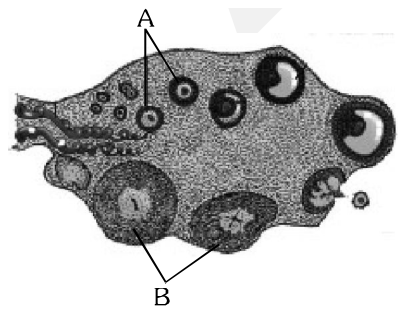
- 1B - Corpus luteum - secretes progesterone
- 2A - Tertiary follicle - forms Graafian follicle
- 3B - Corpus luteum - secretes estrogen
- 4A - Primary oocyte - it is the prophase - I of the meiotic division
Show answer and solution
Correct: option 1, B - Corpus luteum - secretes progesterone
B marks the large bodies left after ovulation, the corpus luteum, whose main secretion is progesterone, which maintains the endometrium. A marks small early follicles, not a tertiary follicle or a single oocyte.
Question 73NEET 2013 Karnataka, Q76
Which of the following best illustrates FEEDBACK in development?
- 1Tissue (X) secretes RNA which changes the development of tissue (Y)
- 2As tissue (X) develops, it secretes enzymes that inhibit the development of tissue (Y)
- 3As tissue (X) develops, it secretes something that induces tissue (Y) to develop
- 4As tissues (X) develops, it secretes something that slows down the growth of tissue (Y)
Show answer and solution
Correct: option 4, As tissues (X) develops, it secretes something that slows down the growth of tissue (Y)
Feedback in development means a growing tissue regulates growth by releasing a substance that reduces the rate of growth of another tissue, as in option (4). Option (3) describes induction, not feedback.
Question 74NEET 2013 Karnataka, Q126
The foetal ejection reflex in humans triggers release of:
- 1oxytocin from foetal pituitary
- 2human Chorionic Gonadotropin (hCG) from placenta
- 3human Placental Lactogen (hPL) from placenta
- 4oxytocin from maternal pituitary
Show answer and solution
Correct: option 4, oxytocin from maternal pituitary
Signals from the fully developed foetus and the placenta cause mild uterine contractions, the foetal ejection reflex. This makes the mother's pituitary release oxytocin, which strengthens the contractions and leads to birth.
Question 75AIPMT 2012 Prelims, Q55
Which one of the following statements is false in respect of viability of mammalian sperm?
- 1Sperm is viable for only up to 24 hours.
- 2Survival of sperm depends on the pH of the medium and is more active in alkaline medium.
- 3Viability of sperm is determined by its motility.
- 4Sperms must be concentrated in a thick suspension
Show answer and solution
Correct: option 4, Sperms must be concentrated in a thick suspension
The key used here marks option (4): on this view sperm do not have to be kept in a thick, concentrated suspension to stay viable, while motility and an alkaline medium do matter. Note that human sperm normally survive about 48 to 72 hours in the female tract, so the statement in option (1) is also open to objection and other keys mark it instead.
Question 76AIPMT 2012 Prelims, Q95
Signals for parturition originate from:
- 1Both placenta as well as fully developed foetus
- 2Oxytocin released from maternal pituitary
- 3Placenta only
- 4Fully developed foetus only
Show answer and solution
Correct: option 1, Both placenta as well as fully developed foetus
The signals for parturition come from the fully developed foetus and the placenta. They set up mild uterine contractions (the foetal ejection reflex), and this in turn causes the release of oxytocin from the maternal pituitary, so oxytocin is a result of the signal and not its origin.
Question 77AIPMT 2012 Prelims, Q100
In a normal pregnant woman, the amount of total gonadotropin activity was assessed. The result expected was
- 1High level of circulating FSH and LH in the uterus to stimulate implantation of the embryo
- 2High level of circulating HCG to stimulate endometrial thickening
- 3High level of FSH and LH in uterus to stimulate endometrial thickening
- 4High level of circulating HCG to stimulate estrogen and progesterone synthesis
Show answer and solution
Correct: option 4, High level of circulating HCG to stimulate estrogen and progesterone synthesis
During pregnancy FSH and LH are kept low by the high levels of progesterone and estrogen. The gonadotropin present in large amount is hCG from the placenta, which maintains the corpus luteum so that it keeps secreting progesterone and estrogen.
Question 78AIPMT 2012 Prelims, Q111
The Leydig cells found in the human body are the secretory source of
- 1Progesterone
- 2intestinal mucus
- 3glucagon
- 4androgens
Show answer and solution
Correct: option 4, androgens
Leydig cells (interstitial cells) lie in the spaces between the seminiferous tubules of the testis. Under the influence of LH they synthesise and secrete the male sex hormones, the androgens, chiefly testosterone.
Question 79AIPMT 2012 Mains, Q108
Identify the human developmental stage shown below as well as the related right place of its occurrence in a normal pregnant woman, and select the right option for the two together.
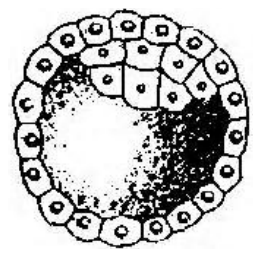
Developmental stage - Site of occurrence
- 1Late morula - Middle Part of Fallopian tube
- 2Blastula - End part of Fallopian tube
- 3Blastocyst - Uterine wall
- 48 - celled morula - Starting point of Fallopian tube
Show answer and solution
Correct: option 3, Blastocyst - Uterine wall
The figure shows a hollow ball with an outer layer of cells (trophoblast), a cavity and a clump of cells at one side (inner cell mass). This is the blastocyst. It is the stage that reaches the uterus and becomes embedded in the uterine wall (implantation); the morula stages are found in the fallopian tube.
Question 80AIPMT 2012 Mains, Q110
The secretory phase in the human menstrual cycle is also called:
- 1luteal phase and lasts for about 6 days
- 2follicular phase lasting for about 6 days
- 3luteal phase and lasts for about 13 days
- 4follicular phase and lasts for about 13 days
Show answer and solution
Correct: option 3, luteal phase and lasts for about 13 days
After ovulation, around day 14, the ruptured follicle becomes the corpus luteum, whose progesterone makes the endometrium secretory. This secretory phase is therefore the luteal phase, and it runs from ovulation to the next menstruation, about 13 to 14 days. The follicular phase is the proliferative phase before ovulation.
Question 81AIPMT 2011 Prelims, Q107
If for some reason, the vasa efferentia in the human reproductive system get blocked, the gametes will not be transported from:
- 1testes to epididymis
- 2epididymis to vas deferens
- 3ovary to uterus
- 4vagina to uterus
Show answer and solution
Correct: option 1, testes to epididymis
The vasa efferentia are the fine ducts that leave the rete testis and open into the epididymis. If they are blocked, sperms cannot pass from the testis to the epididymis.
Question 82AIPMT 2011 Prelims, Q112
The testes in humans are situated outside the abdominal cavity inside a pouch called scrotum. The purpose served is for:
- 1maintaining the scrotal temperature lower than the internal body temperature
- 2escaping any possible compression by the visceral organs
- 3providing more space for the growth of epididymis
- 4providing a secondary sexual feature for exhibiting the male sex
Show answer and solution
Correct: option 1, maintaining the scrotal temperature lower than the internal body temperature
Spermatogenesis needs a temperature about 2 to 2.5 degrees Celsius lower than the normal internal body temperature. The scrotum keeps the testes outside the abdominal cavity and so maintains this lower temperature.
Question 83AIPMT 2011 Prelims, Q148
The figure given below depicts a diagrammatic sectional view of the female reproductive system of humans. Which one set of three parts out of I-VI have been correctly identified?
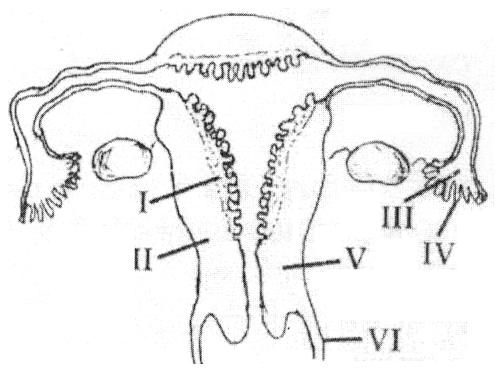
- 1(II) Endometrium (III) Infundibulum, (IV) Fimbriae
- 2(III) Infundibulum, (IV) Fimbriae, (V) Cervix
- 3(IV) Oviducal funnel, (V) Uterus, (VI) Cervix
- 4(I) Perimetrium, (II) Myometrium, (III) Fallopian tube
Show answer and solution
Correct: option 2, (III) Infundibulum, (IV) Fimbriae, (V) Cervix
In the figure I is the endometrium (inner lining), II the myometrium (muscular wall), III the infundibulum (the funnel-shaped end of the oviduct near the ovary), IV the fimbriae (its finger-like projections), V the cervix and VI the vagina. Only the set III infundibulum, IV fimbriae and V cervix is fully correct.
Question 84AIPMT 2011 Mains, Q39
What happens during fertilisation in humans after many sperms reach close to the ovum?
- 1Secretions of acrosome helps one sperm enter cytoplasm of ovum through zona pellucida
- 2All sperms except the one nearest to the ovum lose their tails
- 3Cells of corona radiata trap all the sperms except one
- 4Only two sperms nearest the ovum penetrate zona pellucida
Show answer and solution
Correct: option 1, Secretions of acrosome helps one sperm enter cytoplasm of ovum through zona pellucida
The enzymes released from the acrosome help a sperm pass through the zona pellucida and the plasma membrane into the cytoplasm of the ovum. Contact of one sperm with the zona pellucida changes the membrane so that no other sperm can enter, which ensures that only one sperm fertilises the ovum.
Question 85AIPMT 2011 Mains, Q40
About which day in a normal human menstrual cycle does rapid secretion of LH (Popularly called LH-surge) normally occurs?
- 114th day
- 220th day
- 35th day
- 411th day
Show answer and solution
Correct: option 1, 14th day
LH and FSH reach their peak in the middle of the 28-day cycle, at about the 14th day. This rapid rise of LH, the LH surge, makes the Graafian follicle rupture and release the ovum (ovulation).
Question 86AIPMT 2010 Mains, Q73
Signals from fully developed foetus and placenta ultimately lead to parturition which requires the release of
- 1Relaxin from placenta
- 2Estrogen from placenta
- 3Oxytocin from maternal pituitary
- 4Oxytocin from foetal pituitary
Show answer and solution
Correct: option 3, Oxytocin from maternal pituitary
The signals from the mature foetus and placenta start mild uterine contractions (the foetal ejection reflex). This makes the mother's pituitary release oxytocin, which causes stronger contractions of the uterus and leads to delivery.
Question 87AIPMT 2010 Mains, Q89
In human female the blastocyst
- 1Gets implanted in endometrium by the trophoblast cells
- 2Forms placenta even before implantation
- 3Gets implanted into uterus 3 days after ovulation
- 4gets nutrition from uterine endometrial secretion only after implantation
Show answer and solution
Correct: option 1, Gets implanted in endometrium by the trophoblast cells
The outer trophoblast layer of the blastocyst attaches to the endometrium and the blastocyst becomes embedded in it, which is implantation. The placenta forms only after implantation, implantation takes place about a week after ovulation, and the embryo already uses uterine secretions before it implants.
Question 88AIPMT 2010 Mains, Q95
Secretions from which one of the following are rich in fructose, calcium and some enzymes
- 1Salivary glands
- 2Male accessory glands
- 3Liver
- 4Pancreas
Show answer and solution
Correct: option 2, Male accessory glands
The male accessory glands (seminal vesicles, prostate and bulbourethral glands) secrete the seminal plasma, which is rich in fructose, calcium and certain enzymes.
Question 89AIPMT 2010 Prelims, Q129
The first movements of the foetus and appearance of hair on its head are usually observed during which month of pregnancy
- 1Fifth month
- 2Sixth month
- 3Third month
- 4Fourth month
Show answer and solution
Correct: option 1, Fifth month
In human development the limbs and digits form by the end of the second month and most organ systems by the end of the third month. The first movements of the foetus and hair on the head appear during the fifth month. Fine body hair, eyelids and eyelashes follow by about the end of the sixth month.
Question 90AIPMT 2010 Prelims, Q137
The second maturation division of the mammalian ovum occurs
- 1Until after the ovum has been penetrated by a sperm
- 2Until the nucleus of the sperm has fused with that of the ovum
- 3In the Graafian follicle after the first maturation division
- 4Shortly after ovulation before the ovum makes entry into the fallopian tube
Show answer and solution
Correct: option 1, Until after the ovum has been penetrated by a sperm
The egg is released as a secondary oocyte held at metaphase of the second meiotic division. This division is completed only when a sperm enters the oocyte, and it then gives the ovum and the second polar body. The nuclei of sperm and ovum fuse after that, so option (1) is right.
Question 91AIPMT 2010 Prelims, Q140
Which one of the following statements about morula in humans is correct
- 1It has far less cytoplasm as well as less DNA than in an uncleaved zygote
- 2It has more or less equal quantity of cytoplasm and DNA as in uncleaved zygote
- 3It has more cytoplasm and more DNA than an uncleaved zygote
- 4It has almost equal quantity of cytoplasm as an uncleaved zygote but much more DNA
Show answer and solution
Correct: option 4, It has almost equal quantity of cytoplasm as an uncleaved zygote but much more DNA
During cleavage the zygote divides again and again without growing, so the 8 to 16 cells of the morula share the cytoplasm that the zygote had. DNA, however, is copied before every division, so the total amount of DNA goes up with the number of cells. The morula therefore has about the same cytoplasm but much more DNA.
Question 92AIPMT 2010 Prelims, Q143
Seminal plasma in human males is rich in
- 1glucose and calcium
- 2DNA and testosterone
- 3ribose and potassium
- 4fructose and calcium
Show answer and solution
Correct: option 4, fructose and calcium
Seminal plasma is the combined secretion of the seminal vesicles, prostate and bulbourethral glands. It is rich in fructose, which supplies energy to the sperms, and also in calcium and certain enzymes. So fructose and calcium is the right choice.
Question 93AIPMT 2010 Prelims, Q153
Sertoli cells are found in
- 1adrenal cortex and secrete adrenaline
- 2Seminiferous tubules and provide nutrition to germ cells
- 3Pancreas and secrete progesterone
- 4Ovaries and secrete progesterone
Show answer and solution
Correct: option 2, Seminiferous tubules and provide nutrition to germ cells
Sertoli cells line the inside of the seminiferous tubules of the testis along with the male germ cells. They nourish the developing germ cells, so the second option is right.
Question 94AIPMT 2010 Prelims, Q184
Vasa efferentia are the ductules leading from
- 1Rete testis to vas deferens
- 2Vas deferens to epididymis
- 3Epididymis to urethra
- 4Testicular lobules to rete testis
Show answer and solution
Correct: option 1, Rete testis to vas deferens
The seminiferous tubules open into the rete testis, and the vasa efferentia leave the rete testis and open into the epididymis, which continues as the vas deferens. Of the choices given, only the first starts at the rete testis and leads on towards the vas deferens, so it is the best answer.
Question 95AIPMT 2010 Prelims, Q188
Which one of the following statements about human sperm is correct.
- 1The sperm lysins in the acrosome dissolve the egg envelope facilitating fertilisation
- 2Acrosome serves as a sensory structure leading the sperm towards the ovum
- 3Acrosome serves no particular function
- 4Acrosome has a conical pointed structure used for piercing and penetrating the egg resulting in fertilisation.
Show answer and solution
Correct: option 1, The sperm lysins in the acrosome dissolve the egg envelope facilitating fertilisation
The acrosome is a cap over the sperm nucleus filled with enzymes (sperm lysins such as hyaluronidase). These dissolve the coverings of the ovum so that the sperm can enter. It is not a sense organ and does not pierce the egg mechanically.
Question 96AIPMT 2010 Prelims, Q189
The signals for parturition originate from
- 1Placenta as well as fully developed foetus
- 2Oxytocin released from maternal pituitary
- 3Fully developed foetus only
- 4Placenta only
Show answer and solution
Correct: option 2, Oxytocin released from maternal pituitary
The answer key of the source copy gives oxytocin released from the maternal pituitary; oxytocin makes the uterine muscle contract strongly and drives the expulsion of the baby. Note that the textbook says the signals for parturition originate from the fully developed foetus and the placenta, which set off the foetal ejection reflex, and the release of oxytocin is the result of that reflex. By the textbook the first option is the answer.
Question 97AIPMT 2010 Prelims, Q200
The part of Fallopian tube closest to the ovary is
- 1Infundibulum
- 2Cervix
- 3Ampulla
- 4Isthmus
Show answer and solution
Correct: option 1, Infundibulum
Starting from the ovary, the fallopian tube has a funnel-shaped infundibulum with finger-like fimbriae, then the wider ampulla, and last the narrow isthmus that joins the uterus. The cervix is a part of the uterus. So the infundibulum lies closest to the ovary.
Question 98AIPMT 2009 Prelims, Q59
Which one of the following is the correct matching of the events occurring during menstrual cycle?
- 1Proliferative phase - Rapid regeneration of myometrium and maturation of Graafian follicle.
- 2Development of corpus luteum - Secretory phase and increased secretion of progesterone.
- 3Menstruation - breakdown of myometrium and ovum not fertilised.
- 4Ovulation - LH and FSH attain peak level and sharp fall in the secretion of progesterone.
Show answer and solution
Correct: option 2, Development of corpus luteum - Secretory phase and increased secretion of progesterone.
After ovulation the ruptured follicle becomes the corpus luteum, which secretes a large amount of progesterone during the secretory (luteal) phase. In the proliferative phase and in menstruation it is the endometrium, not the myometrium, that regenerates and breaks down. At ovulation LH and FSH peak, but progesterone is not falling sharply then.
Question 99AIPMT 2009 Prelims, Q65
Seminal plasma in humans is rich in:
- 1fructose and calcium but has no enzymes
- 2glucose and certain enzymes but has no calcium
- 3fructose and certain enzymes but poor in calcium
- 4fructose, calcium and certain enzymes
Show answer and solution
Correct: option 3, fructose and certain enzymes but poor in calcium
The secretions of the seminal vesicles, prostate and bulbourethral glands together form the seminal plasma. As described in the NCERT textbook it is rich in fructose, calcium and certain enzymes, which by this working points to option (4). The answer key supplied with this copy of the paper marks option (3), and that is the answer recorded here.
Question 100AIPMT 2009 Prelims, Q88
Given below is a diagrammatic sketch of a portion of human male reproductive system. Select the correct set of the names of the parts labelled A, B, C, D.
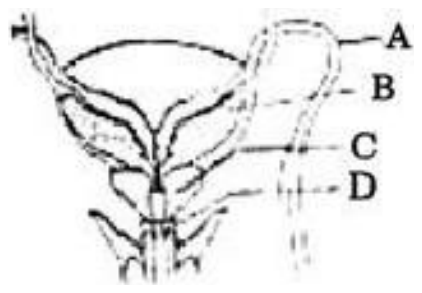
- 1A-vas deferens, B-seminal vesicle, C-prostate, D-bulbourethral gland
- 2A-vas deferens, B-seminal vesicle, C-bulbourethral gland, D-prostate
- 3A-ureter, B-seminal vesicle, C-prostate, D-bulbourethral gland
- 4A-ureter, B-prostate, C-seminal vesicle, D-bulbourethral gland
Show answer and solution
Correct: option 1, A-vas deferens, B-seminal vesicle, C-prostate, D-bulbourethral gland
A is the vas deferens, the duct that loops over the urinary bladder. B is the seminal vesicle lying behind the bladder, C is the prostate around the start of the urethra, and D is the bulbourethral (Cowper's) gland lying below the prostate.
Question 101AIPMT 2009 Prelims, Q93
Foetal ejection reflex in human female is induced by:
- 1release of oxytocin from pituitary
- 2fully developed foetus and placenta
- 3differentiation of mammary glands
- 4pressure exerted by amniotic fluid
Show answer and solution
Correct: option 2, fully developed foetus and placenta
The signals for parturition come from the fully developed foetus and the placenta. They cause mild uterine contractions called the foetal ejection reflex, and this in turn triggers the release of oxytocin from the mother's pituitary.
Question 102AIPMT 2009 Prelims, Q126
The correct sequence of spermatogenetic stages leading to the formation of sperms in a mature human testis is:
- 1spermatogonia - spermatocyte - spermatid - sperms
- 2spermatid - spermatocyte - spermatogonia - sperms
- 3spermatogonia - spermatid - spermatocyte - sperms
- 4spermatocyte - spermatogonia - spermatid - sperms
Show answer and solution
Correct: option 1, spermatogonia - spermatocyte - spermatid - sperms
Spermatogonia divide by mitosis and some become primary spermatocytes. These undergo meiosis (through secondary spermatocytes) to give haploid spermatids, which change shape into sperms by spermiogenesis.
Question 103AIPMT 2009 Prelims, Q129
Which one of the following is the most likely root cause why menstruation is not taking place in regularly cycling human female?
- 1maintenance of the hypertrophical endometrial lining
- 2maintenance of high concentration of sex hormones in the blood stream
- 3retention of well-developed corpus luteum
- 4fertilisation of the ovum
Show answer and solution
Correct: option 4, fertilisation of the ovum
If the ovum is fertilised, the embryo implants and hCG keeps the corpus luteum alive. The corpus luteum goes on secreting progesterone, which maintains the endometrium, so no menstruation occurs. The other three options are results of this; fertilisation is the root cause.
Question 104AIPMT 2009 Prelims, Q138
A change in the amount of yolk and its distribution in the egg will affect:
- 1Pattern of cleavage
- 2Number of blastomeres produced
- 3Fertilization
- 4Formation of zygote
Show answer and solution
Correct: option 1, Pattern of cleavage
Yolk slows down or blocks cleavage furrows. Eggs with little, evenly spread yolk divide completely (holoblastic cleavage), while eggs with much yolk divide unequally or only partly (meroblastic cleavage). So the amount and distribution of yolk decide the pattern of cleavage.
Question 105AIPMT 2008 Prelims, Q158
In humans, at the end of the first meiotic division, the male germ cells differentiate into the
- 1Spermatogonia
- 2Primary spermatocytes
- 3Secondary spermatocytes
- 4Spermatids
Show answer and solution
Correct: option 3, Secondary spermatocytes
A primary spermatocyte (diploid) undergoes the first meiotic division to give two haploid secondary spermatocytes. These complete the second meiotic division to form spermatids.
Question 106AIPMT 2008 Prelims, Q164
Which extraembryonic membrane in humans prevents desiccation of the embryo inside the uterus?
- 1Amnion
- 2Chorion
- 3Allantois
- 4Yolk sac
Show answer and solution
Correct: option 1, Amnion
The amnion encloses the embryo in a cavity filled with amniotic fluid. The fluid keeps the embryo moist and also cushions it against shocks.
Question 107AIPMT 2008 Prelims, Q165
Which one of the following statements is incorrect about menstruation?
- 1The beginning of the cycle of menstruation is called menarche
- 2During normal menstruation about 40 ml blood is lost
- 3The menstrual fluid can easily clot
- 4At menopause in the female, there is especially abrupt increase in gonadotropic hormones
Show answer and solution
Correct: option 3, The menstrual fluid can easily clot
Menstrual blood normally does not clot, because fibrinolysin released with the broken-down endometrium dissolves the clotting protein. The other statements are right: the first menstruation is menarche, about 40 ml of blood is lost, and at menopause the fall in ovarian hormones removes the feedback so gonadotropins rise.
Question 108AIPMT 2007 Prelims, Q53
In the human female, menstruation can be deferred by the administration of:
- 1FSH only
- 2LH only
- 3Combination of FSH and LH
- 4Combination of estrogen and progesterone
Show answer and solution
Correct: option 4, Combination of estrogen and progesterone
Menstruation starts when estrogen and progesterone levels fall and the endometrium loses its hormonal support. Giving estrogen together with progesterone keeps the endometrium maintained, so the flow is postponed. FSH and LH act on the ovary and do not hold the endometrium directly.
Question 109AIPMT 2007 Prelims, Q60
Which part of ovary in mammals acts as an endocrine gland after evolution?
- 1Vitelline membrane
- 2Graafian follicle
- 3Stroma
- 4Germinal epithelium
Show answer and solution
Correct: option 2, Graafian follicle
After the ovum is released, the ruptured Graafian follicle changes into the corpus luteum. The corpus luteum is a temporary endocrine gland that secretes mainly progesterone (and some estrogen) to maintain the endometrium.
Question 110AIPMT 2006 Prelims, Q164
Sertoli cells are regulated by the pituitary hormone known as
- 1FSH
- 2GH
- 3Prolactin
- 4LH
Show answer and solution
Correct: option 1, FSH
FSH from the anterior pituitary acts on the Sertoli cells of the seminiferous tubules and makes them release factors that support spermiogenesis. LH acts on the Leydig cells instead, stimulating androgen secretion.
Question 111AIPMT 2006 Prelims, Q182
Withdrawal of which of the following hormones is the immediate cause of menstruation?
- 1Estrogen
- 2FSH
- 3FSH-RH
- 4Progesterone
Show answer and solution
Correct: option 4, Progesterone
Progesterone from the corpus luteum maintains the thickened endometrium. If fertilisation does not occur the corpus luteum degenerates, the progesterone level falls, and the endometrium breaks down and is shed as the menstrual flow.
Question 112AIPMT 2005 Prelims, Q125
Grey crescent is the area
- 1At the point of entry of sperm into ovum
- 2Just opposite to the site of entry of sperm into ovum
- 3At the animal pole
- 4At the vegetal pole
Show answer and solution
Correct: option 2, Just opposite to the site of entry of sperm into ovum
In the frog egg, entry of the sperm causes the pigmented cortex to rotate towards the entry point. This exposes a lightly pigmented, crescent-shaped band on the side opposite to the point of sperm entry, called the grey crescent, which marks the future dorsal side.
Question 113AIPMT 2005 Prelims, Q141
If mammalian ovum fails to get fertilized, which one of the following is unlikely
- 1Estrogen secretion further decreases
- 2Progesterone secretion rapidly declines
- 3Corpus luteum will disintegrate
- 4Primary follicle starts developing
Show answer and solution
Correct: option 4, Primary follicle starts developing
Without fertilisation the corpus luteum degenerates and progesterone falls sharply, which brings on menstruation. The answer key used for this paper gives option (4) as the unlikely event. Note that many textbooks instead treat option (1) as the unlikely one, since a new set of follicles begins to develop in the next cycle and these secrete estrogen; the keyed answer is kept here as it stands in the key.
Question 114AIPMT 2004 Prelims, Q132
Ovulation in the human female normally takes place during the menstrual cycle -
- 1Just before the end of the secretory cycle
- 2At the beginning of the proliferative phase
- 3At the end of the proliferative phase
- 4At the mid secretory phase
Show answer and solution
Correct: option 3, At the end of the proliferative phase
The proliferative (follicular) phase lasts from the end of menstruation to about day 14, when the LH surge makes the Graafian follicle rupture. Ovulation therefore comes at the end of the proliferative phase, and the secretory (luteal) phase follows it.
Question 115AIPMT 2004 Prelims, Q134
Which of the following hormones is not a secretion product of human placenta -
- 1Prolactin
- 2Estrogen
- 3Progesterone
- 4Human chorionic gonadotropin
Show answer and solution
Correct: option 1, Prolactin
The placenta secretes hCG, estrogens, progesterone and human placental lactogen. Prolactin is a hormone of the anterior pituitary.
Question 116AIPMT 2003 Prelims, Q150
During embryonic development, the establishment of polarity along anterior/posterior, dorsal/ventral or medial/lateral axis is called:
- 1Organizer phenomena
- 2Axis formation
- 3Anamorphosis
- 4Pattern formation
Show answer and solution
Correct: option 1, Organizer phenomena
The answer key of the source copy gives organizer phenomena, the term for the action of an organizer region, such as the dorsal lip of the blastopore, which induces neighbouring cells and so directs the layout of the embryonic axes. Note that the description in the question fits the term axis formation (a part of pattern formation) more directly, so the keyed answer is doubtful.
Question 117AIPMT 2003 Prelims, Q182
Bartholin's glands are situated:-
- 1On the sides of the head of some amphibians
- 2At the reduced tail end of birds
- 3On either side of vagina in humans
- 4On either side of vas deferens in humans
Show answer and solution
Correct: option 3, On either side of vagina in humans
Bartholin's glands (greater vestibular glands) are a pair of glands lying on either side of the vaginal opening in the human female. Their secretion lubricates the vestibule.
Question 118AIPMT 2002 Prelims, Q121
Mainly which hormones control menstrual cycle in human beings:-
- 1FSH
- 2LH
- 3FSH, LH, Estrogen
- 4Progesterone
Show answer and solution
Correct: option 3, FSH, LH, Estrogen
The menstrual cycle is run by the interplay of pituitary and ovarian hormones: FSH makes the follicles grow, the follicles secrete estrogen which rebuilds the endometrium, and the LH surge causes ovulation. No single hormone controls the cycle, so the option listing FSH, LH and estrogen together is the best one.
Question 119AIPMT 2002 Prelims, Q168
What is true for cleavage:-
- 1Size of embryo increase
- 2Size of cells decrease
- 3Size of cells increase
- 4Size of embryo decrease
Show answer and solution
Correct: option 2, Size of cells decrease
Cleavage is a series of rapid mitotic divisions of the zygote without growth between divisions. The total size of the embryo stays the same, so the cells (blastomeres) become smaller with each division.
Question 120AIPMT 2001 Prelims, Q142
- 1Corpus luteum – Graafian follicles
- 2Sebum-sweat
- 3Bundle of His – Pacemaker
- 4Vit. - Niacin
Show answer and solution
Correct: option 1, Corpus luteum – Graafian follicles
The corpus luteum is formed from the Graafian follicle itself after ovulation, so the two are stages of the same structure. Sebum and sweat come from different glands, the pacemaker is the SA node and not the bundle of His, and niacin is vitamin , not .
Question 121AIPMT 2000 Prelims, Q189
Blastopore is the pore of:
- 1Archenteron
- 2Blastocoel
- 3Coelom
- 4A.C.
Show answer and solution
Correct: option 1, Archenteron
During gastrulation cells move inwards to form a new cavity, the archenteron or primitive gut. Its opening to the outside is the blastopore.
Question 122AIPMT 2000 Prelims, Q190
- 1Holoblastic equal
- 2Holoblastic unequal
- 3Superficial
- 4Discoidal
Show answer and solution
Correct: option 1, Holoblastic equal
The mammalian egg has almost no yolk, so the whole egg divides (holoblastic cleavage) and the blastomeres formed are nearly equal in size. Superficial cleavage is seen in insects and discoidal cleavage in the heavily yolked eggs of birds and reptiles.
Question 123AIPMT 1999 Prelims, Q112
Which induces the development of corpus Luteum:
- 1LH
- 2Oestrogen
- 3FSH
- 4LTH
Show answer and solution
Correct: option 1, LH
The mid-cycle surge of luteinising hormone (LH) from the anterior pituitary brings about ovulation and then changes the ruptured Graafian follicle into the corpus luteum. FSH acts earlier, on follicle growth, and oestrogen is a product of the follicle.
Question 124AIPMT 1999 Prelims, Q188
After ovulation follicles converted into:
- 1Corpus luteum
- 2Corpus albicans
- 3Corpus cavernosa
- 4Corpus callosum
Show answer and solution
Correct: option 1, Corpus luteum
After the Graafian follicle ruptures and releases the ovum, what remains of it changes under the influence of LH into the yellow corpus luteum, which secretes progesterone. The corpus albicans is the white scar left later when the corpus luteum degenerates. Corpus cavernosa are in the penis and the corpus callosum is in the brain.
Question 125AIPMT 1998 Prelims, Q192
Correct sequence of embryo development:
- 1Gamete → Zygote → Morula → Blastula → Gastrula
- 2Gamete → Zygote → Blastula → Morula → Gastrula
- 3Gamete → Neurula → Gastrula
- 4Gamete → Neurula → Morula
Show answer and solution
Correct: option 1, Gamete → Zygote → Morula → Blastula → Gastrula
Gametes fuse to form the zygote. Cleavage turns it into a solid ball of cells, the morula, which becomes the hollow blastula. Cell movements then form the germ layers in the gastrula. The neurula comes only after the gastrula.