Questions with solutions
Question 1NEET 2026, Q158
Match List I with List II related to muscular/skeletal system:
| List I | List II |
|---|
| A. Tetany | I. Inflammation of joints |
| B. Arthritis | II. Autoimmune disorder affecting neuromuscular junction |
| C. Myasthenia gravis | III. Wild contraction in muscle due to low in body fluid |
| D. Muscular dystrophy | IV. Progressive degeneration of skeletal muscle |
Choose the correct answer from the options given below:
- 1A-III, B-I, C-II, D-IV
- 2A-IV, B-III, C-II, D-I
- 3A-I, B-II, C-III, D-IV
- 4A-III, B-II, C-I, D-IV
Show answer and solution
Correct: option 1, A-III, B-I, C-II, D-IV
Tetany is rapid spasms (wild contractions) of muscle caused by low in the body fluid. Arthritis is inflammation of joints. Myasthenia gravis is an autoimmune disorder of the neuromuscular junction. Muscular dystrophy is the progressive degeneration of skeletal muscle, mostly genetic. So A-III, B-I, C-II, D-IV.
Question 2NEET 2026, Q168
Which of the following statements are correct with reference to human endoskeleton?
A. Human skull is monocondylic.
B. The joint between any two adjoining vertebrae is a cartilaginous joint.
C. In human beings, the number of cervical vertebrae is seven.
D. All ribs except the last 2 pairs are bicephalic.
E. The occipital bone of skull is articulated with atlas vertebra.
Choose the correct answer from the options given below:
- 1A, B and D only
- 2B and E only
- 3B, C and E only
- 4C, D and E only
Show answer and solution
Correct: option 3, B, C and E only
The human skull has two occipital condyles (dicondylic), so A is wrong. Adjacent vertebrae are joined by cartilaginous joints (B), there are seven cervical vertebrae (C), and the occipital condyles articulate with the first vertebra, the atlas (E). The key does not accept D, so the answer is B, C and E only.
Question 3NEET 2026, Q173
Choose the correct statements regarding muscle contraction.
A. A motor neuron carries a signal sent by the Central Nervous System (CNS) to the sarcolemma of the muscle fibre.
B. The neural signal generates an action potential which causes the release of into sarcoplasm.
C. Increase in inactivates the actin for breaking cross bridges.
D. Actin binds to the myosin head to form a cross bridge.
E. Shortening of sarcomere takes place, by pulling actin filaments towards the centre of 'A' band.
Choose the correct answer from the options given below:
- 1A, B, D and E only
- 2C and D only
- 3C and E only
- 4A and B only
Show answer and solution
Correct: option 1, A, B, D and E only
A signal from the CNS reaches the sarcolemma through a motor neuron (A) and sets up an action potential that releases into the sarcoplasm (B). The binds troponin and uncovers the active sites on actin, so it activates actin rather than inactivating it; C is wrong. The myosin head then binds actin to form a cross bridge (D) and pulls the actin filaments towards the centre of the A band, shortening the sarcomere (E).
Question 4NEET 2026 Re-exam, Q91
The number of vertebrae in a human is ________.
- 17
- 212
- 326
- 4206
Show answer and solution
Correct: option 3, 26
The human vertebral column is made of 26 serially arranged vertebrae: 7 cervical, 12 thoracic, 5 lumbar, 1 sacral (fused) and 1 coccygeal (fused). 7 and 12 are only the cervical and thoracic counts, and 206 is the total number of bones in the body.
Question 5NEET 2026 Re-exam, Q104
Which of the following represents the correct sequence of arrangement of bones in the lower limb of humans?
- 1Femur-tibia-patella-tarsal
- 2Patella-femur-tibia-tarsal
- 3Femur-patella-tibia-tarsal
- 4Femur-tarsal-patella-tibia
Show answer and solution
Correct: option 3, Femur-patella-tibia-tarsal
From the hip downwards the bones are the femur (thigh), the patella (knee cap), the tibia and fibula (lower leg), then the tarsals (ankle), metatarsals and phalanges. Only femur-patella-tibia-tarsal keeps this order.
Question 6NEET 2026 Re-exam, Q140
Sperm motility is due to __________.
- 1flagellar movement
- 2ciliary movement
- 3amoeboid movement
- 4muscular movement
Show answer and solution
Correct: option 1, flagellar movement
A sperm swims by lashing its tail, which is a flagellum. Its movement is therefore flagellar, not ciliary, amoeboid or muscular.
Question 7NEET 2026 Re-exam, Q152
Muscle contraction is initiated by a signal sent by the central nervous system by the release of __________.
- 1acetyl choline
- 2acetyl coenzyme A
- 3cyclic guanine monophosphate
- 4cyclic adenine monophosphate
Show answer and solution
Correct: option 1, acetyl choline
When the nerve signal reaches the neuromuscular junction, the motor neuron releases the neurotransmitter acetyl choline. It sets up an action potential in the sarcolemma, which releases calcium ions and starts the contraction.
Question 8NEET 2026 Re-exam, Q158
Which of the following is the correct order of arrangement of vertebrate column from the head to toe?
- 1Cervical vertebra, thoracic vertebra, sacrum, lumbar vertebra
- 2Sacrum, lumbar vertebra, thoracic vertebra, cervical vertebra
- 3Cervical vertebra, lumbar vertebra, thoracic vertebra, sacrum
- 4Cervical vertebra, thoracic vertebra, lumbar vertebra, sacrum
Show answer and solution
Correct: option 4, Cervical vertebra, thoracic vertebra, lumbar vertebra, sacrum
From the skull downwards the vertebral column has 7 cervical, 12 thoracic and 5 lumbar vertebrae, then the fused sacrum and the coccyx. The order is cervical, thoracic, lumbar, sacrum.
Question 9NEET 2024, Q160
Three types of muscles are given as a, b and c. Identify the correct matching pair along with their location in human body:
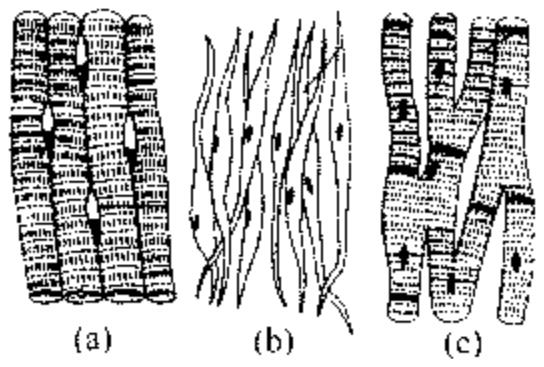
- 1(a) Involuntary - Nose tip
(b) Skeletal - Bone
(c) Cardiac - Heart.
- 2(a) Smooth - Toes
(b) Skeletal - Legs
(c) Cardiac - Heart.
- 3(a) Skeletal - Triceps
(b) Smooth - Stomach
(c) Cardiac - Heart.
- 4(a) Skeletal - Biceps
(b) Involuntary - Intestine
(c) Smooth - Heart.
Show answer and solution
Correct: option 3, (a) Skeletal - Triceps
(b) Smooth - Stomach
(c) Cardiac - Heart.
Figure (a) shows long, unbranched, striated fibres lying side by side, which is skeletal muscle, as in the triceps. Figure (b) shows spindle-shaped fibres without striations, which is smooth muscle, as in the wall of the stomach. Figure (c) shows branched striated fibres joined to each other, which is cardiac muscle, found only in the heart.
Question 10NEET 2024, Q162
Match List I with List II:
| List I | List II |
|---|
| A. Fibrous joints | I. Adjacent vertebrae, limited movement |
| B. Cartilaginous joints | II. Humerus and Pectoral girdle, rotational movement |
| C. Hinge joints | III. Skull, don't allow any movement |
| D. Ball and socket joints | IV. Knee, help in locomotion |
Choose the correct answer from the options given below:
- 1A-III, B-I, C-IV, D-II
- 2A-IV, B-II, C-III, D-I
- 3A-I, B-III, C-II, D-IV
- 4A-II, B-III, C-I, D-IV
Show answer and solution
Correct: option 1, A-III, B-I, C-IV, D-II
Fibrous joints are the immovable sutures between the skull bones. Cartilaginous joints, as between adjacent vertebrae, allow limited movement. The knee is a hinge joint (a synovial joint) that helps in locomotion. The joint between the humerus and the pectoral girdle is a ball and socket joint that allows rotation. So A-III, B-I, C-IV, D-II.
Question 11NEET 2024 Re-exam, Q152
Match List-I with List-II:
| List I - Location of Joint | List II - Type of Joint |
|---|
| A. Joint between humerus and pectoral girdle | I. Gliding joint |
| B. Knee joint | II. Ball and Socket joint |
| C. Joint between atlas and axis | III. Hinge joint |
| D. Joint between carpals | IV. Pivot joint |
Choose the correct answer from the options given below:
- 1A-II, B-III, C-IV, D-I
- 2A-III, B-II, C-I, D-IV
- 3A-I, B-IV, C-III, D-II
- 4A-II, B-I, C-III, D-IV
Show answer and solution
Correct: option 1, A-II, B-III, C-IV, D-I
The head of the humerus fits into the glenoid cavity of the pectoral girdle as a ball and socket joint. The knee bends in one plane only, so it is a hinge joint. The atlas turns on the axis, which is a pivot joint. The carpals slide over one another, which is a gliding joint. So A-II, B-III, C-IV, D-I.
Question 12NEET 2024 Re-exam, Q197
Select the correct statements regarding mechanism of muscle contraction.
A. It is initiated by a signal sent by CNS via sensory neuron.
B. Neurotransmitter generates action potential in the sarcolemma.
C. Increased level leads to the binding of calcium with troponin on actin filaments.
D. Masking of active site for actin is activated.
E. Utilising the energy from ATP hydrolysis to form cross bridge.
Choose the most appropriate answer from the options given below:
- 1B, C and E only
- 2C, D and E only
- 3A and D only
- 4B, D and E only
Show answer and solution
Correct: option 1, B, C and E only
The signal from the CNS travels along a motor neuron, not a sensory neuron, so A is wrong. The neurotransmitter released at the neuromuscular junction sets up an action potential in the sarcolemma (B). Calcium ions are then released and bind to troponin on the actin filaments (C); this removes the masking of the active sites for myosin, so D is wrong. The myosin head uses the energy of ATP hydrolysis to bind actin and form a cross bridge (E). So B, C and E are correct.
Question 13NEET 2023, Q157
Match List I with List II.
| List I (Type of Joint) | List II (Found between) |
|---|
| A. Cartilaginous Joint | I. Between flat skull bones |
| B. Ball and Socket Joint | II. Between adjacent vertebrae in vertebral column |
| C. Fibrous Joint | III. Between carpal and metacarpal of thumb |
| D. Saddle Joint | IV. Between Humerus and Pectoral girdle |
Choose the correct answer from the options given below:
- 1A-III, B-I, C-II, D-IV
- 2A-II, B-IV, C-I, D-III
- 3A-I, B-IV, C-III, D-II
- 4A-II, B-IV, C-III, D-I
Show answer and solution
Correct: option 2, A-II, B-IV, C-I, D-III
Cartilaginous joints join adjacent vertebrae (II). The ball and socket joint is between the humerus and the pectoral girdle (IV). Fibrous joints are the sutures between flat skull bones (I). The saddle joint is between the carpal and metacarpal of the thumb (III). This is option (2).
Question 14NEET 2023, Q199
Which of the following statements are correct regarding skeletal muscle?
A. Muscle bundles are held together by collagenous connective tissue layer called fascicle.
B. Sarcoplasmic reticulum of muscle fibre is a store house of calcium ions.
C. Striated appearance of skeletal muscle fibre is due to distribution pattern of actin and myosin proteins.
D. M line is considered as functional unit of contraction called sarcomere.
Choose the most appropriate answer from the options given below:
- 1A, B and C only
- 2B and C only
- 3A, C and D only
- 4C and D only
Show answer and solution
Correct: option 2, B and C only
A is wrong: the muscle bundles themselves are the fascicles; the collagenous connective tissue layer that holds them together is the fascia. B is correct: the sarcoplasmic reticulum stores calcium ions. C is correct: the striations come from the arrangement of actin and myosin. D is wrong: the sarcomere, the functional unit, is the part of a myofibril between two Z lines. So B and C, option (2).
Question 15NEET 2023 Manipur, Q156
Match List-I with List-II.
| List-I | List-II |
|---|
| (A) Palm bones | (I) Phalanges |
| (B) Wrist bones | (II) Metacarpals |
| (C) Ankle bones | (III) Carpals |
| (D) Digit bones | (IV) Tarsals |
Choose the correct answer from the options given below:
- 1A-III, B-IV, C-I, D-II
- 2A-II, B-III, C-IV, D-I
- 3A-II, B-III, C-I, D-IV
- 4A-IV, B-I, C-II, D-III
Show answer and solution
Correct: option 2, A-II, B-III, C-IV, D-I
The palm is made of 5 metacarpals, the wrist of 8 carpals, the ankle of 7 tarsals and the digits of phalanges. So A-II, B-III, C-IV, D-I.
Question 16NEET 2022, Q157
Which of the following is present between the adjacent bones of the vertebral column?
- 1Smooth muscle
- 2Intercalated discs
- 3Cartilage
- 4Areolar tissue
Show answer and solution
Correct: option 3, Cartilage
Adjacent vertebrae are joined by intervertebral discs made of fibrocartilage, forming cartilaginous joints that allow limited movement. Intercalated discs belong to cardiac muscle, not to the vertebral column.
Question 17NEET 2022, Q162
Given below are two statements: one is labelled as Assertion (A) and the other is labelled as Reason (R).
Assertion (A): Osteoporosis is characterised by decreased bone mass and increased chances of fractures.
Reason (R): Common cause of osteoporosis is increased levels of estrogen.
In the light of the above statements, choose the most appropriate answer from the options given below:
- 1(A) is not correct but (R) is correct
- 2Both (A) and (R) are correct and (R) is the correct explanation of (A)
- 3Both (A) and (R) are correct but (R) is not the correct explanation of (A)
- 4(A) is correct but (R) is not correct
Show answer and solution
Correct: option 4, (A) is correct but (R) is not correct
Osteoporosis is an age-related disorder with decreased bone mass and a higher chance of fractures, so the assertion is correct. Its common cause is a decreased level of estrogen, not an increased level, so the reason is not correct.
Question 18NEET 2022, Q182
Which of the following is a correct match for disease and its symptoms?
- 1Muscular dystrophy - An auto immune disorder causing progressive degeneration of skeletal muscle
- 2Arthritis - Inflammed joints
- 3Tetany - high level causing rapid spasms.
- 4Myasthenia gravis - Genetic disorder resulting in weakening and paralysis of skeletal muscle
Show answer and solution
Correct: option 2, Arthritis - Inflammed joints
Arthritis is inflammation of joints, so option (2) is the correct match. Muscular dystrophy is mostly a genetic disorder, tetany is caused by low in body fluid, and myasthenia gravis is an autoimmune disorder of the neuromuscular junction.
Question 19NEET 2022 Re-exam, Q163
According to the sliding filament theory:
- 1The actin filaments slide away from A-band resulting in shortening of sarcomere.
- 2Actin and myosin filaments slide over each other to increase the length of the sarcomere.
- 3Length of A-band does not change
- 4I-band increases in length.
Show answer and solution
Correct: option 3, Length of A-band does not change
During contraction the thin (actin) filaments slide in over the thick filaments towards the centre of the A-band. The sarcomere shortens and the I-band gets shorter, but the A-band, which is the length of the thick filaments, keeps its length.
Question 20NEET 2022 Re-exam, Q182
Gout is a type of disorder which leads to:
- 1Weakening of bones due to low calcium level
- 2Inflammation of joints due to accumulation of uric acid crystals
- 3Weakening of bones due to decreased bone mass
- 4Inflammation of joints due to cartilage degeneration
Show answer and solution
Correct: option 2, Inflammation of joints due to accumulation of uric acid crystals
Gout is inflammation of the joints caused by the accumulation of uric acid crystals. Decreased bone mass is osteoporosis, and joint inflammation in general is arthritis.
Question 21NEET 2021, Q159
Chronic auto immune disorder affecting neuro muscular junction leading to fatigue, weakening and paralysis of skeletal muscle is called as:
- 1Arthritis
- 2Muscular dystrophy
- 3Myasthenia gravis
- 4Gout
Show answer and solution
Correct: option 3, Myasthenia gravis
Myasthenia gravis is the autoimmune disorder of the neuromuscular junction that causes fatigue, weakening and paralysis of skeletal muscle. Muscular dystrophy is a genetic degeneration of muscle, arthritis is inflammation of joints, and gout is joint inflammation from uric acid crystals.
Question 22NEET 2021, Q187
During muscular contraction which of the following events occur?
(a) ‘H’ zone disappears
(b) ‘A’ band widens
(c) ‘I’ band reduces in width
(d) Myosin hydrolyzes ATP, releasing the ADP and Pi
(e) Z-lines attached to actins are pulled inwards
Choose the correct answer from the options given below.
- 1(a), (c), (d), (e) only
- 2(a), (b), (c), (d) only
- 3(b), (c), (d), (e) only
- 4(b), (d), (e), (a) only
Show answer and solution
Correct: option 1, (a), (c), (d), (e) only
In the sliding filament mechanism the myosin head hydrolyses ATP and pulls the actin filaments, with the Z-lines attached to them, inwards. The I band shortens and the H zone disappears, but the A band keeps its length. So (a), (c), (d) and (e) occur and (b) does not.
Question 23NEET 2021, Q188
Match List - I with List - II.
| List - I | List - II |
|---|
| (a) Scapula | (i) Cartilaginous joints |
| (b) Cranium | (ii) Flat bone |
| (c) Sternum | (iii) Fibrous joints |
| (d) Vertebral column | (iv) Triangular flat bone |
Choose the correct answer from the options given below.
- 1a-i, b-iii, c-ii, d-iv
- 2a-ii, b-iii, c-iv, d-i
- 3a-iv, b-ii, c-iii, d-i
- 4a-iv, b-iii, c-ii, d-i
Show answer and solution
Correct: option 4, a-iv, b-iii, c-ii, d-i
The scapula is a large triangular flat bone (iv). The skull bones of the cranium are joined by fibrous joints, the sutures (iii). The sternum is a flat bone on the ventral midline of the thorax (ii). Adjacent vertebrae of the vertebral column are joined by cartilaginous joints (i). So a-iv, b-iii, c-ii, d-i.
Question 24NEET 2020, Q88
Match the following columns and select the correct option.
| Column - I | Column - II |
|---|
| (a) Floating Ribs | (i) Located between second and seventh ribs |
| (b) Acromion | (ii) Head of the Humerus |
| (c) Scapula | (iii) Clavicle |
| (d) Glenoid cavity | (iv) Do not connect with the sternum |
- 1a-ii, b-iv, c-i, d-iii
- 2a-i, b-iii, c-ii, d-iv
- 3a-iii, b-ii, c-iv, d-i
- 4a-iv, b-iii, c-i, d-ii
Show answer and solution
Correct: option 4, a-iv, b-iii, c-i, d-ii
The floating ribs (11th and 12th pairs) are not connected to the sternum (a-iv). The acromion is the process of the scapula with which the clavicle articulates (b-iii). The scapula lies on the back of the thorax between the second and the seventh ribs (c-i). The glenoid cavity receives the head of the humerus to form the shoulder joint (d-ii).
Question 25NEET 2020 Phase 2, Q79
Match the following columns and select the correct option:
| Column - I | Column - II |
|---|
| (a) Gout | (i) Decreased levels of estrogen |
| (b) Osteoporosis | (ii) Low ions in the blood |
| (c) Tetany | (iii) Accumulation of uric acid crystals |
| (d) Muscular dystrophy | (iv) Auto immune disorder |
| (v) Genetic disorder |
- 1a-iii, b-i, c-ii, d-v
- 2a-iv, b-v, c-i, d-ii
- 3a-i, b-ii, c-iii, d-iv
- 4a-ii, b-i, c-iii, d-iv
Show answer and solution
Correct: option 1, a-iii, b-i, c-ii, d-v
Gout is inflammation of joints caused by the accumulation of uric acid crystals. Osteoporosis is commonly caused by decreased levels of estrogen. Tetany is rapid spasms of muscle due to low calcium ions in the body fluid. Muscular dystrophy is a genetic disorder. So the matching is a-iii, b-i, c-ii, d-v; the auto immune disorder (myasthenia gravis) is left over.
Question 26NEET 2019, Q103
Which of the following muscular disorders is inherited?
- 1Tetany
- 2Muscular dystrophy
- 3Myasthenia gravis
- 4Botulism
Show answer and solution
Correct: option 2, Muscular dystrophy
Muscular dystrophy is the progressive degeneration of skeletal muscle, mostly due to a genetic disorder. Tetany is caused by low calcium in the body fluid, myasthenia gravis is an autoimmune disorder and botulism is a kind of bacterial food poisoning.
Question 27NEET 2019, Q180
Select the correct option.
- 18th, 9th and 10th pairs of ribs articulate directly with the sternum.
- 211th and 12th pairs of ribs are connected to the sternum with the help of hyaline cartilage.
- 3Each rib is a flat thin bone and all the ribs are connected dorsally to the thoracic vertebrae and ventrally to the sternum.
- 4There are seven pairs of vertebrosternal, three pairs of vertebrochondral and two pairs of vertebral ribs.
Show answer and solution
Correct: option 4, There are seven pairs of vertebrosternal, three pairs of vertebrochondral and two pairs of vertebral ribs.
Of the 12 pairs of ribs, the first seven are true (vertebrosternal) ribs joined to the sternum by hyaline cartilage. The 8th, 9th and 10th are false (vertebrochondral) ribs that join the cartilage of the seventh rib, not the sternum directly. The 11th and 12th are floating (vertebral) ribs with no ventral connection. So only statement (4) is correct.
Question 28NEET 2019 Odisha, Q132
Match the following joints with the bones involved:
| |
|---|
| (a) Gliding joint | (i) Between carpal and metacarpal of thumb |
| (b) Hinge joint | (ii) Between Atlas and Axis |
| (c) Pivot joint | (iii) Between the Carpals |
| (d) Saddle joint | (iv) Between Humerus and Ulna |
Select the correct option from the following:
- 1a-iv, b-ii, c-iii, d-i
- 2a-i, b-iii, c-ii, d-iv
- 3a-iii, b-iv, c-ii, d-i
- 4a-iv, b-i, c-ii, d-iii
Show answer and solution
Correct: option 3, a-iii, b-iv, c-ii, d-i
The joints between the carpals are gliding joints (iii). The elbow, between humerus and ulna, is a hinge joint (iv). The joint between atlas and axis is a pivot joint (ii). The joint between the carpal and the metacarpal of the thumb is a saddle joint (i). So a-iii, b-iv, c-ii, d-i.
Question 29NEET 2019 Odisha, Q133
Which of the following diseases is an auto-immune disorder?
- 1Osteoporosis
- 2Gout
- 3Myasthenia gravis
- 4Arthritis
Show answer and solution
Correct: option 3, Myasthenia gravis
Myasthenia gravis is an auto-immune disorder in which the body attacks its own neuromuscular junctions, causing fatigue, weakness and paralysis of skeletal muscle. Osteoporosis is an age-related loss of bone mass, gout is caused by uric acid crystals collecting in joints, and arthritis is the general term for inflammation of joints.
Question 30NEET 2018, Q168
Calcium is important in skeletal muscle contraction because it
- 1detaches the myosin head from the actin filament.
- 2activates the myosin ATPase by binding to it.
- 3binds to troponin to remove the masking of active sites on actin for myosin.
- 4prevents the formation of bonds between the myosin cross bridges and the actin filament.
Show answer and solution
Correct: option 3, binds to troponin to remove the masking of active sites on actin for myosin.
Calcium ions released from the sarcoplasmic reticulum bind to a subunit of troponin on the actin filament. This shifts the troponin-tropomyosin complex and unmasks the active sites on actin, so the myosin heads can bind and form cross bridges.
Question 31NEET 2017, Q131
The pivot joint between atlas and axis is a type of:
- 1fibrous joint
- 2cartilaginous joint
- 3synovial joint
- 4saddle joint
Show answer and solution
Correct: option 3, synovial joint
Pivot joints are freely movable joints with a fluid-filled synovial cavity, so they are synovial joints, like ball and socket, hinge, gliding and saddle joints. The saddle joint is a different kind of synovial joint (between carpal and metacarpal of the thumb).
Question 32NEET 2017, Q144
Out of 'X' pairs of ribs in humans only 'Y' pairs are true ribs. Select the option that correctly represents values of X and Y and provides their explanation.
- 1X = 12, Y = 7
True ribs are attached dorsally to vertebral column and ventrally to the sternum.
- 2X = 12, Y = 5
True ribs are attached dorsally to vertebral column and sternum on the two ends.
- 3X = 24, Y = 7
True ribs are dorsally attached to vertebral column but are free on ventral side.
- 4X = 24, Y = 12
True ribs are dorsally attached to vertebral column but are free on ventral side.
Show answer and solution
Correct: option 1, X = 12, Y = 7
True ribs are attached dorsally to vertebral column and ventrally to the sternum.
Humans have 12 pairs of ribs. The first 7 pairs are true ribs: each is joined to the vertebral column at the back and directly to the sternum in front through hyaline cartilage. Ribs that are free on the ventral side are the floating ribs (pairs 11 and 12), not true ribs.
Question 33NEET 2016 Phase 1, Q137
Lack of relaxation between successive stimuli in sustained muscle contraction is known as:
- 1Spasm
- 2Fatigue
- 3Tetanus
- 4Tonus
Show answer and solution
Correct: option 3, Tetanus
When stimuli reach a muscle so quickly that it cannot relax between them, the twitches fuse into one continuous, sustained contraction called tetanus. A spasm is a sudden involuntary contraction, fatigue is the loss of the ability to contract after prolonged activity, and tonus is the slight steady tension of a resting muscle.
Question 34NEET 2016 Phase 2, Q151
Name the ion responsible for unmasking of active sites for myosin for cross-bridge activity during muscle contraction.
- 1Calcium
- 2Magnesium
- 3Sodium
- 4Potassium
Show answer and solution
Correct: option 1, Calcium
released from the sarcoplasmic reticulum binds to troponin on the thin filament. This shifts tropomyosin away and uncovers the myosin-binding sites on actin, so cross-bridges can form.
Question 35NEET 2016 Phase 2, Q154
Osteoporosis, an age-related disease of skeletal system, may occur due to
- 1immune disorder affecting neuromuscular junction leading to fatigue
- 2high concentration of and
- 3decreased level of estrogen
- 4accumulation of uric acid leading to inflammation of joints
Show answer and solution
Correct: option 3, decreased level of estrogen
Osteoporosis is a loss of bone mass that raises the chance of fractures, and a fall in estrogen (as after menopause) is a common cause. Option (1) describes myasthenia gravis and option (4) describes gout.
Question 36AIPMT 2015, Q58
Sliding filament theory can be best explained as:
- 1Actin and Myosin filaments shorten and slide pass each other
- 2Actin and Myosin filaments do not shorten but rather slide pass each other
- 3When myofilaments slide pass each other, Myosin filaments shorten while Actin filaments do not shorten
- 4When myofilaments slide pass each other Actin filaments shorten while Myosin filament do not shorten
Show answer and solution
Correct: option 2, Actin and Myosin filaments do not shorten but rather slide pass each other
In muscle contraction the thin (actin) filaments slide over the thick (myosin) filaments towards the centre of the sarcomere. The sarcomere and the I band get shorter, but neither kind of filament changes in length.
Question 37AIPMT 2015, Q81
Glenoid cavity articulates:
- 1Scapula with acromion
- 2Clavicle with scapula
- 3Humerus with scapula
- 4Clavicle with acromion
Show answer and solution
Correct: option 3, Humerus with scapula
The glenoid cavity is a shallow depression on the scapula into which the head of the humerus fits, forming the ball and socket shoulder joint. The clavicle articulates with the acromion process of the scapula, not with the glenoid cavity.
Question 38AIPMT 2015 Re-test, Q86
Which of the following is not a function of the skeletal system?
- 1Locomotion
- 2Production of erythrocytes
- 3Storage of minerals
- 4Production of body heat
Show answer and solution
Correct: option 4, Production of body heat
Bones give support and leverage for locomotion, their red marrow produces erythrocytes, and they store calcium and phosphate. Body heat is produced mainly by muscle contraction and metabolism, not by the skeleton.
Question 39AIPMT 2015 Re-test, Q119
Which of the following joints would allow no movement?
- 1Ball and Socket joint
- 2Fibrous joint
- 3Cartilaginous joint
- 4Synovial joint
Show answer and solution
Correct: option 2, Fibrous joint
In a fibrous joint the bones are held firmly together by dense fibrous connective tissue, as in the sutures of the skull, so no movement is possible. Cartilaginous joints allow limited movement, and synovial joints (including the ball and socket joint) move freely.
Question 40AIPMT 2014, Q5
Select the correct matching of the type of the joint with the example in human skeletal system:
Type of joint - Example
- 1Gliding joint - between carpals
- 2Cartilaginous joint - between frontal and parietal
- 3Pivot joint - between third and fourth cervical vertebrae
- 4Hinge joint - between humerus and pectoral girdle
Show answer and solution
Correct: option 1, Gliding joint - between carpals
The joint between carpals is a gliding joint. Frontal and parietal bones meet at a fibrous joint (a suture), not a cartilaginous one. The pivot joint is between the atlas and axis, the first and second cervical vertebrae. The humerus meets the pectoral girdle at a ball and socket joint.
Question 41AIPMT 2014, Q44
Stimulation of a muscle fiber by a motor neuron occurs at:
- 1the sarcoplasmic reticulum
- 2the neuromuscular junction
- 3the transverse tubules
- 4the myofibril
Show answer and solution
Correct: option 2, the neuromuscular junction
The junction between a motor neuron and the sarcolemma of a muscle fibre is the neuromuscular junction, or motor end plate. Acetylcholine released here sets up an action potential in the sarcolemma.
Question 42NEET 2013, Q66
The characteristics and an example of a synovial joint in humans is:
- 1fluid filled between two joints, provides cushion - skull bones
- 2fluid filled synovial cavity between two bones - joint between atlas and axis
- 3lymph filled between two bones, limited movement - gliding joint between carpals
- 4fluid cartilage between two bones, limited movements - Knee joint
Show answer and solution
Correct: option 2, fluid filled synovial cavity between two bones - joint between atlas and axis
A synovial joint has a fluid-filled synovial cavity between the two bones and allows considerable movement. The pivot joint between the atlas and the axis is a synovial joint. Skull bones are joined by fibrous sutures, and the fluid in a synovial joint is synovial fluid, not lymph or cartilage.
Question 43NEET 2013, Q110
Select the correct statement with respect to locomotion in humans:
- 1Accumulation of uric acid crystals in joints causes their inflammation.
- 2The vertebral column has 10 thoracic vertebrae.
- 3The joint between adjacent vertebrae is a fibrous joint.
- 4A decreased level of progesterone causes osteoporosis in old people.
Show answer and solution
Correct: option 1, Accumulation of uric acid crystals in joints causes their inflammation.
Gout is the inflammation of joints caused by uric acid crystals collecting in them, so (1) is correct. There are 12 thoracic vertebrae, the joint between adjacent vertebrae is cartilaginous, and osteoporosis in old age is linked to a fall in estrogen, not progesterone.
Question 44NEET 2013, Q127
The H-zone in the skeletal muscle fibre is due to:
- 1the central gap between myosin filaments in the A - band.
- 2the central gap between actin filaments extending through myosin filaments in the A - band.
- 3extension of myosin filaments in the central portion of the A - band.
- 4the absence of myofibrils in the central portion of A - band.
Show answer and solution
Correct: option 2, the central gap between actin filaments extending through myosin filaments in the A - band.
In a resting sarcomere the thin actin filaments from the two sides overlap the thick myosin filaments only partly and do not meet in the middle. The central part of the A-band that has thick filaments but no actin is the H-zone, that is, the gap between the actin filaments.
Question 45NEET 2013 Karnataka, Q51
During muscle contraction in humans the:-
- 1Sarcomere does not shorten
- 2A band remain same
- 3A, H and I bands shorten
- 4Actin filaments shorten
Show answer and solution
Correct: option 2, A band remain same
In the sliding filament model the thin filaments slide over the thick filaments. The sarcomere, the I band and the H zone shorten, but the A band, which is the length of the thick filaments, stays the same, and the filaments themselves do not shorten.
Question 46NEET 2013 Karnataka, Q110
Select the correct statement with respect to disorders of muscles in humans:
- 1Failure of neuromuscular transmission in myasthenia gravis can prevent normal swallowing
- 2Accumulation of urea and creatine in the joints cause their inflammation
- 3An overdose of vitamin D causes osteoporosis
- 4Rapid contractions of skeletal muscles causes muscle dystrophy
Show answer and solution
Correct: option 1, Failure of neuromuscular transmission in myasthenia gravis can prevent normal swallowing
Myasthenia gravis is an autoimmune disorder of the neuromuscular junction that weakens skeletal muscles, including those used in chewing and swallowing. Gout is due to uric acid crystals in joints, osteoporosis is linked to low estrogen and loss of bone mass, and muscular dystrophy is a genetic degeneration of muscle.
Question 47AIPMT 2012 Prelims, Q142
Select the correct statement regarding the specific disorder of muscular or skeletal system:
- 1Muscular dystrophy - age related shortening of muscles.
- 2Osteoporosis - decrease in bone mass and higher chance of fractures with advancing age.
- 3Myasthenia gravis - Auto immune disorder which inhibits sliding of myosin filaments
- 4Gout - inflammation of joints due to extra deposition of calcium.
Show answer and solution
Correct: option 2, Osteoporosis - decrease in bone mass and higher chance of fractures with advancing age.
Osteoporosis is an age-related disorder with reduced bone mass and a greater chance of fractures, commonly from a fall in estrogen. Muscular dystrophy is a genetic progressive degeneration of skeletal muscle, myasthenia gravis is an autoimmune disorder of the neuromuscular junction causing fatigue and weakness, and gout is inflammation of joints from deposited uric acid crystals, not calcium.
Question 48AIPMT 2012 Mains, Q103
Which one of the following pairs of chemical substances, is correctly categorised?
- 1Calcitonin and thymosin - Thyroid hormones
- 2Pepsin and prolactin - Two digestive enzymes secreted in stomach
- 3Troponin and myosin - Complex proteins in striated muscles
- 4Secretin and rhodopsin - Polypeptide hormones
Show answer and solution
Correct: option 3, Troponin and myosin - Complex proteins in striated muscles
Troponin is a protein of the thin (actin) filament and myosin forms the thick filament of striated muscle. Thymosin comes from the thymus, not the thyroid; prolactin is a pituitary hormone, not an enzyme; rhodopsin is the visual pigment of the rods, not a hormone.
Question 49AIPMT 2011 Mains, Q81
The type of muscles present in our:
- 1heart are involuntary and unstriated smooth muscles
- 2intestine are striated and involuntary
- 3thigh are striated and voluntary
- 4upper arm are smooth muscle fibres fusiform in shape
Show answer and solution
Correct: option 3, thigh are striated and voluntary
Thigh muscles are skeletal muscles, which show striations and work under our will. Heart muscle is striated (cardiac) though involuntary, intestinal muscle is smooth and unstriated, and the upper arm has skeletal muscle, not fusiform smooth fibres. So only the statement about the thigh is correct.
Question 50AIPMT 2011 Mains, Q86
Three of the following pairs of the human skeletal parts are correctly matched with their respective inclusive skeletal category and one pair is not matched. Identify the non-matching pair.
Pairs of skeletal parts - Category
- 1Sternum and Ribs - Axial skeleton
- 2Clavicle and Glenoid Cavity - Pelvic girdle
- 3Humerus and ulna - Appendicular skeleton
- 4Malleus and stapes - Ear ossicles
Show answer and solution
Correct: option 2, Clavicle and Glenoid Cavity - Pelvic girdle
The clavicle and the glenoid cavity (the socket on the scapula that receives the head of the humerus) belong to the pectoral girdle, not the pelvic girdle, so that pair is wrongly matched. The sternum and ribs are part of the axial skeleton, the humerus and ulna are limb bones of the appendicular skeleton, and the malleus and stapes are ear ossicles.
Question 51AIPMT 2010 Mains, Q111
Which one of the following is the correct description of a certain part of a normal human skeleton
- 1Glenoid cavity is a depression to which the thigh bone articulates
- 2Parietal bone and the temporal bone of the skull are joined by fibrous joint
- 3First vertebra is axis which articulates with the occipital condyles
- 4The 9th and 10th pairs of ribs are called the floating ribs
Show answer and solution
Correct: option 2, Parietal bone and the temporal bone of the skull are joined by fibrous joint
The bones of the skull are joined by sutures, which are fibrous joints, so (2) is correct. The glenoid cavity receives the head of the humerus (the thigh bone fits into the acetabulum), the first vertebra is the atlas, and the floating ribs are the 11th and 12th pairs.
Question 52AIPMT 2010 Prelims, Q139
Low in the body fluid may be the cause of
- 1Anaemia
- 2Angina pectoris
- 3Gout
- 4Tetany
Show answer and solution
Correct: option 4, Tetany
Tetany is rapid, sustained spasm of muscles caused by a low level of calcium ions in the body fluids, as happens when parathyroid hormone is deficient. Anaemia is linked to low haemoglobin, angina to poor oxygen supply to heart muscle, and gout to a build-up of uric acid crystals in joints.
Question 53AIPMT 2009 Prelims, Q133
Which one of the following is the correct matching of three items and their grouping category?
| Items | Group |
|---|
| (1) | ilium, ischium, pubis | coxal bones of pelvic girdle |
| (2) | actin, myosin, rhodopsin | muscle proteins |
| (3) | cytosine, uracil, thiamine | pyrimidines |
| (4) | malleus, incus, cochlea | ear ossicles |
- 11
- 22
- 33
- 44
Show answer and solution
Correct: option 1, 1
Each coxal (hip) bone is formed by the fusion of ilium, ischium and pubis, so row (1) is correct. Rhodopsin is a visual pigment and not a muscle protein; thiamine is vitamin B1 and not a pyrimidine base (the base is thymine); and the cochlea is part of the inner ear, the third ear ossicle being the stapes.
Question 54AIPMT 2009 Prelims, Q140
Elbow joint is an example of:
- 1hinge joint
- 2gliding joint
- 3ball and socket joint
- 4pivot joint
Show answer and solution
Correct: option 1, hinge joint
The elbow allows movement in one plane only, bending and straightening, like a door hinge. It is a hinge joint, as is the knee.
Question 55AIPMT 2008 Prelims, Q149
Which one of the following items gives its correct total number?
- 1Cervical vertebrae in humans - 8
- 2Floating ribs in humans - 4
- 3Amino acids found in proteins - 16
- 4Types of diabetes - 3
Show answer and solution
Correct: option 2, Floating ribs in humans - 4
Humans have two pairs of floating ribs, the 11th and 12th, which makes 4 ribs. There are 7 cervical vertebrae and 20 amino acids in proteins, so those numbers are wrong.
Question 56AIPMT 2007 Prelims, Q54
In human body, which one of the following is anatomically correct?
- 1Cranial nerves - 10 pairs
- 2Floating ribs - 2 pairs
- 3Collar bones - 3 pairs
- 4Salivary glands - 1 pair
Show answer and solution
Correct: option 2, Floating ribs - 2 pairs
Humans have 12 pairs of ribs, of which the last 2 pairs (11th and 12th) are floating ribs, not attached to the sternum. The others are wrong: there are 12 pairs of cranial nerves, 1 pair of collar bones and 3 pairs of salivary glands.
Question 57AIPMT 2006 Prelims, Q166
The contractile protein of skeletal muscle involving ATPase activity is
- 1Tropomyosin
- 2Myosin
- 3-Actin
- 4Troponin
Show answer and solution
Correct: option 2, Myosin
The globular head of the myosin molecule is an ATPase: it binds and splits ATP and uses the energy to pull the actin filament. Actin has no ATPase role in contraction, and tropomyosin and troponin are regulatory proteins.
Question 58AIPMT 2005 Prelims, Q113
An acromion process is characteristically found in the
- 1Skull of frog
- 2Sperm of mammals
- 3Pelvic girdle of mammals
- 4Pectoral girdle of mammals
Show answer and solution
Correct: option 4, Pectoral girdle of mammals
The acromion is the flat, expanded end of the spine of the scapula (shoulder blade), with which the clavicle articulates. The scapula is part of the pectoral girdle, so the acromion process belongs to the pectoral girdle of mammals. (The sperm has an acrosome, which is a different structure.)
Question 59AIPMT 2005 Prelims, Q196
Which of the following pairs, is correctly matched
- 1Fibrous joint – between phalanges
- 2Cartilaginous joint – skull bones
- 3Gliding joint – between zygapophyses of the successive vertebrae
- 4Hinge joint – between vertebrae
Show answer and solution
Correct: option 3, Gliding joint – between zygapophyses of the successive vertebrae
The flat articular facets (zygapophyses) of neighbouring vertebrae slide over one another, which is a gliding joint. The joints between phalanges are hinge joints, the skull bones are joined by fibrous sutures, and the bodies of the vertebrae are joined by cartilaginous joints.
Question 60AIPMT 2004 Prelims, Q162
ATPase enzyme needed for muscle contraction is located in -
- 1Troponin
- 2Myosin
- 3Actin
- 4Actinin
Show answer and solution
Correct: option 2, Myosin
The globular head of the myosin molecule (heavy meromyosin) is an active ATPase with binding sites for ATP and for actin. It splits ATP and uses the energy to form cross bridges and pull the thin filaments. Troponin only binds calcium, and actin and actinin have no ATPase activity.
Question 61AIPMT 2002 Prelims, Q117
What will happen if ligaments are cut or broken:-
- 1Bones will move freely at joints
- 2No movement at joint
- 3Bone will become unfix
- 4Bone will become fixed
Show answer and solution
Correct: option 3, Bone will become unfix
Ligaments are bands of dense connective tissue that tie one bone to another at a joint and hold the bones in place. If they are cut, the bones are no longer held together and get dislocated, that is, the bone becomes unfixed.
Question 62AIPMT 2001 Prelims, Q145
- 1Part between two H-line
- 2Part between two A-line
- 3Part between two I-band
- 4Part between two Z-line
Show answer and solution
Correct: option 4, Part between two Z-line
A sarcomere is the part of a myofibril between two successive Z-lines. It is the functional unit of contraction, with a whole A-band in the middle and half an I-band on each side.
Question 63AIPMT 2001 Prelims, Q146
Which statement is correct for muscle contraction:-
- 1Length of H-zone become decrease
- 2Length of A-band remains constant
- 3Length of I-band become increase
- 4Length of two Z-line become increase
Show answer and solution
Correct: option 1 or 2
The answer key accepts options 1 and 2.
During contraction the thin filaments slide over the thick filaments towards the centre of the sarcomere. The H-zone and the I-band become shorter and the Z-lines come closer, while the A-band, which is the length of the thick filaments, stays the same. So statements (1) and (2) are both correct, and the key accepts either.
Question 64AIPMT 2000 Prelims, Q132
What is name of joint between ribs and sternum:
- 1Cartilaginous joint
- 2Angular joint
- 3Gliding joint
- 4Fibrous joints
Show answer and solution
Correct: option 1, Cartilaginous joint
The ribs do not meet the sternum bone to bone; they are joined to it through bars of hyaline cartilage (the costal cartilages). A joint in which the bones are held together by cartilage is a cartilaginous joint.
Question 65AIPMT 2000 Prelims, Q133
Bone related with skull is:
- 1Coracoid
- 2Arytenoid
- 3Pterygoid
- 4Atlas
Show answer and solution
Correct: option 3, Pterygoid
The pterygoid is a bone of the skull (part of the palate region). The coracoid belongs to the pectoral girdle, the arytenoid is a cartilage of the larynx, and the atlas is the first vertebra.
Question 66AIPMT 2000 Prelims, Q138
What happens if bone of frog is kept in dilute hydrochloric acid:
- 1Will become flexible
- 2Will turn black
- 3Will break in pieces
- 4Will shrink
Show answer and solution
Correct: option 1, Will become flexible
The hardness of bone comes from its mineral salts, mainly calcium phosphate and carbonate. Dilute hydrochloric acid dissolves these salts and leaves only the organic matrix of collagen (ossein), so the decalcified bone keeps its shape but becomes soft and flexible.
Question 67AIPMT 1998 Prelims, Q127
- 1Dentary
- 2Maxilla
- 3Premaxilla
- 4Palatine
Show answer and solution
Correct: option 1, Dentary
In mammals each half of the lower jaw (mandible) is a single bone, the dentary. Maxilla, premaxilla and palatine are bones of the upper jaw and palate.
Question 68AIPMT 1998 Prelims, Q128
Number of bones in hind limb of man:
- 114
- 224
- 326
- 430
Show answer and solution
Correct: option 4, 30
One lower limb has femur 1, patella 1, tibia 1, fibula 1, tarsals 7, metatarsals 5 and phalanges 14. The total is .
Question 69AIPMT 1998 Prelims, Q148
Which part not have only involuntary muscles:
- 1Urethra
- 2Iris
- 3Heart muscles
- 4Blood vessels
Show answer and solution
Correct: option 1, Urethra
The iris and the walls of blood vessels have smooth muscle and the heart has cardiac muscle, all involuntary. The urethra has an internal sphincter of smooth muscle but also an external sphincter of striated muscle under the will, which is how urination is held back. So the urethra is the part that is not purely involuntary.
Question 70AIPMT 1998 Prelims, Q159
- 1Actin
- 2Myosin
- 3Troponin
- 4Tropomyosin
Show answer and solution
Correct: option 1, Actin
Actin and myosin are the two contractile proteins of muscle, while troponin and tropomyosin are regulatory proteins that control their interaction. Both of the first two options are therefore contractile proteins; the answer key used here gives actin, the protein of the thin filament that slides during contraction.
Question 71AIPMT 1998 Prelims, Q160
- 1Sarcomere
- 2Muscle fiber
- 3Actin
- 4None
Show answer and solution
Correct: option 1, Sarcomere
The part of a myofibril between two successive Z-lines is the sarcomere. It shortens when the thin filaments slide over the thick ones, so it is the structural and functional unit of contraction.