Questions with solutions
Question 1NEET 2026, Q138
Choose the correct statement regarding GIFT to overcome infertility.
- 1Ova collected from a female donor are transferred to the uterus of an infertile female.
- 2It is the transfer of an ovum collected from a donor into the fallopian tube of another female who cannot produce ovum but can provide suitable environment for fertilization and development.
- 3Early embryos with up to 8 blastomeres are transferred to the uterus of an infertile female.
- 4Early embryos with up to 8 blastomeres are transferred into the fallopian tube of an infertile female.
Show answer and solution
Correct: option 2, It is the transfer of an ovum collected from a donor into the fallopian tube of another female who cannot produce ovum but can provide suitable environment for fertilization and development.
GIFT is gamete intra fallopian transfer: an ovum from a donor is placed in the fallopian tube of a female who cannot produce one but can support fertilisation and further development. Moving an embryo of up to 8 blastomeres into the fallopian tube is ZIFT, and gametes are not placed in the uterus in GIFT.
Question 2NEET 2026, Q147
Match List I with List II:
| List I | List II |
|---|
| A. Progestasert | I. Barrier made of rubber used by females |
| B. Multiload 375 | II. Oral contraceptive |
| C. Diaphragm | III. Hormone releasing IUD |
| D. Saheli | IV. Copper releasing IUD |
Choose the correct answer from the options given below:
- 1A-III, B-IV, C-I, D-II
- 2A-III, B-IV, C-II, D-I
- 3A-IV, B-II, C-I, D-III
- 4A-IV, B-III, C-I, D-II
Show answer and solution
Correct: option 1, A-III, B-IV, C-I, D-II
Progestasert is a hormone releasing IUD, Multiload 375 is a copper releasing IUD, the diaphragm is a rubber barrier that the female places over the cervix, and Saheli is a once-a-week non-steroidal oral pill. So A-III, B-IV, C-I, D-II.
Question 3NEET 2026 Re-exam, Q139
Which of the following disease is not sexually transmitted?
- 1Syphilis
- 2Tuberculosis
- 3Gonorrhoea
- 4Genital warts
Show answer and solution
Correct: option 2, Tuberculosis
Syphilis, gonorrhoea and genital warts all spread through sexual contact. Tuberculosis is a bacterial disease of the lungs that spreads through the air in droplets, so it is not a sexually transmitted infection.
Question 4NEET 2026 Re-exam, Q142
The method of directly of injecting a sperm into ovum in assisted reproductive technology is called:
- 1Gamete intra fallopian transfer (GIFT)
- 2Zygote intra fallopian transfer (ZIFT)
- 3Intra cytoplasmic sperm injection (ICSI)
- 4Embryo transfer (ET)
Show answer and solution
Correct: option 3, Intra cytoplasmic sperm injection (ICSI)
In intra cytoplasmic sperm injection (ICSI) a single sperm is injected straight into the ovum in the laboratory to form an embryo. GIFT moves an ovum into the fallopian tube, ZIFT moves a zygote or early embryo there, and ET is the general transfer of an embryo.
Question 5NEET 2025, Q93
What are the potential drawbacks in adoption of the IVF method?
A. High fatality risk to mother
B. Expensive instruments and reagents
C. Husband/wife necessary for being donors
D. Less adoption of orphans
E. Not available in India
F. Possibility that the early embryo does not survive
Choose the correct answer from the options given below:
- 1B, D, F only
- 2A, C, D, F only
- 3A, B, C only
- 4A, B, C, E, F only
Show answer and solution
Correct: option 1, B, D, F only
IVF needs costly, high-precision instruments and reagents (B), the transferred early embryo may fail to survive or implant (F), and its use turns couples away from legally adopting orphaned children (D). It does not carry a high risk of death for the mother (A), donor gametes can be used so husband and wife need not be the donors (C), and it is available in India (E). So B, D and F only.
Question 6NEET 2024, Q181
Which of the following is not a natural/traditional contraceptive method?
- 1Vaults
- 2Coitus interruptus
- 3Periodic abstinence
- 4Lactational amenorrhea
Show answer and solution
Correct: option 1, Vaults
Natural methods work by avoiding the meeting of sperm and ovum without any device: periodic abstinence, coitus interruptus (withdrawal) and lactational amenorrhea. Vaults are rubber barriers placed in the female reproductive tract, so they are a barrier method.
Question 7NEET 2024, Q184
Match List I with List II:
| List I | List II |
|---|
| A. Non-medicated IUD | I. Multiload 375 |
| B. Copper releasing IUD | II. Progestogens |
| C. Hormone releasing IUD | III. Lippes loop |
| D. Implants | IV. LNG-20 |
Choose the correct answer from the options given below:
- 1A-III, B-I, C-IV, D-II
- 2A-III, B-I, C-II, D-IV
- 3A-I, B-III, C-IV, D-II
- 4A-IV, B-I, C-II, D-III
Show answer and solution
Correct: option 1, A-III, B-I, C-IV, D-II
The Lippes loop is a non-medicated IUD. Multiload 375 (like CuT and Cu7) is a copper releasing IUD. LNG-20 (like Progestasert) is a hormone releasing IUD. Implants placed under the skin contain progestogens alone or with estrogen. So A-III, B-I, C-IV, D-II.
Question 8NEET 2024 Re-exam, Q170
Match List-I with List-II relating to examples of various kind of IUDs and barrier:
| List-I | List-II |
|---|
| A. Copper releasing IUD | I. Vaults |
| B. Non-medicated IUD | II. Multiload 375 |
| C. Contraceptive barrier | III. LNG-20 |
| D. Hormone releasing IUD | IV. Lippes loop |
Choose the correct answer from the options given below:
- 1A-II, B-IV, C-III, D-I
- 2A-IV, B-III, C-I, D-II
- 3A-II, B-I, C-III, D-IV
- 4A-II, B-IV, C-I, D-III
Show answer and solution
Correct: option 4, A-II, B-IV, C-I, D-III
Multiload 375 is a copper releasing IUD (like CuT and Cu7). Lippes loop is a non-medicated IUD. Vaults, like diaphragms and cervical caps, are rubber barriers placed over the cervix. LNG-20 is a hormone releasing IUD (like Progestasert). So A-II, B-IV, C-I, D-III.
Question 9NEET 2024 Re-exam, Q183
Following is the list of STD’s. Select the diseases which are not completely curable.
A. Genital warts
B. Genital herpes
C. Syphilis
D. Hepatitis-B
E. Trichomoniasis
Choose the correct answer from the options given below:
- 1A and D only
- 2B and D only
- 3A and C only
- 4D and E only
Show answer and solution
Correct: option 2, B and D only
Except for hepatitis-B, genital herpes and HIV infection, the sexually transmitted diseases are completely curable when they are found early and treated properly. Of the list, genital herpes (B) and hepatitis-B (D) are the two that cannot be cured completely.
Question 10NEET 2023, Q151
Match List I with List II.
| List I | List II |
|---|
| A. Vasectomy | I. Oral method |
| B. Coitus interruptus | II. Barrier method |
| C. Cervical caps | III. Surgical method |
| D. Saheli | IV. Natural method |
Choose the correct answer from the options given below:
- 1A-III, B-I, C-IV, D-II
- 2A-III, B-IV, C-II, D-I
- 3A-II, B-III, C-I, D-IV
- 4A-IV, B-II, C-I, D-III
Show answer and solution
Correct: option 2, A-III, B-IV, C-II, D-I
Vasectomy is the surgical (sterilisation) method for males (III). Coitus interruptus, or withdrawal, is a natural method (IV). Cervical caps block the cervix and are a barrier method (II). Saheli is a non-steroidal pill taken once a week, an oral method (I). This is option (2).
Question 11NEET 2023, Q155
Which one of the following common sexually transmitted diseases is completely curable when detected early and treated properly?
- 1Genital herpes
- 2Gonorrhoea
- 3Hepatitis-B
- 4HIV Infection
Show answer and solution
Correct: option 2, Gonorrhoea
Except for hepatitis-B, genital herpes and HIV infection, the common sexually transmitted diseases are completely curable if detected early and treated properly. Gonorrhoea is a bacterial infection and can be cured with antibiotics, so option (2) is right.
Question 12NEET 2023, Q175
Given below are two statements: one is labelled as Assertion A and the other is labelled as Reason R.
Assertion A: Amniocentesis for sex determination is one of the strategies of Reproductive and Child Health Care Programme.
Reason R: Ban on amniocentesis checks increasing menace of female foeticide.
In the light of the above statements, choose the correct answer from the options given below:
- 1Both A and R are true and R is the correct explanation of A.
- 2Both A and R are true but R is NOT the correct explanation of A.
- 3A is true but R is false.
- 4A is false but R is true.
Show answer and solution
Correct: option 4, A is false but R is true.
A is false: amniocentesis for sex determination is not a strategy of the Reproductive and Child Health Care programme; it is legally banned for that purpose. R is true: the statutory ban on amniocentesis for sex determination is meant to check the increasing female foeticide. So option (4) is right.
Question 13NEET 2023 Manipur, Q157
Which of the following sexually transmitted infections are completely curable?
- 1Hepatitis-B and Genital herpes
- 2Genital herpes and Genital warts
- 3HIV infection and Trichomoniasis
- 4Syphilis and Trichomoniasis
Show answer and solution
Correct: option 4, Syphilis and Trichomoniasis
Except for hepatitis-B, genital herpes and HIV infection, sexually transmitted infections are completely curable if detected early and treated properly. Syphilis (bacterial) and trichomoniasis (protozoan) are both curable, and this is the only pair without one of the three exceptions.
Question 14NEET 2023 Manipur, Q166
Which of the following statements are correct?
(A) Reproductive health refers to total well-being in all aspects of reproduction
(B) Amniocentesis is legally banned for sex determination in India.
(C) “Saheli” -a new oral contraceptive for females was developed in collaboration with ICMR (New Delhi)
(D) Amniocentesis is used to determine genetic disorders and survivability of foetus.
Choose the most appropriate answer from the options given below:
- 1(A), (B) and (D) only
- 2(A) and (C) only
- 3(B) and (C) only
- 4(D) and (C) only
Show answer and solution
Correct: option 1, (A), (B) and (D) only
(A) is the WHO meaning of reproductive health. Amniocentesis is used to detect genetic disorders and to judge the survivability of the foetus, and its use for sex determination is banned by law in India, so (B) and (D) are correct. Saheli was developed at the Central Drug Research Institute (CDRI), Lucknow, so (C) is wrong.
Question 15NEET 2023 Manipur, Q170
Given below are two statements:
Statement I: Intra Cytoplasmic Sperm Injection (ICSI) is another specialised procedure of in-vivo fertilisation.
Statement II: Infertility cases due to inability of the male partner to inseminate female can be corrected by artificial insemination (AI).
In the light of the above statements, choose the correct answer from the options given below:
- 1Both Statement I and Statement II are true
- 2Both Statement I and Statement II are false
- 3Statement I is correct but Statement II is false
- 4Statement I is incorrect but Statement II is true
Show answer and solution
Correct: option 4, Statement I is incorrect but Statement II is true
In ICSI a sperm is injected directly into the ovum in the laboratory, so it is an in-vitro procedure, not in-vivo; Statement I is incorrect. Artificial insemination, in which semen is introduced into the vagina or uterus, is used when the male partner cannot inseminate the female or has a low sperm count, so Statement II is true.
Question 16NEET 2023 Manipur, Q177
Match List-I with List-II
| List-I | List-II |
|---|
| (A) Non-medicated IUDs | (i) Multiload 375 |
| (B) Copper releasing IUDs | (ii) Rubber barrier |
| (C) Hormone releasing IUDs | (iii) Lippes loop |
| (D) Vaults | (iv) LNG- 20 |
Choose the correct answer from the options given below:
- 1A-III, B-I, C-IV, D-II
- 2A-III, B-IV, C-II, D-I
- 3A-IV, B-III, C-I, D-II
- 4A-II, B-IV, C-III, D-I
Show answer and solution
Correct: option 1, A-III, B-I, C-IV, D-II
Lippes loop is a non-medicated IUD, Multiload 375 is a copper releasing IUD, LNG-20 is a hormone releasing IUD, and vaults are barriers made of rubber. So A-III, B-I, C-IV, D-II.
Question 17NEET 2022, Q159
Lippe's loop is a type of contraceptive used as:
- 1Copper releasing IUD
- 2Cervical barrier
- 3Vault barrier
- 4Non-Medicated IUD
Show answer and solution
Correct: option 4, Non-Medicated IUD
Lippes loop is a non-medicated intra-uterine device. Copper releasing IUDs are CuT, Cu7 and Multiload 375, and hormone releasing IUDs are Progestasert and LNG-20.
Question 18NEET 2022, Q198
Match List-I with List-II with respect to methods of Contraception and their respective actions.
| List-I | List-II |
|---|
| (a) Diaphragms | (i) Inhibit ovulation and Implantation |
| (b) Contraceptive Pills | (ii) Increase phagocytosis of sperm within Uterus |
| (c) Intra Uterine Devices | (iii) Absence of Menstrual cycle and ovulation following parturition |
| (d) Lactational Amenorrhea | (iv) They cover the cervix blocking the entry of sperms |
Choose the correct answer from the options given below:
- 1a-iii, b-ii, c-i, d-iv
- 2a-iv, b-i, c-iii, d-ii
- 3a-iv, b-i, c-ii, d-iii
- 4a-ii, b-iv, c-i, d-iii
Show answer and solution
Correct: option 3, a-iv, b-i, c-ii, d-iii
Diaphragms are barriers that cover the cervix and block the entry of sperms (iv). Contraceptive pills inhibit ovulation and implantation (i). Intra uterine devices increase phagocytosis of sperms within the uterus (ii). Lactational amenorrhea is the absence of menstruation and ovulation after parturition during intense breast-feeding (iii).
Question 19NEET 2022 Re-exam, Q153
Which of the following is not an Intra Uterine Device?
- 1Progestasert
- 2Progestogens
- 3Multiload 375
- 4Lippes loop
Show answer and solution
Correct: option 2, Progestogens
Lippes loop is a non-medicated IUD, Multiload 375 is a copper-releasing IUD and Progestasert is a hormone-releasing IUD. Progestogens are hormones used in pills, injections and implants; they are not a device.
Question 20NEET 2022 Re-exam, Q193
IUDs are small objects made up of plastic or copper that are inserted in the uterine cavity. Which of the following statements are correct about IUDs?
(a) IUDs decrease phagocytosis of sperm within the uterus.
(b) The released copper ions suppress the sperm motility.
(c) IUDs do not make the cervix hostile to the sperm.
(d) IUDs suppress the fertilization capacity of sperm.
(e) The IUDs require surgical intervention for their insertion in the uterine cavity.
Choose the most appropriate answer from the options given below:
- 1(d) only
- 2(a), (d) and (e) only
- 3(b) and (c) only
- 4(b) and (d) only
Show answer and solution
Correct: option 4, (b) and (d) only
IUDs increase phagocytosis of sperm in the uterus, so (a) is wrong. The copper ions released suppress sperm motility and the fertilising capacity of sperm, so (b) and (d) are correct. Hormone-releasing IUDs make the cervix hostile to sperm, so (c) is wrong. IUDs are inserted through the vagina by a doctor or trained nurse, with no surgery, so (e) is wrong.
Question 21NEET 2021, Q154
Match List - I with List - II.
| List - I | List - II |
|---|
| (a) Vaults | (i) Entry of sperm through Cervix is blocked |
| (b) IUDs | (ii) Removal of Vas deferens |
| (c) Vasectomy | (iii) Phagocytosis of sperms within the Uterus |
| (d) Tubectomy | (iv) Removal of fallopian tube |
Choose the correct answer from the options given below.
- 1a-iv, b-ii, c-i, d-iii
- 2a-i, b-iii, c-ii, d-iv
- 3a-ii, b-iv, c-iii, d-i
- 4a-iii, b-i, c-iv, d-ii
Show answer and solution
Correct: option 2, a-i, b-iii, c-ii, d-iv
Vaults are barrier devices that cover the cervix and block the entry of sperm (i). IUDs increase phagocytosis of sperms within the uterus (iii). In vasectomy a small part of the vas deferens is removed or tied (ii), and in tubectomy a small part of the fallopian tube is removed or tied (iv). So a-i, b-iii, c-ii, d-iv.
Question 22NEET 2021, Q157
Which one of the following is an example of Hormone releasing IUD?
- 1CuT
- 2LNG 20
- 3Cu 7
- 4Multiload 375
Show answer and solution
Correct: option 2, LNG 20
LNG-20 and Progestasert are the hormone-releasing IUDs. CuT, Cu7 and Multiload 375 are copper-releasing IUDs.
Question 23NEET 2021, Q184
Venereal diseases can spread through:
(a) Using sterile needles
(b) Transfusion of blood from infected person
(c) Infected mother to foetus
(d) Kissing
(e) Inheritance
Choose the correct answer from the options given below.
- 1(a), (b) and (c) only
- 2(b), (c) and (d) only
- 3(b) and (c) only
- 4(a) and (c) only
Show answer and solution
Correct: option 3, (b) and (c) only
Besides sexual contact, infections such as hepatitis-B and HIV spread by transfusion of infected blood, by sharing infected needles, and from an infected mother to the foetus. Sterile needles do not spread them, and they are neither inherited nor passed on by kissing. So only (b) and (c) are right.
Question 24NEET 2020, Q127
Select the option including all sexually transmitted diseases.
- 1Gonorrhoea, Syphilis, Genital herpes
- 2Gonorrhoea, Malaria, Genital herpes
- 3AIDS, Malaria, Filaria
- 4Cancer, AIDS, Syphilis
Show answer and solution
Correct: option 1, Gonorrhoea, Syphilis, Genital herpes
Gonorrhoea, syphilis and genital herpes are all spread by sexual contact. Malaria and filaria are spread by mosquitoes and cancer is not an infectious disease, so the other options each contain something that is not a sexually transmitted disease.
Question 25NEET 2020, Q132
In which of the following techniques, the embryos are transferred to assist those females who cannot conceive?
- 1ZIFT and IUT
- 2GIFT and ZIFT
- 3ICSI and ZIFT
- 4GIFT and ICSI
Show answer and solution
Correct: option 1, ZIFT and IUT
ZIFT (zygote intra fallopian transfer) places a zygote or early embryo of up to 8 blastomeres in the fallopian tube, and IUT (intra uterine transfer) places an embryo of more than 8 blastomeres in the uterus. GIFT transfers a gamete (an ovum) and ICSI injects a sperm into an ovum, so neither is an embryo transfer.
Question 26NEET 2020 Phase 2, Q56
Which of the following STDs are not curable?
- 1Chlamydiasis, Syphilis, Genital warts
- 2HIV, Gonorrhoea, Trichomoniasis
- 3Gonorrhoea, Trichomoniasis, Hepatitis B
- 4Genital herpes, Hepatitis B, HIV infection
Show answer and solution
Correct: option 4, Genital herpes, Hepatitis B, HIV infection
Hepatitis B, genital herpes and HIV infection are the sexually transmitted infections that cannot be completely cured. All the others, such as gonorrhoea, syphilis, chlamydiasis and trichomoniasis, are curable if detected early and treated properly. Only option (4) lists the three incurable ones.
Question 27NEET 2020 Phase 2, Q89
Progestogens alone or in combination with estrogens can be used as a contraceptive in the form of -
- 1Injections only
- 2Pills, injections and implants
- 3Pills only
- 4Implants only
Show answer and solution
Correct: option 2, Pills, injections and implants
Progestogens alone or with estrogens are taken by mouth as pills, and progestogens alone or with estrogen are also given to females as injections or as implants under the skin. So all three forms, pills, injections and implants, are used.
Question 28NEET 2019, Q140
Which of the following contraceptive methods do involve a role of hormone?
- 1Lactational amenorrhea, Pills, Emergency contraceptives
- 2Barrier method, Lactational amenorrhea, Pills
- 3CuT, Pills, Emergency contraceptives
- 4Pills, Emergency contraceptives, Barrier methods
Show answer and solution
Correct: option 1, Lactational amenorrhea, Pills, Emergency contraceptives
Lactational amenorrhea works because the high prolactin level during intense breastfeeding suppresses ovulation. Pills and emergency contraceptives contain progestogens or progestogen-estrogen combinations. Barrier methods and CuT (a copper-releasing device) do not act through hormones, so only option (1) lists hormone-based methods alone.
Question 29NEET 2019, Q150
Select the hormone-releasing Intra-Uterine Devices.
- 1Vaults, LNG-20
- 2Multiload 375, Progestasert.
- 3Progestasert, LNG-20
- 4Lippes Loop, Multiload 375
Show answer and solution
Correct: option 3, Progestasert, LNG-20
Progestasert and LNG-20 are the hormone-releasing IUDs. Lippes loop is a non-medicated IUD, Multiload 375 is a copper-releasing IUD, and vaults are barrier devices, not IUDs.
Question 30NEET 2019, Q155
Which of the following sexually transmitted diseases is not completely curable?
- 1Gonorrhoea
- 2Genital warts
- 3Genital herpes
- 4Chlamydiasis
Show answer and solution
Correct: option 3, Genital herpes
Except for hepatitis-B, genital herpes and HIV infection, the sexually transmitted diseases are completely curable if detected early and treated properly. Genital herpes, caused by the herpes simplex virus, is therefore the one that is not completely curable.
Question 31NEET 2019 Odisha, Q119
Which of the following is a correct statement?
- 1IUDs increase phagocytosis of sperms in the uterus.
- 2IUDs suppress gametogenesis.
- 3IUDs once inserted need not be replaced.
- 4IUDs are generally inserted by the user herself.
Show answer and solution
Correct: option 1, IUDs increase phagocytosis of sperms in the uterus.
Intra-uterine devices increase the phagocytosis of sperms inside the uterus; copper-releasing ones also reduce sperm motility and fertilising capacity. They do not stop gamete formation, they are inserted by doctors or trained nurses, and they have to be replaced after their working period.
Question 32NEET 2019 Odisha, Q120
Which of the following sexually transmitted diseases do not specifically affect reproductive organs?
- 1AIDS and Hepatitis B
- 2Chlamydiasis and AIDS
- 3Genital warts and Hepatitis-B
- 4Syphilis and Genital herpes
Show answer and solution
Correct: option 1, AIDS and Hepatitis B
HIV attacks helper T-lymphocytes and so damages the immune system, and the hepatitis B virus infects the liver. Both are spread sexually but neither specifically affects the reproductive organs. Chlamydiasis, genital warts, syphilis and genital herpes all affect the genital tract.
Question 33NEET 2018, Q146
The contraceptive ‘SAHELI’
- 1is an IUD.
- 2increases the concentration of estrogen and prevents ovulation in females.
- 3blocks estrogen receptors in the uterus, preventing eggs from getting implanted.
- 4is a post-coital contraceptive.
Show answer and solution
Correct: option 3, blocks estrogen receptors in the uterus, preventing eggs from getting implanted.
Saheli contains centchroman, a non-steroidal oral pill taken once a week. It acts as a selective estrogen receptor modulator: it blocks estrogen receptors in the uterus, so the endometrium is not prepared and implantation is prevented.
Question 34NEET 2017, Q109
Match the following sexually transmitted diseases (Column - I) with their causative agent (Column - II) and select the correct option.
| Column - I | Column - II |
|---|
| (a) Gonorrhea | (i) HIV |
| (b) Syphilis | (ii) Neisseria |
| (c) Genital Warts | (iii) Treponema |
| (d) AIDS | (iv) Human Papilloma - Virus |
- 1a-ii, b-iii, c-iv, d-i
- 2a-iii, b-iv, c-i, d-ii
- 3a-iv, b-ii, c-iii, d-i
- 4a-iv, b-iii, c-ii, d-i
Show answer and solution
Correct: option 1, a-ii, b-iii, c-iv, d-i
Gonorrhea is caused by the bacterium Neisseria gonorrhoeae (ii). Syphilis is caused by Treponema pallidum (iii). Genital warts are caused by the Human Papilloma Virus (iv). AIDS is caused by HIV (i). So a-ii, b-iii, c-iv, d-i.
Question 35NEET 2017, Q172
In case of a couple where the male is having a very low sperm count, which technique will be suitable for fertilisation?
- 1Intrauterine transfer
- 2Gamete intracytoplasmic fallopian transfer
- 3Artificial Insemination
- 4Intracytoplasmic sperm injection
Show answer and solution
Correct: option 4, Intracytoplasmic sperm injection
In intracytoplasmic sperm injection a single sperm is injected directly into the ovum in the laboratory, so even a very low sperm count is enough for fertilisation. That makes option (4) the suitable technique.
Question 36NEET 2017, Q175
The function of copper ions in copper releasing IUD's is:
- 1They suppress sperm motility and fertilising capacity of sperms.
- 2They inhibit gametogenesis.
- 3They make uterus unsuitable for implantation.
- 4They inhibit ovulation.
Show answer and solution
Correct: option 1, They suppress sperm motility and fertilising capacity of sperms.
The copper ions released by copper IUDs suppress the motility of sperms and their capacity to fertilise. Making the uterus unsuitable for implantation is the action of hormone-releasing IUDs.
Question 37NEET 2016 Phase 1, Q102
In context of Amniocentesis, which of the following statement is incorrect?
- 1It is usually done when a woman is between 14-16 weeks pregnant.
- 2It is used for prenatal sex determination.
- 3It can be used for detection of Down syndrome.
- 4It can be used for detection of Cleft palate.
Show answer and solution
Correct: option 4, It can be used for detection of Cleft palate.
In amniocentesis a little amniotic fluid is drawn, usually at 14 to 16 weeks, and the foetal cells in it are examined for their chromosomes. This reveals the sex of the foetus and chromosomal disorders such as Down syndrome. Cleft palate is a structural defect that does not show in the chromosomes, so it cannot be detected this way.
Question 38NEET 2016 Phase 1, Q131
Which of the following approaches does not give the defined action of contraceptive?
- 1Barrier methods - prevent fertilization
- 2Intra uterine devices - increase phagocytosis of sperms, suppress sperm motility and fertilizing capacity of sperms
- 3Hormonal contraceptives - Prevent/retard entry of sperms, prevent ovulation and fertilization
- 4Vasectomy - prevents spermatogenesis
Show answer and solution
Correct: option 4, Vasectomy - prevents spermatogenesis
In vasectomy a small piece of each vas deferens is cut out or tied, which blocks the transport of sperms; the testes go on making sperms, so spermatogenesis is not prevented. The actions given for barrier methods, IUDs and hormonal contraceptives are correct.
Question 39NEET 2016 Phase 2, Q159
Which of the following is hormone-releasing IUD?
- 1LNG-20
- 2Multiload 375
- 3Lippes loop
- 4Cu7
Show answer and solution
Correct: option 1, LNG-20
LNG-20 (like Progestasert) releases a progestogen and is a hormone-releasing IUD. Multiload 375 and Cu7 are copper-releasing IUDs and the Lippes loop is a non-medicated IUD.
Question 40NEET 2016 Phase 2, Q160
Which of the following is incorrect regarding vasectomy?
- 1No sperm occurs in seminal fluid
- 2No sperm occurs in epididymis
- 3Vasa deferentia is cut and tied
- 4Irreversible sterility
Show answer and solution
Correct: option 2, No sperm occurs in epididymis
In vasectomy a small part of each vas deferens is cut and tied, so sperms cannot reach the semen. The testes still make sperms, and these still collect in the epididymis, which lies before the cut. So the statement that no sperm occurs in the epididymis is the incorrect one.
Question 41NEET 2016 Phase 2, Q161
Embryo with more than 16 blastomeres formed due to in vitro fertilization is transferred into
- 1uterus
- 2fallopian tube
- 3fimbriae
- 4cervix
Show answer and solution
Correct: option 1, uterus
After in vitro fertilization, an embryo with up to 8 blastomeres is placed in the fallopian tube (ZIFT), while an embryo with more than 8 blastomeres is placed in the uterus (IUT). An embryo with more than 16 cells therefore goes into the uterus.
Question 42AIPMT 2015, Q53
Which of the following is not a sexually transmitted disease?
- 1Acquired Immuno Deficiency Syndrome (AIDS)
- 2Trichomoniasis
- 3Encephalitis
- 4Syphilis
Show answer and solution
Correct: option 3, Encephalitis
AIDS (HIV), trichomoniasis (Trichomonas vaginalis) and syphilis (Treponema pallidum) are spread by sexual contact. Encephalitis is an inflammation of the brain, usually from a viral infection that is often carried by mosquitoes, and it is not sexually transmitted.
Question 43AIPMT 2015, Q94
Hysterectomy is surgical removal of:
- 1Prostate gland
- 2Vas deferens
- 3Mammary glands
- 4Uterus
Show answer and solution
Correct: option 4, Uterus
The Greek word hystera means uterus, so hysterectomy is the surgical removal of the uterus. Removal of a part of the vas deferens is vasectomy and removal of a breast is mastectomy.
Question 44AIPMT 2015, Q125
Which of the following viruses is not transferred through semen of an infected male?
- 1Human immunodeficiency virus
- 2Chikungunya virus
- 3Ebola virus
- 4Hepatitis B virus
Show answer and solution
Correct: option 2, Chikungunya virus
Chikungunya virus is spread by the bite of Aedes mosquitoes. HIV, hepatitis B virus and Ebola virus can all be present in semen and be passed on through sexual contact.
Question 45AIPMT 2015 Re-test, Q98
A childless couple can be assisted to have a child through a technique called GIFT. The full form of this technique is:
- 1Germ cell internal fallopian transfer
- 2Gamete inseminated fallopian transfer
- 3Gamete intra fallopian transfer
- 4Gamete internal fertilization and transfer
Show answer and solution
Correct: option 3, Gamete intra fallopian transfer
GIFT stands for gamete intra fallopian transfer. An ovum collected from a donor is placed in the fallopian tube of a woman who cannot produce ova but can provide a suitable environment for fertilisation and further development.
Question 46AIPMT 2014, Q20
Assisted reproductive technology, IVF involves transfer of:
- 1Embryo with 16 blastomeres into the fallopian tube.
- 2Ovum into the fallopian tube.
- 3Zygote into the fallopian tube.
- 4Zygote into the uterus.
Show answer and solution
Correct: option 3, Zygote into the fallopian tube.
In IVF the egg is fertilised outside the body, and the zygote or an early embryo of up to 8 blastomeres is transferred into the fallopian tube (ZIFT). An embryo of more than 8 blastomeres goes into the uterus, not the fallopian tube, and transferring an ovum into the fallopian tube is GIFT, where fertilisation is inside the body.
Question 47AIPMT 2014, Q50
Tubectomy is a method of sterilization in which:
- 1uterus is removed surgically
- 2small part of the fallopian tube is removed or tied up.
- 3ovaries are removed surgically.
- 4small part of vas deferens is removed or tied up.
Show answer and solution
Correct: option 2, small part of the fallopian tube is removed or tied up.
Tubectomy is the surgical method of sterilization in females: a small part of each fallopian tube is removed or tied up through a small cut in the abdomen or through the vagina, so the ovum cannot meet the sperm. Removing or tying the vas deferens is vasectomy, the method in males. The uterus and ovaries are not removed.
Question 48AIPMT 2014, Q62
Which of the following is a hormone releasing Intra Uterine Device (IUD)?
- 1Vault
- 2Multiload 375
- 3LNG-20
- 4Cervical cap
Show answer and solution
Correct: option 3, LNG-20
LNG-20 and Progestasert are the hormone-releasing IUDs; LNG-20 releases levonorgestrel. Multiload 375 is a copper-releasing IUD. Vaults and cervical caps are barrier methods, not IUDs.
Question 49NEET 2013, Q62
Which of the following cannot be detected in a developing foetus by amniocentesis?
- 1Sex of the foetus
- 2Down syndrome
- 3Jaundice
- 4Klinefelter syndrome
Show answer and solution
Correct: option 3, Jaundice
Amniocentesis studies the chromosomes of foetal cells in the amniotic fluid. It can show the sex of the foetus and chromosomal disorders such as Down syndrome and Klinefelter syndrome. Jaundice is not a chromosomal condition, so it cannot be detected this way.
Question 50NEET 2013, Q100
One of the legal methods of birth control is:
- 1by abstaining from coitus from day 10 to 17 of the menstrual cycle
- 2by having coitus at the time of day break
- 3by a premature ejaculation during coitus
- 4abortion by taking an appropriate medicine
Show answer and solution
Correct: option 1, by abstaining from coitus from day 10 to 17 of the menstrual cycle
Periodic abstinence is a natural method of contraception: the couple avoids coitus from day 10 to day 17 of the cycle, the period in which ovulation is expected. The time of day has no effect, premature ejaculation is not a method, and abortion ends a pregnancy rather than preventing one.
Question 51NEET 2013, Q133
Artificial insemination means:
- 1transfer of sperms of husband to a test tube containing ova
- 2artificial introduction of sperms of a healthy donor into the vagina
- 3introduction of sperms of a healthy donor directly into the ovary
- 4transfer of sperms of a healthy donor to a test tube containing ova
Show answer and solution
Correct: option 2, artificial introduction of sperms of a healthy donor into the vagina
In artificial insemination, semen collected from the husband or a healthy donor is introduced artificially into the vagina or the uterus of the female. Mixing sperms and ova in a test tube is in vitro fertilisation, a different technique.
Question 52NEET 2013 Karnataka, Q52
Which one of the following statements is correct regarding Sexually Transmitted Diseases (STD)?
- 1A person may contact syphilis by sharing milk with one already suffering from the disease
- 2Haemophilia is one of the STD
- 3Genital herpes and sickle - cell anaemia are both STD
- 4The chances of a 5 year boy contacting a STD are very little
Show answer and solution
Correct: option 1, A person may contact syphilis by sharing milk with one already suffering from the disease
The key used here gives option (1). On working it through, syphilis spreads by sexual contact and not by sharing food or milk, haemophilia and sickle-cell anaemia are inherited disorders, and a 5 year old boy is very unlikely to get an STD, which makes statement (4) the correct one. The key for this copy is unofficial and appears to be wrong for this question.
Question 53NEET 2013 Karnataka, Q66
The stage transferred into the uterus after induced fertilization of ova in the laboratory is:-
- 1embryo at 4 blastomere stage
- 2embryo at 2 blastomere stage
- 3Morula
- 4Zygote
Show answer and solution
Correct: option 3, Morula
After in vitro fertilisation, a zygote or an embryo of up to 8 blastomeres is placed in the fallopian tube (ZIFT), while an embryo with more than 8 blastomeres is placed in the uterus (IUT). Of the stages listed, only the morula has more than 8 cells.
Question 54NEET 2013 Karnataka, Q101
One of the following is not a method of contraception- which one?
- 1condoms
- 2pills of a combination of oxytocin and vasopressin
- 3Lippes loop
- 4tubectomy
Show answer and solution
Correct: option 2, pills of a combination of oxytocin and vasopressin
Contraceptive pills contain progestogens alone or with estrogen. Oxytocin and vasopressin are posterior pituitary hormones with no contraceptive use. Condoms are a barrier method, the Lippes loop is an IUD and tubectomy is surgical sterilisation.
Question 55AIPMT 2012 Prelims, Q57
What is the figure given below showing in particular?
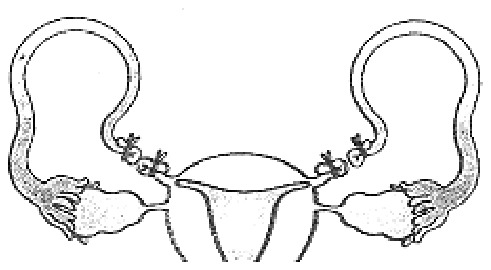
- 1Ovarian cancer
- 2Uterine cancer
- 3Tubectomy
- 4Vasectomy
Show answer and solution
Correct: option 3, Tubectomy
The figure shows the female reproductive tract with a small part of each fallopian tube cut and tied. This surgical method of sterilisation in females is tubectomy; vasectomy is the corresponding cutting of the vas deferens in males.
Question 56AIPMT 2012 Prelims, Q105
The test-tube Baby Programme employs which one of the following techniques?
- 1Intra cytoplasmic sperm injection (ICSI)
- 2Intra uterine insemination (IUI)
- 3Gamete intra fallopian transfer (GIFT)
- 4Zygote intra fallopian transfer (ZIFT)
Show answer and solution
Correct: option 4, Zygote intra fallopian transfer (ZIFT)
In the test-tube baby programme the egg is fertilised outside the body (in vitro fertilisation) and the resulting zygote or early embryo of up to 8 blastomeres is placed in the fallopian tube, which is ZIFT. In IUI and GIFT fertilisation takes place inside the woman's body, and ICSI is only one special way of bringing about the fertilisation in the laboratory.
Question 57AIPMT 2011 Prelims, Q98
Which one of the following is the most widely accepted method of contraception in India, as at present?
- 1Cervical caps
- 2Tubectomy
- 3Diaphragms
- 4IUDs (Intra uterine devices)
Show answer and solution
Correct: option 4, IUDs (Intra uterine devices)
IUDs are effective, reversible and suited to women who want to delay or space children, and they are among the most widely accepted methods of contraception in India.
Question 58AIPMT 2011 Prelims, Q128
Medical Termination of Pregnancy (MTP) is considered safe up to how many weeks of pregnancy?
- 1Eight weeks
- 2Twelve weeks
- 3Eighteen weeks
- 4Six weeks
Show answer and solution
Correct: option 2, Twelve weeks
MTP is considered relatively safe during the first trimester, that is, up to 12 weeks of pregnancy. Abortions in the second trimester are much riskier.
Question 59AIPMT 2011 Mains, Q31
The technique called gamete intrafallopian transfer (GIFT) is recommended for those females:
- 1who cannot produce an ovum
- 2who cannot retain the foetus inside uterus.
- 3whose cervical canal is too narrow to allow passage for the sperms
- 4who cannot provide suitable environment for fertilisation
Show answer and solution
Correct: option 1, who cannot produce an ovum
In GIFT an ovum collected from a donor is transferred into the fallopian tube of another female. It is meant for a woman who cannot produce an ovum herself but can provide a suitable environment for fertilisation and for the further development of the embryo.
Question 60AIPMT 2010 Prelims, Q112
The permissible use of the technique amniocentesis is for
- 1Artificial insemination
- 2Transfer of embryo into the uterus of a surrogate mother
- 3Detecting any genetic abnormality
- 4Detecting sex of the unborn foetus
Show answer and solution
Correct: option 3, Detecting any genetic abnormality
In amniocentesis a little amniotic fluid is drawn out and the foetal cells in it are examined for their chromosomes. Its legal use is to detect genetic disorders such as Down's syndrome. It can also reveal the sex of the foetus, but using it for that purpose is banned by law because it led to female foeticide.
Question 61AIPMT 2010 Prelims, Q136
Cu ion released from copper-releasing Intra Uterine Devices (IUDs)
- 1increase phagocytosis of sperms
- 2suppress sperm motility
- 3prevent ovulation
- 4make uterus unsuitable for implantation
Show answer and solution
Correct: option 2, suppress sperm motility
All IUDs increase phagocytosis of sperms inside the uterus. The copper ions released by copper IUDs such as CuT and Cu7 have an added effect: they suppress the motility and the fertilising capacity of sperms. Making the uterus unsuitable for implantation is the action of hormone-releasing IUDs.
Question 62AIPMT 2010 Prelims, Q174
In vitro fertilisation is a technique that involves transfer of which one of the following into the fallopian tube
- 1Either zygote or early embryo upto 8 cell stage
- 2Embryo of 32 cell stage
- 3Zygote only
- 4Embryo only, upto 8 cell stage
Show answer and solution
Correct: option 1, Either zygote or early embryo upto 8 cell stage
After fertilisation outside the body, the zygote or an early embryo with up to 8 blastomeres is put into the fallopian tube (ZIFT, zygote intra fallopian transfer). An embryo with more than 8 blastomeres is put into the uterus instead (IUT). So either a zygote or an embryo up to the 8 cell stage goes into the tube.
Question 63AIPMT 2008 Prelims, Q151
Given below are four methods (A - D) and their modes of action (a - d) in achieving contraception. Select their correct matching from the four options that follow
| Method | Mode of Action |
|---|
| (A) The pill | (a) Prevents sperms reaching cervix |
| (B) Condom | (b) Prevents implantation |
| (C) Vasectomy | (c) Prevents ovulation |
| (D) Copper T | (d) Semen contains no sperms |
Matching
- 1A-b, B-c, C-a, D-d
- 2A-c, B-a, C-d, D-b
- 3A-d, B-a, C-b, D-c
- 4A-c, B-d, C-a, D-b
Show answer and solution
Correct: option 2, A-c, B-a, C-d, D-b
The pill supplies oestrogen and progestogen, which suppress the gonadotropin surge and so prevent ovulation (c). A condom is a barrier that stops sperms reaching the cervix (a). In vasectomy the vas deferens is cut and tied, so the semen carries no sperms (d). Copper T is an intrauterine device that makes the uterus unsuitable for implantation (b). So A-c, B-a, C-d, D-b.
Question 64AIPMT 2008 Prelims, Q167
Consider the statements given below regarding contraception and answer as directed thereafter
(a) Medical Termination of Pregnancy (MTP) during first trimester is generally safe
(b) Generally chances of conception are nil until mother breast-feeds the infant upto two years
(c) Intrauterine devices like copper-T are effective contraceptives
(d) Contraception pills may be taken upto one week after coitus to prevent conception
Which two of the above statements are correct?
- 1a, b
- 2b, c
- 3c, d
- 4a, c
Show answer and solution
Correct: option 4, a, c
(a) is correct: MTP is relatively safe in the first trimester. (c) is correct: IUDs such as copper-T are effective contraceptives. (b) is wrong because lactational amenorrhoea protects only for about six months of intense breast-feeding. (d) is wrong because emergency pills work only within 72 hours of coitus.
Question 65AIPMT 2003 Prelims, Q115
Test tube baby means a baby born when
- 1It is developed in a test tube
- 2It is developed through tissue culture method
- 3The ovum is fertilised externally and thereafter implanted in the uterus
- 4It develops from a non-fertilized egg
Show answer and solution
Correct: option 3, The ovum is fertilised externally and thereafter implanted in the uterus
In the test tube baby technique the ovum is fertilised by sperm outside the body (in vitro fertilisation) and the early embryo is then transferred to the uterus, where the rest of development takes place. Only fertilisation happens in the laboratory.
Question 66AIPMT 2000 Prelims, Q129
What is the work of copper T:
- 1To inhibit ovulation
- 2To inhibit fertilization
- 3To inhibit implantation of blastocyst
- 4To inhibit gametogenesis
Show answer and solution
Correct: option 3, To inhibit implantation of blastocyst
Copper T is an intra-uterine device. It does not stop ovulation or gamete formation; by its presence in the uterus it makes the uterine lining unsuitable for a blastocyst to implant, which is the answer the key takes. (The present NCERT text also stresses that the copper ions released reduce sperm motility and fertilising capacity.)
Question 67AIPMT 2000 Prelims, Q130
What is the work of progesterone which is present in oral contraceptive pills:
- 1To inhibit ovulation
- 2To check oogenesis
- 3To check entry of sperms into cervix & to make them inactive
- 4To check sexual behaviour
Show answer and solution
Correct: option 1, To inhibit ovulation
The progestogen in the pill acts by negative feedback on the hypothalamus and pituitary, suppressing the release of FSH and LH. Without the LH surge no ovum is released, so ovulation is inhibited.
Question 68AIPMT 1999 Prelims, Q178
Which substance can be used as male contraceptive in future:
- 1FSH
- 2LH
- 3Testosterone
- 4Progesterone
Show answer and solution
Correct: option 4, Progesterone
A hormonal contraceptive for men has to stop sperm production, which depends on FSH and LH from the pituitary. Progesterone-like hormones (progestins) suppress the release of these gonadotropins by negative feedback and so shut down spermatogenesis; this is the option the key gives. Giving FSH or LH would stimulate the testes rather than suppress them.
Question 69AIPMT 1998 Prelims, Q153
Oral contraceptives contain:
- 1Progesterone
- 2LH
- 3Oxytocin
- 4Sterols
Show answer and solution
Correct: option 1, Progesterone
Contraceptive pills contain progestogens, alone or together with oestrogen. They suppress the release of FSH and LH, so ovulation does not occur. LH and oxytocin are not used in pills, so progesterone is the answer.