Questions with solutions
Question 1NEET 2026, Q96
Identify the correct statements about biomolecules.
A. Lipids are generally water soluble.
B. Proteins are polypeptides.
C. Polysaccharides are long chains of sugars.
D. Adenine and guanine are substituted pyrimidines.
E. Almost all enzymes are proteins.
Choose the correct answer from the options given below:
- 1C, D and E only
- 2B, C and E only
- 3B, D and E only
- 4A, B and C only
Show answer and solution
Correct: option 2, B, C and E only
B, C and E are correct: proteins are polypeptides, polysaccharides are long chains of sugars, and almost all enzymes are proteins (a few are RNA). A is wrong because lipids are generally water insoluble. D is wrong because adenine and guanine are substituted purines.
Question 2NEET 2026, Q105
Alpha-helix is found in which level of protein structure?
- 1Quaternary structure
- 2Tertiary structure
- 3Primary structure
- 4Secondary structure
Show answer and solution
Correct: option 4, Secondary structure
The alpha-helix is a regular local folding of the polypeptide chain held by hydrogen bonds, which is the secondary structure of a protein. Primary structure is only the amino acid sequence, tertiary is the overall three-dimensional folding, and quaternary is the arrangement of several polypeptide subunits.
Question 3NEET 2026, Q106
Which of the following statements are correct regarding amino acids?
A. They are substituted methanes.
B. Serine is an aromatic amino acid.
C. Valine is a neutral amino acid.
D. Lysine is an acidic amino acid.
Choose the correct answer from the options given below:
- 1C and D only
- 2A and B only
- 3A and C only
- 4B and C only
Show answer and solution
Correct: option 3, A and C only
A and C are correct: amino acids are substituted methanes (the alpha carbon carries hydrogen, carboxyl, amino and R groups), and valine is a neutral amino acid. B is wrong because serine is not aromatic (the aromatic ones are tyrosine, phenylalanine and tryptophan). D is wrong because lysine is a basic amino acid.
Question 4NEET 2026, Q130
Match List I with List II:
| List I | List II |
|---|
| A. Trypsin | I. Intercellular ground substance |
| B. Morphine | II. Lectin |
| C. Concanavalin A | III. Enzyme |
| D. Collagen | IV. Alkaloid |
Choose the correct answer from the options given below:
- 1A-III, B-IV, C-II, D-I
- 2A-I, B-II, C-III, D-IV
- 3A-III, B-II, C-IV, D-I
- 4A-IV, B-III, C-II, D-I
Show answer and solution
Correct: option 1, A-III, B-IV, C-II, D-I
Trypsin is a protein-digesting enzyme (A-III). Morphine is an alkaloid (B-IV). Concanavalin A is a lectin (C-II). Collagen is the protein of the intercellular ground substance (D-I).
Question 5NEET 2026, Q176
The following reaction depicts the activity of a particular class of enzymes:
Identify the enzyme class 'E' from the following options:
- 1Ligases
- 2Lyases
- 3Isomerases
- 4Transferases
Show answer and solution
Correct: option 2, Lyases
Here the groups X and Y are removed from two neighbouring carbon atoms without hydrolysis and a double bond is left behind. Enzymes that remove groups by a mechanism other than hydrolysis, leaving double bonds, are lyases.
Question 6NEET 2026 Re-exam, Q106
Match List-I with List-II.
| List-I | List-II |
|---|
| A. Starch | I. Fights infection |
| B. Antibody | II. Energy storage |
| C. Concanavalin A | III. Glucose transport |
| D. Glut-4 | IV. Lectin |
Choose the correct answer from the options given below:
- 1A-I, B-II, C-IV, D-III
- 2A-II, B-I, C-IV, D-III
- 3A-II, B-I, C-III, D-IV
- 4A-I, B-II, C-III, D-IV
Show answer and solution
Correct: option 2, A-II, B-I, C-IV, D-III
Starch is the storage polysaccharide of plants, an energy store (A-II). An antibody is a protein that fights infectious agents (B-I). Concanavalin A is a lectin, a secondary metabolite (C-IV). GLUT-4 is the protein that carries glucose into cells (D-III).
Question 7NEET 2026 Re-exam, Q134
Arrange the following elements in descending order of their contribution to percentage weight of the human body.
(a) Oxygen
(b) Carbon
(c) Hydrogen
(d) Nitrogen
Choose the correct answer from the options given below:
- 1(a), (b), (c), (d)
- 2(c), (a), (b), (d)
- 3(b), (c), (d), (a)
- 4(b), (a), (c), (d)
Show answer and solution
Correct: option 1, (a), (b), (c), (d)
By weight the human body is roughly 65% oxygen, 18% carbon, 10% hydrogen and 3% nitrogen. Oxygen leads because most of the body is water. So the descending order is oxygen, carbon, hydrogen, nitrogen: (a), (b), (c), (d).
Question 8NEET 2025, Q117
Name the class of enzyme that usually catalyze the following reaction:
Where, G a group other than hydrogen
S a substrate
another substrate
- 1Hydrolase
- 2Lyase
- 3Transferase
- 4Ligase
Show answer and solution
Correct: option 3, Transferase
In the reaction a group G, other than hydrogen, is moved from one substrate S to another substrate . Enzymes that catalyse the transfer of such a group between a pair of substrates are transferases. Hydrolases break bonds using water, lyases remove groups to leave double bonds, and ligases join two compounds.
Question 9NEET 2025, Q131
Which one of the following enzymes contains 'Haem' as the prosthetic group?
- 1RuBisCo
- 2Carbonic anhydrase
- 3Succinate dehydrogenase
- 4Catalase
Show answer and solution
Correct: option 4, Catalase
A prosthetic group is a non-protein part bound tightly to the enzyme. In peroxidase and catalase, which break down hydrogen peroxide to water and oxygen, the prosthetic group is haem. Carbonic anhydrase needs zinc, and succinate dehydrogenase carries FAD.
Question 10NEET 2025, Q137
Match List I with List II.
| List I | List II |
|---|
| A. Adenosine | I. Nitrogen base |
| B. Adenylic acid | II. Nucleotide |
| C. Adenine | III. Nucleoside |
| D. Alanine | IV. Amino acid |
Choose the option with all correct matches.
- 1A-III, B-IV, C-II, D-I
- 2A-III, B-II, C-IV, D-I
- 3A-III, B-II, C-I, D-IV
- 4A-II, B-III, C-I, D-IV
Show answer and solution
Correct: option 3, A-III, B-II, C-I, D-IV
Adenosine is adenine joined to a sugar, a nucleoside (III). Adenylic acid has a phosphate as well, so it is a nucleotide (II). Adenine is a nitrogen base (I). Alanine is an amino acid (IV). This gives A-III, B-II, C-I, D-IV.
Question 11NEET 2025, Q149
The protein portion of an enzyme is called:
- 1Cofactor
- 2Coenzyme
- 3Apoenzyme
- 4Prosthetic group
Show answer and solution
Correct: option 3, Apoenzyme
The protein part of an enzyme is the apoenzyme. The non-protein part bound to it is the cofactor, which may be a prosthetic group, a coenzyme or a metal ion.
Question 12NEET 2024, Q101
The cofactor of the enzyme carboxypeptidase is:
- 1Haem
- 2Zinc
- 3Niacin
- 4Flavin
Show answer and solution
Correct: option 2, Zinc
Carboxypeptidase is a proteolytic enzyme that needs a metal ion to work, and that ion is zinc. Haem is the prosthetic group of peroxidase and catalase, while niacin is part of the coenzymes NAD and NADP.
Question 13NEET 2024, Q125
Inhibition of Succinic dehydrogenase enzyme by malonate is a classical example of:
- 1Enzyme activation
- 2Cofactor inhibition
- 3Feedback inhibition
- 4Competitive inhibition
Show answer and solution
Correct: option 4, Competitive inhibition
Malonate closely resembles succinate, the substrate, in structure and competes with it for the active site of succinic dehydrogenase. Inhibition by a substrate look-alike is competitive inhibition.
Question 14NEET 2024, Q128
Lecithin, a small molecular weight organic compound found in living tissues, is an example of:
- 1Carbohydrates
- 2Amino acids
- 3Phospholipids
- 4Glycerides
Show answer and solution
Correct: option 3, Phospholipids
Lecithin is a lipid that carries phosphorus and a phosphorylated organic compound, that is, a phospholipid. Phospholipids such as lecithin are found in cell membranes.
Question 15NEET 2024, Q149
Match List I with List II
| List I | List II |
|---|
| A. GLUT-4 | I. Hormone |
| B. Insulin | II. Enzyme |
| C. Trypsin | III. Intercellular ground substance |
| D. Collagen | IV. Enables glucose transport into cells |
Choose the correct answer from the options given below:
- 1A-III, B-IV, C-I, D-II
- 2A-IV, B-I, C-II, D-III
- 3A-I, B-II, C-III, D-IV
- 4A-II, B-III, C-IV, D-I
Show answer and solution
Correct: option 2, A-IV, B-I, C-II, D-III
These are proteins with different functions: GLUT-4 enables glucose transport into cells (A-IV), insulin is a hormone (B-I), trypsin is an enzyme (C-II) and collagen is the intercellular ground substance (D-III).
Question 16NEET 2024, Q159
Match List I with List II:
| List I | List II |
|---|
| A. Lipase | I. Peptide bond |
| B. Nuclease | II. Ester bond |
| C. Protease | III. Glycosidic bond |
| D. Amylase | IV. Phosphodiester bond |
Choose the correct answer from the options given below:
- 1A-IV, B-I, C-III, D-II
- 2A-IV, B-II, C-III, D-I
- 3A-III, B-II, C-I, D-IV
- 4A-II, B-IV, C-I, D-III
Show answer and solution
Correct: option 4, A-II, B-IV, C-I, D-III
Each enzyme breaks the bond that holds its substrate together. Lipase breaks the ester bonds of fats, nuclease breaks the phosphodiester bonds of nucleic acids, protease breaks the peptide bonds of proteins, and amylase breaks the glycosidic bonds of starch. So A-II, B-IV, C-I, D-III.
Question 17NEET 2024, Q199
Regarding catalytic cycle of an enzyme action, select the correct sequential steps:
A. Substrate enzyme complex formation.
B. Free enzyme ready to bind with another substrate.
C. Release of products.
D. Chemical bonds of the substrate broken.
E. Substrate binding to active site.
Choose the correct answer from the options given below:
- 1E, D, C, B, A
- 2E, A, D, C, B
- 3A, E, B, D, C
- 4B, A, C, D, E
Show answer and solution
Correct: option 2, E, A, D, C, B
First the substrate binds to the active site (E), giving the enzyme-substrate complex (A). The enzyme then breaks the chemical bonds of the substrate (D), the products are released (C), and the free enzyme is ready for another substrate molecule (B). The order is E, A, D, C, B.
Question 18NEET 2024 Re-exam, Q116
Which of the following is a nucleotide?
- 1Uridine
- 2Adenylic acid
- 3Guanine
- 4Guanosine
Show answer and solution
Correct: option 2, Adenylic acid
A nucleotide is a nitrogen base joined to a sugar and a phosphate. Adenylic acid is adenine + ribose + phosphate, so it is a nucleotide. Guanine is only a base, while uridine and guanosine are nucleosides (base + sugar, no phosphate).
Question 19NEET 2024 Re-exam, Q131
Ligases is a class of enzymes responsible for catalysing the linking together of two compounds.
Which of the following bonds is not catalysed by it?
- 1C – C
- 2P – O
- 3C – O
- 4C – N
Show answer and solution
Correct: option 1, C – C
The NCERT description of ligases says they join two compounds by forming C-O, C-S, C-N and P-O bonds. The C-C bond is not in that list, so by the textbook wording option (1) is the one asked for, and it is the keyed answer.
Question 20NEET 2024 Re-exam, Q139
Which of the following are not fatty acids?
A. Glutamic acid
B. Arachidonic acid
C. Palmitic acid
D. Lecithin
E. Aspartic acid
Choose the correct answer from the options given below:
- 1C, D and E only
- 2A and B only
- 3A, D and E only
- 4B and C only
Show answer and solution
Correct: option 3, A, D and E only
Palmitic acid (16 carbons) and arachidonic acid (20 carbons) are fatty acids. Glutamic acid and aspartic acid are acidic amino acids, and lecithin is a phospholipid. So A, D and E are not fatty acids.
Question 21NEET 2024 Re-exam, Q146
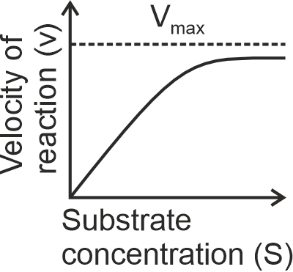
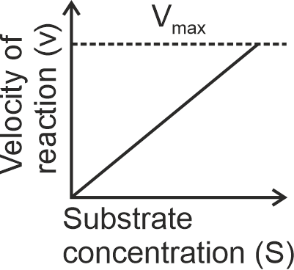
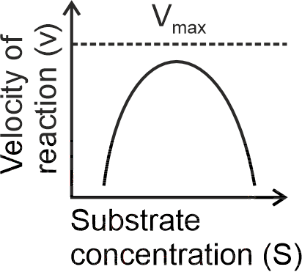
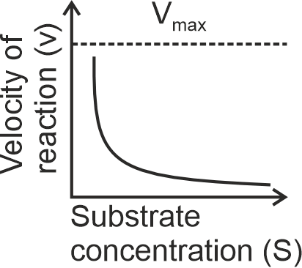
Which of the following graphs depicts the effect of substrate concentration on velocity of enzyme catalysed reaction?
- 1
- 2
- 3
- 4
Show answer and solution
Correct: option 1
As substrate concentration rises, the velocity of the reaction rises at first and then levels off at a maximum, , which is not exceeded because all the enzyme molecules are then occupied by substrate. Only graph (1) shows a curve that climbs and then flattens just below .
Question 22NEET 2024 Re-exam, Q157
Enzymes that catalyse the removal of groups from substrates by mechanisms other than hydrolysis leaving double bonds, are known as:
- 1Transferases
- 2Oxidoreductases
- 3Dehydrogenases
- 4Lyases
Show answer and solution
Correct: option 4, Lyases
Lyases remove a group from a substrate without using water and leave a double bond behind. Transferases move a group from one substrate to another, and oxidoreductases (which include dehydrogenases) carry out oxidation and reduction between two substrates.
Question 23NEET 2024 Re-exam, Q159
Match List-I with List-II.
| List-I | List-II |
|---|
| A. Primary structure of protein | I. Human haemoglobin |
| B. Secondary structure of protein | II. Disulphide bonds |
| C. Tertiary structure of protein | III. Polypeptide chain |
| D. Quaternary structure of protein | IV. Alpha helix and sheet |
Choose the correct answer from the options given below:
- 1A-III, B-IV, C-II, D-I
- 2A-III, B-II, C-I, D-IV
- 3A-I, B-III, C-II, D-IV
- 4A-IV, B-III, C-II, D-I
Show answer and solution
Correct: option 1, A-III, B-IV, C-II, D-I
The primary structure is the order of amino acids in the polypeptide chain. The secondary structure is the local folding into an alpha helix or a beta sheet. The tertiary structure is the three-dimensional folding of the whole chain, held by bonds such as disulphide bonds. The quaternary structure is the arrangement of more than one chain, as in human haemoglobin with its four subunits. So A-III, B-IV, C-II, D-I.
Question 24NEET 2023, Q116
Cellulose does not form blue colour with Iodine because
- 1It is a disaccharide.
- 2It is a helical molecule.
- 3It does not contain complex helices and hence cannot hold iodine molecules.
- 4It breaks down when iodine reacts with it.
Show answer and solution
Correct: option 3, It does not contain complex helices and hence cannot hold iodine molecules.
Starch forms helical secondary structures that hold iodine molecules, and the starch-iodine complex is blue. Cellulose is a polysaccharide with no complex helices, so it cannot hold iodine and gives no blue colour.
Question 25NEET 2023, Q144
Malonate inhibits the growth of pathogenic bacteria by inhibiting the activity of
- 1Succinic dehydrogenase
- 2Amylase
- 3Lipase
- 4Dinitrogenase
Show answer and solution
Correct: option 1, Succinic dehydrogenase
Malonate closely resembles succinate in structure, so it competes with succinate for the active site of succinic dehydrogenase. This competitive inhibition blocks the enzyme, and such inhibitors are used to control bacterial pathogens.
Question 26NEET 2023, Q158
Given below are two statements:
Statement I: A protein is imagined as a line, the left end represented by first amino acid (C-terminal) and the right end represented by last amino acid (N-terminal)
Statement II: Adult human haemoglobin, consists of 4 subunits (two subunits of type and two subunits of type.)
In the light of the above statements, choose the correct answer from the options given below:
- 1Both Statement I and Statement II are true.
- 2Both Statement I and Statement II are false.
- 3Statement I is true but Statement II is false.
- 4Statement I is false but Statement II is true.
Show answer and solution
Correct: option 4, Statement I is false but Statement II is true.
Statement I is false: the first amino acid of a protein is the N-terminal amino acid and the last one is the C-terminal amino acid, not the other way round. Statement II is true: adult human haemoglobin has four subunits, two and two . So option (4) is right.
Question 27NEET 2023, Q164
Given below are two statements:
Statement I: Low temperature preserves the enzyme in a temporarily inactive state whereas high temperature destroys enzymatic activity because proteins are denatured by heat.
Statement II: When the inhibitor closely resembles the substrate in its molecular structure and inhibits the activity of the enzyme, it is known as competitive inhibitor.
In the light of the above statements, choose the correct answer from the options given below:
- 1Both Statement I and Statement II are true.
- 2Both Statement I and Statement II are false.
- 3Statement I is true but Statement II is false.
- 4Statement I is false but Statement II is true.
Show answer and solution
Correct: option 1, Both Statement I and Statement II are true.
Both statements are true. At low temperature an enzyme is only temporarily inactive, while high temperature denatures the protein and destroys its activity. An inhibitor that closely resembles the substrate competes with it for the active site and is called a competitive inhibitor, for example malonate for succinic dehydrogenase. This is option (1).
Question 28NEET 2023 Manipur, Q112
Match List-I with List-II.
| List-I | List-II |
|---|
| (A) Protein | (I) C = C double bonds |
| (B) Unsaturated fatty acid | (II) Phosphodiester bond |
| (C) Nucleic acid | (III) Glycosidic bonds |
| (D) Polysaccharide | (IV) Peptide bonds |
Choose the correct answer from the options given below:
- 1A-IV, B-I, C-II, D-III
- 2A-I, B-IV, C-III, D-II
- 3A-II, B-I, C-IV, D-III
- 4A-IV, B-III, C-I, D-II
Show answer and solution
Correct: option 1, A-IV, B-I, C-II, D-III
Amino acids in a protein are joined by peptide bonds (A-IV). An unsaturated fatty acid has one or more C = C double bonds in its chain (B-I). Nucleotides in a nucleic acid are joined by phosphodiester bonds (C-II), and the sugar units of a polysaccharide by glycosidic bonds (D-III). This is option (1).
Question 29NEET 2023 Manipur, Q119
- 1Amino acids
- 2Glucose
- 3Fructose
- 4Galactose
Show answer and solution
Correct: option 3, Fructose
Inulin is a storage polysaccharide of plants made of fructose units (a fructan). Polymers of glucose are starch, glycogen and cellulose, and polymers of amino acids are proteins. So the answer is option (3).
Question 30NEET 2023 Manipur, Q155
Match List-I with List-II.
| List-I | List-II |
|---|
| (A) Terpenoids | (I) Codeine |
| (B) Lectins | (II) Diterpenes |
| (C) Alkaloids | (III) Ricin |
| (D) Toxins | (IV) Concanavalin A |
Choose the correct answer from the options given below:
- 1A-II, B-III, C-I, D-IV
- 2A-II, B-IV, C-I, D-III
- 3A-II, B-IV, C-III, D-I
- 4A-II, B-I, C-IV, D-III
Show answer and solution
Correct: option 2, A-II, B-IV, C-I, D-III
These are classes of secondary metabolites. Diterpenes are terpenoids, concanavalin A is a lectin, codeine is an alkaloid and ricin is a toxin. So A-II, B-IV, C-I, D-III.
Question 31NEET 2023 Manipur, Q169
Which of the following is not a secondary metabolite?
- 1Anthocyanin
- 2Lecithin
- 3Curcumin
- 4Morphine
Show answer and solution
Correct: option 2, Lecithin
Lecithin is a phospholipid of cell membranes, which makes it a primary metabolite. Anthocyanin (a pigment), curcumin (a drug) and morphine (an alkaloid) are all secondary metabolites.
Question 32NEET 2022, Q134
Exoskeleton of arthropods is composed of:
- 1Glucosamine
- 2Cutin
- 3Cellulose
- 4Chitin
Show answer and solution
Correct: option 4, Chitin
The arthropod exoskeleton is made of chitin, a complex polysaccharide that is a polymer of N-acetylglucosamine. Cutin and cellulose are plant materials, and glucosamine by itself is only an amino sugar.
Question 33NEET 2022, Q143
Read the following statements on lipids and find out correct set of statements:
(a) Lecithin found in the plasma membrane is a glycolipid
(b) Saturated fatty acids possess one or more c=c bonds
(c) Gingely oil has lower melting point, hence remains as oil in winter
(d) Lipids are generally insoluble in water but soluble in some organic solvents
(e) When fatty acid is esterified with glycerol, monoglycerides are formed
Choose the correct answer from the options given below:
- 1(a), (b) and (d) only
- 2(a), (b) and (c) only
- 3(a), (d) and (e) only
- 4(c), (d) and (e) only
Show answer and solution
Correct: option 4, (c), (d) and (e) only
Lecithin is a phospholipid, not a glycolipid, so (a) is wrong. Saturated fatty acids have no carbon-carbon double bond, so (b) is wrong. Gingelly oil has a low melting point and stays liquid in winter (c), lipids are generally insoluble in water but dissolve in organic solvents (d), and esterifying glycerol with a fatty acid gives a monoglyceride (e). So (c), (d) and (e) are correct.
Question 34NEET 2022, Q164
A dehydration reaction links two glucose molecules to produce maltose. If the formula for glucose is then what is the formula for maltose?
- 1
- 2
- 3
- 4
Show answer and solution
Correct: option 4,
Two glucose molecules together have . Forming the glycosidic bond removes one molecule of water, , which leaves .
Question 35NEET 2022, Q199
Match List-I with List-II.
| List-I (Biological Molecules) | List-II (Biological functions) |
|---|
| (a) Glycogen | (i) Hormone |
| (b) Globulin | (ii) Biocatalyst |
| (c) Steroids | (iii) Antibody |
| (d) Thrombin | (iv) Storage product |
Choose the correct answer from the options given below:
- 1a-iv, b-iii, c-i, d-ii
- 2a-iii, b-ii, c-iv, d-i
- 3a-iv, b-ii, c-i, d-iii
- 4a-ii, b-iv, c-iii, d-i
Show answer and solution
Correct: option 1, a-iv, b-iii, c-i, d-ii
Glycogen is the storage polysaccharide of animals (iv). Globulins include the immunoglobulins, which are antibodies (iii). Many hormones are steroids (i). Thrombin is an enzyme, a biocatalyst, which converts fibrinogen to fibrin (ii).
Question 36NEET 2022 Re-exam, Q118
Match List-I with List-II
| List-I | List-II |
|---|
| (a) Adenine | (i) Pigment |
| (b) Anthocyanin | (ii) Polysaccharide |
| (c) Chitin | (iii) Alkaloid |
| (d) Codeine | (iv) Purine |
Choose the correct answer from the options given below
- 1a-i, b-iv, c-iii, d-ii
- 2a-iv, b-i, c-ii, d-iii
- 3a-iv, b-iii, c-ii, d-i
- 4a-iii, b-i, c-iv, d-ii
Show answer and solution
Correct: option 2, a-iv, b-i, c-ii, d-iii
Adenine is a purine base (iv), anthocyanin is a plant pigment (i), chitin is a structural polysaccharide of N-acetylglucosamine (ii) and codeine is an alkaloid (iii). This gives a-iv, b-i, c-ii, d-iii.
Question 37NEET 2022 Re-exam, Q136
Primary proteins are also called as polypeptides because:
- 1They can assume many conformations
- 2They are linear chains
- 3They are polymers of peptide monomers
- 4Successive amino acids are joined by peptide bonds
Show answer and solution
Correct: option 4, Successive amino acids are joined by peptide bonds
A protein is a linear chain of amino acids in which each amino acid is linked to the next by a peptide bond. Many such bonds in one chain give the name polypeptide. The monomers are amino acids, not peptides.
Question 38NEET 2022 Re-exam, Q184
Given below are two statements:
Statement I: Amino acids have a property of ionizable nature of and groups, hence have different structures at different pH.
Statement II: Amino acids can exist as Zwitterionic form at acidic and basic pH.
In the light of the above statements, choose the most appropriate answer from the options given below:
- 1Statement I is incorrect but Statement II is correct
- 2Both Statement I and Statement II are correct
- 3Both Statement I and Statement II are incorrect
- 4Statement I is correct but Statement II is incorrect
Show answer and solution
Correct: option 4, Statement I is correct but Statement II is incorrect
Statement I is correct: the amino and carboxyl groups can ionise, so the structure of an amino acid changes with pH. Statement II is incorrect: the zwitterion, with both charges, exists at one particular pH (the isoelectric point). In acidic solution the amino acid is a cation and in basic solution an anion.
Question 39NEET 2022 Re-exam, Q191
In the enzyme which catalyses the breakdown of:
the prosthetic group is:
- 1Niacin
- 2Nicotinamide adenine dinucleotide
- 3Haem
- 4Zinc
Show answer and solution
Correct: option 3, Haem
Hydrogen peroxide is broken down to water and oxygen by catalase (and peroxidase). Haem is the prosthetic group of these enzymes and is part of the active site. NAD is a coenzyme that contains niacin, and zinc is a metal-ion cofactor of carboxypeptidase.
Question 40NEET 2021, Q135
Which of the following are not secondary metabolites in plants?
- 1Morphine, codeine
- 2Amino acids, glucose
- 3Vinblastin, curcumin
- 4Rubber, gums
Show answer and solution
Correct: option 2, Amino acids, glucose
Amino acids and glucose are primary metabolites: they are found in all cells and have known roles in normal physiology. Morphine and codeine (alkaloids), vinblastin and curcumin (drugs), and rubber and gums (polymeric substances) are secondary metabolites.
Question 41NEET 2021, Q148
Match List - I with List - II.
| List - I | List - II |
|---|
| (a) Protein | (i) C=C double bonds |
| (b) Unsaturated fatty acid | (ii) Phosphodiester bonds |
| (c) Nucleic acid | (iii) Glycosidic bonds |
| (d) Polysaccharide | (iv) Peptide bonds |
Choose the correct answer from the options given below.
- 1a-iv, b-i, c-ii, d-iii
- 2a-i, b-iv, c-iii, d-ii
- 3a-ii, b-i, c-iv, d-iii
- 4a-iv, b-iii, c-i, d-ii
Show answer and solution
Correct: option 1, a-iv, b-i, c-ii, d-iii
Amino acids in a protein are joined by peptide bonds (iv). An unsaturated fatty acid has one or more C=C double bonds (i). Nucleotides in a nucleic acid are joined by phosphodiester bonds (ii). Sugar units of a polysaccharide are joined by glycosidic bonds (iii). So a-iv, b-i, c-ii, d-iii.
Question 42NEET 2021, Q151
Identify the incorrect pair.
- 1Alkaloids - Codeine
- 2Toxin - Abrin
- 3Lectins - Concanavalin A
- 4Drugs - Ricin
Show answer and solution
Correct: option 4, Drugs - Ricin
Among secondary metabolites, codeine and morphine are alkaloids, abrin and ricin are toxins, concanavalin A is a lectin, and vinblastin and curcumin are the drugs. Ricin is a toxin, not a drug, so that pair is the incorrect one.
Question 43NEET 2021, Q191
Following are the statements with reference to ‘lipids’.
(a) Lipids having only single bonds are called unsaturated fatty acids.
(b) Lecithin is a phospholipid.
(c) Trihydroxy propane is glycerol.
(d) Palmitic acid has 20 carbon atoms including carboxyl carbon.
(e) Arachidonic acid has 16 carbon atoms.
Choose the correct answer from the options given below.
- 1(a) and (b) only
- 2(c) and (d) only
- 3(b) and (c) only
- 4(b) and (e) only
Show answer and solution
Correct: option 3, (b) and (c) only
Lecithin is a phospholipid and glycerol is trihydroxy propane, so (b) and (c) are correct. Fatty acids with only single bonds are saturated, so (a) is wrong. Palmitic acid has 16 carbons including the carboxyl carbon and arachidonic acid has 20, so (d) and (e) have the numbers interchanged.
Question 44NEET 2020, Q55
Secondary metabolites such as nicotine, strychnine and caffeine are produced by plants for their:
- 1Nutritive value
- 2Growth response
- 3Defence action
- 4Effect on reproduction
Show answer and solution
Correct: option 3, Defence action
Nicotine, strychnine and caffeine are alkaloids. Such secondary metabolites are not needed for the basic growth of the plant; they are bitter or poisonous and protect the plant against grazing animals and pathogens, so they serve as a chemical defence.
Question 45NEET 2020, Q64
Identify the substances having glycosidic bond and peptide bond, respectively in their structure:
- 1Chitin, cholesterol
- 2Glycerol, trypsin
- 3Cellulose, lecithin
- 4Inulin, insulin
Show answer and solution
Correct: option 4, Inulin, insulin
Glycosidic bonds join sugar units in polysaccharides, and peptide bonds join amino acids in proteins. Inulin is a polymer of fructose (glycosidic bonds) and insulin is a protein hormone (peptide bonds). Cholesterol and lecithin are lipids and glycerol is a simple alcohol, so the other pairs fail.
Question 46NEET 2020, Q122
Which one of the following is the most abundant protein in the animals?
- 1Haemoglobin
- 2Collagen
- 3Lectin
- 4Insulin
Show answer and solution
Correct: option 2, Collagen
Collagen, the fibrous protein of connective tissue, is the most abundant protein in the animal world. (RuBisCO is the most abundant protein in the whole biosphere.)
Question 47NEET 2020, Q123
Identify the basic amino acid from the following.
- 1Tyrosine
- 2Glutamic Acid
- 3Lysine
- 4Valine
Show answer and solution
Correct: option 3, Lysine
Lysine has a second amino group in its side chain, which makes it a basic amino acid. Glutamic acid is acidic, valine is neutral and tyrosine is an aromatic amino acid.
Question 48NEET 2020, Q130
Match the following:
| |
|---|
| (a) Inhibitor of catalytic activity | (i) Ricin |
| (b) Possess peptide bonds | (ii) Malonate |
| (c) Cell wall material in fungi | (iii) Chitin |
| (d) Secondary metabolite | (iv) Collagen |
Choose the correct option from the following:
- 1a-ii, b-iv, c-iii, d-i
- 2a-iii, b-i, c-iv, d-ii
- 3a-iii, b-iv, c-i, d-ii
- 4a-ii, b-iii, c-i, d-iv
Show answer and solution
Correct: option 1, a-ii, b-iv, c-iii, d-i
Malonate is a competitive inhibitor of succinic dehydrogenase (ii). Collagen is a protein, so it has peptide bonds (iv). Chitin forms the cell wall of fungi (iii). Ricin is a toxin, one of the secondary metabolites (i). This is a-ii, b-iv, c-iii, d-i.
Question 49NEET 2020 Phase 2, Q9
Identify the statement which is incorrect.
- 1Glycine is an example of lipids.
- 2Lecithin contains phosphorus atom in its structure.
- 3Tyrosine possesses aromatic ring in its structure.
- 4Sulphur is an integral part of cysteine.
Show answer and solution
Correct: option 1, Glycine is an example of lipids.
Glycine is the simplest amino acid, not a lipid, so the first statement is incorrect. Lecithin is a phospholipid and contains phosphorus, tyrosine is an aromatic amino acid, and cysteine is a sulphur-containing amino acid.
Question 50NEET 2020 Phase 2, Q26
Match the following:
| |
|---|
| (a) Aquaporin | (i) Amide |
| (b) Asparagine | (ii) Polysaccharide |
| (c) Abscisic acid | (iii) Polypeptide |
| (d) Chitin | (iv) Carotenoids |
Select the correct option:
- 1a-ii, b-iii, c-iv, d-i
- 2a-ii, b-i, c-iv, d-iii
- 3a-iii, b-i, c-ii, d-iv
- 4a-iii, b-i, c-iv, d-ii
Show answer and solution
Correct: option 4, a-iii, b-i, c-iv, d-ii
Aquaporins are membrane proteins that form water channels, so they are polypeptides (a-iii). Asparagine is an amide of the amino acid aspartic acid (b-i). Abscisic acid is a derivative of carotenoids (c-iv). Chitin is a structural polysaccharide of N-acetylglucosamine (d-ii).
Question 51NEET 2019, Q112
- 1an alkaloid
- 2an essential oil
- 3a lectin
- 4a pigment
Show answer and solution
Correct: option 3, a lectin
Concanavalin A is a lectin, a carbohydrate-binding protein obtained from jack bean, and is listed among the secondary metabolites as a lectin. Alkaloids are compounds such as morphine and codeine, essential oils include lemon grass oil, and pigments include carotenoids and anthocyanins.
Question 52NEET 2019, Q114
Consider the following statements:
(A) Coenzyme or metal ion that is tightly bound to enzyme protein is called prosthetic group.
(B) A complete catalytic active enzyme with its bound prosthetic group is called apoenzyme.
Select the correct option.
- 1Both (A) and (B) are true.
- 2(A) is true but (B) is false.
- 3Both (A) and (B) are false.
- 4(A) is false but (B) is true.
Show answer and solution
Correct: option 2, (A) is true but (B) is false.
A cofactor that is tightly bound to the protein part of an enzyme is called a prosthetic group, so (A) is true. The protein part alone is the apoenzyme; the complete, catalytically active enzyme together with its cofactor is the holoenzyme, so (B) is false.
Question 53NEET 2019 Odisha, Q97
Which of the following organic compounds is the main constituent of Lecithin?
- 1Cholesterol
- 2Phosphoprotein
- 3Arachidonic acid
- 4Phospholipid
Show answer and solution
Correct: option 4, Phospholipid
Lecithin is phosphatidylcholine: glycerol carrying two fatty acids and a phosphate group joined to choline. A lipid with a phosphate group is a phospholipid, and lecithin is a common phospholipid of cell membranes.
Question 54NEET 2019 Odisha, Q136
Prosthetic groups differ from co-enzymes in that -
- 1their association with apoenzymes is transient.
- 2they can serve as co-factors in a number of enzyme - catalyzed reactions.
- 3they require metal ions for their activity.
- 4they (prosthetic groups) are tightly bound to apoenzymes.
Show answer and solution
Correct: option 3, they require metal ions for their activity.
Both are non-protein co-factors of enzymes. A co-enzyme is an organic compound that joins the apoenzyme only for a short time, usually during catalysis, and can serve many reactions. A prosthetic group is an organic compound that stays tightly bound to the apoenzyme, as haem does in peroxidase and catalase. Tight binding to the apoenzyme is therefore the difference.
Question 55NEET 2019 Odisha, Q138
"Ramachandran plot" is used to confirm the structure of
- 1Triacylglycerides
- 2DNA
- 3RNA
- 4Proteins
Show answer and solution
Correct: option 4, Proteins
A Ramachandran plot shows the allowed pairs of the two backbone rotation angles (phi and psi) of the amino acid residues in a polypeptide. It is used to check whether a proposed protein structure is sterically possible, so it confirms the structure of proteins.
Question 56NEET 2018, Q117
The two functional groups characteristic of sugars are
- 1carbonyl and phosphate
- 2carbonyl and methyl
- 3hydroxyl and methyl
- 4carbonyl and hydroxyl
Show answer and solution
Correct: option 4, carbonyl and hydroxyl
Sugars are polyhydroxy aldehydes or polyhydroxy ketones. They therefore carry a carbonyl group (aldehyde or ketone) and several hydroxyl groups.
Question 57NEET 2017, Q103
Which one of the following statements is correct with reference to enzymes?
- 1Apoenzyme = Holoenzyme + Coenzyme
- 2Holoenzyme = Apoenzyme + Coenzyme
- 3Coenzyme = Apoenzyme + Holoenzyme
- 4Holoenzyme = Coenzyme + Co-factor
Show answer and solution
Correct: option 2, Holoenzyme = Apoenzyme + Coenzyme
The protein part of an enzyme is the apoenzyme. Together with its non-protein part (a co-factor such as a coenzyme) it forms the complete, active holoenzyme. So Holoenzyme = Apoenzyme + Coenzyme.
Question 58NEET 2017, Q105
Which of the following are not polymeric?
- 1Nucleic acids
- 2Proteins
- 3Polysaccharides
- 4Lipids
Show answer and solution
Correct: option 4, Lipids
Nucleic acids are polymers of nucleotides, proteins of amino acids and polysaccharides of monosaccharides. Lipids are not built from repeating monomer units; they are small molecules (fatty acids with glycerol and so on) of low molecular weight.
Question 59NEET 2016 Phase 1, Q153
Which one of the following statements is wrong?
- 1Sucrose is a disaccharide.
- 2Cellulose is a polysaccharide.
- 3Uracil is a pyrimidine.
- 4Glycine is a sulphur containing amino acid.
Show answer and solution
Correct: option 4, Glycine is a sulphur containing amino acid.
Glycine is the simplest amino acid, with only a hydrogen atom as its side chain, so it has no sulphur; the sulphur containing amino acids are cysteine and methionine. The other statements are correct: sucrose is glucose joined to fructose, cellulose is a polymer of glucose, and uracil is a pyrimidine base of RNA.
Question 60NEET 2016 Phase 1, Q180
A typical fat molecule is made up of:
- 1Three glycerol molecules and one fatty acid molecule
- 2One glycerol and three fatty acid molecules
- 3One glycerol and one fatty acid molecule
- 4Three glycerol and three fatty acid molecules
Show answer and solution
Correct: option 2, One glycerol and three fatty acid molecules
A fat is a triglyceride: glycerol has three hydroxyl groups, and each forms an ester bond with one fatty acid. So one glycerol molecule is joined to three fatty acid molecules.
Question 61NEET 2016 Phase 2, Q103
A non-proteinaceous enzyme is
- 1lysozyme
- 2ribozyme
- 3ligase
- 4deoxyribonuclease
Show answer and solution
Correct: option 2, ribozyme
Almost all enzymes are proteins, but a ribozyme is an RNA molecule with catalytic activity. Lysozyme, ligase and deoxyribonuclease are all proteins.
Question 62NEET 2016 Phase 2, Q143
Which of the following is the least likely to be involved in stabilizing the three-dimensional folding of most proteins?
- 1Hydrogen bonds
- 2Electrostatic interaction
- 3Hydrophobic interaction
- 4Ester bonds
Show answer and solution
Correct: option 4, Ester bonds
The tertiary structure of a protein is held by hydrogen bonds, ionic (electrostatic) interactions, hydrophobic interactions and disulphide bridges. Ester bonds are typical of lipids and nucleic acids, not of protein folding, so they are the least likely.
Question 63NEET 2016 Phase 2, Q144
Which of the following describes the given graph correctly?
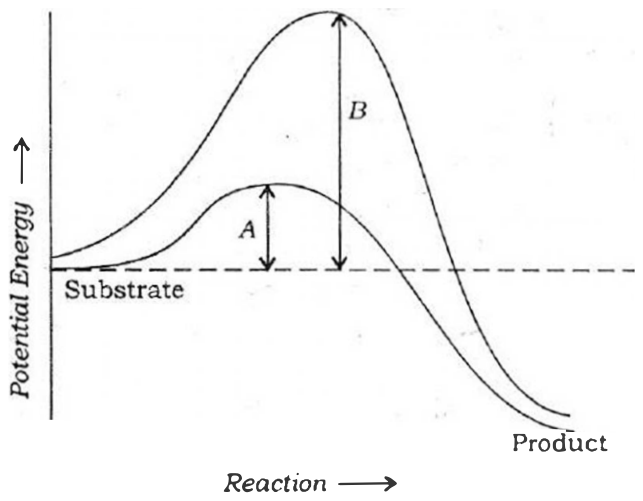
- 1Endothermic reaction with energy A in presence of enzyme and B in absence of enzyme
- 2Exothermic reaction with energy A in presence of enzyme and B in absence of enzyme
- 3Endothermic reaction with energy A in absence of enzyme and B in presence of enzyme
- 4Exothermic reaction with energy A in absence of enzyme and B in presence of enzyme
Show answer and solution
Correct: option 2, Exothermic reaction with energy A in presence of enzyme and B in absence of enzyme
The product lies at a lower potential energy than the substrate, so energy is released and the reaction is exothermic. An enzyme lowers the activation energy, so the smaller barrier A is the activation energy with the enzyme and the larger barrier B is the one without it.
Question 64AIPMT 2015, Q121
Which one of the following statements is incorrect?
- 1In competitive inhibition, the inhibitor molecule is not chemically changed by the enzyme.
- 2The competitive inhibitor does not affect the rate of breakdown of the enzyme-substrate complex.
- 3The presence of the competitive inhibitor decreases the Km of the enzyme for the substrate.
- 4A competitive inhibitor reacts reversibly with the enzyme to form an enzyme-inhibitor complex.
Show answer and solution
Correct: option 3, The presence of the competitive inhibitor decreases the Km of the enzyme for the substrate.
A competitive inhibitor resembles the substrate and competes for the active site, so more substrate is needed to reach half of the maximum velocity. That means Km increases, not decreases, while the maximum velocity is unchanged. The other three statements are true.
Question 65AIPMT 2015 Re-test, Q64
Which of the following biomolecules does have a phosphodiester bond?
- 1Nucleic acids in a nucleotide
- 2Fatty acids in a diglyceride
- 3Monosaccharides in a polysaccharide
- 4Amino acids in a polypeptide
Show answer and solution
Correct: option 1, Nucleic acids in a nucleotide
Nucleotides in a nucleic acid are joined by 3'-5' phosphodiester bonds between the phosphate of one and the sugar of the next. Fatty acids are held to glycerol by ester bonds, monosaccharides by glycosidic bonds and amino acids by peptide bonds, so the nucleic acid option is the keyed one.
Question 66AIPMT 2015 Re-test, Q108
The chitinous exoskeleton of arthropods is formed by the polymerisation of:
- 1lipoglycans
- 2keratin sulphate and chondroitin sulphate
- 3D-glucosamine
- 4N-acetyl glucosamine
Show answer and solution
Correct: option 4, N-acetyl glucosamine
Chitin is a homopolysaccharide made of N-acetyl glucosamine units joined by -1,4 glycosidic bonds. It forms the exoskeleton of arthropods and the cell wall of fungi.
Question 67AIPMT 2014, Q24
Which one of the following is a non-reducing carbohydrate?
- 1Ribose 5-phosphate
- 2Maltose
- 3Sucrose
- 4Lactose
Show answer and solution
Correct: option 3, Sucrose
In sucrose the reducing groups of glucose and fructose are both used up in the glycosidic bond, so no free aldehyde or ketone group is left and it does not reduce Benedict or Fehling solution. Maltose, lactose and ribose 5-phosphate each keep a free reducing group.
Question 68AIPMT 2014, Q35
Select the option which is not correct with respect to enzyme action:
- 1Malonate is a competitive inhibitor of succinic dehydrogenase.
- 2Substrate binds with enzyme at its active site.
- 3Addition of lot of succinate does not reverse the inhibition of succinic dehydrogenase by malonate.
- 4A non-competitive inhibitor binds the enzyme at a site distinct from that which binds the substrate.
Show answer and solution
Correct: option 3, Addition of lot of succinate does not reverse the inhibition of succinic dehydrogenase by malonate.
Malonate resembles succinate and competes with it for the active site of succinic dehydrogenase. Competitive inhibition is overcome by raising the substrate concentration, so adding a lot of succinate does reverse the inhibition. Statement (3) is therefore the incorrect one.
Question 69NEET 2013, Q54
A phosphoglyceride is always made up of:
- 1only an unsaturated fatty acid esterified to a glycerol molecule to which a phosphate group is also attached
- 2a saturated or unsaturated fatty acid esterified to a glycerol molecule to which a phosphate group is also attached
- 3a saturated or unsaturated fatty acid esterified to a phosphate group which is also attached to a glycerol molecule
- 4only a saturated fatty acid esterified to a glycerol molecule to which a phosphate group is also attached
Show answer and solution
Correct: option 2, a saturated or unsaturated fatty acid esterified to a glycerol molecule to which a phosphate group is also attached
In a phosphoglyceride the fatty acids are joined by ester bonds to glycerol, and a phosphate group is attached to the same glycerol. The fatty acids may be saturated or unsaturated. The fatty acid is not joined to the phosphate, so option (2) is right.
Question 70NEET 2013, Q86
The essential chemical components of many coenzymes are:
- 1Nucleic acids
- 2Carbohydrates
- 3Vitamins
- 4Proteins
Show answer and solution
Correct: option 3, Vitamins
Many coenzymes contain a vitamin as their essential part. For example, NAD and NADP contain the vitamin niacin. So the answer is vitamins.
Question 71NEET 2013, Q91
Transition state structure of the substrate formed during an enzymatic reaction is:
- 1permanent but unstable
- 2transient and unstable
- 3permanent and stable
- 4transient but stable
Show answer and solution
Correct: option 2, transient and unstable
When a substrate binds to the active site it passes through a high-energy transition state before the bonds rearrange into the product. This state lasts only a moment and has more energy than either substrate or product, so it is both transient and unstable.
Question 72NEET 2013, Q126
Macro molecule chitin is:
- 1phosphorus containing polysaccharide
- 2sulphur containing polysaccharide
- 3simple polysaccharide
- 4nitrogen containing polysaccharide
Show answer and solution
Correct: option 4, nitrogen containing polysaccharide
Chitin is a polymer of N-acetylglucosamine, an amino sugar. Each unit carries a nitrogen-containing acetamido group, so chitin is a nitrogen-containing (complex) polysaccharide. It forms the exoskeleton of arthropods and the cell wall of fungi.
Question 73NEET 2013 Karnataka, Q67
The figure shows a hypothetical tetrapeptide portion of a protein with parts labelled A-D. Which one of the following option is correct?
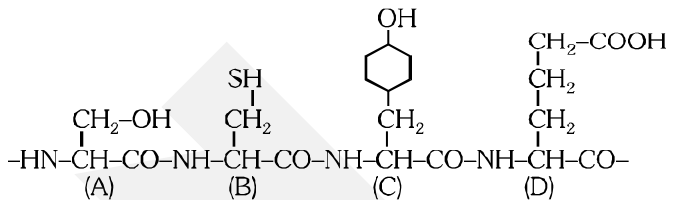
- 1D is the acidic amino acid - glutamic acid
- 2C is an aromatic amino acid - tryptophan
- 3A is the C-terminal amino acid and D is N terminal amino acid
- 4A is the sulphur containing amino acid-methionine
Show answer and solution
Correct: option 1, D is the acidic amino acid - glutamic acid
The side chains are: A, CH2-OH, serine; B, CH2-SH, cysteine; C, a p-hydroxybenzyl group, tyrosine; D, CH2-CH2-COOH, glutamic acid, an acidic amino acid. C is aromatic but is tyrosine, not tryptophan, and A is at the amino (N) end of the chain.
Question 74NEET 2013 Karnataka, Q120
Which of the following elements is a constituent of biotin?
- 1Magnesium
- 2Calcium
- 3Phosphorus
- 4Sulphur
Show answer and solution
Correct: option 4, Sulphur
Biotin (vitamin B7) has a sulphur-containing ring in its molecule, as does thiamine. It contains no magnesium, calcium or phosphorus.
Question 75NEET 2013 Karnataka, Q132
Uridine, present only in RNA is:
- 1nucleoside
- 2nucleotide
- 3purine
- 4pyrimidine
Show answer and solution
Correct: option 1, nucleoside
Uridine is the base uracil joined to ribose sugar, with no phosphate, so it is a nucleoside. Uracil itself is the pyrimidine, and adding a phosphate gives the nucleotide uridylic acid.
Question 76NEET 2013 Karnataka, Q134
Which of the following statements about enzymes is wrong?
- 1Enzymes are denatured at high temperatures
- 2Enzymes are mostly proteins but some are lipids also
- 3Enzymes are highly specific.
- 4Enzymes require optimum pH and temperature for maximum activity.
Show answer and solution
Correct: option 2, Enzymes are mostly proteins but some are lipids also
Almost all enzymes are proteins, and the few exceptions are RNA molecules (ribozymes); none are lipids. The other three statements are true properties of enzymes.
Question 77AIPMT 2012 Prelims, Q120
Given below is the diagrammatic representation of one of the categories of small molecular weight organic compounds in the living tissues. Identify the category shown and the one blank component "X" in it.
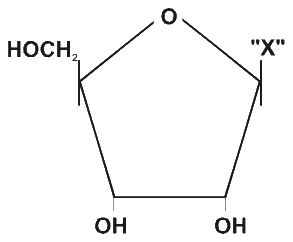
- 1Cholesterol - Guanine
- 2Amino acid -
- 3Nucleotide - Adenine
- 4Nucleoside - Uracil
Show answer and solution
Correct: option 4, Nucleoside - Uracil
The ring is a five-membered pentose sugar with on one side and OH groups on both the 2' and 3' carbons, so it is ribose. A sugar joined to a nitrogenous base without any phosphate group is a nucleoside (a nucleotide would also carry a phosphate group). Of the bases offered with "nucleoside", uracil fits, since uracil occurs with ribose (uridine).
Question 78AIPMT 2012 Prelims, Q126
Which one is the most abundant protein in the animal world?
- 1Trypsin
- 2Hemoglobin
- 3Collagen
- 4Insulin
Show answer and solution
Correct: option 3, Collagen
Collagen, the structural protein of connective tissue (skin, tendons, bone, cartilage), is the most abundant protein in the animal world. RuBisCO holds that position for the whole biosphere.
Question 79AIPMT 2012 Prelims, Q131
Which one out of A-D given below correctly represents the structural formula of the basic amino acid?
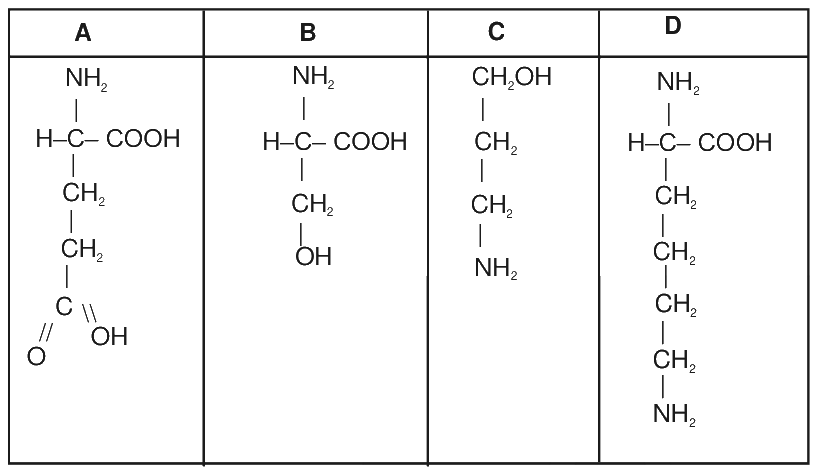
- 1C
- 2D
- 3A
- 4B
Show answer and solution
Correct: option 2, D
A basic amino acid has an extra amino group in its side chain. Structure D has the usual and COOH on the alpha carbon plus a four-carbon side chain ending in a second , which is lysine. A has a second COOH in the side chain (glutamic acid, acidic), B has an OH group (serine, neutral), and C has no carboxyl group at all, so it is not an amino acid. D is printed as option (2).
Question 80AIPMT 2012 Mains, Q65
For its activity, carboxypeptidase requires:
- 1Zinc
- 2Iron
- 3Niacin
- 4Copper
Show answer and solution
Correct: option 1, Zinc
Carboxypeptidase is a protein-digesting enzyme that needs a metal ion as cofactor. The ion is zinc, which is bound at the active site and takes part in breaking the peptide bond.
Question 81AIPMT 2012 Mains, Q96
Which one of the following biomolecules is correctly characterised?
- 1Lecithin - a phosphorylated glyceride found in cell membrane
- 2Palmitic acid- an unsaturated fatty acid with 18 carbon atoms
- 3Adenylic acid - adenosine with a glucose phosphate molecule
- 4Alanine amino acid - Contains an amino group and an acidic group anywhere in the molecule
Show answer and solution
Correct: option 1, Lecithin - a phosphorylated glyceride found in cell membrane
Lecithin is a phospholipid, a glyceride carrying a phosphate group, and is found in cell membranes. Palmitic acid is a saturated fatty acid with 16 carbons; adenylic acid is adenosine with a phosphate group (a nucleotide); and in alanine the amino and carboxyl groups are both on the same (alpha) carbon, not anywhere in the molecule.
Question 82AIPMT 2011 Prelims, Q89
Which one of the following structural formulae of two organic compounds is correctly identified along with its related function?
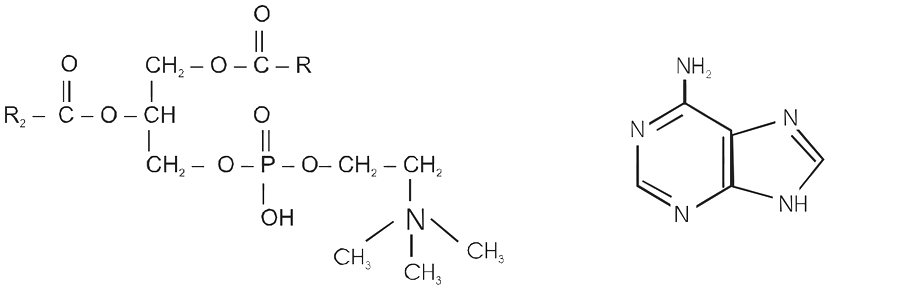
- 1B: Adenine - a nucleotide that makes up nucleic acids
- 2A: Triglyceride - major source of energy
- 3B: Uracil - a component of DNA
- 4A: Lecithin - a component of cell membrane
Show answer and solution
Correct: option 4, A: Lecithin - a component of cell membrane
The first structure (A, on the left) is a glycerol with two fatty acid chains and a phosphate joined to choline, which is the phospholipid lecithin, a component of cell membranes; it is not a triglyceride because it has only two fatty acids. The second structure (B) is the purine adenine, which is a nitrogenous base and not a nucleotide, and it is not uracil.
Question 83AIPMT 2011 Prelims, Q150
The curve given below shows enzymatic activity with relation to three conditions (pH, temperature and substrate concentration).
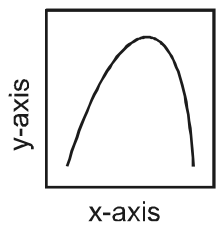
What do the two axes (x and y) represent?
x-axis, y-axis
- 1enzymatic activity, pH
- 2temperature, enzyme activity
- 3Substrate concentration, enzymatic activity
- 4enzymatic activity, temperature
Show answer and solution
Correct: option 2, temperature, enzyme activity
The curve is bell shaped: activity rises to a peak and then falls. That is how enzyme activity (on the y-axis) changes with temperature or pH (on the x-axis), with the peak at the optimum; heat beyond the optimum denatures the enzyme. With substrate concentration the curve would rise and then level off at instead of falling. Of the options, only temperature on the x-axis with enzyme activity on the y-axis fits.
Question 84AIPMT 2010 Mains, Q97
Three of the following statements about enzymes are correct and one is wrong which one is wrong
- 1Most enzymes are proteins but some are lipids
- 2Enzymes require optimum pH for maximal activity
- 3Enzymes are denatured at high temperatures but in certain exceptional organisms they are effective even at temperatures 80°- 90°C
- 4Enzymes are highly specific
Show answer and solution
Correct: option 1, Most enzymes are proteins but some are lipids
Almost all enzymes are proteins, and the few that are not are RNA molecules (ribozymes), never lipids, so statement (1) is wrong. Enzymes do have an optimum pH, are highly specific, and those of thermophilic organisms stay active at 80° to 90°C.
Question 85AIPMT 2008 Prelims, Q112
A competitive inhibitor of succinic dehydrogenase is
- 1Malate
- 2Malonate
- 3Oxaloacetate
- 4-ketoglutarate
Show answer and solution
Correct: option 2, Malonate
Malonate closely resembles succinate, the normal substrate, in structure. It binds to the active site of succinic dehydrogenase in place of succinate and so inhibits the enzyme competitively.
Question 86AIPMT 2008 Prelims, Q114
Carbohydrates are commonly found as starch in plant storage organs. Which of the following five properties of starch (a - e) make it useful as a storage material?
a. Easily translocated
b. Chemical non-reactive
c. Easily digested by animals
d. Osmotically inactive
e. Synthesized during photosynthesis
The useful properties are
- 1Both a & e
- 2Both b & c
- 3Both b & d
- 4a, c & e
Show answer and solution
Correct: option 3, Both b & d
A good storage substance must sit in the cell without disturbing it. Starch is chemically non-reactive (b) and, being insoluble, osmotically inactive (d), so large amounts can be stored without reacting or drawing in water. Starch is not easily translocated, and being digestible by animals is of no use to the plant.
Question 87AIPMT 2007 Prelims, Q2
About 98 percent of the mass of every living organism is composed of just six elements including carbon, hydrogen, nitrogen, oxygen and:
- 1calcium and phosphorous
- 2phosphorus and sulphur
- 3sulphur and magnesium
- 4magnesium and sodium
Show answer and solution
Correct: option 1, calcium and phosphorous
By mass, oxygen, carbon, hydrogen and nitrogen are the four most abundant elements of the body, and the next two are calcium and phosphorus (bones, teeth, nucleic acids, ATP). Sulphur, magnesium and sodium are each present in much smaller amounts.
Question 88AIPMT 2006 Prelims, Q137
An organic substance bound to an enzyme and essential for its activity is called-
- 1Coenzyme
- 2Holoenzyme
- 3Apoenzyme
- 4isoenzyme
Show answer and solution
Correct: option 1, Coenzyme
A coenzyme is a non-protein organic compound that binds to an enzyme and is needed for its activity. The apoenzyme is the protein part alone, the holoenzyme is the complete enzyme (protein plus cofactor), and isoenzymes are different forms of the same enzyme.
Question 89AIPMT 2005 Prelims, Q101
Which of the following is the simplest amino acid
- 1Alanine
- 2Asparagine
- 3Glycine
- 4Tyrosine
Show answer and solution
Correct: option 3, Glycine
Glycine has only a hydrogen atom as its side chain (R = H), so it is the smallest and simplest amino acid. Alanine has a methyl group, and asparagine and tyrosine have larger side chains.
Question 90AIPMT 2005 Prelims, Q105
Which of the following statements regarding enzyme inhibition is correct
- 1Competitive inhibition is seen when a substrate competes with an enzyme for binding to an inhibitor protein
- 2Non-competitive inhibitors often bind to the enzyme irreversibly
- 3Competitive inhibition is seen when the substrate and the inhibitor compete for the active site on the enzyme
- 4Non-competitive inhibition of an enzyme can be overcome by adding large amount of substrate
Show answer and solution
Correct: option 3, Competitive inhibition is seen when the substrate and the inhibitor compete for the active site on the enzyme
A competitive inhibitor resembles the substrate and competes with it for the active site of the enzyme, so option (3) is the correct description. It is competitive, not non-competitive, inhibition that can be overcome by adding more substrate, and option (1) reverses the roles of enzyme and substrate.
Question 91AIPMT 2005 Prelims, Q109
Enzymes, vitamins and hormones can be classified into a single category of biological chemicals, because all of these
- 1Are exclusively synthesized in the body of a living organism as at present
- 2enhance oxidative metabolism
- 3Are conjugated proteins
- 4Help in regulating metabolism
Show answer and solution
Correct: option 4, Help in regulating metabolism
Enzymes catalyse metabolic reactions, many vitamins act as coenzymes, and hormones control the rate of metabolic processes, so all three help in regulating metabolism. They are not all proteins (many vitamins and hormones are not), and vitamins are mostly obtained from food rather than made in the body.
Question 92AIPMT 2005 Prelims, Q142
The catalytic efficiency of two different enzymes can be compared by the
- 1The Km value
- 2The pH optimum value
- 3Molecular size of the enzyme
- 4Formation of the product
Show answer and solution
Correct: option 1, The Km value
The Michaelis constant is the substrate concentration at which an enzyme works at half its maximum velocity. It is a characteristic of each enzyme and shows its affinity for the substrate (a lower means higher affinity), so it is used to compare enzymes.
Question 93AIPMT 2004 Prelims, Q115
In which one of the following enzymes, is copper necessarily associated as an activator -
- 1Tryptophanase
- 2Lactic dehydrogenase
- 3Tyrosinase
- 4Carbonic anhydrase
Show answer and solution
Correct: option 3, Tyrosinase
Tyrosinase, the enzyme that oxidises tyrosine on the way to melanin, is a copper-containing enzyme and is inactive without copper. Carbonic anhydrase needs zinc, and tryptophanase and lactic dehydrogenase do not depend on copper.
Question 94AIPMT 2003 Prelims, Q170
In which one of the following nitrogen is not a constituent:-
- 1Idioblast
- 2Bacteriochlorophyll
- 3Invertase
- 4Pepsin
Show answer and solution
Correct: option 1, Idioblast
Invertase and pepsin are enzymes, hence proteins containing nitrogen, and bacteriochlorophyll has nitrogen in its pyrrole rings. An idioblast is a specialised plant cell that stores non-nitrogenous ergastic matter such as tannins, oils or calcium oxalate crystals, so it is the keyed answer.
Question 95AIPMT 2002 Prelims, Q101
Which is a reducing sugar:-
- 1Galactose
- 2Gluconic acid
- 3-methyl galactoside
- 4Sucrose
Show answer and solution
Correct: option 1, Galactose
A reducing sugar has a free aldehyde or ketone group (a free anomeric carbon) that can reduce Benedict's or Fehling's reagent. Galactose is a monosaccharide with a free anomeric carbon, so it is reducing. In gluconic acid the aldehyde group is already oxidised to an acid, in -methyl galactoside the anomeric carbon is locked in a glycosidic bond, and in sucrose both anomeric carbons are used in the bond between glucose and fructose.
Question 96AIPMT 2002 Prelims, Q174
Which steroid is used for transformation:-
- 1Cortisol
- 2Cholesterol
- 3Testosterone
- 4Progesterone
Show answer and solution
Correct: option 2, Cholesterol
The key gives cholesterol. Cholesterol is the parent steroid of the body: it is the starting material that is transformed into the other steroids, such as cortisol, testosterone, progesterone, bile acids and vitamin D.
Question 97AIPMT 2002 Prelims, Q190
- 1Fibrous protein
- 2Globular protein
- 3Lipid
- 4Carbohydrate
Show answer and solution
Correct: option 1, Fibrous protein
Collagen is a structural protein of connective tissue made of three polypeptide chains wound into a long triple helix, forming strong insoluble fibres. It is therefore a fibrous protein.
Question 98AIPMT 2002 Prelims, Q191
Lipids are insoluble in water because lipids molecules are:-
- 1Hydrophilic
- 2Hydrophobic
- 3Neutral
- 4Zwitter ions
Show answer and solution
Correct: option 2, Hydrophobic
Lipids are made largely of long non-polar hydrocarbon chains that cannot form hydrogen bonds with water. Being hydrophobic (water-repelling), they do not dissolve in water but dissolve in organic solvents.
Question 99AIPMT 2001 Prelims, Q159
Which one correctly matched:
- 1Vit. E – Tocopherol
- 2Vit. D – Riboflavin
- 3Vit. B – Calciferol
- 4Vit. A – Thiamine
Show answer and solution
Correct: option 1, Vit. E – Tocopherol
Vitamin E is tocopherol. Calciferol is vitamin D, riboflavin is vitamin , thiamine is vitamin , and vitamin A is retinol, so only the first pair is correct.
Question 100AIPMT 2001 Prelims, Q161
Most abundant organic compound on earth is
- 1Protein
- 2Cellulose
- 3Lipids
- 4Steroids
Show answer and solution
Correct: option 2, Cellulose
Cellulose is the main structural material of every plant cell wall, so it makes up the largest share of the organic matter in the biosphere.
Question 101AIPMT 2001 Prelims, Q168
Spoilage of oil can be detected by which fatty acid:
- 1Oleic acid
- 2Linolenic acid
- 3Linoleic acid
- 4Erucic acid
Show answer and solution
Correct: option 4, Erucic acid
The keyed answer is erucic acid, a long-chain (22-carbon) unsaturated fatty acid found in mustard and rapeseed oil. Its level is used as a marker of the quality of an edible oil, and a high value marks the oil as unfit for use.
Question 102AIPMT 2001 Prelims, Q170
In plants inulin and pectin are
- 1Reserved material
- 2Wastes
- 3Excretory material
- 4Insect attracting material
Show answer and solution
Correct: option 1, Reserved material
Inulin is a polymer of fructose stored in the roots and tubers of plants such as Dahlia, and pectin is a polysaccharide laid down in cell walls and fruits. Both are stored polysaccharides, not wastes or excretory products, so the keyed option is reserve material.
Question 103AIPMT 2000 Prelims, Q147
Which factor is responsible for inhibition of enzymatic process during feed back:
- 1Substrate
- 2Enzymes
- 3End product
- 4Temperature
Show answer and solution
Correct: option 3, End product
In feedback inhibition the final product of a metabolic pathway, once it accumulates, binds to an enzyme early in the pathway (usually at an allosteric site) and slows it down, so that no more product is made than is needed.
Question 104AIPMT 2000 Prelims, Q169
- 1Nucleotide
- 2Nucleoside
- 3Nucleic acid
- 4Vitamin
Show answer and solution
Correct: option 1, Nucleotide
ATP is made of the base adenine, the sugar ribose and three phosphate groups. A base plus a sugar is a nucleoside, and a nucleoside with phosphate is a nucleotide, so ATP is a nucleotide.
Question 105AIPMT 2000 Prelims, Q170
- 1Phenyl alanine
- 2Glycine
- 3Aspartic acid
- 4Serine
Show answer and solution
Correct: option 1, Phenyl alanine
Essential amino acids cannot be made in the body and must come from food. Phenylalanine is one of them, while glycine, aspartic acid and serine can be made by the body.
Question 106AIPMT 2000 Prelims, Q176
Which of the following have carbohydrate as prosthetic group:
- 1Glycoprotein
- 2Chromoprotein
- 3Lipoprotein
- 4Nucleoprotein
Show answer and solution
Correct: option 1, Glycoprotein
A conjugated protein is named after its non-protein (prosthetic) part. In a glycoprotein that part is a carbohydrate; in a chromoprotein it is a pigment, in a lipoprotein a lipid and in a nucleoprotein a nucleic acid.
Question 107AIPMT 2000 Prelims, Q195
Role of enzyme in reactions:
- 1Decrease activation energy
- 2Increase activation energy
- 3Inorganic catalyst
- 4None of the above
Show answer and solution
Correct: option 1, Decrease activation energy
An enzyme speeds up a reaction by lowering its activation energy, the energy barrier the substrate must cross. Enzymes are organic catalysts (mostly proteins), not inorganic ones.
Question 108AIPMT 1999 Prelims, Q139
Which of the following does not contain metal:
- 1Glycoproteins
- 2Ferritin
- 3Cytochromes
- 4Chromoproteins
Show answer and solution
Correct: option 1, Glycoproteins
Glycoproteins are proteins joined to carbohydrate and have no metal. Ferritin stores iron, cytochromes carry iron in their haem group, and chromoproteins such as haemoglobin and haemocyanin have a metal-containing pigment.
Question 109AIPMT 1999 Prelims, Q187
Which protein found in maximum amount:
- 1Catalase
- 2Zinc carbonic anhydrase
- 3Transferase
- 4RUBISCO
Show answer and solution
Correct: option 4, RUBISCO
RuBisCO (ribulose bisphosphate carboxylase-oxygenase), the enzyme that fixes in the Calvin cycle, makes up a large part of the soluble protein of every green leaf. It is the most abundant protein in the whole biosphere.
Question 110AIPMT 1999 Prelims, Q195
Secondary structure of protein, which is attached to lipid layer and lining the pores of cell membrane will be:
- 1-Helix
- 2-Strand
- 3-Chain
- 4Random
Show answer and solution
Correct: option 1, -Helix
The parts of a membrane protein that cross the lipid bilayer are usually coiled into -helices. In a helix all the peptide groups are hydrogen-bonded within the chain and the non-polar side chains point outwards into the lipid, and several helices placed side by side can enclose a channel or pore.
Question 111AIPMT 1998 Prelims, Q112
Which is wrong for cytochrome P-450
- 1It contains Fe
- 2It concern with oxidation
- 3It is a pigment
- 4It is a coloured cell
Show answer and solution
Correct: option 4, It is a coloured cell
Cytochrome P-450 is a haem protein: it contains iron, is coloured (a pigment, named after its absorption peak at 450 nm) and carries out oxidation reactions such as the hydroxylation of drugs. It is a molecule, not a cell, so the wrong statement is option (4).
Question 112AIPMT 1998 Prelims, Q122
- 1Glucose + galactose
- 2Glucose + fructose
- 3Glucose + glucose
- 4Glucose + mannose
Show answer and solution
Correct: option 1, Glucose + galactose
Lactose (milk sugar) is a disaccharide of one glucose and one galactose joined by a -1,4 glycosidic bond. Glucose + fructose is sucrose and glucose + glucose is maltose.
Question 113AIPMT 1998 Prelims, Q123
True statement for cellulose molecule:
- 1-1-4 linkage, unbranched
- 2-1-4 linkage, branched
- 3-1-4 linkage, branched
- 4-1-6 linkage, unbranched
Show answer and solution
Correct: option 1, -1-4 linkage, unbranched
Cellulose is a straight chain of -glucose units joined by -1,4 glycosidic bonds, with no branches. -1,4 chains with -1,6 branches describe amylopectin and glycogen.
Question 114AIPMT 1998 Prelims, Q177
Variations in proteins are due to:
- 1Sequence of amino acids
- 2Number of amino acids
- 3R-group
- 4None
Show answer and solution
Correct: option 1, Sequence of amino acids
The same 20 amino acids make all proteins. What makes one protein different from another is the order in which the amino acids are joined (the primary structure), which decides its folding and function.