Questions with solutions
Question 1NEET 2026, Q97
How many ATP and NADPH molecules are required to make one molecule of glucose through the Calvin pathway?
- 118 ATP and 12 NADPH
- 26 ATP and 12 NADPH
- 324 ATP and 18 NADPH
- 412 ATP and 18 NADPH
Show answer and solution
Correct: option 1, 18 ATP and 12 NADPH
Each fixed in the Calvin cycle uses 3 ATP and 2 NADPH. One glucose needs six turns of the cycle, so ATP and NADPH are required.
Question 2NEET 2026, Q108
Find the incorrect statement(s) about photosynthesis from the following:
A. The water splitting complex is associated with PS I.
B. plants use the pathway of fixation as the main biosynthetic pathway.
C. In plants, photorespiration does not occur.
D. plants exhibit 'Kranz' anatomy.
E. ATP synthesis in chloroplast occurs through chemiosmosis.
Choose the answer from the options given below:
- 1B only
- 2A and D only
- 3B and C only
- 4B and E only
Show answer and solution
Correct: option 2, A and D only
A and D are incorrect. The water splitting complex is associated with PS II, not PS I, and Kranz anatomy is a feature of plants, not plants. The others are true: plants still use the Calvin () cycle as the main biosynthetic pathway, they do not show photorespiration, and chloroplast ATP is made by chemiosmosis.
Question 3NEET 2026, Q132
The enzyme required for carboxylation in the Calvin cycle is:
- 1PEP carboxylase
- 2RuBP carboxylase – oxygenase
- 3Carboxypeptidase
- 4Hexokinase
Show answer and solution
Correct: option 2, RuBP carboxylase – oxygenase
In the Calvin cycle is joined to RuBP by RuBP carboxylase-oxygenase (RuBisCO), giving two molecules of 3-PGA. PEP carboxylase does the first carboxylation of the pathway in mesophyll cells, not that of the Calvin cycle.
Question 4NEET 2026 Re-exam, Q100
Photorespiration reaction catalyzed by RuBisCo is shown below:
RuBP + 3-Phosphoglycerate + X
Identify "X" from the given options:
- 1Phosphoenolpyruvate
- 22-Phosphoglycolate
- 3Oxaloacetate
- 4Malate
Show answer and solution
Correct: option 2, 2-Phosphoglycolate
When RuBisCO acts as an oxygenase, the five-carbon RuBP combines with and splits into one molecule of 3-phosphoglycerate (3 carbons) and one molecule of phosphoglycolate (2 carbons). So X is 2-phosphoglycolate.
Question 5NEET 2026 Re-exam, Q102
Which pigment has absorption peak at 700 nm in the photosynthetic reaction centre PS I (P700)?
- 1Chlorophyll b
- 2Chlorophyll a
- 3Xanthophylls
- 4Carotenoids
Show answer and solution
Correct: option 2, Chlorophyll a
The reaction centre of each photosystem is a single chlorophyll a molecule. In PS I this chlorophyll a absorbs best at 700 nm and is called P700. Chlorophyll b, xanthophylls and carotenoids are accessory pigments of the antenna.
Question 6NEET 2026 Re-exam, Q114
Select the correct sequence of experiments that led to a gradual understanding of photosynthesis in green plants.
- 1Absorption spectra of chlorophyll a and b production of glucose release of oxygen role of air
- 2Role of air release of oxygen production of glucose absorption spectra of chlorophyll a and b
- 3Release of oxygen production of glucose absorption spectra of chlorophyll a and b role of air
- 4Production of glucose role of air release of oxygen absorption spectra of chlorophyll a and b
Show answer and solution
Correct: option 2, Role of air release of oxygen production of glucose absorption spectra of chlorophyll a and b
Priestley (1770s) first showed the role of air in the growth of green plants. Ingenhousz then showed that green parts release oxygen in sunlight. Sachs (1854) found that glucose is made and stored as starch. Later work with action and absorption spectra showed which wavelengths chlorophyll a and b absorb. That order is option (2).
Question 7NEET 2026 Re-exam, Q116
How many turns of Calvin cycle are required for the formation of three molecules of glucose?
- 16
- 23
- 31
- 418
Show answer and solution
Correct: option 4, 18
Each turn of the Calvin cycle fixes one , so one six-carbon glucose needs 6 turns. Three molecules of glucose need turns.
Question 8NEET 2026 Re-exam, Q122
Which of the following statements regarding photorespiration are correct?
(a) Do not occur in C3 plants
(b) is consumed and is generated
(c) Phosphoglycolate is formed
(d) No synthesis of ATP and NADPH
Choose the correct answer from the options given below:
- 1(a) and (d) only
- 2(c) and (d) only
- 3(b) and (d) only
- 4(a) and (b) only
Show answer and solution
Correct: option 2, (c) and (d) only
Photorespiration happens in C3 plants and is absent in C4 plants, so (a) is wrong. It uses up and releases , the reverse of (b). RuBP joins with to give phosphoglycerate and phosphoglycolate, and the pathway makes neither ATP nor NADPH, so (c) and (d) are right.
Question 9NEET 2025, Q122
Match List I with List II:
| List I | | List II |
|---|
| A. | Chlorophyll a | I. | Yellow-green |
| B. | Chlorophyll b | II. | Yellow |
| C. | Xanthophylls | III. | Blue-green |
| D. | Carotenoids | IV. | Yellow to Yellow-orange |
Choose the option with all correct matches.
- 1A-III, B-IV, C-II, D-I
- 2A-III, B-I, C-II, D-IV
- 3A-I, B-II, C-IV, D-III
- 4A-I, B-IV, C-III, D-II
Show answer and solution
Correct: option 2, A-III, B-I, C-II, D-IV
On a chromatogram of leaf pigments, chlorophyll a is bright or blue-green (A-III), chlorophyll b is yellow-green (B-I), xanthophylls are yellow (C-II) and carotenoids are yellow to yellow-orange (D-IV).
Question 10NEET 2025, Q171
Which of the following statements about RuBisCO is true?
- 1It is active only in the dark.
- 2It has higher affinity for oxygen than carbon dioxide.
- 3It is an enzyme involved in the photolysis of water.
- 4It catalyzes the carboxylation of RuBP.
Show answer and solution
Correct: option 4, It catalyzes the carboxylation of RuBP.
RuBisCO (RuBP carboxylase-oxygenase) catalyses the carboxylation of RuBP in the first step of the Calvin cycle. It has a greater affinity for than for , works in the light, and has no part in the splitting of water.
Question 11NEET 2024, Q106
How many molecules of ATP and NADPH are required for every molecule of fixed in the Calvin cycle?
- 13 molecules of ATP and 2 molecules of NADPH
- 22 molecules of ATP and 3 molecules of NADPH
- 32 molecules of ATP and 2 molecules of NADPH
- 43 molecules of ATP and 3 molecules of NADPH
Show answer and solution
Correct: option 1, 3 molecules of ATP and 2 molecules of NADPH
For each fixed, the reduction step uses 2 ATP and 2 NADPH and the regeneration of RuBP uses 1 more ATP. The total is 3 ATP and 2 NADPH per .
Question 12NEET 2024, Q112
Which of the following are required for the dark reaction of photosynthesis?
A. Light
B. Chlorophyll
C.
D. ATP
E. NADPH
Choose the correct answer from the options given below:
- 1D and E only
- 2A, B and C only
- 3B, C and D only
- 4C, D and E only
Show answer and solution
Correct: option 4, C, D and E only
The dark reaction (Calvin cycle) fixes using the ATP and NADPH made in the light reaction. It does not directly need light or chlorophyll, so C, D and E are required.
Question 13NEET 2024, Q140
Given below are two statements:
Statement I: In plants, some binds to RuBisCO, hence fixation is decreased.
Statement II: In plants, mesophyll cells show very little photorespiration while bundle sheath cells do not show photorespiration.
In the light of the above statements, choose the correct answer from the options given below:
- 1Statement I is false but Statement II is true
- 2Both Statement I and Statement II are true
- 3Both Statement I and Statement II are false
- 4Statement I is true but Statement II is false
Show answer and solution
Correct: option 4, Statement I is true but Statement II is false
In plants competes with for the active site of RuBisCO, and whatever binds lowers fixation, so Statement I is true. In plants photorespiration does not occur: the mesophyll cells have no RuBisCO, and the bundle sheath cells have a high concentration. Statement II, which says the mesophyll cells show a little photorespiration, is false.
Question 14NEET 2024 Re-exam, Q105
Which of the following are required for the light reaction of Photosynthesis?
A.
B.
C.
D. Chlorophyll
E. Light
Choose the correct answer from the options given below:
- 1A, C, D and E only
- 2C, D and E only
- 3A and B only
- 4A, C and E only
Show answer and solution
Correct: option 2, C, D and E only
In the light reaction chlorophyll absorbs light, and water is split to supply electrons, giving ATP, NADPH and oxygen. So water, chlorophyll and light are needed. is used only in the dark reaction, and is a product, not a requirement.
Question 15NEET 2024 Re-exam, Q141
Which one of the following products diffuses out of the chloroplast during photosynthesis?
- 1ADP
- 2NADPH
- 3
- 4ATP
Show answer and solution
Correct: option 3,
The light reaction gives ATP, NADPH and . ATP and NADPH are used up at once in the stroma to fix , and the ADP formed is used again. Oxygen is not needed there, so it diffuses out of the chloroplast.
Question 16NEET 2024 Re-exam, Q150
Observe the given figure. Identify the different stages labelled with alphabets by selecting the correct option.
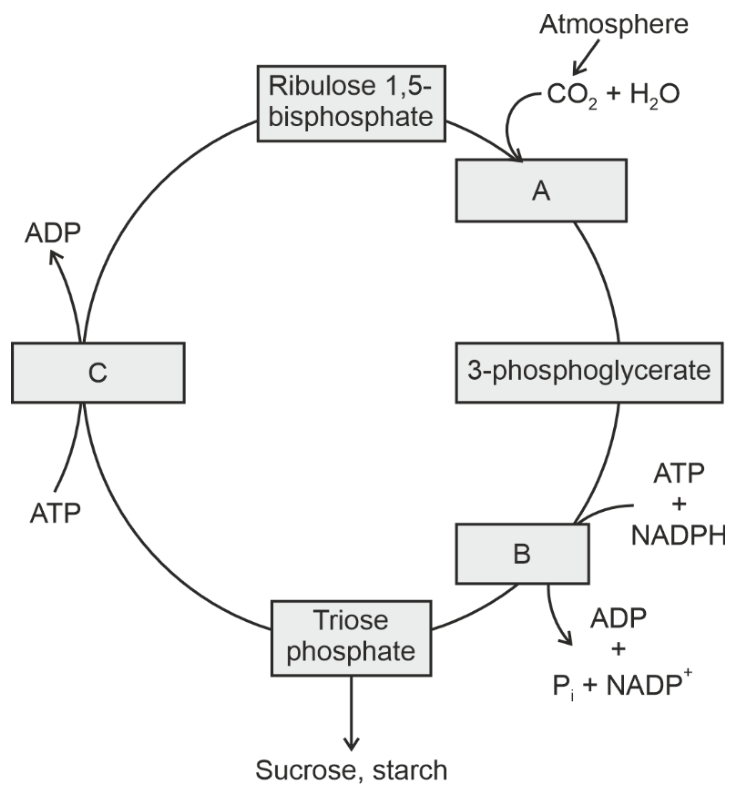
- 1A-Carboxylation, B-Regeneration, C-Reduction
- 2A-Reduction, B-Decarboxylation, C-Regeneration
- 3A-Carboxylation, B-Reduction, C-Regeneration
- 4A-Reduction, B-Carboxylation, C-Regeneration
Show answer and solution
Correct: option 3, A-Carboxylation, B-Reduction, C-Regeneration
The figure is the Calvin cycle. At A, joins ribulose 1,5-bisphosphate to give 3-phosphoglycerate: carboxylation. At B, ATP and NADPH are used to turn 3-phosphoglycerate into triose phosphate: reduction. At C, ATP is used to form ribulose 1,5-bisphosphate again: regeneration.
Question 17NEET 2023, Q112
The reaction centre in PS II has an absorption maxima at
- 1680 nm
- 2700 nm
- 3660 nm
- 4780 nm
Show answer and solution
Correct: option 1, 680 nm
The reaction centre chlorophyll a of photosystem II absorbs best at 680 nm and is called P680. The reaction centre of photosystem I is P700.
Question 18NEET 2023, Q126
How many ATP and are required for the synthesis of one molecule of Glucose during Calvin cycle?
- 112 ATP and 12
- 218 ATP and 12
- 312 ATP and 16
- 418 ATP and 16
Show answer and solution
Correct: option 2, 18 ATP and 12
Each fixed in the Calvin cycle uses 3 ATP (2 in reduction, 1 in regeneration of RuBP) and 2 . One glucose needs 6 , that is 6 turns: ATP and .
Question 19NEET 2023, Q143
Which of the following combinations is required for chemiosmosis?
- 1membrane, proton pump, proton gradient, ATP synthase
- 2membrane, proton pump, proton gradient, NADP synthase
- 3proton pump, electron gradient, ATP synthase
- 4proton pump, electron gradient, NADP synthase
Show answer and solution
Correct: option 1, membrane, proton pump, proton gradient, ATP synthase
Chemiosmosis needs a membrane, a proton pump, a proton gradient across the membrane and ATP synthase. The pump builds the proton gradient across the membrane, and the flow of protons back through ATP synthase drives ATP formation. The gradient is of protons, not electrons, and the enzyme is ATP synthase.
Question 20NEET 2023 Manipur, Q101
Match List-I with List-II
| List-I | List-II |
|---|
| (A) Chlorophyll a | (I) Yellow to yellow orange |
| (B) Chlorophyll b | (II) Yellow green |
| (C) Xanthophyll | (III) Blue green |
| (D) Carotenoid | (IV) Yellow |
Choose the correct answer from the options given below:
- 1A-II, B-III, C-I, D-IV
- 2A-IV, B-III, C-II, D-I
- 3A-III, B-II, C-IV, D-I
- 4A-III, B-I, C-IV, D-II
Show answer and solution
Correct: option 3, A-III, B-II, C-IV, D-I
On a paper chromatogram of leaf pigments, chlorophyll a appears bright or blue green, chlorophyll b yellow green, xanthophylls yellow and carotenoids yellow to yellow orange. So A-III, B-II, C-IV, D-I, which is option (3).
Question 21NEET 2023 Manipur, Q115
Given below are two statements:
Statement I: RuBisCO is the most abundant enzyme in the world.
Statement II: Photorespiration does not occur in plants.
In the light of the above statements, choose the most appropriate answer from the options given below:
- 1Both Statement I and Statement II are correct
- 2Both Statement I and Statement II are incorrect
- 3Statement I is correct but Statement II is incorrect
- 4Statement I is incorrect but Statement II is correct
Show answer and solution
Correct: option 1, Both Statement I and Statement II are correct
Statement I is correct: RuBisCO is present in all green plants in large amounts and is the most abundant enzyme in the world. Statement II is also correct: in plants the bundle sheath cells are supplied with a high concentration of , so RuBisCO acts only as a carboxylase and photorespiration does not occur. Hence option (1).
Question 22NEET 2023 Manipur, Q148
Which out of the following statements is incorrect?
- 1Both ATP and are synthesised during non-cyclic photophosphorylation.
- 2Stroma lamellae lack PS II and NADP reductase
- 3Grana lamellae have both PS I and PS II
- 4Cyclic photophosphorylation involves both PS I and PS II
Show answer and solution
Correct: option 4, Cyclic photophosphorylation involves both PS I and PS II
Cyclic photophosphorylation involves PS I alone: the electron returns to PS I and only ATP is made. So statement (4) is incorrect. The others are true: the non-cyclic route uses both photosystems and makes ATP and , the stroma lamellae lack PS II and NADP reductase, and the grana lamellae carry both photosystems.
Question 23NEET 2022, Q119
Which one of the following is not true regarding the release of energy during ATP synthesis through chemiosmosis? It involves:
- 1Reduction of NADP to on the stroma side of the membrane
- 2Breakdown of proton gradient
- 3Breakdown of electron gradient
- 4Movement of protons across the membrane to the stroma
Show answer and solution
Correct: option 3, Breakdown of electron gradient
In chemiosmosis a proton gradient is built across the thylakoid membrane, and ATP is made when this gradient breaks down as protons move through ATP synthase to the stroma; NADP is reduced on the stroma side, which also removes protons there. There is no "electron gradient" whose breakdown releases the energy, so option (3) is not true.
Question 24NEET 2022, Q122
Given below are two statements:
Statement I:
The primary acceptor in plants is phosphoenolpyruvate and is found in the mesophyll cells.
Statement II:
Mesophyll cells of plants lack RuBisCo enzyme.
In the light of the above statements, choose the correct answer from the options given below:
- 1Statement I is incorrect but Statement II is correct
- 2Both Statement I and Statement II are correct
- 3Both Statement I and Statement II are incorrect
- 4Statement I is correct but Statement II is incorrect
Show answer and solution
Correct: option 2, Both Statement I and Statement II are correct
In plants is first fixed in the mesophyll cells by PEP carboxylase, with the 3-carbon phosphoenolpyruvate as the acceptor. The mesophyll cells have no RuBisCO; it is present in the bundle sheath cells where the Calvin cycle runs. Both statements are correct.
Question 25NEET 2022, Q141
What is the role of large bundle sheath cells found around the vascular bundles in plants?
- 1To protect the vascular tissue from high light intensity
- 2To provide the site for photorespiratory pathway
- 3To increase the number of chloroplast for the operation of Calvin cycle
- 4To enable the plant to tolerate high temperature
Show answer and solution
Correct: option 3, To increase the number of chloroplast for the operation of Calvin cycle
In plants the Calvin cycle runs only in the bundle sheath cells. These large cells have a large number of chloroplasts rich in RuBisCO, and the released there from the acid keeps its concentration high, which prevents photorespiration. So their role is to provide many chloroplasts for the Calvin cycle.
Question 26NEET 2022 Re-exam, Q110
When one molecule is fixed as one molecule of triose phosphate, which of the following photochemically made, high energy chemical intermediates are used in the reduction phase?
- 12 ATP + 2 NADPH
- 21 ATP + 1 NADPH
- 31 ATP + 2 NADPH
- 42 ATP + 1 NADPH
Show answer and solution
Correct: option 1, 2 ATP + 2 NADPH
One fixed by RuBisCO gives two molecules of 3-PGA. In the reduction step of the Calvin cycle each 3-PGA needs one ATP for phosphorylation and one NADPH for reduction, so 2 ATP and 2 NADPH are used per fixed. (The third ATP per is used in regeneration, not reduction.)
Question 27NEET 2022 Re-exam, Q148
Identify the correct statements regarding chemiosmotic hypothesis:
(a) Splitting of the water molecule takes place on the inner side of the membrane.
(b) Protons accumulate within the lumen of the thylakoids.
(c) Primary acceptor of electron transfers the electrons to an electron carrier.
(d) NADP reductase enzyme is located on the stroma side of the membrane.
(e) Protons increase in number in stroma.
Choose the correct answer from the options given below:
- 1(b), (c) and (e)
- 2(a), (b) and (e)
- 3(a), (b) and (d)
- 4(b), (c) and (d)
Show answer and solution
Correct: option 3, (a), (b) and (d)
Water is split on the inner (lumen) side of the thylakoid membrane, so the protons it releases accumulate in the lumen: (a) and (b) are correct. NADP reductase lies on the stroma side of the membrane, so (d) is correct. The primary acceptor of electrons passes its electron to a hydrogen carrier, not an electron carrier, so (c) is wrong, and protons decrease in the stroma, so (e) is wrong.
Question 28NEET 2021, Q106
The first stable product of fixation in sorghum is:
- 1Pyruvic acid
- 2Oxaloacetic acid
- 3Succinic acid
- 4Phosphoglyceric acid
Show answer and solution
Correct: option 2, Oxaloacetic acid
Sorghum is a plant. In its mesophyll cells PEP carboxylase joins to phosphoenolpyruvate to give the 4-carbon oxaloacetic acid, which is the first stable product. Phosphoglyceric acid is the first product in plants.
Question 29NEET 2021, Q144
Which of the following statements is incorrect?
- 1Both ATP and are synthesized during non-cyclic photophosphorylation.
- 2Stroma lamellae have PS I only and lack NADP reductase.
- 3Grana lamellae have both PS I and PS II.
- 4Cyclic photophosphorylation involves both PS I and PS II.
Show answer and solution
Correct: option 4, Cyclic photophosphorylation involves both PS I and PS II.
Cyclic photophosphorylation uses only PS I: the electron returns to PS I and only ATP is made. It takes place in the stroma lamellae, which lack PS II and NADP reductase. So statement (4) is the incorrect one.
Question 30NEET 2020, Q118
In light reaction, plastoquinone facilitates the transfer of electrons from:
- 1PS-II to Cytbf complex
- 2Cytbf complex to PS-I
- 3PS-I to
- 4PS-I to ATP synthase
Show answer and solution
Correct: option 1, PS-II to Cytbf complex
In the Z scheme, electrons leaving PS II are accepted and passed on by plastoquinone to the cytochrome bf complex. Plastocyanin then carries them from the cytochrome complex to PS I.
Question 31NEET 2020, Q126
The oxygenation activity of RuBisCo enzyme in photorespiration leads to the formation of:
- 12 molecules of 3-C compound
- 21 molecule of 3-C compound
- 31 molecule of 6-C compound
- 41 molecule of 4-C compound and 1 molecule of 2-C compound
Show answer and solution
Correct: option 2, 1 molecule of 3-C compound
When RuBisCO binds instead of , the 5-carbon RuBP splits into one molecule of phosphoglycerate (3-C) and one molecule of phosphoglycolate (2-C). Only one 3-C molecule is formed, against two in carboxylation.
Question 32NEET 2020 Phase 2, Q6
During non-cyclic photophosphorylation, when electrons are lost from the reaction centre at PS II, what is the source which replaces these electrons?
- 1Water
- 2Carbon dioxide
- 3Light
- 4Oxygen
Show answer and solution
Correct: option 1, Water
The electrons that leave the PS II reaction centre are replaced by the splitting of water, which is associated with PS II: . Oxygen is a product of this reaction, not the source of electrons.
Question 33NEET 2020 Phase 2, Q33
Which of the following statements is incorrect?
- 1In plants, the site of RuBisCO activity is mesophyll cell
- 2The substrate molecule for RuBisCO activity is a 5-carbon compound
- 3RuBisCO action requires ATP and NADPH
- 4RuBisCO is a bifunctional enzyme
Show answer and solution
Correct: option 1, In plants, the site of RuBisCO activity is mesophyll cell
In plants the mesophyll cells lack RuBisCO and fix carbon dioxide with PEP carboxylase; RuBisCO works in the bundle sheath cells, so the first statement is incorrect. RuBisCO acts on the 5-carbon RuBP and is bifunctional, working as both a carboxylase and an oxygenase. The key treats the statement about ATP and NADPH as correct, in the sense that the Calvin cycle RuBisCO drives depends on them.
Question 34NEET 2019 Odisha, Q143
In Hatch and Slack pathway, the primary acceptor is -
- 1Phosphoenol pyruvate
- 2Rubisco
- 3Oxaloacetic acid
- 4Phosphoglyceric acid
Show answer and solution
Correct: option 1, Phosphoenol pyruvate
In the (Hatch and Slack) pathway, is first fixed in the mesophyll cells by the enzyme PEP carboxylase, which adds it to the 3-carbon phosphoenol pyruvate (PEP). The product is the 4-carbon oxaloacetic acid. So PEP is the primary acceptor; oxaloacetic acid is the first product, and Rubisco is an enzyme, not an acceptor.
Question 35NEET 2019 Odisha, Q145
One scientist cultured Cladophora in a suspension of Azotobacter and illuminated the culture by splitting light through a prism. He observed that bacteria accumulated mainly in the region of:
- 1Orange and yellow light
- 2Blue and red light
- 3Violet and green light
- 4Indigo and green light
Show answer and solution
Correct: option 2, Blue and red light
This is Engelmann's experiment. The aerobic bacteria gather where the alga releases the most oxygen, that is, where photosynthesis is fastest. Chlorophyll absorbs mainly blue and red light, so the bacteria collected in the blue and red regions of the spectrum, giving the first action spectrum of photosynthesis.
Question 36NEET 2018, Q91
Oxygen is not produced during photosynthesis by
- 1Cycas
- 2Nostoc
- 3Green sulphur bacteria
- 4Chara
Show answer and solution
Correct: option 3, Green sulphur bacteria
Green sulphur bacteria carry out anoxygenic photosynthesis: they use instead of water as the hydrogen donor, so sulphur is released and not oxygen. Cycas, Nostoc (a cyanobacterium) and Chara (a green alga) all split water and release .
Question 37NEET 2018, Q120
Which of the following is not a product of light reaction of photosynthesis ?
- 1NADPH
- 2NADH
- 3ATP
- 4Oxygen
Show answer and solution
Correct: option 2, NADH
The light reaction splits water and produces ATP, NADPH and oxygen. NADH is formed in respiration (glycolysis and the Krebs cycle), not in the light reaction.
Question 38NEET 2017, Q142
With reference to factors affecting the rate of photosynthesis, which of the following statements is not correct?
- 1Light saturation for fixation occurs at 10% of full sunlight
- 2Increasing atmospheric concentration up to 0.05% can enhance fixation rate
- 3 plants respond to higher temperatures with enhanced photosynthesis while plants have much lower temperature optimum
- 4Tomato is a greenhouse crop which can be grown in -enriched atmosphere for higher yield
Show answer and solution
Correct: option 3, plants respond to higher temperatures with enhanced photosynthesis while plants have much lower temperature optimum
Statement (3) has the two groups the wrong way round: it is the plants that respond to higher temperatures and have the higher temperature optimum, while plants have a much lower one. The other statements are true: light saturates at about 10% of full sunlight, raising up to 0.05% increases fixation, and tomato is grown in -enriched greenhouses.
Question 39NEET 2017, Q164
Phosphoenol pyruvate (PEP) is the primary acceptor in
- 1 plants
- 2 plants
- 3 plants
- 4 and plants
Show answer and solution
Correct: option 2, plants
In plants the first fixation of happens in the mesophyll cells, where PEP carboxylase adds it to the 3-carbon PEP to form oxaloacetic acid. In plants the primary acceptor is RuBP.
Question 40NEET 2016 Phase 1, Q97
Emerson's enhancement effect and Red drop have been instrumental in the discovery of:
- 1Photophosphorylation and non-cyclic electron transport
- 2Two photosystems operating simultaneously
- 3Photophosphorylation and cyclic electron transport
- 4Oxidative phosphorylation
Show answer and solution
Correct: option 2, Two photosystems operating simultaneously
Emerson found that the yield of photosynthesis falls sharply in light beyond 680 nm (red drop) and that it rises more than expected when shorter-wavelength light is given at the same time (enhancement effect). This showed that two pigment systems, PS I and PS II, work together in the light reaction.
Question 41NEET 2016 Phase 1, Q103
In a chloroplast the highest number of protons are found in:
- 1Stroma
- 2Lumen of thylakoids
- 3Inter membrane space
- 4Antennae complex
Show answer and solution
Correct: option 2, Lumen of thylakoids
During the light reaction protons are released inside the thylakoid by the splitting of water and are also pumped in from the stroma as electrons pass through the carriers. Protons therefore accumulate in the thylakoid lumen, and this gradient drives ATP synthesis as they flow back to the stroma.
Question 42NEET 2016 Phase 1, Q143
A plant in your garden avoids photorespiratory losses, has improved water use efficiency, shows high rates of photosynthesis at high temperatures and has improved efficiency of nitrogen utilisation. In which of the following physiological groups would you assign this plant?
- 1
- 2
- 3CAM
- 4Nitrogen fixer
Show answer and solution
Correct: option 2,
These are the features of a plant. It concentrates in the bundle sheath cells, so RuBisCO works almost only as a carboxylase and photorespiration is avoided; this gives high photosynthetic rates at high temperature, and better water and nitrogen use efficiency than a plant.
Question 43NEET 2016 Phase 2, Q113
The process which makes major difference between and plants is
- 1glycolysis
- 2Calvin cycle
- 3photorespiration
- 4respiration
Show answer and solution
Correct: option 3, photorespiration
Glycolysis, respiration and the Calvin cycle occur in both groups. Photorespiration is significant in plants but is practically absent in plants, because they concentrate around RuBisCO in the bundle sheath cells. That is the major difference.
Question 44AIPMT 2015 Re-test, Q52
The oxygen evolved during photosynthesis comes from water molecules. Which one of the following pairs of elements is involved in this reaction?
- 1Magnesium and Chlorine
- 2Manganese and Chlorine
- 3Manganese and Potassium
- 4Magnesium and Molybdenum
Show answer and solution
Correct: option 2, Manganese and Chlorine
The splitting of water takes place at the oxygen-evolving complex of photosystem II. This complex contains manganese, and chloride ions (with calcium) are needed for it to work. So the pair is manganese and chlorine.
Question 45AIPMT 2015 Re-test, Q132
In photosynthesis, the light-independent reactions take place at:
- 1Stromal matrix
- 2Thylakoid lumen
- 3Photosystem I
- 4Photosystem II
Show answer and solution
Correct: option 1, Stromal matrix
The light-independent (dark) reactions, that is the Calvin cycle in which is fixed into sugar, are catalysed by enzymes dissolved in the stroma of the chloroplast. The thylakoid membranes with photosystems I and II carry out the light reactions.
Question 46NEET 2013 Karnataka, Q94
- 1are rich in PEP carboxylase
- 2lack RuBisCo
- 3lack both RuBisCo and PEP carboxylase
- 4are rich in RuBisCo
Show answer and solution
Correct: option 4, are rich in RuBisCo
In C4 plants the mesophyll cells fix with PEP carboxylase and have no RuBisCo. The Calvin cycle runs in the bundle sheath cells, which are rich in RuBisCo and lack PEP carboxylase.
Question 47AIPMT 2012 Prelims, Q68
A process that makes important difference between and plants is:
- 1Transpiration
- 2Glycolysis
- 3Photosynthesis
- 4Photorespiration
Show answer and solution
Correct: option 4, Photorespiration
In plants RuBisCO also binds , so photorespiration occurs and fixed carbon is lost. plants concentrate in the bundle sheath cells, so photorespiration does not occur. This is the important difference between the two groups.
Question 48AIPMT 2012 Prelims, Q92
The correct sequence of cell organelles during photorespiration is:
- 1Chloroplast, Golgibodies, mitochondria
- 2Chloroplast, Rough Endoplasmic reticulum, Dictyosomes
- 3Chloroplast, mitochondria, peroxisome
- 4Chloroplast, vacuole, peroxisome
Show answer and solution
Correct: option 3, Chloroplast, mitochondria, peroxisome
Photorespiration involves three organelles: phosphoglycolate is formed in the chloroplast, it is converted to glycine in the peroxisome, and is released in the mitochondrion. Option (3) is the only one that names these three organelles (the pathway actually passes through the peroxisome before the mitochondrion).
Question 49AIPMT 2012 Mains, Q72
Read the following four statements (A-D):
(A) Both, photophosphorylation and oxidative phosphorylation involve uphill transport of protons across the membrane.
(B) In dicot stems, a new cambium originates from cells of pericycle at the time of secondary growth.
(C) Stamens in flowers of Gloriosa and Petunia are polyandrous.
(D) Symbiotic nitrogen-fixers occur in free-living state also in soil.
How many of the above statements are right?
- 1Two
- 2Three
- 3Four
- 4One
Show answer and solution
Correct: option 1, Two
(A) is right: in both chloroplasts and mitochondria protons are pumped across the membrane against their gradient, and ATP is made as they flow back. (D) is right: Rhizobium and Frankia live free in the soil and fix nitrogen only as symbionts. (B) is wrong, because in dicot stems the new (interfascicular) cambium comes from medullary ray cells; the pericycle gives cambium in roots. The key counts two right statements, which treats (C) as wrong, the stamens of Petunia being epipetalous.
Question 50AIPMT 2011 Prelims, Q141
- 1Conserving water
- 2Secondary growth
- 3Disease resistance
- 4Reproduction
Show answer and solution
Correct: option 1, Conserving water
In Crassulacean acid metabolism the stomata open at night, when is fixed into organic acids, and stay closed during the hot day while that is used in the Calvin cycle. Keeping the stomata shut in the daytime greatly reduces transpiration, so the plant conserves water.
Question 51AIPMT 2011 Mains, Q61
In Kranz anatomy, the bundle sheath cells have
- 1Thin walls, many intercellular spaces and no chloroplasts
- 2Thick walls, no intercellular spaces and large number of chloroplasts
- 3Thin walls, no intercellular spaces and several chloroplasts
- 4Thick walls, many intercellular spaces and few chloroplasts
Show answer and solution
Correct: option 2, Thick walls, no intercellular spaces and large number of chloroplasts
In the leaves of plants the vascular bundles are ringed by large bundle sheath cells. These cells have thick walls that do not let gases pass, no intercellular spaces, and a large number of chloroplasts. This keeps the carbon dioxide released inside them concentrated around the enzyme RuBisCO.
Question 52AIPMT 2010 Mains, Q69
Read the following four statements, A, B, C and D and select the right option having both correct statements.
Statement:
(A) Z scheme of light reaction takes place in presence of PSI only
(B) Only PSI is functional in cyclic photophosphorylation.
(C) Cyclic photophosphorylation results into synthesis of ATP and
(D) Stroma lamellae lack PSII as well as NADP.
Options:
- 1C and D
- 2B and D
- 3A and B
- 4B and C
Show answer and solution
Correct: option 2, B and D
(A) is wrong: the Z scheme needs both PS II and PS I. (B) is correct: cyclic photophosphorylation uses PS I alone. (C) is wrong: the cyclic flow makes only ATP, no . (D) is correct: the stroma lamellae lack PS II and NADP reductase, which is why only cyclic flow occurs there.
Question 53AIPMT 2010 Mains, Q82
Kranz anatomy is one of the characteristics of the leaves of
- 1Mustard
- 2Potato
- 3Wheat
- 4Sugarcane
Show answer and solution
Correct: option 4, Sugarcane
Kranz anatomy, a wreath of large bundle sheath cells around the veins, is the mark of C4 plants. Sugarcane is a C4 plant, while mustard, potato and wheat are C3 plants.
Question 54AIPMT 2010 Mains, Q106
Study the pathway given below
In which of the following options correct words for all the three blanks A, B and C are indicated.
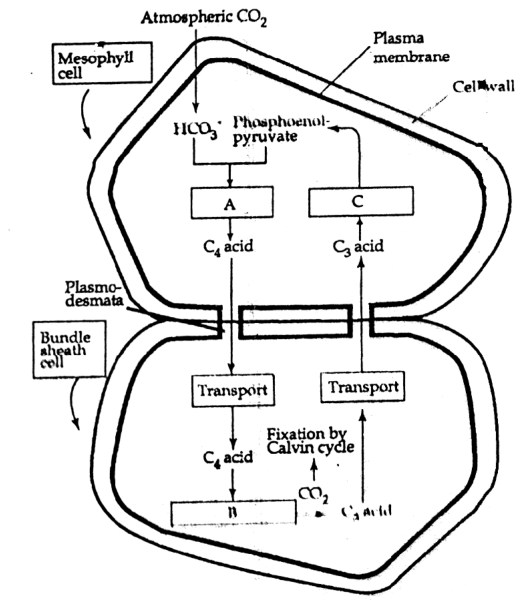
- 1A-Carboxylation, B-Decarboxylation, C-Reduction
- 2A-Decarboxylation, B-Reduction, C-Regeneration
- 3A-Fixation, B-Transamination, C-Regeneration
- 4A-Fixation, B-Decarboxylation, C-Regeneration
Show answer and solution
Correct: option 4, A-Fixation, B-Decarboxylation, C-Regeneration
The figure is the C4 (Hatch and Slack) pathway. In the mesophyll cell is fixed by phosphoenolpyruvate to give a C4 acid (A, fixation). In the bundle sheath cell the C4 acid is decarboxylated to release for the Calvin cycle (B, decarboxylation). The C3 acid returns to the mesophyll, where phosphoenolpyruvate is formed again (C, regeneration).
Question 55AIPMT 2010 Prelims, Q117
plants are more efficient in photosynthesis than plants due to
- 1Presence of larger number of chloroplasts in the leaf cells
- 2Presence of thin cuticle
- 3Lower rate of photorespiration
- 4Higher leaf area
Show answer and solution
Correct: option 1, Presence of larger number of chloroplasts in the leaf cells
The answer key of the source copy marks option (1), and that keyed answer is recorded here. By the textbook, however, the reason is option (3): plants first fix in the mesophyll and release it in the bundle sheath cells, which keeps the level around RuBisCO high, so photorespiration hardly occurs and no fixed carbon is lost. The key appears to be in error for this question.
Question 56AIPMT 2010 Prelims, Q167
PGA as the first fixation product was discovered in photosynthesis of
- 1Gymnosperm
- 2Angiosperm
- 3Alga
- 4Bryophyta
Show answer and solution
Correct: option 3, Alga
Melvin Calvin and his co-workers supplied radioactive to green algae (Chlorella and Scenedesmus) and found that the first stable product of fixation was the 3-carbon acid PGA. So the discovery was made in an alga.
Question 57AIPMT 2009 Prelims, Q91
Cyclic photophosphorylation results in the formation of
- 1ATP and NADPH
- 2ATP, NADPH and
- 3ATP
- 4NADPH
Show answer and solution
Correct: option 3, ATP
In cyclic photophosphorylation only photosystem I works and the electron returns to it through the electron transport chain. Water is not split and NADP is not reduced, so only ATP is formed.
Question 58AIPMT 2009 Prelims, Q111
Stroma in the chloroplasts of higher plant contains:
- 1Light-dependent reaction enzymes
- 2Ribosomes
- 3Chlorophyll
- 4Light-independent reaction enzymes
Show answer and solution
Correct: option 4, Light-independent reaction enzymes
The stroma holds the enzymes of the Calvin cycle, that is, of the light-independent (dark) reactions. Chlorophyll and the light reaction machinery are in the thylakoid membranes. The stroma also contains 70S ribosomes, but the keyed answer is the functional feature the question is after, the dark reaction enzymes.
Question 59AIPMT 2008 Prelims, Q130
The plants are photosynthetically more efficient than plants because
- 1They have more chloroplasts
- 2The compensation point is more
- 3 generated during photorespiration is trapped and recycled through PEP carboxylase
- 4The efflux is not prevented
Show answer and solution
Correct: option 1, They have more chloroplasts
The key used here gives option (1): leaves have chloroplasts in both the mesophyll and the bundle sheath cells. The usual textbook reason for their higher efficiency is that PEP carboxylase concentrates in the bundle sheath, so photorespiratory loss is avoided, which is the idea in option (3). Their compensation point is lower, not higher.
Question 60AIPMT 2008 Prelims, Q136
In leaves of plants malic acid synthesis during fixation occurs in
- 1Guard cells
- 2Epidermal cells
- 3Mesophyll cells
- 4Bundle sheath
Show answer and solution
Correct: option 3, Mesophyll cells
In plants is first fixed in the mesophyll cells by PEP carboxylase into oxaloacetic acid, which is reduced there to malic acid. The malic acid then moves to the bundle sheath, where it is broken down to release .
Question 61AIPMT 2008 Prelims, Q143
Electrons from excited chlorophyll molecule of photosystem II are accepted first by
- 1Ferredoxin
- 2Cytochrome - b
- 3Cytochrome - f
- 4Quinone
Show answer and solution
Correct: option 4, Quinone
The electrons leaving excited P680 of photosystem II pass to quinone acceptors (plastoquinone), and only afterwards to the cytochrome complex. Ferredoxin accepts electrons from photosystem I. Among the given options quinone comes first.
Question 62AIPMT 2007 Prelims, Q37
The first acceptor of electrons from an excited chlorophyll molecule of photosystem II is:
- 1Quinone
- 2Cytochrome
- 3Iron-sulphur protein
- 4Ferredoxin.
Show answer and solution
Correct: option 1, Quinone
Electrons leaving the excited reaction centre of photosystem II pass (through pheophytin) to plastoquinone, a quinone, and only then to the cytochrome complex. Iron-sulphur proteins and ferredoxin accept electrons from photosystem I.
Question 63AIPMT 2007 Prelims, Q45
In the leaves of plants, malic acid formation during fixation occurs in the cells of:
- 1Epidermis
- 2Mesophyll
- 3Bundle Sheath
- 4Phloem
Show answer and solution
Correct: option 2, Mesophyll
In plants is first fixed in the mesophyll cells by PEP carboxylase into oxaloacetic acid, which is reduced to malic acid there. Malic acid then moves to the bundle sheath cells, where it is decarboxylated.
Question 64AIPMT 2006 Prelims, Q118
In photosystem-I, the first electron acceptor is-
- 1Ferredoxin
- 2Cytochrome
- 3Plastocyanin
- 4An iron sulphur protein
Show answer and solution
Correct: option 4, An iron sulphur protein
The excited electron from the P700 reaction centre of photosystem I is first taken up by a bound iron-sulphur protein (FeS). It is then passed to ferredoxin and finally used to reduce NADP+. Plastocyanin and cytochromes are carriers that bring electrons to P700.
Question 65AIPMT 2006 Prelims, Q161
During photorespiration the oxygen consuming reaction (s) occur in
- 1Stroma of chloroplasts and mitochondria
- 2Stroma of chloroplasts and peroxisomes
- 3Grana of chloroplasts and peroxisomes
- 4Stroma of chloroplasts
Show answer and solution
Correct: option 2, Stroma of chloroplasts and peroxisomes
Photorespiration uses oxygen at two steps. In the chloroplast stroma RuBisCO acts as an oxygenase and adds to RuBP, giving phosphoglycolate. In the peroxisome glycolate is oxidised to glyoxylate by glycolate oxidase, again using . In the mitochondrion is released, but oxygen is not consumed there.
Question 66AIPMT 2005 Prelims, Q122
As compared to a -plant, how many additional molecules of ATP are needed for net production of one molecule of hexose sugar by -plants
- 1Zero
- 2Six
- 3Two
- 4Twelve
Show answer and solution
Correct: option 4, Twelve
The Calvin cycle uses 3 ATP per fixed, so a plant needs 18 ATP for one hexose. A plant spends 2 more ATP per to regenerate PEP, giving 5 ATP per and 30 ATP per hexose. The extra requirement is ATP.
Question 67AIPMT 2005 Prelims, Q128
Chemiosmotic theory of ATP synthesis in the chloroplasts and mitochondria is based on
- 1Membrane potential
- 2Accumulation of K ions
- 3Proton gradient
- 4Accumulation of Na ions
Show answer and solution
Correct: option 3, Proton gradient
According to Mitchell's chemiosmotic theory, electron transport pumps protons across the thylakoid or inner mitochondrial membrane, building up a proton gradient. The flow of protons back through ATP synthase drives the synthesis of ATP.
Question 68AIPMT 2005 Prelims, Q151
Carbohydrates, the most abundant biomolecules on earth, are produced by
- 1Some bacteria, algae and green plant cells
- 2All bacteria, fungi and algae
- 3Fungi, algae and green plants cells
- 4Viruses, fungi and bacteria
Show answer and solution
Correct: option 1, Some bacteria, algae and green plant cells
Carbohydrates are made from carbon dioxide by autotrophs. Only photosynthetic and chemosynthetic bacteria (so some bacteria, not all), algae and the green cells of plants can do this. Fungi and viruses cannot make their own carbohydrates, which rules out the other three options.
Question 69AIPMT 2005 Prelims, Q168
Photosynthesis in plants is relatively less limited by atmospheric levels because
- 1The primary fixation of is mediated via PEP carboxylase
- 2Effective pumping of into bundle sheath cells
- 3Four carbon acids are the primary initial fixation products
- 4Rubisco in plants has higher affinity for
Show answer and solution
Correct: option 2, Effective pumping of into bundle sheath cells
In plants is first fixed in the mesophyll into a four-carbon acid, which is moved to the bundle sheath cells and broken down there to release . This pumping keeps the concentration around Rubisco high even when the level in the air is low, so photosynthesis is not held back and photorespiration is avoided. Rubisco itself is no different in its affinity for .
Question 70AIPMT 2005 Prelims, Q178
Photosynthetic Active Radiation (PAR) has the following range of wavelengths
- 1340-450 nm
- 2450-950 nm
- 3500-600 nm
- 4400-700 nm
Show answer and solution
Correct: option 4, 400-700 nm
The photosynthetic pigments absorb light in the visible part of the spectrum, from violet at about 400 nm to red at about 700 nm. This band is called photosynthetically active radiation.
Question 71AIPMT 2004 Prelims, Q121
In plants, the first stable product of photosynthesis during the dark reaction is :-
- 1Oxaloacetic acid
- 23-phosphoglyceric acid
- 3Phosphoglyceraldehyde
- 4Malic acid
Show answer and solution
Correct: option 2, 3-phosphoglyceric acid
In the Calvin cycle joins RuBP and the product splits into two molecules of 3-phosphoglyceric acid, a 3-carbon compound, which is why these are called plants. Oxaloacetic acid is the first product in plants.
Question 72AIPMT 2004 Prelims, Q138
In chloroplasts, chlorophyll is present in the :-
- 1Inner membrane
- 2Thylakoids
- 3Stroma
- 4Outer membrane
Show answer and solution
Correct: option 2, Thylakoids
Chlorophyll and the other photosynthetic pigments are held in the thylakoid membranes, where the light reaction takes place. The stroma holds the enzymes of the dark reaction, and the two envelope membranes carry no chlorophyll.
Question 73AIPMT 2004 Prelims, Q154
Photosynthetically active radiation (PAR) represents the following range of wave length
- 1450-950 nm
- 2340-450 nm
- 3400-700 nm
- 4500-600 nm
Show answer and solution
Correct: option 3, 400-700 nm
Photosynthetic pigments absorb only visible light, so PAR is the visible part of the spectrum, 400 to 700 nm (violet to red).
Question 74AIPMT 2004 Prelims, Q172
Plants adapted to low light intensity have:-
- 1Higher rate of fixation than the sun plants
- 2More extended root system
- 3Leaves modified to spines
- 4Larger photosynthetic unit size than the sun plants
Show answer and solution
Correct: option 4, Larger photosynthetic unit size than the sun plants
Shade plants (sciophytes) collect scarce light by having more antenna chlorophyll molecules for each reaction centre, that is, a larger photosynthetic unit. Their rate of fixation is lower than that of sun plants, and deep roots or spiny leaves are features of plants of dry, bright places.
Question 75AIPMT 2003 Prelims, Q157
Which one of the following concerns photophosphorylation:-
- 1ADP + AMP ATP
- 2ADP + Inorganic ATP
- 3ADP + Inorganic ATP
- 4AMP + Inorganic ATP
Show answer and solution
Correct: option 2, ADP + Inorganic ATP
Photophosphorylation is the formation of ATP from ADP and inorganic phosphate using light energy in the chloroplast. Option (2) shows exactly this; option (3) lacks light and the others use the wrong substrates.
Question 76AIPMT 2003 Prelims, Q159
Which element is located at the centre of the porphyrin ring in chlorophyll:-
- 1Calcium
- 2Magnesium
- 3Potassium
- 4Manganese
Show answer and solution
Correct: option 2, Magnesium
Chlorophyll has a porphyrin head made of four pyrrole rings with a magnesium atom held at its centre, and a phytol tail.
Question 77AIPMT 2003 Prelims, Q162
- 1Are always open
- 2Open during the day and close at night
- 3Open during the night and close during the day
- 4Never open
Show answer and solution
Correct: option 3, Open during the night and close during the day
CAM plants are succulents of dry habitats. They open their stomata at night to take in and store it as malic acid, and keep them shut in the day to save water.
Question 78AIPMT 2003 Prelims, Q166
In sugarcane plant is fixed in malic acid, in which the enzyme that fixes is:-
- 1Ribulose biphosphate carboxylase
- 2Phosphoenol pyruvic acid carboxylase
- 3Ribulose phosphate kinase
- 4Fructose phosphatase
Show answer and solution
Correct: option 2, Phosphoenol pyruvic acid carboxylase
Sugarcane is a plant. In its mesophyll cells PEP carboxylase joins to phosphoenol pyruvic acid to give oxaloacetic acid, which is reduced to malic acid, so the label first appears in a 4-carbon acid.
Question 79AIPMT 2003 Prelims, Q169
Which one of the following is wrong in relation to photorespiration:-
- 1It occurs in chloroplasts
- 2It occurs in daytime only
- 3It is a characteristic of plants
- 4It is a characteristic of plants
Show answer and solution
Correct: option 3, It is a characteristic of plants
Photorespiration starts in the chloroplast when RuBisCO binds , happens only in light, and is typical of plants. plants concentrate around RuBisCO in the bundle sheath and show almost no photorespiration, so statement (3) is the wrong one.
Question 80AIPMT 2003 Prelims, Q175
Which fractions of the visible spectrum of solar radiations are primarily absorbed by carotenoids of the higher plants:-
- 1Blue and green
- 2Green and red
- 3Red and violet
- 4Violet and blue
Show answer and solution
Correct: option 4, Violet and blue
Carotenoids absorb mainly in the 400 to 500 nm range, that is violet and blue light, and reflect yellow, orange and red, which gives them their colour.
Question 81AIPMT 2002 Prelims, Q164
In Photosynthesis energy from light reaction to dark reaction is transferred in the form of:-
- 1ADP
- 2ATP
- 3RUDP
- 4Chlorophyll
Show answer and solution
Correct: option 2, ATP
The light reaction makes ATP (and NADPH), and these are used in the dark reaction to reduce carbon dioxide to sugar. Of the options, ATP is the energy carrier; ADP is the spent form and RuDP is the carbon dioxide acceptor.
Question 82AIPMT 2002 Prelims, Q165
Which of the following absorb light energy for photosynthesis:-
- 1Chlorophyll
- 2Water molecule
- 3
- 4RUBP
Show answer and solution
Correct: option 1, Chlorophyll
Chlorophyll is the pigment that traps light energy, mainly in the blue and red regions, and passes it to the reaction centre. Water is the electron donor, oxygen is a by-product and RuBP is the carbon dioxide acceptor.
Question 83AIPMT 2001 Prelims, Q125
- 1 – Maize
- 2 – Kranz anatomy
- 3Calvin cycle - PGA
- 4Hatch and Slack cycle – O.A.A.
Show answer and solution
Correct: option 1, – Maize
Maize is a plant, so pairing it with is wrong. The other pairs are correct: leaves show Kranz anatomy, the first stable product of the Calvin cycle is PGA, and that of the Hatch and Slack cycle is oxaloacetic acid.
Question 84AIPMT 2001 Prelims, Q130
Which pigment system inactivated in red drop:-
- 1PS-I and P.S-II
- 2PS – I
- 3PS – II
- 4None
Show answer and solution
Correct: option 3, PS – II
Red drop is the sharp fall in the yield of photosynthesis in light of wavelength beyond about 680 nm. Such light is absorbed by PS I but not by PS II, so PS II stays inactive and non-cyclic electron flow stops.
Question 85AIPMT 2000 Prelims, Q101
The first step for initiation of photosynthesis will be:
- 1Photolysis of water
- 2Excitement of chlorophyll molecule due to absorption of light
- 3ATP formation
- 4Glucose formation
Show answer and solution
Correct: option 2, Excitement of chlorophyll molecule due to absorption of light
Photosynthesis begins when a chlorophyll molecule absorbs a photon and one of its electrons is raised to an excited state. Photolysis of water, ATP formation and sugar formation all follow from this event, so option (2) is the first step.
Question 86AIPMT 2000 Prelims, Q103
For the synthesis of one glucose molecule the calvin cycle operates for:
- 12 times
- 24 times
- 36 times
- 48 times
Show answer and solution
Correct: option 3, 6 times
Each turn of the Calvin cycle fixes one molecule of . Glucose has six carbon atoms, so six turns are needed to make one glucose molecule.
Question 87AIPMT 2000 Prelims, Q106
For assimilation of one molecule; the energy required in form of ATP &
- 12 ATP & 2
- 25 ATP & 3
- 33 ATP & 2
- 418 ATP & 12
Show answer and solution
Correct: option 3, 3 ATP & 2
In the Calvin cycle, fixing one uses 2 ATP and 2 in the reduction of two PGA molecules and 1 more ATP to regenerate RuBP. That is 3 ATP and 2 per ; 18 ATP and 12 is the total for a whole glucose.
Question 88AIPMT 2000 Prelims, Q107
Which is the first Acceptor enzyme in plants:
- 1RuDP Carboxylase
- 2Phosphoric acid
- 3RUBISCO
- 4PEP-Carboxylase
Show answer and solution
Correct: option 4, PEP-Carboxylase
In plants is first fixed in the mesophyll cells, where PEP carboxylase joins it to phosphoenolpyruvate to give oxaloacetic acid. RuBisCO (RuDP carboxylase) acts only later, in the bundle sheath cells.
Question 89AIPMT 2000 Prelims, Q196
What happens in light reaction (Photo chemical reaction):
- 1Formation of ATP and
- 2Formation of ATP
- 3Formation of sugar
- 4Breakdown of sugar
Show answer and solution
Correct: option 1, Formation of ATP and
In the light reaction, light energy drives electron flow that produces both ATP (photophosphorylation) and the reduced coenzyme , with oxygen released from water. Sugar is formed later in the dark reaction using these two products.
Question 90AIPMT 1999 Prelims, Q102
Total amount of fixed annually by plants:
- 1 ton
- 2 ton
- 3 ton
- 4 ton
Show answer and solution
Correct: option 4, ton
The textbook estimate of the carbon dioxide fixed by photosynthesis on the whole earth each year is about 70 billion tonnes of carbon, usually quoted as roughly tonnes of . That is option (4); the other values are far too small or impossibly large.
Question 91AIPMT 1998 Prelims, Q174
What change occurs during conversion of proto chlorophyll to chlorophyll:
- 1Addition of 2H in one pyrrole ring
- 2Loss of 2H
- 3Addition of Mg
- 4Loss of Mg
Show answer and solution
Correct: option 1, Addition of 2H in one pyrrole ring
Protochlorophyll already has magnesium at its centre. In light it is reduced: two hydrogen atoms are added to one of its pyrrole rings, which turns it into chlorophyll. So the change is a gain of 2H, not a change in Mg.