Questions with solutions
Question 1NEET 2026, Q107
The main function of bulliform cells in grasses is:
- 1to make the leaf impermeable to fungal spores.
- 2to perform photosynthesis.
- 3to minimize water loss during water stress.
- 4to transport water.
Show answer and solution
Correct: option 3, to minimize water loss during water stress.
Bulliform cells are large, empty, colourless cells of the upper epidermis of grass leaves. When they lose water during water stress they become flaccid and the leaf curls inwards, which reduces the exposed surface and so minimises water loss.
Question 2NEET 2026, Q109
Match List I with List II:
| List I | List II |
|---|
| A. Conjunctive tissue | I. Specialised cells in the vicinity of guard cells |
| B. Casparian strips | II. Endodermal cells rich in starch |
| C. Subsidiary cells | III. Tissue between xylem and phloem |
| D. Starch sheath | IV. Endodermal cells with suberin deposition |
Choose the correct answer from the options given below:
- 1A-IV, B-III, C-I, D-II
- 2A-III, B-IV, C-II, D-I
- 3A-III, B-IV, C-I, D-II
- 4A-IV, B-III, C-II, D-I
Show answer and solution
Correct: option 3, A-III, B-IV, C-I, D-II
Conjunctive tissue is the parenchyma between xylem and phloem in a root (III). Casparian strips are suberin deposits on the walls of endodermal cells (IV). Subsidiary cells are the specialised epidermal cells next to guard cells (I). The starch sheath is the endodermis of a dicot stem, whose cells are rich in starch (II).
Question 3NEET 2025, Q118
Find the statement that is NOT correct with regard to the structure of monocot stem.
- 1Hypodermis is parenchymatous.
- 2Vascular bundles are scattered.
- 3Vascular bundles are conjoint and closed.
- 4Phloem parenchyma is absent.
Show answer and solution
Correct: option 1, Hypodermis is parenchymatous.
A monocot stem has a sclerenchymatous hypodermis, many scattered vascular bundles each with a sclerenchymatous bundle sheath, conjoint and closed bundles, and no phloem parenchyma. So the statement that the hypodermis is parenchymatous is the one that is not correct.
Question 4NEET 2024, Q102
Given below are two statements:
Statement I: Parenchyma is living but collenchyma is dead tissue.
Statement II: Gymnosperms lack xylem vessels but presence of xylem vessels is the characteristic of angiosperms.
In the light of the above statements, choose the correct answer from the options given below:
- 1Statement I is false but Statement II is true
- 2Both Statement I and Statement II are true
- 3Both Statement I and Statement II are false
- 4Statement I is true but Statement II is false
Show answer and solution
Correct: option 1, Statement I is false but Statement II is true
Both parenchyma and collenchyma are living tissues; it is sclerenchyma that is usually dead, so Statement I is false. Gymnosperms lack vessels in their xylem, and vessels are a characteristic feature of angiosperms, so Statement II is true.
Question 5NEET 2024, Q132
Bulliform cells are responsible for
- 1Providing large spaces for storage of sugars.
- 2Inward curling of leaves in monocots.
- 3Protecting the plant from salt stress.
- 4Increased photosynthesis in monocots.
Show answer and solution
Correct: option 2, Inward curling of leaves in monocots.
Bulliform cells are large, empty, colourless cells of the upper epidermis of grass leaves. When they lose water during water stress they become flaccid and the leaf curls inwards, which reduces water loss.
Question 6NEET 2024, Q135
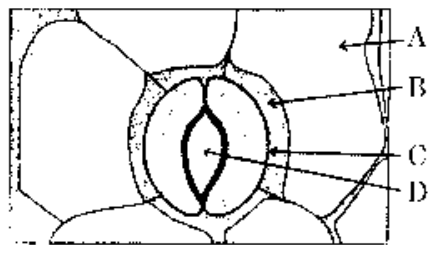
In the given figure, which component has thin outer walls and highly thickened inner walls?
- 1B
- 2C
- 3D
- 4A
Show answer and solution
Correct: option 2, C
The figure shows a stomatal apparatus. The guard cells, labelled C, have thin outer walls (away from the pore) and highly thickened inner walls (towards the pore). A is an epidermal cell, B is a subsidiary cell and D is the stomatal pore.
Question 7NEET 2024 Re-exam, Q102
Which of the following simple tissues are commonly found in the fruit walls of nuts and pulp of pear?
- 1Sclereids
- 2Fibres
- 3Parenchyma
- 4Collenchyma
Show answer and solution
Correct: option 1, Sclereids
Sclereids are short, dead sclerenchyma cells with very thick lignified walls. They make the shells of nuts hard and give the pulp of pear, guava and sapota its gritty feel. Fibres are long sclerenchyma cells, while parenchyma and collenchyma are living tissues with thinner walls.
Question 8NEET 2024 Re-exam, Q109
Which one of the following is not found in Gymnosperms?
- 1Sieve cells
- 2Albuminous cells
- 3Tracheids
- 4Vessels
Show answer and solution
Correct: option 4, Vessels
The xylem of gymnosperms has tracheids but no vessels; vessels are a feature of angiosperms. Gymnosperm phloem has sieve cells and albuminous cells in place of sieve tubes and companion cells. So vessels are the element not found.
Question 9NEET 2024 Re-exam, Q119
Which of the following helps in maintenance of the pressure gradient in sieve tubes?
- 1Albuminous cells
- 2Sieve cells
- 3Phloem parenchyma
- 4Companion cells
Show answer and solution
Correct: option 4, Companion cells
Companion cells are specialised parenchyma cells joined to the sieve tube elements by pit fields. A mature sieve tube element has no nucleus, so the companion cell controls its working and helps keep up the pressure gradient that drives the flow of sap.
Question 10NEET 2024 Re-exam, Q138
Given below are two statements:
Statement I: In a dicotyledonous leaf, the adaxial epidermis generally bears more stomata than the abaxial epidermis.
Statement II: In a dicotyledonous leaf, the adaxially placed palisade parenchyma is made up of elongated cells, which are arranged vertically and parallel to each other.
In the light of the above statements, choose the correct answer from the options given below:
- 1Statement I is true but Statement II is false
- 2Statement I is false but Statement II is true
- 3Both Statement I and Statement II are true
- 4Both Statement I and Statement II are false
Show answer and solution
Correct: option 2, Statement I is false but Statement II is true
Statement I is false: in a dicot (dorsiventral) leaf the lower, abaxial epidermis generally has more stomata than the upper, adaxial one, which may have none. Statement II is true: the palisade parenchyma lies on the adaxial side and is made of elongated cells standing vertically, parallel to each other.
Question 11NEET 2023, Q123
Given below are two statements: One is labelled as Assertion A and the other is labelled as Reason R:
Assertion A: Late wood has fewer xylary elements with narrow vessels.
Reason R: Cambium is less active in winters.
In the light of the above statements, choose the correct answer from the options given below:
- 1Both A and R are true and R is the correct explanation of A.
- 2Both A and R are true but R is NOT the correct explanation of A.
- 3A is true but R is false.
- 4A is false but R is true.
Show answer and solution
Correct: option 1, Both A and R are true and R is the correct explanation of A.
In winter the cambium is less active and forms fewer xylary elements with narrow vessels; this wood is the autumn or late wood. So both A and R are true, and the reduced cambial activity is the reason for the nature of late wood.
Question 12NEET 2023, Q133
Given below are two statements:
Statement I: Endarch and exarch are the terms often used for describing the position of secondary xylem in the plant body.
Statement II: Exarch condition is the most common feature of the root system.
In the light of the above statements, choose the correct answer from the options given below:
- 1Both Statement I and Statement II are true.
- 2Both Statement I and Statement II are false.
- 3Statement I is correct but Statement II is false.
- 4Statement I is incorrect but Statement II is true.
Show answer and solution
Correct: option 4, Statement I is incorrect but Statement II is true.
Endarch and exarch describe the position of protoxylem and metaxylem in the primary xylem, not the secondary xylem, so Statement I is incorrect. In roots the protoxylem lies towards the periphery, which is the exarch condition, so Statement II is true.
Question 13NEET 2023, Q145
Identify the correct statements:
A. Lenticels are the lens-shaped openings permitting the exchange of gases.
B. Bark formed early in the season is called hard bark.
C. Bark is a technical term that refers to all tissues exterior to vascular cambium.
D. Bark refers to periderm and secondary phloem.
E. Phellogen is single-layered in thickness.
Choose the correct answer from the options given below:
- 1B, C and E only
- 2A and D only
- 3A, B and D only
- 4B and C only
Show answer and solution
Correct: option 2, A and D only
A is correct: lenticels are lens-shaped openings in the bark that allow exchange of gases. D is correct: bark includes the periderm and the secondary phloem. B is wrong because bark formed early in the season is soft (early) bark, and E is wrong because phellogen is a couple of layers thick. C is wrong only for the word technical: NCERT calls bark a non-technical term for all tissues exterior to the vascular cambium. Only A and D are correct.
Question 14NEET 2023 Manipur, Q116
Consider the following tissues in the stelar region of a stem showing secondary growth.
(A) Primary xylem
(B) Secondary xylem
(C) Primary phloem
(D) Secondary phloem
Arrange these in the correct sequence of their position from pith towards cortex.
- 1(A), (B), (C), (D)
- 2(B), (A), (D), (C)
- 3(A), (B), (D), (C)
- 4(B), (A), (C), (D)
Show answer and solution
Correct: option 3, (A), (B), (D), (C)
The vascular cambium cuts off secondary xylem towards the inside and secondary phloem towards the outside. This leaves the primary xylem next to the pith and pushes the primary phloem outwards towards the cortex. From pith to cortex the order is primary xylem, secondary xylem, (cambium), secondary phloem, primary phloem, that is (A), (B), (D), (C), option (3).
Question 15NEET 2023 Manipur, Q133
The transverse section of a plant part showed polyarch, radial and exarch xylem, with endodermis and pericycle. The plant part is identified as:
- 1Dicot stem
- 2Monocot stem
- 3Monocot root
- 4Dicot root
Show answer and solution
Correct: option 3, Monocot root
Radial vascular bundles with exarch xylem are found only in roots, which rules out the stems. A root with many xylem bundles (polyarch, usually more than six) is a monocot root; a dicot root has only two to four. So the answer is option (3).
Question 16NEET 2023 Manipur, Q141
Consider the following plant tissues:
(A) Axillary buds
(B) Fascicular vascular cambium
(C) Interfascicular cambium
(D) Cork cambium
(E) Intercalary meristem
Identify the lateral meristems among the above.
- 1(A), (B), (C) and (E) only
- 2(A), (B), (D) and (E) only
- 3(A), (C) and (D) only
- 4(B), (C) and (D) only
Show answer and solution
Correct: option 4, (B), (C) and (D) only
Lateral meristems lie along the sides of stems and roots and add girth: the fascicular vascular cambium, the interfascicular cambium and the cork cambium. Axillary buds come from the shoot apical meristem, and intercalary meristem lies between mature tissues and adds length. So (B), (C) and (D) only, option (4).
Question 17NEET 2022, Q105
Read the following statements about the vascular bundles:
(a) In roots, xylem and phloem in a vascular bundle are arranged in an alternate manner along the different radii.
(b) Conjoint closed vascular bundles do not possess cambium
(c) In open vascular bundles, cambium is present in between xylem and phloem
(d) The vascular bundles of dicotyledonous stem possess endarch protoxylem
(e) In monocotyledonous root, usually there are more than six xylem bundles present
Choose the correct answer from the options given below:
- 1(a), (c), (d) and (e) Only
- 2(a), (b) and (d) Only
- 3(b), (c), (d) and (e) Only
- 4(a), (b), (c) and (d) Only
Show answer and solution
Correct: option 3, (b), (c), (d) and (e) Only
Closed bundles have no cambium (b), open bundles have cambium between xylem and phloem (c), stems have endarch protoxylem (d) and monocot roots are polyarch with usually more than six xylem bundles (e). The key leaves out (a): in a root the xylem and phloem lie on different radii as separate bundles, not inside one vascular bundle. Note that the textbook describes the radial arrangement in almost the same words as (a), so all five statements can be read as correct and no option lists all five; the official key gives option (3).
Question 18NEET 2022, Q112
In old trees the greater part of secondary xylem is dark brown and resistant to insect attack due to:
(a) secretion of secondary metabolites and their deposition in the lumen of vessels.
(b) deposition of organic compounds like tannins and resins in the central layers of stem.
(c) deposition of suberin and aromatic substances in the outer layer of stem.
(d) deposition of tannins, gum, resin and aromatic substances in the peripheral layers of stem.
(e) presence of parenchyma cells, functionally active xylem elements and essential oils.
Choose the correct answer from the options given below:
- 1(b) and (d) Only
- 2(a) and (b) Only
- 3(c) and (d) Only
- 4(d) and (e) Only
Show answer and solution
Correct: option 2, (a) and (b) Only
The dark, hard, durable wood is the heartwood, which lies in the central layers of the stem. It forms when organic compounds such as tannins, resins, oils, gums and aromatic substances (secondary metabolites) are deposited in the lumen of the vessels and tracheids, which stops them conducting water. So (a) and (b) are right. The peripheral or outer layers are the lighter, functional sapwood, which rules out (c), (d) and (e).
Question 19NEET 2022, Q138
The anatomy of springwood shows some peculiar features. Identify the correct set of statements about springwood.
(a) It is also called as the earlywood
(b) In spring season cambium produces xylem elements with narrow vessels
(c) It is lighter in colour
(d) The springwood along with autumnwood shows alternate concentric rings forming annual rings
(e) It has lower density
Choose the correct answer from the options given below:
- 1(c), (d) and (e) Only
- 2(a), (b), (d) and (e) Only
- 3(a), (c), (d) and (e) Only
- 4(a), (b) and (d) Only
Show answer and solution
Correct: option 3, (a), (c), (d) and (e) Only
In spring the cambium is very active and forms many xylem elements with wide vessels, so (b) is wrong. This springwood or earlywood (a) is lighter in colour (c) and has a lower density (e) than autumnwood, and the two together appear as alternate concentric rings that make up an annual ring (d).
Question 20NEET 2022 Re-exam, Q113
Interfascicular cambium is present between
- 1Secondary xylem and secondary phloem
- 2Primary xylem and primary phloem
- 3Pericycle and endodermis
- 4Two vascular bundles
Show answer and solution
Correct: option 4, Two vascular bundles
In a dicot stem the cells of the medullary rays lying next to the intrafascicular cambium become meristematic and form the interfascicular cambium. It therefore lies between two neighbouring vascular bundles; the cambium between primary xylem and primary phloem inside a bundle is the intrafascicular cambium.
Question 21NEET 2022 Re-exam, Q121
The type of tissue commonly found in the fruit wall of nuts is:
- 1Sclereid
- 2Parenchyma
- 3Collenchyma
- 4Sclerenchyma
Show answer and solution
Correct: option 1, Sclereid
Sclereids are spherical, oval or cylindrical, highly thickened dead sclerenchyma cells with a very narrow lumen. They are commonly found in the fruit walls of nuts, the pulp of guava, pear and sapota, and the seed coats of legumes. Sclereid is the specific cell type, so it is preferred over the general term sclerenchyma.
Question 22NEET 2022 Re-exam, Q126
Initiation of lateral roots and vascular cambium during secondary growth takes place in cells of
- 1Pericycle
- 2Epiblema
- 3Cortex
- 4Endodermis
Show answer and solution
Correct: option 1, Pericycle
In roots the pericycle, the layer of cells just inside the endodermis, gives rise to the lateral roots. During secondary growth of a dicot root the part of the pericycle lying above the protoxylem also forms part of the vascular cambium.
Question 23NEET 2021, Q108
Which of the following is an incorrect statement?
- 1Mature sieve tube elements possess a conspicuous nucleus and usual cytoplasmic organelles.
- 2Microbodies are present both in plant and animal cells.
- 3The perinuclear space forms a barrier between the materials present inside the nucleus and that of the cytoplasm.
- 4Nuclear pores act as passages for proteins and RNA molecules in both directions between nucleus and cytoplasm.
Show answer and solution
Correct: option 1, Mature sieve tube elements possess a conspicuous nucleus and usual cytoplasmic organelles.
A mature sieve tube element has peripheral cytoplasm and a large vacuole but no nucleus; its work is controlled by the nucleus of the companion cell. So statement (1) is wrong. The other three statements about microbodies, the perinuclear space and nuclear pores are correct.
Question 24NEET 2021, Q125
Match List - I with List - II.
| List - I | List - II |
|---|
| (a) Lenticels | (i) Phellogen |
| (b) Cork cambium | (ii) Suberin deposition |
| (c) Secondary cortex | (iii) Exchange of gases |
| (d) Cork | (iv) Phelloderm |
Choose the correct answer from the options given below.
- 1a-iv, b-i, c-iii, d-ii
- 2a-iii, b-i, c-iv, d-ii
- 3a-ii, b-iii, c-iv, d-i
- 4a-iv, b-ii, c-i, d-iii
Show answer and solution
Correct: option 2, a-iii, b-i, c-iv, d-ii
Lenticels are lens-shaped openings in the bark that allow exchange of gases (iii). Cork cambium is also called phellogen (i). Secondary cortex is the phelloderm (iv). Cork (phellem) cells have suberin deposited in their walls (ii). So a-iii, b-i, c-iv, d-ii.
Question 25NEET 2021, Q134
Match List - I with List - II.
| List - I | List - II |
|---|
| (a) Cells with active cell division capacity | (i) Vascular tissues |
| (b) Tissue having all cells similar in structure and function | (ii) Meristematic tissue |
| (c) Tissue having different types of cells | (iii) Sclereids |
| (d) Dead cells with highly thickened walls and narrow lumen | (iv) Simple tissue |
Select the correct answer from the options given below.
- 1a-ii, b-iv, c-i, d-iii
- 2a-iv, b-iii, c-ii, d-i
- 3a-i, b-ii, c-iii, d-iv
- 4a-iii, b-ii, c-iv, d-i
Show answer and solution
Correct: option 1, a-ii, b-iv, c-i, d-iii
Actively dividing cells make up meristematic tissue (ii). A tissue whose cells are all alike in structure and function is a simple tissue (iv). Vascular tissues (xylem and phloem) are complex tissues with different types of cells (i). Sclereids are dead cells with very thick walls and a narrow lumen (iii). So a-ii, b-iv, c-i, d-iii.
Question 26NEET 2021, Q141
- 1Large colorless empty cells in the epidermis of grass leaves - Subsidiary cells
- 2In dicot leaves, vascular bundles are surrounded by large thick-walled cells - Conjunctive tissue
- 3Cells of medullary rays that form part of cambial ring - Interfascicular cambium
- 4Loose parenchyma cells rupturing the epidermis and forming a lens-shaped opening in bark - Spongy parenchyma
Show answer and solution
Correct: option 3, Cells of medullary rays that form part of cambial ring - Interfascicular cambium
Medullary ray cells lying between the vascular bundles become meristematic and form the interfascicular cambium, which joins the intrafascicular cambium to complete the ring. The large empty colourless cells of grass leaves are bulliform cells, the cells around leaf vascular bundles are bundle sheath cells, and the lens-shaped openings in bark are lenticels.
Question 27NEET 2020, Q57
Identify the incorrect statement.
- 1Heart wood does not conduct water but gives mechanical support.
- 2Sapwood is involved in conduction of water and minerals from root to leaf.
- 3Sapwood is the innermost secondary xylem and is lighter in colour.
- 4Due to deposition of tannins, resins, oils etc., heart wood is dark in colour.
Show answer and solution
Correct: option 3, Sapwood is the innermost secondary xylem and is lighter in colour.
Heartwood is the central, older secondary xylem; it is dark because of tannins, resins, oils and gums, does not conduct water and only gives mechanical support. Sapwood is the outer (peripheral), lighter coloured secondary xylem that conducts water and minerals. So calling sapwood the innermost secondary xylem is the incorrect statement.
Question 28NEET 2020, Q128
The transverse section of a plant shows following anatomical features:
(a) Large number of scattered vascular bundles surrounded by bundle sheath.
(b) Large conspicuous parenchymatous ground tissue.
(c) Vascular bundles conjoint and closed.
(d) Phloem parenchyma absent.
Identify the category of plant and its part:
- 1Monocotyledonous stem
- 2Monocotyledonous root
- 3Dicotyledonous stem
- 4Dicotyledonous root
Show answer and solution
Correct: option 1, Monocotyledonous stem
Many scattered vascular bundles, each with a sclerenchymatous bundle sheath, that are conjoint and closed, lie in a large parenchymatous ground tissue and lack phloem parenchyma: these are the features of a monocot stem. Roots have radial bundles, and a dicot stem has open bundles arranged in a ring.
Question 29NEET 2020 Phase 2, Q2
Which of the following statements about cork cambium is incorrect?
- 1It forms a part of periderm
- 2It is responsible for the formation of lenticels
- 3It is a couple of layers thick
- 4It forms secondary cortex on its outerside
Show answer and solution
Correct: option 4, It forms secondary cortex on its outerside
Cork cambium (phellogen) is a couple of layers thick and, with cork and secondary cortex, makes up the periderm; lenticels form where it cuts off loose parenchyma cells. It cuts off cork (phellem) on its outer side and secondary cortex (phelloderm) on its inner side, so the statement placing secondary cortex on the outer side is the incorrect one.
Question 30NEET 2020 Phase 2, Q37
Large, empty colourless cells of the adaxial epidermis along the veins of grass leaves are
- 1Guard cells
- 2Bundle sheath cells
- 3Bulliform cells
- 4Lenticels
Show answer and solution
Correct: option 3, Bulliform cells
In grasses certain adaxial epidermal cells along the veins become large, empty and colourless; these are bulliform cells. When they lose water and turn flaccid the leaf curls inward, which cuts down water loss.
Question 31NEET 2019, Q93
Grass leaves curl inwards during very dry weather. Select the most appropriate reason from the following:
- 1Closure of stomata
- 2Flaccidity of bulliform cells
- 3Shrinkage of air spaces in spongy mesophyll
- 4Tyloses in vessels
Show answer and solution
Correct: option 2, Flaccidity of bulliform cells
Grass leaves have large, empty, colourless bulliform cells in the upper epidermis. When these cells lose water under water stress they become flaccid and the leaf rolls inwards, which reduces water loss. So flaccidity of bulliform cells is the reason.
Question 32NEET 2019, Q136
Which of the statements given below is not true about formation of Annual Rings in trees?
- 1Annual ring is a combination of spring wood and autumn wood produced in a year.
- 2Differential activity of cambium causes light and dark bands of tissue - early and late wood respectively.
- 3Activity of cambium depends upon variation in climate.
- 4Annual rings are not prominent in trees of temperate region.
Show answer and solution
Correct: option 4, Annual rings are not prominent in trees of temperate region.
In temperate regions the seasons differ sharply, so the cambium is very active in spring (light early wood) and slow in autumn (dark late wood). One band of each makes a clear annual ring, so rings are most prominent in temperate trees, not absent. Statement (4) is therefore the untrue one.
Question 33NEET 2019, Q170
Phloem in gymnosperms lacks:
- 1Albuminous cells and sieve cells
- 2Sieve tubes only
- 3Companion cells only
- 4Both sieve tubes and companion cells
Show answer and solution
Correct: option 4, Both sieve tubes and companion cells
Gymnosperm phloem has sieve cells and albuminous cells in place of the sieve tubes and companion cells found in angiosperms. So it lacks both sieve tubes and companion cells.
Question 34NEET 2019 Odisha, Q161
In the dicot root the vascular cambium originates from:
- 1Parenchyma between endodermis and pericycle
- 2Intrafascicular and interfascicular tissue in a ring
- 3Tissue located below the phloem bundles and a portion of pericycle tissue above protoxylem.
- 4Cortical region
Show answer and solution
Correct: option 3, Tissue located below the phloem bundles and a portion of pericycle tissue above protoxylem.
In a dicot root the vascular cambium is entirely secondary in origin. It arises from the tissue lying just below the phloem bundles together with the part of the pericycle above the protoxylem, and these join to form a continuous wavy ring that later becomes circular. Intrafascicular and interfascicular cambium describes the dicot stem.
Question 35NEET 2019 Odisha, Q163
Regeneration of damaged growing grass following grazing is largely due to:
- 1Intercalary meristem
- 2Secondary meristem
- 3Lateral meristem
- 4Apical meristem
Show answer and solution
Correct: option 1, Intercalary meristem
Grasses have intercalary meristem, a meristem lying between mature tissues at the bases of the internodes and leaves. When grazing animals remove the upper parts, this meristem keeps dividing and regenerates them. The apical meristem is the part that gets eaten.
Question 36NEET 2018, Q124
Stomata in grass leaf are
- 1Rectangular
- 2Kidney shaped
- 3Dumb-bell shaped
- 4Barrel shaped
Show answer and solution
Correct: option 3, Dumb-bell shaped
The guard cells of grasses are dumb-bell shaped, whereas those of most dicots are bean (kidney) shaped.
Question 37NEET 2018, Q125
Secondary xylem and phloem in dicot stem are produced by
- 1Phellogen
- 2Vascular cambium
- 3Apical meristems
- 4Axillary meristems
Show answer and solution
Correct: option 2, Vascular cambium
The vascular cambium, a lateral meristem, cuts off secondary xylem towards the inside and secondary phloem towards the outside. Phellogen (cork cambium) forms cork and secondary cortex, and apical meristems give primary growth.
Question 38NEET 2018, Q127
Casparian strips occur in
- 1Cortex
- 2Pericycle
- 3Epidermis
- 4Endodermis
Show answer and solution
Correct: option 4, Endodermis
Casparian strips are bands of suberin deposited on the radial and tangential walls of the endodermal cells of the root. They make these walls impervious to water.
Question 39NEET 2018, Q128
Plants having little or no secondary growth are
- 1Conifers
- 2Deciduous angiosperms
- 3Grasses
- 4Cycads
Show answer and solution
Correct: option 3, Grasses
Grasses are monocots with closed vascular bundles that lack a cambium, so they show little or no secondary growth. Conifers, cycads and deciduous (dicot) angiosperms have a vascular cambium and grow in girth.
Question 40NEET 2017, Q96
Which of the following is made up of dead cells?
- 1Xylem parenchyma
- 2Collenchyma
- 3Phellem
- 4Phloem
Show answer and solution
Correct: option 3, Phellem
Phellem (cork) is formed by the cork cambium towards the outside; its cells are dead at maturity and have suberin in their walls. Xylem parenchyma and collenchyma are living, and phloem consists mainly of living cells.
Question 41NEET 2017, Q156
The vascular cambium normally gives rise to:
- 1Phelloderm
- 2Primary phloem
- 3Secondary xylem
- 4Periderm
Show answer and solution
Correct: option 3, Secondary xylem
The vascular cambium cuts off secondary xylem towards the inside and secondary phloem towards the outside. Phelloderm and the periderm come from the cork cambium, and primary phloem comes from the procambium.
Question 42NEET 2017, Q178
Identify the wrong statement in context of heartwood:
- 1Organic compounds are deposited in it
- 2It is highly durable
- 3It conducts water and minerals efficiently
- 4It comprises dead elements with highly lignified walls
Show answer and solution
Correct: option 3, It conducts water and minerals efficiently
Heartwood is the dark central wood. Its dead, highly lignified elements are filled with tannins, resins, oils and gums, which make it hard and durable, but it does not conduct water; it only gives mechanical support. Conduction is done by the outer sapwood.
Question 43NEET 2016 Phase 1, Q174
Specialised epidermal cells surrounding the guard cells are called:
- 1Complementary cells
- 2Subsidiary cells
- 3Bulliform cells
- 4Lenticels
Show answer and solution
Correct: option 2, Subsidiary cells
The epidermal cells next to the guard cells that differ in shape and size from the rest are called subsidiary cells; together with the guard cells and the pore they form the stomatal apparatus. Bulliform cells are large water-storing cells of grass leaves, and complementary cells fill the lenticels of bark.
Question 44NEET 2016 Phase 2, Q101
Cortex is the region found between
- 1epidermis and stele
- 2pericycle and endodermis
- 3endodermis and pith
- 4endodermis and vascular bundle
Show answer and solution
Correct: option 1, epidermis and stele
The cortex is the ground tissue lying below the epidermis and outside the stele; its innermost layer is the endodermis. Everything from the pericycle inwards belongs to the stele.
Question 45NEET 2016 Phase 2, Q102
The balloon-shaped structures called tyloses
- 1originate in the lumen of vessels
- 2characterize the sapwood
- 3are extensions of xylem parenchyma cells into vessels
- 4are linked to the ascent of sap through xylem vessels
Show answer and solution
Correct: option 3, are extensions of xylem parenchyma cells into vessels
Tyloses are balloon-like outgrowths of xylem parenchyma cells that bulge through pits into the lumen of neighbouring vessels. They block the vessels, so they are typical of non-conducting heartwood, not sapwood, and they stop rather than help the ascent of sap.
Question 46AIPMT 2015, Q96
A major characteristic of the monocot root is the presence of:
- 1Scattered vascular bundles
- 2Vasculature without cambium
- 3Cambium sandwiched between phloem and xylem along the radius
- 4Open vascular bundles
Show answer and solution
Correct: option 2, Vasculature without cambium
A monocot root has radial, polyarch vascular bundles with no cambium, so it shows no secondary growth. Scattered bundles belong to the monocot stem, and open bundles with cambium belong to dicots.
Question 47AIPMT 2015, Q111
Vascular bundles in monocotyledons are considered closed because:
- 1Cambium is absent
- 2There are no vessels with perforations
- 3Xylem is surrounded all around by phloem
- 4A bundle sheath surrounds each bundle
Show answer and solution
Correct: option 1, Cambium is absent
A vascular bundle is called closed when it has no cambium between xylem and phloem, so it cannot form secondary tissues. Monocot bundles lack cambium; dicot stem bundles have it and are called open.
Question 48AIPMT 2015 Re-test, Q118
Read the different components from (a) to (d) in the list given below and tell the correct order of the components with reference to their arrangement from outer side to inner side in a woody dicot stem:
(a) Secondary cortex
(b) Wood
(c) Secondary phloem
(d) Phellem
The correct order is:
- 1(d), (c), (a), (b)
- 2(c), (d), (b), (a)
- 3(a), (b), (d), (c)
- 4(d), (a), (c), (b)
Show answer and solution
Correct: option 4, (d), (a), (c), (b)
The cork cambium cuts off phellem (cork) to the outside and secondary cortex (phelloderm) to the inside. Further in, the vascular cambium forms secondary phloem on its outer side and wood (secondary xylem) on its inner side. From outside to inside the order is phellem, secondary cortex, secondary phloem, wood, that is (d), (a), (c), (b).
Question 49AIPMT 2014, Q39
Tracheids differ from other tracheary elements in:
- 1being lignified
- 2having casparian strips
- 3being imperforate
- 4lacking nucleus
Show answer and solution
Correct: option 3, being imperforate
The tracheary elements are tracheids and vessels. Both are lignified and dead, without a nucleus. A vessel member has perforated end walls, while a tracheid has closed, tapering ends and is imperforate. Casparian strips belong to the endodermis.
Question 50AIPMT 2014, Q76
You are given a fairly old piece of dicot stem and a dicot root. Which of the following anatomical structures will you use to distinguish between the two?
- 1Cortical cells
- 2Secondary xylem
- 3Secondary phloem
- 4Protoxylem
Show answer and solution
Correct: option 4, Protoxylem
After secondary growth both stem and root have similar secondary xylem and secondary phloem, and the cortex may be crushed or shed. The primary xylem remains, and its arrangement differs: in the stem the protoxylem lies towards the centre (endarch), while in the root it lies towards the outside (exarch). So the position of the protoxylem tells the two apart.
Question 51NEET 2013, Q93
Age of a tree can be estimated by:
- 1biomass
- 2number of annual rings
- 3diameter of its heartwood
- 4its height and girth
Show answer and solution
Correct: option 2, number of annual rings
In temperate regions the cambium forms one band of spring wood and one band of autumn wood each year, and the two together make one annual ring. Counting the rings in a cross-section of the trunk therefore gives the age of the tree (dendrochronology).
Question 52NEET 2013, Q105
Lenticels are involved in:
- 1Gaseous exchange
- 2Food transport
- 3Photosynthesis
- 4Transpiration
Show answer and solution
Correct: option 1, Gaseous exchange
Lenticels are lens-shaped openings in the bark formed where the phellogen cuts off loosely arranged complementary cells instead of cork. They allow gases to pass between the inner living tissues of the woody stem and the outside air. Some water vapour is lost through them too, but gaseous exchange is their main role and the keyed answer.
Question 53NEET 2013, Q120
Interfascicular cambium develops from the cells of:
- 1Xylem parenchyma
- 2Endodermis
- 3Pericycle
- 4Medullary rays
Show answer and solution
Correct: option 4, Medullary rays
In a dicot stem the cells of the medullary rays that lie next to the intrafascicular cambium become meristematic and form the interfascicular cambium. It joins the cambium inside the bundles to make a complete cambial ring.
Question 54NEET 2013 Karnataka, Q73
Which of the following statement is not true for stomatal apparatus?
- 1Guard cells invariably possess chloroplasts and mitochondria
- 2Guard cells are always surrounded by subsidiary cells
- 3Stomata are involved in gaseous exchange
- 4Inner walls of guard cells are thick
Show answer and solution
Correct: option 2, Guard cells are always surrounded by subsidiary cells
Subsidiary cells are specialised epidermal cells found around the guard cells only in some plants, so 'always' makes statement (2) false. Guard cells do have chloroplasts, their inner walls are thick, and stomata carry out gas exchange.
Question 55NEET 2013 Karnataka, Q95
Meristematic tissue responsible for increase in girth of tree trunk is:
- 1Intercalary meristem
- 2Lateral meristem
- 3Phellogen
- 4Apical meristem
Show answer and solution
Correct: option 2, Lateral meristem
Growth in girth is secondary growth, the work of the lateral meristems (vascular cambium and cork cambium). Apical and intercalary meristems add length. Phellogen is only one of the lateral meristems, so the general term is the keyed answer.
Question 56AIPMT 2012 Prelims, Q60
The common bottle cork is a product of:
- 1Dermatogen
- 2Phellogen
- 3Xylem
- 4Vascular Cambium
Show answer and solution
Correct: option 2, Phellogen
Cork (phellem) is cut off on the outer side by the cork cambium, which is called phellogen. Commercial bottle cork is the thick cork layer of the cork oak, so it is a product of phellogen.
Question 57AIPMT 2012 Prelims, Q64
Companion cells are closely associated with:
- 1Sieve elements
- 2Vessel elements
- 3Trichomes
- 4Guard cells
Show answer and solution
Correct: option 1, Sieve elements
Companion cells are specialised parenchyma cells of the phloem. Each is joined to a sieve tube element through pit fields in their common wall and helps maintain the pressure gradient in the sieve tubes.
Question 58AIPMT 2012 Prelims, Q134
Closed vascular bundles lack
- 1Ground tissue
- 2conjunctive tissue
- 3Cambium
- 4Pith
Show answer and solution
Correct: option 3, Cambium
A vascular bundle is called closed when there is no cambium between its xylem and phloem, as in monocot stems, so it cannot form secondary tissues. Open bundles, as in dicot stems, have this cambium.
Question 59AIPMT 2012 Prelims, Q143
Water containing cavities in vascular bundles are found in:
- 1Sunflower
- 2Maize
- 3Cycas
- 4Pinus
Show answer and solution
Correct: option 2, Maize
In the vascular bundles of a monocot stem such as maize, the first-formed protoxylem elements break down and leave a water-containing (lysigenous) cavity. Such cavities are not found in the bundles of sunflower, a dicot, or of the gymnosperms Cycas and Pinus.
Question 60AIPMT 2012 Prelims, Q145
Gymnosperms are also called soft wood spermatophytes because they lack:
- 1Cambium
- 2Phloem fibres
- 3Thick-walled tracheids
- 4Xylem fibres
Show answer and solution
Correct: option 4, Xylem fibres
The wood of gymnosperms is made almost entirely of tracheids and lacks vessels and the hard xylem fibres that give angiosperm wood its strength, so it is called soft wood. Gymnosperms do have a cambium and thick-walled tracheids.
Question 61AIPMT 2012 Mains, Q75
As compared to a dicot root, a monocot root has:
- 1More abundant secondary xylem
- 2Many xylem bundles
- 3Inconspicuous annual rings
- 4Relatively thicker periderm
Show answer and solution
Correct: option 2, Many xylem bundles
A monocot root is polyarch, usually with more than six xylem bundles, while a dicot root has two to four. Monocot roots have no secondary growth, so they form no secondary xylem, annual rings or periderm.
Question 62AIPMT 2011 Prelims, Q60
- 1All tissues external to endodermis
- 2All tissues except epidermis and vascular bundles
- 3Epidermis and cortex
- 4All tissues is internal to endodermis
Show answer and solution
Correct: option 2, All tissues except epidermis and vascular bundles
The ground tissue system is everything other than the epidermis and the vascular bundles: cortex, pericycle, pith and medullary rays, and the mesophyll in leaves.
Question 63AIPMT 2011 Prelims, Q97
In land plants, the guard cells differ from other epidermal cells in having:
- 1Cytoskeleton
- 2Mitochondria
- 3Endoplasmic reticulum
- 4Chloroplasts
Show answer and solution
Correct: option 4, Chloroplasts
Guard cells contain chloroplasts, while the other epidermal cells generally do not. Cytoskeleton, mitochondria and endoplasmic reticulum are present in all living epidermal cells.
Question 64AIPMT 2011 Prelims, Q122
The cork cambium, cork and secondary cortex are collectively called:
- 1Phelloderm
- 2Phellogen
- 3Periderm
- 4Phellem
Show answer and solution
Correct: option 3, Periderm
Cork cambium is the phellogen, cork is the phellem and the secondary cortex is the phelloderm. The three together make up the periderm.
Question 65AIPMT 2011 Mains, Q53
Some vascular bundles are described as open because these
- 1are surrounded by pericycle but to endodermis
- 2are capable of producing secondary xylem and phloem
- 3possess conjunctive tissue between xylem and phloem
- 4are not surrounded by pericycle
Show answer and solution
Correct: option 2, are capable of producing secondary xylem and phloem
A vascular bundle is called open when cambium is present between its xylem and phloem, as in dicot stems. This cambium can divide and add secondary xylem and secondary phloem. Bundles without cambium, as in monocots, cannot do this and are called closed. The pericycle, endodermis and conjunctive tissue have nothing to do with the term.
Question 66AIPMT 2010 Mains, Q76
Transport of food material in higher plants takes place through
- 1Sieve elements
- 2Companion cells
- 3Transfusion cells
- 4Tracheids
Show answer and solution
Correct: option 1, Sieve elements
Food (mainly sucrose) moves through the phloem, and the conducting channels of phloem are the sieve elements (sieve tubes). Companion cells only help in loading and maintaining them, and tracheids are xylem cells that carry water.
Question 67AIPMT 2010 Mains, Q104
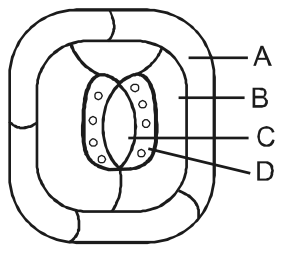
Given below is the diagram of a stomatal apparatus. In which of the following all the four parts Labelled as A, B, C and D are correctly identified.
- 1A-Epidermal cell, B-Subsidiary cell, C-Stomatal aperture, D-Guard cell
- 2A-Subsidiary cell, B-Epidermal cell, C-Guard cell, D-Stomatal aperture
- 3A-Guard cell, B-Stomatal aperture, C-Subsidiary cell, D-Epidermal cell
- 4A-Epidermal cell, B-Guard cell, C-Stomatal aperture, D-Subsidiary cell
Show answer and solution
Correct: option 1, A-Epidermal cell, B-Subsidiary cell, C-Stomatal aperture, D-Guard cell
Working from outside to inside: A is an ordinary epidermal cell, B is a subsidiary cell lying next to the guard cells, D is a bean-shaped guard cell containing chloroplasts, and C is the pore between the two guard cells, the stomatal aperture.
Question 68AIPMT 2010 Prelims, Q115
Which one of the following is not lateral meristem
- 1Interfascicular cambium
- 2Phellogen
- 3Intercalary meristem
- 4Intrafascicular cambium
Show answer and solution
Correct: option 3, Intercalary meristem
Lateral meristems lie along the sides of stems and roots and add girth: the fascicular (intrafascicular) cambium, the interfascicular cambium and the cork cambium (phellogen). The intercalary meristem lies between mature tissues, for example at the base of grass internodes, and adds length. So it is not a lateral meristem.
Question 69AIPMT 2010 Prelims, Q198
Heartwood differs from sapwood in
- 1Absence of vessels and parenchyma
- 2Having dead and non-conducting elements
- 3Being susceptible to pests and pathogens
- 4Presence of rays and fibres
Show answer and solution
Correct: option 2, Having dead and non-conducting elements
Heartwood is the dark central wood of an old stem. Its elements are dead, plugged with tyloses and filled with tannins, resins and gums, so it does not conduct water and only gives mechanical support; these deposits also make it resistant to pests. Sapwood is the outer, lighter wood that still conducts water.
Question 70AIPMT 2009 Prelims, Q94
Anatomically fairly old dicotyledonous root is distinguished from the dicotyledonous stem by
- 1Absence of secondary phloem
- 2Presence of cortex
- 3Position of protoxylem
- 4Absence of secondary xylem
Show answer and solution
Correct: option 3, Position of protoxylem
Old dicot roots and stems both have secondary xylem, secondary phloem and cortex. The primary xylem still tells them apart: in the root the protoxylem lies towards the outside (exarch), while in the stem it lies towards the centre (endarch).
Question 71AIPMT 2009 Prelims, Q109
The annular and spirally thickened conducting elements generally develop in the protoxylem when the root or stem is:
- 1elongating
- 2widening
- 3differentiating
- 4maturing
Show answer and solution
Correct: option 4, maturing
The key gives option (4), maturing. Annular and spiral thickenings leave most of the wall unthickened, so these vessels and tracheids can be stretched; that is why they are usually described as forming in the protoxylem while the organ is still elongating, which is option (1). Our working therefore does not agree with this unofficial key.
Question 72AIPMT 2009 Prelims, Q131
Palisade parenchyma is absent in leaves of:
- 1Mustard
- 2Soybean
- 3Gram
- 4Sorghum
Show answer and solution
Correct: option 4, Sorghum
Sorghum is a monocot with isobilateral leaves, in which the mesophyll is not divided into palisade and spongy parenchyma. Mustard, soybean and gram are dicots with dorsiventral leaves that have palisade tissue on the upper side.
Question 73AIPMT 2009 Prelims, Q132
In barley stem vascular bundles are:
- 1closed and scattered
- 2open and in a ring
- 3closed and radial
- 4open and scattered
Show answer and solution
Correct: option 1, closed and scattered
Barley is a monocot. In a monocot stem the vascular bundles are conjoint and closed (no cambium) and are scattered throughout the ground tissue. Open bundles in a ring are found in dicot stems.
Question 74AIPMT 2008 Prelims, Q135
Vascular tissues in flowering plants develop from
- 1Dermatogen
- 2Phellogen
- 3Plerome
- 4Periblem
Show answer and solution
Correct: option 3, Plerome
In the histogen theory the plerome, the central histogen, forms the stele, which includes the vascular tissues. Dermatogen forms the epidermis, periblem the cortex, and phellogen is the cork cambium.
Question 75AIPMT 2008 Prelims, Q160
The length of different internodes in a culm of sugarcane is variable because of
- 1Intercalary meristem
- 2Shoot apical meristem
- 3Position of axillary buds
- 4Size of leaf lamina at the node below each internode
Show answer and solution
Correct: option 1, Intercalary meristem
In grasses such as sugarcane an intercalary meristem lies at the base of each internode. Its activity lengthens that internode, and since it is active to different extents in different internodes, their lengths differ.
Question 76AIPMT 2007 Prelims, Q10
For a critical study of secondary growth in plants, which one of the following pairs is suitable?
- 1Wheat and maiden hair fern
- 2Sugarcane and sunflower
- 3Teak and pine
- 4Deodar and fern
Show answer and solution
Correct: option 3, Teak and pine
Secondary growth by vascular cambium occurs in dicots and gymnosperms. Teak is a woody dicot and pine is a gymnosperm, so both show it. Wheat and sugarcane are monocots and ferns are pteridophytes, which lack secondary growth.
Question 77AIPMT 2007 Prelims, Q36
Passage cells are thin-walled cells found in:
- 1central region of style through which the pollen tube grows towards the ovary.
- 2endodermis of roots facilitating rapid transport of water from cortex to pericycle.
- 3phloem elements that serve as entry points for substances for transport to other plant parts.
- 4testa of seed to enable emergence of growing embryonic axis during seed germination.
Show answer and solution
Correct: option 2, endodermis of roots facilitating rapid transport of water from cortex to pericycle.
Most endodermal cells of a root are thickened, but a few opposite the protoxylem stay thin-walled. These passage cells let water move quickly from the cortex into the pericycle and xylem.
Question 78AIPMT 2006 Prelims, Q126
A common structural feature of vessel elements and sieve tube elements is-
- 1Thick secondary walls
- 2Pores on lateral wall
- 3Presence of p-protein
- 4Enucleate condition
Show answer and solution
Correct: option 4, Enucleate condition
Both lack a nucleus at maturity: a vessel element is a dead cell with no protoplast, and a sieve tube element is living but loses its nucleus. Thick lignified secondary walls belong only to vessels, and P-protein only to sieve tubes.
Question 79AIPMT 2005 Prelims, Q160
In a woody dicotyledonous tree, which of the following parts will mainly consist of primary tissues
- 1Stem and root
- 2All parts
- 3Shoot tips and root tips
- 4Flowers, fruit and leaves
Show answer and solution
Correct: option 4, Flowers, fruit and leaves
Secondary growth by the vascular cambium and cork cambium takes place in the stem and root of a woody dicot, so these are mostly secondary tissue. Flowers, fruits and leaves do not undergo secondary growth, so their mature tissues are primary. The shoot and root tips are mainly meristem that is still dividing, not mature primary tissue.
Question 80AIPMT 2005 Prelims, Q193
An important step in the manufacture of pulp for paper industry from the woody tissues of plants is the
- 1Removal of water from the wood by prolonged heating at approximately
- 2Treatment of wood with chemicals that break down cellulose
- 3Removal of oils present in the wood by treatment with suitable chemicals
- 4Preparation of pure cellulose by removing lignin
Show answer and solution
Correct: option 4, Preparation of pure cellulose by removing lignin
Paper is made of cellulose fibres. In wood these fibres are bound together and stiffened by lignin, so pulping treats the wood with chemicals that dissolve the lignin and leave nearly pure cellulose. Breaking down the cellulose would destroy the very material the paper is made from.
Question 81AIPMT 2003 Prelims, Q165
The cells of the quiescent centre are characterised by:-
- 1Having dense cytoplasm and prominent nuclei
- 2Having light cytoplasm and small nuclei
- 3Dividing regularly to add to the corpus
- 4Dividing regularly to add to tunica
Show answer and solution
Correct: option 2, Having light cytoplasm and small nuclei
The quiescent centre is a group of almost inactive cells in the root apex. They divide very rarely and have little RNA and protein synthesis, so their cytoplasm is light and their nuclei small. Tunica and corpus belong to the shoot apex.
Question 82AIPMT 2003 Prelims, Q171
Diffuse porous wood is characteristics of those plants which are growing in:-
- 1Alpine region
- 2Cold winter regions
- 3Temperate climate
- 4Tropics
Show answer and solution
Correct: option 4, Tropics
In the tropics growth conditions are nearly uniform through the year, so the cambium forms vessels of similar size throughout the wood, giving diffuse porous wood. Ring porous wood, with large vessels in spring wood, is typical of regions with marked seasons.
Question 83AIPMT 2003 Prelims, Q172
The apical meristem of the root is present
- 1Only in radicles
- 2Only in tap roots
- 3Only in adventitious roots
- 4In all the roots
Show answer and solution
Correct: option 4, In all the roots
Every root, whether the radicle, a tap root, a lateral root or an adventitious root, grows in length by a root apical meristem lying just behind the root cap.
Question 84AIPMT 2002 Prelims, Q175
Main function of lenticel is:-
- 1Transpiration
- 2Guttation
- 3Gaseous exchange
- 4Bleeding
Show answer and solution
Correct: option 3, Gaseous exchange
Lenticels are pores in the bark made of loosely packed complementary cells. They let oxygen and carbon dioxide pass between the inner tissues of the woody stem and the air. A little water vapour is also lost through them, but that is not their main function.
Question 85AIPMT 2002 Prelims, Q179
Four radial V.B. are found in:-
- 1Dicot root
- 2Monocot root
- 3Dicot stem
- 4Monocot stem
Show answer and solution
Correct: option 1, Dicot root
Radial vascular bundles, with xylem and phloem on different radii, are found in roots. A dicot root usually has two to four xylem and phloem groups (often tetrarch), while a monocot root has many (polyarch). Stems have conjoint bundles.
Question 86AIPMT 2002 Prelims, Q182
Axillary bud and terminal bud derived from the activity of:-
- 1Lateral meristem
- 2Intercalary meristem
- 3Apical meristem
- 4Parenchyma
Show answer and solution
Correct: option 3, Apical meristem
The terminal bud contains the shoot apical meristem. As the shoot grows, some cells of this apical meristem are left behind in the leaf axils and form the axillary buds. So both buds come from the apical meristem.
Question 87AIPMT 2002 Prelims, Q193
Which of the following statement is true:-
- 1Vessels are multicellular and with wide lumen
- 2Tracheids are multicellular and with narrow lumen
- 3Vessels are unicellular and with narrow lumen
- 4Tracheids are unicellular and with wide lumen
Show answer and solution
Correct: option 1, Vessels are multicellular and with wide lumen
A vessel is a long tube formed by many cells (vessel members) joined end to end with perforated end walls, and it has a wide lumen. A tracheid is a single elongated cell with tapering ends and a narrower lumen.
Question 88AIPMT 2001 Prelims, Q133
In which of the following plant sunken stomata are found:-
- 1Nerium
- 2Hydrilla
- 3Mango
- 4Guava
Show answer and solution
Correct: option 1, Nerium
Nerium is a xerophyte. Its stomata lie sunken in pits lined with hairs on the lower surface of the leaf, which cuts down water loss. Hydrilla is a submerged plant without working stomata.
Question 89AIPMT 2000 Prelims, Q180
What happens in plants during vascularisation:
- 1Differentiation of procambium, formation of primary phloem followed by formation of primary xylem
- 2Differentiation of procambium followed by the formation of primary phloem and xylem simultaneously
- 3Formation of procambium, primary phloem and xylem simultaneously
- 4Differentiation of procambium followed by the formation of secondary xylem
Show answer and solution
Correct: option 2, Differentiation of procambium followed by the formation of primary phloem and xylem simultaneously
Vascular tissue arises in steps. The procambium is first set apart from the apical meristem, and its cells then mature into primary phloem and primary xylem together. Secondary xylem comes much later, from the vascular cambium.
Question 90AIPMT 1999 Prelims, Q111
Transition of exarch bundles of root to endarch bundles of stem occurs in:
- 1Epicotyl
- 2Hypocotyl
- 3Apical bud
- 4Coleoptile
Show answer and solution
Correct: option 2, Hypocotyl
The radial, exarch vascular arrangement of the root changes into the conjoint, endarch arrangement of the stem in the root-stem transition zone. This zone lies in the hypocotyl, the part of the seedling axis between the radicle and the cotyledons.
Question 91AIPMT 1999 Prelims, Q183
Casparian bands are found in:
- 1Endodermis
- 2Pericycle
- 3Periderm
- 4Cortex
Show answer and solution
Correct: option 1, Endodermis
The cells of the root endodermis have a band of suberin, the Casparian strip, on their radial and transverse walls. It is waterproof and forces water and minerals to pass through the cell membranes of the endodermal cells before entering the stele.
Question 92AIPMT 1998 Prelims, Q144
Extrastelar secondary growth takes place by:
- 1Vascular cambium
- 2Phellogen
- 3Phellem
- 4Phelloderm
Show answer and solution
Correct: option 2, Phellogen
Secondary growth outside the stele is the work of the cork cambium (phellogen), which arises in the cortex. It cuts off cork (phellem) to the outside and secondary cortex (phelloderm) to the inside; those two are its products. The vascular cambium is responsible for stelar secondary growth.
Question 93AIPMT 1998 Prelims, Q200
- 1Secondary phloem
- 2Cork
- 3Cambium
- 4All of these
Show answer and solution
Correct: option 2, Cork
Periderm is made of the cork (phellem), the cork cambium (phellogen) and the secondary cortex (phelloderm). Secondary phloem is formed by the vascular cambium and is not part of it, so 'All of these' is wrong and cork is the answer.