Questions with solutions
Question 1NEET 2026, Q140
Evolution of human appears parallel to the progressive development of brain and language skills. As such, the evolution of individual species in the sequence of their appearance is:
- 1Homo habilis Homo erectus Ramapithecus Neanderthal Homo sapiens
- 2Ramapithecus Homo habilis Homo erectus Neanderthal Homo sapiens
- 3Homo sapiens Ramapithecus Homo habilis Neanderthal Homo erectus
- 4Neanderthal Ramapithecus Homo habilis Homo erectus Homo sapiens
Show answer and solution
Correct: option 2, Ramapithecus Homo habilis Homo erectus Neanderthal Homo sapiens
Ramapithecus lived about 15 million years ago, Homo habilis about 2 million years ago, Homo erectus about 1.5 million years ago, Neanderthal man between about 1,00,000 and 40,000 years ago, and modern Homo sapiens arose after that. Only option (2) keeps this order.
Question 2NEET 2026, Q174
Which of the following is not an example of convergent evolution?
- 1Eyes of octopuses and mammals
- 2Fore limbs of whales and bats
- 3Wings of butterflies and birds
- 4Flippers of penguins and dolphins
Show answer and solution
Correct: option 2, Fore limbs of whales and bats
The fore limbs of whales and bats have the same bone plan inherited from a common ancestor but do different jobs. They are homologous organs and show divergent evolution. The other three pairs are analogous structures, similar in function but different in origin, which is convergent evolution.
Question 3NEET 2026, Q179
Match List I with List II with respect to chronology of evolution of life forms:
| List I | List II |
|---|
| A. About 65 mya | I. Jawless fish probably evolved |
| B. About 500 mya | II. The dinosaurs suddenly disappeared from the earth |
| C. About 350 mya | III. Seaweeds and few plants probably existed |
| D. About 320 mya | IV. Invertebrates were formed and became active |
Choose the correct answer from the options given below:
- 1A-II, B-IV, C-I, D-III
- 2A-II, B-IV, C-III, D-I
- 3A-I, B-II, C-III, D-IV
- 4A-III, B-IV, C-I, D-II
Show answer and solution
Correct: option 1, A-II, B-IV, C-I, D-III
Invertebrates were formed and active by about 500 mya, jawless fish probably evolved around 350 mya, seaweeds and a few plants existed around 320 mya, and the dinosaurs suddenly disappeared about 65 mya. So A-II, B-IV, C-I, D-III.
Question 4NEET 2026 Re-exam, Q141
Natural selection can lead to __________.
(a) stabilisation
(b) genetic drift
(c) directional change
(d) disruption
Choose the correct answer from the options given below:
- 1(a) only
- 2(a), (c) and (d) only
- 3(a), (b), (c) and (d)
- 4(a) and (c) only
Show answer and solution
Correct: option 2, (a), (c) and (d) only
Natural selection acts in three ways: stabilisation (more individuals get the mean value), directional change (more get a value away from the mean) and disruption (more get the values at both ends). Genetic drift is a chance change in allele frequency, not a result of selection. So (a), (c) and (d) are right.
Question 5NEET 2026 Re-exam, Q147
A population of diploid organisms is at Hardy-Weinberg equilibrium. If the frequency of allele A is 0.1, the frequency of AA is __________.
- 10.01
- 20.02
- 30.10
- 40.99
Show answer and solution
Correct: option 1, 0.01
At Hardy-Weinberg equilibrium the frequency of the homozygote AA is , where is the frequency of allele A. Here .
Question 6NEET 2026 Re-exam, Q159
Which of the following is not evidence for evolution?
- 1Convergent evolution of traits like wings of birds and butterflies
- 2Paleontological evidence from fossil records
- 3Embryological support for evolution as proposed by Ernst Heckel
- 4Divergent evolution of anatomical structures such as forelimbs
Show answer and solution
Correct: option 3, Embryological support for evolution as proposed by Ernst Heckel
Fossils, homologous organs (divergent evolution) and analogous organs (convergent evolution) are all accepted evidence for evolution. The embryological support proposed by Ernst Haeckel was disproved by Karl Ernst von Baer, who showed that embryos never pass through the adult stages of other animals, so it does not count as evidence.
Question 7NEET 2026 Re-exam, Q160
Given below are two statements:
Statement I: Modern Homo sapiens arose in Australia and moved across continents.
Statement II: Homo sapiens arose around 75000 to 10000 years ago.
In the light of the above statements, choose the most appropriate answer from the options given below:
- 1Both Statement I and Statement II are correct
- 2Both Statement I and Statement II are incorrect
- 3Statement I is correct but Statement II is incorrect
- 4Statement I is incorrect but Statement II is correct
Show answer and solution
Correct: option 4, Statement I is incorrect but Statement II is correct
Homo sapiens arose in Africa, not Australia, and then moved across the continents, so Statement I is incorrect. Modern Homo sapiens arose during the ice age between 75,000 and 10,000 years ago, so Statement II is correct.
Question 8NEET 2026 Re-exam, Q164
Adaptive radiation in placental mammals and Australian Marsupials leading to similarity between distant species is an example of __________.
- 1divergent evolution
- 2convergent evolution
- 3founder effect
- 4genetic drift
Show answer and solution
Correct: option 2, convergent evolution
Placental mammals and Australian marsupials radiated separately, yet each group produced forms that look alike, such as the placental wolf and the Tasmanian wolf. When unrelated groups come to resemble each other because they adapt to similar habitats, it is convergent evolution.
Question 9NEET 2026 Re-exam, Q170
Given below are two statements: one is labelled as Assertion A and the other is labelled as Reason R.
Assertion A: Forelimbs of human and bats are homologous.
Reason R: Forelimbs of humans and bats have similar anatomical structure.
In the light of the above statements, choose the most appropriate answer from the options given below:
- 1Both A and R are correct and R is the correct explanation of A
- 2Both A and R are true, but R is not the correct explanation of A
- 3A is true but R is false
- 4A is false but R is true
Show answer and solution
Correct: option 1, Both A and R are correct and R is the correct explanation of A
Homologous organs have the same basic structure because of common ancestry, even when they do different work. The forelimbs of humans and bats have the same pattern of bones (humerus, radius, ulna, carpals, metacarpals and phalanges), and that similar structure is what makes them homologous. Both are correct and R explains A.
Question 10NEET 2025, Q151
Sweet potato and potato represent a certain type of evolution. Select the correct combination of terms to explain the evolution.
- 1Analogy, convergent
- 2Homology, divergent
- 3Homology, convergent
- 4Analogy, divergent
Show answer and solution
Correct: option 1, Analogy, convergent
Sweet potato is a modified root and potato is a modified stem; both store food. Different structures doing the same job are analogous, and analogy results from convergent evolution.
Question 11NEET 2024, Q151
The flippers of the Penguins and Dolphins are the example of the
- 1Divergent evolution
- 2Adaptive radiation
- 3Natural selection
- 4Convergent evolution
Show answer and solution
Correct: option 4, Convergent evolution
Penguins are birds and dolphins are mammals, so their flippers do not come from a recent common ancestor with flippers. They look alike because both groups adapted to swimming. Such analogous structures are the result of convergent evolution.
Question 12NEET 2024, Q174
Which one of the following factors will not affect the Hardy-Weinberg equilibrium?
- 1Constant gene pool
- 2Genetic recombination
- 3Genetic drift
- 4Gene migration
Show answer and solution
Correct: option 1, Constant gene pool
Hardy-Weinberg equilibrium means that allele frequencies stay the same from generation to generation, that is, the gene pool remains constant. Five factors disturb it: gene migration, genetic drift, mutation, genetic recombination and natural selection. A constant gene pool is the equilibrium itself, so it does not affect it.
Question 13NEET 2024, Q176
Given below are some stages of human evolution. Arrange them in correct sequence. (Past to Recent)
A. Homo habilis
B. Homo sapiens
C. Homo neanderthalensis
D. Homo erectus
Choose the correct sequence of human evolution from the options given below:
- 1A-D-C-B
- 2D-A-C-B
- 3B-A-D-C
- 4C-B-D-A
Show answer and solution
Correct: option 1, A-D-C-B
Homo habilis lived about 2 million years ago, Homo erectus about 1.5 million years ago, Neanderthal man about 1,00,000 to 40,000 years ago, and modern Homo sapiens arose after that. From past to recent the order is A-D-C-B.
Question 14NEET 2024, Q193
Match List I with List II:
| List I | List II |
|---|
| A. Mesozoic Era | I. Lower invertebrates |
| B. Proterozoic Era | II. Fish & Amphibia |
| C. Cenozoic Era | III. Birds & Reptiles |
| D. Paleozoic Era | IV. Mammals |
Choose the correct answer from the options given below:
- 1A-III, B-I, C-IV, D-II
- 2A-II, B-I, C-III, D-IV
- 3A-III, B-I, C-II, D-IV
- 4A-I, B-II, C-IV, D-III
Show answer and solution
Correct: option 1, A-III, B-I, C-IV, D-II
The Proterozoic is the oldest of the four and had only lower invertebrates. Fishes and amphibians arose and flourished in the Paleozoic. The Mesozoic was the age of reptiles, and birds arose in it. The Cenozoic is the age of mammals. So A-III, B-I, C-IV, D-II.
Question 15NEET 2024 Re-exam, Q154
Match List-I with List-II:
| List I | List II |
|---|
| A. Gene pool | I. Stable within a generation |
| B. Genetic drift | II. Change in gene frequency by chance |
| C. Gene flow | III. Transfer of genes into or out of population |
| D. Gene frequency | IV. Total number of genes and their alleles |
Choose the correct answer from the options given below:
- 1A-III, B-II, C-I, D-IV
- 2A-IV, B-II, C-III, D-I
- 3A-I, B-II, C-III, D-IV
- 4A-II, B-III, C-IV, D-I
Show answer and solution
Correct: option 2, A-IV, B-II, C-III, D-I
The gene pool is the total of all genes and their alleles in a population. Genetic drift is a change in gene frequency that happens by chance. Gene flow is the movement of genes into or out of a population through migration. By the Hardy-Weinberg principle the gene frequencies stay stable from generation to generation when nothing disturbs them. So A-IV, B-II, C-III, D-I.
Question 16NEET 2024 Re-exam, Q155
Which evolutionary phenomenon is depicted by the sketch given in figure?
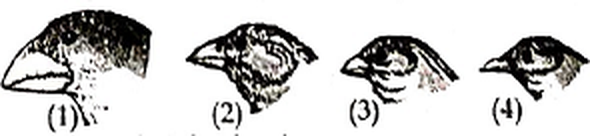
- 1Artificial selection
- 2Genetic drift
- 3Convergent evolution
- 4Adaptive radiation
Show answer and solution
Correct: option 4, Adaptive radiation
The sketch shows the beaks of Darwin's finches from the Galapagos Islands. From one seed-eating ancestor many forms with different beaks arose, each suited to a different food. Evolution of several species from one starting point, spreading into different habitats, is adaptive radiation.
Question 17NEET 2024 Re-exam, Q165
Match List-I with List-II with respect to convergent evolution:
| List-I | List-II |
|---|
| A. Lemur | I. Flying phalanger |
| B. Bobcat | II. Numbat |
| C. Anteater | III. Spotted cuscus |
| D. Flying squirrels | IV. Tasmanian tiger cat |
Choose the correct answer from the options given below:
- 1A-III, B-IV, C-II, D-I
- 2A-III, B-II, C-IV, D-I
- 3A-IV, B-III, C-II, D-I
- 4A-IV, B-II, C-III, D-I
Show answer and solution
Correct: option 1, A-III, B-IV, C-II, D-I
Each placental mammal has an Australian marsupial that looks like it and lives in a similar way. The lemur matches the spotted cuscus, the bobcat matches the Tasmanian tiger cat, the anteater matches the numbat (the marsupial anteater) and the flying squirrel matches the flying phalanger. So A-III, B-IV, C-II, D-I.
Question 18NEET 2024 Re-exam, Q180
Match List-I with List-II:
| List-I | List-II |
|---|
| A. Living Fossil | I. Elongated canine teeth |
| B. Connecting Link | II. Vermiform appendix |
| C. Vestigial Organ | III. Echidna |
| D. Atavism | IV. Latimeria |
Choose the correct answer from the options given below:
- 1A-IV, B-III, C-II, D-I
- 2A-IV, B-II, C-III, D-I
- 3A-IV, B-III, C-I, D-II
- 4A-III, B-IV, C-I, D-II
Show answer and solution
Correct: option 1, A-IV, B-III, C-II, D-I
Latimeria, the coelacanth, was thought to be extinct and has changed little over a very long time, so it is a living fossil. Echidna is an egg-laying mammal, a connecting link between reptiles and mammals. The vermiform appendix is a vestigial organ in humans. Atavism is the reappearance of an ancestral character, such as long canine teeth. So A-IV, B-III, C-II, D-I.
Question 19NEET 2024 Re-exam, Q184
What is the correct order (old to recent) of periods in Paleozoic era?
- 1Silurian, Devonian, Permian, Carboniferous
- 2Silurian, Devonian, Carboniferous, Permian
- 3Permian, Devonian, Silurian, Carboniferous
- 4Silurian, Carboniferous, Permian, Devonian
Show answer and solution
Correct: option 2, Silurian, Devonian, Carboniferous, Permian
The periods of the Paleozoic era, from oldest to most recent, are Cambrian, Ordovician, Silurian, Devonian, Carboniferous and Permian. Among the four named here the order is Silurian, Devonian, Carboniferous, Permian.
Question 20NEET 2023, Q171
Select the correct group/set of Australian Marsupials exhibiting adaptive radiation.
- 1Tasmanian wolf, Bobcat, Marsupial mole
- 2Numbat, Spotted cuscus, Flying phalanger
- 3Mole, Flying squirrel, Tasmanian tiger cat
- 4Lemur, Anteater, Wolf
Show answer and solution
Correct: option 2, Numbat, Spotted cuscus, Flying phalanger
The Australian marsupials that arose by adaptive radiation include the numbat, spotted cuscus, flying phalanger (sugar glider), marsupial mole, Tasmanian wolf, Tasmanian tiger cat, koala, wombat and kangaroo. The bobcat, mole, flying squirrel, lemur, anteater and wolf are placental mammals. Only option (2) has marsupials alone.
Question 21NEET 2023 Manipur, Q179
Identify the fossil of man who showed the following characteristics.
(A) Brain capacity of 1400 cc
(B) Used hides to protect their body
(C) Buried their dead bodies
In the light of above statements, choose the correct answer from the options given below:
- 1Homo habilis
- 2Australopithecus
- 3Homo erectus
- 4Neanderthal man
Show answer and solution
Correct: option 4, Neanderthal man
Neanderthal man, who lived in east and central Asia about 1,00,000 to 40,000 years ago, had a brain size of 1400 cc, used hides to protect the body and buried the dead. Homo habilis (650-800 cc) and Homo erectus (about 900 cc) had smaller brains.
Question 22NEET 2022, Q183
Natural selection where more individuals acquire specific character value other than the mean character value, leads to:
- 1Random change
- 2Stabilising change
- 3Directional change
- 4Disruptive change
Show answer and solution
Correct: option 3, Directional change
When more individuals acquire a value of the character other than the mean value, the peak of the distribution shifts in one direction; this is directional change. In stabilisation more individuals acquire the mean value, and in disruption more individuals acquire the values at both ends of the distribution curve.
Question 23NEET 2022, Q197
Which of the following statements is not true?
- 1Flippers of penguins and dolphins are a pair of homologous organs
- 2Analogous structures are a result of convergent evolution
- 3Sweet potato and potato is an example of analogy
- 4Homology indicates common ancestry
Show answer and solution
Correct: option 1, Flippers of penguins and dolphins are a pair of homologous organs
Flippers of penguins and dolphins are analogous organs: they do the same job but arose by convergent evolution, so statement (1) is not true. Sweet potato (a root) and potato (a stem) are also an example of analogy, and homology does indicate common ancestry.
Question 24NEET 2022 Re-exam, Q165
Panspermia, an idea that is still a favourite for some astronomers, means:
- 1Transfer of spores as unit of life from other planets to Earth
- 2Creation of life from dead and decaying matter
- 3Creation of life from chemicals
- 4Origin of sperm in human testes
Show answer and solution
Correct: option 1, Transfer of spores as unit of life from other planets to Earth
Panspermia is the idea that life came to Earth from outer space, as units of life called spores carried from other planets. Life from decaying matter is spontaneous generation, and life from chemicals is chemical evolution.
Question 25NEET 2022 Re-exam, Q194
Select the correct statement regarding mutation theory of evolution.
- 1Large differences due to mutations arise gradually in a population
- 2This theory was proposed by Alfred Wallace
- 3Variations are small directional changes
- 4Single step large mutation is a cause of speciation
Show answer and solution
Correct: option 4, Single step large mutation is a cause of speciation
Hugo de Vries, working on evening primrose, proposed that evolution is caused by mutations, which are large, sudden, random and directionless. He held that a single-step large mutation (saltation) causes speciation. Small, directional, gradual variations belong to the view of Darwin.
Question 26NEET 2021, Q107
The factor that leads to Founder effect in a population is:
- 1Natural selection
- 2Genetic recombination
- 3Mutation
- 4Genetic drift
Show answer and solution
Correct: option 4, Genetic drift
Founder effect happens when a small group breaks away from a large population and starts a new one. By chance its allele frequencies differ from the original population. Such a chance change in allele frequency is genetic drift.
Question 27NEET 2021, Q198
Match List - I with List - II.
| List - I | List - II |
|---|
| (a) Adaptive radiation | (i) Selection of resistant varieties due to excessive use of herbicides and pesticides |
| (b) Convergent evolution | (ii) Bones of forelimbs in Man and Whale |
| (c) Divergent evolution | (iii) Wings of Butterfly and Bird |
| (d) Evolution by anthropogenic action | (iv) Darwin Finches |
Choose the correct answer from the options given below.
- 1a-iv, b-iii, c-ii, d-i
- 2a-iii, b-ii, c-i, d-iv
- 3a-ii, b-i, c-iv, d-iii
- 4a-i, b-iv, c-iii, d-ii
Show answer and solution
Correct: option 1, a-iv, b-iii, c-ii, d-i
Darwin's finches are the classic case of adaptive radiation (iv). Wings of a butterfly and a bird are analogous organs, the result of convergent evolution (iii). Forelimb bones of man and whale are homologous, the result of divergent evolution (ii). Resistant varieties selected by heavy use of herbicides and pesticides are evolution by anthropogenic action (i). So a-iv, b-iii, c-ii, d-i.
Question 28NEET 2020, Q56
From his experiments, S.L. Miller produced amino acids by mixing the following in a closed flask:
- 1, , and water vapor at 800°C
- 2, , and water vapor at 800°C
- 3, , and water vapor at 600°C
- 4, , and water vapor at 600°C
Show answer and solution
Correct: option 1, , , and water vapor at 800°C
In 1953 Miller passed an electric discharge through a closed flask holding methane (), hydrogen (), ammonia () and water vapour at 800°C, copying the conditions of the early Earth, and found amino acids among the products. Only option (1) has the right gases and the right temperature.
Question 29NEET 2020, Q60
Embryological support for evolution was disapproved by:
- 1Karl Ernst von Baer
- 2Alfred Wallace
- 3Charles Darwin
- 4Oparin
Show answer and solution
Correct: option 1, Karl Ernst von Baer
Ernst Haeckel proposed embryological support for evolution, saying that embryos pass through the adult stages of their ancestors. Karl Ernst von Baer studied embryos carefully and showed that embryos never pass through the adult stages of other animals, so he disapproved the proposal.
Question 30NEET 2020, Q78
Which of the following refer to correct example(s) of organisms which have evolved due to changes in environment brought about by anthropogenic action?
(a) Darwin's Finches of Galapagos islands.
(b) Herbicide resistant weeds.
(c) Drug resistant eukaryotes.
(d) Man-created breeds of domesticated animals like dogs.
- 1only (a)
- 2(a) and (c)
- 3(b), (c) and (d)
- 4only (d)
Show answer and solution
Correct: option 3, (b), (c) and (d)
Anthropogenic means caused by humans. Herbicide resistant weeds and drug resistant eukaryotes were selected by the herbicides and drugs that people use, and breeds of dogs were made by artificial selection, so (b), (c) and (d) qualify. Darwin's finches evolved by natural adaptive radiation on the Galapagos islands with no human role.
Question 31NEET 2020, Q86
Flippers of Penguins and Dolphins are examples of:
- 1Adaptive radiation
- 2Convergent evolution
- 3Industrial melanism
- 4Natural selection
Show answer and solution
Correct: option 2, Convergent evolution
A penguin is a bird and a dolphin is a mammal, yet both have flippers for swimming. These are analogous structures: similar function evolved in unrelated groups living in the same kind of habitat, which is convergent evolution.
Question 32NEET 2020 Phase 2, Q1
After about how many years of formation of earth, life appeared on this planet?
- 150 million years
- 2500 million years
- 350 billion years
- 4500 billion years
Show answer and solution
Correct: option 2, 500 million years
The earth is thought to have formed about 4.5 billion years ago, and life appeared roughly 500 million years after its formation, that is about 4 billion years ago. Billions of years are ruled out because the earth itself is only 4.5 billion years old.
Question 33NEET 2020 Phase 2, Q24
Embryological support for evolution was proposed by:
- 1Karl Ernst von Baer
- 2Charles Darwin
- 3Alfred Wallace
- 4Ernst Heckel
Show answer and solution
Correct: option 4, Ernst Heckel
Ernst Haeckel (printed as "Heckel") proposed embryological support for evolution from features seen in the embryos of all vertebrates, such as vestigial gill slits, that are absent in the adult. Karl Ernst von Baer studied this proposal carefully and disapproved it, noting that embryos never pass through the adult stages of other animals.
Question 34NEET 2020 Phase 2, Q52
A Hominid fossil discovered in Java in 1891, now extinct, having cranial capacity of about 900 cc was:
- 1Neanderthal man
- 2Homo sapiens
- 3Australopithecus
- 4Homo erectus
Show answer and solution
Correct: option 4, Homo erectus
The fossil found in Java in 1891 is Java man, which belongs to Homo erectus. Homo erectus had a brain of about 900 cc and probably ate meat. Neanderthal man had a brain of about 1400 cc, and Australopithecus had a much smaller one.
Question 35NEET 2020 Phase 2, Q53
The phenomenon of evolution of different species in a given geographical area starting from a point and spreading to other habitats is called -
- 1Co-evolution
- 2Natural selection
- 3Adaptive radiation
- 4Saltation
Show answer and solution
Correct: option 3, Adaptive radiation
Adaptive radiation is the evolution of several species in one geographical area, starting from a common point and spreading out into different habitats. Darwin's finches on the Galapagos Islands and the Australian marsupials are the standard examples. Saltation is a single large mutation step, and co-evolution is the linked evolution of two interacting species.
Question 36NEET 2019, Q107
In a species, the weight of newborn ranges from 2 to 5 kg. 97% of the newborn with an average weight between 3 to 3.3 kg survive whereas 99% of the infants born with weights from 2 to 2.5 kg or 4.5 to 5 kg die. Which type of selection process is taking place?
- 1Directional Selection
- 2Stabilizing Selection
- 3Disruptive Selection
- 4Cyclical Selection
Show answer and solution
Correct: option 2, Stabilizing Selection
Newborns of average weight survive while those at both extremes die, so selection favours the mean value of the character and removes both ends of the range. This is stabilizing selection. Directional selection would favour one extreme and disruptive selection both extremes.
Question 37NEET 2019, Q117
Match the hominids with their correct brain size:
| | | |
|---|
| (a) | Homo habilis | (i) | 900 cc |
| (b) | Homo neanderthalensis | (ii) | 1350 cc |
| (c) | Homo erectus | (iii) | 650-800 cc |
| (d) | Homo sapiens | (iv) | 1400 cc |
Select the correct option.
- 1a-iii, b-i, c-iv, d-ii
- 2a-iii, b-ii, c-i, d-iv
- 3a-iii, b-iv, c-i, d-ii
- 4a-iv, b-iii, c-i, d-ii
Show answer and solution
Correct: option 3, a-iii, b-iv, c-i, d-ii
Homo habilis had a brain capacity of 650-800 cc (iii), Homo erectus about 900 cc (i) and the Neanderthal man about 1400 cc (iv). Modern Homo sapiens has about 1350 cc (ii). So a-iii, b-iv, c-i, d-ii.
Question 38NEET 2019, Q118
Variations caused by mutation, as proposed by Hugo de Vries, are:
- 1random and directional
- 2random and directionless
- 3small and directional
- 4small and directionless
Show answer and solution
Correct: option 2, random and directionless
Working on evening primrose, de Vries proposed that evolution is caused by mutations, which are large, sudden changes that arise at random and in no particular direction. Darwin's variations, in contrast, are small and directional. So mutations are random and directionless.
Question 39NEET 2019, Q151
A gene locus has two alleles A, a. If the frequency of dominant allele A is 0.4, then what will be the frequency of homozygous dominant, heterozygous and homozygous recessive individuals in the population?
- 10.36 (AA); 0.48 (Aa); 0.16 (aa)
- 20.16 (AA); 0.24 (Aa); 0.36 (aa)
- 30.16 (AA); 0.48 (Aa); 0.36 (aa)
- 40.16 (AA); 0.36 (Aa); 0.48 (aa)
Show answer and solution
Correct: option 3, 0.16 (AA); 0.48 (Aa); 0.36 (aa)
By the Hardy-Weinberg principle, and . Then AA , Aa and aa . These add up to 1.
Question 40NEET 2019 Odisha, Q92
A population of a species invades a new area. Which of the following condition will lead to Adaptive Radiation?
- 1Area with many types of vacant habitats.
- 2Area with many habitats occupied by a large number of species.
- 3Area with large number of habitats having very low food supply.
- 4Area with a single type of vacant habitat.
Show answer and solution
Correct: option 1, Area with many types of vacant habitats.
Adaptive radiation is the evolution of many forms from one ancestral stock as it spreads into different habitats. That needs several kinds of habitat that are empty, so the invaders face no competitors and each group can adapt to a different habitat. Occupied habitats, poor food supply or a single habitat type do not allow this.
Question 41NEET 2019 Odisha, Q124
In Australia, marsupials and placental mammals have evolved to share many similar characteristics. This type of evolution may be referred to as -
- 1Cyclical Evolution
- 2Convergent Evolution
- 3Adaptive Radiation
- 4Divergent Evolution
Show answer and solution
Correct: option 2, Convergent Evolution
Marsupials and placental mammals are different groups, yet living in similar habitats has produced look-alike pairs such as the Tasmanian wolf and the placental wolf, or the marsupial mole and the mole. Unrelated groups evolving similar features in response to similar needs is convergent evolution.
Question 42NEET 2019 Odisha, Q180
Which of the following statements is correct about the origin and evolution of men?
- 1Homo habilis probably ate meat.
- 2Neanderthal men lived in Asia between 1,00,000 and 40,000 years back.
- 3Agriculture came around 50,000 years back.
- 4The Dryopithecus and Ramapithecus primates existing 15 million years ago, walked like men.
Show answer and solution
Correct: option 2, Neanderthal men lived in Asia between 1,00,000 and 40,000 years back.
Neanderthal man, with a brain size of 1400 cc, lived in near east and central Asia between 1,00,000 and 40,000 years back, so that statement is correct. Homo habilis probably did not eat meat, agriculture came around 10,000 years back, and Dryopithecus and Ramapithecus were hairy and walked like gorillas and chimpanzees.
Question 43NEET 2018, Q160
According to Hugo de Vries, the mechanism of evolution is
- 1Phenotypic variations
- 2Saltation
- 3Multiple step mutations
- 4Minor mutations
Show answer and solution
Correct: option 2, Saltation
From his work on evening primrose, de Vries proposed that evolution is caused by mutations, which are large, sudden, single-step changes. He called this single-step large mutation saltation, in contrast to Darwin's small gradual variations.
Question 44NEET 2018, Q177
Among the following sets of examples for divergent evolution, select the incorrect option :
- 1Brain of bat, man and cheetah
- 2Heart of bat, man and cheetah
- 3Forelimbs of man, bat and cheetah
- 4Eye of octopus, bat and man
Show answer and solution
Correct: option 4, Eye of octopus, bat and man
Divergent evolution gives homologous organs, as in the brain, heart and forelimbs of the mammals bat, man and cheetah. The eye of an octopus and the eye of a mammal arose independently and are analogous, which is convergent evolution, so option (4) is the incorrect example.
Question 45NEET 2018, Q179
The similarity of bone structure in the forelimbs of many vertebrates is an example of
- 1Convergent evolution
- 2Analogy
- 3Homology
- 4Adaptive radiation
Show answer and solution
Correct: option 3, Homology
The forelimbs of whales, bats, cheetahs and humans have the same bones (humerus, radius, ulna, carpals, metacarpals, phalanges) although they do different jobs. The same structure from common ancestry used for different functions is homology.
Question 46NEET 2017, Q161
Artificial selection to obtain cows yielding higher milk output represents
- 1stabilizing selection as it stabilizes this character in the population.
- 2directional as it pushes the mean of the character in one direction.
- 3disruptive as it splits the population into two, one yielding higher output and the other lower output.
- 4stabilizing followed by disruptive as it stabilizes the population to produce higher yielding cows.
Show answer and solution
Correct: option 2, directional as it pushes the mean of the character in one direction.
Breeders keep choosing only the cows with higher milk yield, so the average value of the character shifts steadily towards one end. A shift of the mean in one direction is directional selection.
Question 47NEET 2016 Phase 1, Q144
Which of the following structures is homologous to the wing of a bird?
- 1Dorsal fin of a Shark
- 2Wing of a Moth
- 3Hind limb of Rabbit
- 4Flipper of Whale
Show answer and solution
Correct: option 4, Flipper of Whale
Homologous organs have the same origin and basic structure but may do different work. The wing of a bird and the flipper of a whale are both vertebrate forelimbs built on the same pentadactyl bone plan. A moth's wing is only analogous, a shark's dorsal fin is not a limb, and a rabbit's hind limb is not the forelimb.
Question 48NEET 2016 Phase 1, Q148
Following are the two statements regarding the origin of life:
(a) The earliest organisms that appeared on the earth were non-green and presumably anaerobes.
(b) The first autotrophic organisms were the chemoautotrophs that never released oxygen.
Of the above statements which one of the following options is correct?
- 1(a) is correct but (b) is false.
- 2(b) is correct but (a) is false.
- 3Both (a) and (b) are correct.
- 4Both (a) and (b) are false.
Show answer and solution
Correct: option 3, Both (a) and (b) are correct.
The first living forms arose in an atmosphere without free oxygen, so they were anaerobic and had no chlorophyll (non-green heterotrophs). The first autotrophs were chemoautotrophs, which obtained energy by oxidising inorganic substances and released no oxygen; oxygen came later with photosynthetic organisms. Both statements are correct.
Question 49NEET 2016 Phase 1, Q150
Analogous structures are a result of:
- 1Divergent evolution
- 2Convergent evolution
- 3Shared ancestry
- 4Stabilizing selection
Show answer and solution
Correct: option 2, Convergent evolution
Analogous structures do the same work but have different origins, for example the wings of a butterfly and of a bird. They arise when unrelated groups adapt to the same need, which is convergent evolution. Divergent evolution from a shared ancestor gives homologous structures instead.
Question 50NEET 2016 Phase 2, Q166
Genetic drift operates in
- 1small isolated population
- 2large isolated population
- 3non-reproductive population
- 4slow reproductive population
Show answer and solution
Correct: option 1, small isolated population
Genetic drift is a chance change in allele frequency. Chance has a large effect only when the number of individuals is small, so drift operates in a small isolated population.
Question 51NEET 2016 Phase 2, Q167
In Hardy-Weinberg equation, the frequency of heterozygous individual is represented by
- 1
- 2
- 3
- 4
Show answer and solution
Correct: option 2,
In , and are the frequencies of the two homozygotes and is the frequency of the heterozygote Aa.
Question 52NEET 2016 Phase 2, Q168
The chronological order of human evolution from early to the recent is
- 1Australopithecus Ramapithecus Homo habilis Homo erectus
- 2Ramapithecus Australopithecus Homo habilis Homo erectus
- 3Ramapithecus Homo habilis Australopithecus Homo erectus
- 4Australopithecus Homo habilis Ramapithecus Homo erectus
Show answer and solution
Correct: option 2, Ramapithecus Australopithecus Homo habilis Homo erectus
Ramapithecus lived about 15 million years ago, Australopithecus about 2 million years ago in East Africa, then came Homo habilis and, about 1.5 million years ago, Homo erectus. So the order is Ramapithecus, Australopithecus, Homo habilis, Homo erectus.
Question 53NEET 2016 Phase 2, Q169
Which of the following is the correct sequence of events in the origin of life?
I. Formation of protobionts
II. Synthesis of organic monomers
III. Synthesis of organic polymers
IV. Formation of DNA-based genetic systems
- 1I, II, III, IV
- 2I, III, II, IV
- 3II, III, I, IV
- 4II, III, IV, I
Show answer and solution
Correct: option 3, II, III, I, IV
In chemical evolution, simple organic monomers formed first (II), these joined into polymers such as proteins and nucleic acids (III), the polymers gathered into protobionts (I), and DNA-based genetic systems arose last (IV). So the order is II, III, I, IV.
Question 54AIPMT 2015, Q56
Which of the following had the smallest brain capacity?
- 1Homo sapiens
- 2Homo neanderthalensis
- 3Homo habilis
- 4Homo erectus
Show answer and solution
Correct: option 3, Homo habilis
Homo habilis had a brain capacity of about 650 to 800 cc. Homo erectus had about 900 cc, Neanderthal man about 1400 cc and modern Homo sapiens about 1350 to 1450 cc, so Homo habilis is the smallest.
Question 55AIPMT 2015, Q126
A population will not exist in Hardy - Weinberg equilibrium if:
- 1There are no mutations
- 2There is no migration
- 3The population is large
- 4Individuals mate selectively
Show answer and solution
Correct: option 4, Individuals mate selectively
Hardy-Weinberg equilibrium needs a large population with random mating and no mutation, migration or selection. Selective (non-random) mating changes genotype frequencies, so the equilibrium is disturbed.
Question 56AIPMT 2015 Re-test, Q110
The wings of a bird and the wings of an insect are:
- 1homologous structures and represent convergent evolution
- 2homologous structures and represent divergent evolution
- 3analogous structures and represent convergent evolution
- 4phylogenetic structures and represent divergent evolution
Show answer and solution
Correct: option 3, analogous structures and represent convergent evolution
Bird wings are modified forelimbs with bones, while insect wings are outgrowths of the body wall. They differ in origin and structure but do the same job of flying, so they are analogous. Analogous structures arise when unrelated groups adapt to the same need, which is convergent evolution.
Question 57AIPMT 2015 Re-test, Q128
Industrial melanism is an example of:
- 1Neo Lamarckism
- 2Neo Darwinism
- 3Natural selection
- 4Mutation
Show answer and solution
Correct: option 3, Natural selection
After industrialisation in England, soot darkened the tree trunks, and the dark form of the peppered moth escaped predators better than the light form and became common. The environment selected one existing variant over the other, which is natural selection.
Question 58AIPMT 2014, Q21
Which one of the following are analogous structures?
- 1Flippers of Dolphin and Legs of Horse.
- 2Wings of Bat and Wings of Pigeon.
- 3Gills of Prawn and Lungs of Man.
- 4Thorns of Bougainvillea and Tendrils of Cucurbita
Show answer and solution
Correct: option 3, Gills of Prawn and Lungs of Man.
Analogous structures do the same work but have a different origin and structure. Gills of prawn and lungs of man both serve breathing but are built quite differently. The forelimbs of dolphin, horse, bat and pigeon share the same bone plan, and thorns of Bougainvillea and tendrils of Cucurbita are both modified axillary buds, so those pairs are homologous.
Question 59AIPMT 2014, Q45
In a population of 1000 individuals 360 belong to genotype AA, 480 to Aa and the remaining 160 to aa. Based on this data, the frequency of allele A in the population is:
- 10.7
- 20.4
- 30.5
- 40.6
Show answer and solution
Correct: option 4, 0.6
The 1000 individuals carry 2000 alleles. The number of A alleles is , so the frequency of A is .
Question 60AIPMT 2014, Q54
Forelimbs of cat, lizard used in walking; forelimbs of whale used in swimming and forelimbs of bats used in flying are an example of:
- 1Convergent evolution
- 2Analogous organs
- 3Adaptive radiation
- 4Homologous organs
Show answer and solution
Correct: option 4, Homologous organs
These forelimbs all have the same plan of bones (humerus, radius, ulna, carpals, metacarpals and phalanges) and a common origin, but do different jobs. Organs with the same structure and origin but different functions are homologous organs, and they show divergent evolution. Analogous organs and convergent evolution are the opposite case: different structure, same function.
Question 61NEET 2013, Q56
The eye of octopus and eye of cat show different patterns of structure, yet they perform similar function. This is an example of:
- 1Homologous organs that have evolved due to divergent evolution.
- 2Analogous organs that have evolved due to convergent evolution.
- 3Analogous organs that have evolved due to divergent evolution.
- 4Homologous organs that have evolved due to convergent evolution.
Show answer and solution
Correct: option 2, Analogous organs that have evolved due to convergent evolution.
Organs that differ in structure and origin but do the same job are analogous organs. They arise when unrelated groups evolve similar solutions, which is convergent evolution. The eyes of an octopus and of a mammal are a standard example.
Question 62NEET 2013, Q58
The process by which organisms with different evolutionary history evolve similar phenotypic adaptations in response to a common environmental challenge, is called:
- 1Convergent evolution
- 2Non-random evolution
- 3Adaptive radiation
- 4Natural selection
Show answer and solution
Correct: option 1, Convergent evolution
When unrelated organisms facing the same environmental challenge come to look or work alike, it is convergent evolution. Adaptive radiation is the opposite: one ancestral group spreading into many different forms.
Question 63NEET 2013, Q72
The tendency of population to remain in genetic equilibrium may be disturbed by:
- 1lack of migration
- 2lack of mutations
- 3lack of random mating
- 4random mating
Show answer and solution
Correct: option 3, lack of random mating
Hardy-Weinberg equilibrium holds when there is random mating and no migration, mutation, genetic drift or selection. Lack of migration, lack of mutation and random mating are all conditions that keep the equilibrium. Non-random mating changes the frequencies, so lack of random mating disturbs it.
Question 64NEET 2013, Q95
Variation in gene frequencies within populations can occur by chance rather than by natural selection. This is referred to as:
- 1Genetic drift
- 2Random mating
- 3Genetic load
- 4Genetic flow
Show answer and solution
Correct: option 1, Genetic drift
A chance change in allele frequency, most marked in small populations, is called genetic drift. It is not caused by selection. Random mating keeps frequencies constant, genetic load is the burden of harmful alleles, and gene flow is the movement of alleles by migration.
Question 65NEET 2013, Q123
According to Darwin, the organic evolution is due to:
- 1Interspecific competition.
- 2Competition within closely related species.
- 3Reduced feeding efficiency in one species due to the presence of interfering species.
- 4Intraspecific competition.
Show answer and solution
Correct: option 1, Interspecific competition.
Darwin's theory rests on the struggle for existence and the survival of the fittest. NCERT states that Darwin was convinced that interspecific competition is a potent force in organic evolution, and the key follows that statement, giving option (1).
Question 66NEET 2013 Karnataka, Q58
Random unidirectional change in allele frequencies that occur by chance in all populations and especially in small populations is known as:-
- 1Migration
- 2Natural selection
- 3Genetic drift
- 4Mutation
Show answer and solution
Correct: option 3, Genetic drift
A change in allele frequency that happens purely by chance, with the strongest effect in small populations, is genetic drift. Natural selection is not random, migration is gene flow between populations, and mutation creates new alleles.
Question 67NEET 2013 Karnataka, Q70
Genetic variation in a population arises due to:
- 1Recombination only
- 2Mutations as well as recombination
- 3Reproductive isolation and selection
- 4Mutations only
Show answer and solution
Correct: option 2, Mutations as well as recombination
New alleles arise by mutation, and recombination during meiosis and fertilisation shuffles them into new combinations. Both are sources of variation; selection and isolation act on variation that already exists.
Question 68NEET 2013 Karnataka, Q115
Dinosaurs dominated the World in which of the following geological era?
- 1Coenozoic
- 2Jurassic
- 3Mesozoic
- 4Devonian
Show answer and solution
Correct: option 3, Mesozoic
The Mesozoic era (Triassic, Jurassic and Cretaceous periods) is the age of reptiles, when dinosaurs dominated. Jurassic and Devonian are periods, not eras, and the Coenozoic is the age of mammals.
Question 69NEET 2013 Karnataka, Q118
The finch species of Galapagos Islands are grouped according to their food sources. Which of the following is not a finch food?
- 1Carrion
- 2Insects
- 3Tree buds
- 4Seeds
Show answer and solution
Correct: option 1, Carrion
Darwin's finches evolved from a seed-eating ancestor into forms with beaks suited to seeds, insects, buds and other plant food. None of them feeds on carrion (dead animals).
Question 70AIPMT 2012 Prelims, Q56
Evolution of different species in a given area starting from a point and spreading to other geographical areas is known as:
- 1Adaptive radiation
- 2Natural selection
- 3Migration
- 4Divergent evolution
Show answer and solution
Correct: option 1, Adaptive radiation
This is the definition of adaptive radiation: one ancestral stock in an area gives rise to many species that spread into different habitats. Darwin's finches on the Galapagos Islands and the Australian marsupials are the standard examples.
Question 71AIPMT 2012 Prelims, Q81
Which one of the following options gives one correct example each of convergent evolution and divergent evolution?
- 1Convergent evolution: Eyes of octopus and mammals; Divergent evolution: Bones of forelimbs of vertebrates
- 2Convergent evolution: Thorns of Bougainvillia and tendrils of Cucurbita; Divergent evolution: Wings of butterflies and birds
- 3Convergent evolution: Bones of forelimbs of vertebrates; Divergent evolution: Wings of butterfly and birds
- 4Convergent evolution: Thorns of Bougainvillia and tendrils of Cucurbita; Divergent evolution: Eyes of Octopus and mammals
Show answer and solution
Correct: option 1, Convergent evolution: Eyes of octopus and mammals; Divergent evolution: Bones of forelimbs of vertebrates
Convergent evolution gives analogous organs: different structures doing the same job, such as the eyes of octopus and mammals or the wings of butterflies and birds. Divergent evolution gives homologous organs: the same basic structure modified for different jobs, such as the forelimb bones of vertebrates or the thorns of Bougainvillea and tendrils of Cucurbita. Only option (1) has both examples in the right place.
Question 72AIPMT 2012 Prelims, Q84
What was the most significant trend in the evolution of modern man (Homo sapiens) from his ancestors?
- 1Shortening of jaws
- 2Binocular vision
- 3Increasing cranial capacity
- 4Upright posture
Show answer and solution
Correct: option 4, Upright posture
The key used here marks upright posture: walking erect on two legs freed the hands for making and using tools, and on this view it is the change that set the human line apart. Note that the steady increase in cranial capacity (from about 650 to 800 cc in Homo habilis to about 1400 cc in Neanderthal man and modern man) is the trend stressed in the textbook, and other keys mark option (3).
Question 73AIPMT 2012 Prelims, Q122
The extinct human who lived 1,00,000 to 40,000 years ago, in Europe, Asia and parts of Africa, with short stature, heavy eyebrows, retreating foreheads, large jaws with heavy teeth, stocky bodies, a lumbering gait and stooped posture was
- 1Homo habilis
- 2Neanderthal human
- 3Cro-magnon humans
- 4Ramapithecus
Show answer and solution
Correct: option 2, Neanderthal human
The time span of 1,00,000 to 40,000 years ago and the build described (short and stocky, heavy brow ridges, sloping forehead, large jaws) are those of Neanderthal man, who had a brain size of about 1400 cc and lived in Europe and near east and central Asia. Homo habilis and Ramapithecus are far older, and Cro-magnon man was a tall, modern-looking Homo sapiens.
Question 74AIPMT 2012 Mains, Q97
The idea of mutations was brought forth by:
- 1Hugo de Vries, who worked on evening primrose
- 2Gregor Mendel, who worked on Pisum sativum
- 3Hardy Weinberg, who worked on allele frequencies in a population
- 4Charles Darwin, who observed a wide variety of organisms during sea voyage
Show answer and solution
Correct: option 1, Hugo de Vries, who worked on evening primrose
Hugo de Vries studied the evening primrose (Oenothera lamarckiana) and proposed that new species arise through mutations, large sudden heritable changes, rather than through the small variations that Darwin emphasised.
Question 75AIPMT 2011 Prelims, Q144
What was the most significant trend in evolution of modern man (Homo sapiens) from his ancestors?
- 1Upright posture
- 2Shortening of jaws
- 3Binocular vision
- 4Increasing brain capacity
Show answer and solution
Correct: option 4, Increasing brain capacity
The steady increase in cranial capacity, from about 650 to 800 cc in Homo habilis and 900 cc in Homo erectus to around 1400 cc in Neanderthal and modern man, is the most significant trend, since it made intelligence, tool making, language and culture possible.
Question 76AIPMT 2011 Mains, Q57
Sweet potato is homologous to
- 1Potato
- 2Colocasia
- 3Ginger
- 4Turnip
Show answer and solution
Correct: option 4, Turnip
Homologous organs have the same origin. Sweet potato is a modified root that stores food, and so is turnip, so the two are homologous. Potato (a tuber), Colocasia (a corm) and ginger (a rhizome) are all modified underground stems, so they are only analogous to sweet potato.
Question 77AIPMT 2010 Mains, Q63
Given below are four statements (A-D) each with one or two blanks. Select the option which correctly fills up the blanks in two.
Statements:
(A) Wings of butterfly and birds look alike and are the results of ..... (i) ....., evolution
(B) Miller showed that , , and .... (i) ..., when exposed to electric discharge in a flask resulted in formation of ...... (ii) .....
(C) Vermiform appendix is a ...... (i) ..... organ and an ...... (ii) .... evidence of evolution.
(D) According to Darwin evolution took place due to ...... (i) .... and ....... (ii) ..... of the fittest.
Options:
- 1(C) - (i) vestigial, (ii) anatomical, (D) (i) mutations (ii) multiplication
- 2(D) - (i) small variation, (ii) survival, (A) - (i) convergent
- 3(A) - (i) convergent, (B) - (i) oxygen, (ii) nucleosides
- 4(B) - (i) water vapour, (ii) amino acids, (C) - (i) rudimentary (ii) anatomical
Show answer and solution
Correct: option 2, (D) - (i) small variation, (ii) survival, (A) - (i) convergent
(A) Wings of butterflies and birds are analogous organs, the result of convergent evolution. (B) Miller used , , and water vapour and obtained amino acids. (C) The appendix is a vestigial organ and an anatomical evidence. (D) Darwin explained evolution by small variations and survival of the fittest; mutations were de Vries's idea. Only option (2) fills both of its statements correctly.
Question 78AIPMT 2010 Mains, Q75
The most apparent change during the evolutionary history of Homo sapiens is traced in
- 1Remarkable increase in the brains size
- 2Loss of body hair
- 3Walking upright
- 4Shortening of the jaws
Show answer and solution
Correct: option 1, Remarkable increase in the brains size
Through human evolution the cranial capacity rose steadily, from about 650 to 800 cc in Homo habilis and about 900 cc in Homo erectus to about 1400 cc in Neanderthal man and modern man. This growth of the brain is the most striking change.
Question 79AIPMT 2010 Prelims, Q169
Darwin's finches are a good example of
- 1Connecting link
- 2Adaptive radiation
- 3Convergent evolution
- 4Industrial melanism
Show answer and solution
Correct: option 2, Adaptive radiation
On the Galapagos Islands many kinds of finches, with beaks suited to different foods, arose from one seed-eating ancestral stock. Evolution of several forms from one starting point, spreading into different habitats, is adaptive radiation.
Question 80AIPMT 2009 Prelims, Q135
In the case of peppered moth (Biston betularia) the black-coloured form became dominant over the light-coloured form in England during industrial revolution. This is an example of:
- 1appearance of the darker coloured individuals due to very poor sunlight
- 2protective mimicry
- 3inheritance of darker colour character acquired due to the darker environment
- 4natural selection whereby the darker forms were selected
Show answer and solution
Correct: option 2, protective mimicry
The key gives option (2), protective mimicry. Industrial melanism is the standard example of natural selection: on soot-darkened tree trunks the dark moths were hidden from birds, survived better and left more offspring, which is option (4). Our working therefore does not agree with this unofficial key.
Question 81AIPMT 2008 Prelims, Q119
Thorn of Bougainvillea and tendril of cucurbita are example of
- 1Retrogressive evolution
- 2Analogous organs
- 3Homologous organs
- 4Vestigial organs
Show answer and solution
Correct: option 3, Homologous organs
Both the thorn of Bougainvillea and the tendril of Cucurbita are modified axillary branches. They have the same origin but different functions (protection and climbing), so they are homologous organs.
Question 82AIPMT 2008 Prelims, Q124
What is true about the isolated small tribal populations?
- 1There is no change in population size as they have a large gene pool
- 2There is a decline in population as boys marry girls only from their own tribe
- 3Hereditary diseases like colour blindness do not spread in the isolated population
- 4Wrestlers who develop strong body muscles in their life time pass this character on to their progeny
Show answer and solution
Correct: option 2, There is a decline in population as boys marry girls only from their own tribe
A small isolated tribe has a small gene pool and no gene flow from outside. Marriage within the tribe is inbreeding, which brings harmful recessive genes together and lowers fitness, so the population declines. Hereditary diseases spread more in such groups, and acquired characters such as a wrestler's muscles are not inherited.
Question 83AIPMT 2008 Prelims, Q125
Which one of the following scientist's name is correctly matched with the theory put forth by him?
- 1Mendel - Theory of Pangenesis
- 2Weismann - Theory of continuity of Germplasm
- 3Pasteur - Inheritance of acquired characters
- 4de Vries - Natural selection
Show answer and solution
Correct: option 2, Weismann - Theory of continuity of Germplasm
August Weismann proposed the theory of continuity of germplasm. Pangenesis and natural selection were Darwin's ideas, inheritance of acquired characters was Lamarck's, de Vries gave the mutation theory, and Pasteur disproved spontaneous generation.
Question 84AIPMT 2008 Prelims, Q126
Which one of the following is incorrect about the characteristics of protobionts (coacervates and microspheres) as envisaged in the abiogenic origin of life?
- 1They could maintain an internal environment
- 2They were able to reproduce
- 3They could separate combinations of molecules from the surroundings
- 4They were partially isolated from the surroundings
Show answer and solution
Correct: option 2, They were able to reproduce
Protobionts were aggregates of molecules partly separated from the surroundings by a boundary, able to keep an internal environment different from outside. They were not living cells and could not truly reproduce, so statement (2) is the incorrect one.
Question 85AIPMT 2008 Prelims, Q127
Darwin's Finches are an excellent example of
- 1Connecting links
- 2Adaptive radiation
- 3Seasonal migration
- 4Brood parasitism
Show answer and solution
Correct: option 2, Adaptive radiation
On the Galapagos Islands many finch species with different beaks and food habits evolved from one ancestral seed-eating stock. Such evolution of several forms from one point into different habitats is adaptive radiation.
Question 86AIPMT 2008 Prelims, Q128
Which one of the following pairs of items correctly belongs to the category of organs mentioned against it?
- 1Wings of honey-bee and wings of crow - Homologous organs
- 2Thorn of Bougainvillea and tendrils of Cucurbita - Analogous organs
- 3Nictitating membrane and blind spot in human eye - Vestigial organs
- 4Nephridia of earthworm and malpighian tubules of cockroach - Excretory organs
Show answer and solution
Correct: option 4, Nephridia of earthworm and malpighian tubules of cockroach - Excretory organs
Nephridia and Malpighian tubules are both excretory organs, so pair (4) is right. Insect and bird wings are analogous, the thorn and tendril are homologous, and the blind spot is a functional part of the retina, not a vestigial organ.
Question 87AIPMT 2007 Prelims, Q4
What is common to whale, seal and shark?
- 1Homoiothermy
- 2Seasonal migration
- 3Thick subcutaneous fat
- 4Convergent evolution
Show answer and solution
Correct: option 4, Convergent evolution
Whale and seal are mammals while shark is a cold-blooded cartilaginous fish with no blubber, so warm-bloodedness and thick subcutaneous fat are not shared. All three have independently acquired a streamlined body and flippers or fins for life in water, which is convergent evolution.
Question 88AIPMT 2007 Prelims, Q21
When two species of different genealogy come to resemble each other as a result of adaptation, the phenomenon is termed:
- 1Convergent evolution
- 2Divergent evolution
- 3Microevolution
- 4Co-evolution
Show answer and solution
Correct: option 1, Convergent evolution
Unrelated lineages that adapt to a similar way of life evolve similar features, such as the wings of insects and birds. This coming together of form from different ancestry is convergent evolution.
Question 89AIPMT 2007 Prelims, Q22
Adaptive radiation refers to:
- 1Power of adaptation in an individual to a variety of environments
- 2Adaptations due to Geographical isolation
- 3Evolution of different species from a common ancestor
- 4Migration of members of a species to different geographical areas
Show answer and solution
Correct: option 3, Evolution of different species from a common ancestor
Adaptive radiation is the evolution of many different species from one ancestral stock, each adapted to a different habitat or way of life, as in Darwin's finches and the Australian marsupials.
Question 90AIPMT 2007 Prelims, Q24
The Finches of Galapagos islands provide an evidence in favour of:
- 1Biogeographical Evolution
- 2Special Creation
- 3Evolution due to Mutation
- 4Retrogressive Evolution
Show answer and solution
Correct: option 1, Biogeographical Evolution
Darwin's finches on the different Galapagos islands evolved from a common mainland ancestor into forms with different beaks suited to the food of each island. This link between geographical distribution and the origin of species is biogeographical evidence of evolution.
Question 91AIPMT 2007 Prelims, Q25
One of the important consequences of geographical isolation is:
- 1Random creation of new species
- 2No change in the isolated fauna
- 3Preventing Speciation
- 4Speciation through reproductive isolation
Show answer and solution
Correct: option 4, Speciation through reproductive isolation
A geographical barrier stops gene flow between populations. Each population then accumulates its own variations until the two can no longer interbreed, that is, they become reproductively isolated and form separate species.
Question 92AIPMT 2007 Prelims, Q26
Industrial melanism as observed in peppered moth proves that:
- 1Melanism is a pollution-generated feature
- 2The true black melanic forms arise by a recurring random mutation
- 3The melanic form of the moth has no selective advantage over lighter form in industrial area
- 4The lighter-form moth has no selective advantage either in polluted industrial area or non-polluted area.
Show answer and solution
Correct: option 2, The true black melanic forms arise by a recurring random mutation
The black form of the peppered moth was not produced by soot; it already arose from time to time by random mutation, and natural selection favoured it on soot-darkened trees. The melanic form does have an advantage in industrial areas and the light form in unpolluted areas, so options 3 and 4 are false.
Question 93AIPMT 2007 Prelims, Q27
The concept of chemical evolution is based on:
- 1Possible origin of life by combination of chemicals
- 2Crystallization of chemicals under suitable environmental conditions
- 3Interaction of water, air and clay under
- 4Effect of solar radiation of chemicals
Show answer and solution
Correct: option 1, Possible origin of life by combination of chemicals
Chemical evolution (Oparin and Haldane) holds that life arose from non-living matter: simple inorganic molecules combined into organic molecules and these into the first living systems. So it is based on the possible origin of life by combination of chemicals.
Question 94AIPMT 2007 Prelims, Q28
Among the human ancestors the brain size was more than 1000 CC in:
- 1Homo habilis
- 2Homo neanderthalensis
- 3Homo erectus
- 4Ramapithecus
Show answer and solution
Correct: option 2, Homo neanderthalensis
Homo habilis had a brain of about 650 to 800 cc and Homo erectus about 900 cc, while Ramapithecus was an ape-like form with a much smaller brain. Neanderthal man had a brain of about 1400 cc, the only one here clearly above 1000 cc.
Question 95AIPMT 2007 Prelims, Q30
Select the correct statement from the following:
- 1Mutations are random and directional
- 2Darwinian variations are small and directionless
- 3Fitness is the end result of the ability to adapt and gets selected by nature
- 4All mammals except whales and camels have seven cervical vertebrae.
Show answer and solution
Correct: option 3, Fitness is the end result of the ability to adapt and gets selected by nature
According to Darwin, fitness is the outcome of the ability to adapt and is what nature selects. Mutations are random and directionless, Darwinian variations are small and directional, and whales and camels too have seven cervical vertebrae (the exceptions are sloths and the manatee).
Question 96AIPMT 2007 Prelims, Q34
Which one of the following statement is correct?
- 1Ontogeny repeats phylogeny
- 2Stem cells are specialized cells
- 3There is no evidence of the existence of gills during embryogenesis of mammals
- 4All plant and animal cells are totipotent.
Show answer and solution
Correct: option 1, Ontogeny repeats phylogeny
Haeckel's biogenetic law states that ontogeny (the development of an individual) repeats phylogeny (its evolutionary history). Stem cells are unspecialised, mammalian embryos do show gill slits, and most animal cells are not totipotent.
Question 97AIPMT 2006 Prelims, Q112
Which one of the following amino-acids was not found to be synthesized in Miller's experiment?
- 1Glycine
- 2Aspartic acid
- 3Glutamic acid
- 4Alanine
Show answer and solution
Correct: option 3, Glutamic acid
Miller passed electric sparks through a mixture of methane, ammonia, hydrogen and water vapour and reported amino acids such as glycine, alanine and aspartic acid. Glutamic acid is the one in this list that was not among the amino acids he reported.
Question 98AIPMT 2006 Prelims, Q147
An important evidence in favour of organic evolution is the occurrence of-
- 1Homologous and vestigial organs
- 2Analogous and vestigial organs
- 3Homologous organs only
- 4Homologous and analogous organs
Show answer and solution
Correct: option 1, Homologous and vestigial organs
Homologous organs have the same basic structure and origin but different functions, which points to a common ancestor. Vestigial organs are reduced, functionless remains of organs that worked in ancestors. Both show descent with change. Analogous organs show only similar adaptation in unrelated groups.
Question 99AIPMT 2006 Prelims, Q148
Which one of the following is not a living fossil-
- 1King crab
- 2Sphenodon
- 3Archaeopteryx
- 4Peripatus
Show answer and solution
Correct: option 3, Archaeopteryx
A living fossil is a species still alive today that has changed little from its ancient relatives, such as the king crab (Limulus), Sphenodon and Peripatus. Archaeopteryx is an extinct Jurassic form linking reptiles and birds, known only from fossils.
Question 100AIPMT 2006 Prelims, Q154
Jurassic period of the Mesozoic era characterized by
- 1Gymnosperms are dominant plants and first birds appear
- 2Radiation of reptiles and origin of mammal like reptiles
- 3Dinosaurs become extinct and angiosperms appear
- 4Flowering plants and first dinosaurs appear
Show answer and solution
Correct: option 1, Gymnosperms are dominant plants and first birds appear
In the Jurassic the land vegetation was dominated by gymnosperms (cycads and conifers), dinosaurs ruled, and the first birds such as Archaeopteryx appeared. Mammal-like reptiles arose earlier (Permian to Triassic), and the extinction of dinosaurs with the rise of flowering plants belongs to the Cretaceous.
Question 101AIPMT 2006 Prelims, Q159
Evolutionary history of an organism is known as
- 1Phylogeny
- 2Ancestry
- 3Paleontology
- 4Ontogeny
Show answer and solution
Correct: option 1, Phylogeny
Phylogeny is the evolutionary history of a species or group. Ontogeny is the developmental history of an individual from zygote to adult, and paleontology is the study of fossils.
Question 102AIPMT 2006 Prelims, Q197
Sickle cell anemia has not been eliminated from the African population because
- 1It is controlled by recessive genes
- 2It is not a fatal disease
- 3It provides immunity against malaria
- 4It is controlled by dominant genes
Show answer and solution
Correct: option 3, It provides immunity against malaria
People heterozygous for the sickle cell allele are resistant to malaria, because the parasite does not survive well in their red blood cells. In malaria-prone parts of Africa this advantage of the heterozygote keeps the allele in the population even though homozygotes are severely ill.
Question 103AIPMT 2005 Prelims, Q118
At a particular locus, frequency of 'A' allele is 0.6 and that of 'a' is 0.4. What would be the frequency of heterozygotes in a random mating population at equilibrium
- 10.24
- 20.16
- 30.48
- 40.36
Show answer and solution
Correct: option 3, 0.48
By the Hardy-Weinberg principle the genotype frequencies are , and heterozygotes have frequency . Here .
Question 104AIPMT 2005 Prelims, Q127
Using imprints from a plate with complete medium and carrying bacterial colonies, you can select streptomycin resistant mutants and prove that such mutations do not originates as adaptation. These imprints need to be used
- 1On plates with and without streptomycin
- 2Only on plates with streptomycin
- 3On plates with minimal medium
- 4Only on plates without streptomycin
Show answer and solution
Correct: option 2, Only on plates with streptomycin
This is the Lederbergs' replica plating experiment. Imprints of the master plate, which has never met streptomycin, are pressed onto plates containing streptomycin; resistant colonies appear at the same positions on every replica. This shows the resistant mutants were already present on the master plate before exposure, so the mutation is not an adaptation to the drug. The master plate itself serves as the streptomycin-free reference, so the imprints are needed only on streptomycin plates.
Question 105AIPMT 2005 Prelims, Q129
Which one of the following experiments suggests that simplest living organisms could not have originated spontaneously from non-living matter
- 1Larva could appear in decaying organic matter
- 2Meat was not spoiled, when heated and kept sealed in a vessel
- 3microbes did not appear in stored meat
- 4Microbes appeared from unsterilized organic matter
Show answer and solution
Correct: option 2, Meat was not spoiled, when heated and kept sealed in a vessel
If meat that has been heated (killing the organisms in it) and then sealed from the air does not spoil, life is not arising from the non-living matter itself; it comes only from organisms that already exist. This is the kind of experiment (Spallanzani, Pasteur) that disproved spontaneous generation.
Question 106AIPMT 2005 Prelims, Q134
Which one of the following phenomena supports Darwin's concept of natural selection in organic evolution
- 1production of 'Dolly', the sheep by cloning
- 2Development of organs from 'stem' cells for organ transplantation
- 3Development of transgenic animals
- 4Prevalence of pesticide resistant insects
Show answer and solution
Correct: option 4, Prevalence of pesticide resistant insects
When a pesticide is used, the few insects that happen to carry resistance survive and reproduce while the others die, so resistant forms come to dominate the population. This is natural selection acting on existing variation. The other three are laboratory techniques, not selection in nature.
Question 107AIPMT 2005 Prelims, Q162
Which of the following is the relatively most accurate method for dating of fossils
- 1Electron-spin resonance method
- 2Uranium-lead method
- 3Potassium-argon method
- 4Radio-carbon method
Show answer and solution
Correct: option 1, Electron-spin resonance method
The radio-carbon, potassium-argon and uranium-lead methods depend on radioactive decay and each suits only a certain age range, with errors that grow outside it. The electron-spin resonance method measures the electrons trapped in the crystals of the fossil material itself by natural radiation, and is taken as the most accurate of the four.
Question 108AIPMT 2005 Prelims, Q176
There are two opposing views about origin of modern man. According to one view Homo erectus in Asia were the ancestors of modern man. A study of variation of DNA however suggested African origin of modern man. What kind of observation of DNA variation could suggest this
- 1Greater variation in Asia than in Africa
- 2Similar variation in Africa and Asia
- 3Variation only in Asia and no variation in Africa
- 4Greater variation in Africa than in Asia
Show answer and solution
Correct: option 1, Greater variation in Asia than in Africa
A population that has existed longest in one place has had the most time to collect mutations, so the place of origin shows the greatest DNA variation, while groups that left later carry only a part of it. An African origin is therefore supported by greater variation in Africa than in Asia, which is option (4). The key used here gives option (1), and that answer is kept.
Question 109AIPMT 2005 Prelims, Q177
Which of the following is not true for a species
- 1Members of a species can interbreed
- 2Variations occur among members of a species
- 3Gene flow does not occur between the populations of a species
- 4Each species is reproductively isolated from every other species.
Show answer and solution
Correct: option 3, Gene flow does not occur between the populations of a species
A species is a group of populations whose members can interbreed, show variation, and are reproductively isolated from other species. Because they can interbreed, genes do pass between the populations of one species. So the statement that gene flow does not occur is the untrue one.
Question 110AIPMT 2005 Prelims, Q189
De Vries gave his mutation theory on organic evolution while working on
- 1Oenothera lamarckiana
- 2Drosophila melanogaster
- 3Pisum sativum
- 4Althea rosea
Show answer and solution
Correct: option 1, Oenothera lamarckiana
Hugo de Vries noticed sudden, heritable new forms appearing among plants of the evening primrose, Oenothera lamarckiana, and based his mutation theory on them. Drosophila was Morgan's material and Pisum sativum was Mendel's.
Question 111AIPMT 2004 Prelims, Q110
Age of fossils in the past was generally determined by radio-carbon method and other methods involving radioactive elements found in the rocks. More precise methods, which were used recently and led to the revision of the evolutionary periods for different groups of organisms includes -
- 1Study of the conditions of fossilization
- 2Electron spin resonance (ESR) & fossil DNA
- 3Study of carbohydrates/proteins in rocks
- 4Study of carbohydrates/proteins in fossils
Show answer and solution
Correct: option 2, Electron spin resonance (ESR) & fossil DNA
Electron spin resonance dating measures the electrons trapped in crystals such as tooth enamel by natural radiation and gives more precise ages than the older radioactive methods. Together with the analysis of DNA recovered from fossils, it led to revised dates for several groups.
Question 112AIPMT 2004 Prelims, Q111
What kind of evidence suggested that man is more closely related with chimpanzee than with other hominoid apes?
- 1Comparison of chromosomes morphology only
- 2Evidence from fossil remains and the fossil mitochondrial DNA alone
- 3Evidence from DNA extracted from sex chromosomes, autosomes & mitochondria
- 4Evidence from DNA from sex chromosomes only
Show answer and solution
Correct: option 3, Evidence from DNA extracted from sex chromosomes, autosomes & mitochondria
The close relationship of humans and chimpanzees rests on DNA comparisons from all parts of the genome: autosomes, sex chromosomes and mitochondrial DNA all show the greatest similarity between the two. The other options rely on only one kind of evidence.
Question 113AIPMT 2004 Prelims, Q144
The most likely reason for the development of resistance against pesticides in insects damaging a crop is :-
- 1Genetic recombination
- 2Directed mutations
- 3Acquired heritable changes
- 4Random mutations
Show answer and solution
Correct: option 4, Random mutations
Mutations arise at random, not in response to the pesticide. A few insects happen to carry a mutation that makes them resistant; the pesticide kills the rest, and these survivors multiply. Resistance is thus random mutation followed by selection, not a directed or acquired change.
Question 114AIPMT 2004 Prelims, Q158
Diversification in plant life appeared:-
- 1Due to abrupt mutations
- 2Suddenly on earth
- 3By seed dispersal
- 4Due to long periods of evolutionary changes
Show answer and solution
Correct: option 4, Due to long periods of evolutionary changes
The variety of plants seen today, from algae to flowering plants, arose slowly over hundreds of millions of years as variations accumulated under natural selection. It was neither sudden nor the result of one mutation, and seed dispersal only spreads plants that already exist.
Question 115AIPMT 2004 Prelims, Q177
According to Oparin, which one of the following was not present in the primitive atmosphere of the earth:-
- 1Oxygen
- 2Hydrogen
- 3Water vapour
- 4Methane
Show answer and solution
Correct: option 1, Oxygen
Oparin held that the early atmosphere was reducing: it had hydrogen, methane, ammonia and water vapour but no free oxygen. Free oxygen built up much later, after photosynthetic organisms appeared.
Question 116AIPMT 2004 Prelims, Q188
Presence of gills in the tadpole of frog indicates that:-
- 1Fishes evolved from frog like ancestors
- 2Frogs will have gills in future
- 3Frogs evolved from gilled ancestors
- 4Fishes were amphibious in the past
Show answer and solution
Correct: option 3, Frogs evolved from gilled ancestors
The tadpole breathes with gills like a fish before it changes into a lung-breathing frog. This larval stage repeats a feature of the ancestors (the idea that development recalls ancestry), which is evidence that amphibians evolved from gilled, fish-like ancestors.
Question 117AIPMT 2003 Prelims, Q104
Convergent evolution is illustrated by:
- 1Rat and dog
- 2Bacterium and protozoan
- 3Starfish and cuttle fish
- 4Dogfish and whale
Show answer and solution
Correct: option 4, Dogfish and whale
Convergent evolution is when unrelated groups come to look alike because they live in the same kind of habitat. The dogfish is a cartilaginous fish and the whale is a mammal, yet both have a streamlined body and fins or flippers for swimming. The other pairs do not show such an acquired likeness.
Question 118AIPMT 2003 Prelims, Q105
Which one of the following sequences was proposed by Darwin and Wallace for organic evolution:
- 1Overproduction, variations, constancy of population size, natural selection
- 2Variations, constancy of population size, overproduction, natural selection
- 3Overproduction, constancy of population size, variations, natural selection
- 4Variations, natural selection, overproduction, constancy of population size
Show answer and solution
Correct: option 3, Overproduction, constancy of population size, variations, natural selection
The argument starts from two observations: organisms produce far more offspring than can survive (overproduction), yet population size stays roughly constant, so there must be a struggle for existence. Since individuals vary, those with favourable variations survive and reproduce, which is natural selection. That order is option (3).
Question 119AIPMT 2003 Prelims, Q106
Random genetic drift in a population probably results from:
- 1Highly genetically variable individuals
- 2Interbreeding within this population
- 3Constant low mutation rate
- 4Large population size
Show answer and solution
Correct: option 2, Interbreeding within this population
Genetic drift is a chance change in allele frequency and is strong only in a small, isolated population whose members breed among themselves. A large population size works against drift, and neither a steady low mutation rate nor high variability causes it. Of the choices, interbreeding within the (small) population is the one linked to drift.
Question 120AIPMT 2003 Prelims, Q125
In recent years, DNA sequences (nucleotide sequence) of mt-DNA and Y chromosomes were considered for the study of human evolution, because:
- 1They are small, and therefore, easy to study
- 2They are uniparental in origin and do not take part in recombination
- 3Their structure is known in greater detail
- 4They can be studied from the samples of fossil remains
Show answer and solution
Correct: option 2, They are uniparental in origin and do not take part in recombination
Mitochondrial DNA is inherited only from the mother and the Y chromosome only from the father, and neither is reshuffled by recombination. They pass down a lineage unchanged except for mutations, so differences between them can be used to trace maternal and paternal ancestry.
Question 121AIPMT 2003 Prelims, Q127
Industrial melanism is an example of:
- 1Drug resistance
- 2Darkening of skin due to smoke from industries
- 3Protective resemblance with the surroundings
- 4Defensive adaptation of skin against ultraviolet radiations
Show answer and solution
Correct: option 3, Protective resemblance with the surroundings
In industrial areas of England soot darkened the tree trunks, and dark (melanic) peppered moths, being hidden from birds against this background, were selected for and became common. This is natural selection for protective resemblance with the surroundings; the smoke did not darken the moths themselves.
Question 122AIPMT 2003 Prelims, Q128
In a random mating population in equilibrium, which of the following brings about a change in gene frequency in a non-directional manner:
- 1Mutations
- 2Random drift
- 3Selection
- 4Migration
Show answer and solution
Correct: option 1, Mutations
The source key gives mutations: a mutation is a random event with no relation to the needs of the organism, so the change it makes in gene frequency has no fixed direction, whereas selection and migration push frequencies in a particular direction. Note that random genetic drift is also non-directional by definition, and many books give that as the answer.
Question 123AIPMT 2003 Prelims, Q129
Darwin in his 'Natural Selection Theory' did not believe in any role of which one of the following in organic evolution:
- 1Parasites and predators as natural enemies
- 2Survival of the fittest
- 3Struggle for existence
- 4Discontinuous variations
Show answer and solution
Correct: option 4, Discontinuous variations
Darwin held that evolution proceeds by the selection of small, continuous variations, acting through the struggle for existence (which includes natural enemies) and the survival of the fittest. He gave no importance to sudden, discontinuous variations (sports); these were later stressed by de Vries as mutations.
Question 124AIPMT 2003 Prelims, Q130
Which one of the following describes correctly the homologous structures:
- 1Organs with anatomical similarities, but performing different functions
- 2Organs with anatomical dissimilarities but performing same function
- 3Organs that have no function now, but had an important function in ancestors
- 4Organs appearing only in embryonic stage and disappearing later in the adult
Show answer and solution
Correct: option 1, Organs with anatomical similarities, but performing different functions
Homologous organs share the same basic structure and origin but are modified for different functions, like the forelimbs of whale, bat and human. Option (2) describes analogous organs and option (3) vestigial organs.
Question 125AIPMT 2003 Prelims, Q176
Nicotiana sylvestris flowers only during long days and N. tabacum flowers only during short days. If raised in the laboratory under different photoperiods, they can be induced to flower at the same time and can be cross-fertilized to produce self-fertile offspring. What is the best reason for considering N. sylvestris and N. tabacum to be separate species:-
- 1They cannot interbreed in nature
- 2They are reproductively distinct
- 3They are physiologically distinct
- 4They are morphologically distinct
Show answer and solution
Correct: option 1, They cannot interbreed in nature
By the biological species concept, species are groups that do not interbreed under natural conditions. The two plants flower in different seasons, so in nature they never cross (temporal isolation), even though they can be crossed artificially. That makes option (1) the best reason.
Question 126AIPMT 2002 Prelims, Q104
Some bacteria able to grow in Streptomycin containing medium due to -
- 1Natural selection
- 2Induced mutation
- 3Reproductive isolation
- 4Genetic drift
Show answer and solution
Correct: option 1, Natural selection
A few bacteria in a population already carry a chance mutation that makes them resistant to streptomycin. When the antibiotic is present the sensitive cells die and the resistant ones survive and multiply, which is natural selection of pre-existing variants (as shown by Lederberg's replica plating experiment). The antibiotic does not induce the mutation.
Question 127AIPMT 2002 Prelims, Q107
Reason of fast speciation in present day crop plants is -
- 1Mutation
- 2Isolation
- 3Polyploidy
- 4Sexual Reproduction
Show answer and solution
Correct: option 3, Polyploidy
Polyploidy, the multiplication of whole chromosome sets, produces a new reproductively isolated form in a single step, so it gives very rapid speciation. Many crop plants such as wheat, cotton and potato are polyploids. Mutation and isolation act much more slowly.
Question 128AIPMT 2002 Prelims, Q108
Which of the following is important for speciation:-
- 1Seasonal isolation
- 2Reproductive isolation
- 3Behavioural isolation
- 4Tropical isolation
Show answer and solution
Correct: option 2, Reproductive isolation
A new species arises only when a population can no longer exchange genes with its parent population, that is, when it becomes reproductively isolated. Seasonal and behavioural isolation are only particular kinds of reproductive isolation, so the general term is the best answer.
Question 129AIPMT 2002 Prelims, Q109
Which of the following are homologous organs:-
- 1Wings of birds & Locust
- 2Wings of birds (Sparrow) & Pectoral fins of fish
- 3Wings of bat & Butterfly
- 4Legs of frog & Cockroach
Show answer and solution
Correct: option 2, Wings of birds (Sparrow) & Pectoral fins of fish
Homologous organs share the same origin and basic plan even if their work differs. The wing of a bird and the pectoral fin of a fish are both vertebrate paired forelimbs (pectoral appendages), so they are homologous. A vertebrate limb or wing compared with an insect wing or leg has a different origin and structure; those pairs are analogous at most.
Question 130AIPMT 2002 Prelims, Q110
Genetic drift operates in:-
- 1Small isolated population
- 2Large isolated population
- 3Fast reproductive population
- 4Slow reproductive population
Show answer and solution
Correct: option 1, Small isolated population
Genetic drift is the random change of allele frequencies from one generation to the next purely by chance. Chance sampling errors are significant only when the population is small and isolated; in a large population they average out.
Question 131AIPMT 2002 Prelims, Q111
There is no life on moon due to the absence of -
- 1
- 2Water
- 3Light
- 4Temperature
Show answer and solution
Correct: option 2, Water
Life as we know it needs liquid water as the medium for all its chemical reactions. The moon has no liquid water (and no atmosphere to hold it), so life cannot exist there. Oxygen is not essential for all life, since anaerobes live without it, and the moon does receive light.
Question 132AIPMT 2002 Prelims, Q112
According to fossils which discovered up to present time, origin and evolution of man was started from which country -
- 1France
- 2Java
- 3Africa
- 4China
Show answer and solution
Correct: option 3, Africa
The oldest hominid fossils, such as Australopithecus and Homo habilis, have been found in East and South Africa, so the origin of man is traced to Africa. The Java and Peking (China) fossils are of the later Homo erectus, and the Cro-Magnon fossils of France are later still.
Question 133AIPMT 2002 Prelims, Q131
In which condition, the gene ratio remains constant for any species:-
- 1Sexual selection
- 2Random mating
- 3Mutation
- 4Gene flow
Show answer and solution
Correct: option 2, Random mating
By the Hardy-Weinberg principle, allele (gene) frequencies stay constant from generation to generation in a large population with random mating and with no mutation, selection, gene flow or drift. Sexual selection, mutation and gene flow all change the frequencies, so random mating is the condition asked for.
Question 134AIPMT 2002 Prelims, Q148
In which era reptiles were dominated:-
- 1Coenozoic era
- 2Mesozoic era
- 3Paleozoic era
- 4Archaeozoic era
Show answer and solution
Correct: option 2, Mesozoic era
The Mesozoic era (Triassic, Jurassic and Cretaceous periods) was the time when dinosaurs and other reptiles ruled land, sea and air, so it is called the age of reptiles. The Coenozoic era is the age of mammals.
Question 135AIPMT 2001 Prelims, Q158
Half life period of is:
- 1500 years
- 25000 years
- 350 years
- 4 years
Show answer and solution
Correct: option 2, 5000 years
The half-life of carbon-14 is about 5730 years, which is why it is used to date remains up to a few tens of thousands of years old. Of the given values, 5000 years is the closest.
Question 136AIPMT 2001 Prelims, Q186
Reason of diversity in living being:
- 1Mutation
- 2Long term evolutionary change
- 3Gradual change
- 4Short term evolutionary change
Show answer and solution
Correct: option 2, Long term evolutionary change
The huge variety of living forms is the result of evolution going on over millions of years, with variations piling up and new species branching off. Mutation only supplies the raw material, and short-term change cannot produce this much diversity.
Question 137AIPMT 2001 Prelims, Q188
Similarities in organism with different genotype indicates:
- 1Microevolution
- 2Macroevolution
- 3Convergent evolution
- 4Divergent evolution
Show answer and solution
Correct: option 3, Convergent evolution
When unrelated organisms with different genetic make-up come to look or work alike because they live in similar conditions, it is convergent evolution (analogous structures). Divergent evolution is the opposite: related forms becoming different.
Question 138AIPMT 2001 Prelims, Q190
Which of the following is closest relative of man:
- 1Chimpanzee
- 2Gorilla
- 3Orangutan
- 4Gibbon
Show answer and solution
Correct: option 1, Chimpanzee
Chromosome banding patterns, protein sequences and DNA comparisons all show the chimpanzee to be the living ape most similar to humans, closer than the gorilla, orangutan or gibbon.
Question 139AIPMT 2001 Prelims, Q191
Which of the following is correct order of the evolutionary history of man:
- 1Peking man, Homo sapiens, Neanderthal man, Cro-Magnon man
- 2Peking man, Neanderthal man, Homo sapiens, Cro-Magnon man
- 3Peking man, Heidelberg man, Neanderthal man, Cro-Magnon man
- 4Peking man, Neanderthal man, Homo sapiens, Heidelberg man
Show answer and solution
Correct: option 3, Peking man, Heidelberg man, Neanderthal man, Cro-Magnon man
Peking man is a form of Homo erectus and is the oldest of these. Heidelberg man came next, then Neanderthal man, and Cro-Magnon man is the most recent, being an early modern Homo sapiens.
Question 140AIPMT 2001 Prelims, Q194
- 1Cyanobacteria
- 2Chemoheterotrophs
- 3Autotrophs
- 4Photoautotrophs
Show answer and solution
Correct: option 2, Chemoheterotrophs
The first cells arose in a sea rich in ready-made organic molecules and with no free oxygen. They were anaerobes that took in these molecules for food, that is, chemoheterotrophs. Autotrophs, including cyanobacteria, came later.
Question 141AIPMT 2001 Prelims, Q195
Frequency of an allele in an isolated population may change due to:
- 1Genetic drift
- 2Gene flow
- 3Mutation
- 4Natural selection
Show answer and solution
Correct: option 1, Genetic drift
An isolated population gets no gene flow and is usually small. In a small population chance alone can shift allele frequencies from one generation to the next, and this random change is genetic drift.
Question 142AIPMT 2001 Prelims, Q196
In Lederberg's replica plating experiment what shall be used to obtain streptomycin resistant strain:
- 1Minimal medium and streptomycin
- 2Complete medium and streptomycin
- 3Only minimal medium
- 4Only complete medium
Show answer and solution
Correct: option 2, Complete medium and streptomycin
The master plate is copied onto plates of complete medium containing streptomycin. The complete medium lets every kind of cell grow, and the antibiotic kills all but the resistant ones, so only resistant colonies appear. This showed the mutants existed before exposure to the drug.
Question 143AIPMT 2001 Prelims, Q197
Forthcoming generations are less adaptive than their parental generation due to:
- 1Natural selection
- 2Mutation
- 3Genetic drift
- 4Adaptation
Show answer and solution
Correct: option 2, Mutation
Natural selection and adaptation raise fitness. Mutations are random, and most of them are harmful or disturb gene combinations that already work well, so mutation is what can leave offspring less well adapted than their parents.
Question 144AIPMT 2001 Prelims, Q199
Occurrence of endemic species in South America and Australia due to:
- 1These species has been extinct from other regions
- 2Continental separation
- 3There is no terrestrial route to these places
- 4Retrogressive evolution
Show answer and solution
Correct: option 2, Continental separation
South America and Australia broke away from the other land masses by continental drift. Their animals and plants then evolved in isolation, giving forms found nowhere else, such as the marsupials of Australia.
Question 145AIPMT 2001 Prelims, Q200
Darwin's theory of pangenesis shows similarity with theory of inheritance of acquired characters then what shall be correct according to it:
- 1Useful organs become strong and developed while useless organs become extinct. These organs help in struggle for survival
- 2Size of organs increase with aging
- 3Development of organs is due to will power
- 4There should be some physical basis of inheritance
Show answer and solution
Correct: option 4, There should be some physical basis of inheritance
In pangenesis every body part gives off tiny particles called gemmules (pangenes) that collect in the gametes and carry the characters to the offspring. Like Lamarck's idea, this needs a material carrier of characters from body to germ cells, so the point it makes is that inheritance must have a physical basis.
Question 146AIPMT 2000 Prelims, Q150
Which is not a vestigial organ in man:
- 1Third molar
- 2Nails
- 3Segmental muscles of abdomen
- 4Coccyx
Show answer and solution
Correct: option 2, Nails
Nails are functional structures that protect the tips of the fingers and toes. The third molar (wisdom tooth), the segmental muscles of the abdomen and the coccyx (tail bone) are all reduced remnants with little or no function, i.e. vestigial.
Question 147AIPMT 2000 Prelims, Q151
Homo sapiens have evolved in:
- 1Paleocene
- 2Pleistocene
- 3Oligocene
- 4Miocene
Show answer and solution
Correct: option 2, Pleistocene
Modern man, Homo sapiens, appeared during the Pleistocene epoch (the ice ages) of the Quaternary period. The Paleocene, Oligocene and Miocene are much older epochs of the Tertiary, when only earlier primates and apes existed.
Question 148AIPMT 2000 Prelims, Q152
Character which is closely related to human evolution:
- 1Disappearance of tail
- 2Reduction in size of jaws
- 3Binocular vision
- 4Flat nails
Show answer and solution
Correct: option 2, Reduction in size of jaws
Binocular vision and flat nails are shared by primates in general, and the tail is already lost in all apes. The shortening of the jaws, with smaller teeth and a flatter face, is a change that took place along the human line itself, so it is the character most closely tied to human evolution.
Question 149AIPMT 2000 Prelims, Q153
Which evidence of evolution related to Darwin's finches:
- 1Evidences from biogeographical distribution
- 2Evidences from comparative anatomy
- 3Evidences from embryology
- 4Evidences from palaeontological
Show answer and solution
Correct: option 1, Evidences from biogeographical distribution
Darwin's finches live on the Galapagos Islands, where one ancestral stock from the mainland spread to different islands and gave rise to many species with different beaks. This adaptive radiation on isolated islands is evidence from the geographical distribution of organisms (biogeography).
Question 150AIPMT 2000 Prelims, Q154
Who is directly related to man:
- 1Gorilla
- 2Rhesus
- 3Gibbon
- 4Orangutan
Show answer and solution
Correct: option 1, Gorilla
Among the listed primates the gorilla, an African great ape, is the closest relative of man. The orangutan and the gibbon branched off earlier, and the rhesus is a monkey, which is more distant still.
Question 151AIPMT 2000 Prelims, Q155
Lemur edri-edri is found in:
- 1Madagascar
- 2Mauritius
- 3India
- 4Sri Lanka
Show answer and solution
Correct: option 1, Madagascar
Lemurs, including the indri, are primitive primates that are found naturally only on the island of Madagascar, where they evolved in isolation.
Question 152AIPMT 1999 Prelims, Q150
- 1Wings of cockroach and wings of bats
- 2Wings of insects and wings of birds
- 3Air bladder of fishes and lungs of frog
- 4Pectoral fins of fishes and forelimbs of horse
Show answer and solution
Correct: option 4, Pectoral fins of fishes and forelimbs of horse
Homologous organs share the same origin and basic plan even if their use differs. The pectoral fins of fishes and the forelimbs of a horse are both the anterior paired appendages of vertebrates, so the key takes option (4). Insect wings and the wings of bats or birds are analogous: same use, different origin.
Question 153AIPMT 1999 Prelims, Q173
Reptiles like mammals originated in:
- 1Jurassic
- 2Triassic
- 3Cretaceous
- 4Permian
Show answer and solution
Correct: option 2, Triassic
The key takes the Triassic period, the opening period of the Mesozoic era, as the time of the mammal-like reptiles (therapsids), the group from which the first mammals arose at the end of that period. Note that many texts place the first appearance of mammal-like reptiles earlier, in the Permian; the answer given here is the one in the key.
Question 154AIPMT 1999 Prelims, Q182
Industrial melanism is example of:
- 1Natural selection
- 2Mutation
- 3Racial difference
- 4Predation
Show answer and solution
Correct: option 1, Natural selection
In industrial England, soot darkened the tree trunks. Dark (melanic) forms of the peppered moth Biston betularia were then better hidden from birds than the light forms and increased in number. A change in the proportions of existing forms because the environment favours one of them is natural selection.
Question 155AIPMT 1999 Prelims, Q186
Which one is obtained by S. Miller in his experiments on origin of life before 1953:
- 1Simple sugars
- 2Amino acids
- 3Nucleotide
- 4Peptides
Show answer and solution
Correct: option 2, Amino acids
Miller passed electric sparks through a mixture of methane, ammonia, hydrogen and water vapour, imitating the supposed primitive atmosphere. After about a week the liquid contained amino acids such as glycine, alanine and aspartic acid, showing that organic molecules could form without life.
Question 156AIPMT 1998 Prelims, Q116
Species separated by geographical barriers are called:
- 1Allopatric
- 2Sympatric
- 3Sibling
- 4Endemic
Show answer and solution
Correct: option 1, Allopatric
Allopatric species (or populations) live in different areas separated by a barrier such as a mountain range or sea. Sympatric species share the same area, and sibling species look alike but do not interbreed.
Question 157AIPMT 1998 Prelims, Q130
- 12.46 crore years
- 22.46 lakh year
- 31 lakh year
- 41 crore year
Show answer and solution
Correct: option 1, 2.46 crore years
Dryopithecus was an ape-like primate of the Miocene, living roughly 20 to 25 million years ago. 25 million years is 2.5 crore years, so the closest option is 2.46 crore years.
Question 158AIPMT 1998 Prelims, Q131
Which of the following statement is true:
- 1Homo erectus is direct ancestor of Homo sapiens
- 2Neanderthal man is direct ancestor of modern man
- 3Australopithecus is direct ancestor of modern man
- 4Fossils of cromagnon man first found in Ethiopia
Show answer and solution
Correct: option 1, Homo erectus is direct ancestor of Homo sapiens
Homo sapiens arose from Homo erectus. Neanderthal man was a side branch that died out, Australopithecus came much earlier and is not the direct ancestor, and Cro-Magnon fossils were first found in France, not Ethiopia. So only option (1) is true.
Question 159AIPMT 1998 Prelims, Q133
Evolution of heart from one to two, three and four chambered proves:
- 1Biogenetic law of Haeckel
- 2Lamarckism
- 3Hardy weinberg's law
- 4Neo Darwinism
Show answer and solution
Correct: option 1, Biogenetic law of Haeckel
Haeckel's biogenetic law says ontogeny repeats phylogeny. The heart of a developing mammal passes through stages like the two-chambered heart of fishes and the three-chambered heart of amphibians before becoming four-chambered, the same order as in the vertebrate series. This is taken as support for the biogenetic law.
Question 160AIPMT 1998 Prelims, Q178
Genetic drift in mendelian population takes place in:
- 1Small population
- 2Large population
- 3Oceanic population
- 4Never occurs
Show answer and solution
Correct: option 1, Small population
Genetic drift is a chance change in gene frequency. Chance has a large effect only when few individuals breed, so drift is important in small populations (the Sewall Wright effect) and negligible in large ones.
Question 161AIPMT 1998 Prelims, Q189
In present times the origin of life is not possible from inorganic compounds due to:
- 1Raw material not available
- 2High conc. of in atmosphere
- 3Decrease in temperature
- 4Excess of pollution
Show answer and solution
Correct: option 2, High conc. of in atmosphere
Life arose in a reducing atmosphere with no free oxygen. The present atmosphere is oxidising: free oxygen would oxidise simple organic molecules as soon as they formed, so they cannot build up into living systems.
Question 162AIPMT 1998 Prelims, Q190
On Galapagos island Darwin observed variation in beaks of birds (Darwin's finches) and he concluded:
- 1Inter species variation
- 2Intraspecies variation
- 3Natural selection according to food
- 4Inheritance of acquired characters
Show answer and solution
Correct: option 3, Natural selection according to food
The finches of the different islands came from a common seed-eating ancestor. Their beaks differ according to the food available, such as seeds, insects or cactus. Darwin took this as natural selection fitting each form to its food (adaptive radiation).