Questions with solutions
Question 1NEET 2026, Q115
Arrange the following in the correct developmental sequence related to microsporogenesis:
A. Microspore tetrads
B. Sporogenous tissue
C. Pollen grains
D. Pollen mother cells
Choose the correct answer from the options given below:
- 1D, A, C, B
- 2B, D, C, A
- 3B, D, A, C
- 4A, D, C, B
Show answer and solution
Correct: option 3, B, D, A, C
Cells of the sporogenous tissue act as pollen mother cells, which divide by meiosis to give microspore tetrads. The microspores then separate and mature into pollen grains. The order is therefore B, D, A, C.
Question 2NEET 2026, Q122
Which one of the following is a triploid cell?
- 1Central cell
- 2Primary endosperm cell
- 3Zygote
- 4Synergid
Show answer and solution
Correct: option 2, Primary endosperm cell
The primary endosperm cell is formed when one male gamete fuses with the two polar nuclei of the central cell (triple fusion), giving a triploid primary endosperm nucleus. The zygote is diploid, a synergid is haploid, and the central cell before fusion carries two haploid polar nuclei.
Question 3NEET 2026, Q134
Which one of the following types of pollination brings genetically different types of pollen grains to the stigma?
- 1Geitonogamy
- 2Autogamy
- 3Xenogamy
- 4Cleistogamy
Show answer and solution
Correct: option 3, Xenogamy
Xenogamy is the transfer of pollen from the anther of one plant to the stigma of a different plant, so it is the only type that brings genetically different pollen. Autogamy and cleistogamy use pollen of the same flower, and geitonogamy uses pollen of another flower on the same plant.
Question 4NEET 2026 Re-exam, Q151
How many theca are present in each lobe of a typical bilobed angiosperm anther?
- 12
- 26
- 38
- 412
Show answer and solution
Correct: option 1, 2
A typical angiosperm anther is bilobed and each lobe has two theca, which is why the anther is called dithecous. So the answer is 2.
Question 5NEET 2026 Re-exam, Q154
Which of the following in female gametophyte of an angiosperm helps in guiding the pollen tube for fertilizing the eggs?
- 1Antipodals
- 2Synergids
- 3Central cells
- 4Polar nucleus
Show answer and solution
Correct: option 2, Synergids
The synergids have a filiform apparatus at their micropylar tip, and it guides the pollen tube into the synergid on its way to the egg. Antipodals, the central cell and the polar nuclei do not guide the pollen tube.
Question 6NEET 2026 Re-exam, Q155
Which of the following plant produces non-albuminous seeds?
- 1Wheat
- 2Maize
- 3Barley
- 4Pea
Show answer and solution
Correct: option 4, Pea
In non-albuminous seeds the endosperm is fully used up by the growing embryo, as in pea and groundnut. Wheat, maize and barley keep part of the endosperm in the mature seed, so they are albuminous.
Question 7NEET 2026 Re-exam, Q156
If the diploid chromosome number of typical angiosperm is 36, what would be the chromosome number in its endosperm?
- 118
- 236
- 354
- 472
Show answer and solution
Correct: option 3, 54
The endosperm is triploid: it forms when one male gamete (n) fuses with the two polar nuclei (n + n). With , , so the endosperm has chromosomes.
Question 8NEET 2025, Q102
Given below are two statements: One is labelled as Assertion (A) and the other is labelled as Reason (R).
Assertion (A): Both wind and water pollinated flowers are not very colourful and do not produce nectar.
Reason (R): The flowers produce enormous amount of pollen grains in wind and water pollinated flowers.
In the light of the above statements, choose the correct answer from the options given below:
- 1Both A and R are true and R is the correct explanation of A
- 2Both A and R are true but R is NOT the correct explanation of A
- 3A is true but R is false
- 4A is false but R is true
Show answer and solution
Correct: option 2, Both A and R are true but R is NOT the correct explanation of A
Both statements are true. Wind and water pollinated flowers are dull and without nectar because they do not need to attract animal pollinators, and they make very large amounts of pollen to make up for the pollen lost in chance transfer. The large pollen output is not the reason for the lack of colour and nectar, so R does not explain A.
Question 9NEET 2025, Q127
Given below are two statements: One is labelled as Assertion (A) and the other is labelled as Reason (R).
Assertion (A): A typical unfertilised, angiosperm embryo sac at maturity is 8 nucleate and 7-celled.
Reason (R): The egg apparatus has 2 polar nuclei.
In the light of the above statements, choose the correct answer from the options given below:
- 1Both A and R are true and R is the correct explanation of A
- 2Both A and R are true but R is NOT the correct explanation of A
- 3A is true but R is false
- 4A is false but R is true
Show answer and solution
Correct: option 3, A is true but R is false
A is true: the mature embryo sac has three antipodal cells, two synergids, one egg cell and one large central cell with two polar nuclei, which makes 7 cells and 8 nuclei. R is false: the egg apparatus is the egg cell with the two synergids; the two polar nuclei lie in the central cell.
Question 10NEET 2025, Q141
Match List I with List II:
| List I | List II |
|---|
| A. Scutellum | I. Persistent nucellus |
| B. Non-albuminous seed | II. Cotyledon of Monocot seed |
| C. Epiblast | III. Groundnut |
| D. Perisperm | IV. Rudimentary cotyledon |
Choose the option with all correct matches.
- 1A-II, B-III, C-IV, D-I
- 2A-IV, B-III, C-II, D-I
- 3A-IV, B-III, C-I, D-II
- 4A-II, B-IV, C-III, D-I
Show answer and solution
Correct: option 1, A-II, B-III, C-IV, D-I
The scutellum is the single cotyledon of a monocot (grass) embryo (II). Groundnut is a non-albuminous seed, with no endosperm left at maturity (III). The epiblast is a rudimentary second cotyledon in grasses (IV). Perisperm is the persistent remains of the nucellus (I). So A-II, B-III, C-IV, D-I.
Question 11NEET 2025, Q153
Given below are two statements: One is labelled as Assertion (A) and the other is labelled as Reason (R).
Assertion (A): Cells of the tapetum possess dense cytoplasm and generally have more than one nucleus.
Reason (R): Presence of more than one nucleus in the tapetum increases the efficiency of nourishing the developing microspore mother cells.
In light of the above statements, choose the most appropriate answer from the options given below:
- 1Both A and R are true and R is the correct explanation of A
- 2Both A and R are true but R is NOT the correct explanation of A
- 3A is true but R is false
- 4A is false but R is true
Show answer and solution
Correct: option 1, Both A and R are true and R is the correct explanation of A
The tapetum is the innermost wall layer of the microsporangium; its cells have dense cytoplasm and usually more than one nucleus, so A is true. The extra nuclei support the high metabolic activity needed to nourish the developing sporogenous cells and pollen, so R is true and explains A.
Question 12NEET 2025, Q154
How many meiotic and mitotic divisions need to occur for the development of a mature female gametophyte from the megaspore mother cell in an angiosperm plant?
- 12 Meiosis and 3 Mitosis
- 21 Meiosis and 2 Mitosis
- 31 Meiosis and 3 Mitosis
- 4No Meiosis and 2 Mitosis
Show answer and solution
Correct: option 3, 1 Meiosis and 3 Mitosis
The megaspore mother cell divides once by meiosis to give four megaspores, of which one is functional. Its nucleus then divides by three successive mitoses (2, 4, 8 nuclei) to form the 8-nucleate, 7-celled embryo sac. So 1 meiosis and 3 mitoses.
Question 13NEET 2024, Q124
Identify the set of correct statements:
A. The flowers of Vallisneria are colourful and produce nectar.
B. The flowers of waterlily are not pollinated by water.
C. In most of water-pollinated species, the pollen grains are protected from wetting.
D. Pollen grains of some hydrophytes are long and ribbon like.
E. In some hydrophytes, the pollen grains are carried passively inside water.
Choose the correct answer from the options given below:
- 1B, C, D and E only
- 2C, D and E only
- 3A, B, C and D only
- 4A, C, D and E only
Show answer and solution
Correct: option 1, B, C, D and E only
Vallisneria is pollinated by water, and water-pollinated flowers are neither colourful nor produce nectar, so A is wrong. Waterlily flowers emerge above the water and are pollinated by insects or wind (B). In most water-pollinated species the pollen is protected from wetting by a mucilaginous covering (C), and in sea grasses such as Zostera the pollen grains are long and ribbon like and are carried passively inside the water (D and E).
Question 14NEET 2024, Q146
Identify the correct description about the given figure:
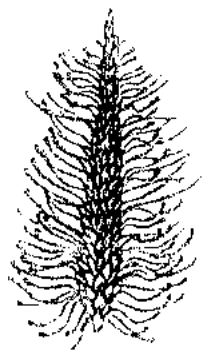
- 1Compact inflorescence showing complete autogamy.
- 2Wind pollinated plant inflorescence showing flowers with well exposed stamens.
- 3Water pollinated flowers showing stamens with mucilaginous covering.
- 4Cleistogamous flowers showing autogamy.
Show answer and solution
Correct: option 2, Wind pollinated plant inflorescence showing flowers with well exposed stamens.
The figure shows the compact inflorescence of a wind-pollinated plant (a grass type), with stamens hanging well out of the flowers so that the light pollen is easily carried away by the wind.
Question 15NEET 2024 Re-exam, Q108
Which part of the ovule stores reserve food materials?
- 1Nucellus
- 2Integument
- 3Placenta
- 4Funicle
Show answer and solution
Correct: option 1, Nucellus
The nucellus is the mass of cells inside the integuments, and its cells hold plenty of reserve food. The integuments are protective coats, the funicle is the stalk of the ovule, and the placenta is the tissue of the ovary to which the ovule is attached.
Question 16NEET 2024 Re-exam, Q112
Pollen grains remain preserved as fossils due to the presence of:
- 1Epidermal layer
- 2Tapetum
- 3Exine layer
- 4Intine layer
Show answer and solution
Correct: option 3, Exine layer
The exine, the outer wall of the pollen grain, is made of sporopollenin. This is one of the most resistant organic materials known: it withstands high temperature, strong acids and alkalis, and no enzyme breaks it down. That is why pollen grains survive as fossils.
Question 17NEET 2024 Re-exam, Q137
The part marked as 'x' in the given figure is
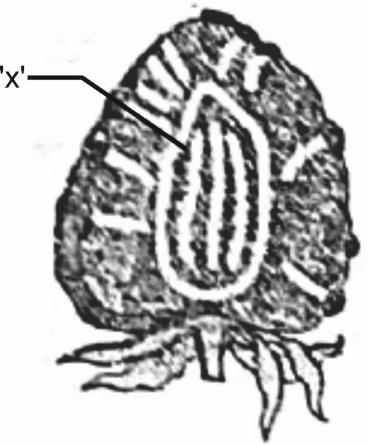
- 1Endosperm
- 2Thalamus
- 3Endocarp
- 4Mesocarp
Show answer and solution
Correct: option 2, Thalamus
The figure shows a false fruit, in which the thalamus, not just the ovary, takes part in forming the fruit, as in strawberry and apple. The fleshy part marked 'x' is the thalamus.
Question 18NEET 2023, Q102
In angiosperm, the haploid, diploid and triploid structures of a fertilized embryo sac sequentially are:
- 1Synergids, Primary endosperm nucleus and zygote
- 2Antipodals, synergids, and primary endosperm nucleus
- 3Synergids, Zygote and Primary endosperm nucleus
- 4Synergids, antipodals and Polar nuclei
Show answer and solution
Correct: option 3, Synergids, Zygote and Primary endosperm nucleus
Synergids (and antipodals) are haploid cells of the embryo sac. The zygote, formed by fusion of one male gamete with the egg, is diploid. The primary endosperm nucleus, formed by fusion of the second male gamete with the two polar nuclei, is triploid. So the order haploid, diploid, triploid is synergids, zygote, primary endosperm nucleus.
Question 19NEET 2023, Q104
Large, colourful, fragrant flowers with nectar are seen in:
- 1insect pollinated plants
- 2bird pollinated plants
- 3bat pollinated plants
- 4wind pollinated plants
Show answer and solution
Correct: option 1, insect pollinated plants
Colour, fragrance and nectar are advertisements and rewards for animals, and the combination of large, colourful, fragrant, nectar-rich flowers is the typical description of insect-pollinated flowers. Wind-pollinated flowers are small, dull and have no nectar.
Question 20NEET 2023, Q130
What is the function of tassels in the corn cob?
- 1To attract insects
- 2To trap pollen grains
- 3To disperse pollen grains
- 4To protect seeds
Show answer and solution
Correct: option 2, To trap pollen grains
The question follows the NCERT sentence that the tassels seen on a corn cob are the stigmas and styles, which wave in the wind to trap pollen grains. Maize is wind pollinated, so these long feathery threads are there to catch pollen.
Question 21NEET 2023 Manipur, Q106
In which of the following sets of families, the pollen grains are viable for months?
- 1Rosaceae, Liliaceae and Poaceae
- 2Leguminosae, Solanaceae and Rosaceae
- 3Solanaceae, Poaceae and Liliaceae
- 4Brassicaceae, Liliaceae and Poaceae
Show answer and solution
Correct: option 2, Leguminosae, Solanaceae and Rosaceae
Pollen of cereals such as rice and wheat (Poaceae) loses viability within about 30 minutes, so any set containing Poaceae is wrong. Pollen of some members of Rosaceae, Leguminosae and Solanaceae stays viable for months. That is option (2).
Question 22NEET 2023 Manipur, Q126
Transfer of pollen grains from anther to stigma of another flower of same plant is known as:
- 1Autogamy
- 2Cleistogamy
- 3Geitonogamy
- 4Xenogamy
Show answer and solution
Correct: option 3, Geitonogamy
Geitonogamy is pollination between two flowers of the same plant; it needs a pollinating agent but is genetically like self-pollination. Autogamy is within the same flower, cleistogamy is autogamy in flowers that never open, and xenogamy is between different plants. So the answer is option (3).
Question 23NEET 2023 Manipur, Q138
In angiosperms the correct sequence of events in formation of female gametophyte in the ovule is
(A) 3 successive free nuclear divisions in functional megaspores.
(B) Degeneration of 3 megaspores.
(C) Meiotic division in megaspore mother cell.
(D) Migration of 3 nuclei towards each pole.
(E) Formation of wall resulting in seven celled embryo sac.
Choose the correct answer from the options given below.
- 1(B), (C), (A), (D), (E)
- 2(C), (B), (A), (D), (E)
- 3(A), (B), (C), (D), (E)
- 4(C), (E), (A), (D), (B)
Show answer and solution
Correct: option 2, (C), (B), (A), (D), (E)
The megaspore mother cell first divides by meiosis into four megaspores (C), and three of them degenerate (B). The nucleus of the one functional megaspore then divides three times without wall formation to give eight nuclei (A). Three nuclei gather at each pole and two polar nuclei stay in the centre (D), and finally walls are laid down to give the 7-celled, 8-nucleate embryo sac (E). The order is (C), (B), (A), (D), (E), option (2).
Question 24NEET 2022, Q117
Identify the incorrect statement related to Pollination:
- 1Moths and butterflies are the most dominant pollinating agents among insects
- 2Pollination by water is quite rare in flowering plants
- 3Pollination by wind is more common amongst abiotic pollination
- 4Flowers produce foul odours to attract flies and beetles to get pollinated
Show answer and solution
Correct: option 1, Moths and butterflies are the most dominant pollinating agents among insects
Among insects, bees are the dominant pollinating agents, not moths and butterflies, so statement (1) is incorrect. The other three are true: water pollination is rare (about 30 genera, mostly monocots), wind is the commoner abiotic agent, and flowers pollinated by flies and beetles give off foul odours.
Question 25NEET 2022, Q121
Given below are two statements:
Statement I:
Cleistogamous flowers are invariably autogamous
Statement II:
Cleistogamy is disadvantageous as there is no chance for cross pollination
In the light of the above statements, choose the correct answer from the options given below:
- 1Statement I is incorrect but Statement II is correct
- 2Both Statement I and Statement II are correct
- 3Both Statement I and Statement II are incorrect
- 4Statement I is correct but Statement II is incorrect
Show answer and solution
Correct: option 2, Both Statement I and Statement II are correct
Cleistogamous flowers never open, so the pollen can only land on the stigma of the same flower: they are invariably autogamous, and Statement I is correct. Because no cross-pollination is possible, there is no new variation and continued selfing can lead to inbreeding depression, which is the disadvantage in Statement II. Both statements are correct.
Question 26NEET 2022, Q136
Which part of the fruit, labelled in the given figure makes it a false fruit?
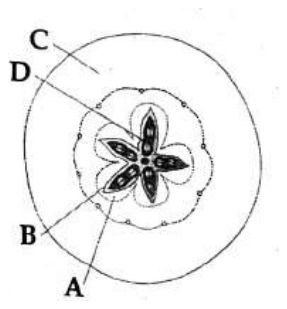
- 1D Seed
- 2A Mesocarp
- 3B Endocarp
- 4C Thalamus
Show answer and solution
Correct: option 4, C Thalamus
A false fruit is one in which a part other than the ovary forms part of the fruit. The figure is a section of an apple, where the fleshy edible part C is the thalamus that has grown around the ovary. That contribution of the thalamus makes it a false fruit.
Question 27NEET 2022 Re-exam, Q119
The residual persistent part which forms the perisperm in the seeds of beet is
- 1Integument
- 2Calyx
- 3Endosperm
- 4Nucellus
Show answer and solution
Correct: option 4, Nucellus
In some seeds, such as black pepper and beet, part of the nucellus is not used up during development and persists in the seed. This residual, persistent nucellus is called the perisperm.
Question 28NEET 2022 Re-exam, Q128
To ensure that only the desired pollens fall on the stigma in artificial hybridization process
(a) the female flower buds of plant producing unisexual flowers need not be bagged.
(b) there is no need to emasculate unisexual flowers of selected female parent
(c) emasculated flowers are to be bagged immediately after cross pollination
(d) emasculated flowers are to be bagged after removal of anthers
(e) bisexual flowers, showing protogyny are never selected for cross
Choose the correct answer from the options given below
- 1(a), (d) and (e) only
- 2(a), (b) and (c) only
- 3(b), (c) and (d) only
- 4(b), (c) and (e) only
Show answer and solution
Correct: option 3, (b), (c) and (d) only
A unisexual female flower has no anthers, so it needs no emasculation (b is correct), but its buds must still be bagged before they open to keep out unwanted pollen (a is wrong). Bisexual flowers are bagged after the anthers are removed (d) and are bagged again after the desired pollen is dusted on the stigma (c). Nothing bars protogynous flowers from being used (e is wrong). So (b), (c) and (d) are correct.
Question 29NEET 2022 Re-exam, Q134
In general the egg apparatus of embryo sac in angiosperm consists of
- 1One egg cell, two synergids, two antipodal cells, two Polar nuclei
- 2One egg cell, two synergids, three antipodal cells, two Polar nuclei
- 3One egg cell, two synergids, two antipodal cells, three Polar nuclei
- 4One egg cell, three synergids, two antipodal cells, two Polar nuclei
Show answer and solution
Correct: option 2, One egg cell, two synergids, three antipodal cells, two Polar nuclei
Strictly, the egg apparatus is the group of one egg cell and two synergids at the micropylar end. The options describe the whole typical embryo sac, which is 7-celled and 8-nucleate: one egg, two synergids, three antipodal cells and a central cell with two polar nuclei. Only option (2) has these numbers.
Question 30NEET 2022 Re-exam, Q150
Which of the following can be expected if scientists succeed in introducing apomictic gene into hybrid varieties of crops?
- 1There will be segregation of the desired characters only in the progeny
- 2Polyembryony will be seen and each seed will produce many plantlets
- 3Seeds of hybrid plants will show longer dormancy
- 4Farmers can keep on using the seeds produced by the hybrids to raise new crop year after year
Show answer and solution
Correct: option 4, Farmers can keep on using the seeds produced by the hybrids to raise new crop year after year
Apomictic seeds form without meiosis and fertilisation, so the progeny are genetically identical to the parent and the hybrid characters do not segregate. Farmers would then not need to buy fresh hybrid seed every year and could keep using the seed from their own hybrid crop.
Question 31NEET 2021, Q102
A typical angiosperm embryo sac at maturity is:
- 18-nucleate and 7-celled
- 27-nucleate and 8-celled
- 37-nucleate and 7-celled
- 48-nucleate and 8-celled
Show answer and solution
Correct: option 1, 8-nucleate and 7-celled
The mature Polygonum-type embryo sac has 3 antipodal cells, 2 synergids and 1 egg cell, each with one nucleus, plus one large central cell holding the 2 polar nuclei. That makes 7 cells and 8 nuclei.
Question 32NEET 2021, Q119
The term used for transfer of pollen grains from anthers of one plant to stigma of a different plant which, during pollination, brings genetically different types of pollen grains to stigma, is:
- 1Xenogamy
- 2Geitonogamy
- 3Chasmogamy
- 4Cleistogamy
Show answer and solution
Correct: option 1, Xenogamy
Xenogamy is pollination between flowers of two different plants, so it is the only type that brings genetically different pollen to the stigma. Geitonogamy is between flowers of the same plant. Chasmogamy and cleistogamy describe open and closed flowers.
Question 33NEET 2021, Q143
In some members of which of the following pairs of families, pollen grains retain their viability for months after release?
- 1Poaceae ; Rosaceae
- 2Poaceae ; Leguminosae
- 3Poaceae ; Solanaceae
- 4Rosaceae ; Leguminosae
Show answer and solution
Correct: option 4, Rosaceae ; Leguminosae
Pollen of some members of Rosaceae, Leguminosae and Solanaceae stays viable for months. Pollen of cereals such as rice and wheat (Poaceae) loses viability within about 30 minutes, so every pair containing Poaceae is ruled out.
Question 34NEET 2020, Q47
In water hyacinth and water lily, pollination takes place by:
- 1insects or wind
- 2water currents only
- 3wind and water
- 4insects and water
Show answer and solution
Correct: option 1, insects or wind
Not every aquatic plant is pollinated by water. In water hyacinth and water lily the flowers come out above the water surface and are pollinated by insects or wind, as in most land plants.
Question 35NEET 2020, Q79
The plant parts which consist of two generations - one within the other:
(a) Pollen grains inside the anther
(b) Germinated pollen grain with two male gametes
(c) Seed inside the fruit
(d) Embryo sac inside the ovule
- 1(a) only
- 2(a), (b) and (c)
- 3(c) and (d)
- 4(a) and (d)
Show answer and solution
Correct: option 4, (a) and (d)
The anther and the ovule belong to the diploid sporophyte, while the pollen grain (male gametophyte) and the embryo sac (female gametophyte) are the haploid gametophyte generation. So pollen grains inside the anther and the embryo sac inside the ovule each show one generation inside the other, which is (a) and (d). A germinated pollen grain with its male gametes is entirely gametophyte.
Question 36NEET 2020, Q102
The body of the ovule is fused within the funicle at:
- 1Hilum
- 2Micropyle
- 3Nucellus
- 4Chalaza
Show answer and solution
Correct: option 1, Hilum
The ovule is attached to the placenta by a stalk called the funicle. The region where the body of the ovule joins the funicle is the hilum.
Question 37NEET 2020 Phase 2, Q23
Which of the following is incorrect for wind-pollinated plants?
- 1Many ovules in each ovary
- 2Flowers are small and not brightly coloured
- 3Pollen grains are light and non-sticky
- 4Well exposed stamens and stigma
Show answer and solution
Correct: option 1, Many ovules in each ovary
Wind-pollinated flowers are small and dull, with light, non-sticky pollen, well-exposed stamens and large feathery stigmas. They usually have a single ovule in each ovary and numerous flowers packed in an inflorescence, so "many ovules in each ovary" is the incorrect feature.
Question 38NEET 2020 Phase 2, Q45
In some plants thalamus contributes to fruit formation. Such fruits are termed as:
- 1Aggregate fruits
- 2True fruits
- 3Parthenocarpic fruit
- 4False fruits
Show answer and solution
Correct: option 4, False fruits
A true fruit develops only from the ovary. When the thalamus also contributes to the fruit, as in apple, strawberry and cashew, the fruit is called a false fruit. Parthenocarpic fruits are those formed without fertilisation.
Question 39NEET 2019, Q111
Which one of the following statements regarding post-fertilization development in flowering plants is incorrect?
- 1Ovary develops into fruit
- 2Zygote develops into embryo
- 3Central cell develops into endosperm
- 4Ovules develop into embryo sac
Show answer and solution
Correct: option 4, Ovules develop into embryo sac
After fertilisation the ovary becomes the fruit, the zygote becomes the embryo and the primary endosperm cell formed from the central cell becomes the endosperm. The ovules develop into seeds; the embryo sac is formed inside the ovule before fertilisation. So statement (4) is incorrect.
Question 40NEET 2019, Q128
Persistent nucellus in the seed is known as:
- 1Chalaza
- 2Perisperm
- 3Hilum
- 4Tegmen
Show answer and solution
Correct: option 2, Perisperm
In some seeds, such as black pepper and beet, remnants of the nucellus persist; this residual nucellus is the perisperm. The chalaza is the basal part of the ovule, the hilum is the scar on the seed and the tegmen is the inner seed coat.
Question 41NEET 2019, Q142
What is the fate of the male gametes discharged in the synergid?
- 1One fuses with the egg, other(s) degenerate(s) in the synergid.
- 2All fuse with the egg.
- 3One fuses with the egg, other(s) fuse(s) with synergid nucleus.
- 4One fuses with the egg and other fuses with central cell nuclei.
Show answer and solution
Correct: option 4, One fuses with the egg and other fuses with central cell nuclei.
The pollen tube releases two male gametes into a synergid. One fuses with the egg to form the zygote (syngamy) and the other fuses with the two polar nuclei of the central cell to form the primary endosperm nucleus (triple fusion). This is double fertilisation.
Question 42NEET 2019 Odisha, Q171
What type of pollination takes place in Vallisneria?
- 1Flowers emerge above water surface, and pollen is carried by wind.
- 2Male flowers are carried by water currents to female flowers at surface of water.
- 3Pollination occurs in submerged condition by water.
- 4Flowers emerge above surface of water, and pollination occurs by insects.
Show answer and solution
Correct: option 2, Male flowers are carried by water currents to female flowers at surface of water.
In Vallisneria the female flower reaches the surface of the water on a long stalk, and the male flowers or pollen grains are released on to the water surface. They are carried passively by the water currents, and some reach the female flowers. This is pollination by water at the surface (epihydrophily).
Question 43NEET 2019 Odisha, Q172
In which one of the following, both autogamy and geitonogamy are prevented?
- 1Castor
- 2Maize
- 3Wheat
- 4Papaya
Show answer and solution
Correct: option 4, Papaya
Papaya is dioecious: male and female flowers are borne on different plants, so pollen can reach neither the same flower (autogamy) nor another flower of the same plant (geitonogamy). Castor and maize are monoecious, which prevents autogamy but not geitonogamy, and wheat has bisexual flowers.
Question 44NEET 2019 Odisha, Q174
Which is the most common type of embryo sac in angiosperms?
- 1Monosporic with two sequential mitotic divisions
- 2Bisporic with two sequential mitotic divisions
- 3Tetrasporic with one mitotic stage of divisions
- 4Monosporic with three sequential mitotic divisions
Show answer and solution
Correct: option 3, Tetrasporic with one mitotic stage of divisions
In most angiosperms only one of the four megaspores stays functional, so the embryo sac develops from a single megaspore (monosporic development, the Polygonum type). Its nucleus divides by three successive mitotic divisions to give 2, then 4, then 8 nuclei, which form the 7-celled, 8-nucleate embryo sac.
Question 45NEET 2018, Q92
- 1Fusion of two male gametes with one egg
- 2Fusion of one male gamete with two polar nuclei
- 3Fusion of two male gametes of a pollen tube with two different eggs
- 4Syngamy and triple fusion
Show answer and solution
Correct: option 4, Syngamy and triple fusion
In flowering plants one male gamete fuses with the egg (syngamy) and the other fuses with the two polar nuclei (triple fusion). Because two fusions take place in the same embryo sac, the event is called double fertilization, so it is syngamy together with triple fusion.
Question 46NEET 2018, Q93
Which one of the following plants shows a very close relationship with a species of moth, where none of the two can complete its life cycle without the other ?
- 1Banana
- 2Yucca
- 3Hydrilla
- 4Viola
Show answer and solution
Correct: option 2, Yucca
Yucca is pollinated only by the moth Pronuba (Tegeticula), and the moth lays its eggs in the ovary of the Yucca flower where its larvae feed on some of the developing seeds. Each depends on the other to complete its life cycle, an obligate mutualism.
Question 47NEET 2018, Q94
Pollen grains can be stored for several years in liquid nitrogen having a temperature of
- 1
- 2
- 3
- 4
Show answer and solution
Correct: option 1,
Liquid nitrogen boils at , and pollen grains are cryopreserved at this temperature in pollen banks, where they stay viable for years.
Question 48NEET 2018, Q110
Which of the following has proved helpful in preserving pollen as fossils ?
- 1Oil content
- 2Cellulosic intine
- 3Pollenkitt
- 4Sporopollenin
Show answer and solution
Correct: option 4, Sporopollenin
The exine of a pollen grain is made of sporopollenin, one of the most resistant organic materials known; it withstands high temperature, strong acids and alkalis, and no enzyme degrades it. This is why pollen grains are well preserved as fossils.
Question 49NEET 2017, Q91
Double fertilization is exhibited by
- 1Gymnosperms
- 2Algae
- 3Fungi
- 4Angiosperms
Show answer and solution
Correct: option 4, Angiosperms
Double fertilization is unique to angiosperms. One male gamete fuses with the egg (syngamy) and the other fuses with the two polar nuclei (triple fusion) inside the embryo sac. Gymnosperms, algae and fungi have only a single fertilization.
Question 50NEET 2017, Q95
Attractants and rewards are required for:
- 1Anemophily
- 2Entomophily
- 3Hydrophily
- 4Cleistogamy
Show answer and solution
Correct: option 2, Entomophily
Insect-pollinated flowers must draw insects to them, so they offer attractants (colour, fragrance) and rewards (nectar, pollen). Wind and water pollination need no animal, and cleistogamous flowers never open.
Question 51NEET 2017, Q107
A dioecious flowering plant prevents both:
- 1Autogamy and xenogamy
- 2Autogamy and geitonogamy
- 3Geitonogamy and xenogamy
- 4Cleistogamy and xenogamy
Show answer and solution
Correct: option 2, Autogamy and geitonogamy
In a dioecious species male and female flowers are on different plants. Pollen can then reach neither the same flower (autogamy) nor another flower of the same plant (geitonogamy); only xenogamy is possible.
Question 52NEET 2017, Q146
Functional megaspore in an angiosperm develops into:
- 1Ovule
- 2Endosperm
- 3Embryo sac
- 4Embryo
Show answer and solution
Correct: option 3, Embryo sac
The one functional megaspore divides by three mitotic divisions to form the female gametophyte, which is the embryo sac (7 cells, 8 nuclei). The embryo comes from the zygote and the endosperm from the primary endosperm nucleus.
Question 53NEET 2017, Q165
The morphological nature of the edible part of coconut is:
- 1Perisperm
- 2Cotyledon
- 3Endosperm
- 4Pericarp
Show answer and solution
Correct: option 3, Endosperm
What is eaten in a coconut is its endosperm: the coconut water is free-nuclear endosperm and the white kernel around it is cellular endosperm.
Question 54NEET 2017, Q180
Flowers which have single ovule in the ovary and are packed into inflorescence are usually pollinated by:
- 1Water
- 2Bee
- 3Wind
- 4Bat
Show answer and solution
Correct: option 3, Wind
Wind-pollinated flowers often have a single ovule in each ovary and many flowers packed into an inflorescence, as in the corn cob and other grasses.
Question 55NEET 2016 Phase 1, Q93
The coconut water from tender coconut represents:
- 1Endocarp
- 2Fleshy mesocarp
- 3Free nuclear proembryo
- 4Free nuclear endosperm
Show answer and solution
Correct: option 4, Free nuclear endosperm
In coconut the primary endosperm nucleus first divides many times without wall formation, giving a liquid with thousands of free nuclei. This free nuclear endosperm is the coconut water; the white kernel around it is the cellular endosperm formed later.
Question 56NEET 2016 Phase 1, Q156
Which one of the following statements is not true?
- 1Tapetum helps in the dehiscence of anther
- 2Exine of pollen grains is made up of sporopollenin
- 3Pollen grains of many species cause severe allergies
- 4Stored pollen in liquid nitrogen can be used in the crop breeding programmes
Show answer and solution
Correct: option 1, Tapetum helps in the dehiscence of anther
The tapetum is the innermost wall layer of the anther and its job is to nourish the developing pollen grains. Dehiscence of the anther is helped by the endothecium, with its fibrous thickenings, so statement (1) is not true. The other three statements are correct.
Question 57NEET 2016 Phase 1, Q162
Cotyledon of maize grain is called:
- 1plumule
- 2coleorhiza
- 3coleoptile
- 4scutellum
Show answer and solution
Correct: option 4, scutellum
In grasses such as maize the single cotyledon is a shield-shaped structure called the scutellum, lying to one side of the embryonal axis. The coleoptile is the sheath over the plumule and the coleorhiza is the sheath over the radicle.
Question 58NEET 2016 Phase 1, Q168
Seed formation without fertilization in flowering plants involves the process of:
- 1Sporulation
- 2Budding
- 3Somatic hybridization
- 4Apomixis
Show answer and solution
Correct: option 4, Apomixis
Apomixis is the production of seeds without fertilisation, as in some grasses and members of Asteraceae; it is a form of asexual reproduction that mimics sexual reproduction. Sporulation and budding do not form seeds, and somatic hybridization is the fusion of protoplasts in the laboratory.
Question 59NEET 2016 Phase 1, Q173
Which of the following statements is not correct?
- 1Pollen grains of many species can germinate on the stigma of a flower, but only one pollen tube of the same species grows into the style.
- 2Insects that consume pollen or nectar without bringing about pollination are called pollen/nectar robbers.
- 3Pollen germination and pollen tube growth are regulated by chemical components of pollen interacting with those of the pistil.
- 4Some reptiles have also been reported as pollinators in some plant species.
Show answer and solution
Correct: option 1, Pollen grains of many species can germinate on the stigma of a flower, but only one pollen tube of the same species grows into the style.
The pistil recognises pollen chemically: only compatible pollen of the right species is allowed to germinate, and many pollen tubes of that species, not just one, grow into the style. So statement (1) is not correct. The other three statements are true; for example, some lizards such as the gecko and the garden lizard are known pollinators.
Question 60NEET 2016 Phase 2, Q117
In majority of angiosperms
- 1egg has a filiform apparatus
- 2there are numerous antipodal cells
- 3reduction division occurs in the megaspore mother cells
- 4a small central cell is present in the embryo sac
Show answer and solution
Correct: option 3, reduction division occurs in the megaspore mother cells
The megaspore mother cell divides by meiosis to give four megaspores, so reduction division takes place there. The filiform apparatus belongs to the synergids, not the egg; there are only three antipodal cells; and the central cell is the largest cell of the embryo sac.
Question 61NEET 2016 Phase 2, Q118
Pollination in water hyacinth and water lily is brought about by the agency of
- 1water
- 2insects or wind
- 3birds
- 4bats
Show answer and solution
Correct: option 2, insects or wind
Not all aquatic plants are pollinated by water. In water hyacinth and water lily the flowers emerge above the water surface and are pollinated by insects or wind, as in most land plants.
Question 62NEET 2016 Phase 2, Q119
The ovule of an angiosperm is technically equivalent to
- 1megasporangium
- 2megasporophyll
- 3megaspore mother cell
- 4megaspore
Show answer and solution
Correct: option 1, megasporangium
The ovule is an integumented megasporangium: its nucellus contains the megaspore mother cell, which forms the megaspores. The megasporophyll corresponds to the carpel.
Question 63AIPMT 2015, Q82
Transmission tissue is characteristic feature of:
- 1Solid style
- 2Dry stigma
- 3Wet stigma
- 4Hollow style
Show answer and solution
Correct: option 1, Solid style
A solid style has no canal; its core is filled with a strand of elongated cells called the transmitting (transmission) tissue, through which the pollen tubes grow. In a hollow style the pollen tubes grow along the lining of the stylar canal instead.
Question 64AIPMT 2015, Q113
Which one of the following may require pollinators, but is genetically similar to autogamy?
- 1Xenogamy
- 2Apogamy
- 3Cleistogamy
- 4Geitonogamy
Show answer and solution
Correct: option 4, Geitonogamy
Geitonogamy is the transfer of pollen to the stigma of another flower of the same plant. It needs a pollinating agent like cross-pollination, but the pollen comes from the same plant, so genetically it is like autogamy.
Question 65AIPMT 2015, Q123
Which one of the following statements is not true?
- 1Pollen grains of some plants cause severe allergies and bronchial afflictions in some people
- 2The flowers pollinated by flies and bats secrete foul odour to attract them
- 3Honey is made by bees by digesting - pollen collected from flowers
- 4Pollen grains are rich in nutrients, and they are used in the form of tablets and syrups
Show answer and solution
Correct: option 3, Honey is made by bees by digesting - pollen collected from flowers
Honey is made by bees from the nectar of flowers, not from pollen. The statements about pollen allergy, foul-smelling flowers pollinated by flies and bats, and pollen tablets used as food supplements are true.
Question 66AIPMT 2015, Q133
Which of the following are the important floral rewards to the animal pollinators?
- 1Nectar and pollen grains
- 2Floral fragrance and calcium crystals
- 3Protein pellicle and stigmatic exudates
- 4Colour and large size flower
Show answer and solution
Correct: option 1, Nectar and pollen grains
Animals visit flowers to collect food, and nectar and pollen grains are the usual rewards. Colour, size and fragrance only attract the visitor; they are not rewards.
Question 67AIPMT 2015 Re-test, Q69
Male gametophyte in angiosperms produces:
- 1Three sperms
- 2Two sperms and a vegetative cell
- 3Single sperm and a vegetative cell
- 4Single sperm and two vegetative cells
Show answer and solution
Correct: option 2, Two sperms and a vegetative cell
The pollen grain is the male gametophyte. Its first division gives a vegetative cell and a generative cell, and the generative cell divides once more into two male gametes. The mature male gametophyte is thus three-celled: two sperms and one vegetative cell.
Question 68AIPMT 2015 Re-test, Q70
Coconut water from a tender coconut is:
- 1Degenerated nucellus
- 2Immature embryo
- 3Free nuclear endosperm
- 4Innermost layers of the seed coat
Show answer and solution
Correct: option 3, Free nuclear endosperm
In coconut the primary endosperm nucleus first divides many times without wall formation. The liquid with thousands of free nuclei is the coconut water, that is, free-nuclear endosperm; the white kernel around it is the cellular endosperm.
Question 69AIPMT 2015 Re-test, Q82
Filiform apparatus is characteristic feature of:
- 1Synergids
- 2Generative cell
- 3Nucellar embryo
- 4Aleurone cell
Show answer and solution
Correct: option 1, Synergids
The synergids of the embryo sac have finger-like cellulosic thickenings at their micropylar tip called the filiform apparatus, which guides the pollen tube into the synergid.
Question 70AIPMT 2015 Re-test, Q84
The wheat grain has an embryo with one large, shield-shaped cotyledon known as:
- 1Coleoptile
- 2Epiblast
- 3Coleorrhiza
- 4Scutellum
Show answer and solution
Correct: option 4, Scutellum
In grass embryos such as wheat, the single shield-shaped cotyledon lying to one side of the embryonal axis is the scutellum. The coleoptile covers the plumule and the coleorrhiza covers the radicle.
Question 71AIPMT 2015 Re-test, Q105
Which one of the following fruits is parthenocarpic?
- 1Banana
- 2Brinjal
- 3Apple
- 4Jackfruit
Show answer and solution
Correct: option 1, Banana
A parthenocarpic fruit develops without fertilisation and is therefore seedless. The cultivated banana is the standard example. Brinjal, apple and jackfruit develop after fertilisation and carry seeds.
Question 72AIPMT 2015 Re-test, Q106
In angiosperms, microsporogenesis and megasporogenesis:
- 1occur in ovule
- 2occur in anther
- 3form gametes without further divisions
- 4Involve meiosis
Show answer and solution
Correct: option 4, Involve meiosis
In microsporogenesis the microspore mother cell in the anther divides by meiosis to give microspores, and in megasporogenesis the megaspore mother cell in the ovule divides by meiosis to give megaspores. They occur in different organs, and the spores must divide further by mitosis to form gametes, so the only common feature is meiosis.
Question 73AIPMT 2014, Q18
- 1fertilization of a flower by the pollen from a flower of another plant belonging to a distant population.
- 2fertilization of a flower by the pollen from another flower of the same plant.
- 3fertilization of a flower by the pollen from the same flower.
- 4fertilization of a flower by the pollen from a flower of another plant in the same population.
Show answer and solution
Correct: option 2, fertilization of a flower by the pollen from another flower of the same plant.
Geitonogamy is the transfer of pollen from the anther to the stigma of another flower of the same plant. Pollen from the same flower is autogamy, and pollen from a different plant is xenogamy.
Question 74AIPMT 2014, Q40
Function of filiform apparatus is to:
- 1Guide the entry of pollen tube
- 2Recognize the suitable pollen at stigma
- 3Stimulate division of generative cell
- 4Produce nectar
Show answer and solution
Correct: option 1, Guide the entry of pollen tube
The filiform apparatus is the set of finger-like cellular thickenings at the micropylar tip of the synergids. It guides the pollen tube into the synergid.
Question 75AIPMT 2014, Q49
Pollen tablets are available in the market for:
- 1Ex situ conservation
- 2In vitro fertilization
- 3Breeding programmes
- 4Supplementing food
Show answer and solution
Correct: option 4, Supplementing food
Pollen grains are rich in nutrients, so pollen tablets and syrups are sold as food supplements. They are claimed to improve the performance of athletes and race horses. They are not used for conservation, fertilization or breeding.
Question 76AIPMT 2014, Q87
Non-albuminous seed is produced in:
- 1Pea
- 2Maize
- 3Castor
- 4Wheat
Show answer and solution
Correct: option 1, Pea
A non-albuminous seed has no endosperm left at maturity because the developing embryo uses it up, as in pea and groundnut. Maize, wheat and castor seeds keep their endosperm and are albuminous.
Question 77NEET 2013, Q47
Perisperm differs from endosperm in:
- 1having no reserve food
- 2being a diploid tissue
- 3its formation by fusion of secondary nucleus with several sperms
- 4being a haploid tissue
Show answer and solution
Correct: option 2, being a diploid tissue
Perisperm is the nucellus that persists in some seeds, such as black pepper and beet. The nucellus is part of the parent sporophyte, so it is diploid. Endosperm in flowering plants comes from triple fusion and is triploid. Both can store food, so the difference is that perisperm is diploid.
Question 78NEET 2013, Q50
Megasporangium is equivalent to:
- 1Fruit
- 2Nucellus
- 3Ovule
- 4Embryo sac
Show answer and solution
Correct: option 3, Ovule
In flowering plants the megasporangium, together with its protective integuments, is called the ovule. The megaspore forms inside it and grows into the embryo sac, which is the female gametophyte. So megasporangium is equivalent to the ovule.
Question 79NEET 2013, Q90
Advantage of cleistogamy is:
- 1More vigorous offspring
- 2No dependence on pollinators
- 3Vivipary
- 4Higher genetic variability
Show answer and solution
Correct: option 2, No dependence on pollinators
Cleistogamous flowers never open, so they always self-pollinate and set seed even when there are no pollinators. Because it is self-pollination, it does not give more variability or more vigorous offspring.
Question 80NEET 2013, Q108
Which one of the following statements is correct?
- 1Sporogenous tissue is haploid
- 2Endothecium produces the microspores
- 3Tapetum nourishes the developing pollen
- 4Hard outer layer of pollen is called intine
Show answer and solution
Correct: option 3, Tapetum nourishes the developing pollen
The tapetum is the innermost wall layer of the anther and feeds the developing pollen grains, so (3) is correct. Sporogenous tissue is diploid and its cells undergo meiosis to give microspores; the endothecium is a wall layer that helps in dehiscence; and the hard outer layer of pollen is the exine, the intine being the thin inner layer.
Question 81NEET 2013 Karnataka, Q83
Animal vectors are required for pollination in:
- 1Vallisneria
- 2Mulberry
- 3Cucumber
- 4Maize
Show answer and solution
Correct: option 3, Cucumber
Cucumber has unisexual flowers that are pollinated by insects such as bees. Vallisneria is pollinated by water, and mulberry and maize by wind.
Question 82NEET 2013 Karnataka, Q89
The viability of seeds is tested by:
- 12, 6 dichlorophenol indophenols
- 22, 3, 5 triphenyl tetrazolium chloride
- 3DMSO
- 4Safranine
Show answer and solution
Correct: option 2, 2, 3, 5 triphenyl tetrazolium chloride
In the tetrazolium test, dehydrogenases of the respiring cells in a living embryo reduce colourless 2,3,5-triphenyl tetrazolium chloride to red formazan. A viable seed stains red and a dead one stays colourless.
Question 83NEET 2013 Karnataka, Q91
Albuminous seeds store their reserve food mainly in:
- 1Endosperm
- 2Cotyledons
- 3Hypocotyl
- 4Perisperm
Show answer and solution
Correct: option 1, Endosperm
An albuminous (endospermic) seed still has its endosperm when mature, as in wheat, maize and castor, and the reserve food lies there. In non-albuminous seeds such as pea the endosperm is used up and the cotyledons hold the food.
Question 84NEET 2013 Karnataka, Q92
Megaspores are produced from the megaspore mother cells after:
- 1Mitotic division
- 2Formation of a thick wall
- 3Differentiation
- 4Meiotic division
Show answer and solution
Correct: option 4, Meiotic division
The megaspore mother cell is diploid and divides by meiosis to give four haploid megaspores. This step is megasporogenesis.
Question 85NEET 2013 Karnataka, Q113
Which one of the following statements is correct?
- 1Cleistogamous flowers are always autogamous
- 2Xenogamy occurs only by wind pollination
- 3Chasmogamous flowers do not open at all
- 4Geitonogamy involves the pollen and stigma of flowers of different plants
Show answer and solution
Correct: option 1, Cleistogamous flowers are always autogamous
Cleistogamous flowers never open, so only their own pollen can reach the stigma and they are always autogamous. Xenogamy can be brought about by any agent, chasmogamous flowers are the open ones, and geitonogamy is between flowers of the same plant.
Question 86NEET 2013 Karnataka, Q116
Which of the following statements is correct?
- 1Sporopollenin can be degraded by enzymes
- 2Sporopollenin is made up of inorganic materials
- 3Sporopollenin can withstand high temperatures as well as strong acids and alkalis
- 4Sporopollenin can withstand high temperatures but not strong acids
Show answer and solution
Correct: option 3, Sporopollenin can withstand high temperatures as well as strong acids and alkalis
Sporopollenin, the material of the pollen exine, is one of the most resistant organic substances known. It withstands high temperatures, strong acids and alkalis, and no enzyme is known to degrade it.
Question 87AIPMT 2012 Prelims, Q76
Both, autogamy and geitonogamy are prevented in -
- 1Papaya
- 2Cucumber
- 3Castor
- 4Maize
Show answer and solution
Correct: option 1, Papaya
Papaya is dioecious: male and female flowers are on different plants, so pollen can come only from another plant and both autogamy and geitonogamy are prevented. Cucumber, castor and maize are monoecious, which prevents autogamy but not geitonogamy.
Question 88AIPMT 2012 Prelims, Q82
An organic substance that can withstand environmental extremes and cannot be degraded by any enzyme is:
- 1Cuticle
- 2Sporopollenin
- 3Lignin
- 4Cellulose
Show answer and solution
Correct: option 2, Sporopollenin
Sporopollenin forms the exine, the outer wall of the pollen grain. It withstands high temperature, strong acids and alkali, and no enzyme is known that degrades it, which is why pollen is preserved so well as fossils.
Question 89AIPMT 2012 Prelims, Q129
Even in absence of pollinating agents seed setting is assured in
- 1Commelina
- 2Zostera
- 3Salvia
- 4Fig
Show answer and solution
Correct: option 1, Commelina
Commelina produces cleistogamous flowers, which never open, in addition to its normal open flowers. In a closed flower the anthers and stigma lie close together, so self-pollination and seed set are certain even without any pollinator. Zostera depends on water, and Salvia and fig depend on insects.
Question 90AIPMT 2012 Prelims, Q146
The coconut water and the edible part of coconut are equivalent to:
- 1Endosperm
- 2Endocarp
- 3Mesocarp
- 4Embryo
Show answer and solution
Correct: option 1, Endosperm
In coconut the endosperm first develops as free nuclei floating in liquid (the coconut water, a free-nuclear endosperm) and later lays down cell walls to form the white kernel (cellular endosperm). Both parts are therefore endosperm. The mesocarp is the fibrous husk and the endocarp is the hard shell.
Question 91AIPMT 2012 Mains, Q78
What is the function of germ pore?
- 1Emergence of radicle
- 2Absorption of water for seed germination
- 3Initiation of pollen tube
- 4Release of male gametes
Show answer and solution
Correct: option 3, Initiation of pollen tube
Germ pores are the spots on a pollen grain where the tough exine is absent. When the pollen germinates on the stigma, the intine pushes out through a germ pore to form the pollen tube.
Question 92AIPMT 2012 Mains, Q79
Which one of the following statements is wrong?
- 1When pollen is shed at two-celled stage, double fertilization does not take place.
- 2Vegetative cell is larger than generative cell.
- 3Pollen grains in some plants remain viable for months.
- 4Intine is made up of cellulose and pectin.
Show answer and solution
Correct: option 1, When pollen is shed at two-celled stage, double fertilization does not take place.
In over 60 per cent of flowering plants the pollen is shed at the two-celled stage; the generative cell then divides in the pollen tube to give the two male gametes, and double fertilization takes place as usual. Statement (1) is therefore wrong. The other three statements are correct.
Question 93AIPMT 2012 Mains, Q80
Plants with ovaries having only one or a few ovules, are generally pollinated by:
- 1Bees
- 2Butterflies
- 3Birds
- 4Wind
Show answer and solution
Correct: option 4, Wind
Wind pollination is a matter of chance, and only a few pollen grains reach a stigma. Wind-pollinated flowers usually have a single ovule in each ovary and many flowers packed in an inflorescence, as in the grasses.
Question 94AIPMT 2011 Prelims, Q52
'Filiform apparatus' is a characteristic feature of:
- 1Suspensor
- 2Egg
- 3Synergid
- 4Zygote
Show answer and solution
Correct: option 3, Synergid
The synergids of the embryo sac have finger-like cellular thickenings at their micropylar tip called the filiform apparatus. It guides the pollen tube into the synergid.
Question 95AIPMT 2011 Prelims, Q70
Nucellar polyembryony is reported in species
- 1Citrus
- 2Gossypium
- 3Triticum
- 4Brassica
Show answer and solution
Correct: option 1, Citrus
In Citrus (and mango) some nucellar cells around the embryo sac divide, push into the embryo sac and grow into embryos, so one seed has several embryos.
Question 96AIPMT 2011 Prelims, Q75
In which one of the following pollination is autogamous
- 1Geitonogamy
- 2Xenogamy
- 3Chasmogamy
- 4Cleistogamy
Show answer and solution
Correct: option 4, Cleistogamy
Cleistogamous flowers never open, so pollen can only reach the stigma of the same flower: pollination is always autogamous. Geitonogamy and xenogamy involve another flower, and chasmogamous (open) flowers may be cross-pollinated.
Question 97AIPMT 2011 Prelims, Q101
What would be the number of chromosome of the aleurone cells of a plant with 42 chromosomes in its root tip cells?
- 142
- 263
- 384
- 421
Show answer and solution
Correct: option 2, 63
Root tip cells are diploid, so and . The aleurone layer is the outer layer of the endosperm, which is triploid in angiosperms because it forms from the fusion of one male gamete with two polar nuclei. Its cells therefore have chromosomes.
Question 98AIPMT 2011 Prelims, Q137
Wind pollination is common in:
- 1Legumes
- 2Lilies
- 3Grasses
- 4Orchids
Show answer and solution
Correct: option 3, Grasses
Wind pollination is quite common in grasses. Their flowers are small and not showy, the pollen is light and produced in large amounts, the stamens are well exposed and the stigmas are large and feathery to trap pollen from the air. Legumes, lilies and orchids are mostly insect pollinated.
Question 99AIPMT 2011 Mains, Q66
In angiosperms, Functional megaspore develops into
- 1Embryo sac
- 2Ovule
- 3Endosperm
- 4Pollen sac
Show answer and solution
Correct: option 1, Embryo sac
Of the four megaspores formed by meiosis, one stays functional. Its nucleus divides by mitosis three times to give the 8-nucleate, 7-celled embryo sac, which is the female gametophyte. The ovule is the structure that contains the megaspore, and the endosperm forms only after fertilisation.
Question 100AIPMT 2011 Mains, Q68
What is common between vegetative reproduction and Apomixis
- 1Both are applicable to only dicot plants
- 2Both bypass the flowering phase
- 3Both occur round the year
- 4Both produces progeny identical to the parent
Show answer and solution
Correct: option 4, Both produces progeny identical to the parent
Neither process involves meiosis and fusion of gametes, so the offspring carry the same genes as the parent and are clones. Apomixis makes seeds without fertilisation, so it still needs flowers, which rules out bypassing the flowering phase. Both occur in monocots as well as dicots.
Question 101AIPMT 2010 Prelims, Q101
Apomictic embryos in citrus arise from:
- 1Maternal sporophytic tissue in ovule
- 2Antipodal cells
- 3Diploid egg
- 4Synergids
Show answer and solution
Correct: option 1, Maternal sporophytic tissue in ovule
In Citrus, some cells of the nucellus that surround the embryo sac start dividing, push into the embryo sac and grow into embryos without fertilisation. The nucellus is diploid tissue of the mother plant (sporophyte) inside the ovule, so these apomictic embryos come from maternal sporophytic tissue. Antipodals and synergids are haploid cells of the gametophyte and are not the source.
Question 102AIPMT 2010 Prelims, Q181
Transfer of pollen grains from the anther to the stigma of another flower of the same plant is called
- 1Geitonogamy
- 2Karyogamy
- 3Autogamy
- 4Xenogamy
Show answer and solution
Correct: option 1, Geitonogamy
Autogamy is pollination within the same flower, geitonogamy is between two flowers of the same plant, and xenogamy is between flowers of two different plants. Karyogamy is the fusion of nuclei. The case described is geitonogamy.
Question 103AIPMT 2010 Prelims, Q191
Wind pollinated flowers are
- 1Small, producing large number of dry pollen grains
- 2Large producing abundant nectar and pollen
- 3Small, producing nectar and dry pollen
- 4Small, brightly coloured, producing large number of pollen grains
Show answer and solution
Correct: option 1, Small, producing large number of dry pollen grains
Wind-pollinated flowers do not need to attract animals, so they are small, not brightly coloured and have no nectar. They make very large numbers of light, dry, non-sticky pollen grains because most of them are lost in the air.
Question 104AIPMT 2009 Prelims, Q146
An example of a seed with endosperm, perisperm, and caruncle is:
- 1coffee
- 2lily
- 3castor
- 4cotton
Show answer and solution
Correct: option 3, castor
The castor seed is endospermic, keeps a thin remnant of nucellus as perisperm, and has a caruncle, a spongy outgrowth at the micropylar end. Of the plants listed, castor is the one that has the caruncle.
Question 105AIPMT 2008 Prelims, Q138
Endosperm is consumed by developing embryo in the seed of
- 1Maize
- 2Coconut
- 3Castor
- 4Pea
Show answer and solution
Correct: option 4, Pea
Pea seeds are non-endospermic: the growing embryo uses up the endosperm and the food is stored in the cotyledons. Maize, coconut and castor seeds keep their endosperm when mature.
Question 106AIPMT 2008 Prelims, Q159
Which one of the following is resistant to enzyme action?
- 1Leaf cuticle
- 2Cork
- 3Wood fibre
- 4Pollen exine
Show answer and solution
Correct: option 4, Pollen exine
The exine of a pollen grain is made of sporopollenin, one of the most resistant organic materials known. No enzyme is known to degrade it, which is why pollen is well preserved as fossils.
Question 107AIPMT 2008 Prelims, Q161
Which one of the following pairs of plant structures has haploid number of chromosomes?
- 1Egg nucleus and secondary nucleus
- 2Megaspore mother cell and antipodal cells
- 3Egg cell and antipodal cells
- 4Nucellus and antipodal cells
Show answer and solution
Correct: option 3, Egg cell and antipodal cells
The egg cell and the antipodal cells are cells of the embryo sac, which develops from a haploid megaspore, so both are haploid. The secondary nucleus (fused polar nuclei), the megaspore mother cell and the nucellus are diploid.
Question 108AIPMT 2008 Prelims, Q162
What does the filiform apparatus do at the entrance into ovule?
- 1It guides pollen tube from a synergid to egg
- 2It helps in the entry of pollen tube into a synergid
- 3It prevents entry of more than one pollen tube into the embryosac
- 4It brings about opening of the pollen tube
Show answer and solution
Correct: option 2, It helps in the entry of pollen tube into a synergid
The filiform apparatus is the set of finger-like wall thickenings at the micropylar tip of the synergids. It guides the pollen tube into a synergid.
Question 109AIPMT 2008 Prelims, Q163
Unisexuality of flowers prevents
- 1Autogamy and geitonogamy
- 2Autogamy, but not geitonogamy
- 3Both geitonogamy and xenogamy
- 4Geitonogamy, but not xenogamy
Show answer and solution
Correct: option 2, Autogamy, but not geitonogamy
A unisexual flower has only stamens or only a pistil, so pollination within the same flower (autogamy) is impossible. If male and female flowers are on the same plant, pollen can still pass between flowers of that plant, so geitonogamy is not prevented.
Question 110AIPMT 2007 Prelims, Q43
Male gametes in angiosperms are formed by the division of:
- 1Microspore mother cell
- 2Microspore
- 3Generative cell
- 4Vegetative cell
Show answer and solution
Correct: option 3, Generative cell
The microspore divides into a large vegetative (tube) cell and a small generative cell. The generative cell then divides by mitosis to give the two male gametes.
Question 111AIPMT 2007 Prelims, Q47
Which one of the following is surrounded by a callose wall?
- 1Pollen grain
- 2Microspore mother cell
- 3Male gamete
- 4Egg
Show answer and solution
Correct: option 2, Microspore mother cell
Before meiosis each microspore (pollen) mother cell lays down a thick wall of callose, which isolates it from its neighbours. The callose is later dissolved by callase to free the microspores.
Question 112AIPMT 2006 Prelims, Q101
What would be the number of chromosomes in the cells of the aleurone layer in a plant species with 8 chromosomes in its synergids?
- 116
- 224
- 332
- 48
Show answer and solution
Correct: option 2, 24
Synergids are haploid cells of the embryo sac, so n = 8. The aleurone layer is the outer layer of the endosperm, which is triploid (3n) because it forms from the fusion of two polar nuclei with one male gamete. So its cells have 3 × 8 = 24 chromosomes.
Question 113AIPMT 2006 Prelims, Q189
The arrangement of the nuclei in a normal embryo sac in the dicot plants is
- 12 + 4 + 2
- 23 + 2 + 3
- 32 + 3 + 3
- 43 + 3 + 2
Show answer and solution
Correct: option 2, 3 + 2 + 3
The usual (Polygonum type) embryo sac has 8 nuclei in 7 cells: three at the micropylar end forming the egg apparatus (one egg and two synergids), two polar nuclei in the central cell, and three antipodals at the chalazal end. That is 3 + 2 + 3.
Question 114AIPMT 2006 Prelims, Q191
In a cereal grain the single cotyledon of embryo is represented by
- 1Coleorhiza
- 2Scutellum
- 3Prophyll
- 4Coleoptile
Show answer and solution
Correct: option 2, Scutellum
In grasses and cereals the single cotyledon is a shield-shaped structure called the scutellum, lying to one side of the embryonal axis. The coleoptile is the sheath covering the plumule and the coleorhiza is the sheath covering the radicle.
Question 115AIPMT 2005 Prelims, Q112
Through which cell of the embryo sac, does the pollen tube enter the embryo sac
- 1Persistent synergid
- 2Egg cell
- 3Central cell
- 4Degenerated synergid
Show answer and solution
Correct: option 4, Degenerated synergid
The pollen tube enters the embryo sac at the micropylar end, guided by the filiform apparatus, and grows into one of the two synergids. That synergid degenerates as the tube enters and discharges the male gametes into it, so entry is through the degenerated synergid.
Question 116AIPMT 2005 Prelims, Q115
In a type of apomixis known as adventive embryony, embryos develop directly from the
- 1Synergids or antipodals in an embryo sac
- 2Nucellus or integuments
- 3Zygote
- 4Accessory embryo sacs in the ovule
Show answer and solution
Correct: option 2, Nucellus or integuments
In adventive embryony the embryo arises directly from diploid sporophytic cells of the ovule that lie outside the embryo sac, namely the nucellus or the integuments, as in Citrus and mango. No gamete or embryo sac cell is involved.
Question 117AIPMT 2005 Prelims, Q153
Which one of the following represents an ovule, where the embryo sac becomes horse-shoe shaped and the funiculus and micropyle are close to each other
- 1Amphitropous
- 2Anatropous
- 3Circinotropous
- 4Atropous
Show answer and solution
Correct: option 1, Amphitropous
In an amphitropous ovule the body is curved so strongly that the embryo sac itself bends into a horse-shoe shape, and the micropyle comes to lie near the funiculus. In an anatropous ovule the micropyle is also near the funiculus but the embryo sac stays straight. An atropous ovule is straight with the micropyle opposite the funiculus, and in a circinotropous ovule the long funiculus coils around the ovule.
Question 118AIPMT 2004 Prelims, Q112
Anthesis is a phenomenon which refers to -
- 1formation of pollen
- 2Development of anther
- 3Opening of flower bud
- 4Reception of pollen by stigma
Show answer and solution
Correct: option 3, Opening of flower bud
Anthesis is the opening of the flower bud, the stage at which the flower becomes functional and its anthers and stigma are exposed for pollination.
Question 119AIPMT 2004 Prelims, Q135
An ovule which becomes curved so that the nucellus and embryo sac lie at right angles to the funicle is :-
- 1Campylotropous
- 2Anatropous
- 3Orthotropous
- 4Hemitropous
Show answer and solution
Correct: option 4, Hemitropous
In a hemitropous (hemianatropous) ovule the body is turned through 90°, so the nucellus and embryo sac lie at right angles to the funicle. An orthotropous ovule is straight, an anatropous one is turned through 180°, and in a campylotropous ovule the body itself is bent.
Question 120AIPMT 2004 Prelims, Q200
When a diploid female plant is crossed with a tetraploid male, the ploidy of endosperm cells in the resulting seed is:-
- 1Pentaploidy
- 2Diploidy
- 3Triploidy
- 4Tetraploidy
Show answer and solution
Correct: option 4, Tetraploidy
Endosperm forms when one male gamete fuses with the two polar nuclei. In the diploid female each polar nucleus is n, together 2n. The male gamete of the tetraploid (4n) plant is 2n. So the endosperm is 2n + 2n = 4n, tetraploid.
Question 121AIPMT 2003 Prelims, Q163
In a flowering plant, archesporium gives rise to:-
- 1Only the wall of the sporangium
- 2Both wall and the sporogenous cells
- 3Wall and the tapetum
- 4Only tapetum and sporogenous cells
Show answer and solution
Correct: option 2, Both wall and the sporogenous cells
In an anther the archesporial cells divide periclinally into outer primary parietal cells and inner primary sporogenous cells. The parietal cells build the wall layers (including the tapetum) and the sporogenous cells form the microspore mother cells, so the archesporium gives both the wall and the sporogenous tissue.
Question 122AIPMT 2002 Prelims, Q142
Which of the following is without exception in Angiosperms:-
- 1Presence of vessels
- 2Double fertilisation
- 3Secondary growth
- 4Autotrophic nutrition
Show answer and solution
Correct: option 2, Double fertilisation
Double fertilisation, in which one male gamete fuses with the egg and the other with the polar nuclei, occurs in all angiosperms. The other features have exceptions: a few angiosperms lack vessels, most monocots have no secondary growth, and parasites such as Cuscuta are not autotrophic.
Question 123AIPMT 2002 Prelims, Q150
In Angiosperms pollen tube liberate their male gametes into the:-
- 1Central cell
- 2Antipodal cells
- 3Egg cell
- 4Synergids
Show answer and solution
Correct: option 4, Synergids
The pollen tube enters the embryo sac through the filiform apparatus of one of the synergids and bursts inside that synergid, releasing the two male gametes there. One gamete then moves to the egg and the other to the central cell for double fertilisation.
Question 124AIPMT 2002 Prelims, Q152
What is the direction of micropyle in anatropous ovule:-
- 1Upward
- 2Downward
- 3Right
- 4Left
Show answer and solution
Correct: option 2, Downward
An anatropous ovule is turned through 180 degrees, so the body is inverted and the micropyle comes to lie close to the funicle and hilum, pointing downward towards the placenta.
Question 125AIPMT 2002 Prelims, Q155
In Angiosperm all the four microspores of tetrad are covered by a layer which is formed by:-
- 1Pectocellulose
- 2Callose
- 3Cellulose
- 4Sporopollenin
Show answer and solution
Correct: option 2, Callose
The four microspores of a tetrad are held together inside a common wall of callose (a glucan). The enzyme callase from the tapetum later dissolves it to free the microspores. Sporopollenin forms the exine of each individual pollen grain, not the common layer.
Question 126AIPMT 2001 Prelims, Q122
Anemophily type of pollination is found in
- 1Salvia
- 2Bottle brush
- 3Vallisneria
- 4Coconut
Show answer and solution
Correct: option 4, Coconut
Anemophily is pollination by wind. Coconut produces a large amount of light, dry pollen that is carried by wind. Salvia is pollinated by insects, bottle brush by birds and Vallisneria by water.
Question 127AIPMT 2001 Prelims, Q138
In grasses what happens in micro spore mother cell for the formation of mature pollen grains:-
- 1One meiotic and two mitotic divisions
- 2One meiotic & one mitotic divisions
- 3One meiotic division
- 4One mitotic division
Show answer and solution
Correct: option 1, One meiotic and two mitotic divisions
The microspore mother cell divides by meiosis to give four microspores. In grasses the pollen is shed at the three-celled stage: one mitosis gives the vegetative and generative cells, and a second mitosis of the generative cell gives two male gametes. So there is one meiotic and two mitotic divisions.
Question 128AIPMT 2001 Prelims, Q140
Adventive embryony in citrus is due to:-
- 1Nucellus
- 2Integuments
- 3Zygotic embryo
- 4Fertilized egg
Show answer and solution
Correct: option 1, Nucellus
In Citrus some diploid cells of the nucellus around the embryo sac start dividing, push into the embryo sac and grow into extra embryos. This adventive embryony is why a citrus seed often has many embryos.
Question 129AIPMT 2000 Prelims, Q116
Eight nucleated embryosac is a:
- 1Only monosporic
- 2Only bisporic
- 3Only tetra sporic
- 4Any of the above
Show answer and solution
Correct: option 4, Any of the above
An eight-nucleate embryo sac can arise from one megaspore (monosporic, Polygonum type), from two megaspore nuclei (bisporic, Allium type) or from all four (tetrasporic, Adoxa type). So the eight-nucleate condition is not limited to any one type.
Question 130AIPMT 2000 Prelims, Q120
Endosperm is formed during the double fertilization by:
- 1Two polar nuclei & one male gamete
- 2One polar nuclei & one male gamete
- 3Ovum and male gamete
- 4Two polar nuclei & two male gametes
Show answer and solution
Correct: option 1, Two polar nuclei & one male gamete
In double fertilisation one male gamete fuses with the egg to form the zygote. The other male gamete fuses with the two polar nuclei (triple fusion) to give the triploid primary endosperm nucleus, which develops into the endosperm.
Question 131AIPMT 1999 Prelims, Q121
Ornithophily takes place in:
- 1Yellow flower having nectaries
- 2Scented flower
- 3Flower with charming colour
- 4Modified corolla tube
Show answer and solution
Correct: option 1, Yellow flower having nectaries
Ornithophily is pollination by birds. Birds have a poor sense of smell and visit flowers for nectar, so bird-pollinated flowers are brightly coloured, scentless and rich in nectar. The key takes the option that names both the bright colour and the nectaries, option (1).
Question 132AIPMT 1998 Prelims, Q179
Embryo of sunflower have:
- 1Two cotyledons
- 2One cotyledons
- 3Eight cotyledons
- 4Cotyledons absent
Show answer and solution
Correct: option 1, Two cotyledons
Sunflower (Helianthus) is a dicotyledonous plant, so its embryo has two cotyledons.
Question 133AIPMT 1998 Prelims, Q191
A male insect mistakes a flower of orchid to be its female due to shape and perform the act of copulation and induce pollination. This is an example of:
- 1Mimicry
- 2Pseudo copulation
- 3Pseudo pollination
- 4None
Show answer and solution
Correct: option 1, Mimicry
In the orchid Ophrys the flower looks like the female of a bee or wasp; this resemblance is mimicry, the answer given by the key used here. The male's attempt to mate with the flower, during which it carries the pollen, is called pseudocopulation.