Questions with solutions
Question 1NEET 2026, Q98
Which of the following statements are not true regarding restriction endonucleases?
A. They are called molecular scissors.
B. These are the enzymes responsible for restricting the growth of bacteriophages in E. coli.
C. They cut the DNA only at the centre of the palindromic sites.
D. They remove nucleotides only from the ends of DNA fragments.
E. They recognise specific palindromic base-pair sequences.
Choose the answer from the options given below:
- 1A and B only
- 2D and E only
- 3C and D only
- 4A and E only
Show answer and solution
Correct: option 3, C and D only
C and D are not true. Restriction endonucleases cut each strand a little away from the centre of the palindromic site, which is how sticky ends arise, so they do not cut only at the centre. Removing nucleotides from the ends of DNA is the work of exonucleases. A, B and E are true descriptions.
Question 2NEET 2026, Q110
Match List I with List II:
| List I | List II |
|---|
| A. Genetically modified organism | I. Agrobacterium tumefaciens |
| B. Thermostable DNA polymerase | II. Bt cotton |
| C. Ti plasmid | III. Thermus aquaticus |
| D. pBR322 | IV. Escherichia coli |
Choose the correct answer from the options given below:
- 1A-II, B-I, C-IV, D-III
- 2A-I, B-IV, C-III, D-II
- 3A-II, B-III, C-I, D-IV
- 4A-I, B-II, C-IV, D-III
Show answer and solution
Correct: option 3, A-II, B-III, C-I, D-IV
Bt cotton is a genetically modified organism (A-II). The thermostable Taq DNA polymerase used in PCR comes from Thermus aquaticus (B-III). The Ti (tumour inducing) plasmid belongs to Agrobacterium tumefaciens (C-I). pBR322 is a cloning vector of Escherichia coli (D-IV).
Question 3NEET 2026, Q119
Identify the correct sequence of steps in each cycle of Polymerase Chain Reaction:
- 1Denaturation Annealing Extension
- 2Denaturation Extension Annealing
- 3Extension Annealing Denaturation
- 4Annealing Denaturation Extension
Show answer and solution
Correct: option 1, Denaturation Annealing Extension
Each PCR cycle starts with denaturation, where heat separates the two DNA strands. Primers then anneal to the single strands, and finally the thermostable DNA polymerase extends the primers. The order is denaturation, annealing, extension.
Question 4NEET 2026, Q120
Which of the following statements are correct with respect to DNA separation, isolation and visualization?
A. The cutting of DNA is done by molecular scissors.
B. The DNA fragments separate according to their size in an agarose gel, upon electrophoresis.
C. The separated DNA fragments can be seen without staining when exposed to UV light.
D. The separated DNA fragments, when stained with ethidium bromide, can be seen in visible light.
Choose the correct answer from the options given below:
- 1A and D only
- 2B and D only
- 3B and C only
- 4A and B only
Show answer and solution
Correct: option 4, A and B only
A and B are correct: restriction enzymes (molecular scissors) cut DNA, and the fragments separate by size through the sieving effect of the agarose gel. C and D are wrong because DNA fragments are seen only after staining with ethidium bromide followed by exposure to UV light, where they appear as bright orange bands.
Question 5NEET 2026, Q136
Insertion of a foreign DNA at BamHI site in an E. coli cloning vector pBR322 results in the loss of antibiotic resistance towards:
- 1Gentamycin
- 2Ampicillin and tetracycline
- 3Tetracycline
- 4Ampicillin
Show answer and solution
Correct: option 3, Tetracycline
In pBR322 the BamHI site lies inside the tetracycline resistance gene. A foreign DNA inserted there interrupts that gene (insertional inactivation), so the recombinant loses tetracycline resistance but stays resistant to ampicillin.
Question 6NEET 2026 Re-exam, Q162
During PCR, primers bind to the DNA strands in the __________ step.
- 1denaturation
- 2extension
- 3annealing
- 4ligation
Show answer and solution
Correct: option 3, annealing
Each PCR cycle has three steps. Denaturation separates the two DNA strands, annealing is the step in which the primers bind to the complementary ends of the single strands, and extension is the step in which Taq polymerase adds nucleotides. Ligation is not a PCR step.
Question 7NEET 2026 Re-exam, Q168
Given below are two statements:
Statement I:
Plasmids are autonomously replicating DNA.
Statement II:
Plasmids are extrachromosomal DNA.
In the light of the above statements, choose the most appropriate answer from the options given below:
- 1Both Statement I and Statement II are correct
- 2Both Statement I and Statement II are incorrect
- 3Statement I is correct but Statement II is incorrect
- 4Statement I is incorrect but Statement II is correct
Show answer and solution
Correct: option 1, Both Statement I and Statement II are correct
A plasmid is a small circular DNA molecule that lies outside the bacterial chromosome and replicates on its own, independent of the chromosomal DNA. Both statements are correct.
Question 8NEET 2026 Re-exam, Q176
Given below are two statements: one is labelled as Assertion A and the other is labelled as Reason R.
Assertion A: In recombinant DNA technology, lysozyme is used for disrupting bacterial cells while cellulase is for plant cells.
Reason R: Isolation of genetic material needs disruption of cells.
In the light of the above statements, choose the most appropriate answer from the options given below:
- 1Both A and R are correct and R is the correct explanation of A
- 2Both A and R are correct but R is not the correct explanation of A
- 3A is correct but R is not correct
- 4A is not correct but R is correct
Show answer and solution
Correct: option 1, Both A and R are correct and R is the correct explanation of A
DNA sits inside the cell, so the cell has to be broken open to release it. Lysozyme breaks the bacterial cell wall and cellulase breaks the plant cell wall (chitinase is used for fungi). Both are correct, and the need to break the cells open is why these enzymes are used.
Question 9NEET 2026 Re-exam, Q180
Match List-I with List-II.
| List-I | List-II |
|---|
| A. Transformation | I. Restriction enzyme |
| B. Cloning site | II. Transfer DNA to host bacteria |
| C. Selection | III. Replication |
| D. Ori | IV. Antibiotic |
Choose the correct answer from the options given below:
- 1A-II, B-I, C-IV, D-III
- 2A-I, B-II, C-IV, D-III
- 3A-III, B-IV, C-II, D-I
- 4A-IV, B-I, C-III, D-II
Show answer and solution
Correct: option 1, A-II, B-I, C-IV, D-III
Transformation is the uptake of DNA by host bacteria (II). A cloning site is a recognition site for a restriction enzyme (I). Antibiotic resistance genes serve as selectable markers (IV). Ori is the sequence where replication starts (III). So A-II, B-I, C-IV, D-III.
Question 10NEET 2025, Q92
Polymerase chain reaction (PCR) amplifies DNA following the equation.
- 1
- 2
- 3
- 4
Show answer and solution
Correct: option 2,
Each PCR cycle (denaturation, annealing, extension) doubles the number of copies of the target DNA. After cycles one molecule gives copies, so the amplification is exponential.
Question 11NEET 2025, Q115
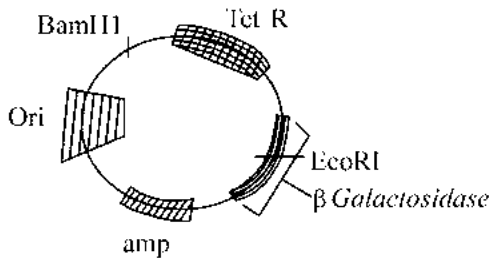
In the above represented plasmid an alien piece of DNA is inserted at EcoRI site. Which of the following strategies will be chosen to select the recombinant colonies?
- 1Using ampicillin & tetracyclin containing medium plate.
- 2Blue color colonies will be selected.
- 3White color colonies will be selected.
- 4Blue color colonies grown on ampicillin plates can be selected.
Show answer and solution
Correct: option 3, White color colonies will be selected.
The EcoRI site lies inside the gene for β-galactosidase, so inserting the foreign DNA there inactivates that gene (insertional inactivation). On a medium with a chromogenic substrate, colonies with an intact gene turn blue, while recombinant colonies cannot make the enzyme and stay white. So the white colonies are selected.
Question 12NEET 2025, Q126
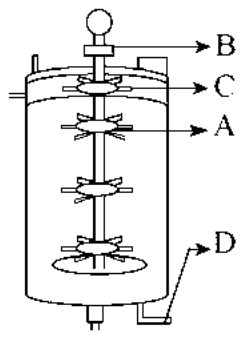
Identify the part of a bio-reactor which is used as a foam breaker from the given figure.
- 1A
- 2B
- 3D
- 4C
Show answer and solution
Correct: option 4, C
In a simple stirred-tank bioreactor the foam breaker is the flat paddle fixed on the stirrer shaft at the top, just above the surface of the culture, labelled C. The blades lower down on the shaft (A) are the impellers that mix the contents, B is at the top of the shaft outside the vessel, and D is the pipe at the bottom of the vessel.
Question 13NEET 2025, Q136
Given below are two statements:
Statement I: The DNA fragments extracted from gel electrophoresis can be used in construction of recombinant DNA.
Statement II: Smaller size DNA fragments are observed near anode while larger fragments are found near the wells in an agarose gel.
In the light of the above statements, choose the most appropriate answer from the options given below:
- 1Both statement I and statement II are correct
- 2Both statement I and statement II are incorrect
- 3Statement I is correct but statement II is incorrect
- 4Statement I is incorrect but statement II is correct
Show answer and solution
Correct: option 1, Both statement I and statement II are correct
Both statements are correct. Bands cut out of the gel and eluted give purified DNA fragments that are joined to a vector to make recombinant DNA. DNA is negatively charged and moves towards the anode; the gel acts as a sieve, so small fragments travel farthest (near the anode) and large ones stay close to the wells.
Question 14NEET 2025, Q172
Which of the following enzyme(s) are NOT essential for gene cloning?
A. Restriction enzymes
B. DNA ligase
C. DNA mutase
D. DNA recombinase
E. DNA polymerase
Choose the correct answer from the options given below:
- 1C and D only
- 2A and B only
- 3D and E only
- 4B and C only
Show answer and solution
Correct: option 1, C and D only
Gene cloning needs restriction enzymes to cut the DNA, DNA ligase to join the insert to the vector, and DNA polymerase to copy the DNA (in PCR and in the host). A mutase and a recombinase are not part of the standard cloning procedure, so C and D are not essential.
Question 15NEET 2025, Q179
The blue and white selectable markers have been developed which differentiate recombinant colonies from non-recombinant colonies on the basis of their ability to produce colour in the presence of a chromogenic substrate.
Given below are two statements about this method:
Statement I: The blue coloured colonies have DNA insert in the plasmid and they are identified as recombinant colonies.
Statement II: The colonies without blue colour have DNA insert in the plasmid and are identified as recombinant colonies.
In the light of the above statements, choose the most appropriate answer from the options given below:
- 1Both Statement I and Statement II are correct
- 2Both Statement I and Statement II are incorrect
- 3Statement I is correct but Statement II is incorrect
- 4Statement I is incorrect but Statement II is correct
Show answer and solution
Correct: option 4, Statement I is incorrect but Statement II is correct
The foreign DNA is inserted within the gene for -galactosidase, which inactivates the enzyme (insertional inactivation). Colonies with the insert cannot act on the chromogenic substrate and stay colourless; colonies without an insert turn blue. So Statement I is incorrect and Statement II is correct.
Question 16NEET 2024, Q121
What is the fate of a piece of DNA carrying only gene of interest which is transferred into an alien organism?
A. The piece of DNA would be able to multiply itself independently in the progeny cells of the organism.
B. It may get integrated into the genome of the recipient.
C. It may multiply and be inherited along with the host DNA.
D. The alien piece of DNA is not an integral part of chromosome.
E. It shows ability to replicate.
Choose the correct answer from the options given below:
- 1A and E only
- 2A and B only
- 3D and E only
- 4B and C only
Show answer and solution
Correct: option 4, B and C only
A piece of DNA that carries only the gene of interest has no origin of replication, so it cannot multiply by itself in the progeny cells (A and E are wrong). It may, however, get integrated into the genome of the recipient, and then it multiplies and is inherited along with the host DNA. So B and C are correct.
Question 17NEET 2024, Q131
Hind II always cuts DNA molecules at a particular point called recognition sequence and it consists of:
- 110 bp
- 28 bp
- 36 bp
- 44 bp
Show answer and solution
Correct: option 3, 6 bp
Hind II, the first restriction endonuclease to be isolated, always cuts DNA at a specific recognition sequence that is six base pairs long.
Question 18NEET 2024, Q164
The "Ti plasmid" of Agrobacterium tumefaciens stands for
- 1Temperature independent plasmid
- 2Tumour inhibiting plasmid
- 3Tumor independent plasmid
- 4Tumor inducing plasmid
Show answer and solution
Correct: option 4, Tumor inducing plasmid
Agrobacterium tumefaciens causes crown gall tumours in dicot plants by transferring a piece of DNA (T-DNA) from its plasmid into the plant cell. The plasmid is therefore called the tumor inducing (Ti) plasmid; a disarmed form of it is used as a cloning vector.
Question 19NEET 2024, Q177
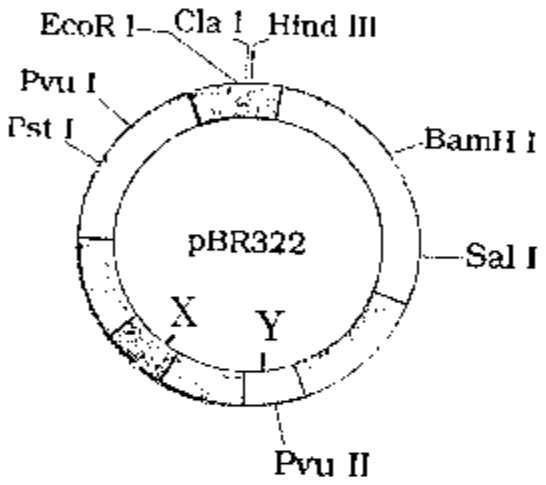
The following diagram showing restriction sites in E.coli cloning vector pBR322. Find the role of 'X' and 'Y' genes:
- 1Gene 'X' is responsible for recognition sites and 'Y' is responsible for antibiotic resistance.
- 2The gene 'X' is responsible for resistance to antibiotics and 'Y' for protein involved in the replication of Plasmid.
- 3The gene 'X' is responsible for controlling the copy number of the linked DNA and 'Y' for protein involved in the replication of Plasmid.
- 4The gene 'X' is for protein involved in replication of Plasmid and 'Y' for resistance to antibiotics.
Show answer and solution
Correct: option 3, The gene 'X' is responsible for controlling the copy number of the linked DNA and 'Y' for protein involved in the replication of Plasmid.
In the textbook map of pBR322 the two unlabelled regions at the bottom are ori and rop. X is ori, the origin of replication, which also controls the copy number of the linked DNA. Y is rop, which codes for the proteins involved in the replication of the plasmid. The antibiotic resistance genes ( and ) lie elsewhere, around the Pst I, Pvu I, BamH I and Sal I sites.
Question 20NEET 2024, Q183
Which of the following statements is incorrect?
- 1Bio-reactors have an agitator system, an oxygen delivery system and foam control system.
- 2A bio-reactor provides optimal growth conditions for achieving the desired product.
- 3Most commonly used bio-reactors are of stirring type.
- 4Bio-reactors are used to produce small scale bacterial cultures.
Show answer and solution
Correct: option 4, Bio-reactors are used to produce small scale bacterial cultures.
Small volumes of culture are grown in the laboratory in flasks. Bioreactors are used to process large volumes (100 to 1000 litres) of culture, so the statement about small scale cultures is incorrect. The other three statements describe a bioreactor correctly.
Question 21NEET 2024 Re-exam, Q103
In a chromosome, there is a specific DNA sequence, responsible for initiating replication. It is called as:
- 1Recognition sequence
- 2Cloning site
- 3Restriction site
- 4ori site
Show answer and solution
Correct: option 4, ori site
Replication starts at a fixed sequence called the origin of replication, or ori. Any DNA joined to it is copied inside the host cell. A recognition or restriction site is where a restriction enzyme cuts, and a cloning site is where foreign DNA is inserted.
Question 22NEET 2024 Re-exam, Q134
Identify the incorrect statement related to gel electrophoresis.
- 1Separated DNA fragments can be directly seen under UV radiation
- 2Separated DNA can be extracted from gel piece
- 3Fragment of DNA moves toward anode
- 4Sieving effect of agarose gel helps in separation of DNA fragments
Show answer and solution
Correct: option 1, Separated DNA fragments can be directly seen under UV radiation
DNA fragments in a gel cannot be seen directly, even under UV. They must first be stained with ethidium bromide, after which they show as bright orange bands in UV light. The other statements are true: DNA is negatively charged and moves to the anode, the gel sieves fragments by size, and the bands can be cut out and the DNA extracted (elution).
Question 23NEET 2024 Re-exam, Q142
Recombinant DNA molecule can be created normally by cutting the vector DNA and source DNA respectively with:
- 1Hind II, Hind II
- 2Hind II, Alu I
- 3Hind II, EcoR I
- 4Hind II, BamHI
Show answer and solution
Correct: option 1, Hind II, Hind II
The vector and the source DNA are normally cut with the same restriction enzyme. The cut ends of the two are then of the same kind and can be joined by DNA ligase. Only option (1) uses the same enzyme for both.
Question 24NEET 2024 Re-exam, Q162
Select the restriction endonuclease enzymes whose restriction sites are present for the tetracycline resistance () gene in the pBR322 cloning vector.
- 1Bam HI and Sal I
- 2Sal I and Pst I
- 3Pst I and Pvu I
- 4Pvu I and Bam HI
Show answer and solution
Correct: option 1, Bam HI and Sal I
In pBR322 the sites for BamH I and Sal I lie inside the tetracycline resistance gene. The sites for Pst I and Pvu I lie inside the ampicillin resistance gene. So the pair for the tetracycline resistance gene is BamH I and Sal I.
Question 25NEET 2024 Re-exam, Q173
Which of the following are correct about EcoR1?
A. Cut the DNA with blunt end
B. Cut the DNA with sticky end
C. Recognise a specific palindromic sequence
D. Cut the DNA between the base G and A when encounters the DNA sequence ‘GAATTC’
E. Exonuclease
Choose the correct answer from the options given below:
- 1B, C, E only
- 2A, D, E only
- 3A, C, D only
- 4B, C, D only
Show answer and solution
Correct: option 4, B, C, D only
EcoRI is a restriction endonuclease: it cuts inside the DNA, not from the ends, so E is wrong. It recognises the palindromic sequence GAATTC (C) and cuts each strand between G and A (D). Because the two cuts are a little away from the centre of the palindrome, overhanging single-stranded sticky ends are left (B), not blunt ends. So B, C and D are correct.
Question 26NEET 2024 Re-exam, Q190
Following are the steps involved in the process of PCR.
a. Annealing
b. Amplification (~1 billion times)
c. Denaturation
d. Treatment with Taq polymerase and deoxynucleotides
e. Extension
Choose the correct sequence of steps of PCR from the options given below:
- 1
- 2
- 3
- 4
Show answer and solution
Correct: option 1,
Each PCR cycle begins with denaturation, where heat separates the two strands of the DNA. The primers then anneal to the single strands. Taq polymerase uses the deoxynucleotides to extend the primers. Repeating the cycle many times amplifies the DNA about a billion times. The order is c, a, d, e, b.
Question 27NEET 2023, Q108
Upon exposure to UV radiation, DNA stained with ethidium bromide will show
- 1Bright red colour
- 2Bright blue colour
- 3Bright yellow colour
- 4Bright orange colour
Show answer and solution
Correct: option 4, Bright orange colour
After gel electrophoresis the DNA fragments are stained with ethidium bromide, which sits between the bases and fluoresces under UV light, so the DNA is seen as bright orange bands.
Question 28NEET 2023, Q128
During the purification process for recombinant DNA technology, addition of chilled ethanol precipitates out
- 1RNA
- 2DNA
- 3Histones
- 4Polysaccharides
Show answer and solution
Correct: option 2, DNA
When DNA is isolated, RNA is removed with ribonuclease and proteins with protease. The purified DNA is finally precipitated by adding chilled ethanol and is seen as fine threads that can be spooled out.
Question 29NEET 2023, Q132
In gene gun method used to introduce alien DNA into host cells, microparticles of __________ metal are used.
- 1Copper
- 2Zinc
- 3Tungsten or gold
- 4Silver
Show answer and solution
Correct: option 3, Tungsten or gold
In the biolistic or gene gun method, plant cells are bombarded with high velocity microparticles of gold or tungsten coated with DNA.
Question 30NEET 2023, Q150
Main steps in the formation of Recombinant DNA are given below. Arrange these steps in a correct sequence.
A. Insertion of recombinant DNA into the host cell.
B. Cutting of DNA at specific location by restriction enzyme.
C. Isolation of desired DNA fragment.
D. Amplification of gene of interest using PCR.
Choose the correct answer from the options given below:
- 1B, C, D, A
- 2C, A, B, D
- 3C, B, D, A
- 4B, D, A, C
Show answer and solution
Correct: option 1 or 3
The answer key accepts options 1 and 3.
The DNA is cut at specific locations by a restriction enzyme, the desired fragment is isolated (by gel electrophoresis), the gene of interest is amplified by PCR, and the recombinant DNA is finally inserted into the host cell: B, C, D, A. The official key also accepts C, B, D, A, reading step C as isolation of the DNA before it is cut, so options (1) and (3) are both marked correct.
Question 31NEET 2023, Q185
Which of the following is not a cloning vector?
- 1BAC
- 2YAC
- 3pBR322
- 4Probe
Show answer and solution
Correct: option 4, Probe
BAC (bacterial artificial chromosome), YAC (yeast artificial chromosome) and the plasmid pBR322 are all vectors used to carry and clone foreign DNA. A probe is a labelled single-stranded piece of DNA or RNA used to find a complementary sequence; it is not a vector. So option (4) is the answer.
Question 32NEET 2023 Manipur, Q103
Ligation of foreign DNA at which of the following site will result in loss of tetracycline resistance of pBR322?
- 1EcoR I
- 2BamH I
- 3Pst I
- 4Pvu I
Show answer and solution
Correct: option 2, BamH I
In pBR322 the BamH I site lies inside the tetracycline resistance gene, so inserting foreign DNA there inactivates that gene (insertional inactivation). Pst I and Pvu I lie in the ampicillin resistance gene, and EcoR I lies outside both resistance genes. So the answer is BamH I, option (2).
Question 33NEET 2023 Manipur, Q122
Thermostable DNA polymerase used in PCR was isolated from:
- 1Agrobacterium tumefaciens
- 2Bacillus thuringiensis
- 3Thermus aquaticus
- 4Escherichia coli
Show answer and solution
Correct: option 3, Thermus aquaticus
PCR needs a polymerase that survives the high temperature of the denaturation step. Taq polymerase, isolated from the hot-spring bacterium Thermus aquaticus, stays active at these temperatures. So the answer is option (3).
Question 34NEET 2023 Manipur, Q139
Match List-I with List-II.
| List-I | List-II |
|---|
| (A) Kanamycin | (I) Delivers genes into animal cells |
| (B) ClaI | (II) Selectable marker |
| (C) Disarmed retroviruses | (III) Restriction site |
| (D) Kanamycin gene | (IV) Antibiotic resistance |
Choose the correct answer from the options given below.
- 1A-IV, B-III, C-I, D-II
- 2A-II, B-IV, C-I, D-III
- 3A-II, B-III, C-I, D-IV
- 4A-III, B-I, C-IV, D-II
Show answer and solution
Correct: option 3, A-II, B-III, C-I, D-IV
ClaI is a restriction enzyme site in vectors such as pBR322 (B-III), and disarmed retroviruses are used as vectors to deliver genes into animal cells (C-I); only options (1) and (3) have both. The key gives option (3), which pairs the kanamycin resistance gene with antibiotic resistance (D-IV) and kanamycin, the antibiotic used for selecting transformants, with selectable marker (A-II).
Question 35NEET 2023 Manipur, Q145
Which of the following statement is incorrect about Agrobacterium tumefaciens?
- 1It transforms normal plant cells into tumorous cells.
- 2It delivers 'T-DNA' into plant cell.
- 3It is used to deliver gene of interest in both prokaryotic as well as eukaryotic host cells.
- 4'' plasmid from Agrobacterium tumefaciens used for gene transfer is not pathogenic to plant cells.
Show answer and solution
Correct: option 3, It is used to deliver gene of interest in both prokaryotic as well as eukaryotic host cells.
Agrobacterium tumefaciens is a pathogen of dicot plants: it delivers its T-DNA into plant cells and turns them into tumour cells, and the disarmed Ti plasmid used as a vector is no longer pathogenic. It is a natural vector for plant (eukaryotic) cells only, not for prokaryotic hosts, so statement (3) is the incorrect one.
Question 36NEET 2023 Manipur, Q158
Which of the following can act as molecular scissors?
- 1RNA polymerase
- 2DNA polymerase
- 3Restriction enzymes
- 4DNA ligase
Show answer and solution
Correct: option 3, Restriction enzymes
Restriction enzymes (restriction endonucleases) cut DNA at specific recognition sequences, which is why they are called molecular scissors. The polymerases build nucleic acid chains and DNA ligase joins DNA fragments.
Question 37NEET 2022, Q107
Given below are two statements: one is labelled as Assertion (A) and the other is labelled as Reason (R).
Assertion (A):
Polymerase chain reaction is used in DNA amplification
Reason (R):
The ampicillin resistant gene is used as a selectable marker to check transformation
In the light of the above statements, choose the correct answer from the options given below:
- 1(A) is not correct but (R) is correct
- 2Both (A) and (R) are correct and (R) is the correct explanation of (A)
- 3Both (A) and (R) are correct but (R) is not the correct explanation of (A)
- 4(A) is correct but (R) is not correct
Show answer and solution
Correct: option 3, Both (A) and (R) are correct but (R) is not the correct explanation of (A)
PCR makes many copies of a DNA segment in vitro, so the assertion is true. An ampicillin resistance gene in a vector is indeed a selectable marker that separates transformants from non-transformants, so the reason is also true. The reason has nothing to do with how PCR amplifies DNA, so it does not explain the assertion.
Question 38NEET 2022, Q111
Which one of the following statement is not true regarding gel electrophoresis technique?
- 1Bright orange coloured bands of DNA can be observed in the gel when exposed to UV light.
- 2The process of extraction of separated DNA strands from gel is called elution.
- 3The separated DNA fragments are stained by using ethidium bromide.
- 4The presence of chromogenic substrate gives blue coloured DNA bands on the gel.
Show answer and solution
Correct: option 4, The presence of chromogenic substrate gives blue coloured DNA bands on the gel.
In gel electrophoresis the separated DNA is stained with ethidium bromide and seen as bright orange bands under UV light, and the bands are then cut out and the DNA extracted by elution. A chromogenic substrate giving a blue colour is used to pick recombinant colonies (insertional inactivation of beta-galactosidase), not to see DNA bands on a gel. So statement (4) is not true.
Question 39NEET 2022, Q145
In the following palindromic base sequences of DNA, which one can be cut easily by particular restriction enzyme?
- 15' GTATTC 3'; 3' CATAAG 5'
- 25' GATACT 3'; 3' CTATGA 5'
- 35' GAATTC 3'; 3' CTTAAG 5'
- 45' CTCAGT 3'; 3' GAGTCA 5'
Show answer and solution
Correct: option 3, 5' GAATTC 3'; 3' CTTAAG 5'
A palindromic sequence reads the same on both strands when each is read in the 5' to 3' direction. Only 5' GAATTC 3' with 3' CTTAAG 5' satisfies this: the lower strand read 5' to 3' is also GAATTC. It is the recognition site of EcoRI. The other three pairs are not palindromes.
Question 40NEET 2022, Q154
Given below are two statements:
Statement I: Restriction endonucleases recognise specific sequence to cut DNA known as palindromic nucleotide sequence.
Statement II: Restriction endonucleases cut the DNA strand a little away from the centre of the palindromic site.
In the light of the above statements, choose the most appropriate answer from the options given below:
- 1Statement I is incorrect but Statement II is correct
- 2Both Statement I and Statement II are correct
- 3Both Statement I and Statement II are incorrect
- 4Statement I is correct but Statement II is incorrect
Show answer and solution
Correct: option 2, Both Statement I and Statement II are correct
Restriction endonucleases recognise palindromic nucleotide sequences, so Statement I is correct. They cut each strand a little away from the centre of the palindrome, between the same two bases on the opposite strands, which leaves sticky ends, so Statement II is also correct.
Question 41NEET 2022, Q196
Which of the following is not a desirable feature of a cloning vector?
- 1Presence of two or more recognition sites
- 2Presence of origin of replication
- 3Presence of a marker gene
- 4Presence of single restriction enzyme site
Show answer and solution
Correct: option 1, Presence of two or more recognition sites
A cloning vector should have an origin of replication, a selectable marker and a single recognition site for the commonly used restriction enzymes. Two or more recognition sites for the same enzyme would cut the vector into several fragments and complicate cloning, so that is not desirable.
Question 42NEET 2022 Re-exam, Q103
Given below are two statements: one is labelled as Assertion (A) and the other is labelled as Reason (R).
Assertion (A): When a particular restriction enzyme cuts strand of DNA, overhanging stretches or sticky ends are formed.
Reason (R): Some restriction enzymes cut the strand of DNA a little away from the centre of palindromic site.
In the light of the above statements, choose the correct answer from the options given below:
- 1(A) is not correct but (R) is correct
- 2Both (A) and (R) are correct and (R) is the correct explanation of (A)
- 3Both (A) and (R) are correct but (R) is not the correct explanation of (A)
- 4(A) is correct but (R) is not correct
Show answer and solution
Correct: option 2, Both (A) and (R) are correct and (R) is the correct explanation of (A)
Restriction enzymes such as EcoRI cut each strand a little away from the centre of the palindromic site, between the same two bases on the opposite strands. This staggered cut leaves single-stranded overhanging stretches called sticky ends. Both statements are correct and the Reason is exactly why the sticky ends form.
Question 43NEET 2022 Re-exam, Q133
Separation of DNA fragments is done by a technique known as
- 1Gel electrophoresis
- 2Polymerase Chain Reaction
- 3Recombinant technology
- 4Southern blotting
Show answer and solution
Correct: option 1, Gel electrophoresis
DNA fragments are negatively charged, so in gel electrophoresis they move towards the anode through an agarose gel and separate by size, the smaller fragments travelling farther. PCR amplifies DNA and Southern blotting transfers fragments that are already separated.
Question 44NEET 2022 Re-exam, Q144
The enzyme (a) is needed for isolating genetic material from plant cells and enzyme (b) for isolating genetic material from fungus. Choose the correct pair of options from the following:
- 1(a) Cellulase (b) Lipase
- 2(a) Cellulase (b) Protease
- 3(a) Cellulase (b) Chitinase
- 4(a) Chitinase (b) Lipase
Show answer and solution
Correct: option 3, (a) Cellulase (b) Chitinase
To release DNA the cell wall must first be broken. The plant cell wall is made of cellulose, so cellulase is used; the fungal cell wall is made of chitin, so chitinase is used. Lysozyme does the same job for bacteria.
Question 45NEET 2022 Re-exam, Q149
Match List-I with List-II:
| List-I | List-II |
|---|
| (a) Gene gun | (i) Replacement of a faulty gene by a normal healthy gene |
| (b) Gene therapy | (ii) Used for transfer of gene |
| (c) Gene cloning | (iii) Total DNA in the cells of an organism |
| (d) Genome | (iv) To obtain identical copies of a particular DNA molecule |
Choose the correct answer from the options given below:
- 1a-ii, b-iii, c-iv, d-i
- 2a-ii, b-i, c-iv, d-iii
- 3a-i, b-iii, c-ii, d-iv
- 4a-iv, b-i, c-iii, d-ii
Show answer and solution
Correct: option 2, a-ii, b-i, c-iv, d-iii
A gene gun (biolistics) is used to transfer genes into plant cells (ii). Gene therapy replaces or compensates for a faulty gene with a normal healthy gene (i). Gene cloning makes many identical copies of a particular DNA molecule (iv). The genome is the total DNA in the cells of an organism (iii).
Question 46NEET 2022 Re-exam, Q183
Which of the following methods is not commonly used for introducing foreign DNA into the plant cell?
- 1Bacteriophages
- 2Agrobacterium mediated transformation
- 3Gene gun
- 4‘Disarmed pathogen’ vectors
Show answer and solution
Correct: option 1, Bacteriophages
Bacteriophages infect bacteria, not plant cells, so they are not used for plants. Plant cells are transformed with the gene gun (biolistics) or with disarmed pathogen vectors such as the Ti plasmid of Agrobacterium.
Question 47NEET 2022 Re-exam, Q198
Refer to the following statements for agarose-gel electrophoresis:
(a) Agarose is a natural polymer obtained from sea-weed.
(b) The separation of DNA molecules in agarose-gel electrophoresis depends on the size of DNA.
(c) The DNA migrates from negatively-charged electrode to the positively-charged electrode
(d) The DNA migrates from positively-charged electrode to the negatively-charged electrode.
Choose the most appropriate answer from the options given below:
- 1(b), (c) and (d) only
- 2(a) and (b) only
- 3(a), (b) and (c) only
- 4(a), (b) and (d) only
Show answer and solution
Correct: option 3, (a), (b) and (c) only
Agarose is a natural polymer extracted from sea weeds, and the gel separates DNA fragments by size, the smaller ones moving farther: (a) and (b) are correct. DNA is negatively charged, so it moves from the negative electrode towards the positive electrode (anode): (c) is correct and (d) is wrong.
Question 48NEET 2021, Q118
DNA strands on a gel stained with ethidium bromide when viewed under UV radiation, appear as:
- 1Yellow bands
- 2Bright orange bands
- 3Dark red bands
- 4Bright blue bands
Show answer and solution
Correct: option 2, Bright orange bands
DNA fragments separated by gel electrophoresis cannot be seen directly. After staining with ethidium bromide and exposure to UV light they show up as bright orange bands.
Question 49NEET 2021, Q127
Which of the following is a correct sequence of steps in a PCR (Polymerase Chain Reaction)?
- 1Denaturation, Annealing, Extension
- 2Denaturation, Extension, Annealing
- 3Extension, Denaturation, Annealing
- 4Annealing, Denaturation, Extension
Show answer and solution
Correct: option 1, Denaturation, Annealing, Extension
Each PCR cycle first separates the two DNA strands by heat (denaturation), then lets the primers bind to them (annealing), and then Taq polymerase extends the primers (extension).
Question 50NEET 2021, Q130
During the purification process for recombinant DNA technology, addition of chilled ethanol precipitates out:
- 1RNA
- 2DNA
- 3Histones
- 4Polysaccharides
Show answer and solution
Correct: option 2, DNA
After the cell is broken open and RNA and proteins are removed with enzymes, chilled ethanol is added. The purified DNA precipitates and is seen as fine threads that can be spooled out.
Question 51NEET 2021, Q132
Which of the following is not an application of PCR (Polymerase Chain Reaction)?
- 1Molecular diagnosis
- 2Gene amplification
- 3Purification of isolated protein
- 4Detection of gene mutation
Show answer and solution
Correct: option 3, Purification of isolated protein
PCR makes many copies of a DNA segment, so it is used for gene amplification, for molecular diagnosis and for detecting mutations. It acts only on nucleic acid and has no role in purifying a protein.
Question 52NEET 2021, Q150
Plasmid pBR322 has PstI restriction enzyme site within gene that confers ampicillin resistance. If this enzyme is used for inserting a gene for β-galactoside production and the recombinant plasmid is inserted in an E.coli strain
- 1it will not be able to confer ampicillin resistance to the host cell.
- 2the transformed cells will have the ability to resist ampicillin as well as produce β-galactoside.
- 3it will lead to lysis of host cell.
- 4it will be able to produce a novel protein with dual ability.
Show answer and solution
Correct: option 1, it will not be able to confer ampicillin resistance to the host cell.
Cutting with PstI and inserting foreign DNA at that site breaks the gene. This insertional inactivation means the recombinant plasmid can no longer make its host resistant to ampicillin.
Question 53NEET 2021, Q168
During the process of gene amplification using PCR, if very high temperature is not maintained in the beginning, then which of the following steps of PCR will be affected first?
- 1Annealing
- 2Extension
- 3Denaturation
- 4Ligation
Show answer and solution
Correct: option 3, Denaturation
Each PCR cycle starts with denaturation, in which a high temperature (about 94 °C) separates the two strands of the DNA. Without that temperature the strands do not separate, so denaturation is the first step affected, and annealing and extension cannot follow.
Question 54NEET 2021, Q185
A specific recognition sequence identified by endonucleases to make cuts at specific positions within the DNA is:
- 1Degenerate primer sequence
- 2Okazaki sequences
- 3Palindromic Nucleotide sequences
- 4Poly(A) tail sequences
Show answer and solution
Correct: option 3, Palindromic Nucleotide sequences
Each restriction endonuclease recognises a specific palindromic nucleotide sequence, one that reads the same on both strands in the 5′ to 3′ direction (GAATTC for EcoRI), and cuts the DNA within it.
Question 55NEET 2020, Q84
In gel electrophoresis, separated DNA fragments can be visualized with the help of:
- 1Acetocarmine in bright blue light
- 2Ethidium bromide in UV radiation
- 3Acetocarmine in UV radiation
- 4Ethidium bromide in infrared radiation
Show answer and solution
Correct: option 2, Ethidium bromide in UV radiation
DNA fragments on an agarose gel cannot be seen in visible light without staining. The gel is stained with ethidium bromide and exposed to UV radiation, and the DNA then shows up as bright orange bands.
Question 56NEET 2020, Q90
Choose the correct pair from the following:
- 1Ligases - Join the two DNA molecules
- 2Polymerases - Break the DNA into fragments
- 3Nucleases - Separate the two strands of DNA
- 4Exonucleases - Make cuts at specific positions within DNA
Show answer and solution
Correct: option 1, Ligases - Join the two DNA molecules
DNA ligases join two DNA molecules or fragments by sealing their ends, so pair (1) is correct. Polymerases build DNA, nucleases cut DNA (helicase separates the strands), and exonucleases remove nucleotides from the ends; cuts at specific positions inside DNA are made by endonucleases.
Question 57NEET 2020, Q105
Identify the wrong statement with regard to Restriction Enzymes.
- 1Each restriction enzyme functions by inspecting the length of a DNA sequence.
- 2They cut the strand of DNA at palindromic sites.
- 3They are useful in genetic engineering.
- 4Sticky ends can be joined by using DNA ligases.
Show answer and solution
Correct: option 4, Sticky ends can be joined by using DNA ligases.
The official answer key gives option (4). Statements (1), (2) and (3) follow the NCERT description of restriction enzymes: each enzyme inspects the length of a DNA sequence, binds at its specific palindromic recognition site and cuts both strands there, which makes these enzymes a basic tool of genetic engineering. Statement (4) is the only one that is not about what a restriction enzyme does, since the joining is done by a different enzyme, DNA ligase. Note that the statement itself is true (sticky ends are joined by DNA ligase), so this key is open to question.
Question 58NEET 2020, Q109
The specific palindromic sequence which is recognized by EcoRI is:
- 15' - GAATTC - 3'
3' - CTTAAG - 5'
- 25' - GGAACC - 3'
3' - CCTTGG - 5'
- 35' - CTTAAG - 3'
3' - GAATTC - 5'
- 45' - GGATCC - 3'
3' - CCTAGG - 5'
Show answer and solution
Correct: option 1, 5' - GAATTC - 3'
3' - CTTAAG - 5'
EcoRI recognizes the palindrome 5'-GAATTC-3' (3'-CTTAAG-5' on the other strand) and cuts each strand between G and A, leaving sticky ends. Option (2) is not a palindrome, option (3) is the sequence written the wrong way round, and option (4) is the site of BamHI.
Question 59NEET 2020, Q116
The sequence that controls the copy number of the linked DNA in the vector, is termed:
- 1Selectable marker
- 2Ori site
- 3Palindromic sequence
- 4Recognition site
Show answer and solution
Correct: option 2, Ori site
The origin of replication (ori) is the sequence where replication starts, and any DNA linked to it replicates in the host cell. It also controls the copy number of the linked DNA.
Question 60NEET 2020, Q117
Match the organism with its use in biotechnology.
| |
|---|
| (a) Bacillus thuringiensis | (i) Cloning vector |
| (b) Thermus aquaticus | (ii) Construction of first rDNA molecule |
| (c) Agrobacterium tumefaciens | (iii) DNA polymerase |
| (d) Salmonella typhimurium | (iv) Cry proteins |
Select the correct option from the following:
- 1a-ii, b-iv, c-iii, d-i
- 2a-iv, b-iii, c-i, d-ii
- 3a-iii, b-ii, c-iv, d-i
- 4a-iii, b-iv, c-i, d-ii
Show answer and solution
Correct: option 2, a-iv, b-iii, c-i, d-ii
Bacillus thuringiensis produces Cry proteins (iv). Thermus aquaticus is the source of the heat-stable DNA polymerase used in PCR (iii). The Ti plasmid of Agrobacterium tumefaciens is used as a cloning vector for plants (i). The first recombinant DNA molecule was made using a plasmid of Salmonella typhimurium (ii). This is a-iv, b-iii, c-i, d-ii.
Question 61NEET 2020 Phase 2, Q17
First discovered restriction endonuclease that always cuts DNA molecule at a particular point by recognising a specific sequence of six base pairs is:
- 1Adenosine deaminase
- 2Thermostable DNA polymerase
- 3Hind II
- 4EcoR I
Show answer and solution
Correct: option 3, Hind II
Hind II was the first restriction endonuclease to be isolated and characterised; it always cuts DNA at a particular point by recognising a specific sequence of six base pairs. EcoR I was discovered later, and the other two options are not restriction enzymes.
Question 62NEET 2020 Phase 2, Q31
In a mixture, DNA fragments are separated by
- 1Restriction digestion
- 2Electrophoresis
- 3Polymerase chain reaction
- 4Bioprocess engineering
Show answer and solution
Correct: option 2, Electrophoresis
DNA fragments are negatively charged and move towards the anode through an agarose gel, the smaller fragments travelling farther; this gel electrophoresis separates them by size. Restriction digestion produces the fragments and PCR amplifies them, but neither separates a mixture.
Question 63NEET 2020 Phase 2, Q32
In Recombinant DNA technology antibiotics are used:
- 1to detect alien DNA
- 2to impart disease-resistance to the host plant
- 3as selectable markers
- 4to keep medium bacteria-free
Show answer and solution
Correct: option 3, as selectable markers
Cloning vectors carry genes for resistance to antibiotics such as ampicillin or tetracycline. Growing the cells on a medium with the antibiotic lets only transformants survive, so the antibiotics work with these genes as selectable markers to pick out transformed cells from non-transformed ones.
Question 64NEET 2020 Phase 2, Q39
Match the following techniques or instruments with their usage:
| |
|---|
| (a) Bioreactor | (i) Separation of DNA fragments |
| (b) Electrophoresis | (ii) Production of large quantities of products |
| (c) PCR | (iii) Detection of pathogen, based on antigen - antibody reaction |
| (d) ELISA | (iv) Amplification of nucleic acids |
Select the correct option from following:
- 1a-ii, b-i, c-iv, d-iii
- 2a-iv, b-iii, c-ii, d-i
- 3a-ii, b-i, c-iii, d-iv
- 4a-iii, b-ii, c-iv, d-i
Show answer and solution
Correct: option 1, a-ii, b-i, c-iv, d-iii
A bioreactor is a large vessel for producing large quantities of products (a-ii). Electrophoresis separates DNA fragments by size (b-i). PCR amplifies nucleic acids (c-iv). ELISA detects a pathogen through the antigen-antibody reaction (d-iii).
Question 65NEET 2020 Phase 2, Q46
- 1Cutting of separated DNA bands from the agarose gel
- 2Transfer of separated DNA fragments to synthetic membranes
- 3Collection of isolated DNA
- 4Amplification of DNA
Show answer and solution
Correct: option 3, Collection of isolated DNA
When chilled ethanol is added to a cell extract, the DNA comes out of solution as fine threads. Winding these threads onto a rod to lift the DNA out is called spooling, so it is the collection of isolated DNA. Cutting bands from a gel is elution, transfer to a membrane is blotting and amplification is done by PCR.
Question 66NEET 2020 Phase 2, Q50
Select the correct statement from the following:
- 1The polymerase enzyme joins the gene of interest and the vector DNA.
- 2Restriction enzyme digestions are performed by incubating purified DNA molecules with the restriction enzymes of optimum conditions.
- 3PCR is used for isolation and separation of gene of interest.
- 4Gel electrophoresis is used for amplification of a DNA segment.
Show answer and solution
Correct: option 2, Restriction enzyme digestions are performed by incubating purified DNA molecules with the restriction enzymes of optimum conditions.
Restriction digestion is carried out by incubating purified DNA with the restriction enzyme under the conditions that are best for that enzyme. The gene of interest is joined to the vector by DNA ligase, not by a polymerase. PCR amplifies a DNA segment, and gel electrophoresis separates DNA fragments by size, so the other three statements are wrong.
Question 67NEET 2019, Q113
Which one of the following equipments is essentially required for growing microbes on a large scale, for industrial production of enzymes?
- 1BOD incubator
- 2Sludge digester
- 3Industrial oven
- 4Bioreactor
Show answer and solution
Correct: option 4, Bioreactor
Large volumes of culture (100 to 1000 litres) are grown in bioreactors, vessels that keep temperature, pH, substrate, salts, vitamins and oxygen at the best levels for the microbes to make the desired product. A BOD incubator is a small laboratory incubator and a sludge digester is part of sewage treatment.
Question 68NEET 2019, Q122
DNA precipitation out of a mixture of biomolecules can be achieved by treatment with:
- 1Isopropanol
- 2Chilled ethanol
- 3Methanol at room temperature
- 4Chilled chloroform
Show answer and solution
Correct: option 2, Chilled ethanol
After the cell is broken open and the RNA, proteins and other molecules are removed by enzymes, the purified DNA is precipitated by adding chilled ethanol. It then appears as a mass of fine threads that can be spooled out.
Question 69NEET 2019, Q145
Following statements describe the characteristics of the enzyme Restriction Endonuclease. Identify the incorrect statement.
- 1The enzyme cuts DNA molecule at identified position within the DNA.
- 2The enzyme binds DNA at specific sites and cuts only one of the two strands.
- 3The enzyme cuts the sugar-phosphate backbone at specific sites on each strand.
- 4The enzyme recognizes a specific palindromic nucleotide sequence in the DNA.
Show answer and solution
Correct: option 2, The enzyme binds DNA at specific sites and cuts only one of the two strands.
A restriction endonuclease recognises a specific palindromic sequence, binds there and cuts the sugar-phosphate backbone of both strands of the double helix at specific points. Saying that it cuts only one of the two strands is wrong, so (2) is the incorrect statement.
Question 70NEET 2019 Odisha, Q105
Match the following enzymes with their functions:
| |
|---|
| (a) Restriction endonuclease | (i) joins the DNA fragments |
| (b) Restriction exonuclease | (ii) extends primers on genomic DNA template |
| (c) DNA ligase | (iii) cuts DNA at specific position |
| (d) Tag polymerase | (iv) removes nucleotides from the ends of DNA |
Select the correct option from the following:
- 1a-iv, b-iii, c-i, d-ii
- 2a-ii, b-iv, c-i, d-iii
- 3a-iii, b-i, c-iv, d-ii
- 4a-iii, b-iv, c-i, d-ii
Show answer and solution
Correct: option 4, a-iii, b-iv, c-i, d-ii
A restriction endonuclease cuts DNA at a specific position inside the molecule (iii). An exonuclease removes nucleotides from the ends of DNA (iv). DNA ligase joins DNA fragments (i). The heat-stable polymerase used in PCR extends the primers on the genomic DNA template (ii). So a-iii, b-iv, c-i, d-ii.
Question 71NEET 2019 Odisha, Q106
The two antibiotic resistance genes on vector pBR 322 are for
- 1Chloramphenicol and Tetracycline
- 2Tetracycline and Kanamycin
- 3Ampicillin and Tetracycline
- 4Ampicillin and Chloramphenicol
Show answer and solution
Correct: option 3, Ampicillin and Tetracycline
The cloning vector pBR322 carries two selectable markers: the ampicillin resistance gene and the tetracycline resistance gene. Inserting foreign DNA into one of them inactivates it, which is how recombinants are picked out.
Question 72NEET 2019 Odisha, Q147
Given below are four statements pertaining to separation of DNA fragments using Gel electrophoresis. Identify the incorrect statements.
(a) DNA is negatively charged molecule and so it is loaded on gel towards the Anode terminal.
(b) DNA fragments travel along the surface of the gel whose concentration does not affect movement of DNA.
(c) Smaller the size of DNA fragment, larger is the distance it travels through it.
(d) Pure DNA can be visualized directly by exposing to UV radiation.
Choose correct answer from the options given below:
- 1(b), (c) and (d)
- 2(a), (b) and (d)
- 3(a), (c) and (d)
- 4(a), (b) and (c)
Show answer and solution
Correct: option 1, (b), (c) and (d)
(a) is incorrect: DNA is negatively charged, so it is loaded at the cathode end and moves towards the anode. (b) is incorrect: the fragments move through the pores of the gel matrix, and the gel concentration sets the pore size and so affects their movement. (c) is correct: the gel acts as a sieve, so smaller fragments travel farther. (d) is incorrect: DNA is seen under UV light only after staining with ethidium bromide. The incorrect statements are (a), (b) and (d).
Question 73NEET 2019 Odisha, Q148
An enzyme catalysing the removal of nucleotides from ends of DNA is:
- 1Exonuclease
- 2Protease
- 3DNA ligase
- 4Endonuclease
Show answer and solution
Correct: option 4, Endonuclease
Nucleases cut DNA. An exonuclease removes nucleotides one by one from the ends of a DNA strand, while an endonuclease cuts at positions inside the DNA. DNA ligase joins DNA fragments and protease digests proteins. The enzyme described is an exonuclease.
Question 74NEET 2019 Odisha, Q150
A selectable marker is used to:
- 1select a suitable vector for transformation in a specific crop
- 2mark a gene on a chromosome for isolation using restriction enzyme
- 3help in eliminating the non-transformants, so that the transformants can be regenerated
- 4identify the gene for a desired trait in an alien organism
Show answer and solution
Correct: option 2, mark a gene on a chromosome for isolation using restriction enzyme
A selectable marker is a gene on the vector, such as one for resistance to ampicillin or tetracycline. Only the cells that took up the vector survive on the selective medium, so the marker identifies and removes the non-transformants and lets the transformants grow selectively.
Question 75NEET 2018, Q101
The correct order of steps in Polymerase Chain Reaction (PCR) is
- 1Denaturation, Extension, Annealing
- 2Annealing, Extension, Denaturation
- 3Extension, Denaturation, Annealing
- 4Denaturation, Annealing, Extension
Show answer and solution
Correct: option 4, Denaturation, Annealing, Extension
Each PCR cycle first separates the two DNA strands by heat (denaturation), then lets the primers bind to the single strands on cooling (annealing), and finally Taq polymerase extends the primers (extension).
Question 76NEET 2017, Q94
What is the criterion for DNA fragments movement on agarose gel during gel electrophoresis?
- 1The larger the fragment size, the farther it moves
- 2The smaller the fragment size, the farther it moves
- 3Positively charged fragments move to farther end
- 4Negatively charged fragments do not move
Show answer and solution
Correct: option 2, The smaller the fragment size, the farther it moves
DNA fragments are negatively charged and move towards the anode through the agarose gel, which acts as a sieve. Smaller fragments pass through the pores more easily, so the smaller the fragment, the farther it moves.
Question 77NEET 2017, Q115
The process of separation and purification of expressed protein before marketing is called:
- 1Upstream processing
- 2Downstream processing
- 3Bioprocessing
- 4Postproduction processing
Show answer and solution
Correct: option 2, Downstream processing
After the biosynthetic stage in the bioreactor, the product is separated, purified and formulated before it can be marketed. These steps together are called downstream processing.
Question 78NEET 2017, Q125
- 1Positively charged
- 2Negatively charged
- 3Neutral
- 4Either positively or negatively charged depending on their size
Show answer and solution
Correct: option 2, Negatively charged
The phosphate groups of the sugar-phosphate backbone give DNA a negative charge whatever its size. This is why DNA fragments move towards the anode in gel electrophoresis.
Question 79NEET 2017, Q132
A gene whose expression helps to identify transformed cell is known as:
- 1Selectable marker
- 2Vector
- 3Plasmid
- 4Structural gene
Show answer and solution
Correct: option 1, Selectable marker
A selectable marker, such as an antibiotic resistance gene on a plasmid, lets transformed cells be told apart from non-transformed ones: only cells that took up the vector grow on the selective medium.
Question 80NEET 2017, Q145
The DNA fragments separated on an agarose gel can be visualised after staining with:
- 1Bromophenol blue
- 2Acetocarmine
- 3Aniline blue
- 4Ethidium bromide
Show answer and solution
Correct: option 4, Ethidium bromide
DNA in a gel is stained with ethidium bromide and then viewed under ultraviolet light, where the fragments show up as bright orange bands. The other three stains are not used to make DNA bands visible in this way.
Question 81NEET 2016 Phase 1, Q123
Which of the following is not a feature of the plasmids?
- 1Independent replication
- 2Circular structure
- 3Transferable
- 4Single-stranded
Show answer and solution
Correct: option 4, Single-stranded
Plasmids are small, circular, extra-chromosomal DNA molecules of bacteria that replicate on their own and can be transferred from one cell to another. Their DNA is double-stranded, so 'single-stranded' is not a feature of plasmids.
Question 82NEET 2016 Phase 1, Q132
The taq polymerase enzyme is obtained from:
- 1Thermus aquaticus
- 2Thiobacillus ferroxidans
- 3Bacillus subtilis
- 4Pseudomonas putida
Show answer and solution
Correct: option 1, Thermus aquaticus
Taq polymerase is the heat-stable DNA polymerase of the bacterium Thermus aquaticus, which lives in hot springs. Because it stays active at the high temperature used to denature DNA, it is the enzyme used in PCR.
Question 83NEET 2016 Phase 1, Q151
Which of the following is a restriction endonuclease?
- 1Hind II
- 2Protease
- 3DNase I
- 4RNase
Show answer and solution
Correct: option 1, Hind II
Hind II, from Haemophilus influenzae, was the first restriction endonuclease to be isolated; it cuts DNA at a specific recognition sequence of six base pairs. Protease digests proteins, RNase digests RNA, and DNase I cuts DNA without recognising a specific sequence, so it is not a restriction enzyme.
Question 84NEET 2016 Phase 2, Q125
Stirred-tank bioreactors have been designed for
- 1purification of product
- 2addition of preservatives to the product
- 3availability of oxygen throughout the process
- 4ensuring anaerobic conditions in the culture vessel
Show answer and solution
Correct: option 3, availability of oxygen throughout the process
The stirrer in a stirred-tank bioreactor mixes the contents evenly and, with sterile air bubbled in, keeps oxygen available throughout the vessel. Purification and addition of preservatives are downstream steps done after the bioreactor stage.
Question 85NEET 2016 Phase 2, Q126
A foreign DNA and plasmid cut by the same restriction endonuclease can be joined to form a recombinant plasmid using
- 1Eco RI
- 2Taq polymerase
- 3polymerase III
- 4ligase
Show answer and solution
Correct: option 4, ligase
Cutting both DNAs with the same restriction enzyme gives matching sticky ends that pair with each other. DNA ligase then seals the sugar-phosphate backbone to form the recombinant plasmid. Eco RI cuts DNA, and the polymerases synthesise it.
Question 86NEET 2016 Phase 2, Q127
Which of the following is not a component of downstream processing?
- 1Separation
- 2Purification
- 3Preservation
- 4Expression
Show answer and solution
Correct: option 4, Expression
Downstream processing covers what is done to the product after it has been made: separation, purification and formulation with preservatives. Expression of the gene to make the product happens earlier, inside the host cells in the bioreactor.
Question 87NEET 2016 Phase 2, Q128
Which of the following restriction enzymes produces blunt ends?
- 1Sal I
- 2Eco RV
- 3Xho I
- 4Hind III
Show answer and solution
Correct: option 2, Eco RV
Eco RV cuts both strands at the centre of its recognition sequence (GAT|ATC), leaving blunt ends. Sal I, Xho I and Hind III make staggered cuts that leave sticky ends.
Question 88AIPMT 2015 Re-test, Q68
The DNA molecule to which the gene of interest is integrated for cloning is called:
- 1Carrier
- 2Transformer
- 3Vector
- 4Template
Show answer and solution
Correct: option 3, Vector
A cloning vector, such as a plasmid or a bacteriophage, is the DNA molecule into which the gene of interest is inserted so that it is carried into the host cell and replicated there.
Question 89AIPMT 2015 Re-test, Q78
The cutting of DNA at specific locations became possible with the discovery of:
- 1Ligases
- 2Restriction enzymes
- 3Probes
- 4Selectable markers
Show answer and solution
Correct: option 2, Restriction enzymes
Restriction endonucleases recognise specific base sequences and cut DNA at those sites, which is why they are called molecular scissors. Ligases join DNA pieces, probes detect sequences, and selectable markers identify transformed cells.
Question 90AIPMT 2015 Re-test, Q130
The introduction of t-DNA into plants involves:
- 1Allowing the plant roots to stand in water
- 2Infection of the plant by Agrobacterium tumefaciens
- 3Altering the pH of the soil, then heat-shocking the plants
- 4Exposing the plants to cold for a brief period
Show answer and solution
Correct: option 2, Infection of the plant by Agrobacterium tumefaciens
Agrobacterium tumefaciens is a pathogen of dicot plants that transfers a piece of its Ti plasmid, the T-DNA, into the plant genome when it infects the plant. This natural ability is used to deliver genes into plants.
Question 91AIPMT 2014, Q1
Which vector can clone only a small fragment of DNA?
- 1Cosmid
- 2Bacterial artificial chromosome
- 3Yeast artificial chromosome
- 4Plasmid
Show answer and solution
Correct: option 4, Plasmid
A plasmid can carry an insert of only about 10 kb or less. A cosmid takes up to about 45 kb, a BAC about 300 kb and a YAC up to about 1000 kb, so the plasmid is the vector limited to small fragments.
Question 92NEET 2013, Q97
Which of the following is not correctly matched for the organism and its cell wall degrading enzyme?
- 1Plant cells - Cellulase
- 2Algae - Methylase
- 3Fungi - Chitinase
- 4Bacteria - Lysozyme
Show answer and solution
Correct: option 2, Algae - Methylase
To isolate DNA the cell wall is first digested: cellulase for plant cells, chitinase for fungi and lysozyme for bacteria. The algal cell wall is also mainly cellulose and is broken by cellulase. Methylase adds methyl groups to DNA and does not digest any cell wall, so (2) is the wrong match.
Question 93NEET 2013, Q102
DNA fragments generated by the restriction endonucleases in a chemical reaction can be separated by:
- 1Polymerase chain reaction
- 2Electrophoresis
- 3Restriction mapping
- 4Centrifugation
Show answer and solution
Correct: option 2, Electrophoresis
DNA fragments are negatively charged, so in an agarose gel under an electric field they move towards the anode, and smaller fragments move farther through the gel. Gel electrophoresis therefore separates the fragments by size. PCR only amplifies DNA.
Question 94NEET 2013, Q118
The colonies of recombinant bacteria appear white in contrast to blue colonies of non-recombinant bacteria because of:
- 1Insertional inactivation of alpha-galactosidase in non-recombinant bacteria
- 2Insertional inactivation of alpha-galactosidase in recombinant bacteria
- 3Inactivation of glycosidase enzyme in recombinant bacteria
- 4Non-recombinant bacteria containing beta-galactosidase
Show answer and solution
Correct: option 2, Insertional inactivation of alpha-galactosidase in recombinant bacteria
In blue-white selection the foreign DNA is inserted inside the galactosidase gene of the vector, which inactivates the enzyme (insertional inactivation). Recombinant colonies therefore cannot split the chromogenic substrate and stay white, while non-recombinants keep the working enzyme and turn blue. The keyed option (2) states this for recombinant bacteria; note that the enzyme is in fact beta-galactosidase, and the booklet prints "alpha".
Question 95NEET 2013 Karnataka, Q108
Genes of interest can be selected from a genomic library by using:
- 1Cloning vectors
- 2DNA probes
- 3Gene targets
- 4Restriction enzymes
Show answer and solution
Correct: option 2, DNA probes
A DNA probe is a labelled single-stranded piece of DNA or RNA that pairs with its complementary sequence. Hybridising it to the clones of a library picks out the clone carrying the wanted gene.
Question 96NEET 2013 Karnataka, Q128
During the process of isolation of DNA, chilled ethanol is added to:
- 1Precipitate DNA
- 2Break open the cell to release DNA
- 3Facilitate action of restriction enzymes
- 4Remove proteins such as histones
Show answer and solution
Correct: option 1, Precipitate DNA
After the cells are broken open with enzymes and the RNA and proteins removed with ribonuclease and protease, chilled ethanol is added. The purified DNA is insoluble in it and precipitates as fine threads that can be spooled out.
Question 97AIPMT 2012 Prelims, Q59
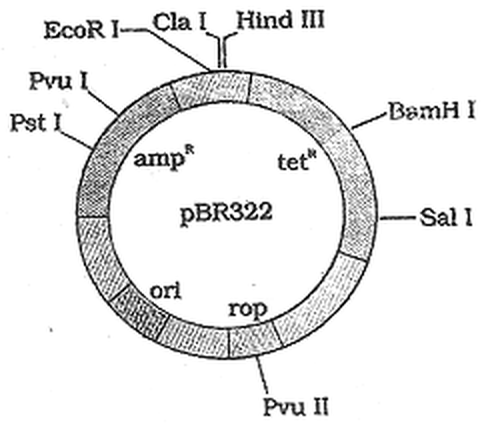
The figure below is the diagrammatic representation of the E.coli vector pBR 322. Which one of the given options correctly identifies its certain component(s)?
- 1ori - original restriction enzyme
- 2rop - reduced osmotic pressure
- 3Hind III, EcoRI - selectable markers
- 4, - antibiotic resistance genes
Show answer and solution
Correct: option 4, , - antibiotic resistance genes
In pBR322, and are the genes for resistance to ampicillin and tetracycline, and they act as the selectable markers. ori is the origin of replication, rop codes for proteins involved in replication of the plasmid, and Hind III and EcoRI are restriction (recognition) sites.
Question 98AIPMT 2012 Prelims, Q116
Which one is a true statement regarding DNA polymerase used in PCR?
- 1It is used to ligate introduced DNA in recipient cell
- 2It serves as a selectable marker
- 3It is isolated from a virus
- 4It remains active at high temperature
Show answer and solution
Correct: option 4, It remains active at high temperature
PCR uses Taq polymerase, obtained from the bacterium Thermus aquaticus that lives in hot springs. The enzyme is thermostable, so it survives the high-temperature denaturation step (about 94 °C) of every cycle and keeps extending the primers. It is not a ligase, not a marker and does not come from a virus.
Question 99AIPMT 2012 Prelims, Q140
For transformation, micro-particles coated with DNA to be bombarded with gene gun are made up of:
- 1Silver or Platinum
- 2Platinum or Zinc
- 3Silicon or Platinum
- 4Gold or Tungsten
Show answer and solution
Correct: option 4, Gold or Tungsten
In the biolistic (gene gun) method, plant cells are bombarded at high velocity with micro-particles of gold or tungsten coated with the DNA. These metals are dense and chemically inert, so the tiny particles can penetrate the cell wall without harming the cell.
Question 100AIPMT 2012 Mains, Q89
Biolistics (gene-gun) is suitable for:
- 1Disarming pathogen vectors
- 2Transformation of plant cells
- 3Constructing recombinant DNA by joining with vectors
- 4DNA finger printing
Show answer and solution
Correct: option 3, Constructing recombinant DNA by joining with vectors
In biolistics, cells are bombarded with high-velocity micro-particles of gold or tungsten coated with DNA, so that the DNA enters the cell directly. The answer key used for this paper marks option (3). Note that the method is a way of delivering DNA into cells and is described in the textbook as suitable for plant cells, which is option (2); joining DNA to a vector is done with restriction enzymes and ligase.
Question 101AIPMT 2012 Mains, Q90
In genetic engineering, the antibiotics are used:
- 1as selectable markers
- 2to select healthy vectors
- 3as sequences from where replication starts
- 4to keep the cultures free of infection
Show answer and solution
Correct: option 1, as selectable markers
Cloning vectors carry antibiotic resistance genes, for example for ampicillin and tetracycline in pBR322. When cells are grown on a medium containing the antibiotic, only the transformed cells survive, so the antibiotic serves to select transformants and recombinants. The sequence where replication starts is the ori.
Question 102AIPMT 2012 Mains, Q118
The figure below shows three steps (A,B,C) of Polymerase Chain Reaction (PCR). Select the option giving correct identification together with what it represents?
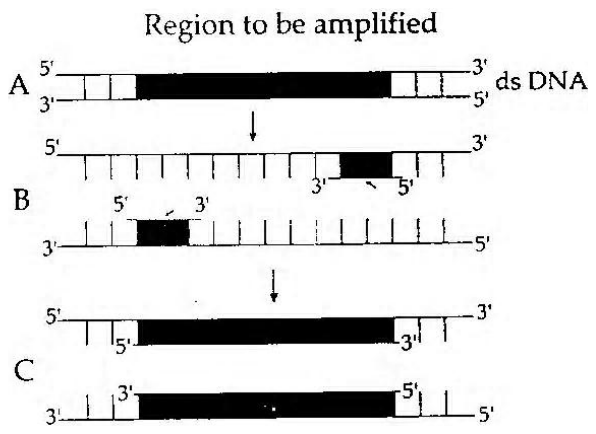
- 1B - Denaturation at a temperature of about 98°C separating the two DNA strands.
- 2A - Denaturation at a temperature of about 50°C
- 3C - Extension in the presence of heat stable DNA polymerase
- 4A - Annealing with two sets of primers
Show answer and solution
Correct: option 3, C - Extension in the presence of heat stable DNA polymerase
A is the double-stranded DNA being denatured by heat (about 94°C), B shows the two primers annealed to the separated strands, and C shows the primers extended into full new strands. Extension is carried out by the heat-stable Taq DNA polymerase, so option (3) pairs the step and its description correctly.
Question 103AIPMT 2012 Mains, Q120
Which one of the following represents a palindromic sequence in DNA?
- 15' - GAATTC - 3'
3' - CTTAAG - 5'
- 25' - CCAATG - 3'
3' - GAATCC - 5'
- 35' - CATTAG - 3'
3' - GATAAC - 5'
- 45' - GATACC - 3'
3' - CCTAAG - 5'
Show answer and solution
Correct: option 1, 5' - GAATTC - 3'
3' - CTTAAG - 5'
A palindromic DNA sequence reads the same on both strands when each is read in the 5' to 3' direction. In option (1) the upper strand reads GAATTC and the lower strand, read 5' to 3', also reads GAATTC. This is the recognition site of EcoRI. None of the other pairs has this property.
Question 104AIPMT 2011 Prelims, Q58
Given below is a sample of a portion of DNA strand. What is so special shown in it
5' —— GAATTC —— 3'
3' —— CTTAAG —— 5'
- 1Replication completed
- 2Deletion mutation
- 3Start codon at the 5' end
- 4Palindromic sequence of base pairs
Show answer and solution
Correct: option 4, Palindromic sequence of base pairs
Read 5' to 3', the upper strand is GAATTC and the lower strand is also GAATTC. A sequence that reads the same on both strands when the direction of reading is kept the same is a palindrome; this one is the recognition site of the restriction enzyme EcoRI.
Question 105AIPMT 2011 Prelims, Q95
There is a restriction endonuclease called EcoRI. What does 'co' part in it stand for?
- 1colon
- 2coelom
- 3coenzyme
- 4coli
Show answer and solution
Correct: option 4, coli
A restriction enzyme is named after its source: the first letter is from the genus and the next two from the species. In EcoRI, E is Escherichia, co is coli, R is the strain RY 13 and I shows it was the first enzyme isolated from that strain.
Question 106AIPMT 2011 Prelims, Q114
Agarose extracted from sea weeds finds use in:
- 1Spectrophotometry
- 2Tissue Culture
- 3PCR
- 4Gel electrophoresis
Show answer and solution
Correct: option 4, Gel electrophoresis
Agarose is a natural polymer obtained from sea weeds. It forms the gel matrix used in gel electrophoresis, where DNA fragments are separated by size as they move through its pores towards the anode.
Question 107AIPMT 2011 Prelims, Q135
Continuous addition of sugars in 'fed batch' fermentation is done to:
- 1produce methane
- 2obtain antibiotics
- 3purify enzymes
- 4degrade sewage
Show answer and solution
Correct: option 2, obtain antibiotics
In fed-batch culture the nutrient (sugar) is added in small amounts through the run, which keeps the cells growing and producing for longer without the high sugar level that would suppress product formation. This is the standard way of getting high yields of antibiotics such as penicillin.
Question 108AIPMT 2011 Mains, Q79
Which one of the following techniques made it possible to genetically engineer living organism?
- 1Recombinant DNA techniques
- 2X-ray diffraction
- 3Heavier isotope labelling
- 4Hybridization
Show answer and solution
Correct: option 1, Recombinant DNA techniques
Genetic engineering means cutting a chosen gene with restriction enzymes, joining it to a vector with ligase and introducing it into a host organism. These recombinant DNA techniques are what allow genes to be moved between organisms. X-ray diffraction revealed the structure of DNA and isotope labelling showed how it replicates, but neither alters an organism's genes.
Question 109AIPMT 2011 Mains, Q82
Read the following four statements (A-D) about certain mistakes in two of them
(A) The first transgenic buffalo, Rosie produced milk which was human alpha-lactalbumin enriched.
(B) Restriction enzymes are used in isolation of DNA from other macro-molecules.
(C) Downstream processing is one of the steps of R-DNA technology.
(D) Disarmed pathogen vectors are also used in transfer of R-DNA into the host.
Which are the two statements having mistakes?
- 1Statement (B) and (C)
- 2Statement (C) and (D)
- 3Statement (A) and (C)
- 4Statement (A) and (B)
Show answer and solution
Correct: option 4, Statement (A) and (B)
(A) is wrong because Rosie was a transgenic cow, not a buffalo. (B) is wrong because restriction enzymes cut DNA at specific sequences; DNA is freed from other macromolecules with enzymes such as lysozyme, cellulase, proteases and RNase. (C) and (D) are correct: downstream processing is a step of recombinant DNA technology, and disarmed pathogens such as Agrobacterium and retroviruses are used as vectors. So the mistakes are in (A) and (B).
Question 110AIPMT 2010 Mains, Q90
Which of the following are used in gene cloning
- 1Plasmids
- 2Nucleoids
- 3Lomasomes
- 4Mesosomes
Show answer and solution
Correct: option 1, Plasmids
Plasmids are small circular DNA molecules of bacteria that replicate on their own, so a gene joined to a plasmid is copied along with it. They are the common cloning vectors. Nucleoids, lomasomes and mesosomes are cell structures and are not used as vectors.
Question 111AIPMT 2010 Mains, Q119
In genetic engineering, a DNA segment (gene) of interest, is transferred to the host cell through a vector. Consider the following four agents (A-D) in this regard and select the correct option about which one or more of these can be used as a vector/vectors:
(A) a bacterium
(B) plasmid
(C) plasmodium
(D) bacteriophage
Options:
- 1(B) and (D) only
- 2(A), (B) and (D) only
- 3(A) only
- 4(A) and (C) only
Show answer and solution
Correct: option 1, (B) and (D) only
Plasmids and bacteriophages can replicate inside a bacterial cell and carry foreign DNA with them, so both are used as cloning vectors. A bacterium is the host, not the vector, and Plasmodium is the malarial parasite.
Question 112AIPMT 2010 Prelims, Q118
Which one of the following is used as vector for cloning genes into higher organisms
- 1Salmonella typhimurium
- 2Rhizopus nigricans
- 3Retrovirus
- 4Baculovirus
Show answer and solution
Correct: option 3, Retrovirus
Retroviruses can insert their genetic material into the chromosomes of animal cells. After they are disarmed so that they no longer cause disease, they are used to carry desired genes into animal cells. That makes the retrovirus the vector used for higher organisms among the choices.
Question 113AIPMT 2010 Prelims, Q132
Stirred-tank bioreactors have been designed for
- 1Purification of the product
- 2Ensuring anaerobic conditions in the culture vessel
- 3Availability of oxygen throughout the process
- 4Addition of preservatives to the product
Show answer and solution
Correct: option 3, Availability of oxygen throughout the process
A stirred-tank bioreactor has a stirrer that mixes the contents evenly and a system that bubbles sterile air through the culture. The curved base and the stirring keep oxygen available to the cells everywhere in the vessel throughout the process. Purification and adding preservatives belong to downstream processing, which is done later.
Question 114AIPMT 2010 Prelims, Q154
Which one of the following palindromic base sequences in DNA can be easily cut at about the middle by some particular restriction enzyme
- 15'-GATATG-3', 3'-CTACTA-5'
- 25'-GAATTC-3', 3'-CTTAAG-5'
- 35'-CACGTA-3', 5'-CTCAGT-3'
- 45'-CGTTCG-3', 3'-ATGGTA-5'
Show answer and solution
Correct: option 2, 5'-GAATTC-3', 3'-CTTAAG-5'
A palindromic DNA sequence reads the same on both strands when each is read in the 5' to 3' direction. 5'-GAATTC-3' paired with 3'-CTTAAG-5' is such a sequence; it is the recognition site of EcoRI, which cuts between G and A on each strand. The other pairs are neither complementary nor palindromic.
Question 115AIPMT 2010 Prelims, Q179
Restriction endonucleases are enzymes which
- 1Recognize a specific nucleotide sequence for binding of DNA ligase
- 2Restrict the action of the enzyme DNA polymerase
- 3Remove nucleotides from the ends of the DNA molecule
- 4Make cuts at specific positions within the DNA molecule
Show answer and solution
Correct: option 4, Make cuts at specific positions within the DNA molecule
A restriction endonuclease recognises a specific palindromic sequence and cuts the sugar-phosphate backbone of both strands at fixed points inside the DNA. Enzymes that remove nucleotides from the ends are exonucleases.
Question 116AIPMT 2009 Prelims, Q55
Polyethylene glycol method is used for:
- 1Biodiesel production
- 2Seedless fruit production
- 3Energy production from sewage
- 4Gene transfer without a vector
Show answer and solution
Correct: option 4, Gene transfer without a vector
Polyethylene glycol makes the membrane of protoplasts permeable so that naked DNA is taken up directly. It is therefore a method of direct (vectorless) gene transfer.
Question 117AIPMT 2009 Prelims, Q58
Which one of the following is commonly used in transfer of foreign DNA into crop plants?
- 1Meloidogyne incognita
- 2Agrobacterium tumefaciens
- 3Penicillium expansum
- 4Trichoderma harzianum
Show answer and solution
Correct: option 2, Agrobacterium tumefaciens
Agrobacterium tumefaciens naturally transfers a piece of its Ti plasmid (T-DNA) into dicot plant cells. The disarmed Ti plasmid is used as a vector to carry foreign genes into crop plants. Meloidogyne is a nematode, and Penicillium and Trichoderma are fungi.
Question 118AIPMT 2008 Prelims, Q185
Gel electrophoresis is used for
- 1Isolation of DNA molecule
- 2Cutting of DNA into fragments
- 3Separation of DNA fragments according to their size
- 4Construction of recombinant DNA by joining with cloning vectors
Show answer and solution
Correct: option 3, Separation of DNA fragments according to their size
DNA fragments are negatively charged and move towards the anode through the agarose gel. The gel acts as a sieve, so smaller fragments move farther, and the fragments are separated according to size.
Question 119AIPMT 2008 Prelims, Q193
The linking of antibiotic resistance gene with the plasmid vector became possible with
- 1Exonucleases
- 2DNA ligase
- 3Endonucleases
- 4DNA polymerase
Show answer and solution
Correct: option 2, DNA ligase
DNA ligase joins the ends of DNA fragments by forming phosphodiester bonds. It was used to link the antibiotic resistance gene, cut out with a restriction enzyme, to the plasmid vector to make the first recombinant DNA.
Question 120AIPMT 2006 Prelims, Q157
Two microbes found to be very useful in genetic engineering are
- 1Escherichia coli and Agrobacterium tumefaciens
- 2Vibrio cholerae and a tailed bacteriophage
- 3Diplococcus sp. and Pseudomonas sp.
- 4Crown gall bacterium and Caenorhabditis elegans
Show answer and solution
Correct: option 1, Escherichia coli and Agrobacterium tumefaciens
Escherichia coli is the standard host for cloning genes and supplies plasmids and restriction enzymes, and Agrobacterium tumefaciens carries the Ti plasmid used to transfer genes into plants. Caenorhabditis elegans is a nematode worm, not a microbe, and the other pairs are not the main tools of genetic engineering.
Question 121AIPMT 2006 Prelims, Q177
- 1Cuts the DNA molecule randomly
- 2Cuts the DNA molecule at specific sites
- 3Restricts the synthesis of DNA inside the nucleus
- 4Synthesizes DNA
Show answer and solution
Correct: option 2, Cuts the DNA molecule at specific sites
A restriction endonuclease recognises a particular short, usually palindromic, base sequence and cuts both DNA strands at that site. This specificity is what makes these enzymes useful as molecular scissors. They neither cut at random nor make DNA.
Question 122AIPMT 2005 Prelims, Q150
Which one of the following hydrolyses internal phosphodiester bonds in a polynucleotide chain
- 1Lipase
- 2protease
- 3Exonuclease
- 4Endonuclease
Show answer and solution
Correct: option 4, Endonuclease
Nucleases cut the phosphodiester bonds of nucleic acids. Endonucleases cut bonds inside the chain, while exonucleases remove nucleotides one at a time from the ends. Lipases and proteases act on fats and proteins.
Question 123AIPMT 2005 Prelims, Q165
Production of a human protein in bacteria by genetic engineering is possible because
- 1Bacterial cell can carry out the RNA splicing reactions
- 2The mechanism of gene regulation is identical in humans and bacteria
- 3The human chromosome can replicate in bacterial cell
- 4The genetic code is universal
Show answer and solution
Correct: option 4, The genetic code is universal
A codon stands for the same amino acid in bacteria as in humans. So when a human coding sequence is placed in a bacterium, its ribosomes read it into the same chain of amino acids. Bacteria cannot splice out introns, their gene regulation is different, and a human chromosome does not replicate in them.
Question 124AIPMT 2004 Prelims, Q105
The most thoroughly studied of the known bacteria-plant interactions is the :-
- 1Gall formation on certain angiosperms by Agrobacterium
- 2Nodulation of Sesbania stems by nitrogen fixing bacteria
- 3Plant growth stimulation by phosphate–solubilising bacteria
- 4Cyanobacterial symbiosis with some aquatic ferns
Show answer and solution
Correct: option 1, Gall formation on certain angiosperms by Agrobacterium
Crown gall formation by Agrobacterium tumefaciens has been worked out in the greatest detail: the bacterium transfers the T-DNA of its Ti plasmid into the plant genome and this causes the tumour. This knowledge is the basis of its use as a vector in plant genetic engineering.
Question 125AIPMT 2004 Prelims, Q108
In transgenics expression of transgene in target tissue is determined by :-
- 1Transgene
- 2Promoter
- 3Reporter
- 4Enhancer
Show answer and solution
Correct: option 2, Promoter
Where and when a gene is transcribed depends on the promoter placed in front of it: RNA polymerase and tissue-specific transcription factors bind there. A transgene joined to a tissue-specific promoter is therefore expressed only in the target tissue. A reporter gene only shows that expression has happened.
Question 126AIPMT 2004 Prelims, Q127
Restriction endonucleases :-
- 1Are used in genetic engineering for ligating two DNA molecules
- 2Are used for in vitro DNA synthesis
- 3Are synthesized by bacteria as part of their defense mechanism
- 4Are present in mammalian cells for degradation of DNA when the cell dies
Show answer and solution
Correct: option 3, Are synthesized by bacteria as part of their defense mechanism
Bacteria make restriction endonucleases to cut up the DNA of invading phages, while their own DNA is protected by methylation. Joining DNA is done by ligase and DNA synthesis by DNA polymerase, and these enzymes are not found in mammalian cells.
Question 127AIPMT 2004 Prelims, Q173
The Ti plasmid is often used for making transgenic plants. This plasmid is found in
- 1Rhizobium of the roots of leguminous plants
- 2Agrobacterium
- 3Yeast as a 2 µm plasmid
- 4Azotobacter
Show answer and solution
Correct: option 2, Agrobacterium
Ti means tumour inducing. The Ti plasmid belongs to Agrobacterium tumefaciens, which passes a piece of it (T-DNA) into the cells of dicot plants and causes crown gall. With the tumour genes removed, the plasmid is used as a vector to carry wanted genes into plants.
Question 128AIPMT 2003 Prelims, Q114
Which one of the following bacteria has found extensive use in genetic engineering work in plants:
- 1Clostridium septicum
- 2Xanthomonas citri
- 3Bacillus coagulans
- 4Agrobacterium tumefaciens
Show answer and solution
Correct: option 4, Agrobacterium tumefaciens
Agrobacterium tumefaciens naturally transfers a piece of its Ti plasmid (the T-DNA) into the genome of the plants it infects. A disarmed Ti plasmid is therefore the standard vector for putting foreign genes into plants.
Question 129AIPMT 2002 Prelims, Q194
Which of the following enzymes are used to join bits of DNA:-
- 1Ligase
- 2Primase
- 3DNA polymerase
- 4Endonuclease
Show answer and solution
Correct: option 1, Ligase
DNA ligase seals the gap between two DNA fragments by forming a phosphodiester bond, so it joins bits of DNA, such as Okazaki fragments or a cut gene and a vector. Endonuclease cuts DNA, primase makes RNA primers and DNA polymerase adds nucleotides.
Question 130AIPMT 2002 Prelims, Q196
Manipulation of DNA in genetic engineering became possible due to the discovery of:-
- 1Restriction endonuclease
- 2DNA ligase
- 3Transcriptase
- 4Primase
Show answer and solution
Correct: option 1, Restriction endonuclease
Restriction endonucleases cut DNA at specific recognition sequences, which made it possible to cut out a chosen gene and open a vector at a matching site. Their discovery is what made recombinant DNA work possible.
Question 131AIPMT 2001 Prelims, Q104
What is true for plasmid:-
- 1Plasmids are widely used in gene transfer
- 2These are found in virus
- 3Plasmid contain gene for vital activities
- 4These are main part of chromosome
Show answer and solution
Correct: option 1, Plasmids are widely used in gene transfer
Plasmids are small, circular, extrachromosomal DNA molecules of bacteria that replicate on their own. Because they can carry a foreign gene into a host cell, they are the most widely used vectors in gene transfer. They are not found in viruses, are not part of the chromosome, and carry no genes essential for life.
Question 132AIPMT 2001 Prelims, Q114
Which of the following cut the DNA from specific places:-
- 1Restriction endonuclease (EcoRI)
- 2Ligase
- 3Exonuclease
- 4Alkaline phosphate
Show answer and solution
Correct: option 1, Restriction endonuclease (EcoRI)
A restriction endonuclease recognises a specific base sequence and cuts the DNA within it; EcoRI cuts at GAATTC. Ligase joins DNA pieces, and an exonuclease removes nucleotides from the ends, not from specific sites.
Question 133AIPMT 2001 Prelims, Q156
Maximum number of bases in plasmids discovered so far:
- 150 kilo base
- 2500 kilo base
- 35000 kilo base
- 45 kilo base
Show answer and solution
Correct: option 2, 500 kilo base
Plasmids are small extra-chromosomal circles of DNA, usually a few kilobases long. The largest ones known when this was asked were of the order of some hundreds of kilobases, so 500 kilo base is the keyed answer.
Question 134AIPMT 2000 Prelims, Q105
The bacteria generally used for genetic engineering is:
- 1Agrobacterium
- 2Bacillus
- 3Pseudomonas
- 4Clostridium
Show answer and solution
Correct: option 1, Agrobacterium
Agrobacterium tumefaciens naturally transfers a piece of its Ti plasmid (T-DNA) into plant cells. The modified Ti plasmid is therefore widely used as a vector to carry desired genes into plants, which makes Agrobacterium the answer among these options.
Question 135AIPMT 2000 Prelims, Q158
Plasmid has been used as vector because:
- 1It is circular DNA which have capacity to join to eukaryotic DNA
- 2It can move between prokaryotic and eukaryotic cells
- 3Both ends show replication
- 4It has antibiotic resistance gene
Show answer and solution
Correct: option 1, It is circular DNA which have capacity to join to eukaryotic DNA
A plasmid is a small circular, self-replicating DNA molecule of bacteria. It can be cut open with a restriction enzyme and joined to a piece of foreign (eukaryotic) DNA, and the recombinant plasmid then carries that DNA into a host cell, which is what makes it a vector. The antibiotic resistance gene only helps in selecting the transformed cells.
Question 136AIPMT 1999 Prelims, Q141
- 1Break the polynucleotide chain by breaking the each terminal nucleotide
- 2Breaks phosphodiester bond
- 3Breaks peptide bonds
- 4Breaks ester bonds
Show answer and solution
Correct: option 2, Breaks phosphodiester bond
Nucleases cut nucleic acids by hydrolysing the phosphodiester bonds that join one nucleotide to the next. Removing terminal nucleotides describes only exonucleases, and peptide bonds are broken by proteases.
Question 137AIPMT 1998 Prelims, Q110
- 1DNA-ligase
- 2Restriction endonuclease
- 3Exonuclease
- 4Peptidase
Show answer and solution
Correct: option 2, Restriction endonuclease
Restriction endonucleases cut DNA inside the strand at specific recognition sequences, so they are called molecular scissors or knives. DNA ligase does the opposite job of joining fragments, exonucleases only remove nucleotides from the ends, and peptidases act on proteins.
Question 138AIPMT 1998 Prelims, Q111
Genetic engineering involves:
- 1Use of restriction endonuclease on bacterial DNA and formation of new traits
- 2Use of Ligase for cutting DNA
- 3Developing instruments
- 4Use of statistic in genetics
Show answer and solution
Correct: option 1, Use of restriction endonuclease on bacterial DNA and formation of new traits
Genetic engineering means cutting DNA with restriction endonucleases, joining the wanted gene into a vector and so giving the host organism a new trait. Ligase joins DNA and does not cut it, so option (2) is false. Option (1) describes the technique.
Question 139AIPMT 1998 Prelims, Q176
Which of the following most used in genetic engineering:
- 1E. coli and Agrobacterium
- 2Mycobacteria and Salmonella
- 3Aspergillus
- 4Penicillium
Show answer and solution
Correct: option 1, E. coli and Agrobacterium
Escherichia coli is the usual host for cloning genes, and its plasmids and enzymes are standard tools. Agrobacterium tumefaciens, with its Ti plasmid, is the natural vector used to put genes into plants. The others are not routine tools of genetic engineering.