Questions with solutions
Question 1NEET 2026, Q93
Match List I with List II:
| List I (Phase of cell cycle) | List II (Activity) |
|---|
| A. phase | I. Actual cell division occurs |
| B. S phase | II. Cell is metabolically active and continuously grows but does not replicate its DNA |
| C. phase | III. Synthesis of DNA occurs and the amount of DNA per cell doubles |
| D. M phase | IV. Proteins are synthesized while cell growth continues |
Choose the correct answer from the options given below:
- 1A-II, B-III, C-IV, D-I
- 2A-III, B-IV, C-I, D-II
- 3A-I, B-II, C-III, D-IV
- 4A-IV, B-I, C-II, D-III
Show answer and solution
Correct: option 1, A-II, B-III, C-IV, D-I
In the cell is metabolically active and grows without replicating DNA (II). In S phase DNA is synthesised and its amount doubles (III). In proteins are made while growth continues (IV). M phase is the actual division (I). So A-II, B-III, C-IV, D-I.
Question 2NEET 2026, Q159
In which animal do haploid cells divide mitotically to produce gametes?
- 1Male honeybees
- 2Male grasshoppers
- 3Male earthworms
- 4Male frogs
Show answer and solution
Correct: option 1, Male honeybees
Male honeybees (drones) develop from unfertilised eggs and are haploid, so their cells cannot undergo a reduction division; they form sperms by mitosis. The other animals listed are diploid and form gametes by meiosis.
Question 3NEET 2026 Re-exam, Q128
The correct sequence of adult cell cycle phases is ________.
- 1G1-G2-S-M
- 2G1-M-G2-S
- 3G1-S-G2-M
- 4S-M-G2-G1
Show answer and solution
Correct: option 3, G1-S-G2-M
Interphase runs through G1 (growth), then S (DNA synthesis), then G2 (growth and preparation for division), and is followed by the M phase. So the order is G1-S-G2-M.
Question 4NEET 2026 Re-exam, Q131
Given below are two statements:
Statement I: Chromosomes are fully condensed at the end of prophase I.
Statement II: Meiosis I resembles mitosis.
In the light of the above statements, choose the most appropriate answer from the options given below:
- 1Both Statement I and Statement II are true
- 2Both Statement I and Statement II are false
- 3Statement I is correct, but Statement II is false
- 4Statement I is incorrect, but Statement II is true
Show answer and solution
Correct: option 3, Statement I is correct, but Statement II is false
Prophase I ends with diakinesis, when the chromosomes are fully condensed, so Statement I is correct. Meiosis I is the reduction division in which homologous chromosomes separate; it is meiosis II that resembles a normal mitosis. So Statement II is false.
Question 5NEET 2025, Q158
What is the main function of the spindle fibers during mitosis?
- 1To separate the chromosomes
- 2To synthesize new DNA
- 3To repair damaged DNA
- 4To regulate cell growth
Show answer and solution
Correct: option 1, To separate the chromosomes
Spindle fibres attach to the kinetochores of chromosomes, line them up at the equator and pull the sister chromatids to opposite poles in anaphase. DNA synthesis happens earlier, in S phase.
Question 6NEET 2024, Q103
Spindle fibers attach to kinetochores of chromosomes during
- 1Telophase
- 2Prophase
- 3Metaphase
- 4Anaphase
Show answer and solution
Correct: option 3, Metaphase
In metaphase the spindle fibres attach to the kinetochores of the chromosomes and the chromosomes line up at the equator. In anaphase the centromeres split and the chromatids are pulled apart.
Question 7NEET 2024, Q109
Given below are two statements:
Statement I: Chromosomes become gradually visible under light microscope during leptotene stage.
Statement II: The beginning of diplotene stage is recognized by dissolution of synaptonemal complex.
In the light of the above statements, choose the correct answer from the options given below:
- 1Statement I is false but Statement II is true
- 2Both Statement I and Statement II are true
- 3Both Statement I and Statement II are false
- 4Statement I is true but Statement II is false
Show answer and solution
Correct: option 2, Both Statement I and Statement II are true
In leptotene the chromosomes condense and gradually become visible under the light microscope, so Statement I is true. Diplotene begins with the dissolution of the synaptonemal complex, after which the homologues separate except at the chiasmata, so Statement II is also true.
Question 8NEET 2024, Q163
Following are the stages of cell division:
A. Gap 2 phase
B. Cytokinesis
C. Synthesis phase
D. Karyokinesis
E. Gap 1 phase
Choose the correct sequence of stages from the options given below:
- 1E-C-A-D-B
- 2C-E-D-A-B
- 3E-B-D-A-C
- 4B-D-E-A-C
Show answer and solution
Correct: option 1, E-C-A-D-B
Interphase runs as Gap 1 (), Synthesis (S) and Gap 2 (). The M phase follows: first the nucleus divides (karyokinesis), then the cytoplasm divides (cytokinesis). The order is E-C-A-D-B.
Question 9NEET 2024, Q172
Match List I with List II:
| List I (Sub Phases of Prophase I) | List II (Specific characters) |
|---|
| A. Diakinesis | I. Synaptonemal complex formation |
| B. Pachytene | II. Completion of terminalisation of chiasmata |
| C. Zygotene | III. Chromosomes look like thin threads |
| D. Leptotene | IV. Appearance of recombination nodules |
Choose the correct answer from the options given below:
- 1A-IV, B-III, C-II, D-I
- 2A-IV, B-II, C-III, D-I
- 3A-I, B-II, C-IV, D-III
- 4A-II, B-IV, C-I, D-III
Show answer and solution
Correct: option 4, A-II, B-IV, C-I, D-III
In leptotene the chromosomes first become visible as thin threads. In zygotene homologous chromosomes pair, with formation of the synaptonemal complex. In pachytene recombination nodules appear and crossing over takes place. In diakinesis the terminalisation of chiasmata is completed. So A-II, B-IV, C-I, D-III.
Question 10NEET 2024 Re-exam, Q129
Recombination between homologous chromosomes is completed by the end of
- 1Diakinesis
- 2Zygotene
- 3Diplotene
- 4Pachytene
Show answer and solution
Correct: option 4, Pachytene
Crossing over, the exchange of segments between non-sister chromatids of homologous chromosomes, takes place in pachytene of prophase I. Recombination is complete by the end of pachytene, and the chromosomes stay linked only at the points of crossing over. Zygotene is the stage of pairing, and chiasmata become visible in diplotene.
Question 11NEET 2024 Re-exam, Q158
Match List-I with List-II.
| List-I - Event | List-II - Stage of Prophase-I (Meiosis-I) |
|---|
| A. Chiasmata formation | I. Pachytene |
| B. Crossing over | II. Diakinesis |
| C. Synaptonemal complex formation | III. Diplotene |
| D. Terminalisation of chiasmata | IV. Zygotene |
Choose the correct answer from the options given below:
- 1A-III, B-I, C-IV, D-II
- 2A-II, B-I, C-III, D-IV
- 3A-III, B-I, C-II, D-IV
- 4A-II, B-III, C-IV, D-I
Show answer and solution
Correct: option 1, A-III, B-I, C-IV, D-II
In zygotene the homologous chromosomes pair and the synaptonemal complex forms. Crossing over between non-sister chromatids takes place in pachytene. In diplotene the complex dissolves and the homologues stay joined only at the X-shaped chiasmata. In diakinesis the chiasmata are terminalised. So A-III, B-I, C-IV, D-II.
Question 12NEET 2024 Re-exam, Q166
Match List-I with List-II.
| List-I | List-II |
|---|
| A. Cells are metabolically active and proliferate | I. phase |
| B. DNA replication takes place | II. phase |
| C. Proteins are synthesised | III. phase |
| D. Quiescent stage with metabolically active cells | IV. S phase |
Choose the correct answer from the options given below:
- 1A-IV, B-II, C-III, D-I
- 2A-I, B-III, C-IV, D-II
- 3A-I, B-I, C-III, D-IV
- 4A-II, B-IV, C-I, D-III
Show answer and solution
Correct: option 4, A-II, B-IV, C-I, D-III
DNA replicates in the S phase, and the quiescent stage in which cells stay metabolically active but do not divide is , so B-IV and D-III. Of the two that remain, the phase is when the cell is metabolically active and grows, and the phase is when proteins are synthesised in preparation for mitosis. So A-II, B-IV, C-I, D-III.
Question 13NEET 2023, Q111
The process of appearance of recombination nodules occurs at which sub stage of prophase I in meiosis?
- 1Zygotene
- 2Pachytene
- 3Diplotene
- 4Diakinesis
Show answer and solution
Correct: option 2, Pachytene
Recombination nodules appear on the bivalents during pachytene. They mark the sites where crossing over takes place between non-sister chromatids of homologous chromosomes.
Question 14NEET 2023, Q114
Among eukaryotes, replication of DNA takes place in -
- 1M phase
- 2S phase
- 3 phase
- 4 phase
Show answer and solution
Correct: option 2, S phase
DNA is replicated in the S (synthesis) phase of interphase, where the DNA content doubles from 2C to 4C. and are growth phases and M phase is the division itself.
Question 15NEET 2023, Q124
Which of the following stages of meiosis involves division of centromere?
- 1Metaphase I
- 2Metaphase II
- 3Anaphase II
- 4Telophase
Show answer and solution
Correct: option 3, Anaphase II
In anaphase I the homologous chromosomes separate but the sister chromatids stay joined at their centromeres. The centromere of each chromosome splits only at anaphase II, letting the sister chromatids move to opposite poles.
Question 16NEET 2023, Q146
Match List I with List II:
| List I | List II |
|---|
| A. M Phase | I. Proteins are synthesized |
| B. Phase | II. Inactive phase |
| C. Quiescent stage | III. Interval between mitosis and initiation of DNA replication |
| D. Phase | IV. Equational division |
Choose the correct answer from the options given below:
- 1A-III, B-II, C-IV, D-I
- 2A-IV, B-II, C-I, D-III
- 3A-IV, B-I, C-II, D-III
- 4A-II, B-IV, C-I, D-III
Show answer and solution
Correct: option 3, A-IV, B-I, C-II, D-III
M phase is mitosis, the equational division (A-IV). In phase proteins are synthesised in preparation for mitosis (B-I). The quiescent stage is an inactive stage in which cells do not divide (C-II). phase is the interval between mitosis and the start of DNA replication (D-III).
Question 17NEET 2023, Q191
Select the correct statements.
A. Tetrad formation is seen during Leptotene.
B. During Anaphase, the centromeres split and chromatids separate.
C. Terminalization takes place during Pachytene.
D. Nucleolus, Golgi complex and ER are reformed during Telophase.
E. Crossing over takes place between sister chromatids of homologous chromosome.
Choose the correct answer from the options given below:
- 1A and C only
- 2B and D only
- 3A, C and E only
- 4B and E only
Show answer and solution
Correct: option 2, B and D only
A is wrong: tetrads (bivalents) form by synapsis in zygotene and are clearly seen in pachytene, not in leptotene. B is correct: in anaphase the centromeres split and the chromatids separate. C is wrong: terminalisation of chiasmata happens in diakinesis. D is correct: the nucleolus, Golgi complex and ER reform in telophase. E is wrong: crossing over is between non-sister chromatids of homologous chromosomes. So B and D, option (2).
Question 18NEET 2023, Q196
Given below are two statements:
Statement I: During phase of cell cycle, the cell is metabolically inactive.
Statement II: The centrosome undergoes duplication during S phase of interphase.
In the light of the above statements, choose the most appropriate answer from the options given below:
- 1Both Statement I and Statement II are correct.
- 2Both Statement I and Statement II are incorrect.
- 3Statement I is correct but Statement II is incorrect.
- 4Statement I is incorrect but Statement II is correct.
Show answer and solution
Correct: option 4, Statement I is incorrect but Statement II is correct.
Statement I is incorrect: cells in the quiescent stage stay metabolically active; they only stop dividing unless called on to do so. Statement II is correct: in animal cells the centriole (centrosome) duplicates in the cytoplasm during the S phase, when DNA replicates. So option (4) is right.
Question 19NEET 2023 Manipur, Q102
Doubling of the number of chromosomes can be achieved by disrupting mitotic cell division soon after
- 1Prophase
- 2Metaphase
- 3Anaphase
- 4Telophase
Show answer and solution
Correct: option 3, Anaphase
The centromeres split and the sister chromatids separate in anaphase, so from that point the cell holds twice the number of chromosomes. If division is stopped soon after this, before two daughter cells are formed, all of them stay in one cell and the chromosome number is doubled. The key gives option (3), Anaphase.
Question 20NEET 2023 Manipur, Q108
The dissolution of synaptonemal complex occurs during
- 1Diakinesis
- 2Leptotene
- 3Pachytene
- 4Diplotene
Show answer and solution
Correct: option 4, Diplotene
The synaptonemal complex forms in zygotene and holds the homologues together through pachytene. Diplotene begins with its dissolution, after which the homologues stay joined only at the chiasmata. So the answer is Diplotene, option (4).
Question 21NEET 2023 Manipur, Q149
During which stages of mitosis and meiosis, respectively does the centromere of each chromosome split?
- 1Telophase, Anaphase I
- 2Anaphase, Anaphase II
- 3Metaphase, Metaphase II
- 4Prophase, Telophase I
Show answer and solution
Correct: option 2, Anaphase, Anaphase II
The centromere splits when the sister chromatids separate. In mitosis this happens in anaphase. In meiosis the centromeres stay whole in anaphase I, where homologous chromosomes separate, and split only in anaphase II. So the answer is option (2).
Question 22NEET 2023 Manipur, Q159
Select correct sequence of substages of Prophase-I of meiotic division:
(A) Zygotene
(B) Pachytene
(C) Diakinesis
(D) Leptotene
(E) Diplotene
Choose the correct answer from the options given below:
- 1(D), (A), (B), (E), (C)
- 2(A), (D), (B), (C), (E)
- 3(D), (B), (A), (E), (C)
- 4(A), (B), (D), (E), (C)
Show answer and solution
Correct: option 1, (D), (A), (B), (E), (C)
Prophase I runs through five stages in the order leptotene, zygotene, pachytene, diplotene and diakinesis. With the given letters this is (D), (A), (B), (E), (C).
Question 23NEET 2023 Manipur, Q167
Which one of the following is the quiescent stage of cell cycle?
- 1
- 2
- 3M
- 4
Show answer and solution
Correct: option 2,
Cells that stop dividing leave the phase and enter an inactive stage called the quiescent stage, . Such cells stay metabolically active but do not proliferate unless called on to do so.
Question 24NEET 2022, Q103
Which one of the following never occurs during mitotic cell division?
- 1Coiling and condensation of the chromatids
- 2Spindle fibres attach to kinetochores of chromosomes
- 3Movement of centrioles towards opposite poles
- 4Pairing of homologous chromosomes
Show answer and solution
Correct: option 4, Pairing of homologous chromosomes
Pairing of homologous chromosomes (synapsis) happens only in zygotene of prophase I of meiosis. Condensation of chromatids, movement of centrioles to the poles and attachment of spindle fibres to kinetochores are all normal events of mitosis.
Question 25NEET 2022, Q108
The appearance of recombination nodules on homologous chromosomes during meiosis characterizes:
- 1Terminalization
- 2Synaptonemal complex
- 3Bivalent
- 4Sites at which crossing over occurs
Show answer and solution
Correct: option 4, Sites at which crossing over occurs
Recombination nodules appear in pachytene on the paired homologous chromosomes. They mark the points where non-sister chromatids exchange segments, that is, the sites at which crossing over occurs.
Question 26NEET 2022, Q152
Regarding Meiosis, which of the statements is incorrect?
- 1Four haploid cells are formed at the end of Meiosis-II
- 2There are two stages in Meiosis, Meiosis-I and II
- 3DNA replication occurs in S phase of Meiosis-II
- 4Pairing of homologous chromosomes and recombination occurs in Meiosis-I
Show answer and solution
Correct: option 3, DNA replication occurs in S phase of Meiosis-II
DNA is replicated only once, in the S phase of the interphase before Meiosis-I. There is no S phase and no replication between Meiosis-I and Meiosis-II, so statement (3) is incorrect. The other statements describe meiosis correctly.
Question 27NEET 2022, Q181
Select the incorrect statement with reference to mitosis:
- 1Splitting of centromere occurs at anaphase.
- 2All the chromosomes lie at the equator at metaphase.
- 3Spindle fibres attach to centromere of chromosomes.
- 4Chromosomes decondense at telophase.
Show answer and solution
Correct: option 3, Spindle fibres attach to centromere of chromosomes.
Spindle fibres attach to the kinetochores, the small disc-shaped structures on the surface of the centromere, not to the centromere itself, so statement (3) is the incorrect one. The other three statements are correct descriptions of anaphase, metaphase and telophase.
Question 28NEET 2022 Re-exam, Q102
Which stage of meiosis can last for months or years in the oocytes of some vertebrates?
- 1Diakinesis
- 2Leptotene
- 3Pachytene
- 4Diplotene
Show answer and solution
Correct: option 4, Diplotene
In the oocytes of some vertebrates the diplotene stage of prophase I can last for months or years. Chiasmata are visible at this stage and the cell stays arrested in it until meiosis resumes.
Question 29NEET 2022 Re-exam, Q107
In meiosis, crossing over and exchange of genetic material between homologous chromosomes are catalyzed by the enzyme
- 1Polymerase
- 2Phosphorylase
- 3Recombinase
- 4Transferase
Show answer and solution
Correct: option 3, Recombinase
Crossing over takes place in pachytene between non-sister chromatids of homologous chromosomes. It is an enzyme-mediated process and the enzyme involved is recombinase.
Question 30NEET 2022 Re-exam, Q145
Identify the correct sequence of events during Prophase I of meiosis:
(a) Synapsis of homologous chromosomes
(b) Chromosomes become gradually visible under microscope
(c) Crossing over between non-sister chromatids of homologous chromosomes
(d) Terminalisation of chiasmata
(e) Dissolution of synaptonemal complex
Choose the correct answer from the options given below:
- 1(a), (c), (d), (e), (b)
- 2(a), (b), (c), (d), (e)
- 3(b), (c), (d), (e), (a)
- 4(b), (a), (c), (e), (d)
Show answer and solution
Correct: option 4, (b), (a), (c), (e), (d)
Chromosomes become visible in leptotene (b), homologous chromosomes pair by synapsis in zygotene (a), crossing over occurs in pachytene (c), the synaptonemal complex dissolves in diplotene (e) and the chiasmata terminalise in diakinesis (d). The order is (b), (a), (c), (e), (d).
Question 31NEET 2022 Re-exam, Q156
Bivalent or Tetrad formation is a characteristic feature observed during
- 1Chiasmata in zygotene stage
- 2Synaptonemal complex in zygotene stage
- 3Chiasmata in Diplotene stage
- 4Synaptonemal complex in Pachytene stage
Show answer and solution
Correct: option 2, Synaptonemal complex in zygotene stage
In zygotene the homologous chromosomes pair (synapsis) with the formation of the synaptonemal complex. The pair of synapsed homologous chromosomes held by this complex is called a bivalent or tetrad. Chiasmata appear only later, in diplotene.
Question 32NEET 2022 Re-exam, Q186
With respect to metaphase, which of the following statements is incorrect?
- 1Chromosomes lie at the equator of the cell
- 2Complete disintegration of nuclear envelope takes place
- 3Chromosomes are highly condensed
- 4Metaphase chromosomes are made up of four sister chromatids held together by centromere
Show answer and solution
Correct: option 4, Metaphase chromosomes are made up of four sister chromatids held together by centromere
A metaphase chromosome is made up of two sister chromatids held together by the centromere, not four. The other statements are true of metaphase: the nuclear envelope has completely disintegrated, and the fully condensed chromosomes lie at the equator.
Question 33NEET 2021, Q105
Which of the following stages of meiosis involves division of centromere?
- 1Metaphase I
- 2Metaphase II
- 3Anaphase II
- 4Telophase II
Show answer and solution
Correct: option 3, Anaphase II
In anaphase I whole homologous chromosomes separate and the centromeres stay intact. The centromere of each chromosome splits only at the start of anaphase II, letting the sister chromatids move to opposite poles.
Question 34NEET 2021, Q149
Match List - I with List - II.
| List - I | List - II |
|---|
| (a) S phase | (i) Proteins are synthesized |
| (b) phase | (ii) Inactive phase |
| (c) Quiescent stage | (iii) Interval between mitosis and initiation of DNA replication |
| (d) phase | (iv) DNA replication |
Choose the correct answer from the options given below.
- 1a-iii, b-ii, c-i, d-iv
- 2a-iv, b-ii, c-iii, d-i
- 3a-iv, b-i, c-ii, d-iii
- 4a-ii, b-iv, c-iii, d-i
Show answer and solution
Correct: option 3, a-iv, b-i, c-ii, d-iii
DNA replicates in S phase (iv). In proteins are made in preparation for mitosis (i). The quiescent stage () is the inactive phase in which cells do not divide (ii). is the interval between mitosis and the start of DNA replication (iii). So a-iv, b-i, c-ii, d-iii.
Question 35NEET 2021, Q152
The fruit fly has 8 chromosomes (2n) in each cell. During interphase of Mitosis if the number of chromosomes at phase is 8, what would be the number of chromosomes after S phase?
- 18
- 216
- 34
- 432
Show answer and solution
Correct: option 1, 8
In S phase the DNA content doubles (2C to 4C), but the two sister chromatids of each chromosome stay joined at one centromere. The chromosome number therefore does not change and remains 8.
Question 36NEET 2021, Q164
The centriole undergoes duplication during:
- 1S-phase
- 2Prophase
- 3Metaphase
- 4 phase
Show answer and solution
Correct: option 1, S-phase
In animal cells, DNA replication takes place in the nucleus during S phase, and the centriole duplicates in the cytoplasm during the same phase.
Question 37NEET 2021, Q181
Which stage of meiotic prophase shows terminalisation of chiasmata as its distinctive feature?
- 1Leptotene
- 2Zygotene
- 3Diakinesis
- 4Pachytene
Show answer and solution
Correct: option 3, Diakinesis
Diakinesis, the last stage of prophase I, is marked by the terminalisation of chiasmata. Synapsis occurs in zygotene, crossing over in pachytene, and the chiasmata first become visible in diplotene.
Question 38NEET 2020, Q61
Dissolution of the synaptonemal complex occurs during:
- 1Pachytene
- 2Zygotene
- 3Diplotene
- 4Leptotene
Show answer and solution
Correct: option 3, Diplotene
The synaptonemal complex forms in zygotene when homologous chromosomes pair, and crossing over takes place in pachytene. In diplotene the complex dissolves and the homologues begin to separate, staying joined only at the chiasmata.
Question 39NEET 2020, Q70
Some dividing cells exit the cell cycle and enter vegetative inactive stage. This is called quiescent stage (). This process occurs at the end of:
- 1M phase
- 2 phase
- 3S phase
- 4 phase
Show answer and solution
Correct: option 2, phase
Cells that do not divide further leave the cycle from the phase and enter the quiescent stage, where they stay metabolically active but do not proliferate unless called on to do so. The exit happens before the cell commits to DNA synthesis, so it is placed in , which is the keyed answer.
Question 40NEET 2020, Q77
Identify the correct statement with regard to phase (Gap 1) of interphase.
- 1DNA synthesis or replication takes place.
- 2Reorganisation of all cell components takes place.
- 3Cell is metabolically active, grows but does not replicate its DNA.
- 4Nuclear Division takes place.
Show answer and solution
Correct: option 3, Cell is metabolically active, grows but does not replicate its DNA.
is the interval between mitosis and the start of DNA replication. In it the cell is metabolically active and grows continuously but does not replicate its DNA. DNA replication belongs to the S phase and nuclear division to the M phase.
Question 41NEET 2020, Q106
Match the following with respect to meiosis:
| |
|---|
| (a) Zygotene | (i) Terminalization |
| (b) Pachytene | (ii) Chiasmata |
| (c) Diplotene | (iii) Crossing over |
| (d) Diakinesis | (iv) Synapsis |
Select the correct option from the following:
- 1a-iii, b-iv, c-i, d-ii
- 2a-iv, b-iii, c-ii, d-i
- 3a-i, b-ii, c-iv, d-iii
- 4a-ii, b-iv, c-iii, d-i
Show answer and solution
Correct: option 2, a-iv, b-iii, c-ii, d-i
In zygotene homologous chromosomes pair, which is synapsis (iv). Crossing over takes place in pachytene (iii). In diplotene the homologues separate except at the X-shaped chiasmata (ii). Diakinesis is marked by terminalization of the chiasmata (i). This is a-iv, b-iii, c-ii, d-i.
Question 42NEET 2020 Phase 2, Q11
In a mitotic cycle, the correct sequence of phases is
- 1, S, , M
- 2M, , , S
- 3, , S, M
- 4S, , , M
Show answer and solution
Correct: option 1, , S, , M
Interphase runs in the order (growth), S (DNA synthesis) and (preparation for division), and it is followed by the M phase. Hence the sequence is , S, , M.
Question 43NEET 2020 Phase 2, Q16
Attachment of spindle fibers to kinetochores of chromosomes becomes evident in:
- 1Telophase
- 2Prophase
- 3Metaphase
- 4Anaphase
Show answer and solution
Correct: option 3, Metaphase
At metaphase the nuclear envelope has gone, the chromosomes lie at the equator, and spindle fibres are attached to the kinetochores of each chromosome. In anaphase these attached chromatids are already moving apart, and in prophase the spindle is still being assembled.
Question 44NEET 2020 Phase 2, Q70
Match the following events that occur in their respective phases of cell cycle and select the correct option:
(a) phase
(b) S phase
(c) phase
(d) Metaphase in M - phase
(i) Cell grows and organelle duplication
(ii) DNA replication and chromosome duplication
(iii) Cytoplasmic growth
(iv) Alignment of chromosomes
- 1a-iii, b-iv, c-i, d-ii
- 2a-iv, b-i, c-ii, d-iii
- 3a-i, b-ii, c-iii, d-iv
- 4a-ii, b-iii, c-iv, d-i
Show answer and solution
Correct: option 3, a-i, b-ii, c-iii, d-iv
In the phase the cell grows and its organelles are duplicated. DNA replication, and with it chromosome duplication, takes place in the S phase. In the cytoplasm keeps growing and proteins are made for mitosis. At metaphase the chromosomes line up at the equator. So the matching is a-i, b-ii, c-iii, d-iv.
Question 45NEET 2020 Phase 2, Q83
During Meiosis I, in which stage synapsis takes place?
- 1Zygotene
- 2Diplotene
- 3Leptotene
- 4Pachytene
Show answer and solution
Correct: option 1, Zygotene
Synapsis, the pairing of homologous chromosomes with the formation of the synaptonemal complex, takes place in zygotene of prophase I. Crossing over follows in pachytene, and in diplotene the synaptonemal complex dissolves.
Question 46NEET 2019, Q108
The correct sequence of phases of cell cycle is:
- 1
- 2
- 3
- 4
Show answer and solution
Correct: option 4,
Interphase runs as (growth), then S (DNA synthesis), then (preparation for division), and is followed by the M phase. Only option (4) places S between and and ends with M.
Question 47NEET 2019, Q135
- 1exit the cell cycle
- 2enter the cell cycle
- 3suspend the cell cycle
- 4terminate the cell cycle
Show answer and solution
Correct: option 3, suspend the cell cycle
Cells that are not going to divide further leave and enter an inactive, quiescent stage called . They stay metabolically active but do not proliferate unless called on to do so, and then they can return to the cycle. The cycle is therefore suspended rather than ended, which is why the official key gives option (3) and not "terminate".
Question 48NEET 2019 Odisha, Q118
After meiosis I, the resultant daughter cells have
- 1same amount of DNA in comparison to haploid gamete.
- 2four times the amount of DNA in comparison to haploid gamete.
- 3same amount of DNA as in the parent cell in S phase.
- 4twice the amount of DNA in comparison to haploid gamete.
Show answer and solution
Correct: option 4, twice the amount of DNA in comparison to haploid gamete.
A gamete has 1C of DNA. The cell entering meiosis has replicated its DNA and holds 4C. Meiosis I separates the homologous chromosomes, each still made of two chromatids, so each daughter cell has 2C, twice the DNA of a haploid gamete. Meiosis II then halves it to 1C.
Question 49NEET 2019 Odisha, Q137
Crossing over takes place between which chromatids and in which stage of the cell cycle?
- 1Non-sister chromatids of homologous chromosomes at Zygotene stage of prophase I.
- 2Non-sister chromatids of non-homologous chromosomes at Pachytene stage of prophase I.
- 3Non-sister chromatids of non-homologous chromosomes at Zygotene stage of prophase I.
- 4Non-sister chromatids of homologous chromosomes at Pachytene stage of prophase I.
Show answer and solution
Correct: option 4, Non-sister chromatids of homologous chromosomes at Pachytene stage of prophase I.
Homologous chromosomes pair (synapsis) in zygotene. In the next stage, pachytene, recombination nodules appear and segments are exchanged between non-sister chromatids of the paired homologous chromosomes, with the enzyme recombinase. So crossing over is between non-sister chromatids of homologous chromosomes at pachytene of prophase I.
Question 50NEET 2018, Q123
The stage during which separation of the paired homologous chromosomes begins is
- 1Diakinesis
- 2Diplotene
- 3Pachytene
- 4Zygotene
Show answer and solution
Correct: option 2, Diplotene
In diplotene of prophase I the synaptonemal complex dissolves and the homologous chromosomes of each bivalent start to separate, staying joined only at the chiasmata. Pairing happens in zygotene, crossing over in pachytene, and diakinesis only completes terminalisation.
Question 51NEET 2017, Q102
Which of the following options gives the correct sequence of events during mitosis?
- 1condensation nuclear membrane disassembly crossing over segregation telophase
- 2condensation nuclear membrane disassembly arrangement at equator centromere division segregation telophase
- 3condensation crossing over nuclear membrane disassembly segregation telophase
- 4condensation arrangement at equator centromere division segregation telophase
Show answer and solution
Correct: option 2, condensation nuclear membrane disassembly arrangement at equator centromere division segregation telophase
In mitosis the chromosomes condense in prophase, the nuclear membrane breaks down at the end of prophase, the chromosomes line up at the equator in metaphase, the centromeres split and the chromatids separate in anaphase, and telophase follows. Crossing over belongs to meiosis, not mitosis, and option (4) leaves out the breakdown of the nuclear membrane.
Question 52NEET 2017, Q166
Anaphase Promoting Complex (APC) is a protein degradation machinery necessary for proper mitosis of animal cells. If APC is defective in a human cell, which of the following is expected to occur?
- 1Chromosomes will not condense
- 2Chromosomes will be fragmented
- 3Chromosomes will not segregate
- 4Recombination of chromosome arms will occur
Show answer and solution
Correct: option 3, Chromosomes will not segregate
The APC breaks down the proteins that hold sister chromatids together, which lets the cell pass from metaphase to anaphase. If it does not work the chromatids stay joined, so the chromosomes cannot separate to the poles.
Question 53NEET 2016 Phase 1, Q105
Spindle fibres attach on to:
- 1Telomere of the chromosome
- 2Kinetochore of the chromosome
- 3Centromere of the chromosome
- 4Kinetosome of the chromosome
Show answer and solution
Correct: option 2, Kinetochore of the chromosome
Kinetochores are small disc-shaped structures on the surface of the centromere. They are the actual sites where the spindle fibres attach to a chromosome at metaphase. Telomeres are chromosome ends, and a kinetosome is the basal body of a cilium.
Question 54NEET 2016 Phase 1, Q118
In meiosis crossing over is initiated at:
- 1Pachytene
- 2Leptotene
- 3Zygotene
- 4Diplotene
Show answer and solution
Correct: option 1, Pachytene
Homologous chromosomes pair during zygotene, and in pachytene recombination nodules appear on the bivalents where crossing over takes place between non-sister chromatids. The chiasmata seen in diplotene are only the visible result of crossing over that happened in pachytene.
Question 55NEET 2016 Phase 1, Q172
Which of the following is not a characteristic feature during mitosis in somatic cells?
- 1Spindle fibres
- 2Disappearance of nucleolus
- 3Chromosome movement
- 4Synapsis
Show answer and solution
Correct: option 4, Synapsis
Synapsis is the pairing of homologous chromosomes, which happens in the zygotene stage of prophase I of meiosis and not in mitosis. Spindle fibres, the disappearance of the nucleolus and the movement of chromosomes are all seen in mitosis.
Question 56NEET 2016 Phase 1, Q179
A cell at telophase stage is observed by a student in a plant brought from the field. He tells his teacher that this cell is not like other cells at telophase stage. There is no formation of cell plate and thus the cell is containing more number of chromosomes as compared to other dividing cells. This would result in:
- 1Aneuploidy
- 2Polyploidy
- 3Somaclonal variation
- 4Polyteny
Show answer and solution
Correct: option 2, Polyploidy
If the chromosomes separate but no cell plate forms, cytokinesis fails and both sets of chromosomes stay in one cell. The cell then has whole extra sets of chromosomes, which is polyploidy. Aneuploidy is the gain or loss of single chromosomes, caused by non-disjunction.
Question 57NEET 2016 Phase 2, Q107
During cell growth, DNA synthesis takes place in
- 1S phase
- 2 phase
- 3 phase
- 4M phase
Show answer and solution
Correct: option 1, S phase
DNA is replicated in the S (synthesis) phase of interphase, where the DNA content doubles from 2C to 4C. and are gap phases of growth and M is the division phase.
Question 58NEET 2016 Phase 2, Q145
When cell has stalled DNA replication fork, which checkpoint should be predominantly activated?
- 1
- 2
- 3M
- 4Both and M
Show answer and solution
Correct: option 2,
A stalled replication fork means DNA replication in S phase is incomplete. The checkpoint checks that the DNA has been fully and correctly replicated before the cell is allowed to enter mitosis, so it is the one activated to hold the cell back. The checkpoint acts before replication starts and the M checkpoint checks spindle attachment.
Question 59NEET 2016 Phase 2, Q146
Match the stages of meiosis in Column-I to their characteristic features in Column-II and select the correct option using the codes given below:
| Column-I | Column-II |
|---|
| a. Pachytene | (i) Pairing of homologous chromosomes |
| b. Metaphase I | (ii) Terminalization of chiasmata |
| c. Diakinesis | (iii) Crossing-over takes place |
| d. Zygotene | (iv) Chromosomes align at equatorial plate |
- 1a-iii, b-iv, c-ii, d-i
- 2a-i, b-iv, c-ii, d-iii
- 3a-ii, b-iv, c-iii, d-i
- 4a-iv, b-iii, c-ii, d-i
Show answer and solution
Correct: option 1, a-iii, b-iv, c-ii, d-i
Crossing-over takes place in pachytene (iii). In metaphase I the bivalents line up on the equatorial plate (iv). Diakinesis is marked by terminalization of chiasmata (ii). Homologous chromosomes pair (synapsis) in zygotene (i). So a-iii, b-iv, c-ii, d-i.
Question 60AIPMT 2015, Q88
Select the correct option:
| I | | II |
|---|
| (a) | Synapsis aligns homologous chromosomes | (i) | Anaphase-II |
| (b) | Synthesis of RNA and protein | (ii) | Zygotene |
| (c) | Action of enzyme recombinase | (iii) | -phase |
| (d) | Centromeres do not separate but chromatids move towards opposite poles | (iv) | Anaphase-I |
| | (v) | Pachytene |
- 1a-ii, b-iii, c-v, d-iv
- 2a-i, b-ii, c-v, d-iv
- 3a-ii, b-iii, c-iv, d-v
- 4a-ii, b-i, c-iii, d-iv
Show answer and solution
Correct: option 1, a-ii, b-iii, c-v, d-iv
Synapsis, the pairing of homologous chromosomes, takes place in zygotene (ii). RNA and proteins are synthesised in the phase (iii). Crossing over, which needs the enzyme recombinase, takes place in pachytene (v). In anaphase I (iv) the homologous chromosomes separate while the centromeres stay undivided, so sister chromatids remain together. Anaphase II is not used.
Question 61AIPMT 2015, Q116
A somatic cell that has just completed the S phase of its cell cycle, as compared to gamete of the same species, has:
- 1same number of chromosomes but twice the amount of DNA
- 2twice the number of chromosomes and four times the amount of DNA
- 3four times the number of chromosomes and twice the amount of DNA
- 4twice the number of chromosomes and twice the amount of DNA
Show answer and solution
Correct: option 2, twice the number of chromosomes and four times the amount of DNA
A gamete has n chromosomes and 1C DNA. A somatic cell has 2n chromosomes, and after the S phase its DNA has doubled from 2C to 4C while the chromosome number stays 2n. So it has twice the chromosomes and four times the DNA of a gamete.
Question 62AIPMT 2015 Re-test, Q77
Arrange the following events of meiosis in correct sequence:
(a) Crossing over
(b) Synapsis
(c) Terminalisation of chiasmata
(d) Disappearance of nucleolus
- 1(b), (c), (d), (a)
- 2(b), (a), (d), (c)
- 3(b), (a), (c), (d)
- 4(a), (b), (c), (d)
Show answer and solution
Correct: option 3, (b), (a), (c), (d)
In prophase I, homologous chromosomes pair in zygotene (synapsis), crossing over takes place in pachytene, and the chiasmata terminalise in diakinesis, by the end of which the nucleolus disappears. The order is (b), (a), (c), (d).
Question 63AIPMT 2014, Q17
In 'S' phase of the cell cycle:
- 1amount of DNA is reduced to half in each cell.
- 2amount of DNA doubles in each cell.
- 3amount of DNA remains same in each cell.
- 4chromosome number is increased.
Show answer and solution
Correct: option 2, amount of DNA doubles in each cell.
DNA replicates in the S (synthesis) phase, so the amount of DNA per cell doubles from 2C to 4C. The chromosome number does not change.
Question 64AIPMT 2014, Q63
During which phase(s) of cell cycle, amount of DNA in a cell remains at 4C level if the initial amount is denoted as 2C?
- 1 and M
- 2 and
- 3 and S
- 4Only
Show answer and solution
Correct: option 1, and M
A cell in (or ) has 2C DNA. The DNA doubles during S phase, rising from 2C to 4C. It then stays at 4C through and through M phase until the cell divides into two, so the answer is and M.
Question 65AIPMT 2014, Q82
The enzyme recombinase is required at which stage of meiosis:
- 1Diakinesis
- 2Pachytene
- 3Zygotene
- 4Diplotene
Show answer and solution
Correct: option 2, Pachytene
Crossing over, the exchange of segments between non-sister chromatids of homologous chromosomes, takes place in pachytene of prophase I. It is an enzyme-mediated process, and the enzyme involved is recombinase. Zygotene is the stage of pairing (synapsis), and in diplotene and diakinesis the chiasmata become visible and then terminalise.
Question 66NEET 2013, Q68
A stage in cell division is shown in the figure. Select the answer which gives correct identification of the stage with its characteristics.
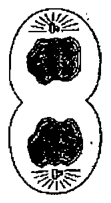
- 1Late anaphase - chromosomes move away from equatorial plate, golgi complex not present.
- 2Cytokinesis - cell plate formed, mitochondria distributed between two daughter cells.
- 3Telophase - endoplasmic reticulum and nucleolus not reformed yet.
- 4Telophase - nuclear envelope reforms, golgi complex reforms.
Show answer and solution
Correct: option 4, Telophase - nuclear envelope reforms, golgi complex reforms.
The figure shows an animal cell with a chromatin mass at each pole and a furrow pinching in at the middle, which is telophase. In telophase the nuclear envelope forms again around each chromosome cluster, and the nucleolus, Golgi complex and endoplasmic reticulum reform. A cell plate is formed only in plant cells.
Question 67NEET 2013, Q107
The complex formed by a pair of synapsed homologous chromosomes is called:
- 1Kinetochore
- 2Bivalent
- 3Axoneme
- 4Equatorial plate
Show answer and solution
Correct: option 2, Bivalent
During zygotene of prophase I the homologous chromosomes pair up (synapsis). Each synapsed pair is called a bivalent, or a tetrad because it has four chromatids. A kinetochore is the spindle attachment site, and an axoneme is the core of a cilium or flagellum.
Question 68NEET 2013 Karnataka, Q53
During meiosis I, the chromosomes start pairing at:
- 1Zygotene
- 2Pachytene
- 3Diplotene
- 4Leptotene
Show answer and solution
Correct: option 1, Zygotene
Pairing of homologous chromosomes (synapsis), with formation of the synaptonemal complex, begins in zygotene of prophase I. Crossing over follows in pachytene and the pairs start to separate in diplotene.
Question 69NEET 2013 Karnataka, Q61
During the metaphase stage of mitosis spindle fibres attach to chromosomes at:-
- 1kinetochore
- 2both centromere and kinetochore
- 3centromere, kinetochore and areas adjoining centromere
- 4centromere
Show answer and solution
Correct: option 1, kinetochore
Spindle fibres attach to the kinetochores, the small disc-shaped protein structures on the surface of the centromere, and not to the centromere DNA itself.
Question 70NEET 2013 Karnataka, Q102
A stage of mitosis is shown in the diagram. Which stage is it and what are its characteristics?
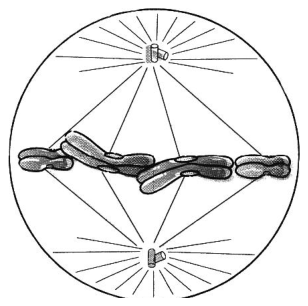
- 1Metaphase-spindle fibers attached to kinetochores, centromeres split and chromatids separate
- 2Metaphase- chromosomes moved to spindle equator chromosomes made up of two sister chromatids
- 3Anaphase - centromeres split and chromatids separate and start moving away
- 4late prophase - chromosomes move to spindle equator
Show answer and solution
Correct: option 2, Metaphase- chromosomes moved to spindle equator chromosomes made up of two sister chromatids
The chromosomes lie in one plane at the equator with spindle fibres from both poles attached, which is metaphase. At this stage each chromosome still consists of two sister chromatids; the centromeres split only in anaphase.
Question 71AIPMT 2012 Prelims, Q87
During gamete formation, the enzyme recombinase participates during
- 1Metaphase - I
- 2Anaphase - II
- 3Prophase - I
- 4Prophase - II
Show answer and solution
Correct: option 3, Prophase - I
Recombinase brings about crossing over between non-sister chromatids of homologous chromosomes. Crossing over takes place in the pachytene stage of prophase I of meiosis.
Question 72AIPMT 2012 Prelims, Q138
Given below is the representation of a certain event at a particular stage of a type of cell division. Which is this stage?
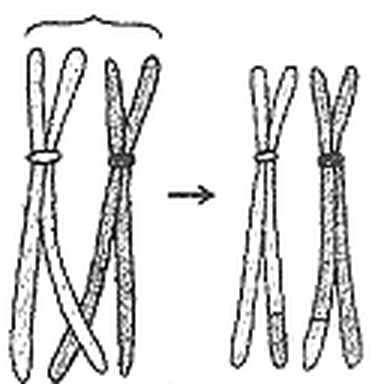
- 1Prophase I during meiosis
- 2Prophase II during meiosis
- 3Prophase of Mitosis
- 4Both prophase and metaphase of mitosis
Show answer and solution
Correct: option 1, Prophase I during meiosis
The picture shows a pair of homologous chromosomes whose non-sister chromatids cross and exchange segments, which is crossing over. Crossing over happens between paired homologues in the pachytene stage of prophase I of meiosis. Homologues do not pair in mitosis or in meiosis II.
Question 73AIPMT 2012 Mains, Q95
Identify the meiotic stage in which the homologous chromosomes separate while the sister chromatids remain associated at their centromeres:
- 1Metaphase I
- 2Metaphase II
- 3Anaphase I
- 4Anaphase II
Show answer and solution
Correct: option 3, Anaphase I
In anaphase I the homologous chromosomes of each bivalent move to opposite poles, but the centromeres do not split, so the two sister chromatids of each chromosome stay together. The sister chromatids separate only in anaphase II.
Question 74AIPMT 2011 Prelims, Q124
Select the correct option with respect to mitosis.
- 1Chromatids separate but remain in the centre of the cell in anaphase.
- 2Chromatids start moving towards opposite poles in telophase.
- 3Golgi complex and endoplasmic reticulum are still visible at the end of prophase.
- 4Chromosomes move to the spindle equator and get aligned along equatorial plate in metaphase
Show answer and solution
Correct: option 4, Chromosomes move to the spindle equator and get aligned along equatorial plate in metaphase
In metaphase the chromosomes, attached to spindle fibres by their kinetochores, line up on the equatorial (metaphase) plate. Chromatids separate and move to the poles in anaphase, not telophase, and by the end of prophase the Golgi complex, endoplasmic reticulum, nucleolus and nuclear envelope are no longer visible.
Question 75AIPMT 2011 Mains, Q46
At metaphase, chromosomes are attached to the spindle fibres by their:
- 1Satellites
- 2Secondary constrictions
- 3Kinetochores
- 4Centromere
Show answer and solution
Correct: option 3, Kinetochores
Kinetochores are small disc-shaped structures on the sides of the centromere, and they are the actual sites where spindle fibres attach to a chromosome. The centromere is the primary constriction that holds the two chromatids together and carries the kinetochores. Satellites and secondary constrictions play no part in spindle attachment.
Question 76AIPMT 2010 Prelims, Q126
Which stages of cell division do the following figures A and B represent respectively
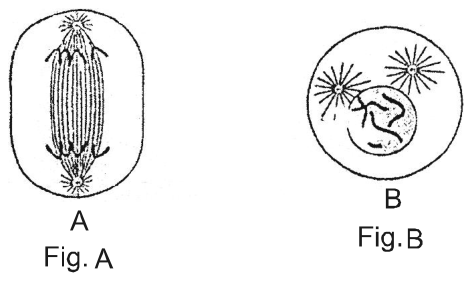
- 1Telophase – Metaphase
- 2Late Anaphase – Prophase
- 3Prophase – Anaphase
- 4Metaphase – Telophase
Show answer and solution
Correct: option 2, Late Anaphase – Prophase
In figure A the chromosomes have separated into two groups that have reached the opposite poles of the spindle, while the cell has not yet divided; this is late anaphase. In figure B the nuclear envelope is still present, the chromatin has condensed into long threads and the two asters are moving apart; this is prophase.
Question 77AIPMT 2010 Prelims, Q142
During mitosis ER and nucleolus begin to disappear at
- 1Early metaphase
- 2Late metaphase
- 3Early Prophase
- 4Late prophase
Show answer and solution
Correct: option 4, Late prophase
In early prophase the chromatin condenses and the centrosomes begin to move apart, but the nucleolus and the cell organelles can still be seen. Cells examined at the end of prophase no longer show the Golgi complexes, endoplasmic reticulum, nucleolus and nuclear envelope. These structures therefore start to disappear in late prophase.
Question 78AIPMT 2009 Prelims, Q84
Given below is a schematic break-up of the phases / stages of cell cycle:
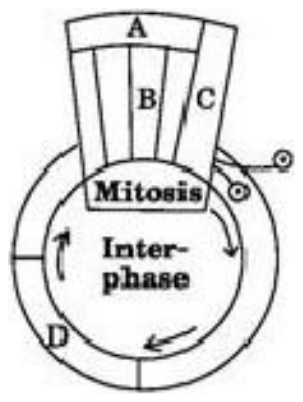
Which one of the following is the correct indication of the stage/phase in the cell cycle?
- 1C-Karyokinesis
- 2D-Synthetic phase
- 3A-Cytokinesis
- 4B-Metaphase
Show answer and solution
Correct: option 2, D-Synthetic phase
Following the arrows round the interphase ring from mitosis, the phases are G1, then S, then G2. D marks the middle part of interphase, which is the S or synthetic phase, when DNA is replicated. In the M phase part of the figure, A covers the whole of mitosis and C is its last part, so the other pairings do not fit.
Question 79AIPMT 2009 Prelims, Q87
- 1mRNA and ribosomes
- 2spindle fibres and centromere
- 3two homologous chromosomes
- 4a male and a female gamete
Show answer and solution
Correct: option 3, two homologous chromosomes
Synapsis is the pairing of homologous chromosomes during zygotene of prophase I of meiosis, forming bivalents held by the synaptonemal complex.
Question 80AIPMT 2005 Prelims, Q149
Centromere is required for
- 1Movement of chromosomes towards poles
- 2Cytoplasmic cleavage
- 3Crossing over
- 4Transcription
Show answer and solution
Correct: option 1, Movement of chromosomes towards poles
The centromere carries the kinetochores to which the spindle fibres attach. Without it a chromosome cannot be pulled to a pole during anaphase and is lost.
Question 81AIPMT 2005 Prelims, Q170
At what stage of the cell cycle are histone proteins synthesized in a eukaryotic cell
- 1During telophase
- 2During S-phase
- 3During G-2 stage of prophase
- 4During entire prophase
Show answer and solution
Correct: option 2, During S-phase
Histones are needed to pack newly made DNA into nucleosomes, so they are made at the same time as the DNA is replicated, in the S-phase of interphase.
Question 82AIPMT 2004 Prelims, Q106
Which one of the following precedes re-formation of the nuclear envelope during M phase of the cell cycle :-
- 1Transcription from chromosomes and reassembly of the nuclear lamina
- 2Formation of the contractile ring and formation of the phragmoplast
- 3Formation of the contractile ring and transcription from chromosomes
- 4Decondensation from chromosomes and reassembly of the nuclear lamina
Show answer and solution
Correct: option 2, Formation of the contractile ring and formation of the phragmoplast
The nuclear envelope re-forms in telophase. The contractile ring (animal cells) and the phragmoplast (plant cells) start to form in late anaphase, before that. Decondensation of chromosomes and the return of transcription come with or after the re-formed envelope, so the options that include them do not describe earlier events.
Question 83AIPMT 2004 Prelims, Q129
Crossing over that results in genetic recombination in higher organisms occurs between :-
- 1Non-sister chromatids of a bivalent
- 2Two daughter nuclei
- 3Two different bivalents
- 4Sister chromatids of a bivalents
Show answer and solution
Correct: option 1, Non-sister chromatids of a bivalent
Crossing over takes place in pachytene of prophase I between non-sister chromatids of the two homologous chromosomes paired in one bivalent. Sister chromatids are identical, so exchange between them gives no new combination.
Question 84AIPMT 2004 Prelims, Q141
In the somatic cell cycle :-
- 1DNA replication takes place in S-phase
- 2A short interphase is followed by a long mitotic phase
- 3 phase follows mitotic phase
- 4In phase DNA content is double the amount of DNA present in the original cell
Show answer and solution
Correct: option 1, DNA replication takes place in S-phase
DNA is replicated in the S (synthesis) phase of interphase. Interphase is long and the M phase is short; the M phase is followed by , not ; and the DNA content is doubled only after S phase, so in it is the same as in the original cell.
Question 85AIPMT 2004 Prelims, Q199
If you are provided with root-tips of onion in your class and are asked to count the chromosomes which of the following stages can you most conveniently look into:-
- 1Telophase
- 2Anaphase
- 3Prophase
- 4Metaphase
Show answer and solution
Correct: option 4, Metaphase
At metaphase the chromosomes are at their shortest and thickest and lie spread on the equatorial plate, so each can be seen separately and counted. In prophase they are long and tangled, and in anaphase and telophase they are bunched at the poles.
Question 86AIPMT 2002 Prelims, Q134
Mitotic spindle is mainly composed of which protein:-
- 1Actin
- 2Tubulin
- 3Actomyosin
- 4Myoglobin
Show answer and solution
Correct: option 2, Tubulin
Spindle fibres are microtubules, and microtubules are built from the protein tubulin. Actin and actomyosin belong to microfilaments and muscle, and myoglobin is the oxygen-storing pigment of muscle.
Question 87AIPMT 2002 Prelims, Q140
Best material for the study of mitosis in laboratory:-
- 1Anther
- 2Root tip
- 3Leaf tip
- 4Ovary
Show answer and solution
Correct: option 2, Root tip
The root tip has an apical meristem whose cells divide by mitosis all the time, so a squash of an onion root tip shows every stage. Anthers and ovaries are used to study meiosis, and a leaf tip has no active meristem.
Question 88AIPMT 2000 Prelims, Q175
Spindle fibre unite with which structure of chromosomes:
- 1Chromocentre
- 2Chromomere
- 3Kinetochore
- 4Centriole
Show answer and solution
Correct: option 3, Kinetochore
The kinetochore is a disc-shaped protein structure on the centromere of each chromatid. Spindle fibres attach to it and pull the chromosomes during division.
Question 89AIPMT 2000 Prelims, Q186
In which stage of cell cycle, DNA replication occurs:
- 1 - phase
- 2S - phase
- 3 - phase
- 4M - phase
Show answer and solution
Correct: option 2, S - phase
DNA is copied in the S (synthesis) phase of interphase, where its amount doubles. and are growth phases before and after it, and M is the division phase.
Question 90AIPMT 1999 Prelims, Q109
Amount of cellular DNA increases during:
- 1Cytokinesis
- 2Fertilisation
- 3Mutation
- 4Respiration
Show answer and solution
Correct: option 2, Fertilisation
At fertilisation the haploid nucleus of the male gamete joins the haploid nucleus of the egg, so the zygote holds twice the DNA of either gamete. Cytokinesis only divides the cytoplasm, a mutation changes the sequence and not the amount, and respiration does not involve DNA.
Question 91AIPMT 1998 Prelims, Q154
In S-phase, DNA is replicated in a medium containing radioactive thymidine, radioactivity will be observed in:
- 1Euchromatin
- 2Heterochromatin
- 3Both
- 4Nucleolus
Show answer and solution
Correct: option 3, Both
Thymidine is built only into newly made DNA. In S-phase all the DNA of the nucleus is copied, the loosely packed euchromatin as well as the condensed heterochromatin (which replicates later in the same phase). So the label appears in both.
Question 92AIPMT 1998 Prelims, Q158
A normal leaf cell have how many genomes:
- 11
- 22
- 33
- 44
Show answer and solution
Correct: option 2, 2
A genome is one complete haploid set of chromosomes. A leaf cell is a diploid () body cell of the sporophyte, so it carries two genomes, one from each parent.