Questions with solutions
Question 1NEET 2026, Q101
Match List I with List II:
| List I (Placentation) | List II (Example) |
|---|
| A. Marginal | I. Mustard |
| B. Axile | II. Pea |
| C. Parietal | III. Marigold |
| D. Basal | IV. Lemon |
Choose the correct answer from the options given below:
- 1A-I, B-III, C-II, D-IV
- 2A-IV, B-II, C-I, D-III
- 3A-II, B-IV, C-I, D-III
- 4A-III, B-I, C-IV, D-II
Show answer and solution
Correct: option 3, A-II, B-IV, C-I, D-III
Marginal placentation is seen in pea (II), axile in lemon (IV), parietal in mustard (I) and basal in marigold (III). So A-II, B-IV, C-I, D-III.
Question 2NEET 2026, Q102
In angiosperms, root hairs arise from which one of the following regions of the root?
- 1The root cap zone
- 2The region of meristematic activity
- 3The region of elongation
- 4The region of maturation
Show answer and solution
Correct: option 4, The region of maturation
Root hairs are fine outgrowths of epidermal cells in the region of maturation, which lies above the region of elongation. They absorb water and minerals from the soil.
Question 3NEET 2026, Q112
In racemose inflorescence, ________
- 1the main axis terminates in a flower
- 2the growth is limited
- 3flowers are borne in an acropetal succession
- 4flowers are solitary
Show answer and solution
Correct: option 3, flowers are borne in an acropetal succession
In a racemose inflorescence the main axis keeps growing and bears flowers laterally in acropetal succession, with older flowers at the base and younger ones towards the tip. A main axis that ends in a flower and has limited growth describes the cymose type.
Question 4NEET 2026, Q133
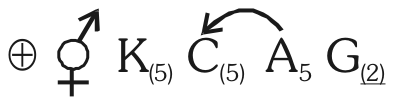
Which of the following floral formula is the correct floral formula of Solanaceae family?
- 1⊕ ⚥
- 2⊕ ⚥
- 3⊕ ⚥
- 4⊕ ⚥
Show answer and solution
Correct: option 1, ⊕ ⚥
Solanaceae flowers are actinomorphic and bisexual with five united sepals, K(5), five united petals, C(5), five epipetalous stamens (shown by the arc joining C and A), and a bicarpellary syncarpous superior ovary, G(2) with a line under G. Only option (1) shows united sepals together with the arc for epipetalous stamens.
Question 5NEET 2026 Re-exam, Q105
Phyllotaxy is the pattern of arrangement of ________.
- 1leaves
- 2flowers
- 3fruits
- 4sepals
Show answer and solution
Correct: option 1, leaves
Phyllotaxy is the pattern in which leaves are arranged on the stem or branch. It is of three types: alternate, opposite and whorled. The arrangement of flowers is called inflorescence.
Question 6NEET 2026 Re-exam, Q113
Which of the following are characteristic features of Solanaceae family?
(a) Flowers are bisexual and actinomorphic
(b) Calyx have five sepals and are united
(c) Androecium have five stamens and are epipetalous
(d) Ovary is inferior
Choose the correct answer from the options given below:
- 1(a), (b) and (c) only
- 2(d) only
- 3(a) and (b) only
- 4(b), (c) and (d) only
Show answer and solution
Correct: option 1, (a), (b) and (c) only
In Solanaceae the flower is bisexual and actinomorphic, the calyx has five united sepals, and the five stamens are epipetalous, so (a), (b) and (c) are right. The ovary is superior, not inferior, so (d) is wrong.
Question 7NEET 2026 Re-exam, Q120
Match List-I with List-II.
| List-I | List-II |
|---|
| A. Marginal placentation | I. Argemone |
| B. Axile placentation | II. Tomato |
| C. Parietal placentation | III. Primrose |
| D. Free central placentation | IV. Pea |
Choose the correct answer from the options given below:
- 1A-II, B-IV, C-I, D-III
- 2A-IV, B-II, C-III, D-I
- 3A-IV, B-III, C-I, D-II
- 4A-IV, B-II, C-I, D-III
Show answer and solution
Correct: option 4, A-IV, B-II, C-I, D-III
Marginal placentation, with ovules along the ventral suture, is seen in pea (A-IV). Axile placentation is seen in tomato, china rose and lemon (B-II). Parietal placentation is seen in mustard and Argemone (C-I). Free central placentation is seen in Dianthus and Primrose (D-III).
Question 8NEET 2025, Q104
Given below are two statements:
Statement I: In a floral formula stands for zygomorphic nature of the flower, and stands for inferior ovary.
Statement II: In a floral formula stands for actinomorphic nature of the flower and stands for superior ovary.
In the light of the above statements, choose the correct answer from the options given below:
- 1Both Statement I and Statement II are correct
- 2Both Statement I and Statement II are incorrect
- 3Statement I is correct but Statement II is incorrect
- 4Statement I is incorrect but Statement II is correct
Show answer and solution
Correct: option 4, Statement I is incorrect but Statement II is correct
In a floral formula stands for an actinomorphic (radially symmetrical) flower, not a zygomorphic one. G with a line below it, , stands for a superior ovary, and G with a line above it for an inferior ovary. So Statement I is incorrect and Statement II is correct.
Question 9NEET 2025, Q124
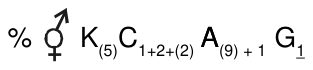
In the seeds of cereals, the outer covering of endosperm separates the embryo by a protein-rich layer called:
- 1Coleoptile
- 2Coleorhiza
- 3Integument
- 4Aleurone layer
Show answer and solution
Correct: option 4, Aleurone layer
In a cereal grain such as maize, the outer covering of the bulky endosperm is a protein-rich layer called the aleurone layer, which separates the endosperm from the embryo. The coleoptile and coleorhiza are sheaths around the plumule and the radicle, and integuments are the coverings of the ovule.
Question 10NEET 2025, Q155
Which of the following is an example of a zygomorphic flower?
- 1Petunia
- 2Datura
- 3Pea
- 4Chilli
Show answer and solution
Correct: option 3, Pea
A zygomorphic flower can be cut into two equal halves in only one vertical plane. The pea flower, with its standard, wings and keel, is zygomorphic. Petunia, Datura and chilli (family Solanaceae) have actinomorphic flowers.
Question 11NEET 2024, Q114
Identify the type of flowers based on the position of calyx, corolla and androecium with respect to the ovary from the given figures (a) and (b)
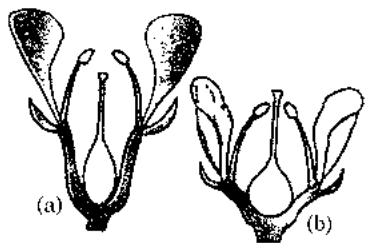
- 1(a) Perigynous; (b) Perigynous
- 2(a) Epigynous; (b) Hypogynous
- 3(a) Hypogynous; (b) Epigynous
- 4(a) Perigynous; (b) Epigynous
Show answer and solution
Correct: option 1, (a) Perigynous; (b) Perigynous
In both figures the gynoecium sits in the centre and the other floral parts arise from the rim of the thalamus at about the same level as the ovary, so the ovary is half inferior. Both flowers are therefore perigynous, as in plum, rose and peach.
Question 12NEET 2024, Q122
Identify the part of the seed from the given figure which is destined to form root when the seed germinates.
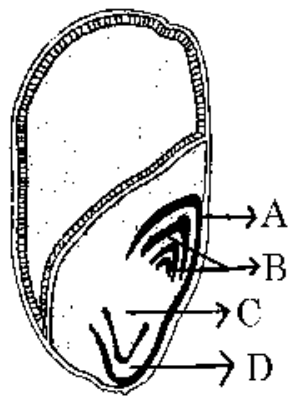
- 1D
- 2A
- 3B
- 4C
Show answer and solution
Correct: option 4, C
The figure is a monocot (maize) seed in section. The embryonal axis has a plumule at the upper end and a radicle at the lower end; the plumule is enclosed in the coleoptile and the radicle in the coleorhiza. The radicle, labelled C, forms the root on germination.
Question 13NEET 2024, Q129
Which of the following is an example of actinomorphic flower?
- 1Sesbania
- 2Datura
- 3Cassia
- 4Pisum
Show answer and solution
Correct: option 2, Datura
An actinomorphic flower can be divided into two equal halves in any radial plane passing through the centre, as in mustard, Datura and chilli. Sesbania, Cassia and Pisum (pea) have zygomorphic flowers.
Question 14NEET 2024, Q136
Match List I with List II
| List I (Types of Stamens) | List II (Example) |
|---|
| A. Monoadelphous | I. Citrus |
| B. Diadelphous | II. Pea |
| C. Polyadelphous | III. Lily |
| D. Epiphyllous | IV. China-rose |
Choose the correct answer from the options given below:
- 1A-III, B-I, C-IV, D-II
- 2A-IV, B-II, C-I, D-III
- 3A-IV, B-I, C-II, D-III
- 4A-I, B-II, C-IV, D-III
Show answer and solution
Correct: option 2, A-IV, B-II, C-I, D-III
Stamens united into one bundle are monoadelphous, as in China-rose (A-IV); into two bundles, diadelphous, as in pea (B-II); into more than two bundles, polyadelphous, as in Citrus (C-I). Stamens attached to the perianth are epiphyllous, as in lily (D-III).
Question 15NEET 2024, Q145
Match List I with List II
| List I | List II |
|---|
| A. Rose | I. Twisted aestivation |
| B. Pea | II. Perigynous flower |
| C. Cotton | III. Drupe |
| D. Mango | IV. Marginal placentation |
Choose the correct answer from the options given below:
- 1A-II, B-III, C-IV, D-I
- 2A-II, B-IV, C-I, D-III
- 3A-I, B-II, C-III, D-IV
- 4A-IV, B-III, C-II, D-I
Show answer and solution
Correct: option 2, A-II, B-IV, C-I, D-III
Rose has a perigynous flower (A-II), pea has marginal placentation (B-IV), cotton has twisted aestivation of the petals (C-I) and the fruit of mango is a drupe (D-III).
Question 16NEET 2024 Re-exam, Q117
Match List-I with List-II:
| List-I | List-II |
|---|
| A. Vexillary aestivation | I. Brinjal |
| B. Epipetalous stamens | II. Peach |
| C. Epiphyllous stamens | III. Pea |
| D. Perigynous flower | IV. Lily |
Choose the correct answer from the options given below:
- 1A-III, B-I, C-IV, D-II
- 2A-III, B-IV, C-I, D-II
- 3A-III, B-II, C-I, D-IV
- 4A-II, B-I, C-IV, D-III
Show answer and solution
Correct: option 1, A-III, B-I, C-IV, D-II
Vexillary (papilionaceous) aestivation is seen in pea (A-III). In brinjal the stamens are attached to the petals, that is, epipetalous (B-I). In lily the stamens are attached to the perianth, that is, epiphyllous (C-IV). Peach has a perigynous flower, with the ovary half inferior (D-II).
Question 17NEET 2024 Re-exam, Q118
Match List-I with List-II:
| List-I | List-II |
|---|
| A. China rose | I. Free central |
| B. Mustard | II. Basal |
| C. Primrose | III. Axile |
| D. Marigold | IV. Parietal |
Choose the correct answer from the options given below:
- 1A-IV, B-III, C-II, D-I
- 2A-II, B-III, C-IV, D-I
- 3A-III, B-IV, C-I, D-II
- 4A-III, B-IV, C-II, D-I
Show answer and solution
Correct: option 3, A-III, B-IV, C-I, D-II
These are types of placentation. China rose has axile placentation, with ovules on a central axis in a chambered ovary (A-III). Mustard has parietal placentation, with ovules on the inner wall of the ovary (B-IV). Primrose has free central placentation, with no septa (C-I). Marigold has basal placentation, a single ovule at the base of the ovary (D-II).
Question 18NEET 2024 Re-exam, Q135
Which of the following examples show monocarpellary, unilocular ovary with many ovules?
A. Sesbania
B. Brinjal
C. Indigofera
D. Tobacco
E. Asparagus
Choose the correct answer from the options given below:
- 1B and E only
- 2C, D and E only
- 3A, B and D only
- 4A and C only
Show answer and solution
Correct: option 4, A and C only
A monocarpellary, unilocular ovary with many ovules is the gynoecium of the family Fabaceae. Sesbania and Indigofera belong to Fabaceae. Brinjal and tobacco (Solanaceae) have a bicarpellary, bilocular ovary, and Asparagus (Liliaceae) has a tricarpellary, trilocular ovary.
Question 19NEET 2023, Q110
Axile placentation is observed in
- 1Mustard, Cucumber and Primrose
- 2China rose, Beans and Lupin
- 3Tomato, Dianthus and Pea
- 4China rose, Petunia and Lemon
Show answer and solution
Correct: option 4, China rose, Petunia and Lemon
In axile placentation the ovules are borne on a central axis in a multilocular ovary, as in China rose, tomato, Petunia and lemon. Mustard has parietal, pea, beans and lupin have marginal, and Dianthus and primrose have free central placentation, which rules out the other options.
Question 20NEET 2023, Q119
Family Fabaceae differs from Solanaceae and Liliaceae. With respect to the stamens, pick out the characteristics specific to family Fabaceae but not found in Solanaceae or Liliaceae.
- 1Diadelphous and Dithecous anthers
- 2Polyadelphous and epipetalous stamens
- 3Monoadelphous and Monothecous anthers
- 4Epiphyllous and Dithecous anthers
Show answer and solution
Correct: option 1, Diadelphous and Dithecous anthers
The androecium of Fabaceae has ten stamens that are diadelphous (nine united and one free) with dithecous anthers. Solanaceae has epipetalous stamens and Liliaceae has epiphyllous stamens, so the diadelphous condition is special to Fabaceae.
Question 21NEET 2023, Q140
Given below are two statements: One is labelled as Assertion A and the other is labelled as Reason R:
Assertion A: A flower is defined as modified shoot wherein the shoot apical meristem changes to floral meristem.
Reason R: Internode of the shoot gets condensed to produce different floral appendages laterally at successive nodes instead of leaves.
In the light of the above statements, choose the correct answer from the options given below:
- 1Both A and R are true and R is the correct explanation of A.
- 2Both A and R are true but R is NOT the correct explanation of A.
- 3A is true but R is false.
- 4A is false but R is true.
Show answer and solution
Correct: option 1, Both A and R are true and R is the correct explanation of A.
A flower is a modified shoot: the shoot apical meristem changes to a floral meristem, the internodes do not elongate so the axis is condensed, and the apex produces floral appendages laterally at successive nodes instead of leaves. Both A and R are true, and R describes how the shoot is modified, so it explains A.
Question 22NEET 2023 Manipur, Q114
In Calotropis, aestivation is:
- 1Imbricate
- 2Twisted
- 3Valvate
- 4Vexillary
Show answer and solution
Correct: option 3, Valvate
In Calotropis the petals of a whorl just touch one another at the margins without overlapping, which is valvate aestivation, option (3). Twisted aestivation is seen in china rose, imbricate in Cassia and vexillary in pea.
Question 23NEET 2023 Manipur, Q134
In a pea flower, five petals are arranged in a specialized manner with one posterior, two lateral and two anterior. These are named as ________, ________ and ________ respectively.
- 1Keel, Standard and Carina
- 2Standard, Wings and Keel
- 3Keel, Wings and Standard
- 4Vexillum, Keel and Standard
Show answer and solution
Correct: option 2, Standard, Wings and Keel
In the papilionaceous corolla of pea the large posterior petal is the standard (vexillum), the two lateral petals are the wings, and the two smallest anterior petals are fused to form the keel. So the order is Standard, Wings and Keel, option (2).
Question 24NEET 2023 Manipur, Q150
Match the following:
| Type of flower | Example |
|---|
| (A) Zygomorphic | (I) Mustard |
| (B) Hypogynous | (II) Plum |
| (C) Perigynous | (III) Cassia |
| (D) Epigynous | (IV) Cucumber |
Select the correct option:
- 1A-IV, B-I, C-III, D-II
- 2A-III, B-I, C-II, D-IV
- 3A-I, B-II, C-IV, D-III
- 4A-I, B-II, C-III, D-IV
Show answer and solution
Correct: option 2, A-III, B-I, C-II, D-IV
Cassia has a zygomorphic (bilaterally symmetrical) flower (A-III). Mustard is hypogynous with a superior ovary (B-I). Plum is perigynous with a half-inferior ovary (C-II). Cucumber is epigynous with an inferior ovary (D-IV). This is option (2).
Question 25NEET 2022, Q109
The flowers are Zygomorphic in:
(a) Mustard
(b) Gulmohar
(c) Cassia
(d) Datura
(e) Chilly
Choose the correct answer from the options given below:
- 1(c), (d), (e) Only
- 2(a), (b), (c) Only
- 3(b), (c) Only
- 4(d), (e) Only
Show answer and solution
Correct: option 3, (b), (c) Only
A zygomorphic flower can be cut into two equal halves in only one vertical plane. Gulmohar and Cassia have such bilaterally symmetrical flowers. Mustard, Datura and chilli flowers are actinomorphic (radially symmetrical). So only (b) and (c) qualify.
Question 26NEET 2022, Q123
Identify the correct set of statements:
(a) The leaflets are modified into pointed hard thorns in Citrus and Bougainvillea
(b) Axillary buds form slender and spirally coiled tendrils in cucumber and pumpkin
(c) Stem is flattened and fleshy in Opuntia and modified to perform the function of leaves
(d) Rhizophora shows vertically upward growing roots that help to get oxygen for respiration
(e) Subaerially growing stems in grasses and strawberry help in vegetative propagation
Choose the correct answer from the options given below:
- 1(a), (b), (d) and (e) Only
- 2(b) and (c) Only
- 3(a) and (d) Only
- 4(b), (c), (d) and (e) Only
Show answer and solution
Correct: option 4, (b), (c), (d) and (e) Only
Thorns of Citrus and Bougainvillea are modified axillary buds (stems), not leaflets, so (a) is wrong. The rest are correct: stem tendrils from axillary buds in cucumber and pumpkin (b), the flattened green stem of Opuntia that does photosynthesis (c), pneumatophores of Rhizophora (d), and runners of grasses and strawberry that spread the plant (e).
Question 27NEET 2022, Q125
Which one of the following plants shows vexillary aestivation and diadelphous stamens?
- 1Solanum nigrum
- 2Colchicum autumnale
- 3Pisum sativum
- 4Allium cepa
Show answer and solution
Correct: option 3, Pisum sativum
Vexillary (papilionaceous) aestivation of the corolla and diadelphous stamens, nine united and one free, are features of the pea family Fabaceae. Pisum sativum is the pea. Solanum belongs to Solanaceae, and Colchicum and Allium are lily-family monocots.
Question 28NEET 2022 Re-exam, Q116
Which of the following statement is not correct?
- 1The rhizome is thick, prostrate and branched
- 2Rhizome is a condensed form of stem
- 3The apical bud in rhizome always remains above the ground
- 4The rhizome is aerial with no distinct nodes and internodes
Show answer and solution
Correct: option 4, The rhizome is aerial with no distinct nodes and internodes
A rhizome, as in ginger, is an underground stem that grows horizontally and has distinct nodes and internodes, with scale leaves and buds at the nodes. So the statement that it is aerial and has no distinct nodes and internodes is the one that is not correct.
Question 29NEET 2022 Re-exam, Q130
Match List - I with List - II.
| List - I | List - II |
|---|
| (a) Imbricate | (i) Calotropis |
| (b) Valvate | (ii) Cassia |
| (c) Vexillary | (iii) Cotton |
| (d) Twisted | (iv) Bean |
Choose the correct answer from the options given below
- 1a-i, b-iii, c-iv, d-ii
- 2a-ii, b-i, c-iii, d-iv
- 3a-ii, b-i, c-iv, d-iii
- 4a-ii, b-iv, c-iii, d-i
Show answer and solution
Correct: option 3, a-ii, b-i, c-iv, d-iii
Imbricate aestivation is seen in Cassia and gulmohur (ii), valvate in Calotropis (i), vexillary or papilionaceous in pea and bean (iv), and twisted in china rose, lady's finger and cotton (iii). This gives a-ii, b-i, c-iv, d-iii.
Question 30NEET 2022 Re-exam, Q135
The Floral Diagram represents which one of the following families?
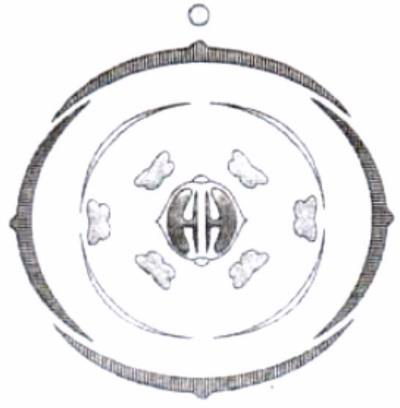
- 1Liliaceae
- 2Fabaceae
- 3Brassicaceae
- 4Solanaceae
Show answer and solution
Correct: option 3, Brassicaceae
The diagram shows four sepals, four petals, six stamens (two outer and four inner) and a bicarpellary ovary divided by a false septum. A tetramerous flower with six stamens and a replum is characteristic of Brassicaceae; Liliaceae is trimerous, and Fabaceae and Solanaceae are pentamerous.
Question 31NEET 2021, Q123
Diadelphous stamens are found in:
- 1China rose
- 2Citrus
- 3Pea
- 4China rose and citrus
Show answer and solution
Correct: option 3, Pea
In diadelphous stamens the filaments are joined into two bundles. Pea has this, with nine stamens united and one free. China rose is monadelphous (one bundle) and citrus is polyadelphous (many bundles).
Question 32NEET 2021, Q138
Match Column - I with Column - II.
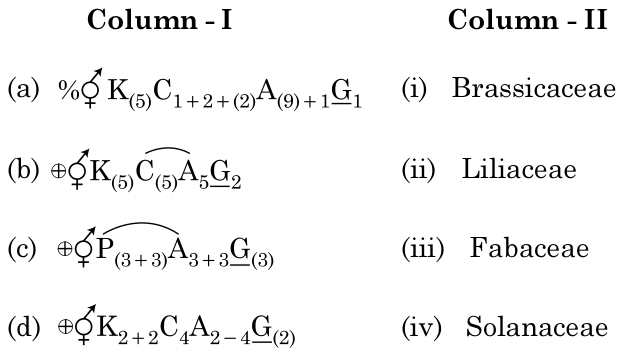
Select the correct answer from the options given below.
- 1a-iii, b-iv, c-ii, d-i
- 2a-i, b-ii, c-iii, d-iv
- 3a-ii, b-iii, c-iv, d-i
- 4a-iv, b-ii, c-i, d-iii
Show answer and solution
Correct: option 1, a-iii, b-iv, c-ii, d-i
Formula (a) is zygomorphic with five united sepals, petals as 1 + 2 + (2) and stamens as (9) + 1, which is Fabaceae (iii). Formula (b) has five united sepals, five united petals with five epipetalous stamens and a bicarpellary superior ovary, which is Solanaceae (iv). Formula (c) has a perianth of 3 + 3 with stamens 3 + 3 and a tricarpellary ovary, which is Liliaceae (ii). Formula (d) has sepals 2 + 2, four petals and stamens 2 + 4, which is Brassicaceae (i). So a-iii, b-iv, c-ii, d-i.
Question 33NEET 2020, Q66
The roots that originate from the base of the stem are:
- 1Fibrous roots
- 2Primary roots
- 3Prop roots
- 4Lateral roots
Show answer and solution
Correct: option 1, Fibrous roots
In monocots such as wheat the primary root is short lived and is replaced by a large number of roots that arise from the base of the stem; these form the fibrous root system. The primary root grows from the radicle, lateral roots branch from the primary root, and prop roots hang down from branches.
Question 34NEET 2020, Q67
The ovary is half inferior in:
- 1Brinjal
- 2Mustard
- 3Sunflower
- 4Plum
Show answer and solution
Correct: option 4, Plum
In a perigynous flower the gynoecium sits in the centre and the other parts are borne on the rim of the thalamus at about the same level, so the ovary is called half inferior. Plum, rose and peach are examples. Brinjal and mustard have a superior ovary, and sunflower has an inferior ovary.
Question 35NEET 2020, Q92
- 1Inferior ovary
- 2Superior ovary
- 3Hypogynous ovary
- 4Half inferior ovary
Show answer and solution
Correct: option 1, Inferior ovary
Ray florets are the outer florets of the head in the sunflower family (Asteraceae). Their flowers are epigynous: the other floral parts arise above the ovary, so the ovary is inferior.
Question 36NEET 2020 Phase 2, Q30
Correct position of floral parts over thalamus in mustard plant is -
- 1Margin of the thalamus grows upward, enclosing the ovary completely, and other parts arise below the ovary.
- 2Gynoecium is present in the centre and other parts cover it partially.
- 3Gynoecium is situated in the centre, and other parts of the flower are located at the rim of the thalamus, at the same level.
- 4Gynoecium occupies the highest position, while the other parts are situated below it.
Show answer and solution
Correct: option 4, Gynoecium occupies the highest position, while the other parts are situated below it.
Mustard has a hypogynous flower: the gynoecium occupies the highest position on the thalamus and the other floral parts are situated below it, so the ovary is superior. Parts at the rim at the same level describes a perigynous flower, and a thalamus enclosing the ovary describes an epigynous one.
Question 37NEET 2020 Phase 2, Q34
Which of the following is the correct floral formula of Liliaceae?
- 1
- 2
- 3
- 4
Show answer and solution
Correct: option 2
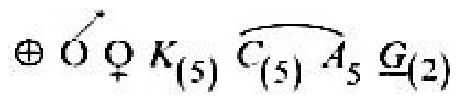
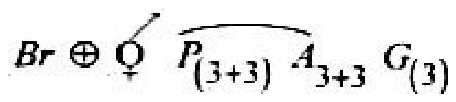
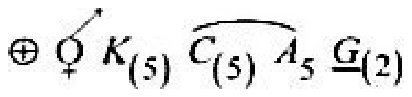
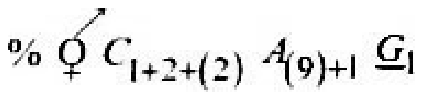
A Liliaceae flower is bracteate, actinomorphic and bisexual, with a perianth of six tepals in two whorls of three, six stamens in two whorls of three attached to the tepals, and a superior ovary of three fused carpels. Only the second formula, with , and , shows this. The formulas with five sepals and petals belong to dicot families, and the fourth one is that of Fabaceae.
Question 38NEET 2020 Phase 2, Q38
Identify the correct features of Mango and Coconut fruits.
(i) In both fruit is a drupe
(ii) Endocarp is edible in both
(iii) Mesocarp in Coconut is fibrous, and in Mango it is fleshy
(iv) In both, fruit develops from monocarpellary ovary
Select the correct option from below:
- 1(i), (ii) and (iii) only
- 2(i) and (iv) only
- 3(i) and (ii) only
- 4(i), (iii) and (iv) only
Show answer and solution
Correct: option 4, (i), (iii) and (iv) only
Mango and coconut are both drupes that, as NCERT describes, develop from monocarpellary superior ovaries, so (i) and (iv) hold. The mesocarp is fleshy and edible in mango and fibrous in coconut, so (iii) holds. The endocarp is hard and stony in both and is not eaten, so (ii) is wrong.
Question 39NEET 2019, Q138
Placentation, in which ovules develop on the inner wall of the ovary or in peripheral part, is:
- 1Basal
- 2Axile
- 3Parietal
- 4Free central
Show answer and solution
Correct: option 3, Parietal
In parietal placentation the ovules are borne on the inner wall of the ovary or on its peripheral part, as in mustard and Argemone. In axile placentation they are on a central axis of a chambered ovary, in free central on a central axis without septa, and in basal a single ovule sits at the base.
Question 40NEET 2019 Odisha, Q162
Which of the following shows whorled phyllotaxy?
- 1Alstonia
- 2Calotropis
- 3Mustard
- 4China rose
Show answer and solution
Correct: option 1, Alstonia
In whorled phyllotaxy more than two leaves arise at each node and form a whorl, as in Alstonia. Calotropis has opposite leaves (a pair at each node), while mustard and China rose have alternate leaves (one at each node).
Question 41NEET 2019 Odisha, Q164
Bicarpellary ovary with obliquely placed septum is seen in:
- 1Solanum
- 2Sesbania
- 3Brassica
- 4Aloe
Show answer and solution
Correct: option 2, Sesbania
The gynoecium of the family Solanaceae is bicarpellary, syncarpous and superior, with a bilocular ovary whose carpels are placed obliquely and a swollen placenta with many ovules. Solanum belongs to this family. Sesbania (Fabaceae) is monocarpellary, Brassica has a false septum (replum) that is not oblique, and Aloe (Liliaceae) is tricarpellary.
Question 42NEET 2019 Odisha, Q173
Match the placental types (column - I) with their examples (column - II).
| Column - I | Column - II |
|---|
| (a) Basal | (i) Mustard |
| (b) Axile | (ii) China rose |
| (c) Parietal | (iii) Dianthus |
| (d) Free central | (iv) Sunflower |
Choose the correct answer from the following options:
- 1a-iv, b-ii, c-i, d-iii
- 2a-iii, b-iv, c-i, d-ii
- 3a-ii, b-iii, c-iv, d-i
- 4a-i, b-ii, c-iii, d-iv
Show answer and solution
Correct: option 1, a-iv, b-ii, c-i, d-iii
Basal placentation, with a single ovule at the base of the ovary, is seen in sunflower (iv). Axile placentation is seen in China rose (ii). Parietal placentation, with ovules on the inner wall of the ovary, is seen in mustard (i). Free central placentation, with ovules on a central axis and no septa, is seen in Dianthus (iii). So the match is a-iv, b-ii, c-i, d-iii.
Question 43NEET 2018, Q126
- 1Carnivorous plants
- 2Free-floating hydrophytes
- 3Halophytes
- 4Submerged hydrophytes
Show answer and solution
Correct: option 3, Halophytes
Pneumatophores are roots that grow vertically upwards out of the mud to take in oxygen. They are found in mangrove plants such as Rhizophora that grow in saline swamps, which are halophytes.
Question 44NEET 2018, Q129
Sweet potato is a modified
- 1Tap root
- 2Adventitious root
- 3Stem
- 4Rhizome
Show answer and solution
Correct: option 2, Adventitious root
The tubers of sweet potato are swollen adventitious roots that arise from the nodes of the stem and store food. They are not tap roots (as in carrot) and not stems (as in potato).
Question 45NEET 2017, Q118
Root hairs develop from the region of:
- 1Maturation
- 2Elongation
- 3Root cap
- 4Meristematic activity
Show answer and solution
Correct: option 1, Maturation
Behind the zone of elongation lies the zone of maturation, where cells differentiate. Some epidermal cells of this zone grow out as root hairs, which absorb water and minerals.
Question 46NEET 2017, Q119
- 1Drupe
- 2Berry
- 3Nut
- 4Capsule
Show answer and solution
Correct: option 1, Drupe
A coconut is a drupe: it develops from a single ovary and has a pericarp with a thin epicarp, a fibrous mesocarp and a hard stony endocarp around the seed.
Question 47NEET 2017, Q150
In Bougainvillea thorns are the modifications of:
- 1Stipules
- 2Adventitious root
- 3Stem
- 4Leaf
Show answer and solution
Correct: option 3, Stem
The thorns of Bougainvillea (and Citrus) are axillary buds that have become hard, pointed structures, so they are modified stems that protect the plant from grazing animals.
Question 48NEET 2016 Phase 1, Q114
The standard petal of a papilionaceous corolla is also called:
- 1Carina
- 2Pappus
- 3Vexillum
- 4Corona
Show answer and solution
Correct: option 3, Vexillum
A papilionaceous corolla, as in pea, has five petals: one large posterior petal called the standard or vexillum, two lateral wings (alae) and two fused anterior petals forming the keel (carina). Pappus is the modified calyx of Asteraceae.
Question 49NEET 2016 Phase 1, Q115
Tricarpellary, syncarpous gynoecium is found in flowers of:
- 1Liliaceae
- 2Solanaceae
- 3Fabaceae
- 4Poaceae
Show answer and solution
Correct: option 1, Liliaceae
Liliaceae has a gynoecium of three fused carpels with a superior, trilocular ovary and axile placentation. Solanaceae is bicarpellary syncarpous, Fabaceae is monocarpellary and Poaceae is described as monocarpellary.
Question 50NEET 2016 Phase 1, Q130
Proximal end of the filament of stamen is attached to the:
- 1Anther
- 2Connective
- 3Placenta
- 4Thalamus or petal
Show answer and solution
Correct: option 4, Thalamus or petal
A stamen has a filament and an anther. The distal end of the filament carries the anther, and the proximal (lower) end is attached to the thalamus or, in epipetalous stamens, to a petal.
Question 51NEET 2016 Phase 1, Q138
Which of the following is not a stem modification?
- 1Pitcher of Nepenthes
- 2Thorns of citrus
- 3Tendrils of cucumber
- 4Flattened structures of Opuntia
Show answer and solution
Correct: option 1, Pitcher of Nepenthes
The pitcher of Nepenthes is a modified leaf (the leaf lamina forms the pitcher). Thorns of citrus and tendrils of cucumber develop from axillary buds, and the flattened green structures of Opuntia are phylloclades, so all three of those are modified stems.
Question 52NEET 2016 Phase 1, Q176
Stems modified into flat green organs performing the functions of leaves are known as:
- 1Cladodes
- 2Phyllodes
- 3Phylloclades
- 4Scales
Show answer and solution
Correct: option 3, Phylloclades
A phylloclade is a flattened, green stem of unlimited growth that carries out photosynthesis, as in Opuntia. A phyllode is a flattened petiole, so it is a leaf part, scales are reduced leaves, and a cladode is a green stem branch of only one or two internodes, as in Asparagus.
Question 53NEET 2016 Phase 2, Q97
The term 'polyadelphous' is related to
- 1gynoecium
- 2androecium
- 3corolla
- 4calyx
Show answer and solution
Correct: option 2, androecium
Polyadelphous describes stamens whose filaments are united into more than two bundles, as in citrus. Stamens make up the androecium.
Question 54NEET 2016 Phase 2, Q98
How many plants among Indigofera, Sesbania, Salvia, Allium, Aloe, mustard, groundnut, radish, gram and turnip have stamens with different lengths in their flowers?
- 1Three
- 2Four
- 3Five
- 4Six
Show answer and solution
Correct: option 2, Four
Stamens of unequal length within a flower are seen in Salvia (didynamous: two long, two short) and in the Brassicaceae members mustard, radish and turnip (tetradynamous: four long, two short). Indigofera, Sesbania, groundnut and gram are legumes with diadelphous stamens, and Allium and Aloe are lilies with six similar stamens. That gives four plants.
Question 55NEET 2016 Phase 2, Q99
Radial symmetry is found in the flowers of
- 1Brassica
- 2Trifolium
- 3Pisum
- 4Cassia
Show answer and solution
Correct: option 1, Brassica
Brassica (mustard) flowers are actinomorphic: they can be cut into two equal halves along any radial plane through the centre. Trifolium, Pisum and Cassia have zygomorphic flowers with only one plane of symmetry.
Question 56NEET 2016 Phase 2, Q100
Free-central placentation is found in
- 1Dianthus
- 2Argemone
- 3Brassica
- 4Citrus
Show answer and solution
Correct: option 1, Dianthus
In free-central placentation the ovules are borne on a central axis and there are no septa, as in Dianthus and Primrose. Argemone and Brassica have parietal placentation and Citrus has axile placentation.
Question 57AIPMT 2015, Q54
Leaves become modified into spines in:
- 1Pea
- 2Onion
- 3Silk Cotton
- 4Opuntia
Show answer and solution
Correct: option 4, Opuntia
In Opuntia, a cactus, the leaves are reduced to spines to cut down water loss and for defence, while the flattened green stem does the photosynthesis. In pea the leaves form tendrils, in onion they are fleshy storage leaves, and silk cotton has ordinary palmately compound leaves.
Question 58AIPMT 2015, Q65
is the floral formula of:
- 1Sesbania
- 2Petunia
- 3Brassica
- 4Allium
Show answer and solution
Correct: option 2, Petunia
The formula shows an actinomorphic, bisexual flower with five united sepals, five united petals, five epipetalous stamens and a bicarpellary syncarpous superior ovary. This is the floral formula of Solanaceae, and Petunia belongs to that family. Sesbania (Fabaceae) is zygomorphic, Brassica (Brassicaceae) has four sepals, four petals and six stamens, and Allium (Liliaceae) has a perianth and a tricarpellary ovary.
Question 59AIPMT 2015, Q89
Keel is the characteristic feature of flower of:
- 1Indigofera
- 2Aloe
- 3Tomato
- 4Tulip
Show answer and solution
Correct: option 1, Indigofera
The keel is the pair of fused anterior petals of a papilionaceous corolla, found in the family Fabaceae. Indigofera belongs to Fabaceae. Aloe and tulip are in Liliaceae and tomato is in Solanaceae, which have no keel.
Question 60AIPMT 2015, Q90
Perigynous flowers are found in:
- 1Cucumber
- 2China rose
- 3Rose
- 4Guava
Show answer and solution
Correct: option 3, Rose
In a perigynous flower the ovary sits in the centre of a cup-shaped thalamus and the other floral parts arise from the rim at about the same level; the ovary is half inferior, as in rose, plum and peach. China rose is hypogynous, and cucumber and guava are epigynous.
Question 61AIPMT 2015, Q128
The hilum is a scar on the:
- 1Fruit, where it was attached to pedicel
- 2Fruit, where style was present
- 3Seed, where micropyle was present
- 4Seed, where funicle was attached
Show answer and solution
Correct: option 4, Seed, where funicle was attached
The hilum is the scar on the seed coat marking the point where the developing seed was attached to the fruit through the funicle (stalk of the ovule). The micropyle is a separate small pore above the hilum.
Question 62AIPMT 2015 Re-test, Q53
Axile placentation is present in:
- 1Argemone
- 2Dianthus
- 3Lemon
- 4Pea
Show answer and solution
Correct: option 3, Lemon
In axile placentation the ovules are borne on a central axis in a multilocular ovary, as in lemon, china rose and tomato. Argemone has parietal, Dianthus has free central and pea has marginal placentation.
Question 63AIPMT 2015 Re-test, Q85
Among china rose, mustard, brinjal, potato, guava, cucumber, onion and tulip, how many plants have superior ovary?
- 1Four
- 2Five
- 3Six
- 4Three
Show answer and solution
Correct: option 3, Six
A superior ovary (hypogynous flower) is found in china rose, mustard, brinjal, potato, onion and tulip, which makes six. Guava and cucumber have an inferior ovary (epigynous flower).
Question 64AIPMT 2015 Re-test, Q111
Flowers are unisexual in:
- 1Onion
- 2Pea
- 3Cucumber
- 4China rose
Show answer and solution
Correct: option 3, Cucumber
Cucumber, like other cucurbits, is monoecious and bears separate male and female flowers on the same plant. Onion, pea and China rose have bisexual flowers.
Question 65AIPMT 2014, Q14
Placenta and pericarp are both edible portions in:
- 1Potato
- 2Apple
- 3Banana
- 4Tomato
Show answer and solution
Correct: option 4, Tomato
Tomato is a berry in which the fleshy pericarp and the swollen placenta are both eaten. In apple the edible part is the thalamus, in banana the mesocarp and endocarp, and potato is a stem tuber, not a fruit.
Question 66AIPMT 2014, Q15
An example of edible underground stem is:
- 1Potato
- 2Carrot
- 3Groundnut
- 4Sweet potato
Show answer and solution
Correct: option 1, Potato
The potato tuber is an underground stem that stores food; its eyes are nodes with buds. Carrot and sweet potato are roots, and groundnut is a fruit.
Question 67AIPMT 2014, Q16
When the margins of sepals or petals overlap one another without any particular direction, the condition is termed as:
- 1Valvate
- 2Vexillary
- 3Imbricate
- 4Twisted
Show answer and solution
Correct: option 3, Imbricate
In imbricate aestivation the margins overlap one another but not in any particular direction, as in Cassia and gulmohur. In valvate they only touch, in twisted the overlap is regular in one direction, and vexillary is the special arrangement of the pea flower.
Question 68AIPMT 2014, Q51
Which one of the following statements is correct?
- 1A sterile pistil is called a staminode.
- 2The seed in grasses is not endospermic.
- 3Mango is a parthenocarpic fruit.
- 4A proteinaceous aleurone layer is present in maize grain.
Show answer and solution
Correct: option 4, A proteinaceous aleurone layer is present in maize grain.
In the maize grain the outer covering of the endosperm is separated from the embryo by a protein-rich layer called the aleurone layer, so option (4) is correct. A staminode is a sterile stamen, not a sterile pistil. Grass seeds are endospermic, and mango is a true fruit (a drupe) formed after fertilization, not a parthenocarpic one.
Question 69AIPMT 2014, Q66
An aggregate fruit is one which develops from:
- 1Multicarpellary superior ovary
- 2Multicarpellary syncarpous gynoecium
- 3Multicarpellary apocarpous gynoecium
- 4Complete inflorescence
Show answer and solution
Correct: option 3, Multicarpellary apocarpous gynoecium
An aggregate fruit forms from a single flower that has many free carpels (a multicarpellary apocarpous gynoecium); each carpel becomes a fruitlet and the fruitlets stay together, as in strawberry and custard apple. A syncarpous gynoecium gives a simple fruit, and a whole inflorescence gives a composite (multiple) fruit.
Question 70NEET 2013, Q69
Seed coat is not thin, membranous in:
- 1Coconut
- 2Groundnut
- 3Gram
- 4Maize
Show answer and solution
Correct: option 1, Coconut
In maize the seed coat is thin and membranous and is fused with the fruit wall, and in groundnut it is the thin papery skin around the seed. Of the four, the key takes coconut as the seed whose coat is not thin and membranous.
Question 71NEET 2013, Q92
In china rose the flowers are:
- 1Actinomorphic, epigynous with valvate aestivation
- 2Zygomorphic, hypogynous with imbricate aestivation
- 3Zygomorphic, epigynous with twisted aestivation
- 4Actinomorphic, hypogynous with twisted aestivation
Show answer and solution
Correct: option 4, Actinomorphic, hypogynous with twisted aestivation
China rose (Hibiscus, family Malvaceae) has radially symmetrical (actinomorphic) flowers with a superior ovary, so the flower is hypogynous. Its petals overlap one another in a regular spiral, which is twisted aestivation. All three features together are given only in option (4).
Question 72NEET 2013, Q106
Among bitter gourd, mustard, brinjal, pumpkin, china rose, lupin, cucumber, sunnhemp, gram, guava, bean, chilli, plum, petunia, tomato, rose, withania, potato, onion, aloe and tulip how many plants have hypogynous flower?
- 1Ten
- 2Fifteen
- 3Eighteen
- 4Six
Show answer and solution
Correct: option 2, Fifteen
A hypogynous flower has a superior ovary. That is the case in mustard, brinjal, china rose, lupin, sunnhemp, gram, bean, chilli, petunia, tomato, withania, potato, onion, aloe and tulip: fifteen plants. Bitter gourd, pumpkin, cucumber and guava are epigynous, and plum and rose are perigynous.
Question 73NEET 2013 Karnataka, Q50
Among flowers of Calotropis, tulip, Sesbania, Asparagus, Colchicine, Sweet pea, Petunia, Indigofera, Mustard, Soybean, Tobacco and groundnut how many plants have corolla with valvate aestivation?
- 1Six
- 2Seven
- 3Eight
- 4Five
Show answer and solution
Correct: option 2, Seven
In valvate aestivation the petals just touch at the margins without overlapping. Sesbania, sweet pea, Indigofera, soybean and groundnut are papilionaceous flowers with vexillary aestivation, so they are excluded. The key counts the remaining seven plants (Calotropis, tulip, Asparagus, Colchicum, Petunia, mustard and tobacco) as valvate, which gives seven; note that mustard is not normally described as valvate, so a count of six is also defensible.
Question 74NEET 2013 Karnataka, Q79
Inflorescence is racemose in:
- 1Brinjal
- 2Tulip
- 3Aloe
- 4Soyabean
Show answer and solution
Correct: option 4, Soyabean
Soyabean belongs to Fabaceae, whose inflorescence is racemose. Brinjal (Solanaceae) has a cymose inflorescence and the tulip flower is solitary, and the key takes soyabean as the answer.
Question 75NEET 2013 Karnataka, Q103
In a cymose inflorescence the main axis:
- 1has unlimited growth
- 2bears a solitary flower
- 3has unlimited growth but lateral branches end in flowers
- 4terminates in a flower
Show answer and solution
Correct: option 4, terminates in a flower
In a cymose inflorescence the main axis ends in a flower, so its growth is limited and the flowers are borne in basipetal order. Unlimited growth of the main axis is the racemose type.
Question 76NEET 2013 Karnataka, Q111
How many plants among China rose, Ocimum, sunflower, mustard, Alstonia, guava, Calotropis and Nerium (Oleander) have opposite phyllotaxy?
- 1Three
- 2Four
- 3Five
- 4Two
Show answer and solution
Correct: option 1, Three
Opposite leaves (two at a node) are found in Ocimum, guava and Calotropis, which makes three. China rose, sunflower and mustard have alternate leaves, while Alstonia and Nerium have whorled leaves.
Question 77AIPMT 2012 Prelims, Q77
Placentation in tomato and lemon is
- 1Parietal
- 2Free central
- 3Marginal
- 4Axile
Show answer and solution
Correct: option 4, Axile
In tomato and lemon the ovary is divided into chambers and the ovules are attached to the central axis, which is axile placentation. Parietal is seen in mustard, free central in Dianthus and Primula, and marginal in pea.
Question 78AIPMT 2012 Prelims, Q85
Cymose inflorescence is present in:
- 1Solanum
- 2Sesbania
- 3Trifolium
- 4Brassica
Show answer and solution
Correct: option 1, Solanum
In a cymose inflorescence the main axis ends in a flower and growth is limited; this is the type found in Solanum. Sesbania, Trifolium and Brassica have racemose inflorescences.
Question 79AIPMT 2012 Prelims, Q89
- 1Asparagus
- 2Euphorbia
- 3Australian Acacia
- 4Opuntia
Show answer and solution
Correct: option 3, Australian Acacia
In Australian Acacia the leaflets fall early and the petiole becomes flat, green and leaf-like to carry out photosynthesis; such a petiole is a phyllode. In Asparagus, Euphorbia and Opuntia it is the stem that is modified.
Question 80AIPMT 2012 Prelims, Q98
The gynoecium consists of many free pistils in flowers of
- 1Aloe
- 2Tomato
- 3Papaver
- 4Michelia
Show answer and solution
Correct: option 4, Michelia
A gynoecium of many free carpels is called apocarpous, and Michelia has this condition. In Aloe, tomato and Papaver the carpels are fused (syncarpous).
Question 81AIPMT 2012 Prelims, Q119
How many plants in the list given below have composite fruits that develop from an inflorescence?
Walnut, poppy, radish, fig, pineapple, apple, tomato, mulberry
- 1Four
- 2Five
- 3Two
- 4Three
Show answer and solution
Correct: option 4, Three
A composite (multiple) fruit is formed from a whole inflorescence. Fig (a syconus from a hypanthodium), pineapple (a sorosis from a spike) and mulberry (a sorosis from a catkin) are of this kind. Walnut, poppy, radish, apple and tomato each develop from a single flower, so the count is three.
Question 82AIPMT 2012 Prelims, Q147
Vexillary aestivation is characteristic of the family
- 1Fabaceae
- 2Asteraceae
- 3Solanaceae
- 4Brassicaceae
Show answer and solution
Correct: option 1, Fabaceae
In vexillary (papilionaceous) aestivation the largest petal, the standard, overlaps the two lateral wings, which in turn overlap the two smallest anterior petals, the keel. This arrangement is found in pea and bean flowers of the family Fabaceae.
Question 83AIPMT 2012 Mains, Q70
Which one of the following organisms is correctly matched with its three characteristics?
- 1Pea: pathway, Endospermic seed, Vexillary aestivation
- 2Tomato: Twisted aestivation, Axile placentation, Berry
- 3Onion: Bulb, Imbricate aestivation, Axile placentation
- 4Maize: pathway, Closed vascular bundles, Scutellum
Show answer and solution
Correct: option 3, Onion: Bulb, Imbricate aestivation, Axile placentation
Onion (Liliaceae) has a bulb, imbricate aestivation of the perianth and axile placentation, so all three features fit. Pea has a non-endospermic seed, tomato has valvate (not twisted) aestivation, and maize is a plant.
Question 84AIPMT 2012 Mains, Q71
How many plants in the list given below have marginal placentation?
Mustard, Gram, Tulip, Asparagus, Arhar, Sun hemp, Chilli, Colchicine, Onion, Moong, Pea, Tobacco, Lupin
- 1Four
- 2Five
- 3Six
- 4Three
Show answer and solution
Correct: option 3, Six
Marginal placentation is the mark of the family Fabaceae, whose single-carpel ovary bears ovules along the ventral suture. Gram, arhar, sun hemp, moong, pea and lupin belong to Fabaceae, which makes six. Mustard has parietal placentation, and the members of Liliaceae and Solanaceae in the list have axile placentation.
Question 85AIPMT 2011 Prelims, Q79
The "Eyes" of the potato tuber are
- 1root buds
- 2flower buds
- 3shoot buds
- 4axillary buds
Show answer and solution
Correct: option 4, axillary buds
A potato tuber is an underground stem. Each eye is a node carrying buds in the axil of a scale leaf, that is, axillary buds, which grow into new shoots when the tuber is planted.
Question 86AIPMT 2011 Prelims, Q82
Which one of the following statements is correct?
- 1In tomato, fruit is a capsule
- 2Seeds of orchids have oil-rich endosperm
- 3Placentation in primrose is basal
- 4Flower of tulip is a modified shoot
Show answer and solution
Correct: option 4, Flower of tulip is a modified shoot
Every flower, including that of tulip, is a modified shoot in which the internodes do not elongate and the leaves are changed into floral parts. The tomato fruit is a berry, orchid seeds are minute with no proper endosperm, and primrose has free central placentation.
Question 87AIPMT 2011 Prelims, Q109
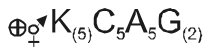
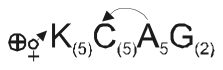
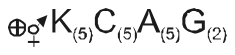
The correct floral formula of chilli is:
- 1
- 2
- 3
- 4
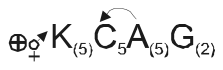
Show answer and solution
Correct: option 2
Chilli belongs to Solanaceae. Its flower is actinomorphic and bisexual, with five united sepals , five united petals , five free stamens that are epipetalous (shown by the arc joining C and A) and a bicarpellary syncarpous superior ovary . Only option (2) shows united petals, free epipetalous stamens and together.
Question 88AIPMT 2011 Prelims, Q126
Flowers are Zygomorphic in:
- 1Mustard
- 2Gulmohur
- 3Tomato
- 4Datura
Show answer and solution
Correct: option 2, Gulmohur
A zygomorphic flower can be cut into two equal halves in only one vertical plane. Gulmohur (like pea, bean and Cassia) has such bilateral symmetry, while mustard, tomato and Datura have radially symmetrical (actinomorphic) flowers.
Question 89AIPMT 2011 Prelims, Q129
The ovary is half inferior in flowers of
- 1Peach
- 2Cucumber
- 3Cotton
- 4Guava
Show answer and solution
Correct: option 1, Peach
In a perigynous flower the ovary sits in the centre with the other floral parts on the rim of the thalamus at about the same level, and the ovary is called half inferior, as in plum, rose and peach. Cotton has a superior ovary (hypogynous), while cucumber and guava have an inferior ovary (epigynous).
Question 90AIPMT 2011 Prelims, Q139
- 1Mango
- 2Wheat
- 3Pea
- 4Tomato
Show answer and solution
Correct: option 1, Mango
A drupe is a fleshy one-seeded fruit with a stony endocarp, developing from a monocarpellary superior ovary, as in mango and coconut. Wheat forms a caryopsis, pea a legume (pod) and tomato a berry.
Question 91AIPMT 2011 Mains, Q35
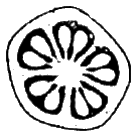
Which one of the following diagrams represents the placentation in Dianthus?
- 1
- 2
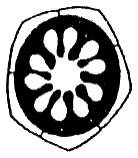
- 3
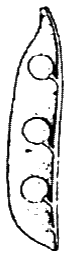
- 4
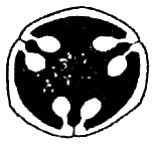
Show answer and solution
Correct: option 2
Dianthus has free central placentation: the ovules are borne on a central axis and there are no septa, so the ovary has a single chamber. Diagram (2) shows this. Diagram (1), with septa joining the central axis to the wall, is axile placentation; diagram (3) is marginal placentation as in pea; diagram (4) is parietal placentation.
Question 92AIPMT 2011 Mains, Q56
Whorled, simple leaves with reticulate venation are present in
- 1Calotropis
- 2Neem
- 3China Rose
- 4Alstonia
Show answer and solution
Correct: option 4, Alstonia
In Alstonia more than two simple leaves arise at each node and form a whorl, and being a dicot it has reticulate venation. Calotropis has opposite leaves, China rose has alternate leaves, and neem has pinnately compound leaves.
Question 93AIPMT 2010 Mains, Q74
Consider the following four statements A, B, C and D select the right option for two correct statements.
Statements:
(A) In vexillary aestivation, the large posterior petal is called-standard, two lateral ones are wings and two small anterior petals are termed keel.
(B) The floral formula for Liliaceae is ⊕ ⚥
(C) In pea flower the stamens are monadelphous
(D) The floral formula for Solanaceae is ⊕ ⚥
The Correct statements are
- 1(C) and (D)
- 2(A) and (C)
- 3(A) and (B)
- 4(B) and (C)
Show answer and solution
Correct: option 1, (C) and (D)
The answer key used for this paper gives option (1). Going by NCERT, however: (A) describes vexillary aestivation correctly (standard, wings, keel). (B) Liliaceae has six tepals in two whorls, six stamens and a tricarpellary superior ovary. (C) In pea the stamens are diadelphous (9 + 1), not monadelphous. (D) Solanaceae is . On that basis (A) and (B) are the correct statements, so treat the keyed answer with caution.
Question 94AIPMT 2010 Mains, Q107
Which one of the following is a xerophytic plant in which the stem is modified into a flat, green and succulent structure
- 1Acacia
- 2Opuntia
- 3Casuarina
- 4Hydrilla
Show answer and solution
Correct: option 2, Opuntia
In Opuntia the stem is a flattened, green, fleshy phylloclade that stores water and carries out photosynthesis, while the leaves are reduced to spines. Hydrilla is a water plant.
Question 95AIPMT 2010 Mains, Q113
Aestivation of petals in the flower of cotton is correctly shown is
- 1
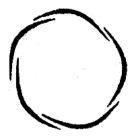
- 2
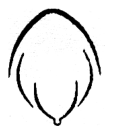
- 3
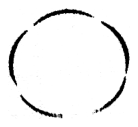
- 4
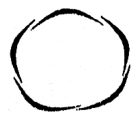
Show answer and solution
Correct: option 1
Cotton, like china rose and lady's finger, has twisted aestivation: one margin of each petal overlaps the next petal and its other margin is overlapped by the petal before it, all in the same direction. Figure (1) shows this regular one-way overlap.
Question 96AIPMT 2010 Mains, Q117
The correct floral formula of soyabean is
- 1
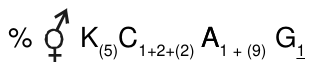
- 2
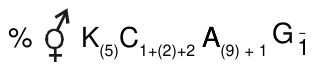
- 3
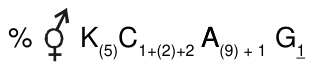
- 4
Show answer and solution
Correct: option 1
Soyabean belongs to the family Fabaceae. Its flower is zygomorphic and bisexual, with five united sepals, K(5); five petals, a standard, two wings and two fused keel petals, C1+2+(2); ten stamens that are diadelphous, nine united and one free; and a superior ovary of one carpel, shown by the line below G1. Formula (1) has the corolla as C1+2+(2) and a superior ovary. Formula (4) differs from it only in the order in which the stamens are written, (9)+1 instead of 1+(9); the answer key gives (1).
Question 97AIPMT 2010 Prelims, Q105
In unilocular ovary with a single ovule the placentation is
- 1Basal
- 2Free Central
- 3Axile
- 4Marginal
Show answer and solution
Correct: option 1, Basal
In basal placentation the placenta develops at the base of a one-chambered ovary and carries a single ovule, as in sunflower and marigold. Free central and axile placentation carry many ovules on a central axis, and marginal placentation has ovules in rows along the ventral suture, as in pea.
Question 98AIPMT 2010 Prelims, Q148
Keel is characteristic of the flowers of
- 1Cassia
- 2Calotropis
- 3Bean
- 4Gulmohur
Show answer and solution
Correct: option 3, Bean
Pea and bean flowers have a papilionaceous corolla: one large standard petal, two wings, and two front petals joined into a boat-shaped keel that encloses the stamens and pistil. Cassia and gulmohur have a different (imbricate) arrangement of petals without a keel, and Calotropis has valvate petals.
Question 99AIPMT 2010 Prelims, Q166
The technical term used for the androecium in a flower of China rose (Hibiscus rosa-sinensis) is
- 1Diadelphous
- 2Polyandrous
- 3Polyadelphous
- 4Monadelphous
Show answer and solution
Correct: option 4, Monadelphous
In China rose the filaments of all the stamens are joined into a single bundle, a staminal tube around the style, while the anthers stay free. Stamens united into one bundle are called monadelphous. Two bundles (pea) is diadelphous and many bundles (citrus) is polyadelphous.
Question 100AIPMT 2010 Prelims, Q177
The scutellum observed in a grain of wheat or maize is comparable to which part of the seed in other monocotyledons
- 1Endosperm
- 2Aleurone layer
- 3Plumule
- 4Cotyledon
Show answer and solution
Correct: option 4, Cotyledon
In the grass family the embryo has one large shield-shaped cotyledon lying to one side of the embryonal axis; it is called the scutellum. So the scutellum is the single cotyledon of the monocot seed.
Question 101AIPMT 2010 Prelims, Q192
Ovary is half-inferior in the flowers of
- 1Plum
- 2Brinjal
- 3Cucumber
- 4Guava
Show answer and solution
Correct: option 4, Guava
The answer key of the source copy gives Guava. Note that this does not agree with the textbook: a half-inferior ovary is found in perigynous flowers, where the other floral parts sit on the rim of the thalamus at about the level of the ovary, as in plum, rose and peach. Guava and cucumber have an inferior ovary (epigynous flowers) and brinjal has a superior ovary. By the textbook the answer is Plum.
Question 102AIPMT 2009 Prelims, Q56
- 1Soybean
- 2Sunnhemp
- 3Tobacco
- 4Tulip
Show answer and solution
Correct: option 3, Tobacco
The formula shows an actinomorphic, bisexual flower with five united sepals, five united petals, five epipetalous stamens and a bicarpellary syncarpous superior ovary. This is the floral formula of Solanaceae, the family of tobacco. Soybean and sunnhemp belong to Fabaceae (zygomorphic flowers, ten stamens) and tulip to Liliaceae (trimerous flowers).
Question 103AIPMT 2009 Prelims, Q66
A fruit developed from hypanthodium inflorescence is called:
- 1Sorosis
- 2Syconus
- 3Caryopsis
- 4Hesperidium
Show answer and solution
Correct: option 2, Syconus
Hypanthodium is the flask-shaped inflorescence of fig (Ficus) with the flowers inside a fleshy receptacle. The composite fruit formed from it is a syconus. Sorosis develops from a spike or catkin, caryopsis is the fruit of grasses and hesperidium that of citrus.
Question 104AIPMT 2009 Prelims, Q105
An example of axile placentation is:
- 1Dianthus
- 2Lemon
- 3Marigold
- 4Argemone
Show answer and solution
Correct: option 2, Lemon
In axile placentation the ovules are borne on a central axis of a multilocular ovary, as in lemon, china rose and tomato. Dianthus has free central placentation, marigold has basal placentation and Argemone has parietal placentation.
Question 105AIPMT 2009 Prelims, Q124
Cotyledons and testa respectively are edible parts in:
- 1walnut and tamarind
- 2french bean and coconut
- 3cashew nut and litchi
- 4groundnut and pomegranate
Show answer and solution
Correct: option 4, groundnut and pomegranate
In groundnut the fleshy cotyledons of the seed are eaten, and in pomegranate the juicy outer seed coat (testa) is eaten. In coconut the edible part is the endosperm, in litchi it is the aril, and in tamarind it is the mesocarp, so the other pairs do not fit.
Question 106AIPMT 2008 Prelims, Q129
The fruit is chambered, developed from inferior ovary and has seeds with succulent testa in
- 1Cucumber
- 2Pomegranate
- 3Orange
- 4Guava
Show answer and solution
Correct: option 2, Pomegranate
The pomegranate fruit (a balausta) develops from an inferior ovary and is divided into chambers. Its edible part is the juicy outer seed coat (testa) of the seeds.
Question 107AIPMT 2008 Prelims, Q132
Dry indehiscent single-seeded fruit formed bicarpellary syncarpous inferior ovary is
- 1Cremocarp
- 2Caryopsis
- 3Cypsela
- 4Berry
Show answer and solution
Correct: option 3, Cypsela
A cypsela, the fruit of the sunflower family, is a dry, indehiscent, one-seeded fruit from a bicarpellary, syncarpous, inferior ovary. A cremocarp is two-seeded and splits, a caryopsis comes from a superior monocarpellary ovary, and a berry is fleshy.
Question 108AIPMT 2008 Prelims, Q141
Replum is present in the ovary of flower of
- 1Pea
- 2Lemon
- 3Mustard
- 4Sunflower
Show answer and solution
Correct: option 3, Mustard
In mustard and other members of the family Brassicaceae the ovary is divided into two chambers by a false septum called the replum, which grows between the two parietal placentae.
Question 109AIPMT 2008 Prelims, Q142
The fleshy receptacle of syconus of fig encloses a number of
- 1Mericarps
- 2Achenes
- 3Samaras
- 4Berries
Show answer and solution
Correct: option 2, Achenes
The syconus of fig is a hollow, fleshy receptacle formed from a hypanthodium inflorescence. Each female flower inside it develops into a small one-seeded fruit, an achene.
Question 110AIPMT 2006 Prelims, Q102
Pineapple (ananas) fruit develops from-
- 1a unilocular polycarpellary flower
- 2a multipistillate syncarpous flower
- 3a cluster of compactly borne flowers on a common axis
- 4a multilocular monocarpellary flower
Show answer and solution
Correct: option 3, a cluster of compactly borne flowers on a common axis
Pineapple is a composite (multiple) fruit of the sorosis type. It forms from a whole spike inflorescence: the many closely packed flowers, their bracts and the common axis fuse and become fleshy together.
Question 111AIPMT 2006 Prelims, Q111
In which of the following fruits is the edible part the aril?
- 1Custard apple
- 2Pomegranate
- 3Orange
- 4Litchi
Show answer and solution
Correct: option 4, Litchi
In litchi the edible part is the fleshy white aril, an outgrowth that covers the seed. In custard apple it is the fleshy pericarp of the fruitlets, in pomegranate the juicy seed coat (testa), and in orange the juicy hairs of the endocarp.
Question 112AIPMT 2006 Prelims, Q129
What type of placentation is seen in sweet pea?
- 1Basal
- 2Axile
- 3Free central
- 4Marginal
Show answer and solution
Correct: option 4, Marginal
Sweet pea belongs to the pea family, whose ovary is made of one carpel with one chamber. The ovules are borne in a row along the ventral suture, which is marginal placentation.
Question 113AIPMT 2006 Prelims, Q130
Long filamentous threads protruding at the end of a young cob of maize are-
- 1Anthers
- 2Styles
- 3Ovaries
- 4Hairs
Show answer and solution
Correct: option 2, Styles
The cob is the female inflorescence of maize. The silky threads hanging out of its tip are the very long styles (with stigmas) of the female flowers, which catch wind-borne pollen.
Question 114AIPMT 2006 Prelims, Q143
Pentamerous, actinomorphic flowers, bicarpellary ovary with oblique septa, and fruit a capsule or berry, are characteristic features of-
- 1Asteraceae
- 2Brassicaceae
- 3Solanaceae
- 4Liliaceae
Show answer and solution
Correct: option 3, Solanaceae
Solanaceae has regular, five-part flowers and a superior ovary of two fused carpels that are placed obliquely, with a swollen placenta; the fruit is a berry (tomato, brinjal) or a capsule (Datura). Liliaceae is trimerous and Brassicaceae is tetramerous with a siliqua.
Question 115AIPMT 2005 Prelims, Q107
Which of the following represents the edible part of the fruit of Litchi
- 1Endocarp
- 2Pericarp
- 3Juicy aril
- 4Mesocarp
Show answer and solution
Correct: option 3, Juicy aril
In litchi the pericarp is the dry, leathery outer skin that is peeled away. The white, fleshy part that is eaten is the aril, an outgrowth that surrounds the seed.
Question 116AIPMT 2004 Prelims, Q137
Edible part of mango is :-
- 1Receptacle
- 2Epicarp
- 3Mesocarp
- 4Endocarp
Show answer and solution
Correct: option 3, Mesocarp
Mango is a drupe. Its pericarp has a thin skin (epicarp), a fleshy, juicy middle layer (mesocarp) that is eaten, and a hard stony endocarp around the seed.
Question 117AIPMT 2004 Prelims, Q187
In a longitudinal section of a root, starting from the tip upward, the four zones occur in the following order:-
- 1Root cap, cell division, cell maturation, cell enlargement
- 2Cell division, cell enlargement, cell maturation, root cap
- 3Cell division, cell maturation, cell enlargement, root cap
- 4Root cap, cell division, cell enlargement, cell maturation
Show answer and solution
Correct: option 4, Root cap, cell division, cell enlargement, cell maturation
The tip is covered by the root cap. Just behind it is the meristematic zone (cell division), then the zone of elongation where the new cells enlarge, and above that the zone of maturation where cells differentiate and root hairs arise.
Question 118AIPMT 2003 Prelims, Q174
Juicy hair-like structures observed in the lemon fruit develop from:-
- 1Exocarp
- 2Mesocarp
- 3Endocarp
- 4Mesocarp and endocarp
Show answer and solution
Correct: option 3, Endocarp
Lemon is a hesperidium. The glandular rind is the exocarp, the white spongy layer is the mesocarp, and the membranous endocarp lining the segments bears the juicy unicellular hairs that are eaten.
Question 119AIPMT 2003 Prelims, Q199
The aleurone layer in maize grain is specially rich in:-
- 1Proteins
- 2Starch
- 3Lipids
- 4Auxins
Show answer and solution
Correct: option 1, Proteins
The aleurone layer is the outermost layer of the endosperm in a cereal grain. Its cells are filled with protein (aleurone) grains, while the rest of the endosperm stores mainly starch.
Question 120AIPMT 2002 Prelims, Q167
Edible part in mango is:-
- 1Mesocarp
- 2Epicarp
- 3Endocarp
- 4Epidermis
Show answer and solution
Correct: option 1, Mesocarp
Mango is a drupe. Its pericarp has a thin skin-like epicarp, a fleshy juicy mesocarp, which is the part eaten, and a hard stony endocarp around the seed.
Question 121AIPMT 2002 Prelims, Q169
- 1Potato
- 2Peanut
- 3Onion
- 4Garlic
Show answer and solution
Correct: option 2, Peanut
A geocarpic fruit develops under the soil. In peanut (groundnut) the stalk of the fertilised ovary elongates and pushes it into the soil where the pod ripens. Potato is a stem tuber, and onion and garlic are bulbs, not fruits.
Question 122AIPMT 2001 Prelims, Q115
Tetradynamous conditions occur in:-
- 1Cruciferae
- 2Malvaceae
- 3Solanaceae
- 4Liliaceae
Show answer and solution
Correct: option 1, Cruciferae
Tetradynamous stamens are six in number, four long (inner) and two short (outer). This is the characteristic androecium of Cruciferae (the mustard family). Malvaceae has monadelphous stamens.
Question 123AIPMT 2001 Prelims, Q116
Which is correct pair for edible part:-
- 1Tomato – Thalamus
- 2Maize - Cotyledons
- 3Guava - Mesocarp
- 4Date palm - Pericarp
Show answer and solution
Correct: option 4, Date palm - Pericarp
In date palm the fleshy pericarp of the one-seeded berry is eaten and the hard seed is thrown away. In tomato the pericarp and placentae are eaten, in maize the starchy endosperm, and in guava the thalamus and pericarp together.
Question 124AIPMT 2001 Prelims, Q117
Bicarpellary gynoecium and oblique ovary occurs in:-
- 1Mustard
- 2Banana
- 3Pisum
- 4Brinjal
Show answer and solution
Correct: option 4, Brinjal
In Solanaceae the gynoecium is bicarpellary and syncarpous, and the ovary is placed obliquely with a swollen placenta. Brinjal belongs to this family. Mustard is also bicarpellary but its ovary is not oblique, and Pisum has one carpel.
Question 125AIPMT 2001 Prelims, Q118
- 1Epicarp
- 2Mesocarp and less developed endocarp
- 3Endocarp and less developed mesocarp
- 4Epicarp & mesocarp
Show answer and solution
Correct: option 3, Endocarp and less developed mesocarp
The banana fruit is a berry. Its peel is the epicarp, which is removed, and the soft part eaten is mainly the endocarp along with the poorly developed mesocarp.
Question 126AIPMT 2001 Prelims, Q123
What is the eye of potato:-
- 1Axillary bud
- 2Accessory bud
- 3Adventitious bud
- 4Apical bud
Show answer and solution
Correct: option 1, Axillary bud
A potato tuber is a swollen underground stem. Each eye is a node with a scale leaf, and in its axil lies an axillary bud that can grow into a new shoot.
Question 127AIPMT 2000 Prelims, Q111
Which is expressing right appropriate pairing:
- 1Brassicaceae - Sunflower
- 2Malvaceae - Cotton
- 3Papilionaceae - Catechu
- 4Liliaceae - Wheat
Show answer and solution
Correct: option 2, Malvaceae - Cotton
Cotton (Gossypium) belongs to Malvaceae. Sunflower is in Asteraceae (Compositae), catechu (Acacia catechu) is in Mimosaceae, and wheat is a grass of Poaceae (Gramineae).
Question 128AIPMT 2000 Prelims, Q119
- 1Carrot
- 2Radish
- 3Ground nut
- 4Turnip
Show answer and solution
Correct: option 3, Ground nut
A geocarpic fruit is one that develops under the soil. In groundnut the stalk of the fertilised ovary (the peg) grows down into the soil and the pod ripens there. Carrot, radish and turnip are swollen roots, not fruits.
Question 129AIPMT 2000 Prelims, Q124
Hair are found in the inflorescences of Zea mays are the modification of:
- 1Style
- 2Stigma
- 3Spathe
- 4Filaments
Show answer and solution
Correct: option 1, Style
The long silky threads (corn silk) hanging from the female inflorescence of maize are the very long styles of the individual flowers; each one catches pollen and leads to one grain.
Question 130AIPMT 2000 Prelims, Q125
Pneumatophores are found in:
- 1The vegetation which is found in marshy and saline lake
- 2The vegetation which found in saline soil
- 3Xerophytes
- 4Epiphytes
Show answer and solution
Correct: option 1, The vegetation which is found in marshy and saline lake
Pneumatophores are roots that grow vertically upward out of waterlogged mud to take in air. They are typical of mangrove plants such as Rhizophora, which grow in marshy, saline, oxygen-poor swamps.
Question 131AIPMT 1998 Prelims, Q151
In angiosperm, characters of flowers are used in classification because:
- 1Characters of flowers are conservative
- 2Flowers are large
- 3Flowers are attractive
- 4None of the above
Show answer and solution
Correct: option 1, Characters of flowers are conservative
Floral characters change very little with the environment in which the plant grows, unlike vegetative characters such as leaf size or plant height. Because they are stable (conservative), they are reliable for classifying angiosperms. Size and attractiveness of flowers have nothing to do with it.
