Questions with solutions
Question 1NEET 2026, Q70
At a certain temperature, T (K), during a process, 500 J is absorbed by the system and work of 200 J is done by the system. Then change in internal energy of the system is:
- 1700 J
- 2300 J
- 3400 J
- 4500 J
Show answer and solution
Correct: option 2, 300 J
First law: with (absorbed) and (done by the system). .
Question 2NEET 2026, Q85
Consider the following reaction:
and at 298 K.
Identify the correct option with for the reaction and spontaneity of the reaction at 298 K.
(Given: )
- 1, spontaneous
- 2, non-spontaneous
- 3, spontaneous
- 4, non-spontaneous
Show answer and solution
Correct: option 2, , non-spontaneous
, so . . A positive means the reaction is non-spontaneous.
Question 3NEET 2026 Re-exam, Q59
Two moles of an ideal gas undergo free expansion from 10 L to 100 L at 300 K. The values of and are
(R is universal gas constant)
- 1;
- 2;
- 3;
- 4;
Show answer and solution
Correct: option 4, ;
Entropy is a state function, so . In a free expansion of an ideal gas no work is done and no heat is exchanged with the surroundings, so .
Question 4NEET 2026 Re-exam, Q69
Consider the reversible processes for 1.0 mol of an ideal gas as shown in the figure.
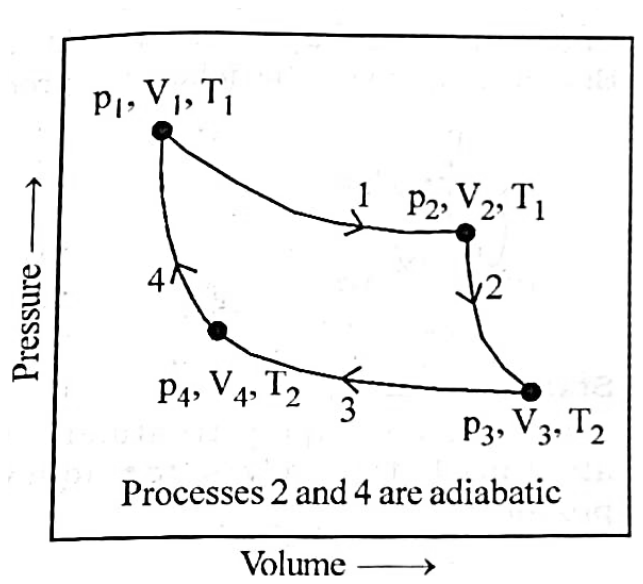
, , and represent work done (in calories) in the processes 1, 2, 3 and 4, respectively; and are changes in the internal energy for the processes 2 and 4, respectively.
[use ]
The correct option is
- 1
- 2
- 3
- 4
Show answer and solution
Correct: option 1,
Processes 1 and 3 are isothermal (at and ), and for a reversible isothermal change . With and , and , which add up to option (1). For the adiabatic steps , so , and the net work over the cycle is not zero.
Question 5NEET 2026 Re-exam, Q74
A protein undergoes reversible thermal denaturation from its initial state N to denatured state D according to . At , the concentrations of both N and D are equal at equilibrium, and the standard enthalpy change of denaturation is . The standard entropy change ( in ) of the protein upon denaturation at is closest to
- 12.0
- 22000.0
- 3333.0
- 411.1
Show answer and solution
Correct: option 1, 2.0
Equal concentrations of N and D mean , so . Then and , taking as 333 K.
Question 6NEET 2025, Q65
;
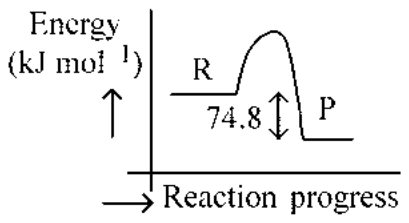
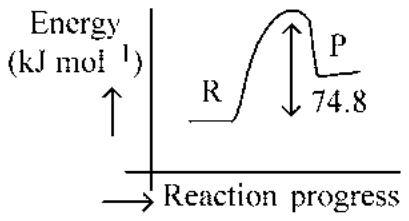
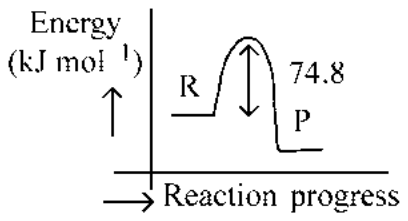
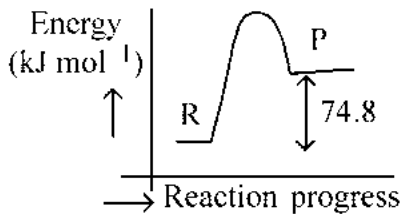
Which of the following diagrams gives an accurate representation of the above reaction?
[R reactants; P products]
- 1
- 2
- 3
- 4
Show answer and solution
Correct: option 1
is negative, so the reaction is exothermic: the products lie below the reactants, and the gap between the R level and the P level is 74.8 kJ mol. Diagram (1) shows P lower than R with 74.8 marked between the two levels. In (2) and (4) P is above R, and in (3) the 74.8 is marked from R up to the top of the barrier. Option (1).
Question 7NEET 2025, Q85
The standard heat of formation, in kcal/mol of is:
[Given: standard heat of formation of ion (aq) = 216 kcal/mol, standard heat of crystallisation of = 4.5 kcal/mol, standard heat of formation of = 349 kcal/mol]
- 1128.5
- 2133.0
- 3+133.0
- 4+220.5
Show answer and solution
Correct: option 1, 128.5
Crystallisation is , kcal/mol. So , which gives kcal/mol, option (1).
Question 8NEET 2024, Q55
Match List I with List II.
| List I (Process) | List II (Conditions) |
|---|
| A. Isothermal process | I. No heat exchange |
| B. Isochoric process | II. Carried out at constant temperature |
| C. Isobaric process | III. Carried out at constant volume |
| D. Adiabatic process | IV. Carried out at constant pressure |
Choose the correct answer from the options given below:
- 1A-II, B-III, C-IV, D-I
- 2A-IV, B-III, C-II, D-I
- 3A-IV, B-II, C-III, D-I
- 4A-I, B-II, C-III, D-IV
Show answer and solution
Correct: option 1, A-II, B-III, C-IV, D-I
An isothermal process is carried out at constant temperature (II), an isochoric process at constant volume (III), an isobaric process at constant pressure (IV), and in an adiabatic process no heat is exchanged with the surroundings (I). So A-II, B-III, C-IV, D-I, option (1).
Question 9NEET 2024, Q65
In which of the following processes entropy increases?
A. A liquid evaporates to vapour.
B. Temperature of a crystalline solid lowered from 130 K to 0 K.
C.
D.
Choose the correct answer from the options given below:
- 1C and D
- 2A and C
- 3A, B and D
- 4A, C and D
Show answer and solution
Correct: option 4, A, C and D
Entropy rises when disorder rises. A: liquid to vapour gives much freer molecules, so entropy increases. B: cooling a crystal towards 0 K reduces the motion of its particles, so entropy decreases. C: a solid gives two moles of gas, so entropy increases. D: one mole of gas molecules becomes two moles of gaseous atoms, so entropy increases. The answer is A, C and D, option (4).
Question 10NEET 2024, Q88
The work done during reversible isothermal expansion of one mole of hydrogen gas at 25°C from pressure of 20 atmosphere to 10 atmosphere is:
(Given )
- 1100 calories
- 20 calorie
- 3 calories
- 4413.14 calories
Show answer and solution
Correct: option 3, calories
For a reversible isothermal expansion of an ideal gas, . With , , K and : cal. The sign is negative because the gas does work on the surroundings. That is option (3).
Question 11NEET 2024 Re-exam, Q64
Choose the correct statement for the work done in the expansion and heat absorbed or released when 5 litres of an ideal gas at 10 atmospheric pressure isothermally expands into vacuum until volume is 15 litres:
- 1Both the heat and work done will be greater than zero
- 2Heat absorbed will be less than zero and work done will be positive
- 3Work done will be zero and heat will also be zero
- 4Work done will be greater than zero and heat will remain zero
Show answer and solution
Correct: option 3, Work done will be zero and heat will also be zero
Expansion into vacuum is free expansion: the external pressure is zero, so . For an ideal gas at constant temperature , and the first law then gives as well.
Question 12NEET 2024 Re-exam, Q79
For an endothermic reaction:
(A) is negative.
(B) is positive.
(C) is negative.
(D) is positive.
Choose the correct answer from the options given, below:
- 1B and D
- 2C and D
- 3A and B
- 4A and C
Show answer and solution
Correct: option 1, B and D
An endothermic reaction absorbs heat from the surroundings, so the heat taken in at constant pressure, , is positive. Since , the enthalpy change is positive too. Statements B and D are correct.
Question 13NEET 2024 Re-exam, Q96
For the following reaction at 300 K
the enthalpy change is +15 kJ, then the internal energy change is:
- 119988.4 J
- 2200 J
- 31999 J
- 41.9988 kJ
Show answer and solution
Correct: option 1, 19988.4 J
with . So J.
Question 14NEET 2023, Q91
Which amongst the following options is the correct relation between change in enthalpy and change in internal energy?
- 1
- 2
- 3
- 4
Show answer and solution
Correct: option 2,
From , at constant pressure and temperature . For ideal gases , where is the change in the number of moles of gas. So .
Question 15NEET 2023 Manipur, Q93
Consider the following reaction:
. What is the enthalpy change for decomposition of one mole of water? (Choose the right option).
- 118 kJ
- 2100 kJ
- 3120.9 kJ
- 4241.82 kJ
Show answer and solution
Correct: option 4, 241.82 kJ
Reversing the reaction changes the sign: decomposing 2 mol of water vapour needs kJ. For one mole the enthalpy change is kJ.
Question 16NEET 2022, Q77
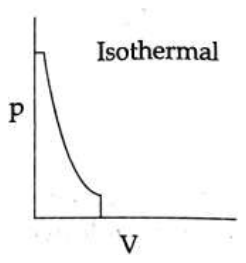
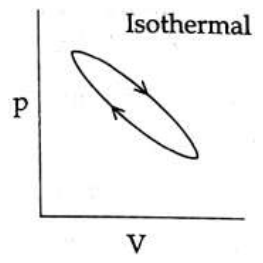
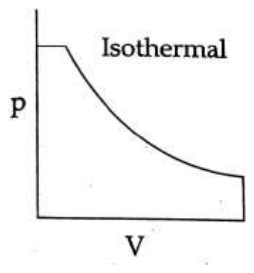
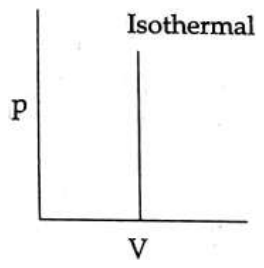
Which of the following p-V curve represents maximum work done?
- 1
- 2
- 3
- 4
Show answer and solution
Correct: option 3
The work done is the area under the p-V curve. In (4) the volume does not change, so the work is zero; in (2) the process is a closed loop and only the small area inside the loop counts; in (1) the volume change is small. Curve (3) covers the largest volume change and has the largest area under it, so it shows the maximum work.
Question 17NEET 2022 Re-exam, Q64
One mole of an ideal gas at 300 K is expanded isothermally from 1 L to 10 L volume. for this process is:
(Use )
- 10 J
- 21260 J
- 32520 J
- 45040 J
Show answer and solution
Correct: option 1, 0 J
The internal energy of an ideal gas depends only on its temperature. In an isothermal process the temperature does not change, so whatever the change in volume; the value of is not needed.
Question 18NEET 2021, Q62
Which one among the following is the correct option for right relationship between and for one mole of ideal gas?
- 1
- 2
- 3
- 4
Show answer and solution
Correct: option 2,
For one mole of an ideal gas , so , which is (Mayer's relation).
Question 19NEET 2021, Q90
For irreversible expansion of an ideal gas under isothermal condition, the correct option is:
- 1
- 2
- 3
- 4
Show answer and solution
Correct: option 3,
The internal energy of an ideal gas depends only on temperature, so at constant temperature . An irreversible process is spontaneous, so the total entropy of system and surroundings increases: , that is, not zero.
Question 20NEET 2020, Q2
The correct option for free expansion of an ideal gas under adiabatic condition is:
- 1, and
- 2, and
- 3, and
- 4, and
Show answer and solution
Correct: option 1, , and
In free expansion the external pressure is zero, so . Adiabatic means . Then , and for an ideal gas the internal energy depends only on temperature, so .
Question 21NEET 2020, Q32
For the reaction, , the correct option is:
- 1 and
- 2 and
- 3 and
- 4 and
Show answer and solution
Correct: option 4, and
A bond is formed, which releases energy, so . Two moles of gaseous atoms become one mole of gas molecules, so the disorder falls and .
Question 22NEET 2020 Phase 2, Q153
If for a certain reaction is at 450 K, the value of (in ) for which the same reaction will be spontaneous at the same temperature is
- 1
- 233
- 3
- 470
Show answer and solution
Correct: option 4, 70
The reaction is spontaneous when , that is . Of the options only 70 is larger than this.
Question 23NEET 2020 Phase 2, Q168
At standard conditions, if the change in the enthalpy for the following reaction is .
Given that bond energy of and is and , respectively, what is the bond energy (in ) of ?
- 1736
- 2518
- 3259
- 4368
Show answer and solution
Correct: option 4, 368
= (bond energies of reactants) (bond energies of products). So , which gives and for the bond.
Question 24NEET 2019, Q51
Under isothermal condition, a gas at 300 K expands from 0.1 L to 0.25 L against a constant external pressure of 2 bar. The work done by the gas is:
[Given that 1 L bar = 100 J]
- 1
- 2
- 3
- 4
Show answer and solution
Correct: option 4,
Against a constant external pressure, . This is the work done on the gas, so the work done by the gas is , which is the keyed option (4).
Question 25NEET 2019, Q86
In which case change in entropy is negative?
- 1Evaporation of water
- 2Expansion of a gas at constant temperature
- 3Sublimation of solid to gas
- 4
Show answer and solution
Correct: option 4,
Entropy falls when disorder falls. In two moles of gaseous atoms combine into one mole of gas molecules, so is negative. Evaporation, expansion of a gas and sublimation all increase disorder.
Question 26NEET 2019 Odisha, Q62
An ideal gas expands isothermally from to at 300 K against a constant pressure of . The work done on the gas is -
- 1+ 900 kJ
- 2− 900 kJ
- 3+ 270 kJ
- 4− 900 J
Show answer and solution
Correct: option 4, − 900 J
Against a constant external pressure, J. The sign is negative because the gas does work on the surroundings.
Question 27NEET 2019 Odisha, Q63
Reversible expansion of an ideal gas under isothermal and adiabatic conditions are as shown in the figure.
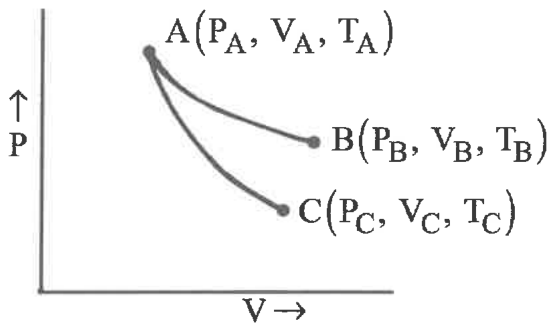
AB Isothermal expansion
AC Adiabatic expansion
Which of the following options is not correct?
- 1
- 2
- 3
- 4
Show answer and solution
Correct: option 2,
In a reversible adiabatic expansion the gas does work at the cost of its own internal energy, so it cools: . Statement (2) is therefore the one that is not correct. The others hold: the isothermal curve lies above the adiabatic one, so more work is done along AB; the entropy of the gas rises in the isothermal expansion but does not change in the reversible adiabatic one; and because AB is isothermal.
Question 28NEET 2018, Q85
The bond dissociation energies of , and XY are in the ratio of 1 : 0.5 : 1. for the formation of XY is . The bond dissociation energy of will be
- 1
- 2
- 3
- 4
Show answer and solution
Correct: option 1,
Let the bond energies of , and XY be , and . For , = bonds broken − bonds formed . Setting gives .
Question 29NEET 2017, Q60
A gas is allowed to expand in a well insulated container against a constant external pressure of 2.5 atm from an initial volume of 2.50 L to a final volume of 4.50 L. The change in internal energy of the gas in joules will be:
- 11136.25 J
- 2−500 J
- 3−505 J
- 4+505 J
Show answer and solution
Correct: option 3, −505 J
The container is insulated, so and . With this is about , which matches the option −505 J.
Question 30NEET 2017, Q77
For a given reaction, and . The reaction is spontaneous at: (Assume that and do not vary with temperature)
- 1T < 425 K
- 2T > 425 K
- 3all temperatures
- 4T > 298 K
Show answer and solution
Correct: option 2, T > 425 K
The reaction is spontaneous when , that is when .
Question 31NEET 2016 Phase 1, Q64
The correct thermodynamic conditions for the spontaneous reaction at all temperatures is:
- 1 and
- 2 and
- 3 and
- 4 and
Show answer and solution
Correct: option 3, and
A reaction is spontaneous when is negative. If is negative and is positive, both terms make negative whatever the temperature. This is the condition the answer key takes, option (3).
Question 32NEET 2016 Phase 1, Q72
Consider the following liquid - vapour equilibrium
Which of the following relations is correct?
- 1
- 2
- 3
- 4
Show answer and solution
Correct: option 4,
The change of vapour pressure with temperature follows the Clausius-Clapeyron equation, , where is the enthalpy of vaporisation. Since is positive, vapour pressure rises with temperature, which rules out the forms with a minus sign.
Question 33NEET 2016 Phase 2, Q52
For a sample of perfect gas when its pressure is changed isothermally from to , the entropy change is given by
- 1
- 2
- 3
- 4
Show answer and solution
Correct: option 2,
For an isothermal change of an ideal gas, . At constant temperature is constant, so . This gives . The options with in them do not even have the units of entropy.
Question 34AIPMT 2015, Q32
Which of the following statements is correct for a reversible process in a state of equilibrium?
- 1
- 2
- 3
- 4
Show answer and solution
Correct: option 2,
In general . At equilibrium and , which gives , option (2).
Question 35AIPMT 2015 Re-test, Q24
The heat of combustion of carbon to is kJ/mol. The heat released upon formation of 35.2 g of from carbon and oxygen gas is:
- 1 kJ
- 2 kJ
- 3 kJ
- 4 kJ
Show answer and solution
Correct: option 3, kJ
releases 393.5 kJ for each mole (44 g) of formed. 35.2 g is mol, so the enthalpy change is kJ, option (3).
Question 36AIPMT 2014, Q166
For the reaction:
kcal, at 300 K
Hence, is:
- 1 kcal
- 22.7 kcal
- 3 kcal
- 49.3 kcal
Show answer and solution
Correct: option 3, kcal
with and : kcal. Then kcal.
Question 37AIPMT 2014, Q175
Using the Gibbs energy change, kJ, for the following reaction,
the of in water at 25°C is:
()
- 1
- 2
- 3
- 4
Show answer and solution
Correct: option 3,
The examiners dropped this question and gave every candidate the 4 marks.
The answer key gives no option for this question, so it is treated as dropped and every candidate gets the marks. The working: , so and , which is the value in option (3).
Question 38NEET 2013 Karnataka, Q12
When 5 litres of a gas mixture of methane and propane is perfectly combusted at 0°C and 1 atmosphere, 16 litres of oxygen at the same temperature and pressure is consumed. The amount of heat released from this combustion in kJ (, ) is:
- 138
- 2317
- 3477
- 432
Show answer and solution
Correct: option 2, 317
needs 2 volumes of and needs 5. If the mixture has L of methane, gives L of methane and 2 L of propane. At 0°C and 1 atm these are and mol, so heat released kJ.
Question 39NEET 2013 Karnataka, Q16
Three thermochemical equations are given below:
(i) ;
(ii) ;
(iii) ;
Based on the above equations, find out which of the relationship given below is correct:
- 1
- 2
- 3
- 4
Show answer and solution
Correct: option 2,
Adding equations (ii) and (iii) cancels CO and gives equation (i), graphite burning to . By Hess's law the enthalpies add in the same way, so .
Question 40AIPMT 2012 Prelims, Q157
In which of the following reactions, standard reaction entropy change () is positive and standard Gibb's energy change () decreases sharply with increasing temperature?
- 1C graphite +
- 2
- 3
- 4 C graphite +
Show answer and solution
Correct: option 1, C graphite +
, so falls steeply with temperature only when is clearly positive, which needs more moles of gas in the products. In (1) half a mole of gas gives one mole of gas, so . In (2) and (3) gas is used up () and in (4) the moles of gas do not change (). So option (1).
Question 41AIPMT 2012 Prelims, Q174
The enthalpy of fusion of water is 1.435 kcal/mol. The molar entropy change for the melting of ice at 0°C is:
- 110.52 cal / (mol K)
- 221.04 cal / (mol K)
- 35.260 cal / (mol K)
- 40.526 cal / (mol K)
Show answer and solution
Correct: option 3, 5.260 cal / (mol K)
At the melting point the change is reversible, so , option (3).
Question 42AIPMT 2012 Prelims, Q189
Standard enthalpy of vapourisation for water at 100°C is 40.66 kJ mol. The internal energy of vaporisation of water at 100°C (in kJmol) is:
(Assume water vapour to behave like an ideal gas).
- 1+ 37.56
- 2– 43.76
- 3+ 43.76
- 4+ 40.66
Show answer and solution
Correct: option 1, + 37.56
For , . , option (1).
Question 43AIPMT 2012 Mains, Q42
Equal volumes of two monoatomic gases, A and B, at same temperature and pressure are mixed. The ratio of specific heats () of the mixture will be:
- 10.83
- 21.50
- 33.3
- 41.67
Show answer and solution
Correct: option 4, 1.67
Both gases are monoatomic, so each has and , and a mixture of them has the same molar heat capacities. Hence .
Question 44AIPMT 2011 Prelims, Q35
If the enthalpy change for the transition of liquid water to steam is 30 kJ at , the entropy change for the process would be:
- 110 J
- 21.0 J
- 30.1 J
- 4100 J
Show answer and solution
Correct: option 4, 100 J
For a phase transition at equilibrium , so . With J and K, J .
Question 45AIPMT 2011 Prelims, Q39
Enthalpy change for the reaction, is kJ.
The dissociation energy of H–H bond is:
- 1 kJ
- 2 kJ
- 3 kJ
- 4 kJ
Show answer and solution
Correct: option 3, kJ
The reaction forms 2 mol of H–H bonds and releases 869.6 kJ, so forming 1 mol releases kJ. Breaking a bond is the reverse process and absorbs the same energy, so the bond dissociation energy is kJ per mole.
Question 46AIPMT 2011 Prelims, Q41
Which of the following is correct option for free expansion of an ideal gas under adiabatic condition?
- 1, ,
- 2, ,
- 3, ,
- 4, ,
Show answer and solution
Correct: option 3, , ,
Adiabatic means no heat is exchanged, . Free expansion is against zero external pressure, so . Then , and since the internal energy of an ideal gas depends only on temperature, .
Question 47AIPMT 2011 Mains, Q14
Consider the following processes:
| (kJ/mol) |
|---|
| +150 |
| –125 |
| +350 |
For , will be:
- 1525 kJ/mol
- 2–175 kJ/mol
- 3–325 kJ/mol
- 4325 kJ/mol
Show answer and solution
Correct: option 2, –175 kJ/mol
Use Hess's law. Twice the first equation gives (+300). Add the second, (–125), and the reverse of the third, (–350). A cancels, and what is left is . kJ/mol.
Question 48AIPMT 2010 Mains, Q35
Match List I (Equations) with List II (Types of processes) and select the correct option.
| List I (Equations) | List II (Types of process) |
|---|
| (a) | (i) Non-spontaneous |
| (b) | (ii) Equilibrium |
| (c) | (iii) Spontaneous and endothermic |
| (d) | (iv) Spontaneous |
- 1a-i, b-ii, c-iii, d-iv
- 2a-iii, b-iv, c-ii, d-i
- 3a-iv, b-i, c-ii, d-iii
- 4a-ii, b-i, c-iv, d-iii
Show answer and solution
Correct: option 3, a-iv, b-i, c-ii, d-iii
When the reaction moves forward to reach equilibrium, so it is spontaneous (a-iv). When the system is at equilibrium (c-ii). The condition means , so is negative; this condition is what makes a reaction with positive and positive go, so it is spontaneous and endothermic (d-iii). That leaves (b) for the non-spontaneous case (b-i), which is the pairing intended by the question.
Question 49AIPMT 2010 Mains, Q38
Three moles of an ideal gas expanded spontaneously into vacuum. The work done will be:
- 1Infinite
- 23 Joules
- 39 Joules
- 4Zero
Show answer and solution
Correct: option 4, Zero
Work of expansion is . In expansion into vacuum (free expansion) the external pressure is zero, so no work is done, whatever the amount of gas.
Question 50AIPMT 2010 Mains, Q43
For vaporization of water at 1 atmospheric pressure, the values of and are and , respectively. The temperature when Gibb's energy change () for this transformation will be zero, is:
- 1273.4 K
- 2393.4 K
- 3373.4 K
- 4293.4 K
Show answer and solution
Correct: option 3, 373.4 K
gives , the normal boiling point of water.
Question 51AIPMT 2010 Mains, Q57
The following two reactions are known
;
;
The value of for the following reaction
is:
- 1+ 10.3 kJ
- 2- 43.3 kJ
- 3- 10.3 kJ
- 4+ 6.2 kJ
Show answer and solution
Correct: option 4, + 6.2 kJ
By Hess's law the required reaction is the first reaction minus twice the second: .
Question 52AIPMT 2010 Prelims, Q88
Standard entropies of , and are 60, 40 and 50 respectively. For the reaction
to be at equilibrium, the temperature should be:
- 1750 K
- 21000 K
- 31250 K
- 4500 K
Show answer and solution
Correct: option 1, 750 K
. At equilibrium , so .
Question 53AIPMT 2009 Prelims, Q176
The values of and for the reaction, are 170 kJ and , respectively. This reaction will be spontaneous at
- 1910 K
- 21110 K
- 3510 K
- 4710 K
Show answer and solution
Correct: option 2, 1110 K
The reaction is spontaneous when , that is when . Only 1110 K is above 1000 K.
Question 54AIPMT 2009 Prelims, Q191
From the following bond energies:
bond energy:
bond energy:
bond energy:
bond energy:
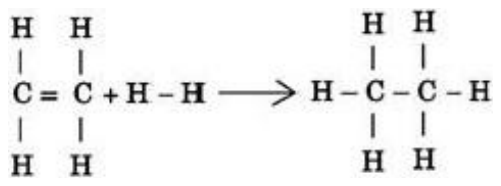
Enthalpy for the reaction,
- 1
- 2
- 3
- 4
Show answer and solution
Correct: option 2,
= energy of bonds broken minus energy of bonds formed. Broken: one and one , . Formed: one and two , . So .
Question 55AIPMT 2008 Prelims, Q57
Which of the following are not state functions?
(I) q + w
(II) q
(III) w
(IV) H-TS
- 1(II) and (III)
- 2(I) and (IV)
- 3(II), (III) and (IV)
- 4(I), (II) and (III)
Show answer and solution
Correct: option 1, (II) and (III)
Heat q and work w each depend on the path taken, so they are not state functions. Their sum q + w is the change in internal energy , and H − TS is the Gibbs energy G; both depend only on the state. So only (II) and (III) are not state functions.
Question 56AIPMT 2008 Prelims, Q60
Bond dissociation enthalpy of , and HCl are 434, 242 and 431 respectively. Enthalpy of formation of HCl is
- 1
- 2
- 3
- 4
Show answer and solution
Correct: option 4,
For , = (bonds broken) − (bonds formed) .
Question 57AIPMT 2008 Prelims, Q65
For the gas phase reaction,
Which of the following conditions is correct?
- 1 and
- 2 and
- 3 and
- 4 and
Show answer and solution
Correct: option 3, and
Breaking apart needs energy, so the dissociation is endothermic (). One mole of gas gives two moles of gas, so the disorder rises ().
Question 58AIPMT 2007 Prelims, Q112
Consider the following reactions:
(a) ,
(b) ,
(c)
(d)
Enthalpy of formation of is
- 1
- 2
- 3
- 4
Show answer and solution
Correct: option 2,
Enthalpy of formation is the enthalpy change when one mole of a compound is made from its elements in their standard states. Only reaction (b) does that for liquid water: gas and gas give one mole of . Reaction (a) is neutralisation, and (c) and (d) start from compounds. So the answer is the option; from reaction (b) the value itself is .
Question 59AIPMT 2006 Prelims, Q51
Identify the correct statement for change of Gibbs energy for a system () at constant temperature and pressure:
- 1If , the process is spontaneous
- 2If , the system has attained equilibrium
- 3If , the system is still moving in a particular direction
- 4If , the process is not spontaneous
Show answer and solution
Correct: option 2, If , the system has attained equilibrium
At constant temperature and pressure a process is spontaneous when and non-spontaneous when . When there is no net driving force in either direction, so the system is at equilibrium. Only option (2) says this.
Question 60AIPMT 2006 Prelims, Q54
Assume each reaction is carried out in an open container. For which reaction will ?
- 1
- 2
- 3
- 4
Show answer and solution
Correct: option 1,
, so the two are equal only when the number of moles of gas does not change. is for option (1), for (2), for (3) and for (4). Hence option (1).
Question 61AIPMT 2006 Prelims, Q64
The enthalpy and entropy change for the reaction:
are and respectively. The temperature at which the reaction will be in equilibrium is:
- 1285.7 K
- 2273 K
- 3450 K
- 4300 K
Show answer and solution
Correct: option 1, 285.7 K
At equilibrium , so .
Question 62AIPMT 2006 Prelims, Q75
The enthalpy of hydrogenation of cyclohexene is . If resonance energy of benzene is , its enthalpy of hydrogenation would be:
- 1
- 2
- 3
- 4
Show answer and solution
Correct: option 2,
Three isolated double bonds would release . Benzene is already more stable than that imaginary triene by , so it releases that much less: .
Question 63AIPMT 2005 Prelims, Q56
A reaction occurs spontaneously if -
- 1 and is +ve and are –ve
- 2 and both and are +ve
- 3 and both and are +ve
- 4 and both and are +ve
Show answer and solution
Correct: option 4, and both and are +ve
A reaction is spontaneous when is negative. With both and positive this needs . If the system is at equilibrium, if then is positive, and a positive with a negative can never give .
Question 64AIPMT 2005 Prelims, Q65
The absolute enthalpy of neutralisation of the reaction:
will be:-
- 1
- 2
- 3Greater than
- 4Less than
Show answer and solution
Correct: option 3, Greater than
A strong acid and a strong base that are both fully ionised give per mole of water formed. MgO is a solid, weak base, so part of the heat is used up in breaking its lattice and ionising it, and less heat is released. The enthalpy change is therefore less negative, that is greater than .
Question 65AIPMT 2005 Prelims, Q90
Which of the following pairs of a chemical reaction is certain to result in a spontaneous reaction -
- 1Endothermic and decreasing disorder
- 2Exothermic and increasing disorder
- 3Endothermic and increasing disorder
- 4Exothermic and decreasing disorder
Show answer and solution
Correct: option 2, Exothermic and increasing disorder
. An exothermic reaction has negative and increasing disorder means positive , so both terms make negative at every temperature. The other combinations are either never spontaneous or spontaneous only in a limited temperature range.
Question 66AIPMT 2004 Prelims, Q59
If the bond energies of H–H, Br–Br and H–Br are 433, 192 and 364 respectively the for the reaction is
- 1+103 kJ
- 2+261 kJ
- 3–103 kJ
- 4–261 kJ
Show answer and solution
Correct: option 3, –103 kJ
= (bond energies of bonds broken) − (bond energies of bonds formed) . So option (3) is right.
Question 67AIPMT 2004 Prelims, Q72
Considering entropy (S) as a thermodynamic parameter, the criterion for the spontaneity of any process is:
- 1
- 2 only
- 3 only
- 4
Show answer and solution
Correct: option 4,
By the second law, a process is spontaneous when the total entropy of the universe increases: . The entropy of the system alone, or of the surroundings alone, may fall in a spontaneous process.
Question 68AIPMT 2004 Prelims, Q86
Standard enthalpy and standard entropy changes for the oxidation of ammonia at 298 K are and , respectively. Standard Gibbs energy change for the same reaction at 298 K is:
- 1
- 2
- 3
- 4
Show answer and solution
Correct: option 1,
. The entropy change must first be converted from J to kJ.
Question 69AIPMT 2004 Prelims, Q99
The work done during the expansion of a gas from a volume of to against a constant external pressure of 3 atm is:
- 1–608 J
- 2+304 J
- 3–304 J
- 4–6 J
Show answer and solution
Correct: option 1, –608 J
. Since , . The sign is negative because the gas does work on the surroundings.
Question 70AIPMT 2003 Prelims, Q57
For the reaction:
at constant temperature, is:
- 1
- 2
- 3
- 4
Show answer and solution
Correct: option 2,
, where counts gases only. Gaseous products: 3 mol; gaseous reactants: mol (water is liquid). , so .
Question 71AIPMT 2003 Prelims, Q59
The densities of graphite and diamond at 298 K are 2.25 and 3.31 , respectively. If the standard free energy difference () is equal to 1895 , the pressure at which graphite will be transformed into diamond at 298 K is -
- 1 Pa
- 2 Pa
- 3 Pa
- 4 Pa
Show answer and solution
Correct: option 1, Pa
At constant temperature the free energy change varies with pressure as , and conversion starts when . For one mole (12 g), . So Pa, which is of the order of Pa; the nearest option is Pa.
Question 72AIPMT 2003 Prelims, Q60
What is the entropy change (in ) when one mole of ice is converted into water at ? (The enthalpy change for the conversion of ice to liquid water is 6.0 at )
- 120.13
- 22.013
- 32.198
- 421.98
Show answer and solution
Correct: option 4, 21.98
Melting at the melting point is reversible, so .
Question 73AIPMT 2003 Prelims, Q69
For which one of the following equations is equal to for the product:
- 1
- 2
- 3
- 4
Show answer and solution
Correct: option 3,
An enthalpy of formation is the enthalpy change when one mole of a compound forms from its elements in their standard states. Only fits. In (1) ozone is not the standard state of oxygen, in (2) methane is a compound and two products form, and in (4) CO is a compound and two moles of product form.
Question 74AIPMT 2003 Prelims, Q71
The molar heat capacity of water at constant pressure, C, is 75 . When 1.0 KJ of heat is supplied to 100 g of water which is free to expand, the increase in temperature of water is:
- 11.2 K
- 22.4 K
- 34.8 K
- 46.6 K
Show answer and solution
Correct: option 2, 2.4 K
100 g of water is mol. , so K.
Question 75AIPMT 2002 Prelims, Q59
- 1
- 2
- 3
- 4
Show answer and solution
Correct: option 1,
Entropy change is heat absorbed reversibly divided by temperature, , so its unit is joule per kelvin, and per mole for molar entropy: .
Question 76AIPMT 2002 Prelims, Q60
In a closed insulated container a liquid is stirred with a paddle to increase the temperature which of the following is true:
- 1,
- 2
- 3,
- 4
Show answer and solution
Correct: option 1, ,
The container is insulated, so no heat crosses the boundary and . Stirring does work on the liquid, and by the first law , which is not zero because the temperature rises.
Question 77AIPMT 2002 Prelims, Q61
2 mole of ideal gas at 27ºC temp. is expanded reversibly from 2 lit. to 20 lit. Find entropy change (R = 2 cal/mol K):
- 192.1
- 20
- 34
- 49.2
Show answer and solution
Correct: option 4, 9.2
For a reversible isothermal expansion of an ideal gas . Here .
Question 78AIPMT 2002 Prelims, Q62
Heat of combustion for , and are , and Kcal/mol. then for is:
- 1 Kcal
- 2 Kcal
- 3 Kcal
- 4 Kcal
Show answer and solution
Correct: option 1, Kcal
The reaction enthalpy equals the heats of combustion of the reactants minus those of the products: Kcal.
Question 79AIPMT 2001 Prelims, Q68
Change in enthalpy for reaction
If heat of formation of and are & kJ/mol respectively:
- 1 kJ/mol
- 2 kJ/mol
- 3 kJ/mol
- 4 kJ/mol
Show answer and solution
Correct: option 1, kJ/mol
kJ.
Question 80AIPMT 2001 Prelims, Q70
Enthalpy of is negative. If enthalpy of combustion of and are x and y respectively. Then which relation is correct:
- 1
- 2
- 3
- 4
Show answer and solution
Correct: option 2,
Subtracting the combustion equation of from that of gives the reaction asked, so its enthalpy is . This is negative, hence (both are negative numbers and methane's is the more negative).
Question 81AIPMT 2000 Prelims, Q92
J
J
J
for the following reaction is:
- 1 J
- 2 J
- 3 J
- 4 J
Show answer and solution
Correct: option 1, J
The required reaction is (first equation) (second equation) (third equation): the 2Zn and cancel and . So J.
Question 82AIPMT 2000 Prelims, Q93
At latent heat of fusion of a compound is 2930 J/mol. Entropy change is:
- 19.77 J/mol-K
- 210.77 J/mol-K
- 39.07 J/mol-K
- 40.977 J/mol-K
Show answer and solution
Correct: option 1, 9.77 J/mol-K
For a phase change at its equilibrium temperature , with K.
Question 83AIPMT 2000 Prelims, Q94
For the reaction which one is true:
- 1
- 2
- 3
- 4
Show answer and solution
Correct: option 1,
, where counts only gases. Here (the ethanol and water are liquids), so .
Question 84AIPMT 1999 Prelims, Q80
What is true for a cyclic process:
- 1
- 2
- 3
- 4
Show answer and solution
Correct: option 2 or 3
The answer key accepts options 2 and 3.
In a cyclic process the system returns to its starting state, so every state function is unchanged: and . Work is not a state function and is generally not zero. The key accepts both (2) and (3).
Question 85AIPMT 1999 Prelims, Q82
A system is expanded under adiabatic process:
- 1Temp. increase
- 2 decreases
- 3 increases
- 4None of these
Show answer and solution
Correct: option 2, decreases
In an adiabatic process , so . When the system expands it does work on the surroundings, is negative, and the internal energy falls (the temperature drops).
Question 86AIPMT 1999 Prelims, Q83
Which of the following is true for a reaction in which all the reactant & product are liquids:
- 1
- 2
- 3
- 4None of the above
Show answer and solution
Correct: option 1,
, where is the change in moles of gas. With only liquids there is no gas and the volume change is negligible, so and .
Question 87AIPMT 1998 Prelims, Q95
Identify the correct statement regarding entropy:
- 1At absolute zero of temperature, the entropy of all crystalline substances is taken to be zero
- 2At absolute zero of temperature, the entropy of a perfectly crystalline substance is +ve
- 3At absolute zero of temperature, entropy of a perfectly crystalline substance is taken to be zero
- 4At C, the entropy of a perfectly crystalline substance is taken to be zero
Show answer and solution
Correct: option 3, At absolute zero of temperature, entropy of a perfectly crystalline substance is taken to be zero
This is the third law of thermodynamics: the entropy of a perfectly crystalline substance is zero at absolute zero (0 K). It applies only to perfect crystals, not to all crystalline substances, and at 0 K, not at C.
Question 88AIPMT 1998 Prelims, Q100
One mole of an ideal gas at 300 K is expanded isothermally from an initial volume of 1 litre to 10 litres. The for this process is ( cal. ):
- 11381.1 cal.
- 2Zero
- 3163.7 cal.
- 49 lit. atm.
Show answer and solution
Correct: option 2, Zero
The internal energy of an ideal gas depends only on its temperature. In an isothermal process the temperature does not change, so , whatever the change in volume. (The 1381.1 cal is the work, , not .)