Questions with solutions
Question 1NEET 2023, Q57
Which one is an example of heterogeneous catalysis?
- 1Oxidation of sulphur dioxide into sulphur trioxide in the presence of oxides of nitrogen.
- 2Hydrolysis of sugar catalysed by ions.
- 3Decomposition of ozone in presence of nitrogen monoxide.
- 4Combination between dinitrogen and dihydrogen to form ammonia in the presence of finely divided iron.
Show answer and solution
Correct: option 4, Combination between dinitrogen and dihydrogen to form ammonia in the presence of finely divided iron.
In heterogeneous catalysis the catalyst is in a different phase from the reactants. In Haber's process the reactants and are gases and the iron catalyst is a solid. In options (1) and (3) reactants and catalyst are all gases, and in (2) they are all in solution, so those are homogeneous.
Question 2NEET 2023, Q94
Pumice stone is an example of -
- 1sol
- 2gel
- 3solid sol
- 4foam
Show answer and solution
Correct: option 3, solid sol
Pumice stone is a colloid in which a gas is dispersed in a solid. The NCERT table of colloids lists pumice stone against a solid dispersion medium under the name solid sol, and the key follows that entry, option (3). A foam (option 4) has a gas dispersed in a liquid, such as froth or whipped cream.
Question 3NEET 2023 Manipur, Q83
Which of the following is a positively charged sol?
- 1Silver sol
- 2 sol
- 3Methylene blue sol
- 4Congo red sol
Show answer and solution
Correct: option 3, Methylene blue sol
Basic dyes such as methylene blue, like hydrated metal oxide sols and haemoglobin, carry a positive charge. Metal sols (silver), metal sulphide sols () and acid dyes such as congo red are negatively charged.
Question 4NEET 2022, Q54
Given below are two statements:
Statement I:
In the coagulation of a negative sol, the flocculating power of the three given ions is in the order -
Statement II:
In the coagulation of a positive sol, the flocculating power of the three given salts is in the order -
In the light of the above statements, choose the most appropriate answer from the options given below:
- 1Statement I is incorrect but Statement II is correct.
- 2Both Statement I and Statement II are correct.
- 3Both Statement I and Statement II are incorrect.
- 4Statement I is correct but Statement II is incorrect.
Show answer and solution
Correct: option 4, Statement I is correct but Statement II is incorrect.
By the Hardy-Schulze rule, the higher the charge on the oppositely charged ion, the greater its flocculating power. A negative sol is coagulated by cations, so is correct. A positive sol is coagulated by anions, so the order should be , the reverse of Statement II. Statement I is correct and Statement II is incorrect.
Question 5NEET 2022 Re-exam, Q66
Shown below are adsorption isotherms for a gas 'X' at temperatures , and :
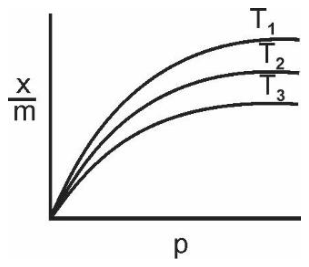
and represent pressure and extent of adsorption, respectively. The correct order of temperatures for the given adsorption is:
- 1
- 2
- 3
- 4
Show answer and solution
Correct: option 3,
Adsorption of a gas gives out heat, so at a fixed pressure the amount adsorbed () falls as the temperature rises. The top curve () has the largest and so the lowest temperature, and the bottom curve () the highest. Hence .
Question 6NEET 2021, Q74
The right option for the statement "Tyndall effect is exhibited by", is:
- 1NaCl solution
- 2Glucose solution
- 3Starch solution
- 4Urea solution
Show answer and solution
Correct: option 3, Starch solution
The Tyndall effect is the scattering of light by particles of colloidal size. Starch forms a colloidal sol in water, while NaCl, glucose and urea form true solutions whose particles are too small to scatter light.
Question 7NEET 2020, Q3
Measuring Zeta potential is useful in determining which property of colloidal solution?
- 1Viscosity
- 2Solubility
- 3Stability of the colloidal particles
- 4Size of the colloidal particles
Show answer and solution
Correct: option 3, Stability of the colloidal particles
Zeta potential is the potential difference between the fixed layer and the diffused layer of charge around a colloidal particle. A large zeta potential means strong repulsion between particles, so they do not coagulate. It is therefore a measure of the stability of the colloid.
Question 8NEET 2020 Phase 2, Q138
In which of the sols, the colloidal particles are with negative charge?
- 1Haemoglobin
- 2Starch
- 3Hydrated
- 4
Show answer and solution
Correct: option 2, Starch
Starch sol is a negatively charged sol, like sols of metals, metal sulphides, gums and clay. Haemoglobin, hydrated metal oxides such as and oxides such as form positively charged sols.
Question 9NEET 2019, Q72
Which mixture of the solutions will lead to the formation of negatively charged colloidal sol.?
- 150 mL of 1 M + 50 mL of 1.5 M KI
- 250 mL of 1 M + 50 mL of 2 M KI
- 350 mL of 2 M + 50 mL of 1.5 M KI
- 450 mL of 0.1 M + 50 mL of 0.1 M KI
Show answer and solution
Correct: option 1 or 2
The answer key accepts options 1 and 2.
The AgI particles adsorb and become negative only when KI is in excess. In (1) there are 50 mmol of against 75 mmol of KI, and in (2) 50 mmol against 100 mmol, so both leave excess iodide. In (3) silver nitrate is in excess (a positive sol) and in (4) the amounts are equal. The official key accepts both (1) and (2).
Question 10NEET 2019 Odisha, Q85
The correct option representing a Freundlich adsorption isotherm is -
- 1
- 2
- 3
- 4
Show answer and solution
Correct: option 3,
The Freundlich isotherm is with , so the power of the pressure lies between 0 and 1. Only 0.3 is in that range.
Question 11NEET 2018, Q75
On which of the following properties does the coagulating power of an ion depend?
- 1Both magnitude and sign of the charge on the ion
- 2Size of the ion alone
- 3The magnitude of the charge on the ion alone
- 4The sign of charge on the ion alone
Show answer and solution
Correct: option 1, Both magnitude and sign of the charge on the ion
By the Hardy-Schulze rule, a sol is coagulated by the ion whose charge is opposite in sign to that of the sol particles, and the higher the valency of that ion the greater its coagulating power. So both the sign and the magnitude of the charge matter.
Question 12NEET 2017, Q58
Which one of the following statements is not correct?
- 1Catalyst does not initiate any reaction.
- 2The value of equilibrium constant is changed in the presence of a catalyst in the reaction at equilibrium.
- 3Enzymes catalyse mainly bio-chemical reactions.
- 4Coenzymes increase the catalytic activity of enzyme.
Show answer and solution
Correct: option 2, The value of equilibrium constant is changed in the presence of a catalyst in the reaction at equilibrium.
A catalyst speeds up the forward and the backward reaction to the same extent, so equilibrium is reached sooner but the equilibrium constant does not change. Statement (2) is therefore not correct; the other three are true.
Question 13NEET 2016 Phase 1, Q50
Which one of the following characteristics is associated with adsorption?
- 1 is negative but and are positive
- 2, and all are negative
- 3 and are negative but is positive
- 4 and are negative but is positive
Show answer and solution
Correct: option 2, , and all are negative
Adsorption is spontaneous, so is negative. The adsorbed molecules lose freedom of movement when they are held on the surface, so is negative. With , a negative is then possible only if is negative, that is, adsorption is exothermic. All three are negative.
Question 14NEET 2016 Phase 1, Q79
Fog is a colloidal solution of:
- 1Liquid in gas
- 2Gas in liquid
- 3Solid in gas
- 4Gas in gas
Show answer and solution
Correct: option 1, Liquid in gas
Fog is tiny water droplets (the dispersed phase, a liquid) suspended in air (the dispersion medium, a gas). Such a colloid is a liquid aerosol. Gas in gas is never a colloid because gases mix completely.
Question 15NEET 2016 Phase 2, Q48
The decomposition of phosphine () on tungsten at low pressure is a first-order reaction. It is because the
- 1rate is proportional to the surface coverage
- 2rate is inversely proportional to the surface coverage
- 3rate is independent of the surface coverage
- 4rate of decomposition is very slow
Show answer and solution
Correct: option 1, rate is proportional to the surface coverage
The reaction happens on the metal surface, so its rate depends on the fraction of the surface covered by phosphine. At low pressure only a small part of the surface is covered, and that fraction rises in direct proportion to the pressure. The rate is therefore proportional to the surface coverage and so to the pressure, which is first-order behaviour. At high pressure the surface is full and the rate becomes zero order.
Question 16NEET 2016 Phase 2, Q49
The coagulation values in millimoles per litre of the electrolytes used for the coagulation of are given below:
I. (NaCl) = 52, II. () = 0.69,
III. () = 0.22
The correct order of their coagulating power is
- 1I > II > III
- 2II > I > III
- 3III > II > I
- 4III > I > II
Show answer and solution
Correct: option 3, III > II > I
The coagulation value is the least amount of electrolyte needed to coagulate the sol, so a smaller value means a greater coagulating power: the two are inversely related. (0.22) needs the least, then (0.69), then NaCl (52). The order of coagulating power is III > II > I.
Question 17AIPMT 2015, Q42
Which property of colloidal solution is independent of charge on the colloidal particles:
- 1Electrophoresis
- 2Electro-osmosis
- 3Tyndall effect
- 4Coagulation
Show answer and solution
Correct: option 3, Tyndall effect
The Tyndall effect is the scattering of light by colloidal particles; it depends on their size and refractive index, not on their charge. Electrophoresis, electro-osmosis and coagulation by electrolytes all arise from the charge on the particles. Hence option (3).
Question 18AIPMT 2014, Q139
Which of the following statements is correct for the spontaneous adsorption of a gas?
- 1 is positive and, therefore, should also be highly positive.
- 2 is negative and, therefore, should be highly positive.
- 3 is negative and therefore, should be highly negative.
- 4 is positive and, therefore, should be negative.
Show answer and solution
Correct: option 3, is negative and therefore, should be highly negative.
When a gas is adsorbed its molecules lose freedom of movement, so is negative. For the process to be spontaneous must be negative. With positive, this is possible only if is negative and large enough to outweigh it. Hence option (3).
Question 19AIPMT 2014, Q158
Which property of colloids is not dependent on the charge on colloidal particles?
- 1Tyndall effect
- 2Coagulation
- 3Electrophoresis
- 4Electro-osmosis
Show answer and solution
Correct: option 1, Tyndall effect
The Tyndall effect is the scattering of light by colloidal particles; it depends on their size and on the difference in refractive index, not on their charge. Coagulation (neutralising the charge), electrophoresis (movement of charged particles in a field) and electro-osmosis all depend on the charge.
Question 20AIPMT 2012 Prelims, Q159
In Freundlich Adsorption isotherm, the value of 1/n is:
- 1between 0 and 1 in all cases
- 2between 2 and 4 in all cases
- 31 in case of physical adsorption
- 41 in case of chemisorption
Show answer and solution
Correct: option 1, between 0 and 1 in all cases
The Freundlich isotherm is with . The exponent therefore lies between 0 (adsorption independent of pressure) and 1 (adsorption proportional to pressure), option (1).
Question 21AIPMT 2012 Prelims, Q167
Which one of the following, statements is incorrect about enzyme catalysis?
- 1Enzymes are mostly proteinous in nature
- 2Enzyme action is specific
- 3Enzymes are denaturated by ultraviolet rays and at high temperature
- 4Enzymes are least reactive at optimum temperature
Show answer and solution
Correct: option 4, Enzymes are least reactive at optimum temperature
Enzymes are mostly proteins, each acts on a specific substrate, and heat or ultraviolet light denatures them. The optimum temperature is by definition the temperature at which the enzyme is most active, not least, so statement (4) is the incorrect one.
Question 22AIPMT 2012 Prelims, Q192
The protecting power of lyophilic colloidal sol is expressed in terms of:
- 1Coagulation value
- 2Gold number
- 3Critical miscelle concentration
- 4Oxidation number
Show answer and solution
Correct: option 2, Gold number
The gold number is the mass in milligrams of a lyophilic colloid that just prevents the coagulation of 10 mL of a gold sol when 1 mL of 10% NaCl solution is added. The smaller the gold number, the greater the protecting power. Option (2).
Question 23AIPMT 2011 Prelims, Q6
If x is amount of adsorbate and m is amount of adsorbent, which of the following relations is not related to adsorption process?
- 1 at constant .
- 2 at constant .
- 3 at constant .
- 4
Show answer and solution
Correct: option 4,
against at constant is an adsorption isotherm, against at constant is an adsorption isobar, and against at constant is an adsorption isostere. No adsorption relation has the form ; in fact adsorption decreases as temperature rises.
Question 24AIPMT 2007 Prelims, Q114
The Langmuir adsorption isotherm is deduced using the assumption
- 1The adsorbed molecules interact with each other
- 2The adsorption takes place in multilayers
- 3The adsorption sites are equivalent in their ability to adsorb the particles
- 4The heat of adsorption varies with coverage
Show answer and solution
Correct: option 3, The adsorption sites are equivalent in their ability to adsorb the particles
Langmuir's model assumes a surface with a fixed number of identical sites, each holding one molecule, so only a single layer forms. The adsorbed molecules do not affect one another, so the heat of adsorption is the same at every coverage. Of the four statements only the equivalence of the sites is one of these assumptions; the other three contradict the model.
Question 25AIPMT 2006 Prelims, Q53
A plot of versus for the adsorption of a gas on a solid gives a straight line with slope equal to:
- 1
- 2
- 3
- 4
Show answer and solution
Correct: option 3,
The Freundlich isotherm is . Taking logarithms, , a straight line whose slope is and whose intercept is .
Question 26AIPMT 2005 Prelims, Q54
Which one of the following forms micelles in aqueous solution above certain concentration -
- 1Glucose
- 2Urea
- 3Dodecyl trimethyl ammonium chloride
- 4Pyridinium chloride
Show answer and solution
Correct: option 3, Dodecyl trimethyl ammonium chloride
Micelles are formed by surfactant ions that have a long water-repelling hydrocarbon chain and an ionic head. Dodecyl trimethyl ammonium chloride is a cationic detergent with a 12-carbon chain, so above its critical micelle concentration its ions aggregate into micelles. Glucose, urea and pyridinium chloride have no long hydrophobic chain.
Question 27AIPMT 2004 Prelims, Q52
Which of the following forms cationic micelles above certain concentration:
- 1sodium acetate
- 2Urea
- 3Cetyl trimethylammonium chloride
- 4Sodium dodecyl sulphonate
Show answer and solution
Correct: option 3, Cetyl trimethylammonium chloride
A micelle needs an ion with a long hydrocarbon tail. In cetyl trimethylammonium chloride the long-chain part is the cation, , so above the critical micelle concentration it gives cationic micelles. Sodium dodecyl sulphonate has its long chain in the anion and gives anionic micelles, while sodium acetate and urea do not form micelles at all.
Question 28AIPMT 2003 Prelims, Q80
According to the adsorption theory of catalysis, the speed of the reaction increase because:
- 1The concentration of reactant molecules at the active centers of the catalyst becomes high due to adsorption
- 2In the process of adsorption, the activation energy of the molecules becomes large
- 3Adsorption produces heat which increases the speed of the reaction
- 4Adsorption lowers the activation energy of the reaction.
Show answer and solution
Correct: option 3, Adsorption produces heat which increases the speed of the reaction
The source's key gives option (3), and that is the answer recorded here. Our own working does not agree with it: in the adsorption theory the reactant molecules are held on the catalyst surface, which weakens their bonds and provides a path of lower activation energy, as option (4) says, and also raises their concentration at the active centres, as option (1) says. The heat of adsorption is not the reason the reaction speeds up. Treat this key as doubtful.
Question 29AIPMT 2002 Prelims, Q82
Position of non polar & polar part in micelle
- 1Polar at outer surface but non polar at inner surface
- 2Polar at inner surface non polar at outer surface
- 3Distributed over all the surface
- 4Are present in the surface only
Show answer and solution
Correct: option 1, Polar at outer surface but non polar at inner surface
In a micelle formed in water, the non-polar hydrocarbon tails avoid water and cluster in the interior, while the polar (ionic) heads stay on the outside in contact with water. So the polar part is at the outer surface and the non-polar part is inside.
Question 30AIPMT 2001 Prelims, Q79
Which is not correct regarding the adsorption of a gas on surface of solid:
- 1On increasing temp. adsorption increase continuously
- 2Enthalpy & entropy change is –ve
- 3Adsorption is more for some specific substance
- 4Reversible
Show answer and solution
Correct: option 1, On increasing temp. adsorption increase continuously
Adsorption is exothermic and the gas loses freedom on the surface, so both and are negative. Because it is exothermic, raising the temperature lowers the extent of adsorption (even chemisorption falls after an initial rise), so it never increases continuously with temperature.
Question 31AIPMT 2000 Prelims, Q97
Which one of the following method is commonly used method for destruction of colloid:
- 1Dialysis
- 2Condensation
- 3Filteration by animal membrane
- 4By adding electrolyte
Show answer and solution
Correct: option 4, By adding electrolyte
Colloidal particles stay dispersed because they all carry the same kind of charge and repel one another. Ions of an added electrolyte neutralise this charge, the particles come together and settle out (coagulation). Dialysis and filtration through an animal membrane purify a sol, and condensation is a way of preparing one.
Question 32AIPMT 1999 Prelims, Q52
According to Hardy Schultze law the order of coagulation power of cations will be:
- 1
- 2
- 3
- 4
Show answer and solution
Correct: option 2,
The Hardy Schulze rule says that the higher the charge on the coagulating ion, the greater its coagulating power. So the order follows the charge: .
Question 33AIPMT 1998 Prelims, Q72
Density of which of the following substance not decreases on adding in vapours:
- 1
- 2
- 3Ether
- 4Coke
Show answer and solution
Correct: option 4, Coke
, and ether are liquids that dissolve bromine and form a solution. Coke is a porous solid: it does not dissolve bromine but adsorbs the vapour on its surface, so it only gains mass and its density does not fall. The key gives coke.
Question 34AIPMT 1998 Prelims, Q97
At the critical micelle concentration (CMC) the surfactant molecules:
- 1Associate
- 2Dissociate
- 3Decompose
- 4Become completely soluble
Show answer and solution
Correct: option 1, Associate
Below the CMC, surfactant molecules behave as ordinary dissolved ions. At and above the CMC they come together into aggregates called micelles, with the hydrocarbon tails inside and the polar heads outside. So they associate.