Questions with solutions
Question 1NEET 2026, Q56
Match List I with List II:
| List I (Order of reaction) | List II (Unit of rate constant) |
|---|
| A. Zero order | I. |
| B. First order | II. |
| C. Second order | III. |
| D. Third order | IV. |
Choose the correct answer from the options given below:
- 1A-IV, B-III, C-II, D-I
- 2A-I, B-II, C-III, D-IV
- 3A-IV, B-III, C-I, D-II
- 4A-IV, B-II, C-I, D-III
Show answer and solution
Correct: option 3, A-IV, B-III, C-I, D-II
For order the unit of is . Zero order: (IV); first order: (III); second order: (I); third order: (II).
Question 2NEET 2026, Q83
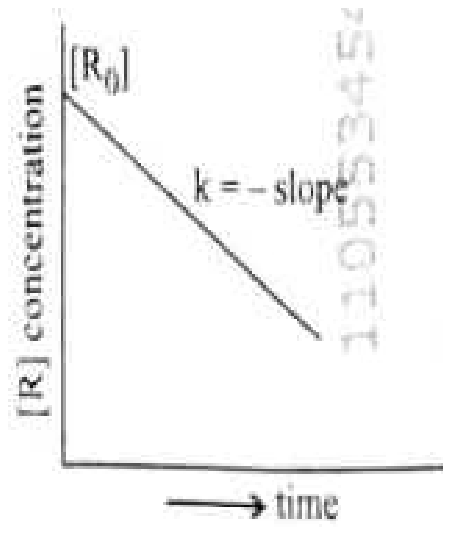
For a certain reaction , the plot of concentration [R] vs time has a negative slope as shown. The order of reaction is:
- 10
- 21
- 32
- 42.5
Show answer and solution
Correct: option 1, 0
For a zero order reaction , so a plot of [R] against time is a straight line with slope and intercept , exactly as shown. The order is 0.
Question 3NEET 2026, Q88
Given below is an expression for the rate constant of a first order reaction occurring at a certain temperature, T (K).
The energy of activation in for the reaction is:
(Given: k in , )
- 112.42
- 214.34
- 318.63
- 424.84
Show answer and solution
Correct: option 4, 24.84
Compare with the Arrhenius equation : . So .
Question 4NEET 2026 Re-exam, Q60
is a zero-order reaction, where . If the initial concentration of A is 2 M, then the time taken to complete 75% of the reaction will be
- 11.5 min
- 20.75 min
- 31.0 min
- 42.0 min
Show answer and solution
Correct: option 2, 0.75 min
For the rate is , so A is used up at . 75% of 2 M is 1.5 M, and for a zero-order reaction the time is min.
Question 5NEET 2026 Re-exam, Q64
For an elementary chemical reaction, the Arrhenius plot is given below.
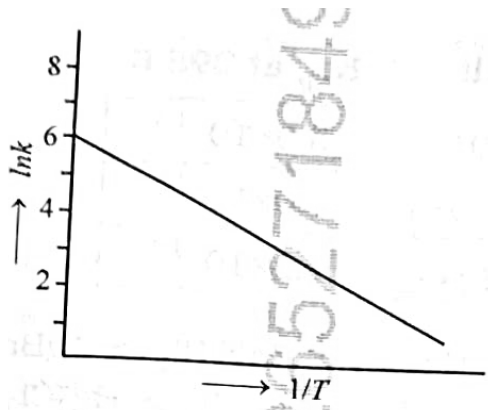
If the energy of activation is and , the temperature at which the rate constant becomes , is
- 1125 K
- 2150 K
- 3200 K
- 4250 K
Show answer and solution
Correct: option 3, 200 K
, and the intercept of the plot gives . For , , so and K.
Question 6NEET 2025, Q56
If the half-life () for a first order reaction is 1 minute, then the time required for 99.9% completion of the reaction is closest to:
- 12 minutes
- 24 minutes
- 35 minutes
- 410 minutes
Show answer and solution
Correct: option 4, 10 minutes
For a first order reaction with . For 99.9% completion , so minutes. Option (4).
Question 7NEET 2025, Q89
If the rate constant of a reaction is , how much time does it take for concentration of the reactant to get reduced to ?
(Given: log 2 = 0.301)
- 169.3 s
- 223.1 s
- 3210 s
- 421.0 s
Show answer and solution
Correct: option 1, 69.3 s
The unit shows the reaction is first order. s (three half-lives of 23.1 s each). Option (1).
Question 8NEET 2024, Q68
Activation energy of any chemical reaction can be calculated if one knows the value of
- 1rate constant at two different temperatures.
- 2rate constant at standard temperature.
- 3probability of collision.
- 4orientation of reactant molecules during collision.
Show answer and solution
Correct: option 1, rate constant at two different temperatures.
From the Arrhenius equation, . If the rate constants and are known at two temperatures and , is the only unknown. A single rate constant leaves both and unknown. So option (1).
Question 9NEET 2024, Q73
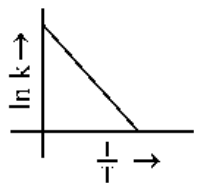
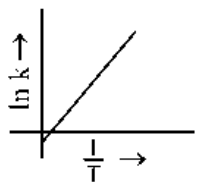
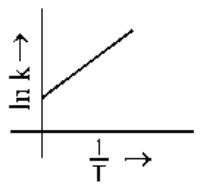
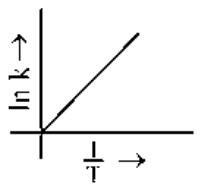
Which plot of ln k vs is consistent with Arrhenius equation?
- 1
- 2
- 3
- 4
Show answer and solution
Correct: option 1
Taking logarithms of gives . A plot of against is therefore a straight line with a negative slope and a positive intercept . Only the falling line of option (1) fits; the other three rise.
Question 10NEET 2024, Q99
The rate of a reaction quadruples when temperature changes from 27°C to 57°C. Calculate the energy of activation.
Given , log 4 = 0.6021
- 13804 kJ/mol
- 238.04 kJ/mol
- 3380.4 kJ/mol
- 43.80 kJ/mol
Show answer and solution
Correct: option 2, 38.04 kJ/mol
Use with , K and K. Then . That is option (2).
Question 11NEET 2024 Re-exam, Q52
Following data is for a reaction between reactants A and B:
| Rate () | [A] | [B] |
|---|
| 0.1 M | 0.1 M |
| 0.2 M | 0.1 M |
| 0.2 M | 0.2 M |
The order of the reaction with respect to A and B, respectively, are
- 11, 0
- 20, 1
- 31, 2
- 42, 1
Show answer and solution
Correct: option 3, 1, 2
From the first to the second run [A] doubles at constant [B] and the rate doubles, so the order in A is 1. From the second to the third run [B] doubles at constant [A] and the rate becomes 4 times (), so the order in B is 2.
Question 12NEET 2024 Re-exam, Q81
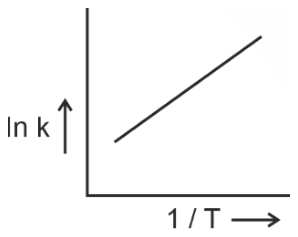
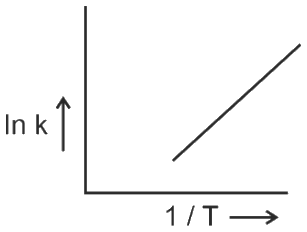
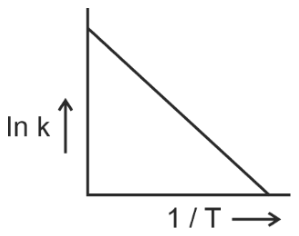
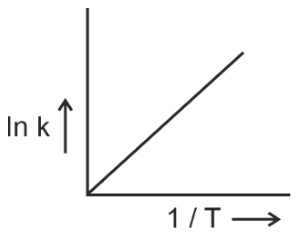
Which of the following plot represents the variation of versus in accordance with Arrhenius equation?
- 1
- 2
- 3
- 4
Show answer and solution
Correct: option 3
Taking logarithms of gives . This is a straight line with intercept and a negative slope , so falls linearly as increases. Only graph (3) slopes downward.
Question 13NEET 2024 Re-exam, Q97
Rate constants of a reaction at 500 K and 700 K are and , respectively; then, activation energy of the reaction is:
(Given: log 3.5 = 0.5441, R = )
- 1182310 J
- 218500 J
- 318219 J
- 418030 J
Show answer and solution
Correct: option 3, 18219 J
. Here and . So J. The nearest option is 18219 J; the last digits depend only on rounding.
Question 14NEET 2023, Q56
Given below are two statements: one is labelled as Assertion A and the other is labelled as Reason R:
Assertion A: A reaction can have zero activation energy.
Reason R: The minimum extra amount of energy absorbed by reactant molecules so that their energy becomes equal to threshold value, is called activation energy.
In the light of the above statements, choose the correct answer from the options given below:
- 1Both A and R are true and R is the correct explanation of A.
- 2Both A and R are true and R is NOT the correct explanation of A.
- 3A is true but R is false.
- 4A is false but R is true.
Show answer and solution
Correct: option 4, A is false but R is true.
R is the definition of activation energy, so it is true. The key treats A as false: with the Arrhenius equation gives , meaning every collision would lead to reaction, which is not accepted for an ordinary chemical reaction. Hence A is false but R is true.
Question 15NEET 2023, Q84
For a certain reaction, the rate = , when the initial concentration of A is tripled keeping concentration of B constant, the initial rate would
- 1decrease by a factor of nine.
- 2increase by a factor of six.
- 3increase by a factor of nine.
- 4increase by a factor of three.
Show answer and solution
Correct: option 3, increase by a factor of nine.
The rate depends on . Tripling [A] with [B] fixed gives a new rate of , so the rate increases by a factor of nine.
Question 16NEET 2023 Manipur, Q53
The correct option for the rate law that corresponds to overall first order reaction is
- 1Rate
- 2Rate
- 3Rate
- 4Rate
Show answer and solution
Correct: option 2, Rate
The overall order is the sum of the powers of the concentration terms. The sums are , , and . Only option (2) adds up to 1.
Question 17NEET 2023 Manipur, Q81
For a reaction
The average rate of appearance of B is given by . The correct relation between the average rate of appearance of B with the average rate of disappearance of A is given in option
- 1
- 2
- 3
- 4
Show answer and solution
Correct: option 1,
Dividing each rate by its stoichiometric coefficient, . Hence : two moles of B appear for every three moles of A used up.
Question 18NEET 2022, Q71
The given graph is a representation of kinetics of a reaction.
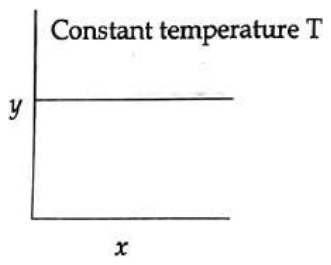
The y and x axes for zero and first order reactions, respectively are
- 1zero order ( = rate and = concentration), first order ( = rate and = )
- 2zero order ( = concentration and = time), first order ( = and = concentration)
- 3zero order ( = concentration and = time), first order ( = rate constant and = concentration)
- 4zero order ( = rate and = concentration), first order ( = and = concentration)
Show answer and solution
Correct: option 4, zero order ( = rate and = concentration), first order ( = and = concentration)
The graph is a horizontal line, so y does not change with x. For a zero order reaction the rate is independent of concentration. For a first order reaction is independent of concentration. Both pairs in option (4) give a horizontal line; in the other options the zero order concentration falls with time, or the first order rate changes.
Question 19NEET 2022, Q87
For a first order reaction A Products, initial concentration of A is 0.1 M, which becomes 0.001 M after 5 minutes. Rate constant for the reaction in is
- 10.2303
- 21.3818
- 30.9212
- 40.4606
Show answer and solution
Correct: option 3, 0.9212
For a first order reaction .
Question 20NEET 2022 Re-exam, Q68
The half life of a first order reaction is 2000 years. If the concentration after 8000 years is 0.02 M, then the initial concentration was:
- 10.04 M
- 20.16 M
- 30.32 M
- 40.08 M
Show answer and solution
Correct: option 3, 0.32 M
8000 years is half lives. In a first order reaction the concentration halves in each half life, so the initial concentration was M.
Question 21NEET 2022 Re-exam, Q93
For a chemical reaction
Rate of formation of C is and rate of disappearance of A is . The rate of reaction and amount of B consumed in interval of 10 seconds, respectively will be:
- 1 and
- 2 and
- 3 and
- 4 and
Show answer and solution
Correct: option 2, and
Rate of reaction . B disappears at 3 times this rate, , so in 10 s the amount consumed is .
Question 22NEET 2021, Q83
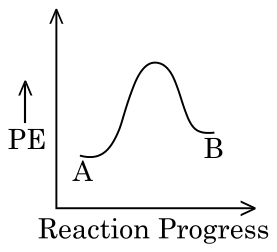
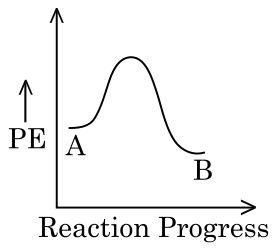
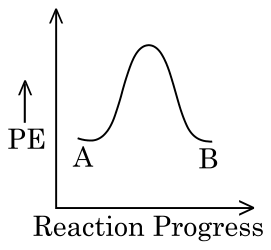
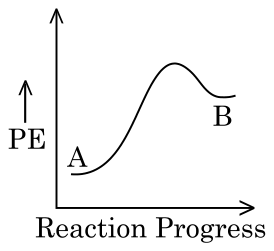
For a reaction AB, enthalpy of reaction is and enthalpy of activation is . The correct potential energy profile for the reaction is shown in option.
- 1
- 2
- 3
- 4
Show answer and solution
Correct: option 2
The enthalpy of reaction is negative, so the product B must lie a little lower in energy than the reactant A. There is also an activation barrier, so the curve rises to a maximum above A before falling to B. Only the profile with B below A after a hump fits.
Question 23NEET 2021, Q89
The slope of Arrhenius Plot of first order reaction is K. The value of of the reaction is. Choose the correct option for your answer.
[Given ]
- 1
- 2
- 3
- 4
Show answer and solution
Correct: option 1,
From , the slope of against is . So .
Question 24NEET 2020, Q10
An increase in the concentration of the reactants of a reaction leads to change in:
- 1activation energy
- 2heat of reaction
- 3threshold energy
- 4collision frequency
Show answer and solution
Correct: option 4, collision frequency
With more reactant molecules in the same volume, they collide more often, so the collision frequency rises. Activation energy, threshold energy and heat of reaction are fixed for a given reaction and do not depend on concentration.
Question 25NEET 2020, Q12
The rate constant for a first order reaction is . The time required to reduce 2.0 g of the reactant to 0.2 g is:
- 1100 s
- 2200 s
- 3500 s
- 41000 s
Show answer and solution
Correct: option 3, 500 s
For a first order reaction s.
Question 26NEET 2020 Phase 2, Q143
In collision theory of chemical reaction, represents
- 1the collision frequency of reactants, A and B
- 2steric factor
- 3the fraction of molecules with energies equal to
- 4the fraction of molecules with energies greater than
Show answer and solution
Correct: option 1, the collision frequency of reactants, A and B
In collision theory the rate is written as . Here is the collision frequency of A and B (collisions per second per unit volume), is the steric factor and is the fraction of molecules with energy equal to or greater than .
Question 27NEET 2020 Phase 2, Q170
The half-life for a zero order reaction having 0.02 M initial concentration of reactant is 100 s. The rate constant (in ) for the reaction is
- 1
- 2
- 3
- 4
Show answer and solution
Correct: option 4,
For a zero order reaction . So .
Question 28NEET 2019, Q63
If the rate constant for a first order reaction is k, the time (t) required for the completion of 99% of the reaction is given by:
- 1
- 2
- 3
- 4
Show answer and solution
Correct: option 3,
For a first order reaction . At 99% completion , so .
Question 29NEET 2019, Q67
For the chemical reaction
the correct option is:
- 1
- 2
- 3
- 4
Show answer and solution
Correct: option 3,
The rate is the change of each concentration divided by its coefficient, negative for reactants: rate . Only option (3) matches this.
Question 30NEET 2019 Odisha, Q83
A first order reaction has a rate constant of . The time required for 40 g of this reactant to reduce to 10 g will be -
[Given that ]
- 12000 s
- 2602 s
- 3230.3 s
- 4301 s
Show answer and solution
Correct: option 2, 602 s
s. (Going from 40 g to 10 g is two half-lives of 301 s each.)
Question 31NEET 2019 Odisha, Q84
For a reaction, activation energy and the rate constant at 200 K is . The rate constant at 400 K will be -
[Given that gas constant, ]
- 1
- 2
- 3
- 4
Show answer and solution
Correct: option 4,
From the Arrhenius equation . With the exponential is 1, so at every temperature. The rate constant at 400 K is the same, .
Question 32NEET 2018, Q79
The correct difference between first- and second-order reactions is that
- 1a first-order reaction can be catalyzed; a second-order reaction cannot be catalyzed
- 2the half-life of a first-order reaction does not depend on ; the half-life of a second-order reaction does depend on
- 3the rate of a first-order reaction does not depend on reactant concentrations; the rate of a second-order reaction does depend on reactant concentrations
- 4the rate of a first-order reaction does depend on reactant concentrations; the rate of a second-order reaction does not depend on reactant concentrations
Show answer and solution
Correct: option 2, the half-life of a first-order reaction does not depend on ; the half-life of a second-order reaction does depend on
For a first-order reaction , which has no in it. For a second-order reaction , which depends on . The rates of both depend on concentration and both can be catalysed, so the other options are wrong.
Question 33NEET 2018, Q84
When initial concentration of the reactant is doubled, the half-life period of a zero order reaction
- 1is tripled
- 2is doubled
- 3is halved
- 4remains unchanged
Show answer and solution
Correct: option 2, is doubled
For a zero order reaction , so the half-life is directly proportional to the initial concentration. Doubling doubles the half-life.
Question 34NEET 2017, Q81
A first order reaction has a specific reaction rate of . How much time will it take for 20 g of the reactant to reduce to 5 g?
- 1238.6 sec
- 2138.6 sec
- 3346.5 sec
- 4693.0 sec
Show answer and solution
Correct: option 2, 138.6 sec
sec. Going from 20 g to 10 g to 5 g takes two half-lives, so sec.
Question 35NEET 2017, Q88
Mechanism of a hypothetical reaction is given below
(i) (fast)
(ii) (slow)
(iii) (fast)
The overall order of the reaction will be
- 11
- 22
- 30
- 41.5
Show answer and solution
Correct: option 4, 1.5
The slow step fixes the rate: rate . X is an intermediate formed in the fast first step, for which , so . Then rate and the overall order is .
Question 36NEET 2016 Phase 1, Q49
The rate of a first-order reaction is at 10 seconds and at 20 seconds after initiation of the reaction. The half-life period of the reaction is:
- 124.1 s
- 234.1 s
- 344.1 s
- 454.1 s
Show answer and solution
Correct: option 1, 24.1 s
For a first-order reaction the rate is proportional to the concentration, so the rate itself decays exponentially: . Then .
Question 37NEET 2016 Phase 1, Q76
The addition of a catalyst during a chemical reaction alters which of the following quantities?
- 1Entropy
- 2Internal energy
- 3Enthalpy
- 4Activation energy
Show answer and solution
Correct: option 4, Activation energy
A catalyst provides another path with a lower activation energy, so the reaction goes faster. It does not change the reactants or products, so state functions of the reaction such as entropy, internal energy and enthalpy change stay the same.
Question 38AIPMT 2015, Q8
The activation energy of a reaction can be determined from the slope of which of the following graphs?
- 1 vs.
- 2 vs.
- 3 vs.
- 4 vs.
Show answer and solution
Correct: option 2, vs.
The Arrhenius equation gives . A plot of against is a straight line of slope , from which is found. Hence option (2).
Question 39AIPMT 2015, Q44
When initial concentration of a reactant is doubled in a reaction, its half-life period is not affected. The order of the reaction is:
- 1First
- 2Second
- 3More than zero but less than first
- 4Zero
Show answer and solution
Correct: option 1, First
For a reaction of order the half-life varies as . Only for is it independent of the initial concentration, with . Hence option (1).
Question 40AIPMT 2015 Re-test, Q35
The rate constant of the reaction is mole per second. If the concentration of A is 5 M then concentration of B after 20 minutes is:
- 10.36 M
- 20.72 M
- 31.08 M
- 43.60 M
Show answer and solution
Correct: option 2, 0.72 M
A rate constant with the units of concentration per time belongs to a zero order reaction, whose rate does not depend on the concentration of A. The amount of B formed is M, option (2).
Question 41NEET 2013, Q14
What is the activation energy for a reaction if its rate doubles when the temperature is raised from 20°C to 35°C? ()
- 1
- 2
- 3
- 4
Show answer and solution
Correct: option 2,
Use with , K and K. Then , option (2).
Question 42NEET 2013, Q42
A reaction having equal energies of activation for forward and reverse reactions has:
- 1
- 2
- 3
- 4
Show answer and solution
Correct: option 2,
The enthalpy change of a reaction equals the difference between the two activation energies: . If the two are equal, , option (2). Nothing follows about or .
Question 43NEET 2013 Karnataka, Q3
For a reaction between A and B the order with respect to A is 2 and the order with respect to B is 3. The concentration of both A and B are doubled the rate will increase by a factor of:
- 112
- 216
- 332
- 410
Show answer and solution
Correct: option 3, 32
The rate law is rate . Doubling both concentrations multiplies the rate by .
Question 44NEET 2013 Karnataka, Q33
A reaction is 50% complete in 2 hours and 75% complete in 4 hours. The order of reaction is:
- 11
- 22
- 33
- 40
Show answer and solution
Correct: option 1, 1
Going from 0 to 50% takes 2 hours, and going from 50% to 75% (half of what remained) takes another 2 hours. A half-life that does not depend on the starting concentration is the mark of a first order reaction.
Question 45AIPMT 2012 Prelims, Q156
In a reaction, A + B Product, rate is doubled when the concentration of B is doubled, and rate increases by a factor of 8 when the concentrations of both the reactants (A and B) are doubled, rate law for the reaction can be written as:
- 1Rate =
- 2Rate =
- 3Rate =
- 4Rate =
Show answer and solution
Correct: option 4, Rate =
Doubling B alone doubles the rate, so the order in B is 1. Doubling both multiplies the rate by 8 = 2 (from B) 4 (from A), and , so the order in A is 2. Rate = , option (4).
Question 46AIPMT 2012 Prelims, Q168
In a zero-order reaction for every 10° rise of temperature, the rate is doubled. If the temperature is increased from 10°C to 100°C, the rate of the reaction will become:
- 1256 times
- 2512 times
- 364 times
- 4128 times
Show answer and solution
Correct: option 2, 512 times
From 10°C to 100°C there are steps of 10°, and the rate doubles in each. The rate becomes times, option (2).
Question 47AIPMT 2012 Mains, Q34
Activation energy () and rate constants ( and ) of a chemical reaction at two different temperatures ( and ) are related by:
- 1
- 2
- 3
- 4
Show answer and solution
Correct: option 2 or 4
The answer key accepts options 2 and 4.
From the Arrhenius equation . Subtracting the equation at from the one at gives , which is option (4). Taking the minus sign outside the bracket gives , which is option (2). As printed here the two are the same relation, so both are accepted.
Question 48AIPMT 2011 Prelims, Q10
Which one of the following statements for the order of a reaction is incorrect?
- 1Order can be determined only experimentally.
- 2Order is not influenced by stoichiometric coefficient of the reactants.
- 3Order of reaction is sum of power to the concentration terms of reactants to express the rate of reaction.
- 4Order of reaction is always whole number.
Show answer and solution
Correct: option 4, Order of reaction is always whole number.
Order is an experimental quantity: the sum of the powers of the concentration terms in the measured rate law, which need not match the stoichiometric coefficients. It can be zero, a whole number or a fraction, so the statement that it is always a whole number is the incorrect one.
Question 49AIPMT 2011 Mains, Q4
The half life of a substance in a certain enzyme-catalysed reaction is 138 s. The time required for the concentration of the substance to fall from to , is:
- 1414 s
- 2552 s
- 3690 s
- 4276 s
Show answer and solution
Correct: option 3, 690 s
Treating the reaction as first order, the half life is constant. The concentration falls by a factor , which takes 5 half lives. Time s.
Question 50AIPMT 2011 Mains, Q8
The rate of the reaction can be written in three ways:
The relationship between k and k' and between k and k'' are:
- 1;
- 2;
- 3;
- 4;
Show answer and solution
Correct: option 2, ;
The second expression is meant for , the product of the reaction. From the stoichiometry, , so . This gives and , which is option (2) (its second relation is the one for ).
Question 51AIPMT 2011 Mains, Q20
The unit of rate constant for a zero order reaction is:
- 1
- 2
- 3
- 4
Show answer and solution
Correct: option 1,
For a zero order reaction, rate . The rate constant therefore has the units of rate, .
Question 52AIPMT 2010 Mains, Q50
The rate of reaction
is given by the rate equation rate = . The value of the rate constant can be increased by:
- 1increasing the temperature
- 2increasing the concentration of NO
- 3increasing the concentration of the
- 4doing all of above
Show answer and solution
Correct: option 1, increasing the temperature
The rate constant does not depend on the concentrations of the reactants; changing them changes the rate, not . By the Arrhenius equation , rises when the temperature is raised.
Question 53AIPMT 2010 Prelims, Q51
For the reaction,
the value of rate of disappearance of is given as . The rate of formation of and is given respectively as:
- 1 and
- 2 and
- 3 and
- 4 and
Show answer and solution
Correct: option 2, and
Rates are in the ratio of the stoichiometric coefficients: . So forms at and at , which is option (2).
Question 54AIPMT 2010 Prelims, Q63
For an endothermic reaction, energy of activation is and enthalpy of reaction is (both of these in kJ/mol). Minimum value of will be:
- 1less than
- 2equal to
- 3more than
- 4equal to zero
Show answer and solution
Correct: option 3, more than
In an endothermic reaction the products lie above the reactants, and the top of the energy barrier lies above the products. So , where is the activation energy of the reverse reaction and is positive. Hence must be more than .
Question 55AIPMT 2010 Prelims, Q84
During the kinetic study of the reaction, , following results were obtained:
| Run | | | Initial rate of formation of |
|---|
| I | 0.1 | 0.1 | |
| II | 0.3 | 0.2 | |
| III | 0.3 | 0.4 | |
| IV | 0.4 | 0.1 | |
Based on the above data which one of the following is correct?
- 1rate =
- 2rate =
- 3rate =
- 4rate =
Show answer and solution
Correct: option 4, rate =
Runs I and IV have the same [B]; [A] goes up 4 times and the rate goes up 4 times ( to ), so the order in A is 1. Runs II and III have the same [A]; [B] doubles and the rate goes up 4 times ( to ), so the order in B is 2. Hence rate = .
Question 56AIPMT 2009 Prelims, Q159
For the reaction , if , the value of would be:
- 1
- 2
- 3
- 4
Show answer and solution
Correct: option 4,
The rate is . So .
Question 57AIPMT 2009 Prelims, Q163
In the reaction . The rate of appearance of bromine () is related to rate of disappearance of bromide ions as following:
- 1
- 2
- 3
- 4
Show answer and solution
Correct: option 4,
The rate of reaction is . So ; the minus sign is there because the bromide concentration falls while bromine forms.
Question 58AIPMT 2009 Prelims, Q169
Half life period of a first-order reaction is 1386 seconds. The specific rate constant of the reaction is:
- 1
- 2
- 3
- 4
Show answer and solution
Correct: option 2,
For a first-order reaction , which is .
Question 59AIPMT 2009 Prelims, Q199
For the reaction , it is observed that:
(a) on doubling the initial concentration of A only, the rate of reaction is also doubled and
(b) on doubling the initial concentrations of both A and B, there is a change by a factor of 8 in the rate of the reaction.
The rate of this reaction is given by:
- 1rate =
- 2rate =
- 3rate =
- 4rate =
Show answer and solution
Correct: option 1, rate =
Doubling A alone doubles the rate, so the order in A is 1. Doubling both multiplies the rate by 8; a factor of 2 comes from A, so the factor of 4 comes from B, which means the order in B is 2. Hence rate = .
Question 60AIPMT 2008 Prelims, Q58
The bromination of acetone that occurs in acid solution is represented by this equation
These kinetic data were obtained for given reaction concentrations
| Initial concentration , M | Initial concentration , M | Initial concentration , M | Initial rate, disappearance of , |
|---|
| 0.30 | 0.05 | 0.05 | |
| 0.30 | 0.10 | 0.05 | |
| 0.30 | 0.10 | 0.10 | |
| 0.40 | 0.05 | 0.20 | |
Based on these data, the rate equation is
- 1Rate =
- 2Rate =
- 3Rate =
- 4Rate =
Show answer and solution
Correct: option 2, Rate =
Rows 1 and 2: doubling leaves the rate unchanged, so the order in is zero. Rows 2 and 3: doubling doubles the rate, so the order in is one. Rows 1 and 4: is 4 times and acetone is 4/3 times, and the rate is about times, so the order in acetone is one. Hence Rate = .
Question 61AIPMT 2008 Prelims, Q66
The rate constants and for two different reactions are and respectively. The temperature at which is
- 1
- 21000 K
- 3
- 42000 K
Show answer and solution
Correct: option 1,
Setting gives . Taking natural logs, , so .
Question 62AIPMT 2007 Prelims, Q106
In a first-order reaction , if k is rate constant and initial concentration of the reactant A is 0.5 M then the half-life is:
- 1
- 2
- 3
- 4
Show answer and solution
Correct: option 1,
For a first-order reaction . The half-life does not depend on the initial concentration, so the 0.5 M is not needed.
Question 63AIPMT 2007 Prelims, Q107
The reaction of hydrogen and iodine monochloride is given as:
This reaction is of first order with respect to and , following mechanisms were proposed:
Mechanism A:
Mechanism B:
; slow
; fast
Which of the above mechanism(s) can be consistent with the given information about the reaction
- 1A only
- 2B only
- 31 and 2 both
- 4Neither 1 nor 2
Show answer and solution
Correct: option 2, B only
The rate law comes from the slow step of the mechanism. Mechanism A is a single step with one and two ICl, which would give rate , second order in ICl. In mechanism B the slow step has one and one ICl, giving rate , first order in each, as observed. So only B fits.
Question 64AIPMT 2007 Prelims, Q108
If 60% of a first order reaction was completed in 60 minutes, 50% of the same reaction would be completed in approximately:
(log 4 = 0.60, log 5 = 0.69)
- 140 minutes
- 250 minutes
- 345 minutes
- 460 minutes
Show answer and solution
Correct: option 3, 45 minutes
. With , . Then minutes, closest to 45 minutes.
Question 65AIPMT 2006 Prelims, Q68
For the reaction:
Which of the following does not express the reaction rate:
- 1
- 2
- 3
- 4
Show answer and solution
Correct: option 1,
Rate . C is a product, so its term must carry a plus sign. Option (1) has a minus sign and therefore does not express the rate.
Question 66AIPMT 2006 Prelims, Q77
Consider the reaction
The equality relationship between and is:
- 1
- 2
- 3
- 4
Show answer and solution
Correct: option 2,
Rate . Multiplying by 2 gives : two moles of ammonia form for every three moles of hydrogen used.
Question 67AIPMT 2005 Prelims, Q76
The rate of reaction between two reactants A and B decreases by a factor of 4 if the concentration of reactant B is doubled. The order of this reaction with respect to reactant B is:-
- 12
- 2–1
- 31
- 4–2
Show answer and solution
Correct: option 4, –2
If rate , doubling [B] multiplies the rate by . Here the rate becomes one fourth, so and .
Question 68AIPMT 2005 Prelims, Q85
For a first order reaction the reaction rate at reactant concentration of 0.01M is found to be . The half life period of the reaction is:-
- 1300s
- 230s
- 3220s
- 4347s
Show answer and solution
Correct: option 4, 347s
For first order, rate , so . Then s.
Question 69AIPMT 2004 Prelims, Q62
The rate of a first order reaction is at 0.5 M concentration of the reactant. The half life of the reaction is:
- 123.1 min
- 28.73 min
- 37.53 min
- 40.383 min
Show answer and solution
Correct: option 1, 23.1 min
For a first order reaction, rate , so . Then min.
Question 70AIPMT 2003 Prelims, Q62
The activation energy for a simple chemical reaction is in forward direction. The activation energy for reverse reaction:
- 1Is negative of
- 2Is always less than
- 3Can be less than or more than
- 4Is always double of
Show answer and solution
Correct: option 3, Can be less than or more than
. For an exothermic reaction ( negative) the reverse barrier is larger than ; for an endothermic reaction it is smaller. So it can be less than or more than .
Question 71AIPMT 2003 Prelims, Q66
The reaction follows first order kinetics. The time taken for 0.8 mole of A to produce 0.6 mole of B is 1 hour. What is the time taken for conversion of 0.9 mole of A to produce 0.675 mole of B
- 11 hour
- 20.5 hour
- 30.25 hour
- 42 hour
Show answer and solution
Correct: option 1, 1 hour
In the first case of A reacts; in the second reacts. For a first order reaction the time for a given fraction to react does not depend on the starting amount, so the time is again 1 hour.
Question 72AIPMT 2003 Prelims, Q72
If the rate of the reaction is equal to the rate constant, the order of the reaction is -
- 10
- 21
- 32
- 43
Show answer and solution
Correct: option 1, 0
Rate . The rate equals whatever the concentration only when , since . So the reaction is zero order.
Question 73AIPMT 2003 Prelims, Q73
The temperature dependence of rate constant (k) of a chemical reaction is written in terms of Arrhenius equation, . Activation energy () of the reaction can be calculated by plotting
- 1k vs T
- 2k vs
- 3log k vs
- 4log k vs
Show answer and solution
Correct: option 3, log k vs
Taking logs, . A plot of against is a straight line with slope , from which is found.
Question 74AIPMT 2003 Prelims, Q89
The radioisotope, tritium has a half-life of 12.3 years. If the initial amount of tritium is 32 mg, how many milligrams of its would remain after 49.2 years:
- 11 mg
- 22 mg
- 34 mg
- 48 mg
Show answer and solution
Correct: option 2, 2 mg
half-lives. Amount left mg.
Question 75AIPMT 2002 Prelims, Q63
, rate of reaction is equals to:
- 1
- 2
- 3
- 4
Show answer and solution
Correct: option 2,
The rate is the same when each change is divided by its coefficient: . Hence .
Question 76AIPMT 2002 Prelims, Q64
It would be a zero order reaction when:
- 1The rate of reaction is proportional to square of conc. of A
- 2The rate of reaction remains same at any conc. of A
- 3The rate remains unchanged at any conc. of B and C
- 4The rate of reaction doubles if conc. of B is increased to double
Show answer and solution
Correct: option 2, The rate of reaction remains same at any conc. of A
For a zero order reaction, rate , so the rate does not depend on the concentration of the reactant A at all. That is exactly option 2; independence from the products B and C says nothing about the order in A.
Question 77AIPMT 2001 Prelims, Q71
For the reaction rate and rate constant are and respectively. Then conc. of at that time will be:
- 11.732
- 23
- 3
- 4
Show answer and solution
Correct: option 2, 3
The unit shows the reaction is first order, so rate . Then .
Question 78AIPMT 2001 Prelims, Q72
A human body required the 0.01 Curie activity of radioactive substance after 24 hours. Half life of radioactive is 6 hours. Then max. activity of radioactive substance that can be injected will be:
- 10.08
- 20.04
- 30.16
- 40.32
Show answer and solution
Correct: option 3, 0.16
24 hours is four half-lives, in which the activity falls to of its starting value. The starting activity must be Curie.
Question 79AIPMT 2001 Prelims, Q73
When a bio chemical reaction is carried out in laboratory out side the human body in the absence of enzyme, then the rate of reaction obtained is times, then activation energy of reaction in the presence of enzyme is:
- 1
- 2P is required
- 3Different from, obtained in laboratory
- 4Can't say any things
Show answer and solution
Correct: option 3, Different from, obtained in laboratory
An enzyme is a catalyst: it opens a path with a lower activation energy, which is why the reaction is a million times faster in the body. The activation energy with the enzyme is therefore different from (lower than) the value measured in the laboratory without it.
Question 80AIPMT 2000 Prelims, Q74
A 300 gram radioactive sample has half life of 3 hour's. After 18 hour's remaining quantity will be:
- 14.68 gram
- 22.34 gram
- 33.34 gram
- 49.37 gram
Show answer and solution
Correct: option 1, 4.68 gram
Number of half-lives . Amount left , which is the 4.68 gram of option 1.
Question 81AIPMT 2000 Prelims, Q95
For the reaction which of the following relation correctly represents the consumption & formation of reactants and products:
- 1
- 2
- 3
- 4
Show answer and solution
Correct: option 1,
The rate is each concentration change divided by its coefficient, negative for a reactant. With the coefficients printed in the question (3 for , 5 for ): , so . The minus sign shows that bromide is used up while bromine forms.
Question 82AIPMT 1999 Prelims, Q57
The concentration of a solution is changed from 0.2 to 0.4, then what will be rate and rate constant. The reaction is of first order and rate constant is :
- 1 ;
- 2 ;
- 3 ;
- 4 ;
Show answer and solution
Correct: option 3, ;
For a first-order reaction, rate . At the new concentration, rate . The rate constant does not depend on concentration, so it stays .
Question 83AIPMT 1999 Prelims, Q58
Half life of a radioactive sample is 4 days. After 16 days how much quantity of matter remain undecayed:
- 1
- 2
- 3
- 4
Show answer and solution
Correct: option 3,
16 days is half-lives. The fraction left is .
Question 84AIPMT 1999 Prelims, Q99
Half life of a substance is 77 days then its decay constant will be:
- 10.9
- 20.09
- 30.009
- 40.013
Show answer and solution
Correct: option 3, 0.009
Radioactive decay is first order, so per day.
Question 85AIPMT 1998 Prelims, Q87
By which activation energy calculate:
- 1At a constant temp.
- 2At two different temp.
- 3For reversible reaction
- 4For volatile reaction
Show answer and solution
Correct: option 2, At two different temp.
From the Arrhenius equation, . Measuring the rate constant at two different temperatures gives ; a single temperature is not enough.