Questions with solutions
Question 1NEET 2026, Q46
Match List I with List II:
| List I | List II |
|---|
| A. | I. (i) oleum; (ii) NaOH, ; (iii) |
| B. | II. (i) ; (ii) |
| C. | III. (i) ; (ii) , catalyst |
| D. | IV. (i) conc. , ; (ii) |
Choose the correct answer from the options given below:
- 1A-I, B-III, C-IV, D-II
- 2A-II, B-IV, C-III, D-I
- 3A-II, B-III, C-I, D-IV
- 4A-II, B-III, C-IV, D-I
Show answer and solution
Correct: option 4, A-II, B-III, C-IV, D-I
A: cumene is oxidised by air to cumene hydroperoxide, which dilute acid splits into phenol and acetone (II). B: the acid is first esterified with methanol and the ester is then hydrogenated over a catalyst to ethanol (III). C: propan-1-ol is dehydrated by hot conc. to propene, and acid-catalysed hydration (Markovnikov) gives propan-2-ol (IV). D: benzene is sulphonated with oleum, fused with NaOH and acidified to give phenol (I).
Question 2NEET 2026, Q74
The functional group that can be identified through phthalein dye test is:
- 1Phenolic
- 2Alcohol
- 3Aldehyde
- 4Carboxylic acid
Show answer and solution
Correct: option 1, Phenolic
Phenols condense with phthalic anhydride in the presence of conc. to form phthalein dyes (phenol gives phenolphthalein, pink in alkali). The test therefore identifies the phenolic group.
Question 3NEET 2025, Q86
Total number of possible isomers (both structural as well as stereoisomers) of cyclic ethers of molecular formula is:
- 16
- 28
- 310
- 411
Show answer and solution
Correct: option 3, 10
Five-membered ring: tetrahydrofuran (1). Four-membered ring: 2-methyloxetane (chiral, 2) and 3-methyloxetane (1). Three-membered ring: ethyloxirane (chiral, 2), 2,2-dimethyloxirane (1) and 2,3-dimethyloxirane (cis, which is meso, 1; trans, a pair of enantiomers, 2). Total 1 + 2 + 1 + 2 + 1 + 3 = 10, option (3).
Question 4NEET 2024, Q71
Which one of the following alcohols reacts instantaneously with Lucas reagent?
- 1
- 2
- 3
- 4
Show answer and solution
Correct: option 1,
Lucas reagent (conc. HCl with anhydrous ) converts alcohols to chlorides through a carbocation, so the speed follows carbocation stability. A tertiary alcohol gives turbidity at once, a secondary alcohol in a few minutes, and a primary alcohol not at room temperature. Option (1), 2-methylpropan-2-ol, is the only tertiary alcohol; (2) and (4) are primary and (3) is secondary.
Question 5NEET 2024 Re-exam, Q86
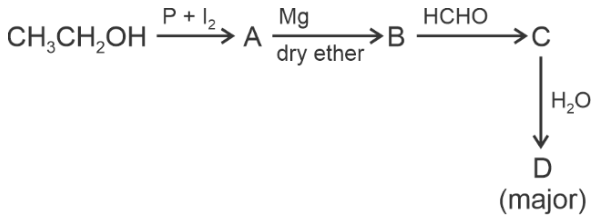
Identify D in the following sequence of reactions:
- 1n-propyl alcohol
- 2isopropyl alcohol
- 3propanal
- 4propionic acid
Show answer and solution
Correct: option 1, n-propyl alcohol
(which makes ) converts ethanol to ethyl iodide (A). Magnesium in dry ether gives the Grignard reagent (B). It adds to formaldehyde to give the alkoxide (C), and water hydrolyses this to the primary alcohol , n-propyl alcohol. Formaldehyde always gives a primary alcohol with one carbon more than the Grignard reagent.
Question 6NEET 2023, Q73
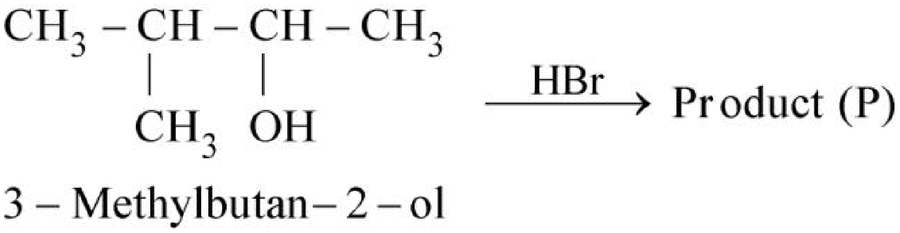
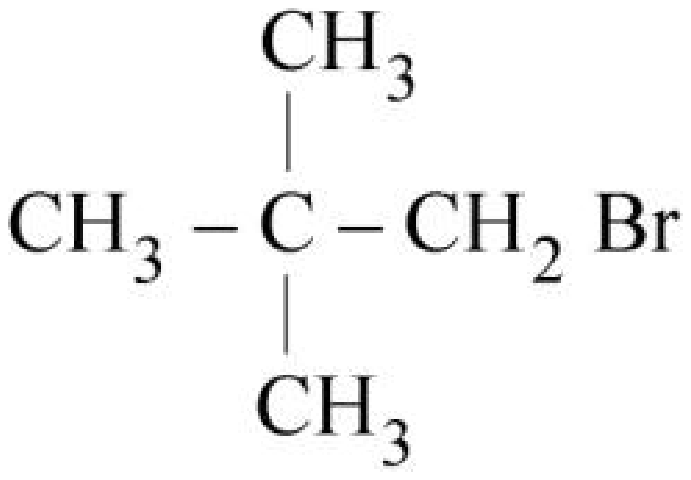
Consider the following reaction and identify the product (P).
- 1
- 2
- 3
- 4
Show answer and solution
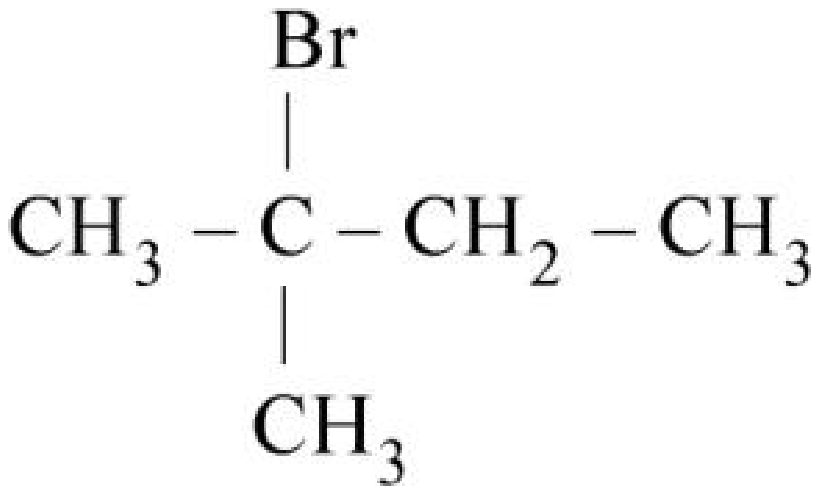
Correct: option 1
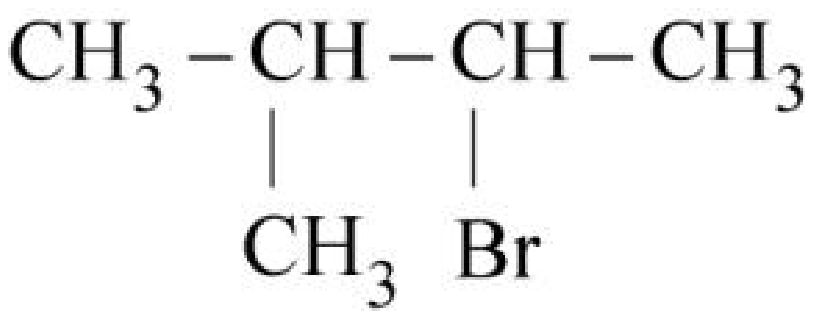
HBr protonates the OH group and water leaves, giving a secondary carbocation at C-2. A hydride shift from C-3 turns it into the more stable tertiary carbocation, which is then attacked by bromide. The product is 2-bromo-2-methylbutane, option (1).
Question 7NEET 2023, Q97
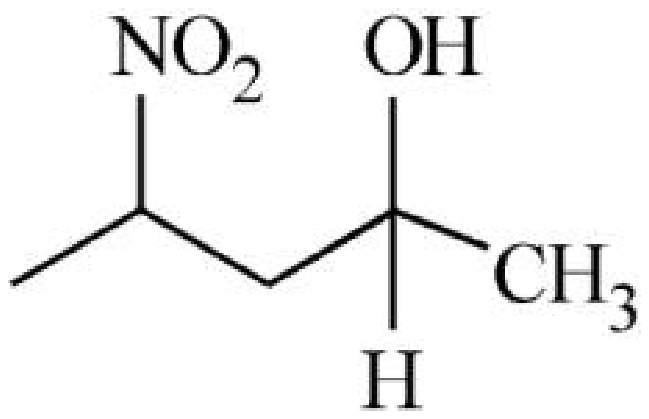
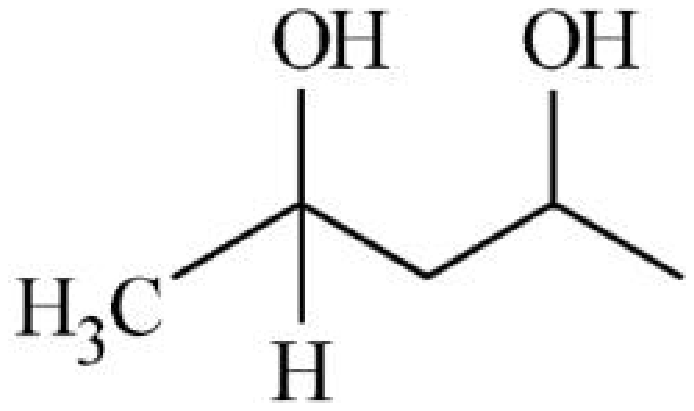
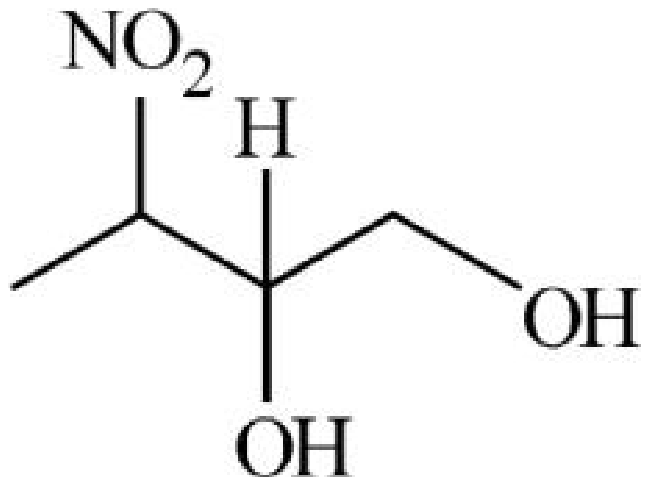
Which amongst the following will be most readily dehydrated under acidic conditions?
- 1
- 2
- 3
- 4
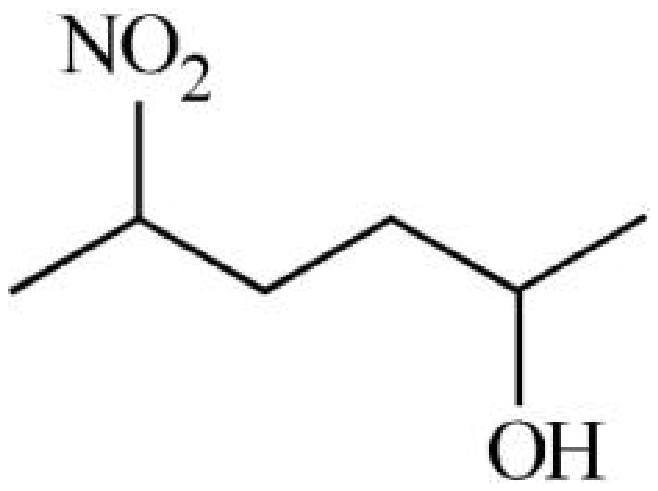
Show answer and solution
Correct: option 2
Acid catalysed dehydration goes through a carbocation, so the alcohol that forms the most stable carbocation reacts fastest. The group is strongly electron withdrawing and destabilises the carbocation in options (1), (3) and (4). The diol in option (2) has no nitro group, so it is dehydrated most readily.
Question 8NEET 2023, Q99
Consider the following reaction:

Identify products A and B.
- 1

- 2

- 3

- 4
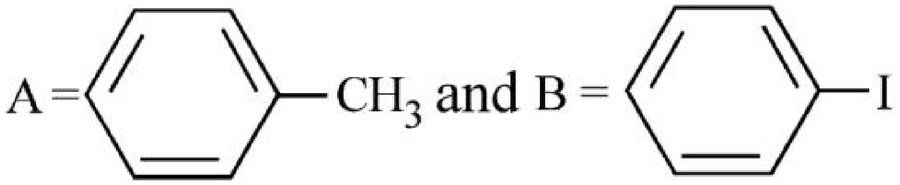
Show answer and solution
Correct: option 3
HI protonates the ether oxygen and iodide then attacks a carbon attached to it. The bond between oxygen and the aromatic ring has partial double bond character and is not broken, so the benzyl-oxygen bond breaks (the benzyl carbocation is also stabilised by resonance). The products are benzyl iodide and phenol, option (3).
Question 9NEET 2023 Manipur, Q58
Reagents which can be used to convert alcohols to carboxylic acids, are
(A)
(B)
(C)
(D) Cu, 573 K
(E)
Choose the most appropriate answer from the options given below.
- 1(A), (B) and (C) only
- 2(A), (B) and (E) only
- 3(B), (C) and (D) only
- 4(B), (D) and (E) only
Show answer and solution
Correct: option 1, (A), (B) and (C) only
Strong oxidising agents take a primary alcohol all the way to the acid: Jones reagent ( in ), acidified , and alkaline followed by acidification. Heated copper at 573 K only dehydrogenates an alcohol to an aldehyde or ketone, and in acetic anhydride is a reagent for stopping at the aldehyde stage. So (A), (B) and (C) are the ones that give carboxylic acids.
Question 10NEET 2023 Manipur, Q100
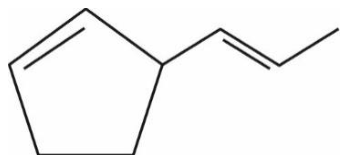
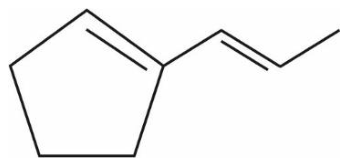
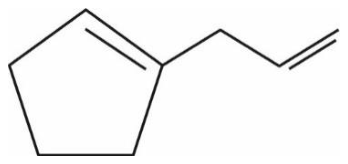
The major product formed in the following conversion is _____.
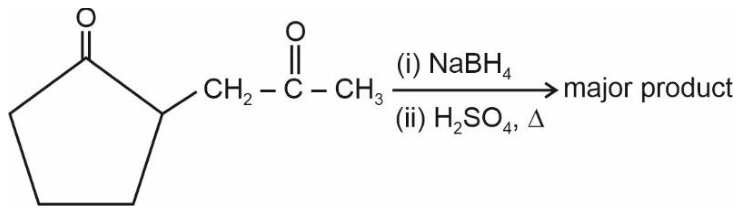
- 1
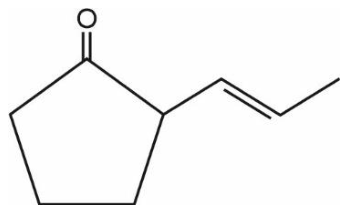
- 2
- 3
- 4
Show answer and solution
Correct: option 3
reduces both ketone groups to secondary alcohols, giving a diol. Heating with then dehydrates both alcohols, and the eliminations go in the directions that give the most stable product: one double bond in the ring at the carbon carrying the side chain and a second one in the side chain next to it, so the two are conjugated. This conjugated diene is option (3). In options (2) and (4) the two double bonds are not conjugated, and option (1) still has the ring ketone, which would have reduced.
Question 11NEET 2022, Q65
Given below are two statements:
Statement I:
The acidic strength of monosubstituted nitrophenol is higher than phenol because of electron withdrawing nitro group.
Statement II:
o-nitrophenol, m-nitrophenol and p-nitrophenol will have same acidic strength as they have one nitro group attached to the phenolic ring.
In the light of the above statements, choose the most appropriate answer from the options given below:
- 1Statement I is incorrect but Statement II is correct.
- 2Both Statement I and Statement II are correct.
- 3Both Statement I and Statement II are incorrect.
- 4Statement I is correct but Statement II is incorrect.
Show answer and solution
Correct: option 4, Statement I is correct but Statement II is incorrect.
The nitro group withdraws electrons and stabilises the phenoxide ion, so every nitrophenol is more acidic than phenol: Statement I is correct. The effect depends on position: at the ortho and para positions the nitro group acts through resonance as well as induction, at the meta position through induction only, so the three isomers differ in acidic strength. Statement II is incorrect.
Question 12NEET 2022, Q90
Given below are two statements:
Statement I:
In Lucas test, primary, secondary and tertiary alcohols are distinguished on the basis of their reactivity with conc. , known as Lucas Reagent.
Statement II:
Primary alcohols are most reactive and immediately produce turbidity at room temperature on reaction with Lucas Reagent.
In the light of the above statements, choose the most appropriate answer from the options given below:
- 1Statement I is incorrect but Statement II is correct.
- 2Both Statement I and Statement II are correct.
- 3Both Statement I and Statement II are incorrect.
- 4Statement I is correct but Statement II is incorrect.
Show answer and solution
Correct: option 4, Statement I is correct but Statement II is incorrect.
Lucas reagent is concentrated HCl with , and the test separates the three classes of alcohol by how fast the insoluble chloride appears, so Statement I is correct. It is the tertiary alcohols that react at once; primary alcohols give no turbidity at room temperature. Statement II is incorrect.
Question 13NEET 2022 Re-exam, Q80
Match the reagents (List-I) with the product (List-II) obtained from phenol.
| List-I | List-II |
|---|
| (a) (i) NaOH (ii) (iii) | (i) Benzoquinone |
| (b) (i) Aqueous NaOH + (ii) | (ii) Benzene |
| (c) Zn dust, | (iii) Salicyl aldehyde |
| (d) , | (iv) Salicylic acid |
Choose the correct answer from the options given below:
- 1a-iv, b-ii, c-i, d-iii
- 2a-iii, b-iv, c-i, d-ii
- 3a-ii, b-i, c-iv, d-iii
- 4a-iv, b-iii, c-ii, d-i
Show answer and solution
Correct: option 4, a-iv, b-iii, c-ii, d-i
(a) Sodium phenoxide with and then acid is Kolbe's reaction, giving salicylic acid (iv). (b) Chloroform with aqueous NaOH and then acid is the Reimer-Tiemann reaction, giving salicylaldehyde (iii). (c) Heating with zinc dust removes the oxygen and gives benzene (ii). (d) Chromic acid oxidises phenol to benzoquinone (i).
Question 14NEET 2022 Re-exam, Q92
Which one of the following reaction sequence is incorrect method to prepare phenol?
- 1Benzene, oleum, NaOH,
- 2Aniline, + HCl, , heating
- 3Cumene, ,
- 4Chlorobenzene, NaOH, STP condition
Show answer and solution
Correct: option 4, Chlorobenzene, NaOH, STP condition
Benzene is sulphonated by oleum and the sulphonic acid is fused with NaOH and acidified to give phenol. Aniline is diazotised and the diazonium salt is warmed with water to give phenol. Cumene is oxidised by air to its hydroperoxide, which acid splits into phenol and acetone. Chlorobenzene, however, reacts with NaOH only at about 623 K and 300 atm because its C-Cl bond has partial double bond character; nothing happens at ordinary temperature and pressure.
Question 15NEET 2021, Q60
What is the IUPAC name of the organic compound formed in the following chemical reaction?
Acetone Product
- 12-methyl propan-2-ol
- 2pentan-2-ol
- 3pentan-3-ol
- 42-methyl butan-2-ol
Show answer and solution
Correct: option 4, 2-methyl butan-2-ol
The ethyl group of the Grignard reagent adds to the carbonyl carbon of acetone, and hydrolysis gives the tertiary alcohol . Its longest chain has four carbons with OH and a methyl group on C-2, so it is 2-methylbutan-2-ol.
Question 16NEET 2020, Q17
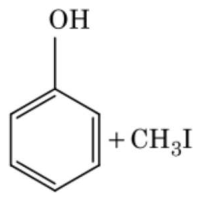
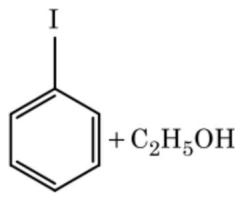
Anisole on cleavage with HI gives:
- 1
- 2
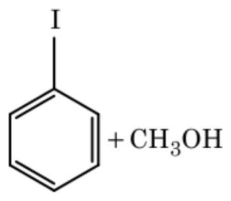
- 3
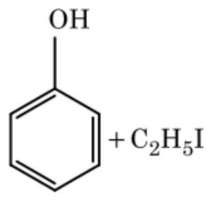
- 4
Show answer and solution
Correct: option 1
Anisole is . The bond between oxygen and the benzene ring has partial double bond character and does not break, so iodide attacks the methyl carbon. The products are phenol and methyl iodide, .
Question 17NEET 2020, Q29
Reaction between acetone and methylmagnesium chloride followed by hydrolysis will give:
- 1Isopropyl alcohol
- 2Sec. butyl alcohol
- 3Tert. butyl alcohol
- 4Isobutyl alcohol
Show answer and solution
Correct: option 3, Tert. butyl alcohol
A Grignard reagent adds to a ketone to give a tertiary alcohol after hydrolysis. The methyl group adds to the carbonyl carbon of acetone: , which is tert-butyl alcohol.
Question 18NEET 2020 Phase 2, Q142
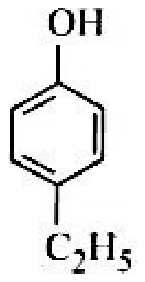
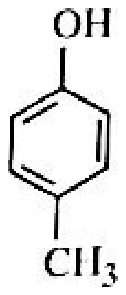
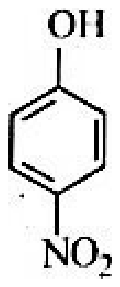
Which of the following substituted phenols is the strongest acid?
- 1
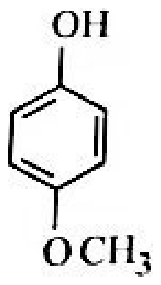
- 2
- 3
- 4
Show answer and solution
Correct: option 4
A phenol is more acidic when the phenoxide ion left behind is better stabilised. The group at the para position withdraws electrons by both the inductive and the resonance effect and spreads the negative charge, so p-nitrophenol (option 4) is the strongest acid. The , and groups release electrons and make the phenol weaker than phenol itself.
Question 19NEET 2020 Phase 2, Q161
What is Z?
- 1
- 2
- 3
- 4
Show answer and solution
Correct: option 4,
Hydroboration followed by oxidation with alkaline adds water across the double bond in the anti-Markovnikov sense: boron, and then , ends up on the less substituted carbon. But-1-ene therefore gives the primary alcohol butan-1-ol, .
Question 20NEET 2019, Q47
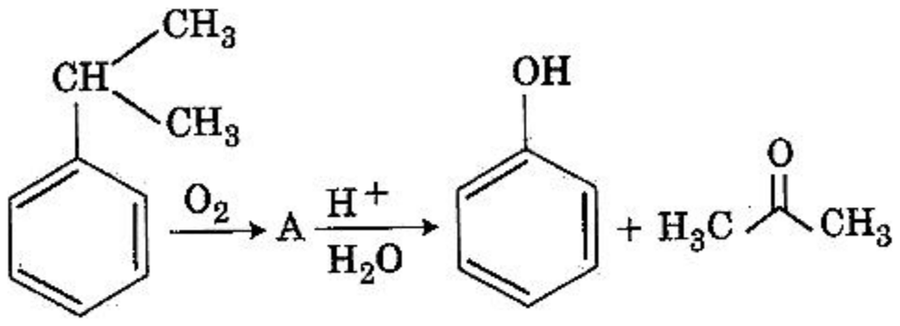
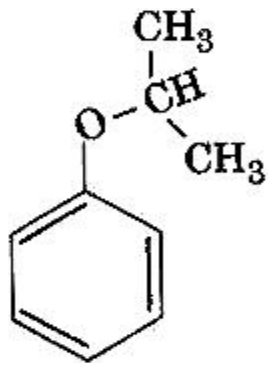
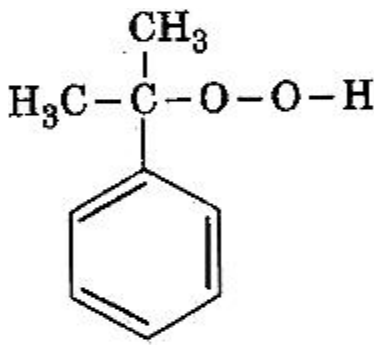
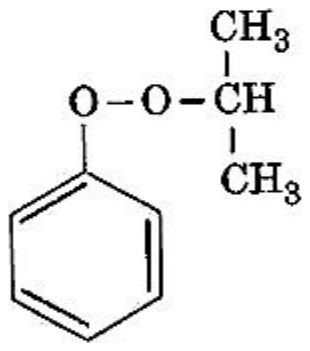
The structure of intermediate A in the following reaction, is:
- 1
- 2
- 3
- 4
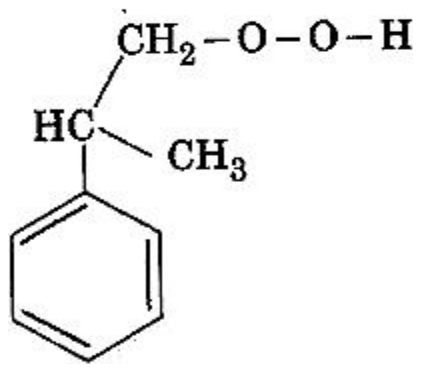
Show answer and solution
Correct: option 2
This is the cumene process for phenol. Air oxidises cumene (isopropylbenzene) at its benzylic C–H to cumene hydroperoxide, , and dilute acid then rearranges it to phenol and acetone. Option (2) is cumene hydroperoxide.
Question 21NEET 2019, Q69
The compound that is most difficult to protonate is:
- 1
- 2
- 3
- 4
Show answer and solution
Correct: option 4,
Protonation uses a lone pair on oxygen. In phenol the oxygen lone pair is delocalised into the benzene ring by resonance, so it is the least available and phenol is the hardest to protonate. Methyl groups push electrons towards oxygen, which makes methanol and dimethyl ether easier to protonate than water.
Question 22NEET 2019 Odisha, Q74
When vapours of a secondary alcohol is passed over heated copper at 573 K, the product formed is -
- 1a ketone
- 2an alkene
- 3a carboxylic acid
- 4an aldehyde
Show answer and solution
Correct: option 1, a ketone
Heated copper at 573 K dehydrogenates alcohols. A secondary alcohol loses hydrogen to give a ketone: . A primary alcohol gives an aldehyde, and a tertiary alcohol is dehydrated to an alkene.
Question 23NEET 2019 Odisha, Q80
The major products C and D formed in the following reaction respectively are:
- 1 and
- 2 and
- 3 and
- 4 and
Show answer and solution
Correct: option 3, and
HI first cleaves the ether by the path through the stable tert-butyl cation, giving tert-butyl iodide and propan-1-ol. Because HI is in excess and the mixture is heated, the alcohol is also converted into its iodide. The final products are 1-iodopropane and tert-butyl iodide.
Question 24NEET 2018, Q52
Identify the major products P, Q and R in the following sequence of reactions :
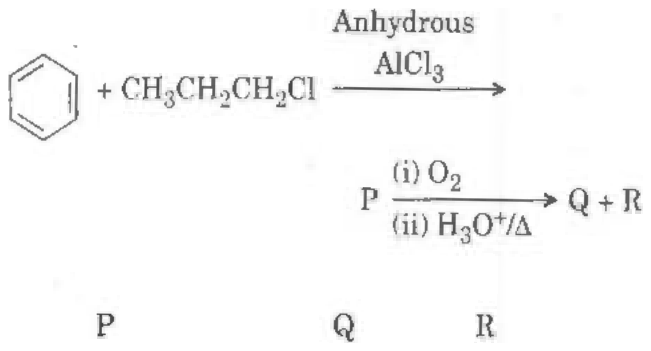
- 1
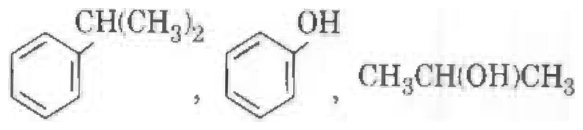
- 2
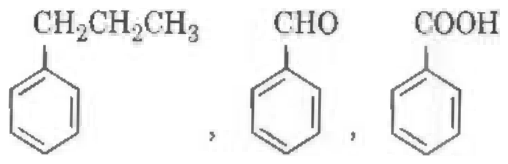
- 3
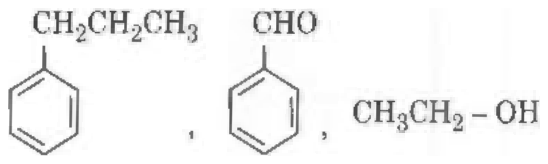
- 4
Show answer and solution
Correct: option 4
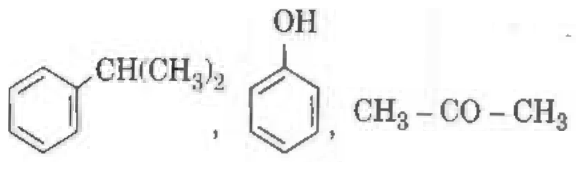
In the Friedel-Crafts alkylation the n-propyl carbocation rearranges by a hydride shift to the more stable isopropyl carbocation, so P is cumene, . Cumene is oxidised by air to cumene hydroperoxide, which on treatment with hot dilute acid splits into phenol (Q) and acetone, (R).
Question 25NEET 2018, Q60
The compound A on treatment with Na gives B, and with gives C. B and C react together to give diethyl ether. A, B and C are in the order
- 1
- 2
- 3
- 4
Show answer and solution
Correct: option 4,
Ethanol (A) reacts with sodium to give sodium ethoxide, (B), and with to give chloroethane, (C). B and C then give diethyl ether by the Williamson synthesis: .
Question 26NEET 2018, Q66
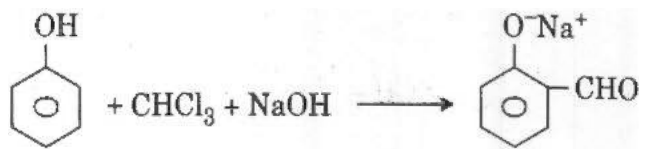
In the reaction
the electrophile involved is
- 1dichloromethyl anion ()
- 2formyl cation ()
- 3dichloromethyl cation ()
- 4dichlorocarbene ()
Show answer and solution
Correct: option 4, dichlorocarbene ()
This is the Reimer-Tiemann reaction. Hydroxide removes a proton from to give , which loses to form dichlorocarbene, . This electron-deficient species is the electrophile that attacks the ortho position of the phenoxide ion; hydrolysis then gives the group.
Question 27NEET 2018, Q68
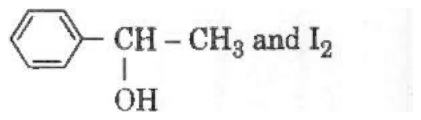
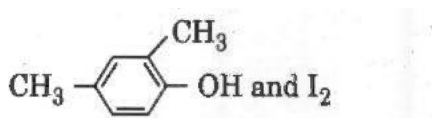
Compound A, , is found to react with NaOI (produced by reacting Y with NaOH) and yields a yellow precipitate with characteristic smell.
A and Y are respectively
- 1
- 2

- 3

- 4
Show answer and solution
Correct: option 1
The yellow precipitate with a characteristic smell is iodoform, , and NaOI is made from and NaOH, so Y is . The iodoform test is given by compounds with a or group. Only 1-phenylethanol, , in option (1) has this group.
Question 28NEET 2017, Q55
Which one is the most acidic compound?
- 1
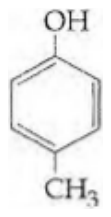
- 2
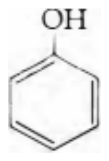
- 3
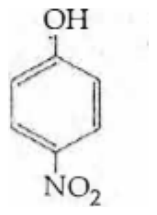
- 4
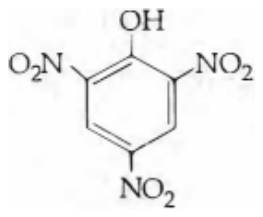
Show answer and solution
Correct: option 4
The group withdraws electrons and stabilises the phenoxide ion, especially from the ortho and para positions, while releases electrons and lowers acidity. 2,4,6-Trinitrophenol (picric acid), with three nitro groups at the ortho and para positions, is by far the most acidic of the four.
Question 29NEET 2017, Q83
The heating of phenyl-methyl ethers with HI produces.
- 1ethyl chlorides
- 2iodobenzene
- 3phenol
- 4benzene
Show answer and solution
Correct: option 3, phenol
. The bond between oxygen and the ring carbon has partial double bond character and is not broken, so the iodide attacks the methyl carbon, giving phenol and methyl iodide.
Question 30NEET 2016 Phase 1, Q63
Which of the following reagents would distinguish cis-cyclopenta-1, 2-diol from the trans-isomer?
- 1Acetone
- 2Ozone
- 3
- 4Aluminium isopropoxide
Show answer and solution
Correct: option 1, Acetone
Acetone reacts with a 1,2-diol to form a cyclic ketal (an acetonide) only when both groups can reach the same carbon. In the cis-diol the two groups are on the same side of the ring and the cyclic ketal forms; in the trans-isomer they point to opposite sides and cannot bridge. So acetone tells the two apart.
Question 31NEET 2016 Phase 1, Q82
- 1Williamson ether synthesis reaction
- 2Alcohol formation reaction
- 3Dehydration reaction
- 4Williamson alcohol synthesis reaction
Show answer and solution
Correct: option 1, Williamson ether synthesis reaction
Sodium hydride removes the proton of the alcohol to give the sodium alkoxide. The alkoxide ion then attacks methyl iodide in an step, displacing iodide and forming an ether (). Making an ether from an alkoxide and an alkyl halide is the Williamson ether synthesis.
Question 32AIPMT 2015, Q27
The reaction
is called:
- 1Williamson continuous etherification process
- 2Etard reaction
- 3Gatterman - Koch reaction
- 4Williamson Synthesis
Show answer and solution
Correct: option 4, Williamson Synthesis
A sodium alkoxide reacts with a primary alkyl halide by nucleophilic substitution to give an ether and sodium chloride. This laboratory route to ethers is the Williamson synthesis, option (4). The continuous etherification process is the acid dehydration of an alcohol, and the other two reactions make aldehydes.
Question 33AIPMT 2015 Re-test, Q16
Reaction of phenol with chloroform in presence of dilute sodium hydroxide finally introduces which one of the following functional group?
- 1
- 2
- 3
- 4
Show answer and solution
Correct: option 2,
This is the Reimer-Tiemann reaction. Dichlorocarbene from chloroform and alkali attacks the phenoxide ring at the ortho position to give a group, which is hydrolysed by the alkali to . The final product is salicylaldehyde, so the group introduced is , option (2).
Question 34AIPMT 2015 Re-test, Q41
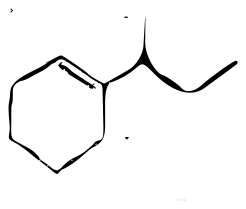
Which of the following is not the product of dehydration of
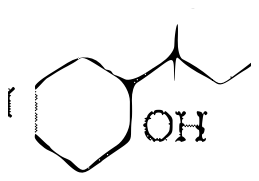
- 1
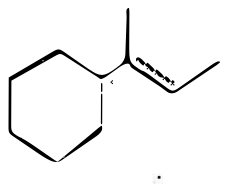
- 2
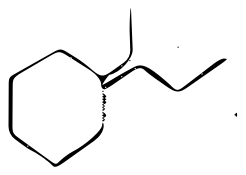
- 3
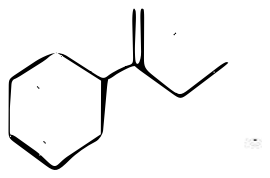
- 4
Show answer and solution
Correct: option 4
The alcohol is 2-cyclohexylbutan-2-ol. Losing water gives a tertiary carbocation on the carbon that carried the OH, and a proton is then lost from a carbon next to it: from the of the ethyl group (option 1), from the ring carbon (option 2) or from the methyl group (option 3). Each of these alkenes has its double bond at the carbon that held the OH. In option (4) the double bond lies inside the ring away from that carbon, which would need a rearrangement to a less stable cation, so it is not a product.
Question 35AIPMT 2014, Q155
Among the following sets of reactants which one produces anisole?
- 1; ;
- 2; RMgX
- 3; NaOH;
- 4; neutral
Show answer and solution
Correct: option 3, ; NaOH;
Anisole is methoxybenzene, . Phenol with NaOH gives sodium phenoxide, which attacks in a Williamson synthesis to give anisole. Set (1) is a Friedel-Crafts acylation giving a methylacetophenone, set (2) gives a secondary alcohol, and set (4) only gives the violet colour test for phenol.
Question 36AIPMT 2014, Q160
Which of the following will not be soluble in sodium hydrogen carbonate?
- 1Benzenesulphonic acid
- 22,4,6-trinitrophenol
- 3Benzoic acid
- 4o-Nitrophenol
Show answer and solution
Correct: option 4, o-Nitrophenol
A compound dissolves in only if it is a stronger acid than carbonic acid. Benzenesulphonic acid, benzoic acid and picric acid (2,4,6-trinitrophenol, made strongly acidic by three nitro groups) all are, and liberate . o-Nitrophenol (p about 7.2) is a weaker acid than carbonic acid, so it does not dissolve.
Question 37AIPMT 2014, Q174
Identify Z in the sequence of reactions:
- 1
- 2
- 3
- 4
Show answer and solution
Correct: option 2,
With a peroxide present, HBr adds to but-1-ene against Markovnikov's rule, so Y is 1-bromobutane, . Sodium ethoxide then displaces bromide from this primary halide (Williamson synthesis) to give butyl ethyl ether, , option (2).
Question 38NEET 2013, Q11
Among the following ethers, which one will produce methyl alcohol on treatment with hot concentrated HI?
- 1
- 2
- 3
- 4
Show answer and solution
Correct: option 2,
With HI, a methyl ether of a primary or secondary alkyl group is cleaved by attack of iodide on the small methyl group, giving methyl iodide and the other alcohol. When the other group is tertiary, as in tert-butyl methyl ether, the protonated ether breaks by the path to the stable tert-butyl carbocation, giving tert-butyl iodide and methyl alcohol. So option (2) is right.
Question 39NEET 2013 Karnataka, Q23
Phenol is distilled with Zn dust followed by Friedel Crafts alkylation with propyl chloride in the presence of to give a compound (B). (B) is oxidised in the presence of air to form the compound (C). The structural formula of (C) is:
- 1
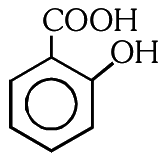
- 2
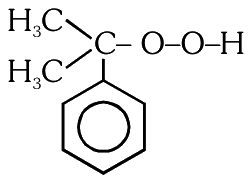
- 3
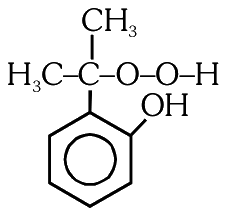
- 4
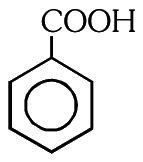
Show answer and solution
Correct: option 2
Zinc dust removes the oxygen of phenol to give benzene. In the Friedel Crafts step the propyl cation rearranges to the more stable isopropyl cation, so (B) is isopropylbenzene (cumene). Air oxidises cumene at its benzylic C–H to cumene hydroperoxide, , which is the structure in option (2).
Question 40NEET 2013 Karnataka, Q45
Number of isomeric alcohols of molecular formula which give positive iodoform test is:
- 1Three
- 2Four
- 3Five
- 4Two
Show answer and solution
Correct: option 2, Four
An alcohol gives the iodoform test only if it has the group, so the alcohols are . The butyl group can be n-butyl, isobutyl, sec-butyl or tert-butyl, giving hexan-2-ol, 4-methylpentan-2-ol, 3-methylpentan-2-ol and 3,3-dimethylbutan-2-ol: four structural isomers.
Question 41AIPMT 2012 Mains, Q60
Which of the following compounds can be used as antifreeze in automobile radiators?
- 1Methyl alcohol
- 2Glycol
- 3Nitrophenol
- 4Ethyl alcohol
Show answer and solution
Correct: option 2, Glycol
Ethylene glycol mixes with water in all proportions, lowers its freezing point considerably and, having a high boiling point, does not evaporate from a hot radiator. It is the standard antifreeze for car radiators.
Question 42AIPMT 2011 Prelims, Q2
In the following reactions,
(a)
(b)
the major products (A) and (C) are respectively:
- 1 and
- 2 and
- 3 and
- 4 and
Show answer and solution
Correct: option 2, and
Acid-catalysed dehydration of 3-methylbutan-2-ol goes through a carbocation and gives mainly the more substituted (Saytzeff) alkene, 2-methylbut-2-ene, so A is . Without peroxide, HBr adds by Markovnikov's rule through the more stable tertiary carbocation, so Br ends up on the carbon carrying the methyl group: C is 2-bromo-2-methylbutane, .
Question 43AIPMT 2010 Mains, Q36
Among the following four compounds:
(i) Phenol
(ii) Methyl phenol
(iii) Meta-nitrophenol
(iv) Para-nitrophenol
The acidity order is:
- 1(iv) > (iii) > (i) > (ii)
- 2(iii) > (iv) > (i) > (ii)
- 3(i) > (iv) > (iii) > (ii)
- 4(ii) > (i) > (iii) > (iv)
Show answer and solution
Correct: option 1, (iv) > (iii) > (i) > (ii)
An electron-withdrawing nitro group stabilises the phenoxide ion and raises the acidity, while an electron-releasing methyl group lowers it. At the para position the nitro group withdraws electrons by resonance as well as by the inductive effect; at the meta position only the inductive effect works. So para-nitrophenol > meta-nitrophenol > phenol > methyl phenol, that is (iv) > (iii) > (i) > (ii).
Question 44AIPMT 2010 Mains, Q45
When glycerol is treated with excess of HI, it produces:
- 12-iodopropane
- 2allyl iodide
- 3propene
- 4glycerol triiodide
Show answer and solution
Correct: option 1, 2-iodopropane
HI first gives the unstable 1,2,3-triiodopropane, which loses to form allyl iodide. With excess HI, allyl iodide adds HI, loses again to give propene, and propene adds one more HI by Markovnikov's rule to give 2-iodopropane (isopropyl iodide).
Question 45AIPMT 2010 Mains, Q49
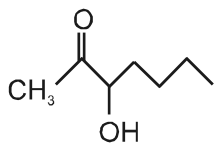
Which one of the following compounds will be most readily dehydrated?
- 1
- 2
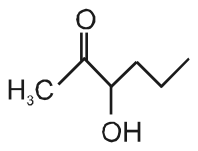
- 3
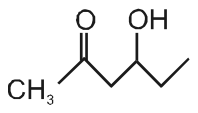
- 4
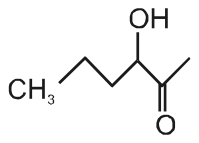
Show answer and solution
Correct: option 3
Option (3) is a beta-hydroxy ketone: the OH is on the carbon next but one to the C=O. The hydrogens on the carbon between them are acidic, so water is lost very easily to give a conjugated (alpha, beta-unsaturated) ketone. In the other three the OH is on the carbon directly attached to the C=O, where dehydration gives no such stabilised product and the carbocation would sit next to the electron-withdrawing carbonyl group.
Question 46AIPMT 2010 Prelims, Q57
Given are cyclohexanol (I), acetic acid (II), 2, 4, 6-trinitrophenol (III) and phenol (IV). In these the order of decreasing acidic character will be:
- 1III > II > IV > I
- 2II > III > I > IV
- 3II > III > IV > I
- 4III > IV > II > I
Show answer and solution
Correct: option 1, III > II > IV > I
Acidity follows the stability of the anion left behind. Three groups make the picrate ion so stable that 2,4,6-trinitrophenol is a stronger acid than acetic acid. Acetic acid (resonance-stabilised carboxylate) is stronger than phenol, and cyclohexanol, whose alkoxide has no resonance, is the weakest. So III > II > IV > I.
Question 47AIPMT 2010 Prelims, Q60
Which one of the following compounds has the most acidic nature?
- 1
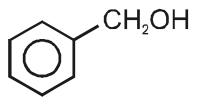
- 2
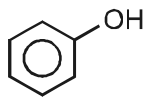
- 3
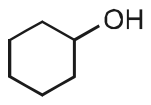
- 4
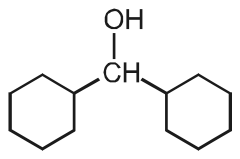
Show answer and solution
Correct: option 2
Option (2) is phenol; the others are benzyl alcohol, cyclohexanol and dicyclohexylmethanol, which are ordinary alcohols. Only in phenol is the O–H on the ring itself, so the phenoxide ion formed is stabilised by resonance with the benzene ring. That makes phenol far more acidic than the alcohols.
Question 48AIPMT 2009 Prelims, Q160
Consider the following reaction,
;
the product Z is:
- 1
- 2
- 3
- 4
Show answer and solution
Correct: option 3,
turns ethanol into bromoethane (X). Alcoholic KOH removes HBr to give ethene (Y). Ethene adds cold sulphuric acid to form ethyl hydrogen sulphate, and heating this with water hydrolyses it to ethanol, so Z is .
Question 49AIPMT 2009 Prelims, Q179
on heating with periodic acid gives:
- 1
- 2
- 3
- 4
Show answer and solution
Correct: option 3,
Periodic acid breaks the carbon-carbon bond between two neighbouring carbons that each carry an group, and turns each carbon into a carbonyl group. Ethylene glycol therefore gives two molecules of formaldehyde, HCHO.
Question 50AIPMT 2009 Prelims, Q188
Consider the following reaction:
,
the product Z is:
- 1Benzaldehyde
- 2Benzoic acid
- 3Benzene
- 4Toluene
Show answer and solution
Correct: option 2, Benzoic acid
Zinc dust removes the oxygen of phenol to give benzene (X). Friedel-Crafts methylation with and gives toluene (Y). Alkaline oxidises the methyl side chain fully to , so Z is benzoic acid.
Question 51AIPMT 2007 Prelims, Q147
In the reaction
.........
Which of the following compounds will be formed?
- 1
- 2
- 3
- 4
Show answer and solution
Correct: option 1,
HI first protonates the ether oxygen, and the iodide ion then attacks one of the two carbons next to oxygen by an step. Both are primary, but the ethyl carbon is less crowded than the of the branched isobutyl group, so iodide attacks there. The products are ethyl iodide and isobutyl alcohol.
Question 52AIPMT 2006 Prelims, Q66
The general molecular formula, which represents the homologous series of alkanols is:
- 1
- 2
- 3
- 4
Show answer and solution
Correct: option 4,
An alkanol is , a saturated alkyl group joined to OH. Counting all the hydrogens together gives , for example methanol and ethanol .
Question 53AIPMT 2006 Prelims, Q73
The major organic product in the reaction,
Product is:
- 1
- 2
- 3
- 4
Show answer and solution
Correct: option 4,
HI protonates the ether oxygen and iodide then attacks by the path at the less hindered carbon. That carbon is the methyl group, so the products are methyl iodide and propan-2-ol: .
Question 54AIPMT 2006 Prelims, Q86
Ethylene oxide when treated with Grignard reagent yields:
- 1Secondary alcohol
- 2Tertiary alcohol
- 3Cyclopropyl alcohol
- 4Primary alcohol
Show answer and solution
Correct: option 4, Primary alcohol
The alkyl group of RMgX attacks a ring carbon and opens the epoxide to give , which on hydrolysis gives . The OH is on a group, so the product is a primary alcohol with two more carbons than R.
Question 55AIPMT 2005 Prelims, Q84
Which one of the following compounds is most acidic:-
- 1
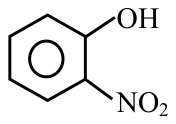
- 2
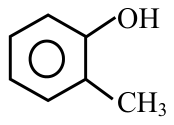
- 3
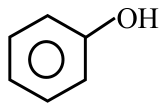
- 4
Show answer and solution
Correct: option 1
Phenols are far more acidic than alcohols because the phenoxide ion is stabilised by resonance, so the chloro alcohol is the weakest. On the ring, the electron-withdrawing nitro group (–I and –R) spreads the negative charge of the phenoxide further and raises acidity, while the electron-releasing methyl group lowers it. The nitrophenol of option (1) is therefore the most acidic.
Question 56AIPMT 2004 Prelims, Q64
Which one of the following can be oxidised to the corresponding carbonyl compound:
- 1o-Nitrophenol
- 2Phenol
- 32-methyl-2-hydroxy propane
- 42-hydroxy propane
Show answer and solution
Correct: option 4, 2-hydroxy propane
2-Hydroxy propane (propan-2-ol) is a secondary alcohol; it has a hydrogen on the carbon bearing the –OH, so it is oxidised to the ketone propanone. 2-Methyl-2-hydroxy propane is a tertiary alcohol with no such hydrogen, and the phenols do not give a corresponding carbonyl compound.
Question 57AIPMT 2004 Prelims, Q76
The –OH group of an alcohol or the carboxylic acid can be replaced by –Cl, using:
- 1Hypochlorous acid
- 2Chlorine
- 3Hydrochloric acid
- 4Phosphorus pentachloride
Show answer and solution
Correct: option 4, Phosphorus pentachloride
replaces –OH by –Cl in both types of compound: and . Hydrochloric acid does not convert a carboxylic acid into an acid chloride, and chlorine and hypochlorous acid do not replace –OH.
Question 58AIPMT 2004 Prelims, Q91
Which of the following will not form a yellow precipitate on heating with an alkaline solution of iodine:
- 1
- 2
- 3
- 4
Show answer and solution
Correct: option 2,
The yellow precipitate is iodoform, . The iodoform test is given by alcohols that contain the group, which iodine first oxidises to . Butan-2-ol, ethanol and propan-2-ol all have this group; methanol, , does not, so it gives no precipitate.
Question 59AIPMT 2002 Prelims, Q87
n-propyl alcohol and isopropyl alcohol can be chemically distinguished by which reagent:
- 1
- 2Reduction
- 3Oxidation with Potassium dichromate
- 4Ozonolysis
Show answer and solution
Correct: option 3, Oxidation with Potassium dichromate
Oxidation with dichromate gives different products: n-propyl alcohol, a primary alcohol, gives propanal and then propanoic acid, while isopropyl alcohol, a secondary alcohol, gives the ketone acetone. These products are easily told apart. reacts with both in the same way, and neither alcohol is reduced or undergoes ozonolysis.
Question 60AIPMT 2002 Prelims, Q95
When phenol is treated with and , the product formed is:
- 1Benzaldehyde
- 2Salicylaldehyde
- 3Salicylic acid
- 4Benzoic acid
Show answer and solution
Correct: option 2, Salicylaldehyde
This is the Reimer–Tiemann reaction. Chloroform and alkali give dichlorocarbene, which attacks the phenoxide ion at the ortho position; hydrolysis then puts a group there, giving salicylaldehyde (o-hydroxybenzaldehyde). Salicylic acid would need or instead.
Question 61AIPMT 2001 Prelims, Q51
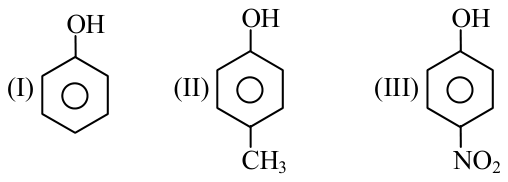
The correct acidic order of following is:
- 1I > II > III
- 2III > I > II
- 3II > III > I
- 4I > III > II
Show answer and solution
Correct: option 2, III > I > II
I is phenol, II is p-cresol and III is p-nitrophenol. The nitro group withdraws electrons and stabilises the phenoxide ion, so III is the strongest acid; the methyl group releases electrons and destabilises the phenoxide ion, so II is the weakest. The order is III > I > II.
Question 62AIPMT 2001 Prelims, Q61
In preparation of alkene from alcohol using which is effective factor:
- 1Porosity of
- 2Temperature
- 3Concentration
- 4Surface area of
Show answer and solution
Correct: option 2, Temperature
Over alumina the product is decided by temperature: at about 520 K two alcohol molecules lose water to give an ether, while at about 620 K one molecule is dehydrated to the alkene. Temperature is therefore the deciding factor.
Question 63AIPMT 2001 Prelims, Q62
Which of following is correct:
- 1Any aldehyde gives secondary alcohol on reduction
- 2Reaction of vegetable oil with give glycerin
- 3, iodine with NaOH gives iodoform
- 4Sucrose on reaction with NaCl give invert sugar
Show answer and solution
Correct: option 3, , iodine with NaOH gives iodoform
Ethanol is oxidised by /NaOH to acetaldehyde, which has a group and gives yellow iodoform, . Aldehydes give primary alcohols on reduction, and invert sugar is made by hydrolysing sucrose with acid or invertase, not with NaCl. Statement (3) is the keyed one.
Question 64AIPMT 2000 Prelims, Q57
Which reagent converts propene to 1-propanol:
- 1
- 2
- 3
- 4Aq. KOH
Show answer and solution
Correct: option 2,
1-Propanol is the anti-Markovnikov hydration product of propene. Hydroboration-oxidation (, then ) places the OH on the less substituted carbon and gives . Acid-catalysed hydration and oxymercuration-demercuration follow Markovnikov's rule and give 2-propanol, and aqueous KOH does not react with an alkene.
Question 65AIPMT 2000 Prelims, Q85
Which of the following statement is correct for the stability of ions of ethyl alcohol and phenol:
- 1Delocalisation of -electrons in phenoxide ion
- 2Delocalisation of electrons in ethoxide ion
- 3Inductive effect of ethyl and phenyl group
- 4Localisation of -electrons in phenoxide ion
Show answer and solution
Correct: option 1, Delocalisation of -electrons in phenoxide ion
In the phenoxide ion the negative charge on oxygen is spread over the benzene ring by resonance, which stabilises the ion. In the ethoxide ion the charge stays on oxygen and is even intensified by the electron-releasing ethyl group. This delocalisation in phenoxide is why phenol is a stronger acid than ethanol.
Question 66AIPMT 1999 Prelims, Q71
Order of acidic strength of the following compound will be:
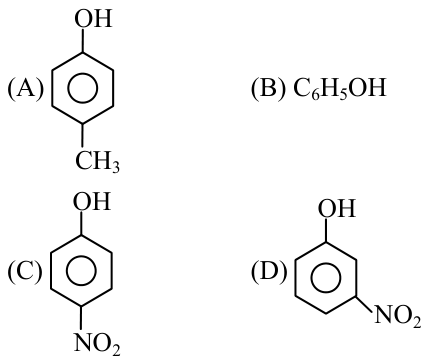
- 1C > D > B > A
- 2D > C > B > A
- 3A > B > C > D
- 4B > A > C > D
Show answer and solution
Correct: option 1, C > D > B > A
A is p-cresol, B is phenol, C is p-nitrophenol and D is m-nitrophenol. A nitro group withdraws electrons and stabilises the phenoxide ion; at the para position it does so by both resonance and induction, at the meta position by induction only, so C is more acidic than D. The methyl group of p-cresol donates electrons and makes it weaker than phenol. Order: C > D > B > A.
Question 67AIPMT 1998 Prelims, Q52
Aspirin can be prepared by the reaction of acetyl chloride with:
- 1Benzoic acid
- 2Phenol
- 3p-hydroxy benzoic acid
- 4o-hydroxy benzoic acid
Show answer and solution
Correct: option 4, o-hydroxy benzoic acid
Aspirin is acetylsalicylic acid (2-acetoxybenzoic acid). It is made by acetylating the –OH group of salicylic acid, which is o-hydroxybenzoic acid, with acetyl chloride or acetic anhydride.
Question 68AIPMT 1998 Prelims, Q55
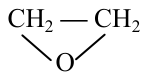
The product formed by the reaction of
- 1
- 2
- 3
- 4
Show answer and solution
Correct: option 1,
The compound is ethylene oxide (oxirane). The R group of the Grignard reagent attacks one ring carbon and opens the strained ring, giving . Hydrolysis then gives the primary alcohol , two carbons longer than R.
Question 69AIPMT 1998 Prelims, Q63
Which of the following does not give nucleophilic substitution with alcohol:
- 1
- 2Acetic anhydride
- 3Ether
- 4None
Show answer and solution
Correct: option 3, Ether
Acetyl chloride and acetic anhydride have a reactive acyl carbon with a good leaving group ( or acetate), so an alcohol attacks them and forms an ester. An ether has no such centre and no good leaving group, so it does not react with an alcohol.
