Questions with solutions
Question 1NEET 2023, Q69
Which amongst the following molecules on polymerization produces neoprene?
- 1
- 2
- 3
- 4
Show answer and solution
Correct: option 2,
Neoprene is polychloroprene, made by free radical polymerisation of chloroprene, 2-chlorobuta-1,3-diene, which is option (2). Option (1) is buta-1,3-diene, option (3) is vinylacetylene and option (4) is isoprene, the monomer of natural rubber.
Question 2NEET 2023 Manipur, Q69
Given below are two statements:
Statement I:
High density polythene is formed in the presence of catalyst triethylaluminium and titanium tetrachloride.
Statement II:
High density polymers are chemically inert
In the light of the above statements, choose the correct answer from the options given below
- 1Both Statement I and Statement II are true.
- 2Both Statement I and Statement II are false.
- 3Statement I is correct but Statement II is false.
- 4Statement I is incorrect but Statement II is true.
Show answer and solution
Correct: option 1, Both Statement I and Statement II are true.
High density polythene is made by polymerising ethene at 333 to 343 K and 6 to 7 atm with the Ziegler-Natta catalyst, triethylaluminium with titanium tetrachloride, so Statement I is true. The closely packed linear chains make it tough, hard and chemically inert, so Statement II is true as well.
Question 3NEET 2022, Q51
Which statement regarding polymers is not correct?
- 1Thermosetting polymers are reusable.
- 2Elastomers have polymer chains held together by weak intermolecular forces.
- 3Fibers possess high tensile strength.
- 4Thermoplastic polymers are capable of repeatedly softening and hardening on heating and cooling respectively.
Show answer and solution
Correct: option 1, Thermosetting polymers are reusable.
Thermosetting polymers become heavily cross-linked on heating and set permanently, so they cannot be softened and reused. The other three statements describe elastomers, fibres and thermoplastics correctly, so option (1) is the incorrect one.
Question 4NEET 2022 Re-exam, Q62
Which among the following is a thermoplastic polymer?
- 1Melamine polymer
- 2Bakelite
- 3Polythene
- 4Urea-formaldehyde resin
Show answer and solution
Correct: option 3, Polythene
Thermoplastics are linear or slightly branched polymers that soften on heating and harden on cooling again and again; polythene is one. Bakelite, melamine and urea-formaldehyde resins are heavily cross-linked thermosetting polymers that cannot be remelted.
Question 5NEET 2021, Q75
Which one of the following polymers is prepared by addition polymerisation?
- 1Teflon
- 2Nylon-66
- 3Novolac
- 4Dacron
Show answer and solution
Correct: option 1, Teflon
Teflon is made by the addition (chain-growth) polymerisation of tetrafluoroethene, with no small molecule lost. Nylon-66, novolac and dacron are condensation polymers.
Question 6NEET 2020, Q11
Which of the following is a natural polymer?
- 1cis-1,4-polyisoprene
- 2poly (Butadiene-styrene)
- 3polybutadiene
- 4poly (Butadiene-acrylonitrile)
Show answer and solution
Correct: option 1, cis-1,4-polyisoprene
Natural rubber is cis-1,4-polyisoprene. The other three (Buna-S, polybutadiene and Buna-N) are synthetic rubbers.
Question 7NEET 2020 Phase 2, Q163
Which of the following statement is correct about Bakelite?
- 1It is an addition polymer.
- 2It is a branched chain polymer.
- 3It is a linear polymer.
- 4It is a cross linked polymer.
Show answer and solution
Correct: option 4, It is a cross linked polymer.
Bakelite is made by condensation of phenol with formaldehyde. The first product, novolac, is linear, but on heating with more formaldehyde the chains join through methylene bridges into a three-dimensional network. Bakelite is therefore a cross linked, thermosetting condensation polymer.
Question 8NEET 2019, Q61
The biodegradable polymer is:
- 1nylon-6, 6
- 2nylon 2-nylon 6
- 3nylon-6
- 4Buna-S
Show answer and solution
Correct: option 2, nylon 2-nylon 6
Nylon 2-nylon 6 is an alternating polyamide of glycine and aminocaproic acid, and it is biodegradable. Nylon-6,6, nylon-6 and Buna-S are ordinary synthetic polymers that microbes do not break down.
Question 9NEET 2019 Odisha, Q89
The polymer that is used as a substitute for wool in making commercial fibres is -
- 1polyacrylonitrile
- 2Buna - N
- 3melamine
- 4nylon - 6, 6
Show answer and solution
Correct: option 1, polyacrylonitrile
Polyacrylonitrile, the addition polymer of acrylonitrile, is used as a substitute for wool in commercial fibres such as orlon and acrilan. Buna-N is a synthetic rubber, melamine polymer is used for unbreakable crockery and nylon-6,6 for sheets, bristles and textile fibres.
Question 10NEET 2018, Q54
Regarding cross-linked or network polymers, which of the following statements is incorrect?
- 1Examples are bakelite and melamine.
- 2They are formed from bi- and tri-functional monomers.
- 3They contain covalent bonds between various linear polymer chains.
- 4They contain strong covalent bonds in their polymer chains.
Show answer and solution
Correct: option 4, They contain strong covalent bonds in their polymer chains.
Cross-linked polymers such as bakelite and melamine are made from bi- and tri-functional monomers, and their defining feature is strong covalent bonds between the various linear polymer chains. Statements 1, 2 and 3 say exactly this. Statement 4 places the strong covalent bonds in the chains instead of between them, which does not describe cross-linking, so it is the one the key marks incorrect.
Question 11NEET 2016 Phase 1, Q57
- 1All cis-configuration
- 2All trans-configuration
- 3Alternate cis - and trans-configuration
- 4Random cis - and trans-configuration
Show answer and solution
Correct: option 1, All cis-configuration
Natural rubber is cis-1,4-polyisoprene: every double bond in the chain has the cis arrangement, which makes the chains coil and gives rubber its elasticity. The all-trans polymer is gutta-percha, which is hard and not elastic.
Question 12NEET 2016 Phase 2, Q78
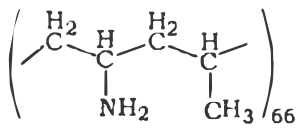
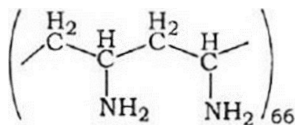
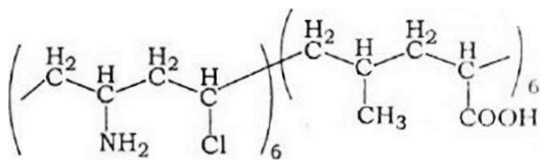
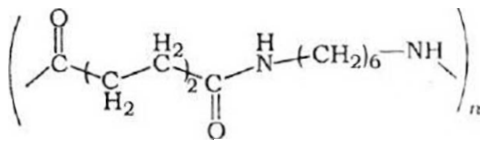
Which one of the following structures represents nylon 6,6 polymer?
- 1
- 2
- 3
- 4
Show answer and solution
Correct: option 4
Nylon 6,6 is a polyamide made by condensing hexamethylenediamine, , with adipic acid, . Its repeating unit is , with amide links in the chain. Only option (4) shows this; the others are carbon-chain addition polymers with side groups.
Question 13AIPMT 2015, Q38
Biodegradable polymer which can be produced from glycine and aminocaproic acid is:
- 1PHBV
- 2Buna - N
- 3Nylon 6, 6
- 4Nylon 2- nylon 6
Show answer and solution
Correct: option 4, Nylon 2- nylon 6
Glycine (, two carbons) and aminocaproic acid (, six carbons) condense into an alternating polyamide named after the carbon counts of the two monomers, nylon 2-nylon 6. It is biodegradable. Hence option (4).
Question 14AIPMT 2015 Re-test, Q8
Caprolactam is used for the manufacture of:
- 1Terylene
- 2Nylon-6,6
- 3Nylon-6
- 4Teflon
Show answer and solution
Correct: option 3, Nylon-6
Caprolactam is a cyclic amide with six carbons; heating it with water opens the ring and the units join to give Nylon-6. Terylene comes from ethylene glycol and terephthalic acid, Nylon-6,6 from hexamethylenediamine and adipic acid, and Teflon from tetrafluoroethene. Option (3).
Question 15AIPMT 2014, Q141
Which one of the following is an example of a thermosetting polymer?
- 1
- 2
- 3
- 4
Show answer and solution
Correct: option 1
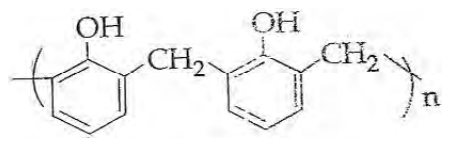
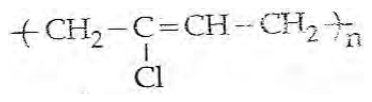
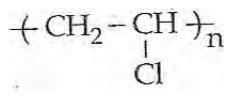
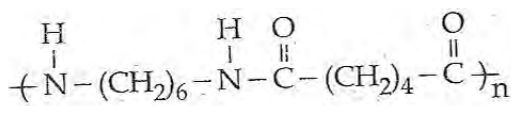
Option (1) is the phenol-formaldehyde polymer (novolac, which on further heating with formaldehyde gives cross-linked bakelite); phenol-formaldehyde resins are the standard example of a thermosetting polymer. Option (2) is neoprene, an elastomer; option (3) is PVC, a thermoplastic; option (4) is nylon 6,6, a fibre. So the answer is (1).
Question 16AIPMT 2014, Q177
Which of the following organic compounds polymerizes to form the polyester Dacron?
- 1Benzoic acid and para
- 2Propylene and para
- 3Benzoic acid and ethanol
- 4Terephthalic acid and ethylene glycol
Show answer and solution
Correct: option 4, Terephthalic acid and ethylene glycol
Dacron (terylene) is a condensation polyester made from terephthalic acid (benzene-1,4-dicarboxylic acid) and ethylene glycol (ethane-1,2-diol); each monomer has two functional groups, so ester links can form at both ends and build a chain.
Question 17NEET 2013, Q1
Which is the monomer of Neoprene in the following?
- 1
- 2
- 3
- 4
Show answer and solution
Correct: option 2,
Neoprene is made by free-radical polymerisation of chloroprene, 2-chlorobuta-1,3-diene, . Option (1) is isoprene (natural rubber), option (3) is vinylacetylene and option (4) is buta-1,3-diene, so option (2) is right.
Question 18NEET 2013, Q10
- 1Polysaccharide
- 2Polyamide
- 3Polythene
- 4Polyester
Show answer and solution
Correct: option 2, Polyamide
Nylons are condensation polymers whose repeating units are joined by amide () links, for example nylon-6,6 from hexamethylenediamine and adipic acid. They are therefore polyamides, option (2).
Question 19AIPMT 2012 Prelims, Q177
Which one of the following is not a condensation polymer?
- 1Melamine
- 2Glyptal
- 3Dacron
- 4Neoprene
Show answer and solution
Correct: option 4, Neoprene
Neoprene is made by addition polymerisation of chloroprene (2-chlorobuta-1,3-diene), with no small molecule lost. Melamine (melamine-formaldehyde) resin, glyptal and dacron are all formed by condensation with loss of water. So option (4).
Question 20AIPMT 2012 Prelims, Q199
Which of the following statements is false?
- 1Artificial silk is derived from cellulose.
- 2Nylon-66 is an example of elastomer.
- 3The repeat unit in natural rubber is isoprene.
- 4Both starch and cellulose are polymers of glucose.
Show answer and solution
Correct: option 2, Nylon-66 is an example of elastomer.
Nylon-66 is a polyamide with strong hydrogen bonding between chains, which makes it a fibre, not an elastomer. So statement (2) is false. Rayon (artificial silk) is made from cellulose, natural rubber is cis-polyisoprene, and starch and cellulose are both built from glucose.
Question 21AIPMT 2012 Mains, Q55
Which one of the following sets forms the biodegradable polymer?
- 1 and
- 2 and
- 3

- 4

Show answer and solution
Correct: option 2, and
Glycine () and aminocaproic acid () form the polyamide nylon-2-nylon-6, whose amide links resemble those of proteins and can be broken down by microorganisms. The other sets give Buna-N, terylene and Buna-S, none of which is biodegradable.
Question 22AIPMT 2011 Prelims, Q49
Of the following which one is classified as polyester polymer?
- 1Terylene
- 2Bakelite
- 3Melamine
- 4Nylon-66
Show answer and solution
Correct: option 1, Terylene
Terylene (dacron) is made by condensing ethylene glycol with terephthalic acid, and its repeating units are joined by ester links, so it is a polyester. Bakelite is a phenol-formaldehyde resin, melamine polymer is a melamine-formaldehyde resin, and nylon-6,6 is a polyamide.
Question 23AIPMT 2010 Prelims, Q95
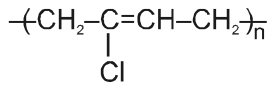
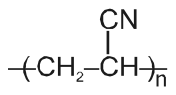
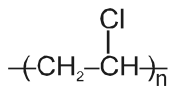
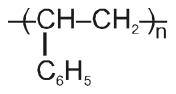
Which of the following structures represents Neoprene polymer?
- 1
- 2
- 3
- 4
Show answer and solution
Correct: option 1
Neoprene is the polymer of chloroprene, 2-chloro-1,3-butadiene (). On polymerisation the repeating unit is , which is option (1). The other three are the repeating units of polyacrylonitrile, PVC and polystyrene.
Question 24AIPMT 2009 Prelims, Q186
Structures of some common polymers are given. Which one is not correctly presented?
- 1Neoprene
- 2Terylene

- 3Nylon 66

- 4Teflon
Show answer and solution
Correct: option 1, Neoprene
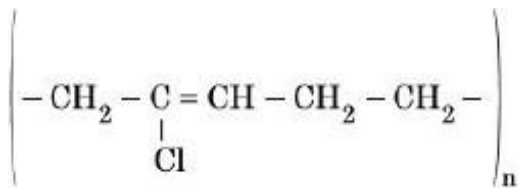
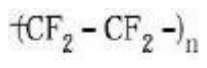
Neoprene is the polymer of chloroprene, , so its repeating unit is with four carbons in the chain. The structure shown has an extra group, so it is the wrong one. The units shown for terylene, nylon 66 and teflon are the usual ones.
Question 25AIPMT 2008 Prelims, Q99
Which of the following statements is not true?
- 1Natural rubber is a 1, 4 - polymer of isoprene
- 2In vulcanization, the formation of sulphur bridges between different chains make rubber harder and stronger
- 3Natural rubber has the trans-configuration at every double bond
- 4Buna-S is a copolymer of butadiene and styrene
Show answer and solution
Correct: option 3, Natural rubber has the trans-configuration at every double bond
Natural rubber is cis-1,4-polyisoprene: every double bond has the cis arrangement, which is what lets the chains coil and makes it elastic. The all-trans polymer is gutta-percha. The other three statements are true.
Question 26AIPMT 2007 Prelims, Q150
Which one of the following polymers is prepared by condensation polymerization?
- 1Styrene
- 2Nylon-66
- 3Teflon
- 4Rubber
Show answer and solution
Correct: option 2, Nylon-66
Nylon-66 is made from hexamethylenediamine and adipic acid, which join through amide links with loss of a water molecule at each step; that is condensation polymerisation. Teflon, rubber and the polymer of styrene are all built by addition of unsaturated monomers with nothing lost.
Question 27AIPMT 2006 Prelims, Q70
is a:
- 1copolymer
- 2Addition polymer
- 3Thermosetting polymer
- 4Homopolymer
Show answer and solution
Correct: option 1, copolymer
The repeating unit contains two different parts joined by amide links: one from a diamine (the NH...NH part) and one from adipic acid (the CO...CO part). A polymer built from two different monomers is a copolymer. It is formed by condensation, not addition, and a linear polyamide of this kind (nylon) is a thermoplastic fibre, not a thermosetting polymer.
Question 28AIPMT 2005 Prelims, Q77
The monomer of the polymer:
- 1
- 2
- 3
- 4
Show answer and solution
Correct: option 4,
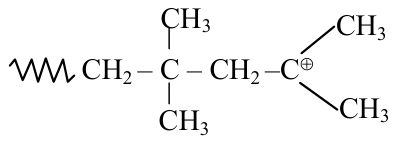
The chain is a repeat of the unit , growing through a tertiary carbocation at its end. Opening the double bond of 2-methylpropene (isobutylene), , gives exactly this unit, so it is the monomer; the product is polyisobutylene made by cationic polymerisation.
Question 29AIPMT 2004 Prelims, Q54
Which one of the following is a chain growth polymer:
- 1Nucleic acid
- 2Polystyrene
- 3protein
- 4Starch
Show answer and solution
Correct: option 2, Polystyrene
Chain growth (addition) polymers form when unsaturated monomers add one after another to a growing chain without losing any small molecule. Polystyrene is made this way from styrene. Nucleic acids, proteins and starch are condensation (step growth) polymers formed with loss of water.
Question 30AIPMT 2003 Prelims, Q95
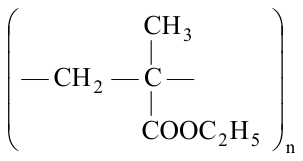
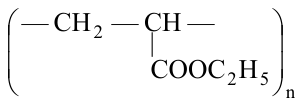
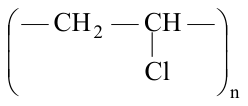
Acrolein is a hard, horny and a high melting point material. Which of the following represent its structure:
- 1
- 2
- 3
- 4
Show answer and solution
Correct: option 1
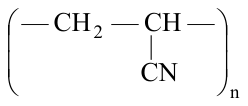
The hard, horny, high-melting material described is the acrylic fibre polyacrylonitrile (sold as Acrilan or Orlon), made by polymerising . Its repeating unit is , option (1). (2) is poly(ethyl methacrylate), (3) is poly(ethyl acrylate) and (4) is PVC.
Question 31AIPMT 2003 Prelims, Q97
Which one of the following monomers gives the polymer neoprene on polymerization: -
- 1
- 2
- 3
- 4
Show answer and solution
Correct: option 3,
Neoprene is the synthetic rubber made by polymerising chloroprene, 2-chlorobuta-1,3-diene. Option (1) is vinyl chloride (gives PVC) and option (4) is tetrafluoroethene (gives Teflon).
Question 32AIPMT 2002 Prelims, Q91
Monomer of is:
- 12-methyl propene
- 2Styrene
- 3Propylene
- 4Ethene
Show answer and solution
Correct: option 1, 2-methyl propene
The repeating unit comes from an addition polymer. Putting back the double bond between its two chain carbons gives , which is 2-methylpropene (isobutylene); the polymer is polyisobutylene.
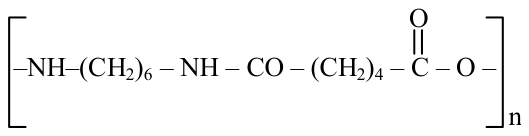
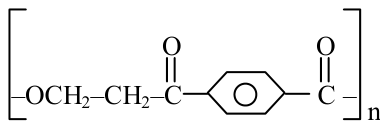
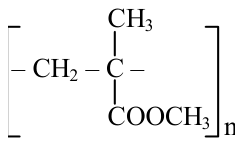
Question 33AIPMT 2001 Prelims, Q58
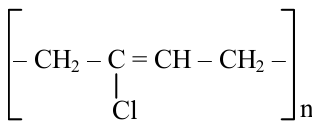
Which of the following is not correctly matched
- 1Neoprene
- 2Nylon-66
- 3Terylene
- 4PMMA
Show answer and solution
Correct: option 3, Terylene
Terylene is the polyester of ethylene glycol and terephthalic acid, so its repeating unit is . The unit drawn in (3) has the glycol carbon bonded straight to the carbonyl carbon with one oxygen missing, so it is not Terylene. Neoprene (polychloroprene) and PMMA are drawn correctly. Note that the Nylon-66 unit as printed in this copy ends in an extra oxygen, which is also not the true amide unit ; the keyed answer is (3).
Question 34AIPMT 2000 Prelims, Q60
- 1Teflon
- 2Orlon
- 3Polythene
- 4Nylon-6
Show answer and solution
Correct: option 1, Teflon
Tetrafluoroethene polymerises by addition to polytetrafluoroethene, , which is Teflon. Orlon comes from acrylonitrile, polythene from ethene and nylon-6 from caprolactam.
Question 35AIPMT 1999 Prelims, Q65
Monomer of natural rubber is:
- 1
- 2
- 3
- 4
Show answer and solution
Correct: option 3,
Natural rubber is cis-1,4-polyisoprene. Its monomer is isoprene, 2-methylbuta-1,3-diene, , which is option (3).