Questions with solutions
Question 1NEET 2026, Q47
The major product Z formed in the following sequence of reactions is:
- 1
- 2
- 3
- 4
Show answer and solution
Correct: option 2,
Free-radical chlorination of ethane gives chloroethane (X), and ammonia converts it to ethylamine (Y). A primary aliphatic amine with nitrous acid forms an unstable diazonium salt that loses and, with water, gives the alcohol, so Z is ethanol.
Question 2NEET 2026, Q61
Select the reagents that reduce nitriles to primary amines:
A. (i) ; (ii)
B.
C.
D.
E. /aq. NaOH
Choose the correct answer from the options given below:
- 1A, B and C only
- 2A, C and D only
- 3A, D and E only
- 4B, D and E only
Show answer and solution
Correct: option 2, A, C and D only
Nitriles are reduced to primary amines by (A), by catalytic hydrogenation with (C) and by sodium amalgam in ethanol (D). Sn/HCl is the reagent for reducing nitro compounds, and /NaOH is the Hoffmann bromamide reagent that acts on amides, not nitriles.
Question 3NEET 2026, Q89
The following two reactions give the same foul smelling product Z.
X and Z, respectively, are:
- 1;
- 2;
- 3;
- 4;
Show answer and solution
Correct: option 4, ;
Hoffmann bromamide degradation of propanamide gives ethylamine (Y), and the carbylamine reaction of this primary amine with and ethanolic KOH gives the foul-smelling ethyl isocyanide, (Z). A haloalkane gives the isocyanide with AgCN, which is covalent and bonds through nitrogen; KCN would give the cyanide.
Question 4NEET 2026 Re-exam, Q79
Identify the reactions which give aniline as the major product.
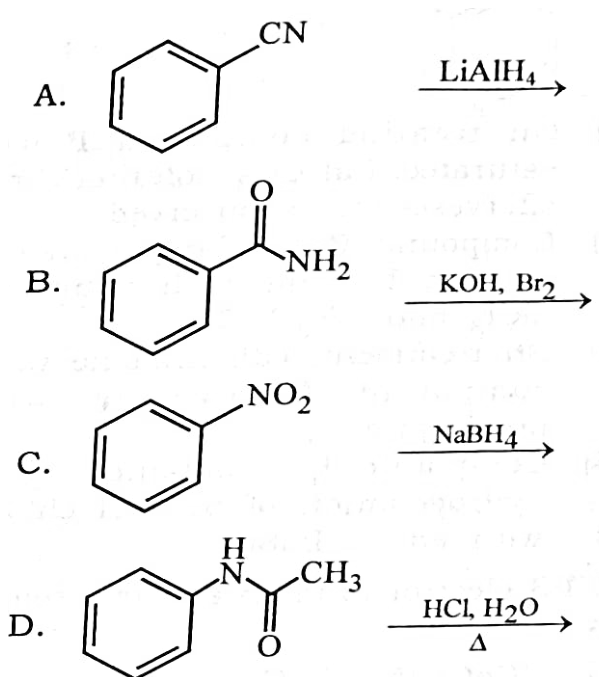
Choose the correct answer from the options given below.
- 1A and B only
- 2B and D only
- 3A and C only
- 4C and D only
Show answer and solution
Correct: option 2, B and D only
A: reduces benzonitrile to benzylamine, , not aniline. B: benzamide with and KOH undergoes Hoffmann bromamide degradation and loses the carbonyl carbon to give aniline. C: does not reduce a nitro group to an amine. D: acid hydrolysis of acetanilide gives aniline (as its salt) and acetic acid. So B and D give aniline.
Question 5NEET 2026 Re-exam, Q84
Given below are two statements:
Statement-I: Oxidation of p-nitrotoluene with acidic gives an acid that is stronger than benzoic acid.
Statement-II: Reduction of p-nitrotoluene with Sn/HCl followed by neutralization gives an amine that is more basic than aniline.
In light of the above statements, choose the most appropriate answer from the options given below.
- 1Both Statement-I and Statement-II are correct.
- 2Both Statement-I and Statement-II are incorrect.
- 3Statement-I is correct but Statement-II is incorrect.
- 4Statement-I is incorrect but Statement-II is correct.
Show answer and solution
Correct: option 1, Both Statement-I and Statement-II are correct.
Oxidation of the methyl group gives p-nitrobenzoic acid; the electron-withdrawing group stabilises the carboxylate ion, so it is a stronger acid than benzoic acid. Reduction of the nitro group gives p-toluidine; the electron-releasing group raises the electron density on nitrogen, so it is more basic than aniline. Both statements are correct.
Question 6NEET 2025, Q49
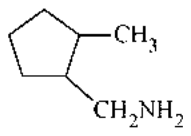
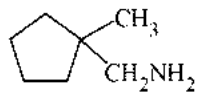
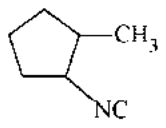
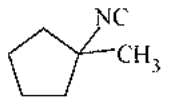
Predict the major product 'P' in the following sequence of reactions -
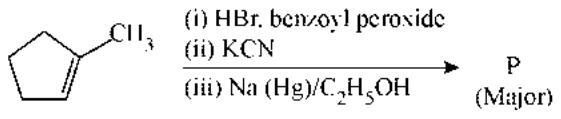
- 1
- 2
- 3
- 4
Show answer and solution
Correct: option 1
HBr with benzoyl peroxide adds to 1-methylcyclopentene in the anti-Markovnikov way, so Br goes to the ring carbon next to the one carrying . KCN then replaces Br by CN, and Na(Hg)/ reduces to . The product has and on adjacent ring carbons, option (1).
Question 7NEET 2025, Q67
The correct order of decreasing basic strength of the given amines is:
- 1N-methylaniline > benzenamine > ethanamine > N-ethylethanamine
- 2N-ethylethanamine > ethanamine > benzenamine > N-methylaniline
- 3N-ethylethanamine > ethanamine > N-methylaniline > benzenamine
- 4benzenamine > ethanamine > N-methylaniline > N-ethylethanamine
Show answer and solution
Correct: option 3, N-ethylethanamine > ethanamine > N-methylaniline > benzenamine
Aliphatic amines are much stronger bases than aromatic amines, because in arylamines the nitrogen lone pair is delocalised into the ring. Among the aliphatic ones the secondary amine N-ethylethanamine (two +I ethyl groups) is stronger than ethanamine. Among the aromatic ones the methyl group on nitrogen makes N-methylaniline slightly stronger than benzenamine. Order: N-ethylethanamine > ethanamine > N-methylaniline > benzenamine, option (3).
Question 8NEET 2025, Q74
Given below are two statements:
Statement I: Benzenediazonium salt is prepared by the reaction of aniline with nitrous acid at 273 - 278 K. It decomposes easily in the dry state.
Statement II: Insertion of iodine into the benzene ring is difficult and hence iodobenzene is prepared through the reaction of benzenediazonium salt with KI.
In the light of the above statements, choose the most appropriate answer from the options given below:
- 1Both Statement I and Statement II are correct
- 2Both Statement I and Statement II are incorrect
- 3Statement I is correct but Statement II is incorrect
- 4Statement I is incorrect but Statement II is correct
Show answer and solution
Correct: option 1, Both Statement I and Statement II are correct
Aniline is diazotised with nitrous acid at 273 - 278 K, and the diazonium salt is unstable and decomposes easily when dry, so it is used at once in solution: Statement I is correct. Direct iodination of benzene is reversible and difficult, so iodobenzene is made by warming the diazonium salt solution with KI: Statement II is correct. Option (1).
Question 9NEET 2024, Q51
Given below are two statements:
Statement I: Aniline does not undergo Friedel-Crafts alkylation reaction.
Statement II: Aniline cannot be prepared through Gabriel synthesis.
In the light of the above statements, choose the correct answer from the options given below:
- 1Statement I is incorrect but Statement II is true.
- 2Both Statement I and Statement II are true.
- 3Both Statement I and Statement II are false.
- 4Statement I is correct but Statement II is false.
Show answer and solution
Correct: option 2, Both Statement I and Statement II are true.
Statement I is true: the group of aniline is a Lewis base and forms a salt with the catalyst, which puts a positive charge on nitrogen and deactivates the ring. Statement II is true: Gabriel synthesis needs a nucleophilic substitution by the phthalimide anion, and aryl halides do not undergo it, so aromatic primary amines cannot be made this way. Both statements are true, option (2).
Question 10NEET 2024, Q97
Identify the major product C formed in the following reaction sequence:
- 1-bromobutanoic acid
- 2propylamine
- 3butylamine
- 4butanamide
Show answer and solution
Correct: option 2, propylamine
Cyanide replaces iodide, so A is butanenitrile, (one carbon more). Partial hydrolysis of the nitrile stops at the amide, so B is butanamide, . with NaOH is the Hoffmann bromamide degradation, which turns an amide into a primary amine with one carbon less: C is , propylamine. That is option (2).
Question 11NEET 2024 Re-exam, Q56
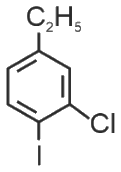
The major product X formed in the following reaction sequence is:
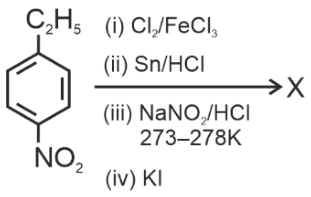
- 1
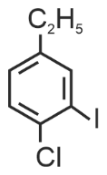
- 2
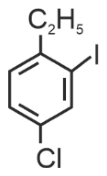
- 3
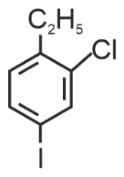
- 4
Show answer and solution
Correct: option 3
The starting compound is 1-ethyl-4-nitrobenzene. In chlorination the ethyl group directs ortho/para and the nitro group directs meta; both point to the position next to the ethyl group, so Cl enters ortho to . Sn/HCl reduces to , /HCl at 273-278 K turns it into the diazonium salt, and KI replaces the diazonium group by iodine. X therefore has Cl ortho to the ethyl group and I para to it, which is structure (3).
Question 12NEET 2024 Re-exam, Q73
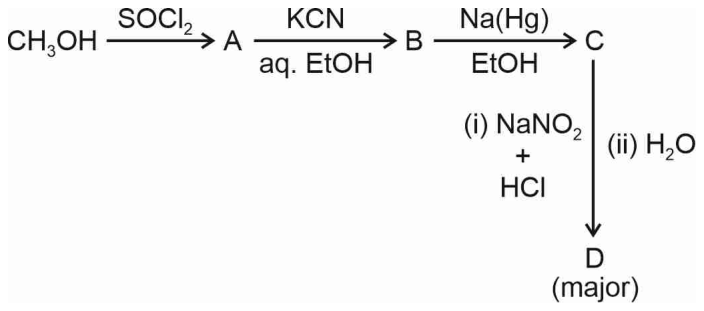
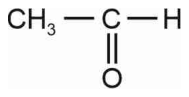
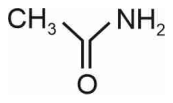
The major product D formed in the following reaction sequence is:
- 1
- 2
- 3
- 4
Show answer and solution
Correct: option 3,
converts methanol to (A). KCN replaces Cl by CN to give (B). Na(Hg) in ethanol reduces the nitrile to the primary amine (C). A primary aliphatic amine with + HCl forms an unstable diazonium salt that loses in water and gives the alcohol, so D is ethanol, .
Question 13NEET 2024 Re-exam, Q78
The compound that does not undergo Friedel-Crafts alkylation reaction but gives a positive carbylamine test is:
- 1Aniline
- 2Pyridine
- 3N-methylaniline
- 4Triethylamine
Show answer and solution
Correct: option 1, Aniline
The carbylamine test (foul-smelling isocyanide with and alcoholic KOH) is given only by primary amines, and aniline is the only primary amine in the list. Aniline also fails the Friedel-Crafts reaction because its group, a Lewis base, forms a salt with the catalyst, which puts a positive charge on nitrogen and deactivates the ring.
Question 14NEET 2023, Q51
Which of the following reactions will NOT give primary amine as the product?
- 1 Product
- 2 Product
- 3 Product
- 4 Product
Show answer and solution
Correct: option 3, Product
Hoffmann bromamide degradation of ethanamide gives , and reduction of the nitrile or of the amide with gives ; all three are primary amines. Reduction of the isocyanide gives , a secondary amine, so option (3) does not give a primary amine.
Question 15NEET 2023 Manipur, Q76
Which amongst the following compounds/species is least basic?
- 1
- 2
- 3
- 4
Show answer and solution
Correct: option 4
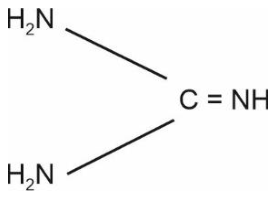
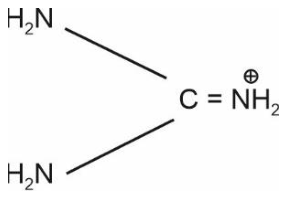
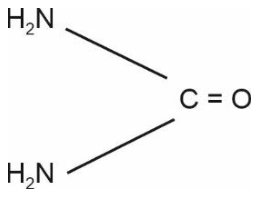
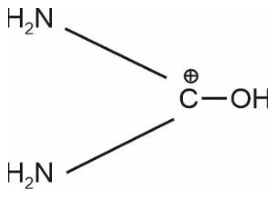
Guanidine (1) is a very strong base because its conjugate acid is resonance stabilised, and urea (3) is a weak base since the nitrogen lone pairs are delocalised onto the carbonyl oxygen. Species (2) and (4) are already protonated, so they are far weaker bases than their parents; (4), protonated urea, comes from the weaker parent base and carries a positive charge that pulls the nitrogen lone pairs in strongly, so it has the least tendency to accept another proton.
Question 16NEET 2023 Manipur, Q88
Choose the correct sequence of reagents in the conversion of 4-nitrotoluene to 2-bromotoluene.
- 1; Sn/HCl; ;
- 2Sn/HCl; ; ;
- 3; Sn/HCl; ;
- 4Sn/HCl; ; ;
Show answer and solution
Correct: option 1, ; Sn/HCl; ;
Brominating 4-nitrotoluene first puts Br ortho to the methyl group (which is also meta to the nitro group), giving 2-bromo-4-nitrotoluene. Sn/HCl then reduces the nitro group to an amine, converts it to the diazonium salt, and replaces the diazonium group by hydrogen, leaving 2-bromotoluene. If the nitro group were reduced first, the strongly activating amino group would send bromine ortho to itself, which is the wrong position.
Question 17NEET 2022, Q73
Given below are two statements:
Statement I:
Primary aliphatic amines react with to give unstable diazonium salts.
Statement II:
Primary aromatic amines react with to form diazonium salts which are stable even above 300 K.
In the light of the above statements, choose the most appropriate answer from the options given below:
- 1Statement I is incorrect but Statement II is correct.
- 2Both Statement I and Statement II are correct.
- 3Both Statement I and Statement II are incorrect.
- 4Statement I is correct but Statement II is incorrect.
Show answer and solution
Correct: option 4, Statement I is correct but Statement II is incorrect.
Aliphatic diazonium salts are very unstable and lose at once to give alcohols, so Statement I is correct. Aromatic diazonium salts are stable only in cold solution, at about 273 to 278 K, and decompose on warming, so Statement II is incorrect.
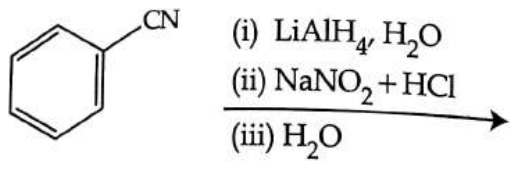
Question 18NEET 2022, Q100
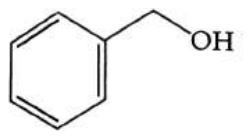
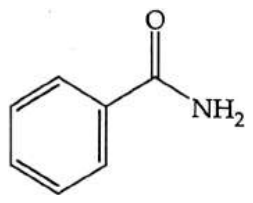
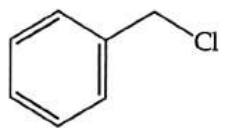
The product formed from the following reaction sequence is
- 1
- 2
- 3
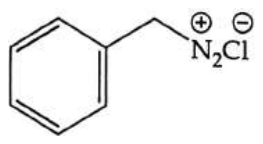
- 4
Show answer and solution
Correct: option 1
reduces the nitrile group of benzonitrile to a primary amine, giving benzylamine, . This is an aliphatic primary amine, so with it forms an unstable diazonium salt that loses and, with water, gives benzyl alcohol, , structure (1).
Question 19NEET 2022 Re-exam, Q69
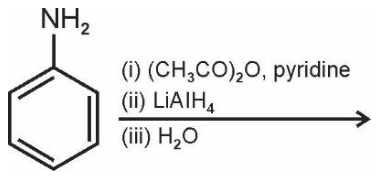
The product formed from the following reaction sequence is:
- 1
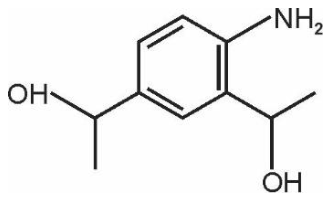
- 2
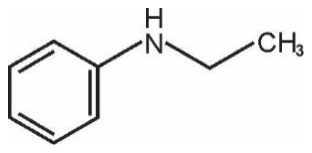
- 3
- 4
Show answer and solution
Correct: option 2
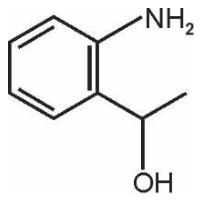
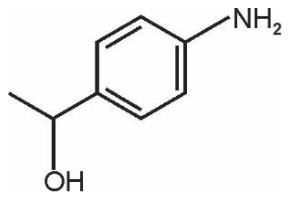
Acetic anhydride with pyridine acetylates the amino group of aniline, giving acetanilide . followed by water reduces the amide C=O to , so the product is N-ethylaniline , option (2). The ring is not touched, so the ring-substituted alcohols in the other options cannot form.
Question 20NEET 2022 Re-exam, Q82
Match List-I with List-II:
| List-I (Reaction) | List-II (Product formed) |
|---|
| (a) Gabriel synthesis | (i) Benzaldehyde |
| (b) Kolbe synthesis | (ii) Ethers |
| (c) Williamson synthesis | (iii) Primary amines |
| (d) Etard reaction | (iv) Salicylic acid |
Choose the correct answer from the options given below:
- 1a-iii, b-iv, c-ii, d-i
- 2a-iii, b-i, c-ii, d-iv
- 3a-ii, b-iii, c-i, d-iv
- 4a-iv, b-iii, c-i, d-ii
Show answer and solution
Correct: option 1, a-iii, b-iv, c-ii, d-i
Gabriel phthalimide synthesis gives primary amines (iii). Kolbe's reaction of sodium phenoxide with gives salicylic acid (iv). Williamson synthesis, an alkoxide with an alkyl halide, gives ethers (ii). The Etard reaction oxidises toluene with chromyl chloride to benzaldehyde (i).
Question 21NEET 2021, Q57
Identify the compound that will react with Hinsberg's reagent to give a solid which dissolves in alkali.
- 1
- 2
- 3
- 4
Show answer and solution
Correct: option 3,
Hinsberg's reagent is benzenesulphonyl chloride. A primary amine gives an N-alkylbenzenesulphonamide that still has an acidic N-H hydrogen, so it dissolves in alkali. Ethanamine, , is the only primary amine here; the secondary amine gives an alkali-insoluble product, and the tertiary amine and the nitro compound do not react.
Question 22NEET 2021, Q87
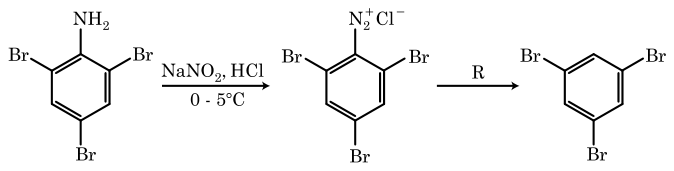
The reagent 'R' in the given sequence of chemical reaction is:
- 1
- 2
- 3HI
- 4CuCN/KCN
Show answer and solution
Correct: option 2,
The amine is first converted into a diazonium salt. In the last step the diazonium group is replaced by hydrogen, giving 1,3,5-tribromobenzene. This reduction is done with a mild reducing agent such as ethanol (or hypophosphorous acid), which is itself oxidised to ethanal. Water would give a phenol, HI an aryl iodide and CuCN/KCN a nitrile.
Question 23NEET 2020, Q23
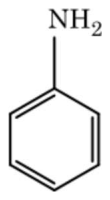
Which of the following amine will give the carbylamine test?
- 1
- 2
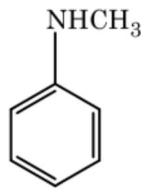
- 3
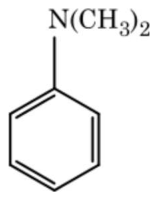
- 4
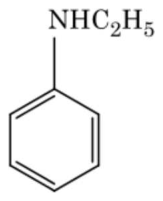
Show answer and solution
Correct: option 1
Only primary amines give the carbylamine test: on heating with chloroform and alcoholic KOH they form a foul-smelling isocyanide. Aniline, , is a primary amine. N-methylaniline and N-ethylaniline are secondary and N,N-dimethylaniline is tertiary, so they do not respond.
Question 24NEET 2020 Phase 2, Q156
Reaction of propanamide with ethanolic sodium hydroxide and bromine will give
- 1Methylamine
- 2Propylamine
- 3Aniline
- 4Ethylamine
Show answer and solution
Correct: option 4, Ethylamine
This is the Hoffmann bromamide degradation, in which an amide gives a primary amine with one carbon atom less: . Propanamide (three carbons) therefore gives ethylamine.
Question 25NEET 2019, Q90
The correct order of the basic strength of methyl substituted amines in aqueous solution is:
- 1
- 2
- 3
- 4
Show answer and solution
Correct: option 1,
In water the basic strength depends on the electron-releasing effect of the methyl groups, on how well the protonated amine is stabilised by hydrogen bonding with water, and on steric crowding. For methyl amines the combined result is secondary > primary > tertiary: .
Question 26NEET 2019 Odisha, Q87
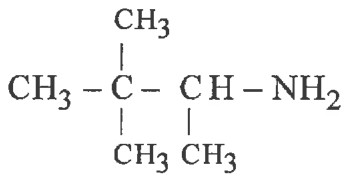
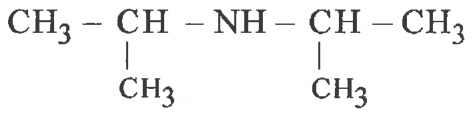
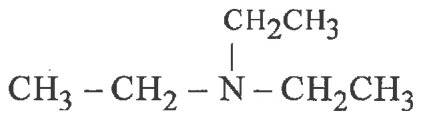
The amine that reacts with Hinsberg's reagent to give an alkali insoluble product is -
- 1
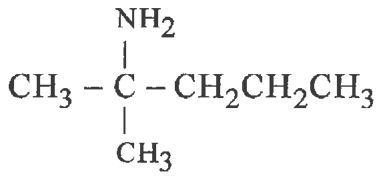
- 2
- 3
- 4
Show answer and solution
Correct: option 3
Hinsberg's reagent is benzenesulphonyl chloride. A primary amine, as in (1) and (2), gives an N-alkyl sulphonamide that still has an acidic N-H hydrogen and dissolves in alkali. A secondary amine, as in (3), gives an N,N-dialkyl sulphonamide with no hydrogen on nitrogen, so it is insoluble in alkali. The tertiary amine in (4) does not react. So the answer is the secondary amine (3).
Question 27NEET 2018, Q55
Nitration of aniline in strong acidic medium also gives m-nitroaniline because
- 1In absence of substituents nitro group always goes to m-position.
- 2In electrophilic substitution reactions amino group is meta directive.
- 3In spite of substituents nitro group always goes to only m-position.
- 4In acidic (strong) medium aniline is present as anilinium ion.
Show answer and solution
Correct: option 4, In acidic (strong) medium aniline is present as anilinium ion.
In the strongly acidic nitrating mixture, aniline is protonated to the anilinium ion, . The group has no lone pair to donate and withdraws electrons, so it is meta directing, and a good amount of m-nitroaniline forms.
Question 28NEET 2017, Q64
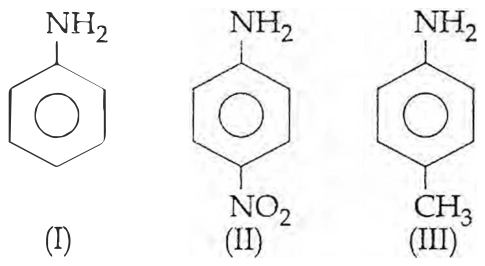
The correct increasing order of basic strength for the following compounds is:
- 1II < III < I
- 2III < I < II
- 3III < II < I
- 4II < I < III
Show answer and solution
Correct: option 4, II < I < III
I is aniline, II is p-nitroaniline and III is p-toluidine. The group withdraws electrons from the ring and from nitrogen, making II the weakest base. The group releases electrons and makes the lone pair on nitrogen more available, so III is the strongest. The order is II < I < III.
Question 29NEET 2017, Q87
Which of the following reactions is appropriate for converting acetamide to methanamine?
- 1Carbylamine reaction
- 2Hoffmann hypobromamide reaction
- 3Stephens reaction
- 4Gabriels phthalimide synthesis
Show answer and solution
Correct: option 2, Hoffmann hypobromamide reaction
In the Hoffmann bromamide reaction an amide is treated with and NaOH and gives a primary amine with one carbon less: .
Question 30NEET 2016 Phase 1, Q88
The correct statement regarding the basicity of arylamines is:
- 1Arylamines are generally less basic than alkylamines because the nitrogen lone-pair electrons are delocalized by interaction with the aromatic ring electron system.
- 2Arylamines are generally more basic than alkylamines because the nitrogen lone-pair electrons are not delocalized by interaction with the aromatic ring electron system.
- 3Arylamines are generally more basic than alkylamines because of aryl group.
- 4Arylamines are generally more basic than alkylamines, because the nitrogen atom in arylamines is sp-hybridized.
Show answer and solution
Correct: option 1, Arylamines are generally less basic than alkylamines because the nitrogen lone-pair electrons are delocalized by interaction with the aromatic ring electron system.
Basicity depends on how freely the nitrogen lone pair can accept a proton. In an arylamine such as aniline the lone pair is in conjugation with the ring and is spread over it by resonance, so it is less available. In an alkylamine the alkyl group pushes electrons towards nitrogen instead. Arylamines are therefore the weaker bases.
Question 31NEET 2016 Phase 2, Q81
Which one of the following nitro-compounds does not react with nitrous acid?
- 1
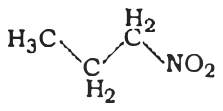
- 2
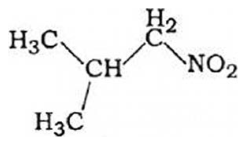
- 3
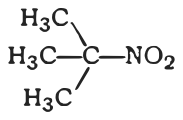
- 4
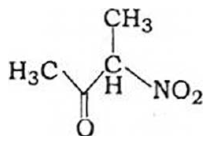
Show answer and solution
Correct: option 3
A nitro compound reacts with nitrous acid only if the carbon carrying the group has at least one hydrogen. Primary nitro compounds give nitrolic acids and secondary ones give pseudonitroles. Option (3), 2-methyl-2-nitropropane, is a tertiary nitro compound with no hydrogen on that carbon, so it does not react. Options (1), (2) and (4) all have such a hydrogen.
Question 32NEET 2016 Phase 2, Q85
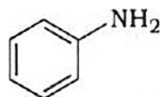
A given nitrogen-containing aromatic compound A reacts with Sn/HCl, followed by to give an unstable compound B. B, on treatment with phenol, forms a beautiful coloured compound C with the molecular formula . The structure of compound A is
- 1
- 2
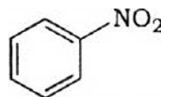
- 3
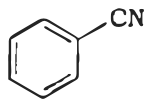
- 4
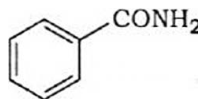
Show answer and solution
Correct: option 2
Sn/HCl is a reducing agent, so A must be reduced before it meets nitrous acid. Nitrobenzene is reduced to aniline, which with gives the unstable benzenediazonium salt B. B couples with phenol to give p-hydroxyazobenzene, , an orange dye with the formula . So A is nitrobenzene, option (2).
Question 33AIPMT 2015, Q13
The electrolytic reduction of nitrobenzene in strongly acidic medium produces:
- 1Azoxybenzene
- 2Azobenzene
- 3Aniline
- 4p-Aminophenol
Show answer and solution
Correct: option 4, p-Aminophenol
Electrolytic reduction of nitrobenzene in weakly acidic medium gives aniline. In strongly acidic medium the reduction stops at phenylhydroxylamine, which rearranges in the acid to p-aminophenol. Hence option (4).
Question 34AIPMT 2015 Re-test, Q4
The number of structural isomers possible from the molecular formula is
- 12
- 23
- 34
- 45
Show answer and solution
Correct: option 3, 4
is a saturated amine. The isomers are propan-1-amine and propan-2-amine (primary), N-methylethanamine (secondary) and N,N-dimethylmethanamine (tertiary), which makes 4, option (3).
Question 35AIPMT 2015 Re-test, Q30
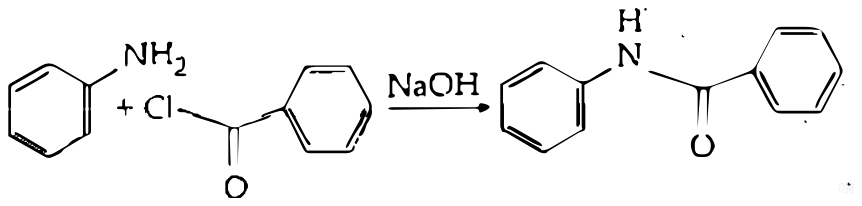
- 1Acetylation reaction
- 2Schotten-Baumann reaction
- 3Friedel-Craft's reaction
- 4Perkin's reaction
Show answer and solution
Correct: option 2, Schotten-Baumann reaction
Aniline reacts with benzoyl chloride in the presence of aqueous NaOH to give N-phenylbenzamide (benzanilide). Benzoylation of an amine or a phenol with benzoyl chloride and aqueous alkali is the Schotten-Baumann reaction, option (2). It is not acetylation, because the group added is benzoyl and not acetyl.
Question 36AIPMT 2015 Re-test, Q42
Method by which Aniline cannot be prepared is:
- 1reduction of nitrobenzene with in ethanol.
- 2potassium salt of phthalimide treated with chlorobenzene followed by hydrolysis with aqueous NaOH solution.
- 3hydrolysis of phenylisocyanide with acidic solution.
- 4degradation of benzamide with bromine in alkaline solution.
Show answer and solution
Correct: option 2, potassium salt of phthalimide treated with chlorobenzene followed by hydrolysis with aqueous NaOH solution.
Reduction of nitrobenzene, acid hydrolysis of phenyl isocyanide (which gives aniline and formic acid) and Hofmann bromamide degradation of benzamide all give aniline. Option (2) is the Gabriel phthalimide synthesis, in which the phthalimide anion must displace the halogen of the halide; chlorobenzene does not undergo nucleophilic substitution under these conditions because its bond has partial double bond character. So aniline cannot be made this way.
Question 37AIPMT 2014, Q143
Which of the following will be most stable diazonium salt ?
- 1
- 2
- 3
- 4
Show answer and solution
Correct: option 3,
In benzenediazonium ion the group is attached directly to the benzene ring, so its positive charge is delocalised over the ring by resonance. Alkyl and benzyl diazonium ions have no such resonance stabilisation and lose at once. So is the most stable.
Question 38AIPMT 2014, Q144
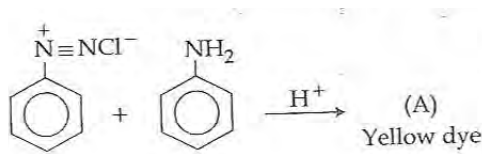
In the following reaction, the product (A)
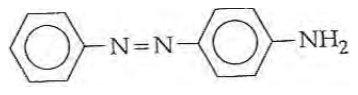
- 1
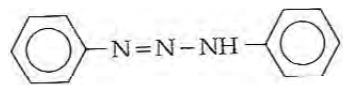
- 2
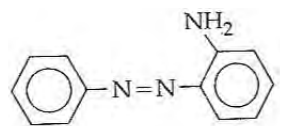
- 3
- 4
Show answer and solution
Correct: option 1
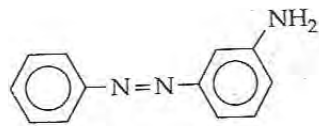
This is a coupling reaction. The benzenediazonium ion is a weak electrophile and attacks the activated ring of aniline at the position para to the group, giving p-aminoazobenzene, a yellow dye. That is the structure in option (1), with joining the two rings and para to it.
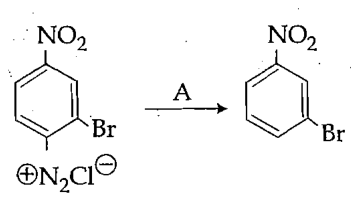
Question 39NEET 2013, Q33
- 1
- 2 and
- 3
- 4
Show answer and solution
Correct: option 2, and
The diazonium group has been replaced by hydrogen while the nitro and bromo groups are unchanged. Hypophosphorous acid, , with water reduces an arenediazonium salt to the arene and is itself oxidised to phosphorous acid. would put in Cl and warm aqueous acid would give a phenol, so option (2) is right.
Question 40NEET 2013 Karnataka, Q41
On hydrolysis of a "compound", two compounds, are obtained. One of which on treatment with sodium nitrite and hydrochloric acid gives a product which does not respond to iodoform test. The second one reduces Tollen's reagent and Fehling's solution The "Compound" is:
- 1
- 2
- 3
- 4
Show answer and solution
Correct: option 1,
An isocyanide hydrolyses to a primary amine and formic acid: . Propylamine with /HCl gives propan-1-ol, which has no group and fails the iodoform test. Formic acid has an aldehyde-like H–C=O group and reduces both Tollens' reagent and Fehling's solution.
Question 41NEET 2013 Karnataka, Q42
Some reactions of amines are given. Which one is not correct?
- 1
- 2
- 3
- 4
Show answer and solution
Correct: option 1
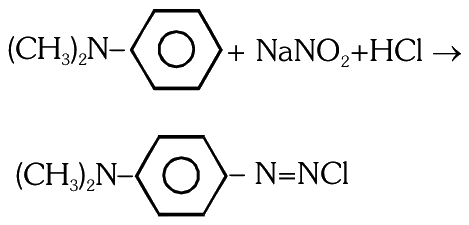
Only a primary aromatic amine has the group needed to form a diazonium salt. N,N-Dimethylaniline is a tertiary amine; with nitrous acid it is nitrosated on the ring to give p-nitroso-N,N-dimethylaniline, not a product with an group, so reaction (1) is wrong. The other three (primary aliphatic amine to alcohol and , sulphonamide formation, secondary amine to N-nitrosoamine) are correct.
Question 42AIPMT 2012 Mains, Q56
An organic compound () (A), when treated with nitrous acid, gave an alcohol and gas was evolved. (A) on warming with and caustic potash gave (C) which on reduction gave isopropylmethylamine. Predict the structure of (A).
- 1
- 2
- 3
- 4
Show answer and solution
Correct: option 1,
An alcohol with evolution of on treatment with nitrous acid, and a reaction with and KOH (carbylamine test), both show that (A) is a primary amine. The isocyanide (C) is reduced to a secondary amine R–NH–; since this is isopropylmethylamine, R is isopropyl. So (A) is isopropylamine, .
Question 43AIPMT 2011 Prelims, Q12
In a set of reactions m-bromobenzoic acid gave a product D. Identify the product D.
- 1
- 2
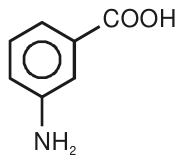
- 3
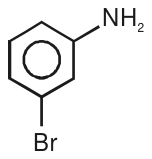
- 4
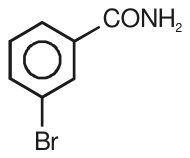
Show answer and solution
Correct: option 3
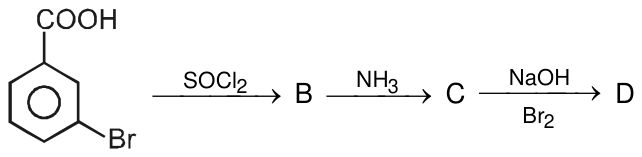
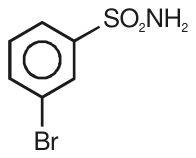
converts the acid to the acid chloride, m-bromobenzoyl chloride (B). Ammonia turns it into the amide, m-bromobenzamide (C). is the Hofmann bromamide degradation, which removes the carbonyl carbon and leaves a primary amine with one carbon fewer, so D is m-bromoaniline.
Question 44AIPMT 2011 Prelims, Q25
What is the product obtained in the following reaction:
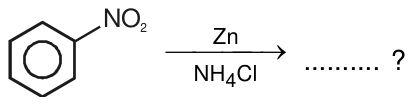
- 1
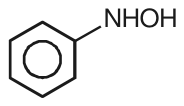
- 2
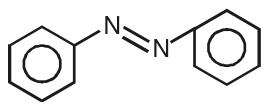
- 3
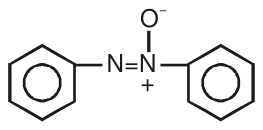
- 4
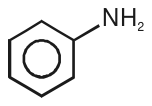
Show answer and solution
Correct: option 1
The product of reducing nitrobenzene depends on the medium. In a neutral medium, zinc dust with aqueous , the reduction stops at N-phenylhydroxylamine, . Aniline needs an acidic medium (Sn/HCl), while azoxybenzene and azobenzene are formed in alkaline media.
Question 45AIPMT 2011 Mains, Q16
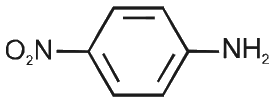
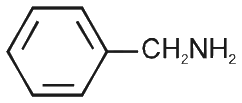
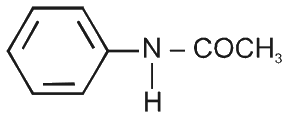
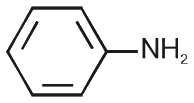
Which of the following compounds is most basic?
- 1
- 2
- 3
- 4
Show answer and solution
Correct: option 2
In benzylamine, option (2), the group is attached to a carbon, so the lone pair on nitrogen stays on nitrogen and is free to accept a proton, as in an alkyl amine. In aniline and p-nitroaniline the lone pair is delocalised into the ring (and pulled further by ), and in acetanilide it is delocalised onto the carbonyl group, so all three are much weaker bases.
Question 46AIPMT 2011 Mains, Q30
An organic compound ‘A’ on treatment with gives ‘B’ which on heating gives ‘C’, ‘C’ when treated with in the presence of KOH produces ethylamine. Compound ‘A’ is:
- 1
- 2
- 3
- 4
Show answer and solution
Correct: option 4,
with KOH is the Hoffmann bromamide reaction, which turns an amide into an amine with one carbon less. Ethylamine (two carbons) must therefore come from propanamide, (C). The amide forms on heating the ammonium salt (B), which is made from propanoic acid and ammonia. So A is .
Question 47AIPMT 2010 Mains, Q48
Match the compounds given in List I with their characteristic reactions given in List II. Select the correct option.
| List I (Compounds) | List II (Reactions) |
|---|
| (a) | (i) Alkaline hydrolysis |
| (b) | (ii) With KOH (alcohol) and produces bad smell |
| (c) | (iii) Gives white ppt. with ammoniacal |
| (d) | (iv) With Lucas reagent cloudiness appears after 5 minutes |
- 1a-ii, b-i, c-iv, d-iii
- 2a-iii, b-ii, c-i, d-iv
- 3a-ii, b-iii, c-i, d-iv
- 4a-iv, b-ii, c-iii, d-i
Show answer and solution
Correct: option 3, a-ii, b-iii, c-i, d-iv
(a) is a primary amine, so it gives the foul-smelling isocyanide in the carbylamine test (ii). (b) is a terminal alkyne, whose acidic hydrogen gives a white silver alkynide with ammoniacal (iii). (c) is an ester, which undergoes alkaline hydrolysis (i). (d) is a secondary alcohol, which turns cloudy with Lucas reagent in about 5 minutes (iv).
Question 48AIPMT 2010 Prelims, Q68
Aniline in a set of the following reactions yielded a coloured product 'Y'.
The structure of 'Y' would be:
- 1
- 2
- 3

- 4
Show answer and solution
Correct: option 1
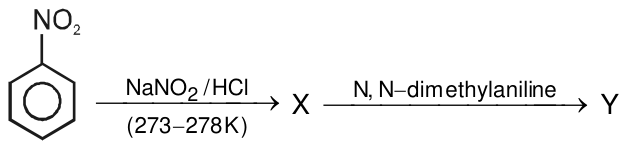
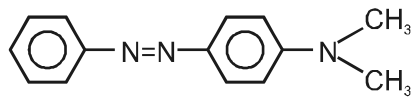
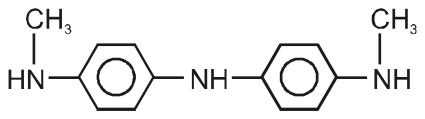
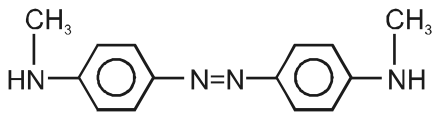
at 273–278 K diazotises aniline, so X is benzenediazonium chloride. This couples with N,N-dimethylaniline at the position para to the group, giving the azo dye p-(dimethylamino)azobenzene, which has an link between the two rings and on one of them. That is option (1).
Question 49AIPMT 2010 Prelims, Q69
Acetamide is treated with the following reagents separately. Which one of these would yield methyl amine?
- 1-
- 2Sodalime
- 3Hot conc.
- 4
Show answer and solution
Correct: option 1, -
Bromine with sodium hydroxide brings about the Hoffmann bromamide reaction, which turns an amide into the amine with one carbon less: . So acetamide gives methyl amine. The other reagents do not remove the carbonyl carbon to leave an amine.
Question 50AIPMT 2010 Prelims, Q77
Which of the following statements about primary amines is 'False'?
- 1Alkyl amines are stronger bases than aryl amines
- 2Alkyl amines react with nitrous acid to produce alcohols
- 3Aryl amines react with nitrous acid to produce phenols
- 4Alkyl amines are stronger bases than ammonia
Show answer and solution
Correct: option 3, Aryl amines react with nitrous acid to produce phenols
Primary aryl amines react with nitrous acid in the cold to give diazonium salts, not phenols, so statement (3) is false. Primary alkyl amines give unstable diazonium salts that lose nitrogen and form alcohols. Alkyl groups release electrons and make alkyl amines stronger bases than ammonia, while in aryl amines the lone pair is delocalised into the ring, which makes them weaker.
Question 51AIPMT 2009 Prelims, Q178
- 1
- 2
- 3
- 4
Show answer and solution
Correct: option 4
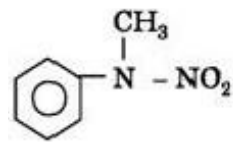
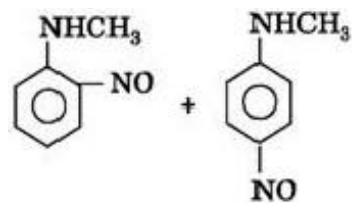
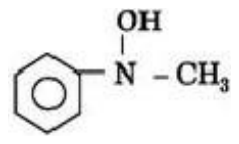
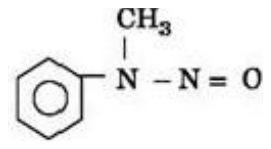
N-methylaniline is a secondary amine. Nitrous acid, made from and HCl, puts a nitroso group on the nitrogen of a secondary amine, giving the N-nitroso compound (a yellow oil). No diazonium salt forms because the nitrogen has only one hydrogen.
Question 52AIPMT 2008 Prelims, Q98
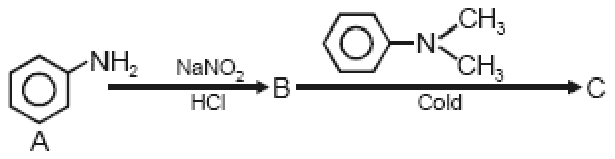
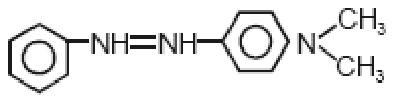
In a reaction of aniline a coloured product C was obtained.
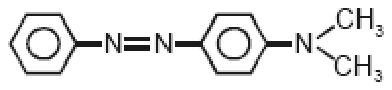
The structure of C would be
- 1
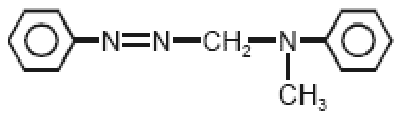
- 2
- 3
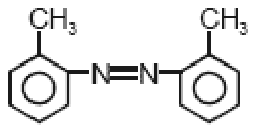
- 4
Show answer and solution
Correct: option 1
Aniline with and HCl gives benzenediazonium chloride (B). This weak electrophile couples in the cold with the activated ring of N,N-dimethylaniline at the position para to the group, giving the coloured azo dye p-(dimethylamino)azobenzene, option (1).
Question 53AIPMT 2007 Prelims, Q140
Which one of the following on reduction with lithium aluminium hydride yields a secondary amine?
- 1Methyl Cyanide
- 2Nitroethane
- 3Methylisocyanide
- 4Acetamide
Show answer and solution
Correct: option 3, Methylisocyanide
An isocyanide is reduced at the carbon attached to nitrogen: , dimethylamine, a secondary amine. Methyl cyanide gives ethylamine, nitroethane gives ethylamine and acetamide gives ethylamine, all primary amines.
Question 54AIPMT 2006 Prelims, Q55
In a set of reactions propionic acid yielded a compound D.
The structure of D would be:
- 1
- 2
- 3
- 4
Show answer and solution
Correct: option 4,
turns the acid into propanoyl chloride (B), and ammonia turns that into propanamide, (C). with KOH is the Hofmann bromamide degradation, which gives a primary amine with one carbon fewer than the amide. D is therefore ethylamine, .
Question 55AIPMT 2006 Prelims, Q88
Which of the following is more basic than aniline:
- 1Diphenylamine
- 2Triphenylamine
- 3p-Nitroaniline
- 4Benzylamine
Show answer and solution
Correct: option 4, Benzylamine
In aniline the lone pair on nitrogen is spread into the ring, which lowers its basicity. Extra phenyl groups or a nitro group pull the pair away even more. In benzylamine, , the nitrogen is attached to a group and not to the ring, so the lone pair stays on nitrogen and the compound is a stronger base, like an alkyl amine.
Question 56AIPMT 2005 Prelims, Q83
Electrolytic reduction of nitrobenzene in weakly acidic medium gives:-
- 1Aniline
- 2p-Hydroxy aniline
- 3N-Phenyl hydroxyl amine
- 4Nitroso benzene
Show answer and solution
Correct: option 1, Aniline
At the cathode in a weakly acidic medium nitrobenzene is reduced all the way, through nitrosobenzene and N-phenylhydroxylamine, to aniline. Only in a strongly acidic medium does the intermediate phenylhydroxylamine rearrange to p-aminophenol (p-hydroxy aniline).
Question 57AIPMT 2005 Prelims, Q88
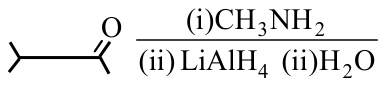
The major organic product formed from the following reaction
- 1
- 2
- 3
- 4
Show answer and solution
Correct: option 2
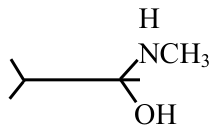
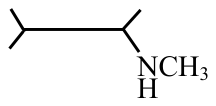
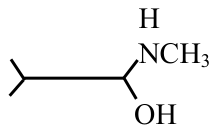
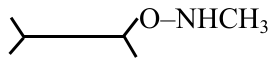
A primary amine adds to the carbonyl group and loses water to give an imine, C=N–. followed by water then reduces the C=N bond to CH–NH. The product is the secondary amine of option (2), in which the carbonyl carbon carries H and and no oxygen remains.
Question 58AIPMT 2005 Prelims, Q93
Aniline in a set of reactions yielded a product D
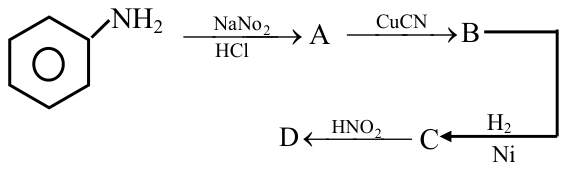
The structure of the product D would be -
- 1
- 2
- 3
- 4
Show answer and solution
Correct: option 1,
/HCl converts aniline to benzenediazonium chloride (A). CuCN replaces the diazonium group by –CN, giving benzonitrile (B). /Ni reduces the nitrile to benzylamine, (C). Nitrous acid converts this primary aliphatic amine to the alcohol with loss of nitrogen, so D is benzyl alcohol, .
Question 59AIPMT 2004 Prelims, Q79
Aniline when diazotized in cold and then treated with dimethyl aniline gives a coloured product. Its structure would be:
- 1

- 2

- 3

- 4

Show answer and solution
Correct: option 2
Diazotisation turns aniline into benzenediazonium chloride, . This weak electrophile couples with N,N-dimethylaniline at the position para to the group, giving the azo dye p-dimethylaminoazobenzene, . That is the structure in option (2).
Question 60AIPMT 2003 Prelims, Q91
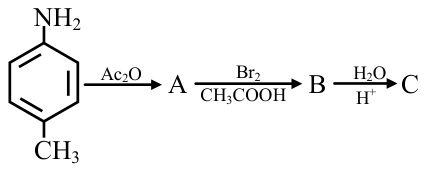
The final product C, obtained in this reaction, would be:
- 1
- 2
- 3
- 4
Show answer and solution
Correct: option 3
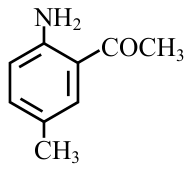
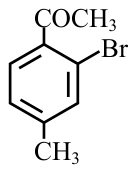
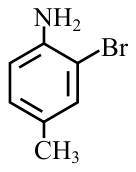
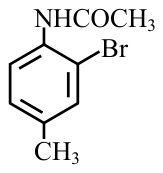
Acetic anhydride acetylates the amino group of p-toluidine, giving the acetamide A. Bromine in acetic acid then substitutes once, ortho to the group (the para position is blocked by the methyl group), giving B. Acid hydrolysis removes the acetyl group and restores the free amine, so C is 2-bromo-4-methylaniline, option (3). Option (4) is B, before hydrolysis.
Question 61AIPMT 2002 Prelims, Q94
Z in the above reaction sequence is:
- 1
- 2
- 3
- 4
Show answer and solution
Correct: option 1,
Cyanide replaces chloride to give X, . Hydrogen over nickel reduces the nitrile to the primary amine Y, . Acetic anhydride acetylates the amine, so Z is the amide .
Question 62AIPMT 2001 Prelims, Q54
Intermediates formed during reaction of with and KOH are:
- 1RCONHBr and RNCO
- 2RNHCOBr and RNCO
- 3RNH-Br and RCONHBr
- 4
Show answer and solution
Correct: option 1, RCONHBr and RNCO
This is the Hofmann bromamide reaction. The amide is first brominated on nitrogen to the N-bromoamide RCONHBr; base removes the remaining N-H proton and the R group migrates to nitrogen as bromide leaves, giving the isocyanate RNCO, which is then hydrolysed to the amine .
Question 63AIPMT 2000 Prelims, Q54
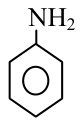
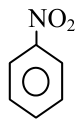
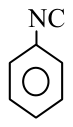
A B C N-methyl aniline then A is:
- 1
- 2
- 3
- 4
Show answer and solution
Correct: option 2
Work backwards. N-methylaniline, , is formed by reducing phenyl isocyanide, , so C is phenyl isocyanide. An isocyanide is made from a primary amine with and KOH (carbylamine reaction), so B is aniline. Aniline is obtained by reducing nitrobenzene, so A is nitrobenzene, option 2.
Question 64AIPMT 1999 Prelims, Q53
Which of the following compound gives p-cresol with p-methyl diazonium chloride:
- 1
- 2
- 3
- 4
Show answer and solution
Correct: option 1,
Warming a diazonium salt with water replaces the group by , so the p-methyl diazonium salt gives p-cresol. would replace the group by H (giving toluene) and phenol would give an azo dye by coupling.
Question 65AIPMT 1999 Prelims, Q85
Which of the following reaction gives by isocyanide:
- 1Reimer Tiemann reaction
- 2Carbyl amine reaction
- 3Hoffmann bromamide reaction
- 4None of the above
Show answer and solution
Correct: option 2, Carbyl amine reaction
In the carbylamine reaction a primary amine is heated with chloroform and alcoholic KOH to give an isocyanide: . Reimer-Tiemann gives a hydroxy aldehyde and Hoffmann bromamide gives an amine.
Question 66AIPMT 1998 Prelims, Q64
Aniline reacts with water, gives respectively:
- 1p-Bromo aniline, p-chloro aniline
- 22, 4, 6 tri bromo aniline, p-chloro aniline
- 32, 4, 6 tri bromo aniline, Benzene diazonium chloride
- 4p-bromo aniline, Benzene diazonium chloride
Show answer and solution
Correct: option 3, 2, 4, 6 tri bromo aniline, Benzene diazonium chloride
The group activates the ring so strongly that bromine water substitutes both ortho positions and the para position, giving 2,4,6-tribromoaniline. With in the cold, the primary aromatic amine is diazotised to benzene diazonium chloride.