Questions with solutions
Question 1NEET 2023, Q67
Intermolecular forces are forces of attraction and repulsion between interacting particles that will include:
A. dipole - dipole forces.
B. dipole - induced dipole forces.
C. hydrogen bonding.
D. covalent bonding.
E. dispersion forces.
Choose the most appropriate answer from the options given below:
- 1B, C, D, E are correct.
- 2A, B, C, D are correct.
- 3A, B, C, E are correct.
- 4A, C, D, E are correct.
Show answer and solution
Correct: option 3, A, B, C, E are correct.
Intermolecular forces act between molecules: dipole-dipole forces, dipole-induced dipole forces, dispersion (London) forces and hydrogen bonding. Covalent bonding holds atoms together inside a molecule, so it is not an intermolecular force. A, B, C and E are correct.
Question 2NEET 2023, Q82
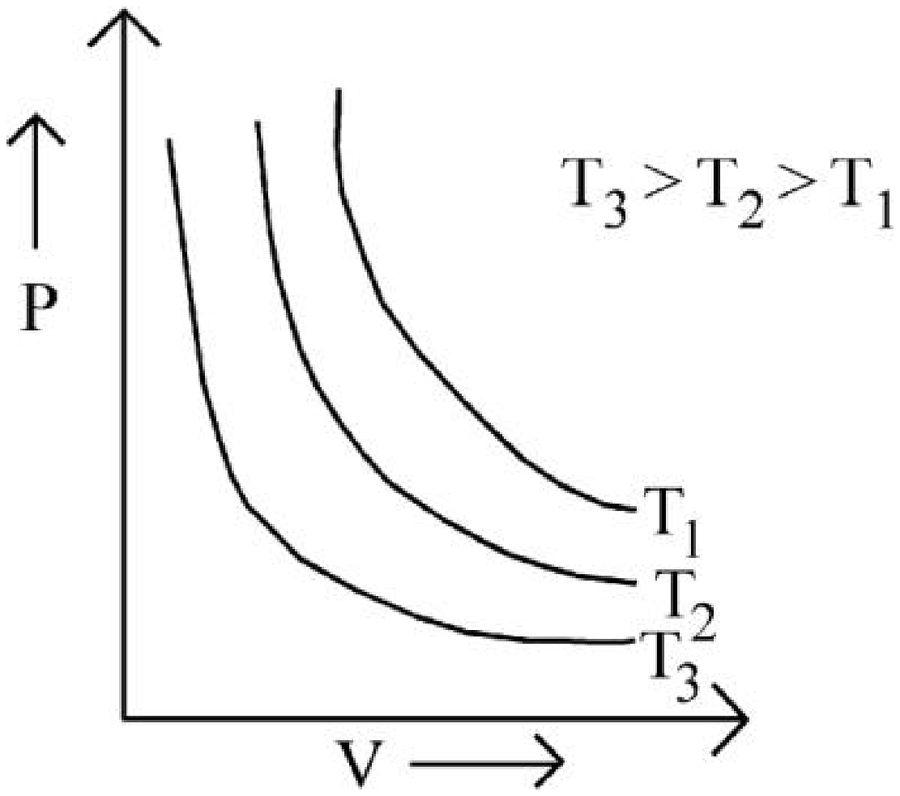
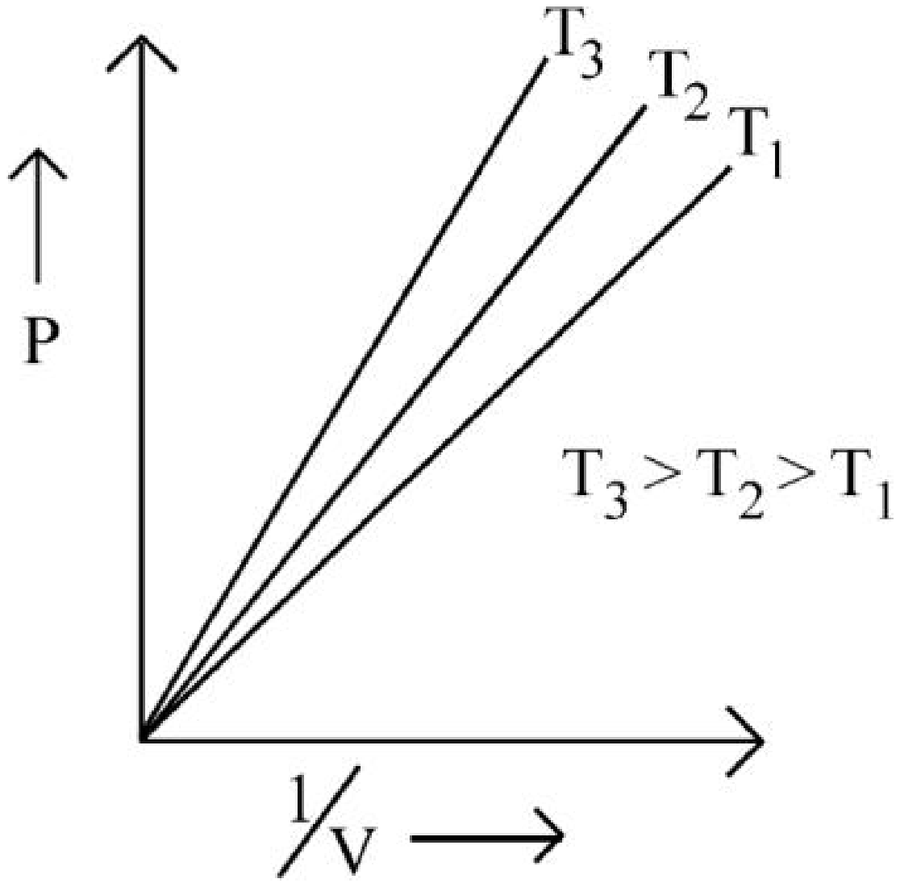
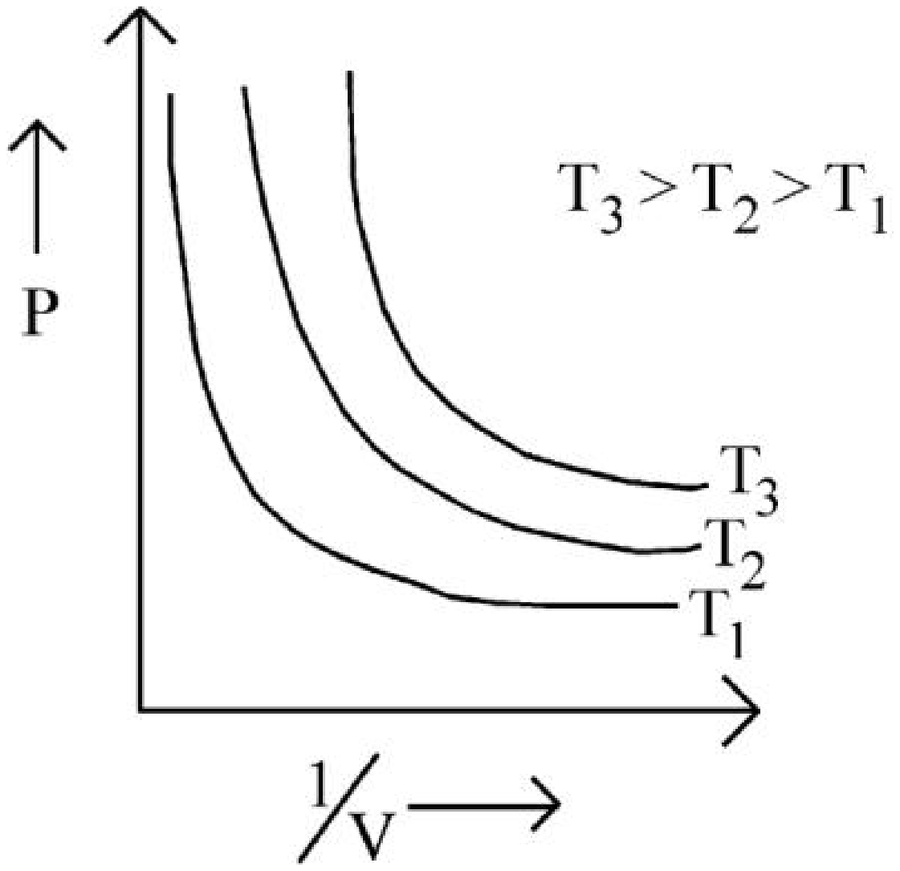
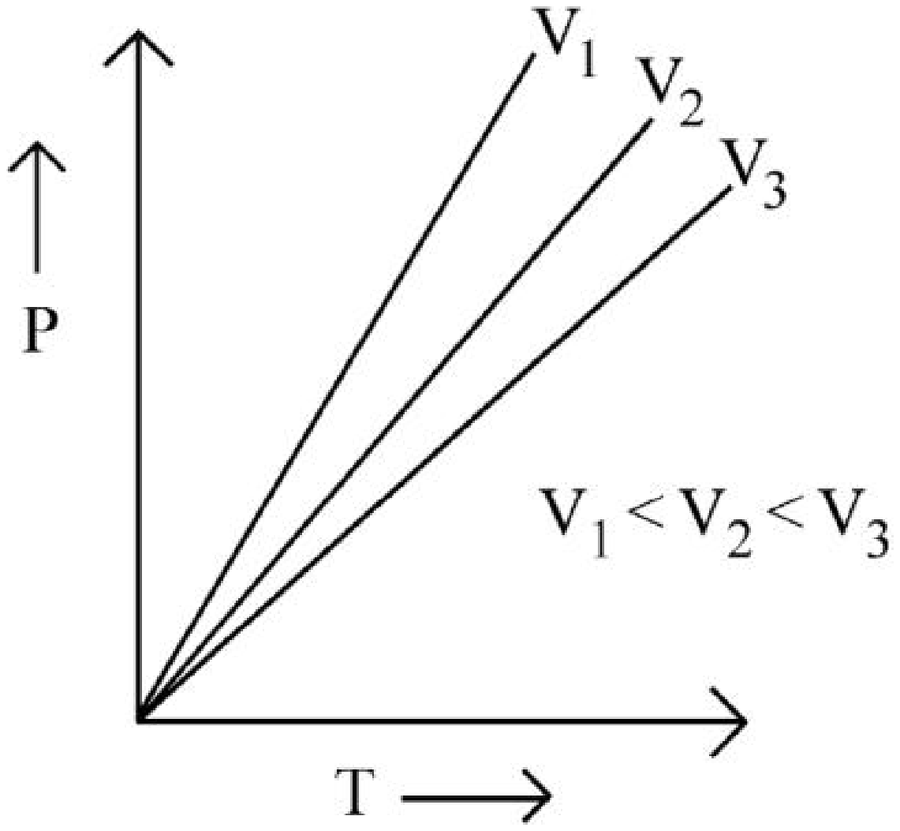
Which amongst the following options is correct graphical representation of Boyle's Law?
- 1
- 2
- 3
- 4
Show answer and solution
Correct: option 2
At constant temperature , so a plot of P against is a straight line through the origin with slope nRT. A higher temperature gives a steeper line, so the line is the steepest when . That is graph (2). In graph (1) the P-V curves are in the wrong order (the higher isotherm must lie further out), and graph (4) is a P-T plot, not Boyle's law.
Question 3NEET 2023 Manipur, Q57
The correct option in which the density of argon (Atomic mass = 40) is highest
- 10°C, 4 atm
- 2273°C, 4 atm
- 3STP
- 40°C, 2 atm
Show answer and solution
Correct: option 1, 0°C, 4 atm
For an ideal gas , so the density is largest when is largest. is for option (1), for (2), at STP and for (4). The highest is 0°C and 4 atm.
Question 4NEET 2023 Manipur, Q77
The correct van der Waals equation for 1 mole of a real gas is
- 1
- 2
- 3
- 4
Show answer and solution
Correct: option 3,
For n moles the van der Waals equation is . Putting gives , which is option (3).
Question 5NEET 2022, Q72
Which one is not correct mathematical equation for Dalton's Law of partial pressure? Here p = total pressure of gaseous mixture
- 1, where = mole fraction of th gas in gaseous mixture
= pressure of th gas in pure state
- 2
- 3
- 4, where = partial pressure of th gas
= mole fraction of th gas in gaseous mixture
Show answer and solution
Correct: option 1, , where = mole fraction of th gas in gaseous mixture
= pressure of th gas in pure state
Dalton's law says the total pressure is the sum of the partial pressures, , each being , which leads to . The relation in option (1) is Raoult's law for the vapour pressure of a liquid solution, not Dalton's law.
Question 6NEET 2022, Q89
A 10.0 L flask contains 64 g of oxygen at 27°C. (Assume gas is behaving ideally). The pressure inside the flask in bar is
(Given R = 0.0831 L bar )
- 14.9
- 22.5
- 3498.6
- 449.8
Show answer and solution
Correct: option 1, 4.9
Moles of and K. bar, which matches option (1), 4.9.
Question 7NEET 2022 Re-exam, Q85
Four gas cylinders containing He, , and gases separately are gradually cooled from a temperature of 500 K. Which gas will liquefy first?
(Given in K – He : 5.3, : 126, : 304.1 and : 405.5)
- 1
- 2He
- 3
- 4
Show answer and solution
Correct: option 1,
A gas can be liquefied only at or below its critical temperature. On cooling from 500 K the first critical temperature reached is the highest one, 405.5 K for , so ammonia liquefies first.
Question 8NEET 2022 Re-exam, Q91
A vessel contains 3.2 g of dioxygen gas at STP (273.15 K and 1 atm pressure). The gas is now transferred to another vessel at constant temperature, where pressure becomes one third of the original pressure. The volume of new vessel in L is: (Given-molar volume at STP is 22.4 L)
- 167.2
- 26.72
- 32.24
- 422.4
Show answer and solution
Correct: option 2, 6.72
Moles of , which occupies L at STP. At constant temperature (Boyle's law), so when the pressure falls to one third the volume becomes three times: L.
Question 9NEET 2021, Q82
Choose the correct option for graphical representation of Boyle's law, which shows a graph of pressure vs. volume of a gas at different temperatures:
- 1
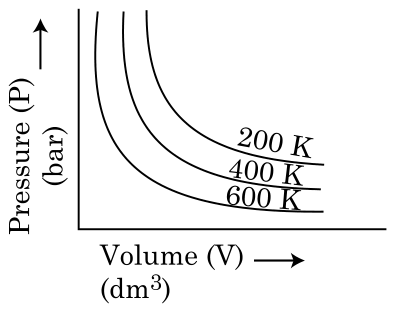
- 2
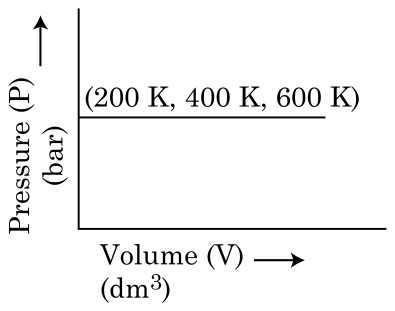
- 3
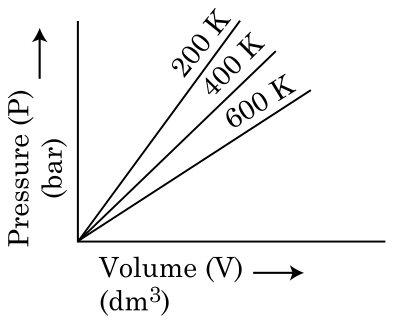
- 4
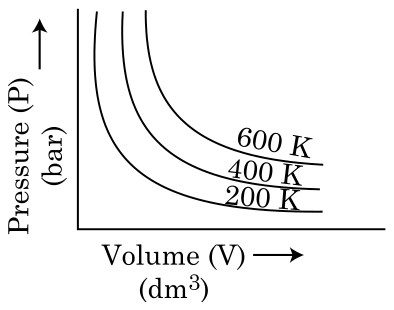
Show answer and solution
Correct: option 4
At constant temperature is constant, so each P-V curve is a rectangular hyperbola. At a higher temperature the product is larger, so the curve lies farther from the origin. The graph with the 600 K curve on top and the 200 K curve at the bottom is correct.
Question 10NEET 2021, Q100
Choose the correct option for the total pressure (in atm.) in a mixture of 4 g and 2 g confined in a total volume of one litre at is:
[Given , K]
- 12.518
- 22.602
- 325.18
- 426.02
Show answer and solution
Correct: option 3, 25.18
Moles of and moles of , so the total is 1.125 mol. atm.
Question 11NEET 2020, Q14
A mixture of and Ar gases in a cylinder contains 7 g of and 8 g of Ar. If the total pressure of the mixture of the gases in the cylinder is 27 bar, the partial pressure of is:
[Use atomic masses (in ): N = 14, Ar = 40]
- 19 bar
- 212 bar
- 315 bar
- 418 bar
Show answer and solution
Correct: option 3, 15 bar
Moles of and moles of Ar . Mole fraction of . Partial pressure bar.
Question 12NEET 2020 Phase 2, Q147
The minimum pressure required to compress of a gas at 1 bar to at is
- 10.2 bar
- 21.0 bar
- 32.5 bar
- 44.0 bar
Show answer and solution
Correct: option 4, 4.0 bar
The temperature is constant, so Boyle's law applies: . Then .
Question 13NEET 2019, Q84
A gas at 350 K and 15 bar has molar volume 20 percent smaller than that for an ideal gas under the same conditions. The correct option about the gas and its compressibility factor (Z) is:
- 1Z > 1 and attractive forces are dominant
- 2Z > 1 and repulsive forces are dominant
- 3Z < 1 and attractive forces are dominant
- 4Z < 1 and repulsive forces are dominant
Show answer and solution
Correct: option 3, Z < 1 and attractive forces are dominant
, which is less than 1. A real gas occupies less volume than an ideal gas when the attraction between its molecules pulls them closer together, so attractive forces are dominant.
Question 14NEET 2019 Odisha, Q61
The volume occupied by 1.8 g of water vapour at 374 °C and 1 bar pressure will be -
[Use ]
- 13.10 L
- 25.37 L
- 396.66 L
- 455.87 L
Show answer and solution
Correct: option 2, 5.37 L
Moles of water and K. L.
Question 15NEET 2019 Odisha, Q78
In water saturated air, the mole fraction of water vapour is 0.02. If the total pressure of the saturated air is 1.2 atm, the partial pressure of dry air is -
- 11.176 atm
- 20.98 atm
- 31.18 atm
- 41.76 atm
Show answer and solution
Correct: option 1, 1.176 atm
The mole fraction of dry air is . By Dalton's law its partial pressure is atm.
Question 16NEET 2018, Q76
Given van der Waals constant for , , and are respectively 4.17, 0.244, 1.36 and 3.59, which one of the following gases is most easily liquefied?
- 1
- 2
- 3
- 4
Show answer and solution
Correct: option 3,
The van der Waals constant measures the attraction between molecules. The larger is, the more easily the gas liquefies. has the largest value, 4.17, so it is liquefied most easily.
Question 17NEET 2018, Q86
The correction factor 'a' to the ideal gas equation corresponds to
- 1electric field present between the gas molecules
- 2volume of the gas molecules
- 3density of the gas molecules
- 4forces of attraction between the gas molecules
Show answer and solution
Correct: option 4, forces of attraction between the gas molecules
In the van der Waals equation , the term with corrects the pressure for the attractive forces between molecules, while corrects for the volume of the molecules themselves.
Question 18NEET 2016 Phase 1, Q68
Equal moles of hydrogen and oxygen gases are placed in a container with a pin-hole through which both can escape. What fraction of the oxygen escapes in the time required for one-half of the hydrogen to escape?
- 11/8
- 21/4
- 33/8
- 41/2
Show answer and solution
Correct: option 1, 1/8
By Graham's law the rate of effusion is inversely proportional to the square root of the molar mass: . In the time half of the hydrogen escapes, oxygen escapes a quarter as fast, so the fraction of oxygen that escapes is .
Question 19AIPMT 2015 Re-test, Q22
A gas such as carbon monoxide would be most likely to obey the ideal gas law at:
- 1high temperatures and high pressures.
- 2low temperatures and low pressures.
- 3high temperatures and low pressures.
- 4low temperatures and high pressures.
Show answer and solution
Correct: option 3, high temperatures and low pressures.
A real gas behaves ideally when its molecules are far apart and fast moving, so that their own volume and the attractions between them can be neglected. That is the case at low pressure and high temperature, option (3).
Question 20AIPMT 2014, Q136
Equal masses of , and methane have been taken in a container of volume V at temperature 27°C in identical conditions. The ratio of the volumes of gases : : methane would be:
- 18 : 1 : 2
- 28 : 16 : 1
- 316 : 8 : 1
- 416 : 1 : 2
Show answer and solution
Correct: option 4, 16 : 1 : 2
At the same temperature and pressure the volume of a gas is proportional to its number of moles (Avogadro's law). For equal masses , the moles are for , and . Multiplying by 32 gives 16 : 1 : 2.
Question 21NEET 2013, Q26
Maximum deviation from ideal gas is expected from:
- 1
- 2
- 3
- 4
Show answer and solution
Correct: option 3,
Deviation from ideal behaviour grows with the strength of the attraction between molecules. , and are non-polar and have only weak dispersion forces, whereas is polar and forms hydrogen bonds, so it is the most easily liquefied and deviates the most. Option (3) is right.
Question 22NEET 2013, Q43
Dipole-induced dipole interactions are present in which of the following pairs:
- 1 and
- 2HCl and He atoms
- 3 and He atoms
- 4 and alcohol
Show answer and solution
Correct: option 2, HCl and He atoms
A dipole-induced dipole force needs one polar molecule and one non-polar species. HCl is polar and distorts the electron cloud of a non-polar helium atom, so option (2) is right. with and with He are both non-polar pairs (dispersion forces only), while water and alcohol are both polar and hydrogen bond.
Question 23NEET 2013 Karnataka, Q30
What is the density of gas at 227°C and 5.00 atm. pressure? ()
- 11.40 g/mL
- 22.81 g/mL
- 33.41 g/mL
- 40.29 g/mL
Show answer and solution
Correct: option 3, 3.41 g/mL
For an ideal gas grams per litre, with K. The number matches option (3); the result is per litre although the options are printed with g/mL.
Question 24AIPMT 2012 Prelims, Q161
50 mL of each gas A and of gas B takes 150 and 200 seconds respectively for effusing through a pin hole under the similar condition. If molecular mass of gas B is 36, the molecular mass of gas A will be:
- 196
- 2128
- 332
- 464
Show answer and solution
Correct: option 3, 32
By Graham's law, for equal volumes the time of effusion is proportional to : , so and . This value is not among the options; the answer key used here gives option (3), 32, as the nearest one.
Question 25AIPMT 2012 Mains, Q37
A certain gas takes three times as long to effuse out as helium. Its molecular mass will be:
- 127 u
- 236 u
- 364 u
- 49 u
Show answer and solution
Correct: option 2, 36 u
By the law of effusion the rate is proportional to , so the time taken for the same amount is proportional to . Then , giving u.
Question 26AIPMT 2012 Mains, Q41
For real gases van der Waals equation is written as
where 'a' and 'b' are van der Waals constants.
Two sets of gases are:
(I) , , and
(II) , and
The gases given in set-I in increasing order of 'b' and gases given in set-II in decreasing order of 'a', are arranged below. Select the correct order from the following:
- 1(I) (II)
- 2(I) (II)
- 3(I) (II)
- 4(I) (II)
Show answer and solution
Correct: option 4, (I) (II)
The constant 'b' measures the volume of the molecules, so it grows with molecular size, and 'a' measures the attraction between molecules, so it grows with the size and polarisability of the molecule. therefore has the largest 'b' in set I, and in set II the attraction falls in the order (about 2.28, 1.38 and 0.25 ). The answer key used for this paper gives option (4); note that the tabulated values of 'a' fit the set-II order printed in option (3), so the keyed answer is doubtful.
Question 27AIPMT 2011 Prelims, Q19
By what factor does the average velocity of a gaseous molecule increase when the temperature (in Kelvin) is doubled?
- 12.0
- 22.8
- 34.0
- 41.4
Show answer and solution
Correct: option 4, 1.4
Average speed , so it is proportional to . Doubling multiplies the speed by .
Question 28AIPMT 2011 Prelims, Q22
Two gases A and B having the same volume diffuse through a porous partition in 20 and 10 seconds respectively. The molecular mass of A is 49 u. Molecular mass of B will be:
- 150.00 u
- 212.25 u
- 36.50 u
- 425.00 u
Show answer and solution
Correct: option 2, 12.25 u
For equal volumes, rate of diffusion is inversely proportional to time, and by Graham's law . So , giving u.
Question 29AIPMT 2011 Prelims, Q30
A gaseous mixture was prepared by taking equal mole of CO and . If the total pressure of the mixture was found 1 atmosphere, the partial pressure of the nitrogen () in the mixture is:
- 10.5 atm
- 20.8 atm
- 30.9 atm
- 41 atm
Show answer and solution
Correct: option 1, 0.5 atm
By Dalton's law, partial pressure = mole fraction total pressure. With equal moles the mole fraction of is 0.5, so its partial pressure is atm.
Question 30AIPMT 2011 Mains, Q22
A bubble of air is underwater at temperature 15°C and the pressure 1.5 bar. If the bubble rises to the surface where the temperature is 25°C and the pressure is 1.0 bar, what will happen to the volume of the bubble?
- 1Volume will become greater by a factor of 1.6.
- 2Volume will become greater by a factor of 1.1.
- 3Volume will become smaller by a factor of 0.70.
- 4Volume will become greater by a factor of 2.5.
Show answer and solution
Correct: option 1, Volume will become greater by a factor of 1.6.
For a fixed amount of gas, . So . The volume grows by a factor of about 1.6.
Question 31AIPMT 2010 Mains, Q34
The pressure exerted by 6.0 g of methane gas in a vessel at 129°C is (Atomic masses: C = 12.01, H = 1.01 and R = ):
- 1215216 Pa
- 213409 Pa
- 341648 Pa
- 431684 Pa
Show answer and solution
Correct: option 3, 41648 Pa
The molar mass of is , so mol. The temperature is K. From the ideal gas equation, Pa.
Question 32AIPMT 2009 Prelims, Q165
What is the dominant intermolecular force or bond that must be overcome in converting liquid to a gas?
- 1Dipole-dipole interaction
- 2Covalent bonds
- 3London dispersion force
- 4Hydrogen bonding
Show answer and solution
Correct: option 4, Hydrogen bonding
Methanol has an group, so its molecules are held together mainly by hydrogen bonds. These are the strongest attraction between the molecules and must be broken on vaporisation; the covalent bonds inside each molecule stay intact.
Question 33AIPMT 2008 Prelims, Q52
If a gas expands at constant temperature, it indicates that
- 1Number of the molecules of gas increases
- 2Kinetic energy of molecules decreases
- 3Pressure of the gas increases
- 4Kinetic energy of molecules remains the same
Show answer and solution
Correct: option 4, Kinetic energy of molecules remains the same
The average kinetic energy of gas molecules depends only on the absolute temperature. At constant temperature it therefore stays the same during the expansion; the number of molecules does not change and the pressure falls rather than rises.
Question 34AIPMT 2005 Prelims, Q69
The surface tension of which of the following liquid is maximum:-
- 1
- 2
- 3
- 4
Show answer and solution
Correct: option 2,
Surface tension grows with the strength of the forces between molecules. Each water molecule can form up to four hydrogen bonds, giving a much stronger network than in the alcohols (one –OH per molecule and a hydrocarbon part) or in benzene (only dispersion forces). Water therefore has the highest surface tension.
Question 35AIPMT 2002 Prelims, Q58
Vander waal's real gas, act as a ideal gas, at which conditions:
- 1High temp., Low pressure
- 2Low temp., High pressure
- 3High temp., High pressure
- 4Low temp., Low pressure
Show answer and solution
Correct: option 1, High temp., Low pressure
At low pressure the molecules are far apart, so their own volume and their mutual attraction are negligible; at high temperature their kinetic energy is large compared with the attraction. Both correction terms of the van der Waals equation then vanish and the gas behaves ideally.
Question 36AIPMT 2001 Prelims, Q94
The Beans are cooked earlier in pressure cooker, because:
- 1B.P. increase with increasing pressure
- 2B.P. decrease with increasing pressure
- 3Extra pressure of pressure cooker, softens the beans
- 4Internal energy is not lost while cooking in pressure cooker
Show answer and solution
Correct: option 1, B.P. increase with increasing pressure
A liquid boils when its vapour pressure equals the pressure above it. The higher pressure inside the cooker raises the boiling point of water above , and at this higher temperature the food cooks faster.
Question 37AIPMT 2000 Prelims, Q65
Average molar kinetic energy of CO and at same temperature is:
- 1
- 2
- 3
- 4Can't say any thing. Both volumes are not given
Show answer and solution
Correct: option 1,
The average kinetic energy of one mole of an ideal gas is . It depends only on the temperature, not on the nature of the gas or its volume, so at the same temperature the two values are equal.
Question 38AIPMT 1999 Prelims, Q86
In a gaseous mixture which of , and gases have same rate of diffusion:
- 1,
- 2,
- 3,
- 4All
Show answer and solution
Correct: option 2, ,
By Graham's law the rate of diffusion is proportional to , so gases with equal molar mass diffuse at the same rate. and both have molar mass 44, while is 46.
Question 39AIPMT 1999 Prelims, Q95
400 ml gas at 500 torr and 666.6 ml gas at 600 torr taken in a container of 3 litre then the total pressure of mixture:
- 1200 torr
- 2400 torr
- 3600 torr
- 450 torr
Show answer and solution
Correct: option 1, 200 torr
At constant temperature each gas obeys in the 3000 ml container. Partial pressures: torr and torr. By Dalton's law the total is torr.