Questions with solutions
Question 1NEET 2026, Q55
Calculate emf of the half cell given below:
(Given: , )
- 1
- 2
- 3
- 4
Show answer and solution
Correct: option 1,
The half cell is written as an oxidation, , so . (The reduction potential of the same electrode is ; the key takes the oxidation potential as written.)
Question 2NEET 2026, Q73
A solution of copper sulphate is electrolysed for 10 minutes with a current of 1.5 amperes. The mass of copper deposited at cathode is:
(Given: Molar mass of Cu ;
)
- 12.4036 g
- 21.7018 g
- 30.5876 g
- 40.2938 g
Show answer and solution
Correct: option 4, 0.2938 g
Charge . needs 2 F per mole, so mass .
Question 3NEET 2026 Re-exam, Q56
The standard electrode potential (E°) for the half-cell reaction at 298 K is
(Given: and at 298 K)
- 1+0.40 V
- 2+0.76 V
- 3−0.48 V
- 4+0.92 V
Show answer and solution
Correct: option 2, +0.76 V
Electrode potentials are not additive, but is. has and has . Subtracting the second from the first gives with V.
Question 4NEET 2026 Re-exam, Q62
For a salt XY, which is a strong electrolyte, the plot of versus has a slope of at 298 K. At 0.01 M concentration of XY, the value of is . The limiting molar conductivity of ion (, in ) at 298 K will be
(Given: )
- 180.0
- 2100.0
- 390.0
- 476.0
Show answer and solution
Correct: option 1, 80.0
For a strong electrolyte with . At M, , so . By Kohlrausch's law .
Question 5NEET 2025, Q61
If the molar conductivity () of a solution of a monobasic weak acid is , its extent (degree) of dissociation will be
[Assume and .]
- 10.115
- 20.125
- 30.225
- 40.215
Show answer and solution
Correct: option 3, 0.225
By Kohlrausch's law . The degree of dissociation is , option (3).
Question 6NEET 2024, Q83
Match List I with List II.
| List I (Conversion) | List II (Number of Faraday required) |
|---|
| A. 1 mol of to | I. 3F |
| B. 1 mol of to | II. 2F |
| C. 1.5 mol of Ca from molten | III. 1F |
| D. 1 mol of FeO to | IV. 5F |
Choose the correct answer from the options given below:
- 1A-III, B-IV, C-II, D-I
- 2A-II, B-IV, C-I, D-III
- 3A-III, B-IV, C-I, D-II
- 4A-II, B-III, C-I, D-IV
Show answer and solution
Correct: option 2, A-II, B-IV, C-I, D-III
One Faraday is the charge of one mole of electrons. A: , so 1 mol of water needs 2F (II). B: Mn goes from to , 5F (IV). C: , so 1.5 mol needs 3F (I). D: Fe goes from to , so 1 mol of FeO needs 1F (III). So A-II, B-IV, C-I, D-III, option (2).
Question 7NEET 2024, Q100
Mass in grams of copper deposited by passing 9.6487 A current through a voltmeter containing copper sulphate solution for 100 seconds is:
(Given: Molar mass of Cu: 63 , 1F = 96487 C)
- 10.0315 g
- 23.15 g
- 30.315 g
- 431.5 g
Show answer and solution
Correct: option 3, 0.315 g
Charge passed C, which is F. Copper is deposited by , so 2 F deposits 1 mol (63 g). Mass deposited g, option (3).
Question 8NEET 2024 Re-exam, Q59
From the following select the one which is not an example of corrosion.
- 1Rusting of iron object
- 2Production of hydrogen by electrolysis of water
- 3Tarnishing of silver
- 4Development of green coating on copper and bronze ornaments
Show answer and solution
Correct: option 2, Production of hydrogen by electrolysis of water
Corrosion is the slow, spontaneous oxidation of a metal by its surroundings: iron rusts, silver tarnishes to black , and copper and bronze grow a green basic carbonate layer. Electrolysis of water is a non-spontaneous reaction driven by an external current and no metal is eaten away, so it is not corrosion.
Question 9NEET 2024 Re-exam, Q90
The standard cell potential of the following cell is 0.32 V. Calculate the standard Gibbs energy change for the reaction:
(Given: 1 F = 96487 C)
- 1
- 2
- 3
- 4
Show answer and solution
Correct: option 1,
Two electrons are transferred, so J . The sign is negative because a cell with a positive potential runs spontaneously.
Question 10NEET 2023, Q55
The conductivity of centimolar solution of KCl at is and the resistance of the cell containing the solution at is 60 ohm. The value of cell constant is -
- 1
- 2
- 3
- 4
Show answer and solution
Correct: option 3,
Conductivity , so the cell constant is .
Question 11NEET 2023, Q85
Given below are two statements: one is labelled as Assertion A and the other is labelled as Reason R:
Assertion A: In equation , value of depends on n.
Reason R: is an intensive property and is an extensive property.
In the light of the above statements, choose the correct answer from the options given below:
- 1Both A and R are true and R is the correct explanation of A.
- 2Both A and R are true and R is NOT the correct explanation of A.
- 3A is true but R is false.
- 4A is false but R is true.
Show answer and solution
Correct: option 1, Both A and R are true and R is the correct explanation of A.
does not change when the cell reaction is multiplied by a number, so it is intensive, while scales with the amount of reaction, so it is extensive. That is why changes with n, the number of electrons transferred. Both statements are true and R explains A.
Question 12NEET 2023 Manipur, Q60
Molar conductance of an electrolyte increases with dilution according to the equation:
Which of the following statements are true?
(A) This equation applies to both strong and weak electrolytes.
(B) Value of the constant A depends upon the nature of the solvent.
(C) Value of constant A is same for both and .
(D) Value of constant A is same for both and .
Choose the most appropriate answer from the options given below.
- 1(B) and (C) only
- 2(B) and (D) only
- 3(A) and (B) only
- 4(A), (B) and (C) only
Show answer and solution
Correct: option 2, (B) and (D) only
This is the Debye-Hückel-Onsager (Kohlrausch) relation, which holds only for strong electrolytes, so (A) is false. The constant A depends on the solvent, the temperature and the type of electrolyte (the charges on its ions), so (B) is true. and are both 2-1 electrolytes and share the same A, while is a 2-2 electrolyte with a different A; hence (D) is true and (C) is false.
Question 13NEET 2023 Manipur, Q74
The correct value of cell potential in volt for the reaction that occurs when the following two half cells are connected, is
- 1+0.01 V
- 2+0.89 V
- 3+1.77 V
- 4+2.65 V
Show answer and solution
Correct: option 3, +1.77 V
The half cell with the higher reduction potential (dichromate) is the cathode and iron is the anode. V. Electrode potentials are intensive, so they are not multiplied by the number of electrons.
Question 14NEET 2022, Q52
At 298 K, the standard electrode potentials of , , and are 0.34 V, V, V and 0.80 V, respectively.
On the basis of standard electrode potential, predict which of the following reaction can not occur?
- 1
- 2
- 3
- 4
Show answer and solution
Correct: option 1,
A metal can displace another from its salt only if its own electrode potential is lower. Silver (0.80 V) lies above copper (0.34 V), so for option (1) V and the reaction cannot occur. In the other three the metal added (Zn or Fe) has the lower potential, so is positive.
Question 15NEET 2022, Q63
Given below are half cell reactions:
,
V
,
V
Will the permanganate ion, liberate from water in the presence of an acid?
- 1No, because V
- 2Yes, because V
- 3No, because V
- 4Yes, because V
Show answer and solution
Correct: option 2, Yes, because V
The value V is given for the couple written as , that is the oxidation potential, so the reduction potential of is V. Permanganate is reduced at the cathode and water is oxidised to at the anode: V. A positive value means the reaction is feasible, so the answer is option (2).
Question 16NEET 2022, Q95
Find the emf of the cell in which the following reaction takes place at 298 K
(Given that V, at 298 K)
- 11.05 V
- 21.0385 V
- 31.385 V
- 40.9615 V
Show answer and solution
Correct: option 4, 0.9615 V
The examiners dropped this question and gave every candidate the 4 marks.
This question was dropped in the official answer key. By the Nernst equation V. With the printed V this gives 10.41 V, which is not among the options. The value was evidently meant to be 1.05 V, which would give 0.9615 V, option (4).
Question 17NEET 2022 Re-exam, Q54
Two half cell reactions are given below.
The standard EMF of a cell with feasible redox reaction will be:
- 1 V
- 2 V
- 3 V
- 4 V
Show answer and solution
Correct: option 4, V
The values given are oxidation potentials ( and ), so the reduction potentials are V for and V for . In the feasible cell aluminium is oxidised (anode) and is reduced (cathode). V. Potentials are not multiplied by the number of electrons.
Question 18NEET 2022 Re-exam, Q94
Standard electrode potential for the cell with cell reaction
is 1.1 V. Calculate the standard Gibbs energy change for the cell reaction. (Given )
- 1
- 2
- 3
- 4
Show answer and solution
Correct: option 3,
with electrons transferred. .
Question 19NEET 2021, Q70
The molar conductance of NaCl, HCl and at infinite dilution are 126.45, 426.16 and 91.0 respectively. The molar conductance of at infinite dilution is. Choose the right option for your answer.
- 1
- 2
- 3
- 4
Show answer and solution
Correct: option 2,
By Kohlrausch's law, .
Question 20NEET 2021, Q94
The molar conductivity of 0.007 M acetic acid is . What is the dissociation constant of acetic acid? Choose the correct option.
- 1
- 2
- 3
- 4
Show answer and solution
Correct: option 3,
, so . Then .
Question 21NEET 2020, Q6
On electrolysis of dil. sulphuric acid using Platinum (Pt) electrode, the product obtained at anode will be:
- 1Hydrogen gas
- 2Oxygen gas
- 3 gas
- 4 gas
Show answer and solution
Correct: option 2, Oxygen gas
In dilute sulphuric acid, water is oxidised at the anode more easily than sulphate ions: . So oxygen gas is released at the anode, and hydrogen at the cathode.
Question 22NEET 2020, Q31
The number of Faradays (F) required to produce 20 g of calcium from molten (Atomic mass of Ca = 40 ) is:
- 11
- 22
- 33
- 44
Show answer and solution
Correct: option 1, 1
, so one mole of calcium (40 g) needs 2 F. 20 g is 0.5 mol, which needs F.
Question 23NEET 2020 Phase 2, Q139
Identify the reaction from following having top position in EMF series (Std. red. potential) according to their electrode potential at 298 K.
- 1
- 2
- 3
- 4
Show answer and solution
Correct: option 2,
The standard reduction potential table is headed by the couples with the highest (most positive) . The values are about for , for , for and for . Gold has the highest value, so its reaction is at the top.
Question 24NEET 2020 Phase 2, Q173
In a typical fuel cell, the reactants (R) and product (P) are
- 1
- 2
- 3
- 4
Show answer and solution
Correct: option 1,
The common hydrogen-oxygen fuel cell bubbles and through porous electrodes into aqueous alkali. The overall cell reaction is , so the reactants are hydrogen and oxygen and the only product is water.
Question 25NEET 2019, Q53
For the cell reaction
at 298 K. The standard Gibbs energy () of the cell reaction is:
[Given that Faraday constant ]
- 1
- 2
- 3
- 4
Show answer and solution
Correct: option 1,
Two electrons are transferred, so . .
Question 26NEET 2019, Q82
For a cell involving one electron at 298 K, the equilibrium constant for the cell reaction is:
[Given that at T = 298 K]
- 1
- 2
- 3
- 4
Show answer and solution
Correct: option 3,
At equilibrium . With , , so .
Question 27NEET 2019 Odisha, Q79
The standard electrode potential () values of , , and are −1.66 V, 0.80 V, −2.93 V and −0.74 V, respectively. The correct decreasing order of reducing power of the metal is -
- 1K > Al > Ag > Cr
- 2Al > K > Ag > Cr
- 3Ag > Cr > Al > K
- 4K > Al > Cr > Ag
Show answer and solution
Correct: option 4, K > Al > Cr > Ag
The more negative the standard reduction potential, the more easily the metal is oxidised and the stronger it is as a reducing agent. In order of increasing potential: K (−2.93 V), Al (−1.66 V), Cr (−0.74 V), Ag (+0.80 V). So the reducing power falls as K > Al > Cr > Ag.
Question 28NEET 2019 Odisha, Q82
Following limiting molar conductivities are given as
(in ) for will be -
- 1
- 2
- 3
- 4
Show answer and solution
Correct: option 2,
By Kohlrausch's law, . Here and , so . Adding gives .
Question 29NEET 2018, Q81
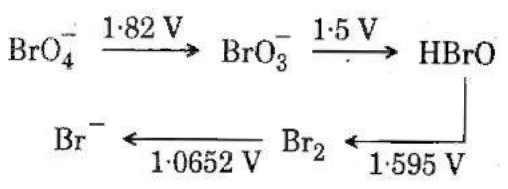
Consider the change in oxidation state of Bromine corresponding to different emf values as shown in the diagram below :
Then the species undergoing disproportionation is
- 1
- 2
- 3
- 4
Show answer and solution
Correct: option 4,
A species disproportionates when the potential for its reduction (the arrow leaving it) is greater than the potential for the step that forms it (the arrow reaching it), because then . For HBrO: V and V, so V and HBrO disproportionates. For () and () the value is negative, and is already in the highest state.
Question 30NEET 2017, Q63
In the electrochemical cell:
, the emf of this Daniel cell is . When the concentration of is changed to 1.0 M and that of changed to 0.01 M, the emf changes to . From the followings, which one is the relationship between and ? (Given, )
- 1
- 2
- 3
- 4
Show answer and solution
Correct: option 3,
For , . In the first case the ratio is 0.01, so . In the second the ratio is 100, so . Hence .
Question 31NEET 2016 Phase 1, Q75
The pressure of required to make the potential of - electrode zero in pure water at 298 K is
- 1 atm
- 2 atm
- 3 atm
- 4 atm
Show answer and solution
Correct: option 1, atm
For , . This is zero when . In pure water , so atm.
Question 32NEET 2016 Phase 2, Q47
The molar conductivity of a solution of with electrolytic conductivity of at 298 K is
- 1
- 2
- 3
- 4
Show answer and solution
Correct: option 2,
Molar conductivity is with in and in mol per litre. So .
Question 33NEET 2016 Phase 2, Q50
During the electrolysis of molten sodium chloride, the time required to produce 0.10 mol of chlorine gas using a current of 3 amperes is
- 155 minutes
- 2110 minutes
- 3220 minutes
- 4330 minutes
Show answer and solution
Correct: option 2, 110 minutes
At the anode , so 0.10 mol of chlorine needs 0.20 mol of electrons. The charge is C. Time s, which is about 107 minutes. The nearest option is 110 minutes.
Question 34NEET 2016 Phase 2, Q56
If the for a given reaction has a negative value, which of the following gives the correct relationships for the values of and ?
- 1
- 2
- 3
- 4
Show answer and solution
Correct: option 1,
, so a negative makes positive. Also , so a positive means is negative and . The reaction is not spontaneous under standard conditions.
Question 35NEET 2016 Phase 2, Q60
The number of electrons delivered at the cathode during electrolysis by a current of 1 ampere in 60 seconds is (charge on electron C)
- 1
- 2
- 3
- 4
Show answer and solution
Correct: option 3,
Charge passed C. Number of electrons .
Question 36NEET 2016 Phase 2, Q63
Zinc can be coated on iron to produce galvanized iron but the reverse is not possible. It is because
- 1zinc is lighter than iron
- 2zinc has lower melting point than iron
- 3zinc has lower negative electrode potential than iron
- 4zinc has higher negative electrode potential than iron
Show answer and solution
Correct: option 4, zinc has higher negative electrode potential than iron
The standard electrode potential of zinc ( V) is more negative than that of iron ( V), so zinc is oxidised more easily. A zinc coating therefore corrodes in place of the iron and protects it even when scratched. An iron coating on zinc could not do this, because zinc would still be the one to corrode.
Question 37AIPMT 2015, Q25
A device that converts energy of combustion of fuels like hydrogen and methane, directly into electrical energy is known as:
- 1Electrolytic cell
- 2Dynamo
- 3Ni-Cd cell
- 4Fuel Cell
Show answer and solution
Correct: option 4, Fuel Cell
A fuel cell is a galvanic cell in which a fuel such as hydrogen or methane is oxidised at one electrode and oxygen is reduced at the other, so the energy of combustion comes out directly as electricity. An electrolytic cell uses electricity, a dynamo converts mechanical energy, and a Ni-Cd cell is a rechargeable battery. Hence option (4).
Question 38AIPMT 2015 Re-test, Q7
Aqueous solution of which of the following compounds is the best conductor of electric current?
- 1Ammonia,
- 2Fructose,
- 3Acetic acid,
- 4Hydrochloric acid,
Show answer and solution
Correct: option 4, Hydrochloric acid,
A solution conducts through its ions. Fructose is a non-electrolyte, and ammonia and acetic acid are weak electrolytes that ionise only slightly. Hydrochloric acid is a strong electrolyte that ionises completely into and , so it conducts best. Option (4).
Question 39AIPMT 2014, Q140
When 0.1 mol is oxidised the quantity of electricity required to completely oxidise to is:
- 196.50 C
- 296500 C
- 3 C
- 49650 C
Show answer and solution
Correct: option 4, 9650 C
: manganese goes from +6 to +7, so one mole of electrons (1 F = 96500 C) is needed per mole. For 0.1 mol the charge is C.
Question 40AIPMT 2014, Q150
The weight of silver (at.wt. = 108) displaced by a quantity of electricity which displaces 5600 mL of at STP will be:
- 1108.0 g
- 25.4 g
- 310.8 g
- 454.0 g
Show answer and solution
Correct: option 1, 108.0 g
5600 mL of at STP is mol. Each mole of needs 4 mol of electrons, so the charge passed is F. One faraday deposits one equivalent of silver (), that is 108 g.
Question 41NEET 2013, Q15
A hydrogen gas electrode is made by dipping platinum wire in a solution of HCl of pH = 10 and by passing hydrogen gas around the platinum wire at one atm pressure. The oxidation potential of electrode would be?
- 10.59 V
- 20.118 V
- 31.18 V
- 40.059 V
Show answer and solution
Correct: option 1, 0.59 V
For the oxidation at 1 atm, . With pH = 10 this is V, option (1).
Question 42NEET 2013, Q31
At 25°C molar conductance of 0.1 molar aqueous solution of ammonium hydroxide is and at infinite dilution its molar conductance is . The degree of ionisation of ammonium hydroxide at the same concentration and temperature is:
- 120.800%
- 24.008%
- 340.800%
- 42.080%
Show answer and solution
Correct: option 2, 4.008%
For a weak electrolyte the degree of ionisation is , that is 4.008%, option (2).
Question 43NEET 2013, Q44
A button cell used in watches functions as following
If half cell potentials are
;
,
The cell potential will be:
- 10.42 V
- 20.84 V
- 31.34 V
- 41.10 V
Show answer and solution
Correct: option 4, 1.10 V
Silver oxide is reduced (cathode) and zinc is oxidised (anode). V, option (4).
Question 44NEET 2013 Karnataka, Q8
Consider the half-cell reduction reaction:
, V
, V
The for the reaction , and possibility of the forward reaction are respectively:
- 1– 4.18 V and yes
- 2+ 0.33 V and yes
- 3+ 2.69 V and no
- 4– 2.69 V and no
Show answer and solution
Correct: option 4, – 2.69 V and no
The overall reaction is the first half-reaction plus twice the second. Potentials are intensive, so the cell value is simply V. A negative means is positive, so the forward reaction does not occur.
Question 45NEET 2013 Karnataka, Q9
How many grams of cobalt metal will be deposited when a solution of cobalt (II) chloride is electrolyzed with a current of 10 amperes for 109 minutes (1 Faraday = 96,500 C; Atomic mass of Co = 59 u):
- 14.0
- 220.0
- 340.0
- 40.66
Show answer and solution
Correct: option 2, 20.0
Charge passed C, which is mol of electrons. needs 2 electrons per atom, so 0.339 mol of Co is deposited, i.e. g.
Question 46AIPMT 2012 Prelims, Q197
Limiting molar conductivity of (i.e. ) is equal to:
- 1
- 2
- 3
- 4
Show answer and solution
Correct: option 4,
By Kohlrausch's law the limiting molar conductivity is the sum of the ionic contributions. supplies , supplies , and subtracting removes , leaving . So option (4).
Question 47AIPMT 2012 Mains, Q36
Standard reduction potentials of the half reactions are given below:
; V
; V
; V
; V
The strongest oxidising and reducing agents respectively are:
- 1 and
- 2 and
- 3 and
- 4 and
Show answer and solution
Correct: option 1, and
A higher reduction potential means the species on the left is reduced more readily, so it is the stronger oxidising agent: (+2.85 V) is the strongest. The lowest reduction potential means the reverse reaction, oxidation of the species on the right, is the easiest: (+0.53 V) is the strongest reducing agent.
Question 48AIPMT 2012 Mains, Q40
Molar conductivities () at infinite dilution of NaCl, HCl and are 126.4, 425.9 and 91.0 respectively. for will be:
- 1425.5
- 2180.5
- 3290.8
- 4390.5
Show answer and solution
Correct: option 4, 390.5
By the law of independent migration of ions, .
Question 49AIPMT 2012 Mains, Q52
The Gibbs' energy for the decomposition of at 500°C is as follows:
;
The potential difference needed for the electrolytic reduction of aluminium oxide () at 500°C is at least:
- 14.5 V
- 23.0 V
- 32.5 V
- 45.0 V
Show answer and solution
Correct: option 3, 2.5 V
In the equation as written, mol of is reduced, so electrons. Using , the size of the potential is V. At least 2.5 V must be applied.
Question 50AIPMT 2011 Prelims, Q8
The electrode potentials for
and
are +0.15 V and + 0.50 respectively. The value of will be:
- 10.500 V
- 20.325 V
- 30.650 V
- 40.150 V
Show answer and solution
Correct: option 2, 0.325 V
Electrode potentials do not add directly, but free energies do: . Adding the two one-electron steps gives the two-electron reduction , so and V.
Question 51AIPMT 2011 Prelims, Q26
Standard electrode potential for couple is + 0.15 V and that for the couple is V. These two couples in their standard state are connected to make a cell. The cell potential will be:
- 1+1.19 V
- 2+0.89 V
- 3+0.18 V
- 4+1.83 V
Show answer and solution
Correct: option 2, +0.89 V
The couple with the higher reduction potential is the cathode () and the other is the anode (). V. Electrode potentials are not multiplied by the number of electrons.
Question 52AIPMT 2011 Prelims, Q44
If the for a given reaction has a negative value, then which of the following gives the correct relationships for the values of and ?
- 1 ;
- 2 ;
- 3 ;
- 4 ;
Show answer and solution
Correct: option 4, ;
, so a negative makes positive. Also , so a positive means , that is .
Question 53AIPMT 2011 Mains, Q18
A solution contains , and ions. This solution was treated with iodine at 35°C. E° for is +0.77 V and E° for = 0.536 V. The favourable redox reaction is:
- 1 will be reduced to
- 2There will be no redox reaction
- 3 will be oxidised to
- 4 will be oxidised to
Show answer and solution
Correct: option 3, will be oxidised to
The couple with the higher reduction potential is reduced. (0.77 V) lies above (0.536 V), so is reduced and is oxidised: , with V. The positive value shows this is the favourable reaction; the reverse (iodine oxidising ) is not.
Question 54AIPMT 2010 Mains, Q33
Which of the following expressions correctly represents the equivalent conductance at infinite dilution of . Given that and are the equivalent conductances at infinite dilution of the respective ions?
- 1
- 2
- 3
- 4
Show answer and solution
Correct: option 2,
By Kohlrausch's law, at infinite dilution each ion contributes independently to the conductance. One equivalent of the salt contains one equivalent of the cation and one equivalent of the anion, so when equivalent conductances are used they are simply added, with no multiplying factors. The equivalent conductance of the salt is the sum of the equivalent conductances of the aluminium and sulphate ions.
Question 55AIPMT 2010 Mains, Q41
Consider the following relations for emf of an electrochemical cell:
(i) EMF of cell = (Oxidation potential of anode) - (Reduction potential of cathode)
(ii) EMF of cell = (Oxidation potential of anode) + (Reduction potential of cathode)
(iii) EMF of cell = (Reduction potential of anode) + (Reduction potential of cathode)
(iv) EMF of cell = (Oxidation potential of anode) - (Oxidation potential of cathode)
Which of the above relations are correct
- 1(iii) and (i)
- 2(i) and (ii)
- 3(iii) and (iv)
- 4(ii) and (iv)
Show answer and solution
Correct: option 4, (ii) and (iv)
The cell emf is the reduction potential of the cathode minus the reduction potential of the anode. An oxidation potential is the reduction potential with its sign reversed, so this equals (oxidation potential of anode) + (reduction potential of cathode), which is relation (ii), and also (oxidation potential of anode) - (oxidation potential of cathode), which is relation (iv). Relations (i) and (iii) have a wrong sign.
Question 56AIPMT 2010 Prelims, Q65
For the reduction of silver ions with copper metal, the standard cell potential was found to be at . The value of standard Gibbs energy will be ()
- 1
- 2
- 3
- 4
Show answer and solution
Correct: option 1,
The cell reaction transfers electrons. .
Question 57AIPMT 2010 Prelims, Q74
An increase in equivalent conductance of a strong electrolyte with dilution is mainly due to:
- 1increase in ionic mobility of ions.
- 2100% ionisation of electrolyte at normal dilution.
- 3increase in both i.e. number of ions and ionic mobility of ions.
- 4increase in number of ions.
Show answer and solution
Correct: option 1, increase in ionic mobility of ions.
A strong electrolyte is already fully ionised, so dilution cannot increase the number of ions. What changes is that the ions move farther apart, the attraction between oppositely charged ions weakens, and each ion moves more freely. The equivalent conductance therefore rises because of the greater ionic mobility.
Question 58AIPMT 2009 Prelims, Q158
Given:
(i) ,
(ii) ,
Electrode potential, for the reaction, , will be:
- 10.90 V
- 20.30 V
- 30.38 V
- 40.52 V
Show answer and solution
Correct: option 4, 0.52 V
Electrode potentials do not add directly, but does. Reaction (i) minus reaction (ii) gives , so , about 0.52 V.
Question 59AIPMT 2009 Prelims, Q171
is reduced by electrolysis at low potentials and high currents. If amperes of current is passed through molten for 6 hours, what mass of aluminium is produced? (Assume 100% current efficiency. At. mass of Al = )
- 1
- 2
- 3
- 4
Show answer and solution
Correct: option 1,
Charge passed , which is mol of electrons. , so moles of Al and the mass is .
Question 60AIPMT 2009 Prelims, Q189
The equivalent conductance of M/32 solution of a weak monobasic acid is and at infinite dilution is . The dissociation constant of this acid is:
- 1
- 2
- 3
- 4
Show answer and solution
Correct: option 4,
Degree of dissociation . For a weak acid .
Question 61AIPMT 2008 Prelims, Q55
Kohlrausch's law states that at
- 1Infinite dilution, each ion makes definite contribution to equivalent conductance of an electrolyte, whatever be the nature of the other ion of the electrolyte
- 2Finite dilution, each ion makes definite contribution to equivalent conductance of an electrolyte, whatever be the nature of the other ion of the electrolyte
- 3Infinite dilution each ion makes definite contribution to equivalent conductance of an electrolyte depending on the nature of the other ion of the electrolyte
- 4Infinite dilution, each ion makes definite contribution to conductance of an electrolyte whatever be the nature of the other ion of the electrolyte
Show answer and solution
Correct: option 1, Infinite dilution, each ion makes definite contribution to equivalent conductance of an electrolyte, whatever be the nature of the other ion of the electrolyte
Kohlrausch's law of independent migration of ions holds at infinite dilution, where each ion adds its own fixed share to the equivalent conductance of the electrolyte regardless of which other ion it is paired with. Option (2) has the wrong dilution, option (3) makes the share depend on the other ion, and option (4) speaks of conductance instead of equivalent conductance.
Question 62AIPMT 2008 Prelims, Q67
Standard free energies of formation (in kJ/mol) at 298 K are -237.2, -394.4 and -8.2 for , and pentane (g) respectively. The value of for the pentane-oxygen fuel cell is
- 10.0968 V
- 21.968 V
- 32.0968 V
- 41.0968 V
Show answer and solution
Correct: option 4, 1.0968 V
The cell reaction is , with . Eight molecules take up 32 electrons, so n = 32 and .
Question 63AIPMT 2008 Prelims, Q76
On the basis of the following E° values, the strongest oxidizing agent is
; E° = − 0.35 V
; E° = − 0.77 V
- 1
- 2
- 3
- 4
Show answer and solution
Correct: option 4,
The values given are oxidation potentials, so the reduction potentials are +0.35 V for and +0.77 V for . The species that is reduced most readily, the one with the highest reduction potential, is the strongest oxidizing agent: .
Question 64AIPMT 2007 Prelims, Q109
The equilibrium constant of the reaction:
; V at 298 K is:
- 1
- 2
- 3
- 4
Show answer and solution
Correct: option 1,
At 298 K, . Two electrons are transferred, so , which gives .
Question 65AIPMT 2007 Prelims, Q111
The efficiency of a fuel cell is given by
- 1
- 2
- 3
- 4
Show answer and solution
Correct: option 4,
A fuel cell turns the energy of a combustion reaction straight into electrical work. The most electrical work it can give is , while the total heat the reaction could release is . Efficiency is useful work over energy available, .
Question 66AIPMT 2006 Prelims, Q67
If and , the standard EMF of the reaction: will be:
- 10.330 V
- 21.653 V
- 31.212 V
- 40.111 V
Show answer and solution
Correct: option 3, 1.212 V
Fe is oxidised to (anode) and is reduced to (cathode). . Electrode potentials are not multiplied by the number of electrons.
Question 67AIPMT 2006 Prelims, Q85
A hypothetical electrochemical cell is shown below:
The emf measured is +0.20 V. The cell reaction is:
- 1
- 2
- 3The cell reaction cannot be predicted
- 4
Show answer and solution
Correct: option 4,
The left electrode is the negative one, the anode, where oxidation takes place: . The right electrode is the cathode: . The positive emf confirms the cell runs in this direction, so the overall reaction is .
Question 68AIPMT 2005 Prelims, Q97
4.5g of aluminium (at. mass 27 amu) is deposited at cathode from solution by a certain quantity of electric charge. The volume of hydrogen produced at STP from ions in solution by the same quantity of electric charge will be -
- 144.8L
- 211.2L
- 322.4L
- 45.6L
Show answer and solution
Correct: option 4, 5.6L
Moles of Al , and each needs 3 electrons, so the charge passed is mol of electrons. , so 0.5 mol of electrons gives 0.25 mol of , which is L at STP.
Question 69AIPMT 2004 Prelims, Q89
The standard e.m.f. of a galvanic cell involving cell reaction with n = 2 is found to be 0.295 V at 25°C. The equilibrium constant of the reaction would be:
(Given F = ; R = )
- 1
- 2
- 3
- 4
Show answer and solution
Correct: option 3,
At equilibrium at 25°C. So and .
Question 70AIPMT 2003 Prelims, Q65
On the basis of the information available from the reaction:
of ,
the minimum e.m.f. required to carry out electrolysis of is ()
- 12.14 V
- 24.28 V
- 36.42 V
- 48.56 V
Show answer and solution
Correct: option 1, 2.14 V
One mole of takes 4 electrons ( Al each losing 3), so . Electrolysis must supply the reverse of this free energy: V.
Question 71AIPMT 2003 Prelims, Q79
The e.m.f. of a Daniell cell at 298 K is .
When the concentration of is 1.0 M and that of is 0.01 M, the e.m.f. is changed to . What is the relationship between and :
- 1
- 2
- 3
- 4
Show answer and solution
Correct: option 1,
. In the first cell the ratio is , so V; in the second it is , so V. Hence .
Question 72AIPMT 2002 Prelims, Q69
In electrolysis of when Pt electrode is taken then is liberated at cathode while with Hg cathode it forms sodium amalgam:
- 1Hg is more inert than Pt
- 2More voltage is required to reduce at Hg than at Pt
- 3Na is dissolved in Hg while it does not dissolve in Pt
- 4Conc. of ions is larger when Pt electrode is taken
Show answer and solution
Correct: option 2, More voltage is required to reduce at Hg than at Pt
Hydrogen has a very high overvoltage on mercury, so a much larger voltage is needed to discharge at Hg than at Pt. At a mercury cathode it therefore becomes easier to discharge , and the sodium formed dissolves in the mercury as amalgam.
Question 73AIPMT 2002 Prelims, Q80
In the silver plating of copper, is used instead of . The reason is:
- 1A thin layer of Ag is formed on Cu
- 2More voltage is required
- 3 ions are completely removed from solution
- 4Less availability of ions, as Cu can not displace Ag from ion
Show answer and solution
Correct: option 4, Less availability of ions, as Cu can not displace Ag from ion
With the copper would displace silver chemically, giving a fast, rough and loose deposit. The stable complex keeps the concentration of free very low, so copper cannot displace silver from it and the metal is laid down slowly and evenly by the current.
Question 74AIPMT 2001 Prelims, Q78
Standard electrode potential are
If , and Fe block are kept together, then:
- 1 increases
- 2 decreases
- 3 remains unchanged
- 4 decreases
Show answer and solution
Correct: option 2, decreases
The couple with the higher potential is reduced and the other is oxidised: , with V, which is positive and so spontaneous. is used up and increases.
Question 75AIPMT 2001 Prelims, Q95
The most convenient method to protect the bottom of ship made of iron is:
- 1Coating it with Red lead oxide
- 2White tin plating
- 3Connecting it with Mg block
- 4Connecting it with Pb block
Show answer and solution
Correct: option 3, Connecting it with Mg block
Magnesium is far more easily oxidised than iron, so a block of Mg connected to the hull acts as a sacrificial anode and corrodes in place of the iron (cathodic protection). Lead and tin are less reactive than iron and would make the iron corrode faster where exposed.
Question 76AIPMT 2000 Prelims, Q41
According to the Faraday Law of electrolysis, the mass deposited at electrode proportional to:
- 1
- 2
- 3
- 4'm' does not depend on Q
Show answer and solution
Correct: option 2,
Faraday's first law of electrolysis: the mass deposited at an electrode is directly proportional to the charge passed, , where is the electrochemical equivalent.
Question 77AIPMT 2000 Prelims, Q89
For the disproportionation of copper:
, is: (Given for is 0.34 V & for is 0.15 V:
- 10.49 V
- 2 V
- 30.38 V
- 4 V
Show answer and solution
Correct: option 3, 0.38 V
First find for by adding free energies (): , so V. In the disproportionation one is reduced to Cu (cathode, 0.53 V) and the other is oxidised to (anode couple, 0.15 V). V.
Question 78AIPMT 2000 Prelims, Q90
Cell reaction is spontaneous when:
- 1 is negative
- 2 is positive
- 3 is positive
- 4 is negative
Show answer and solution
Correct: option 1, is negative
A process is spontaneous when its free energy decreases. For a cell , so a spontaneous cell reaction has a positive cell emf and a negative . The sign of a single reduction potential alone does not decide it; the keyed answer is option 1.
Question 79AIPMT 2000 Prelims, Q91
At infinite dilution equivalent conductances of & ions are 127 & 76 respectively. Equivalent conductance of at infinite dilutions is:
- 1139.5
- 2101.5
- 3203
- 4279
Show answer and solution
Correct: option 1, 139.5
The keyed answer treats the given values as ionic conductances per mole of ions. One equivalent of contains half a mole of and one mole of , so by Kohlrausch's law . (If 127 were already the conductance per equivalent of , as the wording says, the sum would be .)
Question 80AIPMT 1999 Prelims, Q78
Determine the value of cell for the following reaction:
Equilibrium constant is
- 10.1773
- 20.01773
- 30.2153
- 41.773
Show answer and solution
Correct: option 1, 0.1773
At equilibrium . Two electrons are transferred (, ), so V.
Question 81AIPMT 1998 Prelims, Q69
The concentration of solution will change when it is placed in a container which is made of:
- 1Al
- 2Cu
- 3Ag
- 4None
Show answer and solution
Correct: option 1, Al
A metal displaces zinc from its salt solution only if it is a stronger reducing agent than zinc, that is, if it lies above zinc in the activity series. Aluminium does ( V against V for zinc), so it reacts with and changes its concentration. Copper and silver are less reactive than zinc and do nothing.
Question 82AIPMT 1998 Prelims, Q70
The cell reaction of an electrochemical cell is . The change in free energy will be the function of:
- 1
- 2
- 3
- 4
Show answer and solution
Correct: option 2,
For the cell reaction, , and the reaction quotient is because the solid metals have unit activity. So depends on .